Posted tagged ‘Kurds’

How Iran Saved Obama’s “Blame America” Foreign Policy

April 29, 2015

How Iran Saved Obama’s “Blame America” Foreign Policy, Front Page Magazine, April 28, 2015

rouh-450x313

Obama’s public rejection of every ally, from Israel to Egypt to Saudi Arabia, has finally created the Post-American Middle East that his “Blame America” doctrine sought. The Post-American Middle East is a hive of terrorist groups and a region of nuclear arms races where murderous despots with vast armies dream of resurrecting the Ottoman Empire, the Persian Empire and the Abbasid Caliphate.

*********************

Obama’s Middle East policy was doomed to fail because it was based on the myth that everything wrong with the region was America’s fault.

Senator Obama had argued that Iraq would fix itself once we pulled out. Without America, the Iraqis would create a “political solution”. Instead the Shiites used the withdrawal to take over the government and Al Qaeda rebounded to dominate the Sunnis. After years of denying what was going on, he was forced back into Iraq after genocide and beheadings filled every television screen.

From the White House, he deployed the “Iraq Solution” across the Middle East by withdrawing support from American allies and backing terrorist groups like the Muslim Brotherhood. The chaos tore apart the region and turned over entire cities and countries to terrorists.

Egypt went through multiple coups. Street violence in Tunisia wrecked the country and supplied thousands of fighters to ISIS. His regime change war in Libya led to terrorist takeovers of its capital. Al Qaeda nearly took over Mali. Houthi Jihadists backed by Iran took over Yemen’s capital. The Saudis are bombing Yemen. The Egyptians are bombing Libya. The French are still fighting in Mali.

Iran and Al Qaeda have divided up Iraq, Syria and Yemen between themselves.

Withdrawing American power and influence didn’t work because we were never the problem. American soldiers weren’t causing the Sunnis and Shiites to fight each other. They were the only thing preventing it. American power and influence across the Middle East wasn’t holding back freedom and human rights, it was the only thing keeping a modicum of freedom alive in places like Egypt and Tunisia that quickly fell to Islamist rule in the Arab Spring, resulting in street violence, torture, terrorism and military coups.

The left had been fundamentally wrong about the cause of the problems in the Middle East. Obama trashed the region by following its wrongheaded doctrines.

Once the “Blame America” foreign policy has been implemented and the region went to hell, he had no idea what to do next. Intervening in Libya made sense according to the “Blame America” doctrine because Gaddafi had recently cut a deal with the United States and was obstructing the Jihadists who were implementing the local version of the Arab Spring in coordination with the Muslim Brotherhood.

But intervening in Syria didn’t. Assad wasn’t an American ally. Therefore the “Blame America” doctrine said that he should be left alone. But he was obstructing the Arab Spring. Overthrowing him would let the Muslim Brotherhood claim another country, but would alienate Iran and spoil any reconciliation.

Unable to make a final decision, Obama veered back and forth between Iran and the Muslim Brotherhood. Some days he seemed on the verge of bombing Syria and other days he was against even providing the promised weapons to the Sunni rebels. Even his supporters accused him of having no plan.

Syria’s real red line was the one that it had drawn through his foreign policy. Instead of making the Middle East better, his withdrawals had made it worse. And the beneficiaries of his foreign policy, especially the Muslim Brotherhood, were clamoring for more American military intervention.

Even Iraq’s Shiite government, backed by Iran, wanted American intervention.

Obama’s foreign policy had created a new set of untrustworthy client states which had to be kept alive by American intervention. The great joke of his foreign policy was that his new terrorist states acted just like the old dictators they were supposed to replace. They wanted American weapons and soldiers. Their own people hated them and hated America by extension. The climax of the Arab Spring came with crowds in Tahrir Square denouncing Obama and the Muslim Brotherhood for acting as his client state.

The “Blame America” foreign policy had led to even more blame of America. The new “democratic” Islamist governments that he helped bring to power to appease the Arab Street and atone for the sins of supporting the old secular-ish dictators backfired by making the Arab Street hate us more than ever.

Iran saved Obama’s foreign policy. Just as he was stumbling around Syria and weeping at being stuck back in Iraq, the agents of the Iran Lobby suggested that the whole mess could be put back together again. Iran and the US would fight on the same side against ISIS in Syria and Iraq. And this cooperation could be used to hammer out a nuclear accord that would retroactively justify Obama’s Nobel Prize.

The only problem was that everyone else in the region was completely against the idea.

The Iran Lobby threw Obama’s failed foreign policy a lifeline and he grabbed it. The bombing of Syria was off. Assad turned over some WMDs, but went on using others. The US began acting as the air force for Iran’s Shiite militias in Iraq while the Kurds and the Sunni Sheikhs of the Awakening were shut out.

When the Houthis took over Yemen, Obama shrugged. When the Saudis began bombing Yemen, they didn’t tell him because they were afraid the news would leak to Iran. And the administration covertly began pressuring them to stop, confirming that it now took its marching orders from Tehran, not Riyadh.

Obama ignored the vocal opposition, particularly from Israel’s Netanyahu, because the Iran deal was the only thing holding his foreign policy together. It made it seem as if he knew what he was doing. Take away the Iran deal and there was no longer a strategy, just a series of incoherent panicked responses.

That is why he continues to cling to the Iran deal. Without it, the Emperor’s foreign policy is naked.

The Iran deal salvaged the “Blame America” foreign policy by reorienting it away from the Muslim Brotherhood to deal with our great enemy in the region. By acceding to Iran’s nuclear program, Obama could finally fix everything by atoning for America’s biggest foreign policy sin in the region.

Despite his Muslim family background, Obama never understood the Middle East. Instead he looked at the region through a left-wing lens and saw only America’s crimes.

The Sunnis and Shiites, the Arabs, Kurds, Persians and Turkmen, weren’t fighting because of America. They were fighting over differences in religion, ethnicity and clan. The left has always thought that the way to fix the Middle East was to withdraw American influence. Instead doing that destabilized the region and created a power vacuum that Russia and Iran have been more than happy to fill.

Obama’s final foreign policy act was to fall directly into Iran and Al Qaeda’s trap.

Iran and the various Al Qaeda groups had effectively split parts of the region among themselves. By embracing Iran, Obama alienated the Sunni Middle East and shoved entire populations into Al Qaeda’s waiting embrace. He completed the polarizing process that he began with the Arab Spring by selling out the moderates to the extremists and waiting for everyone in the region to love America again.

But the Muslim Brotherhood lost out to its edgier Al Qaeda children. Egypt and the Saudis are scrambling to hold together some sort of Sunni center without the United States and against its wishes. Obama’s alignment with Iran, his rejection of Egypt’s new government and his failure to back the Saudis in Yemen has sent the message that the only legitimate alternative to Al Qaeda is Iran.

That’s not an alternative that most Sunnis can accept. Many would rather stand with Al Qaeda than Iran.

Obama’s public rejection of every ally, from Israel to Egypt to Saudi Arabia, has finally created the Post-American Middle East that his “Blame America” doctrine sought. The Post-American Middle East is a hive of terrorist groups and a region of nuclear arms races where murderous despots with vast armies dream of resurrecting the Ottoman Empire, the Persian Empire and the Abbasid Caliphate.

While genocide goes on, sex slaves are raped under the rule of a Caliph and black flags are unfurled and nuclear weapons are developed to fulfill apocalyptic Islamic prophecies, Obama smiles for the camera and waits for his second Nobel Prize.

It had been America’s fault all along. Now that Iran and Al Qaeda are in charge, everything will be okay.

Could Saudi Arabia Need Israel More than Vice Versa?

April 12, 2015

Could Saudi Arabia Need Israel More than Vice Versa? Israel National News, Gedalyah Reback, April 12, 2015

Israel’s status as a regional superpower is unusual for its lacking a reliable set of local allies. Even where security ties with Egypt, Jordan and Saudi Arabia might be strong, the country is forced to keep those ties in the background. Regardless, it exerts a degree of influence just by its own strategic value. While ties are not public, they are also not available for public scrutiny, perhaps enhancing the relationship opportunities with the above mentioned countries as well as other Arab states.

“Rather than a charm offensive,” asserts Robert Kappel of the German Institute of Global and Area Studies, “Israel needs an assertive regional foreign policy” in order to gain more allies.

But is that really true?

“I don’t think that it’s either-or,” says Professor Eytan Gilboa of Bar Ilan University. “I think Israel has a regional policy. We don’t see it but it collaborates with Arab countries and the Persian Gulf, especially on Iran and much more on counter-terrorism. It has a regional policy but it’s undercover.”

Solving the Israeli-Palestinian Conflict is not a Condition for an Alliance

Turning back specifically to Kappel, Gilboa states “I think he means to use it to deal with the Palestinian issue; then comes the Arab Peace Initiative. The assumption is the PA is unable, unable, to reach an agreement with Israel.”

Gilboa sees an Arab desire to expand relations with Israel in spite of the conflict with the Palestinians. Thus, the Arab Peace Initiative might be evidence the Arab countries are eager to reach out with a public offer that would allow them to open the door for Jerusalem without necessarily having to seal a deal on the conflict.

“I reject one claim: that resolution of the Israeli-Palestinian issue is a condition for a regional alliance. The reason for this is simple – all these countries couldn’t care less about the Palestinians. They have an interest in blocking Iran and extremist Islamic organizations. They made all kinds of statements to the contrary but that is not the issue. I don’t think there’s a linkage here.”

Pressing his point, Gilboa says “There’s much less opportunity for regional pressure on the Palestinians than most people think. ‘Collaboration’ is a euphemism for security cooperation on ‘negative interests.’”

Those negative interests are opposition to common regional security challenges like the above mentioned Iran and Islamist terrorist organizations. But to create an alliance, you need much more than common enemies, says Gilboa – you need common interests.

“Turkey ambivalent to ISIS – they share an ideology but still see it as a competitor. Erdogan would like to revive the Ottoman Empire where a non-Arab country leads the Arab world. Where you see this kind of geopolitics, there are a lot of opportunities for collaboration with these countries.”

And actually, “there’s criticism of Israel for not exploiting the situation,” says Gilboa.

New Countries?

When Arutz Sheva asked if Israel’s chances for regional alliances might actually increase if Syria were to collapse into several smaller states or the Iraqi Kurdish Regional Government (KRG) were to become a full-fledged independent state, Gilboa sees the idea as having validity.

“I think this is a valid point. I am only hearing that Israel is collaborating with the Kurds there and you can do a little bit more, but it is a lot more than it used to be. The alliance with Turkey had prohibited close collaboration with the Kurds. But now that the relationship is bad, this condition is nonexistent. I think indeed they could do more.”

Focusing on the much more developed autonomy, infrastructure and ambitions of the Iraqi Kurds than other groups that could emerge in Syria, Gilboa says Kurdistan could definitely become a game-changer in the region’s mixture of waxing and waning alliances. Most significantly, it could be something that does not necessarily replace Arab states as a reliable ally, but actually enhances the chances of a strong alliance between those Arab countries and Israel.

“I also think there is room for a strategic alliance between Israel and pro-US Arab states. Not just potential between Israel and the non-Arab groups, but collaboration with Israel, non-Arab states and those emerging new political entities in the Middle East. It could be done on a bilateral basis first – perhaps between Israel and Kurdistan – or multilateral. Once you gain influence with a group like the Kurds, you could translate that into the other (multilateral) type of alliance.”

Israel and Kurdistan have a long history of both covert and overt relations, especially on security. Kurdistan might then be an example of an emerging country where Israel could carry more influence than the Saudis (assuming Kurdistan is able to gain more autonomy or full sovereignty). Saudi Arabia’s diplomatic and military clout is still behind that of Israel, according to Gilboa.

“Saudi Arabia’s power is limited to its ability to manipulate oil markets, but their strength is precarious as major importers like the United States become self-sufficient in that realm. Even their military strength might turn out to be limited as its operation in Yemen is one of the largest it has ever undertaken. The assumption the Saudis might have strong influence over Pakistan and could persuade Islamabad to sell Riyadh a nuclear bomb to pull ahead of the Iranians has been thrown into doubt by Pakistan’s decision not to join the military operation against the Houthis.”

Ultimately, it might be Israel’s power that the Saudis need more.

Anything but a Saudi win (in Yemen) would not be good for Saudi Arabia,” emphasizes Gilboa. On the other hand, “Israel is much stronger diplomatically, militarily and its society is much more vibrant.”

The Kobani Precedent

March 25, 2015

The Kobani Precedent, [Bary] Rubin Center, March 25, 2015

(Whose side are “we” on in Iraq? Not the Kurds. Why not? Do “we” prefer an Iranian theocracy with nukes?– DM)

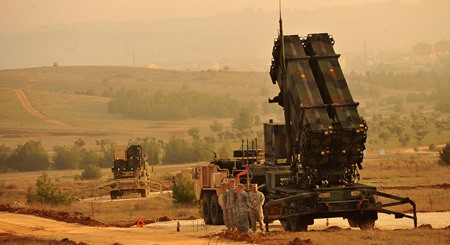
???????????????????U.S. Service members stand by a Patriot missile battery in Gaziantep, Turkey, Feb. 4, 2013, during a visit from U.S. Deputy Secretary of Defense Ashton B. Carter, not shown. U.S. and NATO Patriot missile batteries and personnel deployed to Turkey in support of NATO’s commitment to defending Turkey’s security during a period of regional instability. (DoD photo by Glenn Fawcett)

Unlike in Syria . . . in Iraq the US relates to the official government, mistakenly, as an ally.  This is leading to a potentially disastrous situation  whereby US air power is currently partnering with Iran-supported Shia militias against the Islamic State.

The most powerful of these militias have a presence in the government of Iraq. But they do not act under the orders of the elected Baghdad government, but rather in coordination with their sponsors in the Qods Force of the Iranian Revolutionary Guards Corps.

The Kurds, because of the existence among them of a secular, pro-western nationalist politics with real popular appeal, have unsurprisingly emerged as the only reliable partner.    On both the Shia and the Sunni sides, the strongest and prevailing forces are anti-western.

This reality is denied both by advocates for rapprochement with Iran, and by wishful-thinking supporters of the Syrian rebellion.  But it remains so.

*****************

Recently,  I attempted to undertake a reporting trip into the Kurdish Kobani enclave in northern Syria.  It would not have been my first visit, neither to Syria nor to Kobani.  For the first time, however, I found myself unable to enter.  Instead, I spent a frustrating but, as it turns out, instructive four days waiting in the border town of Suruc in south-east Turkey before running out of time and going home.

The episode was instructive because of what it indicated regarding the extent to which Kurdish control in the enclaves established in mid 2012 is now a fact acknowledged by all neighboring players, including the enemies of the Kurds.  This in itself has larger lessons regarding US and western policy in Syria and Iraq.

But I am getting ahead of myself.  First, let me complete the account of the episode on the border.    My intention had been to enter Kobani ‘illegally’ with the help of the Kurdish YPG and local smugglers.  This sounds more exciting than it is.    I have entered Syria in a similar way half a dozen times over the last two years, to the extent that it has become a not very pleasant but mundane procedure. This time, however, something was different.  I was placed in a local center with a number of other westerners waiting to make the trip. Then, it seemed, we were forgotten.

The westerners themselves were  an interesting bunch, whose varied presence was an indication of the curious pattern by which the Syrian Kurdish cause has entered public awareness in the west.

There was a group of European radical leftists, mainly Italians, who had come after being inspired by stories of the ‘Rojava revolution.’  A little noted element of the control by the Syrian franchise of the PKK of de facto sovereign areas of Syria has been the interest that this has generated in the circles of the western radical left.  These circles are ever on the lookout for something which allows their politics to encounter reality, in a way that does not bring immediate and obvious disaster.  As of now, ‘Rojava,’ given the leftist credentials of the PKK, is playing this role.  So the Europeans in question  wanted to ‘contribute’ to what they called the ‘revolution.’

Unfortunately, their preferred mode of support was leading to a situation of complete mutual bewilderment between themselves and the local Kurds.   Offered military training by their hosts, the radical leftists demurred.  They would not hold a gun for Rojava before they had seen it and been persuaded that it did indeed represent the peoples’ revolution that they hoped for.

Instead, they had a plan for the rebuilding of Kobani along sustainable and environmentally friendly lines, using natural materials  In addition, the health crisis and shortage of medicines in the devastated enclave led the radicals to believe that this might offer an appropriate context for popularizing various items of alternative and naturopathic medicine about which they themselves were enthusiastic.  (I’m not making any of this up).

All this had elicited the predictable reaction from the Kurds, who were trying to manage a humanitarian disaster and a determined attempt by murderous jihadis to destroy  them.  ‘Perhaps you could do the military training first and then we could talk about the other stuff?’ suggested Fawzia, the nice and helpful representative of the PYD who was responsible for us.  This led to further impassioned and theatrical responses from the Italians.

Apart from this crowd, there was a seasoned Chilean war reporter who looked on the leftists with impatience.  He was looking to get down to the frontlines south of Kobani, where the YPG was trying to cut the road from Raqqa to Aleppo at an important point close to the Euphrates.

Also, there was a polite and friendly lone American, a Baptist Christian, who had come to volunteer his services to the YPG.  That was us.

But as the days passed, it became clear that none of us appeared to be getting anywhere near Kobani any time soon.

The reasons given for the delay were plentiful, and unconvincing.  ‘It is the weather,’ Fawzia would say vaguely, ‘too much mud.’  But the presence of mud on the border in February was hardly a new development, so this couldn’t be the reason.

Finally, frustrated at the lack of information, I called a PKK friend based in Europe and asked for his help in finding out why we weren’t  moving.  He got back to me a little later.  ‘It seems the Turkish army is all over the border, more than usual. That’s the reason,’ he told me.

This was more plausible, if disappointing.  After four days on the border, I was out of time and set off back for Gaziantep and then home.  The Italians went to Diyarbakir to take part in a demonstration.  The Chilean and the American volunteer stayed and waited.

When I got back to Jerusalem, all rapidly became clear.  News reports were coming in about a large operation conducted by the Turkish army through Kobani and into Syria.  The operation involved the evacuation of the Turkish garrison at the tomb of Suleiman Shah, south of the enclave.  The American volunteer sent me a picture of the Turkish tanks on tank transporters driving though Suruc at the conclusion of the operation.

This operation was astonishing on a number of levels.

Despite stern Turkish denials, it could only have been carried out on the basis of full cooperation between the Turkish armed forces and the Kurdish fighters of the YPG in Kobani.  Obviously, any unauthorized entry of Turkish troops into the Kurdish canton would have meant an armed battle.

During the fight for Kobani last year, the Turkish government was very clearly quite content for the enclave to fall.  The Turkish army waited on the border, as the prospect of a generalized slaughter of the Kurds in Kobani came close to realization.

But of course, the slaughter didn’t happen.  In the end, the partnering of US air power with the competent and determined forces of the YPG on the ground delivered the first real defeat to the forces of the Islamic State in Syria.

This effective partnering has continued, and has now become the main military element in northern Syria in the battle against IS.

The combination of the YPG and the USAF is now nudging up to a second strategic achievement against the jihadis – namely, the cutting of the road from Tel Hamis to the town of al-Houl on the Iraqi border.   This road forms one of the main transport arteries linking the Islamic State’s conquests in Iraq to its heartland in the Syrian province of Raqqa.  If the links are cut, the prospect opens for the splitting of the Islamic State into a series of dis-connected enclaves.

The YPG-US partnership is particularly noteworthy, given that the YPG is neither more nor less than the Syrian representative of the PKK.  The latter, meanwhile, is a veteran presence on the US and EU lists of terror organizations.  Despite a faltering peace process, the PKK remains in conflict with Turkey, a member of NATO.

But the reality of the Kurdish-US alliance in northern Syria has clearly now been accepted by the Turks as an unarguable fait accompli, to the extent that they are now evidently willing to work together with the armed Syrian Kurds, where their interests require it.

It is an astonishing turnabout in the fortunes of the Kurds of Syria, who before 2011 constituted one of the region’s most brutally oppressed, and most forgotten minority populations.

This raises the question as to why this reversal of fortune has taken place.

Why is the YPG the chosen partner of the Americans in northern Syria, just as the Kurdish Pesh Merga further east is one of the preferred partners on the ground in Iraq?

The answer to this is clear, but not encouraging.  It is because in both countries, the only reliable, pro-western and militarily effective element on the ground is that of the Kurds.

Consider:  in northern Syria, other than the forces of the Islamic State, there are three other elements of real military and political import.  These are the forces of the Assad regime, the al-Qaeda affiliated Jabhat al-Nusra and the YPG.

In addition, there are a bewildering variety of disparate rebel battalions, with loyalties ranging from Salafi Islamism to Muslim Brotherhood style Islamism, to non-political opposition to the Assad regime.  Some of these groups operate independently.  Others are gathered in local alliances such as the Aleppo based Jabhat al-Shamiya (Levant Front), or the Syria-wide Islamic Front, which unites Salafi factions.

Despite the reported existence of a US staffed military operations room in Turkey, the latter two movements are either too weak, or too politically suspect (because of their Islamist nature), to form a potential partner for the US in northern Syria.

Nusra is for obvious reasons not a potential partner for the US in the fight against the Islamic State.  And the US continues to hold to its stated  goal that Bashar Assad should step down.  So the prospect of an overt alliance between the regime and the US against the Islamic State is not on the cards (despite the de facto American alliance with Assad’s  Iran-supported Shia Islamist allies in Iraq).

This leaves the Kurds, and only the Kurds, to work with.  And the un-stated alliance is sufficiently tight for it to begin to have effects also on Turkish-Kurdish relations in Syria, as seen in the Suleiman Shah operation.

But what are the broader implications of this absence of any other coherent partner on the ground?

The stark clarity of the northern Syria situation is replicated in all essentials in Iraq, though a more determined attempt by the US to deny this reality is under way in that country.

In Iraq, there is a clear and stated enemy of the US (the Islamic State), a clear and stated Kurdish ally of the west (the Kurdish Regional Government and its Pesh Merga) and an Iran-supported government which controls the capital and part of the territory of the country.

Unlike in Syria, however, in Iraq the US relates to the official government, mistakenly, as an ally.  This is leading to a potentially disastrous situation  whereby US air power is currently partnering with Iran-supported Shia militias against the Islamic State.

The most powerful of these militias have a presence in the government of Iraq. But they do not act under the orders of the elected Baghdad government, but rather in coordination with their sponsors in the Qods Force of the Iranian Revolutionary Guards Corps.

It is possible that the current partnering with Shia Islamist forces in Iraq is the result of a general US attempt now under way to achieve a historic rapprochement with Iran, as suggested by Michael Doran in a recent essay.  Or it may be that this reality has emerged as a result of poor analysis of the realities of the Levant and Iraq, resulting in a confused and flailing policy.  But either way, the result is an astonishing mess.

In northern Syria, the obvious absence of any partners other than the Kurds has produced a momentary tactical clarity.  But as the larger example of Iraq shows, this clarity is buried in a much larger strategic confusion.

This confusion, at root, derives from a failure to grasp what is taking place in Syria and in Iraq.

In both countries, the removal or weakening of powerful dictatorships has resulted in the emergence of conflict based on older, sub-state ethnic and sectarian identities.  The strength and persistence of these identities is testimony to the profound failure of the states of Syria and Iraq to develop anything resembling a sustainable national identity.  In both Syria and Iraq, the resultant conflict is essentially three-sided.  Sunni Arabs, Shia/Alawi Arabs and Kurds are fighting over the ruins of the state.

Because of the lamentable nature of Arab politics at the present time, the form that both Arab sides are taking is that of political Islam.   On the Shia side, the powerful Iranian structures dedicated to the creation and sponsorship of proxy movements are closely engaged with the clients in both countries (and in neighboring Lebanon.)

On the Sunni Arab side, a bewildering tangle of support from different regional and western states to various militias has emerged.  But two main formations may be discerned. These are the Islamic State, which has no overt state sponsor, and Jabhat al-Nusra, which has close links to Qatar.

In southern Syria, a western attempt to maintain armed forces linked to conservative and western-aligned Arab states (Jordan, Saudi Arabia) has proved somewhat more successful because of the close physical proximity of Jordan and the differing tribal and clan structures in this area when compared with the north.  Even here, however, Nusra is a powerful presence, and Islamic State itself recently appeared in the south Damascus area.

The Kurds, because of the existence among them of a secular, pro-western nationalist politics with real popular appeal, have unsurprisingly emerged as the only reliable partner.    On both the Shia and the Sunni sides, the strongest and prevailing forces are anti-western.

This reality is denied  both by advocates for rapprochement with Iran, and by wishful-thinking supporters of the Syrian rebellion.  But it remains so.  What are its implications for western policy?

Firstly, if the goal is to degrade the Islamic State, reduce it, split it, impoverish it, this can probably be achieved through the alliance of US air power and Kurdish ground forces.  But if the desire, genuinely, is to destroy the Islamic State, this can only be achieved through the employment of western boots on the ground.  This is the choice which is presented by reality.

Secondly, the desire to avoid this choice is leading to the disastrous partnering with Iraqi Shia forces loyal to Iran.  The winner from all this will be, unsurprisingly,  Iran. Neither Teheran nor its Shia militias are the moral superiors to Islamic State. The partnering with them is absurd both from a political and an ethical point of view.

Thirdly, the determination to maintain the territorial integrity of ‘Syria’ and ‘Iraq’ is one of the midwives of the current confusion.  Were it to be acknowledged that Humpty cannot be put back together again, it would then be possible to accurately ascertain which local players the west can partner with, and which it can not.

As of now, the determination to consider these areas as coherent states is leading to absurdities including the failure by the US to directly arm the pro-US Pesh Merga because the pro-Iranians in Baghdad object to this, the failure to revive relations with and directly supply Iraqi Sunni tribal elements in IS controlled areas for the same reason,  and the insistence on relating to all forces ostensibly acting on behalf of Baghdad as legitimate.

Ultimately, the mess in the former Syria and Iraq derives from a very western form of wishful thinking that is common to various sides of the debate in the west.  This is the refusal to accept that political Islam, of both Shia and Sunni varieties, has an unparalleled power of political mobilization among Arab populations in the Middle East at the present time, and that political Islam is a genuinely anti-western force, with genuinely murderous intentions.

For as long as that stark reality is denied, western policy will resemble our Italian leftist friends on the border, baffled and bewildered as they go about proposing ideas and notions utterly alien to and irrelevant to the local situation.

The reality of this situation means that the available partners for the west are minority nationalist projects  such as that of the Kurds (or the Jews,) and traditional, non-ideological conservative elites – such as the Egyptian military, the Hashemite monarchs, and in a more partial and problematic way, the Gulf monarchs.  Attempts to move beyond this limited but considerable array of potential allies will result in the strengthening of destructive, anti-western Islamist forces in the region, of either Sunni or Shia coloration.

As for the Syrian Kurds, they deserve their partnership with US air power, and the greater security it is bringing them.

The American Baptist volunteer, to conclude the story, made it across the border and is now training with the YPG.  He, at least, has a clear sense of who is who in the Middle East.  Hopefully, this sense will eventually percolate up to the policymaking community too.
Book review: The Islamic War

March 16, 2015

The Islamic War: Book review, Dan Miller’s Blog, March 16, 2015

(The views expressed in this article are mine and do not necessarily reflect those of Warsclerotic or its other editors. — DM)

The Islamic War, Martin Archer, 2014

The novel begins with a terror attack on a residential area in Israel, resulting in multiple causalities. It may, or may not, have involved members of the Iranian Revolutionary Guard. Menachem Begin is the Israeli Prime Minister and Ariel Sharon is the Defense Minister. The story begins immediately after the (postponed?) end of the Iran – Iraq war in 1988.

A massive armor, infantry, artillery and air attack on Israeli positions in the Golan follows the terrorist attack. The Israelis are outnumbered and suffer many thousands of casualties.

Israel had anticipated a simultaneous attack via Jordan, so most Israeli tank, infantry and air resources are deployed there, rather than in the Golan, to conceal themselves and await the arrival of Iranian, Iraqi and Syrian forces. They come and are defeated, most killed or fleeing. The Israeli forces then move into Syria and have similar successes there as well.

As the story evolves, it becomes evident that Israel must have known that the Iran – Iraq war had been allowed to fester to permit Iran, Iraq and Syria to develop a well coordinated plan to dispose of Israel, in hopes that a surprise attack could be made as soon as the Iran – Iraq war ended. Other events also suggest that Israel had prior notice:

Nuclear facilities of several hostile nations explode mysteriously.

The Israeli Navy had managed to infiltrate Iranian oil ports — apparently before the attack on the Golan — without being noticed. Then, at a propitious moment near the end of the fighting elsewhere, they destroyed all oil tankers in, entering or leaving port, along with all Iranian oil storage facilities.

The Israel Navy, which had suffered no losses, then moved to Saudi Arabia to protect her oil ports and ships coming to buy her oil and leaving.

As these events unfold, Israel, Egypt, Jordan, Saudi Arabia and Turkey* are negotiating a united front against Iran, Iraq and Syria, much to the displeasure of the U.S. Secretary of State, who wants a cease fire and return to the status quo ante. Fortunately, the U.S. President favors Israel and her coalition and generally ignores his SecState.

I won’t spoil the story by relating what happens at the end, but it’s very good for Israel, Egypt, Jordan, Saudi Arabia, Turkey and the Kurds, and very bad for Iran, Iraq and Syria. The novel is well worth reading, perhaps twice.

_____________

*Historical note: Turkey in 1988 was reasonably secular and also in other ways quite different from now. Egypt under President Al-Sisi is, in some but not all respects, similar to Egypt in 1988 under President Mubarak. Beyond a good relationship with Israel, Al-Sisi is working to modernize and reform Islam by turning it away from the violent jihad which drives both the Islamic State (Sunni) and the Islamic Republic of Iran (Shiite). Egypt remains under fire from the Obama administration due to the “coup” which ousted President Morsi, who had made Egypt essentially an arm of the Muslim Brotherhood. Egypt now helps to protect Israel with her military presence in the Sinai to oppose Hamas and Muslim Brotherhood activities there. Saudi Arabia and Jordan, like most countries in the Middle East, look out for the interests of their rulers first and are quite concerned about both the Islamic State and Iran.

Should We Give Up on the Iraqi Army?

March 4, 2015

Should We Give Up on the Iraqi Army? The Daily BeastPeter W. Galbraith, March 4, 2015

(Please see also Video shows abandoned Iraqi Security Forces armored vehicles near Ramadi.– DM)

1425464112618.cachedSgt. Shawn Miller/US Army

In Baghdad’s Firdos Square, where in 2003 U.S. Marines helped Iraqis topple the statue of Saddam Hussein, there is now a billboard featuring Iran’s Supreme Leader Ayatollah Khameini.

**********************

The U.S. is training a national army for a nation that does not exist.

The Iraqi Army and Shiite militias have now launched an operation to retake Tikrit, a Sunni city 95 miles north of Baghdad that was Saddam Hussein’s hometown. The Americans are standing back. The U.S.-led coalition air forces are not flying missions in support because this is essentially an Iranian-organized and -led operation dominated by Shiite militias that answer to Tehran as much as Baghdad. This may be the shape of things to come.

In mid-February, a Pentagon official made headlines by announcing an April-May time frame for an Iraqi offensive to take Mosul from the so-called Islamic State. Mosul is the second-largest city in Iraq. As The Daily Beast reported last week, the Pentagon now says the April/May date is no longer operative. The Iraqi Army, it was explained, is not ready.

It may never be ready.

1425464110516.cachedStaff Sgt. Tanya Thomas/US Army

At the beginning of 2014, the Iraqi Army comprised 17 divisions. By the end of the year, it was at most seven divisions, possibly as few as five. And, even at full strength, the Iraqi Army was not much of a fighting force.

In spite of outnumbering the ISIS attackers by a ratio of between 10/1 and 15/1, the Iraqi Army lost Mosul in just 10 hours on June 10, 2014. The ISIS forces came to Mosul in pickup trucks. The defenders had armored American Humvees, tanks, helicopters, artillery, and advanced rifles, all of which ended up in ISIS’s hands. Two months later, ISIS used these American weapons to attack the Kurds. The United States, which provided weapons worth billions to the Iraqi Army, is now spending hundreds of millions on airstrikes to destroy them.

Pentagon planners understand the deficiencies of the Iraqi Army. It is disorganized, poorly led, politicized, corrupt, and plagued by sectarian and ethnic divisions. But, where they go wrong is to imagine that these problems can be corrected with better leadership, training, and a policy of inclusiveness towards disaffected Sunnis and Kurds.

In fact, the problems of the Iraqi Army reflect the problems of Iraq where Shiites and Sunnis don’t agree on what it means to be Iraqi and where the Kurds unanimously don’t want to be Iraqi at all. The deficiencies of the army cannot be corrected because they reflect the realities of the society.

The Obama administration and virtually all American foreign policy experts blame former Iraqi Prime Minister Nouri al Maliki’s sectarian policies for contributing to the rise of ISIS. In this telling, Maliki alienated Sunnis by breaking promises to include the Sons of Iraq (the Sunni militia that was key to the defeat of al Qaeda in 2007) in the Iraqi Army, by appointing Shiite loyalists as top officers, and by marginalizing Sunnis in the army, government, and society. Maliki’s administration was sectarian, corrupt and ineffective. But, he may have been right about the Sunnis.

George W. Bush engineered a revolution in Iraq, albeit apparently unaware that he was doing so. The 2003 invasion ended 80 years of Sunni Arab dictatorships and replaced them with democratically elected governments. In each of the elections held since 2005, Iraqi Shiites voted overwhelmingly for Shiite religious parties.

Sunnis, even the many who are not particularly religious, do not accept that the Iraqi identity should be defined in a way that excludes them or treats them as a minority. Many Sunnis believe that Iraq’s new rulers are more loyal to their Shiite co-religionists in Iran than they are to Iraq.

Iran’s decades-long sponsorship of Iraq’s Shiite parties, including the Dawa party of both Maliki and current Prime Minister Haider al Abadi—reinforces Sunni perceptions, which, in any event, may not be wrong. In Baghdad’s Firdos Square, where in 2003 U.S. Marines helped Iraqis topple the statue of Saddam Hussein, there is now a billboard featuring Iran’s Supreme Leader Ayatollah Khameini.

As the Shiites see it, the Sunnis have refused to accept majority rule. They remember—as American planners seem to have forgotten—that Sunni tribal leaders welcomed and supported the al Qaeda extremists who, between 2003 and 2006, assassinated Shiite clerics, massacred Shiite pilgrims, and bombed markets and bus stations in Shiite cities and towns.

The Sunnis turned against al Qaeda not out of revulsion with the killing of Shiites or because they wanted reconciliation, but rather because the extremists had turned on the tribal leaders. When al Qaeda demanded money, daughters and fealty, the Sunni sheikhs had enough. Helped with American cash, they formed militias that finished off al Qaeda in Mesopotamia in a matter of months.

Maliki understood full well that there was no genuine reconciliation between the Shiite religious parties and the Sunnis. He minimized the Sunni role in the Iraqi Army (and central government) because he saw no value in incorporating Sunnis into an army whose primary mission is to protect a Shiite state from Sunnis. And, he was not wrong in his judgment.

When ISIS approached Mosul, some Sunni officers and troops acted as a fifth column providing intelligence and weapons to the attackers. Sunni soldiers who surrendered either went home or joined ISIS. The Shiite commanders fled to nearby Kurdistan, leaving Shiite recruits to face torture and execution (all recorded in videos) at the hands of ISIS.

Ever since Bush’s administrator in Iraq, L. Paul Bremer III, dissolved Saddam Hussein’s army in 2003, the United States has struggled to create an effective Iraqi army. It is impossible to build a real national army when Iraqis do not have a shared idea of the nation and when its components see each other as the enemy.

There are, of course, effective fighting forces in Iraq that are combatting ISIS. The Kurdistan Peshmerga pushed ISIS out of territory it took in August and continue to battle ISIS around Kirkuk, Makhmur, and Mosul. The Kurds have sustained nearly 1,000 casualties and, supported by American close air support, inflicted many times that number on ISIS.

The Kurds, of course, are motivated to defend Kurdistan. They may support a Mosul operation from their territory, but they have made it clear that they will not sacrifice Kurdish lives in a Sunni Arab city or on behalf of a country, Iraq, that they don’t want to be part of.

Shiite militias—armed and, in some cases, led by the Iranians—defended Baghdad and Samarra (home to an important Shiite shrine) last summer. More recently, they have pushed ISIS out of villages in religiously and ethnically mixed Diyala province (sometimes clashing with Peshmerga units).

The Iraqi Army itself is increasingly a sectarian institution. Ironically, this may make it a more effective fighting force. Sunni Arabs who remain in the army are reluctant to sacrifice their lives on behalf of a Shiite state, especially if it means fighting against fellow Sunnis. (Many recruits signed up not to defend Iraq but for a salary, which also contributes to a reluctance to get killed.) By contrast, the Shiite militias fought hard in 2014 to defend their homes and their religion. To the extent that the Iraqi Army becomes more like a Shiite militia (albeit paid and better armed), it may share the militias’ zeal.

The Pentagon still sees the Iraqi Army as a national institution and, as a result, provides it with the lion’s share of U.S. military assistance. Seeing it as another of the ethnic and sectarian forces in Iraq is probably more realistic and may lead to a more effective distribution of weaponry. Currently, more U.S. weapons go to an Iraqi Army that is not ready to fight than to a Kurdistan Pershmerga that is fighting. (Iran supplies the Shiite militias as part of the informal division of labor among the anti-ISIS forces.)

If the offensive against Tikrit now underway should fail (and the Iraqi Army has had considerable difficulty trying to take even some small villages adjacent to a large air base in Anbar province), it will not auger well for a Mosul campaign.

But, success in Tikrit will not necessarily translate into success in Mosul. A foreign army—and this is exactly how Mosul’s Sunnis will see the Iraqi Army—fighting house to house in a city of 3 million is certain to kill a lot of civilians even if the Army behaves well, which is unlikely.

Should it lose Mosul, ISIS would still have substantial territory in Iraq, a pool of resentful Sunnis and a sanctuary in Syria.

In a deeply divided Iraq, a successful government offensive to take Mosul may not solve much.

Yazidis ask Israel for help

January 29, 2015

Yazidis ask Israel for help, Al-MonitorJacky Hugi, January 28, 2015

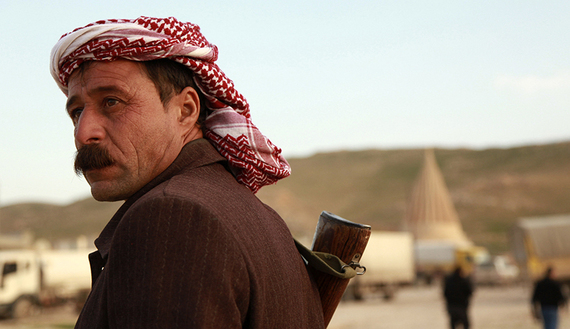
A man from the minority Yazidi sect stands guard at Mount Sinjar, in the town of SinjarA man from the minority Yazidi sect stands guard at Mount Sinjar, in the town of Sinjar, Dec. 20, 2014. (photo by REUTERS/Ari Jalal)

[I]t is an unusual overture of friendship for the government of Prime Minister Benjamin   Netanyahu, and it will be interesting to see if and how Israel takes up the gauntlet. Given the sensitivity of the matter, it is quite uncertain whether anyone will hear about it.

******************

“They have already killed many of us. What do we have to fear?” Lt. Col. Lukman Ibrahim responded when I asked him if he was afraid to openly communicate with an Israeli in a recent long-distance phone conversation from Tel Aviv to Sinjar, in northwestern Iraq, near the Syrian border. Ibrahim, a Yazidi militia officer, is hoping to obtain military aid from the State of Israel.

“The Arab countries do not recognize us, nor do they recognize you,” he said. “They are telling us that we are infidels. Why should we be afraid to talk to you, when even neighboring Arab countries have become our enemies? We regard you as a friendly state, with an opportunity for relations on the basis of neutrality and respect. We do not want more than that.”

Ibrahim, a journalist by profession, serves as an assistant to Marwan Elias Badl, one of the senior field commanders of the Sinjar Protection Forces, the Yazidi militia established ad hoc in August 2014 to halt the Islamic State (IS) onslaught against Yazidi population centers west of Mosul. The militia numbers some 12,000 fighters, most of them untrained, ordinary men who rushed to take up arms to thwart IS’ designs. A few of them are rank-and-file fighters, while some are officers with the Kurdish peshmerga. According to internal estimates, the IS militants killed thousands in their pogrom against the Yazidis. About 5,000 Yazidis are still being held by IS.

The Yazidis have no formal relations with Israel, nor an organized leadership. Yet they need aid, in particular military assistance, and they have chosen to make a public plea for help. “We appeal to the Israeli government and its leader to step in and help this nation, which loves the Jewish people,” said Ibrahim. “We would be most grateful for the establishment of military ties — for instance, the training of fighters and the formation of joint teams. We are well aware of the circumstances the Israelis are in, and of the suffering they have endured at the hands of the Arabs ever since the establishment of their state. We, too, are suffering on account of them.”

When asked what kind of weapons they needed, Ibrahim cited protective measures. “We are not acting against anyone,” he clarified. “And we do not covet other people’s land. We just want to protect ourselves. For example, [we need] armored [Humvees], machine guns and light weapons.”

Contact with Israel is a dirty business in this neighborhood, military contact all the more so. Be that as it may, in a reality where all levees have been breached and the worst appears to have already befallen the Yazidis, what could they possibly lose by seeking a rapport with Jerusalem?

The conversation with Ibrahim was not the only call with Sinjar. Majdal Rasho, a native of Sinjar, had settled in Germany and built his life there. He married and had a family, making a living as a manufacturing supervisor at a chocolate plant. In his spare time, he served as a photographer for TV stations broadcasting in the Kurdish language. He returned to Sinjar as a fighter, but also in his capacity as a video photographer for German TV networks.

“What I have seen here, I just can’t describe,” he said by phone from a battle zone. “Our people had no choice but to flee. We are not Arabs, nor are we Muslims. We see ourselves as sharing a fate with the Israelis, who went through similar pogroms. Those besieged on the mountain approached me and asked, ‘Maybe our Israeli brethren could lend a hand?’”

Yazidism is a religion with no more than a million followers. Its adherents are centered around Mosul and the Sinjar mountain range, in northern Iraq. Their largest diaspora in the West is in Germany, estimated to number some 100,000.

A common destiny with the Jews is a recurring theme in the Yazidis’ discourse. “What happened to us is the biggest genocide since the Holocaust of the Jews in Europe,” said Dr. Mirza Dinnay, a pediatrician based in Germany. “In the Holocaust, the goal was to annihilate an entire people, the Jews. IS has a similar plan — to exterminate an entire people, the Yazidis. No such extermination process had taken place in the past 500 years, with the exception of the Holocaust and what came to pass in Sinjar.”

Dinnay left Germany for Sinjar at the outbreak of the pogrom, leading a delegation of human rights activists. During one of the aid flights arranged by the Iraqi air force, a helicopter carrying food supplies and medication to the besieged Yazidis crashed. Some of the passengers aboard, among them Dinnay, were injured.

The communication between the Yazidis and the Israeli media has been coordinated by Idan Barir, 34, a researcher at the Tel Aviv University Yavetz School of Historical Studies. In the months since IS’ offensive against Yazidi population centers, Barir has become Israel’s top expert on the Yazidis, thanks to his extensive connections with members of the Yazidi community.

“I can think of a range of activities that Israel is experienced in that would not undermine the world order,” Barir told Al-Monitor. “For example, providing military assistance to the Yazidi forces in Sinjar who are crying out for cooperation and aid; setting up a field hospital for medical and psychological treatment of the casualties among the displaced in northern Iraq — not only Yazidis, by the way; sending humanitarian aid to displaced Yazidis in the refugee camps in Iraqi Kurdistan; absorption of a symbolic number of displaced Yazidis in Israel, with preference given to humanitarian, whether medical or mental, cases; incorporation of young Yazidis into military service in Israel; and support of civil initiatives aimed at strengthening and deepening ties between Israelis and Yazidis. It all depends on the decision made by the Israeli government, on its determination and goodwill.”

So far, Israel has not officially responded to such calls, which have yet to be fully formulated and have only recently began over the last few days. In fact, no formal request has come from the Yazidis for asylum as refugees. Barir is currently trying to find a way to reach decision-makers in Israel to pass on the messages from his faraway friends. Without a doubt, it is an unusual overture of friendship for the government of Prime Minister Benjamin Netanyahu, and it will be interesting to see if and how Israel takes up the gauntlet. Given the sensitivity of the matter, it is quite uncertain whether anyone will hear about it.

“It is a moral obligation to ring every bell and to do everything possible to stop the Yazidi tragedy,” said Attorney Zvi Hauser, the former Cabinet secretary in the most recent Netanyahu government (2009-13). “It is inconceivable that in the 21st century, someone’s attempt to eliminate an entire people, because of its faith and religion, is met with indifference.”

Hauser is the first senior figure in Israel who agreed to comment on the Yazidis’ call for help. As a private person, he refrained from reference to the Yazidis’ request for military aid, taking care to say nothing that might be interpreted as a promise. He believes, however, that Israel should favorably consider the Yazidis’ calls.

“The Yazidi narrative is evocative of ours. We, too, went through 2,000 years of existence without sovereignty, in the course of which we faced extermination schemes,” Hauser said. “Israel is a sovereign state, formed by an ethnic minority. It is the national manifestation of an ancient civilization. It would thus be appropriate to examine ways to establish relations and forge an alliance with them, if only to ensure a pluralistic Middle East. This issue has a universal aspect, as well. The development of human civilization is contingent on the diversity and multiplicity of [ethnic] groups and nations. Hence, the extinction of one of these would hurt not only the Yazidis, but also the entire fabric of human life.”


Kurdish Land-Grab Stuns Baghdad

January 27, 2015

Kurdish Land-Grab Stuns Baghdad, Newsweek and , January 27, 2015

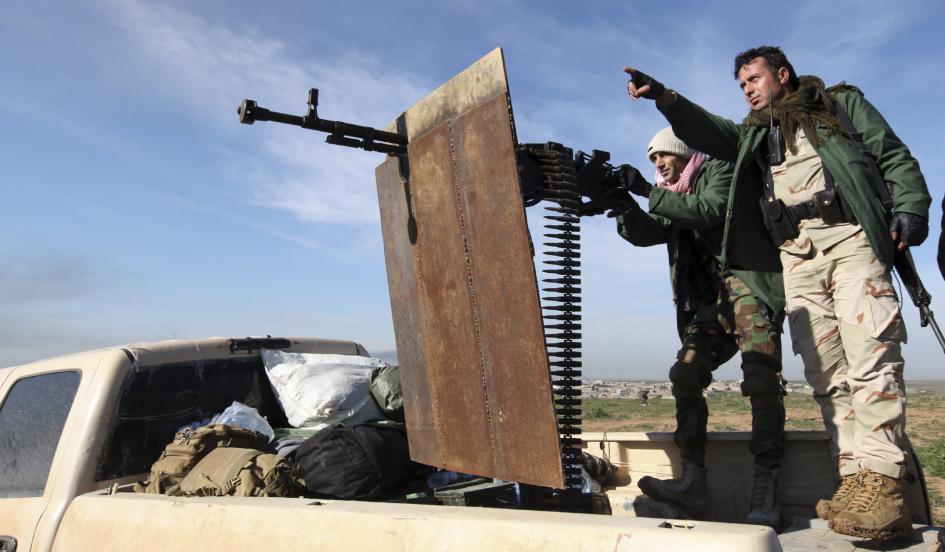
peshmergaKurdish Peshmerga fighters keep watch during the battle with Islamic State militants on the outskirts of Mosul January 21, 2015. AZAD LASHKARI/REUTERS

A senior Kurdish federal official, who declined to be named, said that Peshmerga forces would never hand back areas captured after Isis’s march across northern Iraq, which brought the group to within miles of the semi-autonomous Kurdish region.

While the threat of Isis remains significant, Kurds may have to put their independence dreams on hold and the Iraqi government will worry about Kurdish territorial claims later. As the terror group continues to grow, both parties need each other and the radical Islamist threat will bind them together, at least for now.

******************

Kurdish forces launched a barrage of Grad missiles against Islamic State (Isis) positions inside Mosul last week, for the first time since Isis overran Iraq’s second-largest city in June last year, marking a dramatic shift in the Kurds’ battle against the terrorist group.

The bombardment was preceded by a large-scale Kurdish operation against Isis in northern Iraq, which saw 5,000 Kurdish fighters, supported by US-led coalition airstrikes, sweep around Mosul to recapture an area larger than the size of Andorra, Liechtenstein and San Marino combined.

In the offensive, Kurdish Peshmerga fighters killed over 200 Isis militants, ousting the group from almost 300 square miles of territory, capturing a number of areas contested with Baghdad. As they advanced, encircling Mosul on three sides and cutting vital Isis supply lines to the nearby towns of Tal Afar and Sinjar, the Kurdish forces began a counter-offensive that analysts worry may be the start of a territory war between the Kurdish capital, Erbil, and Baghdad.

The Kurdish forces captured Makhmour, to the east of the city; the towns of Zimar and Wannah, and several Arab villages located in the Sinjar Mountains, west of Mosul; and the area around Mosul Dam, in what amounts to a Kurdish land-grab backed by Western airstrikes.

Iraqi Kurds believe that the recaptured territory around the city is rightfully theirs while the Iraqi government “fears that the Kurds will use territory as leverage during political negotiations”, according to Ranj Alaaldin, a visiting scholar at Columbia University.

A senior Kurdish federal official, who declined to be named, said that Peshmerga forces would never hand back areas captured after Isis’s march across northern Iraq, which brought the group to within miles of the semi-autonomous Kurdish region. “All the current military operations that involve the Peshmerga are implemented in coordination with the international military coalition and the central government is aware of it, but, in the Kurdish areas, we will never ever let Arabs control them again,” the official warned. “We are not ready to fight, terrify our fighters’ souls to liberate these areas and hand them to a traitor who would sell it to the killers. We will not allow this scenario to take place again in these areas.”

While the Kurds argue that they have taken control of this territory to defend against Isis, many Iraqis believe that the Kurds will never give up what they have captured because of their ambitions for an independent state.

“In the chaos that followed the Isis assault on Iraq in June, the Iraqi army melted away from its positions throughout northeastern and northwestern Iraq and the Peshmerga swiftly moved in to take their place – taking control of the whole of Kirkuk,” she said.

Despite these aspirations, Iraqi officials seem content to let Kurdish forces claim the territory from Daesh (as Isis is also known), for now. “As long as we are not ready to move as far as to fight in Mosul, it would be better to let them (Kurds) re-control these areas rather than leave it at the hands of Daesh,” a senior Iraqi military officer said. “Now, we will not raise any political disputes. Let [the Kurds] drive the militants away from these areas and we will think about the consequences later,” he added.

Hamed al-Khudari, a senior Shia lawmaker, agreed that Iraqis should “clear our lands” and “talk about this [territorial dispute] later”. Nevertheless, analysts do not believe that the Iraqi government in Baghdad is capable of ousting Kurdish forces from the territory they have seized in the recent advance. “Baghdad cannot do much to kick out the Kurds from any territory they have captured,” says Wladimir van Wilgenburg, analyst on Kurdish politics for the Jamestown Foundation.

The Kurds’ success on the battlefield, coupled with rumours of a potential Iraqi operation in Mosul, has put Isis on the back-foot but also caused disagreement between Erbil and Baghdad. Differences remain over involvement in any potential operation to recapture Mosul. Masrour Barzani, the head of Kurdistan’s regional security council, has said that Mosul will soon be “liberated” from the terror group’s self-proclaimed caliphate. “I don’t think anyone would envy the situation the people of Mosul are in,” he said. “The terror of Isis is too much for anyone to handle.”

But Kurdish officials believe that the responsibility for the recapture of the predominantly Sunni-Arab city lies solely with Baghdad. “Peshmerga are now 8km away from Mosul but they will not fight inside the city,” the official, who declined to be named, said. “When it comes to liberating Mosul, its people have to fight, not anyone else. We will just support them because we do not want anyone to say that Kurds are fighting Arabs. The [Iraqi] government understands that Mosul is not our battle or Shiites’ battle. Arab Sunnis in Mosul have to take the initiative to liberate their areas.”

Whereas Kurdish officials believe that Baghdad should take leadership over the battle for the city, where citizens now live under the group’s radical version of Islamic law, Iraqi officials claim that the battle against “Daesh is everyone’s to fight. The main goal now for all Iraqis is to fight Daesh and drive them away from all the Iraqi lands, so we will not allow anyone to talk about these [territorial] issues”, says al-Khudari. “This [fighting against IS] is the responsibility of everyone including the central government, the Kurdish forces, the public crowd (Shia militias and volunteers) and the anti-IS Sunni tribes.”

The lack of Kurdish motivation to enter into a battle for Mosul alongside Iraqi forces is due to the knowledge that any fight would be a drawn-out and lethal affair, according to van Wilgenburg. “They know the battle is going to be very heavy if it has to involve street to street fighting,” he says.

“The Kurds are already assisting the fight in Mosul. They recently fired into the city.” Erbil and Baghdad both have “to be pragmatic”, says Gonul Tol, executive director at the Center for Turkish Studies at the Middle East Institute. Baghdad is focused on recapturing Isis-held territory as opposed to Kurdish territory while Kurds “do not want to get involved” in Mosul to avoid “igniting a Kurdish-Arab war”.

While the threat of Isis remains significant, Kurds may have to put their independence dreams on hold and the Iraqi government will worry about Kurdish territorial claims later. As the terror group continues to grow, both parties need each other and the radical Islamist threat will bind them together, at least for now.

800,000-strong Shiite militia calls for formal recognition by Baghdad

January 18, 2015

800,000-strong Shiite militia calls for formal recognition by Baghdad, RUDAW, January 18, 2015

(RUDAW is a Kurdish media network. Hezbollah was conceived by Muslim clerics and funded by Iran following the Israeli invasion of Lebanon in 1982. From the inception of Hezbollah to the present, the elimination of the State of Israel has been one of Hezbollah’s primary goals. [Footnotes omitted.] — DM)

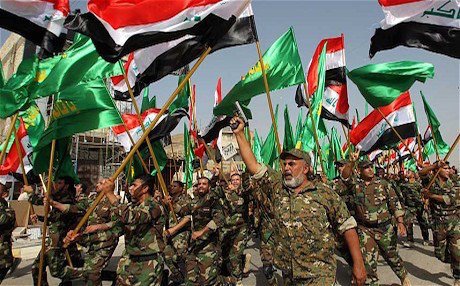
97644Image1Thousands of Shiite men responded to a call for jihad after ISIS stormed across Iraq in June and captured a third of the country. AFP photo.

BAGHDAD, Iraq – The leader of Iraq’s Hezbollah met with Shiite clerical authorities in Najaf Sunday to discuss formal recognition of hundreds of thousands of militiamen by the government and putting them on official payroll, a Hezbollah statement said.

Sheikh Abbas al-Mahmadawi, leader of the Shiite militia group Hezbollah, said that he met with Shiite clerics in Najaf, including Ayatollah Muhammad Saeed al-Hakim, to seek recognition “for the success of the militia groups in the fight against the Islamic State (ISIS).”

Al-Mahmadawi added that the Shiite volunteer militia should be recognized by the authorities and compensated financially “because many of them do not have any salaries and many have been wounded and handicapped.”

According to al-Mahmadawi, there are 800,000 volunteer Shiite fighters in Iraq who joined the fight against ISIS last June.

But he added that “the numbers have been inflated by some political parties” by more than double.

“We do not have any such numbers on the ground which is put down as 2 million volunteers,” he said in a statement following his visit to Najaf.

Al-Mahmadawi hoped that Baghdad would put the Shiite militia on its payroll now that the country is about to pass this year’s budget.

Thousands of Shiite men responded to a call for jihad against ISIS by Iraq’s Grand Ayatollah Ali Sistani last year, when the extremist Sunni group captured Mosul and made a lightening advance towards Baghdad and important Shiite shrines.

A great number of Shiite militiamen are based in the towns of Jalawla and Saadiya, north of Diyala, which they jointly liberated from ISIS in November.

Local residents, mainly the Kurdish population, have remained apprehensive about returning to their homes for fear of the armed militia groups, which operate outside government control and have been accused by Sunnis of acting as vigilantes.

On Saturday, Iraq’s parliament speaker Salim al-Jibouri met with Kurdish leaders in Sulaimani on forming a joint committee to facilitate the return of displaced peoples to Jalawla and Saadiya.

Meanwhile, around 200 tribal and political figures in Diyala met on Saturday to discuss normalizing the situation in the province after some of the fiercest battles between ISIS and a joint force of Peshmerga and Shiite militia groups.

Christians Burned Alive

January 10, 2015

Christians Burned Alive, Gatestone InstituteRaymond Ibrahim, January 10, 2015

Muslim Persecution of Christians, November 2014

“They picked them up by their arms and legs and held them over the brick furnace until their clothes caught fire. And then they threw them [alive] inside the furnace.” — Javeed Maseeh, family spokesman, concerning a Christian couple in Pakistan murdered on rumors they had burned verses from the Qur’an.

“I would appeal to your honor to put pressure on the government of Pakistan to end misuse of blasphemy laws against Christians, Ahmadiyyia and other religious minorities and condition US Aid on human rights and repeal of blasphemy laws.” — From a letter to U.S. President Barack Obama by Dr. Nazir S. Bhutti, President of the Pakistan Christian Congress, expressing surprise that the U.S. did not even bother to condemn the burning of Christians alive.

East Jerusalem: Despite constant and ever bolder attacks on a church, police refuse to respond to pleas for help from the Christian congregation.

Denmark: Muslim refugees are persecuting Christian refugees. “Christian asylum seekers are repeatedly exposed to everything from harassment to threats and physical abuse….” — Niels Eriksen Nyman, 10news.dk

“Young Christian men are made scapegoats to show police performance, while the real culprits are carrying out their illegal activities right under the police’s nose.” — Brother-in-law of “Mithu,” 35, Christian father of five, who was arrested in Pakistan on false charges and tortured to death in prison.

The youngest [slave] being the most expensive. 20-30 years old: 100,000 dinars [$86]; 10-20 years old: 150,000 dinars [$129]; 9 years old: 200,000 dinars [$172]. — The Islamic State.

The Islamic State called on its followers to take the jihad to Egypt.

Qaiser Ayub, a 40 year old professor of computer science in Pakistan, of Christian background, was arrested and charged with insulting Islam’s prophet Muhammad.

Both in the Islamic world and the Western world, Muslims continued to attack and slaughter Christians.

In Pakistan, “A mob accused of burning alive a Christian couple in an industrial kiln in Pakistan allegedly wrapped a pregnant mother in cotton so she would catch fire more easily, according to family members who witnessed the attack,” reported NBC News:

Sajjad Maseeh, 27, and his wife Shama Bibi, 24, were set upon by at least 1,200 people after rumors circulated that they had burned verses from the Quran, family spokesman Javed Maseeh told NBC News via telephone late Thursday. Their legs were also broken so they couldn’t run away.

“They picked them up by their arms and legs and held them over the brick furnace until their clothes caught fire,” he said. “And then they threw them inside the furnace.”

Bibi, a mother of four who was four months pregnant, was wearing an outfit that initially didn’t burn, according to Javed Maseeh. The mob removed her from over the kiln and wrapped her up in cotton to make sure the garments would be set alight.

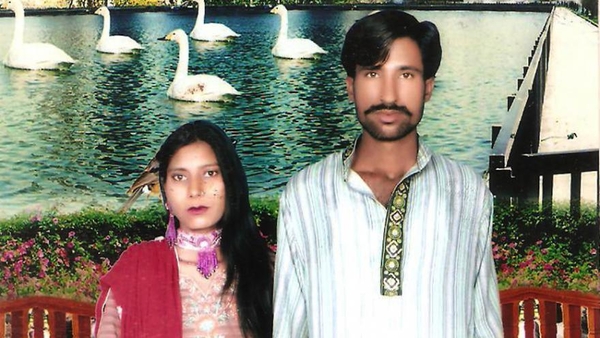
814Shama Bibi (left) and Sajjad Maseeh, a Christian couple and parents of four children, were burned to death by a Muslim lynch mob in Pakistan because of a false blasphemy accusation.

Discussing this latest atrocity against Pakistan’s Christian minorities, an AFP report states:

Blasphemy is a hugely sensitive issue in the majority Muslim country, with even unproven allegations often prompting mob violence.

Anyone convicted, or even just accused, of insulting Islam, risks a violent and bloody death at the hands of vigilantes.

A Christian woman [Asia Bibi] has been on death row since November 2010 after she was found guilty of making derogatory remarks about the Prophet Mohammed during an argument with a Muslim woman.

An elderly British man with severe mental illness, sentenced to death for blasphemy in Pakistan in January, was shot by a prison guard last month.

Two days after the Christian couple were burned alive, a policeman in Pakistan hacked a man to death for allegedly making blasphemous remarks against Islam.

About the Christian couple, Dr. Nazir S. Bhatti, President of the Pakistan Christian Congress, wrote a letter to U.S. President Obama expressing surprise that the U.S. did not even bother to condemn this crime:

It is surprising that neither US Administration under your honor nor US State Department even bothered to condemn this horrific crime of burning live of Christian couple by a mob living in country named Islamic Republic of Pakistan which is receiving billions of aid of US taxpayers.

I would appeal your honor to put pressure on government of Pakistan to end misuse of blasphemy laws against Christian, Ahamadiyyia and other religious minorities and condition US Aid to Pakistan on human rights and repeal of blasphemy laws.

Meanwhile, in America itself, in Oklahoma, Jimmy Stepney, a Muslim, stabbed Jerome Bullock, a Christian, after Stepney had said that Muslims need to “step up” beheadings. According to Koco5 News:

The [police] report went on to say Stepney had been making comments about beheading people.

“We were watching the news,” said Bullock. “He said he felt like more Muslims need to step up to the plate and do certain thing. He was talking about beheading people.”

The severity of the plight of Christians in the Middle East was further underscored by Dr. Alexander Yakovenko, Russian Ambassador to the United Kingdom, who wrote:

Russia is currently considering the possibility of initiating a draft decision of the UN Human Rights Council on the protection of Christians in the Middle East and North Africa. Russian experts are now working on this document.[…]

The scale of the problems demands the coordination of international efforts to protect Christians in the Middle East.

Further initiatives, new measures and relevant discussions aimed at finding durable solutions in this regard are strongly needed. Of course, we believe that Europe, including the UK, should make its contribution to these efforts, taking into account the Christian roots of the European civilization, which are now often forgotten for the sake of political correctness.[…]

The fate of the region’s religious minorities is of the greatest concern. The mass exodus of Christians, who have been an integral part of the Middle Eastern mosaic for centuries, is particularly troubling.

The rest of November’s roundup of Muslim persecution of Christians around the world includes (but is not limited to) the following accounts, listed by theme and country in alphabetical order, not necessarily according to severity:

Muslim Attacks on Christian Churches

Bangladesh: Two Christian pastors from the Faith Bible Church of God were arrested for preaching the Gospel to Muslims . They could face two years in prison if convicted for “hurting religious sentiments” and luring Muslims to convert by offering them money. The pastors deny both charges. Police arrested the pastors and 41 other people, including Muslims, after a throng of Muslims disrupted a house meeting. According to a witness: “More than 100 Muslims headed by local Jamaat-e-Islami party members and Muslim clerics gathered at the house and started barking questions at the pastors—why did they propagate Christianity in the locality and convert some of them,” and who gave them permission to preach to Muslims. “The pastors replied that it did not take any permission from any authority to propagate any religion and convert people to any religion. Suddenly the Muslims became apoplectic with rage, tried to pick a fight and started jabbing the pastors’ faces.”

Egypt: Father Timothy Shakar, priest of St. Mina Church in Port Said, confirmed that two homemade bombs were planted near the St. Mina Church but caused no injuries, or losses of life or property. Police searched other churches in the region for more bombs.

Germany: Nine men who had earlier broken into, vandalized, and robbed several Christian churches in the Cologne area—including by stealing money from the collection boxes and liturgical vessels—were caught during a massive raid. Apparently, all of the arrested are German by nationality, but Muslim by background and heritage. Some were also identified as “Salafis”—especially fundamentalist Muslims—connected to international terrorist organizations. Some had even raised hundreds of thousands of Euros from native Germans to support overseas “charities,” the proceeds of which actually went to terrorist groups such as ISIS.

Iraq: As cries of “Allahu Akbar” emanated from surrounding mosques, Islamic State militants blew up yet another Christian church — St. George’s Church and its associated nunnery in the city of Mosul — along with other non-Sunni sites. Separately, after breaking the cross from off the dome of the St. Ephrem Church dome (before and after pictures here) and selling its pews and other furnishings, the IS transformed the church into a mosque and council seat for the jihadis.

East Jerusalem: Despite constant and ever bolder attacks on a church, police refuse to respond to pleas for help from the Christian congregation. According to Morning Star News, “The attacks, driven by both intent to seize property and opposition to Christianity, have been mounted by young men with ties to Palestinian militants who for more than three months have been trying to force Living Bread Church from its rented building. Church pastor Karen Dunham and others have filed at least eight police reports about the assaults.” The most recent incident took place on November 5, when the gas tank of a car owned by a church volunteer was filled with sugar. On November 2, a car owned by one of the pastor’s relatives was stolen. And on October 16, three American Christians were injured while trying to repair a metal security door: A crowd of Palestinian men attacked them with box cutters, sticks, clubs and pepper spray. According to the church’s attorney, authorities “have their [the assailants’] pictures, they have their names, they even have their national ID numbers, and still they do nothing…. The level of brute force compared to the level of lack of response of the police force there is pretty shocking…. It almost seems like if someone is going to go in and murder her [Dunham], that no one is going to lift a finger.”

Malaysia: Approximately 70 local residents in Petaling Jaya protested the construction of a church. They claimed the growing number of Christian places of worship in the area is part of an attempt to evangelize and convert Muslims to Christianity. An NGO, the local branch of Pertubuhan Sahabat, supported the claims of the Muslims. They argued that there are three churches in the vicinity, although close to 70 percent of the residents in the area are Muslims. According to a spokesman, “Even before the church is built, flyers on Christianity have been distributed to our homes, and this could confuse our children and divert them from the path of Islam.” The vacant plot was previously occupied by squatters, a car park and several food stalls. Another local Muslim added “None of our neighbours are Christians, we can vouch for that… it is an insult to Muslims to allow a church to be built here, but none of our representatives seem to have the time to listen to us.” One demonstrator hurled large rocks at the temporary steel fence around the vacant plot.

Jihadi Slaughter of Christians

Kenya: Members of neighboring Somalia’s Islamic group Al Shabaab—”the Youth”—hijacked a bus carrying 60 passengers in the town of Mandera, near Kenya’s border with Somalia. They singled out and massacred 28 non-Muslims, the overwhelming majority of whom were Christian. According to an eyewitness, “When we got down, passengers were separated according to Somali and non-Somalis. The non-Somalis were ordered to read some verses of the holy Koran, and those who failed to read were ordered to lie down. One by one they were shot in the head at point blank range.”

Nigeria: On November 10, a suicide bomb attack on a Christian secondary school as students gathered for morning assembly killed at least 47 people. The Islamic group Boko Haram— meaning: “Western education is forbidden”—is believed to be behind the blast. In a separate incident, Christians from the predominantly Christian city of Mubi in Adamawa state were tortured and killed after Boko Haram took control of the town. Churches and homes were torched throughout the city, which was renamed Madinat al-Islam, or “the City of Islam.” In yet another separate incident, Boko Haram militants raided the mostly Christian town of Shani. According to a resident speaking to Reuters, “They rode on motorcycles and were more than 30 men. They started throwing bombs into houses… then the Boko Haram fired shots at people fleeing. They set ablaze the police station, houses and a telecom mast… I saw people fleeing, some bodies on the ground.” Reuters continues: “The Sunni jihadist movement is fighting to revive a medieval Islamic caliphate in Nigeria’s north.”

Pakistani Persecution

A few days after the Christian couple, mentioned earlier, was burned alive, a 35-year-old Christian father of five known as “Mithu” was arrested on false charges by police and tortured to death in prison. According to the deceased’s brother-in-law: “It was a fake allegation, because the raiding party failed to recover any contraband from Mithu’s person and his house… On the morning of Nov. 22, we were informed by Ilyas Gill, a local councilor, that Mithu had died in police custody because of heart failure…. Young Christian men are made scapegoats to show police performance while the real culprits are carrying out their illegal activities right under the police’s nose.” Morning Star News adds: “Area police routinely round up young, impoverished Christians on false charges of drug peddling and bootlegging, and then force their families to pay heavy bribes in return for their release… family elders had seen signs of torture on the body…”

Christian families in a Punjabi village were forced to flee after a Christian man married a Muslim woman—an act forbidden by Islamic law. According to the Pakistani report, “The Muslims in this village became enraged when this occurred and began threatening them…. When the news of the marriage was learned, the Muslims in Sahiwal attacked Shahab’s [the Christian husband’s] family as well as other Christian families in the village. The Muslims demanded that Ruksana [the Muslim wife] be returned immediately, according to Sharia which prohibits Muslim women from marrying a man from another religion…. the entire Muslim community was threatening to kill Shahab’s father and all of the village’s Christians…. The Christians’ pleas for help from the local police were all in vain.”

And Qaiser Ayub, a 40-year-old professor of Christian background, was arrested and charged with insulting Islam’s prophet Muhammad. The computer science professor had been a fugitive avoiding the police since 2011, when he was first accused of having written blasphemous comments on his blog.

Dhimmitude: Generic Contempt and Hostility

Denmark: In an apparent replication of the Islamic world’s modus operandi, Muslim refugees in the European nation are persecuting Christian refugees. According to 10news.dk, “Christian asylum seekers are repeatedly exposed to everything from harassment to threats and physical abuse by other refugees in the asylum centers, simply because they have converted from Islam to Christianity.” According to Niels Eriksen Nyman, who led the study, “There are certainly many more cases around the country than the ones we hear about in the church. I hate to say it, but I’m afraid that on some of the asylum centers there are some very unhealthy control mechanisms when the staff turns their back… I refuse to support Islamophobia, but we have a serious problem here.” Two recent examples: “An eight year old Christian at the Center Sandholm was bullied and beaten by the larger Arab boys on their way to school. Now the boy nolonger [sic] dares to go to school. On the island Bornholm, somebody had tampered with a Christian asylum seeker’s bike so that he crashed and broke both hands.”

Egypt: The Islamic State called on its followers to take the jihad to Egypt. Abu Mus’ab al-Maqdisi, a leader in the Islamic State, said in a statement titled “Advice to Egypt’s Mujahidin” that “It is necessary to take the battle to Cairo, until the Sinai is safeguarded from the apostates [reference to Egyptian government] and becomes a rear base [qaeda] from which to expand the jihad.” He also called on the jihadis in Egypt to “target the Copts,” the nation’s indigenous, Christian minority: “For targeting them, following them, and killing them is one of the main ways to serve the cause of our virtuous male and female hostages of the tyrants.”

Iraq: Christian homes in Tel Isqof were looted by Kurds who, after fighting the Islamic State, took control of the area on August 17. According to Agenzia Fides, “The city of Tel Isqof was occupied on August 7 by jihadist militias who already in June had conquered Mosul. Faced with the advancing of jihadists, the civilian population, mainly Christians, had fled to the autonomous Region of Iraqi Kurdistan, leaving the city deserted. Ten days later [on August 17], with a counter-offensive the Kurdish Peshmerga had regained control of the city. But it is precisely since then that [Christian] residents periodically return to the city to check the status of their homes, and acknowledge that the doors of a growing number of homes and businesses have been forced and property looted: money and jewelry, technical equipment and electronic instruments.” As in the Islamic State, most Kurds are Sunni Muslims.

Islamic State: IS issued a document breaking down the purchase prices of Christian and Yazidi women being sold as sex-slaves. Apparently these enslaved unfortunates are priced based on age— the youngest being the most expensive. The breakdown is as follows (with USD equivalency in brackets): 40-50 years old: 50,000 dinars [$43]; 30-40 years old: 75,000 dinars [$64]; 20-30 years old: 100,000 dinars [$86]; 10-20 years old: 150,000 dinars [$129]; 9 years old: 200,000 dinars [$172].

Spain: Real Madrid, a professional football (soccer) team, stripped the traditional Christian cross from its club crest as part of a deal with the National Bank of Abu Dhabi. “It is believed the European champions’ new crest, minus the Christian cross, was created so as not to offend Muslim sensibilities in the United Arab Emirates, where a marketing drive will take place,” wrote the Telegraph. Club president Florentino Perez said, “This agreement will help the club to keep conquering the hearts of followers in the United Arab Emirates.”

Syria: As of November, Raqqa, which once had approximately 1,500 Christian families, had only 23 Christian families remaining in it—the others were driven out or killed by the Islamic State. Those few remaining were unable to leave the city for lack of resources or for reasons of age and health. On November 16 they were told that they must pay $535, an exorbitant sum (human sex-slaves are being sold for as little as $43). “In all likelihood Christian families, impoverished by the war, will not be able to pay the tax and will have to leave their homes” or convert to Islam, as many elderly, debilitated Christians unable to flee have already done.

About this Series

While not all, or even most, Muslims are involved, persecution of Christians is expanding. “Muslim Persecution of Christians” was developed to collate some—by no means all—of the instances of persecution that surface each month.

It documents what the mainstream media often fails to report.

It posits that such persecution is not random but systematic, and takes place in all languages, ethnicities and locations.

Can Charlie Hebdo’s Spirit Include Israel?

January 9, 2015

Can Charlie Hebdo’s Spirit Include Israel? Algemeiner, Noah Beck, January 9, 2015

parisians-300x167Grieving Parisians gathered to mourn the victims of the Charlie Hebdo shooting. Photo: Screenshot, Vice News.

[H]ad Palestinian gunmen similarly attacked Israel’s most important daily newspaper and then escaped, would the event inspire such constant coverage or international sympathy? Israel has suffered countless massacres followed by a suspenseful manhunt for the Islamist terrorists; in each of these incidents, the world hardly noticed until Israel forcefully responded and Palestinians died (prompting global condemnation of Israel).

The best response to the Charlie Hebdo attack is to redouble the free expression Islamists meant to stifle. Similarly, the best response to Islamist attacks on the only Mideast democracy, Israel, is to increase support for it.

****************

The Islamist massacre at Charlie Hebdo has understandably captured global attention because it was a barbaric attack on France and freedom of expression. In a moment of defiant moral clarity, “je suis Charlie” emerged as a popular phrase of solidarity with the victims. Hopefully such clarity persists and extends to those facing similar challenges every day in the Middle East.

Christians and other religious minorities have been beheaded by Islamists for years, but it wasn’t until US journalist James Foley was beheaded that the West cared. The Islamic State raped and slaughtered thousands of Yazidis — leaving the surviving refugees stranded on Mount Sinjar — before the West took notice. But one Islamist besieging a cafe in Sydney, killing two, dominated global coverage for the entire 16-hour incident.

Western leaders and media must realize that religious minorities in the Middle East are the canary in the coalmine for the West when it comes to Islamist threats. And Israel provides the clearest early warning of all, precisely because — despite Israel’s location in a region of Islamists and dictatorships — the Jewish state has free elections, freedom of speech, a vigorous political opposition and independent press, equal rights and protections for minorities and women (who are represented in all parts of civil, legal, political, artistic, and economic life), and a prosperous free market economy.

But had Palestinian gunmen similarly attacked Israel’s most important daily newspaper and then escaped, would the event inspire such constant coverage or international sympathy? Israel has suffered countless massacres followed by a suspenseful manhunt for the Islamist terrorists; in each of these incidents, the world hardly noticed until Israel forcefully responded and Palestinians died (prompting global condemnation of Israel).

However, when there is an attack in Europe, North America, or Australia, there is widespread grief, solidarity, and an acceptance of whatever policy reaction is chosen. But when Israel is targeted, there is almost always a call for “restraint,” as happened last November after fatal stabbings by Palestinian terrorists in Tel Aviv and the West Bank.

If two Palestinians entered a European or North American church and attacked worshipers with meat cleavers, killing five people, including priests, the outrage would be palpable in every politician and journalist’s voice. But when Israelis were victims of such an attack, Obama’s reaction was spineless and tone deaf. Did Obama condemn the Charlie Hebdo massacre by noting how many Muslims have died at the hands of French military forces operating in Africa and the Middle East? Of course not. Such moral equivocation would be unthinkable with any ally or Western country except Israel.

Similarly, would Secretary of State John Kerry ever suggest that the Islamic State is somehow motivated by French policies (whether banning Muslim headscarves at public schools or fighting Islamists in Mali)? Obviously not. Yet Kerry did just that sort of thing with Israel when he suggested that the Islamic State is driven by the Israeli-Palestinian conflict.

And the media’s anti-Israel bias is well known but became even more obvious when they couldn’t get a simple story about vehicular terrorism against Israelis correct. Compare how The Guardian writes accurate headlines when France or Canada suffers an Islamist car attack but not when Israel does.

Consider all of the justifiable news coverage and outrage over the 2013 Boston bombings, and imagine if one of those happened every week. Would anyone dare suggest that the US make peace with any Islamists demanding changes to US policy? And yet Israel had such bomb attacks almost every week of 2002 and was invariably asked to restrain itself and make concessions to the very people bombing them (as happened again last summer, when Hamas fired thousands of rockets at Israel).

As Israeli Prime Minister Netanyahu has ruefully observed, “There is a standard for dictatorships, there is a standard for democracies, and there is still a third standard for the democracy called Israel.”

Even when compared to Western democracies, what other country gives incredibly forgiving medical care to terrorists and agrees to treat the children of those working to destroy it? Israel is where a Hamas family member finds refuge when he is a gay convert to Christianity but this is yet another inconvenient fact for the mainstream media (as is the fact that some Israeli Arabs supported the IDF’s 2014 war against Hamas). Why report what contradicts the one-sided, anti-Israel narrative that the media and groups like Human Rights Watch have adopted? That narrative is only reinforced on college campuses (leftist college history professors openly supported Hamas last summer). Nevertheless, US funding of anti-Israel groups continues to aggravate the misinformation problem.

Israel is still the country that everyone loves to hate. So it’s the cheap way to please Muslim voters in Europe and oil producers in the Gulf. But what happens to Israel eventually comes to the West, because Israel is an extension of the West. And just as surrendering Czechoslovakia failed to appease the expansionist appetite and murderous rampage of Nazi totalitarianism, so too will feeding Israel to Islamist totalitarianism fail to appease that movement. In the end, there is no set of concessions — short of civilizational surrender — that the Islamists will accept.

Nevertheless, an EU court decided to remove Hamas from the European Union’s terror list, even though Hamas is responsible for scores of terrorist attacks that have murdered hundreds of Israelis, North Americans, and Europeans, and has a charter calling for the destruction of Israel. And Western European countries have voted for Palestinian statehood at the UN and in their parliaments, effectively rewarding Palestinian terrorism and intransigence. Europe supports the Palestinian Authority as if Hamas couldn’t overthrow it in the West Bank as easily as Hamas did in Gaza Strip in 2007. How can Europe not know that Hamas has designs on the West Bank and that any Israeli withdrawal from that territory will only facilitate such a takeover? And how can Europe believe that Israel could ever make peace with Hamas, which has launched three unprovoked wars on Israel in the last five years (in the decade since Israel withdrew from Gaza)?

Moreover, if lofty concerns about self-determination and human rights are the true motivation behind Europe’s vocal support for Palestinian independence (despite its undemocratic and violent record), why is Europe deafeningly quiet on Kurdish statehood? Given that six million Jews were annihilated by a genocide on European soil, Europe’s hypocrisy on Israel should embarrass the continent even more.

Worse still, Europe’s gestures of appeasement only encourage the Islamists. The best response to the Charlie Hebdo attack is to redouble the free expression Islamists meant to stifle. Similarly, the best response to Islamist attacks on the only Mideast democracy, Israel, is to increase support for it.