Posted tagged ‘Khamenei’

Top Iranian Negotiator: We Reached Solution with P5+1 on Site Inspection, But Khamenei Rejected It

May 28, 2015

Top Iranian Negotiator: We Reached Solution with P5+1 on Site Inspection, But Khamenei Rejected It, MEMRI-TV videos, May 28, 2015

In an Iranian TV interview, Iranian Deputy Foreign Minister Abbas Araqchi, who is Iran’s top nuclear negotiator, revealed that the Iranian negotiating team had reached possible solutions with the P5+1 on the issue of inspection of Iranian nuclear facilities, but that Iranian Supreme Leader Ali Khamenei had decisively rejected them. Inspection of the facilities is one of the key issues remaining in the nuclear talks. The interview aired on Iran’s Channel 2 TV on May 25.


Obama expounds the limits of Iran’s anti-semitism

May 23, 2015

Obama expounds the limits of Iran’s anti-semitism, Power LineScott Johnson, May 22, 2015

Assuming that Obama intends his remarks to be taken seriously, which I don’t, I find Obama’s comments among the stupidest and most ignorant he has ever uttered, although I concede on this point that that the competition is stiff.

*********************

In the course of his recent interview of President Obama — painful reading from beginning to end — Jeffrey Goldberg asked a somewhat challenging question regarding the Islamic Republic of Iran. “You have argued,” Goldberg observed, “that people who subscribe to an anti-Semitic worldview, who explain the world through the prism of anti-Semitic ideology, are not rational, are not built for success, are not grounded in a reality that you and I might understand. And yet, you’ve also argued that the regime in Tehran—a regime you’ve described as anti-Semitic, among other problems that they have—is practical, and is responsive to incentive, and shows signs of rationality.” Oh, wise man, how do you square this particular circle? Obama responded:

Well the fact that you are anti-Semitic, or racist, doesn’t preclude you from being interested in survival. It doesn’t preclude you from being rational about the need to keep your economy afloat; it doesn’t preclude you from making strategic decisions about how you stay in power; and so the fact that the supreme leader is anti-Semitic doesn’t mean that this overrides all of his other considerations. You know, if you look at the history of anti-Semitism, Jeff, there were a whole lot of European leaders—and there were deep strains of anti-Semitism in this country—

Goldberg (unfortunately) interrupted him at this point. Obama then continued:

They may make irrational decisions with respect to discrimination, with respect to trying to use anti-Semitic rhetoric as an organizing tool. At the margins, where the costs are low, they may pursue policies based on hatred as opposed to self-interest. But the costs here are not low, and what we’ve been very clear [about] to the Iranian regime over the past six years is that we will continue to ratchet up the costs, not simply for their anti-Semitism, but also for whatever expansionist ambitions they may have. That’s what the sanctions represent. That’s what the military option I’ve made clear I preserve represents. And so I think it is not at all contradictory to say that there are deep strains of anti-Semitism in the core regime, but that they also are interested in maintaining power, having some semblance of legitimacy inside their own country, which requires that they get themselves out of what is a deep economic rut that we’ve put them in, and on that basis they are then willing and prepared potentially to strike an agreement on their nuclear program.

This appears to have been good enough for Goldberg, but it should make a serious man cry. Let me count the ways.

Obama is in the process of finalizing an absurd arrangement with Iran that will at the same time obviate the cost of its pursuit of nuclear weapons and reward the regime for entering into the arrangement. They will reap the economic rewards of taking advantage of President Obama’s surrender to their (absurd) terms.

The Islamic Republic continues its program of ideological anti-Semitism and regional expansion. We await Obama’s “ratchet.” The regime evidently fears it not. This is glorified hot air.

Obama reiterates “military option [he’s] made clear[.]” The word “clear” here is the tell; it demonstrates that Obama is lying. There is no United States military option. Indeed, Obama’s public relations work on behalf of the Islamic Republic of Iran is suggestive of its removal from the shelf.

How does a seriously committed anti-Semitic regime weigh the costs and benefits of its anti-Semitism? I long for Professor Obama to draw from the well of his historical learning to apply the cost-benefit analysis to the Nazi regime of 1933-1945. Somebody get this man a copy of Lucy Dawidowicz’s The War Against the Jews, 1933-1945.

The Israelis draw the lesson they refer to in the slogan “Never again.” Emanuele Ottolenghi offers reflections that are precisely on point.

How does Professor Obama apply his cost-benefit analysis to the Iran’s 1979 bombing of the AMIA (Jewish) in Buenos Aires? It targeted Jews and killed 85 people. What costs was Iran prepared to incur? What costs has Iran incurred? The applicable cost-benefit analysis might illuminate how Iran thinks about the prospect of “eliminating” Israel by means of its proxies and with the nuclear weapons it is striving at all cost to obtain.

As for the regime’s alleged need to maintain a “semblance of legitimacy” inside Iran and therefore its alleged need to “get themselves out of a deep economic rut,” what does he mean? Obama is not saying that the regime lacks a semblance of legitimacy inside Iran at present. Obama himself continues to provide the regime something more than a “semblance of legitimacy.” Is the Supreme Leader feeling the pressure? No one outside Obama’s circle of friends can take this at face value.

Assuming that Obama intends his remarks to be taken seriously, which I don’t, I find Obama’s comments among the stupidest and most ignorant he has ever uttered, although I concede on this point that that the competition is stiff.

NOTE: Noah Rothman also takes a stab at doing justice to Obama’s comments here. It occurs to me that the words of Walter Laqueur in connection with Jan Karski’s mid-war report on the Holocaust in his book The Terrible Secret also apply here: “Democratic societies demonstrated on this occasion as on many others, before and after, that they are incapable of understanding political regimes of a different character….Democratic societies are accustomed to think in liberal, pragmatic categories; conflicts are believed to be based on misunderstandings and can be solved with a minimum of good will; extremism is a temporary aberration, so is irrational behavior in general, such as intolerance, cruelty, etc. The effort needed to overcome such basic psychological handicaps is immense….Each new generation faces this challenge again, for experience cannot be inherited.” In Obama’s world, I would add, experience can’t even be experienced. Ideological blinders render him obtuse (again assuming his words are to be taken at face value, which I don’t).

How the Islamic Republic Is Manipulating the U.S.

May 19, 2015

How the Islamic Republic Is Manipulating the U.S., Front Page Magazine, May 19, 2015

iran-s-rouhani-phones-pm-nawaz-after-soldier-s-killing-1395854702-4802-450x336

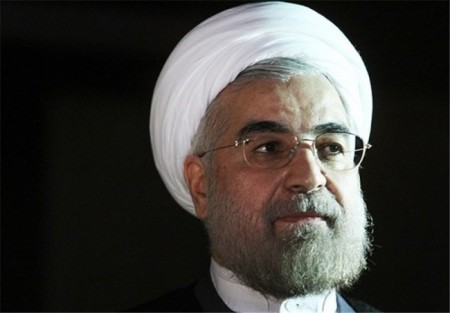
Rouhani and the moderate camp have persuaded Ayatollah Ali Khamenei that superficial diplomatic ties with the Obama administration will, in fact, empower the Islamic Republic, further its hegemonic ambitions, and raise Tehran’s economic status without the need for the Iranian leaders to give up on their revolutionary principles, anti-Americanism and anti-Semitism.

****************

There is a crucial Machiavellian (but not a strategic) tactical shift in the Islamic Republic’s foreign policy and its pursuit of regional preeminence.

First of all, Iranian leaders have realized that by superficially showing the Obama administration that the Islamic Republic is willing to restore diplomatic ties with his administration, they can in fact further advance their ideological and national interests.

Second, knowing that President Obama is desperate for a “historic” nuclear deal and the establishment of diplomatic ties with the Islamic Republic, Iranian leaders have played the role very well by attempting to satisfy President Obama’s empty goals.

Third, the ruling clerics of the Islamic Republic became cognizant of the fact that dealing with the Obama administration does not necessarily mean that they have to give up anything with respect to its domestic suppression, revolutionary Islamist principles, human rights abuses, regional hegemonic ambitions, anti-Americanism, hatred towards Israel, and foreign policy objectives.

The tactical shift, currently, is to satisfy President Obama’s personal and shallow objectives by allowing him to project that he is making historic moves (such speaking on the phone with the Iranian leaders), while simultaneously pursuing their own ideological objectives.

For example, most recently, Rouhani and the Obama administration agreed on opening new diplomatic offices in Tehran and Washington. For President Obama, opening diplomatic offices can be viewed as another “historic move” cited in his records or on his Wikipedia page. From the perspective of Iranian leaders, it is a crucial pillar for the advancement of Iran’s foreign policy and ideological objectives in the region without pressure from the US.

To pursue their objectives more efficiently, Iranian leaders have agreed to meet frequently with the diplomats at the highest level of the Obama administration, “negotiating,” and having some of their interactions publicly televised on American and Western media. In addition, the American and the Iranian flags are repeatedly shown next to each other in the high level meetings.

These moves, in fact, give legitimacy to the theocratic regime to further its ambitions.

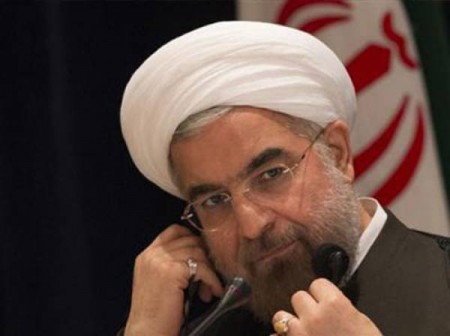
The president was also delighted to make another “historic move” by speaking on the phone with his Iranian counterpart, President Hassan Rouhani. (One would wonder what a great accomplishment it is to pick up a phone and call another president.)

Washington and Tehran broke diplomatic ties in 1979. After the hostage crisis, high American officials and diplomats have not set foot on the Iranian soil due to Iran’s continuous violation of international norms and anti-Americanism.

Nevertheless, President Obama and Secretary of State John Kerry have decided to turn a blind eye on Iran’s egregious human rights abuses, aggressiveness and violations of international laws.

In another shallow move, Kerry claimed to be proud to set foot on Iranian “territory.” He met with Iran’s Foreign Minister, Mohammad Javad Zarif, at the residence of the Iranian ambassador to the United Nations, Gholamali Khoshroo, in New York.

Instead of attempting to change the behavior of the Ayatollahs and their revolutionary principles, President Obama and Kerry are satisfied with these superficial “historic moves.”

Since Iran’s political establishments and policies are driven, not solely by national and geopolitical interests, but also by ideological Islamist (Shiite) principles, hardliners and the office of the Supreme Leader will always view a real rapprochement with the US as taboo.

Restoring full diplomatic ties can also be analyzed as betraying the revolutionary principles of the Islamic Republic, which were based on anti-Americanism, as well as their opposition to Western models of socio-political and socio-economic landscapes.

From the perspective of Iran’s Supreme Leader, Ayatollah Ali Khamenei — who has the final say in foreign policy decisions — genuine diplomatic ties with the US will lead to the empowerment of Iranian civil society and secular factions. From the prism of the senior cadre of the IRGC, relationships with the American government might lead to the opening of the Iranian market, endangering the economic monopoly of IRGC institutions.

On the other hand, Rouhani and his technocrat team, who share the same objectives with the hardliners and want to preserve the interests of the Islamic Republic, came to the realizations that satisfying President Obama’s superficial and shallow objectives of “historic moves,” can indeed assist them in advancing their ambitions.

In conclusion, similar to the ongoing nuclear negotiations, Rouhani and the moderate camp have persuaded Ayatollah Ali Khamenei that superficial diplomatic ties with the Obama administration will, in fact, empower the Islamic Republic, further its hegemonic ambitions, and raise Tehran’s economic status without the need for the Iranian leaders to give up on their revolutionary principles, anti-Americanism and anti-Semitism.

IRGC Deputy Commander Salami: “We Welcome War with the Americans”

May 14, 2015

IRGC Deputy Commander Salami: “We Welcome War with the Americans”, MEMRI via You Tube, May 14, 2015

(Does Iran really believe Obama’s “all option are on the table” nonsense, which hardly anyone credits? — DM)

In an Iranian TV interview, IRGC Deputy Commander Hossein Salami threatened the Americans, saying: “We welcome war with the Americans.” The U.S. aircraft carriers would be destroyed, its air bases in the region burned, and the skies set ablaze, he said. “We have built our strength for the purpose of long, extended wars… more than for the purpose of peace, compromise, and dialogue with them,” said Salami. The interview aired on the Iran TV’s Channel 1 on May 6, 2015.


President Strangelove or, how I learned to stop worrying and love the bomb

May 14, 2015

President Strangelove or, how I learned to stop worrying and love the bomb, Jerusalem Post, David Turner, May 14,2015

Concerned about Soviet intentions in the region the Truman administration entered into the U. S.-Saudi Mutual Defense Assistance Agreement (MDA) in 1951. The Agreement provided the foundation for what would emerge as an American commitment to provide a defense umbrella for the region to protect American interests in the Middle East. American assurances to states in the region seemed intact until the GW Bush Administration invasion of Iraq. Trapped in a war it completely misjudged and soon realized it could not win the administration sought an accommodation with Iran to control Shi’ite militias battling the Americans.

The Bush policy of “accommodation” with Iran became the Obama policy of “appeasement” towards the Islamic Republic. Thus began a six-year-long quest to intended to encourage that country’s recalcitrant and hegemony ambitious leaders to abandon its nuclear weapons program. With the imminent 30 June deadline for signing an Agreement quickly approaching the president invited the Gulf Cooperation Council (GCC) states headed by Saudi Arabia to Camp David promising a mutual defense agreement assuring the Arab states of American protection in the event Iran proved a threat to the region. In addition to “assurances, the Saudis insisted on a signed and “formal alliance structure with the United States guaranteeingU.S. support against potential Iranian aggression.”

In advance of the conference the White House announced that President Obama would meet with the Saudi king the day beforeCamp David. But at the last minute, [d]ispleased with Washington’s dealings with Iran, with an emerging deal over its nuclear program and with US security proposals to Gulf Arab nations,” King Salman announced he would not meet with President Obama and would not attend the Camp Davidconference. In the end only two of six Gulf nations decided to attend with heads of state.

The king’s last-minute cancellation, his turn-down of a meeting with the leader of the Free World was described as “a calculated snub for the president’s policies on Iran and the Middle East.” It was revealed that Kerry, in his meeting with the Saudis the week earlier, told the king that Obama was not prepared to finalize according to the king’s timetable any agreement that might result at Camp David.

And then there was the fact that a mutual defense agreement with the Saudis, the 1951 MDA, already existed already assuring the Saudis protection under America’s nuclear umbrella. Mistrust of American intentions and assurances by America’s “allies” built up over the previous twelve years was palpable.

Bush and the Region

“Even before the inauguration [and, of course, the pretext of 9/11], Cheney asked outgoing Secretary of Defense William Cohen to provide Bush with a briefing focused on Iraq… [Bush appointee] Defense Secretary Rumsfeld saw, “September 11, 2001, as a potential “opportunity.””

Symptomatic of hubris resulting from power minus coherent policy President Bush ignored both Arab and Israeli warnings of Foreseen Consequences certain to follow should the administration follow through with its threat to invade Iraq.

“With his latest remarks, [Saudi, later king] Prince Abdullah joined the chorus of Arab complaints about the Bush administration’s talk of taking military action to oust Saddam Hussein and put an end to his programs to develop weapons of mass destruction. At virtually every stop in the Arab world, Mr. Cheney has been told that an American military strike would destabilize the region.”

And, according to Lawrence Wilkerson, a member of the State Department’s Policy Planning Staff, “[t]he Israelis were telling usIraq is not the enemy – Iran is the enemy.” Wilkerson said that the Israeli reaction to invading Iraq in early 2002 was, “If you are going to destabilize the balance of power, do it against the main enemy.”

Bush and the Bomb

Cut off the head of the snake,” the Saudi ambassador toWashington, Adel al-Jubeir, quotes the king as saying during a meeting with General David Petraeus in April 2008.

In a speech to the Knesset in 2008 to observe Israel’s 60thanniversary Bush told the Knesset, “America stands with you in firmly opposing Iran’s nuclear weapons ambitions. Permitting the world’s leading sponsor of terror to possess the world’s deadliest weapon would be an unforgivable betrayal of future generations.” Nowhere in his speech did Bush hint at his long held view that America was not prepared to enter another Middle East war, that there never was a military option with which to threaten Iran’s nuclear weapons program. No accident then that Bush chose war-averse Robert Gates as his defense secretary; and that Gates in turn chose war-averse Admiral “Mike” Mullen as head the Joint Chiefs of Staff. The dovish defense pair would for years be the president’s PR mouthpiece warning against even the threat of force to halt Iran’s nuclear program. The Gates/Mullen oft-repeated warning of “unforeseen consequences” became, over the years a common, almost mantra-like warning against any action against Iran.

No surprise then that the openly dovish, newly-elected President Obama invited Gates to remain on as his defense department head, “a show of bipartisan continuity in a time of war that will be the first time a Pentagon chief has been carried over from a president of a different party.”

Obama and the Region

By way of destabilizing the region Obama has not yet equaled the fallout of Bush’s invasion of Iraq. If Bush gifted Iraq to Iran, set the stage for the “Arab Spring,” Obama did not come in second for lack of trying. The new president followed Bush by targeting his own tyrant, Muamar Qadafi and transformingLibya, as did Bush in Iraq, a political wreck bordering on a failed state.  Libya today is ruled al-Queda, Islamic State and other terror organizations with two governments powerless to assert control. Bordering Egypt Libya today supplies both the Sinai Salafist insurgency and the terror enclave of Gaza with weapons. And as Bush ignored Israeli and Arab warnings regarding the impact of invading Iraq, Obama chose to those same Arab-Israeli warnings regarding his intention to depose America’s principal Arab ally, Hosni Mubarak of Egypt. In a single mindless move the U.S. followed up its Iraq disaster with Egypt. And followed the collapse of Egypt’s secular regime, insult to injury Obama endorsed as “democratic government” the same Muslim Brotherhood with a decades-long terror campaign against the government; the group behind the assassination of Anwar Sadat for having sought peace with Israel: the Muslim Brotherhood whose child, al-Quaeda, had flown airliners into New York’s World Trade Center! The list of Bush and Obama Administration policy failures seems to know no limits: Iraq redo, Bahrain,Yemen and the bloodbath of Syria. Lacking capacity to learn from ideology-based failures, it continually repeats its “unintended consequences.”

Obama and the Bomb

If Bush set the pattern for accommodation then the tactic at least had some “justification” as Iran’s IRGC was funding, arming and even leading the Shi’ite insurgency against Iraq’s American invaders. Not provoking Iran might have the result of limiting American casualties. But for Obama, recipient in advance of the Nobel Peace Prize for promising regarding “world peace”; for Obama to provide Iran, a state sponsor of Islamist terrorism a world forum to show up American weakness and enhance Iranian prestige; for Obama whose commitment on entering office was to promote nuclear non-proliferation: for Obama to provide Iran all the time necessary to achieve threshold nuclear armament status and, failing to contain Iran the consequence would be a nuclear arms race in the lands of the Arab Spring… Saudi Arabia,Turkey and Egypt are already moving to parity with Iran whileJordan and several Gulf states are at varying stages of planning.   

Obama, who promised nuclear non-proliferation, has turned out to be godfather to a nuclear arms race in the least stable, most militant region of the world!

Iranian Supreme Leader following Lausanne Declaration: Nothing Has Been Achieved So Far

May 5, 2015

Iranian Supreme Leader following Lausanne Declaration: Nothing Has Been Achieved So Far, MEMRI TV via You Tube, May 5, 2015

(Khamenei delivered this speech last month, but this fourteen minute video includes some comments I had not seen him make previously. — DM)

A powerful totalitarian theocracy can bring peace. Of sorts.

May 2, 2015

A powerful totalitarian theocracy can bring peace. Of sorts. Dan Miller’s Blog, May 2, 2015

(The views expressed in this article are mine, and do not necessarily reflect those of Warsclerotic or its other editors. — DM)

a1  Obama and Kahameni -building a toaster

Iran, an already powerful theocratic totalitarian state with extensive hegemonic ambitions, is about to become (if it is not already) a nuclear power. So equipped, it can extend its rule over the Middle East and beyond, bringing the “peace” of submission to Islam. Obama may favor this outcome and in any event appears to be at best indifferent.

Iran is ruled by Ayatollah Khamenei, its supreme political and religious power. He has the ultimate authority to approve or reject any P5+1 agreement, should there be one — which seems increasingly likely due to Obama’s ludicrous efforts to concede every possible matter of substance. Obama wants a foreign policy legacy and needs a “deal;” Iran does not need a “deal.” It has already benefited greatly from sanctions relief. Other nations have also benefited economically to the point that even were the U.S. to try to reimpose sanction such trade would continue and expand. Moreover, it is highly likely that Iran has done all of the necessary technical research on nukes and on delivery devices to the extent that, regardless of whether there is a “deal,” Iran can have deliverable nukes within a few months if not sooner. As I pointed out here, the insanity of the 2013 framework, adhered to except when arguably in America’s favor, led inexorably to this result.

The North Korea – Iran linkage makes the problem worse. Chinese nuclear experts recently revised their estimation of North Korea’s current possession of nukes:.

China’s top nuclear experts have increased their estimates of North Korea’s nuclear weapons production well beyond most previous U.S. figures, suggesting Pyongyang can make enough warheads to threaten regional security for the U.S. and its allies.

The latest Chinese estimates, relayed in a closed-door meeting with U.S. nuclear specialists, showed that North Korea may already have 20 warheads, as well as the capability of producing enough weapons-grade uranium to double its arsenal by next year, according to people briefed on the matter. [Emphasis added.]

Iran and North Korea have a long history of nuclear cooperation. Delivering North Korean technology, materials and nukes to Iran would not be very difficult. I addressed the problem here, herehere and elsewhere.

Consequences of a nuclear Iranian theocracy

The Iranian Shiite theocracy is totalitarian in every sense of the word; it has not moderated under “moderate” President Rouhani. To the contrary, it seems to have worsened. To the extent that credible figures are available, sexually transmitted disease has risen and the birth rate in Iran has fallen, considerably in recent years. Despite sanctions relief, poverty has increased. Where has the money gone? Iran pursues its hegemonic ambitions, most recently to help the Houthi in Yemen, while continuing to provide economic, logistical and weapons support to its other proxy terrorist organizations such as Hamas, Hezbollah, the Muslim Brotherhood and others. Iran is very likely motivated by its own desire eventually to control the Middle East and beyond.

The recent Iranian hijacking of a cargo ship under “U.S. protection” may well have been an Iranian warning to Saudi Arabia, an American ally and leading opponent of the Iranian proxy war by Houthi in Yemen, that it can and might close the Strait of Hormuz to Saudi oil exports.

Strait-of-Hormuz

Although obligated under treaty to come to the defense of the Marshall Islands-registered cargo ship, the Obama Nation did not. Instead, it simply watched as the Iranian Navy fired shots across her bow and took her to an Iranian port to the North at Bandar Abbas. The ship and her crew remain there. Caroline Glick, in an article titled The Marshall Islands’ cautionary tale pointed out that

The Maersk Tigris is flagged to the Marshall Islands. The South Pacific archipelago gained its independence from the US in 1986 after signing a treaty conceding its right to self-defense in exchange for US protection. According to the treaty, the US has “full authority and responsibility for security and defense of the Marshall Islands.” [Emphasis added.]

Given the US’s formal, binding obligation to the Marshall Islands, the Iranian seizure of the ship was in effect an act of war against America.

. . . .

If the US allows Iran to get away with unlawfully seizing a Marshall Islands flagged ship it is treaty bound to protect, it will reinforce the growing assessment of its Middle Eastern allies that its security guarantees are worthless.

As the Israel Project’s Omri Ceren put it in an email briefing to journalists, “the US would be using security assurances not to shield allies from Iran but to shield Iran from allies.” [Emphasis added.]

What can other nations, with which America has treaties calling upon us to come to their defense, expect from the Obama administration if attacked by Iran? Precious little.

Under credible threat from nuclear attack by Iran and lacking actual (as distinguished from verbal) support from the Obama administration, Middle East Arab nations cannot be expected to resist very effectively, even as they seek to obtain their own nuclear arsenals.

Israel, the “Little Satan?” She would fight fiercely to the end, but might be overcome. Perhaps she will take the initiative and destroy Iran’s nuclear facilities before they become too extensive and better protected, perhaps by missiles provided by Russia. I suggested here that she can and should do so. Here is a link to a far more detailed analyses of what she can and should do, soon.

America, the “Great Satan,” is not immune to an Iranian nuclear attack. As I suggested here, a nuclear armed Iran could launch an EMP attack to drive the U.S. back to the stone age. Such an attack would increase Iran’s hegemonic potentials, and hence ambitions, by foreclosing the possibility of American help to nations with which we have protection treaties. However, even without an EMP attack, Obama would not provide much help. Therefore, I wonder whether — despite all of the continuing Iranian “death to America” bluster — Iran would be foolish enough to do it before Obama leaves office. He does His best to help Iran get nukes and pursue its hegemonic ambitions. Why try to kill a staunch friend like Obama’s America?

The Obama administration — and many voters — view global warming, climate change, climate disruption and whatever new phrases as may be developed as the most severe threat to humanity. An interesting article titled Progressives at the Poker Table compares “Progressive” attitudes toward “the threat of climate warming and that of a nuclear-armed Iran.” Predictably, the Obama Administration and most of the “legitimate news media” are far more concerned about the former than the latter, even though there is little if anything that we can do, even at great expense, about climate change (mostly natural in origin). If so disposed, there is quite a lot that we could do about the far greater, and in any event more immediate, threat from a nuclear Iran. Perhaps it’s simply easier to stage pious shows about costly but ineffective ways to “save the Earth” than to make useful efforts to save humanity from Islamic ravages.

Church of climatology

Conclusions

Andrew Klavan ridicules Obama’s P5+1 “deal” here:

The Congress probably won’t do anything to stop it, so Iran will very likely have nukes and the missiles with which to deliver them soon — if it does not already have them.

Hitler made a “deal” with Prime Minister Chamberlain years ago and returned from Munich to display a piece of paper signed by Hitler. Crowds cheered. Hitler laughed and continued his hegemonic pursuits throughout Europe. Hitler could have been stopped with relative ease long before World War II erupted but wasn’t. The “Peace in our time” meme was too powerful. Then we fought WWII.

Is that how the current mess with Iran will turn out?

code pink on Iran

Andrew Klavan: Obama’s Nuclear Disaster

May 1, 2015

Andrew Klavan: Obama’s Nuclear Disaster, Truth Revolt, May 1, 2015


How Iran Saved Obama’s “Blame America” Foreign Policy

April 29, 2015

How Iran Saved Obama’s “Blame America” Foreign Policy, Front Page Magazine, April 28, 2015

rouh-450x313

Obama’s public rejection of every ally, from Israel to Egypt to Saudi Arabia, has finally created the Post-American Middle East that his “Blame America” doctrine sought. The Post-American Middle East is a hive of terrorist groups and a region of nuclear arms races where murderous despots with vast armies dream of resurrecting the Ottoman Empire, the Persian Empire and the Abbasid Caliphate.

*********************

Obama’s Middle East policy was doomed to fail because it was based on the myth that everything wrong with the region was America’s fault.

Senator Obama had argued that Iraq would fix itself once we pulled out. Without America, the Iraqis would create a “political solution”. Instead the Shiites used the withdrawal to take over the government and Al Qaeda rebounded to dominate the Sunnis. After years of denying what was going on, he was forced back into Iraq after genocide and beheadings filled every television screen.

From the White House, he deployed the “Iraq Solution” across the Middle East by withdrawing support from American allies and backing terrorist groups like the Muslim Brotherhood. The chaos tore apart the region and turned over entire cities and countries to terrorists.

Egypt went through multiple coups. Street violence in Tunisia wrecked the country and supplied thousands of fighters to ISIS. His regime change war in Libya led to terrorist takeovers of its capital. Al Qaeda nearly took over Mali. Houthi Jihadists backed by Iran took over Yemen’s capital. The Saudis are bombing Yemen. The Egyptians are bombing Libya. The French are still fighting in Mali.

Iran and Al Qaeda have divided up Iraq, Syria and Yemen between themselves.

Withdrawing American power and influence didn’t work because we were never the problem. American soldiers weren’t causing the Sunnis and Shiites to fight each other. They were the only thing preventing it. American power and influence across the Middle East wasn’t holding back freedom and human rights, it was the only thing keeping a modicum of freedom alive in places like Egypt and Tunisia that quickly fell to Islamist rule in the Arab Spring, resulting in street violence, torture, terrorism and military coups.

The left had been fundamentally wrong about the cause of the problems in the Middle East. Obama trashed the region by following its wrongheaded doctrines.

Once the “Blame America” foreign policy has been implemented and the region went to hell, he had no idea what to do next. Intervening in Libya made sense according to the “Blame America” doctrine because Gaddafi had recently cut a deal with the United States and was obstructing the Jihadists who were implementing the local version of the Arab Spring in coordination with the Muslim Brotherhood.

But intervening in Syria didn’t. Assad wasn’t an American ally. Therefore the “Blame America” doctrine said that he should be left alone. But he was obstructing the Arab Spring. Overthrowing him would let the Muslim Brotherhood claim another country, but would alienate Iran and spoil any reconciliation.

Unable to make a final decision, Obama veered back and forth between Iran and the Muslim Brotherhood. Some days he seemed on the verge of bombing Syria and other days he was against even providing the promised weapons to the Sunni rebels. Even his supporters accused him of having no plan.

Syria’s real red line was the one that it had drawn through his foreign policy. Instead of making the Middle East better, his withdrawals had made it worse. And the beneficiaries of his foreign policy, especially the Muslim Brotherhood, were clamoring for more American military intervention.

Even Iraq’s Shiite government, backed by Iran, wanted American intervention.

Obama’s foreign policy had created a new set of untrustworthy client states which had to be kept alive by American intervention. The great joke of his foreign policy was that his new terrorist states acted just like the old dictators they were supposed to replace. They wanted American weapons and soldiers. Their own people hated them and hated America by extension. The climax of the Arab Spring came with crowds in Tahrir Square denouncing Obama and the Muslim Brotherhood for acting as his client state.

The “Blame America” foreign policy had led to even more blame of America. The new “democratic” Islamist governments that he helped bring to power to appease the Arab Street and atone for the sins of supporting the old secular-ish dictators backfired by making the Arab Street hate us more than ever.

Iran saved Obama’s foreign policy. Just as he was stumbling around Syria and weeping at being stuck back in Iraq, the agents of the Iran Lobby suggested that the whole mess could be put back together again. Iran and the US would fight on the same side against ISIS in Syria and Iraq. And this cooperation could be used to hammer out a nuclear accord that would retroactively justify Obama’s Nobel Prize.

The only problem was that everyone else in the region was completely against the idea.

The Iran Lobby threw Obama’s failed foreign policy a lifeline and he grabbed it. The bombing of Syria was off. Assad turned over some WMDs, but went on using others. The US began acting as the air force for Iran’s Shiite militias in Iraq while the Kurds and the Sunni Sheikhs of the Awakening were shut out.

When the Houthis took over Yemen, Obama shrugged. When the Saudis began bombing Yemen, they didn’t tell him because they were afraid the news would leak to Iran. And the administration covertly began pressuring them to stop, confirming that it now took its marching orders from Tehran, not Riyadh.

Obama ignored the vocal opposition, particularly from Israel’s Netanyahu, because the Iran deal was the only thing holding his foreign policy together. It made it seem as if he knew what he was doing. Take away the Iran deal and there was no longer a strategy, just a series of incoherent panicked responses.

That is why he continues to cling to the Iran deal. Without it, the Emperor’s foreign policy is naked.

The Iran deal salvaged the “Blame America” foreign policy by reorienting it away from the Muslim Brotherhood to deal with our great enemy in the region. By acceding to Iran’s nuclear program, Obama could finally fix everything by atoning for America’s biggest foreign policy sin in the region.

Despite his Muslim family background, Obama never understood the Middle East. Instead he looked at the region through a left-wing lens and saw only America’s crimes.

The Sunnis and Shiites, the Arabs, Kurds, Persians and Turkmen, weren’t fighting because of America. They were fighting over differences in religion, ethnicity and clan. The left has always thought that the way to fix the Middle East was to withdraw American influence. Instead doing that destabilized the region and created a power vacuum that Russia and Iran have been more than happy to fill.

Obama’s final foreign policy act was to fall directly into Iran and Al Qaeda’s trap.

Iran and the various Al Qaeda groups had effectively split parts of the region among themselves. By embracing Iran, Obama alienated the Sunni Middle East and shoved entire populations into Al Qaeda’s waiting embrace. He completed the polarizing process that he began with the Arab Spring by selling out the moderates to the extremists and waiting for everyone in the region to love America again.

But the Muslim Brotherhood lost out to its edgier Al Qaeda children. Egypt and the Saudis are scrambling to hold together some sort of Sunni center without the United States and against its wishes. Obama’s alignment with Iran, his rejection of Egypt’s new government and his failure to back the Saudis in Yemen has sent the message that the only legitimate alternative to Al Qaeda is Iran.

That’s not an alternative that most Sunnis can accept. Many would rather stand with Al Qaeda than Iran.

Obama’s public rejection of every ally, from Israel to Egypt to Saudi Arabia, has finally created the Post-American Middle East that his “Blame America” doctrine sought. The Post-American Middle East is a hive of terrorist groups and a region of nuclear arms races where murderous despots with vast armies dream of resurrecting the Ottoman Empire, the Persian Empire and the Abbasid Caliphate.

While genocide goes on, sex slaves are raped under the rule of a Caliph and black flags are unfurled and nuclear weapons are developed to fulfill apocalyptic Islamic prophecies, Obama smiles for the camera and waits for his second Nobel Prize.

It had been America’s fault all along. Now that Iran and Al Qaeda are in charge, everything will be okay.
Report: Kerry Told Iran He Wishes ‘U.S. Had a Leader like Iran’s Supreme Leader’

April 29, 2015

Report: Kerry Told Iran He Wishes ‘U.S. Had a Leader like Iran’s Supreme Leader’ Washington Free Beacon, April 29, 2015

(Who is fibbing?– DM)

Kerry againAP

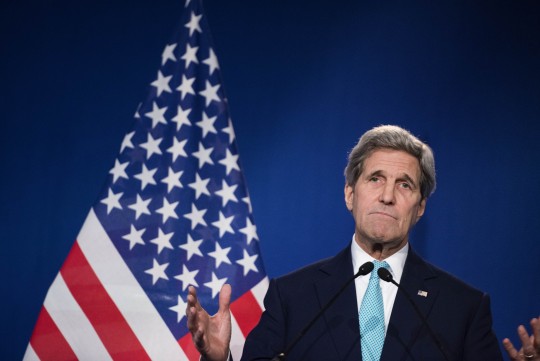
Secretary of State John Kerry told his Iranian counterpart that he wished the United States had a leader more like Supreme Leader Ayatollah Khamenei, according to comments made by a senior Iranian cleric and repeated in the country’s state-run media.

Ayatollah Alam al-Hoda claimed during Friday prayer services in Iran that in negotiations over Tehran’s contested nuclear program, Kerry told the country’s foreign minister that he “wished the U.S. had a leader like Iran’s supreme leader,” according to a Persian-language report on the remarkspublished by the Asriran news site.

“In the negotiations Kerry told [Iranian Foreign Minister Javad] Zarif that he [Kerry] wished U.S. had a leader like Iran’s supreme leader,” according to Alam al-Hoda, who is a senior member of the Iran’s powerful Assembly of Experts.

A senior administration official told the Washington Free Beacon that such a contention is patently absurd.

The remarks are the latest in a string of comments made by Iranian leaders purporting to reveal private details of the talks.

Iranian newspapers have carried multiple reports in recent months suggesting that Iranian Foreign Minister and chief negotiator Javad Zarif was ordered to stop screaming at Kerry behind closed doors.

In his Friday remarks, al-Hoda went on to say that Obama is set on striking a deal with Iran by June.

“Both Republicans and Democrats want these negotiations with Iran, but they fight each other for partisan interests,” he was quoted as saying. “Obama wants the negotiation to succeed so his party can win the next election and Republicans want to stop him.”

Alam al-Hoda also celebrated Iran’s expansion in the region and controversial activities in war-torn countries such as Syria and Yemen.

“Today, the resistance crescent has gone beyond Syria and Lebanon and reached to Yemen,” he said. “Today the resistance front is in control of Strait of Hormuz and Bab-el-Mandeb.”

The “U.S. and Israel have not been so weak anytime before,” he continues. “All these events are being managed by the hidden Imam,” a revered religious figure in Shia Islam.

Saeed Ghasseminejad, an Iranian dissident and fellow at the Foundation for Defense of Democracies (FDD), said U.S. overtures to Iran at the negotiating table have failed to win it any respect from the Islamic Republic’s leaders.

“President Obama thinks that by making more concessions he can gain the trust and respect of Iranian leaders,” Ghasseminejad said. “However, Iranian leaders neither trust him nor respect him.

“Seeing unprecedented weakness in the U.S. president, Iranian leaders do not fear the United States anymore. Partnership, trust, and alliance between the radical Islamist regime of Tehran and United States cannot and should not exist.”

Meanwhile, Zarif said over the weekend that fighting between the Obama administration and Congress over a potential final deal could not stop America from implementing any agreement the White House signs.

“As we have stated since the beginning, we consider the U.S. administration responsible for implementing the agreement and internal problems and conflicts in the U.S. are not related to us and to the implementation of the agreement, and based on the international laws, the countries’ internal problems don’t exempt them from implementing their undertakings and this is the main framework that we attach importance to,” Zarif said, according to the Fars News Agency.

On Monday, Zarif urged the United States to woo Iran.

“Maintaining an uncertain and unstable situation is not acceptable to Iran and the Americans should take practical and confidence-building measures to reach a comprehensive nuclear agreement,” Zarif was quoted as telling reporters.