Posted tagged ‘Israel’

The profs who love Obama’s Iran deal

August 10, 2015

The profs who love Obama’s Iran deal, Front Page MagazineCinnamon Stillwell, August 10, 2015

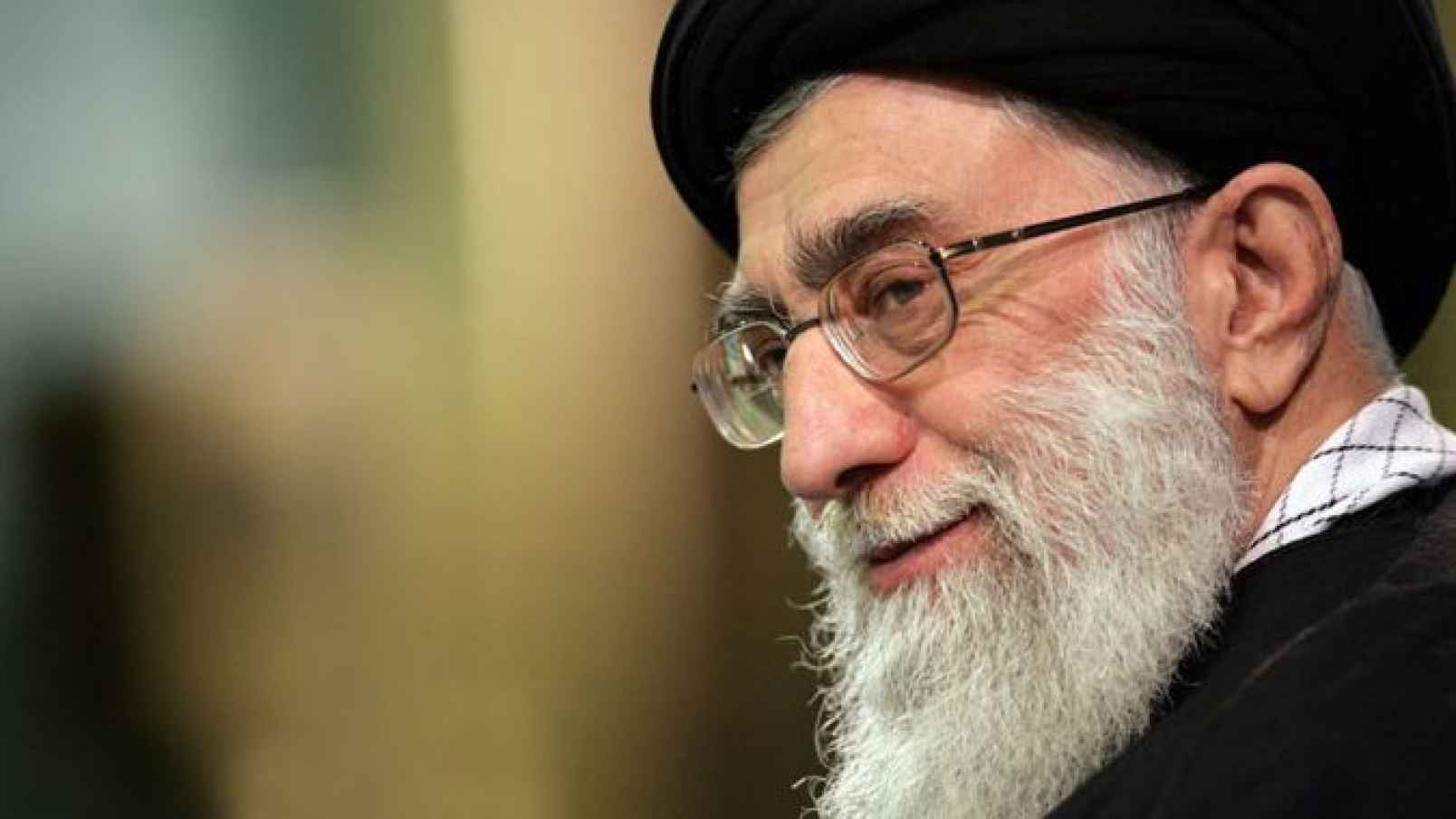
1.29.13-ayatollah-ali-khamenei

Meet the Mullahs’ academic cheerleaders.

Who supports the Obama administration’s increasingly unpopular Joint Comprehensive Plan of Action (JCPOA) aimed ostensibly at curbing Iran’s nuclear program? Many of its strongest proponents come from the field of Middle East studies, which boasts widespread animus towards the U.S. and Israel along with a cadre of apologists for the Iranian regime determined to promote ineffectual diplomacy at all costs.

University of California, Riverside creative writing professor Reza Aslan concedes that his generation of Iranian-Americans “feel[s] far removed from the political and religious turmoil of the Iranian revolution” before falling in line with the Iranian regime’s propaganda: the deal will “empower moderates in Iran, strengthen Iranian civil society and spur economic development,” and create “an Iran that is a responsible actor on the global stage, that respects the rights of its citizens and that has warm relations with the rest of the world.” “Warm relations” are the least likely outcome of the increase in funding for Iran’s terrorist proxies Hamas and Hezbollah that even President Obama admits will follow the easing of sanctions.

Flynt Leverett, an international relations professor at Pennsylvania State University, whitewashes these terrorist groups as “constituencies” and “communities” which the Iranian regime “help[s] organize in various ways to press their grievances more effectively,” effective terrorism being, for Leverett, a laudable goal.  Characterizing the regime as “a rising regional power” and “legitimate political order for most Iranians,” he urges the U.S., through the JCPOA, to “come to terms with this reality.”

Diablo Valley College Middle East studies instructor Amer Araim’s seemingly wishful thinking is equally supportive of Tehran’s line: “it is sincerely hoped that these funds will be used to help the Iranian people develop their economy and to ensure prosperity in that country.” Meanwhile, Hooshang Amirahmadi, an Iranian-American international relations professor at Rutgers University, attempts to legitimize the regime by delegitimizing the sanctions: “The money that will flow to Iran under this deal is not a gift: this is Iran’s money that has been frozen and otherwise blocked.”

Others deny the Iranian regime intends to build a nuclear bomb. University of Michigan history professor Juan Cole has “long argued that [Iran’s leader Ali] Khamenei is sincere about not wanting a nuclear weapon” because of his “oral fatwas or legal rulings” indicating that “using such weapons is contrary to Islamic law.” His unwarranted confidence in the regime leads him to conclude:

[T]hey have developed all the infrastructure and technical knowledge and equipment that would be necessary to make a nuclear weapon, but stop there, much the way Japan has.

Evidently, Cole has no problem with a tyrannical, terrorist-supporting regime that seeks regional hegemony on the threshold of becoming a nuclear power.

Likewise, William Beeman, an anthropology professor at the University of Minnesota, maintains that, “It was . . .  easy for Iran to give up a nuclear weapons program that never existed, and that it never intended to implement.” Like Cole, he uncritically accepts and recites the regime’s disinformation: “Iran’s leaders have regularly denounced nuclear weapons as un-Islamic.”

Beeman—who, in previous negotiations with the Iranian regime, urged the U.S. to be “unfailingly polite and humble” and not to set “pre-conditions” regarding its nuclear program—coldly disregards criticism of the JCPOA for excluding conditions such as the “release of [American] political prisoners” and “recognition of Israel,” calling them “utterly irrelevant.” No doubt the relatives of those prisoners and the Israeli citizens who live in the crosshairs of the regime’s continued threats of annihilation would disagree.

A number of academics have resorted to classic anti-Semitic conspiracy mongering to attack the deal’s Israeli and American opponents, calling them the “Israel Lobby.” Muqtedar Khan, director of the Islamic Studies Program at the University of Delaware, accuses “the Israeli government and all those in the U.S. who are under the influence of its American lobbies” of obstructing the deal, claiming that, “The GOP congress is now being described as the [Israeli Prime Minister Benyamin] Netanyahu congress.”

Hatem Bazian, director of the Islamophobia Research & Documentation Project at the University of California, Berkeley, takes aim at “pro-Israel neo-conservatives,” “neo-conservative warmongers,” “AIPAC,” and (in a mangled version of “Israel-firster”) “Israel’s first D.C. crowd” for “attempting to scuttle the agreement.” Asserting a moral equivalence between the dictatorial Iranian regime and the democratically-elected Israeli government, Bazian demands to know when Israel’s “pile of un-inspected or regulated nuclear weapons stockpile” will be examined before answering, “It is not going to happen anytime soon!” That Israel has never threatened any country with destruction, even after being attacked repeatedly since its rebirth, is a fact ignored by its critics.

The unhinged Facebook posts of Columbia University Iranian studies professor and Iranian native Hamid Dabashi reveal in lurid language his hatred of Israel:

It is now time the exact and identical widely intrusive scrutiny and control compromising the sovereignty of the nation-state of Iran and its nuclear program be applied to the European settler colony of Jewish apartheid state of Israel and its infinitely more dangerous nuclear program! There must be a global uproar against the thuggish vulgarity of Netanyahu and his Zionist gangsters in Israel and the U.S. Congress to force them to dismantle their nuclear program–systematically used to terrorize and murder Palestinian people and steal the rest of Palestine!

Elsewhere, Dabashi attacks adversaries of the JCPOA, including “Israel, Saudi Arabia, the U.S. Neocons, and their treacherous expat Iranian stooges masquerading as ‘Opposition,’” calling them a “terrorizing alliance,” a “gang of murderous war criminals,” and “shameless warmongers.”

Willful blindness to Iran’s brutal, terrorist-supporting regime, moral equivocation, and an irrational hatred for Israel and the West characterize the fawning support enjoyed by the mullahs from these and other professors of Middle East studies. In place of objective, rigorously researched plans for countering Iran’s aggression and advancing the safety of America and its allies, they regurgitate the crudest propaganda from Teheran. Until their field of study is thoroughly reformed, their advice—such as it is—should and must be utterly ignored.

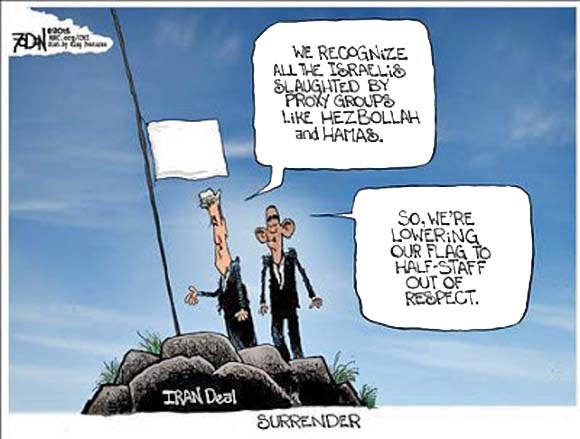
Cartoons of the day

August 10, 2015

H/t Vermont Loon Watch


hollywood
the-flag

H/t Joopklepzeiker

Poliyicus-prostitue

“Death to America” Falling on Obama’s Deaf Ears

August 10, 2015

“Death to America” Falling on Obama’s Deaf Ears, American ThinkerEileen F. Toplansky, August 10, 2015

(Please see also, It’s Not Just Iran’s Hardliners Saying ‘Death to America.’  — DM)

The Iranian curriculum is based on an Iranian-style Islam called the New Islamic Civilization (NIC).  The battle between good and evil, which is to be waged on a global scale, “is the responsibility of each Iranian citizen,” and “it begins with defense.”  America is seen as “arrogant,” and “any kind of freedom of speech, political debate or appreciation of Iranian culture or values other than those espoused by the regime are intolerable[.]”

[T]reating Iran as a normal country instead of one that inculcates acts of aggression is extraordinarily dangerous.

**********************

We are well past the point where we can ever believe Obama the man because, as those prescient about Obama’s background instinctively understood, whatever was taught  Obama the child is what is now being reflected in his dangerous anti-American actions.

Thus, the 17th-century Jesuit-inspired quotation of “give me the child, and I will mold the man” remains true.

This is why the idea that one can trust the Iranians is not only naive, but extraordinarily dangerous, given the education of their children.  In the May 2015 Special Interim Report entitled “Imperial Dreams: The Paradox of Iranian Education” by Eldad J. Pardo, the incessant propagandizing and intimidation of Iranian students is proof positive that they are being primed to attack those whom their leaders deem the enemy.  The first page of the report shows the map of a “New Dreams of World Power” with Iran at the center.  Underneath this map is a picture of “Iranian children preparing for martyrdom.”

Lest one think this is unthinkable, recall the fact that Iran and its proxies regularly send their children as suicidal bombers.  Thus, as Pardo recounts, the Iranian education curriculum includes “the ambition to impose Iranian hegemony on the world; a culture of militarism and jihad; blind obedience and martyrdom; and hostility and paranoia toward foreigners.”

In fact, “jihad war is unending,” and “the frenzied rush toward the end-of-time’s ‘horrifying battle'” is the lifeblood of continuous jihad.

The backdrop to all this education is the idea that Iran is committed to “total struggle for the creation of a just world order” and that such a “condition will remain until the coming of the Mahdi, the Shiite Messiah[.]”  The messianic ideal here is quite different from what most Westerners believe; that it is ignored will be a fatal mistake.  And Obama knows this, which is why Americans must stomach, yet again, his “compendium of demagoguery, historical revisionism and outright lying.”

Iranian students understand that “possible martyrdom on a massive scale and for which they practice from the first grade – could be launched as part of an Iranian ‘attack on countries ruled by oppressive governments.'”  Moreover, Iranian students study about “dissimulation” (taqiyya) and “misleading the enemy.”  They learn that “in time of need, dissimulation and  temporary pacts – even with ‘un-Godly, idolatrous governments’ – are proper (but only until such time as the balance of power should change).”  The idea of sacrifice is “constantly instilled in them,” as evidenced by the Teacher’s Guide for Persian, Grade 3 text.  Never is there any concern with the “human wave assault,” which includes many sacrificed schoolchildren.  Instead, enthusiasm for military participation is promoted in the first grade, for six-year-olds.

Surely Obama’s many Muslim Brotherhood advisers would have informed him of taqiyya, and since Obama early on learned the tenets of Islam, this is part of his worldview.  Whether one believes he is a pathological liar or not, the fact remains that Obama defends the Iranian deal with falsehoods and slurs.  Moreover, he recently exploited American college students at American University, much as his Iranian counterparts abuse their own children with incessant misinformation and propaganda.

The Iranian educational curriculum makes much of the Aryan-Shiite basis of Iranian identity wherein the Allies, and not Nazi Germany, are vilified, and, of course, the Holocaust is completely avoided.  Hence, the unremitting cries of “Death to Israel” fall on ears already primed to hate the Jew.  Furthermore, in echoes of Nazism, “children are instructed not to obey their parents in matters regarding martyrdom,” and pictures of soldiers are amply sprinkled in the textbooks.

This is of little concern to Obama, who has been surrounded by anti-Semites for many years.  The anti-Jewish hatred does not disturb him, nor does it deter him.  While Caroline Glick asserts that Obama maintains that “an anti-Semite is someone who refuses to recognize the 3,000-year connection between the Jews and the Land of Israel,” and “an anti-Semite is also someone who refuses to recognize the long history of persecution that the Jewish people suffered in the Diaspora,” this is hardly a ringing endorsement of ensuring that no harm will come to the Jewish people.  Acknowledging a connection to a piece of land is not the same as making certain that that land is not blown to smithereens.

The Iranian curriculum is based on an Iranian-style Islam called the New Islamic Civilization (NIC).  The battle between good and evil, which is to be waged on a global scale, “is the responsibility of each Iranian citizen,” and “it begins with defense.”  America is seen as “arrogant,” and “any kind of freedom of speech, political debate or appreciation of Iranian culture or values other than those espoused by the regime are intolerable[.]”

In essence, the “school textbooks prepare the entire Iranian population for a constant state of emergency, requiring Iranians to foment revolutions throughout the world, particularly across the Middle East, while evil arrogant enemies – who hate Iran and Islam – scheme against them.”  In fact, texts emphasize the martyrdom of women as well as cyber warfare tactics.  Most importantly, “students learn that no checks are needed on the Supreme Leader’s authority, including his right to sanctify new weapons” (italics mine).  Blind obedience to the Supreme Leader is mandatory.

In a Grade 11 Iranian text, students are enjoined to understand that jihad “covers a range of meanings including killing, massacring, murdering and fighting,” and jihad “permits its use against anyone, anywhere.”  There is “defensive jihad,” which refers to an “enemy transgressing the border or city of the Muslims, or defense of one’s own or other’s life, honor and property.”  Thus, as Muslims gain in number in American cities, it is clear that defensive jihad can be used, especially since defensive jihad is seen as a warfare that is “gradual” and that can be “military and sometimes cultural,” since it “sometimes aims at conquering a land or part of it and sometimes aims at political-economic control.”

Then there is “internal jihad,” which “represents a war with outlawed people who implement rebellion and disobedience as well as armed uprisings.”  Western ideas of freedom will be relegated to the dustbin of history, and those who desire it will be annihilated.

Finally there is “elementary jihad,” which at first glance sounds familiar to Western ears.  It is “defined as an attack on countries ruled by oppressive governments that do not allow free religious activities or freedom to listen to the call of religion.”  But there is no freedom of religion in Iran.  It can be only Islam.  There is no room for any other ideas.  And, in fact, “non-Islamic moral constraints” have no impact as Hezb’allah, Iran’s Lebanese proxy, or any other Islamic-inspired group engages in jihad.

Thus, as Jeffrey Herf writes, treating Iran as a normal country instead of one that inculcates acts of aggression is extraordinarily dangerous.  This is a war of ideas – whose will remain supreme?  In essence, Obama is painting a bull’s-eye on America, and not on Iran, who continues the “Death to America” chant on a regular basis.  And while Mona Charen claims that “Obama doesn’t take the Iranian chant seriously,” I, for one, beg to disagree.


Islamic State building capacity for mass casualty attacks

August 10, 2015

Islamic State building capacity for mass casualty attacks

ByPamela Geller on August 9, 2015

Global jihad 2015

via Islamic State building capacity for mass casualty attacks | Pamela Geller.

Video added by me .

What, Obama worry? The “Junior Varsity” team is not Islamic, says our supreme leader.

The U.S. intelligence community warns that ISIS may be working to build the capability to carry out mass casualty attacks, calling it a “a significant departure from the terror group’s current focus on encouraging lone wolf attacks.” Nonsense. It’s merely in addition to. It’s a jihad, a holy war, on all fronts — individual Muslims, Muslim armies, et al: “kill the unbelievers wherever you find them.”

When are we going to actually deal with the enemy and its ideology?

“ISIS seen building capacity for mass casualty attacks,” By Jim Sciutto, Chief National Security Correspondent, CNN, August 8, 2015

Washington (CNN)Some in the U.S. intelligence community warn that ISIS may be working to build the capability to carry out mass casualty attacks, a significant departure from the terror group’s current focus on encouraging lone wolf attacks, a senior U.S. intelligence official told CNN on Friday.

To date, the intelligence view has been that ISIS is focused on less ambitious attacks, involving one or a small group of attackers armed with simple weapons. In contrast, al Qaeda in the Arabian Peninsula, or AQAP, has been viewed as both more focused on — and more capable of — mass casualty attacks, such as plots on commercial aviation. Now the intelligence community is divided.

Meanwhile, the U.S. effort to train rebels in Syria to fight ISIS is having trouble.

Having trouble?? The 50 that the US recruited at the mind-blowing cost of 500 million dollars have “disappeared.”

The few rebels that the U.S. has put through training are already in disarray, with defense officials telling CNN that up to half are missing, having deserted soon after training or having been captured after last week’s attack by the al-Qaeda-affiliated Nusra Front attack on a rebel site.

Al Nusra claims attack on U.S.-trained rebels in Syria

One defense official admitted to CNN that “they are no longer a coherent military unit,” and Pentagon officials acknowledged the approach of how to support the rebels has to change.

The potential change within ISIS itself is driven — in part — by a broadening competition between ISIS and AQAP for attention and recruits.

More nonsense. It’s a power struggle, no doubt, but both groups are the same. They are waging jihad to impose Islam on the world. Their playbook is the Qur’an. Their example is Muhammad.

There were struggles between the SA and SS in Nazi Germany. It hardly stopped the Nazis.

That same competition was evident this week when AQAP bomb-maker Ibrahim al-Asiri made an online appeal to supporters to carry out lone wolf attacks.

“I think they’re taking a lot of the new recruits that don’t have time to train, who have not been brought up in their systems, and they’re using them to create the type of mass casualty which produces the media attention, which is exactly what they want, that shows they’re still powerful,” said CNN Military analysts Lt. Gen. Mark Hertling. Meanwhile, ISIS is continuing to draw large numbers of new foreign recruits. U.S. intelligence assesses that the formidable flow of foreign fighters to Syria and Iraq has not abated.

isis tank

Currently, the total number of ISIS fighters is between 20,000 and 30,000, similar to the levels when the air campaign began, despite thousands of ISIS fighters believed to have been killed in coalition air strikes.

This number is far too low.

Turkey, the prime transit point into Syria, is still struggling to stem the flow. However, the U.S. believes its agreement to allow U.S. air strikes from a Turkish air base and to help establish a safe zone indicate Istanbul is stepping up.

The administration is also claiming gains on the ground.

The day after the deal

August 9, 2015

The day after the deal, Israel Hayom, Prof. Eyal Zisser, August 9, 2015

(Please see also, Russia and US woo Saudis to help save Assad – albeit putting Israel and Jordan in danger from S. Syria.– DM)

[Soleimani] wanted Russia and Iran to agree on the division of the Middle East in a way that would serve their clients in the region (among them, Assad) and check their joint enemies (the Islamic State). After figuring that out, they probably moved on to the next topic: how to marginalize America in the region. As a means to both ends, Russia will continue to serve as Assad’s protector (despite his many crimes), all the while providing Iran with international backing. But above all it will send arms to Iran, to the Syrian regime, and if needed, to Hezbollah.

***********************

Over the weekend it transpired that Maj. Gen. Ghasem Soleimani, the commander of Iran’s Quds Force, had visited Moscow two weeks ago and met with President Vladimir Putin. The Quds Force, in case you forgot, is in charge of the Iranian Revolutionary Guards’ clandestine operations (including terrorism). The Quds Force is responsible for providing aid to Hezbollah and Hamas as well as to Syrian President Bashar Assad and the Houthi rebels in Yemen. In light of his direct involvement in terrorism, the international community imposed sanctions on Soleimani, including travel restrictions.

Only last week, at a hearing on Capitol Hill, U.S. Secretary of State John Kerry vowed that the U.S. will make sure the sanctions on Soleimani would stay in effect and that the Obama administration would counter Iran’s efforts to destabilize the Middle East. But no one takes Kerry seriously anymore. While Kerry continues to engage Iran’s unimportant Foreign Minister Mohammad Javad Zarif, the real wheeling and dealing is actually in Moscow.

Soleimani did not go to Moscow because he had tickets to the Bolshoi. Rather, he arrived because he wanted to discuss “the day after the nuclear deal” with Putin. Namely, he wanted Russia and Iran to agree on the division of the Middle East in a way that would serve their clients in the region (among them, Assad) and check their joint enemies (the Islamic State). After figuring that out, they probably moved on to the next topic: how to marginalize America in the region. As a means to both ends, Russia will continue to serve as Assad’s protector (despite his many crimes), all the while providing Iran with international backing. But above all it will send arms to Iran, to the Syrian regime, and if needed, to Hezbollah.

The Russians, unlike the Iranians, don’t consider Israel to be an enemy state. But as a famous Russian official once said: “When you chop wood, chips fly.” Israel has become the latest chip — the collateral damage. Soleimani’s visit is just the tip of iceberg. It shed light on the not-so-secret deals that are being negotiated in the wake of the “Vienna nuclear agreement.” Europe, as usual, is focused on profit and its corporate executives are already traveling in droves to Tehran to ink deals. There are also political deals Iran wants to secure, which are as important for Tehran. Their price, however, will be measured in blood rather than in euros or dollars.

No one in the Middle East, it seems, is keen on parsing each and every provision in the nuclear deal. Nor is there an attempt to see whether, in the grand scheme of things, it is will have been a worthwhile endeavor some 10 or 15 years from now, when its key elements expire. In this region, what counts is the way this agreement is perceived here and now — and what really matters to people is the way it is portrayed in the media. Under that criteria, Iran is the victor and America is the vanquished, because it caved to Iran. The deal, according to how the media has portrayed it, is a crushing political blow to Israel and the moderate Arab states, led by Saudi Arabia.

This knockout victory will likely produce a new Iranian-American partnership. At the very least, the two nations will mend fences. This will alienate many of Washington’s clients, who will have to look elsewhere for a more reliable ally. Egypt and the Saudis have already realized this and turned to Russia for aid and arms, figuring it would be more trustworthy than the “staff of this broken reed” (Isaiah 36:6).

Saudi Arabia is reportedly sending feelers to see if there is a deal to be had with Russia and Iran. Under the terms of the proposed deal, Saudi Arabia would withhold aid to the Syrian rebels if Iran ends its rogue presence in the state. Such a deal would secure Assad a victory over the insurgents, or a least ensure his regime survives.

The ongoing developments have caused panic, but not over the rising clout of Iran and Russia. The White House, it seems, is fretting over the possibility that Congress may vote against the Iran deal and further tarnish Obama’s image.

Russia and US woo Saudis to help save Assad – albeit putting Israel and Jordan in danger from S. Syria

August 9, 2015

Russia and US woo Saudis to help save Assad – albeit putting Israel and Jordan in danger from S. Syria, DEBKAfile, August 9, 2015

Lavrov_Kerry_and_al-Jubeir-_Doha_3.8.15Lavrov, Kerry, Al-Jubeir at Doha

[N]either Israel nor Jordan has been co-opted to this big power initiative, as though they are not concerned. However, both have a big stake in Saudi Arabia’s next decisions. If Riyadh is won over by US-Russian blandishments and goes back on its decision to boycott Assad, the Saudi-Israeli-Jordanian effort to support Syrian rebel control of southern Syria will fall apart. This will open up both countries to new perils on their  northern borders.

************************

Building on the nuclear accord signed in Vienna last month, the Obama administration has been in close communion with Moscow and Tehran on regional moves to save the Assad regime, as the key to their next regional policies, including a united front against the Islamic State.. Saudi Arabia and its Gulf partners are being assiduously wooed to join the new alignment being set up for this purpose. The live wire in getting them all together is Omani Foreign Minister Khalid bin Mohamed Al-Attiyah, the secret broker who brought Iran and the United States to the negotiating table for a nuclear accord. This was first reported in the last DEBKA Weekly.

Wednesday, Aug. 7, Obama threw out his first hint on this development: “The window has opened a crack for us to get a political resolution in Syria, partly because both Russia and Iran, I think, recognize that the trend lines are not good for Assad,” he said. “Neither of those patrons are particularly sentimental; they don’t seem concerned about the humanitarian disaster that’s been wrought by Assad and this conflict over the last several years, but they are concerned about the potential collapse of the Syrian state. And that means, I think, the prospect of more serious discussions than we’ve had in the past.”

The US president then affirmed more strongly in a CNN interview Sunday, Aug. 9:  “Is there the possibility that having begun conversations around this narrow issue [the nuclear accord with Iran] that you start getting some broader discussions about Syria, for example, and the ability of all the parties involved to try to arrive at a political transition that keeps the country intact and does not further fuel the growth of ISIL and other terrorist organizations? I think that’s possible,” Obama said. “But I don’t think it happens immediately.”

The administration and its prospective partners are united by the will to destroy ISIS – in its Syrian stronghold, for starters – but are divided on much else, DEBKA file reports. And so the process is moving forward in careful steps.

Their initial focus is on Syria, the bloody battleground which in less than five years has left at least 300,000 dead and more than 10 million people homeless.

The plan the group started out with in the last ten days was a swap as simple as it was ruthless: Saudi Arabia and the United Arab Emirates would slow their assistance to Syrian rebel groups, against whom President Bashar Assad’s army and allies would hold their fire; Iran, for its part, was to start withdrawing its support from the Yemeni Houthis insurgents.

The informal truce in Syria would be the stage for the Assad regime and rebel groups to start discussing a new government with room for opposition parties. The Islamists of the Islamic State and Al Qaeda’s Nusra Front would not be invited.

In Yemen, Tehran would cut back on the arms and intelligence which have enabled the Houthi insurgents to stand up to the combined forces of Saudi Arabia, the UAE and Egypt. The pro-Western Yemeni President Abd Rabo Mansour Hadi would be restored to his palace in Sanaa and invite the insurgent leader, Abdu Malik Al-Houthi, to discuss his partnership in a new government.

This deal was tantamount to a joint US-Russian guarantee of Bashar Assad survival in power in return for a Tehran-Riyadh compact for Hadi’s reinstatement in Sanaa.

These arrangements were debated back and forth in exchanges, some semi-secret, among the leading actors for most of July. The visit to Riyadh of the Syrian intelligence chief Maj. Gen. Ali Mamlouk was set up by Moscow as a major push forward.

The plan was for the entire enterprise to be brought out in the open and sealed in Doha, Qatar, Tuesday, Aug. 3 at a conference attended by US Secretary of State John Kerry, Russian Foreign Minister Sergey Lavrov, Saudi Foreign Minister Adel Al-Jubeir and other top Gulf diplomats.

Iranian Foreign Minister Mohammed Javad Zarif was not there. But he put a strong oar into the proceedings by calling in at Muscat, Oman the day before the conference and subsequently on Friday Aug. 7. Assad also kept his hand in by sending his foreign minister Walid Moallem to Tehran and Muscat last week.

But then, at Doha, just as the package was ready to unveil, the Saudi foreign minister pulled away and blew it up with two provisions: a) Riyadh would not countenance Bashar Assad being allowed to stay in office, and: b) Saudi Arabia would not do business with any representative of the Assad regime.

This put a large spoke in the main wheel of the initiative and also scuttled some of the secondary plans depending on it.

But by then, a lot was happening in the Yemeni and Syrian war arenas:

1. Saudi and UAE armored forces had landed in Aden and were closing in on the Yemeni capital, Sanaa. The Houthi rebels, trained and armed by Iran, were forced to retreat without negotiations on their future role in government.

2. Syrian rebel leaders, sensing the approaching betrayal, sent a secret delegation to Tehran to discuss terms for opening negotiations with Assad. They too were left at sea about the deals in play among Washington, Moscow, Tehran and Riyadh over their future.

Saturday, Aug.8, the Russians, egged on by the Americans, set about winning Riyadh into the fold, Foreign Minister Al-Jubeir was invited to pay a visit to Moscow Tuesday, Aug. 11, for talks about the Syrian conflict and the war on the Islamic State.

Refusing to accept that the new initiative had been grounded in Doha, Moscow presented the visit as continuing the ongoing dialogue on the issues raised at that encounter.

DEBKAfile’s military and intelligence sources note that neither Israel nor Jordan has been co-opted to this big power initiative, as though they are not concerned. However, both have a big stake in Saudi Arabia’s next decisions. If Riyadh is won over by US-Russian blandishments and goes back on its decision to boycott Assad, the Saudi-Israeli-Jordanian effort to support Syrian rebel control of southern Syria will fall apart. This will open up both countries to new perils on their  northern borders.

Column One: Obama’s enemies list

August 6, 2015

Column One: Obama’s enemies list, Jerusalem Post, Caroline Glick, August 6, 2015

ShowImage (8)US President Barack Obama at the Rose Garden of the White House. (photo credit:OFFICIAL WHITE HOUSE PHOTO / PETE SOUZA)

[T]he real question lawmakers need to ask is whether the deal is good for America. Is Obama right or wrong that only partisan zealots and disloyal Zionists could oppose his great diplomatic achievement? To determine the answer to that question, you need to do is ask another one. Does his deal make America safer or less safe? The best way to answer that question is to consider all the ways Iran threatens America today, and ask whether the agreement has no impact on those threats, or whether it mitigates or aggravates them.

***********************

In President Barack Obama’s defense of his nuclear deal with Iran Wednesday, he said there are only two types of people who will oppose his deal – Republican partisans and Israel- firsters – that is, traitors.

At American University, Obama castigated Republican lawmakers as the moral equivalent of Iranian jihadists saying, “Those [Iranian] hard-liners chanting ‘Death to America’ who have been most opposed to the deal… are making common cause with the Republican Caucus.”

He then turned his attention to Israel.

Obama explained that whether or not you believe the deal endangers Israel boils down to whom you trust more – him or Prime Minister Benjamin Netanyahu. And, he explained, he can be trusted to protect Israel better than Netanyahu can because “[I] have been a stalwart friend of Israel throughout my career.”

The truth is that it shouldn’t much matter to US lawmakers whether Obama or Netanyahu has it right about Israel. Israel isn’t a party to the deal and isn’t bound by it. If Israel decides it needs to act on its own, it will.

The US, on the other side, will be bound by the deal if Congress fails to kill it next month.

So the real question lawmakers need to ask is whether the deal is good for America. Is Obama right or wrong that only partisan zealots and disloyal Zionists could oppose his great diplomatic achievement? To determine the answer to that question, you need to do is ask another one. Does his deal make America safer or less safe? The best way to answer that question is to consider all the ways Iran threatens America today, and ask whether the agreement has no impact on those threats, or whether it mitigates or aggravates them.

Today Iran is harming America directly in multiple ways.

The most graphic way Iran is harming America today is by holding four Americans hostage. Iran’s decision not to release them over the course of negotiations indicates that at a minimum, the deal hasn’t helped them.

It doesn’t take much consideration to recognize that the hostages in Iran are much worse off today than they were before Obama concluded the deal on July 14.

The US had much more leverage to force the Iranians to release the hostages before it signed the deal than it does now. Now, not only do the Iranians have no reason to release the hostages, they have every reason to take more hostages.

Then there is Iranian-sponsored terrorism against the US.

In 2011, the FBI foiled an Iranian plot to murder the Saudi ambassador in Washington and bomb the Saudi and Israeli embassies in the US capital.

One of the terrorists set to participate in the attack allegedly penetrated US territory through the Mexican border.

The terrorist threat to the US emanating from Iran’s terrorist infrastructure in Latin America will rise steeply as a consequence of the nuclear deal.

As The Wall Street Journal’s Mary Anastasia O’Grady wrote last month, the sanctions relief the deal provides to Iran will enable it to massively expand its already formidable operations in the US’s backyard. Over the past two decades, Iran and Hezbollah have built up major presences in Cuba, Venezuela, Nicaragua, Ecuador and Bolivia.

Iran’s presence in Latin America also constitutes a strategic threat to US national security. Today Iran can use its bases of operations in Latin America to launch an electromagnetic pulse attack on the US from a ballistic missile, a satellite or even a merchant ship.

The US military is taking active steps to survive such an attack, which would destroy the US’s power grid. Among other things, it is returning the North American Aerospace Defense Command (NORAD) to its former home in Cheyenne Mountain outside Colorado Springs.

But Obama has ignored the findings of the congressional EMP Commission and has failed to harden the US electronic grid to protect it from such attacks.

The economic and human devastation that would be caused by the destruction of the US electric grid is almost inconceivable. And now with the cash infusion that will come Iran’s way from Obama’s nuclear deal, it will be free to expand on its EMP capabilities in profound ways.

Through its naval aggression in the Strait of Hormuz Iran threatens the global economy. While the US was negotiating the nuclear deal with Iran, the Revolutionary Guards unlawfully interdicted – that is hijacked – the Marshall Islands-flagged Maersk Tigris and held its crew hostage for weeks.

Iran’s assault on the Tigris came just days after the US-flagged Maersk Kensington was surrounded and followed by Revolutionary Guards ships until it fled the strait.

A rational take-home message the Iranians can draw from the nuclear deal is that piracy pays.

Their naval aggression in the Strait of Hormuz was not met by American military force, but by American strategic collapse at Vienna.

This is doubly true when America’s listless response to Iran’s plan to use its Houthi proxy’s takeover of Yemen to control the Bab el-Mandab strait is taken into consideration. With the Bab el-Mandab, Iran will control all maritime traffic from the Persian Gulf and the Red Sea. Rather than confront this clear and present danger to the global economy, America abandoned all its redlines in the nuclear talks.

Then there is Iran’s partnership 20-year partnership with al-Qaida.

The 9/11 Commission found in its report that four of the 9/11 terrorists transited Iran before traveling to the US. As former Defense Intelligence Agency director Lt.-Gen. (ret.) Mike Flynn told Fox News in the spring, Iranian cooperation with al-Qaida remains deep and strategic.

When the US Navy SEALs killed Osama bin Laden in 2011, they seized hard drives containing more than a million documents related to al-Qaida operations. All but a few dozen remain classified.

According to Flynn and other US intelligence officials who spoke to The Weekly Standard, the documents expose Iran’s vast collaboration with al-Qaida.

The agreement Obama concluded with the mullahs gives a tailwind to Iran. Iran’s empowerment will undoubtedly be used to expand its use of al-Qaida terrorists as proxies in their joint war against the US.

Then there is Iran’s ballistic missile program.

The UN Security Council resolution passed two weeks ago cancels the UN-imposed embargoes on conventional arms and ballistic missile acquisitions by Iran. Since the nuclear deal facilities Iranian development of advanced nuclear technologies that will enable the mullahs to build nuclear weapons freely when the deal expires, the Security Council resolution means that by the time the deal expires, Iran will have the nuclear warheads and the intercontinental ballistic missiles required to carry out a nuclear attack on the US.

Obama said Wednesday that if Congress votes down his nuclear deal, “we will lose… America’s credibility as a leader of diplomacy. America’s credibility,” he explained, “is the anchor of the international system.”

Unfortunately, Obama got it backwards. It is the deal that destroys America’s credibility and so upends the international system which has rested on that credibility for the past 70 years.

The White House’s dangerous suppression of seized al-Qaida-Iran documents, like its listless response to Iran’s maritime aggression, its indifference to Iran’s massive presence in Latin America, its lackluster response to Iran’s terrorist activities in Latin America, and its belittlement of the importance of the regime’s stated goal to destroy America – not to mention its complete collapse on all its previous redlines over the course of the negotiations – are all signs of the disastrous toll the nuclear deal has already taken on America’s credibility, and indeed on US national security.

To defend a policy that empowers Iran, the administration has no choice but to serve as Iran’s agent. The deal destroys America’s credibility in fighting terrorism. By legitimizing and enriching the most prolific state sponsor of terrorism, the US has made a mockery of its claimed commitment to the fight.

The deal destroys the US’s credibility as an ally.

By serving as apologists for its worst enemy, the US has shown its allies that they cannot trust American security guarantees. How can Israel or Saudi Arabia trust America to defend them when it is endangering itself? The deal destroys 70 years of US nonproliferation efforts. By enabling Iran to become a nuclear power, the US has made a mockery of the very notion of nonproliferation and caused a nuclear arms race in the Middle East.

The damage caused by the deal is already being felt. For instance, Europe, Russia and China are already beating a path to the ayatollahs’ doorstep to sign commercial and military deals with the regime.

But if Congress defeats the deal, it can mitigate the damage. By killing the deal, Congress will demonstrate that the American people are not ready to go down in defeat. They can show that the US remains committed to its own defense and the rebuilding of its strategic credibility worldwide.

In his meeting with Jewish leaders Tuesday, Obama acknowledged that his claim – repeated yet again Wednesday – that the only alternative to the deal is war, is a lie.

Speaking to reporters after the meeting, Greg Rosenbaum, chairman of the National Democratic Jewish Council, which is allied with the White House, said that Obama rejected the notion that war will break out if Congress rejects the deal with veto-overriding majorities in both houses.

According to Rosenbaum, Obama claimed that if Congress rejects his nuclear deal, eventually the US will have to carry out air strikes against Iran’s nuclear facilities in order to prevent them from enriching uranium to weapons-grade levels.

“But,” he quoted Obama as saying, “the result of such a strike won’t be war with Iran.”

Rather, Obama said, Iran will respond to a US strike primarily by ratcheting up its terrorist attacks against Israel.

“I can assure,” Obama told the Jewish leaders, “that Israel will bear the brunt of the asymmetrical responses that Iran will have to a military strike on its nuclear facilities.”

What is notable here is that despite the fact that it will pay the heaviest price for a congressional defeat of the Iran deal, Israel is united in its opposition to the deal. This speaks volume about the gravity with which the Israeli public views the threats the agreement unleashed.

But again, Israel is not the only country that is imperiled by the nuclear deal. And Israelis are not the only ones who need to worry.

Obama wishes to convince the public that the deal’s opponents are either partisan extremists or traitors who care about Israel more than they care about America. But neither claim is true. The main reason Americans should oppose the deal is that it endangers America. And as a consequence, Americans who oppose the deal are neither partisans nor turncoats.

They are patriots.

Russia slams U.S. attempts to provide air cover to Syrian rebels

August 6, 2015

Russia slams U.S. attempts to provide air cover to Syrian rebels

Middle East

August 4, 2015

via Russia slams U.S. attempts to provide air cover to Syrian rebels – The Journal of Turkish Weekly.

Is this a declaration of war ?

Kremlin denounced Monday the U.S. attempts to provide air cover for Syrian rebels, indicating it will ultimately destabilize the country’s situation.

“We have repeatedly stressed that the assistance, especially financial or technical one, to the Syrian opposition would further destabilize the situation in the country,” Kremlin spokesman Dmitry Peskov said.

Once implemented, the plans would benefit the so-called Islamic State (IS) terrorists, weakening the counter potential of the Syrian capital Damascus, Peskov said.

“This is a fundamental disagreement between Moscow and Washington over Syria,” he added.

On Sunday, U.S. President Barack Obama reportedly authorized air defense to U.S.-backed Syrian rebels against attacks from terrorists or Syrian government forces.

More here .

The U.S. directly stated Tuesday that it would protect its nascent force of Syrian rebels from Syrian government attacks.

“What we are trying to convey is that we’ll also do defensive efforts in case or in the hypothetical that they would come under fire from Syrian forces,” State Department spokesman Mark Toner told reporters.

He ruled out that any such attack would be offensive, however, Toner said “any type of effort to protect them from Syrian forces would be defensive in nature”.

White House spokesman Josh Earnest hinted at the policy Monday, saying previous warnings that Washington issued to Damascus to not interfere with its aerial bombardment of Daesh and other Syrian extremists holds true for the U.S.-trained opposition forces.

He added that the U.S. and its coalition partners are “committed to using military force where necessary to protect the coalition-trained and equipped Syrian opposition fighters that are operating against ISIL inside of Syria right now”.

The decision by President Barack Obama could potentially further Washington’s stake in the Syrian conflict, and drag the U.S. deeper into ongoing hostilities – action the Obama administration has been reluctant to take.

http://www.turkishweekly.net/2015/08/05/news/us-explicitly-warns-damascus-not-to-attack-its-rebels/


Liar, Liar, World on Fire!

August 6, 2015

Liar, Liar, World on Fire!

Obama spins lies while Iran spins centrifuges.

August 6, 2015

Daniel Greenfield

via Liar, Liar, World on Fire! | Frontpage Mag.

Daniel Greenfield, a Shillman Journalism Fellow at the David Horowitz Freedom Center, is a New York writer focusing on radical Islam.​

Obama loves to play dress up. Sometimes he likes to play FDR, but his favorite costume is JFK. By claiming to be FDR or JFK, he convinces Democrats that he is part of a historical continuity, instead of a horrible aberration, and that he is doing exactly what FDR or JFK would do if they were alive today.

The costumes make Obama seem American instead of Un-American.

Now Obama put on his JFK costume to play the leader who believes in a “practical” and “attainable peace.” His analogy of the USSR to Iran is both terrible and telling.

Nuclear war was not averted because of arms control. The USSR, like Iran, cheated blatantly. Unlike Iran, its leaders weren’t crazy enough to want to see the world burn.

The same can’t be said of the Supreme Leader of Iran who chants “Death to America” and means it.

Treaties did not end the Cold War. The collapse of the USSR, under the pressure of its economic failures, did. Had Obama kept the sanctions in place, Iran’s regime might have also collapsed.

Instead Obama chose to bailout Iran’s regime to the tune of anywhere from 50 to 150 billion dollars; just as he spat on the legacy of JFK by bailing out Castro when the Cuban regime was on its last legs.

By talking about multilateral arms control and the USSR, Obama implicitly admits that this isn’t about preventing Iran from obtaining nuclear weapons, but about opening communications with the Mullahs.

His accusation that opponents of the deal are like those who want “to take military action against the Soviets” is dishonest after he had just admitted that even taking out Iran’s nuclear program would not lead to a war between Iran and the United States.

But Obama’s whole speech is a collection of lies.

He insists that the nuclear deal is “a detailed arrangement that permanently prohibits Iran from obtaining a nuclear weapon”.

There’s nothing “permanent” about it. Even Obama admitted that by Year 13, “breakout times would have shrunk almost down to zero.”  In the same speech in which he makes that claim, he admits (optimistically) that Iran might get a nuke in fifteen years. That’s not what permanent means.

Later he again insists that, “Iran is never allowed to build a nuclear weapon” and puffs up his chest and declares, “Let me repeat:  The prohibition on Iran having a nuclear weapon is permanent.”

This sounds impressive to audiences at home, but it’s completely meaningless.

Iran is an NPT signatory so it was never allowed to build nuclear weapons to begin with. That hasn’t stopped it from trying to do so.

The deal will be as useless as the NPT when it comes to actually stopping Iran from going nuclear.

Obama and Kerry have tried to sell the deal by confusing existing international obligations and laws with an effective enforceable agreement. When Obama says that Iran is not allowed to build a nuke, that means as much as Kerry telling PBS that Iran is “not allowed” to use the sanctions relief to aid terrorists.

The 9/11 hijackers were also “not allowed” to fly planes into the World Trade Center.

In this speech, Obama admits that even though it’s “not allowed” to, Iran will use the money to fund terrorists and he has already admitted that Iran can go nuclear even though it’s “never allowed” to.

Both men are deliberately misleading audiences that aren’t well versed in lawyerly technicalities.

Obama claimed that the deal, which lets Iran build up its nuclear program, “cuts off all of Iran’s pathways to a bomb.” In reality, the deal lets Iran conduct enrichment, run centrifuges and do everything but have official permission to nuke New York or Tel Aviv.

He already admitted that the breakout time drops to zero. If there were no pathway to a bomb, there would be no breakout time, let alone a breakout time of zero.

Obama insisted that the deal “contains the most comprehensive inspection and verification regime ever negotiated” when Iran has stated that not even Obama knows what its military site inspection arrangements with the IAEA will involve.

Essentially the real agreement has been outsourced to the IAEA based on secret side agreements that the Senate and that even the White House may not be privy to. And the IAEA’s director-general is already complaining that Iran is refusing access to nuclear scientists and military officers.

This deal maintains Iran’s nuclear program while promising that this time the IAEA will have more access for inspections than it did before, assuming Iran doesn’t break this agreement, like it broke the NPT.

That’s it.

Obama insists that if Iran goes back to defying the IAEA, as it has all these years, the sanctions will “snap back”. He even goes further, claiming that, “We won’t need the support of other members of the U.N. Security Council; America can trigger snapback on our own.” America can go to the Security Council. It can’t however restore the full set of sanctions now in place on its own. This is one of those cases where Obama is so deliberately misleading audiences that it’s downright criminal.

Since the facts aren’t on his side, Obama falls back to accusing critics of being warmongers who want to invade Iran just like they wanted to invade Iraq. Does that include his Secretary of State, who carried these negotiations, and who stated, “I was in favor of disarming Saddam Hussein, and I’m glad we did.”

Obama mentioned Iraq twelve times in his speech. He ominously warned that “Many of the same people who argued for the war in Iraq are now making the case against the Iran nuclear deal.”

Does that include Hillary Clinton and Joe Biden?

Obama speaks of ending “a mindset characterized by a preference for military action over diplomacy.” When he attacks George W. Bush as a warmonger who liked unilateral invasions, lying to Americans about the cost of war and imposing his will on “a part of the world with a profoundly different culture”, he forgets his illegal invasion of Libya, the murder of four Americans and the rise of ISIS in Libya.

But Obama isn’t just a liar, he’s also a hypocrite.

“The deal we’ll accept is they end their nuclear program,” Obama said, during a presidential debate with Romney.

In this speech, he sneered at his own campaign promise, reframing the idea of dismantling Iran’s nuclear program, as coming from critics who are “are either ignorant of Iranian society, or they’re just not being straight with the American people”.

“Sanctions alone are not going to force Iran to completely dismantle all vestiges of its nuclear infrastructure,” Obama claims.

He seems to have forgotten how he boasted that, “The work that we’ve done with respect to sanctions now offers Iran a choice. They can take the diplomatic route and end their nuclear program or they will have to face a united world and a United States president, me, who said we’re not going to take any options off the table.”

The only options Obama won’t be taking off the table are surrendering and then lying about it.

This is exactly the type of rhetoric that he just now condemned as ignorant, dishonest and impossible to achieve. So was Obama being ignorant or dishonest then? Or is he being dishonest now?

Obama insists that we face a choice between diplomacy and war. As Churchill told Chamberlain, you can have both. “You were given the choice between war and dishonor. You chose dishonor, and you will have war.” Appeasement of an aggressive conqueror doesn’t prevent war. It makes it inevitable.

The Appeaser-in-Chief tells the audience that it shouldn’t overreact to the “hardliners chanting ‘Death to America’ who have been most opposed to the deal.  They’re making common cause with the Republican caucus.”

These “hardliners” include the Supreme Leader of Iran. The man Obama has made common cause with.

While Obama never misses an opportunity to accuse Republican opponents of treason, when he isn’t accusing them of warmongering, he is the traitor. He has made common cause with those who chant, “Death to America.” And sometimes it’s hard not to wonder whether he agrees with them.

All Obama has to offer in this speech, and in every speech, is a selection of the same dishonest arguments that have been disproven even by his own allies in the Senate and in the media.

He’ll smugly repeat the same lies about Iran’s tiny military budget (the secret one is much bigger), about its “permanent” inability to get a bomb (until it does get one) and the sanctions that can snap back with a snap of his fingers, but will vanish the moment Congress votes down this deal.

There’s nothing new here and there’s nothing truthful here.

Even while Obama spins lies, Iran spins centrifuges. Even as he promises rigorous inspections, Iran covers up its nuclear activities at Parchin.

Obama has violated his own promises on Iran. He mocks the same arguments that he used to advance. He keeps talking about a military option when he won’t even stand up to Iran as it threatens American ships and helicopters, as it takes over Yemen and Iraq, And when in doubt, he begins bashing Bush without ever being honest about his own terrible legacy of military and political interventions.

It’s a petty performance from a man who likes to dress up as FDR and JFK, but who when it comes to Iran can’t even measure up to Jimmy Carter.

John Kerry’s Hypocrisy: “Can You Deliver?”

August 6, 2015

John Kerry’s Hypocrisy: “Can You Deliver?

By: Paul Gherkin

Published: August 6th, 2015

Latest update: August 4th, 2015

via The Jewish Press » » John Kerry’s Hypocrisy: “Can You Deliver?”.

Secretary of State John Kerry (L) seen with PA President Mahmoud Abbas.
Photo Credit: Issam Rimawi/FLASH90

{Originally posted to the author’s website, FirstOne Through}

Listening to US Secretary of State John Kerry try to explain and defend the P5+1 Iranian nuclear deal to various audiences is a spectacle to behold, regardless of one’s position on the best course of action.  One of the people who might want to watch the sessions and learn something from John Kerry is John Kerry.

Secretary Kerry argued at the Council for Foreign Relations (CFR) that Congress must support the deal or it would undermine his ability to negotiate any treaty with any government in the future. At 29:55 of the CFR talk, Kerry said: “Other people in the world are going to sit there and say ‘hey, let’s negotiate with the United States, they have 535 Secretaries of State. I mean, please! I would be embarrassed to try to go out… I mean, what am I going to say to people after this as Secretary of State? ‘Come negotiate with us?’ ‘Can you deliver?’ Please!

Kerry made the point that when two parties sit down to negotiate, it is critical for the sides to know that the negotiating parties are both authorized to negotiate and have the ability to fulfill their sides of the deal. If no such authority or ability exists, the discussions are an irrelevant waste of time.

Despite Kerry being quite clear about his logic, he has nevertheless insisted that Israeli Prime Minister Benjamin Netanyahu sit down and negotiate with Acting-President of the Palestinian Authority Mahmoud Abbas, even though it is clearly understood that Abbas can deliver nothing.

  • No Mandate: Abbas’s four-year term as president ran out in 2009. No presidential elections have been held since then.
  • No Authority: Abbas’s Fatah party lost legislative elections in 2006, winning only 33% of the parliament. No legislative elections have been held since then.
  • No Support: Abbas lags in every Palestinian poll held since 2006.
  • No Control: Abbas has no control of Gaza since his Fatah party was kicked out in 2007.
  • No Track Record: Abbas has shown zero credibility in being able to strike compromises to govern his own people, let alone deliver compromises with Israel.

Despite the glaringly obvious impotence of Abbas, the Obama administration continued to pressure Israel to negotiate with this straw man.

The Obama administration publicly acknowledged that the Palestinian Authority has absolutely no ability to deliver peace a few years ago. During the Gaza war on Israel in 2012, then US Secretary of State Hillary Clinton tried to broker a cease-fire. She made a dozen calls to various world leaders to halt the war- but not ONCE called the Abbas and the Palestinian Authority.

Compounding the inherent flaws in Abbas and the Palestinian Authority is Abbas’s insistence on bringing terms of any deal with Israel to a referendum. Abbas stated that he cannot decide on the “Right of Return” for all Palestinians, but that each of the 5 million Palestinian Arab “refugees” must make a decision for themselves. Hey Kerry- 535 “second-guessers” looks pretty good compared to 5 million! In terms of the rest of the components of a final agreement, Abbas stated that he “would go to a referendum everywhere because the agreement represents Palestinians everywhere.”  That’s impressive – he seeks the approval of 11 million “Palestinian” Arabs from all around the world!

Kerry’s comments regarding Iran are both on- and off-the-mark.  Iran and all of the parties in the negotiations know that the United States is a democracy and the political process must run its course.  Once the American people’s representatives in Congress make a decision, the government will deliver on its commitments.

However, Abbas – a complete straw man if ever there was one – with no authority or control whatsoever, openly states that millions of individuals will ultimately not only decide the fate of an Israeli-PA deal overall, but even on certain components on an individual basis.

Kerry fully appreciates that before negotiators start a process that they want to know the answer to the fundamental question: “Can you deliver“? However, he doesn’t care when he forces Israel to do exactly that with Abbas and the Palestinian Authority.


Related FirstOneThrough video and articles:

Abbas demands R-E-S-P-E-C-T

The Disappointing 4+6 Abbas Anniversary

Palestinian “Refugees” or “SAPs”?