Posted tagged ‘Islamist terror attacks’

A bloodied ISIS staggers on

March 26, 2017

A bloodied ISIS staggers on, Israel Hayom, Prof. Eyal Zisser, March 26, 2017

(According to the first sentence in the article, “Europe is learning the hard way what Israel learned decades ago.” If so, Europe must be an extremely slow learner. More likely, it resembles a terminally ill lung cancer victim who continues to smoke cigarettes and to inhale the smoke in hopes that it will cure him. Please see also, Islam, Not Christianity, is Saturating Europe. — DM)

Europe is learning the hard way what Israel learned decades ago. The war on terror is an ongoing struggle with ups and downs, and always painful failures. This fight requires patience and determination. There is no magic knockout punch, not by a spectacular military operation in the Syrian hinterlands or the assassination of some terrorist cell or another in a Paris or London suburb. A fight such as this can go on for years, as the reality prevalent in Europe is not about to change.

An equally important lesson, which Europe is also about to learn, is that terror constantly changes shape. In the past, al-Qaida spearheaded the waves of terrorist attacks in Europe. Now Islamic State has taken the reigns, and we can assume that if it fades and disappears, another Islamist group will take its place. The name and the headlines will change, to be sure, but the ideology will remain the same; the targets will continue to be innocent civilians across Europe, and the attackers will continue to be the same Muslim youths so enraptured by religious madness. It will be no different than our experience in Israel.

The terrorist attack perpetrated by Islamic State in London came on the heels of stinging defeats in its strongholds in Syria and Iraq. The organization’s dream of establishing an Islamic caliphate is on the verge of falling apart with the approaching fall of its government centers in Mosul, Iraq and Raqqa, Syria, which serves as its capital. The organization has already lost nearly half the territory it once held, and the signals being sent by the new administration in Washington point to U.S. President Donald Trump’s willingness and even determination to send American troops into the fray to fight the organization in a decisive manner.

Islamic State’s defeat will apparently induce a monumental battle between the winners — Iran and its allies — on one side, and Turkey and the moderate Arab states on the other. Iran, to be certain, will try filling the void left by Islamic State by establishing a land corridor from Tehran to Beirut. Its adversaries, meanwhile, will try preventing the Islamic republic from achieving its goals. All this, while Russia and the U.S. will watch from the sidelines and perhaps even fan the flames in order to advance their own interests in the region.

What is important to understand, however, is that the defeat of Islamic State and the fall of the country it created in the Middle East will not be the end of the story, not for the organization itself and certainly not for the ideology it espouses. We must keep in mind that Islamic State is first and foremost an extremist ideology, which enjoys support from local populations in the Middle East and from Muslim communities across the globe.

It is also an organization that rallies support from disenfranchised populations in the region — which feel persecuted by their centralized governments — whether these are Sunnis in Iraq or eastern Syria, or Bedouin tribes in the Sinai Peninsula. Thus, even if the state it created in eastern Syria and northern Iraq crumbles, we can assume Islamic State will withdraw deep into the desert from which it came and shift to operating as a ruthless underground organization that still enjoys support from local populations. Case in point, in Sinai the group continues to operate successfully despite being pummeled by Egypt.

Islamic State also has other areas within which it can operate, such as Libya or Yemen, where it has established footholds under the cover of the civil wars persisting there unabated. There has been a great deal of speculation recently over the possibility that the group could transfer its government centers to these places. Finally, sentiment for the organization and its ideas will continue to inspire and compel Muslim youths from across the globe to carry out terrorist attacks. Other radical Islamist organizations, which are more than willing to pick up where Islamic State ends, are also vying for the hearts and minds of these youths.

The waves of terror, therefore, will continue crashing into Europe, despite all the efforts to stop them and despite the military successes against Islamic State’s leaders and commanders in Syria and Iraq. Yet the fight must remain unrelenting, as this is the nature of the war against terror. It is the only way to ensure normal life in Europe. As the Israeli experience teaches, this should be the goal, even with the knowledge that terror has not been completely defeated.

Lessons From the Parliament Attack

March 26, 2017

Lessons From the Parliament Attack, Power Line, John Hinderaker, March 25, 2017

There is diversity in Islam, including millions of Muslims who adhere only to its spiritual elements or see themselves as more culturally than doctrinally Islamic. But when we speak of Islam, as opposed to Muslims, we are not speaking about a mere religious belief system. We are talking about a competing civilization — that is very much how Islam self-identifies. It has its own history, principles, values, mores, and legal system. Islam, thus understood, is not non-Western. It is anti-Western.

****************************

England has been shaken by the terrorist attack on Westminster Bridge and Parliament that was carried out last Wednesday by Khalid Masood, whose real name was Adrian Elms or Adrian Ajao. As more information has come out about the terrorist, a number of observations can be made.

1) Masood/Elms/Ajao was an unusual terrorist in some ways, and typical in others. Like nearly all Islamic terrorists, he had a middle-class upbringing and at one point lived in a million dollar house in East Sussex. Drugs apparently precipitated his descent, and he had a criminal history that landed him in prison. Masood was not religious until his incarceration–his parents are Christians–but, like many others, he converted to Islam while in prison. After his release, he persuaded one of his daughters to adopt Islam, change her name and wear a hijab. At 52, he was quite a bit older than most terrorists.

2) Masood used the current weapons of choice, an automobile and two knives. Westminster Bridge is generally crowded with pedestrians, and he simply drove his car into a crowd of them, killing five and injuring as many as 50, some critically. This type of attack is very hard to stop–for practical purposes, impossible.

Following the attack, giant yellow bollards were placed in the area around Buckingham Palace to prevent attackers from driving vehicles into the crowds that always congregate there:

I don’t blame the Brits for doing this; the area around the White House is blocked off in a similar way, if I am not mistaken. But obviously, protecting a few high-profile areas does nothing to stop an Islamic terrorist (or anyone else) from driving a vehicle into a crowd anywhere, in any city.

When mass murders occur, liberals tend to focus on the weapons used by the murderer. Terrorist attacks carried out with cars and knives illustrate the futility of this approach. The only solution–if there is one–is to identify and stop the terrorist before he acts. Also, to take any feasible steps that will reduce the number of potential terrorists in the population.

3) Like many other terrorists, Masood was known to the British authorities. But they didn’t consider him a serious threat:

At some point he was investigated by MI5 over links to violent extremism but was considered too minor to monitor, and did not feature on a 3,000-strong list of suspects feared to be capable of mounting an attack.

Not surprisingly, it is very difficult to predict which radical Muslims will actually launch attacks.

4) Masood reportedly spent several years in Saudi Arabia, where he was immersed in Wahabbism. That is a pretty good predictor of radical belief and behavior.

5) One of those murdered by Masood was a policeman named Keith Palmer, whom Masood stabbed to death after crashing through a gate to the Parliament building. Palmer likely would have been even more of a hero if he hadn’t been unarmed. Disarming one’s own police force is insane.

6) Here in the U.S., there has been much talk of “vetting.” While checking out visitors and, especially, immigrants to the U.S. is certainly appropriate, to the limited extent it is possible, vetting is wholly inadequate as a security measure. Many terrorists are second generation immigrants, and others, like Masood, are Islamic converts.

7) The problem is Islam. Not all or even most Muslims, of course, but rather Islam as a political ideology. Andy McCarthy makes the point well at National Review. You should read the whole thing, which is a good primer on the subject. Here are some excerpts:

There is diversity in Islam, including millions of Muslims who adhere only to its spiritual elements or see themselves as more culturally than doctrinally Islamic. But when we speak of Islam, as opposed to Muslims, we are not speaking about a mere religious belief system. We are talking about a competing civilization — that is very much how Islam self-identifies. It has its own history, principles, values, mores, and legal system. Islam, thus understood, is not non-Western. It is anti-Western.

Like the conversion of Masood, the conversion of Birmingham has been a function of this defining Islamic attribute. Individual Muslims may assimilate, but Islam doesn’t do assimilation. Islam does not melt into your melting pot. Islam, as Muslim Brotherhood founder Hassan al-Banna proclaimed, is content with nothing less than political, cultural, and civilizational dominance.

As Soeren Kern relates in a comprehensive Gatestone Institute report on Islam in Britain, the metamorphosis of Birmingham, along with several other U.K. population centers, signifies this resistance. When the Islamic presence in a Western community reaches a critical mass, Islam’s hostility to Western mores and demands for sharia governance result in non-Muslim flight. Marriages between Muslims resident in the Western community and Muslims overseas tend to result in childbirth rates and household growth that dwarfs that of the indigenous population. Arranged, intra-familial, and polygamous marriages, endorsed by Islamic mores, drastically alter the fabric of communities in short order. Birmingham, in particular, has been ground zero of “Operation Trojan Horse,” a sharia-supremacist scheme to Islamize the public schools.
***
[T]he remorseless fact is that before ISIS and al-Qaeda and the Khomeini revolution and Hezbollah and the Blind Sheikh and the Brotherhood and Khalid Masood, there was the single thing that unites them all. There was Islam.

Western political and opinion elites remain willfully blind to this. They cannot help but project onto Islamic beliefs and practices their own progressive pieties — which take seriously neither religion nor the notion that there is any civilization but their own.

America is committed to the assumption that Islam, in all of its varieties and manifestations, is merely a religion. This entitles Islam not only to the full protection of the First Amendment, but also to the presumption that it is a benign if obsolete force, like other religions. Which explains why journalists puzzle over what could possibly have motivated the terrorist who shouts “Allahu akbar” to kill infidels.

Satire | Jamie Glazov Moment: How Not to Blame Islam for the Jihad in London.

March 25, 2017

Jamie Glazov Moment: How Not to Blame Islam for the Jihad in London via YouTube, March 24, 2017

A Week of Terror and Diversity in Europe

March 24, 2017

A Week of Terror and Diversity in Europe, Front Page Magazine, Daniel Greenfield, March 24, 2017

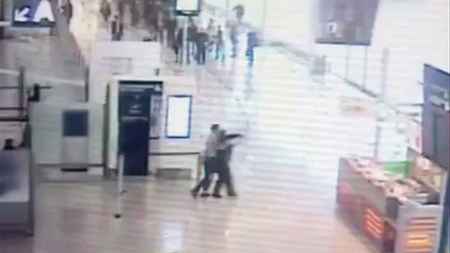
On Saturday, Ziyed Ben Belgacem pays a visit to Orly Airport in Paris. He grabs a female soldier from behind and grapples for her rifle while holding a pellet gun to her head. He warns the other soldiers to drop their rifles and raise their hands.

He shouts, “I am here to die in the name of Allah … There will be deaths.”

He’s mostly right. It’s the plural part he gets wrong. The soldier goes low. Her friends shoot him dead. But he’s not entirely wrong either. There will be deaths. Even if they aren’t at Orly Airport.

French Police go on to investigate the motive of the Tunisian Muslim settler. His father insists that he wasn’t a terrorist. The media rushes to blame drugs for his attack. It reports widely on the drugs in his system rather than the Koran found on his body. No one asks if he was on drugs or on Jihad.

Ziyed Ben Belgacem had been in and out of prison. He was known to the authorities as a potential Jihadist and had been investigated for “radicalization” back in 2015. He had been suspected of burglaries last year and had been paroled in the fall. The system had failed all over again.

Prince William and Kate had been in Paris meeting with victims of the Bataclan Islamic terror attack. They returned to the UK, but media reports emphasize that the latest attack wouldn’t change their plans. But the UK was no refuge from Islamic terror. Not even Westminster Palace was.

On Wednesday, Khalid Masood, a Pakistani Muslim settler, rents a car in a town near Birmingham from an Enterprise rent-a-car shop sandwiched between a Staples and a beauty salon offering walk-in eyebrow waxing. Over a fifth of Birmingham is Muslim and by the time the bloodshed was over and Masood was in the hospital, police raided a flat over a restaurant advertising “A Taste of Persia”.

Because diversity is our strength.

Masood’s victims were certainly diverse.  The men and women he ran over or pushed off Westminster Bridge included Brits, Americans, Romanians, Greeks, Chinese, South Koreans, Italians, Irish, Portuguese, Polish and French. That is the new form that diversity takes in the more multicultural cities.

The victims are diverse. The killers are Muslim.

Prime Minister May spoke of it as a place where “people of all nationalities and cultures gather to celebrate what it means to be free.” But not all nationalities and cultures. Some come there to celebrate what it means to kill infidels for the greater glory of Allah. Just as some pray for London and others pray for the flag of Islam to fly over Westminster Palace.

Khalid Masood, like Ziyed Ben Belgacem, had been in and out of prison. Like France’s Tunisian Muslim terror settler, the UK’s Pakistani Muslim terror settler had been investigated for “violent extremism”.

Nothing came of it.

For thirty years, Masood went in and out of prison. And one fine day he rented a car and began killing. He was on the radar, but nothing was done. And now some are dead and others are wounded. And the politicians who could have prevented it give their speeches and celebrate the magnificent diversity that filled hospitals with the citizens of a dozen nations.

“As I speak, millions will be boarding trains and aeroplanes to travel to London, and to see for themselves the greatest city on Earth,” Prime Minister May declared, throwing in a pitch for tourism. “It is in these actions – millions of acts of normality – that we find the best response to terrorism.”

Come to London. Stroll and see the sights. You probably won’t get Allahuakbared to death. And if you do, the best response is a million acts of normality, apathy and denial.

Mayor Sadiq Khan vowed that after a brief vigil, it would be “business as usual”.

He was right.

On Thursday, Mohammed, a Tunisian Muslim tries to drive a car through a pedestrian mall on a major shopping street in Antwerp. It was right around the anniversary of the Brussels bombings in which Moroccan Muslim settler terrorists had killed 32 people and wounded 300.

And a year later it was business as usual.

On Wednesday, King Philippe had dedicated a memorial in Brussels titled, ‘Wounded But Still Standing in Front of the Inconceivable’. “We have to stand up and say ‘no’ to those acts that are not believable, that are not bearable,” its sculptor insisted.

But the seventh King of the Belgians had a somewhat different message. “It’s the responsibility of each and every one of us to make our society more humane, and more just. Let’s learn to listen to each other again, to respect each other’s weaknesses,” he said. “Above all, let us dare to be tender.”

The Tunisian Muslim driving into a pedestrian mall did not dare to be “tender”. He didn’t respect the weaknesses of a society that tolerated him.

Belgian soldiers deployed for the anniversary spotted him. The police gave chase.  Pedestrians scurried out of the way. The Muslim settler from France was taken into custody for endangering the public. It is hoped that the arrest was made in a properly tender fashion.

Police found a riot gun, knives and fake passports in his car.

The Antwerp police chief said that Mohammed had been known to the police and had been involved in the illegal possession of weapons in France. But official reports blamed the drugs and alcohol in his system. Like fellow Tunisian Ziyed Ben Belgacem, he wasn’t a terrorist, just a drunk and a junkie.

The police urged everyone to keep calm and return to normalcy. Everything was being done to ensure the safety of Antwerp residents and tourists.

Business as usual.

Meanwhile the Antwerp Town Hall had gone from flying British colors in solidarity with the victims of the London attack to worrying over an attack at home.  Just as William and Kate had come from terror in France to terror at home.

British authorities claimed that they foiled a dozen terror attacks last year. There are arrests for terror plots in France and Germany. Every week there is either a terror plot or a memorial for the last terror attack before we are told to go on with our million acts of normalcy.

Some days the terrorists screw up. They pick what they think is an easy target, but she refuses to let go of the rifle. Or they overestimate how much alcohol and cocaine they need to nerve themselves up to kill and die. Other times they get it right. Or right enough. And the news flashes around the world.

Somewhere along the way it wasn’t life that became normal, but terror. And the insistence on normalcy just normalizes the terror. A week with three terror attacks across Europe is no longer extraordinary. We have come to expect that there will be men trying to stab and run us over from Paris to Antwerp to London. And we have come to expect another Islamic terror plot targeting Kansas City, Miami, Columbia, New York, San Bernardino, Boston, Tampa, Dallas, Rochester, Springfield and any city.

We don’t know when or where the next attack will come. But we know whom it will come from.

The question is what are we going to do about it? We can pretend to be baffled the next time some Jihadi with a rap sheet taller than the London Eye and longer than London Bridge goes on a killing spree. We can nod our heads while the politicians throw a vigil and encourage a million acts of apathy.

Or we can end the flow of future terrorists and deport the existing ones.

Because they can’t run us over if we don’t let them in. They can’t bomb us if we don’t let them stay.

We can listen to King Philippe and “dare to be tender”. Decades of such tenderness are what led us here. Or we can dare to make the hard choices that will make us and our children safe for generations.

Saturday. Wednesday. Thursday. How many more days will it take?

What’s really behind Trump’s laptop ban

March 23, 2017

What’s really behind Trump’s laptop ban, Long War Journal, , March 23, 2017

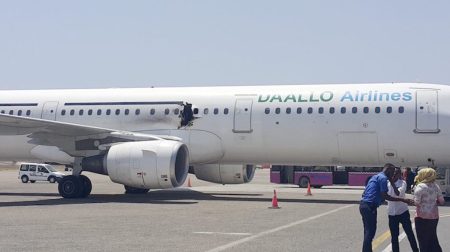
Shabaab, al Qaeda’s branch in Somalia, detonated a laptop bomb on this Daallo Airlines aircraft in February 2016.

[Editor’s note: this article was originally published at Politico.]

More than 15 years after the September 11 hijackings, the U.S. government has issued yet another warning about airline security. On Tuesday, the Department of Homeland Security (DHS) announced new restrictions on electronics brought on board certain U.S.-bound flights. Passengers on planes leaving from 10 airports throughout the Middle East and North Africa will no longer be able to carry laptops or similar electronics with them into the cabin of the plane. Cell phones and smaller electronics are unaffected by the new measures, but computers will have to be checked in luggage.

The move instantly generated controversy and questions. Namely, why now? Some dismissed the DHS announcement as a protectionist move aimed at boosting the futures of U.S. carriers, who have complained of unfair competition from Gulf airlines for years. Twitter wags called it a “Muslim laptop ban,” whose secret aim was to discourage travel from the Arab world. But by now it should be clear that the new restrictions are deadly serious, even if there are legitimate questions about how it is being implemented.

Initial press reports, including by the New York Times, cited anonymous officials as saying that the restrictions were not a response to new intelligence. But the DHS announcement implies otherwise. One question on the DHS web site reads, “Did new intelligence drive a decision to modify security procedures?” The answer: “Yes, intelligence is one aspect of every security-related decision.” The British government’s quick decision to follow suit also suggests that something new is afoot here.

Subsequent reports from CNN and The Daily Beast indicate that intelligence collected during a U.S. Special Forces raid in Yemen in January led to the restrictions. That is possible. The raid was highly controversial, but the Trump administration argues the costs were worth it because the U.S. learned key details about al Qaeda in the Arabian Peninsula’s (AQAP) plotting. A Navy SEAL perished during the operation, as did a number of women and children. Within hours, jihadists began circulating a photo of an adorable little girl who died in the crossfire. The girl was the daughter of Anwar al Awlaki, a Yemeni-American al Qaeda ideologue killed in a September 2011 drone strike. Al Qaeda immediately called for revenge in her name.

Whether new intelligence led to the decision or not, we already know for certain that al Qaeda has continued to think up ways to terrorize the skies. For years, Al Qaeda operatives in Somalia, Syria, Yemen and elsewhere have been experimenting with sophisticated explosives that can be smuggled onto planes.

DHS points to the “attempted airliner downing in Somalia” in February 2016 as one reason for ongoing concerns. That bombing was carried out by al Shabaab, al Qaeda’s official branch in Somalia. Al Shabaab attempted to justify the failed attack by claiming “Western intelligence officials” were on board the flight, but that excuse may be a cover for something more sinister.

Some U.S. officials suspect that al Qaeda’s elite bomb makers wanted to test one of their newest inventions, a lightweight explosive disguised as a laptop that is difficult to detect with normal security procedures. At the very least, Shabaab’s attack demonstrated that al Qaeda has gotten closer to deploying a laptop-sized explosive that can blow a hole in jetliners. While no one other than the terrorist who detonated the bomb was killed, the plane was left with a gaping hole in its side.

Al Qaeda-linked terrorists have tested their contraptions before. In December 1994, a bomb was detonated on board a Philippine Airlines flight, killing one of the passengers and severely damaging the plane. The device was implanted by Ramzi Yousef, the nephew of 9/11 mastermind Khalid Sheikh Mohammed. Yousef planned to blow up several airliners at once as part of “Project Bojinka” and he wanted to try out his invention beforehand. Authorities ultimately scuttled his plot, but al Qaeda didn’t forget Yousef’s idea. Instead, the terrorist organization returned to it again in 2006, when a similar plan targeting jets leaving London’s Heathrow Airport was foiled.

Al Qaeda’s failure in 2006 didn’t dissuade the group from pressing forward with a version of Yousef’s original concept, either.

In September 2014, the U.S. began launching airstrikes against an al Qaeda cadre in Syria described by the Obama administration as the “Khorasan Group.” There was some initial confusion over what the Khorasan Group really is, with some opining that it was simply invented by American officials to justify bombings, or a separate terror entity altogether. In reality, it was simply a collection of al Qaeda veterans and specialists who were ordered by the group’s leader, Ayman al Zawahiri, to begin laying the groundwork in Syria for operations against the West.

As far as we know, the Khorasan Group never did attempt to strike the U.S. or Europe. Perhaps this is because a number of its leaders and members were killed in the drone campaign. But there is an additional wrinkle in the story: Zawahiri didn’t give his men the final green light for an operation. Instead, Zawahiri wanted the Khorasan cohort to be ready when called upon. In the meantime, al Qaeda didn’t want an attack inside the West to jeopardize its primary goal in Syria, which is toppling Bashar al Assad’s regime.

The Islamic State gets all the headlines, but Al Qaeda has quietly built its largest guerrilla army ever in Syria, with upwards of 10,000 or more men under its direct command. The group formerly known as Jabhat al Nusra merged with four other organizations to form Hay’at Tahrir al Sham (“Assembly for the Liberation of Syria”) in January. Brett McGurk, the special presidential envoy for the anti-ISIS coalition, told the Senate Foreign Relations Committee months earlier, in June 2016, that Nusra was already al Qaeda’s “largest formal affiliate in history” with “direct ties” to Zawahiri. The merger gives al Qaeda control over an even larger force.

Al Qaeda could easily repurpose some of these jihadists for an assault in Europe, or possibly the U.S., but has chosen not to thus far. That is telling. Zawahiri and his lieutenants calculated that if Syria was turned into a launching pad for anti-Western terrorism, then their efforts would draw even more scrutiny. At a time when the U.S. and its allies were mainly focused on ISIS, al Qaeda’s potent rival, Zawahiri determined the West could wait.

But Zawahiri’s calculation with respect to Syria could change at any time. And the organization maintains cadres elsewhere that are still plotting against the U.S. and its interests.

The Khorasan Group included jihadists from around the globe, including men trained by AQAP’s most senior bomb maker, a Saudi known as Ibrahim al Asiri. U.S. officials have fingered al Asiri as the chief designer of especially devious explosive devices. Al Asiri has survived multiple attempts to kill him. But even if the U.S. did catch up with al Asiri tomorrow, his expertise would live on. Some of his deputies have trained still others in Syria.

Al Qaeda now has units deployed in several countries that are involved in anti-Western plotting. Testifying before the Senate Armed Services Committee in February 2016, Director of National Intelligence James Clapper warned that al Qaeda “nodes in Syria, Pakistan, Afghanistan, and Turkey” are “dedicating resources to planning attacks.”

The Pentagon regularly announces airstrikes targeting al Qaeda operatives, some of whom, identified as “external” plotters, have an eye on the West. Incredibly, more than a decade and a half after the 9/11 hijackings, al Qaeda members in Afghanistan are still involved in efforts to hit the U.S. In October 2016, for instance, the U.S. struck down Farouq al Qahtani in eastern Afghanistan. The Defense Department explained that Qahtani was “one of the terrorist group’s senior plotters of attacks against the United States.”

Meanwhile, ISIS has also proven it is capable of downing an airliner. Thus far, ISIS leader Abu Bakr al Baghdadi’s men have used low-tech means. In October 2015, the so-called caliphate’s Sinai province claimed the bombing of a Russian airliner. If the group’s propaganda is accurate, then a Schweppes Gold soft drink can filled with explosives and equipped with a detonator led to the deaths of all 224 people on board. This beverage bomb was a far cry from the sleek explosives al Qaeda’s bomb makers have been experimenting with, but it was effective nonetheless. All it required was proper placement next to a fuel line or some other sensitive point in the airliner’s infrastructure. ISIS could have more sophisticated bomb designs in the pipeline as well.

The truth is that the threat to airliners isn’t going away any time soon. However, this doesn’t mean that every counterterrorism measure intended to protect passengers is the right one. Some quickly questioned the Trump administration’s policy. Why does it impact only flight carriers in some countries? Were security measures found to be lax in some airports, but not others? Why is the threat of a laptop bomb mitigated if it is in checked luggage, as opposed to on board the plane? And what about the possibility of al Qaeda or ISIS slipping a bomb onto connecting flights, before the planes head for the U.S. homeland?

These are all good questions that should be asked. And the Trump administration should answer them.

Gorka & Jasser: We Are Fighting ‘Not a War with Islam, but a War Inside Islam’

February 24, 2017

Gorka & Jasser: We Are Fighting ‘Not a War with Islam, but a War Inside Islam’, BreitbartJohn Hayward, February 24, 2017

isis-koran-640x480Flickr/AFP

Broadcasting live from CPAC 2017, SiriusXM host Alex Marlow spoke with Dr. Sebastian Gorka and Dr. Zuhdi Jasser about national security, Islamist terrorism, and their panel discussion, “When Did World War III Begin?”

(Audio at the link. — DM)

Marlow began by asking his guests what they expected from the national security segment of President Donald Trump’s scheduled address to the Conservative Political Action Conference.

“Exactly what we’ve heard before,” Gorka replied. “If you really want to understand the direction of the White House and how much everything changed at 12:01 on January the 20th, you look at two things: you look at a speech that really wasn’t carefully addressed or really paid enough attention to, that’s the Youngstown campaign speech, which was about the threat of jihad in general and what we’re going to do about ISIS.”

“Specifically, it really bears repeating, the inauguration, the address that the president gave at the inauguration, was explicit,” he continued. “Number one, we are going to eradicate the Islamic State – not degrade, not manage, not ameliorate – eradicate. And secondly, words have meaning. When he says our enemy is ‘radical Islamic terrorism,’ that is a 180 degree  change from the last eight years, when we weren’t allowed to even say who the enemy was.”

“Zuhdi knows it better than anybody because he understands that this isn’t about poverty or lack of education. It’s about people who are fighting for the soul of Islam – not a war with Islam, but a war inside Islam; as King Abdullah, as General Sisi has said, for which version is going to win,” Gorka said.

Marlow asked Dr. Jasser about the topic of language control Gorka touched upon and the previous administration’s reluctance to use explicit language like “radical Islamic jihad” to describe the enemy.

“We got to this point because we had an administration who was being whispered to by Muslim Brotherhood sympathizers, by apologists, by governments that might be our allies against al-Qaeda and ISIS, but they love a whack-a-mole program. They don’t want to treat the disease, which is not ‘violent extremism’ but violent Islamism,” Jasser charged.

“We have to start focusing on our own values,” he urged. “There’s nothing more American than fighting theocracy, and yet the Left for the last eight years has invoked blasphemy laws in America by telling us we can’t criticize Islamist political movements.”

Jasser predicted the new administration would succeed in destroying ISIS but warned that “it will come back in another form – two, three, four years later – unless we engage Muslim reformists, like our Muslim reform movement, to treat the underlying theocracy.”

Marlow complained that the mainstream media swiftly denounce candid talk about the problem of radical Islam as “hate speech” even when confined to straightforward reporting without editorial opinion, making it difficult to have a constructive discussion about the problem.

“I think this is exactly what the Saudi regime, the Iranian Khomeinists, the Brotherhood want, is they want to dominate what Islam means,” Jasser said. “And yes, it’s not my Islam, but we have to thread that needle. Because if you don’t call it political Islam or Islamism as the threat, you’re not going to be able to figure out who to engage. We want to engage anti-Caliphate, anti-violent jihad Muslims who are pro-freedom, pro-equality of men and women, who share our values. If we don’t do that discernment in our verbiage, we’re going to miss it and actually end up helping our enemies and end up actually not only being the firefighters, but the arsonists. We have to stop that cycle.”

“Let’s just take it one level deeper. It’s not just empowering our enemies, which would be bad enough,” Gorka added. “If you don’t talk truthfully about who the enemy is, how are you going to win? What we saw in the last eight years is a policy that actually weakened our most important allies.”

“So when you’ve got the president of the most populous Arab nation in the world say this is a war for the heart of Islam, General Sisi, when you’ve got King Abdullah with his Amman statement saying, ‘Look, we have to stop the jihadis hijacking the religion’ – we have a president here who stands up and says, ‘No, no, no, these are not the droids you’re looking for, the religion has nothing to do with this,’” he elaborated, referring to the Obama administration’s insistence on framing the war as a struggle against generic violent extremism.

“Do you know who we hurt the most? Those Muslims who are on the front lines with the jihadis, who understand this isn’t about poverty or lack of education; it’s about an ideology. So we’ve actually hurt the people who are on the front line the most. We’re not prepared to do that anymore. This administration’s going to help the Jordanians, help the Egyptians, help them fight this war,” Gorka vowed.

“I think we have to own what it means to be diverse,” Jasser suggested. “What is ‘diversity’ in the Muslim community? It’s not ethnic diversity. Being Muslim is not an identity movement of a monolithic homogenous group. It is a diverse ideological movement that has fundamentalist, orthodox, liberal, secularists that are all in this Muslim diverse group. So if the Left actually believes in diversity different from what Pelosi whispered into Andre Carson’s ear – ‘Tell them you’re Muslim’ – Islam is not a race. They’re racializing the faith. That’s the biggest obstacle.”

“I think the other thing I hope to see is not only us being against jihadists, but what are we for,” he added. “I think that will be the difference between some of the dictators in the Middle East, that yes, some of them have been on our side against jihad, the militants, but we are the adults in the world, in being for liberty and freedom. I hope that will be part of a Trump Doctrine.”

Gorka agreed, saluting Jasser as “the point man here in America for sense, for common sense in this battle.”

“The saddest part is there are people like him in the Middle East. There are people every day risking their lives on their blog sites, in North Africa, in the Middle East pushing back on this, saying, ‘I’m a Muslim, but I don’t think an infidel needs to be killed.’ That means he’s put the crosshairs on his chest,” Gorka noted. “In some parts of the Muslim world, that’s an instant death sentence.”

“That’s why the four million Muslims in America need to step up and act because we can do things here that you just can’t do in the Middle East,” Jasser said. “They end up in prison. They end up slaughtered, tortured.”

Marlow proposed that “the stifling of speech in the Muslim world is really what has allowed a lot of the jihadist movements to flourish.”

“Why do you think they use the term ‘Islamophobia’ instead of talking about, yes, there might be some bigotry against Muslims in the West?” Jasser asked. “They use the term Islamophobia because they want to anthropomorphize Islam so that you don’t criticize it, and they suppress free speech. That’s how they invoke blasphemy laws in the West.”

“You’re absolutely right. The freedom of speech issue is huge in the Middle East because it’s a life and death issue in many cases,” Gorka said. “But here, it’s almost as important. It’s not life and death, but it is closing down the discussion.”

“You look at what’s happened in the last four weeks with this administration,” he said. “There’s a phrase in soccer: you play the man on the ball. We’re not going to talk about policies; we’re going to attack individuals, whether it’s Kellyanne, the president, myself, Steve Bannon. They do that how? ‘We don’t want to talk about the threat to America. You’re a racist. You’re an Islamophobe. You’re a xenophobe. Oh, well, in that case, we can’t talk to you.’ That’s as dangerous as just the constant ad hominem attacks because then there is no discussion.”

Jasser said his message to CPAC was that “there is hope” for a lasting victory in the long war against Islamist extremism.

“The first step is to defeat the militants, which this president will finally do,” he said. “The second step is to go back to our American roots and defeat theocracy, work with Muslims and our Muslim reform movement. We have a two-page declaration that can be used, I hope, not only to vet refugees, to figure out which groups are with us and against us. I hope we start doing security clearances through those who share our values.”

“There are so many that are – not in this administration, but that are in the government from the previous administration – that I think are Islamists, that might not be violent extremists, but we need to shift the axis of the lens of Homeland Security, foreign policy, to countering violent Islamism. There’s nothing this group here and the country can do to better empower reform-minded Muslims that share our values than to shift from this blasé CVE to CVI,” Jasser said, lampooning the Obama administration’s acronym for “Countering Violent Extremism.”

Gorka referred to CVE as “garbage from the last eight years that obfuscated the threat.”

He said the most important step taken by the new administration was President Trump’s executive order to temporarily limit immigration from the most unsecure Middle Eastern nations.

“Whatever the final version of the reform measures are, the fact is, when an Iraqi collars me in the halls of Congress and says, ‘My friends back home in Iraq applaud this measure because they know how many bad guys are in Iraq that want to come over here, so do it. Thank you,’” Gorka said.

Dr. Sebastian Gorka is deputy assistant to President Trump and was formerly national security editor for Breitbart News. He is the author of Defeating Jihad: The Winnable War. Dr. Zuhdi Jasser is the founder and president of the American Islamic Forum for Democracy and author of A Battle for the Soul of Islam: An American Muslim Patriot’s Fight to Save His Faith.



Why Do Western Leaders Bother to Condemn Terror Attacks?

January 6, 2017

Why Do Western Leaders Bother to Condemn Terror Attacks? PJ MediaRobert Spencer, January 3, 2016

roses(AP Photo/Emrah Gurel)

And it isn’t just a matter of its time running out, either: this same charade has played out after every jihad massacre. The condemnations and declarations of resolve are plentiful, but real action against jihad terror, much less even a realistic acknowledgment of its motivating ideology, has been much harder to find. In this case, as in all others, the condemnations will not be backed up by any action whatsoever. They don’t mean a thing except as an exercise in bizarrely gratuitous virtue-signaling.

**********************************

An Islamic jihadist screaming “Allahu akbar” opened fire in a crowded Istanbul nightclub on New Year’s Eve, murdering 39 people and injuring 69 others. And immediately the pro forma condemnations began pouring in, serving only to highlight the futility and wrongheadedness of the West’s response to the global jihad.

Barack Obama called Turkish President Recep Tayyip Erdogan to tell him that he “strongly condemned” the massacre. National Security Council (NSC) spokesman Ned Price said that the United States condemned the “horrific terrorist attack” in the strongest terms. U.S. State Department spokesman Mark Toner said that the U.S. government “strongly condemns the terrorist attack.”

Obama and the United States government condemned the attack? How reassuring! Was it ever really in doubt where they would come down on this issue?

These condemnations from Western leaders are hollow and meaningless. Indeed, they constitute an admission of impotence unless they are backed up by action.

Defense Secretary Ash Carter appeared to be promising some kind of action as he declared that “this attack only redoubles our resolve to stand shoulder to shoulder with our Turkish allies in condemning these attacks and relentlessly combating terrorism.”

But does the Obama administration, in its final two weeks, really have any intention of doing anything at all to pursue the Istanbul jihad murderer and bringing him to justice? Almost certainly not.

And it isn’t just a matter of its time running out, either: this same charade has played out after every jihad massacre. The condemnations and declarations of resolve are plentiful, but real action against jihad terror, much less even a realistic acknowledgment of its motivating ideology, has been much harder to find. In this case, as in all others, the condemnations will not be backed up by any action whatsoever. They don’t mean a thing except as an exercise in bizarrely gratuitous virtue-signaling.

The impotence and denial is not limited to the Obama administration. NATO Secretary General Jens Stoltenberg tweeted: “Tragic start to 2017 in.”

But the Istanbul massacre was not a tragedy. A tidal wave is a tragedy. This is a war.

To pretend that jihad terror is a tragedy is to imply that it is inevitable, an act of God, a part of life, just something that one has to tolerate the way the victims of a devastating hurricane simply have to get on with their lives.

Jihad terror is nothing like that at all. It is preventable. It can be stopped.

But it can only be stopped if authorities make the hard choices to implement measures that people such as Jens Stoltenberg wouldn’t dare even contemplate: a moratorium on Muslim immigration; the deportation of criminal aliens; the requiring of mosques to teach against the al-Qaeda/ISIS understanding of Islam, and more. Since the current mainstream authorities would rather be caught dead than implement politically incorrect measures, these “tragedies” will continue to become more common.

EU foreign policy chief Federica Mogherini vowed: “We continue to work to prevent these tragedies.”

No, they don’t. EU immigration policies are actually evidence of them working to make attacks more common.

All of the jihadis who murdered 130 people in Paris in November 2015 had just entered Europe as refugees. Is it racism and xenophobia to recall that in February 2015, the Islamic State boasted that it would soon flood Europe with as many as 500,000 refugees? Or that the Lebanese education minister said in September 2015 that there were 20,000 jihadis among the refugees in camps in his country?

And 80% of migrants who have come to Europe claiming to be fleeing the war in Syria aren’t really from Syria at all. Why are they claiming to be Syrian and streaming into Europe, and now into the U.S. as well?

An Islamic State operative gave the answer when he boasted in September 2015, shortly after the migrant influx began, that among the flood of refugees, 4,000 Islamic State jihadis had already entered Europe. He explained their purpose:

“It’s our dream that there should be a caliphate not only in Syria but in all the world, and we will have it soon, inshallah.”

These Muslims were going to Europe in the service of that caliphate. “They are going like refugees,” he said, but they were going intent on sowing blood and mayhem on European streets. As he told this to journalists, he smiled and said: “Just wait.”

On May 10, 2016, Patrick Calvar, the head of France’s DGSI internal intelligence agency, said that the Islamic State was using migrant routes through the Balkans to get jihadis into Europe.

Mogherini is one of the people most responsible for this situation. It is her tragedy — and that of her friends and colleagues.

And there will, thanks to those same people, be plenty more of them. Their condemnations won’t change a thing, and only highlight the absolute failure of their response to the global jihad threat.

Bye Bye, Obama

December 26, 2016

Bye Bye, Obama, PJ Media, Michael Ledeen, December 25, 2016

(Please see also, Is real change coming to Iran? Get ready for March 15, 2017. — DM)

maddog

What would President Trump do if Khamenei passed from the scene, and millions of Iranians took to the streets again?  The president-elect has said he’s not a great enthusiast of regime change, but it’s hard to imagine he’d abandon the Iranians as Obama did seven years ago.  He ought to be thinking it through.

Yes, I know good news is hard to swallow, but we are living in a revolutionary moment, of which the Trump election is a dramatic symptom.  The crisis of the Islamic Republic would be a fitting end to the Obama era. He dreamt of a glorious strategic alliance with Iran, and a definitive lethal blow against Israel. How fitting with the Divine sense of humor to have the Palestinians and Iranians to wreck their own enterprises.

***********************

As I promised, as the days of Obama draw down, the jihadis are stepping up the terror tempo.  They know that there will be no reprisals from the Oahu links, and they fear Trump’s lineup of tough guys in the cabinet, so they’re in a hurry to kill infidels while the killing’s good. Therefore we, along with the other Western nations, are at maximum risk right now, until roundabouts January 20th.

And the killing’s plenty good, isn’t it?  Berlin,  Zurich, Ankara, Moscow, with a very nasty plot uncovered in Melbourne, and yet another involving terrorists in Detroit, Maryland, and Virginia.  Not to mention the ongoing slaughter in Syria, and, on Christmas day, Cameroon.

What does the “western world” do in response?  Declare the Western Wall “occupied territory.” This is no accident, since the jihadis believe that they have unleashed holy war against infidels.  That war will not end, in their view, until we infidels have been crushed and subjected to the will of a caliph.  They’ve got plenty of support from the Russians, without whom thousands of Iranians and Iranian proxies would have been killed in Syria and Iraq, and the Assad regime would have been destroyed.

That would have been a better world, but Obama did not want that world.  Nor did the feckless Europeans, who act as if profits on Iran trade compensate for the open subversion of public order.  Indeed, as Christmas arrived we were treated to the spectacle of the bishop of Rome—aka Pope Francis–blaming material misery for the jihadist assault on the West. Thus the first Jesuit pontiff surrenders the moral high ground to his mortal enemies.

Maybe Obama should convert and run for pope.

Paradoxically, the jihadis and their secular allies are launching their new assault just as they are suffering systematic setbacks on the battlefield, their own internal conflicts are intensifying, and there are signs of a religious and patriotic revival within the boundaries of their archenemy, the United States. Walter Russell Mead neatly catches the irony that, just as Obama handed the Palestinians a resounding political victory, a sober look at the situation suggests that the Palestinians have not been this weak, this divided, or this helpless in many decades.

In like manner, the Iranian regime, flush with its success in Aleppo, is increasingly riven.  Supreme Leader Ali Khamenei has had two medical events in the past 10 days, and the scrambling for the succession has resumed.  You may have noticed that General Qasem Soleimani has returned to the front pages, which invariably happens when the leader is ill; the Revolutionary Guards want him as the strongman of the next regime (he can’t be supreme leader for lack of theological standing, but he could still be a dominant figure). And it isn’t all peaches and cream for Soleimani, as recent demonstrations in Tehran against the rape of Aleppo make clear. Iranian apologists love to tell us that Persian nationalism  overwhelms internal tribal and sectarian divisions, but Iran has lost thousands in Syria, and the Persian nationalists don’t like their husbands and sons dying to save Bashar Assad.

What would President Trump do if Khamenei passed from the scene, and millions of Iranians took to the streets again?  The president-elect has said he’s not a great enthusiast of regime change, but it’s hard to imagine he’d abandon the Iranians as Obama did seven years ago.  He ought to be thinking it through.

Yes, I know good news is hard to swallow, but we are living in a revolutionary moment, of which the Trump election is a dramatic symptom.  The crisis of the Islamic Republic would be a fitting end to the Obama era. He dreamt of a glorious strategic alliance with Iran, and a definitive lethal blow against Israel. How fitting with the Divine sense of humor to have the Palestinians and Iranians to wreck their own enterprises.

You never know. Life is full of surprises.

Terror Experts ‘Very Concerned’ About Sen. Warren Aide and His Radical Mosque

December 13, 2016

Terror Experts ‘Very Concerned’ About Sen. Warren Aide and His Radical Mosque, Counter JihadPaul Sperry, December 12, 2016

warren-1

Sen. Elizabeth Warren said she made an ill-advised appearance at a Boston mosque linked to several major terrorism cases at the request of an office aide who attends the radical mosque.

The Massachusetts Democrat said she agreed to speak Sunday at the Islamic Society of Boston Cultural Center at the urging of staffer Hamza Abdelgany, who is a member of the mosque, which has graduated no fewer than 13 terrorists and recently was caught on video defending many of the terrorists, even after they were convicted in federal court.

Warren spoke before the congregation for several minutes chiefly to complain about “anti-Muslim hate” allegedly inspired by the election of GOP President-elect Donald Trump.

Charles Jacobs, founder of Boston-based Americans for Peace and Tolerance, told CJ that he is “very concerned” that a member of a mosque that supports and even raises money for the legal defense of known terrorists has such political clout. He said that Warren’s ill-considered visit bestowed undue legitimacy on ISB.

ISB operates two mosques: one in Roxbury, where the so-called “interfaith” event attended by Warren was held, and the other in Cambridge, where several terrorists and terrorist supporters have worshipped, including:

  • Boston Marathon bombers Dzhokhar Tsarnaev and Tamerlan Tsarnaev;
  • Aafia Siddiqui, aka Lady al-Qaida, who raised money for the terror group in area mosques and is serving an 86-year federal sentence for trying to murder a US Army captain in Afghanistan, where she was captured with plans to carry out a chemical attack on New York City;
  • ISB imam Abdullah Faaruuq, who was heard on tape urging Boston Muslims to “pick up the gun and the sword” to defend Siddiqui during her 2010 trial.
  • Tarek Mehanna, who in 2012 got 17 years in federal prison for conspiring to use automatic weapons to murder shoppers in a suburban Boston mall, as well as for conspiring to aid Al Qaeda;
  • Ahmad Abousamra, an indicted terrorist co-conspirator of Mehanna who fled to Syria in 2006 where he resurfaced as a top ISIS propagandist and was added to the FBI’s Most Wanted Terrorists list in 2013, where he remains today.
  • ISB congregant Rezwan Ferdaus, who in 2012 got 17 years in federal prison for plotting to attack the Pentagon and US Capitol with remote-controlled airplane bombs.
  • ISB major donor Oussama Ziade, who was indicted in 2009 for dealing with terrorist funds and is now a fugitive living in Lebanon.
  • ISB co-founder Abduraham Alamoudi, who was sentenced in 2004 to 23 years in prison for plotting terrorism and identified by the US government as a top Muslim Brotherhood figure as well as a key al-Qaida fundraiser in America.
  • ISB founding trustee Yusuf Qaradawi, who was placed on the US terror watchlist after calling for violent jihad against US troops in Iraq and is currently the subject of an Interpol arrest warrant on charges of incitement to murder.
  • Jamal Badawi, another former trustee who in 2007 was named an unindicted co-conspirator in a plan to funnel more than $12 million to Palestinian suicide bombers.

ISB leadership also includes Abdul-Malik Merchant, an associate imam who recently was forced to apologize to the Jewish community for posting anti-Semitic posts on social media.

ISB member Tamerlan Tsarnaev, who was caught on surveillance videotape planting a bomb along the Boston Marathon route, became an angry jihadist after joining the mosque. According to his ex-girlfriend, “One minute he was a normal guy, the next minute he is watching these crazy Muslim videos.”

In 2011, ISB hosted an event in support of no fewer than 22 terrorists who were convicted of providing material support for al-Qaeda, Hamas, Palestinian Jihad and Pakistani terrorist groups — including Siddiqui, Alamoudi and Mehanna. During the event, which was caught on video, relatives of the terrorists bashed the FBI, the Justice Department and the US government; and at least one speaker called for violent jihad against the US.

Still, Warren stood where they stood and bashed the president-elect.

“I am very concerned about how Donald trump is beginning to define his administration with the people he personally is picking to lead this country,” Warren said, while claiming that “since the election attacks on racial and religious groups have skyrocketed.”

“Now is a time when we must be willing to say loud and clear there is no room for bigotry anywhere in the United States of America — none,” she said. “An attack on one of us is an attack on all of us, and we will fight back against discrimination whenever and wherever it occurs.”

Six prominent religious leaders fired off a letter criticizing Warren for agreeing to appear at the mosque, arguing she provided “political cover to one of the most intolerant jihadist mosques in America.”

Warren was invited by ISB member Hamza Abdelgany, a staff assistant working out of Warren’s Quincy, Mass., office. Abdelgany was involved with the Muslim Students Association while attending the University of Massachusetts at Boston. The US government says MSA is a front group for the radical Muslim Brotherhood, which supports violent jihad and conspires to one day bring the US and other Western nations under Islamic rule.

“The Muslim Brotherhood was founded in Egypt … Its ultimate goal is the creation of a global Islamic State governed by Sharia law,” U.S. Attorney James T. Jacks said in a 2008 court filing related to a major terrorism case. “Muslim Brotherhood members first migrated to the United States in the 1960s, where they began their grassroots work on campuses through an organization called the Muslim Students Association.”

ISB is run by the Muslim American Society, a known Muslim Brotherhood front group which also runs the so-called “9/11 mosque” in the Washington area, Dar al-Hijrah Islamic Center.

Ilya Feoktistov, director of research for Americans for Peace and Tolerance, said that by ignoring ISB’s well-documented ties to terrorists, Warren is serving as an “enabler” of jihad.

OSU jihadi Abdul Artan: “I’m a Muslim, it’s not what the media portrays me to be”

November 28, 2016

OSU jihadi Abdul Artan: “I’m a Muslim, it’s not what the media portrays me to be”, Jihad Watch

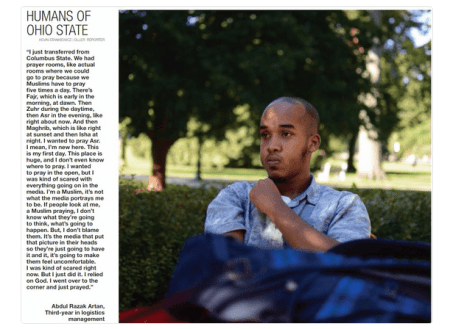
Abdul Razak Artan, the Ohio State University jihad attacker, recently appeared in Ohio State University’s The Lantern, in a feature entitled “Humans of Ohio State.” In it, he played the victim and spoke about being nervous about performing his Islamic prayers in public:

artan-humans-of-ohio-state

“I just transferred from Columbus State. We had prayer rooms, like actual rooms where we could go to pray because we Muslims have to pray five times a day. There’s Fajr, which is early in the morning, at dawn. Then Zuhr during the daytime, then Asr in the evening, like right about now. And then Maghrib, which is like right at sunset and then Isha at night. I wanted to pray Asr. I mean, I’m new here. This is my first day. This place is huge, and I don’t even know where to pray. I wanted to pray in the open, but I was kind of scared with everything going on in the media. I’m a Muslim, it’s not what the media portrays me to be. If people look at me, a Muslim praying, I don’t know what they’re going to think, what’s going to happen. But, I don’t blame them, it’s the media that put that picture in their heads so they’re just going to have it and it, it’s going to make them feel uncomfortable. I was kind of scared right now. But I just did it. I relied on God. I went over to the corner and just prayed.”

Abdul Razak Artan, “third-year in logistic management,” is dead now, so The Lantern can’t go back to him and ask him if he understands better now why people might be nervous about Muslims praying, and why it isn’t just the fault of “the media.”

(Thanks to Kamala.)