H/t Joop
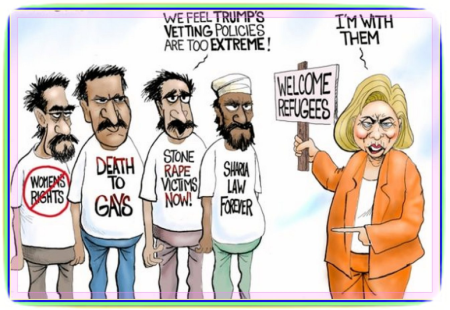
H/t Freedom is Just Another Word


In the Immortal Words of Daniel Pipes…, Power Line,
(Here’s a link to the full interview. — DM)
DP: I worry the most about the subtle, infiltrating Islamists. When it comes to force, we can easily defeat them. But when it comes to our own institutions – schools, law courts, media, parliaments – we are far less prepared to defend ourselves.
*********************
Daniel Pipes recently gave an interview to Germany’s Global Review. His observations are pithy as always; here are some highlights:
GR: Many people say that Islam is not a religion but a reactionary, totalitarian and repressive ideology comparable to fascism and communism; and that Islam cannot be reformed. Other people say that Islamism had nothing to do with religion and Islam. What do you say about relations between Islam and Islamism?
DP: Both these statements are silly. Of course, Islam is one of the major religions of the world; what is there to argue about? Islamism, a modern movement, however, shares much with fascism and communism. Islamism is a form of Islam. Denying this would be akin to saying that the Jesuits are not Christian.
GR: Some experts compare Islam with Confucianism and Hinduism. They note that in the 1950s, Confucian societies were thought unable to develop economically and socially, and that Confucianism was seen as an obstacle to progress; same with Hinduism in India. Today, however, East Asia and India are economic powerhouses and many people perceive Confucianism and Hinduism as drivers of this success story. Could the same happen with Islam, that it will also reform?
DP: Yes, it is possible that Muslim peoples will recover from today’s predicament and go on to economic and political success. We have no way of predicting such things. And no civilization or religion stays permanently down. …
GR: There is a broad spectrum of Islamists. Al-Qaida, the Islamic State, Boko Haram, Al Shabaab, which want to occupy territory by military means and create an ever expanding state. And then the Muslim Brotherhood, the Turkish AK Party and the Iranian Khomeinists. Which of these Islamist groups are the greatest danger for the West and which of these concepts do you think will be the most successful?
DP: I worry the most about the subtle, infiltrating Islamists. When it comes to force, we can easily defeat them. But when it comes to our own institutions – schools, law courts, media, parliaments – we are far less prepared to defend ourselves.
GR: In the Western countries many Islamophobic parties and politicians are on the rise. Do you think this will help the spread of Islamism or will these parties help the counter-jihad? Hillary Clinton said that Trump and his anti-Muslim speeches are the best recruiters for the Islamic State. True?
DP: I do not recognize the term “Islamophobe” and do not know what it means except, in the immortal phrase of Andrew Cummins as a word “created by fascists and used by cowards to manipulate morons.”
Your question reverses the sequence of events. Islamist ideology breads Islamist violence, which starts the process and in turn inspires anti-Islamic sentiments. Anti-Islamic views might also inspire more Islamist violence, but that is incidental. The real dynamic here is Islamism creating anti-Islam parties. As Norbert Hofer has shown in Austria, they are approaching 50 percent of the vote and with it, political power. …
GR: Besides Islamists, the West has to deal with Russia, China, and North Korea. How can it deal with all these challenges at the same time? Which counter-jihadi strategy do you find most promising?
DP: The strategic environment today is far easier than during the cold war; there is no determined ideological enemy with the tools of a great power at its disposal. The key is for the West not to go to sleep. Electing such leaders as Obama and Merkel, however, means going to sleep. The best counter-jihadi strategy is one that takes ideas seriously.
GR: It took the West two decades to get rid of fascism and 70 years to get rid of communism. How long do you think will it take to get rid of Islamism? Are we facing the zenith of Islamism right now or are we just halfway up the road and will it get even worse?
DP: The battle against Islamism has not yet started. I cannot predict how long it will take. It’s still pre-1945 in communist terms and the 1930s in fascist terms. I see Islamism as having peaked in 2012-13 and showing signs of weakness.
Giuliani Wants To Start Electronically Tagging Muslims
by Adrienne Mahsa Varkiani
Jul 28, 2016 10:01 am
Source: Giuliani Wants To Start Electronically Tagging Muslims | ThinkProgress

Former New York Mayor Rudy Giuliani at the Republican National Convention in Cleveland, Monday, July 18, 2016.
Former New York City Mayor and current Donald Trump supporter Rudy Giuliani said on Wednesday that he thinks it’s an “excellent idea” to monitor Muslims on the federal watch list through electronic monitoring tags.
“I would think that’s an excellent idea,” Giuliani told reporters at a press conference, according to NJ Advance Media. “If you’re on the terror watch list, I should you know you’re on the terror watch list. You’re on there for a reason.”
Giuliani said he would suggest that Trump use the same measure of electronically monitoring people as in France. Both the attackers involved in the killing of a priest in Normandy on Tuesday were already known to French security services and on watch lists, and one was being monitored through an electronic tag.
The terrorism watch list and no-fly list are notorious for ethnic and religious profiling, and many innocent people end up on the list — but Giuliani’s comments come as no surprise given his own penchant for surveillance of the Muslim community, another ineffective practice, during his time as New York’s mayor.
“I put undercover agents in mosques for the first time in January 1994,” said Giuliani, following the 1993 World Trade Center bombing which left six dead and hundreds wounded. “I did it because the 1993 bombing was planned in a mosque in Union City, New Jersey, and a second plan was uncovered to bomb our subways, which was foiled. And I kept those police officers in those mosques until I left as mayor.”
Surveillance of the Muslim community in New York grew exponentially after the 9/11 attacks, and according to the American Civil Liberties Union (ACLU), involved the mapping of Muslim communities, heavy photo and video surveillance, police informants, and entire databases with personal information about innocent Muslims. The ACLU has deemed the surveillance “unconstitutional” and said it contributes to an “atmosphere of fear and mistrust” — but perhaps equally important, such methods are wholly ineffective. According to a 2012 report from the Associated Press, in six years of spying on Muslims, listening to their conversations, and cataloging mosques, the NYPD didn’t get a single lead or begin even one terrorism investigation.
The watch lists Giuliani wants to monitor Muslims through also don’t work. As ThinkProgress has previously reported:
Before September 11, 2001, the no-fly list, which names people who are banned from boarding flights in or out of the U.S., contained 16 people. A leak revealed that that number had grown to 47,000 as of 2013. Most of those names were added after President Obama took office. The broader terrorist watch list maintained by the Terrorist Screening Center has an even more expansive scope; the estimated number of people on the list has ranged from 700,000 to more than 1.5 million, figures which include Americans and foreigners.
The watch lists are so huge, and riddled with errors, in large part due to the low bar for evidence. The government’s March 2013 Watchlisting Guidance, for example, notes that “irrefutable evidence or concrete facts are not necessary” to put someone on a watch list.
Trump has previously called for registering all Muslims in a “database,” racial profiling of Muslims, and banning all Muslims from the United States — a ban which his adviser once said would include Muslim Americans as well. He has also suggested that Muslims know about attacks before they happen and do nothing to stop them and said that Obama, who he has repeatedly called a Muslim, is allowing Muslims to commit attacks like the one in Orlando last month.
Juncker: No Matter How Bad Migrant Crisis, Terrorism Gets, We’ll Never Give Up On Open Borders
Source: Juncker: No Matter How Bad Migrant Crisis, Terrorism Gets, We’ll Never Give Up On Open Borders

JEAN-CHRISTOPHE VERHAEGEN/AFP/Getty Images
On France 2’s Four Truths programme this morning, Mr. Juncker said “a lot of initiatives” will be required to strengthen security in the EU. After a bloody month for Europe in which the continent has seen multiple Islamic terror attacks — four in the last week in Germany alone — the EU president insisted better communication between member states would solve the problem.
Mr. Juncker told presenter Gilles Bornstein that he “expected a better response from member states regarding the exchange of information between police and intelligence services”.
The EU chief said he believes member states “are not yet used to the obvious need there is to better share information”.
Mr. Juncker insisted that however bad the “migrant crisis” and terrorism in Europe gets, the EU will never call into question the free movement of people within the bloc.
“This is one of the four fundamental freedoms of the founding Treaty of Rome. It is an inviolable principle,” he said.
In the interview on the publicly owned broadcaster, Mr. Juncker also mused on a number of other issues such as this year’s U.S. presidential race, and Turkish accession to the EU. The unelected European People’s Party figure told Mr. Bornstein that “Turkey is not in a position to join the EU in the short and medium term”.
“If Turkey reintroduced the death penalty, negotiations would stop immediately,” he added.
Mr. Juncker said he considers it illegitimate for him to “interfere in the Democratic [party] Republican [party] debate”, but the EU chief admitted he would prefer Hillary Clinton in the White House to Donald Trump.
The President of the European Commission is not just committed to open borders within Europe. Under his presidency, the European Commission lists migration as one of its priorities. As well as offering residency to the world’s “refugees”, the Commission seeks to make it much easier and more desirable for Africans and their families to move to EU countries.
Speaking after Islamic terror attacks left 130 dead in Paris last November, Mr. Juncker rejected calls to rethink the EU’s open doors policy on migration from Africa and the Middle East. Dismissing suggestions that open borders led to the attacks, Mr. Juncker said he believed “exactly the opposite” – that the attacks should be met with a stronger display of liberal values including open borders.
German police raid Islamic ‘hotbed’ as 15yo detained for allegedly planning terror attack
Published time: 28 Jul, 2016 13:34
Source: German police raid Islamic ‘hotbed’ as 15yo detained for allegedly planning terror attack — RT News

Members of German federal police Bundespolizei demonstrate their skills during a presentation of the new unit for arrests and securing evidence (BFE) in Ahrensfelde near Berlin, Germany. © Hannibal Hanschke / Reuters
The raids took place in Hildesheim, a town which Lower Saxony Interior Minister Boris Pistorius described as “a hotbed of radical Salafist” activity. He said that up to 400 police and special forces took part in the operations, though no figures were released regarding how many arrests were made.
“The German-speaking Islamic circle (DIK) in Hildesheim is a nationwide hot-spot of the radical Salafist scene that Lower Saxony security authorities have been monitoring for a long time,” the state official said, as quoted by Reuters.
He said he wants to ban the DIK, which he blames for radicalizing German Muslims and influencing some to want to travel to the Middle East to join up with terrorist organizations such as Islamic State (IS, formerly ISIS/ISIL).
Pistorius said the raid followed months of planning, as the DIK had established Hildesheim as their main base in Lower Saxony. He also said the radical Islamists were guilty of giving speeches calling for “hate against non-believers.”
“We will not put up with Salafist associations and their backers flouting our rules and bringing our rule of law into question and convincing young people that they want to join the so-called IS,” Pistorius said.

The special operations came as police in the south of the country confirmed on Wednesday evening that they had arrested a 15-year-old boy near Stuttgart. The teenager, who hails from Ludwigsburg, had allegedly been in contact with Ali David Sonboly, who killed nine people during a shooting spree in Munich on July 22.
Police said they found “a large number of small-caliber weapons, several knives and daggers” in the 15-year-old’s possession. Authorities initially said they believed the boy was planning to carry out a shooting spree at his school, but later retracted that statement, Deutsche Welle reported.
Law enforcement officers were given a tip off about the teenager after a private individual who had been carrying out research on the 15-year-old published photos and drawings that suggested that he could have been planning an attack.
Police say they found “extensive evidence, including a larger number of small-caliber cartridges, several knives and daggers, evacuation plans of his school, and a large amount of chemicals, materials and instructions for making explosives,” according to The Local.
The boy has been admitted to a psychiatric facility, and police have seized his computers for further analysis.
Germany has been rocked by a string of recent attacks. On Sunday, a 27-year-old Syrian refugee who was facing deportation to Bulgaria blew himself up after being refused access to a music festival. The explosion injured 15 passersby, but did not cause any deaths.
That same day, a 21-year-old Syrian refugee was arrested after killing a pregnant woman and wounding two people with a machete in the city of Reutlingen, near Stuttgart.
On Friday, an 18-year-old German-Iranian gunman killed nine people in Munich after going on a shooting spree in an attack he had planned for a year. Meanwhile, a 17-year-old who had sought asylum in Germany was shot dead by police last week after wounding five people with an ax near Wurzburg.

German Chancellor Angela Merkel has cut short her holiday to address the problems, which critics say have been caused by her open-door policy which saw over a million refugees – mainly from Syria and Iraq – arrive in Germany in 2015. She has rejected calls to change the policy.
“The terrorists want to make us lose sight of what is important to us, break down our cohesion and sense of community as well as inhibiting our way of life, our openness and our willingness take in people who are in need,” she said, as quoted by Reuters.
“They see hatred and fear between cultures and they see hatred and fear between religions. We stand decisively against that,” she added.
However, Willy Wimmer, former state secretary of the German Christian Democratic Party (CDU), told RT that Merkel must take the blame for wanting to “destroy our country” by allowing unchecked mass immigration.
“She [Merkel] has an obligation to defend our borders and defend our people. That is the main obligation she has. Therefore, what was the reason last year to open our borders? There is no country worldwide that did similar things,” Wimmer said.
2 Hostage Takers Killed After Slitting Priest’s Throat In Assault On French Church Tyler Durden’s picture
by Tyler Durden
Jul 26, 2016 5:52 AM
Source: 2 Hostage Takers Killed After Slitting Priest’s Throat In Assault On French Church | Zero Hedge
Two men stormed a northern French church, killing a priest and seriously wounding another person, before they were shot dead by police, in what authorities said they are treating as a terrorist attack. The men took five hostages, including the priest, in the church in the small town of Saint Etienne du Rouvray in Normandy. The priest was later found with his throat cut, police said. Police surrounded the church and shot the two men as they exited the building, an Interior Ministry spokesman said. France’s President François Hollande and Interior Minister Bernard Cazeneuve are on their way to the town, said government officials. The assault is being treated as a terror attack by investigators, Paris prosecutors said in a statement. A Vatican spokesman said that Pope Francis shares the “pain and horror” of the attack, which he called a “barbarous” act in a sacred place.
Summary:
In the latest European assault to take place just over the past hour, two knifemen raided the Church of the Gambetta in the northern French town of Saint-Etienne-du-Rouvray, near Rouen in the département of Seine-Maritime (see map below) at 10am on Tuesday, taking between 4 and 6 hostages and allegedly killing a priest before being killed by police. According to subsequent unconfirmed reports the priest had been beheaded.
Another worshipper is said to have been seriously wounded.


Both attackers have been killed by police, an interior ministry spokesman confirmed to Reuters. The Paris anti-terrorist prosecutor is launching an investigation into the church attack and hostage-taking situation, the spokesman added
Subsequent reports suggest that one of the suspects tried to travel to Syria last year.
The killed priest has been identified as 84 year old Jacques Hamel.
One resident was walking to church as the horror broke out. He told French newspaper MetroNews: “I was going to go out and do my shopping when the police started shouting me to go straight home and barricade myself.
“There is a lot of agitation, the police are bulletproof vest and armed.”
While the motives of the hostage taking are still unclear it comes at a time when France is on high alert after a spate of recent terror attacks.
Firefighters, along with SWAT and anti-terror units, came to the scene, and said that there were several people wounded in the attack, RTL France media outlet said.
The Vatican has condemned the “barbaric killing” of the priest in the attack, saying it was made even more heinous by the fact that it happened in a sacred place.
French President Francois Hollande is on his way to the site of the attack, according to an official statement from Elysee Palace. Interior Minister Bernard Cazeneuve is also headed to the scene of the hostage-taking, the ministry said.
Turkey Set for Emergency Measures to Quell Post-Coup Turmoil
BY:
July 20, 2016 10:39 am
Source: Turkey Set for Emergency Measures to Quell Post-Coup Turmoil
By Humeyra Pamuk and Nick Tattersall
ISTANBUL (Reuters) – Turkey will announce emergency measures on Wednesday to try to shore up stability and prevent damage to the economy as it purges thousands of members of the security forces, judiciary, civil service and academia after an abortive coup.
Around 50,000 soldiers, police, judges, civil servants and teachers have been suspended or detained since the military coup attempt, raising tensions across the country of 80 million which borders Syria’s chaos and is a Western ally against Islamic State.
Academics were banned from traveling abroad on Wednesday in what a Turkish official said was a temporary measure to prevent the risk of alleged coup plotters in universities from fleeing. State TRT television said 95 academics had been removed from their posts at Istanbul University alone.
“Universities have always been crucial for military juntas in Turkey and certain individuals are believed to be in contact with cells within the military,” the official said.
President Tayyip Erdogan blames the network of U.S.-based cleric Fethullah Gulen for Friday night’s attempted coup, in which more than 230 people were killed as soldiers commandeered fighters jets, military helicopters and tanks to try to overthrow the government.
Erdogan has vowed to clean the “virus” responsible for the plot from all state institutions. The depth and scale of the purges have raised concern among Western allies that Erdogan is trying to suppress all dissent, and that opponents unconnected with the plot will be caught in the net.
He will chair meetings in his palace on Wednesday of the cabinet and the National Security Council, after which a series of emergency measures are expected to be announced.
In a sign of how shaken Turkey’s leadership has been by the coup attempt, with dozens of generals arrested as well as Erdogan’s aide de camp, government ministers and top officials have not been briefed in advance of the meetings.
“The cabinet meeting is classified at the highest level for national security reasons. The palace will give ministers a dossier just beforehand,” one senior official told Reuters.
“Ministers do not yet know what is going to be discussed.”
Around a third of Turkey’s roughly 360 serving generals have been detained since the coup bid, a second senior official said, with 99 charged pending trial and 14 more being held.
The threat of prolonged instability in a NATO member country, which had not seen a violent military coup for more than three decades, has shaken investors’ confidence.
The lira hit a 10-month low in early trade on Wednesday, touching 3.063 to the dollar. The Istanbul stock index is down 8 percent so far this week, its worst three-day performance since 2013. The cost of insuring Turkish debt against default rose to its highest in nearly a month, according to data from Markit.
Deputy Prime Minister Mehmet Simsek told Reuters a priority in the measures to be discussed on Wednesday would be preventing damage to the economy. He also said on Twitter they would be “market-friendly” and would prioritize structural reform.
MILITARY CHIEF REFUSED TO BACK COUP BID
Around 1,400 people were wounded as soldiers commandeered tanks, attack helicopters and warplanes, strafing parliament and the intelligence headquarters and trying to seize the main airport and bridges in Istanbul.
At the height of the abortive coup, the rebel pilots of two F-16 fighter jets had Erdogan’s plane in their sights as he returned to Istanbul from a holiday on the coast. Erdogan said he was almost killed or captured by the mutineers.
In testimony published by the Hurriyet newspaper and corroborated by a Turkish official, an infantry lieutenant-colonel said the coup plotters had tried to persuade military chief Hulusi Akar, who was being held hostage, to join the effort to overthrow Erdogan but that he had refused.
“When he refused, they couldn’t convince the senior commanders either. Akar’s refusal to be a part of this paved the way for the failure of the coup attempt,” the written transcript published by the newspaper said.
Erdogan, Prime Minister Binali Yildirim, ministers, senior commanders and generals had been due to be taken one by one during the night of the coup bid, the testimony said.
Turkey’s Western allies have expressed solidarity with the government over the coup attempt but have also voiced increasing alarm at the scale and swiftness of the response, urging it to adhere to democratic values.
On Tuesday, authorities shut down media outlets deemed to be supportive of Gulen and said 15,000 people had been suspended from the education ministry along with 100 intelligence officials. A further 492 people were removed from duty at the Religious Affairs Directorate, 257 at the prime minister’s office and 300 at the energy ministry.
Those moves come after the detention of more than 6,000 members of the armed forces, from foot soldiers to commanders, and the suspension of close to 3,000 judges and prosecutors. About 8,000 police officers, including in the capital Ankara and the biggest city Istanbul, have also been removed.
U.N. High Commissioner for Human Rights, Zeid Ra’ad Al Hussein, voiced “serious alarm” on Tuesday at the mass suspension of judges and prosecutors and urged Turkey to allow independent monitors to visit those who have been detained.
The foreign ministry has said criticism of the government’s response amounts to backing the coup.
TENSIONS WITH U.S.
Erdogan’s spokesman said on Tuesday the government was preparing a formal request to the United States for the extradition of Gulen. U.S. President Barack Obama discussed the status of Gulen in a telephone call with Erdogan on Tuesday, the White House said, urging Ankara to show restraint as it pursues those responsible for the coup attempt.
Seventy-five-year-old Gulen, who lives in self-imposed exile in Pennsylvania but has a network of supporters within Turkey, has condemned the abortive coup and denied any role in it.
A former ally-turned critic of Erdogan, he suggested the president staged it as an excuse for a crackdown after a steady accumulation of control during 14 years in power.
Prime Minister Yildirim accused Washington, which has said it will consider Gulen’s extradition only if clear evidence is provided, of double standards in its fight against terrorism.
Yildirim said the justice ministry had sent a dossier to U.S. authorities on Gulen, whose religious movement blends conservative Islamic values with a pro-Western outlook and who has a network of supporters within Turkey.
White House spokesman Josh Earnest confirmed Ankara had filed materials in electronic form with the U.S. government, which officials were reviewing. Any extradition request from Turkey, once submitted, would be evaluated under the terms of a treaty between the two countries, he added.
Such a request would face legal and political hurdles in the United States. Even if approved by a judge, it would still have to go to Secretary of State John Kerry, who can consider non-legal factors, such as humanitarian arguments.
“I urge the U.S. government to reject any effort to abuse the extradition process to carry out political vendettas,” Gulen said on Tuesday in a statement issued by the Alliance for Shared Values, a group associated with the cleric.
Turkey to dismiss thousands of deans and educators following attempted coup After firing tens of thousands of military and police officials, judges and lawyers following the unsuccessful coup attempt, Turkey announced that it has now decided to fire thousands of deans and educators from the Turkish education system.
Source: Turkey: Purge spreads to education sector | JerusalemOnline

The purge continues. Erdoğan Photo Credit: Reuters / Channel 2 News
The Council of Higher Education in Turkey announced today (Tuesday) that it will be firing 1,577 deans of Turkish academic institution in light of the unsuccessful coup attempt that took place in the country last weekend.
The Turkish News Agency reported that the Council’s announcement followed a Turkish Education Ministry decision, according to which 15,200 educators would be fired. The Ministry claimed that these educators were linked to the conspirators against Turkish President Recep Tayyip Erdoğan.

The newly fired educators joined the ranks of thousands of military and police officials, as well as lawyers and judges, whom Erdoğan instructed to immediately fire after the attempted coup. The Turkish News Agency also reported that the Turkish Communication Ministry revoked the broadcasting license of television channels that “supported or identified with the conspirators against the regime.”
While the purge campaign in the country deepens, CNN reported that Turkey is also continuing its talks with the US in order to bring about the extradition of Fethullah Gülen, the exiled preacher who Erdoğan claims was behind the coup. Ankara has already submitted official documents to the US as part of the formal request to extradite Gülen, which according to the Turks include evidence that links him to the coup attempt.
Turkish naval ships & choppers reportedly missing since botched coup, Turkey Deputy PM denies
Published time: 19 Jul, 2016 11:11 Edited time: 19 Jul, 2016 13:44

FILE PHOTO, Turkish frigate F-495 TCG Gediz. © Wikipedia
With suspicions growing that the commanders of the vessels could have been behind a coup plot against the Turkish government and are now seeking asylum at Greek ports.
The ships were on duty in either the Aegean or the Black Seas on Friday before the coup to oust President Recep Tayyip Erdogan took place. However, they have failed to return to port, though in theory radar and satellite tracking technology should be able to determine their locations, according to a report in the Times newspaper.

It is believed that the ships could be heading towards Greek ports.
The Turkish deputy prime minister, Numan Kurtulmus, has dismissed reports that any naval vessels have gone missing. However, he did not give any further details as to their current location.
Eight Turkish military officers have already sought asylum in Greece after landing in the country on Saturday, where they were subsequently arrested.
The Turkish ambassador to Greece, Kerim Uras, has told the Greek authorities that the soldiers who fled to Greece will have a “fair and transparent trial in Turkey.”
He added that if the soldiers are not returned Turkey, this would not help bilateral relations between the two countries.
Meanwhile, the fate of the commander of the Turkish Navy Admiral Veysel Kosele, who has not been heard from since the attempted coup took place, is still unknown. It is also unclear if he took any part in the action against the president or whether he is being held against his will.
According to reports within the Turkish media, Admiral Kosele was tricked onto his ship by those supporting the coup who told him that a terrorist attack was taking place.
Two helicopters and 25 Special Forces troops are also missing since the failed coup, according to a report by the Hurriyet newspaper. It was reported that they were heading for a raid to target Erdogan in Marmaris, where he was enjoying a vacation.
A spokesman for the Turkish president said on Tuesday that 14 soldiers have been detained over the attempted attack on the head of state, but some of the group are still at large, Reuters reports.

The EU and NATO both said they do not know anything about the missing vessels or planes, the chief spokesperson for the European Commission, Margaritis Schinas, told journalists on Tuesday. Meanwhile, the Greek Defense Ministry says it is unaware of any Turkish ships that have tried to enter its ports following the attempted coup.
“We are looking out for every ship. We had information from talks that took place that at one point they wanted to enter Greece’s territorial waters. However, this did not happen,” a source told RIA Novosti.
The most senior military figure to be arrested since the coup, General Akin Ozturk, the former air force chief, has already appeared in court. He has denied being the mastermind behind the plot.
Meanwhile, a purge of various Turkish government institutions has been taking place following the failed coup d’etat. Prime Minister Binali Yildirim says 7,543 people have so far been detained, including 6,038 soldiers. A court also remanded 26 generals and admirals in custody on Monday.
A senior security official told Reuters that 8,000 police officers, including in the capital, Ankara, and the biggest city, Istanbul, had been removed from duty.
About 1,500 Finance Ministry officials had been suspended, a ministry official said, and CNN Turk said 30 governors and more than 50 high-ranking civil servants had been dismissed. Annual leave was suspended for more than 3 million civil servants, while close to 3,000 judges and prosecutors have been suspended.
A Ramadan Piece: The “Other” Islam, Gatestone Institute, Salim Mansur, July 5, 2016
(A fascinating history of the battle between political Islam and non-political Islam. The battle continues. — DM)
♦ Abrahamic monotheism as represented in Judaism, Christianity, and Islam, precedes and stands apart from politics as an ethical vision that transcends history. It was a vision which invited people to embrace their common humanity as created and gifted by one omnipotent deity, and to follow a revealed code of ethics for righteous living, holding the promise of peace with an end to interminable conflicts that divided people into warring tribes.
♦ Thoughtful Muslims, for nearly a century before the demise of the Ottoman Empire and the abolition of the Caliphate, had been writing about the need for an Islamic reform. Europe’s cultural advancement following the Reformation and Enlightenment held up a mirror for the Islamic world to follow in similar direction to similar ends. There was a consensus among Muslims that Islam was not intrinsically opposed to the modern world, and a readiness to follow in the footsteps of the West.
♦ This is the “other” Islam. This is submission to truth, whose most righteous exemplar was Abraham when his faith was tested by his Deity, according to the Hebrew Bible, to sacrifice his son. And this is the faith of Sufis who took Muhammad’s message to people in places far removed from the desert confines of Arabia. It is simply, as the Qur’an reminds (30:30), deen al-fitrah, the natural religion, or inclination, of man to know his Creator. There is no return of this “other” Islam; it never went missing.
The cover of the January 1976 issue of Commentary magazine announced its main story, “The Return of Islam,” by Bernard Lewis. The year of publication coincided with the coming end of the fourteenth century of Islam, and the anticipation of a new Islamic century beginning in 1979. Forty years later this essay by Lewis, widely recognized and respected as the most eminent scholar on the Middle East and Islam alive today, came to be celebrated as the first warning of the coming upheaval inside the world of Islam.
Lewis’s essay was a corrective to viewing the Middle East and its people, Arabs and Muslims, in terms of Western values. “Modern Western man,” wrote Lewis, “being unable for the most part to assign a dominant and central place to religion in his own affairs, found himself unable to conceive that any other peoples in any other place could have done so… [or to] admit that an entire civilization can have religion as its primary loyalty.” This meant, Lewis continued, the “inability, political, journalistic, and scholarly alike, to recognize the importance of the factor of religion in the current affairs of the Muslim world”.
Recent events have proven that Lewis was correct in pointing to this critical flaw in much of Western understanding of Islam and Muslims. But the title of the essay was unfortunate and misleading; there was no “return of Islam” for Muslims, since at no point in Islamic or Muslim history had Islam been missing, or dormant.
Instead of the “return of Islam,” it was the return of political Islam, or Islamism. Lewis’s essay was a timely review of Muslim history in terms of political Islam. But political Islam is but one facet of Islam. It is a recurring mistake to see political Islam as the defining feature of Islam that obscures Islam’s spiritual dimension, which is more vital than the coarse authoritarian features of political Islam.
In antiquity, politics was inseparable from religion. It might be said that politics was the handmaiden of religion. A ruler among people in ancient times was a chief priest, or a demigod. This feature of the ancient world in which religion and politics were bound together could be described as “theopolitics”, and Islam was as much influenced in its history by theopolitics as were Judaism and Christianity.
Lewis wrote:
“The three major Middle Eastern religions are significantly different in their relations with the state and their attitudes to political power. Judaism was associated with the state and was disentangled from it; its new encounter with the state at the present time raises problems which are still unresolved. Christianity, during the first formative centuries of its existence, was separate from and indeed antagonistic to the state with which it only later became involved. Islam from the lifetime of its founder was the state, and the identity of religion and government is indelibly stamped on the memories and awareness of the faithful from their own sacred writings, history, and experience.”
A lot of history is compressed in this passage, and so some misreading of that history is inevitable. Lewis went on to discuss Islam as being entwined with political Islam since its inception. “Islam was associated with power from the very beginning,” wrote Lewis, “from the first formative years of the Prophet and his immediate successors.” Consequently, in Islam “religion is not, as it is in Christendom, one sector or segment of life, regulating some matters while others are excluded; it is concerned with the whole of life—not a limited but a total jurisdiction.”
The problem with Lewis’s view of Islam is that he uncritically accepted the theology of political Islam. This theology was constructed during the three centuries after the Prophet Muhammad when, in the course of events between the seventh and the tenth century of the Common Era, Arabs came to rule a vast empire. It was consistent with the temper of late antiquity, and it put a stamp on Islam ever since that most Muslims have accepted without questioning.
Abrahamic monotheism as represented in Judaism, Christianity, and Islam, however, precedes and stands apart from politics as an ethical vision that transcends history. It was a vision which invited people to embrace their common humanity as created and gifted by one omnipotent deity, and to follow a revealed code of ethics for righteous living, holding the promise of peace with an end to interminable conflicts that divided people into warring tribes.
It was the resistance of pagans and polytheists to Judaism, Christianity, and Islam at their origins that compelled their early followers in the course of their respective histories to seek in politics protection for their religious beliefs. In Judaism and Islam, the founders — Moses and Muhammad — combined in their personalities the roles of prophet, warrior, and statesman. The life of Jesus, in this respect, was different.
In Moses’s case, he never entered the promised land, and it was left to his successors to eventually found a state for the Jews. In the instance of Muhammad, there is the question that has divided Muslims ever since his death: was his prophetic mission primarily to establish an Islamic state that would define, for Muslims for all times, Islam as the ideal arrangement in which religion and politics were one and indivisible?
The answer to this question was surrounded in controversy right from the moment of the Prophet’s last illness before his death. The controversy over his succession, and what such succession meant, tore apart the immediate followers of the Prophet, and incited tribal warfare, fratricide and schisms that since then have provided the backdrop to Muslims in respect to their own understanding and practice of Islam as religion and politics.
Islam as the Abrahamic vision of man’s relation with God was supplanted by the theology of political Islam. The process began in the midst of the Prophet’s last illness and accelerated with his death. The majority Sunni sect in Islam coalesced around the view that the immediate successors of the Prophet, elected or chosen, ought to be the closest companions of Muhammad, and their rulings in the formative stage of Muslim history became the standard by which subsequent generations of Muslims innovated the requirements of ruling an empire.
Those Muslims who dissented from the majority view represented by Sunni Islam were the Shi’a, or the party of Ali. Ali was a cousin of the Prophet, raised from his childhood in the Prophet’s household and, hence, the closest companion of Muhammad. Ali was also the Prophet’s son-in-law by marriage to Fatima, his only surviving child. The Shi’a Muslims believed Ali was the designated successor of the Prophet because of their familial ties, but he was forcefully denied the succession by those who usurped it immediately following the Prophet’s demise. Shi’a Islam evolved as the main minority sect with its own theopolitics within Islam.
The first Muslims were Arabs of the desert, the Bedouins, among whom Muhammad was born. Their tribalism persisted despite the Prophet’s warnings and it shaped Islam from the first hour of the post-Prophetic history. Sectarianism within Islam was the unavoidable outcome of clan and tribal conflicts among the first Muslims, and the Sunni-Shi’a divide became the main cleavage as a result, setting the template of further divisions as sects proliferated over time in the history of Islam.
Less than a century after the Prophet’s death in 632 C.E., his followers, the Bedouin Arabs, became the rulers of an empire that stretched from the Iberian Peninsula in the West to the Indus River in the East. There was nothing in the Qur’an, or in the traditions of the Prophet, to instruct these Arabs on the mechanics of administrating an empire. They took to imitating the rulers of Persia, whom they defeated, and adopted the administrative manuals of both Byzantine and Persian officialdom to rule the lands and peoples they conquered. And in order to provide legitimacy in the name of Islam to Arab rule in Damascus and later in Baghdad, the ulema(religious scholars) worked out the details of law and society, the Sharia, derived from the Qur’an and the Prophetic traditions.
The origin of Islamic culture and civilization lies in the empire that Bedouin Arabs, through the force of arms, established in a very short period. This was also the origin of political Islam, which came to represent the dominant face of Islam as theopolitics.
The fight that erupted, with the news of the Prophet’s demise, among his closest companions over succession related to temporal power that the Prophet had exercised, and not his role as a Messenger of God (Rasul Allah). This fight culminated in 680 C.E. with the defeat of the Prophet’s grandson, Husayn, killed and decapitated in the field of Kerbala, close to the banks of the Euphrates in Iraq, by the army sent out by Yazid I, the Ummayad Caliph of the rapidly expanding Islamic empire.
The event in Kerbala was a watershed in the history of Islam. Ethnic Arabs, recently converted to Islam, delivered Husayn’s cruel end. Ever since, this crime, as sordid as the crucifixion of Jesus, has stained Muslim history with the mark of Cain.
After Kerbala, it could no longer be said that Islam, as Abrahamic monotheism, guided politics ethically along the path of justice and mercy. Instead, the politics that surfaced upon the death of the Prophet hardened after the killing of Husayn, and politics henceforth came to define Islam as faith, culture, and society.
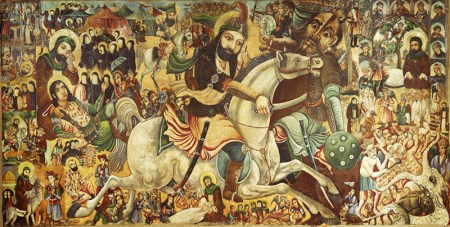 In the Battle of Kerbala, depicted in Abbas Al-Musavi’s painting, Husayn, the son of Ali and grandson of Muhammad, was killed along with his family and all his followers by the armies of the Umayyad Caliphate. It was the most crucial moment in the split between Shi’a and Sunni Islam. (Image source: Brooklyn Museum)
The Ummayads in Damascus, the imperial capital, were the first dynastic rulers among Arabs in Islamic history. The founder of the dynasty, Muawiyyah, seized power following the murder of Ali, the fourth Caliph and the cousin and son-in-law of the Prophet. With the Ummayads the institution of the Caliphate, which was an innovation to fill the void of leadership among the Arabs in Medina following Muhammad’s death, adopted the pomp and pageantry of the Persian and Byzantine rulers. The Caliphate, from that first century of Islamic history until its abolition in 1924 by Mustafa Kemal Ataturk, the founder of modern Turkey, was the embodiment of Oriental Despotism.
Those Muslims who witnessed the tribal conflicts erupt after the Prophet’s demise and recoiled in revulsion from politics turned inward in seeking union with the divine mystery, as mentioned in the Qur’an. They sought solace in the spiritual dimension of Islam and emulated the Prophetic tradition of withdrawal from the world through prayer and meditation. They became the founders of the Sufi, or mystical, tradition in Islam. This was the “other” face of Islam, distinct from political Islam.
The physical expansion of the Islamic empire was carried forth by the armies of the Caliphs. But the spread of Islam as a faith tradition was a slow process, carried forth by Sufi missionaries belonging to various fraternal orders and independent of political rulers of the world of Islam.
There is a world of difference in conversion brought about at the point of sword of conquering armies, and conversion that results from the communion of hearts and minds among people. The latter is more genuine and transformative than the former in every religion. The Qur’an itself — verse 49:13 — warned the Prophet that the acceptance of Islam by the Arabs of the desert was one of submission in the face of defeat, and that belief had not entered their hearts. This verse might be read as forewarning of crimes Muslims would commit through history in the cause of political Islam, beginning with the killing of Husayn in Kerbala.
Political Islam from its outset was an inquisition. It began with Abu Bakr, the first Caliph, when he subverted the Islamic principle stated in the Qur’an — “there is no compulsion in religion” (2:256) — and declared war on those Arab tribes who withheld their loyalty from him following the death of the Prophet. The “Ridda Wars,” or the “Wars of Apostasy,” launched by Abu Bakr inaugurated political Islam, and since then, the precedent he set for Muslim-on-Muslim violence has plagued Islamic history into our times.
The role of the a’lem (pl. ulema; religious scholars) was instrumental in the making of political Islam. The ulema provided legitimacy to the Ummayad Caliphs in Damascus in the period of intra-tribal conflicts that had led to the killings of the three Caliphs (Umar, Uthman, and Ali) after Abu Bakr and then the massacre in the field of Kerbala.
The consensus of the ulema — accepted by those who eventually came to represent the majority Sunni Muslims (the word “Sunni” derived from Sunna, meaning following the path or tradition of the Prophet) — was that political and social order however provided and maintained was preferable to fitnah (disorder). This consensus provided doctrinal legitimacy to the Caliphs. In return, the Caliphs recognized the special function of the religious scholars and jurists in the drafting, codification, and implementation of Sharia, or Islamic laws.
As a result of this bargain between men wielding swords and men wielding pens, the foundational arrangement of political Islam was firmly established. It was an arrangement consistent with the thinking prevalent in antiquity that religion (deen in Arabic) prescribed the totality of human affairs. This meant, as it was understood by the ulema in the formative period of Islamic history, that the primary function of state and government (dawlat in Arabic) was the establishment of the rule of Sharia. As Ann K.S. Lambton in her study, State and Government in Medieval Islam(1981), observed:
“The law precedes the state and is immutable at all times and under all conditions. The state is there to carry out the law. To disobey a law or to neglect a law is not simply to infringe a rule of the social order: it is an act of religious disobedience, a sin, and as such involves a religious penalty.”
Once the bricks and mortar of political Islam were set in the making of the Islamic civilization, Islam as the official doctrine of the state and empire clearly demarcated the norm as prescribed in the Sharia and made the ulema its official guardians. The Islamic state was a nearly perfect embodiment of a closed totalitarian system designed by men towards the end of the first millennium of the Common Era, and any suggestion of change or adoption of new idea in matters of either religion or politics was condemned as bid’ah (heresy deserving punishment).
But Muslim dissidents who viewed the doctrine of political Islam, or what might also be referred to as “official” Islam, as an aberration, went underground and kept the “other” Islam free from the shackles of politics. Beneath the hardened features of political Islam, the “other” Islam of Sufis provided solace to Muslims by tending to their humanity in the light of God’s most favoured attributes of mercy and compassion.
The “other” Islam, unlike political Islam, is not bound by time and space. It is directed to man’s inner yearnings for that which is eternal. It plunges in search of the inner meaning of the Qur’an as the Word of God, and the assuredness that God’s mercy is not denied to any of His creations. The Qur’an states, “We are nearer to man than his jugular vein” (50:16), reassuring man that he is not alone and God is not some distant uncaring deity.
Whereas the defining characteristic of political Islam was religion inseparable from politics, in “other” Islam politics was the corruption of religion and the dissolution of belief. Hence, from the perspective of “other” Islam, the Sharia as the corpus of Islamic laws codified by the ulema and sanctioned by the Caliphs was a poor, even corrupt, representation of the divine Sharia (in Arabic, a “path”) imprinted in the hearts of all believers as the path to acquiring God’s infinite grace.
ii.
Political Islam and the Islamic civilization it inaugurated was time-bound as a theopolitical system constructed in a certain historical period or context. It was a construct of late antiquity and the early medieval era. Since it was a fixed and closed system, it was invariably given to decay and dissolution.
During the Middle Ages, the Islamic civilization flourished just as other civilizations had. As Abdus Salam (1926-1996) — a physicist of Indo-Pakistani origin and the first Muslim scientist awarded the Nobel Prize for Physics in 1979 — observed in one of his lectures, the world of Islam and the world of Christianity (Europe) were more or less at a similar stage of development around the middle of the seventeenth century.
The evidence of this relative equality of the two civilizations, Salam suggested, could be seen in their technological achievements represented by the two monuments, the Taj Mahal in Agra, India, and St. Paul’s Cathedral in London, England, completed about the same time. Some two decades later, Salam observed,
“there was also created — and this time only in the West — a third monument, a monument still greater in its eventual import for humanity’s future. This was Newton’s Principia, published in 1687.”
Newton’s monument had no counterpart in India, or anywhere else in the Muslim world.
The Renaissance, the Age of Enlightenment and the Scientific Revolution, led by men of astounding intellect from Leonardo da Vinci to Galileo and Newton, propelled Europe out of the medieval age into the making of the modern world. But Islamic civilization, held together by political Islam, descended into a death spiral. A century after Newton published his major work, the Ottoman Empire was turning irreversibly into a pale shadow of a civilization that once had threatened the powers of Europe at the gates of Vienna.
In the aftermath of September 11, 2001 attacks in New York and Washington by the Islamist terrorists of al Qaeda, Bernard Lewis published What Went Wrong? (2002). It was Lewis’s effort to answer why, and how, the world of Islam had failed to accommodate the imperatives of the modern world.
“In most of the arts and sciences of civilization, medieval Europe was a pupil and in a sense a dependent of the Islamic world,” wrote Lewis.
“And then, suddenly, the relationship changed. Even before the Renaissance, Europeans were beginning to make significant progress in the civilized arts. With the advent of the New Learning, they advanced by leaps and bounds, leaving the scientific and technological and eventually the cultural heritage of the Islamic world far behind them.”
The civilizational success of political Islam in late antiquity and the early medieval era ironically carried within it the seeds of its own decline and demise. World War I eventually put an end to the anachronism that the Ottoman Empire had become, and the abolition of the Caliphate was a formal effort to bury political Islam for good.
Thoughtful Muslims, for nearly a century before the demise of the Ottoman Empire and the abolition of the Caliphate, had been thinking and writing about the need for an Islamic reform. Europe’s cultural advancement following the Reformation and Enlightenment held up a mirror for the Islamic world to follow in similar direction to similar ends.
In India under British rule, for instance, there were a significant number of Muslims who painfully recognized the malaise of Islamic societies and offered remedy for their advancement into the modern world. Among them the notable were Sir Sayyid Ahmad Khan (1817-98), the founder of the Aligarh University; Syed Ameer Ali (1849-1928), jurist and historian; and Muhammad Iqbal (1877-1938), poet and philosopher.
One of the most important works was published in 1925 by Ali Abd al-Raziq (1888-1966), an Egyptian scholar and jurist at Al-Azhar University in Cairo. In his seminal work, titled al-Islam wa ‘Usul al-Hukm (Islam and the Fundamentals of Authority), al-Raziq pointed out that there was no basis in the Qur’an and the Sunnah (traditions) of the Prophet for the institution of the Caliphate.
Al-Raziq was not someone from outside the ranks of the ulema, or a lay scholar unfamiliar with the intricacies of Islamic jurisprudence and theology in the construction of Sharia. He was a student of Muhammad Abduh (1849-1905) at al-Azhar, when Abduh had been appointed the Grand Mufti of Egypt.
Al-Raziq’s main contention was based on the distinction between spiritual and temporal authority. He indicated that the confusion among Muslims in the period after the Prophet arose from their inability to distinguish between the Apostolic role of Muhammad and the authority he derived as the Messenger of God (Rasul Allah), and the Caliphate as a temporal institution. Al Raziq wrote:
“Muhammad was but an apostle, sent on behalf of a religious summons, one pertaining entirely to religion and unmarred by any taint of monarchy or of summons to a political state; and he possessed neither kingly rule nor government, and he was not charged with the task of founding a kingdom in the political sense, as this word and its synonyms are generally understood.”
Al-Raziq was denounced by his peers. He was made to appear before the Council of the Greatest Ulema of Al-Azhar to hear the judgment against him, as his license to teach and practice law was revoked. Egypt was then ruled under Britain’s supervision, which likely saved al-Raziq from even more severe punishment.
But al-Raziq had stripped away the argument of traditional Islam on the sanctity of the Caliphate, and with it went the idea of Sharia being sacred. In the half-century following the abolition of the Caliphate by Mustafa Kemal, Muslims under European rule gained their independence as new states emerged in the Middle East and elsewhere in the world of Islam.
This period in the middle decades of the last century was a period of intense expectations on the part of Muslims for progress in their living conditions. A massive effort was invested to make the transition from the world of pre-Newtonian knowledge and learning to the modern world of science, industry and democracy.
There was a consensus among the rich and the poor that Islam was not intrinsically opposed to the modern world. There was a readiness among Muslims to follow in the footsteps of the West.
This consensus was reflected in a well-known and widely circulated aphorism attributed to Muhammad Abduh. On returning to Cairo from a visit to Europe, Abduh told his students, “I travelled in the West and found Islam, but no Muslims; I have returned to the East and find Muslims, but not Islam.”
The transition into the modern world, however, proved immensely complex and difficult. Europe’s transition had required several generations and a couple of centuries to break away from the feudal age into the modern age. The resistance from those invested in the ancien arrangements of society and culture was immense, and wars that followed were fierce.
Something similar to the European experience was unavoidable for Muslims in their effort to break from the hold of their traditional culture. And not unlike the wars in Europe, wars within the world of Islam since the 1970s are symptoms of the Muslim struggle to transit into the modern world.
iii.
The abolition of the Caliphate in 1924 was the formal announcement of political Islam’s death. But it refused to die, even as it was laid to rest. Its twitching was felt in the deep dark interior of the world of Islam, in remote and unwelcome places such as Nejd inside Arabia.
Here in Nejd, the medieval theology of Ibn Taymiyyah had struck roots. It had impressed an eighteenth-century itinerant preacher in the region, Abdul Wahhab (1703-92), who turned Ibn Taymiyyah’s extremist thinking into an even more rigid and austere doctrine, hostile to all things inimical to the Bedouin tribal culture of his time and environment.
Abdul Wahhab’s version of political Islam impressed a local tribal chief, and the marriage of convenience between the preacher and the tribal leader gave birth to the first Saudi state in the interior of Arabia. But when it sent tribal warriors to raid towns inside the frontiers of the Ottoman Empire, it provoked the Caliph of Islam in Istanbul, on whose orders this nascent state of the Wahhabi ruler was destroyed.
But the eventual collapse of the Ottoman Empire provided the conditions for the rebirth of the Saudi state as a kingdom under Abdul Aziz ibn Saud in the 1920s. Fortune, in the guise of great power politics, smiled upon him. He seized the support offered by the British, in return for influence in a region of strategic importance. The discovery of oil made the Saudi kingdom a prize to be protected by the Western powers, first Britain and later the United States, with far reaching consequences for the rest of the world, and even more so for the world of Islam and Muslims.
Any modernizing revolution is hugely disruptive. The movement from one stage of social development to another is not linear; it is, instead, filled with zigzags and reversals at every stage of the process toward an uncertain future.
When a people, however, pushes back against this process of change in their midst, or seeks to abort it, this reactionary effort pins its hopes on longing for an idealized past. The Newtonian revolution and the emergence of modern Europe made political Islam anachronistic. Wahhabism, as the official doctrine of the Saudi kingdom, was much more than a return of the most extreme version of political Islam in the early decades of the last century. It was, and remains, a demented effort of the most backward people within the world of Islam to remain culturally tied to antiquity, or jahiliyya (the age of ignorance), which Islam at its origin derided and rejected.
Political Islam in whatever version — Wahhabism, Khomeinism, Ikhwanism (the Muslim Brotherhood) and their derivatives — has no answer for Muslims on how to make their historic transition into the modern world. It can continue to rage against the modern world until its civilized inhabitants, including Muslims, have had enough of its destructiveness and obliterate it.
Then that vision of Abrahamic monotheism, which Muhammad was mysteriously directed to deliver to his people, will be emancipated from political Islam.
This message Muhammad was given admonished Arabs for their lack of faith, provided them with ethics for living honorably, told them in no uncertain term that the God of Abraham made no distinction among nations and people who believe in Him, and that on the Day of Final Reckoning, they need have no fear if they strive in doing what is right.
This is the “other” Islam. This is submission to truth, whose most righteous exemplar was Abraham when his faith was tested by his Deity, according to the Hebrew Bible, to sacrifice his son. And this is the faith of Sufis who took Muhammad’s message to people in places far removed from the desert confines of Arabia. It is simply, as the Qur’an reminds (30:30), deen al-fitrah, the natural religion, or inclination, of man to know his Creator. There is no return of this “other” Islam; it never went missing.




 anneinpt
 artaxes
 danmillerinpanama
 davidking1530
 Peter Hofman
 Joseph Wouk
 Peter
Peter Louisiana Steve
 WarSclerotic
Recent Comments