Posted tagged ‘Islamic State’

Russia Devouring the Eastern Mediterranean?

December 5, 2015

Russia Devouring the Eastern Mediterranean?

by Burak Bekdil

December 5, 2015 at 5:00 am

Source: Russia Devouring the Eastern Mediterranean?

  • Turkey shot down a Russian jet. No gain, but plenty of damage to its economy. Russia gave up one jet to Turkey and has made its military presence in Syria and the strategic eastern Mediterranean permanent.
  • Turkey can no longer speak to Russia about the possibility of ousting Assad.
  • Putin seems to be making sure that NATO will do nothing.

At this year’s G-20 summit in Antalya, Turkey, Russian President, Vladimir Putin, said that the radical jihadist Islamic State (IS) was being financed by donors from at least 40 countries, including some G-20 member states — clearly pointing his finger, without naming names, at Saudi Arabia and Turkey. A few days later, two Turkish F-16 jets shot down a Russian SU-24 warplane, and claimed that the Russian jet had violated Turkish airspace for 17 seconds on the country’s Syrian border — a violation Russia denies. This was the first time a Soviet or Russian military aircraft was shot down by a NATO air force since the end of WWII.

Turkey and Russia have long been in a proxy war in Syria: Russia, together with its quieter partner, China, supports the Shi’ite Iran-backed Syrian regime of President Bashar al-Assad; and Turkey explicitly supports Assad’s Sunni opponents [“moderate” jihadists] — apparently in the hope of building a Muslim Brotherhood/Hamas-type of regime in Damascus that would be friendly to its own Islamist government. After the downing of the Russian jet, the Turco-Russian proxy war has become less proxy.

No more Mr. Nice Guy.
Russian President Vladimir Putin twice refused to meet with Turkish President Recep Tayyip Erdogan on the sidelines of the Paris Climate Summit this week. Pictured: President Putin with then Prime Minister Erdogan, meeting in Istanbul on December 3, 2012. (Image source:kremlin.ru)

An angry Putin called the incident “a stab in the back.” He declined Turkish President Recep Tayyip Erdogan’s requests to discuss the issue. He twice refused to meet Erdogan on the sidelines of the Paris Climate Summit.

Russia’s foreign minister, Sergei Lavrov, quickly cancelled his official visit to Turkey — a visit that had been scheduled for the day after the downing of the Russian jet. At the outset, NATO member Turkey had taught Russia a good lesson. In reality, judging from the consequences, it all looks like a Russian gambit, with Turkey shooting itself in the foot and risking a new NATO-Russia conflict.

Russia’s ire seemingly is being expressed in economic terms:

  • Moscow said it will introduce visa restrictions for Turkish citizens, beginning Jan. 1, 2016.
  • Russian authorities detained a group of Turkish businessmen on charges of “false statements about their trip to the country.”
  • Press reports noted that Russia was considering limiting or excluding Turkish construction companies from the country, a potentially multi-billion dollar loss for the Turkish economy.
  • Moscow warned its citizens against visiting Turkey — a ban that could deal a big blow to Turkey’s lucrative tourism industry. Last year 4.5 million Russians visited Turkey, mostly its Mediterranean coast. Russian tour operators were warned to suspend business with Turkey.
  • The fate of two huge Turco-Russian energy projects remains unknown, as Russia’s energy minister, Alexei Ulyukayev, did not rule out sanctions hitting the Turkish Stream gas pipeline and a planned Russian nuclear energy plant in Turkey. Turkey buys about 55% of its natural gas from Russia. Its second largest gas supplier is Iran, Russia’s ally — and Turkey’s rival — in Syria.
  • Russia’s Minister of Agriculture, Alexander Tkachev, said that Russia would be replacing Turkish food imports with goods from Iran, Israel and Morocco.
  • Shipments of wheat to Turkey from key Russian ports were put on hold.
  • The Kremlin officially announced a wide range of sanctions on Turkey, including a ban on Turkish workers (with estimates that 90,000 will be fired by Jan. 1, 2016), restrictions on imported goods and services from Turkey and calls for “strengthening of port control and monitoring to ensure transport safety.”
  • Around 1,250 trucks carrying Turkish exports were blocked from entering Russia on Nov. 30 and were stranded at border posts, awaiting clearance.
  • Russian soccer clubs will be banned from signing Turkish players during the upcoming winter break.

All of that is commercially punitive. There is a more serious side of the Turco-Russian conflict that concerns NATO and western interests in the Middle East.

Russian Defense Minister Sergei Shoigu announced on Nov. 25 that Russia would deploy S-400 surface-to-air missile systems in its Hmeymim air base in Syria.

Turkey shot down a Russian jet. No gain, but plenty of damage to its economy. Russia gave up one jet and has made its military presence in Syria and the strategic eastern Mediterranean permanent. It has reinforced its bases in Syria and intends to build a new military base there. Turkey can no longer speak to Russia about the possibility of ousting Assad.

In a further move to escalate tensions, the Russian General Staff deployed one of its largest air defense ships at the edge of Turkish territorial waters in the Mediterranean. Russian military spokesman General Sergei Rudskoi said that Russian bomber aircraft would be “supported by chasers, and any kinds of threats will be responded to instantly.” Accordingly, The Moscow, one of the Russian Navy’s two largest warships and the flagship of Russia’s Black Sea Fleet, will be deployed where Turkey-Syria territorial waters connect.

In addition, Putin issued orders to deploy nearly 7,000 troops, plus anti-aircraft missiles, rocket launchers, and artillery to the Turkish border, and asked them to be in readiness for full combat.

There have been other military repercussions, too. Since the shooting down of the Russian jet, the Russian military has been regularly pounding the Syrian villages near the Turkish border that populated by the Turkmen, a Turkish ethnicity that supports jihadists in Syria — and is supported by Ankara. The Russians also have been hitting Turkish aid convoys bound for Turkmen villages. More than 500 Turks and Turkmen have been killed in Russian airstrikes. Meanwhile, the U.S.-led allied air strikes against IS have come to a halt. Neither Washington nor Ankara is keen for another conflict with Russia. So, IS and Russia keep on flourishing.

The Russian military has scrapped all contacts with the Turkish military, possibly waiting for the first Turkish military aircraft that violates foreign airspace to shoot.

Turkey has every liberty to challenge Russia and, inevitably, become the victim. But with its geostrategic, Islamist ambitions, it is exposing NATO allies to the risk of a fresh conflict with Russia — and at a time when the wounds of previous conflicts remain unhealed.

Putin has accused Turkey’s leaders of encouraging the Islamization of the Turkish society, which he said was a “problem.” He was not wrong. In fact, Islamism and neo-Ottoman ambitions are the source of Turkey’s (not-so) proxy war with Russia in the Syrian theater. Although Turkey, officially, is a NATO member and part of the allied campaign against IS, its Sunni Islamist ambitions over Syria hinder the global fight against jihadists. A Turco-Russian conflict is weakening the fight.

Putin seems to be making sure that NATO will do nothing.

Burak Bekdil, based in Ankara, is a Turkish columnist for the Hürriyet Daily and a Fellow at the Middle East Forum.

‘Incursion’: Baghdad demands Turkey withdraw ‘training’ troops from northern Iraq

December 5, 2015

Incursion’: Baghdad demands Turkey withdraw ‘training’ troops from northern Iraq

Published time: 4 Dec, 2015 20:12 Edited time: 5 Dec, 2015 02:34

Source: ‘Incursion’: Baghdad demands Turkey withdraw ‘training’ troops from northern Iraq — RT News

Turkish soldiers © Sertac Kayar
The Iraqi government has demanded that Ankara withdraw the more than 100 Turkish forces that entered Iraq with tanks and artillery for alleged “training” of troops near Islamic State-occupied Mosul. Baghdad stressed the unsanctioned move was a breach of its sovereignty.

READ MORE: Kurds & US Special Forces should be used to seal Turkish-Syrian border – Russian FM

The Iraqi foreign ministry said in a statement early on Saturday that the Turkish troops were acting in violation of the country’s sovereignty and demanded the forces withdraw immediately. “Around one regiment armoured with tanks and artillery” has entered the northern Nineveh area, according to the statement from the Iraqi Prime Minister’s media office.

The Iraqi authorities call on Turkey to respect good neighbourly relations and to withdraw immediately from the Iraqi territory,” the statement said, stressing that the Turkish troops entered “without the request or authorization from the Iraqi federal authorities,” which is a “serious breach of Iraqi sovereignty.”

The foreign ministry called Turkey’s move “an incursion,” Reuters reported.

READ MORE: ‘Everyone knows what’s going on’: Istanbul residents on Turkey-ISIS oil trade

According to the agency’s source, the US-led anti-Islamic State coalition was aware of the Turkey’s move.

Turkish soldiers have reached the Mosul Bashiqa region. They are there as part of routine training exercises. One battalion has crossed into the region,” the source told Reuters without revealing the exact number of troops.

He added that the Turkish forces are “training Iraqi troops.”

However, according to two US defense officials quoted by Reuters, Turkey’s deployment is not part of the efforts of the US-led coalition battling Islamic State (IS, formerly ISIS/ISIL).

On Friday, 130 Turkish soldiers equipped with heavy weapons were deployed at a military base on the outskirts of the city of Mosul, which is currently held by IS, according to the Daily Sabah newspaper.

READ MORE: Turkey skeptical about US proposal to close border ‘under ISIS control’

According to Cumhuriyet newspaper, the number of the deployed Turkish troops amounts to at least 150.

The town of Bashiqa is located about 10 kilometers northeast of Mosul.

© Google Maps
Mosul, Iraq’s second biggest city, was seized by Islamic State in June 2014 and has been fully governed by militants ever since. Moreover, the extremist group captured large stockpiles of weapons and ammunition that were stored in the city.

In the collapse of Mosul, we lost a lot of weapons,” Prime Minister Haider al-Abadi said in an interview with Iraqiya state TV in June. “We lost 2,300 Humvees in Mosul alone,” he added.

READ MORE: Mosul blame game: Iraqi ex-PM Maliki accused in fall of key city to ISIS

The Turkish intrusion into Iraq comes shortly after Ankara’s motives in the war on Islamic State have been questioned by Moscow, Tehran, as well as by Baghdad.

The Russian government has been particularly vocal in pointing the finger at the illegal oil trade between IS terrorists and the Turks. Moscow-Ankara relations deteriorated after a Turkish F-16 jet downed a Russian Su-24 bomber on the Syrian-Turkish border for an alleged airspace violation on November 24, while the Russian jet was returning from an anti-terrorist mission. In the days after, the Russian Defense Ministry presented detailed photo and video evidence showing three huge “live pipelines” made of oil trucks effortlessly crossing the Syrian border into Turkey in militant-controlled areas.

Russian President Vladimir Putin described Turkey’s move as “a stab in the back by accomplices of the terrorists,” while the Defense Ministry directly tied the illegal Syrian and Iraqi oil trade – a chief lifeline for IS terrorists – to the family of Turkish President Recep Tayyip Erdogan.

READ MORE: Russia says Turkey’s Erdogan & family involved in illegal ISIS oil trade

Erdogan has dismissed the accusations as “slander” and continued to defiantly present the downing of a non-hostile jet as a rightful move aimed at defending the Turkish border. The surviving Russian pilot has insisted the crew was in full control of the course of the flight and had never entered Turkey, while adding they had never received any visual or radio warning from the F-16. One Russian pilot, the commander of the jet, was killed by Turkmen rebel fire while parachuting from the plane, and one Russian Marine was killed during the search and recovery operation.

Meanwhile, as the US has stepped in for Turkey, supporting its refutation of Russia’s IS oil claims, other powers have come forward to back Moscow’s charges concerning Ankara’s trade with the terrorists. On Friday, Tehran said that it has collected photo and video evidence of IS oil entering Turkey by truck.

READ MORE: ‘Great partners’: Pentagon rejects Russian evidence of Turkey aiding ISIS

“If the government of Turkey is not informed of Daesh [derogatory term for IS] oil trade in the country, we are ready to put the information at its disposal,” Iran’s official Islamic Republic News Agency (IRNA) quoted Expediency Council Secretary, Mohsen Rezaie, as saying. The official added that they are also ready to present the proof to the public.

While officially Baghdad is now considering whether there is enough evidence of Turkey’s involvement in oil trade with IS to file a formal protest at the UN Security Council, an Iraqi Defense Ministry spokesman, Naseer Nuri, told Sputnik on Wednesday that “general information about the smuggling of Iraqi oil by trucks to certain countries, including Turkey” is already available to them, and “this oil is used to fund Daesh.”

Other Iraqi officials have openly accused Turkey of knowingly trading with the terrorists.

There is “no shadow of a doubt” that Ankara knows about the oil smuggling operations, Iraqi MP and former national security adviser Mowaffak al Rubaie told RT.

“The merchants, the businessmen [are buying oil] in the black market in Turkey under the noses – under the auspices if you like – of the Turkish intelligence agency and the Turkish security apparatus… There are security officers who are sympathizing with ISIS in Turkey. They are allowing them to go from Istanbul to the borders and infiltrate … Syria and Iraq,” he said.

“Money and dollars generated by selling Iraqi and Syrian oil on the Turkish black market is like the oxygen supply to ISIS and it’s operation,” Rubaie added. “Once you cut the oxygen then ISIS will suffocate.”

READ MORE: ‘Oxygen for jihadists’: ISIS-smuggled oil flows through Turkey to intl markets – Iraqi MP

General Wesley Clark: ISIS Serves Interests Of US Allies Turkey And Saudi Arabia

December 4, 2015

General Wesley Clark: ISIS Serves Interests Of US Allies Turkey And Saudi Arabia Tyler Durden’s picture Submitted

by Tyler Durden on 12/03/2015 23:15 -0500

Source: General Wesley Clark: ISIS Serves Interests Of US Allies Turkey And Saudi Arabia | Zero Hedge

Submitted by Claire Bernish via TheAntiMedia.org,

“Let’s be very clear: ISIS is not just a terrorist organization; it is a Sunni terrorist organization. That means it blocks and targets Shi’a. And that means it’s serving the interests of Turkey and Saudi Arabia – even as it poses a threat to them.” – Retired Gen. Wesley Clark

Former NATO Supreme Allied Commander General and retired U.S. General Wesley Clark revealed in an interview with CNN that the Islamic State (Daesh, ISIS) remains geostrategically imperative to Sunni nations, Turkey and Saudi Arabia, as they clamor for strategic power over Shi’a nations, Syria, Iraq, and Iran. He explained that “neither Turkey nor Saudi Arabia want an Iran-Iraq-Syria-Lebanon ‘bridge’ that isolates Turkey, and cuts Saudi Arabia off.”

When asked by the CNN host if Russian President Vladimir Putin’s suggestion that Turkey was “aiding ISIS” had any validity, he responded:

 “All along there’s always been the idea that Turkey was supporting ISIS in some way. We know they’ve funneled people going through Turkey to ISIS. Someone’s buying that oil that ISIS is selling; it’s going through somewhere – it looks to me like it’s probably going through Turkey – but the Turks haven’t acknowledged that.”

After explaining this virtual gateway for the Islamic State’s oil, Clark was quick to emphasize that Putin’s allegations about Turkey’s support for terrorist organization, ISIS, aren’t without their own hypocrisy. Russia, of course, has been upholding President Bashar al-Assad’s administration in Syria against rebel groups backed by the U.S. — despite continuing denials by U.S. officials that that particular theater is its primary interest in the region.

He said, “Putin would like to dirty Turkey by saying it’s supporting terrorists, but the truth is that he’s supporting terrorists. I mean, the tactics used by the Assad regime have been terror tactics. They’re dropping barrel bombs on innocent civilians.”

Clark concludes the interview with a statement that encapsulates growing sentiment of many Westerners who’ve grown war-weary with such geopolitical wrangling overseas:

 “There’s no good guy in this – this is a power struggle for the future of the Middle East.”

Kurds & US Special Forces should be used to seal Turkish-Syrian border

December 3, 2015

Kurds & US Special Forces should be used to seal Turkish-Syrian border -Russian FM

Published time: 3 Dec, 2015 01:36

Source: Kurds & US Special Forces should be used to seal Turkish-Syrian border – Russian FM — RT News

This is a master set on the chess board .

Russia's Foreign Minister Sergei Lavrov © Sergei Karpukhin
With Kurdish militia and US Special Forces on the ground, there is a realistic way to shut off the illegal flow of oil from Syria into Turkey, Russian Foreign Minister Sergey Lavrov said at talks with his Serbian counterpart, Ivica Dacic.

Sealing the border between Turkey and Syria is more important at the moment than finding out who is buying the oil produced by Islamic State (IS, ISIS/ISIL), Lavrov said while speaking with Dacic in Belgrade on Wednesday. The talks come on the eve of a two-day conference of the Organization for Security and Co-operation in Europe (OSCE), currently chaired by Serbia.

“Rather than launching a lengthy procedure of investigation, one must take an absolutely obvious step, i.e. close the Turkish-Syrian border,” Lavrov said, stressing that “Turkey’s efforts will not be enough and it will need help,” RIA Novosti reports.

“As for specific ways of sealing the border between Turkey and Syria, as well as between Turkey and Iraq, one must proceed from the real situation on the ground. Kurdish militia forces, which are allies of the US-led coalition, could be used both on the Syrian and Iraqi side of the border,” he added, as quoted by TASS.

Lavrov did not rule out involvement of US Special Forces stationed in Iraq in the border closure process either, but stressed that the process must be coordinated with Damascus. “Washington claims they could be also used in Syria. I am convinced that it could be done only with consent of the Syrian government,” Lavrov stressed.

At the same time, the minister announced that the facts concerning Turkey’s oil trade with Islamic State would be officially presented at the UN to all parties concerned.

“We have repeatedly publicly stated that oil from the IS-controlled territories is transported abroad, particularly to Turkey. The facts that substantiate these claims will be formally presented in the UN in particular, and to all parties concerned,” he said.

Referring to the November 24 downing of a Russian Su-24 bomber by a Turkish jet over Syria, Lavrov refuted Turkey’s claim that Russia had earlier refused to create “a hot line” between the militaries of the two countries, saying that such a line had been established, but that Ankara had never used it.

“Turkey’s media claim that he [Turkish Foreign Minister Mevlut Cavusoglu] proposed creating a “hot line” between the Defense ministries, but we [Russia] refused. This is a lie, as such a line was established at the earliest stage of the Russian Air Space Forces operation [in Syria] at Russia’s initiative,” he said.

“Turkey has never used it. It did not use it even in the incident on November 24,” Lavrov added, referring to the downing of Russia’s bomber.

The Russian foreign minister also stressed that, if by shooting down the Russian warplane Turkey had been trying to hinder talks on Syria in Vienna, or thwart Russia’s operation in Syria, it had failed.

“If Turkey’s downing of Russia’s plane on November 24 was aimed at sabotaging the political process within the Vienna group, then I can assure you that Turkey will not succeed in this matter,” Lavrov said after the talks with Dacic, who is also the current OSCE Chair.

However, Lavrov also said during the negotiations that he was ready to meet with his Turkish counterpart on the sidelines of the OSCE conference in order to try to lower recent tensions between the two countries.

“As far as the meeting with Turkish Minister [Mevlut] Cavusoglu goes, we are ready to make such a meeting on the sidelines [of the OSCE conference],” Lavrov told reporters as he arrived in Belgrade on Wednesday.

At the same time Lavrov warned that “it will be sad if we hear nothing new.”

‘Allah took their sanity’: Putin accuses Turkish leadership of ‘aiding terror’

December 3, 2015

‘Allah took their sanity’: Putin accuses Turkish leadership of ‘aiding terror’

Published time: 3 Dec, 2015 09:16 Edited time: 3 Dec, 2015 15:14

Source: ‘Allah took their sanity’: Putin accuses Turkish leadership of ‘aiding terror’ — RT News

December 3, 2015. Russian President Vladimir Putin delivers his annual Presidential Address to the Federal Assembly at the Kremlin's St. George Hall. © Ramil Sitdikov
Russian President Vladimir Putin lashed out at “part of the leadership in Turkey” during his annual address to the parliament, accusing Ankara of having trade ties with terrorist groups in Syria and Iraq. He also promised more sanctions for Turkey over downing of the Russian jet.

Follow LIVE UPDATES on Putin addressing Russian legislators

Putin said Russia still cannot comprehend why the downing of the plane happened.

We were prepared to cooperate with Turkey on most sensitive issues and go further than their allies. Allah knows why they did it. Apparently Allah decided to punish the ruling clique in Turkey by taking their sanity,” Putin said.

Putin stressed that Moscow’s anger over the incident is directed at particular individuals and not at the Turkish people.

We have many friends in Turkey,” he said. “They should know that we do not equate them and part of the current Turkish leadership, which holds a direct responsibility for the deaths of our troops in Syria,” he said.

He added that the killing of Russian officers would have long-term consequences for those responsible.

We will not forget this aid to terrorists. We have always considered betrayal the worst and most shameful act. Let those in Turkey know it who shot our pilots in the back, who hypocritically tries to justify themselves and their actions and cover up the crimes of terrorists,” he said.

The routes of alleged oil smuggling from Syria and Iraq to Turkey © syria.mil.ru

Map, images from Russian military show main routes of ISIS oil smuggling to Turkey

Putin said Russia would not resort to saber-rattling to respond to the Turkish actions, but neither would it limit itself to the economic sanctions it imposed since the incident.

The incident with the Russian Su-24 bomber shot down by Turkish warplanes near the Turkish-Syrian border has greatly deteriorated relations between the two countries. Turkey insists it acted in response to a brief violation of its airspace and was justified in using lethal force. Russia insists no violation took place and has accused Turkey of supporting terrorists in Syria.

The downing of the bomber resulted in the deaths of two Russian troops, who were the first combat losses during the two month-long Syrian campaign. The pilot of the downed plane was killed by a pro-Turkish militant group as he was parachuting to the ground. A marine was killed by militants when a helicopter dispatched to rescue the bomber crew came under fire from the ground.

Putin’s address started with a minute’s silence to commemorate the two troops. The widows of the dead Russians were present at the event.

Putin stressed that the Russian operation in Syria is aimed first and foremost at preventing fighters who went to the Middle East from Russia and its neighboring countries from returning home and bringing the threat of terrorist attacks to Russian soil.

They are getting money, weapons, gathering strength. If they get stronger, winning there, they will inevitably come here to sow fear and hatred, blast, kill and torture people,” Putin said.

Putin called on all nations that have pledged to fight terrorism to join forces and abandon the notion that terrorist groups can be used for country’s own goals. He stressed that the rise of terrorism in the Middle East over the last few years was caused to a large degree by foreign meddling.

Some countries in the Middle East and North Africa, which used to be stable and relatively prosperous – Iraq, Libya, Syria – have turned into zones of chaos and anarchy that pose a threat to entire world,” Putin said.

Read more

© syria.mil.ru

We know why it happened. We know who wanted to oust unwanted regimes, and rudely impose their own rules. They triggered hostilities, destroyed statehoods, set people against each other and simply washed their hands [of the situation] – giving way to radicals, extremists and terrorists.”

Russia’s lost thousands of lives over two decades of terrorist attacks and is still not safe from terrorist attacks, as evidenced by the bombings in Volgograd in 2014 and the bombing of a Russian passenger plane in Egypt in October, Putin reminded.

“Breaking the bandits’ back took us almost 10 years,” he said. “We practically pushed the terrorists out of Russia, but we are still engaged in a fierce fight against the remainder of the gangs. This evil still comes back occasionally.

Putin said the rise of jihadists in the Middle East in our time is not unlike the rise of Nazism in the mid-20th century, and that the world should learn from the mistakes of the past, when a failure to act in time resulted in the loss of millions of lives.

We are facing a destructive barbaric ideology again and we have no right to allow those new obscurants to achieve their goals. We have to abandon all differences, create a single fist, a single anti-terrorist front, which would act in accordance with the international law and under the aegis of the United Nations,” he said.

Putin was speaking on Thursday before the Federal Assembly, a joint session of the two chambers of the Russian parliament, plus regional governors and the cabinet. The annual address is a traditional key policy report of the executive, which focuses on domestic politics rather than international relations.

‘Business as usual’ with Turkish President Recep Tayyip Erdogan is now over, Sergey Ivanov, the head of Putin’s office, confirmed to RT after the Russian president’s address:

“Yes, it is definitely over. But fighting terrorism is ‘business as usual’, as the Russian president said,” Ivanov said.

The Turkish leadership “must acknowledge that a tragic mistake was committed and to beg for [forgiveness], or this leadership will not play any significant role in bilateral relations between Russia and Turkey. We will not be able to have any ties with Turkey under this leadership if it doesn’t change its attitude,” Konstantin Kosachev, the chair of the State Duma Committee for Foreign Relations, told RT.


The New French “Résistance”

December 2, 2015

The New French “Résistance,” Gatestone InstituteGuy Millière, December 2, 2015

  • Some spoke of “resistance,” but to them, resistance meant listening to music. A man on a talk show said he was offering “free hugs.”
  • A French judge, Marc Trevidic, in charge of all the major Islamic terrorism cases over the last ten years, said a few days before the November attacks in Paris that the situation was “getting worse” and that “radicalized groups” could “carry out attacks resulting in hundreds of deaths.” He was quickly transferred to a court in northern France, where he has been assigned to petty crimes and divorce cases.
  • All the French political leaders know that the situation is out of control, but not one will say so publicly. Not one has asked the government why it took almost three hours for the police to intervene during the attack at the Bataclan Theater, where 89 people were murdered and over 200 wounded.
  • France’s political leaders are apparently hoping that people will get used to being attacked and learn to live with terrorism. In the meantime, they are trying to divert the attention of the public with — “climate change!”

Several weeks have passed since Islamist attackers bloodied Paris. France’s President François Hollande is describing the killers as just “a horde of murderers” acting in the name of a “mad cause.” He adds that “France has no enemy.” He never uses the word “terrorism.” He no longer says the word “war.”

France never was, in fact, at war. Police were deployed on the streets. Special Forces had to “intervene” a few days later in the Paris suburb of Saint-Denis. That was it.

French forces did bomb positions of the Islamic State in Syria; and Hollande traveled the world to find coalition, but could not. Now he says he wants to turn a page. The French public seems to want to turn a page, too.

From the beginning, pacifism and appeasement filled the air. A German pianist came to playJohn Lennon’s Imagine in front of the Bataclan Theater; since then, other pianists have come. On the Place de la République, people assemble every evening to sing more songs by the Beatles: All You Need Is Love; Love Me Do. Candles are lit, and banners deployed, calling for “universal brotherhood.”

Those invited to speak on TV about what happened allude to “senseless acts.” They do not blame anyone.

Some spoke of “resistance,” but to them, resistance meant listening to music. To others, it meant having a drink with friends in a bar. In a widely circulated video, a man tries to reassure his child. “They have guns,” he mutters, “but we have flowers.”

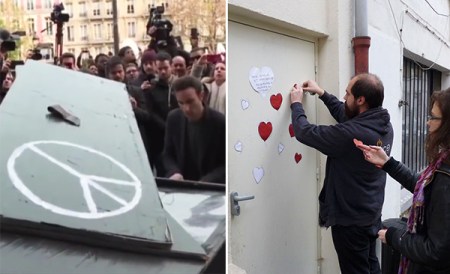
Heart-shaped stickers are posted on mosques. Words such as “We love you” and “We share your pain” are written on the hearts.

1372

Just after the attacks, French philosopher Michel Onfray said that France for many years had led Islamophobic bombings against the Muslim world, so “it was logical if the Muslims now attacked France.”

When his words were used in an Islamic State propaganda video, and reporters asked him if he regretted what he said, he replied, “No.”

A man who lost his wife in the Bataclan massacre said on a talk show that he would live in the future as he did before; that he had no hatred at all against the murderers, just compassion. Another man on a different talk show said he was offering “free hugs.”

If some French think otherwise, they are silent.

All political leaders in France speak like Hollande. They say the country must show “unity” and “solidarity.” All of them know the mood of the vast majority; even those who might want to say more, stay silent.

Almost no one mentions radical Islam. Those who do, prefer the word “jihadism,” and rush to emphasize that “jihadism” is “not related to Islam.”

Hollande, when he still spoke of war, said that France had “an enemy.” He avoided the word “Islamic,” instead referring to the Islamic State by its Arabic acronym, “Daesh.”

He knew that “Daesh” could not be defeated without an American intervention that would not take place. With symbolic gestures, he did the best he could.

He also seems to know that the main enemy of France is not in Syria or Iraq, but inside the country: France already finds herself defeated.

More than half the Islamists who attacked Paris on November 13 were Muslims born and raised in France. Mohamed Merah, the murderer of Jewish children in Toulouse in 2012, and those who attacked the satirical magazine Charlie Hebdo and the kosher supermarket in January all were Muslims born and raised in France.

Over 750 no-go zones — autonomous areas ruled by radical imams and Muslim gangs — exist in France.

Radical imams and Muslim gangs also control most of France’s prisons: 70% of prison inmates in France are apparently Muslim. Non-Muslim inmates are attacked and threatened; many are forced to convert to Islam.

A British survey published in 2014 showed that 16% of French approve of the Islamic State. Among people aged 18-25, the proportion rose to 27%. Within the French Muslim population, the numbers are undoubtedly higher.

More than 1000 French Muslims have left France to fight for the Islamic State. At least 400 havereturned without being stopped or vetted at a border. Thousands of radicalized French Muslims have never left. Many are good, loyal citizens; but many could have learned all they wanted to know on the internet and on Islamic satellite television stations. Still others — hundreds of thousands of French Muslims — are not radicalized but are ready to help the radicalized ones; ready to host them or offer them asylum.

More than 10,000 French Muslims are classified as extremely dangerous by the police and are linked to “jihadist activities”. They are registered in what the French government calls “S files,” but there is no way to monitor their whereabouts. Placing them all in detention centers would involve a complete break with what is left of the rule of law in France.

All of the French Muslims who participated in the November 13 attacks were registered in “S files,” but that did not change anything. They were free to act, and they did.

For the first time in Europe, suicide bomb attacks took place. The explosive used to make suicide belts, triacetone triperoxide (TATP), is powerful and extremely sensitive to friction, temperature change and impact. Making belts containing TATP requires a “professional.”

A French judge, Marc Trevidic, in charge of all the main Islamic terrorism cases over the last ten years, said a few days before the November attacks that the situation was “getting worse,” was now “out of control,” and that “radicalized groups” established in the country could “carry out attacks resulting in hundreds of deaths.” He was quickly transferred to a court in Lille, northern France, where he was assigned to petty crimes and divorce cases.

All the French political leaders know that Marc Trevidic is right — that the situation is out of control — but not one will say so publicly. Not one has asked the government why it took almost three hours for the police to intervene during the attack at the Bataclan Theater, where 89 people were murdered and over 200 wounded. There are simply not enough well-trained police, and not enough weapons in the hands of the police, and not enough bulletproof vests.

For the next few months, more soldiers and police officers will be placed in front of public buildings, synagogues, churches and mosques, but “soft” targets, such as theaters, cafés and restaurants, are not protected. It is as easy to enter a theater in Paris today as it was on November 13. French police do not have the right to carry a weapon when they are on duty.

In a few weeks, French military actions against the Islamic State will doubtless stop. President Hollande, the French government, and most French political leaders probably hope that the French will soon forget the attacks. They know that the problems are now too widespread to be solved without something resembling a civil war. When more attacks occur, they will talk of “war” again. They are supposedly hoping that people will get used to being attacked and learn to live with terrorism.

In the meantime, French politicians are trying to divert the attention of the public with — “climate change!” The conference in Paris will last a fortnight. President Hollande says he wants save the planet. He will be photographed next to America’s Barack Obama and China’s Jiang Zemin.

French journalists are no longer discussing jihad; they are discussing “climate change.”

Until December 11, at least, Paris will be the safest city.

In June 2015, five months after the January attacks, French Prime Minister Manuel Valls said that the French had to “adapt to Islam”. In November, he added that “Islam has to stand up to jihadism”. The French Council of the Muslim Faith, offering “condolences” to the families of the victims, specified that Muslims were “victims” too, and that they should not be “stigmatized.”

Regional elections will be held on December 6th and 13th, the same time as the conference on climate change.

Polls show that the rightist party, National Front, will almost certainly win in a landslide. Marine Le Pen, leader of the National Front, did not depart from the calls for “unity” and “solidarity.” She is, however, the only politician to say unambiguously that the main enemy is not outside the country, but within. She is also the only politician to say that a return to security implies a return to border controls. A National Front victory does not, however, mean that Marine Le Pen will win the 2017 presidential election: all the other parties and the media might band together against her.

France’s National Front is part of the increasingly popular rejection of the European Union. Thei nvasion of Europe by hundreds of thousands of mostly Muslim migrants has strengthened that stance. The Islamist attacks in Paris, combined with the state of emergency decreed in Belgium for several days after the attacks, have helped this rejection to gain more ground. In addition, the news that several of the Paris terrorists came to France among illegal migrants — and had successfully used false Syrian passports to enter Europe, where they could go from country to country unhindered — did not help.

The rise of populism is slowly destroying the unelected, unaccountable, and untransparent European Union. Many European mainstream journalists see this change as a “threat.”

The real threat to Europe might be elsewhere.

“The barbarians,” wrote the commentator Mark Steyn, “are inside, and there are no gates.”

After the attacks in Paris, Judge Marc Trevidic, again, raised the possibility of simultaneous attacks in several cities in France and in Europe. He said that if these attacks took place, the situation would become “really serious”. He said he had documents to show that Islamist groups were planning to organize such attacks. If the suicide bombers, he said, had been on time at the Stade de France, before the 79,000 spectators had entered, the death toll could have been worse. He concluded that too little had been done for too long, and that now it was probably too late.

During the November 27 official ceremony in Paris honoring the victims of the attacks, a song, If We Only Have Love, by Jacques Brel — selected by President Hollande – was sung: “If we only have love – We can melt all the guns – And then give the new world – To our daughters and sons.”

How could an Islamist not be moved by that?

Border control: Truck stopped with nuclear material from Slovakia

December 1, 2015

Border control: Truck stop with nuclear material from Slovakia

30. November 2015 – 20:00

https://www.unzensuriert.at/content/0019362-Grenzkontrolle-LKW-mit-Atommaterial-aus-Slowakei-gestoppt

Translation from German .

That security controls have their place , also at the EU’s internal frontiers, shows at the Austrian-Slovak border. The Austrian customs authorities stopped a small truck on with explosive nuclear cargo. The used test equipment  measured  radiation of the cargo, which had exceeded the allowable limit value equal to 4 times.

The truck driver, was a Croat, is who did not know the cargo contents. , The international drivers could also not show  appropriate transport papers .

Extensive investigations were launched, where the radioactive material originates and what goal it had.

IS: Biological and chemical weapons in the arsenal

That such illicit nuclear shipments can have an immediate terrorist connection, proving intelligence reports on the strategy of the Islamic State (IS). IS-terrorists have in fact an arsenal of biological and chemical weapons gained in the meantime, which could be used at any time. In Kosovo, a biological attack was thwarted this year for the supply of drinking water.

International security experts believe that the IS also has contacts to equip themselves with the appropriate nuclear material, to use this in attacks.

Not Thinking Strait? Turkey Won’t Let Russian Ships Into Bosphorus

December 1, 2015

Not Thinking Strait? Turkey Won’t Let Russian Ships Into Bosphorus

13:12 01.12.2015(updated 14:45 01.12.2015)

Source: Not Thinking Strait? Turkey Won’t Let Russian Ships Into Bosphorus

See also : https://warsclerotic.wordpress.com/2015/11/30/turkey-blockading-russia-from-dardanelles-black-sea-fleet-completely-cut-off/

Dozens of Russian ships have reportedly been waiting for hours near the Bosphorus Strait to get the go-ahead from Turkey to be able to pass through the waterway.

In a clear violation of international norms, Turkish authorities have created hurdles for Russian vessels passing through the Bosphorus Strait; as a result, dozens of Russian ships have been waiting for hours to obtain the green light from Turkey for passage, media reports said.RIA Novosti quoted Viktor Kravchenko, former chief of staff of the Russian Navy, as saying that a possible unilateral closure by Turkey of the Bosphorus Strait for Russian ships would be out of line with international law.

“Turkey will not close the strait to Russian vessels en route to Syria because it would be a violation of international law and the Montreux Convention, in particular, — a document that was signed by most counties at the time”, he said.

The 1936 Montreux Convention on the Regime of the Straits regulates the passage of civilian and naval ships through the Bosphorus Strait and the Dardanelles.  According to Article 2, “merchant vessels shall enjoy complete freedom of transit and navigation in the Straits, by day and by night, under any flag and with any kind of cargo, without any formalities.”

The New Mosque is backdropped by Istanbul's skyline and the Bosporus, Thursday, July 9, 2015
The New Mosque is backdropped by Istanbul’s skyline and the Bosporus, Thursday, July 9, 2015

As for naval warships, in times of peace Turkey must permit the passage of small and medium-sized vessels belonging to all nations. The Black Sea powers (formerly including the USSR and now Russia) can navigate warships of any class through the Straits, “on condition that these vessels pass through the Straits singly, escorted by not more than two destroyers.”

In times of war, the passage of warships shall be left entirely to the discretion of the Turkish government, according to the document.

In December 1982, the UN elaborated the Convention on the Law of the Sea, but Turkey refused to join it and the Montreux convention remained in force. In 1994, Turkey unilaterally adopted new Maritime Traffic Regulations for the Straits, and included a number of restrictions for the passage of foreign vessels.Meanwhile, it was reported that French fighter jets will use the Incirlik military base and that the French aircraft carrier Charles de Gaulle will receive logistical support in the Turkish port of Mersin.

Benghazi Commission: Obama Admin Gun-Running Scheme Armed Islamic State

December 1, 2015

Benghazi Commission: Obama Admin Gun-Running Scheme Armed Islamic State, BreitbartEdwin Mora, November 30, 2015

ISIS-fires-rockets-FlickrAmir-Farshad-Ebraham-640x480

To avoid having the funds tracked back to the Obama administration, the arms flow to Libya was financed thru the United Arab Emirates, while Qatar served as the logistical and shipping hub, she noted.

****************************

The Obama administration pursued a policy in Libya back in 2011 that ultimately allowed guns to walk into the hands of jihadists linked to the Islamic State (ISIS/ISIL) and al-Qaeda (AQ) in Syria, according to a former CIA officer who co-authored a report on behalf of the Citizen’s Commission on Benghazi (CCB), detailing the gun running scheme.

In Congress, the then-bipartisan group known as the “Gang of Eight,” at a minimum, knew of the operation to aid and abet America’s jihadist enemies by providing them with material support. So says Clare Lopez, a former CIA officer and the primary author of CCB’s interim report, titled How America Switched Sides in the War on Terror, speaking with Breitbart News.

The ripple effects of the illegal policy to arm America’s enemies continue to be felt as the U.S. military is currently leading a war against ISIS and AQ terrorists in Iraq and Syria, according to Lopez.

In late October, Defense Secretary Ash Carter said that the U.S. would begin “direct action on the ground” against ISIS terrorists in Iraq and Syria who may have reaped the benefits from the gun-running scheme that started in Libya.

“The Obama administration effectively switched sides in what used to be called the Global War on Terror [GWOT] when it decided to overthrow the sovereign government of our Libyan ally, Muammar Qaddafi, who’d been helping in the fight against al-Qaeda, by actually teaming up with and facilitating gun-running to Libyan al-Qaeda and Muslim Brotherhood [MB] elements there in 2011,” explained Lopez. “This U.S. gun-running policy in 2011 during the Libyan revolution was directed by [then] Secretary of State Hillary Clinton and [the late Libya Ambassador] Christopher Stevens, who was her official envoy to the Libyan AQ rebels.”

To avoid having the funds tracked back to the Obama administration, the arms flow to Libya was financed thru the United Arab Emirates, while Qatar served as the logistical and shipping hub, she noted.

“In 2012, the gun-running into Libya turned around and began to flow outward, from Benghazi to the AQ-and-MB-dominated rebels in Syria,” Lopez added. “This time, it was the CIA Base of Operations that was in charge of collecting up and shipping out [surface-to-air missiles] SAMs from Libya on Libyan ships to Turkey for overland delivery to a variety of jihadist militias, some of whose members later coalesced into groups like Jabhat al-Nusra and ISIS [also known as IS].”

Jabhat al-Nusra is al-Qaeda’s Syrian affiliate.

“The downstream consequences of Obama White House decisions in the Syrian conflict are still playing out, but certainly the U.S. – and particularly CIA – support of identifiable jihadist groups associated with the Muslim Brotherhood, Jabhat al-Nusra, Ahrar al-Sham, the Islamic State and other [jihadists] has only exacerbated what was already a devastating situation,” declared Lopez.

Some of the other weapons that eventually ended up in Syria included thousands of MAN-Portable-Air-Defense-System (MANPADS) missile units, such as shoulder-launched SAMs, from late dictator Muammar Qaddafi’s extensive arms stockpiles that pose a threat to low-flying aircraft, especially helicopters.

“It’s been reported that President Obama signed an Executive Order on Syria in early 2012 [just as he had done for Libya in early 2011], that legally covered the CIA and other U.S. agencies that otherwise would have been in violation of aiding and abetting the enemy in time of war and providing material support to terrorism,” notes Lopez. “Still, such blatant disregard for U.S. national security can only be described as deeply corrosive of core American principles.”

Libya Amb. Stevens was killed by jihadists in Benghazi on September 11, 2012, along with three other Americans.

Echoing a Benghazi resident who provided a first-hand account of the incident, retired U.S. Air Force Lt. Col. Dennis Haney, a CCB member, suggested to Breitbart News that Hillary Clinton’s State Department armed some of the al-Qaeda linked jihadists who may have killed the four Americans in Benghazi.

“The reason the U.S. government was operating in Libya is absolutely critical to this debacle because it reflects where America went off the tracks and literally switched sides in the GWOT,” points out Lopez. “This is about who we are as a country, as a people — where we are going with this Republic of ours.”

“There can be no greater treason than aiding and abetting the jihadist enemy in time of war – or providing material – weapons, funding, intel, NATO bombing – support to terrorism,” she continued. “The reason Benghazi is not the burning issue it ought to be is because so many at top levels of U.S. government were implicated in wrong-doing: White House, Pentagon, Intel Community-CIA, Gang of Eight, at a minimum, in Congress, the Department of State, etc.”

The State Department and the CIA did not respond to Breitbart News’ requests for comment.

Clinton was asked about the gun running operation when testifying before the House Select Committee on Benghazi in October.

The Democratic presidential frontrunner claimed she was not aware of any U.S. government efforts to arm jihadists in Libya and Syria.

Clinton did admit to being open to the idea of using private security experts to arm the Qaddafi opposition, which included al-Qaeda elements, but added that it was “not considered seriously.”

Members of the 2011 “Gang of Eight” mentioned in this report included: then-House Speaker Rep. John Boehner (R-OH), House Minority Leader Rep. Nancy Pelosi (D-CA), then-Rep. Mike Rogers (R-AL), (R-MI), Rep. Dutch Ruppersberger (D-MD), then-Sen. Majority Leader Sen. Harry Reid (D-NV), then-Sen. Minority Leader Sen. Mitch McConnell (R-KY), Sen. Dianne Feinstein (D-CA), and Sen. Saxby Chambliss (R-GA).

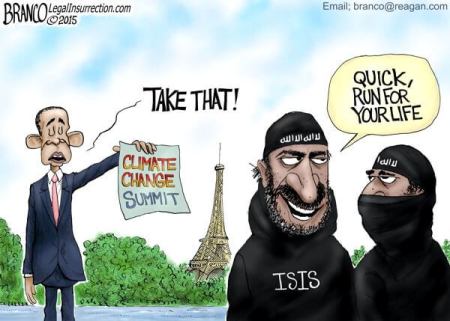
Cartoon of the day

November 30, 2015

H/t Cry and Howl


gw-summit-600-li