Posted tagged ‘Islamic State’

Dr. Ahmed al-Tayeb: Meet the World’s ‘Most Influential Muslim’

August 24, 2016

Dr. Ahmed al-Tayeb: Meet the World’s ‘Most Influential Muslim’, Front Page MagazineRaymond Ibrahim, August 24, 2016

(Please see also, Muslim cleric from terror sponsor Iran praises Pope for saying Islam is peaceful — DM)
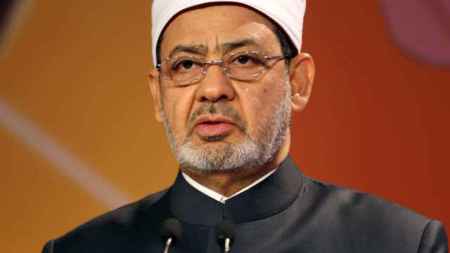
shykh-lzhr-dktwr-hmd-ltyb

There’s nothing like knowing Arabic—that is, being privy to the Muslim world’s internal conversations on a daily basis—to disabuse oneself of the supposed differences between so-called “moderate” and “radical” Muslims.

Consider the case of Egypt’s Dr. Ahmed al-Tayeb.  Hardly one to be dismissed as a fanatic who is ignorant of the true tenets of Islam, Tayeb’s credentials and career are impressive: he holds a Ph. D in Islamic philosophy from the Paris-Sorbonne University; formerly served as Grand Imam of Egypt, meaning he was the supreme interpreter of Islamic law; and since 2003 has been president of Al-Azhar University, considered the world’s leading institution of Islamic learning.   A 2013 survey named Tayeb the “most influential Muslim in the world.”

He is also regularly described by Western media and academia as a “moderate.”  Georgetown University presents him as “a strong proponent of interfaith dialogue.”  According to The National, “He is considered to be one of the most moderate and enlightened Sunni clerics in Egypt.”  In February 2015, the Wall Street Journal praised him for making “one of the most sweeping calls yet for educational reform in the Muslim world to combat the escalation of extremist violence.”

Most recently he was invited to the Vatican and warmly embraced by Pope Francis.  Al Azhar had angrily cut off all ties with the Vatican five years earlier when, in the words of U.S. News, former Pope Benedict “had demanded greater protection for Christians in Egypt after a New Year’s bombing on a Coptic Christian church in Alexandria killed 21 people.  Since then, Islamic attacks on Christians in the region have only increased.”

Pope Francis referenced his meeting with Tayeb as proof that Muslims are peaceful: “I had a long conversation with the imam, the Grand Imam of the Al-Azhar University, and I know how they think.  They [Muslims] seek peace, encounter.”

How does one reconcile Tayeb’s benevolent image in the West with his reality in Egypt?

For instance, all throughout the month of Ramadan last June, Tayeb appeared on Egyptian TV explaining all things Islamic—often in ways that do not suggest that Islam seeks “peace, encounter.”

During one episode, he reaffirmed a phrase that is almost exclusively associated with radicals: in Arabic, al-din wa’l-dawla, meaning “the religion and the polity”—a phrase that holds Islam to be both a religion and a body of rules governing society and state.

He did so in the context of discussing the efforts of Dr. Ali Abdel Raziq, a true reformer and former professor at Al Azhar who wrote a popular but controversial book in 1925, one year after the abolition of the Ottoman caliphate.  Titled, in translation, Islam and the Roots of Governance, Raziq argued against the idea of resurrecting the caliphate, saying that Islam is a personal religion that should no longer be mixed with politics or governance.

Raziq was vehemently criticized by many clerics and even fired from Al Azhar.  Concluded Tayeb, with assent:

Al Azhar’s position was to reject his position, saying he forfeited his credentials and his creed.  A great many ulema—in and out of Egypt and in Al Azhar—rejected his work and its claim, that Islam is a religion but not a polity.  Instead, they reaffirmed that Islam is both a religion and a polity [literally, al-din wa’l-dawla].

The problem with the idea that Islam must govern the whole of society should be obvious: Sharia, or Islamic law, which is what every Muslim including Tayeb refer to when they say that Islam is a polity, is fundamentally at odds with modern notions of human rights and, due to its supremacist and “anti-infidel” aspects, the source of conflict between Muslims and non-Muslims the world over.

That this is the case was made clear during another of Tayeb’s recent episodes.  On the question of apostasy in Islam—whether a Muslim has the right to abandon Islam for another or no religion—the “radical” position is well known: unrepentant apostates are to be punished with death.

Yet Tayeb made the same pronouncement.  During another Ramadan episode he said that “Contemporary apostasy presents itself in the guise of crimes, assaults, and grand treason, so we deal with it now as a crime that must be opposed and punished.”

While his main point was that those who do not follow Islam are prone to being criminals, he especially emphasized those who exhibit their apostasy as being a “great danger to Islamic society. And that’s because his apostasy is a result of his hatred for Islam and a reflection of his opposition to it. In my opinion, this is grand treason.”

Tayeb added what all Muslims know: “Those learned in Islamic law [al-fuqaha] and the imams of the four schools of jurisprudence consider apostasy a crime and agree that the apostate must either renounce his apostasy or else be killed.”  He even cited a hadith, or tradition, of Islam’s prophet Muhammad calling for the execution of Muslims who quit Islam.

Meanwhile, when speaking to Western and non-Muslim audiences, as he did during his recent European tour, Tayeb tells them what they want to hear.  Recently speaking before an international forum he asserted that “The Quran states that there is no compulsion in religion,” and that “attempts to force people into a religion are against the will of God.”  Similarly, when meeting with the Italian Senate’s Foreign Policy Commission Pier Ferdinando Casini and his accompanying delegation, Tayeb “asserted that Islam is the religion of peace, cooperation and mercy….  Islam believes in freedom of expression and human rights, and recognizes the rights of all human beings.”

While such open hypocrisy—also known as taqiyya—may go unnoticed in the West, in Egypt, human rights groups often call him out.  The Cairo Institute for Human Rights recently issued a statement accusing Al Azhar of having two faces: one directed at the West and which preaches freedom and tolerance, and one directed to Muslims and which sounds not unlike ISIS:

In March 2016 before the German parliament, Sheikh al-Tayeb made unequivocally clear that religious freedom is guaranteed by the Koran, while in Cairo he makes the exact opposite claims….  Combating terrorism and radical religious ideologies will not be accomplished by directing at the West and its international institutions religious dialogues that are open, support international peace and respect freedoms and rights, while internally promoting ideas that contribute to the dissemination of violent extremism through the media and educational curricula of Al Azhar and the mosques.

At any rate, if Tayeb holds such draconian views on apostasy from Islam—that is, when he’s speaking in Arabic to fellow Muslims—what is his position concerning the Islamic State?  Last December, Tayeb was asked why Al Azhar refuses to issue a formal statement denouncing the genocidal terrorist organization as lapsing into a state of kufr, that is, of becoming un-Islamic, or “infidel.” Tayeb responded:

Al Azhar cannot accuse any [Muslim] of being a kafir [infidel], as long as he believes in Allah and the Last Day—even if he commits every atrocity….  I cannot denounce ISIS as un-Islamic, but I can say that they cause corruption on earth.

As critics, such as Egyptian talk show host Ibrahim Eissa pointed out, however, “It’s amazing.  Al Azhar insists ISIS are Muslims and refuses to denounce them.  Yet Al Azhar never ceases to shoot out statements accusing novelists, writers, thinkers—anyone who says anything that contradicts their views—of lapsing into a state of infidelity.  But not when it comes to ISIS!”

This should not be surprising considering that many insiders accuse Al Azhar of teaching and legitimizing the atrocities that ISIS commits.  Sheikh Muhammad Abdullah Nasr, a scholar of Islamic law and Al Azhar graduate once exposed his alma mater in a televised interview:

It [Al Azhar] can’t [condemn the Islamic State as un-Islamic].  The Islamic State is a byproduct of Al Azhar’s programs.  So can Al Azhar denounce itself as un-Islamic?  Al Azhar says there must be a caliphate and that it is an obligation for the Muslim world [to establish it].  Al Azhar teaches the law of apostasy and killing the apostate.  Al Azhar is hostile towards religious minorities, and teaches things like not building churches, etc.  Al Azhar upholds the institution of jizya.  Al Azhar teaches stoning people.  So can Al Azhar denounce itself as un-Islamic?

Similarly, while discussing how the Islamic State burns some of its victims alive—most notoriously, a Jordanian pilot—Egyptian journalist Yusuf al-Husayni remarked on his satellite program that “The Islamic State is only doing what Al Azhar teaches.  He went on to quote from textbooks used in Al Azhar that permit burning people—more specifically, “infidels”—alive.

Meanwhile, Tayeb—the face of and brain behind Al Azhar—holds that Europe “must support all moderate Islamic institutions that adopt the Al-Azhar curriculum,” which “is the most eligible one for educating the youth.”  He said this during “a tour [in Germany and France] to facilitate dialogue between the East and the West.”

As for the ongoing persecution of Egypt’s most visible non-Muslim minorities, the Coptic Christians, Tayeb is renowned for turning a blind eye.  Despite the well-documented “severe persecution” Christians experience in Egypt; despite the fact that Muslim mobs attack Christians almost “every two to three days” now—recent examples include the burning of churches and Christian homes, the coldblooded murder of a Coptic man defending his grandchild from Muslim bullies, and the stripping, beating, and parading in the nude of a 70-year-old Christian woman—Tayeb recently told Coptic Christian Pope Tawadros that “Egypt represents the ultimate and highest example of national unity” between Muslims and Christians.

Although he vociferously denounces the displacement of non-Egyptian Muslims in Buddhist Myanmar, he doesn’t have a single word for the persecution and displacement of the Copts, that is, his own Egyptian countrymen.  Instead heproclaims that “the Copts have been living in Egypt for over 14 centuries in safety, and there is no need for all this artificial concern over them,” adding that “true terrorism was created by the West.”

Indeed, far from speaking up on behalf of Egypt’s Christian minorities, he has confirmed that they are “infidels”—that same label he refused to describe ISIS with.   While he did so in a technical manner—correctly saying that, as rejecters of Muhammad’s prophecy, Christians are infidels [kafir]—he also knows that labeling them as such validates all the animosity they feel and experience in Egypt, since the mortal enemy of the Muslim is the infidel.

This is consistent with the fact that Al Azhar encourages enmity for non-Muslims, specifically Coptic Christians, and even incites for their murder.  As Egyptian political commentator Dr. Khalid al-Montaser once marveled:

Is it possible at this sensitive time — when murderous terrorists rest on [Islamic] texts and understandings of takfir [accusing Muslims of apostasy], murder, slaughter, and beheading — that Al Azhar magazine is offering free of charge a book whose latter half and every page — indeed every few lines — ends with “whoever disbelieves [non-Muslims] strike off his head”?

The prestigious Islamic university—which co-hosted U.S. President Obama’s 2009 “A New Beginning” speech—has even issued a free booklet dedicated to proving that Christianity is a “failed religion.”

One can go on and on.   Tayeb once explained with assent why Islamic law permits a Muslim man to marry a Christian woman, but forbids a Muslim woman from marrying a Christian man: since women by nature are subordinate to men, it’s fine if the woman is an infidel, as her superior Muslim husband will keep her in check; but if the woman is a Muslim, it is not right that she be under the authority of an infidel.  Similarly, Western liberals may be especially distraught to learn thatTayeb once boasted, “You will never one day find a Muslim society that permits sexual freedom, homosexuality, etc., etc., as rights.  Muslim societies see these as sicknesses that need to be resisted and opposed.”

To recap, while secular Western talking heads that don’t know the first thing about Islam continue squealing about how it is being “misunderstood,” here is arguably the Muslim world’s leading authority confirming many of the cardinal points held by ISIS: he believes that Islam is not just a religion to be practiced privately but rather is a totalitarian system designed to govern the whole of society through the implementation of its human rights abusing Sharia; he supports one of the most inhumane laws, punishment of the Muslim who wishes to leave Islam; he downplays the plight of Egypt’s persecuted Christians, that is, when he’s not inciting against them by classifying them as “infidels”—the worst category in Islam’s lexicon—even as he refuses to denounce the genocidal Islamic State likewise.

Yet this well credentialed and respected scholar of Islam is considered a “moderate” by Western universities and media, from Georgetown University to the Wall Street Journal.  He is someone whom Pope Francis trusts, embraces, and quotes to reassure the West of Islam’s peacefulness.

In all fairness of course, Tayeb is neither a “moderate” nor a “radical.”  He’s merely a Muslim trying to be true to Islam.   Put differently, he’s merely a messenger.

Critics would be advised to take it up with the Message itself.
New Study: Extremist Literature Common in Canadian Mosques

August 24, 2016

New Study: Extremist Literature Common in Canadian Mosques, Clarion Project, Elliot Friedland, August 24, 2016

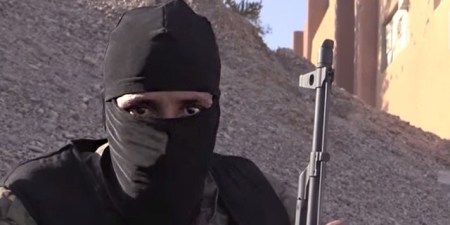
Islamic-State-Fighter-1-HP_1Illustrative picture. (Photo: © Screenshot from video)

Extremist literature is widely available in mosques and Islamic schools in Canada, according to a new study, reported by the National Post.

The study was conducted by Thomas Quiggin a former intelligence analyst with the Privy Council Office and the Royal Canadian Mounted Police (RCMP) and Saied Shoaaib, a journalist originally from Egypt.

The study found that not only was the material available, but in some places it was the majority of the literature available.

The co-authors argued that politicians have reacted insufficiently to the threat, and that extremists were gaining the upper hand ideologically.

“Further research is required to determine the depth and breadth of this problem,” the study concluded.

The findings are especially troubling in the light of another study, published earlier in August, which interviewed Canadian citizens who had travelled to Syria or Iraq to fight for jihadist organizations such as the Islamic State (ISIS, ISIL), as reported by Macleans.

In this study, titled Talking to Foreign Fighters: Socio-Economic Push versus Existential Pull Factors, researchers questioned 40 foreign fighters, 60 family members, friends and associates, and 30 online supporters from December 2015 to February 2016.

They have so far they have published findings from an initial sample of 20 jihadists. Their findings indicate that ideology was a primary motivating factor in the radicalization journeys by of those to whom they spoke.

“None of our sample indicated coming from familial situations of poverty or marginality,” they said. “On the contrary, many indicated they had fairly happy and privileged, or at least comfortable, childhoods. In general, there was almost no discussion of the economic situation of their families.”

Those interviewed “run the gamut from troubled youth with personal problems to accomplished young men and women from stable backgrounds,” the authors wrote.

“Anger and frustration have their role to play in the process, but it is the positive investment in an alternate world-saving role that matters most, no matter how strange it may appear to outsiders.”

They also saw that many seemed to radicalize and travel in “clusters,” as opposed to lone wolves.

Furthermore, they added that mentoring from someone seen as a religious figure was necessary for many to complete the process of radicalization. “In most cases, we would say the help and encouragement of some other outside mentors is required to complete the process of radicalization, to turn wannabe terrorists into deployable agents or independent martyrs for the cause. The process of self-radicalization needs to be legitimated to be complete.”

With the presence of extremist literature available in mosques, the ability of Canadians to be drawn into such an ideology seems clear.

Turkish tanks roll into Syria to confront Islamic State

August 24, 2016

Turkish tanks roll into Syria to confront Islamic State President Erdogan says operation aims to uproot jihadist group and Syrian Kurdish rebels, ‘put an end’ to border problems

By AP and AFP August 24, 2016, 12:23 pm

Source: Turkish tanks roll into Syria to confront Islamic State | The Times of Israel

A Turkish army tank drives toward Syria in the Turkish border city of Karkamis, in the southern region of Gaziantep, August 24, 2016. (AFP/BULENT KILIC)

ANKARA, Turkey — Turkey’s military launched an operation before dawn Wednesday to clear a Syrian border town of its Islamic State militants, and the country’s state-run news agency said Turkish tanks had crossed into Syria as part of the offensive.

In its report, the Anadolu Agency, which cited unnamed military officals, did not say how many tanks entered Syria. The private NTV television said as many as 20 tanks had crossed into Syria and that clashes were taking place at the border. Earlier in the day, NTV said that a small number of Turkish special forces had crossed into Syria as part of the operation.

NTV television said it was an “intruder mission” to carry out “pinpoint operations” against IS as part of the operation to clear the town of Jarablus of the extremists.

President Recep Tayyip Erdogan said the Turkish operation inside Syrian territory was aimed not just against jihadists but also Kurdish militia and should permanently put an end to problems on the border.

“From 4:00 am (0100 GMT) our forces began an operation against the Daesh (IS) and PYD (Kurdish Democratic Union Party) terror groups,” Erdogan said in a speech in Ankara, adding the move was aimed at “putting an end” to problems on the border.

As he spoke, Turkey’s state-run Anadolu news agency reported that pro-Ankara Free Syrian Army (FSA) rebels had already penetrated three kilometers (two miles) inside Syria toward the IS-held town of Jarabulus.

The office of Turkish Prime Minister Binali Yildirim said the operation, carried out by Turkish and US-backed coalition forces, began at 4 a.m. (0100 GMT), with Turkish artillery launching intense cross-border fire on the town of Jarablus, followed by Turkish warplanes bombing IS targets in the town, Anadolu said.

Smoke billows following air strikes by a Turkish Army jet fighter on the Syrian Turkish border village of Jarabulus during fighting against Islamic S State group targets, August 24, 2016 . (AFP/BULENT KILIC)

Smoke billows following air strikes by a Turkish Army jet fighter on the Syrian Turkish border village of Jarabulus during fighting against Islamic S State group targets, August 24, 2016 . (AFP/BULENT KILIC)

Just a few hours after the operation started, Vice President Joe Biden landed in Ankara for talks that include developments in Syria.

The visit comes at a difficult time for ties between the two NATO allies. Turkey is demanding that Washington quickly extradite a US-based cleric blamed for orchestrating last month’s failed coup. The United States is asking for evidence against the cleric and asking that Turkey allow the extradition process to take its course.

In Syria, Turkey is concerned about the growing power of US-backed Syrian Kurdish forces, who it says are linked to Kurdish groups waging an insurgency in southeastern Turkey. Wednesday’s operation puts Turkey on track for a confrontation with the Kurdish fighters in Syria.

Biden is scheduled to meet with Erdogan and Prime Minister Binali Yildirim.

The operation in Jarablus is meant to safeguard Turkey’s own security, according to Turkish Interior Minister Efkan Ala, who said Ankara “cannot sit and watch.”

“It is Turkey’s legal right, it is within its authority” to take action, the minister said, adding that Wednesday’s operation aimed to support the moderate Syrian opposition and was being carried out in coordination with the US-led coalition forces.

A Turkish army tank and an armored vehicle are stationed near the border with Syria, in Karkamis, Turkey, August. 23, 2016. (IHA via AP)

A Turkish army tank and an armored vehicle are stationed near the border with Syria, in Karkamis, Turkey, August. 23, 2016. (IHA via AP)

Turkey’s Hurriyet newspaper quoted Turkish sources as saying Turkish howitzers and rocket launchers had fired 224 rounds at 63 targets within an hour and 45 minutes, and that the Turkish air raids started just after 6 a.m.

The London-based Syrian Observatory for Human Rights also said Turkish ground troops had entered Syria. The activist group, which tracks the war through a network of local residents and fighters, said Turkish tanks and anti-mine vehicles crossed into Syria and were heading to Jarablus on Wednesday morning.

The Turkish government said the border area had been declared a “special security zone,” and asked journalists not to try to access it, citing safety concerns and threats posed by IS.

The assault followed Turkish Foreign Minister Mevlet Cavusoglu’s pledge on Tuesday of “every kind” of support for operations against IS along a 100-kilometer (62-mile) stretch of Syrian frontier. He said Turkey would support twin operations stretching from the Syrian town of Afrin in the northwest, which is already controlled by Kurdish forces, to Jarablus, in the central north, which is held by the Islamic State group.

Turkish army tank driving towards Syria in the Turkish-Syrian border city of Karkamis, in the southern region of Gaziantep, August 24, 2016. (AFP/BULENT KILIC)

Turkish army tank driving towards Syria in the Turkish-Syrian border city of Karkamis, in the southern region of Gaziantep, August 24, 2016. (AFP/BULENT KILIC)

Jarablus, which lies on the western bank of the Euphrates River where it crosses from Turkey into Syria, is one of the last important IS-held towns standing between Kurdish-controlled areas in northern Syria.

Located 20 miles (33 kilometers) from the town of Manbij, which was liberated from IS by Kurdish-led forces earlier this month, taking control of Jarablus and the IS-held town of al-Bab to the south would be a significant step toward linking up border areas under Kurdish control east and west of the Euphrates River.

In recent days Turkey has increased security measures on its border with Syria, deploying tanks and armored personnel carriers. On Tuesday, residents of the Turkish town of Karkamis, across the border from Jarablus, were told to evacuate after three mortars believed to be fired by IS militants landed there, Turkey’s Dogan news agency said.

Turkey has vowed to fight IS militants at home and to “cleanse” the group from its borders after a weekend suicide bombing at a Kurdish wedding in southern Turkey killed at least 54 people, many of them children. Turkish officials have blamed IS for the attack.

Ankara is also concerned about the growing power of US-backed Syrian Kurdish forces, who it says are linked to Kurdish groups waging an insurgency in southeastern Turkey.

A Turkish army tank and an armored vehicle are stationed near the border with Syria, in Karkamis, Turkey, Tuesday, Aug. 23, 2016. (IHA via AP)

A Turkish army tank and an armored vehicle are stationed near the border with Syria, in Karkamis, Turkey, Tuesday, Aug. 23, 2016. (IHA via AP)

The Kurdish-led group known as the Syria Democratic Forces, or SDF, recaptured Manbij from IS earlier this month, triggering concerns in Ankara that Kurdish forces would seize the entire border strip with Turkey. The US says it has embedded some 300 special forces with the SDF, and British special forces have also been spotted advising the group.

The Kurds’ outsized role in the Syrian civil war is a source of concern for the Syrian government as well. Fierce clashes erupted between the two sides over control of the northeastern province of Hasakeh last week, and Syrian warplanes bombed Kurdish positions for the first time, prompting the US to scramble its jets to protect American troops in the area.

The Syrian government and the Kurds agreed on a ceasefire Tuesday, six days after the clashes erupted. The Kurdish Hawar News Agency said government forces agreed to withdraw from Hasakeh as part of the truce.

Syrian state media did not mention any withdrawal, saying only that the two sides had agreed to evacuate the wounded and exchange detainees. Government and Kurdish forces have shared control of Hasakeh since the early years of the Syrian war.

WATCH: Boy Suicide Bomber Stripped of Explosive Belt in Iraq

August 22, 2016

WATCH: Boy Suicide Bomber Stripped of Explosive Belt in Iraq

by Alexander Jones

22 Aug 2016

Source: WATCH: Boy Suicide Bomber Stripped of Explosive Belt in Iraq

Frightening footage has emerged purporting to show Kurdish security forces removing an explosive belt from an alleged Islamic State teenage suicide bomber moments before it was about to be detonated in the northern Iraqi city of Kirkuk on Sunday.

The chilling scene, caught on camera and uploaded to YouTube by Kurdish channel Kurdistan24, shows the boy’s hands being held by two law enforcement officers as another member of the security establishment attempts to disarm the device.

Wearing a Barcelona football shirt before it was cut off, the boy, believed to be 12 or 13 years old, according to Kurdish media network Rudaw, reportedly then burst into tears as he was led away by police.

The arrest is believed to have taken place in Kirkuk’s Huzairan neighbourhood, Rudaw reports, but precise details on where the boy intended to stage his potential attack are unconfirmed — it has been claimed that the boy was planning to blow himself up outside a Shia mosque, however.

The device was later safely destroyed away from the public.

The incident came less than 24 hours after a child as young as 12 killed at least 51 people and injured 69 — 17 of them seriously, according to Turkish president Recep Tayyip Erdogan — in a suicide bombing at a packed wedding ceremony in the southern Turkish city of Gaziantep.

President Erdogan said on Sunday that “Daesh is the likely perpetrator of the attack”, using the Arabic name for ISIS, adding that it is not yet clear whether the youngster detonated the suicide vest or if the explosives were set off remotely by someone else.

What is clear, however, is that IS is mobilizing children at “an ever-accelerating rate”.

According to a report published earlier this year by the West Point-based Combating Terrorism Centre, IS is “mobilizing children and youth at an increasing and unprecedented rate [and] that the number of child and youth militants far exceeds current estimates.”

Contextualizing the upward trend in the terror group’s use of child suicide bombers, the report concluded: “It seems plausible that, as military pressure against the Islamic State has increased in recent months, such operations […] are becoming more tactically attractive.”

Recording instances of young people who were featured in official IS reports as “martyrs” between January 2015 and January 2016, the report found that of the 89 cases surveyed, 39 percent died upon detonating a vehicle-borne explosive device, 33 percent were killed as foot soldiers in unspecified battlefield operations, six percent died while working as propagandists, and four percent committed suicide in mass casualty attacks against the civilian populace.

Calling for Another Nice-Style Attack, ISIS Suggests Jihadists Try Baseball Bat, Power Screwdriver

August 21, 2016

Calling for Another Nice-Style Attack, ISIS Suggests Jihadists Try Baseball Bat, Power Screwdriver, PJ MediaBridget Johnson, August 21, 2016

(Islamist terror tactics evolve while “our” submissive anti-Islamophobia strategy plods along. — DM)

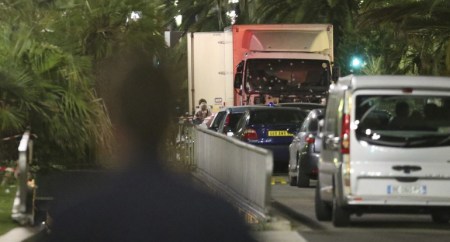
truck jihadA policeman looks at the truck used for an attack on Bastille Day crowds in Nice on July 15, 2016. (AP Photo/Luca Bruno)

A new video out of ISIS’ Al-Khayr province in Syria suggests jihadists emulate the on-hand weaponry of the Nice attack with at-home items such as a power screwdriver, baseball bat or hypodermic needle.

The death toll in the July 14 attack on the French coastal city, in which a Tunisian living in Nice drove a cargo truck into a Bastille Day crowd, rose to 86 a few days ago as another man died of his injuries. Eighty-three were killed at the scene.

French authorities initially declared that the truck driver, Mohamed Lahouaiej-Bouhlel, had no known links to terrorism. The attacker’s uncle said Lahouaiej-Bouhlel, claimed by ISIS as one of their own, was recruited by an Algerian shortly before the attack even though he “didn’t pray, didn’t go to the mosque and ate pork.”

His choice of a truck as a weapon has been fueling the ISIS call for lone jihadists to use whatever weapons are convenient and less likely to arouse suspicion.

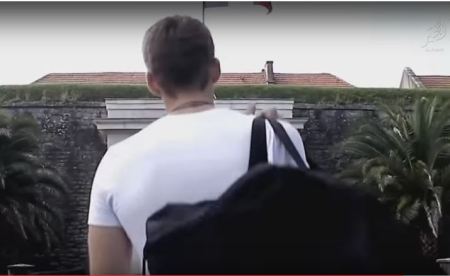
As far as targets, the new video focuses largely on France and the United States. After giving weapons suggestions, the video shows a white man in a white T-shirt and jeans carrying a black bag and approaching a gate with a French flag flying overhead.

white guy(ISIS video screenshot)

The video begins, though, with footage of Israel Defense Force soldiers clashing with Palestinians. It soon shows Catholics celebrating Mass and talks about kuffar (disbelievers) paying jizya tax to the Islamic State.

Among the multiple terror montages in the nearly 20-minute video are scenes from the World Trade Center on 9/11, specifically those trapped by the fire trying to summon help from windows or jumping.

They highlighted Hamas’ statement after the Nice attack, in which the Gaza terror group condemned the France attack “out of principle and moral and humanitarian rejection of all forms of extremism and terrorism.”

That July 15 Hamas statement added: “The movement emphasizes in this context that the Palestinian people are more than stung by the fire of Israeli terrorism, which our people are still suffering from for decades.” ISIS hopes to poach recruits from Hamas fighters in Gaza as they push toward Israel.

The ISIS video shows American polling places, including at the former Berryville Primary School in Arkansas, but does not show either candidate, just President Obama and his European counterparts. They also use footage of U.S. service members and drone operation, and a short clip that appears to be either news footage or a city video showing police officers receiving a briefing. The officers shown are from Medford, Ore. Another Medford officer lingers near the trunk of a patrol car.

isis screen(ISIS video screenshot)

The images of the West are broken up by people describing coalition strikes that hit their homes and photos of children allegedly killed in coalition airstrikes, telling jihadists that they have to get revenge.

After showing images of the Eiffel Tower, the Leaning Tower of Pisa in Rome, and the Statue of Liberty, the video encourages jihadists to diversify in their choice of weapons like the truck driver in Nice. They briefly show a do-it-yourself gun pattern, followed by a multi-bit ratcheting power screwdriver, a Louisville Slugger bat, a stock photo of a hand holding a test tube with an orange liquid, and a another stock photo of a hand holding a hypodermic needle with clear fluid inside.

Other suggestions include homemade explosives, a rock and a knife.

The video wraps up with footage of the Orlando shooting and praise of Mohamed Belkaid, an Algerian candy maker living in Belgium who was connected to the November Paris attacks and was killed by Belgian police in March, and Najim Laachraoui, one of the suicide bombers at the Brussels airport in March.

No ISIS There – Are U.S. Troops In Hasakah “Advising” Kurds To Attack The Syrian Army?

August 20, 2016

No ISIS There – Are U.S. Troops In Hasakah “Advising” Kurds To Attack The Syrian Army?

August 19, 2016

Source: M of A – No ISIS There – Are U.S. Troops In Hasakah “Advising” Kurds To Attack The Syrian Army?

Yesterday a fight broke out between Syrian Arab Army troops and local Kurdish forces in the predominately Kurdish city of Hasakah in north-eastern Syria. Hasakah, with some 200,000 inhabitants, has held a SAA garrison for years. There is some enmity between the Kurds and the soldiers but the situation is generally peaceful.

There have been earlier fights but these were local rivalries between Syrian auxiliary National Defense Forces from local Arab (Christian) minorities and some gangs who form a Kurdish internal security force under the label Asayish. Such fights usually ended after a day or two when grown-ups on both sides resolved the conflict over this or that checkpoint or access route.

The Islamic State (grey on the map) once threatened Hasakah but that danger is now far away.


Map via ISW

Yesterday another fight broke out, but got serious. The Syrian air force was called in to defend against direct attacks on the SAA garrison and minority quarters:

Syrian government warplanes bombed Kurdish-held areas of the northeastern city of Hasaka on Thursday for the first time in the five-year-old civil war, the Syrian Kurdish YPG militia and a monitoring group said.

The Syrian government still has footholds in the cities of Qamishli and Hasaka, both in Hasaka governorate, co-existing largely peacefully with YPG-held swathes of territory.The cause of this week’s flare-up was unclear.

Xelil said government forces were bombarding Kurdish districts of Hasaka with artillery, and there were fierce clashes in the city.

The Syrian Observatory for Human Rights, which tracks the war using a network of activists, said warplanes had targeted Kurdish security forces’ positions in the northwest and northeast of the Hasaka city.

The reason that fighting started might have to do with U.S. troops who, for whatever reason, seem to be in Hasakah. The U.S. military now laments that these troops came under Syrian air force fire:

The Syrian airstrikes took place in the northeastern city of Hasaka, an area that has seen increasing ground clashes between the Kurdish YPG fighters present and the Syrian regime forces. There was a small number of U.S. Special Operators acting as advisers to the YPG when the Syrian airstrikes began.After the Syrian Su-24s began to strike, the U.S. immediately contacted the Russians, Davis said, and made clear that American aircraft would respond if coalition forces were under attack.

The Russians explained that they were not the ones conducting the strikes and the U.S. scrambled manned fighter aircraft to the area to protect the Americans and allies under attack.

By the time the U.S. and coalition aircraft arrived the Syrian attack jets had left.

There is no Islamic State in the area which is now far away from the front line.

  • Why are U.S. troops, who have zero legal grounds of being in Syria at all, in Hasakah city or the wider area?
  • Who are they “advising” there and for what purpose?
  • Why does rare local fighting starts to get serious just when U.S. troops are in the area?

The U.S. has the chutzpah to “warn” the Syrians of defending their own troops on Syrian grounds:

Additional U.S. combat air patrols have been sent to the area yesterday and have been flying there today, as well.Davis said that the Syrians would be “well-advised” not to interfere with coalition forces on the ground in the future.

Syrian government forces are attacked by Kurdish troops who are “advised” by U.S. special forces. According to the U.S. spokesperson the Syrian air force is not allowed to defend them? What has this to do with “fighting ISIS” in eastern Syria which is allegedly the sole reason for U.S. troops being in Syria?

The Syrian air force was back over Hasakah today and continued to bomb position from which the Syrian army was attacked. They would not be flying there without Russian consent. Does the U.S. military want to start a fight with the Syrian air force and its Russian backers?

The YPG Kurds claim they are now evacuating civilians from some city quarters. They seem to expect a prolonged conflict.

Any move against the Syrian army in Hasakah will be watched carefully from Ankara. Turkey fears, with valid reason, that the U.S. supports the Kurdish aim of a  national entity in Syria and Iraq. This would endanger Turkey with its own large Kurdish minority.

If the Kurds expel the Syrian forces from Hasakah with U.S. support, Turkey would know that any U.S. claim to not work against its Turkish ally interest is false. This would deepen already high Turkish animosity against the U.S. and would accelerate its move towards some alliance with Russia and Iran.

Gorka: The war is real and the war is here

August 18, 2016

Gorka: The war is real and the war is here, Fox News via YouTube, August 17, 2016

Ten Most Troubling Finds Inside House Probe of Pentagon’s ‘Distorted’ Intel on Islamic State

August 13, 2016

Ten Most Troubling Finds Inside House Probe of Pentagon’s ‘Distorted’ Intel on Islamic State, BreitbartAaron Klein, August 13, 2016

(Please see also, The Trickle-Down Erosion of Honesty in Obama’s White House. — DM)

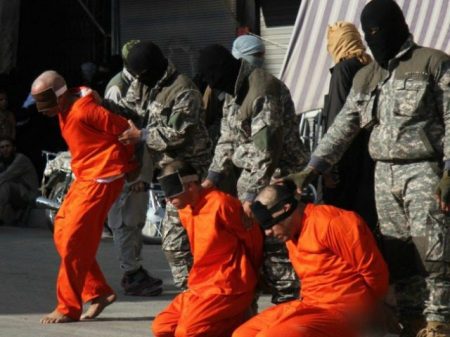
islamic-state-executions-640x480

TEL AVIV – A damning investigation by House Republicans released on Wednesday has found that the intelligence arm of the U.S. Military’s Central Command (CENTCOM) routinely produced intelligence that “distorted, suppressed, or substantially altered” the results of the campaign against the Islamic State.

Breitbart Jerusalem reviewed the House report and herein presents the ten most troubling finds, in no particular order.

1 – Top CENTCOM leaders modified intelligence assessments to present an “unduly positive” assessment of combating the Islamic State and training the Iraqi Security Forces (ISF).

The complaint alleges that senior leaders within the CENTCOM Intelligence Directorate and JIC, including the Director of Intelligence and other senior intelligence staff, violated regulations, tradecraft standards, and professional ethics by modifying intelligence assessments to present an unduly positive outlook on CENTCOM efforts to train the ISF and combat ISIL.

Media outlets have also raised allegations of possible reprisals against individuals within the CENTCOM Intelligence Directorate. …

According to multiple interviewees, operational reporting was used as a justification to alter or “soften” an analytic product so it would cast U.S. efforts in a more positive light. No interview provided any instances where operational reporting was used as a justification to come to a more pessimistic conclusion. Additionally, numerous interviewees indicated that analytical products which conflicted with operational reporting were routinely subject to more stringent scrutiny than those that did not.

2 – Intelligence analysts declined to be interviewed, possibly out of fear of reprisals from CENTCOM leadership, while the interviews that did take place were under the watchful eyes of DOD officials.

Additionally, the Joint Task Force requested interviews with four more analysts whose positions provided them with visibility into the allegations. These analysts declined to be interviewed. Although they did not express their reasons for declining, the Joint Task Force is concerned that some of the analysts may have done so out of fear of potential reprisals for their testimony.

For example, as the Joint Task Force’s interviews were commencing, the Director of the DIA publicly characterized reports of the whistleblower’s allegations as exaggerations.

It must also be noted that, pursuant to longstanding arrangements between DOD and the Armed Services Committee, DOD insisted on having department officials present during Joint Task Force interviews.

3 – CENTCOM intel agents operated within a ‘toxic’ leadership environment.

The Republican lawmakers fingered CENTCOM leaders, and noted the intelligence process was cleaner under previous officials and Lloyd Austin III, who served as commander from 2013 to 2016. Dozens of analysts viewed the “subsequent leadership environment as toxic”:

Survey results provided to the Joint Task Force demonstrated that dozens of analysts viewed the subsequent leadership environment as toxic, with 40% of analysts responding that they had experienced an attempt to distort or suppress intelligence in the past year.

4 – General Austin’s claim to Congress that IS was in a “defensive crouch” did not reflect the data possessed at the time by CENTCOM senior leaders.

Although no interviewee remembered the process of preparing the specific press releases and congressional testimony highlighted here, interviewees described a process in which congressional testimony and public affairs statements did not necessarily reflect contemporaneous intelligence assessments. In particular, the Joint Task Force was dismayed to learn that Intelligence Directorate senior leaders seemed unfamiliar with General Austin’s statements to Congress that ISIL was in a “defensive crouch” and indicated this characterization did not reflect their best assessments at the time.

5 – CENTCOM established an intelligence “fusion center” for IS-related intel, but kept out analysts whose views conflicted with senior intelligence leaders.

In June 2014, with the ISIL threat apparent, CENTCOM established an intelligence “fusion center,” a specially equipped JIC facility staffed around-the-clock, to serve as a “focal point” for ISIL-related intelligence. Interviewees recalled only informal communications noting the center’s establishment, and some were also uncertain about the center’s organizational structure, responsibilities, and how it was determined which JIC analysts would participate. The establishment of the Intelligence Fusion Center also removed some analysts who had the most experience with respect to ISIL and Iraq, including those whose analytic views often conflicted with those of CENTCOM’s senior intelligence leaders, from the production of daily intelligence products. This impact was especially significant given the critical analytic tasks of the Intelligence Fusion Center at this time of paramount importance in the theater.

6 – Restrictions were implemented for analysts whose views dissented from the mainstream inside CENTCOM.

Public statements by CENTCOM representatives emphasized close collaboration with other elements of the IC, but many interviewees indicated that in late 2014, senior CENTCOM Intelligence Directorate leaders instructed analysts to cease all external coordination with other IC analysts. The authority to coordinate was restricted to senior officials only, including to leaders of the Fusion Center. Other special arrangements were also put into place to notify the Director of Intelligence in the event that analysts sought to formally “dissent” from analysis produced elsewhere. The restrictions on collaboration have since been partially rescinded.

7 – Analysis was minimized in favor of details from coalition forces while intelligence was skewed to be ‘optimistic.’

Furthermore, senior leaders also relied on details reported from coalition forces rather than more objective and better documented intelligence reporting. The Joint Task Force can find no justifiable reason why operational reporting was repeatedly used as a rationale to change the analytic product, particularly when the changes only appeared to be made in a more optimistic direction. By supplanting analytic tradecraft with unpublished and ad hoc operational reporting, Joint Intelligence Center (JIC) leadership circumvented important processes that are intended to protect the integrity of intelligence analysis.

8 – Shocking survey results showed analysts believed data was “distorted, suppressed, or substantially altered” by their supervisors.

The annual Analytic Objectivity and Process Survey, directed by the ODNI, was conducted from August through October 2015, and included responses from 125 analysts and managers within CENTCOM. The survey results were significantly worse than those of other IC agencies or COCOMs, and showed that a substantial number of CENTCOM respondents felt their supervisors distorted, suppressed, or substantially altered analytic products.

Over 50% of analysts responded that CENTCOM procedures, practices, processes, and organizational structures hampered objective analysis, and 40% responded that they had experienced an attempt to distort or suppress intelligence in the past year. Yet despite receiving these results in December 2015, CENTCOM and IC leaders did not take corrective actions to address many of the issues identified in the survey results.

9 – Even after whistleblower complaints and the “alarming” internal survey last year, the Pentagon took no steps to correct its allegedly distorted intelligence process.

The Joint Task Force is troubled that despite receiving the whistleblower complaint in May 2015 and receiving alarming survey results in December 2015, neither CENTCOM, the Defense Intelligence Agency (DIA), the Under Secretary of Defense for Intelligence, nor the Office of the Director of National Intelligence (ODNI) took any demonstrable steps to improve the analytic climate within CENTCOM. The survey results alone should have prompted CENTCOM and IC leaders to take corrective action without other inducements.

10 – Mirroring the Benghazi House Committee’s complaints against the State Department, the Joint Task Force here writes it “did not receive access to all the materials it requested” and details a process of denying information and records.


When Being Raped By ISIS Brings Shame on the Family

August 11, 2016

When Being Raped By ISIS Brings Shame on the Family, Clarion Project, Elliot Friedland, August 11, 2016

cryIllustrative picture. (Photo: © Creative Commons/MarLeah Cole)

Women held as sex-slaves by the Islamic State are remaining in the hands of ISIS because their families are too ashamed to rescue them, according to the pan-Arab outlet Al-Aan, which is based in Dubai.

Reports that were depending on testimonies from women who escaped ISIS show that Turkmen families whose daughters have been rescued from Islamic State captivity are treating the girls as a source of shame.

The paper claimed to know about 5 Turkmen girls who could have escaped ISIS and joined their families in the province of Al-Najaf and Karbala in the south of Iraq. But their families refused to cooperate with any rescue agencies that can give them information because of the fear of shame.

The liberation of six hundred women and girls has reportedly been prevented by concerns over honor.

In Iraq where tradition firmly controls society, women and girls are prohibited from having emotional relationships or eloping without the permission and knowledge of the family.

Girls who violate these social codes are typically murdered by their families.

Despite the fact that rape is by definition non-consensual, families still look down on rape victims because they regard the woman’s chastity as having been breached by the mere act of penetration regardless of the volition of the woman concerned.

Such brutal honor codes and what activists are doing to stand up against them were chronicled in Clarion Project’s award winning movie Honor Diaries.

Human rights organizations have to take on these problematic cultural trends if they are serious about rehabilitating women that have already undergone so many traumas.

The mindset that views women as property to be bought and sold in sexual slavery is the same as the mindset that views a woman to be damaged goods and a source of shame after she has been raped. She is not seen as a person in her own right but as a mere appendage to a male.

This toxic perception of women must be challenged.

Attempted Suicide Bomber Shot and Killed in Canada

August 11, 2016

Attempted Suicide Bomber Shot and Killed in Canada, Clarion Project, August 11, 2016

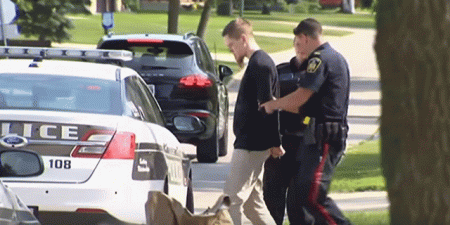
Aaron-driver-canadian-suicide-bomber-screenshot-640-320Aaron Driver being arrested in 2015. (Photo: © Screenshot from video)

An Islamic State sympathizer armed with an explosive device was shot and killed by Canadian police on Wednesday evening, reported CBCNews.

Aaron Driver, 24, detonated an explosive device which injured himself and one other person in the town of Strathoy, Southern Ontario. Police responded to a terror threat reported earlier in the day and confronted Driver.

Police said he had another device which he planned to detonate on a suicide mission in a public area.

“A suspect was identified and the proper course of action has been taken to ensure that there is no danger to the public’s safety,” the Royal Canadian Mounted Police said in a statement.

“As this is still an unfolding matter and that the investigation is still underway, we are not able to provide further comment at this time.”

Driver had been arrested previously on terror charges by the police in June 2015 and was released on a peace bond in February this year.He signed the peace bond agreement, meaning he was “consenting or acknowledging that there are reasonable grounds to fear that he may participate, contribute — directly or indirectly — in the activity of a terrorist group.”

The terms of his peace bond were that he had to register his address with the police and inform them of any change to his address. He also had a curfew of 9pm to 6am and could not have a computer or smartphone or log onto social media accounts.

Driver was also reportedly under police surveillance.

He had drawn the attention of Canada’s spy agency CSIS when he tweeted in support of the Islamic State under the alias Harun Abdurahman. Among other things, Driver said that the 2014 terrorist attack on Parliament Hill in which a Canadian soldier was killed was justified.

“I’m OK with soldiers or police officers being targeted for what they’re doing to Muslims” he told CBC in an interview in July.

“I think it’s a little hypocritical that people would take issue with people retaliating against them … when it’s the police and the military who are killing Muslims.”

He also downplayed suggestions he posed a terrorist threat in the interview, adding “I don’t think I’m a threat, and I don’t think there’s a reason for Canadians to think that I’m a threat.”