Posted tagged ‘Islamic slaughter’

EXCLUSIVE: Turkey ‘protects & supplies’ Al-Nusra camps at its border – Syria’s YPG to RT

March 4, 2016

EXCLUSIVE: Turkey ‘protects & supplies’ Al-Nusra camps at its border – Syria’s YPG to RT

Published time: 4 Mar, 2016 05:04 Edited time: 4 Mar, 2016 09:51

Source: EXCLUSIVE: Turkey ‘protects & supplies’ Al-Nusra camps at its border – Syria’s YPG to RT — RT News

And now a statement from the State Department ?

Read also : https://warsclerotic.wordpress.com/2016/03/04/state-department-issues-new-warning-about-terrorist-threat-to-u-s-citizens/#comment-84060

Jabhat Al-Nusra terrorists have pitched their camps right next to the border and receive regular supplies from the Turkish side, Syrian Kurdish forces told RT’s Lizzie Phelan, who traveled with YPG to investigate suspicious activity there.

An RT crew has filmed a number of vehicles coming through the Bab al-Salam crossing on the Turkish-Syrian border, on the outskirts of the northern town of Azaz, which is partially controlled by Al-Nusra, according to reports.

“We can actually see here the important border town of Azaz, that Turkey is determined to prevent YPG from taking. Just a little beyond that you can see the Bab al-Salam border crossing and a heavy flow of vehicles coming from Turkey into Azaz,” the RT correspondent said, reporting from the Turkey-Syria border, an area that TV crews rarely gain access to.

https://www.instagram.com/p/BCc9siFSq4o/

“When we zoom in we can see Turkish military vehicles, probably around a kilometer away, maybe less. And just in front here’s another small village that YPG say Al-Nusra uses for training,” Phelan said.

“Beyond that we can see the Turkish flag flying, that’s on the Turkish side of the border, and through there the YPG says they monitor a regular supply of weapons coming from Turkey to that Al-Nusra camp.”

2.&just a few km from Nusra controlled Azaz that is determined 2 prevent YPG from taking.

There were reports of dozens of Turkish military vehicles crossing into Kurdish northern Syria, with servicemen digging trenches in the area. Turkey’s “provocative” military buildup on the border and shelling of the Syrian territory could thwart the fragile truce and disrupt the peace process in the Arab Republic, the head of the Russian ceasefire monitoring center Lt. Gen. Sergey Kuralenko said this week.

Read more

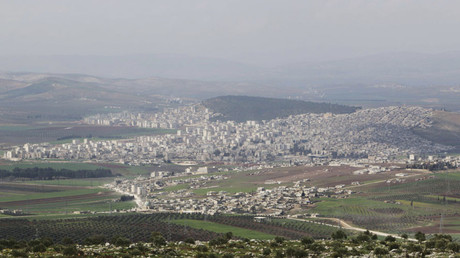
A general view shows the Kurdish city of Afrin, in Aleppo's countryside March 18, 2015. © Mahmoud Hebbo

The ceasefire in Syria, which came into force on February 27, brokered by leading world powers, including the US and Russia, is designed to pave the way to reconciliation between the Syrian government and moderate rebel forces. They would together agree on a peaceful transition in the country. Some of the forces in Syria, including IS and Al-Nusra, are not subject to the ceasefire.

Experts have been criticizing moderate rebel forces, but even they think that the situation is shifting now.

Moderate rebels used to be “a fable, a pure lie,” Syrian political analyst Taleb Ibrahim told RT.

“Everyone remembers what happened to the rebels who had been trained in Turkish camps by the CIA, and when they returned to Syria, and turned to Al-Nusra Front”.

However, the situation is starting to change slowly, as more and more Syrian rebel fighters “discover that they are destroying their country and serving external plans to divide Syria.”

Russian aircraft continue to carry out airstrikes against Al-Nusra front militants to “stabilize the situation” in the regions north of the city of Aleppo, the Russian Defense Ministry said in a statement.

READ MORE: Russia presents proof of Turkey’s role in ISIS oil trade

There have been at least 31 violations of the Syrian ceasefire over the past three days, Russian Foreign Ministry spokeswoman Maria Zakharova said on Wednesday, adding that during the same period the number of local ceasefire agreements between various factions had increased to 38.

WATCH: Hamas Emulates Islamic State Executions of Israelis in New Propaganda Videos

March 2, 2016

WATCH: Hamas Emulates Islamic State Executions in New Propaganda Videos

by Deborah Danan

1 Mar 2016

Source: WATCH: Hamas Emulates Islamic State Executions of Israelis in New Propaganda Videos

TEL AVIV – A new propaganda video showing terrorists simulating Islamic State-style executions of Israeli soldiers is one of the latest in a series of Hamas-produced videos showcasing terrorist skills and demonstrations.

The clip shows three masked Hamas terrorists in camouflage carrying out synchronized throat-slittings of three IDF soldiers in front of a cheering crowd.

MEMRI gathered a series of clips shown on Gaza TV, including “how-to” clips for would-be terrorists to carry out suicide bombings, beheadings, and stabbings.

One of the clips shows a rally in the Gaza town of Rafah in which the murder of Eitam and Dalia Henkin is reenacted. The narrator hails the terrorists responsible for the murder as “heroes” and heaps further praise on them for executing the couple in front of their young children, while leaving the children themselves unharmed.

Israeli investigators said the terrorists would likely have continued their massacre had the parents not put up a struggle, which caused one of the gunmen to accidentally shoot his accomplice in the hand, prompting both attackers to flee the scene, Arutz 7 reported.

In another scene, actors dressed as Israeli civilians and soldiers board a bus, followed by a suicide bomber. The bus then explodes, apparently killing all those on board.

Hamas recently aired a music video encouraging terrorists to resume suicide bombings in Israeli cities. The video featured Jewish flesh being “roasted” and the smoking remains of a bombed Egged bus.

‘Next Time in Jerusalem’: Islamic State Supporters Celebrate Baghdad Deadly Suicide Bombings

March 2, 2016

EXCLUSIVE – ‘Next Time in Jerusalem’: Islamic State Supporters Celebrate Deadly Baghdad Suicide Bombings

by Aaron Klein and Ali Waked

1 Mar 2016

Source: ‘Next Time in Jerusalem’: Islamic State Supporters Celebrate Baghdad Deadly Suicide Bombings

AFP

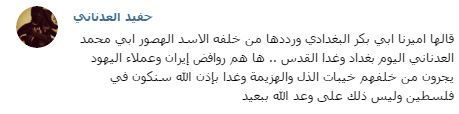
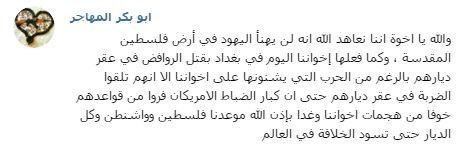
TEL AVIV – Internal messages obtained by Breitbart Jerusalem show Islamic State supporters celebrated the deadly suicide attacks carried out by the organization’s operatives in a Shi’ite part of Baghdad on Sunday, rejoicing in the death and injury of “more than 100 infidels.”

The string of suicide attacks in the Iraqi capital’s Abu Ghraib and al-Sadr districts left at least 70 people dead and many more wounded.

IS released a somewhat laconic statement claiming responsibility, but its supporters were jubilant in messages exchanged in a private encrypted chat utilized by IS and its supporters, vowing that the next such operation would be in Jerusalem.

حفيد“Allah is great, my brothers, our jihadi fighters surprised the enemy infidels at the gates of Baghdad,” wrote Abu Jaafar Albagdadi, a high-profile IS operative. “We hurt them and the American officers who fled in panic from our fighters. Today in Baghdad, tomorrow in Jerusalem and Palestine with Allah’s help.”

جعفر 11“Our Caliph Abu Bakr al-Baghdadi made it clear, and repeated the words of our [military] commander Abu Mohammed al-Adnani: Today in Baghdad, tomorrow in Jerusalem,” wrote Eladnani the Grandson, an Iraqi IS member. “Look at Iran and the Jews’ cronies bearing a humiliating defeat. Tomorrow, with Allah’s help, we’ll be in Palestine. Allah promised it and it will happen.”

بكرIn the closed chat group, which utilizes the encrypted Telegram messaging service, top IS operative Abu Bakr Almuhager added: “My brothers, we’ve made a vow to Allah that the Jews will not take pleasure in occupying the holy land of Palestine. … Our brothers hit the infidels in the safety of their quarters in Baghdad, despite the ongoing war against us, and chased away the American officers. Our next meeting will be in Palestine, or Washington, or wherever, until the sacred caliphate rules the world.”

Moderate “European” Islam: Stemming Terror with Band Aids

March 1, 2016

Moderate “European” Islam: Stemming Terror with Band Aids

by Judith Bergman March 1, 2016 at 4:00 am

Source: Moderate “European” Islam: Stemming Terror with Band Aids

  • The project of a “French Islam” has failed abysmally. A 2,200-page report, “Suburbs of the Republic,” concluded that Muslim immigrants in France were increasingly rejecting French values and identity, and instead immersing themselves in Islam. The report warned that Islamic sharia law was displacing French civil law in many parts of suburban Paris.
  • The pattern of “importing” imams with no knowledge of the local language and customs is the same all over Europe.
  • Qatar and Saudi Arabia, where the official form of Islam is Wahhabism, are the main financiers of mosques in Europe. Wahhabism discourages Muslim integration in the West, but actively encourages jihad against non-Muslims. Qatar has financed mosques in France, Italy, Ireland and Spain, among other places, thus spreading Wahhabism across the continent.

Last week Austria ordered the first foreign-funded imam to be expelled when his visa expires. The decision was made under the new provisions of an anti-radicalization law, which Austria passed one year ago under considerable controversy. The main aim of the law is to counter extremism by requiring imams to speak German, and to prohibit foreign funding for mosques, imams and Muslim organizations in Austria. It also stresses that Austrian law must take precedence over Islamic sharia law for Muslims living in the country.

“We want a future in which increasing numbers of imams have grown up in Austria speaking German, and can in that way serve as positive examples for young Muslims,” said Integration Minister Sebastian Kurz, who helped draft the law. Another 65 imams are expected to be deported in the coming weeks, after being informed that their visas will not be renewed. The decision to deport the foreign imam has — predictably — been deemed unconstitutional by Austria’s Constitutional Court, which finds the law discriminatory because it targets only Muslims.

In a similar vein, the Belgian government recently earmarked €3.3 million to be able to pay the wages of 80 new imams in order to “help stimulate a moderate European form of Islam,” reported the Flemish daily newspaper De Standaard last week. Justice Minister Koen Geens said that official recognition of mosques forms “part of our strategy to promote a more integrated form of Islam,” one intended to counter radicalization, violent extremism and terrorism. He added: “A recognized mosque is a sign of an integrated Islam. In the fight against radicalization, it is important that young people don’t drift into the arms of radical mosques. This also provides us with more interlocutors.”

Last year, the news outlet Antwerpen revealed that a young Moroccan imam who had preached in the officially recognized “moderate” mosque, the Dome in Borgerhout, had gone to Syria with two other men to join the jihadists. Youssef El G. — the imam in question — had not been monitored, because the mosque was considered moderate. The police said his departure came as a surprise.

Encouraging Muslims toward a more moderate “European” Islam is an old idea, but has not yet succeeded in practice anywhere in Europe and its specific nature remains largely undefined.

In France, the concept of a “French Islam” was put to the test in 2003, when Nicolas Sarkozy, then interior minister, created the French Council for the Muslim Religion (CFCM) to help address issues such as imam training, mosque building and regulating halal slaughter. The purpose was to encourage a homegrown, liberal version of Islam. “What we should be afraid of is Islam gone astray, garage Islam, basement Islam, underground Islam. It is not the Islam of the mosques, open to the light of day,” Mr. Sarkozy said at the time.

The project of a “French Islam” has failed abysmally. Already in 2011 a 2,200-page report, “Banlieue de la Republique” (Suburbs of the Republic), commissioned by the influential French think tank L’Institut Montaigne — directed by Gilles Kepel, a well-known political scientist and specialist in the Muslim world — concluded that Muslim immigrants in France were increasingly rejecting French values and identity, and instead immersing themselves in Islam. The report also warned that Islamic sharia law was rapidly displacing French civil law in many parts of suburban Paris.

The report showed how radical Muslim leaders in France, who are promoting the social marginalization of Muslim immigrants in order to create a parallel Muslim society ruled by sharia law, are exacerbating the problem. The report described a proliferation of mosques and prayer rooms in the suburbs. The religious orientations of the mosques were already heavily influenced by the national origin of the founder or president of a given mosque, in other words, not nearly close to any “French” Islam, regardless of what that concept might actually contain.

Indeed, according to Reuters, only 25-30 percent of practicing imams in France are French nationals. Many do not speak French and have no knowledge of French law or customs. According to Abdelali Mamoun, an imam of Alfortville, just outside Paris, of the roughly 2,500 mosques in France, 800 are Moroccan, 600 Algerian and 400 Turkish-linked. The Grand Mosque in Paris, for example, was assigned to Algeria’s trusteeship by the French government in 1957. Since 1982, Algeria has been responsible for funding the Grand Mosque. Only between 30% and 40% of the mosques in France are independent, says Mamoun. He defines independent mosques as institutions that set out to serve all Muslim communities, that are not sponsored from abroad and do not have imams imported and paid from abroad.

The Grand Mosque in Paris was assigned to Algeria’s trusteeship by the French government in 1957. Since 1982, Algeria has been responsible for funding the Grand Mosque. (Image source: Wikimedia Commons)

Nevertheless, France still holds onto the idea of a French “moderate” Islam. In March 2015, in the wake of the terrorist attacks on the satirical magazine Charlie Hebdo and the concern about the influence of radical foreign imams on Muslims in France, French Prime Minister Manuel Valls announced that France would finance double the number of university courses on Islam — from six to twelve — to stop the influence of foreign funding on the training of French imams.

Valls said he wanted more imams and other religious figures, such as prison chaplains, who have been trained abroad to “undergo more training in France, to speak French fluently and to understand the concept of secularism” that is a core pillar of French Republican values. “The only response to the dangers that we face is the French Republic,” Valls said. “This means the acceptance of the secular state, improving education, universities, understanding and intelligence… But there will be no laws, decrees or government directives to define what Islam means,” Valls said. “The French state will never attempt to take control of a religion.”

After the Paris attacks in November 2015, Anouar Kbibech, president of the French Council for the Muslim Religion, said it would fight extremists by creating a permit to preach for imams, as well as a new religious body to fight jihadist propaganda. The certificate would be given to those imams who promote a “tolerant and open Islam.”

“The time for action has come. The Muslims of France will play their part,” said Kbibech. Actually, the time for action was over more than a decade ago, in 2003, at the founding of the CFCM. By now, any action is probably too little, much too late.

The pattern of “importing” imams with no knowledge of the local European languages and customs is the same all over Europe. Qatar and Saudi Arabia, where the official form of Islam is Wahhabism, are the main financiers of mosques in Europe. Qatar has financed mosques in France, Italy, Ireland and Spain, among other places, thus spreading Wahhabism across the continent. Wahhabism is a version of Sunni Islam that discourages Muslim integration in the West, but actively encourages jihad against non-Muslims. The former emir of Qatar, Sheikh Hamad bin Khalifa al-Thani, vowed a few years ago to “spare no effort” to spread the fundamentalist teachings of Wahhabi Islam across “the whole world.”

In October 2014, General Jonathan Shaw, a former commander of British Forces in Iraq, who retired as Assistant Chief of the Defence Staff in 2012, told The Telegraph that Qatar and Saudi Arabia were primarily responsible for the rise of the extremist Islam that inspires Islamic State terrorists by funding the global spread of radical Islam. “The root problem is that those two countries are the only two countries in the world where Wahhabi Salafism is the state religion – and Isil is a violent expression of Wahhabist Salafism,” said Gen. Shaw.

In December 2015, German vice-chancellor Sigmar Gabriel said that the Saudi regime is funding extremist mosques and communities that pose a danger to public security. “We have to make clear to the Saudis that the time of looking away is over… Wahhabi mosques all over the world are financed by Saudi Arabia. Many Islamists who are a threat to public safety come from these communities in Germany,” the vice-chancellor said. In addition to the mosques it has already built, Saudi-Arabia offered to build an additional 200 mosques for the benefit of the mass migration of Muslims into Germany, one for every 100 migrants and refugees entering the country.

The question that invariably arises is whether European governments genuinely believe in the possibility of a moderate “European Islam” in the face of the failure that attempts to bring about such a concept, still largely undefined, have met with thus far.

Considering the massive Muslim radicalization with which the continent is faced, much of it homegrown — the head of Europol said last week that the terror threat in Europe is the highest in over a decade — trying to foster a hazy concept of a “moderate” European Islam at this late point is like trying to stem a tidal wave with a band-aid.

In some European countries, the most basic concepts of how Islamic radicalization works are seemingly not even understood by the relevant judicial authorities. Denmark’s State Prosecutor recently decided that imam Hajj Saeed will not be prosecuted for his statements in a sermon where he incited Muslims to wage war against Jews, and said that the Western “infidel” civilization has led non-Muslims “to an abyss of deprivation and corruption and has reduced them from being human to being at the level of animals.” Saeed incited war against Jews at a mosque associated with Hizb ut-Tahrir in Copenhagen on February 13, 2015 — in the very same sermon that the terrorist Omar Abdel Hamid El-Husseini attended the day before he murdered two people in separate terrorist attacks at the local synagogue and at a café.

The Danish State Prosecutor, in her decision, writes that the imam’s statements,

“…were part of a sermon about interfaith dialogue. It is my assessment that the statements regarding war against Jews must be understood in that context and as a historical reference to the reaction of the prophet Muhammed in a particular historical situation. It therefore cannot be assumed that this was a direct encouragement to attack Jews. I therefore do not find that there is sufficient evidence to find the imam guilty of breaching § 266b and I do not find that further investigation will bring such evidence.”

The sermon had been organized by Hizb ut-Tahrir, a radical organization that works for the re-establishment of the caliphate — not for “interfaith dialogue.”

When investigations against imam Hajj Saeed began in March 2015, after a private Danish citizen filed a complaint, Hizb ut-Tahrir told Danish journalists that the complaint against the imam was baseless: “The sermon refers to a historical context and it is taken out of context… He has not incited to violence or murder. He is just referring to a historical event.” Conspicuously, Hizb ut-Tahrir’s “explanation” ended up being exactly what the state Prosecutor decided in the end.

It is noteworthy that several European governments have finally come to the realization that foreign funding of local mosques and imams is counterproductive to the security of their states and that it is essential that this foreign funding and training of foreign imams stop. Based on previous experience, however, the hope that a “European Islam” will be fostered is a vain and rather utopian one. In Belgium, the existence of a state-recognized “Belgian mosque” did not stop the “moderate” imam in question from traveling to Syria to join the jihadists there.

Judith Berman is a journalist based in the Middle East.

Turkey’s ‘provocative’ military actions could jeopardize Syria ceasefire

March 1, 2016

Turkey’s ‘provocative’ military actions could jeopardize Syria ceasefire – Russian military

Published time: 29 Feb, 2016 23:27 Edited time: 1 Mar, 2016 01:37

Source: Turkey’s ‘provocative’ military actions could jeopardize Syria ceasefire – Russian military — RT News


Turkey’s “provocative” military buildup on the border and shelling of the Syrian territory could thwart the truce and disrupt the peace process in the Arab Republic, said the head of the Russian ceasefire monitoring center Lt. Gen. Sergey Kuralenko.

Turkey is strengthening its military positions on the border with Syria and is concentrating armored vehicles in the area, Lieutenant General Kuralenko said, denouncing these moves as “obviously provocative steps that could lead to a breakdown of the ceasefire and the peace process in the Syrian Arab Republic.”

The Russian military has examined footage taken by a Russian TV crew near the Syrian city of Tel Abyad located not far from the Turkish border, which demonstrated Ankara’s military “organizing firing positions and concentrating armored vehicles near the border,” Kuralenko said.

Meanwhile Turkish artillery fired at least 50 rounds at alleged Islamic State (IS, formerly ISIS/ISIL) targets north of Aleppo as part of the US-led coalition’s offensive, according to local media reports.

Read more

© Ammar Abdullah

The truce in Syria is generally being observed, the Lt. Gen. added, noting however that terrorist groups shelled populated areas at least seven times on Monday.

“In general, the truce between the governmental troops and the opposition forces on the territory of the Syrian Arab republic holds,” he said adding that a Russian center in Latakia monitors the situation in the six Syrian provinces of Hama, Homs, Latakia, Damascus, Aleppo and Deraa on a 24-hour basis.

“Within the last 24 hours, officers from the Russian [ceasefire monitoring] center as well as Syrian government forces and self-defense forces recorded seven cases of terrorist groups shelling Syrian residential areas,” he told journalists.

Kuralenko said that Al-Nusra militants attacked Syrian Kurdish positions in Aleppo province using artillery, while IS terrorists continued shelling the road between the cities of Hama and Aleppo, making the “delivery of humanitarian aid to Aleppo and nearby provinces impossible.”

The Lieutenant General stressed that governmental forces and the opposition achieved “significant progress” in the reconciliation process in four Syrian provinces, although he did not mention them by name.

The head of the Russian ceasefire monitoring center also discussed the first results of the truce with his US counterpart and they both expressed satisfaction with the joint efforts. “We discussed the first results of the ceasefire and signified satisfaction with the concerted efforts,” Kuralenko told journalists referring to a telephone conversation with representatives of the US ceasefire monitoring center in Amman.

In the meantime, Russian aircraft carried out several air strikes against Al-Nusra front militants to “stabilize the situation” in the regions north of the city of Aleppo, according to the Russian Defense Ministry.

Al-Nusra extremists were shelling the Syrian army positions from the Narb-Nafsa village located north of Aleppo. In response, Russian Air Space Forces “carried out missile and bomb attacks against… Al Nusra units in the region and hit positions of terrorists near Narb-Nafsa…” the statement said.

At the same time, the Russian ceasefire monitoring center once again stressed that Russian aircraft conducted no strikes against the groups which joined the truce.

Secretary of State John Kerry said that Moscow and Washington have worked out a mechanism to track down all reported violations of the ceasefire in Syria through specially set up teams in Geneva and Amman. Kerry specified that he and Lavrov agreed that the mechanism should ensure that any strikes in Syria target only Islamic State and Al Nusra Front.

“We are going to track down each alleged violation and work even more now to put in place a construct which will help us to guarantee that missions are indeed missions against Nusra or missions against Daesh [the Arabic name for IS],” Kerry said at a news conference with German Foreign Minister Frank-Walter Steinmeier.

‘We will participate’: Saudi military admits US coalition mulling ground invasion in Syria

March 1, 2016

‘We will participate’: Saudi military admits US coalition mulling ground invasion in Syria

Published time: 1 Mar, 2016 03:23

Source: ‘We will participate’: Saudi military admits US coalition mulling ground invasion in Syria — RT News

© Faisal Al Nasser
Saudi Arabia has acknowledged that the US-led anti-ISIS coalition has held a “political” discussion about a potential ground troop deployment in Syria. Riyadh’s statements have been criticized by Damascus as destructive and a threat to regional security.

In an interview with Reuters, an aide to Saudi Arabia’s defense minister, Brigadier General Ahmed Asseri, confirmed that defense ministers from the anti-Islamic State (IS, formerly ISIS/ISIL) coalition debated placing ground troops on the ground in Syria during a ministerial meeting in Brussels last month.

“It was discussed two weeks ago in Brussels,” Asseri said, clarifying that the discussions took place on the “political” level only without going into details of a potential “military mission.”

Read more

© Bulent Kilic

The general stressed that if the decision is made, Saudis would be more than willing to contribute troops – a move that Syria strongly warned against on a number of occasions. Asseri also acknowledged that Riyadh has been working on the military implementation of a possible Syria invasion.

“Once this is organized, and decided how many troops and how they will go and where they will go, we will participate in that,” he said.

“We need to discuss at the military level very extensively with the military experts to make sure that we have a plan.”

The Saudi general stressed that for the time being, the Kingdom’s air force is ready to strike Islamic State targets from Turkey’s Incirlik air base, where four Saudi fighter jets were deployed last month.

Washington also confirmed Saudi Arabia’s’ willingness to strike targets in Syria, with State Department spokesman John Kirby saying that the US would welcome the Kingdom’s participation.

“But there’s a lot that needs to be discussed in terms of what they would do, what their makeup would be, how they would need to be supported by the coalition going forward. So there’s a lot of homework that needs to be done,” Kirby said.

Read more

© Ammar Abdullah

Saudi Arabia’s push for ground incursion into Syria comes at a time when Moscow warned that Turkey is strengthening its military positions on the border with Syria at a time when US and Russia are doing their best to cement a fragile ceasefire in the country.

On Monday, an official source at the Syrian Foreign and Expatriates Ministry told Syria’s official SANA news agency that Saudi Arabia is playing a “destructive role” in the peace process while “threatening security and stability” of the world.

The statement came in reply to Saudi Foreign Minister Adel Al-Jubeir comments that he made on Sunday, accusing Syrian troops of violating the ceasefire brokered by Russia and the US, and reiterating the Kingdom’s position that Bashar Assad has no place in the future of Syria.

The Syrian official stressed that Al-Jubeir’s statements violate UN Security Council resolution 2268 that endorses the ceasefire. The resolution specifically demands that all parties to the agreement use their influence to ensure that parties to the Syrian conflict fulfill their commitments and create the conditions for a durable ceasefire.

In this regards, the source told SANA that Damascus requests that the UN Secretary-General form a committee to examine the possibility of “crimes that were committed and are still being committed by the Saudi regime and in the Arab world.”

Meanwhile, a US defense official told Reuters that Washington will continue to support forces on the ground in Syria that fight against Islamic State terrorists.

“We will continue to provide equipment packages to vetted leaders and their units so that over time they can make a concerted push into territory still controlled,” the official said. “As a matter of policy, we won’t comment or speculate on potential future operations.”

Erdoğan says he does not obey or respect top court ruling on jailed journalists

February 29, 2016

Erdoğan says he does not obey or respect top court ruling on jailed journalists

February 28, 2016, Sunday/ 12:32:10/ İPEK ÜZÜM | ISTANBUL

Source: Erdoğan says he does not obey or respect top court ruling on jailed journalists


Erdoğan says he does not obey or respect top court ruling on jailed journalists

President Recep Tayyip Erdoğan speaks to reporters before departing for an African tour on Feb. 28. (Photo: DHA)

President Recep Tayyip Erdoğan said on Sunday he does not obey or respect the decision by the Constitutional Court declaring that the imprisonment of two prominent journalists for a report on alleged illegal arms transfers to Syria amounted to a violation of their rights.

Cumhuriyet Editor-in-Chief Can Dündar and its Ankara representative Erdem Gül were freed in the early hours of Friday after 92 days in jail following the top court’s ruling. The court said the journalists’ right to freedom and security, the right to express their thoughts and freedom of the press under articles 19, 26 and 28 of the Constitution, respectively, were violated.

“The Constitutional Court may have reached such a verdict. I would only remain silent. I am not in a position to accept it,” Erdoğan told reporters before departing for a visit to African countries. “I do not obey it nor do I respect it.”

Dündar and Gül were arrested on charges of espionage and aiding a terrorist organization in November after the publication of video footage purporting to show the National Intelligence Organization (MİT) helping to send weapons to Syria when they were intercepted in 2014 by gendarmerie forces. The arrest drew international condemnation and revived concern about media freedom in Turkey.

Erdoğan, who had described the interception of the MİT trucks as an act of espionage aimed at undermining Turkey internationally, vowed that Dündar would pay a “heavy price” for reporting on the incident. “I will not let him go [unpunished],” he said back in November.

“The media cannot have unlimited freedom. These reports are an attack on the current president of this country,” Erdoğan said on Sunday. “This has nothing to do with freedom of expression at all. This is an espionage case.”

He also said the İstanbul 14th High Criminal Court, which is overseeing the two journalists’ trial and ruled for their release in line with the decision of the Constitutional Court, could have resisted the top court’s ruling and refused to free them.

“That would have invalidated the Constitutional Court ruling or those who were freed would have appealed to the European Court of Human Rights,” he said.

Despite their release from prison, Dündar and Gül are still facing possible life sentences in a trial, which is due to start on March 25. The indictment against the two journalists seeks an aggravated life sentence, a life sentence and 30 years of imprisonment on separate charges including “obtaining and revealing secret information pertaining to the security of the state for espionage purposes,” “seeking to overthrow the Turkish government” and “aiding an armed terrorist organization.”

Erdoğan’s remarks lead to strong criticisms

Erdoğan’s remarks on the Constitutional Court’s decision about Gül and Dündar attracted strong criticisms from intellectuals, jurists and politicians.

Main opposition Republican People’s Party (CHP) Deputy Chairman Sezgin Tanrıkulu said Erdoğan has to respect and implement both the Constitution and the decisions of constitutional institutions as befitting his current position.

Tanrıkulu said: “A president cannot disregard the Constitution. If he says such a thing, this clearly implies he also does not respect the current constitutional order in the country. He is also encouraging people not to respect the Constitution and the court rulings.”

Bülent Tezcan, the deputy parliamentary group chairman of the CHP, also reacted against Erdoğan’s statement on Twitter on Sunday. He said Erdoğan does not recognize the Constitution, adding, “Now, he [Erdoğan] is calling on the courts to not recognize the laws and the Constitution.”

Constitutional law professor and Peoples’ Democratic Party (HDP) deputy Mithat Sancar said he was not surprised by Erdoğan’s recent statement, underlining Erdoğan has not been respecting constitutional laws since he was elected president in August 2014. “Not only with his statements, he has also violated the Constitution with his acts. One of the most typical violation is engaging in an electoral campaign as though he was the chairman of a political party [ruling Justice and Development Party (AK Party)] before the June 7 election,” Sancar said.

Saying Erdoğan engaged in similar acts that do not comply with the Constitution while he was serving as prime minister before he was elected president, Sancar stated: “Actually, the AK Party has never been at peace with the rule of law. When it feels it is necessary, it puts the laws aside. When it also feels the need, it uses these laws against its opponents in the harshest manner.”

Responding to critics who accuse him of violating his constitutional limits, Erdoğan had said he was elected by the nation and is determined to use his authorities “to the end.”

“You can either accept it or not. Turkey’s government system has been de facto changed in this regard. What should be done now is to finalize the legal framework of this de facto situation with a new Constitution,” Erdoğan said during a speech on Aug. 16, 2015.

‘Erdoğan staged a coup on anniversary of Feb. 28’

CHP deputy Özgür Özel held a press conference in Parliament on Sunday. Reminding that Sunday marks the anniversary of the Feb. 28, 1997 post-modern coup, Özel accused Erdoğan of staging a coup on the anniversary of Feb. 28 coup.

“Erdoğan made a coup against the judiciary on the anniversary of Feb. 28. He attempted to adjust the higher judiciary,” Özel stated.

Nationalist Movement Party (MHP) parliamentary group chairman Oktay Vural said Erdoğan has admitted that Turkey is no longer a state being ruled by law. Speaking at a press conference in Parliament on Sunday, Vural said that Erdoğan also gave an order to the local court during his speech, but Erdoğan had promised to respect the supremacy of law during his presidential oath.

“If you say you don’t respect the court ruling, this means you don’t think of a state as being ruled by law. There is no supremacy of law, but you have the law of superiors in your mind. This one-man, pro-coup mindset is against the rule of law and the supremacy of law. This is a typical example of the Feb. 28 [coup],” Vural maintained.

Contemporary Journalists Association (ÇGD) President Ahmet Abakay said the president is obligated to respect the Constitutional Court. “However, we know that the president does not respect even the Constitution via his practices and statements. This situation does not comply with a democratic country. The state administrators have to respect the laws, Constitution and the judicial bodies and they are binding for them. But now in Turkey, the administrators do not respect the law,” Abakay said.

Pointing to Erdoğan’s remarks that the trial of Dündar and Gül was not a case of freedom of expression but an espionage case, Abakay said this is not true. He added: “This is not an espionage case. For a journalist, whether a report is factual or not is important. Erdoğan has never said the report [of Cumhuriyet daily] was a lie. He even confirmed it by saying, ‘So what if the trucks were filled with weapons?’ Reporting is the duty of those friends [Gül and Dündar] and they just did their job.”

Commenting on Erdoğan’s remarks that the local court should have resisted the ruling of the top court, Abakay also said his statement was actually a clear threat against those judges who gave the decision. “He tells the judges in what way they should give their rulings,” Abakaya added.

Veteran journalist Hasan Cemal also posted a tweet on the issue on Sunday, stating: “I don’t know what to say; you become tongue-tied, when you look at Erdoğan’s reactions against the Constitutional Court’s ruling. I repeat this: Stability is nothing more than a dream in a country with Erdoğan, who is disregarding the law in such level.”

Journalist Özgür Mumcu addressed Erdoğan in a tweet on Sunday, saying: “You are now in your palace because the Constitutional Court, which you say don’t respect, did not decide to shut down your party previously. If people also had not respected that ruling of the court, where would you be now?”

Emin Çapa, CNN Türk’s senior economy editor, also commented on the issue, saying that Erdoğan can say that he does not agree with the ruling, but he holds a position in which he is obligated to respect court rulings and implement those rulings.

The Constitutional Court’s ruling, which Erdoğan is highly critical of, was praised by members of the European Parliament, Council of Europe and diplomats on Friday.

Pointing out that the top court’s ruling reveals its implicit acknowledgment that pre-trial imprisonment is an act of illegal confinement, Rebecca Harms, president of the Greens in the European Parliament, noted that freedom of expression and opinion must not be labeled a criminal offense since pluralism and freedom of speech are basic prerequisites of a viable democracy.

Daniel Höltgen, Council of Europe spokesman, said in a statement on Thursday evening that he was glad to hear of the Constitutional Court’s decision to release the two journalists. “I trust that the Constitutional Court will continue to assert itself for the sake of freedom of expression in Turkey, relying on the European Convention on Human Rights,” Höltgen said.

Commenting on the Constitutional Court’s decision on her Twitter account on Thursday evening, European Parliament’s Turkey rapporteur Kati Piri also welcomed the ruling and said both Dündar and Gül should be freed soon.

Russian TV crew films Turkish fortifications, tanks on Syrian border (PHOTOS, VIDEO)

February 29, 2016

Russian TV crew films Turkish fortifications, tanks on Syrian border (PHOTOS, VIDEO)

Published time: 29 Feb, 2016 02:02

Source: Russian TV crew films Turkish fortifications, tanks on Syrian border (PHOTOS, VIDEO) — RT News

A Russian TV crew has managed to obtain video proof of Turkey’s increased military presence on the Syrian border, as it filmed fortifications and tanks on the frontier.

The lodgments are heavily fortified by tanks and self-propelled guns, REN-TV crew reported from the scene.

Shells and other ammunition are being delivered to the Turkish positions, which are shelling Kurdish forces in Syrian territory, according to the report.

“The barrels of the tanks and self-propelled guns are pointed in the direction of the mainly Kurdish Syrian city of Kobane,” the journalist said.

There were at least six or seven tanks in the area and the Turkish forces on the border can be deployed in Syria “in an instant,” according to REN-TV.

Read more

© Ammar Abdullah

Meanwhile, the area appeared to be very active, as Turkey continued to transport various supplies to the border.

The REN-TV journalists spoke to the mostly Kurdish locals, who openly accused Turkey of being “friends” with the Islamic State fighters that had earlier raided nearby houses. The extremist fighters took the most expensive things from the homes, including “money and jewelry,” they said.

The residents also provided evidence proving that various military crimes had taken place and described how Turkey and Islamic State forces had opened fire on locals trying to flee the area – and then stolen their cars.

“There were 30 cars moving towards the border when Turkish military and Daesh fighters opened fire on the vehicles, a lot of them caught fire. Terrorists ended up taking the vehicles that could still drive,” resident Beker Ramadon told REN-TV.

Moreover, in the city of Jarabulus, which is located in the north of Syria near the Turkish border, residents told the journalists that local houses are being destroyed by Turkish tanks.

“Turkish tanks fired at and destroyed a house five days ago,” a Kurdish fighter said, pointing to the rubble.

The REN-TV reporters tried to determine where the fire had come from and noticed a couple of hidden tanks in the pictures they had taken from the crime scene.

During the first night of the Syrian ceasefire, more than 200 Islamic State fighters crossed the Turkish border into Syria and another 100 came up from the Syrian city of Raqqa before joining forces near Kurdistan, the Russian center for reconciliation said in a report.

READ MORE: 9 violations of Syrian ceasefire in 24 hours – Russian monitors

The journalists said the fighting had intensified quickly after that, adding that if not for the brave efforts of the Kurdish forces in Syria, the city could have been easily overrun by the terrorists.

There have also been reports of a heavy artillery attack on the Kurdish town of Tel Abyad in northern Syria near Kurdistan. However, Turkish military sources denied to Hurriyet that its forces had been involved in any cross-border shelling.

The much-anticipated Syrian ceasefire was brokered by leading world powers, including the US and Russia. It aims to pave the way to reconciliation between the Syrian government and “moderate” rebel forces, which would together agree on a peaceful political transition for the country.

The terrorist groups in Syria, such as Islamic State and Nusra Front, are excluded from the ceasefire, which took effect at midnight on February 27.

In an interview earlier this week, Turkey’s Prime Minister, Ahmet Davutoglu denied that Turkey had any intent to invade Syria. According to the PM, it was unlikely that such a move would be supported by its Arab allies, which have already criticized Ankara for sending troops into northern Iraq.

At the same time, Davutoglu told CNN Turk that the Syrian ceasefire plan will not be considered binding if it threatens Turkey’s security, adding that Ankara will continue to fight the Syrian Kurds and ISIS, taking all the “necessary measures.”

In an Al-Jazeera interview this week, Davutoglu also admitted that Ankara was, in fact, supporting armed groups in Syria.

“How would they be able to defend themselves if there was no Turkish support for the Syrian people? … If there’s a real moderate Syrian opposition today, it’s because of Turkish support. If the [Assad] regime isn’t able to control all the territories today, [it’s] because of Turkish and some other countries’ support,” he said.

How American Soldiers Used Pig’s Blood and Corpses to Fight Muslim Terrorism

February 26, 2016

How American Soldiers Used Pig’s Blood and Corpses to Fight Muslim Terrorism, Front Page Magazine, Daniel Greenfield, February 26, 2016

(Wouldn’t that suggest that terrorists are Muslims? Unthinkable! — DM)

mn


A century before American soldiers fought Muslim terrorism in the Middle East, they fought it in the Philippines. Their attackers were Moro Muslims whose savage fanaticism appeared inexplicable. A formerly friendly Muslim might suddenly attack American soldiers, local Muslim rulers promised friendship while secretly aiding the terrorists and the yellow left-wing press at home seized on every report of an atrocity to denounce American soldiers as murderers whose honor was forever soiled.

Much of what went on in that conflict, including the sacrifices of our soldiers, has been forgotten. The erasure has been so thorough that the media casually claims that the American forces did not use pig corpses and pig’s blood to deter Muslim terrorists. Media fact checks have deemed it a “legend”.

It’s not a legend. It’s history.

The practice began in the Spanish period. A source as mainstream as the New Cambridge History of Islam informs us that, “To discourage Juramentados, the Spaniards buried their corpses with dead pigs.”

Juramentados was the Spanish term for the Muslim Jihadists who carried out suicide attacks against Christians while shouting about Allah. American forces, who had little experience with Muslim terrorists, adopted the term and the Spanish tactics of burying Muslim terrorists alongside dead pigs.

It was a less sensitive age and even the New York Times blithely observed that, “The Moros, though they still admire these frenzied exits from the world, have practically ceased to utilize them, since when a pig and a man occupy a single grave the future of the one and the other are in their opinions about equal.”

The New York Times conceded that the story “shocked a large number of sensitive people,” but concluded that, “while regretting the necessity of adopting a plan so repugnant to humane ideas, we also note that the Moros can stop its application as soon as they choose, and therefore we feel no impulse either to condemn its invention or to advise its abandonment. The scheme involves the waste of a certain amount of pork, but pork in hot climates is an unwholesome diet, anyhow, and the less of it our soldiers and other ‘infidels’ in the Philippines have to eat the better for them.”

Colonel Willis A. Wallace of the 15th Cavalry claimed credit for innovating the practice in March 1903 to dissuade the Muslim terrorist who believed that “every Christian he kills places him so much closer in contact with the Mohammedan heaven.”

“Conviction and punishment of these men seemed to have no effect,” Colonel Wallace related. After a “more than usually atrocious slaughter” in the marketplace, he had the bodies of the killers placed on display and encouraged “all the Moros in the vicinity who cared to do so to come and see the remains”.

“A great crowd gathered where the internment was to take place and it was there that a dead hog, in plain view of the multitude, was lifted and placed in the grave in the midst of the three bodies, the Moro grave-diggers themselves being required to do this much to their horror. News of the form of punishment adopted soon spread.”

“There is every indication that the method had a wholesome effect,” Colonel Wallace concluded.

Colonel Wallace was certainly not the only officer to bury pigs with Muslim terrorists in the Philippines, though he was apparently the only one to discuss it in such great detail.

Medal of Honor winner Colonel Frank West buried three pigs with three Muslim terrorists after the murder of an American officer. He appears to have done so with the approval of General Perishing. Some stories mention Colonel Alexander Rodgers of the 6th Cavalry becoming so celebrated for it that he was known to Moro Muslims as “The Pig”. One contemporary account does describe him burying a pig with the corpse of a Muslim terrorist who had murdered an American soldier.

Rear Admiral Daniel P Mannix III had contended that, “What finally stopped the Juramentados was the custom of wrapping the dead man in a pig’s skin and stuffing his mouth with pork”.

Media fact checks have claimed that General John “Black Jack” Perishing would not have offended Muslims by authorizing such a course of action and that any claims of his involvement are also a legend.

General Perishing however wrote in his autobiography that, “These Juramentado attacks were materially reduced in number by a practice that the Mohamedans held in abhorrence. The bodies were publicly buried in the same grave with a dead pig. It was not pleasant to have to take such measures, but the prospect of going to hell instead of heaven sometimes deterred the would-be assassins.”

We can be certain then that the practice of burying Muslim terrorists with pigs was indeed real and fairly widespread. Was pig’s blood also used on Muslim terrorists as a deterrent to prevent attacks?

The Scientific American described just such an event. In a hard look at the area, it wrote of a place where, “Polygamy is universally practiced and slavery exists very extensively. Horse stealing is punishable by death, murder by a fine of fifty dollars. The religion is Mohamedan.”

A Muslim terrorist, the magazine wrote, “will suddenly declare himself ‘Juramentado’, that is inspired by Mohammed to be a destroyer of Christians. He forthwith shaves his head and eyebrows and goes forth to fulfill his mission.”

The Scientific American described how a Muslim terrorist who had disemboweled an American soldier was made an example of. “A grave was dug without the walls of the city. Into this the murderer was unceremoniously dropped. A pig was then suspended by his hind legs above the grave and the throat of the animal cut. Soon the body lay immersed in gore… a guard stood sentry over the grave until dusk when the pig was buried side by side with the Juramentado.”

“This so enraged the Moros that they besieged the city. Matters became so grave that General Wood felt called upon to disperse the mob resulting in the death of a number of Moros.”

It is clear from these accounts which encompass General Perishing’s autobiography, the New York Times and the Scientific American that the use of pig corpses and pig’s blood in the Philippines was not a legend, but fact. It was not carried out by a few rogue officers, but had the support of top generals. It was not a single isolated incident, but was a tactic that was made use of on multiple occasions.

American forces in the Philippines faced many of the same problems that our forces do today. But they were often free to find more direct solutions to them. When Muslim rulers claimed that they had no control over the terrorists whom they had sent to kill Americans, our officers responded in kind.

“Shortly after General Bates’ arrival on the island, the Sultan sent word that there were some half dozen Juramentados in Jolo over whom he had no control. General Bates replied, ‘Six hundred of my men have turned Juramentado and I have no control over them.’”

Another version of this story by Rear Admiral Mannix III had Admiral Hemphill dispatching a gunboat to shell the Sultan’s palace and then informing him that the gunboat had “turned Juramentado”. As with pig corpses and blood, such blunt tactics worked. Unfortunately political correctness makes it difficult to utilize them today. And political correctness carries with it a high price in American lives.

It is important that we remember the real history of a less politically correct time when American lives mattered more than upsetting those whom the New York Times deemed “sensitive people” and what another publication dismissed as the “sensitive spirit” of the Muslim terrorist.

But as that publication suggested, “It is not necessary to go into spasms about the insult to the Mahometan conscience. Every Christian that walks the earth is a living insult to that ‘sensitive spirit’”.

“The murderer may feel that he is unduly treated by being defiled with the touch of the swine, but he can avoid it by refraining from becoming a practical Juramentado. Our sympathies, if anywhere, are with the innocent pig slaughtered for such a purpose and buried in such company.”

These days we do not bury pigs with Muslim terrorists. Our political and military leaders shudder at the thought of Muslims accusing us of blasphemy. And so instead we bury thousands of American soldiers.

‘No Plan B for Syrian settlement’

February 25, 2016

No Plan B for Syrian settlement’ – Russian Foreign Ministry

Published time: 25 Feb, 2016 11:06 Edited time: 25 Feb, 2016 11:33

Source: ‘No Plan B for Syrian settlement’ – Russian Foreign Ministry — RT News

Su-24 bombers of the Russian Aerospace Forces at the Khmeimim airbase in Syria. © Dmitriy Vinogradov
Moscow is not discussing any alternative plans for a political settlement in Syria, Deputy Foreign Minister Mikhail Bogdanov has said. The Russian-American peace initiative on Syria is going to be formalized through a UN Security Council resolution.

“We’re perplexed by our Western partners, the US included, mentioning the existence of some kind of ‘Plan B,’ Nothing is known on that one, we are considering no alternative plans,” Bognanov told the ‘Middle East: From violence to security’ conference in Moscow.

On February 22, Russian and American presidents simultaneously announced that an agreement on peaceful plan for Syria had been reached, coming into force on February 27, at midnight Damascus time.

Terrorist organizations such as Islamic State and Al-Nusra Front are not included in the ceasefire and will continue to be attacked until their complete annihilation, the Russian president said in a statement dedicated to the Syrian truce.

Commenting on the ambiguous so-called “Plan B” mentioned by US Secretary of State John Kerry, President Putin’s press secretary Dmitry Peskov said that Russia’s priority remains “carrying out the plan, the initiative that has been voiced by the two presidents [Vladimir Putin and Barack Obama].”

Damascus has no idea about an American “Plan B” either, said Bouthaina Shaaban, a political and media adviser to the President Assad.

“I don’t know whether these [Plan B] statements were made to apply pressure [on Damascus], anyway, it should not be put on the Syrian government, which has agreed on the Russian-American initiative,” Shaaban told RT.

The roadmap for bringing end to violence in Syria is going to be put on paper at the United Nations Security Council (UNSC), Mikhail Bogdanov also said.

Such a document, possibly formalized as a UNSC resolution, is likely to be ready “within days,” a high-ranking Russian diplomat said.

Moscow is concerned with the declared intentions to create a buffer zone on the Turkish-Syrian border and attempts to pull together a military bloc for a ground invasion into Syria. The aims and international legitimacy of such plans raise “grave concern,” the diplomat said.

The Deputy FM also referred to the idea promoted by President Vladimir Putin about forming a “broad antiterrorist front” with the central role of the UNSC and participation of Syrian and Iraqi armies, Kurdish self-defense forces, armed patriotic Syrian opposition and involvement of the regional and global players.

“The developments [in Syria] show that the necessity for a broad front is only growing,” Bogdanov said.

All armed groups that want to join the ceasefire agreement are due to lodge a request by noon, February 26. Mikhail Bogdanov acknowledged that such requests from the Syrian oppositions indeed have been filed.

Moscow does work with Damascus to ensure introduction of the armistice and expects Washington to do the same with the US allies and opposition groups Washington has influence on, Bogdanov stressed.

The diplomat also hopes that Russian and American militaries will define collectively the areas, where armed groups that comply with the ceasefire agreement are operating, to add them to a no-strike list