Posted tagged ‘Islamic Jihad’

IDF exposes another terror tunnel from Gaza

May 5, 2016

Mortars fired at Israel after IDF locates another terror tunnel stretching under security fence This morning, it was cleared for publication that the IDF discovered another tunnel that penetrates into Israel from Gaza. At 2:30pm, two mortar shells exploded in the Eshkol Regional Council. There were no causalities. The IDF responded with tank fire.

May 5, 2016, 3:15PM Becca Noy

Source: IDF exposes another terror tunnel from Gaza | JerusalemOnline

image description
Work near the tunnel Photo Credit: IDF Spokesperson’s Unit/Channel 2 News

It was cleared for publication today (Thursday) that a 28-meter (around 90 feet) deep tunnel was located under the security fence. The tunnel apparently leads into Israel. IDF officials stated that this is a violation of Israel’s sovereignty. Hours later, mortar shells were fired into the Eshkol Regional Council. Two falls were located in the area. The IDF responded with tank fire.

“Threats don’t deter Hamas and we will continue operating in light of the present violation of our sovereignty,” Israeli Defense Minister Moshe Ya’alon stated today. “Since Hamas fired, we responded and we will continue to respond to any Hamas provocation so that an escalation won’t occur and Hamas won’t continue firing.”

The tunnel was located after the IDF increased its activities in the area, while combining technological, operational and intelligence tools in order to quash the tunnel threat. The IDF is currently investigating the tunnel, which will be mapped before it is destroyed.

Yesterday, the Israeli Air Force targeted several terror targets near the Palestinian city of Rafah in Gaza, after Hamas fired a number of mortar shells at IDF forces that were operating along the border in order to detect the tunnels. No soldiers were injured due to the mortar fire. IDF tanks also responded by returning fire.

image description
The tunnel, today Photo Credit: IDF Spokesperson’s Unit/Channel 2 News

“Don’t test our patience,” threatened Hamas, after the situation along the border spiraled yesterday. The terrorist organization claimed that it is deciding on how to respond to the “Israeli escalation in Eastern Gaza.”

Islamist Extremism in France (Part II)

May 4, 2016

Islamist Extremism in France (Part II), Clarion Project, Leslie Shaw, May 4, 2016

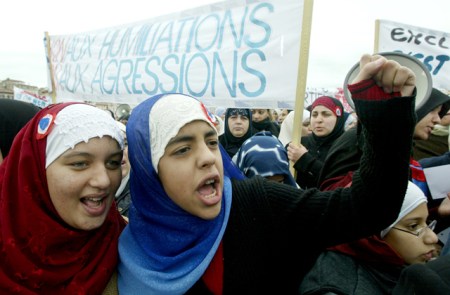
France-Muslims-Protest-Hijab-Ban-IP_0Muslims in France protest against a French law that forbids the wearing of religious symbols (including the hijab) in the primary and secondary schools. (Photo: © Reuters)

France has one of the largest Muslim communities in the West (estimated at 10% of the population), and French corporates have more experience than most in dealing with radical Islam.

City of Paris

In September 2012, in response to the encroachment of radical Islam, the mayor of Paris set up an Observatory on Secularism to ensure the principles of the 1905 separation of Church and State were being respected by the city’s 73,000 employees.

The observatory remained dormant but was reactivated in January 2015 after the Islamic terrorist attacks. Saïd Kouachi, one of the Charlie Hebdo killers, worked in the city sanitation department from 2007 to 2009. He was part of an employment program for young people from the ghettoes surrounding Paris.

A number of these youths were assigned to going door-to-door to inform householders on the benefits of domestic waste segregation. Many created problems for their supervisors due to their increasingly fundamentalist Islamic beliefs: refusing to shake hands with women, bringing prayer mats with them and taking time off to return to their workplaces to pray. Kouachi was moved from district to district as his supervisors, who described him as fundamentalist and unmanageable, became exasperated with his behavior. He was fired in July 2009.

A supervisor later revealed that city authorities had been notified about Kouachi’s radical behavior on several occasions, but that the subject was taboo. A “Charter on Secularism” was posted in the sanitation workshops and a one-day training program held for supervisors in 2013, but no action was taken to deal with the problem.

Since January 2015, the Observatory members meet regularly, have issued a 20-page rulebook to municipal employees and interviewed numerous city managers about the problems of radicalization. Departments most affected are sanitation, parks and gardens, public safety and security, and youth and sport. Common issues are praying in the workplace, refusal to shake hands with, look at or follow instructions from female supervisors, demands for work schedule accommodation on Fridays and during Ramadan, wearing of hijabs and other head-coverings.

RATP Paris Transit Authority

The RATP chapter of the CFDT union claims there is a groundswell of Islamist ideology within the company where Samy Amimour, one of the 2015 Paris suicide bombers, worked as a bus driver. In December 2015, a newspaper reported that several RATP employees were targeted by “Fiche S,” a law enforcement indicator that flags individuals linked to terrorism.

Religion-based workplace incidents are widespread. In 2013, RATP management issued a guidebook to supervisors listing typical infringements of secular principles and outlining rules to enforce. An RATP executive commented, “We pretend the problem has been solved, but the reality is that managers in contact with radicalized individuals in bus depots are left on their own to handle these kinds of things.”

ADP Paris Airports Authority

Following the November 2015 attacks in Paris, CDG Airport CEO Augustin de Romanet revealed that 70 airside security badges had been withdrawn from Muslim airport employees and 4,000 staff lockers raided by police as the employees were considered a security risk.

French Automobile Industry

The problems facing French public-sector companies have long been present in the automobile industry, where Muslims account for around 70 percent of the workforce. Militant Islam began to manifest itself in the 1980s, when it emerged that shop stewards frequently had links to the Muslim Brotherhood.

Employees began to shave their heads, grow beards and wear Islamic garb as the Salafist ideology gained ground in the suburbs where the auto plants are located. Automakers Renault and Peugeot integrated Muslim practices into their management model, setting up on-site prayer rooms and planning work schedules to fit in with prayer times and Ramadan.

Employee associations were established to cater to the needs of Muslim staff, organizing religious celebrations, pilgrimages to Mecca and arranging for the repatriation to North Africa of deceased workers. This policy of appeasement benefited the industry since it minimized religion-linked workplace conflict and litigation and fostered employee engagement.

Radical Islam and the Emergence of Jihadism

The first generation of Muslim immigrants who came to France in the 1950s kept their faith to themselves. The second generation was more militant and began making demands for accommodation of Islam. Opting for exclusion rather than integration into mainstream society, some turned to crime. Those caught and imprisoned often converted to radical Islam, spreading the ideology throughout the ghettoes upon release.

The third generation came of age with the nationwide 2005 riots, sparked by the electrocution of two juvenile delinquents who climbed over a fence into an electricity substation to escape from the police.

The same year, Abu Musab al-Suri published a 1,600-page Global Islamic Resistance Call urging the masterminds of jihad to exploit the presence of the huge disaffected Muslim populations in Europe by prompting them to set up terror cells targeting Western civilians. The strategy was rolled out on the internet and by Salafist imams operating in mosques financed by the Gulf states.

A growing number of Muslims in France and Europe converted to radical Islam resulting in the emergence of an informal jihadist army on the continent. In February 2016, the number of radical Islamists identified by French law enforcement was 11,700.

Gaza terrorists fire 3rd mortar at IDF troops

May 4, 2016

Gaza: Three mortar attacks in one day on IDF troops For third time Wednesday, terrorists attack IDF forces stationed along Gaza border; fourth such attack in two days.

By Ari Soffer

First Publish: 5/4/2016, 1:02 PM / Last Update: 5/4/2016, 3:13 PM

Source: Gaza terrorists fire 3rd mortar at IDF troops – Defense/Security – News – Arutz Sheva

Terrorists fire mortar shells (file) Flash 90

Terrorists in the Gaza Strip fired a two mortar shells at IDF engineers operating on the Israeli side of the border Wednesday, as tensions in the south continue to rise.

The mortar strikes – which came hours after a similar attack this morning – bring the total number of similar breaches of the ceasefire by Gazan terrorists in two days to four. IDF forces returned fire at a Hamas military post in response to the second attack.

No soldiers were injured in the first attack on Wednesday, which IDF forces responded to with tank fire.

Early Tuesday evening, terrorists opened fire on IDF forces just hours after Prime Minister Binyamin Netanyahu made an impromptu visit to troops stationed at the border with Hamas-ruled Gaza.

It is not yet known which of the many terrorist factions operating in Gaza is responsible for the latest attacks. Previous attacks have either been claimed by or attributed to jihadist terror cells linked to ISIS, or Hamas’s chief Islamist rivals Islamic Jihad, as part of efforts to challenge Hamas’s rule and provoke another round of fighting with Israel.

Iran Renews Commitment to Jihad Against Israel

May 4, 2016

Iran Renews Commitment to Jihad Against Israel

BY:
May 3, 2016 1:44 pm

Source: Iran Renews Commitment to Jihad Against Israel

Senior Iranian leaders on Tuesday renewed their commitment to violent resistance against Israel during meetings with top leaders of the Islamic Jihad terror group, according to recent remarks.

Ali Larijani, the speaker of Iran’s parliament, held a Tuesday meeting in Tehran with Ramadan Abdullah, secretary general of the Islamic Jihad group. Following the powwow, Larijani affirmed Iran’s commitment to the terrorist fight against Israel.

“Intifada is an important opportunity for Palestine and you should endeavor to keep this stream alive and God will help you on the path of Intifada until victory,” Larijani was quoted as saying in the country’s state-controlled press.

The Islamic Jihad leader reportedly thanked the Iranian official and claimed that “Intifada is the only way for Palestinians to gain freedom and get rid of their cumbersome situation,” according to the report.

Ali Shamkhani, the secretary Iran’s Supreme National Security Council, offered similar comments on Monday supporting resistance against Israel.

“All advocates of the Palestinian cause worldwide now share the view that the only way to victory and restoration of the Palestinians’ rights is to rely on people’s determination to continue Islamic resistance,” Shamkhani was quoted as saying after his own meeting with Abdullah.

Cessation of hostilities in Aleppo to be announced in coming hours

May 3, 2016

Cessation of hostilities in Aleppo to be announced in coming hours – Lavrov

Published time: 3 May, 2016 11:55 Edited time: 3 May, 2016 13:34

Source: Cessation of hostilities in Aleppo to be announced in coming hours – Lavrov — RT News

A cessation of hostilities in the Syrian city of Aleppo will be announced in the coming hours, Russian Foreign Minister Sergey Lavrov said on Tuesday after talks with UN Syria envoy Staffan de Mistura.

Lavrov added that the US and Russian militaries are currently holding talks on the Aleppo ceasefire.
“I hope that in the coming hours such an agreement will be announced,” the minister said after the meeting in Moscow.

According to UN special envoy Staffan de Mistura, the stalled Syria peace talks could be resumed if an Aleppo ceasefire is agreed. He added that there is now a possibility to relaunch the ceasefire by extending local truces.

I have a feeling and a hope that we can relaunch this,” De Mistura said. “We all hope that … in a few hours we can relaunch the cessation of hostilities. If we can do this, we will be back on the right track.”

Lavrov also announced the creation of a new Russian-US monitoring center in Geneva, Switzerland, which will oversee ceasefire violations in Syria.

“We are grateful to the UN for its help in solving logistical issues on the creation of this center in Geneva where the militaries of the two countries will discuss face-to-face specific developments on the ground,” he said.

Moscow is also urging Washington to distinguish between extremists and the Syrian opposition, Lavrov added.

To make the ceasefire work and make it inclusive, our partners must do everything possible to remove the moderate opposition, which relies on foreign support, from the positions occupied by the terrorists.

Lavrov also called for an extended ceasefire in Syria. “Of course, there are separate groups who would like to undermine the cessation of hostilities, to provoke an escalation [of the crisis]. We can’t let them do it,” he said.

Lavrov also warned against any calls for a ground operation in Syria.

Russia is concerned, and not just us alone, about Turkey’s shelling of the Syrian territory, continued creation of certain security zones in Syria, not to mention the increasing calls for a ground operation.”

Moscow is convinced “that such calls come from those who are not interested in the real political settlement [of Syrian crisis] and who rely on a military solution.”

“We are convinced that this is the way to a catastrophic situation, and such appeals should be stopped,” Lavrov said.

In April, the Geneva peace talks were gridlocked after the Saudi-backed Syrian opposition withdrew from the negotiations, citing the deteriorating situation in Aleppo.

Acknowledging the increasingly shaky state of the ceasefire in Syria, de Mistura then expressed hope that Russia and the US could breathe new impetus into the process, halting the fighting on the ground and solidifying the political transition process.

On Monday, the Free Syrian Army refused to recognize partial ceasefires or local lulls in violence, claiming that if the UN-backed truce was not implemented in full, the group would reserve its right to withdraw from the Geneva talks and respond to any attacks.

UN official: Hamas doesn’t use cement for terror

May 3, 2016

Senior UN official denies Hamas uses cement for terror tunnels UN Assistant Secretary-General says ‘no proof’ Hamas uses construction material for ‘military purposes.’

By Matt Wanderman

First Publish: 5/3/2016, 1:45 PM

Source: UN official: Hamas doesn’t use cement for terror – Defense/Security – News – Arutz Sheva

Terror tunnel Flash90

UN Assistant Secretary-General Robert Piper claims that there is no proof that Hamas is taking advantage of UN-provided construction material for “military purposes,” the pro-Hamas Middle East Monitor reports.

He made his remark after Israel announced that it was blocking the transfer of cement into Gaza because Hamas uses it to build terror tunnels. Piper said that the United Nations has provided 1.2 million tons of construction materials to Gaza, though he did not explain why despite that very few reparations have been carried out since 2014’s Operation Protective Edge.

Recently, the Palestinian Authority claimed that the reconstruction is stymied by a lack of funds. Critics, including the Gaza-based think tank PalThink, say that the PA is trying to improve its own standing rather than Gaza. “Whenever the PA proposes development plans, it mixes between the reconstruction of Gaza and its own financial needs in order to get billions for its treasury,” says isntitute head Omar Sha’ban.

Despite Piper’s protestations, Hamas seems to make far more progress on building tunnels than on repairing residential neighborhoods and public services.

Robert Piper heads the UN Office for the Coordination of Humanitarian Affairs (UNOCHA), which handles natural disasters and complex emergencies.

“Nightmare” Mistake: Visa Free Travel For 80 Million Turks Coming Up

May 3, 2016

Nightmare” Mistake: Visa Free Travel For 80 Million Turks Coming Up Tyler Durden’s picture Submitted

by Tyler Durden

05/02/2016 21:43 -0400

Source: “Nightmare” Mistake: Visa Free Travel For 80 Million Turks Coming Up | Zero Hedge

Submitted by Mike “Mish” Shedlock of MishTalk

“Nightmare” Mistake: Visa Free Travel For 80 Million Turks Coming Up

Of all the inane, self-serving, deals German Chancellor Angela Merkel made with Turkey, visa-free travel for 80 million Islamic Turks tops the list.

“This is all a nightmare,” said one diplomat charged with making the deal work.

Nightmares aside, Brussels Prepares Legal Groundwork on Visa-Free Travel for Turks.

Brussels will this week propose visa-free travel to Europe for 80m Turks but says Ankara still needs to meet several politically explosive reform conditions within weeks, including overhauling its terrorism laws and party funding rules.


The enhanced travel rights were Turkey’s main windfall from a landmark EU deal in March, in which Ankara helped dramatically cut migrant flows to Europe by agreeing to take back all migrants arriving on the Greek islands.


On Wednesday the European Commission will legally recommend Turks should be granted short-term visa-free travel to the Schengen area. But it will point out that up to nine of the 72 eligibility conditions required of Turkey remain incomplete, according to people familiar with the proposal.


The stage is now set for a stand-off before the June visa deadline, with far-reaching consequences for the migration crisis, domestic politics across Europe and Turkey’s long-term relations with the bloc. Decisions on visa rights for Ukraine, Georgia and Kosovo are set to be taken at the same time.


“This is all a nightmare,” said one diplomat involved in talks. Another European diplomat described the Turkey-EU deal as carrying “the seeds of its own destruction”.


It is a gamble some senior EU officials fear “is a big mistake” and will backfire. “This will be the perfect get-out for the Dutch, French and Germans, who are facing major domestic problems and  suffering from buyer’s remorse since the Turkey deal,” the official said. “And the European Parliament will just not accept a political fudge, the Turks won’t be able to ram it through.”

Appropriate Terms (in Order of Occurrence)

  • Windfall to Turkey
  • Short-Term
  • Stage Set for Standoff
  • Nightmare
  • Seeds of its Own Destruction
  • Big Mistake
  • Backfire
  • Political Fudge

Political fudge, seeds of its own destruction, and nightmare are my three favorite descriptions.

A strong argument can be made for “short-term” given the massive long-term problems should this deal actually go through.

Turkey’s Fake War on Jihadis

April 28, 2016

Turkey’s Fake War on Jihadis, Gatestone InstituteBurak Bekdil, April 28, 2016

♦ Last year, a Turkish pollster found that one in every five Turks thought that the Charlie Hebdo attack in Paris was the natural response to men who insulted Prophet Mohammed.

♦ “Infidels who were enemies of Islam thought they buried Islam in the depths of history when they abolished the caliphate on March 3, 1924 … Some 92 years after … we are shouting out that we will re-establish the caliphate, here, right next to the parliament.” — Mahmut Kar, media bureau chief for Hizb ut-Tahrir Turkey.

♦ At a March meeting with top U.S. officials, King Abdullah of Jordan accused Turkey of exporting terrorists to Europe. He said: “The fact that terrorists are going to Europe is part of Turkish policy and Turkey keeps on getting a slap on the hand, but they are let off the hook.”

♦ And Turkey is the country its Western allies believe will help them fight jihadists? Lots of luck!

In theory, Turkey is part of the international coalition that fights the Islamic State (IS). Since it joined the fight last year, it has arrested scores of IS militants, made some efforts to seal its porous border with Syria and tagged IS as a terrorist organization. Turkish police have raided homes of suspected IS operatives. More recently, Turkey’s Interior Ministry updated its list of “wanted terrorists” to include 23 IS militants, and offered rewards of more than 42 million Turkish liras (more than $14 million) for any information leading to the suspects’ capture. But this is only part of the story.

On March 24, a Turkish court released seven members of IS, including the commander of the jihadists’ operations on Turkish soil. A total of 96 suspects are on trial, including the seven men who were detained but released. All are free now, although the indictment against them claims that they

“engaged in the activities of the terrorist organization called DAESH [Arabic acronym of IS]. The suspects had sent persons to the conflict zones; they applied pressure, force, violence and threats by using the name of the terrorist organization, and they had provided members and logistic support for the group.”

The release of terror suspects came in sharp contrast with another court decision that ruled for a trial, but while under detention, for four academics who had signed a petition calling for peace in Turkey’s Kurdish dispute. Unlike the IS militants, the academics remain behind bars.

The Turkish government, which controls the judiciary almost in its entirety, relies on Islamist grassroots supporters of various flavors — from Islamists and ‘lite jihadists’ to radicals.

Last year the Turkish pollster MetroPOLL found that one in every five Turks thought that theCharlie Hebdo attack in Paris was the natural response to people who insulted Prophet Mohammed [only 16.4% of Turks thought of the incident as an attack on freedom of expression]. Among the ruling Justice and Development Party’s (AKP) voters, the rate of approval of the attack was 26.4%; and only 6.2% viewed it as an attack on free speech. Only 17.8% of AKP voters thought the attack was the work of radical Islamists. Three-quarters of AKP voters thought Muslims were aggrieved by the attack; while as few as 15.4% thought the victims were the cartoonists who were murdered. Two-thirds of AKP voters thought attacks on Islam by Christian Crusaders were continuing.

The fact that key IS suspects are now free because the government may fear looking mean to its Islamist supporters only partly explains the appalling judicial rulings on jihadists and academics. “The suspects may be holding the Turkish government hostage … What if they threatened the authorities that they would reveal the government support for their organization in the past? You normally don’t walk free over such serious legal allegations,” observes one western diplomat in Ankara.

Russia has been claiming that Turkey keeps supporting the Islamic State through trading the jihadists’ oil, their main source of income. A new report claims that total supplies to terrorists in Syria last year was 2,500 tons of ammonium nitrate; 456 tons of potassium nitrate; 75 tons of aluminum powder; sodium nitrate; glycerine; and nitric acid. The report stated:

“In order to pass through the border controls unimpeded, effectively with the complicity of the Turkish authorities, products are processed for companies that are purportedly registered in Jordan and Iraq … Registration and processing of the cargo are organized at customs posts in the [Turkish] cities of Antalya, Gaziantep and Mersin. Once the necessary procedures have been carried out, the goods pass unhindered through the border crossings at Cilvegozu and Oncupinar.”

Turkey keeps playing a fake war on jihadist terrorists. At a March meeting with top U.S. officials, King Abdullah of Jordan accused Turkey of exporting terrorists to Europe. He said: “The fact that terrorists are going to Europe is part of Turkish policy and Turkey keeps on getting a slap on the hand, but they are let off the hook.”

In fact, the Turkish government’s secret love affair with various Islamist groups is not always so secret. In March, thousands of supporters of Hizb ut-Tahrir, a global Islamist group, gathered at a public sports hall in Ankara — courtesy of the Turkish government — to discuss the re-establishment of the Islamic caliphate. In his speech, Mahmut Kar, the media bureau chief of Hizb-ut Tahrir Turkey said:

“Infidels who were enemies of Islam thought they buried Islam in the depths of history when they abolished the caliphate on March 3, 1924 … We are hopeful, enthusiastic and happy. Some 92 years after … we are shouting out that we will re-establish the caliphate, here, right next to the parliament.”

(Hizb ut-Tahrir, viewed by Russia and Kazakhstan as a terrorist group, defines itself as a political organization aiming to “lead the ummah” to the re-establishment of the caliphate and rule with sharia law.)

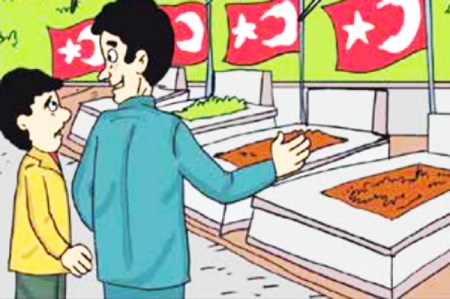
Guess what else Turkey is doing while pretending to be fighting jihadists? Apparently, President Recep Tayyip Erdogan’s declared political ambition to “raise devout generations” seems to have geared up. Turkey’s Religious Affairs General Directorate (Diyanet), the ultimate official religious authority in the country, recently issued comic books to the nation’s children telling them how marvelous it is to become an Islamic martyr.

1566Turkey’s Religious Affairs General Directorate (Diyanet), the ultimate official religious authority in the country, recently issued comic books to the nation’s children telling them how marvelous it is to become an Islamic martyr.

One comic strip is a dialogue between a father and his son. “How marvelous it is to become a martyr,” the father says. Unconvinced, the son asks: “Would anyone want to become a martyr?” And the father replies: “Yes, one would. Who doesn’t want to win heaven?”

And this is the country its Western allies believe will help them fight jihadists? Lots of luck!

The “Two State Solution”: Irony and Truth

April 27, 2016

The “Two State Solution”: Irony and Truth

by Louis René Beres

April 27, 2016 at 5:00 am

Source: The “Two State Solution”: Irony and Truth

  • “The establishment of such a [Palestinian] state means the inflow of combat-ready Palestinian forces into Judea and Samaria … In time of war, the frontiers of the Palestinian state will constitute an excellent staging point for mobile forces to mount attacks on infrastructure installations vital for Israel’s existence…” — Shimon Peres, Nobel Laureate and Former Prime Minister of Israel, in 1978.
  • The Palestine Liberation Organization (PLO) was formed in 1964; three years before there were any “occupied territories.” Exactly what, then was the PLO planning to “liberate”?
  • Both Fatah and Hamas have always considered, and still consider, Israel as simply part of “Palestine.” On their current official maps, all of Israel is identified as “Occupied Palestine.”
  • “You understand that we plan to eliminate the State of Israel, and establish a purely Palestinian state. … I have no use for Jews; they are and remain, Jews.” — PLO Chairman Yasser Arafat, January 30, 1996 (2.5 years after signing the Oslo Peace Accords).
  • In view of these repeatedly intolerant Arab views on Israel’s existence, international law should not expect Palestinian compliance with any agreements, including those concerning use of armed force — even if these agreements were to include explicit U.S. security guarantees to Israel.

There is no lack of irony in the endless discussions of Israel and a Palestinian state.

One oddly neglected example is the complete turnaround of former Israeli prime minister Shimon Peres. Recognized today as perhaps the proudest Israeli champion of a “Two State Solution” — sometimes also referred to as a “Road Map to Peace in the Middle East” — Peres had originally considered Palestinian sovereignty to be an intolerable existential threat to Israel. More precisely, in his book, Tomorrow is Now (1978), Mr. Peres unambiguously warned:

“The establishment of such a (Palestinian) state means the inflow of combat-ready Palestinian forces into Judea and Samaria this force, together with the local youth, will double itself in a short time. It will not be short of weapons or other military equipment, and in a short space of time, an infrastructure for waging war will be set up in Judea, Samaria and the Gaza Strip. … In time of war, the frontiers of the Palestinian state will constitute an excellent staging point for mobile forces to mount attacks on infrastructure installations vital for Israel’s existence…”

Now, Prime Minister Benjamin Netanyahu, in apparent agreement with this original position of Peres on Palestine, is nonetheless willing to go along with some form or another of a Palestinian state, but only so long as its prospective leaders should first agree to “demilitarization.” Netanyahu, the “hawk,” is now in agreement with the early, original warning of Peres, the “dove.” Peres’s assessment has been Netanyahu’s firm quid pro quo.

For Israel, as Mr. Netanyahu understands, legal mistakes and misunderstandings could quickly give rise to potentially irreversible harms. With reference to the particular matter of “Palestine,” the underlying hazards are complex, longstanding, and possibly global. These hazards would also only be exacerbated by any newly mandated (by the U.S., Russia, and/or United Nations) Israeli return of the Golan Heights to Syria. Then, armed militants could once again start shooting down at the farmers below, laboring on the Israeli plain.

History can help us better to understand the real outcome of any “Two-State Solution.” From the beginnings of the state system, in 1648, following the Thirty Years’ War, and the Peace of Westphalia, states have routinely negotiated treaties to provide security. To the extent that they have been executed in good faith, these agreements are fashioned and tested according to international law. Often, of course, disputes arise when signatories have determined that continued compliance is no longer in their presumed national interest.

For Israel, its 1979 Peace Treaty with Egypt remains fundamental and important. Still, any oscillating regime change or Islamist ascendancy in Cairo could easily signal an abrogation of this agreement. These same risks of deliberate nullification could apply to an openly secular Egyptian government, should its leaders (today, this would mean President el-Sisi) decide, for absolutely any reason, that the historic treaty with Israel should now be terminated.

Any post-Sisi regime that would extend some governing authority to the Muslim Brotherhood, to its proxies, or to its jihadist successors (such as ISIS), could produce a sudden Egyptian abrogation. Although the cessation of treaty obligations by the Egyptian side would almost certainly represent a serious violation of the 1969 Vienna Convention on the Law of Treaties, the governing “treaty on treaties,” there is little if anything that Israel or the so-called “international community” could do in response. In the still-insightful words of seventeenth-century English philosopher, Thomas Hobbes: “Covenants, without the sword, are but words….” (Leviathan).

Back to Palestine. As recently as last Friday, Palestinian Authority (PA) television, not Hamas, threatened the Jews, not just Israelis, with genocide:

PA TV Preacher: “Allah, punish Your enemies, the enemies of religion, count their numbers and kill them to the last one, and bring them a black day. Allah, punish the wicked Jews, and those among the atheists who help them. Allah, we ask that You bestow upon us respect and honor by enabling us to repel them, and we ask You to save us from their evil.” [Official PA TV, April 22, 2016]

That is just part of a wider security problem. Under law, Israel has a “peremptory” (irrefutable, not open to challenge or appeal) right to remain “alive.” It was, therefore, entirely proper for Mr. Netanyahu to have previously opposed a Palestinian state in any form. After all, both Fatah and Hamas have always considered, and still consider, Israel as simply part of “Palestine.” On their current official maps, all of Israel — not just West Bank, Judea and Samaria — is prominently identified as “Occupied Palestine.” As for Jerusalem, an April 15, 2016, UNESCO resolution was expressly dismissive of “so-called” Jewish sites, including the Western Wall.

Palestine, while not yet a fully sovereign state, is still a “nonmember observer state” of the United Nations. In that more limited capacity, “Palestine” had already been admitted into UNESCO, and, unsurprisingly, joined enthusiastically in the April 15, 2016 resolution calling into question all “Jewish sites.”

In the strict Islamic view, and not merely in narrowly jihadi or Islamist perspectives, Israel is described as the individual Jew writ large. The Jewish State, in this doctrinal view, must be despised and uprooted on account of the allegedly innate and irremediable “evil” that purportedly lurks within each and every individual Jew. This insidiously murderous viewpoint is a far cry from the more fashionable idea that Israel is somehow despised in the region “only” for legitimate political reasons, that it is supposedly an “occupier.” In reality, the Israeli is routinely despised in the Islamic world because its people do not submit to Islam. This alleged Jewish infirmity can never hope to be “healed.”

A current Egyptian textbook of “Arab Islamic History,” used widely in teacher training colleges, expresses these basic and crudely determinative sentiments:

“The Jews are always the same, every time and everywhere. They will not live save in darkness. They contrive their evils clandestinely. They fight only when they are hidden; because they are cowards. … The Prophet enlightened us about the right way to treat them, and succeeded finally in crushing the plots they had planned. We today must follow this way, and purify Palestine from their filth.”[1]

In an earlier article in Al-Ahram by Dr. Lutfi Abd al-Azim, the famous commentator urged, with complete seriousness:

“The first thing that we have to make clear is that no distinction must be made between the Jew and the Israeli….The Jew is a Jew, through the millennia … in spurning all moral values, devouring the living, and drinking his blood for the sake of a few coins. The Jew, the Merchant of Venice, does not differ from the killer of Deir Yasin or the killer of the camps. They are equal examples of human degradation. Let us therefore put aside such distinctions, and talk only about Jews.”[2]

Writing also on the “Zionist Problem,” Dr. Yaha al-Rakhawi remarked openly in AlAhram

“We are all once again face to face with the Jewish Problem, not just the Zionist Problem; and we must reassess all those studies which make a distinction between “The Jew” and “The Israeli.” And we must redefine the meaning of the word “Jew” so that we do not imagine that we are speaking of a divinely revealed religion, or a minority persecuted by mankind … we cannot help but see before us the figure of the great man Hitler, may God have mercy on him, who was the wisest of those who confronted this problem … and who out of compassion for humanity tried to exterminate every Jew, but despaired of curing this cancerous growth on the body of mankind.”[3]

Finally, consider what Israel’s original Oslo Accords “peace partner,” Yasser Arafat, said on January 30, 1996, while addressing forty Arab diplomats at the Grand Hotel in Stockholm. Speaking under the title, “The Impending Total Collapse of Israel,” Arafat remarked unapologetically, and without any hesitation:

“We Palestinians will take over everything; including all of Jerusalem. … All the rich Jews who will get compensation will travel to America. … We of the PLO will now concentrate all our efforts on splitting Israel psychologically into two camps. Within five years, we will have six to seven million Arabs living in the West Bank, and in Jerusalem. … You understand that we plan to eliminate the State of Israel, and establish a purely Palestinian state. … I have no use for Jews; they are and remain, Jews.”

Israeli Prime Minister Yitzhak Rabin, U.S. President Bill Clinton, and PLO chairman Yasser Arafat at the Oslo Accords signing ceremony on September 13, 1993. In 1996, Arafat publicly stated: “We Palestinians will take over everything … You understand that we plan to eliminate the State of Israel, and establish a purely Palestinian state. … I have no use for Jews; they are and remain, Jews.” (Image source: Vince Musi / The White House)

In view of these repeatedly intolerant Arab views on Israel’s existence, international law should not expect Palestinian compliance with any pre-state agreements, including those concerning use of armed force. This is true even if these agreements were to include certain explicit U.S. security guarantees to Israel. Also, authentic treaties can be binding only upon states, therefore any inherently non-treaty agreement between a pre-state “Palestine” and Israel could quickly prove to be of little or no real standing or effectiveness.

What if the government of a new Palestinian state were somehow willing to consider itself bound by the pre-state, non-treaty agreement? Even in these very improbable circumstances, the functioning Palestinian government could still have ample pretext, and opportunity, to lawfully terminate the agreement. Palestine, for example, could withdraw from the “treaty” because of what it would regard as a “material breach” — a purported violation by Israel that had allegedly undermined the “object or purpose” of the agreement. It could also point toward what international law calls Rebus sic stantibus (“fundamental change of circumstances”).

Here, if Palestine might decide to declare itself vulnerable to previously unforeseen dangers — perhaps even not from Israel but from other Arab armies or their sub-state proxies — it could lawfully end its previous commitment to remain demilitarized.

There is another factor that explains why Prime Minister Netanyahu’s conditioned hope for Palestinian demilitarization remains misconceived, and why Prime Minister Peres’s earlier pessimism remains well-founded. After declaring independence, a new Palestinian government, one possibly displaying the same openly genocidal sentiments, could point to particular pre-independence “errors of fact,” or “duress,” as appropriate grounds to terminate the agreement. Significantly, the usual grounds that may be invoked under domestic law to invalidate contracts can apply equally under international law, both to actual treaties, and to less authoritative agreements.

Any treaty or treaty-like agreement is void if, at the time of entry, it is in conflict with a “peremptory” rule of international law, a rule accepted by the community of states as one from which no deviation is permitted. Because the right of sovereign states to maintain military forces for self-defense is always such a rule, “Palestine” could be well within its lawful rights to abrogate any agreement that had, before its independence, compelled demilitarization.

In short, Benjamin Netanyahu should take no comfort from any legal promises of Palestinian demilitarization. Should the government of a future Palestinian state choose to invite foreign armies or terrorists on to its territory, possibly after the original government had been overthrown by more militantly jihadist or other Islamic forces, it could do so not only without practical difficulties, but also without necessarily violating pertinent international rules.

The core danger to Israel of any presumed Palestinian demilitarization is always far more practical than legal. The “Road Map” to “Palestine” still favored by U.S. President Barack Obama and most European leaders, stems from a persistent misunderstanding of Palestinian history, and, simultaneously, of the long legal history of Jewish life and title to disputed areas in Judea and Samaria (the West Bank) and Jerusalem. At a minimum, President Obama and, even more importantly, his successor, should finally recognize that the Palestine Liberation Organization (PLO) was formed in 1964; three years before there were any “occupied territories.” Exactly what, then was the PLO planning to “liberate”? This is a primary question that still cries out for a reasonable response.

A Palestinian state, any Palestinian state, would represent a mortal danger to Israel. This danger could not be relieved, even by the stipulated requirements of Israel’s current prime minister, or by any pre-independence Palestinian commitments to “demilitarize.”

Ironically, if by chance, a new state of Palestine would actually choose to abide by such pre-state commitments, it could then become more susceptible to a takeover by a jihadist organization such as ISIS.

In a staggeringly complicated region, filled with ironies, there are legal truths that should assist Israeli leaders to choose a more promising remedy to war and terror than an illusory “Two-State Solution.” Shimon Peres’s early warnings about “Palestine” were on-the-mark and should be heeded today.

Louis René Beres is Emeritus Professor of International Law at Purdue University. He can be reached at: lberes@purdue.edu


Saudi Influence in Washington Must End

April 22, 2016

Saudi Influence in Washington Must End, Front Page Magazine, Robert Spencer, April 22, 2016

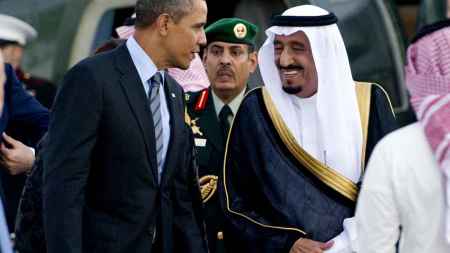
buddies

The 28 pages of a Congressional report detailing where the 9/11 hijackers got their financing have been classified for years, but what they contain is an open secret. Former Senator Bob Graham explained: “The 28 pages primarily relate to who financed 9/11, and they point a very strong finger at Saudi Arabia as being the principal financier.” So why keep this information secret? Because the Saudis wield undue influence in Washington, among both parties – an influence that has deformed our response to the global jihad threat, and continues to do so.

Responding to a bill that would allow 9/11 victims’ families to sue governments linked to terror attacks inside the U.S., the Saudis have acted like neither an ally nor an innocent party: they’ve threatened to sell $750 billion in U.S. asserts, vividly demonstrating why their influence in Washington is so detrimental.

Nonetheless, they still have a friend in Barack Obama, a man who has never hesitated to reach out in friendship to those who threaten the United States. Obama is trying to get Congress to reject the bill, and his solicitude for the Saudis is drawing criticism even from members of his own party. Senator Kirsten Gillibrand (D-NY) called on him to release the 28 pages: “If the president is going to meet with the Saudi Arabian leadership and the royal family, they think it would be appropriate that this document be released before the president makes that trip, so that they can talk about whatever issues are in that document.”

The New York Daily News, normally a reliable Democratic Party organ, fumed: “If the President allows himself to get pushed around this way in front of the world, then he earns every bit of the anger being directed at him by the extended family of September 11.”

Of course, all too many Republicans are just as much in the tank for the Saudis as the Democrats. CBS News reported on September 30, 2001, on George W. Bush’s watch, that “two dozen members of Osama bin Laden’s family were urgently evacuated from the United States in the first days following the terrorist attacks on New York and Washington, according to the Saudi ambassador to Washington.” If Hitler had had twenty-four relatives on U.S. soil on December 8, 1941, would FDR have urgently evacuated them to Berlin?

The FBI under both Bush and Obama has likewise been an apparently willing servant of the Saudis. The Miami Herald reported on July 1, 2014 that “freshly released but heavily censored FBI documents include tantalizing new information about events connected to the Sarasota Saudis who moved suddenly out of their home about two weeks before the 9/11 terrorist attacks, leaving behind clothing, jewelry and cars….This release suggests that the FBI has covered up information that is vitally important to public safety.” These “Sarasota Saudis” were a family that abruptly fled the country shortly before 9/11, “leaving behind three vehicles, food in the refrigerator and toys in the swimming pool.” Mohammed Atta may have visited their home. Yet for years, the FBI insisted that they had nothing to do with the 9/11 jihad plot, and has been extremely reticent about sharing information about their investigation. Whom is the FBI protecting, and why?

Meanwhile, the Saudis have spent untold billions of dollars spreading their Wahhabi ideology, including material such as “Jihad: The Forgotten Obligation,” in areas of the Islamic world where jihad had indeed been forgotten, largely if not completely. The Saudis have, in reawakening Muslims to this obligation, set the world on fire: al-Qaeda was a product of the Wahhabi ideology, and the Islamic State, with its unquenchable desire to commit as many jihad mass murder attacks as possible on American soil, despises the House of Saud and is determined to overthrow it but is nevertheless its demon child. The Saudis remain one of the world’s chief financiers of jihad terror.

This is an ally of the United States? No. The Saudis are not an ally of the U.S. and have not been since 9/11 and before. A presidential candidate who really wants to strike a blow against the global jihad would vow to release the 28 pages and to stand up to the Saudis’ threats, and to break the Saudis’ economic hold on the U.S. by putting the full weight of the U.S. government behind offshore drilling, oil pipelines, fracking, and the development of alternative energy sources.

In 1942, Franklin Delano Roosevelt not only wasn’t making sure that Hitler’s relatives were safely back home; he also wasn’t meeting with the Führer to discuss a German-U.S. alliance. It is long past time that the United States stop behaving like a weak client state of the House of Saud.