Posted tagged ‘Iran Scam’

Syria Asks IAEA for Help Converting Nuclear Reactor

June 8, 2015

Syria Asks IAEA for Help Converting Nuclear Reactor, Jewish Press, Hana Levi JulianJune 8, 2015

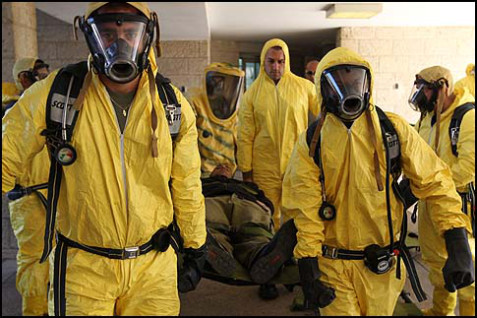
The border police run an exercise, while they train for chemical , biological or atomic. warfare. Feb 14 2011.  Photo by Nati Shohat/Flash90. *** Local Caption *** îâá éøåùìéí  àéîåï àáë çìéôåú îéâåï àéîåï úéøâåì úøâéì Israeli’s Border Police training for chemical, biological, and nuclear attacks. Photo Credit: Nati Shohat / Flash 90

IAEA head Yukiya Amano told reporters Monday that Syria has told the agency it would ship the higher-grade uranium abroad.

However, it is not clear where Syria would ship the higher-grade uranium — Iran is Syria’s closest ally – and neither is it clear what grade its uranium currently is.

**********************

The regime of Syrian President Bashar al-Assad has asked the United Nations International Atomic Energy Agency for help with a nuclear reactor near Damascus, international media agencies reported Tuesday.

The UN agency is studying the Syrian request to help convert the reactor, which currently runs on highly-enriched uranium, into one that uses lower grade nuclear fuel.

IAEA head Yukiya Amano told reporters Monday that Syria has told the agency it would ship the higher-grade uranium abroad.

However, it is not clear where Syria would ship the higher-grade uranium — Iran is Syria’s closest ally – and neither is it clear what grade its uranium currently is.

Low enriched uranium is defined as that which is enriched to less than five percent of fissile purity. Weapons quality uranium is enriched above 20 percent but that which is used to fuel an atomic bomb is enriched to 90 percent.

Amano said the IAEA is studying the request and has yet to make a decision.

Shoshana Bryen: The Kurds: A Guide for U.S. Policymakers

June 7, 2015

Shoshana Bryen: The Kurds: A Guide for U.S. Policymakerssecurefreedom via You Tube, June 5, 2015

Shoshana Bryen, Senior Director, Jewish Policy Center; Former Senior Director for Security Policy, Jewish Institute for National Security Affairs (JINSA):


Why Does the Iranian Regime Rape its Own Citizens?

June 7, 2015

Why Does the Iranian Regime Rape its Own Citizens? The Clarion Project,  Elliot Friedland, June  7, 2015

(Don’t worry. Once The Islamic Republic of Iran gets the bomb, it may become as civilized as the Islamic State. — DM)

Iran-Basij-Hooded-Men-IP_1In 2009 the Basij militia (pictured here) raped protesters as a matter of policy. (Photo: Reuters)

In prisons, virgin girls who are sentenced to death (the death penalty covers a wide variety of crimes, including the nebulous charge of Moharabeh, “enmity against God”) are typically forced into “temporary marriages” with the prison guards and raped on the night before their execution.

According to the Iran Human Rights Documentation Center this is “because the guards believed young girls executed while virgins would go to heaven” and they wanted to prevent that.

Rape and other forms of sexual assault are a means of humiliation and degrading the regime’s opponents – and are also a potent means of intimidating others into cowed obedience.

******************

Like all countries which use sharia law as state law, the Islamic Republic of Iran institutionalizes a litany of women’s rights abuses.

These include:

  • The husband is the head of the family, and his wife is legally bound to obey him. Article 1,105 of the civil code states: “In relations between husband and wife, the position of the head of the family exclusively belongs to the husband.”
  • A married woman cannot leave the country without her husband’s permission.
  • A woman’s testimony as a witness is worth half that of a man, in compliance with the Sharia basis of the legal system.
  • Women are forced to wear the hijab, a headscarf, in all public places. More broadly, Islamic modesty requirements are enforced by a morality police.
  • Polygamy and temporary marriage are permitted for men (up to four wives are allowed, subject to certain restrictions), but not for women.

Moreover, women are frequently subject to honor killings. In cases where the father kills his daughter, he is not liable for the death penalty, but only for imprisonment. This is further compounded as when someone is murdered, the family of the victim can forgive the murderer and choose to forgo punishment.

As harsh as the everyday discrimination is, however, the most serious violations are meted out against dissenters.

Use of rape as a method of torture against political opponents has been deployed widely against both men and women, as well as sexual taunts, threats and other forms of assault.

The International Campaign for Human Rights in Iran told PBS that in the aftermath of the disputed 2009 election, “rape was routinely practiced as a matter of policy to intimidate young ordinary people from ever coming out to protest again.”

In prisons, virgin girls who are sentenced to death (the death penalty covers a wide variety of crimes, including the nebulous charge of Moharabeh, “enmity against God”) are typically forced into “temporary marriages” with the prison guards and raped on the night before their execution.

According to the Iran Human Rights Documentation Center this is “because the guards believed young girls executed while virgins would go to heaven” and they wanted to prevent that.

A former Iranian Basij militia man spoke to The Jerusalem Post on the condition of anonymity and recorded his role in perpetrating these rapes when he was a prison guard.

He said, “I could tell that the girls were more afraid of their ‘wedding’ night than of the execution that awaited them in the morning. And they would always fight back, so we would have to put sleeping pills in their food. By morning, the girls would have an empty expression; it seemed like they were ready or wanted to die. I remember hearing them cry and scream after [the rape] was over. I will never forget how this one girl clawed at her own face and neck with her fingernails afterwards. She had deep scratches all over her.”

Rape and other forms of sexual assault are a means of humiliation and degrading the regime’s opponents – and are also a potent means of intimidating others into cowed obedience.

Thus, the Islamic Republic inflicts on the bodies of its citizens the purest demonstration of raw power, reminding them who rules Iran.

Forfeiting America’s Military Leverage

June 6, 2015

Forfeiting America’s Military Leverage, American ThinkerAbraham Katsman, June 6, 2015

International diplomacy, it is said, is the art of letting the other party have your way.  While there are numerous diplomatic strategies to accomplish that, one of history’s more effective means of pursuing foreign policy goals was for a superior power to conspicuously display naval forces in the waters of the weaker power, posing a military threat until satisfactory terms with the weaker nation could be reached. Such “gunboat diplomacy” could be remarkably persuasive.

But if there is such a thing as the opposite of gunboat diplomacy, we are witnessing it in the nuclear negotiations with Iran.  There will be repercussions.

The United States and other leading nations taking part in the negotiations have military capabilities that dwarf those of Iran, at best a second-rate power. Yet, in spite of the huge military advantages — not to mention the moral gulf between the U.S and Iran, or the huge stakes of allowing Iran to go nuclear — negotiations have proceeded as if between equals.

U.S. military spending is greater than that of the next seven countries combined. Superpower America has a near-monopoly on those gunboats, as well as military aircraft and cruise missiles. But that power is only useful if there is a willingness to use it — or, more precisely, if America’s enemies believe that that there is such a willingness.

If there were ever thoughts that the U.S. under Obama would lay down the law with Iran and order, under overt military threat, the “voluntary” dismantling of the mullah’s nuclear program, they have passed quietly. Sure, President Obama occasionally makes some perfunctory mention that the military option is still on the table, but no one takes his half-hearted warning seriously, least of all the Iranians.

It doesn’t help matters when Obama says, as he did on Israeli TV this week, “A military solution will not fix [the Iranian nuclear problem]. Even if the United States participates, it would temporarily slow down an Iranian nuclear program but it will not eliminate it.”

Obama has effectively forfeited America’s military leverage. He has taken the position that the only alternative to his Iranian appeasement approach is war, and that war is not an outcome acceptable to him under any circumstances.

No Iranian misconduct disrupts Obama’s pacifism. Against American interests and those of America’s allies, Iran has expanded its reach into Syria, Lebanon, Iraq, and Yemen, ethnically cleansing Sunni communities in Iraq. It has seized a cargo ship under U.S. protection, and holds several Americans hostage (complete with an ongoing farcical “trial” against Washington Post reporter Jason Rezaian for espionage). It has increased its nuclear stockpile and violated its existing international agreements, including regarding type and number of centrifuges it may operate, and announced that it will build additional reactors with the help of China and Russia.

In fact, America’s gunboats notwithstanding, it is Iran that has been dictating the terms of a prospective agreement. Iran’s intransigence in the nuclear negotiations has been rewarded: the U.S. has already backed off demands regarding Iranian nuclear enrichment, centrifuges, missile technology, and duration of the prospective agreement — and gotten nothing in return.

Not only is the United States administration going along with all this, but it has released some $11 billion in cash assets to the Islamic Republic. On top of that, it is offering a “signing bonus” of tens of billions of additional dollars to Iran for coming to a nuclear agreement, irrespective of Iranian behavior, support for terror or holding Americans prisoners.

In this context, with no credible American military threat on the table, we should not be surprised that Iran is getting everything it wants from the negotiations at no cost and no risk. As a bonus, it gets to show the world how unserious its American arch-enemy has become.

For the last century, the United States has asserted a global foreign policy, the core of which is being ready, willing, and able to impose its military might to protect its vital interests. Is there a more compelling current American interest than to keep nuclear weapons out of the reach of a rabidly anti-American, anti-Semitic, destabilizing, theocratic, apocalyptic regime, which also threatens the world’s major oil suppliers and is the world’s greatest supporter of terror? If Obama cannot even consider the military protection of that interest, he has rendered American foreign policy impotent, and its military capabilities irrelevant.

That abandonment of longstanding American projection of military power to protect global interests does not go unnoticed, by either friend or foe. The American military’s deterrent effect has been eroded; its security umbrella to its allies looks a lot less secure. The effect on alliances both current and future is corrosive.

From Riyadh to Taipei to Jerusalem, from Moscow to Beijing to Pyongyang, the world is paying close attention. As much as these nuclear negotiations are about Iran, they are even more about America.


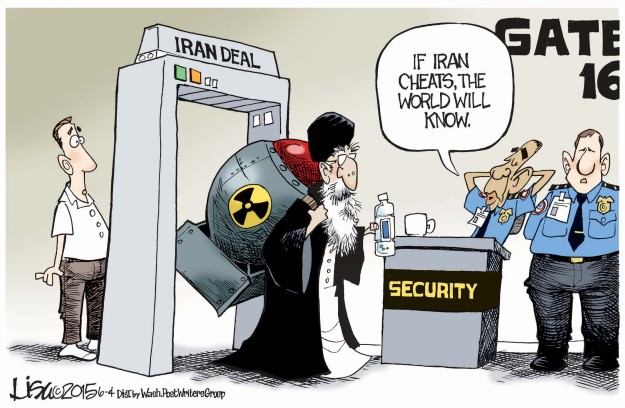
Cartoon of the day

June 6, 2015

H/t You Viewed Editorial

cg556fbf6cdc16d

Iran Will Walk

June 5, 2015

Iran Will Walk, The Gatestone InstituteLawrence A. Franklin, June 5, 2015

(What if the article is otherwise correct but Obama agrees to a “deal” anyway? — DM)

  • The Islamic Revolutionary Guard Corps (IRGC), the Praetorian Guard of Iran’s regime, controls most of the economy, as well as the black-market, alternative economy. The IRGC therefore actually benefits from sanctions; it is private firms, such as those involved in international commerce, that suffer. Why would IRGC operatives want to see the playing field made more level by private investment, transparency and a competitive economy?
  • Sanctions never hurt the regime’s ruling class; lifting them only helped the regime solidify its power over its people.
  • The objective of these two demands [an immediate lifting of all sanctions and no, or severely limited, inspections] is either to have them accepted, or to render it untenable for the Obama administration to offer Congress any deal that could be accepted – thereby shifting blame for the collapse of the talks to the U.S.
  • The U.S should also be on guard against the mullahs’ belief that the Obama administration is weak both politically and its aversion to using force. The mullahs might find great pleasure in humiliating Obama, as they did President Jimmy Carter, by dragging out hostage crisis negotiations by running out the clock until his term was over. They clearly believe that the Obama administration, simply to say it got “a deal,” is ready to sign anything.

From Washington to Riyadh, not to mention Jerusalem, statesmen are gritting their teeth at the possibility of a U.S.-Iran nuclear deal that seems overly generous to the theocratic-terror state of the Islamic Republic.

1008Representatives of the P5+1 countries pose with Iranian Foreign Minister Javad Zarif after nuclear negotiations in Lausanne, Switzerland on April 2, 2015. (Image source: U.S. State Department)

Most intelligence analysts and journalists assume that because Iran’s leadership endorsed the negotiations and has been the beneficiary of several key concessions by the P5+1 (the five permanent members of the UN Security Council, plus Germany), that an agreement is imminent. Forecasters have been predicting what the likely consequences of such a deal would be: negative.

But what if the Iranians walk?

Sanctions never hurt the regime’s ruling class; lifting them only helped the regime to solidify its power over its people.

A nuclear deal combined with an improvement in the commercial and business relations with the West would be inimical to IRGC interests.

The Islamic Revolutionary Guard Corps (IRGC), the Praetorian Guard of the regime, controls most of the economy as well as the black-market, alternative economy. IRGC-controlled conglomerates operate outside the law and reap huge profits through their control of the black market. The IRGC therefore actually benefits by sanctions; it is the private firms, such as those involved in international commerce, that suffer.

Furthermore, IRCG naval vessels, and private ships under their control, have been engaging in sanctions-breaking deliveries of imports across Persian Gulf waters to Dubai. The IRGC then sells the products at a profit by filtering them through the many foundations they control in Iran.

The most recent example of IRGC’s skirting of sanctions involved the illegal acquisition of aircraft through front-organizations with offices in both Europe and the Arabian Peninsula. Mahan Air, an IRGC front, was able to purchase 15 used commercial aircraft for $300 million. Another front, al-Naser Air, was about to purchase two more aircraft, this time from a U.S. owner. Israeli intelligence, however, passed details of the planned sale to the U.S. government, and on May 21, the deal was scuttled by the Office of Export Enforcement of the Department of Commerce.

Why would IRGC operatives want to see the playing field made more level by private investment, transparency and a competitive economy?

Moreover, if a nuclear deal indicated improved relations with the United States, Iranian hardliners, whether clerical revolutionaries or intelligence operatives, might fear seeing their ideological legitimacy erode. The Iranian regime’s only remaining fig leaf of legitimacy is its anti-American animus, with its accompanying pledge to “protect” Iran’s interests against the U.S.-Israel-Sunni “alliance.”

Improved relations with Washington might raise false hopes among Iran’s citizens that the regime may ultimately improve its woeful record on human rights. There remains only a thin patina of clerical control over Iranian society; if the hoped-for social and political reforms were not implemented, the result could produce a destabilizing political environment, harmful to the interests of the regime.

Another fallacy embraced by many “inside-the-beltway” analysts is that, as the Supreme Leader Ayatollah Khamenei endorsed the negotiations, a legitimate deal is now probable.

The once all-powerful Office of the Supreme Leader no longer calls all the shots. The current Iranian regime resembles a military junta or a security state as much as a theocracy. While the reach of Ayatollah Khamenei, through his network of representatives, still penetrates all dimensions of Iranian society, he does not have the final decision on key security matters. The regime’s strategic assets, for instance, such as its ballistic missile programs, are firmly under the control of the IRGC. Decisions related to Iran’s expansionist presence in the region are made by IRGC Quds Force Commander Qasem Soleimani. The role of Khamenei’s representative to the IRGC resembles more that of a handler than of an action officer.

The principal task for the regime is to find a way to back out of the negotiations while avoiding the blame. Iran’s efforts at disengagement may already have been underway for the past few weeks; the pace of decoupling from the talks seems to be accelerating. Iran has been increasing its demands apparently in the hope that they will either be accepted, or else rejected like the “poison pills” they are — such as inspectors no longer being allowed on its military sites.[1]

Another way to make the talks no longer palatable for the Obama administration was to create a hostile incident with the United States in the Persian Gulf, as it has tried to do by aggressively tailing American warships. Iranian ships affiliated with the IRGC Navy also seized a commercial ship, the Maersk Tigris, in the Strait of Hormuz, and temporarily detained both vessel and crew. Then, on May 14, IRGC boats fired several shots across the bow of a Singapore flagged vessel, but it escaped unharmed.

By this type of reckless comportment, the IRGC Navy appears intent on producing a clash with American naval vessels in the Gulf waters. Western negotiators have only to recall the presidency of Mohammad Khatami, when the IRGC and Iran’s Ministry of Intelligence and Security operated independently after they felt that the reformers had gone too far, thus threatening hard-liner control of the regime. The IRGC may have decided that Rouhani along with his American-educated Foreign Minister Zarif have reached a similar tipping point. This independent IRGC initiative is being executed even though a deal would release Iranian monetary assets that would in turn boost the sagging economy.[2]

Iran’s combative posture in Gulf waters against international shipping is also a direct challenge to international maritime law, which guarantees freedom of navigation through the world’s shipping lanes such as the Strait of Hormuz. A key principle of U.S. foreign policy is to enforce this freedom of navigation, if it is challenged by any foreign power, as one also hopes the U.S. will do in the South China Sea.

Iranian military and political spokesmen have also raised the temperature of their anti-American and anti-Israeli rhetoric of late. Leading members of the regime, including its Supreme Leader, Ali Khamenei, keep repeating, “Death to America” as well as its theological “obligation” to destroy Israel. While the Obama administration has alleged that these threats are just for “internal consumption,” an old Persian saying goes: “They spit in his eye and he calls it rain.”

Mojtaba Zolnour, Ayatollah Khamenei’s Deputy Representative to the IRGC, stated that the Islamic Republic of Iran, “has the divine permission to destroy Israel.” This media assault on Israel was designed to widen the divergence between the Obama administration and the Israeli government regarding the efficacy of the framework of a nuclear agreement negotiated so far.

Additionally, various Iranian principals have drawn “lines in the sand” designed to cause the Americans to disengage from the talks, such as the assertion that Iran will never accept inspection of its declared military sites. Another is Tehran’s repeated statement that it will not accept a gradual lifting of sanctions. Iranian leaders have insisted on immediate and irreversible lifting of all sanctions immediately after a nuclear deal is signed. The objective of these two demands is either to have them accepted, or to render it untenable for the Obama administration to offer Congress any deal that could be accepted — thereby shifting the blame for the collapse of the talks to the U.S.

Regime hard-line representatives to the majlis [Iranian Parliament] have already been mobilizing members to denounce the talks as detrimental to Iran’s national sovereignty. Eighty majlismembers signed a petition on May 12, calling upon the regime to suspend the nuclear talks until Washington halts its rhetorical threats against Iran. Hardliners in the majlis and elsewhere within the regime’s bureaucracy will likely continue to lobby against any deal.

Western analysts should be looking for the Iranian regime’s hard-line media outlets to increase domestic commentary condemning alleged U.S. deception in the negotiations as a reason to abandon the talks.

The death knell for the nuclear negotiations could come from newspapers such as Kayhan, a pro-regime newspaper run by Hossein Shariatmadari, and often characterized as a Khamenei mouthpiece.

The regime’s Friday-prayer Imams in key Iranian cities might also start opposing the talks. The themes of their noonday khutbahs [sermons] are likely to appeal to Iranian people’s patriotism, and suggest that it is more important for Iran to endure continued sanctions rather than submit to intrusive monitoring that offends Iran’s sovereignty.

Finally, hardliners who oppose any possibility of Iran’s improved relations with the U.S. may launch personal attacks on Iran’s negotiators to the nuclear talks, and, in an effort to discredit them, challenge their loyalty to the Iranian revolution. Their point of attack on Foreign Minister Mohammad Javad Zarif’s loyalty might be his alleged obsequious behavior to Secretary of State John Kerry. Zarif, on account of his many years of residency and education in the United States, can be depicted as an Americanized Iranian.

The United States should also be on guard against the mullahs’ belief that the Obama administration is weak — both politically and in its reluctance to use force. The mullahs might find great pleasure in humiliating Obama as they did President Jimmy Carter, when they dragged out hostage crisis negotiations by running out the clock until his term was over. They clearly believe that the Obama administration, simply to say it got “a deal,” is ready to sign anything.


[1]Iran’s powerful Guard rejects inspection of military sites” by Ali Akhbar Dareini, Associated Press, 19 April 2015. Deputy Chief of the IRGC General Hossein Salami is quoted and several more statements by IRGC officials since have repeated the same prohibitive statements regarding Iran’s military sites.

[2]U.S. to Award Iran $11.9 Billion Through End of Nuke Talks,” Washington Free Beacon, 21 January 2015. In the first of many subsequent denunciations, Senator Mark Clark of Illinois attacked the Obama administration’s plan to free Iran’s frozen assets if nuclear deal is reached.
Iran’s cooperation with North Korea includes nuclear warhead technology

June 3, 2015

Iran’s cooperation with North Korea includes nuclear warhead technology, The Hill, Alireza Jafarzadeh, June 5, 2015

(The author of the article,

Jafarzadeh, the deputy director of the Washington office of the National Council of Resistance of Iran, is credited with exposing Iranian nuclear sites in Natanz and Arak in 2002, triggering International Atomic Energy Agency inspections. He is the author of “The Iran Threat” (Palgrave MacMillan: 2008).

— DM)

For years, the conventional wisdom has been that Iran and North Korea have long cooperated in missile technology, giving the perception of not so dangerous of an alliance. That was until last week. In yet another groundbreaking revelation, Iran’s main opposition movement, the Mujahedin-e Khalq (MEK) provided information that Iran and North Korea have been engaged in extensive exchange of information and visits by experts on nuclear weapons and nuclear warhead design, as recently as April 2015.

The MEK, based on information obtained by its network inside Iran, provided a detailed account of a visit to North Korea in 2013 by Tehran’s top nuclear weapons experts headed by elusive Mohsen Fakhrizadeh, who was present during the last nuclear test conducted by North Korea.

A seven-member North Korean delegation, comprised of experts in nuclear warhead design and various parts of ballistic missiles including guidance systems, spent the last week of April in Iran. This was the third such nuclear and missile team to visit Iran in 2015. The next delegation is scheduled to secretly arrive in Iran in June and will be comprised of nine experts, according to the same MEK sources.

That Tehran continues to closely engage with North Korea, a country that cheated its way into making a nuclear weapon, all the while pledging that it would not do so, should be an additional cause for alarm. It should be a red flag for the P5+1 countries as they continue their negotiations with Iran in Vienna and Geneva with only days left before the June 30 deadline to sign an agreement.

The Iran-North Korea nuclear cooperation is in sharp contrast to what the Iranian regime leaders are telling the world. It also explains why the Supreme Leader Ali Khamenei rejects IAEA inspections of military sites, snap inspection of all sites, and interviews with nuclear scientists.

Tehran has so far managed to largely push its missile program out of the nuclear agreement requirements, and with it its extensive nuclear cooperation with North Korea—something that was kept under the radar for years.

The North Korean nuclear experts who traveled to Iran in April stayed in a secret guesthouse, a cordoned-off eight-story building, near a Hemmat Industrial Group site in the Khojir area, northeast of Tehran. Named “Imam Khomeini Complex,” and also known as 2000 units, the site is controlled by the Ministry of Defense (MoD).

The Korean delegation’s needs were met by Center for Research and Design of New Aerospace Technology, one of seven sections of the Organization of Defensive Innovation and Research (SPND). Dr. Aref Bali Lashak, who personally dealt with the Korean delegation, heads this section.

The North Korean delegation dealt with this section of SPND whose responsibility is electronics area of research and manufacturing interior parts of nuclear warhead. The visit’s arrangements were made by the Directorate of Coordination of the Iranian Ministry of Defense (MoD), headed by Brigadier General Nassorllah Ezati and the Directorate of Inspections of the MoD headed by IRGC Brigadier General Alireza Tamizi.

While there were earlier reports about Fakhrizadeh’s presence during the North Korean’s 2013 nuclear test, a two-year investigation by the Iranian opposition shows that Fakhrizadeh had gone to North Korea for the nuclear test through China under the alias  “Dr. Hassan Mohseni.”

Fakhrizadeh, the head of SPND and the key figure in activities concerning the military dimensions of the regime’s nuclear program, is a Brigadier General of the IRGC, with whom the IAEA has repeatedly requested interviews, but to no avail.

The MEK first exposed the formation of SPND in July 2011 and the State Department placed it on its sanctions list in August 2014.

According to the Iranian opposition reports, during the North Korean visit, Fakhrizadeh, accompanied by two other SPND nuclear experts, stayed in Hotel Koryo in Pyongyang and spent only two hours at the Iranian regime’s embassy. To keep his visit a secret, Mansour Chavoshi, Tehran’s Ambassador to Pyongyang, personally welcomed Fakhrizadeh and facilitated his communications and exchanges with North Korean officials.

The stunning detailed information provided by the MEK is further indication that the drive to acquire nuclear weapons remains at the core of the Iranian regime’s program as nuclear negotiations continue.

North Korea’s nefarious connection once again proves that after three decades of concealment and deception, adding six or nine months to the nuclear breakout time as a result of the P5+1 negotiations will not lead to a lasting solution. Washington needs to rethink its strategy in dealing with the Iranian regime; a strategy that would eliminate, not delay, the regime’s ability to build the bomb, because Tehran consistently shows that it must not be trusted. Any nuclear agreement with Tehran, which would leave open a pathway to the nuclear bomb, must be rejected. To that end, Congress might have its biggest role to play.

Iran Implicated in Foiled Hezbollah Attacks on Europe

June 2, 2015

Iran Implicated in Foiled Hezbollah Attacks on Europe, The Clarion ProjectRYAN MAURO, June 2, 2015

Iran-Basij-IP_3Iranian Basij volunteer militia members (Photo: © Reuters)

If this is the behavior of the Iranian regime when it has every incentive to temporarily play nice, then what will it do when it breaks free of sanctions and uses trade deals to disarm the U.S. of its economic leverage?

********************

The arrest of a Hezbollah terrorist in Cyprus is believed to have foiled attacks in Europe, probably against Israeli or Jewish targets. The plots show that Iran is as committed to international terrorism as ever and is not the least bit dissuaded by the prospect of a lucrative nuclear deal.

The terrorist came to Cyprus last month and had nearly two tons of ammonium nitrate—a substance commonly used for making bombs—in his basement. That’s about the amount that was used to carry out the Oklahoma City bombing in 1995 that took down a federal building and killed 168 people.

It is suspected that he was planning on attacking Israelis, and there is evidence linking the operative to Hezbollah leader Hassan Nasrallah. It is also believed that the operative belonged to a network planning on using Cyprus as a “port of export” for additional terrorist plots in Europe.

The National Council of Resistance in Iran, an opposition group, says that a Cyprus newspaper reported that he was trained in Iran by the Revolutionary Guards Corps.

In 2012, a Hezbollah terrorist was arrested and later found guilty of planning attacks on Israeli tourists in Cyprus. His possession of a Swedish passport enabled him to conduct surveillance on targets in Europe. It was discovered that he was tracking flights from Israel to Cyprus, researching bus routes used by Israeli tourists and assessing a hospital parking lot. He also traveled to France and the Netherlands for Hezbollah.

The foiled plot helps make an important point about the nature of the Iranian regime. If there was any time for the regime to resist its impulses to engage in international terrorism, it is now.

An Iranian-sponsored plot could unravel the nuclear deal that could strengthen its “Islamic Revolution,” bolster the regime and allow it to dramatically increase its sponsorship of terrorism. And yet, even under these conditions, the Iranian regime can’t help but orchestrate terror plots in Europe with the objective of killing hundreds of innocents.

If this is the behavior of the Iranian regime when it has every incentive to temporarily play nice, then what will it do when it breaks free of sanctions and uses trade deals to disarm the U.S. of its economic leverage?

Harf ”perplexed” by NYT story on Iran’s increased nuclear stockpile

June 2, 2015

Harf ”perplexed” by NYT story on Iran’s increased nuclear stockpile, Washington Free Beacon via You Tube, June 2, 2015

(Please see also, Contrary to Obama’s claims, Iran increased its nuclear fuel stockpiles — DM)


Iran Short Film Series – 3. Believe Them!

June 2, 2015

Iran Short Film Series – 3. Believe Them! Clarion Project, via You Tube, June 1, 2015

(But to believe what Iranian leaders say, repeatedly, would be Islamophobic. Or something. — DM)