Posted tagged ‘Iran Scam’

Velayati: Iran More Powerful to Back Regional Allies after Nuclear Deal

August 15, 2015

Velayati: Iran More Powerful to Back Regional Allies after Nuclear Deal, Tasnim News Agency, August 15, 2015

(Great! More jobs for jihadists. Obama should like that. — DM)

139405101138017015791263

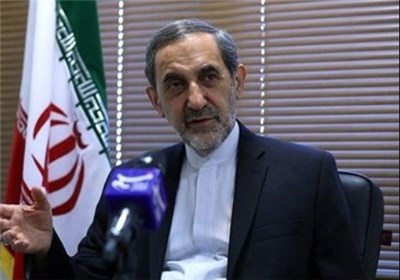
TEHRAN (Tasnim) – Secretary-General of World Assembly of Islamic Awakening Ali Akbar Velayati praised the recent conclusion of nuclear talks between Iran and six world powers, saying that with the deal, Tehran has more strength to support its friends in the Middle East region.

Speaking at the opening ceremony of the 6th gathering of General Assembly of Ahl-ul-Bayt World Assembly here in Tehran on Saturday morning, Velayati, who is also the head of the Strategic Research Center of Iran’s Expediency Council, stressed the need for the consolidation of the anti-Israeli Resistance Front in the region.

“The Islamic Republic of Iran will always support the current (Resistance Front) and of course, with the nuclear agreement, it will have more power to side with its friends in the region,” he noted.

Iran and the Group 5+1 (Russia, China, the US, Britain, France and Germany) on July 14 reached a conclusion on a lasting nuclear agreement that would terminate all sanctions imposed on Tehran over its nuclear energy program after coming into force.

The Iranian official further pointed to the most important reasons behind regional crises, saying that despite the claims made by certain countries, the crises do not have religious or sectarian nature.

Velayati added that the regional problems has its roots in the plots hatched by Islam’s enemies, who are seeking to misuse some religious differences and portray a violent image of Muslims.

The 6th General Assembly of Ahl-ul-Bayt World Assembly was inaugurated with a speech by Iranian President Hassan Rouhani.

About1.800 foreign guests from 130 countries along with senior Iranian political and cultural figures have participated in the four-day event.

Cartoons of the day

August 15, 2015

H/t Freedom is just another word

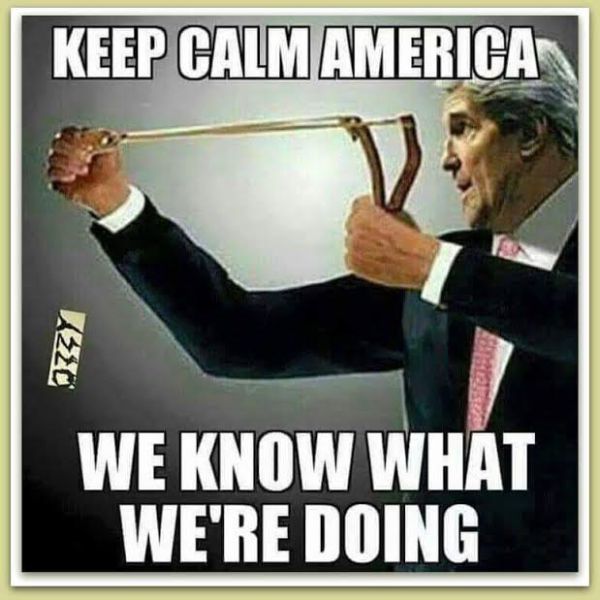
Kerry with slingshot

H/t Vermont Loon Watch

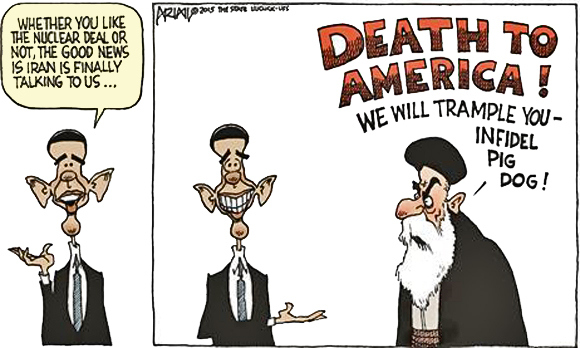
Death to America

H/t Kingjester’s Blog

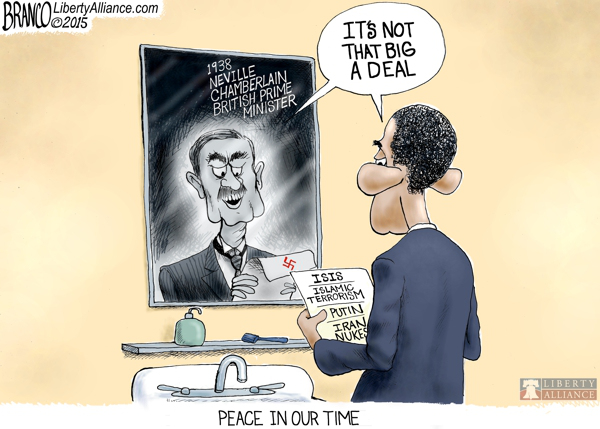
No big deal

A new era of impeachments in Iran?

August 14, 2015

A new era of impeachments in Iran? Al-MonitorArash Karami, August 13, 2015

(What would happen to the Iran “deal” if Rouhani’s “moderates” were impeached? — DM)

Iranian President Hassan Rouhani smiles during a meeting with German Economy and Energy Minister Sigmar Gabriel (unseen) in Tehran on July 20, 2015. Gabriel flew to Iran, becoming the first top Western official to visit the country since world powers and Tehran reached a historic nuclear deal. AFP PHOTO / ATTA KENARE (Photo credit should read ATTA KENARE/AFP/Getty Images)Iranian President Hassan Rouhani smiles during a meeting with German Economy and Energy Minister Sigmar Gabriel (not pictured) in Tehran, July 20, 2015. (photo by Getty Images/Atta Kenare)

The Hassan Rouhani administration took office two years ago and has undoubtedly primarily focused its energy and political clout on the nuclear talks with the five permanent members of the UN Security Council. But domestically, Iran’s conservative-dominated parliament has been more active than ever in pushing back the administration and targeting its ministers through summoning them to parliament, issuing yellow warning cards and using threats of impeachment.

The front pages of two Iranian newspapers, Ebtekar and Aftab-e Yazd, wrote Aug. 13 about this active parliament in targeting Rouhani’s ministers.

Ebtekar published an article titled “A new season of political impeachments,” which read, “The Rouhani administration has reached the halfway point and already the record for most questions by members of parliament put to ministers has been broken. [Parliament] has asked approximately 2,000 questions of the Cabinet.”

The article said that while questioning ministers is part of the parliament’s function, “many believe that in the last two years another goal was used for this function.” The article states that with the exception of a handful of ministers, ministers “have felt the shadow of impeachment above their heads.” The article’s reasons for record number of summons and questions range from personal issues to having an eye on the 2016 parliamentary elections.

Arash Bahmani has written for Al-Monitor about the troubles facing Minister of Culture and Islamic Guidance Ali Jannati, who Supreme Leader Ayatollah Ali Khamenei has reportedly reprimanded. As Alireza Ramezani wrote in Al-Monitor, “As the parliamentary elections approach, conservatives will try to find alternative solutions to drive the administration back and compensate for their loss in the battle over the nuclear deal.”

The newest target has been Alireza Teyebnia, Iran’s minister of economics and finance, who received his third yellow card from parliament Aug. 9, setting into motion the process for his impeachment. The minister, who received the highest number of approval votes during his hearing in August 2013, was summoned to parliament by conservative Iranian member of parliament Mehrdad Bazrpash to answer questions about the increase on taxes of guilds and legislation involving opening lines of credit to Iranian banks.

According to Eghtesad online, the two questions that Teyebnia was summoned for had little to do with his office. Taxes on guilds are set by parliament and Teyebnia’s position only gives him discretion to implement legislation passed by parliament, something Teyebnia explained during the parliament session. Also, the issue of a line of credit to banks has more to do with the Central Bank than the Ministry of Economics and Finance.

Aftab-e Yazd, in an article titled “Teyebnia deserves praise, not the injustice of MPs,” interviewed Ebrahim Nekoo, a member of parliament’s economic committee. While Nekoo defended the right of parliament members to summon ministers, he called Teyebnia’s treatment by parliament members as “unfair.” When asked about the possible impeachment of Teyebnia, Nekoo said, “This type of impeachment is not even logical.” He added, “Given the upcoming parliamentary elections, the possibility of finding a new minister with a better performance than Teyebnia is weak.”

Teyebnia added that given the post-sanctions environment and expectations that the lifting of sanctions will improve Iran’s economic situation, the administration’s economic team is in a sensitive position and must manage this transition. He said, “No one is more proficient in the affairs of the Economics Ministry than Teyebnia.”


Putting Obama over country is treason

August 14, 2015

Putting Obama over country is treason, Front Page Magazine, Daniel Greenfield, August 14, 2015

(Another important Democrat, “Rep. Alcee Hastings (D-Fla.), ranking House Dem on the Commission on Security and Cooperation in Europe, or U.S. Helsinki Commission, and a member of the Congressional Black Caucus,” has now opposed Obama’s deal. In addition, he stated:

“I will also introduce legislation on Sept. 8 that authorizes the sitting president or his successors to use military force to prevent Iran from becoming a nuclear weapons state. Iran’s sincerity in forgoing the procurement of a nuclear weapon makes these steps, in my opinion, an absolute necessity — regardless of how Congress votes.”

Will Obama characterize Hastings as a traitor as well? — DM)

obama (2)

The apocalyptic rhetoric out of the White House is meant to shut down the debate. Threats of war and accusations of treason are not the language of an administration that is confident in its own arguments.

***********************

“I think it’s a bad deal and I’ve said so for several weeks now. I think we need to put country ahead of party,” Senator Jim Webb said. “It troubles me when I see all this debate about whether this is disloyalty to the president or the Democratic Party.”

Webb is a Democrat and he joins a number of other Democrats in criticizing a bad deal that even Obama admitted will allow Iran to get nuclear weapons after a number of years.

Obama and his cronies have pursued an extraordinary campaign of vilification against Republicans and Democrats who dared to question the deal that will allow Iran to upgrade its nuclear program and obtain ICBM missiles, that will fund its terrorist activities around the world and even lift sanctions on terrorists like Anis Naccache, who engaged in nuclear proliferation, over European protests.

The apocalyptic rhetoric out of the White House is meant to shut down the debate. Threats of war and accusations of treason are not the language of an administration that is confident in its own arguments.

Democrats and Republicans have been accused of treason, of warmongering and of making common cause with Iranian leaders who chant “Death to America” by this administration and its allies. These accusations are hysterical, unhinged and contradict themselves. If you take them literally, Obama and his allies are accusing critics of both wanting war with America’s enemies and collaborating with them.

Elected officials who don’t want money going to terrorists are traitors. Anyone who doesn’t want to escalate the conflict in the region by enabling Iran’s arms buildup is a warmonger. And those who think that Obama’s deal with a regime that chants “Death to America” is flawed are aligned with the enemy.

There’s so much abuse coming out of the White House that its officials can’t even coordinate a coherent smear campaign that makes any kind of sense. Senator Schumer is being tarred as a chickenhawk traitor who voted for the Iraq War and secretly works for Israel, but Senator Webb is a Vietnam veteran who was wounded in the war and whose son served in Iraq, but who opposed the Iraq War.

Is he also a chickenhawk traitor or is Obama Inc. going to assemble a different smear for every dissenting Democrat? If so it had better get started because the majority of the country opposes it.

Only 52 percent of Democrats support the deal. Are all the rest traitors too? Is the Democratic Party going to have purge most of its own treasonous base and only retain those fully loyal to Obama?

It is not treason to disagree with Obama. It is not treason for the Senate to assert its rightful powers under the Constitution. It is certainly not treason for the Senate to stand with the majority of Americans who oppose an agreement that will allow a terrorist state to control a deadly nuclear program.

America is not a monarchy. Dissent is not treason. It can be the highest form of patriotism. And if being pro-Israel is treason, then how are we to describe Biden and Kerry’s ties to the Iran Lobby?

We have seen this before. This is an administration that fights ruthlessly against any changes to deeply flawed plans even when they undermine the success of the policy they are meant to implement. That’s what happened with ObamaCare and the administration was forced to illegally tinker with it to try and make it work. It would apparently like to do that with the Iran deal, which is one more reason to distrust all the empty assurances. The deal that the Senate will vote on is not the deal that we will get.

Democrats face a choice between following Senator Webb’s sensible advice and putting country first or putting Obama first.

And that’s what this is really about.

Obama has hoarded unprecedented amounts of authority leading to constant power struggles with Congress, the Supreme Court and even within the White House. Obama is currently quarreling with his own Secretary of Defense and would like Congress to authorize him to free Gitmo terrorists without the approval of his own appointee. Is Obama’s own Secretary of Defense also a traitor?

Every former Secretary of Defense has been critical of Obama’s policies.

Obama fired Chuck Hagel for exactly the reason he is now feuding with his current Secretary of Defense. Former Secretary of Defense Robert Gates said that the “the only military matter, apart from leaks, about which I ever sensed deep passion on his part was ‘Don’t Ask, Don’t Tell.’”

Former Secretary of Defense Leon Panetta blamed Obama for the rise of ISIS.  “The White House was so eager to rid itself of Iraq that it was willing to withdraw rather than lock in arrangements that would preserve our influence and interests,” he wrote.

Was every man who served as Secretary of Defense under Obama a worthless traitor or was he the problem all along? Has putting Obama’s ego ahead of country been bad for our influence and interests?

Senate Democrats are on the cusp of a post-Obama era. They will be held accountable for what they do now, then. Five or ten years from now, no one will remember the angry threats from MoveOn, but they will remember that Senate Democrats put the ego of a lame duck politician ahead of their country.

When Iran tests its first nuclear bomb, Obama will be giving paid speeches and the cameras will be on them. They will be asked why they allowed this to happen. The blame for it will fall on them.

As the White House and its allies hurl accusations of treason at anyone who points out the flaws of the Iran nuclear sellout, Democrats must decide whether they are loyal to America or to Obama.

Do they put country first or party first?

Webb, Schumer and Menendez have set a fine example for other Senate Democrats by pointing out the flaws of the deal and how it needs to be improved. All of them have far more policy experience than Obama or his staffers, many of whom were jumped up from driving buses or writing speeches, to taking on the foreign policy of a nation. Are these men committing treason by speaking out against the deal?

Are they traitors? Or are those who put Obama and the Democratic Party ahead of the country betraying their duty? Did the majority of voters, who oppose the deal, elect them to rigidly follow the leader or to use their minds and experiences to represent their interests and look out for them?

We are not a nation of parties. We are a nation of people.

Republicans or Democrats, we know that when Iran’s leaders chant, “Death to America”, they mean it. We remember the Iran Hostage Crisis. We remember the bombing of the Marine barracks in Beirut.

We know that a deal that gives the regime responsible for these atrocities a zero breakout time to a nuclear bomb is a bad deal for America. And supporting a bad deal just because it’s Obama’s bad deal is a betrayal of our national security, a betrayal of our soldiers in harm’s way and a betrayal of our future.

It’s time for Senate Democrats to stop fearing accusations of disloyalty to Obama and put loyalty to their country first.

Europeans Rush to Profit from Iran Deal

August 13, 2015

Europeans Rush to Profit from Iran Deal, The Gatestone InstituteSoeren Kern, August 13, 2015

(Sanctions “snap back?” That’s like “anytime, anywhere inspections.” Both are fiction.– DM)

  • Middle East expert Ilan Berman points out that for Iran, trading with Europe is actually the perfect self-defense, a virtual guarantee that it will not face military attack if it cheats on its obligations under the nuclear deal.
  • Sanctions will also be lifted on Supreme Leader Ali Khamenei’s $95 billion business empire, as well as on Iran’s Islamic Revolutionary Guard Corps, which operates a vast network of companies and industries. No wonder European media outlets are referring to Iran as the “new El Dorado,” the “chance of a century,” and the “last untapped market.”
  • “Conducting business with the Iranian regime means to finance the nuclear program, the annihilation threats against Israel, Holocaust denial, the export of Islamist terror and the oppression of the Iranian population.” — Stop the Bomb, Austria.
  • “Everyone is looking at Iran with greed.” — Senior French official.

European politicians and business leaders, resembling the running of the bulls in Spain, are falling over themselves in a rush to secure the “first-mover” advantage in Iran’s $400 billion economy.

Under the nuclear deal reached in Vienna on July 14, international sanctions will be removed on Iran’s banking, energy and trade sectors if Tehran agrees to certain curbs on its nuclear program.

The lifting of sanctions on Iran, a market of 80 million consumers (the second-largest market in the Middle East after Turkey in terms of GDP) creates the potential for staggering business opportunities.

Iranian officials say that investments of $185 billion are required in the oil and gas sector alone during the next five years. The mining sector requires $29 billion between now and 2025. Iran hopes to triple the number of cars manufactured in the country to three million a year by 2025.

Sanctions will also be lifted on Supreme Leader Ali Khamenei’s $95 billion business empire, as well as on Iran’s Islamic Revolutionary Guard Corps, which operates a vast network of companies and industries.

No wonder that European media outlets are referring to Iran as the “new El Dorado,” the “chance of a century,” and the “last untapped market.”

Although the United States Congress will not vote on the accord until September, Europeans appear to be operating on the premise that Iran is now open for business.

Within days of the agreement’s signing, the European Union approved the deal, and senior officials from Germany, France, Italy and the European Union rushed to Tehran to pursue business deals; leaders from Austria, Spain and Sweden are planning to lead trade missions to Iran in September and October.

On August 12, Switzerland — a neutral country that is not a member of the European Union — announced it would unilaterally lift sanctions on Iran effective immediately, presumably providing Tehran with access to technology and the Swiss banking system.

Analysts say the flurry of European activity implies that international sanctions on Iran are crumbling, and if Tehran violates its commitments under the nuclear deal, efforts to re-impose them are unlikely to succeed.

Saeed Ghasseminejad, an Iran analyst with the Washington-based Foundation for the Defense of Democracies, said:

“President Obama’s promise about the snapback sanction has no truth in it. When international companies go to Iran and commit themselves and their shareholders to long-term multi-billion dollar investments, there will be no snapback sanction mechanism.

“It took the U.S. almost a decade to convince Europeans to leave Iran’s market, as the European companies were deeply invested in the country. Those who promise an immediate return of sanctions in future are either naïve or they are not telling the truth.”

In an interview with the New York Times, Philip Gordon, the Obama Administration’s former coordinator for the Middle East who is now with the Council on Foreign Relations, admitted that American negotiators had deliberately left vague the procedures over sanctions snap-back, which means that if Iran fails to comply with the agreement, not all sanctions will necessarily be reapplied.

According to the Times, “The accord stipulates, for instance, that renewed sanctions ‘would not apply with retroactive effect’ to contracts signed before a potential violation is flagged. European companies and governments could argue that contracts signed now would be excluded from any future sanctions.”

Addressing a meeting at Iran’s Strategic Council on Foreign Relations on August 3, Iranian Foreign Minister Javad Zarif bragged that the international sanctions regime against the country has collapsed and will never again be re-imposed. He said:

“The structure of the sanctions that the US had built based on the UN Security Council’s resolutions was destroyed and like the 1990s when no other country complied with the US sanctions against Iran, no one will accept the return of the sanctions in the future.”

In an essay for Politico Europe, Middle East expert Ilan Berman pointed out that for Tehran, trading with Europe is actually the perfect self-defense, a virtual guarantee that it will not face military attack if it cheats on its obligations under the nuclear deal.

“The end result is a situation in which Europe’s growing political and economic stake in the Islamic Republic virtually guarantees that Iran won’t return to its old status as an international pariah, whether or not it ends up abiding by the terms of the JCPOA,” Berman wrote. “The lesson, it seems, is that trading with Europe means never having to say you’re sorry.”

Following is a brief country-by-country round-up of key European trade delegations seeking to open business opportunities with Iran.

Germany. German Vice Chancellor Sigmar Gabriel was the first senior European official to visit Iran after the signing of the Vienna agreement. On July 19, Gabriel, who also serves as Economy Minister, led a delegation of high-ranking German business leaders to Iran to build bilateral trade relations. He said there was “great interest on the part of German industry in normalizing and strengthening economic relations with Iran.”

The German Federation of Industries (Bundesverband der Deutschen Industrie, BDI) believesexports to Iran could rise to more than 10 billion euros ($10.9 billion) within three to four years, up from 2.4 billion euros in 2014.

Gabriel insisted that Iran must improve relations with Israel if it wants closer economic ties with Germany. “For Germany this much is clear: Anyone who wants sustainable relations with us cannot question Israel’s right to exist,” Gabriel said.

But Iranian officials flatly rejected Gabriel’s plea. “We have totally different views from Germany on certain regional issues in the Middle East, and we have explicitly expressed our viewpoints in different negotiations,” a foreign ministry spokesperson said.

France. Foreign Minister Laurent Fabius was the second senior European official to visit Iran after the nuclear deal was signed. Arriving in Tehran on July 29, Fabius proclaimed: “We are two great independent countries, two great civilizations. It is true that in recent years, for reasons that everyone knows, links have loosened, but now thanks to the nuclear deal, things are going to change.”

Imports from Iran to France fell to just 62 million euros in 2013 from 1.77 billion in 2011. French exports to Iran in 2013 fell to 494 million euros from 1.66 billion euros in 2011, according to French foreign ministry estimates.

Fabius, who denied accusations that France’s primary motivation in signing the Iran deal was to create business opportunities for French companies, also conveyed an invitation from French President François Hollande to Iranian President Hassan Rouhani to visit France in November.

Fabius’ visit was marred by Iranian hardliners, who blame him for the spread of AIDS in the country. Some 300 Iranians were infected with tainted blood supplies that were exported to Iran in the mid-1980s, when Fabius was the Socialist prime minister, and when France’s national blood transfusion center knowingly distributed HIV-contaminated blood products. Fabius was charged with manslaughter in 1999 but was later acquitted. Iranian protesters greeted Fabius with flyers depicting him with blood on his hands and the pledge: “We will not forgive or forget.”

Representatives from France’s largest employer federation, MEDEF, are due to visit Iran on September 27-29 to explore investment opportunities and re-establish commercial ties.

In February 2014, more than 100 French business leaders — with representatives from companies including Airbus, Alstom, Citroën, GDF Suez, Lafarge, Peugeot, Renault and Total — visited Iran “in an exploratory capacity.” It was the largest of trade delegation of its kind from Europe since Iran signed an interim agreement in November 2013 promising to limit its nuclear program.

At the time, French Finance Minister Pierre Moscovici said the visit was intended to “convey the message that, if the situation improves, there will be significant commercial opportunities for France in Iran.”

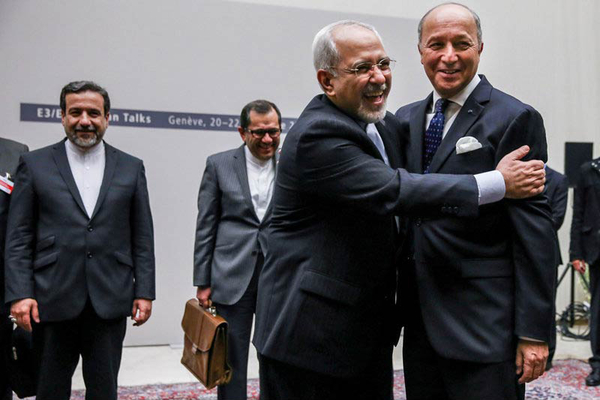
984Foreign Minister Laurent Fabius says: “Trade is very important. It fosters growth. It’s important for the Iranians, it’s important for us,” adding that regarding the current nuclear deal with Iran, “we did not take it for commercial reasons, but for strategic reasons…” Above, Iranian Foreign Minister Javad Zarif hugs Fabius at the close of nuclear talks in Geneva, Nov. 23, 2014. (Image source: ISNA)

Italy. Italian Foreign Minister Paolo Gentiloni and Economic Development Minister Federica Guidi led a high-level trade mission to Iran on August 4-6, aimed at opening export opportunities for Italian companies. According to forecasts by SACE, the Italian export credit company, Italian exports to Iran are expected to grow to €3.8 billion ($4.1 billion) in 2018, up from €1.2 billion currently.

Companies in the oil and gas industry and the machine tool industry, the two sectors most adversely affected by sanctions, are hoping to recapture market share lost due to the trade embargo. Companies active in the machine tools sector (which accounts for nearly 60% of current Italian exports to Iran) have seen their exports drop to €700 million from €1.3 billion during the past five years, according to SACE.

Gentiloni and Guidi met with Iranian Oil Minister Bijan Namdar Zanganeh on August 6. After the meeting, Zanganeh said that Iran had invited the Italian oil and gas giant Eni, as well as other Italian companies, to participate in projects in the Iranian oil industry.

On August 4, SACE, together with the Italian Ministry of Economic Development and Mediobanca, the leading investment bank in Italy, announced the finalization of a Memorandum of Understanding with the Iranian Ministry of Economy and Finance and the Central Bank of Iran, aimed at facilitating the development of future economic and trade relations between the two countries.

Under the agreement, “the parties will collaborate to evaluate short and medium-long term projects of mutual interest implying Italian export and investments and to identify local financial institutions that could benefit from credit lines provided by Mediobanca, and guaranteed by SACE and the Ministry of Economy and Finance of Iran, to support the financing and payment of such transactions.”

Also on August 4, Finmeccanica, Italy’s main industrial group, announced that it had signed a €500 million ($543 million) contract with Iran’s Ghadir Investment Company to build a power plant in the country. Ghadir is 80% owned by the Islamic Revolutionary Guards’ Corps (IGRC). The IRGC, through its elite Quds Force, is responsible for the deaths of at least 1,000 American troops in Iraq.

Austria. Austrian President Heinz Fischer is set to become the first European head of state to visit Iran since 2004 when he travels to Tehran on September 7-9. Fischer will be accompanied by Vice Chancellor and Economy Minister Reinhold Mitterlehner, Foreign Minister Sebastian Kurz, as well as a delegation of high-ranking Austrian business leaders. Mitterlehner said he hopes that Austrian exports to Iran will reach one billion euros per year by 2020, up from 232 million euros today.

On July 23-24, the Austrian Economic Chamber (Wirtschaftskammer Österreich, WKÖ)organized a major EU-Iran trade conference that was attended by nearly 400 Austrian and Iranian business leaders, including Iranian Industry Minister Mohammad Reza Nematzadeh.

According to Nematzadeh: “We are no longer interested in unidirectional importation of goods and machinery from Europe. We are looking for two-way trade, as well as cooperation in development, design, engineering and joint investment for production and export.”

Not all Austrians are happy about the government’s rush to embrace Iran. The Austrian branch of the activist group “Stop the Bomb” organized a protest outside the WKÖ’s headquarters on July 23. In a statement, the group said:

“While the implementation of the nuclear deal with the Iranian has not even started and the sanctions on Iran are still in place, Iran trade lobbyists are set to host the ‘EU-Iran-Conference’ at the Austrian Economic Chamber WKO in Vienna. Among the participants are WKO-President Christoph Leitl and the Iranian Industry & Trade Minister Mohammad Reza Nematzadeh. 70 years after the Shoah, Austrian and German companies are in the first row to boost business ties with the anti-Semitic Iranian regime.

“This conference shows that billions of Euros are going to flow to the Iranian mullahs as a result of the Vienna agreement. This will enable the regime to sponsor its terror proxies like Hamas and Hezbollah and to enforce its aggressive expansion in the region in unprecedented ways. The terror against the Iranian population will not decrease, but increase. Already now more people have been executed under supposedly ‘moderate’ President Rouhani than under his predecessor Ahmadinejad.

“Conducting business with the Iranian regime means to finance the nuclear program, the annihilation threats against Israel, Holocaust denial, the export of Islamist terror and the oppression of the Iranian population.”

Spain. Foreign Minister José Manuel García-Margallo, Industry, Energy and Tourism Minister José Manuel Soria and Development Minister Ana Pastor will lead a high-level trade delegation to Iran in early September. The objective is to open doors for Spanish companies in the energy, telecommunications and infrastructure sectors.

After the sanctions are lifted, Spain hopes to double its exports to Iran to 600 million euros, up from 300 million euros today, according to the Chamber of Commerce. The key sectors of interest for Spanish companies are petroleum, petro-chemical, mining, automobile, infrastructure and rail transport.

Despite the embargo, more than 350 mostly small- and medium-sized Spanish companies are currently active in Iran. On July 19, the newspaper El Mundo reported that more than a dozen Spanish companies sold so-called dual-use materials that could have been used to help Iran build weapons of mass destruction.

Since 2011, Spanish authorities have carried out nearly a dozen police operations aimed at disrupting illegal weapons sales to Iran. One such operation blew the lid off a scheme to sell nine helicopters to Iran. Another operation discovered that a company ostensibly dedicated to importing Persian rugs was trying to sell missile casings to the Iranian military.

A report published by Gatestone Institute in April 2014 found that in addition to Spain, companies or individuals in more than a dozen European countries — including Belgium, Britain, Finland, France, Germany, Hungary, Ireland, Italy, the Netherlands, Norway, Slovenia, Sweden and Switzerland — have been involved in illegal dual-use exports to Iran.

A senior French official interviewed by the Reuters news agency summed it up this way: “Everyone is looking at Iran with greed.”
Some deal: Iran will soon be able to kill 90 percent of our population

August 13, 2015

Some deal: Iran will soon be able to kill 90 percent of our population, Newsday, Lawrence J. Hass, August 13, 2015

Iran has tested how to conduct an EMP attack, such as by attaching a nuclear weapon to an orbiting satellite or launching a nuclear-armed missile into the atmosphere from a ship.

Iranian military leaders have endorsed an EMP attack against America, according to secret Iranian military documents that Pentagon officials have translated, and the Pentagon’s North American Aerospace Defense Command is moving back into Cheyenne Mountain in Colorado because it can resist an EMP attack.

Those who, in light of this deal and Iran’s missile and EMP work, nevertheless dismiss the “Death to America” threats from Iran as just political rhetoric might heed the words of former Israeli Foreign Minister Abba Eban: “It is our experience that political leaders do not always mean the opposite of what they say.”

********************

Just four days after U.S.-led global powers and Iran completed their nuclear deal, Ayatollah Ali Khamenei, Iran’s supreme leader, reaffirmed the “Death to America” mantra that has pervaded his regime since its establishment in 1979, stating, “The entire country is under the umbrella of this great movement.” Iran has killed hundreds of Americans in the Middle East, both directly and through its terrorist proxies. It has threatened U.S. regional interests by funding anti-Israeli terrorists, propping up Syria’s terror-backing Bashar al-Assad and de-stabilizing U.S.-backed governments.

Moving forward, this deal will enable Tehran to threaten U.S. security more directly in at least two ways: First, Iran could deploy a nuclear warhead on one of its ballistic missiles and fire it at the United States. Iran is building increasingly sophisticated ballistic missiles, with its Shahab-3 able to reach Israel, and the Sejjil that it’s developing capable of reaching Italy and Poland.

Tehran also announced plans to build missile silos in what experts consider a precursor to deploying longer range missiles.

Second, Iran could detonate a nuclear device over the United States in an electromagnetic pulse attack that destroys our electric grid, putting the nation in the dark for months and eventually leaving 90 percent of Americans dead from disease or starvation.

Iran has tested how to conduct an EMP attack, such as by attaching a nuclear weapon to an orbiting satellite or launching a nuclear-armed missile into the atmosphere from a ship.

Iranian military leaders have endorsed an EMP attack against America, according to secret Iranian military documents that Pentagon officials have translated, and the Pentagon’s North American Aerospace Defense Command is moving back into Cheyenne Mountain in Colorado because it can resist an EMP attack.

That Iran can develop nuclear weapons under the deal, making these two scenarios plausible, is clear; the only question is when.

For starters, the deal is time-limited and, as restrictions end in 10-15 years, Iran can pursue two paths to a bomb – enriching uranium to weapons-grade levels or building plutonium-producing reactors, or both.
But Tehran need not wait that long because international inspectors will be hard-pressed to confirm that Iran is abiding by the deal’s restrictions on how much uranium it’s enriching, how many centrifuges it’s operating, and what it may be doing at secret sites that the world has not yet discovered.

That’s because rather than “anywhere, anytime” inspections, Iran will have 24 days to comply with requests from the International Atomic Energy Agency to visit a suspected undeclared site, during which Iran can move, hide, or destroy evidence of its nuclear progress.

If Iran refuses to allow a site visit after 24 days, global leaders likely would begin further negotiations with Iran that would give the latter weeks more to clean up a site.

But Tehran need not wait that long because international inspectors will be hard-pressed to confirm that Iran is abiding by the deal’s restrictions on how much uranium it’s enriching, how many centrifuges it’s operating, and what it may be doing at secret sites that the world has not yet discovered.

That’s because rather than “anywhere, anytime” inspections, Iran will have 24 days to comply with requests from the International Atomic Energy Agency to visit a suspected undeclared site, during which Iran can move, hide, or destroy evidence of its nuclear progress.

If Iran refuses to allow a site visit after 24 days, global leaders likely would begin further negotiations with Iran that would give the latter weeks more to clean up a site.

Nor, under this deal, must Tehran reveal the military-related dimensions of its nuclear work to date, leaving the world dangerously ignorant of how close it already is to developing and deploying a nuclear weapon and also leaving inspectors without a baseline against which to judge Iranian compliance in the future.

Moreover, the $100 billion to $150 billion in sanctions relief will give Iran a huge windfall to develop a more robust infrastructure for nuclear weapons production – either quickly by evading the weak inspections regime or more patiently by waiting about a decade until the world frees Iran of all restrictions.

Those who, in light of this deal and Iran’s missile and EMP work, nevertheless dismiss the “Death to America” threats from Iran as just political rhetoric might heed the words of former Israeli Foreign Minister Abba Eban: “It is our experience that political leaders do not always mean the opposite of what they say.”

The Iran-North Korea Axis of Atomic Weapons?

August 13, 2015

The Iran-North Korea Axis of Atomic Weapons? Forbes OpinionClaudia Rosett, August 13, 2015

(I have been beating this drum for years and this is among the best articles on the subject I have read. It is clearly past time for the Obama Administration to “come clean” on what it knows about the Iran – North Korea axis. Congress should reject the current “deal” with Iran if it does not do so, fully and promptly. — DM)

President Obama has been telling Congress and the American public that the Iran nuclear deal — the Joint Comprehensive Plan of Action — “cuts off all Iran’s pathways to the bomb.” That’s not true. One of the most dangerous aspects of this deal is that it does not sever the longtime alliance between Tehran and Pyongyang. If there has indeed been cooperation between these two regimes on nuclear weapons, it’s time not only for Iran to come clean, but for the Obama administration to stop covering up.

******************

As U.S. lawmakers debate the Iran nuclear deal, they are rightly concerned about Iran’s refusal to disclose its past work on nuclear weapons. Not only does this refusal deprive inspectors of a baseline for monitoring Iran’s compliance; it also deprives Congress of information about the networks that Iran’s regime might most readily employ should it choose to secretly continue its quest for  the nuclear bomb.

On that note, it should also concern Congress that Tehran is not alone in hiding information on Iran’s history of developing nuclear weapons. Whatever President Obama and his negotiating team might know about such matters, they have been — to put it mildly — less than diligent about informing the American public.

An honest accounting would quite likely reveal something that many press reports have alleged, but U.S. administration officials have never publicly confirmed: A history of nuclear weapons collaboration between Iran and nuclear-proliferating North Korea.

Don’t take my word for it. Let us turn instead to an in-depth article published on August 4, 2003 by a staff writer of the Los Angeles Times under the headline “Iran Closes In on Ability to Build a Nuclear Bomb.” The reporter was no junior correspondent. The article was the product of a three-month international investigation by a veteran investigative reporter, previously a member of a Pulitzer-Prize winning team at the New York Times, Douglas Frantz.

Drawing on “previously secret reports, international officials, independent experts, Iranian exiles and intelligence sources in Europe and the Middle East,” Frantz wrote that “North Korean military scientists recently were monitored entering Iranian nuclear facilities. They are assisting in the design of a nuclear warhead, according to people inside Iran and foreign intelligence officials.”

Frantz added: “So many North Koreans are working on nuclear and missile projects in Iran that a resort on the Caspian coast is set aside for their exclusive use.”

Perhaps Frantz should recycle that article to Secretary of State John Kerry, who while testifying to a congressional panel last month was asked about its allegations by Rep. Christopher Smith, and ducked the question.

Frantz might have a better chance of getting Kerry’s attention; Frantz now works for Kerry. In 2009, then-Senator Kerry hired Frantz as deputy staff director and chief investigator of the Senate Foreign Relations Committee. Frantz returned briefly to newspaper work in 2012, as national security editor of The Washington Post. Frantz was then hired once again to work under Kerry, this time at the State Department, where Frantz has worked since 2013 as Assistant Secretary in charge of the Bureau of Public Affairs.

At State, Frantz’s portfolio includes engaging “domestic and international media to communicate timely and accurate information with the goal of furthering U.S. foreign policy and national security interests as well as broadening understanding of American values.”

But it appears that as a State Department advocate of a free and well-informed press, Frantz himself is not free to answer questions from the press about his own reporting on North Korea’s help to Iran in designing a nuclear warhead. The State Department has refused my repeated requests to interview Frantz on this subject. Last year, an official at State’s Bureau of Public Affairs responded to my request with an email saying, “Unfortunately Assistant Secretary Frantz is not available to discuss issues related to Iran’s nuclear program.” This June I asked again, and received the emailed reply: “This is indeed an important topic for Doug, but he feels that speaking about his past work would no longer be appropriate, since he is no longer a journalist.”

The real issue, of course, is not the career timeline of Douglas Frantz, but the likelihood, past and future, of nuclear collaboration between Iran and North Korea. Frantz may no longer be a journalist, but it’s hard to see why that should constrain him, or his boss, Secretary Kerry, from speaking publicly about important details of Iran’s illicit nuclear endeavors — information which Frantz in his incarnation as a star journalist judged credible enough to publish in a major newspaper.

If Frantz needs to protect his sources, by all means let him do so. He need not name his contacts inside Iran, or the “foreign intelligence officials” who gave him his scoop. If Frantz’s story was accurate, then presumably the administration has its own sources for such information. Recall that in June, with reference to Iran’s past work on nuclear weapons — the “possible military dimensions” of its nuclear program — Kerry told reporters “We know what they did. We have no doubt. We have absolute knowledge with respect to the certain military activities they were engaged in.”

So, what precisely were those activities, and Congress might want to ask Frantz, or his boss, Secretary of State Kerry, if information available to the U.S. administration supports Frantz’s story of North Korean-Iran collaboration on nuclear warheads. If so, then surely it’s time for the administration to lift the classified veil and share the blockbuster details not only with Congress, but with American voters — who deserve to know a lot more of the history that might yet shape the future of this “historic” Iran nuclear deal.

Of course, the real problem for the Obama administration is that an officially confirmed story of Iran-North Korea collaboration on nuclear warheads could spell further trouble for winning congressional approval of this nuclear deal. North Korea is a rogue state which despite sanctions has long served as a munitions back shop for Iran. If that business has included tutorials on nuclear warhead design, that is very bad news. North Korea has already conducted three nuclear tests, has been threatening a fourth, and appears to be producing bomb fuel — both plutonium and highly enriched uranium — for a nuclear arsenal which by the estimates of various experts could within a few years include dozens of warheads. Under the Iran nuclear deal, Iran would emerge with a lot more money to browse such wares.

According to public statements this year by a number of senior U.S. military officials, North Korea has also acquired the ability –untested, but dangerous — to mount miniaturized nuclear warheads on ballistic missiles. In other words, North Korea is becoming a full service shop for nuclear weapons, including the materials and technology to make them and the means to deliver them.

North Korea has a long record of peddling its weapons and related technology abroad, from conventional arms to missiles to the notorious caper in which North Korea helped Iran’s client state, Syria, build an entire clandestine nuclear reactor for no apparent use except to produce plutonium for nuclear weapons (that reactor was nearing completion when it was destroyed in 2007 by an Israeli air strike). Iran and North Korea are longtime allies, veteran smugglers and since the early days of Iran’s 1979 Islamic revolution have been prolific partners in weapons traffic.

Nor has Frantz been the only journalist to report that Iran and North Korea have worked together on nuclear weapons. For years, there have been reports in the media of Iranian officials attending North Korean nuclear tests, and North Koreans turning up at nuclear weapons research facilities in Iran. In testimony July 28th at a joint subcommittee hearing of the House Committee on Foreign Affairs, a former Congressional Research Service specialist on Asia, Larry Niksch, provided a list of respected news services that have published stories on Iran-North Korea nuclear cooperation. Among them were Reuters, Germany’s Der Spiegel and Suddeutsche Zeitung, Japan’s Kyodo News and Sankei Shimbun. and Australia’s Sydney Morning Herald. Broadly, these stories have cited sources such as foreign intelligence agencies and Iranian defectors.

The staple element missing from this picture is any official U.S. confirmation that Iran and North Korea have worked together on nuclear matters. The Obama administration has confirmed dealings between Iran and North Korea in conventional arms and missiles. But, as Niksch stated, “On nuclear collaboration there has been a virtual blackout of public information.”

When asked about allegations of Iran-North Korea nuclear ties, Obama administration officials either retreat behind the classified veil, or deflect the question. A standard response is that they take such allegations “seriously” and will look into them. From that process, to date, no significant public information has emerged.

The likely reason for this cone of silence is that for more than two decades, American presidents have tried to defang first North Korea’s nuclear program, and now Iran’s, by concocting nuclear deals that don’t hold up. In the process, Presidents Clinton, Bush (in his second term) and now President Obama, have each in turn tried to minimize disclosures that could derail their various nuclear deals. The unfortunate result is that instead of stopping nuclear proliferation, they have collectively run cover for some of the most virulent ties between Iran and North Korea. In doing so, they have deprived the American public of information important to assessing any nuclear deal with either North Korea or Iran.

Some secrecy may be necessary to protect intelligence sources and methods. That should not excuse any American president or his team from failure to alert the public to the extent of the Iran-North Korea connection, or refusal to comment in any meaningful way on allegations of nuclear weapons cooperation between Tehran and Pyongyang.

President Obama has been telling Congress and the American public that the Iran nuclear deal — the Joint Comprehensive Plan of Action — “cuts off all Iran’s pathways to the bomb.” That’s not true. One of the most dangerous aspects of this deal is that it does not sever the longtime alliance between Tehran and Pyongyang. If there has indeed been cooperation between these two regimes on nuclear weapons, it’s time not only for Iran to come clean, but for the Obama administration to stop covering up.

Our World: The anti-peace administration

August 12, 2015

Our World: The anti-peace administration, The Jerusalem PostCaroline B. Glick, August 11, 2015

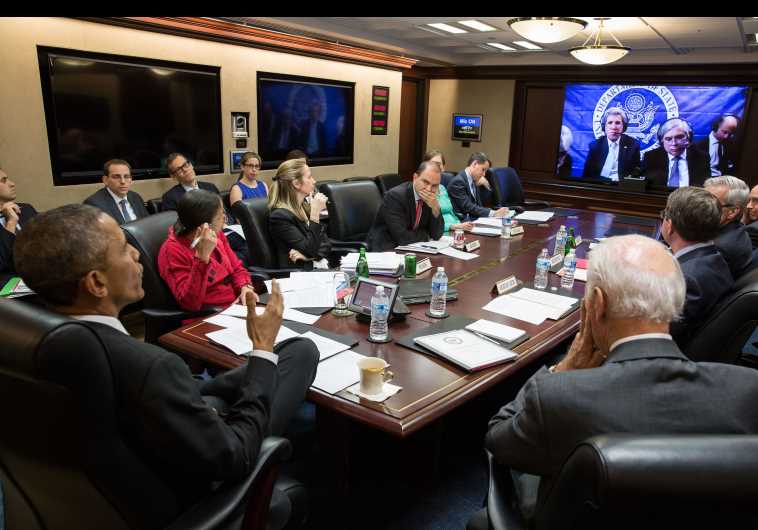
ShowImage (9)President Barack Obama, Vice President Joe Biden, and White House aides receive an update from Secretary of State John Kerry and Secretary of Energy Ernest Moniz via teleconference in Lausanne. (photo credit:WHITE HOUSE)

The US has striven to achieve peaceable relations between the states of the Middle East for nearly 70 years. Yet today, US government is disparaging the burgeoning strategic ties between the Sunni Arab states and Israel.

In a briefing to a delegation of visiting Israeli diplomatic correspondents in Washington last week, a senior Obama administration official sneered that the only noticeable shift in Israel-Arab relations in recent years is that the current Egyptian government has been coordinating security issues “more closely” with Jerusalem than the previous one did.

“But we have yet to see that change materialize in the Gulf.”

If this is how the US views the state of Israel’s relations with the Arabs, then Israel should consider canceling its intelligence cooperation with the US. Because apparently, the Americans haven’t a clue what is happening in the Middle East.

First of all, to characterize the transformation of Israeli-Egyptian relations as a mere question of “more closely” coordinating on security issues is to vastly trivialize what has happened over the past two years.

Before then Egyptian defense minister Abdel Fattah el-Sisi overthrew the US-backed Muslim Brotherhood regime headed by Muhammad Morsi in July 2013, there was a growing sense that Morsi intended to vacate Egypt’s signature to the peace deal with Israel at the first opportunity. Just a month after Morsi ascended to power in January 2013, the Muslim Brotherhood began threatening to review Egypt’s continued commitment to the peace treaty.

The main reason Morsi did not cancel the peace deal with Israel was that Egypt was bankrupt. He needed US and international monetary support to enable his government to pay for imported grain to feed Egypt’s destitute population of 90 million.

During his year in power, Morsi used Hamas as the Brotherhood’s shock troops. He embraced Iran, inviting president Mahmoud Ahmadinejad to visit Cairo in February 2013.

If Morsi were still in power today, with its $150 billion in sanctions relief Iran would have been in a position to support Egypt’s economy. So it is possible that if Morsi were still president, he would have felt he had the financial security to walk away from the peace treaty.

In happy contrast, under Sisi, Israeli-Egyptian ties are closer than they have ever been. Just last week Egyptian diplomats told Al Ahram that Israel’s support was critical for building administration support for Sisi.

Over Ramadan, Egyptian television broadcast a pro-Jewish mini-series.

Israel is closely working with the Egyptians on defeating the growing threat of Islamic State, Hamas and other Islamic terrorist groups waging a bloody insurgency against the regime in Sinai.

Last summer, it was due to the close coordination between Sisi and Israel that the US failed to force Israel to accept Hamas’s cease-fire terms, as those were represented by the Islamist regimes of Qatar and Turkey.

In part due to Israel’s critical support for Sisi’s government, and in part owing to their opposition to Iran’s rise as a regional hegemon armed with nuclear weapons, Saudi Arabia, the UAE and Jordan have all joined Egypt in viewing Israel as a strategic partner and protector.

Last year Saudi Arabia together with the UAE and Jordan supported Israel and Egypt in opposing Hamas and its American, Turkish and Qatari defenders. Had it not been for this massive Arab support, it is very likely that Israel would have been forced to accept the US’s demands and grant Hamas control over Gaza’s international borders.

In June, as negotiations between the US and the other five powers and Iran were moving toward an agreement, the Council on Foreign Relations in New York hosted a meeting between then incoming Foreign Ministry director general Dore Gold and retired Saudi General Anwar Eshki, a former advisor to the Saudi ambassador to the US. The two revealed that over the previous 18 months, they had conducted five secret meetings to discuss Iran.

Although President Barack Obama harangued Israel in his speech at American University last Wednesday, claiming that the Israeli government is the only government that has publicly opposed his nuclear deal with the Iranians, Monday US congressmen now shuttling between Egypt and Israel told Israeli reporters that Egypt opposes the nuclear deal.

As for the Gulf states, according to the US media, last week they told visiting US Secretary of State John Kerry that they support the nuclear deal.

Kerry addressed his counterparts in the Gulf Cooperation Council.

But the fact is that the only foreign minister who expressed such support was Qatari Foreign Minister Khaled al-Attiyah. To be sure, Attiyah was charged to speak for all of his counterparts because Qatar holds the GCC’s rotating chairmanship. But given that Qatar has staked out a pro-Iranian foreign policy in stark contrast to its neighbors and GCC partners, Attiyah’s statement is impossible to take seriously without the corroboration of his colleagues.

As for Qatar’s statement of support, Qatar has worked for years to cultivate good relations with Iran. It might have been expected therefore that Attiyah’s endorsement of the deal would have been enthusiastic. But it was lukewarm at best.

In Attiyah’s words, Kerry promised that the deal would place Iran’s nuclear sites under continuous inspections. “Consequently,” he explained, “the GCC countries have welcomed on this basis what has been displayed and what has been talked about by His Excellency Mr. Kerry.”

The problem of course is that Kerry wasn’t telling the truth. And the Arabs knew he was lying. The deal does not submit Iran’s nuclear sites to a rigorous inspection regime. And the GCC, including Qatar, opposes it.

In his briefing with Israeli reporters, the high-level US official rejected the importance of the détente between Israel and its Arab neighbors because he claimed the Arabs have not changed their position regarding their view of a final peace deal between Israel and the Palestinians.

But this is also nonsense. To be sure, the official position of the Saudis and the UAE is still the so-called Arab peace initiative from 2002 which stipulates that the Arabs will only normalize relations with Israel after it has ceded Jerusalem, Judea, Samaria and the Golan and allowed millions of foreign-born Arabs to freely immigrate to the shrunken Jewish state. In other words, their official position is that they will only have normal relations with Israel after Israel destroys itself.

But their official position is no longer their actual position. Their actual position is to view Israel as a strategic ally.

The senior official told the Israeli reporters that in order to show that “their primary security concern is Iran,” then as far as the Arabs are concerned, “resolving some of the other issues in the region, including the Palestinian issue should be in their interest. We would like to see them more invested in moving the process forward.”

In the real world, there is no peace process. And the Palestinian factions are fighting over who gets to have better relations with Iran. Monday we learned that PA leader Mahmoud Abbas wishes to visit Iran in the coming months in the hopes of getting the money that until recently was enjoyed by his Hamas rivals.

Hamas for its part is desperate to show Tehran that it remains a loyal client. So today, no Palestinian faction shares the joint Israeli-Saudi-Egyptian interest in preventing Iran from becoming a nuclear armed regional hegemon.

The administration showed its hand in that briefing with the Israeli reporters last week. For all their talk about Middle East peace, Obama and his advisors are not at all interested in achieving it or of noticing when it has been achieved.

Contentions | The Iran Deal’s Evaporating Logic

August 11, 2015

Contentions | The Iran Deal’s Evaporating Logic, Commentary Magazine, August 11, 2015

Proponents of the Iran nuclear deal are finding the justifications for compelling Congress to ratify the accord, save for preserving Barack Obama’s fragile self-image, are coming apart. As such, the accord’s supporters have increasingly turned to defending the deal with appeals to the president’s stature and authority, as well as by calling into question the motives and character of its opponents. That alone should tell you all you need to know. Though some of the Iran nuclear deal’s remaining backers do still occasionally claim that it will succeed in what was once its singular purpose: limiting Iran’s ability to produce prohibited armaments. One of most convincing precedents supporting this contention has, however, been largely disaffirmed. 

When asked to cite a model to demonstrate how the nuclear deal will not only prevent Iranian from developing a fissionable device but also produce a variety of happy byproducts like the moderation of the Islamic Republic’s destabilizing behavior, the deal’s supporters most frequently point to the 1987 Intermediate-Range Nuclear Forces (INF) treaty with the Soviet Union.

“From the Western perspective, the nuclear deal represents the most important security agreement since the signing of the Intermediate-Range and Shorter-Range Missiles (INF) Treaty between Washington and Moscow during the twilight years of the Cold War,” Al Jazeera columnist Richard Javad Heydarian averred.

Peter Beinart took this contention an ill-advised step further. “By 1987, Reagan had signed the Intermediate-Range Nuclear Forces (INF) treaty, the most sweeping arms-control deal of the Cold War. His rhetoric toward the Soviet Union also radically changed,” Beinart wrote in The Atlantic. “Reagan, in other words, dramatically de-escalated the Cold War long before he knew Gorbachev would let Eastern Europe go free and at a time when prominent conservatives were literally calling him Neville Chamberlain for signing the INF deal.”

That’s true. Graham Allison, also writing in The Atlantic, quoted a few conservatives from the period that feared Reagan was providing the Soviets with a reprieve from the crushing obligations of the arms race. “Reagan insisted that he was capable of brokering agreements to reduce the risks of accidents or unauthorized actions that risked nuclear war with one hand, while redoubling his efforts to undermine the Soviet regime with the other,” he insisted. “And he did just that. The Soviet Union collapsed in 1991.”

This is a remarkable simplification of history. Beinart claims that Regan’s shifting rhetoric (he renounced his “evil empire” comment while standing in the middle of Red Square under the watchful eye of a young Vladimir Putin) provided Mikhail Gorbachev space to make the case to the Politburo that he was not capitulating to Reagan in this accord. But this is a variation of the liberal case that ideational and not material considerations led to the collapse of the Soviet Union. Moreover, the INF effectively marked the end of the arms race, in part because it had already been lost by the Soviets. By contrast, there has been no ideational shift in the theocratic regime in Tehran nor is there any indication in Iran’s behavior that it is desirous of rapprochement with the West. If anything, Iran has behaved in a more bellicose fashion as nuclear negotiations with the P5+1 intensified.

The USSR is long gone, but the INF remains in place. Opponents of the Iran nuclear deal are advised to pay close attention to what that arrangement has become. It is no longer an arms control agreement but a political relic that serves little purpose but to shield from public scrutiny the extent to which Russia has become an irresponsible and revanchist international actor.

Writing in Politico Magazine in April, Foreign Policy Initiative scholars Eric Edelman and Tzvi Kahn outline the scope of the Russian’s efforts to game the INF. In response to Russia’s brazenness, American officials have routinely downplayed Moscow’s cheating. Despite repeatedly warning the United States that it was prepared to violate the INF over the course of the last decade, the Bush administration refused to acknowledge that reality. When Moscow did violate the terms of the INF in this decade, the Obama administration also pretended not to notice. And when this administration finally did address Russia’s violations of the terms of the INF, that acknowledgement was not followed on with any consequences.

That failure of resolve continues even today. According to the Washington Free Beacon’s Bill Gertz, a Pentagon assessment last month revealing the extent of Russia’s violations of the INF paints a damning picture of the Kremlin’s behavior. Unfortunately for anyone who would like to fully understand how Russia has undermined the INF, the White House is allegedly blocking that report’s release.

“Rep. Mike Rogers, chairman of the House Armed Services strategic forces subcommittee, disclosed the existence of the Pentagon assessment last month and said the report is needed for Congress’ efforts to address the problem in legislation,” Gertz reported. “Rogers said the assessment was conducted by chairman of the Joint Chiefs of Staff Gen. Martin Dempsey, and noted that it outlines potential responses to the treaty breach.”

To acknowledge the treaty’s failure would provide additional political legitimacy to an effort by House Republicans that seeks to provide funding for short-range cruise missile defenses in Poland and Romania. That’s a direct repudiation of this White House, which continues to stand by its 2009 rejection of a Bush-era deal that would have provided the Czech Republic and Poland with long-range interceptor and radar technology. In short, politics is dictating American national defense planning and strategy.

“Similarly, for decades, Tehran has violated its nuclear commitments — and the United States has failed to hold it accountable,” Edelman and Kahn observed.

There is no evidence to suggest that regime as demonstrably duplicitous as Iran’s will not cheat on this arrangement. In fact, the terms of this deal would make it difficult to definitively identify cheating, much less to marshal support for an international response to it. Even if such behavior could be identified, though, it’s not entirely clear that this administration (or its successor, presuming the next administration is a Democratic one) will be predisposed to punish Iranian cheating at all. To acknowledge the fact that the nuclear deal with Iran has failed would be to invite searing criticism from the deal’s domestic opponents.

The INF is a treaty in a persistent vegetative state; it’s corporal form remains, but its spirit has long since passed on to another plane. A conventional arms race in Eastern Europe has taken its place. If the West were to acknowledge that arms race, it would be obliged to participate in it. So it simply refuses to acknowledge it. If the Iran deal fails, its proponents in Washington are unlikely to ever say as much. Not until it is too late.

Obama vs. the Jews

August 11, 2015

Obama vs. the Jews, Front Page Magazine, Daniel Greenfield, August 11, 2015

21obama

Even in the extremely unlikely circumstance that enough Democrats would come together to veto the deal, Obama had already told the agreement’s leading Democratic opponent in the House, “If Congress overrides my veto, you do not get a U.S. foreign policy that reflects that vote. What you get is you pass this law and I, as president, will do everything possible to go in the other direction.”

****************

It was his birthday and Obama was grouchy.

“It’s my birthday and I’m going to be blunt,” Obama told the Jewish leaders meeting with him. When they complained that, “Words have consequences, and when they come from official sources, they can be even more dangerous,” he was unapologetic. 

“If you guys would back down, I would back down from some of the things I’m doing,” he warned.

By that he meant that if they stopped objecting to the Iran deal, he would stop accusing critics of his nuclear sellout to Iran of being money-grubbing warmongers.

Obama complained, “It’s been a really busy day. You’d think they’d be nicer to me on my birthday.”

His busy day had consisted of a meeting with the ineffectual UN Secretary General, lunch with Biden and a photo op in the East Room. But he also had reservations at Rose’s Luxury, an expensive Capitol Hill restaurant where ordinary people wait for hours to get in.

Rose’s doesn’t take reservations, but Obama was an exception.

Shortly after his meeting with Jewish leaders, he and his close Iranian-born adviser Valerie Jarrett skipped the line at Rose’s and got the party started. On the next day, Obama blasted Republican opponents as treasonous allies of those who chant “Death to America,” even though he was the one who had actually made common cause with Iran’s regime.

The day after that, Senator Schumer called Obama to tell him he would oppose the deal and asked him to let him announce it on Friday. The White House instead leaked it to the Huffington Post.  The first response to Schumer’s announcement came from MoveOn, which blew the dog whistle loudly enough to be heard in the next state over, “Our country doesn’t need another Joe Lieberman in the Senate.”

The only obvious thing that both politicians had in common was that they were Jewish.

Obama had lost the argument on the facts. The majority of Americans opposed the deal by 52 to 28 percent. Even among Democrats, support stood at only 52 percent.

His game plan for winning the debate was to get as ugly and dirty as possible.

Despite having just gotten back into Iraq, after contemplating an attack on Syria and coming off an illegal assault on Libya, any Democrat opposing him risked being accused of wanting another Iraq War. Or as White House press secretary Josh Earnest coyly put it, “This difference of opinion that emerged overnight is one that has existed between Senator Schumer and President Obama for over a decade.”

Obama allies emphasized that Schumer had voted for the Iraq War. Obama was once again rerunning his old campaign against Biden and Hillary, even though one was his VP and the other his successor.

Barack Obama had already rolled out the “lonely little guy in the White House” playbook complaining about lobbies and money. He had been irked at his representatives not getting full access to the AIPAC activists who were visiting members of Congress and was reading from Bush I’s old script. But now he began to sound more like Pat Buchanan ranting about Israel’s “amen corner” beating the drums for war.

Having forgotten the time he sent his campaign consultants to defeat Netanyahu in the Israeli election, he complained that Netanyahu was inappropriately interfering. During his speech, he rediscovered a love for the Constitution which he claimed obligated him to sideline Israel. Sadly he lacked the same love for the Constitution’s Treaty Clause which requires two-thirds of the Senate to ratify a treaty.

The complaints about lobbies and money sounded strange coming from a guy who had his own SuperPAC with tens of millions of dollars to spend. Behind him was a network of organizations with hundreds of millions of dollars in cash on hand and billionaire donors to donate on demand.

The Rockefeller Brothers Fund had invested a fortune into the project. Some of the money went into the Ploughshares Fund, which did its own promotion for the deal, and funneled cash to Global Zero, which released a video promoting the deal featuring Jack Black and Morgan Freeman.  His position was backed by George Soros’ J Street, an astroturfed anti-Israel group that was bringing serious money to the party.

Once Schumer came out on the deal, he was targeted by Credo Mobile and MoveOn, among other powerful left-wing groups, determined that nothing would be allowed to interfere with Iran’s nukes.

There was no shortage of lobbies and money in Obama’s corner. The citizen activists opposed to the deal might have the support of the American people, but they were outmatched by the massive wealth and infrastructure of the Democracy Alliance and Obama’s mainstream media allies.

The teachers, mothers, engineers and small businessmen could travel to Washington D.C. and complain to their Congressman. Obama could go on the Daily Show and complain about them to Jon Stewart.

There was no comparing their respective power.

And all that was without mentioning the Iran Lobby which boasted close relationships with Joe Biden and John Kerry.

Obama continued to escalate tensions with the Jewish community, even though he faced no real risk that enough Democrats would come together to override his veto. Even Schumer’s rejection had bent over backward to praise and flatter him. The American people might disapprove of the deal, but they had also disapproved of ObamaCare and his illegal war in Libya. And he had just rolled over them.

The administration wasn’t in this fight because it worried that it might lose. Between the GOP establishment and Obama, the game had already been rigged. Everyone, including Schumer, would play their parts, get their applause and the agreement would move forward. Hundreds of AIPAC members lobbying a few members of Congress wouldn’t stop that. Neither would a few ads.

Even in the extremely unlikely circumstance that enough Democrats would come together to veto the deal, Obama had already told the agreement’s leading Democratic opponent in the House, “If Congress overrides my veto, you do not get a U.S. foreign policy that reflects that vote. What you get is you pass this law and I, as president, will do everything possible to go in the other direction.”

Obama would implement the deal no matter what Congress did. Iran would get its nukes.

But for Obama, scowling and impatiently tapping his fingers while waiting to go for his birthday dinner, musing that he could have already been there if it wasn’t for these old white men whining to him, looking forward to his round of golf and a trip to Camp David, it had become petulantly personal.

For the left, the political is often indistinguishable from the personal, and for Obama it has always been that way. Obama’s view of government is Louis XIV’s “I am the State”. All opposition is personal. All dissent is treason. Enemies have to be punished on the principle of the thing.

It didn’t matter that the Jewish leaders had zero chance of actually stopping his agreement with Iran. Most of them didn’t even want to be there. What mattered was that they had opposed him and they had to be punished for it.

Obama had compared Americans uneasy about Iran’s “Death to America” slogan to schoolyard bullies who wanted to “smack around” the “little guy” who dared to “mouth off.” But he was the one playing the bully, going out of his way to sow tension, using rhetoric condemned even by Jewish supporters of the deal, not because he needed it to win, but because he was angry and resentful.

Millions of Jews around the world saw the specter of an atomic cloud rising into the sky, but Obama had a birthday meal at Rose’s Luxury to go to, a round of golf to play and his feelings were being hurt and his birthday was being ruined by these annoying Jews who wouldn’t take “No” for an answer.

Obama isn’t even stirring up anti-Semitism to defend the Iran deal. He’s lashing out, accusing critics of being traitors and warmongers, because they ruined his birthday party.