Posted tagged ‘Iran Scam’

Iran breaks the world executions record

November 17, 2015

Iran breaks the world executions record, Front Page MagazineDr. Majid Rafizadeh, November 17, 2015

Iranian executions

Is the Obama administration aware that it is trusting and dealing with a country that has just broken the world record in executions? Of course the President is aware of that, and it seems that he has decided to turn a blind eye to Iran’s increasing aggression and oppression inside and outside of its own country.

According to the recent and fifth report by the special United Nations investigator of human rights, human rights violations in Iran are rising even since the nuclear agreement was reached. Accordingly, execution rates have been increasing at “an exponential rate” in Iran. In 2014, 753 were executed and at least 694 people (including women and juveniles) were executed from January 2015 till mid-September. This is reported to be the highest rate of execution the Islamic Republic has had in 25 years.

If we take the ratio of the population into consideration, the Islamic Republic breaks the world record in number of executions per capita. As Ahmed Shaheed, the U.N. special rapporteur for human rights in Iran, pointed out, “The Islamic Republic of Iran continues to execute more individuals per capita than any other country in the world. Executions have been rising at an exponential rate since 2005 and peaked in 2014, at a shocking 753 executions[.]” According to the UN analyst, Iran is on track to execute more than 1000 people by the end of this year. Of course, these are only the official numbers being reported by the Iranian regime, the unreported number of executions by the government is likely much higher.

An execution may be ordered over many things, such as insulting the Supreme Leader, enmity toward Allah, and other non-violent offenses. According to the U.S. State Department’s  Human Rights report on Iran, “the law criminalizes dissent and applies the death penalty to offenses such as ….‘attempts against the security of the state,’ ‘outrage against high-ranking officials,’ ….(moharebeh), and ‘insults against the memory of Imam Khomeini and against the supreme leader of the Islamic Republic.’”

In addition, when it comes to journalists, social media activists, and women, political rights, discriminatory laws, as well as arbitrary detentions have been on the rise as well. According to the global gender gap index of the World Economic Forum, the Islamic Republic is ranked 137 out of 142, followed by Mali, Syria, Chad, Pakistan and Yemen.

In contrast to the report, a more liberal, softer and open image of the Islamic Republic has been repeatedly projected to the international community by Iranian President Hassan Rouhani, Mohammad Javad Zarif, the Western-educated foreign minister, and his technocratic team.

There was an assumption by liberals that several developments, including the improving ties between the West and Iran, the nuclear agreement, and the presidency of a moderate political figure would translate into improving civil liberties, social justice and removing restrictions on political critics in Iran. However, the real picture inside the country suggests a much different landscape. As Azita, an Iranian human rights activist and teacher from the ethnically Azeri-populated city of Tabriz said, “This is similar to, or even worse than, the period of Khatami where Basij, moral police, and IRGC increased suppression in order to tell the young people particularly that the laws will not changed.”

The State Department report clearly highlights the notion that the superficial illusion of a softer image projected by Iran belies the social, political, and economic reality inside the country.

This explains three phenomena. First, although President Rouhani promised that he will improve several critical issues such as civil liberties, social justice, freedom of expression, assembly, and press, and women’s rights, he decided to instead solely focus on the nuclear deal in order to get Iran out of the financial sanctions that restrained its growth.

Secondly, one can make the argument that President Rouhani has also decided not to cross the boundaries of Iran’s Revolutionary Guard Corps (IRGC) by cooperating with them and allowing them to have full control over domestic social and political policies, as well as foreign policy (Syria, Hezbollah, etc.).

Third, the hardliners are increasing their repressive tools and cracking-down on civil liberties in order to send a message to the Iranian young people and the West that the nuclear agreement does not mean Tehran is going to open up its political system and loosen Sharia law.

Iran’s Supreme Leader, Ayatollah Ali Khamanei, and his social base (the hardliners) are very concerned that Iranian youth might become a source of revolution. As a result they attempt to keep the country closed and they fear Western political and cultural influence on young people.

As Mr. Khamanei warned the senior cadre of the IRGC, “The main purpose of the enemies is for Iranians to give up on their revolutionary mentality…Enemy means global arrogance, the ultimate symbol of which is the United States….Economic and security breaches are definitely dangerous, and have dire consequences…But political and cultural intrusion by the enemy is a more serious danger that everyone should be vigilant about.”

Finally, the nuclear agreement seems to have overshadowed the human rights conditions inside Iran and the repressive Shiite Islamist laws. European countries and the Obama administration appear to have been turning a blind eye and have been becoming less critical of the Islamic Republic’s human rights record since the nuclear negotiation began and after the nuclear deal was signed.

It is time for the Obama administration to draw attention to the real face of the so-called moderate president of Iran who contradicts the truth by depicting himself and his country in a softer image to the world while simultaneously allowing executions and egregious, appalling and atrocious human rights abuses on his watch.

France’s Politically Correct War on Islamic Terror

November 16, 2015

France’s Politically Correct War on Islamic Terror, The Gatestone InstituteSoeren Kern, November 16, 2015

(Please see also, Why Islam is a religion of war. — DM)

  • French leaders consistently act in ways that undermine their stated goal of eradicating Islamic terror.
  • Critics of the policy say “Daesh” is a politically correct linguistic device that allows Western leaders to claim that the Islamic State is not Islamic — and thus ignore the root cause of Islamic terror and militant jihad.
  • French leaders have also been consistently antagonistic toward Israel, a country facing Islamic terror on a daily basis. France is leading international diplomatic efforts to push for a UN resolution that would lead to the establishment of an independent Palestinian state within a period of two years. The move effectively whitewashes Palestinian terror.
  • French critics of Islam are routinely harassed with strategic lawsuits that seek to censor, intimidate and silence them. In a recent case, Sébastien Jallamion, a 43-year-old policeman from Lyon was suspended from his job and fined 5,000 euros after he condemned the death of Frenchman Hervé Gourdel, who was beheaded by jihadists in Algeria.
  • “Those who denounce the illegal behavior of fundamentalists are more likely to be sued than the fundamentalists who behave illegally.” — Marine Le Pen, leader of France’s Front National.

French President François Hollande has vowed to avenge the November 13 jihadist attacks in Paris that left more than 120 dead and 350 injured.

Speaking from the Élysée Palace, Hollande blamed the Islamic State for the attacks, which he called an “act of war.” He said the response from France would be “unforgiving” and “merciless.”

Despite the tough rhetoric, however, the question remains: Does Hollande understand the true nature of the war he faces?

Hollande pointedly referred to the Islamic State as “Daesh,” the acronym of the group’s full Arabic name, which in English translates as “Islamic State of Iraq and the Levant,” or “ISIL.”

The official policy of the French government is to avoid using the term “Islamic State” because, according to French Foreign Minister Laurent Fabius, it “blurs the lines between Islam, Muslims and Islamists.”

Critics of the policy say “Daesh” is a politically correct linguistic device that allows Western leaders to claim that the Islamic State is not Islamic — and thus ignore the root cause of Islamic terror and militant jihad.

Islamic ideology divides the world into two spheres: the House of Islam and the House of War. The House of War (the non-Muslim world) is subject to permanent jihad until it is made part of the House of Islam, where Sharia is the law of the land.

Jihad — the perpetual struggle to expand Muslim domination throughout the world with the ultimate aim of bringing all of humanity under submission to the will of Allah — is the primary objective of true Islam, as unambiguously outlined in its foundational documents.

Consequently, even if the Islamic State were to be bombed into oblivion, France and the rest of the non-Muslim world will continue to be the target of Islamic supremacists. The West cannot defeat Islamic terrorism by attempting to conceptually delink it from true Islam. But still they try.

After the January 2015 jihadist attacks on the Paris offices of the magazine Charlie Hebdo that left 12 people dead, President Hollande declared:

“We must reject facile thinking and eschew exaggeration. Those who committed these terrorist acts, those terrorists, those fanatics, have nothing to do with the Muslim religion.”

French Prime Minister Manuel Valls said: “We are in a war against terrorism. We are not in a war against religion, against a civilization.” Again, he said: “We are at war with terrorism, jihadism and radicalism. France is not at war against Islam and Muslims.”

At a June conference with more than 100 leaders of the French Muslim community, Valls denied there is any link between extremism and Islam. He also refused to raise the issue of radicalization because the topic was “too sensitive.” Instead, he said:

“Islam still provokes misunderstandings, prejudices and is rejected by some citizens. Yet Islam is here to stay in France. It is the second largest religious group in our country.

“We must say all of this is not Islam: The hate speech, anti-Semitism that hides behind anti-Zionism and hate for Israel, the self-proclaimed imams in our neighborhoods and our prisons who are promoting violence and terrorism.”
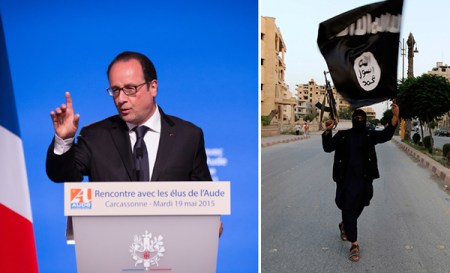
1348After the January 2015 jihadist attacks in Paris, France’s President François Hollande declared: “We must reject facile thinking and eschew exaggeration. Those who committed these terrorist acts, those terrorists, those fanatics, have nothing to do with the Muslim religion.”

France is home to around 6.5 million Muslims, or roughly 10% of the country’s total population of 66 million. Although most Muslims in France live peacefully, many are drawn to radical Islam. A CSA poll found that 22% of Muslims in the country consider themselves Muslim first and French second. Nearly one out of five (17%) Muslims in France believe that Sharia law should be fully applied in France, while 37% believe that parts of Sharia should be applied in the country.

France is also one of the largest European sources of so-called foreign fighters in Syria: More than 1,500 French Muslims have joined the Islamic State in Iraq and Syria, and many more are believed to be supporters of the group in France.

Since the Charlie Hebdo attacks, the French government has introduced a raft of new counter-terrorism measures — including sweeping surveillance powers to eavesdrop on the public — aimed at preventing further jihadist attacks.

French counter-terrorism operatives have foiled a number of jihadist plots, including a plan to attack a major navy base in Toulon, and an attempt to murder a Socialist MP in Paris.

As the latest attacks in Paris (as well as the failed attack on a high-speed train from Amsterdam to Paris in August) show, surveillance is not foolproof. Claude Moniquet, a former French intelligence operative, warns that European intelligence agencies are overwhelmed by the sheer number of people who may pose a threat. He writes:

“Some 6,000 Europeans are or were involved in the fighting in Syria (they went there, they were killed in action, they are still in IS camps, they are on their way there or their way back.)

“If you have 6,000 ‘active’ jihadists, this probably means that if you try to count those who were not identified, the logistics people who help them join up, their sympathizers and the most radical extremists who are not yet involved in violence but are on the verge of it, you have something between 10,000 and 20,000 ‘dangerous’ people in Europe.

“To carry out ‘normal’ surveillance on a suspect on a permanent basis, you need 20 to 30 agents and a dozen vehicles. And these are just the requirements for a ‘quiet’ target.

“If the suspect travels abroad, for instance, the figure could go up to 50 or 80 agents and necessitate co-operation between the services of various countries. Work it out: to keep watch on all the potential suspects, you’d need between 120,000 and 500,000 agents throughout Europe. Mission impossible!”

Meanwhile, French leaders consistently act in ways that undermine their stated goal of eradicating Islamic terror.

The French government has been one of the leading European proponents of the nuclear deal with Iran, the world’s biggest state sponsor of terrorism. Although Iran and its proxy, Hezbollah, are responsible for deaths of scores of French citizens, Fabius wasted no time in rushing to Tehran in search of business opportunities for French companies. In July, Fabius proclaimed:

“We are two great independent countries, two great civilizations. It is true that in recent years, for reasons that everyone knows, links have loosened, but now thanks to the nuclear deal, things are going to change.”

Fabius also extended an invitation for Iran’s President, Hassan Rouhani, to visit France in November. This trip — which has been mired in controversy, not over terrorism or nuclear proliferation, but over Iran’s demand that no wine be served during a formal dinner at the Élysée Palace — was postponed indefinitely after the Paris attacks. Hollande’s advisors apparently concluded that this is not the right moment for a photo-op with Rouhani, a career terrorist.

French leaders have also been consistently antagonistic toward Israel, a country facing Islamic terror on a daily basis.

After Israel launched a military offensive aimed at stopping Islamic terror groups in the Gaza Strip from launching missiles into the Jewish state, France led international calls for Israel to halt the operation. French Defense Minister Jean-Yves Le Drian said:

“France calls for an immediate ceasefire… to ensure that every side starts talking to each other to avoid an escalation that would be tragic for this part of the world.”

More recently, France has been a leading European advocate of a European Union policy that now requires Israel to label products “originating in Israeli settlements beyond Israel’s 1967 borders.” The move is widely seen as part of an international campaign to delegitimize the State of Israel. Israeli Prime Minister Benjamin Netanyahu slammed the move:

“The labelling of products of the Jewish state by the European Union brings back dark memories. Europe should be ashamed of itself. It took an immoral decision… this will not advance peace, it will certainly not advance truth and justice. It is wrong.”

France is also leading international diplomatic efforts to push for a United Nations resolution that would lead to the establishment of an independent Palestinian state within a period of two years. The move effectively whitewashes Palestinian terror. Netanyahu responded:

“The only way to reach an agreement is through bilateral negotiations, and we will forcibly reject any attempts to force upon us international dictates.

“In the international proposals that have been suggested to us — which they are actually trying to force upon us — there is no real reference to Israel’s security needs or our other national interests.

“They are simply trying to push us into indefensible borders while completely ignoring what will happen on the other side of the border.”

Meanwhile, after more than a year as a member of the US-led coalition against the Islamic State, French officials waited until late September to begin striking targets in Syria. But they refused to destroy the headquarters of the Islamic State in Raqqa — where the Paris attacks were reportedly planned.

Back in France, critics of Islam are routinely harassed with strategic lawsuits that seek to censor, intimidate and silence them.

In a recent case, Sébastien Jallamion, a 43-year-old policeman from Lyon, was suspended from his job and fined 5,000 euros after he condemned the death of Frenchman Hervé Gourdel, who was beheaded by jihadists in Algeria in September 2014. Jallamion explained:

“According to the administrative decree that was sent to me today, I am accused of having created an anonymous Facebook page in September 2014, showing several ‘provocative’ images and commentaries, ‘discriminatory and injurious,’ of a ‘xenophobic or anti-Muslim’ nature. As an example, there was that portrait of the Calif al-Baghdadi, head of the Islamic State, with a visor on his forehead. This publication was exhibited during my appearance before the discipline committee with the following accusation: ‘Are you not ashamed of stigmatizing an imam in this way?’ My lawyer can confirm this… It looks like a political punishment. I cannot see any other explanation.

“Our fundamental values, those for which many of our ancestors gave their life are deteriorating, and that it is time for us to become indignant over what our country is turning into. This is not France, land of Enlightenment that in its day shone over all of Europe and beyond. We must fight to preserve our values, it’s a matter of survival.”

Meanwhile, Marine Le Pen, the leader of France’s Front National (FN) and one of the most popular politicians in the country, went on trial in October 2015 for comparing Muslim street prayers to the wartime occupation of France. At a campaign rally in Lyon in 2010, she said:

“I’m sorry, but for those who really like to talk about World War II, if we’re talking about an occupation, we could talk about the [street prayers], because that is clearly an occupation of territory.

“It is an occupation of sections of the territory, of neighborhoods in which religious law applies — it is an occupation. There are no tanks, there are no soldiers, but it is an occupation nevertheless, and it weighs on people.”

Le Pen said she was a victim of “judicial persecution” and added:

“It is a scandal that a political leader can be sued for expressing her beliefs. Those who denounce the illegal behavior of fundamentalists are more likely to be sued than the fundamentalists who behave illegally.”

Responding to the jihadist attacks in Paris, Le Pen said:

“France and the French are no longer safe. It is my duty to tell you. Urgent action is needed.

“France must finally identify her allies and her enemies. Her enemies are those countries that have friendly relationships with radical Islam, and also those countries that have an ambiguous attitude toward terrorist enterprises.

“Regardless of what the European Union says, it is essential that France regain permanent control over its borders.

“France has been rendered vulnerable; it must rearm, because for too long it has undergone a programmed collapse of its defensive capabilities in the face of predictable and growing threats. It must restore its military resources, police, gendarmerie, intelligence and customs. The State must be able to ensure again its vital mission of protecting the French.

“Finally, Islamist fundamentalism must be annihilated. France must ban Islamist organizations, close radical mosques and expel foreigners who preach hatred in our country as well as illegal migrants who have nothing to do here. As for dual nationals who are participating in these Islamist movements, they must be stripped of their French nationality and deported.”

In the aftermath of the attacks, Le Pen, who has long been critical of President Hollande’s politically correct counter-terrorism policies, is certain to rise in public opinion polls. This will increase the political pressure on the government to take decisive action against the jihadists.

Faced with similar pressure after the Charlie Hebdo attacks in January, Hollande seemed reluctant to push too far, apparently fearful of the consequences of confronting the Muslim community in France. It remains to be seen whether the latest attacks in Paris, which some are describing as France’s September 11, mark a turning point.

Western leaders ignore ‘apocalyptic Islam’ at their peril

November 15, 2015

Western leaders ignore ‘apocalyptic Islam’ at their peril, Israel National News, Ari Soffer, November 15, 2015

img634813Bataclan concert hall following terror attackReuters

[G]laringly absent from the discussions [of the Paris attack] are any serious attempts to understand the ideological motivations of the Muslim extremists, several of them French citizens, who carried out the worse terror attacks in France in a generation – including the first-ever suicide bombings on French soil.

**************************

Despite years of warnings by intelligence agencies that radicalized Muslims would eventually emerge from the battlefields of Syria and Iraq to launch bloody attacks in the West, Europe has been blindsided by one of the most brutal terrorist atrocities in recent memory.

The coordinated attacks by three teams of ISIS terrorists in Paris on Friday sent shockwaves far beyond France, with the massacre of at least 129 people reigniting the debate around immigration after it was revealed that at least two of the attackers entered Europe posing as “refugees.”

The attacks also fueled debate over how to end the Syrian civil war, as well as over ongoing efforts to defeat ISIS on the battlefields of Syria and Iraq, the latter of which has seen several successes over the past few weeks.

But glaringly absent from the discussions are any serious attempts to understand the ideological motivations of the Muslim extremists, several of them French citizens, who carried out the worse terror attacks in France in a generation – including the first-ever suicide bombings on French soil.

That, says best-selling author Joel Rosenberg, is the reason such acts of terror are bound to repeat themselves.

Joel spoke to me prior to the attacks at the recent Jerusalem Leaders Policy Summit, and voiced concern that by failing to grapple with the apocalyptic ideology behind actors such as ISIS, Western states would never be able to decisively defeat them.

Watch: Author Joel Rosenberg speaks in Jerusalem:

A jovial, somewhat self-deprecating character, Rosenberg – who worked for Binyamin Netanyahu during his failed prime ministerial bid in 1999, as well as Natan Sharansky – describes himself as “a failed political consultant,” but boasts a rather more successful career as writer, selling millions of novels highlighting the threat of radical Islam.

Today he lives in Netanya in northern Israel with his family, having made aliyah from the US last August at the height of Operation Protective Edge (though a practicing Christian his father was Jewish, making him eligible for aliyah under the Right of Return). From there, he has continued his efforts to explain “the threats we mutually face as Israelis and Americans from radical Islam” – a threat he says he only fully appreciated after working with Netanyahu.

“Misunderstanding the nature of the threat… of evil, is to risk being blindsided by it,” he said, citing Peal Harbor and 9/11 as examples. “And we’re going to be blindsided by a nuclear Iran, just like we’re being blindsided by ISIS.”

“At the core of it, American leaders are refusing to deal with the theology and eschatology of our enemy,” he said. “Not every Muslim is a terrorist, not every Muslim is a threat, not every Muslim is a problem – in fact the vast majority are not.

“The question is, the ones who are – what do they want? What do they say they want? What motivates them?”

The current US administration is particularly hesitant to label the threat as it is.

“Obama refuses to even acknowledge radical Islam. Come on – really? At this stage in the 21st century you’re not even ready to acknowledge the ideology that is motivating these folks? That’s a problem.”

Days later, as the attacks in Paris unfolded, some criticized the US president for once again failing to mention radical Islam at all in his speech reacting to the massacre.

Watch: Obama delivers response to Paris attacks:

But beyond the relatively wide umbrella of “radical Islam” Rosenberg warns of a far deadlier threat.

“Radical Islam encompasses a wide range of groups… Hamas, the Muslim Brotherhood, Hezbollah, the Taliban, Al Qaeda – all of these are serious threats,” he noted. “But apocalyptic Islam is now the biggest threat. this is the Iranian leadership, this is ISIS.”

He argues that the hyper-messianic ideologies shared by both sides of the Shia-Sunni jihadist coin are unprecedented in the history of modern western civilization.

“Apocalyptic Islam is motivated by the idea that the end of days has come, that the Mahdi [Muslim messiah – ed.] is coming at any moment to establish a global Islamic kingdom or Caliphate, and that the way to hasten his coming is to annihilate two countries: Israel the ‘Little Satan,’ and America the ‘Big Satan,'” he explained, describing the messianic beliefs shared by both ISIS and the “Twelver Shia” sect which figures prominently among Iran’s leadership.

“But the western political class doesn’t want to even deal with the theological ideas that are driving the radical Islamists – let alone to explain the end of times theologies of two ‘nation states’,” he continued, referring to Iran and ISIS’s self-declared “Islamic State,” which encompasses huge swathes of territory in Iraq and Syria.

“Never in history have we had one, much less than two states, whose leaders are trying to force the end of the world,” Rosenberg noted.

While Jews and Christians also have their own beliefs in the “end of times” or the messianic age, the difference is that “we don’t believe we have to commit a genocide to bring about the end of times.”

While some strategic and doctrinal differences do clearly exist between Iran and ISIS – who are themselves mortal enemies – Rosenberg emphasized that the fundamental threat was essentially the same.

“Shia apocalypticism and Sunni apocalypticism are similar. Both believe the messiah is coming soon, that his kingdom is coming, they need to change their behavior to accelerate his coming… but the eschatology and strategies are different.

“ISIS’s strategy is to commit genocide today, because the goal is to build the caliphate, to force the hand of the messiah to come.

“Iran is not trying to build a caliphate today. They’re building the infrastructure to build nuclear weapons. Why? Because while ISIS wants to commit genocide today Iran wants to commit genocide tomorrow. The point is: don’t launch until you’re ready. Rather than kill thousands in one day, Iran wants to eventually kill millions.”

He disagreed with assessments shared by some experts that the Iranian regime, while extreme, ultimately functions as a rational actor, insisting their words, beliefs and actions only led to one conclusion.

“When you look a the messages of annihilation they are saying… when you look at the infrastructure they’re building and when you look at the eschatology, these roads converge.

“They’re not interested in negotiating something together with us – they’re taking a gift,” he said of the nuclear deal Tehran signed with world powers. “You’re giving us two paths to a nuclear bomb: if we cheat, or if we don’t cheat? OK we’ll take it!”

In the shorter term Iran might they use its nuclear capabilities for more limited political goals such as “blackmail or to give a cover for terror,” he said.

But in the long term its goals were just as bloodthirsty as ISIS. In facing down both threats, the West must recognize it is facing a zero-sum game.

“For these guys killing is at the center of what they’re doing. When you bear that in mind making concessions isn’t just a mistake or misguided – it’s insane.”

Iran Threatens to Walk Away from Nuke Deal

November 13, 2015

Iran Threatens to Walk Away from Nuke Deal Rouhani: Any new sanctions are a deal breaker

BY:
November 12, 2015 3:05 pm

Source: Iran Threatens to Walk Away from Nuke Deal – Washington Free Beacon

Iran has threatened to walk away from the recently inked nuclear deal and stop rolling back its nuclear enrichment program, according to recent comments by Hassan Rouhani, the Islamic Republic’s president.

Rouhani, in comments on Thursday, threatened to break the deal if the United States imposes any new sanctions on Iran, even ones concerning the country’s human rights abuses and its ballistic missile program.

The comments are a direct response to promises by the Obama administration to continue pursuing economic sanctions targeted at Iran’s terrorist proxies and efforts to foment unrest across the globe.

The warning from the Iranian president was delivered amid bipartisan calls in Congress to increase pressure on Iran in response to its recent arrest of two Americans, one a dual citizen and one a D.C.-based permanent resident.

Iran “will not fulfill agreements” aimed at curbing its nuclear program if any new sanctions are considered, Rouhani said, according to reports carried by the country’s state-controlled media.

“The obligations are the following: the group of six [global powers] will not impose new sanctions, and we should fulfill the agreements,” Rouhani said. “In case the Unites States or other countries fail to comply with their obligations, we will be forced to do the same.”

Rouhani’s made these comments just days after reports emerged indicating that Iran has stopped dismantling its nuclear centrifuges, a key requirement of the agreement.

Major differences between the United States and Iran have arisen on the issue of sanctions. While Iran maintains that all U.S. sanctions must be terminated, the Obama administration says it is only required to suspend nuclear-related sanctions.

This leaves open the possibility that the United States could reintroduce sanctions if Iran violates the deal and could level new sanctions unrelated to the country’s nuclear program.

Rouhani acknowledged that this has caused tension between the two nations, stating in his remarks, “a U.S. decision to withdraw only nuclear-related sanctions on Tehran but keeping other restrictions in place has led to continuous disagreement between Iran and the United States.”

The Iranian president also demanded in his remarks that the United States “apologize” for its past actions against Iran.

“If they [the U.S.] modify their policies, correct errors committed in these 37 years and apologize to the Iranian people, the situation will change and good things can happen,” Rouhani said.

Sen. Ted Cruz (R., Texas), a vocal opponent of the nuclear deal, told the Washington Free Beacon that the administration is intentionally ignoring Iran’s bad behavior in order to preserve the accord.

“The Obama administration may insist that the nuclear deal is somehow isolated from other bad behavior on the part of the Islamic Republic, but the fact is that this is all part of the same ugly pattern,” Cruz said. “Tehran understands perfectly well that the terrorist activities of the Revolutionary Guard, including the detention last month of American citizen Siamek Namazi and American resident Nizar Zakka, are part of the same anti-American hostility that also fuels their nuclear program.”

“Trying to separate out their activities is a fool’s errand,” Cruz said. “There can be no good-faith deal with a regime that is the world’s leading state sponsor of terrorism and that has been targeting America and our allies for 36 years.”

The Obama administration has reserved the right to pursue new sanctions.

The State Department explained to the Free Beacon earlier this week that it will not remove sanctions relating to certain elements of Iran’s Revolutionary Guard Corps, an organization responsible for waging terror attacks. Other sanctions aimed at curbing Iranian human rights abuses also remain in place.

However, the State Department has declined to go further with its sanctions against the corps, telling the Free Beacon that it is not considering designating the military group as a foreign terrorist organization, which could severely restrict its activities.

“We believe the sanctions we have in place remain the most appropriate and effective tools for targeting the IRGC, and we are making full use of such authorities with respect to the IRGC,” a State Department official told the Free Beacon this week. “In addition to Iran’s designation as a State Sponsor of Terrorism, we have a substantial set of sanctions already in place against the IRGC.”

Questions still remain about whether the United States will respond to the recent arrests of two American citizens in Iran. While members of Congress have called for sanctions as a result of the arrests, the administration has balked.

Sen. Mark Kirk (R., Ill.), among other lawmakers, has demanded that the Obama administration work with lawmakers to strengthen sanctions.

“Iran’s threatening behavior will worsen if the administration does not work with Congress to enact stronger measures to push back, including renewal of the expiring Iran Sanctions Act of 1996 and targeted sanctions against Iran’s Revolutionary Guard and against any Iranian official found to have participated in the unjust detainment of American citizens,” Kirk said in a statement.

“It should come as no surprise that Iranian leaders are trying to blackmail the administration into ignoring Iran’s terrorism, human rights abuses, tests of missiles that can strike Israel, and detention of American citizens,” Kirk told the Free Beacon. While Congress has red lines that Iran passed long ago, the question is whether the administration has any red lines.”

Iran is pursuing a policy aimed a tying the White House’s hands, analysts said.

“Under the deal Iran always has a gun to America’s head,” said Omri Ceren, managing director for press at The Israel Project, a D.C.-based organization that has been critical of the final terms of the deal. “Any time the Iranians don’t like anything the U.S. is doing, they can blackmail Washington by threatening to walk away from the deal. “

“This time they’re telling Congress that lawmakers are prohibited from responding to the arrest of American citizens,” Ceren said. “Who knows what they’ll ban the U.S. from doing next time?”

Other analysts agreed.

Michael Rubin, a former Pentagon adviser and expert on rogue regimes, said that these types of threats by Iran are a hallmark of the hardline administration.

“It’s the traditional Tehran two-step: One step forward and two back,” Rubin said.

Iran is comfortable issuing threats because it has already begun to receive sanctions relief granted under the nuclear accord. Tehran also has leverage over the Obama administration because of the way the deal is structured, according to Rubin.

“Kerry’s team played into Iran’s hands by front-loading Iran’s rewards and removing any incentive for Tehran to adhere to commitments,” Rubin said. “Who besides Obama and Kerry would give a rogue regime and the world’s largest state sponsor of terrorism a free pass against consequence for any of their actions?”

“Kerry essentially handed Iran a get out of jail free card, and the Iranian leadership will respond by seeing how far they can push,” Rubin explained. “Obama stays quiet on the arrest of reporters or businessman? Well, why not execute one or two and see what happens then? Obama ignores Iranian shipment of missiles to Hezbollah? Why not launch a few?”

Democrats seek to undo political damage of the Iran Deal

November 12, 2015

Democrats seek to undo political damage of the Iran Deal, Legal Insurrection, November 12, 2015

The New White House Meme About Bibi: He Doesn’t Understand.

2015-11-12_090314_Netanyahu_Obama-620x426

[T]he nuclear deal has done tremendous political damage to the Democrats. And while much of the media is portraying Netanyahu’s D.C. visit as Netanyahu’s chance to mend fences, I think it’s been Obama’s.

Polling shows that despite the tensions between Obama and Netanyahu, which Jonathan Tobin correctly characterizes as being exacerbated by Obama, bipartisan support for Israel is strong and growing. Obama and Congressional Democrats are quite aware of this.

****************************

The New White House Meme About Bibi: He Doesn’t Understand.

In a look at the history of the tensions between President Barack Obama and Israeli Prime Minister Benjamin Netanyahu, The New York Times several days ago started with an interesting anecdote.

For President Obama, it was a day of celebration. He had just signed the most important domestic measure of his presidency, his health care program. So when Prime Minister Benjamin Netanyahu of Israel arrived at the White House for a hastily arranged visit, it was likely not the main thing on his mind.

To White House officials, it was a show of respect to make time for Mr. Netanyahu on that day back in March 2010. But Mr. Netanyahu did not see it that way. He felt squeezed in, not accorded the rituals of such a visit. No photographers were invited to record the moment. “That wasn’t a good way to treat me,” he complained to an American afterward.

The tortured relationship between Barack and Bibi, as they call each other, has been a story of crossed signals, misunderstandings, slights perceived and real. Burdened by mistrust, divided by ideology, the leaders of the United States and Israel talked past each other for years until the rupture over Mr. Obama’s push for a nuclear agreement with Iran led to the spectacle of Mr. Netanyahu denouncing the president’s efforts before a joint meeting of Congress.

It’s interesting because this is not at all how I remembered it. I remember that the lack of attention to the meeting was perceived as an intentional slight of Netanyahu. A quick check of the contemporaneous reporting confirmed this.

(Later when describing the meeting the article says that the situation was “made worse by exaggerated stories of shabby behavior in Israeli news media.” I don’t know that exaggerations were necessary.)

Reuters: In a sign of lingering tensions, the Obama administration withheld from Netanyahu some of the usual trappings of a White House visit. Press coverage of the Oval Office talks was barred, and the leaders made no public statements afterward.

Jackson Diehl of The Washington Post (who was, in fact, quoted by Prof. Jacobson at the time): Finally, Obama has added more poison to a U.S.-Israeli relationship that already was at its lowest point in two decades. Tuesday night the White House refused to allow non-official photographers record the president’s meeting with Netanyahu; no statement was issued afterward. Netanyahu is being treated as if he were an unsavory Third World dictator, needed for strategic reasons but conspicuously held at arms length. That is something the rest of the world will be quick to notice and respond to. Just like the Palestinians, European governments cannot be more friendly to an Israeli leader than the United States.

New York Magazine: It was an ominous signal when the White House didn’t provide photos or briefings after the much-anticipated meeting between President Obama and Israeli Prime Minister Benjamin Netanyahu earlier this week. After Joe Biden was blindsided by a surprise Israeli announcement of a new East Jerusalem housing project a couple of weeks earlier, the Obama administration was clearly sending a message of extreme displeasure.

BBC: But the White House had no immediate comment on their content. In a break with convention, reporters were not invited to witness the pair shake hands at the start of their discussions. It was a pointed contrast with the traditional public welcome for Israeli leaders at the White House, the BBC’s Steve Kingstone in Washington reports.

New York Time editorial a few days later: Mr. Obama was right to demand that Mr. Netanyahu repair the damage. Details of their deliberately low-key White House meeting (no photos, no press, not even a joint statement afterward) have not been revealed. We hope Israel is being pressed to at least temporarily halt building in East Jerusalem as a sign of good faith. Jerusalem’s future must be decided in negotiations.

In none of these accounts, was there any mention of the signing of Obamacare, (which did take place earlier that day.) The “low-key” approach to the meeting between the leaders was reported as a deliberate attempt by the administration to signal its displeasure with Netanyahu. I saw no indication that the administration tried to fight that impression at the time.

My best guess is that the New York Times reporters were simply writing the administration’s revisionist account of the events in 2010, without doing the necessary due diligence to ensure that the information they were given was accurate.

Still the article is mostly well-reported covering both sides. There are a few significant omissions (this and this, for example), but the article tries very hard to make the case that any tension between Obama and Netanyahu is the result not of malice, but of Netanyahu misunderstanding Obama. Perhaps the clearest expression of this came in a a description of meetings between Obama and American-Jewish leaders:

In those meetings, Mr. Obama expressed distress. “He bore his soul about how much he cares about Israel,” Mr. Foxman said. “It was painful, hurtful. ‘I care about Israel, I love Israel.”‘ Why did Mr. Netanyahu not understand?

So yes, I think we have a new meme, Obama is pro-Israel but misunderstood. The question is why the administration is so sensitive right now.

I have an idea.

First consider where the Democratic party is nearly one year before the next presidential election.

As Aleister noted recently, the Democrats have lost 12 governorship, 69 House seats, 14 Senate seats and over 900 local legislative seats in 7 years under Obama. While Obama’s personal popularity hovers just a little below 50%, this represents a widespread rebuke to his governance. Remember, his two signal achievements, Obamacare and the Iran nuclear deal were unpopular. As everyone sees increasing health insurance rates and the consequences of the nuclear deal are reported, voters will have reminders of schemes that were enabled by legislative manipulation lacking popular support.

The Sun-Sentinel reported on Saturday on the significance of the Obama-Netanyahu meeting:

The region is home to an estimated 500,000 Jewish residents — sizable enough to tip the results in the biggest swing state in the country. Florida awards 29 electoral votes, more than 10 percent of the total needed to win the presidency.

Changing the outcome “doesn’t require a majority shift,” said Steven Abrams, a county commissioner who was Palm Beach County chairman for Newt Gingrich’s unsuccessful 2012 presidential campaign. “The Jewish vote only needs to change by a percent or two or three in order to make a difference in the outcome of the state.” …

“I have three words: Iran nuclear deal,” Abrams said, referring to the Obama administration’s controversial effort to prevent Iran from developing a nuclear weapon. “It’s one of President Obama’s major initiatives. It’s not a small policy. And it’s a very prominent policy for Jewish voters and many Jewish Democrats and many more Jewish independents are not enthralled by it, and those are targeted voters.”

To be sure the Sun-Sentinel quoted several Democrats saying otherwise, but the nuclear deal according to polling throughout the summer is extremely unpopular.

A Quinnipiac poll in August found that voters in the crucial swing states Ohio, Pennsylvania and Florida opposed the deal by a ratio of greater than 2 to 1. And every time Iran arrests an American or stops cooperating with the terms of the nuclear deal, the deal will be in the news and everyone involved in making the deal will look worse. Even many of the senators who supported the deal and defied popular opinion to block a vote on the deal made persuasive cases about the dangers of the deal.

In terms of Jewish opinion, it’s fascinating that not a single Jewish federation backed the deal. Too many of them, for sure took no position, but none supported the deal. Aside from J-Street, not a single major Jewish organization backed the deal. (The question as to whether J-Street is primarily a Jewish organization is a different question.) Even the ADL, which is now headed by a former Obama staffer, Jonathan Greenblatt, opposed the deal. If nothing else, suggests a strong consensus in the organized Jewish community that the nuclear was a bad deal that endangers Israel.

This suggests that the nuclear deal has done tremendous political damage to the Democrats. And while much of the media is portraying Netanyahu’s D.C. visit as Netanyahu’s chance to mend fences, I think it’s been Obama’s.


So even if cynical in the extreme, the meme that Obama loves Israel but his love was misunderstood by Bibi makes perfect sense. It’s a way of tidying up the past and putting the best face on a contentious relationship.

It is also a pose one would expect the president to strike if he were trying to woo back Jewish voters who are concerned about the threats to Israel presented by the nuclear deal.

Although much of the media has portrayed Netanyahu’s trip to the United States as his bid to mend relations with the administration and more generally with Democrats, there is evidence that the opposite dynamic is in play.

In addition to Obama’s “misunderstood” meme, Jennifer Rubin observed that in the wake of the nuclear deal 16 Democratic senators – 14 of whom supported the deal – are “scrambling for cover” and urging Obama to extend and strengthen the “Memorandum of Understanding” governing the terms of American security assistance to Israel in the face of the Iranian threat. Democratic Whip, Rep. Steny Hoyer, who supported the nuclear deal, has released a letter calling on the United States and its partner to ensure that Iran is held accountable for any cheating.

Polling shows that despite the tensions between Obama and Netanyahu, which Jonathan Tobin correctly characterizes as being exacerbated by Obama, bipartisan support for Israel is strong and growing. Obama and Congressional Democrats are quite aware of this.

Ahead of Europe trip, Rouhani won’t disavow desire to destroy Israel

November 12, 2015

Ahead of Europe trip, Rouhani won’t disavow desire to destroy Israel Iran leader tells French TV Tehran eschews ties with ‘illegitimate’ Israel, refuses to say if he agrees with hard-line statements of predecessor

By Times of Israel staff

November 12, 2015, 11:52 am

Source: Ahead of Europe trip, Rouhani won’t disavow desire to destroy Israel | The Times of Israel

The EU has more labeling to do, but do not hold your breath

Iranian president in a televised interview to France 2 posted online on November 11 2015. (Screen capture France 2)

Iranian president in a televised interview to France 2 posted online on November 11 2015. (Screen capture France 2)

Iranian president Hassan Rouhani refused to say whether he agreed that Israel should be wiped off a map, but called for a one-state end to the conflict with the Palestinians, in two interviews published Thursday.

Speaking to French TV ahead of his first trip to Europe, Rouhani also denied that Iran ever sought nuclear weapons.

Asked by France 2 whether he shared his hard-line predecessor Mahmoud Ahmedinejad’s view that Israel “has no place on the map of the Middle East,” Rouhani answered: “How come this question destined for my predecessor returns now to me?”

He then added that Iran does not believe in a two-state solution.

“We are not speaking of two states but a single one. We say that all the people who originated in Palestine as it was in the borders before 1948 and as it was then as a country should reunite and vote, and whichever [political] system they choose, we will be in agreement with that.”

Iranian President Hassan Rouhani (left, seen from the back) interviewed by France 2 ahead of his visit to France, scheduled for 16-17 November 2015. (Screen capture France 2)

Iranian President Hassan Rouhani (left, seen from the back) interviewed by France 2 ahead of his visit to France, scheduled for 16-17 November 2015. (Screen capture France 2)

“Israel in its current form is not legitimate; this is why we don’t have any relations with it, because we do not consider it legitimate,” said Rouhani, according to a France 2 translation.

Speaking to Italian paper Corriere della Sera, Rouhani was asked when the time will come when “Death to Israel” and similar slogans will no longer be part of Friday prayers.

“We respect all monotheistic religions,” he said, including the Hebrew and Christian ones. “The Jewish people have always lived peacefully in Iran […] they have representatives in the Iranian parliament and they can practice their religion freely. But this is different from Zionism’s policies, which is different from Judaism,” the Iranian president said.

“We condemn the persecutions by the Zionist regime in the region, including the killing of Palestinians, and we condemn American policies of unilaterally supporting this regime. What I am trying to say is that the Iranian people can detest Israel and Zionist policies but at the same time love Judaism, the prophets and the book [the Bible].”

Rouhani’s trip next week — the first by an Iranian leader in over a decade — will see him travel to France, Italy and the Vatican, highlighting warming ties with the Continent in the wake of the July nuclear deal.

The visit will largely be devoted to inking new trade agreements. He said there have been discussions regarding future possible collaboration with French companies on several economic ventures.

Ties with the US have remained cold, but he told Corriere della Sera that he could envision a day when the relationship with Washington, accused in Iran of propping up the unpopular Pahlavi regime overthrown in 1979, is restored.

“One day these embassies will reopen, but what matters is the behavior and those who hold the key to this are the Americans. If they change their policies, correct the mistakes they committed during 37 years and apologize to the Iranian people, the situation will change and good things can happen,” he said.

He told the French station that Iran’s nuclear ambitions have never included military use, repeating Tehran’s official line which stands in contrast to Western fears that the country does seek a nuclear weapon.

Asking whether Iran renounces the pursuit of a nuclear bomb, a France 2 interviewer said “for the French there is still a doubt” on this issue. During P+5 negotiations, Paris was seen as the most suspect of Iranian ambitions.

Rouhani said Tehran has “always sought this research uniquely in the domain of civil nuclear power and this continues today.”

Iran has “never wished, at any moment, not yesterday nor today, to manufacture an atomic bomb,” he said.

He added that Iran has long been a signatory of the Nuclear Non-Proliferation Treaty and has cooperated with the UN’s International Atomic Energy Agency.

“Our country has always collaborated with the IAEA. All the reports of this agency show that Iran has collaborated well. Today, we are willing to take on all the obligations [of the nuclear agreement] on the condition that the permanent members of the UN Security Council plus Germany take on theirs,” he said.

Before the nuclear deal, the IAEA had long complained that Iran restricted access to suspected nuclear sites. The watchdog recently said Iran was complying with a new inspections regime put in place as part of the nuclear pact.

No good news in the Mid East for Obama or Netanyahu when they meet Monday

November 8, 2015

No good news in the Mid East for Obama or Netanyahu when they meet Monday, DEBKAfile, November 8, 2015

Obama_Bibi2480

After more than a year, Israeli Prime Minister Benyamin Netanyahu meets President Barack Obama at the White House on Monday, Nov. 9, with the deck heavily stacked against him – and not just because of the Islamic State, which is a universal bane, or Obama’s Iran policy – or even the evaporation of the peace process with the Palestinians. This time, Netanyahu is not getting a dressing-down over the disappearance of the two-state solution, because even the US president has decided to shelve it for the remainder of his presidency which ends in January 2017.

This is not because the Netanyahu government has missed any chances for talks with the Palestinians, as the Israeli opposition loudly claims, but because it is unrealistic.

Palestinian Authority Chairman Abu Mazen (Mahmud Abbas), who lost all credibility on the Palestinian street long ago, has been quietly but continuously encouraging the continuous Palestinian wave of terror by knives, guns and cars.

The Israeli prime minister had his most promising card snatched from him just ten days before he traveled to Washington. He had intended presenting the US president with the quiet alliance he had formed with key moderate Arab governments as a viable alternative for the deadlocked Palestinian peace process, with the promise of a measure of stability for its members in the turbulence around them.

However, the linchpin Egyptian President Abdel-Fatteh El-Sisi’s position was suddenly shaken up badly by the downing of the Russian passenger plane over Sinai on Oct. 31, presenting him with his most dangerous crisis since he took power in 2013.

In addition, the security situation in Syria, including along Israel’s northern border, especially the Golan, has gone from bad to worse – especially since Russia built up its military presence in Syria.

Israel has been forced to forego most of its red lines for defending its security as no longer relevant. Although no Israeli official says so openly, Israel’s military options in Syria have shrunk, and even the overflights by its air force flights for keeping threats at bay are seriously restricted..

Iran and Hizballah, under Russian air cover, have been slowly but surely making gains in their attempt to retake southern Syria from the rebels and hand it over to the army of Syrian President Assad.

Israel is still insisting that it will not allow the deployment of Iranian or Hizballah forces on the Syrian side of the Golan, but these statements are losing their impact. If the coalition of Russia, Iran, Syria and Hizballah defeats the rebels in southern Syria and moves in up to its border, Israel will find it extremely difficult to prevent this happening.

It would also mark the end of more than three years of investment and building of ties with various elements in southern Syria as part of a strategic decision to transform those groups into a buffer between Israel and Iran in the Golan area.

Netanyahu’s struggle against the nuclear deal with Iran was not just aimed at Washington’s recognition of Iran’s nuclear program, but ever more at Obama’s acknowledgement of Iran as America’s strategic partner and leading Middle East power. But in this respect, the US president is most likely chafing over the setbacks to his own cherished plan, as a result of four developments:

1. Iran has plunged more deeply than ever predicted into the Syrian conflict. For the first time since the 19th century, Iran has not only sent its military to fight beyond its borders, but it is coordinating its moves with Moscow, not Washington.

Even if Israel needed to turn to the US administration for a helping hand against Iran, it would have no address because Washington too has been displaced as a power with any say in the Syrian picture.

2. Although the alliance by Israel and moderate Arab countries was designed by Netanyahu to serve as a counterweight to the US-Iranian partnership,  that alliance too is far from united on Syria:  Egyptian President El-Sisi, for example, supports President Bashar Assad, and is in favor of keeping him in power in Damascus.

3. The Islamic State continues to go from strength to strength in Syria and the Sinai Peninsula which share borders with Israel as well as in Iraq.

4. Israel’s political, defense and intelligence elite have badly misread or missed altogether four major events in the region:

  • Assad’s persistent grip on power
  • The deep Russian and Iranian military intervention in Syria
  • The strengthening of ISIS
  • The eruption of a new, deadly Palestinian campaign of terror which strikes unexpectedly in every town, highway and street.

These errors are taking their toll on Israel’s security, wellbeing and prestige.

Even if Israeli Prime Minister Netanyahu and US President Obama, like Defense Minister Moshe Yaalon and Secretary of Defense Ashton Carter, do reach an agreement on Israel’s security needs for the coming years and US military assistance, such an agreement may not withstand the test of Middle East volatility. The rapidly changing conditions are for now all to the detriment of the US and Israel.

Obama rules out Israeli-Palestinian peace deal before leaving office

November 6, 2015

Obama rules out Israeli-Palestinian peace deal before leaving office US officials say president has made ‘realistic assessment’; will discuss steps to prevent further violence with Netanyahu on Monday

By AP, Times of Israel staff and AFP

November 6, 2015, 2:17 am

Source: Obama rules out Israeli-Palestinian peace deal before leaving office | The Times of Israel


From left: Prime Minister Benjamin Netanyahu, US President Barack Obama and PA President Mahmoud Abbas during a trilateral meeting in New York, Sept. 22, 2009 (photo credit: Avi Ohayon/GPO/Flash90)

From left: Prime Minister Benjamin Netanyahu, US President Barack Obama and PA President Mahmoud Abbas during a trilateral meeting in New York, Sept. 22, 2009 (photo credit: Avi Ohayon/GPO/Flash90)

US officials said Thursday that President Barack Obama has made a “realistic assessment” that a peace deal between Israelis and Palestinians is not possible during his final months in office.

The stark assessment comes ahead of Israeli Prime Minister Benjamin Netanyahu’s visit to the White House on Monday — the first meeting between the two leaders in more than a year. Preparation for that meeting has been overshadowed by Netanyahu’s appointment of a new media chief, Ran Baratz, who has previously branded Obama an anti-Semite and mocked Secretary of State John Kerry. Netanyahu was Thursday night said to have told Kerry that he was reviewing the appointment.

Officials said the two leaders will discuss steps to prevent a confrontation between the parties in the absence of a two-state solution. They said that while Obama remains committed to a two-state solution between Israelis and Palestinians, he does not believe it’s possible before he leaves office in January 2017, barring a major shift.

White House deputy national security adviser Ben Rhodes told Israeli reporters that the president would want to hear from Netanyahu on Monday ways in which the prime minister will seek to keep a two-state solution viable even in the absence of direct negotiations. Rhodes said Obama regards a two-state solution as urgent, and reiterated the US stance that settlement building undermines faith in the diplomatic process and delays such a solution.

“The main thing the president would want to hear from Netanyahu is that, without peace talks, how does he want to move forward to prevent a one-state solution, stabilize the situation on the ground and to signal he is committed to the two-state solution,” said Rob Malley, the president’s senior adviser on the Middle East, according to Haaretz.

The president expects that Netanyahu will take trust-building steps that “leave the door open for a two-state solution,” Malley said, without elaborating. “We said for some time that we expect from both parties to show that they are committed to a two-state solution. We would expect they take steps that are consistent with that,” Malley said.

A wave of Israeli-Palestinian violence, marked by dozens of Palestinian stabbing attacks on Israelis, broke out two months ago; clashes at Jerusalem’s contested Temple Mount have been followed by Palestinian terror attacks across Israel and into the West Bank, and Palestinian-Israeli clashes in the West Bank and at the border with the Gaza Strip.

At a press conference last month, Obama reiterated his long-held conviction that the only way Israel would be secure, and the Palestinians would meet their aspirations, was via a two-state solution. He indicated then, but did not spell out, that the US was not about to start a new peace effort, saying “it’s going to be up to the parties” to do that, “and we stand ready to assist.”

Kerry sought to be broker an accord in 2013-2014, but the effort collapsed amid a stream of bitter accusations and recriminations between the sides.

With no realistic prospect of substantial negotiated progress, the Obama administration is said to remain determined to keep the idea of a two-state solution viable, and it is understood the president and the prime minister will discuss possible steps in that direction.

The two leaders will likely discuss means to prevent a further deterioration on the ground, including how to thwart further terrorism; tackle incitement more effectively; deal with the strained Palestinian Authority; and safeguard Israeli-Jordanian relations.

No meeting is known to be scheduled for the near future between Obama and PA President Mahmoud Abbas.

The two leaders are also expected to announce that their allied countries are at work on a new long-term agreement for US defense assistance to Israel. The current 10-year framework, which provided for over $30 billion in US military aid, expires in 2018, and there has been talk of a new 10-year framework valued at $40-50 billion in total.

Obama and Netanyahu are expected to discuss commitments that could see Israel get more than the 33 hi-tech F-35 jets already ordered, precision munitions and a chance to buy V-22 Ospreys and other weapons systems designed to ensure Israel’s military edge over its neighbors.

The weapons said to be under discussion reflect the prominence of Iran in US and Israeli military thinking.

The F-35 is the only aircraft able to counter the S-300 surface-to-air missile system that Russia has suggested it may sell to Tehran.

Officials said Israel may also seek to ensure that other US allies in the region do not get the F-35.

The White House has so far rebuffed Arab Gulf states’ requests to buy the planes.

But while Israel has been offered some bunker-busting bombs, divisions over how to handle Tehran may put the sale of 30,000 pound “Massive Ordnance Penetrators” that could be used to target Iranian nuclear sites off the table.

“This is not something that has been raised in the context of the MoU discussions,” said senior Obama national security aide Ben Rhodes referring to the deal, known formally as a memorandum of understanding.

Military experts say Israel’s lack of bunker busting capability has limited Netanyahu’s ability to launch a unilateral strike against Iran, effectively giving Washington a veto over military action.

The visit, Rhodes said, “would be an opportunity to discuss and hear from Israel its assessment of its security challenges and the related security needs it has… whether it is something like the F-35 or a variety of others.”

Obama and Netanyahu will be meeting face-to-face for the first time since the US and its partners reached a nuclear accord with Iran. Netanyahu has been a chief critic of the deal.

On that vexed issue, the meeting could mark the day when Netanyahu finally engages with the administration on the practical implications of the deal, enabling the two sides to get down to work coordinating their positions on countering the threats posed by an emboldened and soon-to-be wealthier Iran, and on the appropriate responses to possible Iranian violations of the deal.

Cartoon added by JK

Two-Office Solution

Photo Credit: Asher Schwartz

Iran attacks, cyber edition, Power Line

November 5, 2015

Iran attacks, cyber edition, Power LineScott Johnson, November 5, 2015

Jay Solomon reports in today’s Wall Street Journal: “U.S. Detects Flurry of Iranian Hacking” (accessible via Google here). The Israel Project’s Omri Ceren takes note and comments in an email message (with the usual footnotes!) that I thought readers would find of interest:

The WSJ revealed last night that there has been a “surge” in Iranian cyber attacks against U.S. officials, journalists, and activists who work on Iran. At least some of the attacks have been successful.

The attacks were launched using the laptop of American-Iranian businessman Siamak Namazi, who was arrested and imprisoned in mid-October. It appears the Revolutionary Guard Corps (IRGC) seized Namazi’s computer, made him log into Outlook or Gmail or whatever program he uses, and then sent malware-infected emails to people in his contact list, who then opened up those emails. The Journal had previously published hints of the story: last week the outlet reported “Iranian intelligence agents ransacked [Namazi’s] family home in Tehran and confiscated his computer, and have since been launching cyber attacks on some of his email contacts” [a]. Journalist Robin Wright subsequently revealed she and State Department officials were among those targeted from the confiscated computer [b]. This new Journal story reveals that the cyber-offensive is widespread and that “Obama administration personnel… have had their computer systems hacked.”

The full article…runs almost 1,500 words. Background on some of the angles:

U.S. politics (sanctions) — “Lawmakers have called for the White House to ramp up sanctions on the IRGC… ‘Iran’s threatening behavior will worsen if the administration does not work with Congress to enact stronger measures to push back, including… targeted pressure against Iran’s Revolutionary Guard,’ Sen. Mark Kirk… said Friday” — Lawmakers are talking about a policy menu that has three tiers of potential targets: (1) Just the IRGC personnel involved in Namazi’s arrest, e.g. by having the Treasury Dept. tag them as Specially Designated Nationals (SDNs) (2) the entire IRGC, e.g. by having the State Dept. designate the IRGC as a Foreign Terrorist Organization (FTO) [c] (3) Iran’s non-nuclear infrastructure (ballistic missile development, human rights violations, terror promotion, regional expansionism, etc), e.g. by supporting Congress in renewing the Iran Sanctions Act (ISA) of 1996.

Middle East geopolitics (U.S.-Iran entente) — “President Barack Obama and Secretary of State John Kerry have voiced hopes that the Iran nuclear agreement reached in July could spur greater cooperation between Washington and Tehran on regional issues… Iran for the first time took part in international talks aimed at ending the multisided war in Syria” — Foreign Policy revealed last night that Obama personally intervened with the Saudis to allow Iran to take part in those talks [d]. The Associated Press had already assessed over the summer that “coziness” between the Iranians and Obama administration officials was “the new normal” [e]. The Iranian cyber-offensive – plus the arrest of Namazi, plus Iran’s arrest last month of U.S. resident Nizar Zakka, plus the new joint Iranian-Russian military offensive in Syria, plus Iran’s recent launch of a ballistic missile in violation of UNSC resolution 1929, plus this week’s widespread Death to America celebrations throughout Iran [f] – risks making the administration look naive.

U.S. National security (cyber) — “The IRGC has used cyberwarfare against other Iranian-Americans and people tied to them detained in recent years… Computer experts have noted that by hacking a target’s contacts… the number of people associated with that target can grow exponentially” — The Iranians have been spear phishing US government targets for years. In May 2014 a computer security firm revealed the existence of a three year Iranian cyber-campaign – the “most elaborate social-engineering campaign” the researchers had ever seen – targeting U.S. military officials, Congressional staffers, diplomats, lobbyists, journalists, and so on [g]. Last spring the American Enterprise Institute published a report assessing that the then-impending nuclear deal would “dramatically increase the resources Iran can put toward expanding its cyber attack infrastructure” [h].

The WSJ story will get wrapped into the broader debate about the wisdom of the Joint Comprehensive Plan of Action (JCPOA). When the article went live last night Reuters took it to the White House for a response, and got a “no comment” on background [i]. As today rolls along, administration spokespeople will shift more explicitly to the usual line about Iranian aggression: they’ll say that of course they have concerns about Iranian behavior, but the nuclear deal was never premised on Iranian moderation, and they’ll add that they can still respond to Iran with options in theory. They’ll refuse to identify any specific pushback they intend to implement in practice.

That move has been a staple of administration messaging for months, but may not satisfy journalists or lawmakers in the aftermath of the Namazi arrest and cyber attacks. The policy menu outlined by the Kirk letter provides a range of options – SDNs, FTO, ISA – and should allow the White House to work with Congress on a calibrated pushback. At the bottom level it suggests sanctions against the specific IRGC officials in the specific intelligence unit who seized Namazi and used his laptop to hack American officials. Imposing sanctions at that individual level is quite literally the least the White House can do in response.

[a] http://www.wsj.com/articles/iranian-american-executive-arrested-in-iran-1446164677
[b] http://www.newyorker.com/news/news-desk/an-american-hostage-in-iran-again
[c] http://thehill.com/blogs/pundits-blog/defense/257399-time-to-designate-irans-revolutionary-guards-as-terror-group
[d] http://foreignpolicy.com/2015/11/04/syria-crisis-tests-newfound-detente-between-washington-and-tehran/
[e] http://bigstory.ap.org/article/dd9010d400be449d88076da5aa85b05e/once-unheard-us-iran-exchanges-becoming-new-normal
[f] http://bigstory.ap.org/urn:publicid:ap.org:a55c0f82739f4ee7902e1dd2fd1cb7c9
[g] http://www.defenseone.com/technology/2014/05/iranian-hackers-target-us-military-officials-elaborate-social-media-scam/85417/
[h] http://www.thedailybeast.com/articles/2015/04/16/report-iranian-hackers-eye-u-s-grid.html
[i] http://www.businessinsider.com/r-iranian-military-hackers-focus-on-us-administration-officials-wsj-2015-11

Iran Waiting for IAEA Report for Removing Centrifuges: Spokesman

November 4, 2015

Iran Waiting for IAEA Report for Removing Centrifuges: Spokesman, Tasnim News Agency (Iranian), November 4, 2015

(Please see also, ‘Media misleading by reporting that Iran implementing nuclear deal’  — DM)

Iran guy

TEHRAN (Tasnim) – Spokesman for the Atomic Energy Organization of Iran (AEOI) Behrouz Kamalvandi announced that the country does not plan to decommission its centrifuges for now and will wait for the International Atomic Energy Agency (IAEA) report.

Speaking to the Islamic Republic of Iran Broadcasting (IRIB) on Tuesday night, Kamalvandi referred to the start of Tehran’s preliminary measures as per the text of a recent nuclear agreement with six world powers, dubbed the Joint Comprehensive Plan of Action (JCPOA), according to which the country is supposed to reduce the number of its centrifuges.

However, he said for the removal of centrifuges, the country should wait for a report by the IAEA on Iran’s nuclear activities.

On July 14, Iran and the IAEA signed a Road-map regarding the Islamic Republic’s nuclear work in the Austrian capital city of Vienna.

As part of the Road-map, the IAEA is required to finish its investigations about Iran’s nuclear activities and submit a report to the agency’s board by December 15.

In reaction to certain reports on the removal of 200 centrifuges from Natanz nuclear site, Kamalvandi had said earlier on Tuesday that no centrifuge has been mothballed yet.

Iran and the Group 5+1 (Russia, China, the US, Britain, France, and Germany) on July 14 reached a conclusion on a 159-page nuclear agreement that would terminate all nuclear-related sanctions imposed on Tehran over its nuclear energy program.

The agreement was officially adopted on October 18, and is going to take effect within the next two months.