Posted tagged ‘Iran Scam’

US to Iran: ‘You Can Have Your Missiles and Buy Them With US Dollars’

April 1, 2016

US to Iran: ‘You Can Have Your Missiles and Buy Them With US Dollars’, The Jewish PressLori Lowenthal Marcus, April 1, 2016

US-DollarsU.S. dollars will now be available to the Mullahs

The Obama administration, ever eager to hand out more benefits to the enemies of Israel, the United States, and the rest of Western Civilization, is now planning to help Iran obtain access to U.S. dollars — which will help Iran buy more on the international markets, the Wall Street Journal reports today.

This concession by the U.S. to Iran is apparently being made because Iran has asserted that the unsigned, non-binding deal Iran entered into last year with the United States and other countries does not provide enough benefits to Iran.

At the same time that the Obama administration is trying to figure out how to give Iran access to U.S. dollars, the administration’s own Treasury Department still maintains that the entire Iranian banking system is one big “primary money laundering concern.”

Money laundering is a financial transaction designed to conceal what money is used for or where it came from. President Obama’s Treasury Department, not yet having completely unmoored itself from reality or common sense, sees Iran’s financial system as a money laundering operation because Iran moves money around to support a variety of programs that the rest of the world asserts – usually – are impermissible for Iran to engage in, such as funding terror organizations all around the world like Hezbollah and Hamas, as well as Iranian missile programs that some still believe Iran is barred from operating. To accomplish this, Iran conceals the true sources and uses of the money. That’s the money laundering.

But while the Treasury Department doesn’t want Iran to have access to dollars, the Treasury Department and the State Department want Iran to have access to U.S. dollars. Yes, you read that correctly. After all, says Treasury Secretary Jack Lew, we here in the United States must of course comply with “the letter and the spirit” of the unsigned, non-binding-on-Iran “agreement.”

Surprisingly for the most powerful economy in the world, the big worry here is not only that Iran will be unhappy with the U.S., but also that a continued ban on Iranian access to dollars “will ultimately drive business activity away form the U.S. financial system.” To say that more clearly: While the U.S. might prefer that Iran not engage in all these transactions, it’s going to do so anyway, and if we don’t help, Iran will simply conduct the transactions in another currency. Since we can’t beat ‘em, we might as well join ‘em.

The combination of these two pressures is apparently simply irresistible to the Obama administration, and as a result, in March, Lew told a congressional committee that the administration “will make sure Iran gets relief” from restrictions that limit its access to dollars. The relief will come in the form of changes in Treasury regulations, so no pesky Congressmen, or annoyances like a vote of the U.S. legislature, will be involved.

A few of those irritating Congressmen have complained to the administration about these proposed changes. They’ve written angry letters to President Obama and Secretary Lew. Those letters have had as much impact as your letters to The New York Timesabout its coverage of Israel.

Of course, readers with long memories may recall that back in the summer, when the Iran agreement was not yet an unsigned unbinding – usually – deal, Lew said this about the agreement’s impact on Iran’s access to dollars: after the agreement becomes final (he did not tell us it would be unsigned, of course, or non-binding, at least on Iran) “Iranian banks will not be able to clear U.S. dollars through New York, hold correspondent account relationships with U.S. financial institutions, or enter into financial arrangements with U.S. banks.”

The changes proposed now by the Obama administration and Secretary Lew will render all of those reassuring prohibitions true but irrelevant. That is because Treasury will create administrative work-arounds that enable Iranian banks to achieve the same effects as all of these direct relationships with U.S. financial institutions without Iran actually having any such direct relationships. Isn’t that special?

They’ll just be indirect relationships. No doubt the indirectness of the relationship will be a great comfort to people around the world who are blown up by bombs purchased with U.S. dollars provided by Iran. After all, it’s so much more comforting to be murdered by bombs purchased indirectly.
Omri Ceren: Dollarizing Iran

March 28, 2016

Omri Ceren: Dollarizing Iran, Power LineScott Johnson, March 28, 2016

(Please see also, Congress Seeks Fight Over Obama Effort to Give Iran Access to US Markets. — DM)

Omri Ceren writes from The Israel Project with the first of three updates on the Obama administration’s latest assistance extended to our enemies in the Islamic Republic of Iran. This is at least a good place to begin and I thought readers would find it of interest. Omri writes with his usual alphabetized footnotes:

Last week the AP revealed the Obama administration is planning to provide Iran with another wave of sanctions relief, because the Iranians are demanding it [a]. The Iranians started prominently demanding new concessions a few weeks ago, and their calls were then taken up by Iran deal supporters [b][c][d][e]. The planned concessions go way beyond the nuclear-related sanctions lifted by the summer deal, and include giving Iran access to U.S. financial markets and the dollar, something administration officials swore last summer would never ever happen [f][g].

The administration’s collapse will drive the conversation this week. There have already been a range of responses from policy analysts, from Congress, and from the press. I’ll send around highlights this morning.

First up: the policy implications. Mark Dubowitz and Jonathan Schanzer – executive director and vice president for research at the Foundation for Defense of Democracies – have a new piece in the WSJ unpacking the debate over this new concession. Schanzer linked to it on Twitter this morning and summarized the argument: allowing Iran access to the U.S. dollar would be “a total implosion of US financial policy on Iran” [h].

The broad points from the piece:

The administration ruled out letting Iran dollarize until the Iranians made their new demand – Treasury Secretary Jacob Lew was adamant during a congressional grilling last July. “Iranian banks will not be able to clear U.S. dollars through New York,” he told the Senate Foreign Relations Committee, or “hold correspondent account relationships with U.S. financial institutions, or enter into financing arrangements with U.S. banks.”… What explains this possible reversal? Most likely, Iran demanded it. Secretary of State John Kerry and Foggy Bottom, always fearful that Tehran will walk away from the nuclear deal, may be ready to comply.

The administration ruled out letting Iran dollarize for a good reason: it will nuke the U.S. greenback and poison the global financial system – Congress is getting ready for a fight. It’s not hard to understand why. The Financial Action Task Force, a global antiterrorism finance body, maintains a severe warning about Iranian financial practices. Last month it warned that Iran’s “failure to address the risk of terrorist financing” poses a “serious threat… to the integrity of the international financial system.” The Treasury Department also recognizes the danger, in 2011 labeling the Islamic Republic a “jurisdiction of primary money laundering concern.” That finding, which remains in place, cites Iran’s “support for terrorism,” and “illicit and deceptive financial activities.”

And now the technical stuff.

The Obama administration will likely claim that letting Iran trade in dollars helps monitor the deal and gives the U.S. leverage to enforce it. The bottom half of the Dubowitz and Schanzer piece dismantles those arguments. Most broadly, Treasury long ago assessed that the cost of giving Iran access to the U.S. financial system outweighed the intelligence benefits. Regarding monitoring, the Iranians won’t directly use their dollars for nefarious purposes – exactly because they know we’d catch them – but will instead use the newfound credibility that dollar access gives their banks for those purposes. Regarding leverage, the U.S. won’t gain any new leverage because Iran will keep their dollars where the US can’t get them. In fact the administration argument on leverage is backwards: Obama officials told Congress over the summer that access to the dollar was being withheld specifically to provide the U.S. with leverage over non-nuclear activities – ballistic missiles, terrorism, human rights, etc – so “why throw away that leverage in exchange for no new concessions?”

The technical policy issues are devastating but they may get overshadowed by the even more devastating political optics: the administration told Congress that it had made a final set of concessions to Iran and promised that access to the dollar would never be granted, then the Iranians came back and demanded access to the dollar, and now the administration is collapsing.

[a] http://bigstory.ap.org/article/b2c1eb1820154a518deb12b85882536e/gop-worries-obama-leaving-door-open-new-iran-relief
[b] https://twitter.com/khamenei_ir/status/707981817434009600
[c] http://www.al-monitor.com/pulse/originals/2016/03/iran-sanctions-jcpoa-banking-khamenei-nowruz-speech.html
[d] http://www.reuters.com/article/us-iran-trade-finance-idUSKCN0WO1Y3
[e] http://thediplomat.com/2016/03/the-real-threat-to-the-iran-deal-tehrans-banking-system/
[f] https://www.treasury.gov/press-center/press-releases/Pages/jl0129.aspx%5D
[g] http://www.washingtoninstitute.org/uploads/Documents/other/SzubinTranscript20150916-v2.pdf
[h] https://twitter.com/JSchanzer/status/714420863991422977

Congress Seeks Fight Over Obama Effort to Give Iran Access to US Markets

March 28, 2016

Congress Seeks Fight Over Obama Effort to Give Iran Access to US Markets, Washington Free Beacon, March 28, 2016

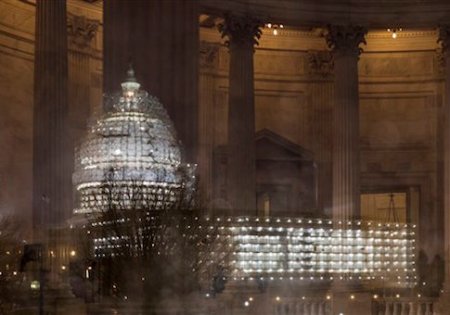
The Capitol in Washington is illuminated during a thunderstorm with the rotunda of the Russell Senate Office Building reflected on the rain-covered windows, late Wednesday afternoon, Feb. 24, 2016. (AP Photo/J. Scott Applewhite)

The Capitol in Washington is illuminated during a thunderstorm with the rotunda of the Russell Senate Office Building reflected on the rain-covered windows, late Wednesday afternoon, Feb. 24, 2016. (AP Photo/J. Scott Applewhite)

Leading foreign policy voices in Congress say they are preparing to fight against an Obama administration effort to provide Iran unprecedented access to U.S. financial resources as part of an expanded package meant to address new demands from the Islamic Republic’s for greater economic concessions, according to several conversations between the Washington Free Beacon and top lawmakers.

The Obama administration is currently exploring new options to grant Iran more sanctions relief than promised under the comprehensive nuclear agreement reached last year, just days after Iran’s Supreme Leader gave a speech accusing the United States of interfering with Iranian banking.

Top foreign policy voices in Congress told the Free Beacon in recent days that they are exploring a range of responses if the Obama administration goes through with reported plans to grant Iran further concessions beyond the purview of the nuclear deal, which dismantled key nuclear-related U.S. sanctions against Iran. At least part of this action could violate current U.S. laws, they said.

The planned concessions could include access to the U.S. dollar and financial markets, which the Obama administration promised would never take place under the deal, according to recent disclosures first reported by the Associated Press.

The Iranian government has recently heightened complaints that it is not being granted enough relief from international economic sanctions as a result of the recently implemented nuclear deal.

The Obama administration’s latest move to placate the Iranians comes on the heels of a Free Beacon report last week disclosing that U.S. officials engaged in secret talks with Iran for years before agreeing in January to pay it nearly $2 billion in taxpayer funds.

The reports have generated harsh responses from lawmakers, who say that the administration’s plans would endanger American economic influence and put the entire international financial system at risk from Iran’s illicit finance and money laundering activities.

“Any administration effort to get foreign financial institutions or foreign-based clearing houses to enable Iran’s terror-sponsoring regime to conduct transactions in U.S. dollars ignores American laws and the Financial Action Task Force,” Sen. Mark Kirk (R., Ill.) told the Free Beacon.

“Such an effort would benefit Iran’s terror financiers while fundamentally undermining the USA PATRIOT ACT 311 finding that Iran’s entire financial sector is a jurisdiction of primary money laundering concern,” Kirk said.

It would also undermine “the Financial Action Task Force’s ongoing calls for international countermeasures to protect financial sectors from Iran’s terrorist financing,” explained Kirk, who is backing a new effort in Congress to increase sanctions on Iran as a result of its recent ballistic missile tests, which violate United Nations resolutions.

Rep. Mike Pompeo (R., Kan.), a member of the House Permanent Select Committee on Intelligence, warned that the Obama administration’s latest move could set the stage for the Iranian Revolutionary Guards Corps, or IRGC, to gain a foothold in the U.S. economy.

“As if a windfall of over $100 billion in sanctions relief was too small, and the massive cash influx into Iran from new business deals too paltry, President Obama appears to be looking for ways to make further concessions to Iran,” said Pompeo, who also has backed new legislation to sanction Iran. “This would be comical if it wasn’t so dangerous.”

“American and international businesses can’t ignore the Islamic Revolutionary Guard Corps’ vast control of the Iranian economy and the threat Iranian banks pose to the international financial system,” Pompeo continued in a statement to the Free Beacon.

“In contrast with the absurd policies of the Obama administration, I work with my colleagues in Congress to protect America’s national security interests—just as we have in response to Iran’s recent ballistic missile tests.”

Pompeo is independently investigating the Obama administration’s recent $1.7 billion payment to Iran, which he and others viewed as a “ransom payment” for the Islamic Republic’s recent release of several captured Americans.

Other longtime Iran critics in Congress also expressed concern over administration efforts to provide Iran with even more economic freedom.

“Further sanctions relief would mark the death knell for U.S. sanctions and would represent a boon to the Iranian regime and its Revolutionary Guard Corp,” Rep. Ron DeSantis, a member of the House Foreign Affairs Committee, told the Free Beacon. “The lengths to which the Obama administration is willing to go to empower Iran is breathtaking.”

Rep. Peter Roskam (R., Ill.) explained that the “administration has lost all credibility on Iran” as a result of its efforts to accommodate Iranian demands.

“President Obama and Secretary Kerry have played the pied piper so many times now,” Roskam told the Free Beacon. “Western companies have to make the determination themselves whether or not they want to make their employees and shareholders complicit in funding terrorism.”

When asked to comment on concerns in Congress, a State Department official told the Free Beacon that it is aware of lawmaker requests for more information on “additional sanctions relief.”

The official added that as long as Iran continues to adhere to the nuclear agreement, the United States “will continue” to do the same.

Obama administration officials first guaranteed last year that Iran would not be permitted to conduct foreign transactions in dollars. This promise, however, is being reevaluated as the administration seeks to keep Iran from walking away from the nuclear deal.

Op-Ed: Obama’s public face – a political theater of distraction and deception

March 20, 2016

Op-Ed: Obama’s public face – a political theater of distraction and deception, Israel National News, Jeffrey Ludwig, March 20, 2016

In his article “Iran’s Diplomacy for Dummies,” Jonathan Tobin, a totally reasonable individual, again misses the perfidy of Obama’s policies, towards Iran.  We brought to the UN our concerns about Iran testing ballistic missiles being a violation of the Iran deal.  Russia stated flatly that they “would not permit sanctions to be [re-] imposed because Iran’s actions did not violate UN Security Council resolutions.”  Samantha Powers expressed frustration and dismay at the Russian reaction to our concerns.

However, Amb. Powers’ comments against the Russians in the UN were nothing more than a charade. Her comments were a pretense of being offended by Russia.  The Obama administration was just playing politics with the issue, and using Samantha as the actress to give voice to our “concern” in this one-act political theater. We pretend to be standing up for real-time enforcement of the Iran deal, and then blame the Russians when enforcement is prevented. Whereas the truth is there was no real expectation or desire for enforcement by Obama and his lady advisors from day one of the negotiations or our sign-off.  Powers and Obama are merely trying to appear earnest in their implementation of the treaty (which they falsely called an agreement).

The charade (i.e., playacting) can be seen at work over a variety of political scenarios.  These bits of play acting are the modus operandi of the Obama administration.  They seek to reverse the idea found in Shakespeare’s drama “Hamlet.”  There we find the line, “The play’s the thing. Wherein [to] catch the conscience of the king.”   For the Obama inner clique, the principle is “the play’s the thing” to deflect our understanding of the king’s dereliction of duty for God and country.

We see this playacting during a recent interview.  During the course of the interview, Obama tried to appear measured and sincere in his thinking.  For example, he says to the interviewer, “Real power means you can get what you want without having to exert violence.”  He presented himself as a wise Solon who prefers negotiation to force. Here he may not be completely duplicitous but simply be in denial.

Many so-called peaceniks on the left fail to see the cowardly and traitorous underpinnings (motives) of their pseudo-pacifism. Thus, seen in a more honest light, we need to understand that preference for negotiation over force is, in reality, a preference for capitulation and a policy of fear. Capitulation is then interpreted as being wise and detached, whereas it is actually a flight from reality and the unpleasant experiences that accompany any of life’s confrontations.

He also pretended to be detached in the Shiite-Sunni conflict. According to Obama, the two sides “need to find an effective way to share the neighborhood.”  Bret Stephens of the Wall Street Journal tags this remark as sounding more “like Mr. Rogers.” However, this writer finds it to be more duplicitous and sinister than Mr. Stephens thinks.   In reality Obama has taken the side of the Shiites and of the Muslim Brotherhood wing of the Sunnis.  He has decided to reject Sunni leadership that is not rooted in Muslim Brotherhood ideology — in Libya (overthrew Qaddafi), Egypt (overthrew Hosni Mubarak and is not working cooperatively with General Abdel el-Sisi, but did send F-16s to el-Sisi’s predecessor Muslim Brotherhood President Mohamed Morsi), and Yemen (allowed a pro-Iranian Shiite faction to overthrow the pro-Saudi government).

Further, the U.S. has not lifted a finger to prevent Iranian-backed Hezbollah from taking over Lebanon.

Lastly, and most important from a Jewish perspective, he has justified U.S. funding of Hamas via their alliance with the PLO in 2014.   And we know that Hamas is a Shiite (Iranian-backed) organization with Muslim Brotherhood backing as well. Thus by saying to Goldberg that Shiites and Sunnis will just have to learn to get along, Obama was feigning a neutrality that in practice he totally rejects.  His remarks are pure political theater, totally divorced from the policies and practices of his administration.

Although Bret Stephens characterizes Obama’s thinking as shallow, it seems to this writer that Obama’s playacting is not rooted in shallowness, but simply in his being wrong. His underlying principles are ultimately harmful.  He is identified with left-wing pseudo pacifism (“pseudo” because violence is justified, but only for leftist ideals), a Marxist-derived anti-American bias that would portray the U.S. as an exploitative society, a bitter anti-Israel bias derived from his Muslim roots, and a false universalism (“false” because it is not God-centered).

His playacting is thus an attempt to distract from his deep ideological commitments. In Hamlet, the play was intended to reveal the hidden murderous action of the King of Denmark.  With the present U.S. executive branch, the intent of the playacting is to hide the murderous intent.

President Obama’s Nowruz Message to the Iranian People

March 19, 2016

President Obama’s Nowruz Message to the Iranian People, The White House via You Tube, March 19, 2016

(Ain’t he Special! — DM)

Satire | Make Trump Shut Up. It’s Patriotic!

March 18, 2016

Make Trump Shut Up. It’s Patriotic! Dan Miller’s Blog, March 18, 2016

(The views expressed in this article (aside from those espoused by my imaginary guest author, with whom no rational person agrees) are mine and do not necessarily reflect those of Warsclerotic or its other editors. — DM)

trump-assault

Editor’s note: This is a guest post by my (imaginary) guest author, the Very Honorable Ima Librul, Senator from the great State of Confusion Utopia. He is a founding member of Climate Change Causes Everything Bad, a charter member of President Obama’s Go For it Team, a senior member of the Senate Foreign Relations Committee and Chairman of the Meretricious Relations Subcommittee. He is also justly proud of his expertise in the care and breeding of green unicorns, for which his Save the Unicorns Foundation has received substantial Federal grants. We are honored to have a post of this caliber by a quintessential Librul such as the Senator. Without further delay, here is the Senator’s article, followed by my own observations. 

As any fool knows, saying things that upset folks is destructive to our peace and tranquility. No patriot would do that. As the Boston Globe observed on March 17th, true patriots can not and should not permit it.

Donald Trump slams protesters at his rallies as “thugs” but, as usual, the unhinged GOP presidential front-runner is dead wrong:

They’re patriots.

. . . .

With Trump nearly sweeping this week’s primaries, those rallies will become more hostile toward anyone pushing against his hideous rhetoric. Yet those patriots will still come, not just because they oppose Trump but for the love of their country which is being shoved toward the abyss. As poet Adrienne Rich wrote in “An Atlas of the Difficult World”:

A patriot is one who wrestles/ for the soul of her country/ as she wrestles for her own being.

Trump has been endorsed by Will Quigg, 48, a grand dragon of the Ku Klux Klan. So has Hillary Clinton, but that’s as different as night is from day; we all know that she is not a racist. The KKK endorsement of Trump shows, beyond dispute, that he is a vile racist. That’s why he despises our President and everything for which we stand.

Trump reminds me of the hateful Britainophobes who mocked Native Americans by wearing their quaint native garb to throw precious tea, violently, into Boston Harbor. For shame!

Trump hatefully complains that Islam is not the religion of peace and that since it is a violent religion Muslims should not be permitted even to visit the United States until it can be determined which are peaceful and which are not. Hogwash! Muslims are just as peaceful as Methodists. They love little children more than Methodists, particularly little girls, and marry them at what Trump probably thinks is too early an age — often at the age of ten. It’s their culture, so there’s nothing wrong with it and we should respect it. Isn’t this a pretty little bride? She looks so happy!

668 (1)

Muslims don’t occupy a country that isn’t theirs like filthy Jews do in Palestine. They don’t try to take over mosques sacred to Islam.


Palestine, unlike Israel, does not practice apartheid. Although Israel has nukes, Iran recently promised not to develop nuclear weapons. Trump, despite his claims to be a master negotiator, would never have got that deal; Obama, a very modest person, did despite obstructions put in his path by Israel and some Republicans.

Not all Jews are bad, of course: a major Jewish group warned that Trump is dangerous. As noted in the immediately linked article, the warning

came amid an impassioned debate in the American Jewish community around Trump’s plans to address an audience of over 18,000 next Monday at the American Israel Public Affairs Committee’s annual policy conference.

Who knows what might happen if Trump were to address that group. Might he claim, as he often does, that the peaceful Palestinians, not Jews, are to blame for Israel’s continued occupation of Palestine? Perhaps some of his antisemitic bullies might assault members of the audience. They might bring not only knives but guns as well! Remember, President Obama warned against bringing even knives to a gun fight!

Trump complains that our borders are not “secure.” He is stupid, ignorant and just plays on the fear of other racists. Hillary Clinton knows that the borders are secure.

PHOENIX — The United States has done a “really good job” of securing the border between Arizona and Mexico, Democratic presidential hopeful Hillary Clinton said in an exclusive interview Thursday.

“I think we’ve done a really good job securing the border,” she said. “I think that those who say we haven’t are not paying attention to what was done the last 15 years under President (George W.) Bush and President (Barack) Obama.”

Clinton said the federal government has added both border officers and obstructions, while the number of people attempting to cross the border has dropped.

“Immigration from Mexico has dropped considerably,” she said. ”It’s just not happening anymore.”

Clinton, the Democratic front-runner, was speaking just days before a campaign event in Phoenix.

Lies, lies, lies. It’s lies all the way down for Trump

The protestors at Trump rallies do not want to silence him, as some far-right nuts have complained. They only want to make him stop saying things that offend them; there’s a big difference, as any fool knows. Like everyone else with two brain cells, we need our safe spaces and he violates our constitutional rights to life, liberty and the pursuit of happiness by refusing to let us have them. Even the music played at Trump rallies is authoritarian and disgusting. That’s why we attend and protest at Trump rallies.

Trump is Hitler. All Republican candidates for president have been Hitlers for many, many years. Hitlerism is the foul soup in which they are conceived, born and raised. It’s high time to throw out the soup and Republicans along with it. Hillary will do that, and more.

*****************

Editor’s comments


As a courtesy to Senator Librul, I inserted all of the links in his article. The presence of supporting links is about the only difference between his screed and those of Democrats and the Republican elite (but I repeat myself) disparaging Trump for stuff he has not done and does not do; for what they claim he is and not for what he is.

It’s high time for us to take America back from those who have been trying to destroy her. She belongs to We the People, not to the Democrat or Publican party bosses. Never forget.


Obama did not build our nation. Our ancestors did and it’s our inheritance.


For whom would the pioneers in the video vote were they alive now? Our “leaders” who sit in Washington, D.C., break their promises and take our money to finance their reelection campaigns so they can continue the process? Those who have weakened our nation and made her a second class world power? Those who elevate political correctness and multiculturalism above reality? Those who rewrite our history so that they can condemn it? I don’t think so. Which candidates do you think they would support?

crazed


Obama Admin Stalling Investigation Into Iran ‘Ransom Payment’

March 18, 2016

Obama Admin Stalling Investigation Into U.S. ‘Ransom Payment’ to Iran Congress in dark as admin ignores questions about taxpayer money for Tehran

BY:
March 17, 2016 11:00 am

Source: Obama Admin Stalling Investigation Into Iran ‘Ransom Payment’

The Obama administration is being accused of stalling a congressional investigation into a purported $1.7 billion taxpayer-funded “ransom payment” to Iran in exchange for the release of several U.S. prisoners, according to documents and information provided to the Washington Free Beacon by sources familiar with the matter.

The administration initially came under fire from congressional critics in January, when it was announced that the United States had settled a longstanding legal dispute with Iran over the breakdown in a decades-old arms sale.

Under the terms of the settlement, Iran was to be paid a $400 million balance and an additional $1.3 billion in interest from a taxpayer fund maintained by the Treasury Department, a State Department official confirmed to the Free Beacon in January.

The settlement was reached outside of the recently implemented nuclear deal and is separate from the $150 billion in unfrozen cash assets the United States is obligated to give to Iran under that agreement, the official said.

The $1.7 billion payment was announced just prior to the release of five U.S. prisoners who had been held in Iran, leading to accusations that the deal is tantamount to a ransom payment. Iranian officials, at the time, independently described the transaction as a form of ransom.

While the Obama administration immediately denied that the two issues were linked, lawmakers remained skeptical and pushed for more answers.

Rep. Mike Pompeo (R., Kan.) reached out to Secretary of State John Kerry on Jan. 21 to outline his concerns and request further disclosures about what he called a “ransom payment” to Iran, according to a letter sent by the lawmaker and obtained by the Free Beacon.

The State Department has not responded and is said to have ignored multiple follow-up requests from Pompeo’s office, according to sources familiar with the situation.

When asked Thursday whether a response is in the works, a State Department official told the Free Beacon, “We take seriously all correspondence from Congress and respond accordingly.”

The administration’s delay is causing frustration on Capitol Hill and prompting accusations that the State Department is stalling congressional efforts to investigate how the settlement with Iran was reached.

“The State Department likes to drag its feet on responding to Congress, particularly on issues related to the Iran nuclear deal,” one source familiar with the situation said. “This stonewalling is reminiscent of recent testimony by a senior Department of Homeland Security official who would not answer members’ questions on refugees and visas.”

“Congress is only trying to do its job of holding President Obama accountable and ensuring taxpayer dollars are spent wisely,” the source added. “The Obama administration’s refusal to answer legitimate questions leaves the American people to wonder what they are hiding.”

In Pompeo’s case, the State Department initially confirmed its receipt of the letter in January but did not provide information as to when officials might respond. The administration subsequently failed to respond to further requests for a response issued over the following months, sources said.

Pompeo’s investigation surrounds “the timing and details” of the cash transfer to Iran of $1.7 billion, according to his letter.

The administration’s behavior “indicates it might be a ransom payment and it is likely interpreted as such by our adversaries,” he wrote. “We may be seeing a dangerous precedent in action as three Americans, reportedly kidnapped by Iranian-backed Shia militias in Baghdad, remain missing.”

“Many find this timing suspicious,” he said. “I fear this payment is the latest incident that is establishing a dangerous precedent that will lead to more Americans being captured abroad.”

The lawmaker sought further information on “the relationship” between the $1.7 billion settlement and the release of the five American prisoners. He also wants to determine whether the lawsuit was ever discussed in “conversations with the Iranians about the release of American hostages.”

“Did you secure an assurance from the Iranians that they will not use this $1.7 billion to fund terrorism?” he asked.

Pompeo goes on to request details about additional legal claims by Iran, asking: “How much money does Iran assert we still owe them? How many more billions can we expect the Obama administration to hand to the Ayatollah?”

Other sources familiar with the matter also chastised the administration for dragging its feet.

“This is one of the main ways the Obama administration hides its Iran foreign policy,” said one foreign policy consultant who works intimately with Congress on the Iran portfolio. “Sometimes they over-classify information to keep it secret, sometimes they mislead lawmakers about their intentions, but a lot of the time they engage in this kind of sandbagging.”

“By the time anyone gets any answers, whatever catastrophic policy they were hiding has become the new normal,” the source said.

Trump and the Left’s Accusations of Fascism

March 16, 2016

Trump and the Left’s Accusations of Fascism, Front Page MagazineBruce Thornton, March 16, 2016

trump

Donald Trump’s success in the primaries and his rhetoric have sparked troubled meditations about an awakening of fascist impulses among his supporters. Bret Stephens has drawn an analogy with the Thirties, “the last dark age of Western politics,” and compared Trump to Benito Mussolini. On the left, Dana Milbank, in a column titled “Trump Flirts with Fascism,” wrote about a campaign rally at which Trump was “leading supporters in what looked very much like a fascist salute,” a scene New York Times house-conservative David Brooks linked to the Nuremberg party rallies.

Much of the rhetoric that links Trump to fascism or Nazism is merely the stale ad Hitlerum fallacy used by progressives to demonize the candidate. They did the same thing when they called George W. Bush “Bushitler.” This slur reflects the hoary leftist dogma that conservatives at heart are repressed xenophobes and knuckle-dragging racists lusting for a messianic leader to restore their lost “white privilege” and punish their minority, immigrant, and feminist enemies. As such, the attack on Trump is nothing new or unexpected from a progressive ideology whose totalitarian inclinations have always had much more in common with fascism than conservatism does.

What Auden called the “low dishonest decade” of the Thirties, however, is indeed instructive for our predicament today, but not because of any danger of a fascist party taking root in modern America. Communism was (and in some ways still is) vastly more successful at infiltrating and shaping American political, cultural, and educational institutions than fascism ever was. But the same cultural pathologies that enabled both fascist and Nazi aggression still afflict us today. These pathologies and their malign effects are more important than the reasons for Trump’s popularity–– anger at elites, economic stagnation, and anti-immigrant passions–– that supposedly echo the “waves of fear and anger” of Auden’s Thirties.

The most important delusion of the Thirties still active today is the idealistic internationalism that had developed over the previous century. A world shrunk by new communication and transportation technologies and linked by global trade, internationalists argued, meant nations and peoples were becoming more alike. Thus they desired the same prosperity, political freedom, human rights, and peace that the West enjoyed. Interstate relations now should be based on this “harmony of interests,” and managed by non-lethal transnational organizations rather than by force. Covenants and treaties like the Hague and Geneva Conventions, and institutions like the League of Nations and the International Court of Arbitration, could peacefully resolve conflicts among nations through diplomatic engagement, negotiation, and appeasement.

The Preamble to the First Hague Convention (1899) captures the idealism that would compromise foreign policy in the Thirties. The Convention’s aims were “the maintenance of the general peace” and “the friendly settlement of international disputes.” This goal was based on the “solidarity which unites the member of the society of civilized nations” and their shared desire for “extending the empire of law and of strengthening the appreciation of international justice.” Two decades later, the monstrous death and destruction of World War I should have shattered the delusion of such “solidarity” existing even among the “civilized nations.” Despite that gruesome lesson, Europe doubled down and created the League of Nations, which failed to stop the serial aggression that culminated in World War II.

But the League wasn’t the only manifestation of naïve internationalism. The Locarno Treaty of 1925 welcomed Germany back into the community of nations with a seat on the League of Nations council. Nobel Peace prizes, and wish-fulfilling headlines like the New York Times’ “France and Germany Bar War Forever,” were all that resulted. The Kellogg-Briand pact of 1928 “condemn[ed] recourse to war for the solution of international controversies, and renounce[d] it as an instrument of national policy” in interstate relations. The signing powers asserted that “the settlement or solution of all disputes or conflicts . . . shall never be sought except by pacific means.”

All the future Axis Powers signed the treaty, and they all soon shredded these “parchment barriers.” In the next few years, Japan invaded Manchuria, Hitler remilitarized the Rhineland in gross violation of the Versailles Treaty, and Italy invaded Ethiopia. By the time Germany annexed Austria, and Neville Chamberlain’s faith in negotiation and appeasement handed Czechoslovakia to Hitler, all these treaties and conventions and conferences were dead letters, and the League of Nations was exposed as a “cockpit in the tower of Babel,” as Churchill suggested after the First World War.

However, such graphic and costly evidence showing the folly of “covenants without the sword,” as Hobbes put it, did not discredit this dangerous idealism over the following decades. Indeed, it lies behind the disasters of Obama’s foreign policy. Just consider his “outreach” to our enemies, his acknowledgement of our own “imperfections,” his reliance on toothless U.N. Security Council Resolutions, his preference for non-lethal economic sanctions to pressure adversaries, and his belief that negotiated settlements and agreements can achieve peace and good relations even with our fiercest enemies. All reflect the same failure to recognize that our adversaries in fact do not sincerely want to reach an agreement, for the simple reason they are not in fact “just like us,” and so they do not want peace and prosperity and good relations with their neighbors and the “world community.”

The catalogue of Obama’s failures is long and depressing. The “reset” with Russia and promise of “flexibility,” the empty “red line” threats against Bashar al Assad, the arrogant dismissal of a metastasizing ISIS as a “jayvee” outfit, the alienation of allies like Egypt, Saudi Arabia, and Israel, the cultivation of the jihadist Muslim Brotherhood, the ill-conceived overthrow of Muammar Ghaddafi, and the rhetoric of guilt and self-abasement are just the most noteworthy failures. The nuclear deal with Iran, of course, is the premier monument to this folly. Yet despite the increasing evidence of its futility­­––Iran’s saber-rattling in the Gulf, capture of U.S. military personnel, genocidal rhetoric, and testing of missiles in blatant violation of a U.N. Security Council resolution–– Obama still clings to this internationalist delusion.

A recent article in The Atlantic on Obama’s foreign policy shows, despite his protestations of hardheaded “realism,” that he has not learned from his failures. Thus he still thinks that the vigorous use of force is usually an unnecessary and dangerous mistake, and that verbal persuasion and diplomatic engagement are more effective. He also still believes that “multilateralism regulates [U.S.] hubris” of the sort that George W. Bush showed when he recklessly invaded Iraq, and that American foreign policy has frequently displayed.

Obama’s delusional faith in rhetoric, especially his own, comes through in his rationale for the infamous 2009 Cairo speech: “I was hoping that my speech could trigger a discussion, could create space for Muslims to address the real problems they are confronting—problems of governance, and the fact that some currents of Islam have not gone through a reformation that would help people adapt their religious doctrines to modernity.” The idea that Obama’s mere words could start a “discussion” that would transform 14-century-old religious doctrines fundamentally inimical to liberal democracy, human rights, and all the other Western goods we live by, is a fantasy. Obama’s self-regard recalls Neville Chamberlain’s boast after his meeting with Hitler at Bad Godesberg that he “had established some degree of personal influence with Herr Hitler.”

Or consider Obama’s take on Vladimir Putin:

He understands that Russia’s overall position in the world is significantly diminished. And the fact that he invades Crimea or is trying to prop up Assad doesn’t suddenly make him a player. You don’t see him in any of these meetings out here helping to shape the agenda. For that matter, there’s not a G20 meeting where the Russians set the agenda around any of the issues that are important.

A “player,” in Obama’s foreign policy universe, is a leader who uses “smart power” like diplomacy and negotiated deals, and recognizes that the use of force will backfire and lead to costly “quagmires.” As Secretary of State John Kerry suggested, Putin is using outdated “19th century” instruments of foreign policy like military force in a world that presumably has evolved beyond it.

In contrast, a genuine “player,” as Obama fancies himself, attends summits and conferences, such as the useless climate change conference in Paris, and “sets the agenda.” And like his rationale for the Cairo speech, as the leader of the world’s greatest power, his rhetoric alone can be a force for change. Thus just saying that Syria’s “Assad must go,” while doing nothing to achieve that end, is still useful, and refusing to honestly identify the traditional Islamic foundations of modern jihadism will build good will among Muslims and turn them against the “extremists.”

Meanwhile, Putin and Iran fight and bomb and kill in Syria and Iraq, and now they are the big “players” in a region that the U.S. once dominated, but that now serves the interests of Russia and Iran. I’m reminded of Demosthenes’ scolding of the Athenians for refusing to confront Phillip II of Macedon: “Where either side devotes its time and energy, there it succeeds the better––Phillip in action, but you in argument.”

In other words, for Obama as for Chamberlain, appeasing words rather than forceful deeds are the key to foreign policy––precisely the belief that led England to disastrously underestimate Hitler until it was too late. And that same belief has turned the Middle East into a Darwinian jungle of clashing tribes, sects, and nations.

Obama wraps his foreign policy of retreat in claims to “realist” calculations of America’s security and genuine interests, and buttresses his claim by citing his strategically inconsequential drone killings. But such rhetoric hides an unwillingness to risk consequential action and pay its political costs. And it reflects a commitment to the internationalist idealism that gives diplomatic verbal processes an almost magical power to transform inveterate enemies into helpful partners. Europe tried that in the Thirties, and it led to disaster. That’s a much more important lesson from that sorry decade’s history than the lurid fantasies about fascism coming to America on the wings of Trump’s rhetoric.

Iran’s Free Hand in Testing Ballistic Missiles

March 16, 2016

Iran’s Free Hand in Testing Ballistic Missiles, Front Page MagazineJoseph Klein, March 16, 2016

rg

The United Nations Security Council met in an “emergency” closed door session on Monday March 14th to discuss Iran’s recent testing of ballistic missiles reportedly designed to be capable of delivering nuclear weapons. The words “Israel must be wiped out” were written in Hebrew on the side of the missiles. These most recent tests followed in the wake of missile tests conducted last fall, which the Security Council did nothing about at the time.

While North Korea was finally hit with more UN sanctions for its nuclear and missile tests, North Korea’s nuclear weapons collaborators in Iran continue to be let off the hook without even a slap on the wrist.

U.S. Ambassador to the UN Samantha Power told reporters, after the March 14th meeting produced no concrete results, that she will keep trying “no matter the quibbling that we heard today about this and that.” She said that Iran’s missile tests were “in defiance of provisions of UN Security Council Resolution 2231, the resolution that came into effect on January 16, on Implementation Day for the JCPOA [Joint Comprehensive Plan of Action].”

The quibbler in chief is Russia. Its UN ambassador said that Iran has not violated the resolution and that there was no need for any punitive measures against Iran.

The truth is that the Obama administration is now hoisted with its own petard. Ambassador Power complained that “Russia seems to be lawyering its way to look for reasons not to act rather than stepping up and being prepared to shoulder our collective responsibility.” Yet that would not have been as easy for Russia to do if the Obama administration had not allowed a loophole in the nuclear deal wide enough for Iran to fire a whole bunch of missiles through.

President Obama wanted the nuclear deal with Iran so badly that he gave in to Iran’s last minute demands to preserve its missile program. Iran insisted that all prior UN Security Council resolutions which had unambiguously prohibited Iran’s development, testing or procurement of ballistic missiles designed to be capable of delivering nuclear weapons must be terminated. Otherwise, Iran would not go forward with the JCPOA. To make matters worse, even though Iran had held the JCPOA hostage to its missile demands, the Obama administration also bowed to Iran’s insistence that its missile program would not be covered by the JCPOA itself. Thus, Iran would not be subject to the automatic “snap back” of sanctions when Iran is found to have violated the JCPOA, because its missile tests would be outside the scope of the JCPOA. In fact, the Obama administration agreed to language in the JCPOA to clarify that such separation of Iran’s missile program from the JCPOA was the intent. All reliance for dealing with Iran’s missile tests would be placed on the much weaker Security Council Resolution 2231.

The new Security Council Resolution 2231, which endorsed the JCPOA but drafted as separate from the JCPOA, used weaker language than the outright prohibition that had existed under the prior resolutions that were now superseded. Calling upon Iran to refrain from doing something is not the same as an enforceable ban. Moreover, even this insipid “call upon” language is included in an annex to the resolution. This annex is little more than a statement of intent by the parties negotiating with Iran, which Iran does not consider binding on itself.

The Obama administration missed the window of opportunity to clamp down on Iran’s missile testing when those tests were being conducted last fall. The previous Security Council resolutions that prohibited Iran’s missile program outright, and the sanctions regime against Iran, were then still in effect. Those resolutions were referenced in the JCPOA itself as still being binding until the JCPOA was actually implemented. Implementation in turn was dependent on verification of Iran’s compliance with certain commitments set forth in the JCPOA having to do with its enrichment and plutonium programs. Until the JCPOA’s formal implementation date of January 16, 2016, when those resolutions were terminated, the missile program ban had not been technically untethered from the JCPOA.

All the Obama administration had to do last fall was to declare Iran in breach of the JCPOA because the missile ban under those resolutions that Iran breached were effectively incorporated into the JCPOA until terminated. The sanctions were still in place. Iran’s assets were still frozen. Russia’s “lawyering” would have done it little good last fall when the United States still had the upper hand both legally and in practical terms. But President Obama frittered away the last real chance to hold Iran’s feet to the fire before the sanctions were lifted. He wanted the nuclear deal to go forward as a centerpiece of his “legacy” and let the next president worry about its fallout.

In fact, instead of pressing the case against Iran and threatening to walk away from the JCPOA when he had the leverage, Secretary of State John Kerry actually defended Iran’s position on its missile tests. “The issue of ballistic missiles is addressed by the provisions of the new United Nations Security Council Resolution (UNSCR), which do not constitute provisions of the Joint Comprehensive Plan of Action (JCPOA),” Kerry wrote in a letter to Senator Marco Rubio last September.  “Since the Security Council has called upon Iran not to undertake any activity related to ballistic missiles designed to be capable of delivering nuclear weapons, including launches using such ballistic missile technology, any such activity would be inconsistent with the UNSCR and a serious matter for the Security Council to review.”

Rubio raised his concern with Kerry that the language in the new Security Council resolution did not appear to require Iran to refrain from pursuing its ballistic missile tests. Rubio seized upon the weak “call upon” language discussed earlier as the basis for his concern. Kerry’s response was that “if Iran were to undertake them it would be inconsistent with the UNSCR and a serious matter for the Security Council to review.”

Senator Rubio had a right to be concerned. Kerry had deliberately agreed to a circular process to deal with Iran’s missile program violations, which was doomed to fail. To placate Iran, he kicked the can down the road until the JCPOA was actually implemented and the prior, much stronger Security Council missile resolutions that were initially tied into the JCPOA by reference went away. The separation of the JCPOA and the new Security Council resolution was completed as of the formal implementation date. Kerry had to know that once the JCPOA was implemented and in full force, with sanctions lifted and the missile program separated out from the JCPOA with its automatic “snap back” provisions, Russia would likely veto any separate sanctions resolution against its ally and missile purchaser based on Iran’s missile tests. The American people got suckered by President Obama’s reckless concessions.

Iran not only will have a pathway to nuclear enrichment sufficient to produce nuclear weapons when the deal’s restrictions sunset – if not before. Thanks to the Obama administration, Iran presently has a free hand to develop and test ballistic missiles capable of delivering those nuclear weapons along any pathway of attack it chooses.

Russia Reminds Obama: You Caved on Iran’s Missile Program, Bro

March 15, 2016

Russia Reminds Obama: You Caved on Iran’s Missile Program, Bro, Washington Free Beacon, Beacon Staff, March 15, 2016


Days after the latest Iranian ballistic missile test, Russia and Iran are telling the Obama administration that Iranian missile tests are not prohibited by the UN Security Council, as the administration argues.

Russia and Iran cited language about ballistic missiles that was changed during last summer’s nuclear negotiations in Vienna. UN Security Council Resolution 1929 had stated plainly: “Iran shall not undertake any activity related to ballistic missiles.” During the negotiations, Iran demanded the removal of this uncompromising language in favor of a new, softer formulation.

The Obama administration complied, resulting in the passage of a new UN Security Council Resolution after the Iran agreement was reached. The new resolution merely “calls upon Iran not to undertake any activity related to ballistic missiles.”

The change in language—from the “shall not” requirement of the original resolution to the “calls upon” suggestion of the new one—was the subject of intense questioning by Congress precisely due to the suspicion that the administration had provided a loophole Iran would use to justify missile development.

In one exchange, Sen. Robert Menendez (D., N.J.) pressed Secretary of State John Kerry to acknowledge that the change in language was substantive.

“The ban on Iranian ballistic missiles,” Menendez told Kerry, “has, in fact, been lifted. The new Security Council resolution is quite clear. Iran is not prohibited from carrying out ballistic missile work.” Kerry rejected Menendez: “That is not accurate … [Iran is] restrained from any sharing of missile technology, purchase of missile technology, exchange of missile technology, work on missiles.”

In response to the Obama administration’s announcement that it would pursue sanctions after Iran’s latest missile test, Russia’s UN Ambassador raised precisely the objection that Menendez and other critics of the deal did: Obama and Kerry removed the prohibition on Iranian ballistic missile work last summer, when they agreed to remove the “shall not” language from the relevant UNSC resolution.