Posted tagged ‘Iran Scam’

China to Obama: America Forced Norks to get Nukes and Must Negotiate a Deal

September 20, 2016

China to Obama: America Forced Norks to get Nukes and Must Negotiate a Deal, Dan Miller’s Blog, September 20, 2016

(The views expressed in this article are mine and do not necessarily reflect those of Warsclerotic or its other editors. — DM)

In an article titled North Korean Nukes, South Korea, Japan, China and Obama, posted the day after North Korea’s most recent nuke test, September 9th, I contended that China would not honor Obama’s request to make North Korea stop developing and testing nukes. China has remained a faithful ally of North Korea since the end stage of the Korean Conflict and “sees Obama, not as the representative of the world’s greatest power, but as a joke. He has no clout internationally and is a national embarrassment.”  NB: I had hoped to publish this article more than a week ago, but my internet was down or at best intermittent from September 13th until September 19th.)

I was right, but it’s a bit worse than I had thought.

On September 12th, an article was published by Xinhua titled China urges U.S. to take responsibility on Korean Peninsula nuclear issueXinhua is

the official press agency of the People’s Republic of China. Xinhua is the biggest and most influential media organization in China. Xinhua is a ministry-level institution subordinate to the Chinese central government. Its president is a member of theCentral Committee of China’s Communist Party.

According to Xinhua,

U.S. Defence Secretary Ashton Carter reportedly called for further pressure on the DPRK last Friday after the country carried out a new nuclear test and said China bears “responsibility” for tackling the problem. [Emphasis added.]

The essence of the Korean Peninsula nuclear issue is the conflict between the DPRK and the United States, spokesperson Hua Chunying said at a press conference. [Emphasis added.]

As a permanent member of the UN Security Council and a close neighbor of the DPRK, China has made unremitting efforts to maintain peace and stability on the Korean Peninsula and safeguard the international nuclear non-proliferation regime, Hua said.

A statement released by the Foreign Ministry of the DPRK Sunday said the United States compelled the DPRK to develop nuclear warheads, and the nuclear threat it has constantly posed to the DPRK for decades is the engine that has pushed the DPRK to this point. [Emphasis added.]

Blindly increasing the pressure and the resulting bounce-back will only make the nuclear issue on the Korean Peninsula “a firm knot,” Hua said, calling for responsibility from all relevant parties.

Hua reiterated that China will remain committed to resolving issues concerning the Peninsula through dialogue to realize long-term peace and stability.

China strongly urges all parties to speak and act cautiously with the larger picture in mind, avoid provoking each other and make genuine efforts to achieve denuclearization, peace and stability on the Korean Peninsula, Hua said.

. . . .

“We have seen the twists and turns in the situation on the Korean Peninsula since the six-party talks have stalled,” Hua said, noting that it proves that simple sanctions cannot solve the issue. [Emphasis added.]

Hua said the security concerns of parties on the Korean Peninsula must and can only be resolved in a way that serves the interests of all parties.

Any unilateral action based on one’s self-interest will lead to a dead end, and it will not help resolve one’s security concerns but will only aggravate the tension, complicate the issue, and make it more difficult to achieve relevant goals, Hua said. [Emphasis added.]

The six-party talks, involving China, the DPRK, the United States, the Republic of Korea (ROK), Russia and Japan, were a multilateral mechanism aimed at solving the Korean Peninusla nuclear issue. The talks began in 2003 and stalled in December 2008. The DPRK quit the talks in April 2009.

“Resuming the six-party talks is difficult, but we cannot give up easily ,” Hua said.

China will continue to keep close communication with relevant parties and call on them to return to the right track of solving issues related to the Korean Peninsula through dialogue and negotiation, the spokesperson said.

China clearly appears to be following the line of Kim Jong-un on why North Korea needs nukes:

The Obama administration cannot engage in successful negotiations with North Korea, for several reasons. They are, in no particular order: Obama will be gone in about four months; Kerry is Obama’s Secretary of State; The Obama-Clinton-Kerry Iran Scam gave the Islamic Republic everything it sought and, at best, left Iran on the highway to nukes. North Korea and Iran are different in at least one major respect: Iran claimed that it did not have nukes and had not tried to develop them; Supreme Leader Khamenei was claimed to have issued a fatwa against the acquisition, development and use of nukes — despite propaganda videos showing how Iran will use nukes against the “great and little Satan.” North Korea has and has tested five nukes. Kim brags about them and threatens to use them.

The nuke threat

38 North is a think tank largely devoted to obtaining and publishing reliable information about North Korea’s nuke and missile programs. An article there by , published on September 12th, concludes:

What are the greatest threats from the rapidly expanding North Korean nuclear program? Left unchecked, Pyongyang will likely develop the capability to reach the continental United States with a nuclear tipped missile in a decade or so. Much more troubling for now is that its recent nuclear and missile successes may give Pyongyang a false sense of confidence and dramatically change regional security dynamics. The likely ability of the DPRK to put nuclear weapons on target anywhere in South Korea and Japan and even on some US assets in the Pacific greatly complicates the regional military picture. That situation would be exacerbated if Pyongyang decides to field tactical nuclear weapons as its arsenal expands and its confidence in its nuclear arsenal grows.

More bombs and better bombs also increase the potential of accidents and miscalculations with greater consequences as the number and sophistication of bombs increase. Rendering the nuclear enterprise safe and secure in case of internal turmoil or a chaotic transition in the North becomes more difficult. We also cannot rule out that a financially desperate leadership may risk the sale of fissile materials or other nuclear assets, perhaps to non-state actors. [Emphasis added.]

So, what to do? The latest nuclear test demonstrates conclusively that attempting to sanction the DPRK into submission and waiting for China to exert leverage over Pyongyang’s nuclear program do not work. Increasing sanctions and adding missile defenses in South Korea to that mix will also not suffice and make China even less likely to cooperate. What’s missing is diplomacy as much as Washington may find it repugnant to deal with the Kim regime.

On September 20th, North Korea announced that it had tested a new long-range rocket engine, suggesting that it “can be used for an intercontinental ballistic missile (ICBM), which is capable, in theory, of hitting targets on the U.S. mainland.” The September 9th nuke test is claimed to have involved “a miniaturized nuclear warhead that could be mounted on a ballistic missile.” How close in North Korea to being able to nuke the U.S. mainland? I don’t know and don’t want to find out by having it happen.

Can diplomacy, even if undertaken by a new administration after Obama leaves office, be successful? Continued sanctions got Iran to engage in negotiations; both Iran and Obama’s America very much wanted the sanctions lifted so that Iran would become an honorable member of the community of nations. There are few if any significant sanctions to lift on North Korea and China will not impose or enforce any; China’s role has been to help North Korea evade sanctions.

In China Won’t Stop Kim Jong-un. The U.S. Must Stand Up to Both of Them, published by Slate Magazine on September 13,  had some perhaps useful suggestions:

[T]he United States should rally the same sort of campaign that revved up the pressure against Iran before those nuclear talks got underway. In other words, the international community should apply sanctions not only against North Korea but also against all institutions that do business with North Korea—an action that would affect some major Chinese banks, which provide it with energy supplies, other goods, and hard currency. [Emphasis added.]

Yes, this would stir tensions in U.S.-China relations; but so do a lot of other actions, many of them instigated by China (for instance, the dodgy territorial claims in the South China Sea), and in this case, any perceptions of American aggression would be offset, to some degree, by a realization—at least by some Chinese officials—that it’s time for Beijing to face up to its problem and reassess its strategic priorities accordingly. (Longtime China-watchers say that some of Xi’s senior comrades have been advocating tougher action against Kim.)

He also suggests that if an end is put to North Korea’s nuclear ambitions and work, America should agree to terminate its no longer necessary THAAD deployments in South Korea and Japan. Further, the next president

should take steps, especially with China, to prevent Pyongyang from deploying a nuclear missile; but if that proves fruitless, he or she should make very clear that North Korea’s use of nuclear weapons—or even a conventional invasion of South Korea (which might be accompanied by a brandishing of nukes to deter anyone from coming to Seoul’s aid)—will be regarded as an attack on the United States and will be dealt with accordingly. There should be no ambiguity about this. Kim Jong-un may be crazy, but his eccentricities have always been in the service of his survival—and he should understand that he’s putting his survival on the line. Daniel Sneider, associate director of Stanford University’s Shorenstein Asia-Pacific Research Center, thinks we should deploy more nuclear-capable aircraft on U.S. bases in Asia to drive this point home fiercely.

It seems worth noting that among the reasons to expect that a Russian-assisted attack on South Korea would be successful, which Kim Il-sung suggested to Stalin in 1950, was that Secretary of State Dean Atcheson had delivered an important address in which he listed the nations to the defense of which America would come if attacked. South Korea was not on the list. As I observed here in November of 2010,

When Kim il-Sung secretly visited Moscow between March 30 and April 25, he assured Stalin that his attack would succeed in three days: there would be an uprising by some two hundred thousand party members and he was convinced that the United States would not intervene. Secretary of State Dean Acheson’s January 12, 1950 speech was persuasive evidence. There, Secretary Acheson had omitted South Korea from a list of nations which the United States would defend if attacked. Stalin gave the go-ahead.

Conclusions

China has encouraged North Korean nuclearization and wants America and her allies, principally South Korea, to cease their “provocations” against the Kim regime. Yet Kim thrives on, and encourages his supporters by, engaging in provocations far more serious and dramatic than anything thus far done by America and South Korea. It seems likely that the North Korean nuke – missile problem will continue until Kim is (a) taken out and (b) replaced with someone less narcissistic and more interested in feeding his people than his ego. Whether such a replacement will emerge is unknown. However, if a Kim clone emerges instead, he seems likely to be more concerned than Kim about his prospects for a long and happy life, even with protection from China.
Iran’s Rouhani: Tactical Shift at the UN

September 19, 2016

Iran’s Rouhani: Tactical Shift at the UN

by Majid Rafizadeh September 19, 2016 at 4:00 am

Source: Iran’s Rouhani: Tactical Shift at the UN

  • By criticizing and blaming the U.S. for not honoring the terms, Rouhani plans to exploit President Obama’s weak point, as the negotiating team has been doing all along, by invoking Obama’s fear that Tehran might pull out of the nuclear deal — a move that would highlight the failure of the accord. This tactic will, as usual, successfully pressure the administration to give Tehran even more geopolitical and economic “carrots,” and pursue a policy with Iran of agreeing to even more concessions.
  • Rouhani’s tactical shift is intended to reinforce Iran’s entrenched revolutionary ideal of anti-Americanism, appease Khamenei and the Revolutionary Guards, and ensure his second term presidency.

Iran’s President Hassan Rouhani and Foreign Minister Mohammad Javad Zarif will be attending the 71st session of the UN General Assembly in New York this week.

Based on the latest developments, all signs point to a tactical shift by Rouhani, in which his messages and tone will be quite different this year.

In the previous sessions of the UN General Assembly, Rouhani and his team adopted a diplomatic tone in order to have the UN Security Council lift sanctions against Iran. He praised the success of the nuclear agreement, its contribution to peace and its prevention of more tension and potential conflagration in the region. Iran’s objective was achieved: a few months later, when all four rounds of the Security Council sanctions were removed, billions of dollars and billions of cover-up stories arrived, all cost-free gifts from the U.S.

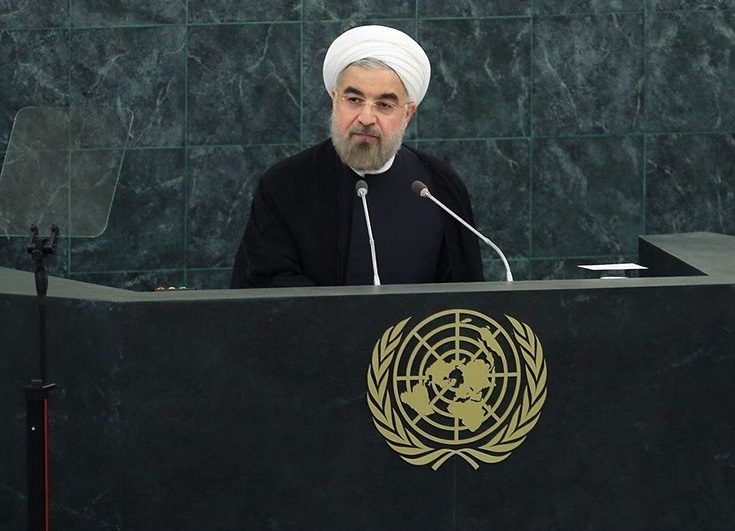
Iranian President Hassan Rouhani speaks at the UN General Assembly, September 26, 2013. (Image source: president.ir)
After achieving these goals for Iran’s ruling politicians, Rouhani’s message this year will switch to blaming the U.S. for all sorts of injurious shortcomings in the nuclear agreement, which Iran, incidentally, still has not signed.

U.S. President Barack Obama’s administration has sent hundreds of billions of dollars to Iran, and has hidden Iran’s supposed non-compliance with the nuclear deal to which it never officially agreed in the first place. The deal, in fact, seems only to have existed in the overheated imaginations of the US and other gullible members of the Joint Comprehensive Plan of Action (JCPOA). Nevertheless, the U.S. has ignored what Iran’s violations could be, and has assisted Tehran in evading any terms of the nuclear agreement it wished.

In addition, now that Iran has seen that the U.S. had lost all political leverage to pressure Tehran through the Security Council sanctions, and that, as critics of the deal had repeatedly and urgently warned, sanctions could not be “snapped back,” partly due to the veto power of Russia and China, Rouhani will be openly delivering the hardline messages of Iran’s Supreme Leader, Ayatollah Ali Khamenei, and the generals of Iran’s Islamic Revolutionary Guard Corps (IRGC), who enjoy power over Iran’s economic and political systems.

Khamenei and the senior cadre of the IRGC draw their legitimacy and power from the revolutionary principle of opposing the U.S., the “Great Satan.”

After the billions of dollars from the nuclear deal were delivered, the regime’s anti-American remarks and behavior only increased. For Rouhani, any expectation of rapprochement with the U.S. must be prevented, and also any domestic political liberalization prevented from occurring.

Reasons for Rouhani’s tactical shift in more publicly adhering to Iran’s revolutionary principle of anti-Americanism also include Iran’s leaders’ awareness that President Obama is tightly and desperately clutching the nuclear agreement until he leaves office: he considers the deal his crowning foreign policy accomplishment and legacy. By criticizing and blaming the U.S. for not honoring the terms, Rouhani plans to exploit President Obama’s weak point, as the negotiating team has been doing all along, by invoking Obama’s fear that Tehran might pull out of the nuclear deal — a move that would highlight the failure of the accord. This tactic will, as usual, successfully pressure the administration to give Tehran even more geopolitical and economic “carrots,” and pursue a policy with Iran of agreeing to even more concessions. Rouhani and Zarif will, as usual, conduct bilateral talks with American diplomats behind the closed doors to make sure they are achieved.

Rouhani’s public shift to Iran’s hard-line political spectrum is also partially pitched to Iran’s upcoming presidential elections. He needs the firm support of the hard-line leaders — fundamentally that of Supreme Leader Khamenei, who enjoys the final say in Iran’s domestic and foreign policy, and that of the IRGC leaders — in order to assure his election to a second term.

By more publicly delivering Khamenei’s message — that the US is not adhering to the terms of the nuclear deal and that it is supposedly the U.S. that has been “breaking oaths and not acting on their commitments and creating obstacles” —
Rouhani is most likely hoping further to endear himself to Khamenei and the IRGC and prove his loyalty.

A recent poll by the Center for International and Security Studies at the University of Maryland revealed that the moderate camp’s popularity has not only decreased, but that Iran’s former president, Mahmoud Ahmadinejad,

“now represents the single largest threat to Rouhani’s re-election, and trails the once-popular incumbent by only eight points. Suddenly, the ex-president [Ahmadinejad] seems once again to be a real political contender.”

Rouhani had also promised the Iranian people that the nuclear deal would improve their economic life. Since the implementation of the nuclear deal, however, the Iranian people have (unsurprisingly) not seen the fruits of the deal and the billions of dollars that the government has received. Rouhani will undoubtedly be trying to distract people’s attention from blaming the Iranian government by pointing to the U.S. as the culprit.

In one of his latest speeches, Khamenei pointed out that the U.S. is attempting to “destroy Iran’s economic relationships with other countries.” He added:

“Was it not supposed to be so that the unjust sanctions would be removed and it would have an effect on people’s lives? After six months, is there any tangible effect on the lives of the people? If not for America violating its oaths, would the administration not be able to do many things during this time? … Of course it has been some years that I have been repeating this about the lack of trust with America, but for some it was hard to accept this reality.”

Another issue on Rouhani’s agenda will be to promote, at the governmental level, business deals and trade, which will further financially benefit the IRGC and Khamenei, not Iran’s private sector.

Rouhani will more likely attempt to justify Iran’s military adventurism in the region by playing the anti-terrorism card, even though Iran is still the leading sponsor of terrorism.

Rouhani’s government will most likely focus on spreading the narrative of Khamenei and the IRGC, that Iran is an indispensable force in fighting the Islamic State and other extremist groups; that regional and global powers need to join Iran in this battle, and that Iran is the victim of terrorism in the region. In addition, Rouhani will presumably attempt to buttress the argument that the international community needs to support the Syrian President Bashar al-Assad in order to defeat terrorism.

Rouhani’s tactical shift is intended to reinforce Iran’s entrenched revolutionary ideal of anti-Americanism, appease Khamenei and the IRGC, and ensure his second term presidency.

Dr. Majid Rafizadeh, political scientists and Harvard University scholar is president of the International American Council on the Middle East. He can be reached at Dr.rafizadeh@post.harvard.edu.

North Korean Nukes, South Korea, Japan, China and Obama

September 10, 2016

North Korean Nukes, South Korea, Japan, China and Obama, Dan Miller’s Blog, September 10, 2016

(The views expressed in this article are mine and do not necessarily reflect those of Warsclerotic or its other editors. — DM)

On September 9th, North Korea conducted its fifth nuke test, of its most powerful nuke thus far. Can Obama get China to help make North Korea stop developing and testing nukes? Nope. China sees Obama, not as the representative of the world’s greatest power, but as a joke. He has no clout internationally and is a national embarrassment.

China and North Korea – a very short history

Here’s a link to an article I posted on June 25, 2013 about the Korean conflict. To summarize, China and the Democratic People’s Republic of Korea (North Korea) have a long history of acting together. China views the Republic of Korea (South Korea), which borders North Korea to the south and is an American ally, as a threat. She does not want reunification of the Korean peninsula under a government favorable to America.

When, on June 25, 1950, North Korea invaded South Korea with Russian aircraft, weaponry, training and other substantial support, China did not assist North Korea. North Korean forces pushed the South Korean government, as well as the few American military advisers (then under the command of the Department of State), south to the Pusan perimeter. Following General MacArthur’s unexpected and successful Inchon invasion which began on September 15th, American and other United Nations forces pushed the North Korean forces back north: MacArthur sent his by then greatly augmented forces east to Wonson and eventually managed to push North Korean forces to the northern side of the Yalu River. However, Chinese forces struck back en masse and MacArthur’s forces were driven back to Seoul.

Ever since bringing to an end MacArthur’s successes in the Korean Conflict, China has supported North Korea. She has opposed, and has then declined to enforce, significant sanctions responsive to North Korean nuclear and missile development and testing. While China may acquiesce in weak UN resolutions condemning North Korean provocations, she rarely goes beyond that.

China, Japan and the two Koreas

China has a long memory and still resents, bitterly, the lengthy period prior to and during World War II when Japan occupied significant parts of China. Ditto South Korea, all of which was under Japanese occupation for a lengthy period prior to and during World War II. Although China has substantial trade with both South Korea and Japan, she is more hostile to Japan than is South Korea; the latter two have substantial mutual interests transcending trade.

Perhaps the most important current dispute between China on the one hand, and Japan-South Korea-America on the other, involves the plans of Japan and South Korea to defend against North Korean missiles by the installation of THAAD anti-missile weapons provided by America. China’s stated reason for opposition to the THAAD system is that it could be used against Chinese, as well as North Korean, missiles. Why does China assert this objection unless she hopes to fire missiles at one or both of them? If China fires missiles at Japan and/or South Korea, they have every right to destroy her missiles and to respond in kind with U.S. assistance if requested.

President Obama

condemned Pyongyang’s fifth nuclear test today in the “strongest possible terms as a grave threat to regional security and to international peace and stability” as outraged lawmakers from both parties called for tougher action to stop North Korea’s nuclear program. [Emphasis added.]

That may well be all that Obama does — despite the warnings of Rep. Adam Smith (D-Wash.), the top Democrat on the House Armed Services Committee, that

we have to make it absolutely clear that if they engage in any military activity, they will be destroyed. We have to have a credible deterrent. That seems to be the only thing that will stop North Korea from engaging in military action… We have sanctioned them, and we should keep sanctioning them, but it’s not going to stop them from developing the nuclear weapons.” [Emphasis added.]

Obama won’t do that:

In a statement Friday, President Obama vowed to “take additional significant steps, including new sanctions, to demonstrate to North Korea that there are consequences to its unlawful and dangerous actions.”

Obama did not suggest what He might have in mind, beyond historically ineffective sanctions and condemnations “in the strongest possible terms,” to let North Korea know that there will be “consequences.”

A September 9th article at the New York Times provides an unpleasant analysis of the options Obama now has, and which His successor will have, in dealing with North Korea.

A hard embargo, in which Washington and its allies block all shipping into and out of North Korea and seek to paralyze its finances, risks confrontations that allies in Asia fear could quickly escalate into war. But restarting talks on the North’s terms would reward the defiance of its young leader, Kim Jong-un, with no guarantee that he will dismantle the nuclear program irrevocably.

For more than seven years, President Obama has sought to find a middle ground, adopting a policy of gradually escalating sanctions that the White House once called “strategic patience.” But the test on Friday — the North’s fifth and most powerful blast yet, perhaps with nearly twice the strength of its last one — eliminates any doubt that that approach has failed and that the North has mastered the basics of detonating a nuclear weapon.

Despite sanctions and technological backwardness, North Korea appears to have enjoyed a burst of progress in its missile program over the last decade, with experts warning that it is speeding toward a day when it will be able to threaten the West Coast of the United States and perhaps the entire country. [Emphasis added.]

. . . .

Mr. Obama has refused to negotiate with the North unless it agrees first that the ultimate objective of any talks would be a Korean Peninsula without nuclear arms. But Mr. Kim has demonstrated, at least for now, that time is on his side. And as he gets closer to an ability to threaten the United States with a nuclear attack, and stakes the credibility of his government on it, it may be even more difficult to persuade him to give up the program.

 In a statement Friday, Mr. Obama condemned the North’s test and said it “follows an unprecedented campaign of ballistic missile launches, which North Korea claims are intended to serve as delivery vehicles intended to target the United States and our allies.”

“To be clear, the United States does not, and never will, accept North Korea as a nuclear state,” he said.

Many experts who have dealt with North Korea say the United States may have no choice but to do so. [Emphasis added.]

“It’s too late on the nuclear weapons program — that is not going to be reversed,” William Perry, the defense secretary under President Bill Clinton during the 1994 nuclear crisis with North Korea, said in August at a presentation in Kent, Conn. The only choice now, he argued, is to focus on limiting the missile program. [Emphasis added.]

Obama has taken no significant steps to limit Iran’s continuing missile development and testing program. How can He limit that of North Korea without Chinese cooperation?

Yet the latest effort to do that, an agreement between the United States and South Korea to deploy an advanced missile defense system in the South, has inflamed China, which argues the system is also aimed at its weapons. While American officials deny that, the issue has divided Washington and Beijing so sharply that it will be even more difficult now for them to come up with a joint strategy for dealing with the North. [Emphasis added.]

China has been so vocal with its displeasure over the deployment of the American system that Mr. Kim may have concluded he could afford to upset Beijing by conducting Friday’s test. [Emphasis added.]

Fueling that perception were reports that a North Korean envoy visited Beijing earlier this week.

North Korea almost certainly sees this as an opportunity to take steps to enhance its nuclear and missile capabilities with little risk that China will do anything in response,” Evans J.R. Revere, a former State Department official and North Korea specialist, said in a speech in Seoul on Friday. [Emphasis added.]

The breach between China and the United States was evident during Mr. Obama’s meeting with President Xi Jinping last week. “I indicated to him that if the Thaad bothered him, particularly since it has no purpose other than defensive and does not change the strategic balance between the United States and China, that they need to work with us more effectively to change Pyongyang’s behavior,” Mr. Obama said, referring to the Terminal High Altitude Area Defense system, as the advanced missile defense project is known. [Emphasis added.]

North Korea and Iran

Iran and North Korea have a long history of cooperation in developing nukes and missiles with which to deliver them. In the past, Iranian scientists have been present at North Korean nuke tests, and vice versa. They have also assisted each other in the development of nukes and missiles.

Iran and North Korea have substantial reasons to cooperate: by virtue of the Iran scam, Iran now has lots of money but is at least minimally restricted in its nuke development. North Korea has little usable currency, needs whatever it can get, and no attempts to halt or even to limit its nuke development have worked.

A missile fired recently by North Korea bore a striking resemblance to an Iranian missile.

Photos released by North Korea of its launch of long-range ballistic missiles are the latest proof of the close military cooperation between Pyongyang and Tehran, an Israeli expert in the field told the news site IsraelDefense on Tuesday.

According to Tal Inbar — head of Space and UAV Research Centre at the Fisher Institute for Air & Space Strategic Studies — what was new in the photos was the shape of the warheads attached to the Nodong missiles, known in Iran as the Shahab-3.

Until now, such warheads — first detected by Inbar in Iran in 2010 — have not been seen in North Korea. At the time, Inbar dubbed them NRVs (or, “new entry vehicles”), which became their nickname among missile experts around the world. [Emphasis added.]

Inbar told IsraelDefense: “The configuration that we saw [on Tuesday] is identical to what we saw in Iran six years ago. In principle, its penetrating body (warhead) is identical to that of Scud missiles, but is mounted on the Shahab-3, and creates a more stable entity than other Shahab/Nodong warheads.”

Inbar said this was the third time that something of this nature had appeared in Iran before it did in North Korea. “But we must remember that the two countries engage in close cooperation where military and space-directed missiles are concerned,” he said. “It is thus possible that both plans and technology are being transferred regularly from one to the other.” [Emphasis added.]

Are North Korea and Iran rational? According to this New York Times analysis, North Korea is.

North Korea’s actions abroad and at home, while abhorrent, appear well within its rational self-interest, according to a 2003 study by David C. Kang, a political scientist now at the University of Southern California. At home and abroad, he found, North Korean leaders shrewdly determined their interests and acted on them. (In an email, he said his conclusions still applied.) [Emphasis added.]

“All the evidence points to their ability to make sophisticated decisions and to manage palace, domestic and international politics with extreme precision,” Mr. Kang wrote. “It is not possible to argue these were irrational leaders, unable to make means-ends calculations.” [Emphasis added.]

Victor Cha, a Georgetown University professor who served as the Asian affairs director on George W. Bush’s National Security Council, has repeatedly argued that North Korea’s leadership is rational.

I submit that the same analysis, applied to Iran, produces the same result. Iran’s leaders know what they want, and are sufficiently rational to achieve it; they did. Obama, not the leader of a dictatorial theocracy, is sufficiently irrational to believe that what he wants for the Islamic Republic of Iran is what America needs it to have. It is not.

Obama and Iran

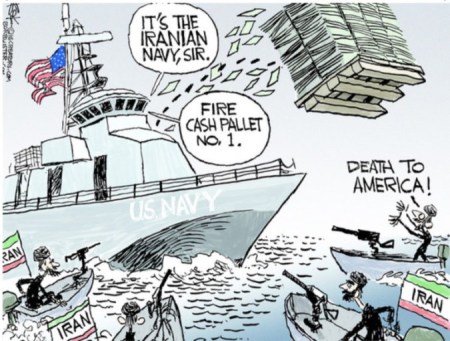
Obama’s Iran scam would be farcical were it not potentially deadly. He did not do what would have been best for America and the free world in general — increase sanctions until Iran complied fully with UN resolutions on missile testing, ceased Uranium enrichment and disposed of the means to do it, ceased all nuke research as well as all nuke cooperation with North Korea and ceased supporting all terrorist groups, including Hezbollah and Hamas. Instead, perhaps considering Himself above such trivia, Obama sought little more than what He considered His greatest achievement — His legacy:

iranian-navy-copy-1

Conclusions

If Obama were viewed internationally as the powerful leader of the world’s most powerful nation, He might be able to get China to clamp down, severely and successfully, on North Korea’s nuke and missile development. Were China to reject His overtures, He could arrange for it to wish that it had acceded. That’s not who Obama is, as demonstrated by, among His other actions, entering into the Iran Scam deal with Iran.

Perhaps Kim Jong-un needs to dress like an Iranian mullah to convince Obama to give him a “deal” similar to the one He gave to Iran. He had better hurry: that won’t work with President Trump.

Obama Admin: Iran Was Only Paid $1.7 Billion in Cash After Hostages Released

September 8, 2016

Obama Admin: Iran Was Only Paid $1.7 Billion in Cash After Hostages Released, Washington Free Beacon, Adam Kredo, September 8, 2016

Assan Rouhani, The President of Iran during the United Nations General Assembly at the United Nations General Assembly Hall on September 25, 2015 in New York City. Photo by Dennis Van Tine/Sipa USA

Hassan Rouhani. Photo by Dennis Van Tine/Sipa USA

Senior Obama administration officials, under the threat of a subpoena, were forced to appear on Capitol Hill on Thursday to explain why lawmakers and the American public were kept in the dark about a $1.7 billion cash payment to Iran that has been widely viewed as a ransom to free imprisoned U.S. hostages.

Four senior administration officials declined to provide in-depth explanations of how U.S. funds were transferred to Iran, but said that at least $1.3 billion was withdrawn from a U.S. taxpayer fund and sent to Iran only after it released the hostages.

The payments to Iran were made in hard currency after the United States delivered the funds to European banks. The money was converted into hard currency and bank notes before being transferred to an official from the Central Bank of Iran for transport to Tehran, according to the officials.

Administration officials confirmed that the $1.7 billion payment only went through once the United States was able to secure the release of several U.S. hostages being held in Iran—though the officials would not say this amounted to a ransom.

The Obama administration also could not guarantee lawmakers that the money would not be spent by Iran to fund terror operations.

These disclosures appear to confirm key details about the payment that the administration had either denied or declined to elaborate on for months.

Details are only becoming public now following several news reports and leaks from Congress about the source of the payment, which has been shrouded in mystery since January, when it was first announced.

“This committee requested records … more than a month ago and to date the self-proclaimed most transparent administration in our history has failed to provide any, not one document to this committee,” said Rep. Sean Duffy (R., Wis.), a member of the House Financial Services Committee, during the hearing.

“The witnesses today only agreed under threat of subpoena” to appear before Congress, Duffy said.

The testimony by these administration officials is likely to fuel claims that the payment amounted to a ransom, following the admission that the administration only went through with the cash delivery after it was able to confirm that the U.S. hostages had left Iran.

“You can’t tell me that you guaranteed our prisoners would have been released had your money not been sent,” Duffy said to Christopher Backemeyer, a deputy assistant secretary for Iranian affairs at the State Department.

Backemeyer also could not provide a guarantee that the money would not be spent by Iran on terrorist operations.

“I can’t speak to every dollar that’s going to go in or out of Iran,” he said.

“There is a risk you have taken in providing $1.7 billion to the leading state sponsor of terrorism in the world,” Duffy said.

European officials handed off the first payment of $400 million in cash to Iran on Jan. 17, only after Iran agreed to release the U.S. hostages following an evening of negotiations that included Secretary of State John Kerry, officials said.

After converting the U.S. funds to European bank notes and cash, the money was given to an “official from the Central Bank of Iran for transfer to Tehran,” according to Paul Ahern, assistant general counsel for enforcement and intelligence at the Treasury Department. “The funds were under U.S. government control until their disbursement.”

The remaining $1.3 billion was withdrawn from a U.S. taxpayer fund operated by the Treasury Department and sent to Europe. Once there, the money was converted into foreign currency and transferred to a representative of Iran’s central bank on Jan. 22 and Feb. 5.

Information about the payment and the circumstances surrounding it remains a mystery.

The administration officials  made the decision to pay Iran in cash, even though other options existed.

“Iran had to have it in cash,” Ahren said. “Iran was very aware of the difficulties it would face in accessing and using the funds if they were in any other form than cash, even after the lifting of sanctions.”

A cash delivery “was the most reliable way that they received the funds in a timely manner and it was the manner preferred by the relative foreign banks,” Ahren said.

“For them,” Backemeyer added, “the critical need was they [Iran] got immediate access.”

The administration officials would not provide in-depth details, citing diplomatic sensitivities.

“My guess is, if any private citizen had done what this administration did, they’d be indicted on money laundering and the administration calls in diplomacy,” said Rep. Jeb Hensarling (R., Texas), who questioned why the deal was hidden from the public

“Why did the administration go to such great lengths to hide it from the American people?” Hensarling asked. “Why did I have to threaten subpoenas to get the administration to show up in the first place?”

The State Department’s Backemeyer explained that some details could only be divulged in a classified setting.

“There will be limitations to what I and my colleagues can say in an open setting,” he explained. “There are a number of litigations and diplomatic sensitivities that could jeopardize U.S. interests if we were to go into too much detail.”

When asked why the United states agreed to pay $1.3 billion in interest to Iran from a taxpayer fund, a State Department official bristled.

“The details of why we settled for this amount are litigation sensitive,” said Lisa Grosh, a legal adviser in the State Department’s office of international claims and investment disputes. “Iran’s lawyers would try to use my words or maybe even your words against us to help their position at the [claims] tribunal. I believe this settlement was the best thing for the United States.”

Ralph Peters: Cash payments to Iran were a bribe to save Obama’s nuclear deal

September 7, 2016

Ralph Peters: Cash payments to Iran were a bribe to save Obama’s nuclear deal, Washington Free Beacon via YouTube, September 7, 2016

Iran: The Return of Ahmadinejad and Co.

September 5, 2016

Iran: The Return of Ahmadinejad & Co., Gatestone InstituteMajid Rafizadeh, September 5, 2016

♦ Iran’s Supreme Leader and the senior cadre of the Islamic Revolutionary Guard Corps have been vocally critical of the nuclear deal. They fear further diplomatic and political rapprochement between the US and Iran, now that they have already achieved their objectives of the lifting of the four major rounds of the UN Security Council’s sanctions.

♦ After the nuclear deal was implemented, polls showed that 63% of Iranians expected to see improvements in the economy and living standards within a year. But currently, in a new poll, 74% of Iranians said there had been no economic improvements in the past year.

Iran’s former president, Mahmoud Ahmadinejad, saying he wants to “redefine revolutionary ideals” set up by the leader of Iran’s 1979 Islamic revolution, Ayatollah Ruhollah Khomeini, appears to be launching a campaign to run in the upcoming Iranian presidential elections, in February, 2017.

Ahmadinejad was well-known for his incendiary and provocative speeches, which included denying the Holocaust. At the end of his presidential term, from 2005 to 2013, his approval rating was extremely low, and he managed to drive away most constituents across political spectrum, including the topmost hardline leaders. He also became the first Iranian president since 1979 to be summoned by the parliament (Majlis) to answer questions regarding his activities and policies.

After all of this, the common conception among politicians, scholars and policy analysts was that Ahmadinejad would never return to politics. It seemed that his retirement plan focused on founding a university and teaching, but his plan to open a university failed.

Despite his low popularity among people, however, the “principalists” (ultra-conservatives) were still on his side, due to his fierce anti-US, anti-Western and anti-Israel policies and rhetoric, as well as the fact that he remains a major figure in the coalition of several conservative groups, the Alliance of Builders of Islamic Iran.

After Ahmadinejad’s presidency, Iran’s Supreme Leader, Ayatollah Ali Khamenei, appointed him to the Expediency Council, Iran’s highest political arbitration body, which arbitrates between the Guardian Council (the supervisory body over the parliament and elections) and the Islamic Consultative Assembly (parliament). The Expediency Council is predominantly made up of Iran’s hardline clerics, and functions as an advisory institution to the Supreme Leader.

Although it seems that Ahmadinejad did not have any intention of returning after being out of the international spotlight for two years, other factors show that he never really left. Domestically, Ahmadinejad remained politically active, trying to unify and lead the hardliners. Since he left office, he has continued holding meetings with former ministers in Tehran.

In the last few months, however, Ahmadinejad’s desire to launch his campaign more forcefully and determinedly has become clearer as, once again, he began attracting the international spotlight, such as when he wrote an open letter to US President Barack Obama, demanding the transfer of $2 billion to Iran.

To capitalize on the popular vote and the presidential elections of 2017, Ahmadinejad has been focusing on attracting constituents from around Iran by traveling to smaller cities and towns, giving lectures and speeches; supporters of Ahmadinejad have called for his return.

During his presidency, people enjoyed subsidies on items including petrol, natural gas and electricity, and his government distributed monthly cash handouts of about $17 to every person. These, as well as criticism of corruption, injustice, and capitalism, were appealing to the rural population and the less affluent.

Ahmadinejad has also been vehemently criticizing Hassan Rouhani, the current Iranian president, as incompetent, and questioning his economic and foreign policies, and pointing out that, “There will be bumps and satanic obstacles in our path… One should not forget that the US is our enemy.”

The latest poll by the Center for International and Security Studies at the University of Maryland revealed that “Ahmadinejad now represents the single largest threat to Rouhani’s re-election, and trails the once-popular incumbent by only eight points. Suddenly, the ex-president seems once again to be a real political contender.”

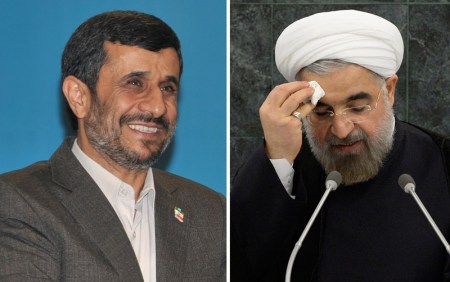
1839Mahmoud Ahmadinejad (left) can indeed be a viable contender against incumbent President Hassan Rouhani (right) in Iran’s 2017 presidential election, and is more likely the choice of the Supreme Leader and hardliners.

This is a ripe environment for him for several reasons.

First of all, the nuclear deal has become a popular issue among the hardliners. The Supreme Leader and senior cadre of the Islamic Revolutionary Guard Corps (IRGC) have been vocally critical of the nuclear deal. They fear further diplomatic and political rapprochement between the US and Iran, now that they have already achieved their objectives of the lifting of the four major rounds of the United Nations Security Council’s sanctions.

Ayatollah Khamenei warned against any relations with the US, and he also questioned the economic benefits of the nuclear agreement: “Weren’t the oppressive sanctions lifted so that the people would feel a change in their lives? Has there been a tangible effect on the people’s lives in the past six months?”

Second, the popularity of the nuclear deal has been on a decline among the population as well. After the nuclear deal was implemented, polls showed that 63% of Iranians expected to see improvements in the economy and living standards within a year. But currently, in a new poll, 74%of Iranians said there had been no economic improvements in the past year.

Ahmadinejad can indeed be a viable contender against Hassan Rouhani, and is more likely the choice of the Supreme Leader and the IRGC leaders, and the candidate favored by the hardliners and principalists.

Satire?| Obama Ratifies Treaty on Sharia Law

September 4, 2016

Satire?| Obama Ratifies Treaty on Sharia Law, Dan Miller’s Blog, September 4, 2016

(The views expressed in this post are mine and do not necessarily reflect those of Warsclerotic or its other editors. — DM)

Having personally ratified the Iran Scam Treaty and the Climate Change Treaty with China, President Obama today met with Turkish, Saudi and Iranian heads of state to ratify a new treaty making Sharia Law binding in the United States. Please see also, The West Needs Sharia Law – Pakistani cleric. Obama, a renowned constitutional scholar, quickly rejected objections by Senate leaders that “He shouldn’t oughta do that because it’s our job” by reminding them that He is the President and is therefore empowered by the Constitution to do whatever pleases Him.

TOTUS Seal

Here is the text of President Obama’s statement on ratification of the Sharia Law Treaty, provided by The Incomparably Honorable I. M. Totus, Teleprompter of the United States:

My beloved Islamist colleagues, men, women and whatever: today, with great pleasure and a heart-felt desire for a better future for all, I today ratified a treaty with The Republic of Turkey, the Kingdom of Saudi Arabia and the Islamic Republic of Iran making Sharia Law officially binding in America just as it is in those great progressive, humanitarian nations.

As United Nations Secretary General Ban Ki-moon recently stated, the debate about the horrors of man-made climate change is over and the issue is settled. So be it with any debate over My success in preventng Iran from using nuclear weapons and, indeed, over My constitutional powers as your humble President. I have settled those matters as well, as all loyal Americans must agree.

Sharia Law will make America a far happier and better place for all including, most importantly, refugees coming to our shores in increasing numbers from other Islamist nations. I can think of no better way to welcome them than by guaranteeing them the dignity, honor and freedoms under Sharia Law they so richly and justly deserve.

For too long has America based its laws on flawed Judeo-Christian principles. But that’s not who we are; we have a long, honorable and mutually beneficial history with Islam and many if not most of our best citizens are Muslims. The treaty I ratified today will finally put us on the right side of history. It will also facilitate My brilliant countering violent extremism initiative by encouraging an honest discussion of Sharia law, long rejected by “America First” nationalists and other Islamophobes who despise Allah and His one true Religion of Peace.

I am confident that all loyal Americans will be happy to abide by our Sharia Laws; common sense steps will be taken to encourage all to do so. Observers from Turkey, Saudi Arabia and Iran will soon come to America to assist us in implementing whatever encouragements may be needed.

We should all thank the three other splendid freedom loving nations which also ratified the new treaty and encourage all other nations of the world to join us as soon as possible.

Thank you and have a pleasant day.

Hated by many Americans until now, The Islamic Republic of Iran has shown that it is a truly glorious example of Islamist democracy in action, where Sharia Law is enforced, followed and enjoyed by all.

hangings_in_iran

With Obama leading the way as always, we are joining them. Just look at the Iranians depicted in the following Iranian propaganda video! They are proud, happy, peaceful, patriotic and loving despite the shameful efforts of America in the past and, indeed, of some war-mongering Americans today, to humble and destroy them and their beloved nation.

No longer will that happen. The President has spoken! This will be the most beneficial and longest lasting of all of His many great leaps forward to make America a country of which He, His beautiful wife Michelle and all other good people can and will be truly proud.

It is anticipated that President Obama will soon issue an executive order changing the name of the country from The United States of America to The Islamist Republic of Obama. The flag of the new Islamist Republic of Obama will combine the best elements of the flags of the Islamic Republic of Iran, the Republic of Turkey and the Kingdom of Saudi Arabia. A photo of Obama as the bringer of true Islamic peace and understanding will be superimposed over the other flag elements.

Obama:

Obama death to America

Iran:
Iranian flag

Turkey:
Flag_of_Turkey.svg

Saudi Arabia:
saudi flag

Oh well.

what me worry

Iran and the future of the Middle East

September 2, 2016

Iran and the future of the Middle East, Israel Hayom, Clifford D. May, September 2, 2016

U.S. President Richard Nixon went to China. President Barack Obama will not be going to Iran.

Nixon’s 1972 visit to the people’s republic included meetings with both Chairman Mao Zedong, the communist revolutionary leader, and Premier Zhou Enlai, the pragmatic head of the government. Detente and normalization of relations followed.

By stark contrast, Ayatollah Ali Khamenei, the Islamic republic’s revolutionary supreme leader, and Hassan Rouhani, the pragmatic president of the theocratic regime, will not deign even to share a bottle of pomegranate juice with Obama, president of “satanic” America, their avowed enemy.

Obama appears unperturbed, confident that detente and normalization of relations — not to mention a more stable Middle East — lie at the end of the road he began to pave with his 2015 Joint Comprehensive Plan of Action, a nuclear deal that garnered neither Congress’ endorsement nor the public’s approval.

The fraught controversy over how we got to this point and where we’re heading is the subject of a new book: “The Iran Wars: Spy Games, Bank Battles, and the Secret Deals that Reshaped the Middle East,” by Jay Solomon, chief foreign affairs correspondent for The Wall Street Journal.

What I found striking in this first draft of contemporary history: the opportunities Obama missed — or, more precisely, dismissed. In 2009, the brutish Mahmoud Ahmadinejad was declared the winner of presidential elections that were not just manipulated by Khamenei — that’s standard procedure — but almost certainly falsified as well. Iranians went out into the streets chanting “Death to the dictators!” and “President Obama, are you with us or against us?”

According to Solomon, not only did Obama refuse to support them, he ended programs to document Iranian human rights abuses and ordered the CIA to turn its back on the Green Movement. “The agency has contingency plans for supporting democratic uprisings anywhere in the world,” Solomon writes. “This includes providing dissidents with communications, money, and in extreme cases even arms. But in this case the White House ordered it to stand down.”

Obama also was unenthusiastic about sanctions. He and Secretary of State John Kerry believed that showing Iran’s rulers respect and engaging them in dialogue would be sufficient to mitigate their animosity and bellicosity. “So many wars have been fought over misunderstandings, misinterpretations, lack of effective diplomacy,” Kerry told Solomon in a 2016 interview. “War is the failure of diplomacy.”

I suspect Clausewitz and Sun Tzu would beg to differ. More to the point, quite a few members of Congress, including such Republicans as Mark Kirk, Ed Royce and Ileana Ros-Lehtinen, and such Democrats as Bob Menendez, Eliot Engel and Howard Berman, were convinced that talking softly was not enough, that when dealing with Iran’s rulers it was necessary to carry a sizeable stick. Solomon notes that congressional staffers partnered with several Washington think tanks to find “new ways to squeeze Iran’s oil profits and ability to conduct financial transactions.”

In particular, he adds, a “lethal weapon” came from the Foundation for Defense of Democracies (the think tank I founded after 9/11/01 and where I serve as president) which “focuses on combating Middle East extremism and, in particular, promoting the security of the United States, Israel and other democracies threatened by radical Islam.” FDD’s executive director, Mark Dubowitz, and his Farsi-speaking research team “provided a constant stream of reports to U.S. lawmakers on Iranian companies and individuals that they believed should be sanctioned for their roles in developing Iran’s nuclear program.”

Eventually, Dubowitz, working with Senator Kirk’s then deputy chief of staff Richard Goldberg, came up with a “financial bomb”: a Belgium-based financial firm called SWIFT “which hosts the international computer network that facilitates virtually every banking transaction in the world through an extensive messaging and financial tracking system.” The Obama administration opposed expelling Iran from SWIFT but “Congress once again overrode the White House’s concerns and unanimously passed” legislation in 2012 that “de-SWIFTed” Tehran.

By 2013, such measures, “were crippling Iran’s economy.” Had the pressure been intensified — or even just maintained — who knows what concessions Iran’s rulers might have made to avoid economic crisis and collapse? But Obama eased up on Iran in exchange for an interim agreement. After that, few if any Iranian concessions were forthcoming. Khamenei insisted that his red lines be observed while those laid down by Obama were transgressed — one after another.

In the end, Iran would not even have to acknowledge that it ever had a nuclear weapons program, much less reveal how far that program had progressed. Nevertheless, the Obama administration would agree that Iran “be allowed to build an industrial-scale nuclear program, with hundreds of thousands of machines, after a ten year period of restraint.”

“I have no doubt we avoided a war,” Kerry told the author in an interview early this year. He could be right. Alternatively, what he sees as avoidance could turn out to be only postponement.

Based on faith rather than evidence, Kerry and Obama believe that the Islamic republic will moderate; that it will give up its ambition of establishing a vast new Islamic empire; that it will no longer dream of bringing “death” to America, Israel, Saudi Arabia and other “infidel” nations; that it will not evolve into a more formidable and lethal adversary.

“Obama has wagered that Khamenei and his revolutionary allies won’t outlast the terms of the nuclear agreement,” Solomon concludes. “If they do, the United States risks unleashing an even larger nuclear cascade on the Middle East.” Yes, that’s the wager. Seems like a long shot to me.

Column One: Obama’s greatest achievement

September 1, 2016

Column One: Obama’s greatest achievement, Jerusalem PostCaroline B. Glick, September 1, 2016

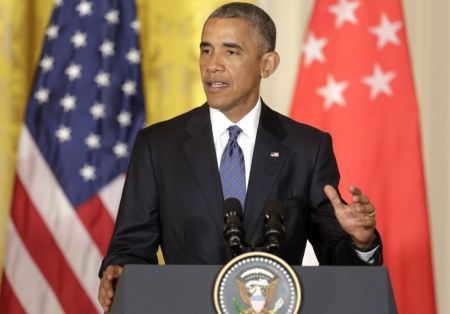
Obama lies on Iran scamU.S. President Barack Obama and Singapore Prime Minister Lee Hsien Loong (not pictured) speak during a press conference at the White House in Washington, U.S., August 2, 2016.  (photo credit:REUTERS)

The time for complaining about President Barack Obama’s nuclear deal with Iran has passed. The time has come to overcome the damage enormous damage his signature foreign policy accomplishment has caused.

To understand why this is the case, it is important to understand the breadth and depth of Obama’s failure.

On August 4, during the course of a press conference, Obama gave his interim assessment of his nuclear agreement with Iran.

“It worked,” he insisted.

A year after the deal was signed, Obama argued, events have proven that he was right and the deal’s critics were wrong.

“You’ll recall that there were all these horror stories about how Iran was going to cheat and this wasn’t going to work and Iran was going to get $150 billion to finance terrorism and all these kinds of scenarios, and none of them have come to pass,” he proclaimed.

Obama then snidely swiped at the deal’s opponents saying that it would be “impressive” if the people who criticized the deal would own up to their mistakes and admit that it worked.

As it works out, everything that Obama said about the deal with Iran during his press conference was a lie.

Some of his lies became apparent within hours.

For instance, Obama falsely claimed that Israel now “acknowledges this has been a game changer and Iran has abided by the deal and they no longer have the sort of short-term breakout capacity that would allow them to develop nuclear weapons.”

Hours later, the Defense Ministry issued a stinging rebuke of Obama’s claim, parroted more diplomatically by the Prime Minister’s Office.

Obama’s press conference took place the day after The Wall Street Journal reported that in January 2016, the US sent an unmarked plane to the Tehran airport filled with $400 million in cash, on the same day Iran released four US hostages.

Obama angrily rejected allegations that the cash payment was a ransom payment for the hostages’ release. He insisted that the US had made the payment as the first installment of a $1.7b. payment the administration made to settle an Iranian government lawsuit against America.

Obama claimed that the administration agreed to the settlement at the urging of the Justice Department.

He said his administration was able to settle the dispute only due to the nuclear deal which placed US officials in direct contact with their Iranian counterparts for the first time in decades.

Within a day, Obama’s claims were exposed as lies. It turns out that Justice Department lawyers opposed the cash payout to Iran.

One of the hostages released in January told the media that the Iranians refused to allow the hostages to leave Iran until the airplane with the cash landed in the airport.

The Iranians, for their part, contemptuously mocked Obama, and stated openly that the $400m.

was a ransom payment for the hostages.

Two weeks later, Obama’s State Department admitted that the $400m. was a payment for the hostages.

Obama’s principle claim is that due to his deal, Iran no longer has a short-term nuclear breakout capacity. He also says that in accordance with the deal, Iran has shipped its nuclear materials out of the country. These claims are both untrue and misleading.

On Thursday Reuters reported that Iran did not ship the quantities of low-enriched uranium out of the country in the quantities the deal required.

Last January, when the deadline arrived for Iran to comply with the deal’s clauses calling for it to move its uranium enriched to 3.5 percent and 20 percent out of the country and so enable the US and its European colleagues to cancel UN sanctions against it, it worked out that Iran had failed to comply.

Rather than acknowledge Iran’s failure and maintain the sanctions in accordance with their deal, the Americans and Europeans decided to move the goalpost closer to Iran.

They secretly decreased the amount of uranium the Iranians were required to part with. They then announced triumphantly that they were canceling UN sanctions because Iran had complied with the agreement.

Reuters reported that much of the low-enriched uranium Iran did remove from its territory wasn’t actually removed from its possession. Instead it was transferred to neighboring Oman, where it is held under Iranian guard and control.

Obama of course knows all of this. So his claims that the agreement “worked” are nothing more than a card trick meant to trick the American public.

Obama’s assertion that Iran’s breakout time to a nuclear arsenal has been slowed as a result of his deal is similarly a stretch of the imagination. The Iranians have suspended much of their prior centrifuge spinning. But that is only because they are now directing their efforts to developing and deploying more advanced centrifuges that will be able to enrich uranium to bomb grade material far more rapidly than the centrifuges they were required to retire.

Experts have already placed Iran’s post-deal nuclear breakout time at a mere six months. And Iran can leave the agreement – which it never actually signed or officially agreed to – anytime it wants.

While developing their next generation centrifuges, the Iranians are expanding the range and precision of their ballistic missiles, deploying them and increasing the size of their arsenals. Despite the fact that these actions are prohibited under US law and breach what was initially claimed about the ever-changing nuclear deal, the Obama administration has refused to impose sanctions against Iran, insisting that its actions merely breach the spirit, rather than substance, of the deal.

The administration has had a similar response to Iran’s recent deployment of Russia’s S-300 missile defense battery around its military nuclear site at Fordo. On Sunday Iranian television showed footage of the missiles being set up around the formerly secret site.

As Omri Ceren of the Israel Project noted this week, Iran’s deployment of the S-300 system places it in breach of three US sanctions laws. Despite this, the White House announced on Wednesday that it has no intention of enforcing US law and applying sanctions on Iran. The S-300 missiles can be used both as a defensive system and as an offensive one.

On Tuesday, Tehran announced that it will be launching three satellites in the coming months.

Satellite launches are widely viewed as a means through which Iran is covertly developing a longrange ballistic missile capability. Rather than censure Iran for its actions, the Obama administration insists that such actions, as well as Iran’s recent longrange rocket tests, do not violate the nuclear deal or warrant US action.

Taken separately and together, Iran’s actions since the nuclear deal was officially concluded make clear that it continues to pursue its nuclear program, and indeed, has become more brazen in its nuclear operations than it was before the agreement was announced last year.

In other words, not only has the deal not worked, contrary to Obama’s claims, it has been a colossal failure on every level. The deal’s opponents were entirely right about the dangers it posed and Obama was entirely wrong.

This is true as well in relation to the administration’s qualified promises that the deal would lead to better relations between the US and Iran. As Shoshana and Stephen Bryen noted last week following the Iranian naval assault on the USS Nitze in the Strait of Hormuz, with its repeated harassment of US naval ships traversing the Strait of Hormuz, Iran is clearly practicing its tactic of swarming US naval craft as a preparation for a real strike against them.

The main reason that Iran’s nuclear program is such a grave concern for Israel and for other Middle Eastern states is that the Iranian regime has hegemonic ambitions. It seeks to destroy Israel and dominate the entire region.

Since it concluded the deal with Washington, Iran has surged its forces and massively expanded its power projection throughout the region.

On Thursday the Daily Mail reported that the commonly held belief that Iran commands 16,000 troops in Syria is wrong. According to the National Council of Resistance in Iran, the regime actually commands 60,000 forces in Syria, deployed throughout the country. The entire Syrian army today numbers a mere 50,000 men.

On August 4, Obama mocked claims that Iran would spend its windfall profits of $100b.-$150b.

from the sanctions relief the nuclear deal offered to fund terrorism. Yet, according to the Daily Mail report, to date Iran has spent $100b. on the war in Syria.

The implications of the report are blood curdling.

They mean that despite Obama’s denials, the funds Iran has received as a result of the sanctions relief he brought about through his nuclear deal have paid for Iran’s war in Syria. That war has caused the death of nearly half a million people and forced more than 11 million people to flee their homes.

Obviously, it is important for Americans to know the truth about the Iran deal and its consequences as they consider their votes for Obama’s replacement.

One of Democratic nominee Hillary Clinton’s top candidates for secretary of state is Wendy Sherman.

Sherman was the chief negotiator of Obama’s nuclear deal with Iran.

For Israel, the question of what to do about Iran now is far more urgent than it is for Americans.

Today more and more commentators are voicing concern over the prospect that Obama will support an anti-Israel resolution at the UN Security Council as a parting shot at Israel.

But any such resolution will be small potatoes in comparison to the strategic devastation his nuclear deal, which is his main foreign policy legacy, has caused.

The rapidity of Iran’s advance makes clear that there is no justification for waiting to act until Obama has left office. If it doesn’t act soon, Israel is on the fast track to waking up one morning and discovering it has no means of thwarting the threat.

Indeed, with each passing month, its options for action become more and more limited.

After Israel’s security leadership undermined Prime Minister Benjamin Netanyahu’s plan to attack Iran’s nuclear installations in 2010 and 2012, Netanyahu settled on a strategy of blocking Obama’s moves to appease Tehran.

That strategy of course failed last summer. Since then, Netanyahu has worked to build an anti-Iranian alliance with the Sunni Arab states. His efforts in this area have clearly met with some measure of success, as witnessed by public statements from prominent Saudis and others.

Whatever that success may be, and whatever the status of that burgeoning alliance of spurned US allies, the fact is that it’s time Israel and its new allies do something more than send signals. Time is a-wasting.

Last spring Brig.-Gen. Hossein Salami, the deputy commander of Iran’s Revolutionary Guard Corps, said, “Today the grounds for the annihilation and collapse of the Zionist regime are more present than ever before.”

Thanks to Obama, he may be right.

It is time for Israel to make him eat his words.

A Lawless President Made More Secret Deals

September 1, 2016

A Lawless President Made More Secret Deals, Counter Jihad, September 1, 2016

A new report revealed by Reuters shows that there were more secret deals made with Iran, and not reported to Congress, in violation of US law.  The President of the United States has knowingly and repeatedly violated a law he himself signed, for the express purpose of avoiding Congressional oversight of his actions mandated both by the law and the Constitution.

During the so-called “Iran Deal” negotiations, it became known that the State Department had agreed to allow Iran to make a “secret side deal” with the International Atomic Energy Agency (IAEA) to which the United States would not be a party.  The intent was to dodge a provision of the law governing the “Iran Deal”‘s negotiation, a law that President Barack Obama had himself signed into law.  He signed this into law in the hope of avoiding the Constitutional requirement that the Senate should advise and assent to treaties by a two-thirds majority.  The law he negotiated as an alternative to obeying the Constitution required that the entire deal, including any side arrangements, be made available to Congress for consideration before approval.

Congress objected to this first ‘secret deal,’ especially Representatives Tom Cotton and Mike Pompeo.  Pompeo said at the time of this revelation, “Not only does this violate the Iran Nuclear Agreement Review Act, it is asking Congress to agree to a deal that it cannot review.”  In a letter to Secretary of State John F. Kerry, he reminded the Secretary that “pursuant to H. Res. 411, the House of Representatives considers the documents transmitted on July 19, 2015 incomplete in light of the fact that the secret side deals between the International Atomic Energy Agency (IAEA) and the Islamic Republic of Iran were not provided to Congress.”

Now we learn that there were many more such deals, none of which was reported to Congress.  In a way, this has been obvious for some time.  The IranTruth site reported in July that there were more secret deals, and asked,“Does the President Know?”  Jeff Dunetz, writing at the same site, identified two more secret deals specifically by August of last year.   French and Iranian officials agreed last summer that the presentation of the deal being made by Secretary Kerry to the US Congress was a distortion of what was being actually negotiated, with the French expressing a concern that the deal was always being weakened in Iran’s favor.

According to Reuters today:

The report is to be published on Thursday by the Washington-based Institute for Science and International Security, said the think tank’s president David Albright, a former U.N. weapons inspector and co-author of the report. It is based on information provided by several officials of governments involved in the negotiations, who Albright declined to identify.

Reuters could not independently verify the report’s assertions.

“The exemptions or loopholes are happening in secret, and it appears that they favor Iran,” Albright said.

Among the exemptions were two that allowed Iran to exceed the deal’s limits on how much low-enriched uranium (LEU) it can keep in its nuclear facilities, the report said. LEU can be purified into highly enriched, weapons-grade uranium.

Will Congress continue to accept this lawless erosion of its Constitutional role?  Will they, at any point, stand up and assert that the President must at least obey the laws he himself signs?  If not, what role does Congress intend to serve?  What future is there for the system of checks and balances that once restrained the executive branch from imperial ambitions?

The matter is even more important than that.  The so-called “Iran Deal” has been a manifest disaster for the interests of the United States abroad.  Tearing it up is one of the five most crucial steps that the United States can take right now. (The pertinent segment of the video provided below begins at 1:14 — DM)

Congress must reassert its role in balancing what has become a lawless executive branch.  It must do so because the Constitution requires it, because the stability of the Republic requires it, but also because this particular deal has badly damaged American interests.  A great deal rides on whether the legislative branch has the political will to reaffirm its Constitutional role in the United States.