Posted tagged ‘IAEA’

France, Iran and the “Peace Process”

June 10, 2015

France, Iran and the “Peace Process,” The Gatestone InstituteShoshana Bryen, June 10, 2015

  • The French draft corresponds with President Obama’s own — strongly held — belief that Israel has to ascribe to the President’s view, despite just having elected a Prime Minster who disagrees.
  • The air is poisoned. The CEO of the French cell phone company Orange declared his desire to boycott Israel, while Orange rakes in money from its operation in the Republic of Congo, a major human rights violator.
  • Smash the two stories together and you get an American President supporting France in its efforts to be a major player in the Middle East in exchange for French support for the P5+1 deal with Iran.

Sometimes, if you smash two stories together, you end up with something interesting; sometimes you get something worrisome. This is one of the latter.

The first story is about France, a member of the P5+1 negotiating a deal with Iran on nuclear capabilities. The French government has expressed increasing concern that the emerging deal is flawed — perhaps fatally. Foreign Minister Laurent Fabius reportedly told the French Parliament, “France will not accept [a deal] if it is not clear that inspections can be done at all Iranian installations, including military sites.” He added, “Yes to an agreement, but not to an agreement that will enable Iran to have the atomic bomb. That is the position of France, which is independent and peaceful.”

The French Ambassador to the United States, Gerard Araud, told an American audience “the most worrying aspect of the agreement” is that Iran will become a “one-year breakout state.” He expressed concern that if Iran becomes a nuclear state, other countries in the region will also seek to become nuclear powers.

The French position creates a problem for President Obama because the deal has to be agreed on by the P5+1, not the “P4+1-with-one-vote-in-opposition.”

1101 (1)Is President Obama supporting France in its efforts to be a major player in the Middle East, in exchange for French support for the P5+1 deal with Iran? Above, Secretary of State John Kerry (left) is pictured meeting French Foreign Minister Laurent Fabius, on February 27, 2013. (Image source: U.S. State Dept.)

The second story is also about France. With historic ties to the Middle East, but extremely limited military capabilities there (or anywhere), France is trying to be a diplomatic power broker. Christian Makarian, deputy editor of L’Express, wrote recently that after Assad used chemical weapons against his people, France wanted to intervene in Syria but was dissuaded by President Obama. “Hollande and… Fabius frequently made reference to last year’s backtracking on military intervention in Syria, which they consider one of their greater policy failings.” This, he postulates, accounts for French willingness to support military action in Iraq.

Influence can come from arms sales, and here the French excel. From 2005-2010, France was the third largest supplier of arms to the Middle East/North Africa (MENA) region, after the U.S. and Russia. MENA now accounts for nearly half the orders from the French military. Saudi Arabia, Morocco, UAE, Qatar, Oman, Tunisia and Algeria are clients, and this year, 5.2 billion euros in orders from Egypt. It amounts to a 17.3 percent increase in total arms sales abroad for 2014 over 2013.

Influence also comes from diplomacy — and this is where the stories begin to collide.

France, Britain and Germany had drafted a UN Security Council Resolution late last year to set parameters for establishing a Palestinian State and “ending the conflict.” It was not submitted because of the impending Israeli election. France is prepared to try now with a draft that would “solve” the problem by using the 1949 Armistice Line as a reference point for a Palestinian state with a shared capital in Jerusalem, a “fair” solution for refugees, and possible land swaps. It would also require that the Palestinians recognize Israel as a “Jewish State.”

Fabius, speaking in New York, said, “these parameters have to be defined and recognized by the Security Council and that obviously the two parties have to discuss, but the discussion will be accompanied by an international effort.”

A French official called it a “backdoor” for negotiations, explaining in a press report that “all actors including the Americans now realize that all other ways have been explored, without success.”

The U.S. has historically opposed “internationalizing” the conflict. Giving the UN authority to establish requirements for the parties violates the Oslo Accords, something Israel opposes and the Palestinians support.

In early May, President Obama indicated that he intended to veto the French proposal, saying “a big overarching deal” is probably not “possible in the next year, given the makeup of the Netanyahu government, given the challenges I think that exist for President Abbas.” In the same interview, he suggested “confidence-building measures” that would have an impact on the economic and social lives of Palestinians and Israelis.

However, the President appears to have moved toward the French position. He recently told Israeli television:

If in fact, there’s no prospect of an actual peace process, if nobody believes there’s a peace process, then it becomes more difficult to argue with those who are concerned about settlement construction, those who are concerned about the current situation, it’s more difficult for me to say to them, ‘Be patient. Wait, because we have a process here.'”

His own expressed skepticism about the achievability of an Israeli-Palestinian agreement appears to have given way to the French notion that “all other ways have been explored,” and that it is time to let the UN determine parameters for a “big overarching deal.” And, as it happens, the French draft corresponds with the President Obama’s own — strongly held — belief that Israel has to ascribe to the President’s view, despite having just elected a Prime Minister who disagrees:

The most important thing, I think, that we can do right now in strengthening Israel’s position is to describe very clearly why I have believed that a two-state solution is the best security plan for Israel over the long term… but also, at the end of the day, to say to any Israeli prime minister that it will require some risks in order to achieve peace.

The “risks” sound ominously like Secretary of State Kerry’s 2013 “warning” that Israel might face a “third intifada” if it didn’t toe the then-American, now-French line. “I mean does Israel want a third Intifada?” he asked. “I’ve got news for you. Today’s status quo will not be tomorrow’s.”

In Washington this week, Ambassador Araud used extraordinarily tough language against Israel in a series of Twitter exchanges with American supporters of Israel, culminating in the “blocking” of one of them. Silly kids’ stuff, but the air is poisoned. The CEO of the French cell phone company Orange declared his desire to boycott Israel, while Orange rakes in money from its operation in the Democratic Republic of Congo, a major human rights violator.

Smash the two stories together, you get an American president supporting France in its efforts to be a major player in the Middle East in exchange for French support of the P5+1 deal with Iran.

In both cases, guess who pays the price: Israel.
Syria Asks IAEA for Help Converting Nuclear Reactor

June 8, 2015

Syria Asks IAEA for Help Converting Nuclear Reactor, Jewish Press, Hana Levi JulianJune 8, 2015

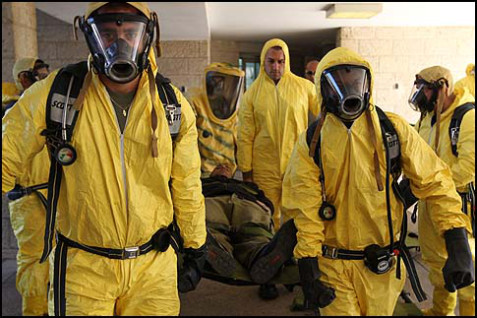
The border police run an exercise, while they train for chemical , biological or atomic. warfare. Feb 14 2011.  Photo by Nati Shohat/Flash90. *** Local Caption *** îâá éøåùìéí  àéîåï àáë çìéôåú îéâåï àéîåï úéøâåì úøâéì Israeli’s Border Police training for chemical, biological, and nuclear attacks. Photo Credit: Nati Shohat / Flash 90

IAEA head Yukiya Amano told reporters Monday that Syria has told the agency it would ship the higher-grade uranium abroad.

However, it is not clear where Syria would ship the higher-grade uranium — Iran is Syria’s closest ally – and neither is it clear what grade its uranium currently is.

**********************

The regime of Syrian President Bashar al-Assad has asked the United Nations International Atomic Energy Agency for help with a nuclear reactor near Damascus, international media agencies reported Tuesday.

The UN agency is studying the Syrian request to help convert the reactor, which currently runs on highly-enriched uranium, into one that uses lower grade nuclear fuel.

IAEA head Yukiya Amano told reporters Monday that Syria has told the agency it would ship the higher-grade uranium abroad.

However, it is not clear where Syria would ship the higher-grade uranium — Iran is Syria’s closest ally – and neither is it clear what grade its uranium currently is.

Low enriched uranium is defined as that which is enriched to less than five percent of fissile purity. Weapons quality uranium is enriched above 20 percent but that which is used to fuel an atomic bomb is enriched to 90 percent.

Amano said the IAEA is studying the request and has yet to make a decision.

Cartoon of the day

June 6, 2015

H/t You Viewed Editorial

cg556fbf6cdc16d

Harf ”perplexed” by NYT story on Iran’s increased nuclear stockpile

June 2, 2015

Harf ”perplexed” by NYT story on Iran’s increased nuclear stockpile, Washington Free Beacon via You Tube, June 2, 2015

(Please see also, Contrary to Obama’s claims, Iran increased its nuclear fuel stockpiles — DM)


Obama Assures Iran It Has Nothing to Fear

June 2, 2015

Obama Assures Iran It Has Nothing to Fear, Commentary Magazine, June 1, 2015

(Obama seems to have been talking about Iranian efforts to militarize nukes, not peaceful uses such as medical or generation of electricity. If, as claimed, Iran has no intention of getting, keeping or using nukes why try to halt it? Why bother even to negotiate?– DM)

“A military solution will not fix it. Even if the United States participates, it would temporarily slow down an Iranian nuclear program but it will not eliminate it.”

****************

At this point, there is virtually no one in Israel or the United States who thinks it is remotely possible that the Obama administration would ever, under virtually any circumstances, use force against Iran. Though President Obama and his foreign policy team have always claimed that “all options,” including force, are always on the table in the event that Iran refuses to back down and seeks to produce a nuclear weapon, that is a threat that few took seriously. But President Obama has never been quite as explicit about this before as he was in an interview with Israel’s Channel 2 in which he reportedly said there is no military option to stop Iran. If Obama wanted to telegraph Iran that it could be as tough as it likes in the talks over the final text of the nuclear deal being negotiated this month this statement certainly did the job. Though they had little worry about Obama’s toughness or resolve, the ayatollahs will be pleased to note that the president no longer even bothers to pretend he is prepared to do whatever is necessary to stop Iran’s nuclear ambition.

According to the Times of Israel, Obama said:

“A military solution will not fix it. Even if the United States participates, it would temporarily slow down an Iranian nuclear program but it will not eliminate it.”

Though he continued to use rhetoric that left force as an option, the implicit threat of American action if a nuclear weapon were a possibility has lacked credibility since the president began his second term. Once he embarked upon secret back-channel talks in which, one by one, he abandoned his previous pledges about forcing Iran to shut down its program in concessions and virtually every other U.S. position on the issue, force was never a real possibility. The signing of a weak interim deal in November, 2013, and then the framework agreed upon this spring signaled the end of any idea that the U.S. was prepared to act. That is especially so because the current deal leaves Tehran in possession of its nuclear infrastructure and with no guarantees about inspections or the re-imposition of sanctions in the event the agreement collapsed. The current deal, even with so many crucial details left unspecified makes Iran a U.S. partner and, in effect, the centerpiece of a new U.S. Middle East policy that essentially sidelines traditional allies like Saudi Arabia and Israel that are directly threatened by Iran.

Moreover, it must be conceded that the use of force against Iran would be problematic even for the United States and its vast military resources. As for Israel, despite a lot of bold talk by some in the Jewish state, there has always been skepticism that its outstanding air force had the ability to sustain an air campaign for the length of time that would be required to make a difference. Nevertheless, the notion that force would not be effective in forestalling an Iranian bomb is mistaken. Serious damage could put off the threat for a long time and, if sanctions were kept in place or made stricter as they should have been to strengthen the West’s bargaining position, the possibility of an Iranian nuke could have been put off for the foreseeable future.

Yet, while talk about using force has been largely obsolete once the interim deal was signed in 2013, for the president to send such a clear signal that he will not under any circumstances walk away from the current talks, no matter what Iran does, is significant.

After all, some of the most important elements of the deal have yet to be nailed down. Iran’s Supreme Leader, Grand Ayatollah Ali Khamenei has publicly stated that he will never allow the sort of inspections that would make a deal verifiable. He has also demanded that sanctions be lifted permanently on the day the agreement is signed, and that there should be no provision for them to be snapped back. Nor are the Iranians conceding that their stockpile of nuclear fuel be taken out of their hands.

So if Obama is to get the “verifiable tough agreement” he told Channel 2 he seeks, the U.S. must somehow convince the Iranians to back down on all these points. That’s going to be difficult since the past two years of negotiations with Obama have taught them to wait for him to give up since he always does so sooner or later. The president’s statement makes it clear that, no matter how obdurate the Iranians remain, he will never walk away from the talks. And since this deal is the lynchpin of his foreign policy legacy, they know very well that all they have to do is to be patient.

Iran already knows that the deal in its current form allows them two clear paths to a bomb. One is by cheating on its easily evaded terms. The other is by waiting patiently for it to expire, the sunset provision being another astonishing concession by Obama.

If a tough deal were even a possibility, this would have been the moment for the president to sound tough. But throughout this process, the only toughness the president has shown has been toward Israel as he sought to disparage and dismiss its justifiable worries about his course of action. Merely saying now, as he does in the Channel 2 interview, that he understands Israel’s fears is mere lip service, especially since it comes along with a virtual guarantee to Iran that it needn’t worry about a U.S. strike under any circumstance.

With only weeks to go until the June 30 deadline for an Iran deal, there is no question that Obama’s statement makes an unsatisfactory final text even more certain than it was before. That’s good news for Tehran and very bad news for an Israeli people who have no reason to trust the president’s promises or believe in his good intentions.

Top Iranian Negotiator: We Reached Solution with P5+1 on Site Inspection, But Khamenei Rejected It

May 28, 2015

Top Iranian Negotiator: We Reached Solution with P5+1 on Site Inspection, But Khamenei Rejected It, MEMRI-TV videos, May 28, 2015

In an Iranian TV interview, Iranian Deputy Foreign Minister Abbas Araqchi, who is Iran’s top nuclear negotiator, revealed that the Iranian negotiating team had reached possible solutions with the P5+1 on the issue of inspection of Iranian nuclear facilities, but that Iranian Supreme Leader Ali Khamenei had decisively rejected them. Inspection of the facilities is one of the key issues remaining in the nuclear talks. The interview aired on Iran’s Channel 2 TV on May 25.


Site inspections must be part of Iran deal: IAEA

May 27, 2015

Site inspections must be part of Iran deal: IAEA, Times of IsraelCECILE FEUILLATRE, May 27, 2015

(France’s foreign minister has also stated that France will not back any deal “unless it provided full access to all installations, including military sites.” – DM)

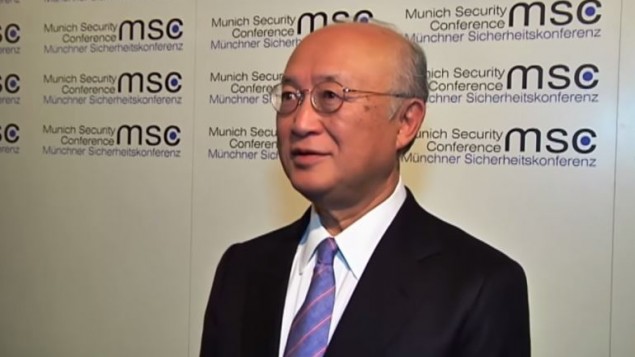
amino-e1432728404999-635x357Director-General of the International Atomic Energy Agency Yukiya Amano. (screen capture: YouTube/FRANCE 24 English)

UN nuclear agency chief Yukiya Amano says months needed to assess military aspects of Iranian nuclear sites.

PARIS, France (AFP) — If Iran signs a nuclear deal with world powers it will have to accept inspections of its military sites, the head of the UN’s atomic watchdog Yukiya Amano told AFP in an interview.

The question of inspections is shaping up to be one of the thorniest issues as world powers try to finalize a deal by June 30 to prevent Iran from developing a nuclear bomb.

Amano said Tehran has agreed to implementing the Additional Protocol of the Nuclear Non-Proliferation Treaty (NPT) that allows for snap inspections of its nuclear facilities, and if required, military sites.

However, differences have emerged over the interpretation of the protocol and the issue is far from resolved.

Iran’s supreme leader Ayatollah Ali Khamenei last week ruled out allowing nuclear inspectors to visit military sites or the questioning of scientists.

And Foreign Minister Mohammad Javad Zarif has said the protocol allows “some access” but not inspections of military sites, in order to protect national “military or economic secrets.”

In an interview with AFP and French daily Le Monde, Amano said that if a deal is reached, Iran will face the same inspections from the International Atomic Energy Agency (IAEA) as any of the 120 countries implementing the additional protocol.

“When we find inconsistency or when we have doubts we can request access to the undeclared location for example, and this could include military sites,” said the Japanese diplomat.

“Some consideration is needed because of the sensitiveness of the site, but the IAEA has the right to request access at all locations, including military ones.”

Iran and the so-called P5+1 group — Britain, China, France, Russia, the United States plus Germany — have been engaged for nearly two years in negotiations on Tehran’s nuclear drive.

The deal is aimed at preventing Iran from developing the atomic bomb in exchange for an easing of crippling economic sanctions.

The two sides signed a framework agreement on April 2 and began meeting in Vienna on Wednesday to start finalizing a deal which is due by June 30.

Possible military dimension

Iran has long asserted its nuclear program is for peaceful energy purposes, and that international concern about it seeking a nuclear bomb is misplaced.

According to the United States, Iran has agreed to cut the number of its centrifuges, used for enriching uranium, by two thirds from 19,000 to about 6,000, and will put excess nuclear equipment into storage monitored by the IAEA.

Iran has also reportedly agreed not to build any new facilities for enriching uranium for 15 years, cut back its stockpile of enriched uranium and mothball some of its plants.

However, Tehran is sensitive over the IAEA’s stringent oversight demands as the agency is at the same time trying to probe allegations that Iran tried to develop nuclear weapons prior to 2003, and possibly since.

Iran denies the allegations, saying they are based on hostile intelligence provided by the US Central Intelligence Agency (CIA) and Israel’s Mossad.

Western officials stress that these claims of “possible military dimensions” need to be cleared up before sanctions can be lifted, but the IAEA’s probe has been stalled since last August.

‘A huge operation’

Amano said that once there is a deal, “several months will be needed” to investigate whether there were any military dimensions to Iran’s research.

“It depends very much on the pace and the intensiveness of the cooperation from Iran. We have identified 12 areas to clarify.”

One notable area the IAEA is interested in is the Parchin military base, where they suspect tests relating to the development of nuclear weapons have taken place.

The IAEA has already visited the sprawling military base near Tehran but wants to return for another look.

Amano said it could take years “to give the credible assurance that all activities in Iran have a peaceful purpose”.

If a deal is reached with the P5+1, the IAEA will be charged with overseeing it and reporting back to the UN Security Council.

“This will be the most extensive safeguard operation of the IAEA. We need to prepare well, we need to plan well, it is a huge operation,” said Amano.

Currently the watchdog has between four and 10 inspectors in Iran at any given time, and if a deal is reached at least 10 will need to be on the ground daily.

The agency will also need to install cameras and seals on sensitive equipment.

Czechs stopped potential nuclear tech purchase by Iran

May 14, 2015

Czechs stopped potential nuclear tech purchase by Iran, Reuters via Ynet News, May 14, 2015

(But they won’t cheat after Obama gets his legacy deal. Right. — DM)

Czechs stopped potential nuclear tech purchase by Iran.UN report says Tehran attempted to buy centrifugal compressors from company in Czech Republic, using false documentation to hide destination of order.

UNITED NATIONS/PRAGUE – The Czech Republic blocked an attempted purchase by Iran this year of a large shipment of sensitive technology useable for nuclear enrichment after false documentation raised suspicions, UN experts and Western sources said.

The incident could add to Western concerns about whether Tehran can be trusted to adhere to a nuclear deal being negotiated with world powers under which it would curb sensitive nuclear work in exchange for sanctions relief.

The negotiators are trying to reach a deal by the end of June after hammering out a preliminary agreement on April 2, with Iran committing to reduce the number of centrifuges it operates and agreeing to other long-term nuclear limitations.

562262409915100640360noNuclear plant in Iran’s Bushehr (Photo: Reuters)

Some details of the attempted purchase were described in the latest annual report of an expert panel for the United Nations Security Council’s Iran sanctions committee, which has been seen by Reuters.

The panel said that in January Iran attempted to buy compressors – which have nuclear and non-nuclear applications – made by the US-owned company Howden CKD Compressors.

A Czech state official and a Western diplomat familiar with the case confirmed to Reuters that Iran had attempted to buy the shipment from Howden CKD in the Czech Republic, and that Czech authorities had acted to block the deal.

It was not clear if any intermediaries were involved in the attempt to acquire the machinery.

There was no suggestion that Howden CKD itself was involved in any wrongdoing. Officials at Prague-based Howden declined to comment on the attempted purchase.

The UN panel, which monitors compliance with the UN sanctions regime, said there had been a “false end user” stated for the order.

“The procurer and transport company involved in the deal had provided false documentation in order to hide the origins, movement and destination of the consignment with the intention of bypassing export controls and sanctions,” it added.

The report offered no further details about the attempted transaction. Iran’s UN mission did not respond to a query about the report.

Contract worth $61 million

The Czech state official said the party seeking the compressors had claimed the machinery was needed for a compressor station, such as the kind used to transport natural gas from one relay station to another.

The official declined to say exactly how the transaction was stopped, provide specifications of the compressors or confirm the intended purchaser. However, he made clear it was the Czech authorities who halted the deal

The official, who spoke on condition of anonymity, said the total value of the contract would have been about 1.5 billion Czech koruna ($61 million).

This was a huge amount for the company concerned, the previously named CKD Kompresory, a leading supplier of multi-stage centrifugal compressors to the oil and gas, petrochemical and other industries.

The firm was acquired by Colfax Corp. of the United States in 2013 for $69.4 million. A spokesman for Colfax declined to comment.

The United States and its Western allies say Iran continues to try to skirt international sanctions on its atomic and missile programs even while negotiating the nuclear deal.

The UN panel of experts also noted in its report that Britain informed it of an active Iranian nuclear procurement network linked to blacklisted firms.

While compressors have non-nuclear applications in the oil and gas industry, they also have nuclear uses, including in centrifuge cascades. Centrifuges purify uranium gas fed into them for use as fuel in nuclear reactors or weapons, if purified to levels of around 90 percent of the fissile isotope uranium-235.

“Such compressors can be used to extract enriched uranium directly from the cascades,” Olli Heinonen, former deputy director-general of the International Atomic Energy Agency and a nuclear expert currently at Harvard University, told Reuters.

“In particular, they are useful when working with higher enrichment such as 20 percent enriched uranium,” he said, adding that precise specifications of the compressors in question would be necessary to make a definitive assessment.

Iran has frozen production of 20 percent enriched uranium, a move that Western officials cite as one of the most important curbs on Iranian nuclear activities under an interim agreement in 2013.

Tehran rejects allegations by Western powers and their allies that it is seeking the capability to produce atomic weapons and says its nuclear program is for peaceful purposes.

The IAEA and the United States have said repeatedly that Tehran has adhered to the terms of the 2013 interim deal.


An EMP attack on America seems likely

April 19, 2015

An EMP attack on America seems likely, Dan Miller’s Blog, April 19, 2015

(The views expressed in this article are mine and do not necessarily reflect those of Warsclerotic or any of its other editors. — DM)

Some consider North Korea to be the rogue nation most likely to use an electromagnetic pulse (EMP) to attack America; Iran is also seen as quite likely to do it. It matters little which succeeds.

Here is a lengthy 2013 video about an EMP attack, what would happen and why:

The possibilities and consequences of an EMP attack on America are too horrific to contemplate; the “legitimate news media” generally ignore them. We therefore tend to relegate them to the realm of remote “tin foil hat conspiracy theories” and to focus instead on more congenial stuff — the latest sex scandal, Hillary Clinton’s campaign van parking in a disabled-only space and other matters unlikely to impact America to an extent even approaching that of an EMP attack. Meanwhile, most of “our” Congress Critters, who should know better, focus on opinion polls, filling their campaign coffers and getting richer personally while neglecting our atrophying missile defense systems and other potential means of avoiding or recovering from an EMP attack.

Here is a 2013 video about the likelihood of an Iranian EMP attack on America that would paralyze the country for a very long time.

North Korea and the Islamic Republic of Iran have long cooperated in the development of nukes and means to deliver them. I wrote about their cooperation here, herehere and elsewhere. It now appears that Iran intends to use them for an EMP attack on America.

The issue of a nuclear EMP attack was raised in the final hours of this week’s elections in Israel when U.S. authority Peter Vincent Pry penned a column for Arutz Sheva warning of Iran’s threat to free nations.

“Iranian military documents describe such a scenario — including a recently translated Iranian military textbook that endorses nuclear EMP attack against the United States,” he wrote. [Emphasis added.]

Here is a March 7, 2015 video about the impact of the P5+1 “negotiations” on Iran getting (or keeping) nukes and the likelihood of an Iranian EMP attack on America:

In April of this year, John Bolton had this to say about the Iran – North Korea connection, how much we don’t know and the ongoing P5+1 “negotiations.”

Perhaps Israel can take out Iran’s nuke capabilities.

Here is a February 2015 video about what’s (not) being done to harden our domestic power grid:

As of February of this year, Govtrack US opined that the chances of passage of the SHIELD act were zero percent. Be that as it may, simply hardening the power grid would not solve communications or transport problems — most modern communications devices, as well as vehicles built after 1987, depend on computer chips and, when the chips are fried, will not function. Even if food and water could be processed, getting them to consumers in sufficient quantities to keep them alive would be an enormous if not impossible task.

Problems of a human nature would also arise and remaining alive would be difficult. If one’s family were about to starve, how many would try to steal food and water from those who still have even enough for a few days? How many roving gangs of armed criminals, quite willing to kill, would do the same? The police would likely have no communications ability and might well be otherwise occupied, tending to their own families. Military forces not confined to base would likely have the same problems and be doing the same.

That suggests another problem in restoring infrastructure seriously damaged or destroyed by the EMP attack. It would not only require the availability of transport, communications and undamaged equipment. It would also require the availability of personnel, not otherwise occupied in scrounging for food, water, medical supplies and other resources to care for their own families, while protecting them from those lacking such resources, as well as from armed gangs.

Now, the U.S. military is taking steps to protect itself by reopening a cold war bunker at Cheyenne Mountain, abandoned in 2006.

Cheyene Mt. Complex

Cheyene Mt. Complex

The Pentagon last week [early April 2015] announced a $700 million contract with Raytheon Corporation to oversee the work for North American Aerospace Command (NORAD) and US Northern Command.

Admiral William Gortney, head of NORAD and Northern Command, said that ‘because of the very nature of the way that Cheyenne Mountain’s built, it’s EMP-hardened.’

. . . .

‘And so, there’s a lot of movement to put capability into Cheyenne Mountain and to be able to communicate in there,’ Gortney told reporters.

‘My primary concern was… are we going to have the space inside the mountain for everybody who wants to move in there, and I’m not at liberty to discuss who’s moving in there,‘ he said.  [Emphasis added.]

The Cheyenne mountain bunker is a half-acre cavern carved into a mountain in the 1960s that was designed to withstand a Soviet nuclear attack. From inside the massive complex, airmen were poised to send warnings that could trigger the launch of nuclear missiles.

But in 2006, officials decided to move the headquarters of NORAD and US Northern Command from Cheyenne to Petersen Air Force base in Colorado Springs. The Cheyenne bunker was designated as an alternative command center if needed.

Now the Pentagon is looking at shifting communications gear to the Cheyenne bunker, officials said.

‘A lot of the back office communications is being moved there,’ said one defense official.

Officials said the military’s dependence on computer networks and digital communications makes it much more vulnerable to an electromagnetic pulse, which can occur naturally or result from a high-altitude nuclear explosion.

Under the 10-year contract, Raytheon is supposed to deliver ‘sustainment’ services to help the military perform ‘accurate, timely and unambiguous warning and attack assessment of air, missile and space threats’ at the Cheyenne and Petersen bases.

Raytheon’s contract also involves unspecified work at Vandenberg Air Force Base in California and Offutt Air Force Base in Nebraska.

When will the site be fully operational, for what and who will be allowed to go there?

Some other military bases are probably being hardened, at least to an extent that might (or might not) preserve their electrical grids. If it works, they may serve as refugee centers for adjacent civilian populations. However, the military installations would likely run out of food and potable water before very long and, with food and water processing centers no longer operational, there would be substantial difficulties in getting — as well as transporting — large quantities of food and water. Were the processing centers to become operational, transportaion difficulties would remain. Communications between the military installations and the outside world? Likely zilch, at least initially, because radios, telephones and other modern communications devices (as most now are) depend on computer chips and would be fried by an EMP attack. Some might eventually be restored at some military bases, but that is not likely to be the case with those not on those bases.

Conclusions

What would you do in the event of an EMP attack? In a major metropolitan area, you would probably be SOL very quickly. In a small town? Marginally but not much better off. An isolated small farm, close to a mountain spring and adequately stocked with food, medical supplies, firearms and ammunition, could provide reason to hope that you might eventually be able to grow or slaughter sufficient food and have access to enough potable water to survive; at least until roving armed gangs arrive and overpower you.

This video is about a massive world-wide pandemic. In the event of a pandemic, electricity, automobiles and communications would still function, at least for a while. Following an EMP attack, the consequences would likely be substantially worse and last far longer.

Here is a link to a novel about one family in a small city and its efforts to survive an EMP attack on America. It does a reasonable job of summarizing the potential consequences.

Verifying Iran Nuclear Deal Not Possible, Experts Say

April 6, 2015

Verifying Iran Nuclear Deal Not Possible, Experts Say

Past Iranian cheating to be codified by future accord

BY:
April 6, 2015 5:00 am

via Verifying Iran Nuclear Deal Not Possible, Experts Say | Washington Free Beacon.


Despite promises by President Obama that Iranian cheating on a new treaty will be detected, verifying Tehran’s compliance with a future nuclear accord will be very difficult if not impossible, arms experts say.

“The Joint Comprehensive Plan of Action will not be effectively verifiable,” said Paula DeSutter, assistant secretary of state for verification, compliance, and implementation from 2002 to 2009.

Obama said Saturday that the framework nuclear deal reached in Switzerland would provide “unprecedented verification.”

International inspectors “will have unprecedented access to Iran’s nuclear program because Iran will face more inspections than any other country in the world,” he said in a Saturday radio address.

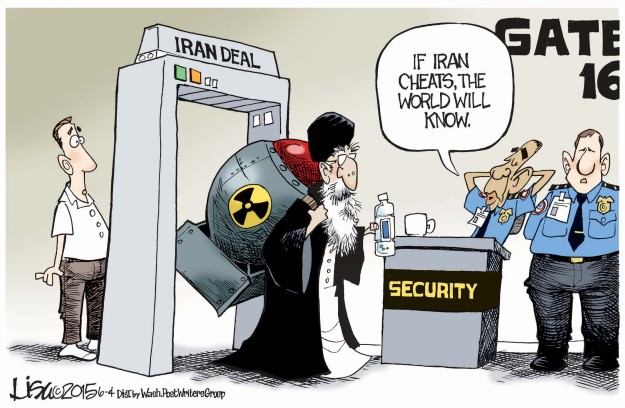
“If Iran cheats, the world will know it,” Obama said. “If we see something suspicious, we will inspect it. So this deal is not based on trust, it’s based on unprecedented verification.”

But arms control experts challenged the administration’s assertions that a final deal to be hammered out in detail between now and June can be verified, based on Iran’s past cheating and the failure of similar arms verification procedures.

A White House fact sheet on the outline of the future agreement states that the new accord will not require Iran to dismantle centrifuges, or to remove stockpiled nuclear material from the country or convert such material into less dangerous fuel rods.

The agreement also would permit continued nuclear research at facilities built in violation of the Nuclear Non-Proliferation Treaty (NPT), which Iran signed in 1970 but has violated repeatedly since at least the early 2000s.

The centerpiece for verifying Iranian compliance will be a document called the Additional Protocol of the International Atomic Energy Agency (IAEA), according to the White House.

However, the State Department’s most recent report on arms compliance, made public in July, states that Iran signed an IAEA Additional Protocol in 2003 but “implemented it provisionally and selectively from 2003 to 2006,” when Tehran stopped complying altogether.

“The framework claims that Iran will once again execute an Additional Protocol with IAEA,” said William R. Harris, an international lawyer who formerly took part in drafting and verifying U.S. arms control agreements. “This might yield unprecedented verification opportunities, but can the international community count on faithful implementation?”

Harris also said Iran could cheat by shipping secretly built nuclear arms to North Korea, based on published reports indicating Iran co-financed North Korea’s nuclear tests, and that Iranian ballistic missile test signals reportedly showed “earmarks” of North Korean guidance systems.

“So what would prevent storage of Iranian nuclear weapons at underground North Korean sites?” he asked. “If there is to be full-scope inspection in Iran, the incentives for extraterritorial R&D and storage increase.”

U.S. intelligence agencies, which will be called on to verify the agreement, also have a spotty record for estimating foreign arms programs. After erroneously claiming Iraq had large stocks of weapons of mass destruction, the intelligence community produced a 2007 National Intelligence Estimate that falsely concluded that Iran halted work on nuclear weapons in 2003.

The IAEA, in a restricted 2011 report, contradicted the estimate by stating that Iran continued nuclear arms work past 2003, including work on computer modeling used in building nuclear warheads.

White House officials who briefed reporters last week on the new framework agreement said the key to verification of the future pact will be the new IAEA protocol. The protocol will provide greater access and information on the Iranian nuclear program, including its hidden and secret sites, they said.

The nuclear facilities at Fordow, an underground facility where centrifuges will be removed, and Natanz, another major centrifuge facility, were both built in violation of the NPT and will not be dismantled.

Additionally, the nuclear facility at Parchin, where Iran is believed to have carried out most of its nuclear weapons work, is not mentioned in any of the fact sheets by name.

The sole reference to Iran’s work on nuclear arms is the reference in the fact sheet to a requirement that Iran address “the possible military dimensions” of its nuclear program.

Officials who briefed reporters also said that under the new agreement inspectors would have access to Iran’s nuclear “supply chain”—the covert system used to circumvent global sanctions and procure materials and equipment.

DeSutter, the former State Department arms verification official, said the transparency measures announced after talks in Lausanne, Switzerland, on Thursday at best could detect quantitative excesses at known locations, but not secret illegal activities, like those that Iran carried out on a large scale in violation of its obligations under the NPT.

The transparency regime for the new deal also will “undermine the already challenging verifiability of the Nuclear Nonproliferation Treaty by legitimizing Iran’s illegal enrichment and reprocessing programs,” DeSutter said.

Thomas Moore, former professional staff member of the Senate Foreign Relations Committee who specialized in arms control matters, also said Iran’s past cheating on the NPT makes verifying a new agreement nearly impossible.

Iran, in its statement on the framework, also denied it would sign a new IAEA protocol. Tehran said of the protocol that it will be implemented on a “voluntary and temporary basis” for transparency and confidence-building.

The imprecise language is a sign “Iran is keeping its weapon option open but refuses required openness to confirm it no longer wants one,” Moore said.

“Iran would not divert centrifuges or the material they make from a declared site,” Moore said. “Rather, it will instead cheat at an undeclared site.”

Because Iran will not ratify the new protocol, the IAEA will be unable to verify the completeness and correctness of Iran’s declarations, Moore said, both declared and undeclared materials and activities.

Iran is already the single most IAEA-inspected nation in the world and additional IAEA inspections are not expected to be better, although Iran’s nuclear expertise will grow, he added.

“The deal is silent on Iran’s actual military dimensions, except to the extent that its supporters claim the IAEA will be able to verify the absence of a weapons program in Iran. They won’t,” Moore said.

“Contrary to the imprecise political rhetoric, this deal does not yet contain the ‘most intrusive’ inspections ever tried,” he said.

David S. Sullivan, a former CIA arms verification specialist and also a former Senate Foreign Relations Committee arms expert, said confirming Iran’s compliance with new nuclear obligations will be difficult.

“U.S. national technical means of verification is always difficult, fraught with the political process of monitoring, collecting, analyzing, and [achieving] consensus on usually ambiguous evidence of cheating that opponents are trying to hide,” Sullivan said.

“These difficulties are even greater for the UN’s IAEA, which is a multinational political agency.”

Past cheating by Iran, confirmed as recently as July 2014 raised questions about why there are negotiations with Tehran, Sullivan said.

“Why are we negotiating for a new agreement, when existing Iranian NPT violations remain in effect, ongoing, and unresolved, suggesting that Iran is unlikely to comply with any new agreement?” Sullivan said.

“Iran alarmingly is officially within three months of having nuclear warheads, according to the international negotiators, and is therefore about to become another nuclear-armed North Korea,” he said, noting that Pyongyang also cheated on the NPT and now has nuclear-tipped missiles.

By not requiring Iran to correct past violations of the NPT, the new agreement will in effect codify its current cheating. “The negotiations started as an attempt to stop Iran’s nuclear weapons program, but now they have legitimized it,” Sullivan said