Posted tagged ‘human rights’

UK: Politicians Urge Ban on the Term “Islamic State”

July 4, 2015

UK: Politicians Urge Ban on the Term “Islamic State,” The Gatestone InstituteSoeren Kern, July 4, 2015

  • “If we deny any connection between terrorism and religion, then we are saying there is no problem in any of the mosques; that there is nothing in the religious texts that is capable of being twisted or misunderstood; that there are no religious leaders whipping up hatred of the West, no perverting of religious belief for political ends.” — Boris Johnson, Mayor of London.
  • “O Muslims, Islam was never for a day the religion of peace. Islam is the religion of war… Mohammed was ordered to wage war until Allah is worshipped alone… He himself left to fight and took part in dozens of battles. He never for a day grew tired of war. — Abu Bakr al-Baghdadi, leader of the Islamic State.
  • While Western politicians claim that the Islamic State is not Islamic, millions of Muslims around the world — referring to what is approved in the Islamic texts — believe that it is.

The BBC has rejected demands by British lawmakers to stop using the term “Islamic State” when referring to the jihadist group that is carving out a self-declared Caliphate in the Middle East.

Lord Hall of Birkenhead, the BBC’s director general, said that the proposed alternative, “Daesh,” is pejorative and using it would be unfair to the Islamic State, thereby casting doubt upon the BBC’s impartiality.

Prime Minister David Cameron recently joined the growing chorus of British politicians who argue that the name “Islamic State” is offensive to Muslims and should be banned from the English vocabulary.

During an interview with BBC Radio 4’s “Today” program on June 29 — just days after a jihadist with links to the Islamic State killed 38 people (including 30 Britons) at a beach resort in Tunisia — Cameron rebuked veteran presenter John Humphrys for referring to the Islamic State by its name.

When Humphrys asked Cameron whether he regarded the Islamic State to be an existential threat, Cameron said:

“I wish the BBC would stop calling it ‘Islamic State’ because it is not an Islamic state. What it is is an appalling, barbarous regime. It is a perversion of the religion of Islam, and, you know, many Muslims listening to this program will recoil every time they hear the words ‘Islamic State.'”

Humphrys responded by pointing out that the group calls itself the Islamic State (al-Dawlah al-Islamiyah, Arabic for Islamic State), but he added that perhaps the BBC could use a modifier such as “so-called” in front of that name.

Cameron replied: “‘So-called’ or ISIL [the acronym for Islamic State of Iraq and the Levant] is better.” He continued:

“But it is an existential threat, because what is happening here is the perversion of a great religion, and the creation of this poisonous death cult, that is seducing too many young minds, in Europe, in America, in the Middle East and elsewhere.

“And this is, I think, going to be the struggle of our generation. We have to fight it with everything that we can.”

Later that day in the House of Commons, Cameron repeated his position. Addressing Cameron, Scottish National Party MP Angus Robertson said that the English-speaking world should adopt Daesh, the Arabic name for the Islamic State, as the proper term.

Daesh, which translates as Islamic State of Iraq and Sham (Syria), is the Arabic equivalent to ISIL. Daesh sounds similar to the Arabic word “Daes,” which means “one who crushes something underfoot,” and “Dahes,” which means “one who sows discord.” As a result of this play on words, Daesh has become a derogatory name for the Islamic State, and its leaders have threatened to “cut the tongue” of anyone who uses the word in public.

Robertson said:

“You are right to highlight the longer-term challenge of extremism and of radicalization. You have pointed out the importance of getting terminology right and not using the name ‘Islamic State.’ Will you join parliamentarians across this house, the US secretary of state and the French foreign minister in using the appropriate term?

“Do you agree the time has come in the English-speaking world to stop using Islamic State, ISIS or ISIL and instead we and our media should use Daesh — the commonly used phrase across the Middle East?”

Cameron replied:

“I agree with you in terms of the use of Islamic State. I think this is seen as particularly offensive to many Muslims who see, as I see, not a state but a barbaric regime of terrorism and oppression that takes delight in murder and oppressing women, and murdering people because they’re gay. I raised this with the BBC this morning.

“I personally think that using the term ‘ISIL’ or ‘so-called’ would be better than what they currently do. I don’t think we’ll move them all the way to Daesh so I think saying ISIL is probably better than Islamic State because it is neither in my view Islamic nor a state.”

Separately, more than 100 MPs signed a June 25 letter to the BBC’s director general calling on the broadcaster to begin using the term Daesh when referring to the Islamic State. The letter, which was drafted by Rehman Chishti, a Pakistani-born Conservative MP, stated:

“The use of the titles: Islamic State, ISIL and ISIS gives legitimacy to a terrorist organization that is not Islamic nor has it been recognized as a state and which a vast majority of Muslims around the world finds despicable and insulting to their peaceful religion.”

Scottish Nation Party MP Alex Salmond, in a June 29 newspaper column, wrote:

“We should start by understanding that in a propaganda war language is crucial.

“Any description of terrorists which confers on them the image that they are representing either a religion or a state must surely be wrong and an own goal of massive proportions. It is after all how they wish to refer to themselves.

“Daesh, sometimes spelled Daiish or Da’esh, is short for Dawlat al Islamiyah fi’al Iraq wa al Sham.

“Many Arabic-speaking media organizations refer to the group as such and there is an argument it is appropriately pejorative, deriving from a mixture of rough translations from the individual Arabic words.

“However, the real point of using Daesh is that it separates the terrorists from the religion they claim to represent and from the false dream of a new caliphate that they claim to pursue.

“It should become the official policy of the government and be followed by the broadcasting organizations.”

The BBC, which routinely refers to Muslims as “Asians” to comply with the politically correct norms of British multiculturalism, has held its ground. It said:

“No one listening to our reporting could be in any doubt what kind of organization this is. We call the group by the name it uses itself, and regularly review our approach. We also use additional descriptions to help make it clear we are referring to the group as they refer to themselves, such as ‘so-called Islamic State.'”

The presenter of the BBC’s “The World This Weekend” radio program, Mark Mardell, added:

“It seems to me, once we start passing comment on the accuracy of the names people call their organizations, we will constantly be expected to make value judgements. Is China really a ‘People’s Republic?’ After the Scottish referendum, is the UK only the ‘so-called United Kingdom?’ With the Greek debacle, there is not much sign of ‘European Union.'”

London Mayor Boris Johnson believes both viewpoints are valid. In a June 28 opinion article published by the Telegraph, he wrote:

“Rehman’s point is that if you call it Islamic State you are playing their game; you are dignifying their criminal and barbaric behavior; you are giving them a propaganda boost that they don’t deserve, especially in the eyes of some impressionable young Muslims. He wants us all to drop the terms, in favor of more derogatory names such as “Daesh” or “Faesh,” and his point deserves a wider hearing.

“But then there are others who would go much further, and strip out any reference to the words “Muslim” or “Islam” in the discussion of this kind of terrorism — and here I am afraid I disagree….

“Why do we seem to taint a whole religion by association with a violent minority? …

“Well, I am afraid there are two broad reasons why some such association is inevitable. The first is a simple point of language, and the need to use terms that everyone can readily grasp. It is very difficult to bleach out all reference to Islam or Muslim from discussion of this kind of terror, because we have to pinpoint what we are actually talking about. It turns out that there is virtually no word to describe an Islamically-inspired terrorist that is not in some way prejudicial, at least to Muslim ears.

“You can’t say “Salafist,” because there are many law-abiding and peaceful Salafists. You can’t say jihadi, because jihad — the idea of struggle — is a central concept of Islam, and doesn’t necessarily involve violence; indeed, you can be engaged in a jihad against your own moral weakness. The only word that seems to carry general support among Muslim leaders is Kharijite — which means a heretic — and which is not, to put it mildly, a word in general use among the British public.

“We can’t just call it “terrorism”, as some have suggested, because we need to distinguish it from any other type of terrorism — whether animal rights terrorists or Sendero Luminoso Marxists. We need to speak plainly, to call a spade a spade. We can’t censor the use of “Muslim” or “Islamic.”

“That just lets too many people off the hook. If we deny any connection between terrorism and religion, then we are saying there is no problem in any of the mosques; that there is nothing in the religious texts that is capable of being twisted or misunderstood; that there are no religious leaders whipping up hatred of the west, no perverting of religious belief for political ends.”

What does the leader of the Islamic State, Abu Bakr al-Baghdadi, have to say? In a May 2015 audio message, he summed it up this way:

“O Muslims, Islam was never for a day the religion of peace. Islam is the religion of war. Your Prophet (peace be upon him) was dispatched with the sword as a mercy to the creation. He was ordered to wage war until Allah is worshipped alone. He (peace be upon him) said to the polytheists of his people, ‘I came to you with slaughter.’ He fought both the Arabs and non-Arabs in all their various colors. He himself left to fight and took part in dozens of battles. He never for a day grew tired of war.

“So there is no excuse for any Muslim who is capable of performing hijrah [migration] to the Islamic State, or capable of carrying a weapon where he is, for Allah (the Blessed and Exalted) has commanded him with hijrah and jihad, and has made fighting obligatory upon him.”
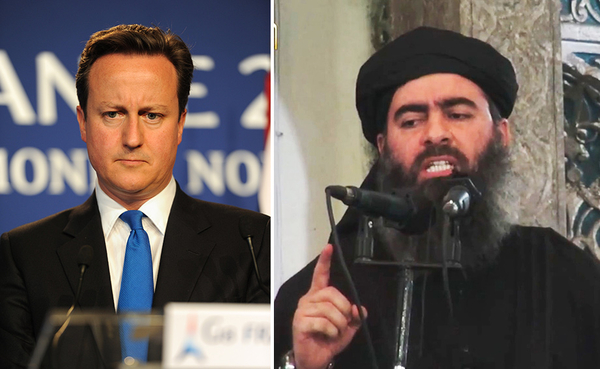
1139Britain’s Prime Minister David Cameron (L) says of the Islamic State, “Islam is a religion of peace. They are not Muslims, they are monsters.” Abu Bakr al-Baghdadi (R), leader of the Islamic State, say, “Islam was never for a day the religion of peace. Islam is the religion of war. Your Prophet (peace be upon him) was dispatched with the sword as a mercy to the creation.”

While Western politicians claim that the Islamic State is not Islamic, millions of Muslims around the world — referring to what is approved in the Islamic texts — believe that it is. While the former are performing politically correct linguistic gymnastics, the latter are planning their next religiously-inspired attacks against the West. A new twist on an old English adage: The sword is mightier than the pen.

Leftist and Islamic Policymakers Outlaw the Truth

July 4, 2015

Leftist and Islamic Policymakers Outlaw the Truth, American ThinkerSonia Bailley, July 4, 2015

No need to worry, the recent Ramadan triple slaughter fest in Tunisia, France and Kuwait has nothing to do with Islam.  There is no linkage between Islam and terrorism, and the word Islamic need not be used to describe the terrorists because their murderous and barbaric ideology has nothing to do with Islam.  Islam is, after all, a religion of peace that is being hijacked, perverted and distorted by only a small percentage of savage extremists.  

Welcome to the false narrative that Western leaders, mainstream media outlets, and academic elites are enforcing on civil society to help shape the public’s perception of Islam so that it is always presented in a positive light.  Any form of expression that reflects badly on Islam is in violation of Islamic law, which forbids any criticism of Islam, even what that criticism expresses the truth.  Stories that are reported according to this narrative need not have anything to do with factual accuracy or truth.  Both the 2009 Fort Hood massacre in Texas and the beheading in Vaughan Foods in Oklahoma last September were reported as workplace violence and not Islamic terrorism.

With the aid of leftist and Islamic policymakers shaping the course of international relations and security policies, that false narrative is finding its way into international policy to destroy the West’s hard-won, cherished core values.  Realities and facts that might tarnish Islam’s name are deemed hate speech and becoming lost through censorship. The 57-state Organization for Security and Co-operation in Europe (OSCE), which is the world’s largest security-oriented intergovernmental organization that happens to be rooted in communism, and the 57-state Organization of the Islamic Cooperation (OIC), which is the most influential and largest Muslim organization in the world pushing to criminalize any criticism of Islam, are two such policymakers who are influencing world leaders and the news media.

Most Western world leaders are bleating the same empty platitudes about the recent Ramadan terrorist attacks in Tunisia, France and Kuwait, carefully avoiding the word “Islam.”  UK Prime Minister David Cameron explained to the media that Islam is a religion of peace, and that the terrorists who “do these things…do it in the name of a twisted and perverted ideology.” When asked if it’s right to say that the recent Ramadan attacks have nothing to do with Islam, UK Home Secretary Theresa May responded to BBC’s Andrew Marr in the positive, “that it has nothing to do with Islam. Islam is a peaceful religion,” and that the terror attacks are “about a perversion of Islam.”

Instead of issuing travel warnings not to vacation in Islamic countries especially during Ramadan, the Islamic “sacred” month of feasting — a month rife with bloodshed and battle since Islam’s inception, when armed raids on Meccan trade caravans and bloody battles were waged by Mohammed and his followers (including the 1973 Yom Kippur War on the 10th of Ramadan), not to mention the ISIS Ramadan message that jihad is 10 times more obligatory during Ramadan, and that those who die will be rewarded by Allah ten times more than during the rest of the year — Western leaders like Cameron continue to nourish the official politically correct narrative of Islam being a religion of peace not linked to terrorism.

The twisted and perverted ideology to which both Cameron and May refer, pervades pages and pages of the Koran and other Islamic doctrine, inspiring jihadists and religious Muslims to “do these things,” including operating child sex slave grooming gangs throughout Europe, especially in the UK, to rape, pimp, torture and sometimes kill non-Muslim underage schoolgirls.  The Koran itself contains over 100 verses  promoting violence against non-Muslims who, to this very day, remain victims of the verse.

What lies at the heart of Islam is an antipathy towards non-Muslims, as well as a deeply-entrenched duty and commandment from Allah to wage Jihad and eventually subjugate non-Muslims worldwide to Islamic rule in the name of Allah.  Massive street prayer is one form of subjugation conducted only to intimidate and Islamize Western society, to remind non-Muslims who’s really in control. Similarly, forcing non-Muslims in their own countries, in the UK for example, to eat halal slaughtered meat — an utterly inhumane and barbaric Islamic practice, not to mention a multi-billion dollar industry controlled by Muslim Brotherhood organizations that fund jihad worldwide — when only a mere 5% of the UK population is Muslim, and when the Koran specifically exempts its followers from eating halal if it’s not available, is another way to subjugate non-Muslims.

People are becoming sitting duck targets for Islamic terrorists in Western countries and abroad because of the little-known but powerful world policymakers like the OSCE and OIC who influence world leaders to kowtow to Islamic interests.  Western leaders fail to convey an accurate picture and understanding of what is really going on in the world because it might reflect badly on Islam, and they don’t want to appear “Islamophobic” for fear of more terrorist attacks.  By failing to report the truth, they are denying citizens the opportunity to take appropriate action that could save their lives when faced with something that could be considered a threat, such as a beach vacation in an Islamic country over Ramadan.

The dead European tourists in Tunisia might still be here today had there been an undistorted flow of information to warn them that warfare and killing in the name of Islam are encouraged during the month of Ramadan.  Furthermore, people might choose to avoid Islamic countries at all times if they were aware that these countries rely upon the most non-liberal draconian and barbaric Islamic or sharia-based corporal punishments imaginable.

The anti-blasphemy narrative pushed by the highly influential but little-known OIC, ehich speaks on behalf of over 1.5 billion Muslims worldwide, not only silences any expression considered to be offensive and insulting to Islam, but punishes the offenders, as Mohammed did to his dissenters and insulters.  They were either condemned to hell or killed.  Because Muslims consider Mohammed as the ideal model for mankind to follow, many Islamic countries such as Pakistan, Saudi Arabia and Iran, have also made blasphemy subject to the death penalty with their anti-blasphemy laws.

It is this anti-blasphemy law that the OIC is striving to legally enforce on the world in order to curtail speech and expression when it comes to Islam — not so much for religious compliance as for the global subjugation of non-Muslims to Islam.  Since 2005, the OIC has been pushing relentlessly for a UN blasphemy resolution (Resolution 16/18 passed in 2011) to silence so-called Islamophobia — a term deliberately coined and marketed in the 1990s by the International Institute of Islamic Thought, one of the thousands of Muslim Brotherhood front groups worldwide, to drive public discourse and policy.  However, the OIC’s top priority is to globally criminalize any criticism of Islam, and is working with the Muslim Brotherhood to accomplish this. Ten years later, in 2015, telling the truth about Islam has become a crime in some European countries.

The highly influential yet little-known OSCE that is rooted in communism, is supposed to protect and promote civil liberties.  Instead, it is negotiating them away by capitulating to the OIC narrative of the Muslim Brotherhood, whose stated goal from the 1990s is to destroy Western civilization from within.  Its goal of global domination is to be accomplished not through violence, at least not yet, but rather through the slow infiltration of Western government, military, judicial and academic institutions.

So far, there has been practically no opposition from  any Western administration in power, only cooperation from world leaders, government officials, and leftist policymakers.  In fact, the cooperation from Western leaders with OSCE and OIC policymakers has been so great, that the U.S. co-sponsored Resolution 16/18 with Pakistan, and helped usher it through in 2011, despite this resolution being a direct assault on the First Amendment of the U.S. Constitution.

At an OSCE May session in Vienna (on how the media can help prevent violent radicalization that leads to terrorism), OSCE panelist Leila Ghandi, producer and TV show host on the most popular Moroccan TV channel (2MTV) that is over 60% government-owned, maintained that the truth or facts about “a community” can sometimes constitute hate speech when those facts are offensive and therefore should not be said.  The panelist’s words echo those of the new OIC Secretary General, Iyad Amin Madani, who tweeted earlier this year following the Charlie Hebdo terrorist attack in Paris, that “freedom of speech must not become a hate speech and must not offend others.”  In other words, truth about Islam is designated as hate speech.

Furthermore, OSCE panelist Victor Khroul, correspondent for Rossiya Segodnya, a Russian state-owned international news agency, questions why the mainstream media throughout the world still refer to the “self-proclaimed self-established state in the Middle East” as the Islamic State. His words echo those of Madani, who proclaimed last year that the Islamic State has no connection with Islam.  Khroul claims it’s a mistake for these people to be called Muslim and their state Islamic, which only “confuses the audience with this correlation with Islam.”  He maintains that it’s still possible “to find other words to describe this so-called state and its activity,” discounting the facts that Islamic State is what ISIS named itself and its state, and that ISIS clearly credits its motivation to Islam and its acts to Allah. The name Islamic State does not have to be rectified because it accurately reflects reality, defines the organization in question, and is therefore a correct term that would sit well in the world of Confucius and his doctrine on rectifying names.

Major Stephen Coughlin, an attorney, former U.S. Army intelligence officer, and the Pentagon’s leading expert on Islamic law and jihad (until he was dismissed in 2008 for linking Islam with terrorism with his Red Pill Briefings), stresses the urgency of defining the enemy as he defines himself:  “you cannot target what you will not define…if I can’t use the concepts of Jihad that Al-Qaeda say they rely on, then I can’t understand what they are going to do.”

Author of Catastrophic Failure: Blindfolding America in the Face of Jihad, Coughlin attended the OSCE May session and responded to the OSCE jargon as follows:

“Once you decide that facts on the ground as they present themselves, can be considered hate speech, this is no longer about truth…you are subordinating facts that the public has a right to know when they formulate their decisions, and replacing them with narratives to keep them from coming to the understanding of events that can be articulated and verified.  That can never be considered hate speech. We’re not talking about speech at all. We’re talking about brazen disinformation.”

Rather than disseminate vital information to the public that can save lives, Western world leaders are betraying their citizens by submitting to the OSCE and OIC narrative of outlawing any criticism of Islam and rendering truth illegal.  Reassuring citizens that Islam is a religion of peace merely renders them incapacitated from exercising sound judgment, crippling their ability to make the right decision in the face of potential harm.

While global institutions and national security policies are being shaped, and compromised, by highly influential but ill-known world organizations such as the OSCE and OIC, it’s critical that citizens get to know who those policymakers really are, and become more engaged in public affairs and the political process in order to arrest the Islamization process of the West…before it’s too late to reverse.


How not to write about Iran

July 2, 2015

How not to write about Iran, The New York Times, Ishaan Tharoor, July 2, 2015

(The NY Times article is a good example of how not to write about Iran. History is important, but Iran’s more recent activities are even more important. That ancient Persia and its Islamic successors engaged in and supported terrorism is important, but that the Islamic Republic of Iran still does is more important. Please see also, Rouhani Threatens Nuclear Breakout. — DM)

In the Western imagination, Iran has long been a kind of bogeyman. It’s the land of hostage crises and headscarves. It was part of the Axis of Evil (whatever that was). Its leaders grouse about defeating Israel, an American ally. Its mullahs, say Iran’s critics, plot terror and continental hegemony.

Supporters of the ongoing talks in Vienna, where Iranian diplomats and their international counterparts are wrangling over a final agreement on Tehran’s nuclear program, are in part hoping to change this overwhelming narrative.

Rapprochement between Iran and the U.S., they argue, would signal a new era for U.S. relations in the Middle East — and, at the very least, put to rest fears of yet another American military escalation in the region.

But whether that changes the actual Western discourse around Iran is another matter. Every society or culture gets stereotyped in some way by others — but Iran, even before the rise of the Islamic Republic in 1979, has been a very conspicuous victim.

That’s in part a consequence of its history. As the inheritor of Persia’s ancient empires, Iran has been the Other — the enemy of the nominal “West” — since classical times and the famous wars with Greek city-states. In the 18th century, some European writers and thinkers popularized the image of a “decadent” and “despotic” Persia as an allegorical device to critique their own societies. A century later, as Europe’s empires gained in power, the Orientalist cliches hardened and served to bolster the West’s own sense of racial and moral superiority.

Even in the present day, many of the old tropes have been trotted out during the nuclear talks. While giving testimony to Congress in 2013, Wendy Sherman, a senior State Department official and lead negotiator with Iran, counseled caution when dealing with the Iranian regime because “deception is in their DNA.” The remarks, which infuriated Tehran, gestured at much older Western perceptions of Iranians as “wily” swindlers who cannot be trusted.

Sherman was hardly alone in conjuring up this stereotype: Those opposed to her efforts have also done the same. An editorial in the Wall Street Journal last year warned against “haggling in a Mideast bazaar” and embarking on a “Persian nuclear carpet ride.” This April, Michael Oren, Israel’s former U.S. ambassador, went on a cringe-worthy ramble about the crafty tricks of Persian rug salesmen.

“The Iranians are not just expert carpet merchants,” Oren wrote, stretching the ungainly metaphor to its frayed, tasseled edges. “They also deal in terror and endangering American allies.”

Other more nuanced assessments fall into similar traps, too. Earlier this week, James Stavridis, a retired U.S. admiral, top NATO official and the dean of the Fletcher School of Law and Diplomacy, painted a picture of the Iranian regime with the broadest brush he could possibly find.

“Tehran’s geopolitical strategy,” he wrote, “is taken directly from the playbooks of the first three Persian empires, which stretched over a thousand years.”

To no great surprise, this view of Iran as a mysterious realm, beholden to its past (and its vast store of carpets), irks some observers.

“Iran is an ancient civilization with a rich culture that definitely has roots in its old history,” Iranian-American journalist Negar Mortazavi tells WorldViews. “But to stereotype modern Iran and Iranians based on what happened thousands of years ago is wrong.”

Mortazavi argues that you would never see such simplistic, overreaching appraisals of American allies: “Do we view today’s Europe through the affairs of the Vikings? No. Do we look at Saudi Arabia through the lens of its old Islamic Empire when it was taking over the world? No.”

Arash Karami, the Iran editor of the Middle East news site Al-Monitor, dismisses the idea “that Iran has imperial ambitions in the Middle East simply because of its history.” He adds that “most Iranians only have a vague understanding” of the long-gone Achaemenid dynasty or the medieval Safavids.

The stereotypes in play seem to support the contention of some hawks that Iran is not a normal, rational state actor. Critics of the Islamic Republic may see nothing wrong with that, but these sorts of characterizations were being made well before the 1979 Islamic Revolution and the collapse of U.S.-Iran ties.

In a write-up published in January 1952, Time magazine named Iran’s democratically-elected Prime Minister Mohammed Mossadegh  as “Man of the Year.” The recognition was not particularly flattering. It sneeringly described Iran as “a mountainous land between Baghdad and the Sea of Caviar.” And it went on to attack both Mossadegh’s plan to nationalize Iran’s oil — at the expense of British and American energy interests — and the leader’s character.

Time actually called the Iranian politician “a strange old wizard.”

A year later, the Ivy League buddies of Time’s editors in the C.I.A. helped engineer a coup that ousted Mossadegh, scrapped Iran’s fledgling democracy, and re-installed the country’s monarchy as an American client. Memory of that event still informs the political conversation within Iran, but is rarely recognized in the West.

“In American media, it seems that either those wily Persians are calculating ‘chess masters’ outwitting the well-meaning Westerner,” says Karami, “or they’re bumbling idiots” who resent how “the West rules the Middle East.”

To be sure, there are many negative things that should be said about Iran’s political status quo — where a repressive theocratic government curbs dissent, jails journalists and actively supports armed proxies elsewhere in the Middle East. But you don’t need to start quoting Xenophon or Morier to get there.

“If you’re writing about a country of more than 77 million people,” says Kia Marakechi, news editor at Vanity Fair, “and the metaphors or signifiers you draw on come more from ‘Aladdin’ than a serious understanding of that nation’s politics and culture, you should probably hand the assignment to someone else.”

Pulling down the slaver flags of Islam and Africa

July 2, 2015

Pulling down the slaver flags of Islam and Africa, Front Page Magazine, Daniel Greenfield, July 2, 2015

flag_of_muslim_league_1

In our incredibly tolerant culture, it has become politically incorrect to watch the General Lee jump a fence or a barn, but paying tribute to the culture that sent the slaves here and that still practices slavery is the culturally sensitive thing to do.

*********************

The return of the Confederacy was averted in the summer of 2015 when major retailers frantically scoured through their vast offerings to purge any images of a car from the Dukes of Hazzard. If not for their quick thinking, armies of men in gray might have come marching down the streets of New York and San Francisco to stop off for an Iced Mocha Frappucino ™ at a local Starbucks before restoring slavery.

History will little note nor long remember the tired wage slaves making $7.25 an hour while checking Amazon and eBay databases for tin models of an orange car with a Confederate flag on top. During this courageous defense of the homeland from the scourge of a mildly politically incorrect 80s show, Hillary Clinton committed her own unpardonable racist hate crime by saying, “All lives matter”.

The politically correct term is, “Black lives matter.”

Even while our own Boss Hoggs in DC and SF are locking up the Duke boys as a symbol of racism, they are loudly arguing that black lives matter, all lives don’t. The proportion that the weight of a life should be measured by race is the sort of idea that we might have associated with slavery. Today it’s an idea that we associate with racial tolerance as we heal our nation’s racial wounds one race riot at a time.

Romanticizing the South means a whipping from our cultural elite. Instead of romanticizing the culture that bought slaves, they romanticize the Middle Eastern and African cultures that sold them the slaves.

When Obama condemned Christianity for the Crusades, only a thousand years too late, in attendance was the Foreign Minister of Sudan; a country that practices slavery and genocide. Obama could have taken time out from his rigorous denunciation of the Middle Ages to speak truth to the emissary of a Muslim Brotherhood regime whose leader is wanted by the International Criminal Court for crimes against humanity. But our moral liberals spend too much time romanticizing actual slaver cultures.

It’s a lot easier for Obama to get in his million dollar Cadillac with its 5-inch thick bulletproof windows, a ride Boss Hogg could only envy, and chase down a couple of good ole boys than it is to condemn a culture that committed genocide in our own time, not in 1099, and that keeps slaves today, not in 1815.

Even while the Duke boys were being chased through Georgia, Obama appeared at an Iftar dinner; an event at which Muslims emulate Mohammed, who had more slaves than Robert E. Lee. There are no slaves in Arlington House today, but in the heartlands of Islam, from Saudi mansions to ISIS dungeons, there are still slaves, laboring, beaten, bought, sold, raped and disposed of in Mohammed’s name.

Slavery does not exist under the Confederate flag eagerly being pulled down. It does exist under the black and green flags of Islam rising over mosques in Iraq, Saudi Arabia and America today.

In our incredibly tolerant culture, it has become politically incorrect to watch the General Lee jump a fence or a barn, but paying tribute to the culture that sent the slaves here and that still practices slavery is the culturally sensitive thing to do. In 2015, slavery is no longer freedom, but it certainly is tolerance.

And it’s not just about Islam.

If romanticizing Dixie is wrong, so is romanticizing those ancient African cultures so beloved by amateur anthropologists and professional sociologists with more plastic tribal jewelry than sense. Slavery was an indigenous African and Middle Eastern practice. Not to mention an indigenous practice in America among indigenous cultures.

If justice demands that we pull down the Confederate flag everywhere, even from the top of the orange car sailing through the air in the freeze frame of an old television show, then what possible justification is there for all the faux Aztec knickknacks? Even the worst Southern plantation owners didn’t tear out the hearts of their slaves on top of pyramids. The romanticization of Aztec brutality plays a crucial role in the mythology of Mexican nationalist groups like La Raza promoting the Reconquista of America today.

Black nationalists romanticize the slave-holding civilization of Egypt despite the fact that the narrative of the liberation of the Hebrew slaves from bondage played a crucial role in the end of slavery in America. The endless stories about the “Amazons” of the African kingdom of Dahomey neatly fit into the leftist myth of a peaceful matriarchal Africa disrupted by European colonialism, but Dahomey ran on slavery.

The “Amazons” helped capture slaves for the Atlantic slave trade. White and black liberals are romanticizing the very culture that captured and sold their forefathers into slavery. “In Dahomey,” the first major mainstream black musical was about African-Americans moving to Dahomey. By then the French had taken over old Dahomey and together with the British had put an end to the slave trade.

The French dismantled the “Amazons” and freed many of Dahomey’s slaves only for the idiot descendants of both groups to romanticize the noble last stand of Dahomey fighting for the right to export black slaves to Cuba and condemn the European liberators who put a stop to that atrocity.

If we crack down on romanticizing Dixie, how can we possibly justify romanticizing Dahomey or the Aztecs or Mohammed? If slavery and racism are wrong, then they are wrong across the board.

Even by the miserably racist standard under which all lives don’t matter, only black lives matter, Dahomey and Mohammed had bought, sold and killed enough black lives to be frowned upon.

If we go back far enough in time, most cultures kept slaves. The Romans and Greeks certainly did. That’s why the meaningful standard is not whether a culture ever had slaves, but whether it has slaves today. If we are going to eradicate the symbols of every culture that ever traded in slaves, there will be few cultural symbols that will escape unscathed. But the academics who insist on cultural relativism in 19th century Africa, reject it in 19th century South Carolina thereby revealing their own racism.

And so instead of fighting actual modern day slavery in Africa and the Middle East, social justice warriors are swarming to invade Hazzard County.

As Ben Carson pointed out, we will not get rid of racism by banning the Confederate flag. Even when it is used at its worst, by the likes of Dylann Storm Roof, it is a symptom, not the problem. Roof was not radicalized by the dead Confederacy, but by the racial tensions kicked off by the Trayvon Martin case.

The same racial tensions that led to the murder of two police officers by a #BlackLivesMatter protester in New York City led to the massacre of nine black congregants in a church in Charleston. This surge of violence has its roots in racist activism by Obama and his supporters seeking power and political gain, but feeding racial tensions for political purposes eventually risks leading to actual violence.

The Confederate flag is a matter of history. The racial tensions stirred up by Obama have actually gotten people killed. Slavery is not making a comeback and Robert E. Lee will not come riding into San Francisco any time soon. The Civil War ended long ago. The country would be a better place if modern racists who believe that some lives, whether black or white, matter more than others would stop trying to start one.

Palestinians: Why Salam Fayyad Lacks Popular Support

July 1, 2015

Palestinians: Why Salam Fayyad Lacks Popular Support, The Gatestone InstituteKhaled Abu Toameh, June 30, 2015

  • It is no secret that several senior Palestinian officials see themselves as potential successors to Abbas. Like his predecessor, Yasser Arafat, Abbas has stubbornly refused to share power with anyone. And like Arafat, he continues to run the Palestinian Authority as if it were his private fiefdom.
  • In Palestinian culture, it is more important if one graduates from an Israeli prison than from the University of Texas in Austin. A Palestinian who carries out an attack on Israel has more credentials among his people than one who studied at Harvard or Oxford universities.
  • It took Salam Fayyad too long to realize that no matter how many good things he does for his people, in the end he will be judged on the basis of his contribution to the fight against Israel, and not how much humanitarian and financial aid he provides.

In a surprise move, the Palestinian Authority (PA) has frozen the bank account of a non-profit organization headed by former Prime Minister Salam Fayyad.

The decision is seen in the context of PA President Mahmoud Abbas’s effort to undermine and discredit Fayyad. Abbas believes that Fayyad, who resigned in 2013, is seeking to replace or succeed him as president.

Following his resignation, the US-educated Fayyad established a Ramallah-based group called Future For Palestine. According to Fayyad, the group’s mission is to “enhance the resilience of Palestinian citizens in their homeland, especially in marginalized and severely impacted areas, by providing the basic development requirements.”

Abbas and the Palestinian Authority leadership did not like the idea from the beginning. Ever since Future For Palestine was established in August 2013, they have been working toward undermining the group and its founder, Fayyad.

The PA leadership is convinced that Fayyad is using the group to advance his own political goals and establish bases of power in the West Bank and Gaza Strip.

During the military confrontation between Israel and Hamas last year, Fayyad’s group launched acampaign to aid the residents of the Gaza Strip. The campaign included the purchase of tens of thousands of bottles of mineral water that were supposed to be dispatched to the Gaza Strip. The Palestinian Authority thwarted the campaign.

To justify the crackdown on Fayyad back then, the PA said that the former prime minister was part of a “conspiracy” to overthrow the Abbas regime. Some reports even suggested that Abbas had ordered his security forces to detain Fayyad for interrogation, but backtracked after threats from the US and several European governments.

Later, Abbas sent security officers to raid the offices of Future For Palestine and conduct a thorough search of its files. Some of Fayyad’s top aides were taken into custody and questioned about the sources of the group’s funding.

Last week, the campaign against Fayyad reached its peak when the Palestinian Authority announced that it has seized the assets of Future For Palestine, and accused the former prime minister of “money laundering.”

PA officials claimed that Fayyad’s group had received $10 million from the United Arab Emirates, a Gulf country that supports Abbas’s political enemy, ousted Fatah leader Mohamed Dahlan. The officials accused Dahlan and Fayyad of working together to topple the Abbas regime. Dahlan fled the West Bank several years ago after falling out with Abbas, who accused him of attempting to stage a coup against the Palestinian Authority leadership.

1135Former Palestinian Authority Prime Minister Salam Fayyad, pictured on January 25, 2013 at the World Economic Forum in Davos, Switzerland. (Image source: World Economic Forum)

Fayyad said this week that he is planning to take legal measures to cancel the decision to freeze his group’s assets. Denying the charge of “money laundering,” Fayyad added that Future For Palestine was operating within the framework of the law and did not commit any offense.

The decision to freeze the bank account of Future For Palestine came in the wake of increased talk about a behind-the-scenes power struggle to succeed the 80-year-old Abbas. The name of Fayyad has repeatedly surfaced as a potential successor to Abbas — a suggestion that has clearly enraged the Palestinian leader and his senior officials in Ramallah.

It is no secret that several senior Palestinian officials see themselves as potential successors to Abbas. These include, besides Dahlan, the chief of the PA’s General Intelligence Security Force in the West Bank, Majed Faraj, Palestinian Football Association Chairman Jibril Rajoub and Chief PLO negotiator Saeb Erekat.

Abbas believes that he has thus far succeeded in sidelining and discrediting at least two candidates: Fayyad and Dahlan. The charges made by Abbas against the two men are designed to depict them as agents of foreign countries who are plotting against him and the entire Palestinian people.

Like his predecessor, Yasser Arafat, Abbas has stubbornly refused to share power with anyone. And like Arafat, he continues to run the Palestinian Authority as if it were his private fiefdom.

Fayyad’s chances of succeeding Abbas are, anyway, very slim, if not non-existent. Fayyad is an independent figure who does not belong to Fatah, Hamas or any other political group. When he ran in the January 2006 parliamentary election at the head of the Third Way list, his group received two seats out of 132.

The reason most Palestinians did not vote for Fayyad is because he had not played any role in the “revolution” against Israel. In this culture, it is more important if one graduates from an Israeli prison than from the University of Texas in Austin. Fayyad did not participate in any armed attack on Jews and never supported the armed struggle against Israel. Nor did he send his son to throw stones or firebombs at Israelis. That is the real reason why people like Fayyad lack popular support.

If and when Abbas steps down, the only candidate who has a good chance of replacing him is one who was part of the “revolution.” A Palestinian who carries out an attack on Israel has more credentials among his people than one who studied at Harvard or Oxford universities. It took Salam Fayyad too long to realize that no matter how many good things he does for his people, in the end he will be judged on the basis of his contribution to the fight against Israel, and not how much humanitarian and financial aid he provides.

UK: Belfast Pastor Faces Prison for “Grossly Offending” Islam

June 28, 2015

UK: Belfast Pastor Faces Prison for “Grossly Offending” Islam, The Gatestone InstituteSoeren Kern, June 28, 2015

  • James McConnell’s prosecution is one of a growing number of examples in which British authorities — who routinely ignore incendiary speech by Muslim extremists — are using hate speech laws to silence Christians.
  • “My church funds medical care for 1,200 Muslim children in Kenya and Ethiopia. I’ve no hatred in my heart for Muslims… I believe in freedom of speech. I’m going to keep on preaching the gospel. I have nothing against Muslims, I have never hated Muslims, I have never hated anyone. But I am against what Muslims believe. They have the right to say what they believe in and I have a right to say what I believe.” — James McConnell, Pastor.
  • “Since the Islamic State took over, it [Mosul] has become the most peaceful city in the world.” — Raied Al-Wazzan, Executive Director, Belfast Islamic Center. Al-Wazzan is now trying to leverage the controversy over McConnell’s remarks to shame local politicians into providing him with free public land to build a mega-mosque.

An evangelical Christian pastor in Northern Ireland is being prosecuted for making “grossly offensive” remarks about Islam.

James McConnell, 78, is facing up to six months in prison for delivering a sermon in which he described Islam as “heathen” and “satanic.” The message was streamed live on the Internet, and a Muslim group called the police to complain.

According to Northern Ireland’s Public Prosecution Service (PPS), McConnell violated the 2003 Communications Act by “sending, or causing to be sent, by means of a public electronic communications network, a message or other matter that was grossly offensive.”

Observers say that McConnell’s prosecution is one of a growing number of examples in which British authorities — who routinely ignore incendiary speech by Muslim extremists — are using hate speech laws to silence Christians.

McConnell, who turned down an offer to avoid a trial, says the issue of Christians being singled out for persecution in Britain must be confronted, and that he intends to turn his case into a milestone trial “in defense of freedom of speech and freedom of religion.”

1133Pastor James McConnell of Belfast: “I have no regrets about what I said. I do not hate Muslims, but I denounce Islam as a doctrine and I make no apologies for that. I will be pleading ‘not guilty’ when I stand in the dock in August.”

The controversy began on the evening of Sunday, May 18, 2014, when McConnell, the founding pastor of the Whitewell Metropolitan Tabernacle, an evangelical mega-church in northern Belfast, preached a sermon on a foundational verse of the Christian Bible, 1 Timothy 2:5, which states: “For there is one God, and one mediator between God and men, the man Christ Jesus.”

Preaching with an oratorical flourish common to traditional Protestantism, McConnell said (sermon begins at 22m, 40s):

“For there is one God. Think about that. For there is one God. But what God is [the Apostle] Paul referring to? What God is he talking about? The God of Abraham, Isaac and Jacob. The God and Father of our Lord Jesus Christ.

“The God who we worship and serve this evening is not Allah. The Muslim God, Allah, is a heathen deity. Allah is a cruel deity. Allah is a demon deity. A deity that this foolish government of ours … pays homage to, and subscribes financial inducements to curry their favor to keep them happy….

“While in Muslim lands Christians are persecuted for their faith; their homes burned, their churches destroyed, and hundreds of them literally have given their lives for Christ in martyrdom. A lovely young [Sudanese] woman by the name of Miriam, 27 years-of-age, because she has accepted Christ as her Savior, will be flogged publicly and hanged publicly. These fanatical worshippers are worshippers of the god called Allah. Ladies and gentlemen, that is a fact and it cannot be denied and it cannot be refuted.

“I know the time will come in this land … and in this nation to say such things will be an offense to the law. It would be reckoned erroneous, unpatriotic. But I am in good company, the company of [Protestant Reformers] Luther and Knox and Calvin and Tyndale and Latimer and Cranmer and Wesley and Spurgeon and such like him.

“The Muslim religion was created many hundreds of years after Christ. Mohammed, was born in 570. But Muslims believe that Islam is the true religion, dating back to Adam, and that the biblical Patriarchs were all Muslims, including Noah and Abraham and Moses, and even our Lord Jesus Christ.

“To judge by some of what I have heard in the past few months, you would think that Islam was little more than a variation of Christianity and Judaism. Not so. Islam’s ideas about God, about humanity, about salvation are vastly different from the teachings of the Holy Scriptures. Islam is heathen. Islam is satanic. Islam is a doctrine spawned in Hell.”

McConnell’s comments about Islam comprised less than ten minutes of a 35-minute sermon that focused on Christian theology.

The blowback was as swift as it was predictable. The Belfast Islamic Center, which claims to represent all of the 4,000 Muslims thought to be living in Northern Ireland, complained to police, who dutifully launched an investigation into whether there was a “hate crime motive” behind McConnell’s remarks.

McConnell later issued a public apology, but he refused to recant. He also rejected a so-called informed warning. Such warnings are not convictions, but they are recorded on a person’s criminal record for 12 months. Anyone who refuses to accept the warning can be prosecuted, and McConnell now faces six months in prison. The first hearing of his case is set for August 6.

In an interview with the Belfast Telegraph, McConnell said he would rather go to prison than disavow his comments about Islam.

“I am 78 years of age and in ill health but jail knows no fear for me. They can lock me up with sex offenders, hoodlums and paramilitaries and I will do my time.

“I have no regrets about what I said. I do not hate Muslims, but I denounce Islam as a doctrine and I make no apologies for that. I will be pleading ‘not guilty’ when I stand in the dock in August.

McConnell said that the charges against him were symbolic of the persecution Christians are facing in Britain today:

“It is a case of back to the future. In the first century, the apostles were jailed for preaching the gospel. Early Christians were boiled in oil, burnt at the stake and devoured by wild beasts. If they faced that and kept their faith, I can easily do six months in jail.”

McConnell’s attorney, Joe Rice, vowed to fight the case “tooth and nail.” He said:

“I don’t agree with everything Pastor McConnell says but his prosecution represents a threat to freedom of speech and freedom of religion. If we’re moving into a genuinely pluralist society, these freedoms must be extended to Christians as much as they are to others.”

After public prosecutors announced that they plan to call eight witnesses in McConnell’s prosecution, Rice said:

“Rest assured we will call many, many more. This will be a landmark case with leading political, religious and academic figures giving evidence.

“The logic of the decision to prosecute Pastor McConnell means that many clerics — including Catholic priests and other evangelical pastors — could now find themselves under investigation for preaching with passion.

“My client’s remarks weren’t addressed at individual Muslims but at Islam in generic terms.”

McConnell stressed that he does not hate Muslims. “My church funds medical care for 1,200 Muslim children in Kenya and Ethiopia,” he said. “I’ve no hatred in my heart for Muslims, but I won’t be stopped from preaching against Islam.” He added:

“I apologized last year if I had unintentionally hurt anyone’s feelings. I would defend the right of any Muslim cleric to preach against me or Christianity. I most certainly don’t want any Muslim clerics prosecuted but I find it very unfair that I’m the only preacher facing prosecution.”

In an interview with the Guardian, McConnell reiterated that he is “not going to be gagged.” He said:

“The police tried to shut me up and tell me what to preach. It’s ridiculous. I believe in freedom of speech. I’m going to keep on preaching the gospel. I have nothing against Muslims, I have never hated Muslims, I have never hated anyone. But I am against what Muslims believe. They have the right to say what they believe in and I have a right to say what I believe.”

The executive director of the Belfast Islamic Center, Raied al-Wazzan, is leading the push to prosecute McConnell. “This is inflammatory language and it definitely is not acceptable,” he saidin an interview with the BBC.

Al-Wazzan is now trying to leverage the controversy over McConnell’s remarks to shame local politicians into providing him with public land, for free, to build a mega-mosque in Belfast. “We need the land from the government,” he told the BBC. “And there is a huge demand for it. The Muslim population is growing in Belfast, in Northern Ireland, but especially in south Belfast.”

In January 2015, al-Wazzan drew attention to himself when he praised the Islamic State’s rule of the northern Iraqi city of Mosul, where jihadists have decimated out the city’s 2,000-year-old, 60,000-strong Christian community. Speaking to the BBC, al-Wazzan said: “Since the Islamic State took over, it [Mosul] has become the most peaceful city in the world.”

After local politicians called for the government to cut public funding for the Belfast Islamic Center, al-Wazzan recanted. But the Belfast Islamic Center’s website continues to prominentlydisplay the writings of a Muslim extremist named Bilal Philips, who has been banned from entering the UK because of his preaching of violence against Jews, Christians and homosexuals, and his glorification of Islamic suicide bombers.

McConnell summed it up this way: “Islam is allowed to come to this country, Islam is allowed to worship in this country, Islam is allowed to preach in this country and they preach hate. And for years we are not allowed to give a tract out, we are not allowed in Islam, we are not allowed to preach the gospel. We are persecuted in Islam if we stand for Jesus Christ.”

Obama on Iran and Syria: See no evil

June 28, 2015

Obama on Iran and Syria: See no evil, Israel Hayom, Elliott Abrams, June 28, 2015

(Obama sees evil only where he wants to see it, starting with his position that Islam is the religion of peace. — DM)

See no evil — once again. Iran’s role is systematically ignored or underplayed, because (as ‎Hof puts it), “The administration has other fish to fry with Tehran.” Namely, the nuclear ‎deal.

******************

The slaughter in Syria and the awful human rights violations in Iran cannot be denied by ‎the Obama administration, but they sure can be downplayed and ignored.‎

On the Iran point, consider the release yesterday, four months late, of the State ‎Department’s annual human rights reports. The reports were presented by Secretary of ‎State John Kerry and Assistant Secretary of State for Human Rights Tom Malinowski. The Iran report is ‎tough. Here’s an excerpt:

The most significant human rights problems were severe restrictions on civil liberties, ‎including the freedoms of assembly, speech, religion, and press; limitations on the citizens’ ‎ability to change the government peacefully through free and fair elections; and disregard ‎for the physical integrity of persons, whom authorities arbitrarily and unlawfully detained, ‎tortured, or killed.‎

“Other reported human rights problems included: disappearances; cruel, inhuman, or ‎degrading treatment or punishment, including judicially sanctioned amputation and ‎flogging; politically motivated violence and repression; harsh and life-threatening ‎conditions in detention and prison facilities, with instances of deaths in custody; arbitrary ‎arrest and lengthy pretrial detention, sometimes incommunicado; continued impunity of ‎the security forces; denial of fair public trial, sometimes resulting in executions without due ‎process; the lack of an independent judiciary; political prisoners and detainees; ineffective ‎implementation of civil judicial procedures and remedies; arbitrary interference with ‎privacy, family, home, and correspondence; severe restrictions on freedoms of speech ‎‎(including via the internet) and press; harassment and arrest of journalists; censorship and ‎media content restrictions; severe restrictions on academic freedom; severe restrictions on ‎the freedoms of assembly and association; some restrictions on freedom of movement; ‎official corruption and lack of government transparency; constraints on investigations by ‎international and nongovernmental organizations (NGOs) into alleged violations of human ‎rights; legal and societal discrimination and violence against women, ethnic and religious ‎minorities, and lesbian, gay, bisexual, and transgender (LGBT) persons based on perceived ‎sexual orientation and gender identity; incitement to anti-Semitism; trafficking in persons; ‎and severe restrictions on the exercise of labor rights.‎”

Iran is of course an important country, so how much of this did Kerry and Malinowski ‎mention in their own opening remarks? Not a word. Not one. Kerry mentioned about 10 ‎countries and “the LGBTI community,” but not Iran. Malinowski mentioned about 20 ‎countries, but not Iran (until pressed by reporters). Do we think this is accidental, that ‎neither man mentioned Iran? How likely is that?‎

Yesterday also brought another superb analysis of events in Syria, and U.S. policy there, ‎from Fred Hof of the Atlantic Council — once the administration’s lead man and “special adviser” on Syria. It is titled “Syria: Civilians Pay the Price,” Hof quotes from the June ‎‎23 report of the Independent International Commission of Inquiry on the Syrian Arab ‎Republic. And here are the excerpts he quotes:

“The government continues to direct attacks towards locations where civilians are likely ‎to congregate, among them, bus stations, marketplaces, and bakeries.”‎

‎”In particular, the continuing use of barrel bombs in aerial campaigns against whole areas, ‎rather than specific targets, is in violation of international humanitarian law and, as ‎previously documented, amounts to the war crime of targeting civilians.”‎

“The larger strategy [of the regime] appears to be one of making life unbearable for civilians ‎who remain inside armed-group controlled areas.”

“The previously documented pattern of attacks indicating that government forces have ‎deliberately targeted hospitals, medical units, and ambulances remains an entrenched ‎feature of the conflict.”‎

“Government sieges are imposed in a coordinated manner. … In particular, government ‎forces have refused to allow aid deliveries of essential medicines and surgical supplies. … Government authorities act in direct breach of binding international humanitarian law ‎obligations to ensure that wounded and sick persons are collected and cared for, and to ‎ensure the rapid and unimpeded passage of humanitarian relief.”

“Everyday decisions — whether to go visit a neighbor, to send your child to school, to step out ‎to buy bread — have become, potentially, decisions about life and death. Large numbers of ‎children have been killed in bombardments of their homes, schools, and playgrounds.”‎

What’s the link to Iran? Hof explains:‎

“The administration also knows that Iran is the principal foreign facilitator of regime war ‎crimes and crimes against humanity. It is the Iranian factor that accounts, in large ‎measure, for the administration’s decision to leave Syrian civilians entirely at the mercy of ‎Tehran’s Syrian client. The administration has other fish to fry with Tehran. So Syrian ‎civilians get to pay the price.‎

“One searches White House and State Department press conferences in vain for any ‎systematic examination of this issue. Even though Russian leverage is as limited as its good ‎intentions, one wonders how prominently civilian protection is featured in Secretary of State ‎John Kerry’s periodic encounters with his Russian counterpart. Even though nuclear talks ‎are important, one wonders if Tehran’s facilitation of Assad regime criminality arises at all ‎in official U.S.-Iranian exchanges. Has there been a systematic diplomatic campaign aimed ‎at persuading Tehran and Moscow to oblige their client to respect pertinent United Nations ‎Security Council resolutions? Is Iran being asked to force its client to stop barrel bombing ‎and lift starvation sieges?‎”

See no evil — once again. Iran’s role is systematically ignored or underplayed, because (as ‎Hof puts it), “The administration has other fish to fry with Tehran.” Namely, the nuclear ‎deal.

This is disgraceful, as Hof states with restraint but with force:‎<

“The indelible stain that can mark the Obama legacy forever on this issue is nothing ‎compared to the terror and suffering that can be mitigated if the president elects to try. ‎Whether the motivation to act springs from legacy concerns, degrading and destroying ‎ISIL, or profound revulsion over what is happening to children and their parents, is ‎unimportant. The Iranians can negotiate while facilitating mass murder. No doubt, they can ‎do so if the greatest power on earth pushes back a bit. President Obama should act now to ‎protect Syrian civilians.‎”

Or as he puts it more angrily, what do those who complain about this policy want? “They ‎want … to persuade the president of the United States to give a damn about suffering, ‎terrified human beings.”

Let’s stop protecting, ignoring, and downplaying the murderous role Iran is playing in Syria ‎and the terrible human rights violations taking place in Iran itself.‎

Who is Responsible for the Atrocities in the Muslim World?

June 27, 2015

Who is Responsible for the Atrocities in the Muslim World? The Gatestone InstituteUzay Bulut, June 27, 2015


  • If colonialism were the main problem, Muslims, too, still are, colonizers — and not particularly “humanitarian” ones, at that.
  • Islamic jihad and Islamic violence; the sanctioning of sex slavery; dehumanization of women; hatred and persecution of non-Muslims have been commonplace in the Islamic world ever since the inception of the religion. Deny everything and blame “the infidel.”
  • But is it America that tells these men to treat their wives or sisters as less than fully human? If we want to criticize the West for what is going on in the Muslim world, we should criticize it for not doing more to stop these atrocities.
  • Trying to whitewash the damage that the Islamic ideology has done to the Muslim world, while putting the blame of Islamic atrocities on the West, will never help Muslims face their own failures and come up with progressive ways to resolve them.

Every time the ISIS, Boko Haram, Iran, or any terrorist group in the Muslim world is discussed, many people tend to hold the West responsible for the devastation and murders they commit. Nothing could be farther from the truth. Blaming the failures in the Muslim world on Western nations is simply bigotry and an attempt to shift the blame and to prevent us from understanding the real root cause of the problem.

When these Islamic terrorist groups abduct women to sell them as sex-slaves or “wives;” conduct mass crucifixions and forced conversions; behead innocent people en masse; try to extinguish religious minorities and demolish irreplaceable archeological sites, the idea that this is the fault of the West is ludicrous, offensive and wrong.

Western states, like many other states, try to protect the security of their citizens. What they essentially need, therefore, are peaceful states as partners with which they can have economic, commercial and diplomatic relations. They do not need genocidal terrorist groups that destroy life, peace and stability in huge swaths across the Muslim world.

Western states also have democratic and humanitarian values, which Islamic states do not. The religious and historical experiences of the Western world and the Islamic world are so enormously different that they ended up having completely different cultures and values.

The West, established on Jewish, Christian and secular values, has created a far more humanitarian, free and democratic culture. Sadly, much of the Muslim world, under Islamic sharia law, has created a misogynistic, violent and totalitarian culture.

This does not mean that the West has been perfect and sinless. The West still commits some appalling crimes: Europe is guilty of paving the way for the slaughter of six million Jews in the Holocaust, and for still not protecting its Jewish communities. Even today, many European states contort logic to recognize Hamas, which openly states that it aims to commit genocide against Jewish people.

The West, however, accepts responsibility for the failures in its own territories: for instance, not being able to protect European women from Muslim rapists. These men have moved to Europe to benefit from the opportunities and privileges there, but instead of showing gratitude to European people and government, they have raped the women there, and tried to impose Islamic sharia law.

If we want to criticize the West for what is going on in the Muslim world, we should criticize it for not doing more to stop these atrocities.

The West, and particularly the U.S., should use all of its power to stop them — especially the genocides committed against Jews, Christians and other non-Muslims in the Muslim world.

We should also criticize the West — and others, such as the United Nations and its distorted Gaza War report — for supporting those who proudly commit terrorist attacks against Israeli civilians, and we should criticize the West for not siding with the state of Israel in the face of genocidal Jew-hatred.

We should criticize the West for letting Islamic anti-Semitism grow in Europe, making lives unbearable for Jews day by day.

We should criticize the West for having accepted without a murmur the Turkish occupation of Northern Cyprus for more than 40 years.

We should also criticize the West for leaving the fate of Kurds, a persecuted and stateless people, to the tender mercies of Turkey, Iran, Iraq and Syria — and now the Islamic State (ISIS). On June 25, ISIS carried out yet another deadly attack, killing and wounding dozens of people in the Kurdish border town of Kobani, in Syrian Kurdistan.

And we should criticize especially the current U.S. government for not being willing to take serious action to stop ISIS, Boko Haram and other extremist Islamic groups.[1]

The list could go on and on. Moreover, it would not be realistic to claim that these groups or regimes all misunderstand the teachings of their religion in exactly the same way.

It would also not be realistic to claim that the West has created all these hundreds of Islamic terror groups across the Muslim world.

The question, then, is: Who or what does create all these terrorist groups and regimes?

In almost all parts of the Muslim world, systematic discrimination, and even murder, are rampant — especially of women and non-Muslims. Extremist Islamic organizations, however, are not the only offenders. Many Muslim civilians who have no ties with any Islamist group also commit these offenses daily. Jihad (war in the service of Islam) and the subjugation of non-Muslims are deeply rooted in the scriptures and history of Islam.

Ever since the seventh century, Muslim armies have invaded and captured Jewish, Christian, Hindu, Buddhist and Zoroastrian lands; for more than 1400 years since, they have continued their jihad, or Islamic raids, against other religions.

Many people seem to be justifiably shocked by the barbarism of ISIS, but Islamic jihad does not belong just to ISIS. Violent jihad is a centuries-long tradition of Islamic ideology. ISIS is just one jihadist army of Islam. There are many.

All of this is an Islamic issue. The free West has absolutely nothing to do with the creation and preservation of this un-free culture.

The West has, on the contrary, been the victim of Islamic military campaigns and imperialistic pursuits: Christian peoples of Europe have been exposed to Ottoman invasions and subjugation for centuries. The fall of Byzantine Empire marked the peak of Islamic Jihad in Christian lands. Many places in Europe — including Greece, Bulgaria, Albania, Bosnia, Croatia, Hungary, Serbia, and Cyprus, among others — were all invaded and occupied by the Ottoman armies. Other targets, including Venice, Austria, and Poland, had to fight fierce defensive wars to protect their territories.

The historical and current troubles in the Muslim world are not, therefore, problems “imported” from an outside source; they are internal cultural and political problems, which Muslim regimes and peoples have reproduced for centuries.

Some of the things that women in Saudi Arabia may not do were listed in The Week magazine: Saudi women are not allowed to “go anywhere without a male chaperone, open a bank account without their husband’s permission, drive a car, vote in elections, go for a swim, compete freely in sports, try on clothes when shopping, enter a cemetery, read an uncensored fashion magazine and buy a Barbie and so on.”

Of course, there is nothing specific in Islamic scriptures about cars, fashion magazines or Barbie Dolls. But there is enough there that indicates why all of these abuses, and more, are widespread across the Islamic world, and why the clerics, imams and muftis approve them.

The central issue is to see how the lines that the Islamic theology draws seed the soil in which this kind of discrimination systematically buds, why it is extolled and how it is advocated.

Saudi Arabia is not the only Muslim country where women are dehumanized. Throughout almost the almost the entire Muslim world — including Turkey, considered one of the most “liberal” Muslim countries — women are continually abused or killed by their husbands, ex-husbands, boyfriends, fathers, brothers or other males. [2]

Is it America that tells these men to treat their wives or sisters as less than fully human?

Is the West really what stops them from respecting human rights or resolving their political matters through diplomatic and peaceful ways? Are Muslims too stupid to make wise decisions, and act responsibly? Why should Americans or Europeans have evil wishes for the rest of the world?

Demonizing Western nations — even after all of their cultural, scientific and rational progress — is simply pure racism.

“The belief that the West is always guilty is among the dozen bad ideas for the 21st century,”wrote the Australian pastor, Dr. Mark Durie. “This irrational and unhelpful idea is taught in many schools today and has become embedded in the world views of many. It is essentially a silencing strategy, sabotaging critical thinking.”

Another term that prevents one from understanding the root causes of the conflicts in the Muslim world is “moral relativism” — a politically correct term that really means moral cowardice.

Defending “moral relativism” and saying that “all cultures are equal” really means saying a culture that encourages child marriages, beating women and selling girls on slave markets has a value equal to a culture that respects women and recognizes their rights, and which renounces wanton violence.

Another popular target of blame for the failures in the Muslim world is historical British colonialism.

If colonialism were the main problem, however, Muslims, too, were, and still are, colonizers — and not particularly “humanitarian” ones, at that. The Muslim colonizers do not even seem to have contributed much to the culture of the places they invaded and colonized. In fact, they have actually delayed the progress of the areas they colonized. The printing press, for instance, came to the Ottoman territories almost 200 years later than to Europe.

“Books… undermine the power of those who control oral knowledge, since they make that knowledge readily available to anyone who can master literacy,” wrote Professor Daron Acemoglu and James Robinson. This threatened to undermine the existing status quo, where knowledge was controlled by elites. The Ottoman sultans and religious establishment feared the creative destruction that would result. Their solution was to forbid printing.” [3]

“European Empires — the British, French and Italians — had a short-lived presence in North Africa and the Middle East compared with the Ottoman Empire, which ruled over that region for more than 500 years,” said the historian Niall Ferguson.

“The culture that exists in the greater Middle East and North Africa today bears very, very few resemblances to the culture that Europeans tried to implement there, beginning in the late 19th century and carrying on through to the mid-20th century.

“You can’t say it is the fault of imperialism and leave out the longest living empire in the Middle East, which was the Ottoman Empire, a Muslim Empire, which went back much farther than any of the European Empires mentioned in that piece.”

Muslim states continue to occupy and colonize various territories — including Kurdistan, Baluchistan and the northern part of Cyprus, an EU member state.

“One of the most tragic consequences of the 1974 Turkish invasion,” according to the Ministry of Foreign Affairs of the Republic of Cyprus, “and the subsequent illegal occupation of 36.2% of the territory of the Republic of Cyprus, is the violent and systematic destruction of the cultural and religious heritage in the occupied areas.

“Hundreds of historic and religious monuments in various regions of the occupied areas have been destroyed, looted and vandalized. Illegal ‘excavations’ have been carried out and cultural treasures have been stolen from museums and private collections and were sold abroad.”

Muslim groups and regimes continue to persecute indigenous peoples such as Assyrians, Chaldeans, Mandaeans, Shabaks, Copts, Yezidis, and Bedoon, among many others.

“A substantial segment of the Bedoon population lives with the constant threat of deportation hanging over it,” according to the analyst Ben Cohen. “Around 120,000 Bedoon live without nationality and with none of the rights that flow from citizenship.”

“Its members cannot obtain birth or marriage certificates, or identity cards, or driving licenses. They are banned from access to public health and education services. Their second-class status means they have no access to the law courts in order to pursue their well-documented claims of discrimination. And on those rare occasions that they summon the will to protest publicly—as they did in 2011, when demonstrators held signs bearing slogans like, ‘I Have a Dream’—the security forces respond with extraordinary brutality, using such weapons as water cannons, concussion grenades, and tear gas with reckless abandon.”

It is not the West or Israel committing these crimes against the Bedoon community; it is Kuwait, a wealthy Islamic state, which treats defenseless people as if they are slaves.

In Qatar, another wealthy Islamic state, Nepalese migrants building a football stadium, “[h]ave died at a rate of one every two days… This figure does not include the deaths of Indian, Sri Lankan and Bangladeshi workers…. The Nepalese foreign employment promotion board said that 157 of its workers in Qatar had died between January and mid-November” last year. In 2013, the figure for that period was 168.”

1131The family of a Nepalese migrant worker, who died in Qatar, prepares to bury him. Nepalese laborers in Qatar are forced to work in dangerous conditions, and die at the rate of one every two days. (Image source: Guardian video screenshot)

“In Libya, naturalisation is only open to a man if he is of Arab descent,” reported the United Nations High Commissioner for Refugees (UNHCR). “And many Akhdam in Yemen, a small ethnic minority who may be descendants of African slaves, are reportedly unable to obtain citizenship.”

Is that not apartheid?

In Kuwait, only Muslim applicants may seek naturalization, while Libya’s nationality law allows for the withdrawal of nationality on the grounds of conversion from Islam to another religion.”

Is that not apartheid? Apartheid laws seem to reign over many places in the Muslim world.

Trying to whitewash the damage the Islamic ideology has done to the Muslim world, while putting the blame of Islamic atrocities on the West, will never help Muslims face their own failures and come up with progressive ways to resolve them.

“All the world’s Muslims have fewer Nobel Prizes than Trinity College, Cambridge. They did great things in the Middle Ages, though,” wrote the evolutionary biologist Richard Dawkins on Twitter, after which other Twitter users piled on to criticize him.

It seems that having oil reserves, per capita, that dwarf anything available to Western countries does not create leading scientific nations.

What holds Muslims back when they have unmatched advantages of underground treasures? Why did the scientific revolution not happen in the Muslim world? Why has much of Islamic history been marked by aggressive jihad?

Islamic jihad and Islamic violence; the sanctioning of sex slavery; dehumanization of women; hatred and persecution of non-Muslims and homosexuals; suppression of free speech; and forced conversions have been commonplace in the Islamic world ever since the inception of the religion.

Many teachings in the Islamic scriptures, as well as the biographies of the founder of the religion, set up the parameters where these abuses not only occur but remain protected on a gigantic scale. These are the teachings that have become the culture of the Muslim world.

Sadly, most Muslims have wasted much time, energy and resources on killing and destruction, but — with the exception of some civilization’s most dazzling artistic splendors — not on scientific and cultural advancement.

Recently, Sheikh Hamad bin Jassim bin Jaber al-Thani, the former Prime Minister of Qatar, said that claims that Qatar paid bribes to win the hosting rights of the 2022 World Cup were “not fair” and stemmed from the West’s Islamophobia and racism towards Arabs.

Recent events indicate that he was, at best, “misinformed.”

Deny everything and blame “the infidel” for your shortcomings. Nothing is more important than your honor, and nothing worse than your shame.

If Muslims wish to create a brighter future, nothing is stopping us but ourselves. We should learn to analyze critically our present and our past.

Human rights activists and academics in the West are lying to Muslims about their culture, and bashing and threatening America, Europe or “Zionism” for the problems of Muslims; this can never lead to any positive developments in the Muslim world. It is the Islamic culture and religious ideology that are responsible for these problems

If there is ever going to be an enlightenment, reform or renaissance in the Muslim world, only a hard look and hard questioning can be its starting point.

_________________


[1] Also the Muslim Brotherhood, Islamic Republic of Iran, al-Qaeda, Al-Badr, al-Gama’a al-Islamiyya, Islamic Jihad, al-Nusra Front, Hizb-ut-Tahrir, Al Ghurabaa, Al-Itihaad al-Islamiya, Al-Mourabitoun, Abdullah Azzam Brigades, Jaish al-Muhajireen wal-Ansar, Jamaat Ul-Furquan, Jamaat-ul-Ahrar, Jamaat-ul-Mujahideen Bangladesh, Jamiat al-Islah al-Idzhtimai, Great Eastern Islamic Raiders’ Front, Al-Shabaab, Abu Sayyaf, Tehreek-e-Nafaz-e-Shariat-e-Mohammadi, Supreme Military Majlis ul-Shura of the United Mujahideen Forces of Caucasus, to name just a few.

[2] See: “Gender Equality Gap Greatest in Islamic Countries, Survey Shows“, by Patrick Goodenough, October 29, 2014; “The Treatment of Women In Islam,” by Rachel Molschky, October 7, 2013; “Women Suffer at the Hands of Radical Islam“, by Raymond Ibrahim, January 9, 2014; “As Muslim women suffer, feminists avert their gaze“, by Robert Fulford, National Post; Ayse Onal, a leading Turkish journalist, says in her book, Honour Killing: Stories of Men Who Killed, that in Turkey alone honour killings average about one a day — 1,806 were reported in the period between 2000 and 2005.

[3] Daron, Acemoglu & Robinson, James (2012), Why Nations Fail: The Origins of Power, Prosperity, and Poverty, Crown Publishing Group.

ISIS “lone wolf” violence on global stage baffles Western authorities fighting terror

June 27, 2015

ISIS “lone wolf” violence on global stage baffles Western authorities fighting terror, DEBKAfile, June 27, 2015

“Nothing to do with Islam.”

— DM)

Tunis-Abu_Yahya_al_Qayrawani_was_responsible_26.6.15_1The Tunisian hotel gunman Abu Yahya al Qayrawani

President Barack Obama has avoided linking terrorism with the Muslim religion. Friday, British premier David Cameron responded to the latest round of ISIS attacks with horror, but he also said, “…this terrorism is not in the name of Islam. Islam is a religion of peace.” The killers, rather, “do it in the name of a twisted, perverted ideology.”

******************

The US State Department said Friday, June 26, that there was no indication so far “on the tactical level” that “the attacks in Tunisia, Kuwait and France were coordinated.”

DEBKAfile: That conventional prototype of Islamist terrorist operations is no longer applicable. The Islamic State of Iraq and the Levant ISIS has its own methods of inflicting widespread death which are hard to detect or predict. A decree sent from the top galvanized followers worldwide into initiating lasrgely solo operations. The result was: 211 people dead on Tunisian beaches, a decapitated victim – the first in Europe – at an US-owned French factory, and 27 Shiites killed at a Kuwaiti mosque.

The three outrages were perpetrated on three continents just two hours apart.

The second Friday of the Muslim festival month of Ramadan marked the first anniversary of the founding of the Muslim caliphate in Iraq and Syria under the rule of Abu Bakr Al Baghdadi and was therefore judged a fitting date for killing infidels and Shiites.

These atrocities, along with the mass-executions of Syrian Kurds in Kobani and attacks on Saudi Shiite mosques, were also designed to further inflame sectarian hostilities between Sunnis and Shiites and remind non-Sunni minorities, including Kurds and Druze, of the cruel punishment in store for them.

The latest operational mode of terror employed by the Islamic State is a special adaptation of the “lone wolf” method – which is nothing like the lone terrorist acting on impulse, such as Israel officials depict after a Palestinian crashes a vehicle into a crowd, or stabs a passerby. It rests on meticulous forward planning, according to all the evidence.

Most of the terrorists activated by ISIS are radical Muslims living or working outside Syria or Iraq, often in western Europe and the United States, who have pledged an oath of loyalty to the Islamic State and its caliph, or else Western converts who returned home from Middle East battlefields:
These extremists set up their own operations for acting alone, or in twos or threes at most. They choose their targets according to three yardsticks:

1. The highest number of victims they can kill.

2.  The most gruesome atrocity, climaxing in beheading, for inspiring terror in a large community.

ISIS strategists have turned their backs on Osama bin Laden’s tactics. He employed 20 Saudi terrorists to hijack two commercial planes for murdering thousands of people in the horrific 9/11 attacks in New York and Washington.

Fourteen years later, ISIS uses a single terrorist who is ready to die – or two at most – to execute a massacre. It took no more than one gunman, later identified as Abu Yahya al Qayrawani, firing his Kalashnikov non-stop, to mow down 39 mostly foreign holidaymakers on the beaches of the Tunisian resort of Sousse.

Disguised as a European holidaymaker, he sauntered out to the first hotel beach, his automatic rifle hidden in a large sun shade and opened deadly fire on the unsuspecting people lying there, swimming or heading for the hotel lobby. He then raced to the next hotel beach, firing as he went and killing people as they sought cover.

He was only stopped by police gunfire. A bomb belt was found tied to his body, meaning that the shooting was just stage one of the attack. A big explosion was to have followed.

This was no ordinary “lone wolf” terrorist. It was a highly competent terror machine on two feet.

The beheading of victims is another novel Islamic States method, compared with the classical Al Qaeda of yore. Its perpetrators are usually selected from a group of Muslim extremists with a history in the movement. The more gruesome the deed, the more valiant and honored is the perpetrator.

Many of the jihadis are known to Western security and intelligence agencies. In same places, especially Britain, France and Tunisia, they may even serve local Western security agencies as informants, a role they use as cover for secretly setting up their attacks. This makes their attacks virtually unpredictable.

The unfortunate truth is that many Western counter-terror bodies have been penetrated by these extremists who pretend to cooperate in the war on terror and instead keep their handlers confused.

President Barack Obama has avoided linking terrorism with the Muslim religion. Friday, British premier David Cameron responded to the latest round of ISIS attacks with horror, but he also said, “…this terrorism is not in the name of Islam. Islam is a religion of peace.” The killers, rather, “do it in the name of a twisted, perverted ideology.”

DEBKAfile: Too many Muslims, even those who do not preach violence, don’t see it in those terms.

Where’s the Pope’s Encyclical on Christian Persecution?

June 26, 2015

Where’s the Pope’s Encyclical on Christian Persecution? Front Page Magazine, June 26, 2015

(Please see also, The Scorpion, The Frog and The Pope. How about an encyclical on Islamic persecution of Christians and Jews? Others as well.– DM)

pope-francis1-450x281

Where is Pope Francis’ encyclical concerning the rampant persecution that Christians—including many Catholics—are experiencing around the world in general, the Islamic world in particular?

****************

Pope Francis recently released a new encyclical. Portions of it deal with environmentalism, global warming, and climate change. Naturally, this has prompted controversy.

It’s noteworthy that Francis didn’t merely opine on global warming during this or that sermon, but that he issued a papal encyclical on the matter. Encyclicals are much more formal and significant that passing comments made during mass. They are letters written by a pope and sent to bishops all around the world. In turn, the bishops are meant to disseminate the encyclical’s ideas to all the priests and churches in their jurisdiction, so that the pope’s teaching reaches every church-attending Catholic.

All this leads to the following question: Where is Pope Francis’ encyclical concerning the rampant persecution that Christians—including many Catholics—are experiencing around the world in general, the Islamic world in particular?

To be sure, the pope has acknowledged it. On April 21, during mass held at Casa Santa Marta, Francis said that today’s church is a “church of martyrs.” He even referenced several of the recent attacks on Christians by Muslims (without of course mentioned the latter’s religious identity).

Said Pope Francis:

In these days how many Stephens [early Christian martyred in Book of Acts] there are in the world! Let us think of our brothers whose throats were slit on the beach in Libya [by the Islamic State]; let’s think of the young boy who was burnt alive by his [Pakistani Muslim] companions because he was a Christian; let us think of those migrants thrown from their boat into the open sea by other [African Muslim] migrants because they were Christians; let us think – just the day before yesterday – of those Ethiopians assassinated because they were Christians… and of many others. Many others of whom we do not even know and who are suffering in jails because they are Christians… The Church today is a Church of martyrs: they suffer, they give their lives and we receive the blessing of God for their witness. [Note: words not uttered by the Pope are in brackets. –DM)

The pope is obviously well acquainted with the reality of Christian persecution around the world. So why isn’t he issuing an encyclical about it? Such an encyclical would be very useful.

The pope could instruct bishops to acknowledge the truth about Christian persecution and to have this news spread to every Catholic church. Perhaps a weekly prayer for the persecuted church could be institutionalized—keeping the plight of those hapless Christians in the spotlight, so Western Catholics and others always remember them, talk about them, and, perhaps most importantly, understand why they are being persecuted.

Once enough people are acquainted with the reality of Christian persecution, they could influence U.S. policymakers—at least to drop those policies that directly exacerbate the sufferings of Christian minorities in the Middle East.

Whatever the effects of such an encyclical—and one can only surmise positive ones—at the very least, the pope would be addressing a topic entrusted to his care and requiring his attention.

In 1958, Pope Pius XII issued an encyclical that addressed the persecution of Christians. A portion follows:

We are aware—to the great sorrow of Our fatherly heart—that the Catholic Church, in both its Latin and Oriental rites, is beset in many lands by such persecutions that the clergy and faithful … are confronted with this dilemma: to give up public profession and propagation of their faith, or to suffer penalties, even very serious ones.

[…]

Missionaries who have left their homes and dear native lands and suffered many serious discomforts in order to bring the light and the strength of the gospel to others, have been driven from many regions as menaces and evil-doers…

Note that Pius does not mention the burning and bombing of churches, or the abduction, rape, enslavement, and slaughter of Christians. The reason is that Christians living outside the West in 1958 rarely experienced such persecution. In other words, today’s global persecution of Christians is exponentially worse than in 1958. Pius complained about how Christianity was being contained, not allowed to spread and win over converts.

Today, indigenous Christians who’ve been in the Middle East before Islam was conceived are being slaughtered, their churches burned to the ground, their women and children, enslaved, raped, and forced to convert. “ISIS” is the tip of the iceberg.

Even in the West, statistics indicate that Islam is set to supersede Christianity,at least in numbers.

Yet no encyclical from Pope Francis on any of this. Instead, Francis deems it more fit to issue a proclamation addressing the environment and climate change.

Whatever position one holds concerning these topics, it is telling that the pope—the one man in the world best placed and most expected to speak up for millions of persecuted Christians and Catholics around the world—is more interested in speaking up for “the world” itself.

Bear in mind, the Christian worldview is not about “saving the earth”—“where moth and rust do corrupt, and where thieves break through and steal”—but in saving souls, both in the now and hereafter. The Lord questioned Saul of Tarsus as to why he was persecuting his flock, not about the environment.

Yet here we are: if even the Catholic Pope does not deem the ongoing, systematic assault on Christianity and Christians a priority issue in need of its own encyclical, what can be expected from the average secular/atheistic politician in the West?

The answer is before us: brutal persecution and slaughter of Christians on the one hand, and absolute indifference from the West on the other.