Posted tagged ‘Germany’

The Refugee Hostel: Germany’s Islamist Hell

February 23, 2016

The Refugee Hostel: Germany’s Islamist Hell, Front Page MagazineStephen Brown, February 23, 2016

refugee-crisis-357690

They fled religious hatred, rape and violence in their homelands for the “safe” haven of Germany — only to encounter the same, brutal conditions in their new accommodations: the refugee hostel.

Violence in refugee centers became a national topic in Germany last October, only weeks after Federal Chancellor Angela Merkel invited into Europe one million, mainly Muslim, refugees. But exposure of this disgraceful situation appears to have had little effect, as German newspapers are reporting this month that conditions remain unchanged.

In fact, life in German refugee hostels has now become so unbearable that religious minorities, women traveling alone or with children, and homosexuals are fleeing their accommodations. For them, according to one paper, the word “hostel” has become synonymous with ‘”defenselessness”.

The constant harassment and mistreatment at the hands of Muslim male refugees is not only becoming intolerable and dangerous, but, for some, life-threatening.

“Torn bibles and insults, ripped off crosses and even blows to the face, the complaints about violence in the refugee centers do not let up,” the German newspaper, Die Welt, stated recently.

According to Rainer Wendt, chairman of the German Police Union, outbreaks of violence in German refugee centers were occurring before last August. In the first six months of 2015, police were called out 1,288 times to refugee asylums and registered 499 crimes. One problem is definitely the overcrowding, Wendt said, but there are also “knallharte” (very brutal) criminal structures among the refugees.

Most violent incidents occur between Muslims themselves. They form groups, Wendt says, according to “ethnicity, religion or clan structure and go at one another with knives and self-made weapons.” And the fights, which can involve dozens on each side, concern “power struggles” and are “above all, religious or politically motivated.” Numerous violent disputes have ended in death.

“Here the Sunnis fight the Shiites, there are Salafists of different brands …women are forced to wear the veil. Men are forced to pray. Islamists want to install their values and order there,” said Wendt.

But among the mistreated minority groups, one is especially targeted for abuse: Muslim converts to Christianity. Many are from Iran and Afghanistan where Christians are a persecuted minority and Islamic law demands that they be put to death for leaving the faith.

One human rights organization official says the chances of a Muslim convert to Christianity, unwilling to hide his faith, being subjected to violence or mobbing in a refugee center is “nearly 100 percent.” And the situation is only going to get worse.

“Among those arriving now, a not insignificant portion is at least on the level of the Muslim Brotherhood in its religious intensity,” he said.

Pastor Gottfried Martens, who counts six hundred Christian converts from Islam in his Berlin parish, agrees. Martens, who baptized many of them himself, said, it is “above all Christian converts from Islam who have to suffer as a minority” in the hostels. Christians are not allowed to prepare their meals in the kitchens and “whoever does not pray five times a day in the direction of Mecca is mobbed.”

“Almost all of them have huge problems in their hostels,” said Martens. “Strictly believing Muslims there convey the view: Where we are, sharia rules, our law rules.”

Which causes one to wonder: What does this situation bode for Germany’s future once these “refugees” are let loose in society?

One Christian refugee from Iran is probably also asking himself this same question. In an anonymous interview with Die Welt, he said he would never have thought he would face religious persecution in Germany like that in Iran. There, he had belonged to an underground church and fled after the secret police had arrested his brother for attending one too. After crossing Turkey on foot, he made it to Germany where he thought he could finally live out a Christian life without fear.

But he was wrong. Placed in a hostel with mostly strictly believing Sunni Syrians, the young Iranian says he cannot openly profess his faith or “then I will be threatened.”

“During Ramadan, they wake me up before dawn and say I should eat before the sun comes up,” he told Die Welt. “When I decline, they say I’m an “infidel.” They spit at me. They treat me like an animal and threaten to kill me.”

The one other group suffering equal, and possibly worse, abuse in German refugee asylums is women traveling alone. Overall, women make up 25 percent of the migrant population. And they, as well as children, are particularly vulnerable to sexual violence. The federal official responsible for this area in refugee asylums nation-wide says reports of such violence reach him daily from around Germany.

As regards the number of such incidents, no one knows for sure. But according to the Psychosocial Center for Refugees, “there are many.” In a center in Giessen, there were 15 reported cases of sexual abuse of women in one month, leading police to investigate cases of rape and forced prostitution. The situation there is described as “a second- or third-world situation…like a UN refugee camp in Africa.”

But the “dark number” regarding sexual assaults is thought to be “high.”

“It is difficult to bring a refugee woman to make a statement to the police,” states one article on the subject. “There often exists cultural inhibitions or the fear an act of violence could negatively affect their asylum application.”

Women are usually greatly outnumbered by men in the hostels. In one center, of the 600 residents, only 87 are women and 34 are underage girls. Such is their fear, they rarely go out their doors, keeping to themselves. As a result, women refugees often feel like “fair game” for the male residents and of having been “abandoned” to them.

“For many women in their accommodations, it is like a co-ed visiting a men’s prison,” said one woman, a former hostel employee.

In some hostels, men are reported to be “always lying in wait.” One Iranian Christian woman said male residents in her hostel are constantly trying to grab her between the legs or touch her hair, a foreshadowing of the mass sexual assault of women in Cologne on New Year’s Eve. And, again, a foreshadowing of what is in store for women once these savages descend in large numbers on all of German society.

A female Russian journalist, who fled to Germany after running afoul of the Putin government, said after living in four different refugee hostels that she “would never have thought such conditions are possible in Germany.”

In one asylum, the violence between two groups of men, she relates, was so severe that “many police came every evening.” She also lived in fear her door could be broken open at any time. Once, conditions were so bad, she did not shower for five days. And women only went to the washroom in pairs.

But it was in the women’s washroom that the Russian journalist witnessed the most “humiliating” occurrence. In three of the hostels, a man was constantly there, as if standing guard, changing his “watch” regularly with others. The intruder may have been charging money to use the facilities, as sometimes happens in refugee centers, although she never had to pay. Nevertheless, she believes these men wanted to show women by their unwanted presence “we despise you, you have nothing to say.”

“I comprehended that this had system,” she said. “…The women there are worth nothing, nothing at all. They are being treated like dogs.”

When the Russian refugee asked one asylum administration why it wasn’t doing anything about the danger women face, she got the impression it was being “silently accepted.” The ten thousand private security men stationed in refugee hostels around Germany are obviously providing insufficient protection. Refugees have also sometimes complained about their behaviour.

Some politicians and German police chiefs, like Wendt, demanded last October, after receiving the initial reports of violence, that religious minorities, women traveling alone and unaccompanied children should have separate accommodations. Which would be the sensible solution. But little has been done despite the federal official’s admission that “abusers have it very easy establishing closeness to women and children and committing acts of sexual violence.”

The reason for such inexcusable, and perhaps criminal, indifference, as for much else that is destroying Western civilization, is ‘political correctness’. By separating the refugees by gender, religion and ethnicity, liberals believe one would already be setting up “parallel societies” in the hostels. As well, separation would represent “a victory” for the Islamists as it repudiates Western values regarding equal treatment, thus hindering integration. Such liberals believe that “intensively religious Muslims must learn to live with other religions.”

Good luck with that.

Incredibly, some liberals have convinced themselves the hostels’ problems are not gender, religion or ethnicity related but rather are owed only to organizational factors like cramped living conditions or better staff training. For example, one woman, who researches gender-specific violence with a German human rights organization, sees no “special connection between the hostels, the residents’ origin and the potential for violence.”

“What happens there also happens to German women outside the accommodations,” she said.

With the existence of such indifferent and shameful attitudes among some of those involved with the hostels, it is not surprising one female observer has concluded that women refugees “have no hope for help and understanding.”

And in their dangerous naivety liberals, as usual, fail to recognize the true reality: Strictly believing Muslims, upon crossing the German border, do not automatically become potential human rights activists who are “suddenly filled with the spirit of Western tolerance.” Instead, they shout out ISIS slogans in the refugee hostels and threaten Shiites with beheadings. Tolerating and respecting women, different ethnic groups and religions is not high on their list of things to do in Germany.

Thus, the real tragedy of the refugee asylums is that people, living human beings, are being heartlessly and needlessly sacrificed on the leftists’ altar of utopian ideas, offerings to their multicultural god. Little account is taken of the naked fear women, children and religious minorities are experiencing. Once again proving that Liberal “humanitarianism” only extends as far as its politically correct beliefs.

Germany: Migrant Crime Skyrockets

February 21, 2016

Germany: Migrant Crime Skyrockets, Gatestone InstituteSoeren Kern, February 21, 2016

♦ The actual number of crimes in Germany committed by migrants in 2015 may exceed 400,000.

♦ The report does not include crime data from North Rhine-Westphalia, the most populous state in Germany and also the state with the largest number of migrants. North Rhine-Westphalia’s biggest city is Cologne, where, on New Year’s Eve, hundreds of German women were sexually assaulted by migrants.

♦ “For years the policy has been to leave the [German] population in the dark about the actual crime situation… The citizens are being played for fools. Rather than tell the truth, they [government officials] are evading responsibility and passing blame onto the citizens and the police.” — André Schulz, director, Association of Criminal Police, Germany.

♦ 10% of the migrants from the chaos in Iraq and Syria have reached Europe so far: “Eight to ten million migrants are still on the way.” — Gerd Müller, Development Minister.

Migrants committed 208,344 crimes in 2015, according to a confidential police report that was leaked to the German newspaper, Bild. This figure represents an 80% increase over 2014 and works out to around 570 crimes committed by migrants every day, or 23 crimes each hour, between January and December 2015.

The actual number of migrant crimes is far higher, however, because the report, produced by the Federal Criminal Police Office (Bundeskriminalamt, BKA), includes only crimes that have been solved (aufgeklärten Straftaten). According to Statista, the German statistics agency, on average only around half of all crimes committed in Germany in any given year are solved (Aufklärungsquote). This implies that the actual number of crimes committed by migrants in 2015 may exceed 400,000.

Moreover, the report — “Crime in the Context of Immigration” (Kriminalität im Kontext von Zuwanderung) — includes data from only 13 of Germany’s 16 federal states.

The report does not include crime data from North Rhine-Westphalia, the most populous state in Germany and also the state with the largest number of migrants. North Rhine-Westphalia’s biggest city is Cologne, where, on New Year’s Eve, hundreds of German women were sexually assaulted by migrants. It is not yet clear why those crimes were not included in the report.

The report also lacks crime data from Hamburg, the second-largest city in Germany, and Bremen, the second most populous city in Northern Germany.

Further, many crimes are simply not reported or are deliberately overlooked: political leaders across Germany have ordered police to turn a blind eye to crimes perpetrated by migrants, apparently to avoid fueling anti-immigration sentiments.

According to the report, most of the crimes were committed by migrants from: Syria (24%), Albania (17%), Kosovo (14%), Serbia (11%), Afghanistan (11%), Iraq (9%), Eritrea (4%), Macedonia (4%), Pakistan (4%) and Nigeria (2%).

Most of the migrant crimes involved theft (Diebstahl): 85,035 incidents in 2015, nearly twice as many as in 2014 (44,793). Those were followed by property and forgery crimes (Vermögens- und Fälschungsdelikte): 52,167 incidents in 2015.

In addition, in 2015, migrants were involved in 36,010 reported cases of assault, battery and robbery (Rohheitsdelikte: Körperverletzung, Raub, räuberische Erpressung), roughly twice as many as in 2014 (18,678). There were also, in 2015, 28,712 reported incidents of fare evasion on public transportation (Beförderungserschleichung).

There were 1,688 reported sexual assaults against women and children, including 458 rapes or acts of sexual coercion (Vergewaltigungen oder sexuelle Nötigungshandlungen).

According to the report, migrants were accused of 240 attempted murders (Totschlagsversuch), in 2015, compared to 127 in 2014. In two-thirds of the cases, the perpetrators and victims were of the same nationality. There were 28 actual murders: migrants killed 27 other migrants, as well as one German.

Finally, the report said that 266 individuals were suspected of being jihadists posing as migrants; 80 of these were determined not to be jihadists; 186 cases are still being investigated. The infiltration of jihadists into the country, according to the report, is “a growing trend.”

The report leaves far more questions than answers. It remains unclear, for example, how German police define the term “migrant” (Zuwanderer) when compiling crime statistics. Does this term refer only to those migrants who arrived in Germany in 2015, or to anyone with a migrant background?

If the report refers only to recently arrived migrants — Germany received just over one million migrants from Africa, Asia and the Middle East in 2015 — this would imply that at least 20% of the migrants who arrived in Germany in 2015 are criminals. But if the number of crimes committed by migrants is actually twice as high as the report states, then at least 40% of newly arrived migrants are criminals. Yet the report asserts: “The vast majority of asylum seekers are not involved in criminal activity.”

Also, for reasons that are not given, the report fails to include offenses committed by North Africans, long known to be responsible for an increase in crimes in cities and towns across Germany.

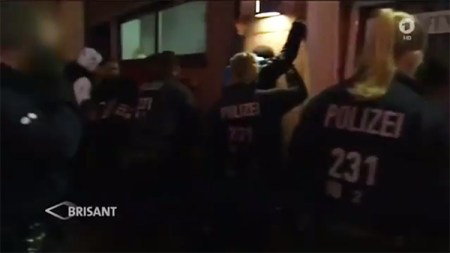
1480Police in Bremen, Germany are shown detaining four young North African criminals who have been terrorizing local shopkeepers. (Image source: ARD video screenshot)

In Hamburg, police say they are helpless to confront a spike in crimes committed by young North African migrants. Hamburg is now home to more than 1,000 so-called unaccompanied minor migrants (minderjährige unbegleitete Flüchtlinge, MUFL), most of whom live on the streets and apparently engage in all manner of criminal acts.

A confidential report, leaked to Die Welt, reveals that Hamburg police have effectively capitulated to the migrant youths, who outnumber and overwhelm them. The document states:

“Even the smallest issue can quickly lead to aggressive offensive and defensive behavior. The youths come together in groups to stand up for each other and also to fight each other…

“When dealing with others, the youths are often irreverent and show a lack of respect for local values ​​and norms. The youths congregate mainly in the downtown area, where they can be seen almost every day. During the daytime, they hang out mostly in the St. George district, but in the evenings they carry out their activities in the Binnenalster, Flora- and Sternschanzenpark and St. Pauli [all across central Hamburg]. They usually appear in groups; up to 30 youths have been observed on weekend nights in St. Pauli. The behavior of these highly delinquent youths towards police officers can be characterized as aggressive, disrespectful and condescending. They are signaling that they are indifferent to police measures…

“The youths quickly become conspicuous, mainly in the domains of pickpocketing or street robbery. They also break into homes and vehicles, but the crimes are often reported as trespassing or vandalism because the youths are just looking for a place to sleep. Shoplifting for obtaining food is commonplace. When they are arrested, they resist and assault [the police officers]. The youths have no respect for state institutions.”

The paper reports that German authorities are reluctant to deport the youths back to their countries of origin because they are minors. As a result, as more unaccompanied minors arrive in Hamburg each day, the crime problem not only persists, but continues to grow.

Meanwhile, in a bid to save the city’s tourism industry, Hamburg police have launched a crackdown on purse-snatchers. More than 20,000 purses — roughly 55 a day — are stolen in the city each year. According to Norman Großmann, the director of the federal police inspector’s office in Hamburg, 90% of the purses are stolen by males between the ages of 20 and 30 who come from North Africa or the Balkans.

In Stuttgart, police are fighting a losing battle against migrant gangs from North Africa who are dedicated to the fine art of pickpocketing.

In Dresden, migrants from Algeria, Morocco and Tunisia have effectively taken control over the iconic Wiener Platz, a large public square in front of the central train station. There they sell drugs and pickpocket passersby, usually with impunity. Police raids on the square have become a game of “whack-a-mole,” with a never-ending number of migrants replacing those who have been arrested.

German authorities have repeatedly been accused of underreporting the true scale of the crime problem in the country. For example, up to 90% of the sex crimes committed in Germany in 2014 do not appear in the official statistics, according to the head of the Association of Criminal Police (Bund Deutscher Kriminalbeamter, BDK), André Schulz. He said:

“For years the policy has been to leave the [German] population in the dark about the actual crime situation… The citizens are being played for fools. Rather than tell the truth, they [government officials] are evading responsibility and passing blame onto the citizens and the police.”

In an apparent effort to defuse escalating political tensions, Germany’s Federal Office for Migration and Refugees (Bundesamt für Migration und Flüchtlinge, BAMF) on February 16 said it was expecting only 500,000 new migrants to arrive in the country in 2016. In December 2015, however, BAMF director Frank-Jürgen Weise told Bild that “this figure [500,000] is only being used for ‘resource planning’ because at this time we cannot say how many people will come in 2016.”

On January 1, the International Monetary Fund (IMF) estimated that 1.3 million asylum seekers would enter the European Union annually during 2016 and 2017.

In a January 9 interview with Bild, Development Minister Gerd Müller warned that the biggest refugee movements to Europe are still to come. He said that only 10% of the migrants from the chaos in Iraq and Syria have reached Europe so far: “Eight to ten million migrants are still on the way.”

Adding to the uncertainty: On February 18, senior security officials from Austria, Croatia, Macedonia, Serbia and Slovenia — all countries along the so-called Balkan Route, which hundreds of thousands of migrants are using to enter the European Union — agreed to coordinate the joint transport of migrants from the Macedonia-Greece border all the way to Austria, from where they will be sent to Germany.

49%-51%: Germany, Russia, UK disagree on odds of Syrian ceasefire holding

February 13, 2016

49%-51%: Germany, Russia, UK disagree on odds of Syrian ceasefire holding

Published time: 13 Feb, 2016 14:51

Source: 49%-51%: Germany, Russia, UK disagree on odds of Syrian ceasefire holding — RT News

Russian Foreign Minister Sergei Lavrov (L) speaks to German Foreign Minister Frank-Walter Steinmeier at the Munich Security Conference in Munich, Germany, February 13, 2016. © Michael Dalder


The foreign ministers of Germany, Russia and the UK attending a security conference in Munich gave conflicting views on how likely the negotiated ceasefire in Syria would hold and who it would depend on.

Responding to a question on how likely the Syrian Army and so-called moderate rebel groups are to observe the ceasefire negotiated by world powers, Germany’s Frank-Walter Steinmeier simply said, “51 percent.”

Sergey Lavrov, his Russian counterpart, was reluctant to voice any percentage, and said any success in the peace process would depend on the US military finally agreeing on coordinating their actions in Syria with Russia.

Read more

Russian Prime Minister Dmitry Medvedev delivers a speech at the Munich Security Conference in Munich, Germany, February 13, 2016. © Michael Dalder

He said that while his counterpart, Secretary of State John Kerry, in his Munich speech earlier said that military cooperation with Russia is what the US wants in Syria, statements from the Pentagon directly contradicted it. Moreover, the US insists on continuing its own military action in Syria while demanding that Russia put its campaign on hold, even though both campaigns are targeting terrorist groups.

“The fact that the discourse around this ceasefire is drifting toward prioritizing the halt of the operations of the Russian Air Forces makes me strongly suspect that our peace effort would end in a sour way. If the military are not maintaining an honest day-to-day contact… nothing can be achieved,” Lavrov said.

“If the Americans try to play it back now, it would be their responsibility,” he added.

Moderator Wolfgang Ischinger joked: “Sounds like a little less than 50 percent,” to which Lavrov glumly replied: “Forty-nine.”

“I don’t speak Russian, but I was judging something close to zero,” commented the third member of the panel, UK Foreign Secretary Philip Hammond.

Read more

Royal Saudi Air Force jets © Fahad Shadeed

He proceeded to say that it was Russia who can finally make or break the ceasefire, accusing Moscow of bombing the same moderate opposition that it expects to observe the ceasefire, an allegation that Russia denies.

“Whatever you call it, whatever the justification, whatever the language – over the last weeks Russia has been bombing the moderate opposition positions. In the name of fighting terrorism, whatever,” Hammond said. “Unless Russia over the next days is going to stop or at least significantly scale back that bombing, the moderate armed opposition will not join in this process.”

Ironically, Russia has been trying for months to get the sponsors of the “moderate Syrian opposition” provide the Russian military with accurate list of the armed groups, which should be considered moderate enough to be negotiated with, and their positions so that Russia wouldn’t bomb them. This information is exactly what Lavrov said the Pentagon is withholding from the Russian military, despite all Moscow’s requests.

What is collectively called the Syrian rebels are a fluid and disorganized assortment of armed groups with conflicting agendas and shifting allegiances. Agreeing who should be at the negotiations table was a major challenge during the organization of the peace talks in Munich, and eventually only the terrorist group Islamic State and the Al-Qaeda branch in Syria, the Nusra Front, were explicitly excluded.

Germany’s Migrant Crisis: January 2016

February 12, 2016

Germany’s Migrant Crisis: January 2016, Gatestone Institute, Soeren Kern, February 12, 2016

♦ Despite snow, ice and freezing temperatures across much of Europe, a total of 91,671 migrants entered Germany during January 2016.

♦ German taxpayers could end up paying 450 billion euros ($500 billion) for the upkeep of the million migrants who arrived in Germany in 2015. This would presumably double to nearly one trillion euros if another million migrants arrive in 2016.

♦ A 19-year-old migrant from Afghanistan sexually assaulted four girls between the ages of 11 and 13 at a swimming pool in Dresden. The migrant was arrested but then set free.

♦ Three teenage migrants from North Africa tried to stone to death two transsexuals in Dortmund after they were seen walking around in women’s clothing. The victims were saved by police.

♦ Bild reported that politicians in Kiel had ordered the police to overlook crimes perpetrated by migrants.

♦ “The topics we cover are determined by the government. … We must report in such a way that serves Europe and the common good, as it pleases Mrs. Merkel. … today we are not allowed to say anything negative about the refugees. This is government journalism.” – Wolfgang Herles, retired public media personality.

♦ The European Commission called for the “rejection of false associations between certain criminal acts, such as the attacks on women in Cologne on New Year’s Eve, and the mass influx of refugees.”

In January 2016, the German public appeared finally to wake up to the implications of their government’s decision to allow 1.1 million — mostly male — migrants from Africa, Asia and the Middle East to enter the country during 2015.

After more than a thousand Muslim migrants sexually assaulted hundreds of women in cities across Germany on New Year’s Eve, Chancellor Angela Merkel began to face a rising voter backlash to her open-door migration policy.

Merkel’s government has responded to the criticism by: 1) attempting to silence critics of the open-door migration policy; 2) trying to “export” the migrant problem to other countries in the European Union; and 3) announcing a series of measures — branded as unrealistic by critics — to deport migrants accused of committing crimes in Germany.

What Merkel has steadfastly refused to do, however, is reduce the number of migrants entering the country. Despite snow, ice and freezing temperatures across much of Europe, a total of 91,671 migrants — an average of around 3,000 migrants each day — entered Germany during the month of January 2016.

The following is a review of some of the more notable stories about the migration crisis in Germany during January 2016.

January 1. More than a thousand migrants sexually assaulted hundreds of German women in the cities of Cologne, Hamburg and Stuttgart. The government and the mainstream media were accused of trying to cover up the crimes, apparently to avoid fueling anti-immigration sentiment.

January 1. As Muslim migrants were causing mayhem on German streets, the Minister President of Baden-Württemberg, Winfried Kretschmann, said he could not understand public concerns about the “alleged Islamization” of Germany. In an interview with Die Welt, he said: “If you look at the facts, this fear is unfounded. We have a stable democracy and a free society. State and religion are separated. How should Muslims, who represent a minority, Islamize our society?” When asked why Germans are afraid, Kretschmann replied: “People are afraid of strangers they do not know.”

January 1. The International Monetary Fund (IMF) estimated that 1.3 million asylum seekers would enter the European Union annually during 2016 and 2017.

January 2. A fight between children as young as 11 at a refugee shelter in Stockach near Konstanz turned into a mass brawl after parents of the children joined in the fighting. Police were deployed to restore order. Seven people were injured.

January 3. A 16-year-old Moroccan migrant went on a rampage after a judge in Bremen ordered him to be jailed for stealing a man’s laptop at knife-point. On the way from the courthouse to the jail, the Moroccan seriously injured a police officer by kicking him in the face. Once inside the jail cell, the migrant ripped a toilet from the floor and smashed it against a wall.

The chairman of the Bremen Police Union, Jochen Kopelke, said that migrants were attacking city police with increasing frequency: “The tone has become extremely aggressive; sometimes the police must apply massive force to get a situation under control.” According to Bremen Senator Ulrich Mäurer, “the excesses of violence against police officers show that these people have no respect for our constitutional order and its representatives.”

January 3. More than 50 migrants were involved in a mass brawl at a refugee shelter inEllwangen near Stuttgart. Police said migrants attacked each other with fire extinguishers, metal pipes, rocks and stones. According to local media, mass brawls have become commonplace at migrant shelters in the area.

January 3. Hans-Werner Sinn, one of the best-known economists in Germany, cited estimates that German taxpayers could end up paying 450 billion euros ($500 billion) for the upkeep of the million migrants who arrived in Germany in 2015. This estimate would presumably double to nearly one trillion euros if another million migrants arrive in Germany in 2016.

January 4. An internal report written by a senior federal police officer revealed chaos “beyond description” in Cologne on New Year’s Eve. The report, which was leaked to the news magazineDer Spiegel and published in full by the newspaper Bild, said that women were forced to “run a gauntlet” of drunken men of a “migrant background” to enter or depart the main train station. “Even the appearance of the police officers and their initial measures did not stop the masses from their actions.” One migrant told a police officer: “I am Syrian; you have to treat me kindly! Mrs. Merkel has invited me.”

January 5. Cologne Mayor Henriette Reker said: “There is no reason to believe that those involved in the sexual assaults in Cologne were refugees.” Cologne Police Chief Wolfgang Alberssaid: “At this time we have no information about the offenders.”

January 6. Former Interior Minister Hans-Peter Friedrich said it was “scandalous that it took the mainstream media several days” to report on the sexual assaults in Cologne. He said public media was a “cartel of silence” exercising censorship to protect migrants from accusations of wrongdoing.

January 7. A charity called Refugees Welcome Bonn, which organized a Rhine River cruise as welcoming party for migrants in Bonn, apologized after it emerged that migrants groped and sexually harassed some female guests during the event.

January 8. The Interior Ministry revealed that of the 32 suspects identified in the Cologne assaults, 22 were asylum seekers. Cologne Police Chief Wolfgang Albers was fired for withholding information about the assaults from the public.

January 9. A vigilante group began patrolling the streets of Düsseldorf to “make the city safer for our women.” Similar groups emerged in Cologne and Stuttgart.

January 10. Three teenage migrants from North Africa tried to stone to death two transsexuals inDortmund after they were seen walking around in women’s clothing. The victims were saved by police, who happened to pass by in a car. One of the victims said: “I never could have imagined that something like this could happen in Germany.”

January 11. A 35-year-old migrant from Pakistan sexually assaulted a three-year-old girl at a refugee shelter in Kamen.

January 12. In an interview with Bild, Frank Oesterhelweg, a politician with the center-right Christian Democrats (CDU), caused a scandal when he said that police should be authorized to use deadly force to prevent migrants from raping German women:

“These criminals deserve no tolerance, they have to be stopped by the police. By force if necessary, and, yes, you read correctly, even with firearms. An armed police officer has a duty to help a desperate woman. One must, if necessary, protect the victims by means of force: With truncheons, water cannons or firearms.”

Police union leader Dietmar Schilff was irate: “These statements are outrageous and do not help the police at all. There are clear rules for using the service weapon. What would have happened in Cologne if the police had used clubs and guns?” According to Bild, many German police officers are afraid of using lethal force “because of the legal consequences.”

January 12. A YouGov poll showed that 62% of Germans believe the number of asylum seekers is too high, up from 53% in November. According to the poll, the growing resistance to immigration was being driven by the hardening of attitudes by German women.

January 13. An Interior Ministry report leaked to Bild warned that jihadist attacks like those in Paris could take place in Germany “at any time.” The report said that attacks would likely be spread over several days and against “various target categories.”

January 13. A 20-year-old migrant from Somalia was sentenced to four years in prison for raping an 88-year-old woman in Herford. His defense attorneys argued for leniency because, according to them, the man was traumatized by his flight from Somalia. In Gelsenkirchen, four migrantsattacked a 45-year-old man after he tried to prevent them from raping a 13-year-old girl.

January 14. The Bundestag, the lower house of the German parliament, approved a plan to provide all refugees with identity cards that will contain information such as fingerprints and country of origin. The cards will be linked to a centralized refugee data system. The plan may be too late: the German government has lost track of the whereabouts of hundreds of thousands of migrants who entered the country in 2015.

January 14. Prosecutors in Cologne said they were offering a reward of 10,000 euros ($11,000) for information leading to the arrest or identification of those who committed the sexual assaults and robberies on New Year’s Eve.

January 14. A Bavarian politician sent a bus carrying 31 refugees on a seven-hour journey to Chancellor Angela Merkel’s office in Berlin to protest her open-door refugee policy. Merkel sentthe migrants back to Bavaria.

January 14. City officials in Rheinberg cancelled this year’s carnival celebrations. Local police said that in wake of the sexual assaults in Cologne on New Year’s Eve, they were unable to guarantee the safety of female revelers.

January 15. A 36-year-old migrant sexually assaulted an eight-year-old girl at a public park in Hilden near Solingen. A 31-year-old migrant from Tunisia was arrested for attempting to rape a 30-year-old woman in Chemnitz. A 31-year-old migrant from Morocco appeared in court for raping a 31-year-old woman in Dresden. A migrant sexually assaulted a 42-year-old woman in Mainz. A migrant sexually assaulted a 32-year-old woman in Münchfeld. An African migrant sexually assaulted a 55-year-old woman in Mannheim.

January 15. Male migrants were banned from a public swimming pool in Bornheim, near Bonn, after they were accused of assaulting female patrons at the facility.
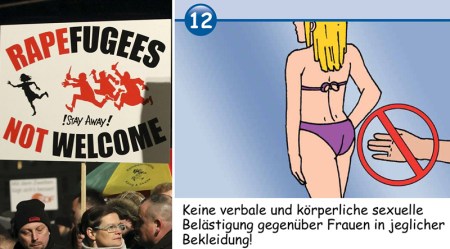
1470In January, there were thousands of cases of migrants sexually assaulting women in Germany, including many that took place in public pools. The government began to face a rising voter backlash to the open-door migration policy, including public protests (left). In some areas, authorities have distributed cartoon guides, to “educate” migrants that sexual assault is not acceptable (right).

January 15. Finance Minister Wolfgang Schäuble, in an interview with the Süddeutsche Zeitung, signaled his determination to export Germany’s migrant problem by calling for a Europe-wide gas tax to help pay for the cost of hosting millions of migrants. He said:

“If the funds in national budgets and the European budget are not enough, then let us agree, for example, to raise a levy on every liter of gasoline at a certain level. If a country refuses to pay, I am still prepared to do it. Then we will build a coalition of the willing.”

January 16. Norbert Röttgen, chairman of the foreign affairs committee in the German Bundestag and a lawmaker in Angela Merkel’s Christian Democratic Union (CDU), called upon the government to create a Ministry for Migration, Integration and Refugees. He said the migrant crisis had developed into a “primary and permanent task for the state” and is of “decisive importance for the future of our country and Europe.”

January 16. A 19-year-old migrant from Afghanistan sexually assaulted four girls between the ages of 11 and 13 at an indoor swimming pool in Dresden. The migrant was arrested but then set free. A migrant from Syria sexually assaulted a 12-year-old girl in Mudersbach. A 36-year-old migrant sexually assaulted an eight-year-old girl in Mettmann.

January 16. A group of between six and eight African migrants ambushed three people leaving a discotheque in Offenburg. The migrants were ejected from the discotheque after female clients complained that the men were sexually harassing them. After they left, at around 4AM, the migrants attacked them with metal rods, street signs and garbage bins.

January 17. In an interview with Bild am Sonntag, the president of the federal criminal police, Holger Münch, said that the number of crimes in refugee shelters had increased “significantly” since 2015, when the migrant influx began. He said that the migrants mostly responsible were from the Balkans and North Africa, especially Algerians, Tunisians and Moroccans. He added that half the offenses at the refugee shelters were physical assaults, but that there was also a growing number of homicides and sexual crimes.

January 17. In an interview with the Süddeutsche Zeitung, former Bavarian Prime Minister Edmund Stoiber warned that Chancellor Angela Merkel will “destroy Europe” if she refuses to reduce the number of migrants entering Germany.

January 17. Berlin clergyman Gottfried Martens accused German politicians and church leaders of ignoring the persecution of Christians by Muslims in German refugee shelters. He said that the Christians were facing “verbal threats, threats with knives, blows to the face, ripped crucifixes, torn bibles, insults of being an infidel, and denial of access to the kitchen because of uncleanness.”

January 18. A 26-year-old Algerian man was the first person to be arrested in connection with a string of sexual assaults during New Year’s celebrations in Cologne. He was apprehended at a refugee shelter in the nearby town of Kerpen. Cologne’s chief prosecutor, Ulrich Bremer, said that nearly 500 women had come forward with allegations of sexual assault, including three cases of rape.

January 18. A 24-year-old migrant from Sudan was released after being held for questioning at a police station in Hanover. After crossing the street, the man, who receives 300 euros ($335) a month in social welfare benefits, dropped his pants and exposed himself in public and shouted, “Who are you? You cannot do anything to me. Whatever I cannot get from the state, I will steal.”

January 19. Addressing the European Parliament in Strasbourg, European Council President Donald Tusk warned that the European Union had “no more than two months” to get control over the migration crisis or face the collapse of the Schengen passport-free travel zone.

January 19. A poll published by Bild showed that support for Chancellor Angela Merkel’s conservative bloc was down 2.5 points at 32.5%, its lowest result since the 2013 election. The poll showed that support for the anti-immigration Alternative for Germany (AfD) was up 1 point at 12.5%; support for the Social Democrats was up 1 point at 22.5%.

January 19. A 28-year-old migrant from Iran pushed a 20-year-old woman onto the tracks of an oncoming train in Berlin. She later died.

January 20. Bild reported that migrants invaded female changing rooms and showers at two public swimming pools in Leipzig. Migrants, dressed in their street clothes and underwear, also jumped into the swimming pools. According to Bild, the city hall had tried to keep the incidents quiet, but details were leaked to the media.

January 21. More than 200 migrants have sued the German government for delays in processing their asylum applications.

January 22. Facing political pressure over the migrant crisis, Chancellor Angela Merkel met in Berlin with Turkish Prime Minister Ahmet Davutoglu to discuss ways to stem the flow of Syrian and other refugees from Turkish shores. She renewed a pledge to provide Turkey with financial support. In November 2015, EU leaders pledged 3 billion euros ($3.4 billion) to Ankara to help care for an estimated 2.5 million Syrian refugees in Turkey; the deal has been delayed by a dispute among EU member states over who will pay.

January 22. A report by municipal authorities in Zwickau that was leaked to Bild revealed that migrants were defecating in public swimming pools. Security cameras also filmed migrants harassing women in the public sauna and attempting to storm the female dressing room.

January 22. Police in Hanover investigated four nightclub bouncers for allegedly beating an 18-year-old Algerian migrant after he tried to steal the purses of two teenage girls. Two days before the incident, the migrant had been sentenced to one year in juvenile detention for robbery, but he was free to roam the streets until his sentence began.

January 22. A migrant attempted to rape a 16-year-old girl in Feuerbach district of Stuttgart, and in downtown Stuttgart, four migrants sexually assaulted a 23-year-old woman.

January 23. The Süddeutsche Zeitung reported that migrants had attacked women in 12 of Germany’s 16 states on New Year’s Eve. In addition to the attacks Cologne, 195 women filed complaints in Hamburg; 31 in Hesse; 27 in Bavaria; 25 in Baden-Württemberg; 11 in Bremen; and six in Berlin.

January 23. Two migrants sexually assaulted an 18-year-old woman in Wiesbaden, and a 35-year-old migrant sexually assaulted a woman in a restroom on a train in Düsseldorf.

January 23. The Stuttgarter Nachrichten reported that dental work for migrants could end up costing German taxpayers billions of euros.

January 24. An official police report leaked to The Huffington Post showed that Interior Minister Thomas de Maizière was not being truthful when he said that between 100 and 200 migrants are being denied entry into Germany each day. The report stated that since September 14, border police had prevented 7,185 migrants from entering the country — or only about 60 migrants turned away each day.

January 25. A 30-year-old migrant from North African exposed himself to a 19-year-old woman on a public bus in Marburg, and then to passersby at the main train station.

January 26. In an interview with the German public radio, Deutschlandfunk, retired public media personality Wolfgang Herles admitted that public broadcasters receive “instructions from above” when it comes to reporting the news:

“We have the problem that we are too close to the government. The topics we cover are determined by the government. But many of the topics the government wants to prevent us from reporting about are more important than the topics they want us to cover…

“We must report in such a way that serves Europe [the European Union] and the common good, as it pleases Mrs. Merkel. There are written instructions … today we are not allowed to say anything negative about the refugees. This is government journalism, and this leads to a situation in which the public loses their trust in us. This is scandalous.”

Previously, Claudia Zimmermann, a reporter with the public television broadcaster WDR, said that public media outlets in Germany “have been warned to report the news from a pro-government perspective.”

January 26. A 24-year-old man on an evening stroll with his three-month-old baby daughter in the Eißendorf district of Hamburg was approached by two migrants who demanded his wallet and cellphone. When he said he was not carrying any valuables, the migrants attacked him with a knife. Fleeing for his life, the man ran onto a frozen pond and broke through the ice. A passerby heard the man calling for help. The baby, under water for an extended period, was revived by paramedics called to the scene. The baby remains in intensive care; the migrants remain at large.

January 26. A 28-year-old migrant from Algeria applied for asylum in Wesel. Authorities became suspicious because of his proficiency in German. They later determined that he had arrived in Germany in November 2014, rather than, as he claimed, in October 2015. It emerged that he had outstanding warrants for theft, but evaded police by using six different identities.

January 26. The Kieler Nachrichten reported that the proliferation of sexual assaults by migrants has women in the northern city of Kiel afraid to be out at night because the city is too dark. In an effort to save electricity, municipal officials decided to convert all of the city’s street lights to LED bulbs, but they do not provide sufficient light to keep the streets illuminated at night.

January 26. The mayor of Freiburg, Dieter Salomon, ordered police to take a hard line against migrants accused of snatching purses and assaulting women in the city’s discotheques. According to club owners, migrants have been robbing women on the dance floor and raping them in the restrooms. Many of the offenders are allegedly underage migrants from North Africa. Club owners say that the migrants are not afraid of authority: “They know that nothing will happen to them here.”

January 27. A 39-year-old migrant from Afghanistan tried to enter Germany at Simbach, a town on the border of Austria. A background check determined that in May 2000, a German court had sentenced the man to an eight-year prison term for rape. He had been deported to Afghanistan in 2006 with orders never to return.

January 27. The public radio and television channel, Mitteldeutscher Rundfunk, reported that German taxi drivers are profiting from the migrant crisis by taking migrants to doctors’ appointments and asylum interviews. The cab fares are being paid for by German taxpayers. MDR reported on a taxi company in Leipzig that had billed the government for 800 taxi fares for taking migrants to run errands. One taxi driver, for example, drove a migrant family on an 80 km (50 mile) journey for an appointment with migration authorities. The meter was left running while the driver waited for the migrants to return from their meeting. The fare was 309 euros ($344).

January 28. Bild reported that politicians in Kiel had ordered the police to overlook crimes perpetrated by migrants. According to the paper, the police in North Rhine-Westphalia and Lower Saxony have also been instructed to be lenient to criminal migrants.

January 28. A migrant from Sudan sexually assaulted a female police officer in Hanover as she was attempting to arrest him for theft. Public prosecutor Thomas Klinge confirmed the incident. “Such brazen behavior towards a police officer has been unheard of until now,” he said.

January 28. Berlin’s Tempelhof airport, the iconic site of the Berlin Airlift in 1948-49, is set to become the biggest refugee shelter in Germany. In a controversial move to alter the airport’s zoning regulations, Berlin’s municipal government — run by a coalition between the Christian Democratic Union and the Social Democratic Party — voted to build five massive structures to house 7,000 migrants there. Opposition politicians said the government was creating an “immigrant ghetto” in the heart of Berlin.

January 28. Police in Berlin said that a volunteer with the charity group Moabit Hilft hadfabricated a story about a 24-year-old migrant said to have died while waiting for days outside an asylum registration office. The story was allegedly faked in an effort to embarrass the government for its slow response to the migrant crisis.

January 29. The European Commission, the powerful administrative arm of the European Union, said that the sexual assaults in Cologne had nothing to do with the migrant crisis and were simply a matter of public order. A confidential memo leaked to The Telegraph stressed the importance of the Commission’s “continuing role in sounding the voice of reason to defuse tensions and counter populist rhetoric.” The Commission called for “the unconditional rejection of false associations between certain criminal acts, such as the attacks on women in Cologne on New Year’s Eve, and the mass influx of refugees.”

January 29. A public vocational school in the Wilhelmsburg district of Hamburg cancelled plans to host classes for refugees after male migrants sexually harassed dozens of female students at the school.

January 29. The German news magazine Focus published the results of a poll showing that 40% of Germans want Chancellor Angela Merkel to resign because of her migrant policies.

January 30. A gang of migrants on a Munich subway train were filmed attacking two elderly men who tried to stop them from groping a woman. Images show the migrants grabbing two men by the arms and neck and shouting abuse at them. It later emerged that the migrants were from Afghanistan; although they had been denied asylum in Germany four years ago, the German government refused to deport them because Afghanistan is “too dangerous.”

January 31. The Interior Minister of Saxony-Anhalt, Holger Stahlknecht, of the Christian Democrats, announced that he would delay releasing the 2015 crime statistics until March 29, two-and-half weeks after regional elections. The statistics are normally released in February or early March. Rüdiger Erben of the Social Democrats said: “The late release date reinforces my suspicion that the statistics are horrific.”

January 31. ISIS sympathizers defaced more than 40 gravestones at a cemetery in Konstanzwith slogans such as, “Germans out of Syria,” “Christ is Dead” and “Islamic State.”

January 31. A 30-year-old German, originally from Turkmenistan, raped a seven-year-old girl in Kiel. The man kidnapped the girl from a school playground at 11AM, took her to his apartment and, after abusing her, set her free. It later emerged that the man, who is the father of two children, had been accused of sexually assaulting a five-year-old girl at another kindergarten in Kiel on January 18, but the public prosecutors failed to pursue the case due to insufficient evidence. “In hindsight, we regret that decision,” the prosecutors said.

January 31. In an underhanded effort to silence critics of the government’s open door migration policy, Vice Chancellor Sigmar Gabriel called on German intelligence to begin monitoring the Alternative for Germany (AfD), the third-largest party in Germany. The AfD is surging in popularity because of its anti-immigration platform.
The End Of The Multiculturalist Consensus In Europe

February 5, 2016

The End Of The Multiculturalist Consensus In Europe, Daily Caller, Michel Gurfinkiel, February 3, 2016

(Please see also, Latest Poll: Merkel in Free Fall, Germans Sensible; 76% of AfD Supporters OK with Genuine Refugees.  — DM)

One wonders why America, a nation of immigrants, can be suddenly so receptive to Donald Trump’s anti-immigration rhetoric. The best answer, so far, is that immigration does not seem to work any more the way it did, at least for certain groups of immigrants.

A similar situation has arisen in Europe. In 2009, the American journalist Christopher Caldwell famously characterized the changes that a massive non-European, non-Judeo-Christian, immigration was forcing over Europe as a “revolution.” We may now be on the brink of a counter-revolution, and that can be as violent and far-reaching as revolution itself.

Last year’s massacres in Paris (the attacks on satirical cartoonists and a kosher supermarket’s customers in January 2015, then the November 13 killing spree) were a tipping point : the French – and by extension, most Europeans — realized that unchecked immigration could lead to civil war.

Then there was the Christmas crisis in Corsica, a French island in the Mediterranean. On December 24, a fire was activated at an immigrant-populated neighborhood in Ajaccio, the capital of Southern Corsica. As soon as the firemen arrived, they were attacked by local youths, Muslims of North African descent. Such ambushes have been part of French life for years. This time, however, the ethnic Corsicans retaliated; for four days, they rampaged through the Muslim neighborhoods, shouting Arabi Fora! (Get the Arabs out, in Corsican). One of Ajaccio’s five mosques was vandalized.

Then, there was the New Year’s crisis in Germany and other Northern European countries. On December 31, one to two thousand male Muslim immigrants and refugees swarmed the Banhofvorplatz in Cologne, a piazza located between the railway Central Station and the city’s iconic medieval cathedral. As it turned out during later in the evening and the night, they intended to “have fun”: to hunt, harass, or molest the “immodest” and presumably “easy” German women and girls who celebrated New Year’s Eve at the restaurants and bars nearby, or to steal their money. 766 complaints were lodged. Similar incidents took place in other German cities, like Hamburg, Frankfurt and Stuttgart, as well as in Stockholm and Kalmar in Sweden, and Helsinki in Finland.

Here again, the local population reacted forcefully. Support for asylum seekers from the Middle East plummeted – 37 percent of Germans said that their view of them has “worsened,” and 62 percent said that there are “too many of them.” The Far Right demonstrated against immigration in many cities, but liberal-minded citizens were no less categorical. Le Monde, the French liberal newspaper, on January 20 quoted Cologne victims as saying, “Since 1945, we Germans have been scared to be charged with racism. Well, the blackmail is over by now.”

Indeed, postwar Europe, and Germany in particular, had been built upon the rejection of Hitler’s mad regime and everything it stood for. Nationalism, militarism, authoritarianism, and racism were out. Multinationalism, pacifism, hyperdemocracy, and multiculturalism were in. This simple, almost Manichean, logic is collapsing now – under the pressure of hard facts. Or rather the Europeans now understand that it was flawed in many ways from the very beginning, especially when it came to multiculturalism, the alleged antidote to racism.

What Europeans had in mind when they rejected racism in 1945 was essentially antisemitism. Today, the “correct” antiracist attitude would be to welcome non-European immigrants en masse and to allow them to keep their culture and their way of life, even it that would contradict basic European values. Hence last summer’s “migrants frenzy,” when the EU leadership in Brussels and major EU countries, including Angela Merkel’s Germany, decided to take in several millions of Middle East refugees overnight.
European public opinion is now awaking to a very different view. And the political class realizes that it must adjust – or be swept away.

European public opinion is now awaking to a very different view. And the political class realizes that it must adjust – or be swept away.

The Schengen regime – which allows free travel from one country to the other in most of the EU area – is being quietly suspended; every government in Europe is bringing back borders controls. The French socialist president François Hollande is now intent to strip disloyal immigrants and dual citizens of their French citizenship (a move that precipitated the resignation, on January 27, of his super-left-wing justice minister, Christiane Taubira). He is also hiring new personnel for the police and the army and even considering raising a citizens’ militia. Merkel now says that immigrants or refugees who do not abide by the law will be deported. Even Sweden, currently ruled by one of Europe’s most left-wing cabinets, has been tightening its very liberal laws on immigration and asylum.

Most Europeans agree with such steps. And wait for even more drastic measures.


Facebook’s War on Freedom of Speech

February 5, 2016

Facebook’s War on Freedom of Speech, Gatestone InstituteDouglas Murray, February 5, 2016

♦ Facebook is now removing speech that presumably almost everybody might decide is racist — along with speech that only someone at Facebook decides is “racist.”

♦ The sinister reality of a society in which the expression of majority opinion is being turned into a crime has already been seen across Europe. Just last week came reports of Dutch citizens being visited by the police and warned about posting anti-mass-immigration sentiments on social media.

♦ In lieu of violence, speech is one of the best ways for people to vent their feelings and frustrations. Remove the right to speak about your frustrations and only violence is left.

♦ The lid is being put on the pressure cooker at precisely the moment that the heat is being turned up. A true “initiative for civil courage” would explain to both Merkel and Zuckerberg that their policy can have only one possible result.

It was only a few weeks ago that Facebook was forced to back down when caught permitting anti-Israel postings, but censoring equivalent anti-Palestinian postings.

Now one of the most sinister stories of the past year was hardly even reported. In September, German Chancellor Angela Merkel met Mark Zuckerberg of Facebook at a UN development summit in New York. As they sat down, Chancellor Merkel’s microphone, still on, recorded Merkel asking Zuckerberg what could be done to stop anti-immigration postings being written on Facebook. She asked if it was something he was working on, and he assured her it was.

At the time, perhaps the most revealing aspect of this exchange was that the German Chancellor — at the very moment that her country was going through one of the most significant events in its post-war history — should have been spending any time worrying about how to stop public dislike of her policies being vented on social media. But now it appears that the discussion yielded consequential results.

Last month, Facebook launched what it called an “Initiative for civil courage online,” the aim of which, it claims, is to remove “hate speech” from Facebook — specifically by removing comments that “promote xenophobia.” Facebook is working with a unit of the publisher Bertelsmann, which aims to identify and then erase “racist” posts from the site. The work is intended particularly to focus on Facebook users in Germany. At the launch of the new initiative, Facebook’s chief operating officer, Sheryl Sandberg, explained that, “Hate speech has no place in our society — not even on the internet.” She went to say that, “Facebook is not a place for the dissemination of hate speech or incitement to violence.” Of course, Facebook can do what it likes on its own website. What is troubling is what this organization of effort and muddled thinking reveals about what is going on in Europe.

1455

The mass movement of millions of people — from across Africa, the Middle East and further afield — into Europe has happened in record time and is a huge event in its history. As events in ParisCologne and Sweden have shown, it is also by no means a series of events only with positive connotations.

As well as being fearful of the security implications of allowing in millions of people whose identities, beliefs and intentions are unknown and — in such large numbers — unknowable, many Europeans are deeply concerned that this movement heralds an irreversible alteration in the fabric of their society. Many Europeans do not want to become a melting pot for the Middle East and Africa, but want to retain something of their own identities and traditions. Apparently, it is not just a minority who feel concern about this. Poll after poll shows a significant majority of the public in each and every European country opposed to immigration at anything like the current rate.

The sinister thing about what Facebook is doing is that it is now removing speech that presumably almost everybody might consider racist — along with speech that only someone at Facebook decides is “racist.”

And it just so happens to turn out that, lo and behold, this idea of “racist” speech appears to include anything critical of the EU’s current catastrophic immigration policy.

By deciding that “xenophobic” comment in reaction to the crisis is also “racist,” Facebook has made the view of the majority of the European people (who, it must be stressed, are opposed to Chancellor Merkel’s policies) into “racist” views, and so is condemning the majority of Europeans as “racist.” This is a policy that will do its part in pushing Europe into a disastrous future.

Because even if some of the speech Facebook is so scared of is in some way “xenophobic,” there are deep questions as to why such speech should be banned. In lieu of violence, speech is one of the best ways for people to vent their feelings and frustrations. Remove the right to speak about your frustrations, and only violence is left. Weimar Germany — to give just one example — was replete with hate-speech laws intended to limit speech the state did not like. These laws did nothing whatsoever to limit the rise of extremism; it only made martyrs out of those it pursued, and persuaded an even larger number of people that the time for talking was over.

The sinister reality of a society in which the expression of majority opinion is being turned into a crime has already been seen across Europe. Just last week, reports from the Netherlands told of Dutch citizens being visited by the police and warned about posting anti-mass-immigration sentiments on Twitter and other social media.

In this toxic mix, Facebook has now — knowingly or unknowingly — played its part. The lid is being put on the pressure cooker at precisely the moment that the heat is being turned up. A true “initiative for civil courage” would explain to both Merkel and Zuckerberg that their policy can have only one possible result.

Germany’s Migrant Deportation Plan: “Political Charade”

February 1, 2016

Germany’s Migrant Deportation Plan: “Political Charade” Gatestone InstituteSoeren Kern, February 1, 2016

♦ N24 television has reported that up to 50% of “asylum seekers” have gone into hiding and their whereabouts are unknown. They presumably include economic migrants and others who are trying to avoid deportation if or when their asylum applications are rejected.

♦ Tens of thousands of migrants destroyed their passports and other identity documents before arriving in Germany. It may take years for German authorities to determine the true identities of these people and their countries of origin.

♦ Even if Germany sends these individuals back to the countries where they first entered the EU (usually Greece, Hungary or Italy), with a borderless Europe, migrants can easily make their way back to Germany.

♦ German authorities are downplaying migrant lawlessness, apparently to avoid fueling anti-immigration sentiment.

♦ Migrants are still coming to Germany at the rate of about 2,000 per day.

♦ “Eight to ten million migrants are still on the way.” – Development Minister Gerd Müller.

After three months of political infighting, Germany’s coalition government has announced new measures aimed at making it easier to deport migrants who are convicted of committing crimes.

The measures emerged in response to voter outrage over the sexual assaults of hundreds of women by migrants in Cologne and other German cities on New Year’s Eve — and alleged attempts by the government and the news media to cover up the crimes.

Known as the Asylum Package II (Asylpaket II), the draft law was announced by the cabinet on January 28 and must now be approved by the Bundestag, the lower house of the German parliament, for it to come into effect.

A central feature of the plan involves increasing the number of migrant reception centers to five, up from two today. The centers would supposedly fast-track legitimate asylum requests submitted by people who can prove they are fleeing war-zones.

The centers would also step up efforts to weed out fraudulent applications submitted by economic migrants who are posing as asylum seekers. The stated aim is to eventually deport those who arrived in Germany under false pretenses.

In addition, the plan would introduce a two-year waiting period for legitimate refugees who want to bring family members to Germany. Exceptions would be made for those who can prove that their family members are being “personally, urgently persecuted.”

The government also said that it would try to limit migration from North Africa by declaring Algeria, Morocco and Tunisia as so-called safe countries, where there is no armed conflict or threat of violence, persecution or torture. This would make it virtually impossible for asylum applications from those countries to be approved.

Critics of the plan say it is more of a political charade than substance and will do little to alleviate Germany’s migration crisis.

First, the German government has lost track of the whereabouts of hundreds of thousands of migrants who entered the country in 2015. N24 television has reported that up to 50% of “asylum seekers” have gone into hiding; their whereabouts are unknown. They presumably include economic migrants and others who are trying to avoid deportation if or when their asylum applications are rejected. The Saarbrücker Zeitung reported that up to 30% of the migrants being sheltered in the eastern German states of Brandenburg, Thuringia and Saxony-Anhalt have “simply vanished.” Separately, German authorities estimate that hundreds of thousands of migrants have entered the country without being registered and whose whereabouts are unknown.

Second, tens of thousands of migrants destroyed their passports and other identity documents before arriving in Germany. It may take years for German authorities to determine the true identities of these people and their countries of origin. This will complicate — and delay — many deportations. Even if Germany sends these individuals back to the countries where they first entered the European Union (usually Greece, Hungary or Italy), with a borderless Europe, migrants can easily make their way back to Germany.

Third, the legal hurdles to deportation from Germany are high. German law states that migrants who commit crimes can only be deported if they are sentenced to prison terms of three years or more. In practice, this rarely happens for most petty crimes. The government is contemplating a change to Section 60 of the Residency Law (Aufenthaltsgesetz) to make it possible to deport migrants sentenced for prison terms of one year. But even if migrants are sentenced for crimes, they cannot be deported to countries that the German government deems “unsafe.” Moreover, migrants cannot be deported to countries where they may face the death penalty.

To many critics, it looks as if the German justice system is being disabled by political correctness. Although migrants are driving a surge in violent crime in cities and towns across Germany, German authorities are downplaying the lawlessness, apparently to avoid fueling anti-immigration sentiment.

A confidential police document leaked to the Rheinischen Post revealed that in 2014, a record-breaking 38,000 asylum seekers in Germany were accused of committing crimes in the country. Analysts believe this figure — which works out to more than 100 crimes a day — is only a fragment: many crimes are not made public.

In Hamburg, police are fighting a losing battle against purse-snatchers. Each year, more than 20,000 purses — roughly 55 a day — are stolen. According to Norman Großmann, the director of the federal police inspector’s office in Hamburg, 90% of the purses are stolen by males between the ages of 20 and 30 who come from North Africa or the Balkans.

In a bestselling new book about the failure of multiculturalism in Germany, Tania Kambouri, a German police officer, describes the breakdown of the German justice system and how German judges are reluctant to punish migrants, including repeat offenders.

Fourth, the German government’s decision to deny asylum requests submitted by migrants from Algeria, Morocco and Tunisia will have little effect in practice. Out of one million migrants who entered Germany in 2015, fewer than 20,000 are believed to have come from those three countries.

Meanwhile, a new poll published by the news magazine, Focus, shows that nearly half the Germans want Chancellor Angela Merkel to resign because of her open-door migration policy: in 2015, it allowed more than one million migrants from Africa, Asia and the Middle East to enter the country.

Still, Merkel steadfastly continues to refuse to implement the one policy that could prevent the migrant crisis from becoming even worse: closing the German borders to keep the migrants out.

Despite snow, ice and freezing temperatures across much of Europe, migrants are still coming to Germany at the rate of about 2,000 per day. More than 54,500 people reached Europe by sea during January 2016, including 50,668 through Greece, according to the United Nations Refugee Agency (UNHCR).

The International Monetary Fund (IMF) estimated that 1.3 million asylum seekers would enter the European Union annually during 2016 and 2017.

In a January 9 interview with Bild, Development Minister Gerd Müller warned that the biggest refugee movements to Europe are still to come. He said that only 10% of the migrants from the chaos in Iraq and Syria have reached Europe so far: “Eight to ten million migrants are still on the way.”

Separately, Germans face being denied visa-free travel to the United States, as U.S. security officials become increasingly alarmed at the proliferation of fake passports that could be used by terrorists. According to a report by Politico:

“In the aftermath of Paris, the U.S. Department of Homeland Security became so worried about the implications for screening travelers to America that it gave France, Belgium, Germany, Italy and Greece a February 1 deadline to fix “crucial loopholes” or lose access to the U.S. visa waiver program. The program allows about 20 million people per year from 38 countries, most of them in Europe, to enter the United States for business or pleasure without a visa.”

1451Left: A new poll shows that nearly half the Germans want Chancellor Angela Merkel to resign because of her open-door migration policy. Right: Interpol has data on 250,000 stolen or lost Syrian and Iraqi passports, including passports that are blank.

According to Politico, in the last five years the number of lost and stolen passports in the EU has doubled. The number of forged passports in the Middle East is also a rising concern. Interpol has data on 250,000 stolen or lost Syrian and Iraqi passports, including passports that are blank.

The Spreading Scent of Cologne

January 26, 2016

The Spreading Scent of Cologne, Gatestone InstituteDenis MacEoin, January 26, 2016

♦ What appals so many onlookers is that this damage to European societies is being done with open eyes and listening ears, and that many lessons have not been learned.

♦ The mass sexual assaults on New Year’s Eve, and many through the year, are clearly the work of single, mainly young men. In packs, people can more easily give in to anti-social tendencies, but these men from North Africa and the Middle East seem to bring with them social attitudes that make it hard for them to conform with European notions of what is, and what is not, criminal or decent.

♦ Muslim hate speakers are given free rein to address students at many British universities. The double-standard is that the same universities have banned controversial but important speakers or just about anybody who supports the state of Israel. And if speakers are not actually banned, hordes of ideologically-inspired students and outsiders will turn up to disrupt their lectures with shouts, screams, and threats.

The city of Cologne, still famous for its scented water, has become, since last New Year’s Eve, best known for the depredations and misogyny of a growing population of immigrants from North Africa, the Middle East and elsewhere. The events of that evening, when hundreds of women were assaulted, manhandled, and even raped by thousands of migrant newcomers who could not be restrained by the police, spread across the world in days if not hours.

At first, the police played down the seriousness of the incidents, but by January 10th, the BBC reported that the number of criminal cases had risen to 516, forty percent of which were related to sexual assault. According to German police, “Asylum seekers and illegal migrants from North Africa comprise the majority of suspects.” This has been confirmed by Germany’s interior ministry, which has stated that almost all those involved were migrants.

1440A scene from New Year’s Eve in front of Cologne’s central railway station, when hundreds of girls and women were sexually assaulted, mostly by migrants.

Of course, Cologne was only the most prominent city to undergo such an ordeal: According to the Washington Post, “No city was hit harder than Cologne, where gangs of mostly young men are alleged to have ‘hunted’ women, corralling them before groping, assaulting and robbing them.” A smaller number of incidents occurred in other German cities such as Hamburg, Stuttgart, and Frankfurt. In the thirteenth-century city of Bielefeld, more than 500 presumed asylum seekers attacked the Elephant Club , a night spot, and assaulted some of the women there. There were similar cases on the same evening in Austria, Switzerland, Finland and Sweden.

Regular readers of articles by authors such as Soeren Kern or Ingrid Carlqvist at the Gatestone Institute will be fully aware of the widespread breakdown of several European countries as a result of uncontrolled immigration. That includes not just the massive wave of immigration during 2015, but the steady collapse of law and order engendered by earlier influxes of Muslim migrants, notably in Germany, the United Kingdom and France. This has been exacerbated by the problem that, whereas many first generation incomers gradually found ways to integrate within mainstream society, there is a trend among third-generation children to demand rights and concessions above those granted to other citizens.

There are an estimated 750 zones urbaines sensibles (“sensitive urban zones”) in France; many cities in Europe have such high levels of Muslim exclusivity that they have become no-go zones for the police, the fire brigade, social workers and others. According to one report

“It’s not Norway or Europe anymore, except when there is welfare money to be collected. The police have largely given up. Early in 2010 Aftenposten stated that there are sharia patrols in this area, and gay couples are assaulted and chased away. Immigrant Fatima Tetouani says that ‘Grønland is more Muslim than Morocco.'”

Three months earlier, retired police Chief Superintendent Torsten Elofsson of Malmö, Sweden’s third city, declared that the crime rate in the city was skyrocketing due to the influence of uncontrolled immigration and the presence of no-go areas. The French city of Marseilles, with a 30%-40% Muslim population, has been declared “the most dangerous city in Europe” because of an increasing level of extreme violence, riots and rapes.

What appals so many onlookers is that this damage is being done with open eyes and listening ears and that many lessons have not been learned, not just in the past year but over decades. What on earth, many of us ask, could have impelled so many European leaders — among whom German Chancellor Angela Merkel stands out — to have opened their arms to potentially millions of immigrants without imposing checks, registration at the point of entry, or other legal controls?

The whole situation was sparked, of course, by the staggering break-up of Syria over so many years. This break-up has led to the flight of very large numbers of genuine refugees, so many of them risking their lives to bring their children across the Mediterranean in the hope of finding safety in the European Union.

If we are to analyse what has happened, we can do no better than to start with this fact. There is in all of this an irony of mammoth proportions. Welcoming people who fear for their lives and their children’s futures is a strong trait of Western civilization. Unlike so many other cultures, the Judaeo-Christian and post-Enlightenment West has a deeply-rooted commitment to human rights, and those rights are not restricted to ourselves but to all mankind. Both Judaism and Christianity are suffused with a sense of human brotherhood, and that sense has led to the modern ideals of rights for women, people of all races, homosexuals, the disabled, religious minorities, and the victims of violence. Nowhere, perhaps, has this been more visible in the United States, a country that was built on the backs of immigrants.

With this in view, and with the memory of the Holocaust and Europe’s failure to prevent it in mind, it was inevitable that European countries would at first welcome the poor, hungry and distressed of Syria and other places.

But here lies the irony. Our undiscriminating welcome is leading us to welcome people many of whom seem dedicated to bringing about our internal collapse. This collapse may be far from total now, but there are grave misgivings about how Europe will look in the future, and certainly by the end of the century. Politicians, church leaders, and charity bosses have been looking at only one side of the equation.

There may not be a Huntingtonian “Clash of Civilizations” at present, but cultural clashes have been dominating the debate, even if many worthy individuals and organizations prefer to turn a blind eye to their consequences.

There have been cultural clashes throughout history, but in the last two hundred years, they have grown in size and intensity. Under the great Islamic empires, clashes between the Muslim ruling classes and religious minorities were usually held in check by the enforcement of Islamic norms. The Western imperial powers also governed by a combination of force, law and bureaucratic administration.

Modern democracies, however, are disinclined to control the behaviour of individuals and groups. They prefer to give citizens freedom to act and speak within the law. Societies have become multicultural, with tolerance of differences a source of pride. Racism has, thankfully, given way in most places to mutual acceptance. In America, Irish, Polish and Italian Catholics settled within a generation or two to become loyal citizens with a minimum of foreign cultural traits.

This is the positive side of multiculturalism. The presence of different cuisines, music, and art of course enriches society, but there is a negative side too. And that is where this irony comes to the fore. A broad Western value is that individuals may, within the bounds of decency, dress much as they please. With the exception of France, Muslim women are free to wear hijabs or other coverings. The increase of veiled women in, say, Britain, has been startling, given that wearing the hijab is now associated with Muslim self-assertion. Others, however, find the hijab and other styles of veil symbols of the oppression of women. In countries such as Saudi Arabia or Iran, “improperly” veiled women may be fined, flogged, or, in some cases, executed on charges of prostitution. In many instances, passers-by may attack them, as in the acid-throwing attacks by the Ansar-e Hezbollah gangs last year in Iran.

In Western countries, freedom of speech and expression is supposed to be a non-negotiable value of public life, with open comment and debate regarded as the life-blood of an open society (as defined, for example, by the late Sir Karl Popper). But, as case after case has shown in Europe and the United States, freedom of this kind is anathema to all devout Muslims. Novels have been banned; authors and translators attacked, flogged and murdered; cartoons have led to rioting, a film-maker was stabbed through the heart — all for having said or illustrated something that allegedly offended some Muslims. Meanwhile, Muslim radicals make use of their freedom to write, publish, and post on the internet vast quantities of hate speech, that often includes a denial of the right to Western freedoms, not only to themselves but to everyone. What is sauce for the goose has become not sauce for the gander.

While serious attempts are made to remove terror-linked Islamic websites from the internet, there are still hundreds if not thousands of websites that present a non-terrorist form of extremism. As recently reported by London’s Daily Mail, Muslim hate speakers are given free rein to address students at many British universities. The double-standard and hypocrisy is that the same universities have banned controversial but important speakers such as the feminist Germaine Greer, historian David Starkey, or just about anybody who supports the state of Israel. And if speakers are not actually banned, hordes of ideologically-inspired students and outsiders will turn up to disrupt their lectures with shouts, screams, and threats. This happened on 19 January, when a mob of anti-Israel activists at King’s College, London, attacked a talk given by Ami Ayalon, now a peace activist and former head of Israeli secret service Shin Bet and commander-in-chief of the navy. The meeting was disturbed by protestors, thought to be from the KCL Action Palestine student group, who threw chairs, smashed windows, and set off fire alarms.

Not all of these bans have been down to Muslims, but many — including the anti-Israel campaigners — have included a large Muslim presence. Anyone who speaks out against the clash between extremist Islam and European culture is bound to be condemned as a “racist” or an “Islamophobe.” Such is the illiberal “liberal” culture that sees even the mildest concern to be opposed to the “righteous” tendencies of our moral guardians — such as highly conservative Christians like Britain’s intolerant Mary Whitehouse.

The irony of the current situation not only relates to our tolerance of Islamic intolerance, but to a more visceral clash of cultures based on expectations and social habits. When Jews, Irish, Polish, and Hispanic Catholics were first thrown into the American melting pot alongside conservative Protestants, the pain of integrating was lessened because they had broadly similar attitudes on moral and social values. Religious views aside, these were people trained in the Judaeo-Christian tradition, aspiring to, or familiar with, democracy, respectful of women (if not yet believers in sexual equality), and in general averse to crime (if we ignore the mobs from each ethnic group). Finding common ground was not always easy, especially for Jews, but there was a basis upon which to forge allegiances, not least the concept of being citizens of a new country in which there were, in principle, opportunities for everyone.

The immigrants now flooding into Europe may often feel the same, but the events of New Year’s Eve, taken with the no-go zones and the general anti-Western attitudes, suggest that as many of them harbour attitudes that are indeed alien, and often antithetical to, modern Western norms. Only about half of the recent immigrants are Syrian refugees desperate to escape a landscape of ruined cities and daily fighting.

Last October, the New York Times wrote:

Aid groups say the chaotic nature of the human traffic has left them without a full picture of the current wave of people reaching Europe. The United Nations refugee agency says that just over half are Syrians, followed by smaller groups from Afghanistan, Eritrea, Iraq and elsewhere. Sixty-nine percent are men, 13 percent women and 18 percent children.

The largest single group appears to be young men, open to adventure but woefully ill-informed about what they are getting into. Among the dozens of them interviewed recently in Turkey and Greece, only a few spoke any languages other than their native tongue, and most knew little about the countries they hoped to make their new home. Some were surprised to learn that beer and pork are prominent in German cuisine.

During 2015, applications for asylum within the EU came from a total of thirty countries, with Syrians, Afghans and Iraqis at the top. Eritreans also made up a substantial portion. Despite claims that the vast majority are economic migrants, not genuine war refugees, the Economist has cast cold water on this in an article entitled “How many migrants to Europe are refugees?”. Nevertheless, official statistics do not usually include illegal refugees. The chaotic conditions of 2015 made it much easier for illegals to enter, and the people-smuggling trade is known to be vast.

The mass sexual assaults on New Year’s Eve, and many through the year, are clearly the work of single, mainly young men. In packs, people can more easily give in to anti-social tendencies, but these men from North Africa and the Middle East seem to bring with them social attitudes that make it hard for them to conform with European notions of what is, and what is not, criminal or decent. In North Africa and the Middle East, sex outside marriage is risky for both partners, especially in societies where honour-killings take place. The open romantic experience that is common throughout Western countries is not open to Arab men and may only be pursued in Iran through the institution of temporary (mut’a) marriage. For sexual fulfilment in those societies, marriage, or alternative options, are essential. In 2007, Navtej Dhillon, of the Brookings Institute, wrote:

Marriage, long the centerpiece of Middle Eastern life, is in crisis. The reason: a new generation of young men cannot afford to marry–a fact that’s destined to exacerbate many of the region’s social and political problems. Little more than a decade ago, 63 percent of Middle Eastern men married by their late 20s. Today the figure is just over 50 percent. Iran brings up the rear, at 38 percent, with the swathe of Maghreb between the Levant and Morocco only marginally better. Contrast that to Asia, which leads the nuptial race with 77 percent of men aged 25 to 29 being married, followed by 69 percent in Latin America and 66 percent in Africa.

The consequences of these trends are profound. In most Arab countries, a bachelor’s life is devoid of economic and social opportunities. Marriage remains the path to adulthood, social status and legitimate sexual relationships. In contrast to Americans and Europeans, the majority of Arab men in their late 20s are not staying single by choice. They are forced into it by circumstances.

Sometimes young men in North Africa pester Western women, tourists or expatriates, in the wish that they are as hungry for sex as they themselves are and will submit to any man’s advances. Local students in a Moroccan university (women as well as men) once told this writer that there had been a dearth of men in Europe after World War II and that, as a result, desperate European women had swarmed to Africa in search of “real” men who could satisfy their passions. Arguing that this was nonsense, I quickly became aware that they sincerely believed this. Any Western woman who has ever been followed by men in these countries can readily testify to how unpleasant such unwanted attention can be. Part of this unpleasantness is knowing that, if a Western woman tried to lodge a complaint with the police, she would almost certainly be held to blame, whether by dressing in a certain way or simply acting as an independent person.

That is why men who come directly from countries with a wholly different set of sexual mores, and who find themselves on the streets with (to them) scantily-dressed and attractive young women, act in the way they did on New Year’s Eve. Although rapes of women do take place in North Africa and the Middle East, they are rare. Believing that Western women are happy to be raped or fondled and that, as non-Muslims, they may be regarded as “fair game,” is a green light for men brought up in puritanical Islamic societies.

Fortunately, recent events have been something of a wake-up alarm. Norway is already providing classes for refugees on Norwegian cultural norms, including sexual mores. The Danish parliament has debated doing the same, and Belgium has just announced that it will makes classes on “respect for women” obligatory for all non-European migrants and refugees. Will Germany follow? Or will political correctness insist that doing so would be contemptuous of the autonomy and cultural rights of non-white people?

It’s About Domination: Rape (and Other Sex) Attacks Across Europe

January 24, 2016

It’s About Domination: Rape (and Other Sex) Attacks Across Europe, Clarion Project, Meira Svirsky, January 24, 2016

(The Muslims involved are not ignorant of European culture; they despise it and seek to show that Islam is superior and that it will dominate by getting away with their antics. Will the apparent desire of a few other refugees to integrate into German society change things? That seems quite unlikely.  — DM)

Germany-Sex-Mob-Scandel-Has-a-Background-IPProtests against the Cologne attacks in Germany. The sign reads “The sex-mob attacks have a background.” (Photo: © Reuters)

Disturbing news out of Germany and Austria reads like a sick advert for a porn movie. “Report: Locals Fled Pool After Migrants Masturbated Into Jacuzzi, Defecated Into Kid’s Pool, Invaded Girls Changing Rooms.” The report continues, saying that when challenged by the pool staff, the men laughed “in the face of pool staff.”

The obscene actions were caught on film by a security camera. After being  thrown out by lifeguards, the men came back, “jeering” and taking selfies in the polluted hot tub.

Many other pools have reported similar incidences, including a series of sexual assaults on bathers as young as a three-year-old boy at the pool with his mother and 11-year-old girls targeted at water slides by gangs of migrants.

After the New Year’s Eve attacks in Germany, where coordinated, organized gangs of migrant men in Cologne and other cities surrounded German women and proceeded to grope, rape and rob them as their helpless boyfriends and police watched (who were themselves surrounded and harassed), the gloves supposedly came off the politically-correct Germany media.

Still, there has been only a trickle of reports. (And disturbingly, included in the reports is the fact that, in one particular sexual-assault incident, the men were detained by police, only to be later released.)

Shamed into reporting the Cologne attacks after a full four days of media silence, the discussion unfortunately centered on victim blaming (by none other than the mayor of Cologne herself — as well as skewed takes on the incidents by feminists ready to sacrifice their sisters to the greater cause of anti-“racism”).

In the cases of gang harassment at pools, officials have taken a similar tack, saying migrant men must be schooled in Europeans values and norms. Pools that refused to allow in migrants in the wake of these incidents have been either shamed or forced into reopening their doors to them, with explanatory posters of improper behavior posted prominently at their doors.

Which completely misses the point.

Yes, a culture of pederasty exists in Afghanistan, where pre-pubescent boys are taken by powerful officials to be “played with” at will.

Yes, women in Middle Eastern and some African countries dress more modestly than their European counterparts, leading some Middle Eastern men to assume European women are “fair meat.”

That doesn’t explain coordinated attacks in at least 12 German states, according to a leaked report of the federal criminal police, nor does it explain leering gangs taking selfies in post-polluted hot tubs.

The New York Times reports Alice Schwarzer, described as a leading “second-wave” German feminist, “became a lightning rod for feminist and anti-racist anger after New Year’s Eve when she condemned the Cologne attacks as a “gang bang” designed to terrorize women.

Although Schwarzer clarified  “she never sought to ignore the fact that there is ‘a problem with epidemic, structural violence against women in Germany, as anywhere in the world,’” she was one of the few to name the reality of what is happening in Europe today.

“Violence is always the dark core of domination, whether it is between ethnic groups, or between different peoples or between the sexes,” Schwarzer said.

Europeans, who expected the migrants to receive their outpouring of largess graciously, have awakened to the latest manifestation of Islamist terror, whose goal is to control and dominate foreign cultures until they submit to the imposition of sharia-compliant Islam.

Apparently, as we have seen with brutalities of the Islamic State and with the above deviant behaviors in Europe, anything goes in order to achieve this goal.

Barring the rise of the extreme right as a counter force, which will result in a violent, full-scale war with Europe’s new populations – taking many innocents along with it — if there is to be light at the end of this ideological tunnel, it must come from within the Muslim populations. Liberal Europe, it seems, has no stomach for it.

In Germany, one small flicker of that light was seen over the weekend as thousands of Syrian refuges holding signs saying “No to Sexism, No to Racism,” “We respect the values of German society” and “We are all Cologne” demonstrated across Germany against the Cologne attacks.

Many more such demonstrations and subsequent actions will be needed to propel Europe to rid itself of its newly imported fifth column.

Europe’s Betrayal of Women

January 15, 2016

Europe’s Betrayal of Women, Pat Condell via You Tube, January 15, 2016