Posted tagged ‘Foreign Policy’

The West has developed a dangerous concern for ‘proportionality.’

October 20, 2015

The West has developed a dangerous concern for ‘proportionality.’ National Review, Victor Davis Hanson, October 20, 2015

The question is not only whether the Obama administration, in private, favors the cause of the radical Palestinians over a Western ally like Israel, but also whether it is even intellectually and morally capable of distinguishing a democratic state that protects human rights from a non-democratic, authoritarian, and terrorist regime that historically has hated the West, and the United States in particular — and is currently engaged in clear-cut aggression.
**************************

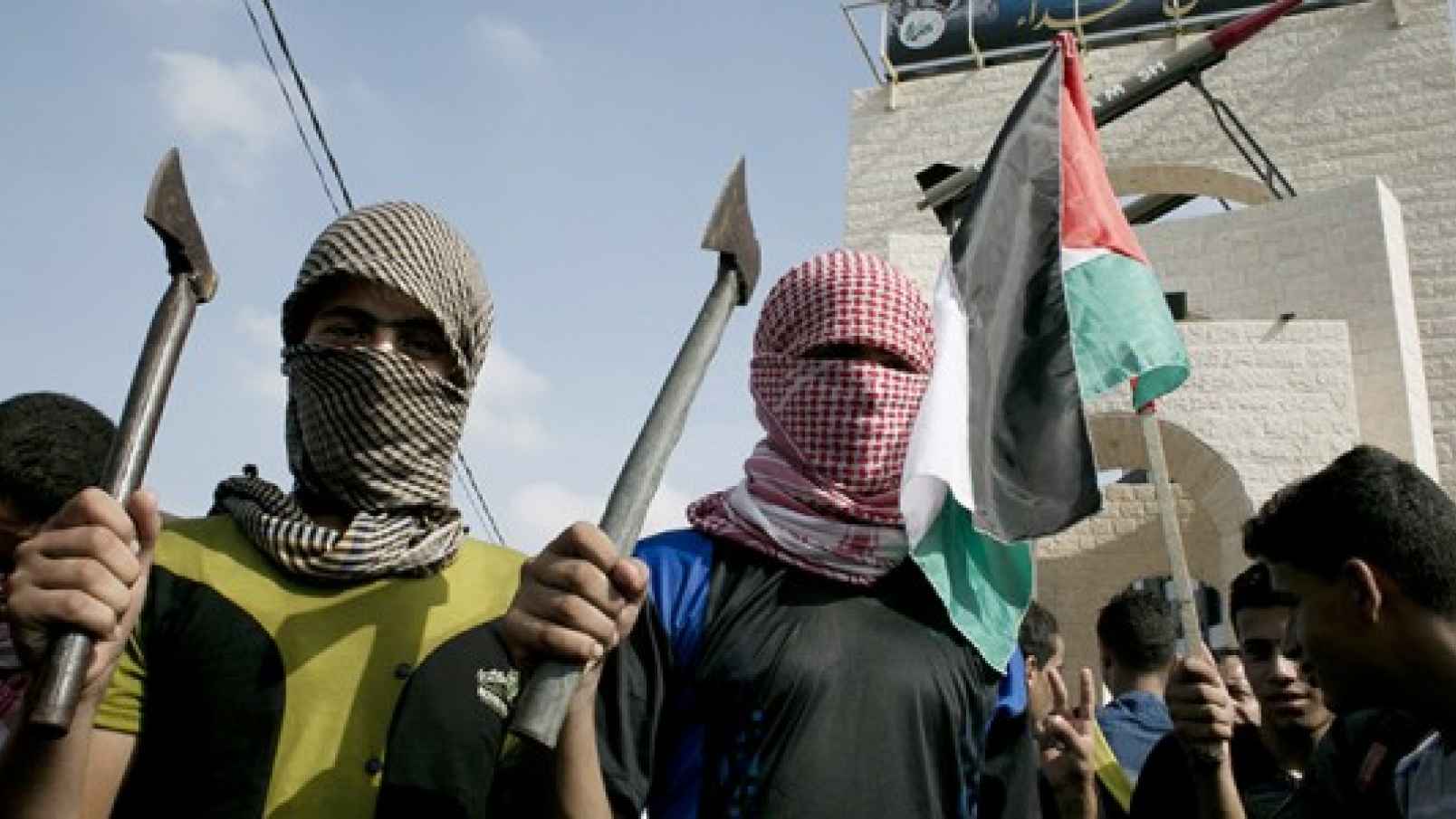
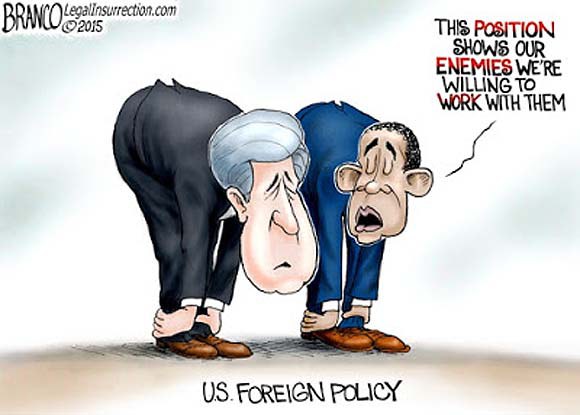
In the current epidemic of Palestinian violence, scores of Arab youths are attacking, supposedly spontaneously, Israeli citizens with knives. Apparently, edged weapons have more Koranic authority, and, in the sense of media spectacle, they provide greater splashes of blood. Thus the attacker is regularly described as “unarmed” and a victim when he is “disproportionately” stopped by bullets.

The Obama State Department has condemned the use of “excessive” Israeli force in response to Palestinian terrorism. John Kirby, the hapless State Department spokesman, blamed “both” sides for terrorism, and the president himself called on attackers and their victims to “tamp down the violence.”

In short, the present U.S. government — which is subsidizing the Palestinians to the tune of hundreds of millions of dollars a year — is incapable of distinguishing those who employ terrorist violence from the victims against whom the terrorism is directed. But why is the Obama administration — which can apparently distinguish those who send out drones from those who are blown up by them on the suspicion of employing terrorist violence — morally incapable of calling out Palestinian violence? After all, in the American case, we blow away suspects whom we think are likely terrorists; in the Israeli instance, they shoot or arrest those who have clearly just committed a terrorist act.

Two reasons stand out.

One, Obama’s Middle East policies are in shambles. Phony red lines, faux deadlines, reset with Putin, surrendering all the original bargaining chips in the Iranian deal, snubbing Israel, cozying up to the Muslim Brotherhood, dismissing the threat of ISIS, allowing Iraq to collapse by abruptly pulling out all American troops, giving way to serial indecision in Afghanistan, ostracizing the moderate Sunni regimes, wrecking Libya, and setting the stage for Benghazi — all of these were the result of administration choices, not fated events. One of the results of this collapse of American power and presence in the Middle East is an emboldened Palestinian movement that has recently renounced the Oslo Accords and encouraged the offensive of edged weapons.

Mahmoud Abbas, the subsidized president of the self-proclaimed Palestinian State, and his subordinates have sanctioned the violence. Any time Palestinians sense distance between the U.S. and Israel, they seek to widen the breach. When the Obama team deliberately and often gratuitously signals its displeasure with Israel, then the Palestinians seek to harden that abstract pique into concrete estrangement.

Amid such a collapse of American power, Abbas has scanned the Middle East, surveyed the Obama pronouncements — from his initial Al Arabiya interview and Cairo speech to his current contextualizations and not-so private slapdowns of Netanyahu — and has wagered that Obama likes Israel even less than his public statements might suggest. Accordingly, Abbas assumes that there might be few consequences from America if he incites another “cycle of violence.”

The more chaos there is, the more CNN videos of Palestinian terrorists being killed by Israeli civilians or security forces, the more NBC clips of knife-wielding terrorists who are described as unarmed, and the more MSNBC faux maps of Israeli absorption of Palestine, so all the more the Abbas regime and Hamas expect the “international community” to force further Israeli concessions. The Palestinians hope that they are entering yet another stage in their endless war against Israel. But this time, given the American recessional, they have new hopes that the emerging Iran–Russia–Syria–Iraq–Hezbollah axis could offer ample power in support of the violence and could help to turn the current asymmetrical war more advantageously conventional. The Palestinians believe, whether accurately or not, that their renewed violence might be a more brutal method of aiding the administration’s own efforts to pressure the Israelis to become more socially just, without which there supposedly cannot be peace in the Middle East.

But there is a second, more general explanation for the moral equivalence and anemic response from the White House. The Obama “we are the ones we’ve been waiting for” administration is the first postmodern government in American history, and it has adopted almost all the general culture’s flawed relativist assumptions about human nature.

Affluent and leisured Western culture in the 21st century assumes that it has reached a stage of psychological nirvana, in which the Westernized world is no longer threatened in any existential fashion as it often was in the past. That allows Westerners to believe that they no longer have limbic brains, and so are no longer bound by Neanderthal ideas like deterrence, balance of power, military alliances, and the use of force to settle disagreements. Their wealth and technology assure them that they are free, then, to enter a brave new world of zero culpability, zero competition, and zero hostility that will ensure perpetual tranquility and thus perpetual enjoyment of our present material bounty.

Our children today play tee-ball, where there are no winners and losers — and thus they are schooled that competition is not just detrimental but also can, by such training, be eliminated entirely. Our adolescents are treated according to the philosophy of “zero tolerance,” in which the hero who stops the punk from bullying a weaker victim is likewise suspended from school. Under the pretense of such smug moral superiority, our schools have abdicated the hard and ancient task of distinguishing bad behavior from good and then proceeding with the necessary rewards and punishments. Our universities have junked military history, which schooled generations on how wars start, proceed, and end. Instead, “conflict resolution and peace studies” programs proliferate, in which empathy and dialogue are supposed to contextualize the aggressor and thus persuade him to desist and seek help — as if aggression, greed, and the desire for intimidation were treatable syndromes rather than ancient evils that have remained dangerous throughout history.

Human nature is not so easily transcended, just because a new therapeutic generation has confused its iPhone apps and Priuses with commensurate moral and ethical advancement. Under the canons of the last 2,500 years of Western warfare, disproportionality was the method by which aggressors were either deterred or stopped. Deterrence — which alone prevented wars — was predicated on the shared assumption that starting a conflict would bring more violence down upon the aggressor than he could ever inflict on his victim. Once lost, deterrence was restored usually by disproportionate responses that led to victory over and humiliation of the aggressive party.

The wreckage of Berlin trumped anything inflicted by the Luftwaffe on London. The Japanese killed fewer than 3,000 Americans at Pearl Harbor; the Americans killed 30 times that number of Japanese in a single March 10, 1945, incendiary raid on Tokyo. “They have sown the wind, and they shall reap the whirlwind” was the standard philosophy by which aggressive powers were taught never again to start hostilities. Defeat and humiliation led to peace and reconciliation.

The tragic but necessary resort to disproportionate force by the attacked not only taught an aggressor that he could not win the fight he had started, but also reminded him that his targeted enemy might not be completely sane, and thus could be capable of any and all retaliation.

Unpredictability and the fear sown by the unknown also help to restore deterrence, and with it calm and peace. In contrast, predictable, proportionate responses can reassure the aggressor that he is in control of the tempo of the war that he in fact started. And worse still, the doctrine of proportionality suggests that the victim does not seek victory and resolution, but will do almost anything to return to the status quo antebellum — which, of course, was disadvantageous and shaped by the constant threat of unexpected attack by its enemies.

Applying this to the Middle East, the Palestinians believe that the new American indifference to the region and Washington’s slapdowns of Netanyahu have reshuffled relative power. They now hope that there is no deterrent to violence and that, if it should break out, there will be only a proportionate and modest response from predictable Westerners.

Under the related doctrine of moral equivalence, Westerners are either unwilling or unable to distinguish the more culpable from the more innocent. Instead, because the world more often divides by 55 to 45 percent rather than 99 to 1 percent certainty, Westerners lack the confidence to make moral judgments — afraid that too many critics might question their liberal sensitivities, a charge that in the absence of dearth, hunger, and disease is considered the worst catastrophe facing an affluent Western elite.

The question is not only whether the Obama administration, in private, favors the cause of the radical Palestinians over a Western ally like Israel, but also whether it is even intellectually and morally capable of distinguishing a democratic state that protects human rights from a non-democratic, authoritarian, and terrorist regime that historically has hated the West, and the United States in particular — and is currently engaged in clear-cut aggression.
The ‘Jerusalem Awakening’

October 19, 2015

The ‘Jerusalem Awakening’ Front Page MagazineRichard L. Cravatts, October 19, 2015

pa

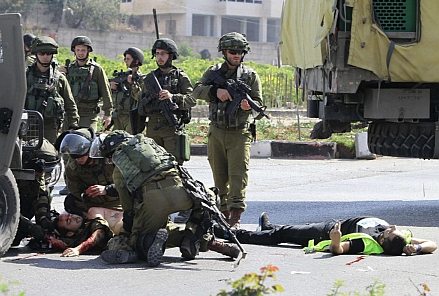
The carnage in Jerusalem and other parts of Israel continued this week with an increased ferocity and barbarity, with stabbings, shooting, bombings, car ramming, rocket attacks, and other assaults on Israeli citizens claiming the lives of five Israelis and twenty-five Palestinians in the past two weeks alone. While the violence intensifies and seems to be spiraling out of control, not only touching Jerusalem but also the West Bank, Gaza, and other Israeli towns, officials are intent on identifying the inspiration for the latest escalation of jihad against Jews.

U.S. Secretary of State John Kerry was quick to assign blame, not to the perpetrators of the deadly attacks—psychotic young men acting in the name of Allah to purge the land of Jews—but to the victims themselves, Israelis. Speaking at the Belfer Center at Harvard University, Kerry disingenuously observed in a question and answer session after his talk that, “There’s been a massive increase in settlements over the course of the last years and there’s an increase in the violence because there’s this frustration that’s growing.” Blaming the settlements for being an obstacle to peace is a favorite refrain for this administration, of course, and it puts the responsibility for the outbreak of violence squarely on Israel, and Netanyahu, instead of where it more justifiably belongs: namely, with Mahmoud Abbas, the Palestinian Authority, and a culture of death where “resistance” and martyrdom are promoted as virtuous rather than inhumanly counterproductive.

Prime Minister Benjamin Netanyahu was more accurate in identifying the inspiration of the current uprising, this so-called “Jerusalem Awakening,” that has increased the tension of everyday life for Israelis and Arabs alike. At a weekly cabinet meeting Netanyahu correctly observed that Israel is “. . . in the midst of a wave of terrorism originating from systematic and mendacious incitement regarding the Temple Mount – incitement by Hamas, the Palestinian Authority, and the Islamic Movement in Israel.”

Secretary Kerry may well wish that it is the dreaded settlements that have motivated young Arab men to begin indiscriminately slashing and shooting Jews, but the prime minister’s view is clearly more accurate, and more believable, given PA Chairman Mahmoud Abbas’s own words of warning when he spoke at the UN at the end of September. He was, he said before the morally-challenged audience, “. . . compelled to sound the alarm about the grave dangers of what is happening in Jerusalem, where extremist Israeli groups are committing repeated, systematic incursions upon Al-Aqsa Mosque . . , while preventing Muslim worshipers from accessing and entering the Mosque at those times and freely exercising their religious rights.”

These actions, Abbas claimed, are “in direct violation of the status quo since before 1967 and thereafter, [and are] aggravating the sensitivities of Palestinians and Muslims everywhere. I call on the Israeli government, before it is too late, to cease its use of brutal force to impose its plans to undermine the Islamic and Christian sanctuaries in Jerusalem, particularly its actions at Al-Aqsa Mosque, for such actions will convert the conflict from a political to religious one[emphasis added], creating an explosive in Jerusalem and in the rest of the occupied Palestinian territory.”

Putting aside the laughable contention that Muslims care even the slightest bit about the sanctity and protection of Christian holy places, the claim that Israel is trying to destroy or undermine mosques on the Temple Mount is an oft-repeated charge, used by Arabs against Israel as a way of inciting hatred toward Jews for their alleged perfidiousness and guile. Israeli columnist Nadav Shragrai has referred to this tactic as the “Protect the Al Aqsa Mosque” blood libel—a propaganda tool that has been employed since the 1920s to cause mistrust of Jews when the then-Grand Mufti Haj Amin al-Husseini, Hitler’s Middle East ally, exhorted Muslims everywhere to defend Islamic holy places in Jerusalem from the pernicious Jews, causing riots, bloodshed, and 133 Jewish deaths.

Abbas was surprisingly candid in admitting that the incursion onto the Temple Mount, where Jews and Christians have traditionally been barred from worshiping, changed the nature of the conflict between the Palestinians and Israelis from a political debate to a religious war. Of course, a holy war against Israelis specifically, and Jews in general, has been a core tenet of Islam since Jews rejected Mohammed in the seventh century, and animates the foundational charters of the PA and Hamas as part of a theological responsibility devout Muslims feel to purify the world through the extirpation of the rapacious, thieving Jews.

The perceived assault by Israel on the Al Aqsa Mosque, and the Temple Mount in general, then, is yet another affirmation to the Muslim world that the scheming Jews seek to weaken and eventually destroy the House of Islam—here in Jerusalem at Islam’s third holiest spot—and replace it with a Third Temple. What seem like random, “lone wolf” attacks on Israeli civilians at bus stops and on streets are actually thought of as part of a religiously-inspired war in the defense of Islam, a holy war in the form of jihad.

The Hamas Charter, for instance, proclaims that the circumstances through which the “Zionist regime” was established through the perfidy of the Jews is, in the honor/shame culture of the Middle East, an open wound on the Islamic world, a situation which demands jihad to restore the sanctity of Islamic land and rid the world of the festering sore that is Israel. “[T]he land of Palestine is an Islamic Waqf [Islamic religious endowment] consecrated for future Moslem generations until Judgment Day,” the Charter states. “The day that enemies usurp part of Moslem land, Jihad becomes the individual duty of every Moslem,” stipulating that jihad is not only a tactical choice for ridding Palestine of the Zionist interloper, it is seen as a religious duty; in fact, it is demanded of true believers.

The Charter’s Article 7 also contains the oft-cited hadith which exhorts Muslims to seek out and murder Jews specifically as a sacred obligation. Islamic teaching depicts Jews as the descendants of “monkeys and pigs,” treacherous deceivers, manipulative barbarians and thieves who attempted to murder the prophets, and who are satanic, murderous, unlawful occupiers of holy Muslim land whose elimination is sacralized in Koranic and hadithic precepts.  “. . . The Islamic Resistance Movement aspires to realize the promise of Allah, no matter how long it takes,” Article 7 reads. “The Prophet, Allah’s prayer and peace be upon him, says: ‘The hour of judgment shall not come until the Muslims fight the Jews and kill them, so that the Jews hide behind trees and stones, and each tree and stone will say: “Oh Muslim, oh servant of Allah, there is a Jew behind me, come and kill him,” except for the Gharqad tree, for it is the tree of the Jews.’”

It is no surprise that in a culture marinated in Jew-hatred, where Jews are debased, portrayed as a subhuman species, bacteria, a disease, fomenters of wars and strife—in fact, are portrayed as the enemies of Allah and mankind—the extermination of Jews, especially in defense of Islam and its holy places, would therefore become not only a reasonable goal but a desired outcome. Who would not murder Jews if they pose such threats to mankind and Islam specifically? Who would ever make peace with the eternal enemies of Allah, let alone negotiate a peace and borders for a new Arab state with them? And would not those jihadis who willingly sacrifice themselves to murder Jews in the name of Allah be celebrated as shahids, martyrs, and have town squares and summer camps named for them and their bravery, exactly as they are by Palestinian leadership now?

If Jews are the most wretched of humans, and the “liberation” of all of Palestine—including the Temple Mount, including Jerusalem, including all of Israel—is considered a sacred duty and religious obligation, then the murder of Jews must, and will, continue in this millennial apocalyptic struggle in which devote Muslims see themselves playing a central role.

Abbas’s disingenuous and lethal tactics in inciting rage against Jewish “interlopers” and “defilers” of Muslim holy ground on the Temple Mount are not new. Scholars and archeologists remember, for instance, the howls of outrage that arose from the Arab world in February 2007, when Israeli authorities initiated a project to rebuild a ramp to the Mugrabi Gate, an entrance to the Temple Mount plaza and the Al Aqsa Mosque platform that had been damaged in an earlier storm.  Riots and protests began immediately, with accusations against Israel coming from throughout the Arab world for its “scheme” and treachery in digging under and threatening to destroy the Al Aqsa Mosque itself. The committee of Muslim scholars in Jordan’s Islamic Action Front, for one, “urge[d] … jihad to liberate Al Aqsa and save it from destruction and sabotage from Jewish usurpers”—a spurious claim, since construction was taking place well outside the Mount platform, some 100 meters from the mosque, and clearly posed no possible threat.

But false irredentist claims, Islamic supremacism which compels Jews and Christians to live in dhimmitude under Muslim control, and an evident cultural and theological disregard for other faiths— while troubling in the battle over sovereignty in Jerusalem—are not, according to Dore Gold, Israel’s former ambassador to the United Nations, the most dangerous aspects of a diplomatic capitulation which would allow the Palestinians control holy places and to claim a shared Jerusalem. In his engaging book, The Fight for Jerusalem: Radical Islam, the West, and the Future of the Holy City, Gold pointed to a far more troubling aspect: in their desire to accede to Arab requests for a presence and religious sovereignty in Jerusalem, the State Department, EU, UN member states, and Islamic apologists in the Middle East and worldwide may actually ignite jihadist impulses they seek to dampen with their well-intentioned, but defective, diplomacy.

Why? Because, as Gold explained, “In the world of apocalyptic speculation, Jerusalem has many other associations—it is the place where the messianic Mahdi [the redeemer of Islam] is to establish his capital. For that reason, some argue that it also should become the seat of the new caliphate that most Islamic groups—from the Muslim Brotherhood to al-Qaeda—seek to establish.”

In September, Abbas announced in Ramallah that “We will not forsake our country and we will keep every inch of our land,” reaffirming his belief that all of Jerusalem would, and should, be retained by the Palestinians as the capital of their new state. “Every drop of blood spilled in Jerusalem is pure, every shahid [martyr] will reach paradise, and every injured person will be rewarded by God.” In facgt, the establishment of the Palestinian capital in East Jerusalem is the first important step in the long-term strategy to rid the Levant of Jews and reestablish the House of Islam in all of historic Palestine. “Jerusalem’s recapture is seen by some as one of the signs that ‘the Hour’ and the end of times are about to occur,” Gold suggested. “And most importantly, because of these associations, it is the launching pad for a new global jihad powered by the conviction that this time the war will unfold according to a pre-planned religious script, and hence must succeed.”

So far from creating a political situation in which both parties—Israelis and the Palestinians—feel they have sought and received equal benefits, such negotiations and final agreements would have precisely the opposite effect: destabilizing the region and creating, not the oft-hoped for Israel and Palestine “living side by side in peace,” but an incendiary cauldron about to explode into an annihilatory, jihadist rage. Those in the West who are urging Israel “to redivide Jerusalem by relinquishing its holy sites,” Dore cautioned, “may well believe that they are lowering the flames of radical Islamic rage, but in fact they will only be turning up those flames to heights that have not been seen before.” If Kerry’s State Department and other Western diplomats are intent on mollifying the Arab street by pressuring Israel to divide Jerusalem as a peace offering to the Palestinians, it may well be setting into motion the exact opposite result—a jihadist, apocalyptic movement invigorated by the misguided diplomacy of the West that, once more, asks Israel to sacrifice its security and nationhood so that Islamists can realize their own imperial and theological ambitions at the Jewish state’s expense.

Cartoon of the day

October 18, 2015

H/t Vermont Loon Watch

ankles-01

An Islamist Intifada

October 18, 2015

An Islamist Intifada, American ThinkerJonathan F. Keiler, October 18, 2015

The history of phony Palestinian Arab nationalism inevitably has led back to this point, revealing the violence for what it is: a war against Jews, and ultimately against anybody else who refuses to submit.

***************************

The current Palestinian Arab “uprising” against Israel appears to be a mostly Islamist offensive, not different in any significant ideological way from radical Islamist movements like ISIS, al-Qaeda, and Hezb’allah.  The idea that it is motivated by Israeli policies, the stalled “peace process,” or Palestinian Arab nationalism is nothing but propaganda, and the laziness and bias of the international press and political classes.

The violence is motivated by the Palestinian Authority’s deliberate agitation, which knowingly taps into the Arab masses deep-seated hatred of Jews and other infidels.  The Authority has a parochial interest in diverting the attention of the masses from its own corruption and incompetence.  It also wants to insulate itself against its Hamas rival in Gaza, which correctly sees the Authority for the hapless and rotten organization it is and would replace it with an incompetent and corrupt Islamist entity in the West Bank.

What neither the Palestinian Authority nor Hamas wants is independence, having rejected every opportunity to create a viable Palestinian Arab state.  The Authority, like all Palestinian Arab leadership since the 1930s, has rejected every opportunity to create a Palestinian state, despite claiming that purpose.  Correspondingly, Gaza is already a wholly independent Palestinian territory, but Hamas also laughably still claims it is “occupied” by Israel.  This patently idiotic assertion is nonetheless accepted as truth by the international left, many governments, and most likely the current occupant of the White House.

Still, Palestinian Arabs in the recent past have consistently played the nationalist card.  The first and second Palestinian intifadas could be characterized as nationalist uprisings, at least to the extent that the stated motivations of Arab leadership and the masses was to end Israeli occupation of the West Bank and Gaza.  The name of the uprisings, “intifada,” or “shaking off” in Arabic, suggested as much.  Predictably, though the Palestinian Arabs succeeded in ending the occupations of Gaza and most of the West Bank, they rejected the fruits of victory.

The uprisings demonstrated the disingenuous nature of Palestinian nationalism.  They furthered supposed Palestinian Arab national aspirations by intensifying international support of Palestinian goals and winning Israeli territorial concessions, but because of Palestinian disinterest in an actual state, these gains have led nowhere.

The result of the first intifada was the Oslo Accords, the withdrawal of the Israeli military from most populated parts of the West Bank, and the establishment of the Palestinian Authority.  If the Palestinian Arabs had any real interest in ending the conflict with Israel and establishing a real national polity, this could have led to a state in the West Bank and Gaza.  However, when Israel offered Yasser Arafat just that, accompanied by further Israeli territorial concessions, he rejected the offer and instead launched another intifada.

The second intifada was manufactured by Arafat, and also erupted over false claims of an Israeli violation of Arab sensitivities on the Jerusalem’s Temple Mount.  But with Arafat’s guidance, it quickly adopted the rhetoric of nationalist occupation.  The extreme violence of the second intifada, which cost Israel almost ten times the losses of the first intifada, also resulted in a tangible gain for the Palestinian Arabs: the abandonment of Israeli communities in Gaza and the Israeli military’s full retreat from that enclave.  When the Israelis departed, they intentionally left behind valuable infrastructure that the Palestinians could have used to build their nation.  In addition, the international community lavished aid and investment on the newly independent territory, which might have tried to transform itself into an Arab Singapore.

But again, the Palestinian Arabs rejected the opportunity.   They destroyed the abandoned Israeli infrastructure in typical self-destructive fits of “rage,” embezzled hundreds of millions of dollars’ worth of international aid, and launched a series of pathetic military offensives against Israel, designed to make their own people suffer.

Under Arafat’s successor Mahmoud Abbas (who remains in charge of the Palestinian Authority in the tenth year of a four-year term), and later under Hamas (after they kicked Abbas and his Fatah Party out), the Palestinians have ludicrously continued to claim that Gaza is occupied.

What is most interesting about the current uprising is that the Palestinians appear to have mostly abandoned any pretense of fighting for a state, and instead have now fully joined the Islamist wave sweeping the Middle East.  Other than Abbas’s posturing, the violence is relatively leaderless, at least in terms of traditional Palestinian Arab political organizations, and driven by Islamist youth.  This uprising, like the second intifada, was instigated by Abbas’s repeated lies about Israeli actions and intentions regarding holy sites in Jerusalem.  But it is persisting in that vein, as radicalized Palestinian Islamists attack Jews in the name of protecting Islam.

Thus, the current violence is less of a piece with the first and second intifadas as it is with the Arab revolts in Mandated Palestine during the 1930s.  Those uprisings were religious, based also on supposed threats posed to Islamic holy sites, with little nationalist motivation.  That’s because in the 1930s there was no Palestinian national movement, there being no such thing as a Palestinian historically, ethnically, or culturally.  To the extent there was any national element to the revolts, it was of the pan-Arab variety – a movement that has proven to be as chimeric as Palestinian nationalism.

In theory, the religious nature of this revolt should put “Palestine’s” many supporters in the West in a more difficult position.  The basis of Western support of Palestine, from the BDS movement to formal recognition to the “peace process,” has been the idea that the conflict between Israel and the Arabs is nationalist, not religious.  As a national conflict, the left and liberal Western governments take the side of the “indigenous” people (Palestinian Arabs), as opposed to the colonial occupiers (Israelis).  But with Palestinians adopting the ideas of the most radical Islamists, this ought to challenge that narrative.  And it reflects reality, because from the 1930s until today, there never has been an authentic Palestinian national movement, as opposed to a basically Islamist desire to rid the Middle East of its only non-Islamic polity.

Hamas has always been an assertively an Islamist organization, openly embracing terror; hostage-taking; public executions of infidels and heretics; and tyranny, both political and religious.  But it also claims to want to vindicate Palestinian national aspirations, which allows some governments and leftists in general to ignore Hamas’s Islamist nature and accept its partial self-depiction as a “resistance movement” to (nonexistent) Israeli occupation.   Likewise, Hezb’allah, the Shia-Islamist terror organization, also self-depicts as a resistance movement to nonexistent Israel occupation (Israel having totally quit Lebanon over 15 years ago).  This nationalist cover allows Western leftist politicians like Jeremy Corbyn (Britain’s new Labor leader) to embrace these groups .

It has also allowed Western leaders like President Obama and Secretary of State Kerry to divorce the Israeli-Palestinian Arab conflict from the larger war on terror.  They prefer to depict it as a local nationalist phenomenon, in which Israeli occupation – rather than Jews simply trying to live as Jews – drives Arab terror.  So far, true to form, the White House and State Department are sticking with that story with the current violence, blaming Israel and the Palestinian Arabs equally, and willfully ignoring the facts of Abbas’s incitement and the Islamist motivations of Arab murderers.

The history of phony Palestinian Arab nationalism inevitably has led back to this point, revealing the violence for what it is: a war against Jews, and ultimately against anybody else who refuses to submit.


Propaganda!

October 17, 2015

Propaganda! Gates of ViennaMC, October 16, 2015

stabbingisrael

So we are told endlessly that Islam is a ‘religion of peace’, and that the flood of Islamic warriors knocking at the gates of Europe consists of ‘refugees’ fleeing war. And you know what? It works. Germans (and Swedes) are already swamped, overwhelmed even, but thanks to effective propaganda they do not see the truth before their eyes. However, the indigenous poor are less distracted. They have to live with the filth and violence, but they have no voice; they are shouted down as ‘racist’ and offered no platform.

It is propaganda at play which keeps the Merkels and Obamas of this world in power. Truth is hidden behind a smokescreen of mendacious words: words such as ‘hope’, ‘change’, ‘progress’, ‘liberal’, ‘Democrat’ and ‘Republican’. These words have become Orwellian doublespeak, a stinking hole of corruption, a rotten miasma emanating from a mass grave — ours!

*************************************

I get very bored when people tell me (which is often) that “Israel murders Palestinians”. Whilst it is true that Palestinians get murdered in Israel, what this statement fails to comprehend is that Israelis get gaoled for murdering anybody, including Palestinians, as in any civilized Western country, but unlike most Middle Eastern countries including the Palestinian Authority (PA).

The difference here is the relentless propaganda to demonise Israel.

Jews have been demonised down through the centuries; it is a historical fact. Every evil regime persecutes Jews, and in every aspiring evil regime, there is an increase in the persecution of Jews.

That said, most people are not born with Jew-hatred embedded in their psyche. It is placed there by nurture, which is essentially propaganda.

Jews particularly open themselves to negative propaganda. A minority of Jews are arrogant and self-righteous in a singularly narrow and offensive way, as can be seen from recent comments on this website. They, too, are mostly reacting to propaganda. They expect tolerance, but are not prepared to be tolerant in return.

It is this dichotomy which is at the heart of the East-West problem. In the West we are all taught to tolerate other people’s peccadilloes (within reason), but this does not tend to occur elsewhere, and certainly not in the Middle East.

Intolerance is a human emotion based on fear, it is thus a prime target of propaganda. Has a ‘white African” president of the USA increased or decreased racial tensions in the USA?

When a President says one thing (“I am a Christian”) but acts like he is a Muslim, it causes confusion and fear. We then need oceans of propaganda and not a little dissimulation to patch the gaping hole in his credibility. As an outsider, one gets the impression that the real, actual ruler of the USA is the (possibly criminal) Islamic organisation CAIR, and that the citizens of the USA are fed layer upon layer of lies and trickery to ensure the current political status quo. A status quo of a non-violent coup d’état.

Propaganda as such started in the UK. In 1906 the British Government did a secret deal with France calling for the UK to side with France in the case of another war with Germany. It should be remembered that relations between UK and France had been hostile for centuries, and after the Fashoda incident; not particularly warm, so this deal was kept under wraps.

When the time came for fulfilment of this obligation in 1914, the UK government had to ‘cover up’ its motives, so they created the ‘poor little Belgium’ story of rape and pillage by German soldiers.

Thus Britain went to war on the back of lies and deceit, and many young men paid for it with their lives.

In 1919 Edward Bernays basically merged propaganda and commercial advertising, using various manipulative techniques to ‘bend’ public perception on issues such as women smoking in public. The idea was to get you, the victim, to spend your money on something you would not normally spend it on.

With the advent of radio, advertising (and thus propaganda) became big business.

Political propaganda grew alongside of commercial propaganda. The human brain is wired such that we are creatures of habit, and this can be used for propagandistic purposes. If, by constant repetition, a meme, true or false, is embedded in the brain, it becomes a truism. Thus most people can be cynically manipulated, for example, to equate Jews (Israelis) with rats, and subsequently be convinced of the need for pest control. The rest is history.

So we are told endlessly that Islam is a ‘religion of peace’, and that the flood of Islamic warriors knocking at the gates of Europe consists of ‘refugees’ fleeing war. And you know what? It works. Germans (and Swedes) are already swamped, overwhelmed even, but thanks to effective propaganda they do not see the truth before their eyes. However, the indigenous poor are less distracted. They have to live with the filth and violence, but they have no voice; they are shouted down as ‘racist’ and offered no platform.

So how did ‘racism’ become the number one social crime? The answer lies in the spin given to Nazi doctrine in the immediate postwar period. The German people were taught by the Nazi propaganda ministry to ‘blame’ their hardships on Jewish bankers and capitalists, especially the defeat in 1918. Yes, the racism behind this was very old and already embedded in society; all that was needed was for the blame to be projected onto all Jews, not on those who were actually guilty (as, of course, a few were, along with their many non-Jewish colleagues). It was also necessary to demonize Slavs, as it was their lands that were required as lebensraum, the expansion of Aryan Germany into their god-given rightful living space.

At the same time as the Nazis were manipulating Germans, the Russian KGB was penetrating the media and education systems of the free Western world. In the immediate postwar period, the benign racism of the interwar period was amplified, by continuous distortion of the Nazi example, into the number one ‘hate crime’ of postmodernism. Nazi racism was focused on political and social need; modern ‘racism’ is a whites-only crime focused on the political needs of the KGB and its cultural Marxist successors.

The demise of Western cultures is predicated by the fear of the accusation of ‘racism’, with its negative associations with Nazism. This is the overarching victory of modern propaganda. It is this set of distortions that projects guilt onto an otherwise rational target group. I am not guilty of ‘white supremacy’, because the whole premise of the accusation of white supremacy is built upon the idea that we are all born equal, and that all cultures are equal. This concept is unproven, and moreover cannot be proven — except, that is, by propaganda. It is the product of a very clever and cynical set of lies and distortions aimed at bringing down Judeo-Christianity, the very root of Western success.

Part and parcel of modern propaganda technique is the necessity of omission. Whilst facts can be reported as such, the omission of pertinent data can render the report truthful but dishonest. So we see with the reporting in Germany of conditions in areas invaded by the latest wave of migrants. How is the Goebbels-era reporting of Jewish issues any different to the Merkel era reporting of immigration issues? One was negative and invented lies, the other was positive — because it left out anything derogatory — thus creating an untruth. The Goebbels lies preceded a war. What will be the result of the Merkel distortions?

The German people have just been shafted to the tune of hundreds of billions of Euros: the cost of open borders. And over the next ten years Merkel’s migrant lies are going to cost many more trillions of euros. One guess as to who will have to pay.

Hitler’s socialism was very expensive, for which reason he had to acquire the gold reserves of Austria, Czechoslovakia and Poland. How will Merkel cope?

It is propaganda at play which keeps the Merkels and Obamas of this world in power. Truth is hidden behind a smokescreen of mendacious words: words such as ‘hope’, ‘change’, ‘progress’, ‘liberal’, ‘Democrat’ and ‘Republican’. These words have become Orwellian doublespeak, a stinking hole of corruption, a rotten miasma emanating from a mass grave — ours!

I got Syria so wrong

October 15, 2015

I got Syria so wrong, Politico, October 15, 2015

Fully complicit in the Assad regime’s impressive portfolio of war crimes and crimes against humanity, Iran relies on its client to secure its overland reach into Lebanon. And Russia works to sustain Assad as a rebuke to Washington. All the while, the eastern part of Syria is run by the self-styled Islamic State, or ISIL, itself a criminal enterprise. For the most part, the two titans of crime — the Assad regime and the Islamic State — have been able to live and let live, concentrating their hideous repertoires of violence on civilians and on armed rebels offering a nationalistic alternative to both. The result is widespread and profound hopelessness. Many Syrians are giving up on their beloved Syria. They are voting with their feet.

*********************

I spent early 2011 trying to ease tensions between Syria and its neighbors. I never predicted the brutality that would come from inside.

Now and then I am asked if I had predicted, way back in March 2011 when violence in Syria began, that within a few years a quarter-million people would be dead, half the population homeless and hundreds of thousands of defenseless civilians terrorized, traumatized, tortured and starved. The companion question, more often than not, is if I had forecast the failure of the West to offer any protection at all to Syrian civilians subjected to a systematic campaign of mass homicide. Having first been exposed to Syria as a teenage exchange student, I was expected by questioners to know something about the place. And as a State Department officer, I was assumed to know something about my government.

But no. It took me the better part of eighteen months to comprehend fully the scope of an unfolding humanitarian and political catastrophe. By September 2012, when I resigned my State Department post as adviser on Syrian political transition to Secretary of State Hillary Clinton, I knew that Syria was plunging into an uncharted abyss — a humanitarian abomination of the first order. And I knew that the White House had little appetite for protecting civilians (beyond writing checks for refugee relief) and little interest in even devising a strategy to implement President Barack Obama’s stated desire that Syrian President Bashar Assad step aside. But at the beginning, nothing drawn from my many years of involvement in Syria inspired accurate prophesy.

That Russia’s recent military intervention in Syria has shocked the Obama administration is itself no surprise. For nearly two years, Washington had chased Moscow diplomatically in the belief that the Kremlin’s soothing words about supporting political transition in Syria were truthful. That which was obvious to many — Russia’s desire to perpetuate Assad in office — is now jarringly clear to the administration. That training and equipping anti-Assad rebels to fight anyone but Assad has been dropped like a bad habit by an administration warned not to proceed along these lines is hardly a bolt from the blue.But the White House is not alone in failing to accurately forecast the severity of the Syrian disaster.

The major reason for my lack of foresight: It didn’t have to turn out this way, and I remain mildly surprised that it did. It is not that Syrians were without grievances concerning the way they were being governed. Widespread unemployment, underemployment and opportunity deficits were already prompting those with means among the best and brightest to leave the country. Although the regime’s corruption, incompetence and brutal intolerance of dissent were hardly state secrets, Assad was not universally associated by Syrians with the system’s worst aspects: “If only the president knew” was a phrase one heard often. Some Syria watchers believed that the Arab Spring would visit the country in the form of political cyclone. I did not. I did not think it inevitable that Assad — a computer-savvy individual who knew mass murder could not remain hidden from view in the 21st century — would react to peaceful protest as violently as he did, with no accompanying political outreach. And as Syria began to descend into the hell to which Assad was leading it, I did not realize that the White House would see the problem as essentially a communications challenge: getting Obama on “the right side of history” in terms of his public pronouncements. What the United States would do to try to influence Syria’s direction never enjoyed the same policy priority as what the United States would say.

Back in early 2011, it seemed possible not only to avoid violent upheaval in Syria but to alter the country’s strategic orientation in a way that would counter Iran’s penetration of the Arab world and erase Tehran’s land link to its murderous Hezbollah militia in Lebanon. Much of my State Department time during the two years preceding Syria’s undoing was thus spent shuttling back and forth between Damascus and Jerusalem, trying to build a foundation for a treaty of peace that would separate Syria from Iran and Hezbollah on the issue of Israel.

There was a degree of idealism in my quest, born in the brain of an American teenager many years before. But there was another personal element as well. Long before Hezbollah murdered Mr. Lebanon — Prime Minister Rafik Hariri — in 2005, it had brutally and pathologically tortured to death a friend of mine serving as an unarmed United Nations observer, Marine Lt. Col. Rich Higgins. Peace between Israel and Syria would require Damascus to cut all military ties to Hezbollah. It would require Syria to stop facilitating Iran’s support to Hezbollah. It would set the stage for a Lebanon-Israel peace that would further marginalize Lebanon’s murder incorporated. Peace for its own sake is good. But the prospect of beating Hezbollah and its Iranian master was inspiring. This prospect, more than anything else, motivated the mediation I undertook as a deputy to Special Envoy George Mitchell in the State Department.

Assad, told me in late February 2011 that he would sever all anti-Israel relationships with Iran, Hezbollah and Hamas and abstain from all behavior posing threats to the State of Israel, provided all land lost by Syria to Israel in the 1967 war — all of it — was returned. My conversation with him was detailed in terms of the relationships to be broken and the behavior to be changed. He did not equivocate. He said he had told the Iranians that the recovery of lost territory — the Golan Heights and pieces of the Jordan River Valley — was a matter of paramount Syrian national interest. He knew the price that would have to be paid to retrieve the real estate. He implied that Iran was OK with it. He said very directly he would pay the price in return for a treaty recovering everything.

Israeli Prime Minister Benjamin Netanyahu was interested. He was not at all eager to return real estate to Syria, but he found the idea of prying Syria out of Iran’s grip fascinating. And the negative implications for Hezbollah of Lebanon following Syria’s peace accord with Israel were not lost on him in the least. Although there were still details to define about the meaning of “all” in the context of the real estate to be returned, Netanyahu, too, knew the price that would ultimately have to be paid to achieve what he wanted.

But by mid-April 2011 the emerging deal that had looked promising a month earlier was off the table. By firing on peaceful demonstrators protesting police brutality in the southern Syrian city of Deraa, gunmen of the Syrian security services shredded any claim Assad had to governing legitimately. Indeed, Assad himself — as president of the Syrian Arab Republic and commander in chief of the armed forces — was fully responsible for the shoot-to-kill atrocities. Even so, he told Barbara Walters in a December 2011 ABC TV interview, “They are not my forces, they are military forces belong[ing] to the government . . . I don’t own them, I am the president. I don’t own the country, so they are not my forces.”

Before the shooting began the United States and Israel were willing to assume Assad had sufficient standing within Syria to sign a peace treaty and — with American-Israeli safeguards in place — make good on his security commitments before taking title to demilitarized territories. But when he decided to try to shoot his way out of a challenge that he and his first lady could have resolved personally, peacefully and honorably, it was clear he could no longer speak for Syria on matters of war and peace.

Some of my U.S. government colleagues from bygone days tell me we dodged a bullet: that an uprising against the Assad regime’s arrogance, cluelessness and corruption in the middle of treaty implementation would have caused real trouble. Others believe we were too slow: that a treaty signing in early 2011 could have kept the gale force winds of the Arab Spring from unhinging Syria. I don’t know. I don’t know if Assad or Netanyahu would, in the end, have done a deal. What I do know is that I felt good about where things were in mid-March 2011. What I also know is that by mid-April hope of a treaty was gone, probably never to return in my lifetime.

Assad’s decision to apply lethal violence to something that could have been resolved peacefully was the essence of betrayal. He betrayed his country so thoroughly as to destroy it. Four years on, he reigns in Damascus as a satrap of Iran and a dependent of Moscow. In the end, he solidified Israel’s grip on land lost in 1967 by his defense minister father.

Fully complicit in the Assad regime’s impressive portfolio of war crimes and crimes against humanity, Iran relies on its client to secure its overland reach into Lebanon. And Russia works to sustain Assad as a rebuke to Washington. All the while, the eastern part of Syria is run by the self-styled Islamic State, or ISIL, itself a criminal enterprise. For the most part, the two titans of crime — the Assad regime and the Islamic State — have been able to live and let live, concentrating their hideous repertoires of violence on civilians and on armed rebels offering a nationalistic alternative to both. The result is widespread and profound hopelessness. Many Syrians are giving up on their beloved Syria. They are voting with their feet.

There is no end in sight to this vicious bloodletting. Iran and Russia could stop the gratuitous mass murder but opt not to do so. Moscow now facilitates it with military intervention. The United States could stop it or slow it down significantly without invading and occupying Syria — indeed, without stretching the parameters of military science. But it has adamantly refused to do so. Meanwhile, the minions of the Islamic State loot and destroy the world heritage site of Palmyra while subjecting much of eastern Syria to their own brand of violent rule and internal terror.

Both sides of this debased criminal-terrorist coin need to be addressed urgently. Assad’s barrel bombing of Deraa in the south — where peaceful protests against regime brutality first attracted international notice in March 2011 — along with his bombing of Aleppo and Idlib in the north must be stopped cold. These horrific devices kill the innocent and recruit for the Islamic State: precisely as they are intended to do. Means exist far short of invasion and occupation to make it difficult for Assad regime helicopters to deliver their deadly cargoes. What is required is a clear statement of intent by Obama, one communicated to the Department of Defense, so that options can be produced for presidential decision and execution.

With regard to ISIL, a professional ground combat component provided by regional powers is desperately needed to work with coalition aircraft to sweep this abomination from Syria and permit a governmental alternative to the Assad regime to take root inside Syria. With central and eastern Syria free of both the regime and ISIL, an all-Syrian national stabilization force can be built. Western desires for a negotiated end to the Syrian crisis would be based, under these circumstances, on more than a wish and a hope.

The United States should neither seek nor shy away from confrontation with Russian forces in Syria. Moscow will not like it if its client’s ability to perform mass murder is impeded. Russia will not be pleased if ISIL, its false pretext for military intervention in Syria, is swept from the table. Ideally, Russia will not elect to escort regime aircraft on their mass homicide missions. And it would be difficult for even Russian President Vladimir Putin to articulate outrage if ISIL is crushed militarily. But if Russia seeks out armed confrontation with the United States in Syria, it would be a mistake for Washington to back down. People like Putin will push until they hit steel. And he will not stop in Syria.

Having failed miserably as a prophet in 2011 does not deter me from predicting the following: Obama will bequeath to his successor a problem of gargantuan dimensions if he does not change policy course now. Left to the joint ministrations of Assad and the Islamic State, Syria will continue to hemorrhage terrified, hungry and hurt human beings in all directions while terrorists from around the globe feast on the carcass of an utterly ruined state. Western Europe now reaps a whirlwind of desperate and displaced humanity it thought would be limited to Syria’s immediate neighborhood.

My failure to predict the extent of Syria’s fall was, in large measure, a failure to understand the home team. In August 2011, Barack Obama said Assad should step aside. Believing the president’s words guaranteed decisive follow-up, I told a congressional committee in December 2011 that the regime was a dead man walking. When the president issued his red-line warning, I fearlessly predicted (as a newly private citizen) that crossing the line would bring the Assad regime a debilitating body blow. I still do not understand how such a gap between word and deed could have been permitted. It is an error that transcends Syria.

I want the president to change course, but I fear that Syrians — Syrians who want a civilized republic in which citizenship and consent of the governed dominate — are on their own. I’ve been so wrong so many times. One more time would be great. It would mean saving thousands of innocent lives. It would mean real support for courageous Syrian civil society activists who represent the essence of a revolution against brutality, corruption, sectarianism and unaccountability. It would mean the reclamation of American honor. It would mean preserving my near-perfect record of getting things wrong. It would be a godsend.

Cartoon of the day

October 15, 2015

H/t Power Line

Leading-from-Behind-copy

“Russia” calling “another US’ bad bluff”!

October 15, 2015

“Russia” calling “another US’ bad bluff”! Zero Point via You Tube, October 14, 2015


According to the blurb below the video,

The US has now thrown in the towel on the ill-fated strategy of training Syrian fighters and sending them into battle only to be captured and killed by other Syrian fighters who the US also trained..

The Pentagon’s effort to recruit 5,400 properly “vetted” anti-ISIS rebels by the end of the year ended in tears when the entire world laughed until it cried after word got out that only “four or five” of these fighters were actually still around. The rest are apparently either captured, killed, lost in the desert, or fighting for someone else..

This has cost the US taxpayer somewhere in the neighborhood of $40 million over the last six months..
Because this latest program was such a public embarrassment, the Pentagon had to come up with a new idea to assist Syria’s “freedom fighters” now that they are fleeing under bombardment by the Russian air force only to be cut down by Hezbollah..

The newest plan: helicopter ammo. No, really. The US has now resorted to dropping “tons” of ammo into the middle of nowhere and hoping the “right” people find it..

Here’s CNN:

U.S. military cargo planes “gave” 50 tons of ammunition to rebel groups overnight in northern Syria, using an air drop of 112 pallets as the first step in the Obama Administration’s urgent effort to find new ways to support those groups..

Details of the air mission over Syria were confirmed by a U.S. official not authorized to speak publicly because the details have not yet been formally announced..

C-17s, accompanied by fighter escort aircraft, dropped small arms ammunition and other items like hand grenades in Hasakah province in northern Syria to a coalition of rebels groups vetted by the US, known as the Syrian Arab Coalition..

And here’s a bit more color from GOP mouthpiece Fox News:

The ammunition originally was intended for the U.S. military’s “train and equip” mission, the official said. But that program was canceled last week..

“So now we are more focused on the ‘E’ [equip] part of the T&E [train & equip],” said the official, who described equipping Syrian Arabs as the focus of the new strategy against ISIS..

The Defense Department announced Friday that it was overhauling the mission to aid Syrian rebel fighters. After the program fell far short of its goals for recruiting and training Syrian fighters, the DOD said it would focus instead on providing “equipment packages and weapons to a select group of vetted leaders and their units so that over time they can make a concerted push into territory still controlled by ISIL”..

The shift also comes as Russia continues to launch airstrikes in Syria, causing tension with the U.S. amid suspicions Moscow is only trying to prop up Bashar Assad..

Col. Steve Warren, spokesman for the U.S.-led anti-ISIS coalition, confirmed that coalition forces conducted the airdrop..

“The aircraft delivery includes small arms ammunition to resupply counter-ISIL ground forces so that they can continue operations against ISIL. All aircraft exited the drop area safely,” he said in a statement. All pallets successfully were recovered by friendly forces, a U.S. official said..

The US just paradropped 50 tons of ammo on pallets into the most dangerous place on the face of the planet with no way of ensuring that it falls into the “right” hands (it goes without saying that the term “right” is meaningless there). Meanwhile, the Russians are dropping bombs on the same extremists who are set to receive the guns the US is dropping..

Of course if it does somehow fall into the “wrong” hands, it wouldn’t be the first time (see Mosul and recall the $500 billion worth of weapons Washington “misplaced” in Yemen) and as we said a few days ago, this is at least great news for the military-industrial complex. It means more “terrorist attacks” on U.S. “friends and allies”, and perhaps even on U.S. soil – all courtesy of the US government supplying the weapons – are imminent…

Looking beyond the ‘third intifada’

October 14, 2015

Looking beyond the ‘third intifada’ Jerusalem PostLouis Rene Beres, October 13, 2015

ShowImage (14)Funeral in the Shuafat refugee camp in east Jerusalem, on October 10, 2015. (photo credit: AHMAD GHARABLI / AFP)

About expected Palestinian state intentions, there is little real mystery to fathom. It should already be widely understood that any new state of Palestine could provide a ready platform for launching endlessly renewable war and terrorism against Israel. Significantly, not a single warring Palestinian faction has ever even bothered to deny such overtly criminal intent. On the contrary, aggressive intent has always been openly embraced, fervently cheered as a distinctly sacred “national” incantation.

*********************************

It’s farewell to the drawing-room’s civilized cry, The professor’s sensible where to and why, The frock-coated diplomat’s social aplomb, Now matters are settled with gas and with bomb.”

– W.H. Auden, Danse Macabre

With apparent suddenness, and a very deliberate brutality, Palestinian terrorists are launching a new wave of indiscriminate assaults they proudly hail as a “third intifada.”

But behind the protective veneer of language, where homicide is conveniently transfigured into revolution, these latest Arab attacks remain what they have always been – that is, crudely camouflaged expressions of rampant criminality.

Jurisprudentially, this is all perfectly obvious. Prima facie, under all pertinent international law, calculated assaults on mostly women and children can never be sanitized or justified. Always, rather, they represent codified crimes of war and crimes against humanity.

Always, such crimes are unpardonable.

Oddly enough, even after the painfully long history of egregious Palestinian crimes carried out against noncombatant populations, a sizable portion of the “international community” still seeks to encourage Palestinian statehood. Self-righteously, of course, and with ritualistic indignation directed against Israeli “intransigence,” the “civilized community of nations” remains willing to rip a 23rd Arab state from the still-living body of Israel. Even now, as the Palestinians remain rigorously segmented into barbarously warring factions – into opponents who enthusiastically maim and torture each other, all while cooperating in doing the same to their commonly despised Israeli victims – world public opinion calls naively for Palestinian “self-determination.”

Even now, when any new Palestinian state could quickly come to resemble an already-fractured Syria, the United Nations and its secretary – general seem much more concerned with comforting the markedly unheroic Palestinian criminals than with protecting fully innocent Israeli civilians.

Unapologetically, and whatever their unhindered and ongoing excesses, Fatah, Hamas and Islamic Jihad are easily able to incite followers to inflict and then celebrate incessant harms upon Israel.

At some point, it is likely that such harms, joyously imposed with a reassuring impunity, could involve diverse weapons of mega-terrorism, including assorted chemical, biological, or even nuclear agents.

In this last category of insidious choice, Palestine, after formalizing its sought-after condition of statehood or sovereignty, could be placed in an optimal position to assault Israel’s Dimona nuclear reactor.

This plainly sensitive facility was previously attacked, in both 1991 and again in 2014. Those earlier missile and rocket barrages, which produced no ascertainably injurious damages to the critical reactor core, had originated with Iraqi and Hamas aggressions, respectively.

About expected Palestinian state intentions, there is little real mystery to fathom. It should already be widely understood that any new state of Palestine could provide a ready platform for launching endlessly renewable war and terrorism against Israel. Significantly, not a single warring Palestinian faction has ever even bothered to deny such overtly criminal intent. On the contrary, aggressive intent has always been openly embraced, fervently cheered as a distinctly sacred “national” incantation.

A September 2015 poll by the Palestinian Center for Policy and Survey research – the leading social research organization in the Palestinian territories – found that a majority of Palestinians unhesitatingly reject a two-state solution.

When asked, as a corollary question, about any preferred or alternate ways to establish an independent Palestinian state, 42 percent called for “armed action.”

Only 29% favored “negotiation,” or some sort of peaceful resolution.

Not much mystery here.

On all currently official Hamas and Palestinian Authority (PA ) maps of “Palestine,” Israel has been removed altogether, or identified exclusively as “occupied Palestine.”

By these revealingly forthright and vengeful depictions, Israel has already been forced to suffer a “cartographic genocide.” Unambiguously, from the standpoint of any prospective Palestinian state policies toward Israel, such incendiary maps are portentous, predictive and possibly even prophetic.

What is not generally recognized is that a Palestinian state, any Palestinian state, could play a determinedly serious role in bringing some form of nuclear conflict to the Middle East. Palestine, of course, would itself be non-nuclear; but that’s not the issue. There would remain several other ways in which the new state’s predictable infringements of Israeli security could make the Jewish state more vulnerable to an eventual nuclear attack from Iran, or, in the even more distant future, from a newly-nuclear Arab state.

This second prospect would likely have its core origins in understandable reactions to the plainly impotent Vienna pact with Iran.

Following the July 14, 2015 Joint Comprehensive Plan of Action (JCPOA ), several Sunni states in the region, most plausibly Egypt and/ or Saudi Arabia, will likely feel compelled to “go nuclear.”

In essence, any such considered Sunni Arab nuclear proliferation would represent a more-or-less coherent “self-defense” reaction against expectedly escalating perils, once still-avoidable dangers now issuing from the reciprocally fearful Shi’ite world.

There is also more to expect from the Sunni side. Here, in actions that would have no apparent connection to expected Iranian nuclearization, Islamic State (IS) could begin an avowedly destructive march westward, across Jordan, and all the way to the borders of West Bank (Judea/Samaria). There, should a Palestinian state already be established and functional, dedicated Sunni terrorist cadres would likely make quick work of any deployed Palestinian army. In the event that a new Arab state had not yet been suitably declared – that is, in a fashion consistent with codifying Montevideo Convention (1934) expectations – invading IS forces (not Israel) will have become the principal impediment to Palestinian independence.

Credo quia absurdum – “I believe because it is absurd.” In either case, any such IS or IS-related conquest could create another available platform for launching relentless terrorist attacks across the region.

In time, of course, most of these murderous attacks would be aimed precisely at Israel.

IS, as everyone can see, is on the move. It has already expanded well beyond Iraq and Syria, notably into Yemen, Libya, Egypt and Somalia.

Although Hamas leaders generally deny any IS presence in Gaza, that terrorist group’s black flag is now seen more and more regularly in that expressly Palestinian space.

In principle, at least, Israel could sometime find itself forced to cooperate with Hamas against IS, but any reciprocal willingness from the Islamic Resistance Movement, whether glaringly conspicuous or beneath the radar, is implausible.

Additionally, Egypt regards Hamas as part of the much wider Muslim Brotherhood, and prospectively, just as dangerous as IS.

In any event, after Palestine, and even in the absence of any takeover of the new Arab state by IS forces, Israel’s physical survival would require increasing self-reliance in existential military matters.

Such expansions, in turn, would demand: 1) an appropriately revised nuclear strategy, involving deterrence, defense, preemption and warfighting capabilities; and 2) a corollary conventional strategy.

Significantly, however, the birth of Palestine could impact these strategies in several disruptive ways.

Most ominously, a Palestinian state could render most of Israel’s conventional capabilities substantially more problematic. It could thereby heighten certain eventual chances of a regional nuclear war.

Credo quia absurdum. A nuclear war in the Middle East is not out of the question. At some point, such a conflict could arrive in Israel not only as a “bolt-from-the-blue” surprise missile attack, but also as a result, whether intended or inadvertent, of escalation.

If, for example, certain enemy states were to begin “only” with conventional and/or biological attacks upon Israel, Jerusalem might then respond, sooner or later, with nuclear reprisals. Or if these enemy states were to begin hostilities with certain conventional attacks upon Israel, Jerusalem’s own conventional reprisals might then be met, at least in the future, with enemy nuclear counterstrikes.

For now, this second scenario could become possible only if Iran were to continue its evident advance toward an independent nuclear capability. It follows that a persuasive Israeli conventional deterrent, at least to the extent that it could prevent enemy state conventional, and/or biological attacks, would substantially reduce Israel’s risk of any escalatory exposure to a nuclear war. Israel will need to maintain its capacity for “escalation dominance,” but Palestinian statehood, on its face, could still impair this overriding strategic obligation.

A subsidiary question comes to mind. Why should Israel need a conventional deterrent at all? Israel, after all, seemingly maintains a capable nuclear arsenal and corollary doctrine, even though both still remain “deliberately ambiguous.”

And there arises a still further query. Even after “Palestine,” wouldn’t enemy states desist from launching conventional and/or biological attacks upon Israel, here, out of an entirely reasonable and prudent fear of suffering a nuclear retaliation? Not necessarily. Aware that Israel would cross the nuclear threshold only in certain extraordinary circumstances, these enemy states could be convinced – rightly or wrongly – that so long as their attacks were to remain non-nuclear, Israel would respond only in kind. Faced with such probable calculations, Israel’s ordinary security would still need to be sustained by conventional deterrent threats.

A strong conventional capability will still be needed by Israel to deter or to preempt conventional attacks – attacks that could, if undertaken, lead quickly, via escalation, to various conceivable forms of unconventional war.

Credo quia absurdum. It is still not sufficiently understood that Palestine could have serious effects on power and peace in the Middle East. As the creation of yet another enemy Arab state would need to arise from the intentional dismemberment of Israel, the Jewish state’s strategic depth would inevitably be diminished. Over time, therefore, Israel’s conventional capacity to ward off assorted enemy attacks could be correspondingly reduced.

Paradoxically, if enemy states were to perceive Israel’s own sense of expanding weakness and desperation, this could strengthen Israel’s nuclear deterrent. If, however, pertinent enemy states did not perceive such a “sense” among Israel’s decision-makers (a far more likely scenario), these states, now animated by Israel’s conventional force deterioration, could then be encouraged to attack. The cumulative result, spawned by Israel’s post-Palestine incapacity to maintain strong conventional deterrence, could become: 1) defeat of Israel in a conventional war; 2) defeat of Israel in an unconventional chemical/biological/nuclear war; 3) defeat of Israel in a combined conventional/unconventional war; or 4) defeat of Arab/Islamic state enemies by Israel in an unconventional war.

For Israel, a country less than half the size of Lake Michigan, even the “successful” fourth possibility could prove intolerable. The tangible consequences of a nuclear war, or even a “merely” chemical/ biological war, could be calamitous for the victor as well as the vanquished.

Under such exceptional conditions of belligerency, the traditional notions of “victory” and “defeat” would likely lose all serious meaning.

Although a meaningful risk of regional nuclear war in the Middle East must exist independently of any Palestinian state, this uniquely serious threat would be still greater if a new Arab terrorist state were authoritatively declared.

Palestine, it has increasingly been argued, could sometime become vulnerable to overthrow by even more militant jihadist Arab forces, a violent transfer of power that could then confront Israel with an even broader range of regional perils.

In this connection, IS, again, could find itself at the outer gates of “Palestine.” In such a scenario, it is plausible that the IS fighters would make fast work of any residual Palestinian defense force, PA and/ or Hamas, and then absorb Palestine itself into a rapidly expanding Islamic “caliphate.”

Before anything remotely decent could be born from such a determined theocracy, a very capable sort of gravedigger would have to wield the forceps.

The “third intifada” is just another legitimizing term for remorseless Palestinian terrorism. Should it transform the always fratricidal Palestinian territories into another corrupted Arab state, Palestine, either by itself, or as a newly-incorporated part of a still-growing IS “caliphate,” would become another Syria. Even more significantly, Palestine could bring specifically nuclear-based harms to the broader region.

Then, quite predictably, all pertinent “matters” would be settled “with gas and with bomb.”

Never Again’ means standing with Israel

October 14, 2015

Never Again’ means standing with Israel, Jerusalem Post, Dr. Ben Carson, October 14, 2015

ShowImage (13)Ben Carson . (photo credit: MARC ISRAEL SELLEM)

While Israel must be able to go it alone, it should never have to stand alone.  In recent years, personalities and politics have been permitted to negatively affect America’s relationship with Israel despite the fact that the bonds between our two nations are so unique and vital.  When the enemies of Israel and the United States sense rifts between us, they are emboldened and grow even more dangerous.

****************************

Sometimes it is hard to find the right words to talk about the kind of evil that defies reason and destroys lives.  We saw that evil on full display during the Holocaust perpetuated by the fanatical and tyrannical Nazi regime under Adolph Hitler.  The lessons to be drawn from those darkest of days in world history are plentiful, and as relevant today as they were nearly 80 years ago.

In recent days I suggested that things might have unfolded in a very different manner in Europe had the Jewish people been armed and better able to defend themselves. What would have been the impact on Hitler’s war machine if his victims had had more access to guns? It is something that we will never know for sure.

What I do know however, beyond any shadow of a doubt, is that I never intended for my words to diminish the enormity of the tragedy or in any way to cause any pain for Holocaust survivors or their families.

Both those who perished and those who survived the Nazi camps deserve our deepest reverence, as do the partisan fighters who rose in armed opposition.

It is truly incomprehensive to imagine what these men, women and children endured, and it is impossible for us to put ourselves in their shoes.  This I know, since I have seen some of those actual shoes first-hand at the Holocaust Museum in Washington, D.C. and at Yad Vashem in Israel. Those shoes, stripped from just some of the millions of Holocaust victims, are a jarring symbol that humanizes the loss.

They are poignant and painful reminders. I have learned about the Holocaust and studied the history.  So should every American, as well as others all around the world.

When I was in Israel last year, stepping from the dimmed lights of their Holocaust Museum into the bright Jerusalem sunshine underscored for me in a literal and figurative manner that often out of darkness comes light.  And upon reflection, I concluded that there are vital lessons that can be drawn from the Holocaust’s senselessness and savagery.  One is that going back centuries the Jewish people have somehow managed to find a way to overcome every oppressor who sought to destroy them.

Another is that the Jewish people need a state and that they must have the ability to defend themselves in order to ensure that “never again” remains a reality. That state, Israel, has been re-established in their historic homeland.

The founding of the State of Israel in 1948 was an accomplishment that almost never fully came to pass. Just hours after declaring its independence, Arab armies descended on the fledgling state in a war of annihilation only to be overcome by spirited Israeli forces who fought with the conviction and valor of those with nowhere else to go and no other option for survival.

Sadly for Israel, serious threats remain and its people must still live in a perpetual state of readiness to confront those who seek her destruction.  Israel’s armed forces and the country’s qualitative military edge over other nations in the Middle East are essential elements that ensure that the Jewish people continue to have a state of their own and that Israel can thrive.

The Middle East is a region awash with dictatorships, ruthless violence, turmoil and political instability where Israel is the only Western-style democracy.

As Americans we stand with Israel because the Jewish state embodies many of the same aspects that make the United States the greatest nation in the world: commitment to human rights, religious liberty for all citizens, the rule of law, equal rights for women, a free press, a robust judicial system.

America’s relationship with Israel is one with deep benefits for both nations. This proves invaluable every day in term of strategic cooperation and in specific arenas of homeland security and counterterrorism.

In the years to come, America’s ability to defend herself against all enemies, foreign and domestic, will be critical.  Our determination to secure our homeland and to safeguard our citizens against adversaries and radical Islamist terrorist groups must be stronger than ever.

Looking to the future, while remaining mindful of the past, I believe that it is in America’s national security interests to deepen our commitment to Israel.  If elected president in November 2016, I will explore every opportunity to strengthen ties between our two nations and to ensure that Israel always has the tools it needs to protect herself and our shared interests.

While Israel must be able to go it alone, it should never have to stand alone.  In recent years, personalities and politics have been permitted to negatively affect America’s relationship with Israel despite the fact that the bonds between our two nations are so unique and vital.  When the enemies of Israel and the United States sense rifts between us, they are emboldened and grow even more dangerous.

The strength of the U.S.-Israel relationship can and must be strengthened.

That is precisely why I look forward to my first conversation as President of the United States with the Prime Minister of Israel. On that phone call I will utter four important words that reflect the future direction we will take together: “Our relationship is restored.”