Posted tagged ‘Foreign Policy’

Greasing the wheels of hate

October 25, 2015

Greasing the wheels of hate, Israel Hayom, Gerald M. Steinberg, October 25, 2015

In order to maintain a prolonged terror campaign, it is imperative to cultivate a deep-seated hatred. This hatred reverberates with university graduate students, law students, phone company employees with a steady and decent paycheck, and even the minds of 13-year-old children. More than anything, however, such a campaign requires funding. Indeed, along with the Palestinian Authority, this terror industry is propelled by European elements, including those with affiliations to European Union governments. Despite their declared ambition of promoting peace and understanding, they are essentially providing this terror campaign with all the fuel it needs — incitement, justification and glorification.

Incitement

Imams in mosques and the leaders of Fatah and Hamas use the old libel of “Al-Aqsa is in danger” to incite the Palestinian masses. Other organizations, however, also contribute to this narrative, which has proved its effectiveness. For example, the Alternative Information Center, which is registered in Israel and is directly funded, among other sources, by the EU, published a call for “solidarity with the popular Palestinian resistance,” while warning that “fanatical groups of settlers supported by the government … are desecrating the [Temple Mount] compound … and are calling to destroy the mosque.” In addition to accusing Israel of colonialist policies of ethnic cleansing, it is also claimed that Israel and “Zionist militias” are responsible for the destruction of hundreds of churches and mosques since 1948.

Justification

In an emergency report published by the Palestinian Center for Human Rights, a Gaza-based organization funded by European governments (including some from the EU), Israeli victims are uniformly described as “settlers,” which is supposed provide political “justification” for the violence. Moreover, the report turns the attacker into the victim and blames the Israeli security forces for committing crimes. The photograph of 13-year-old terrorist Ahmad Saleh Manasra, showing him wounded and bleeding after being neutralized, became the poster child of Palestinian propaganda; similar to Muhammad al-Dura during the Second Intifada — used to portray Israel as a child killer. While completely ignoring video footage documenting his terrorist attack and eyewitness testimonies, the Palestinian Center for Human Rights writes in its report that Ahmad was on his way to buy a dove when he was attacked. And if that claim is not enough to render the organization’s professionalism and objectives a complete and utter joke — there are no dove stores in Pisgat Ze’ev either.

Glorification

The Palestinian Bar Association granted the terrorist Muhannad Halabi an honorary degree. At the onset of the current wave of terror, Halabi, a law student, murdered two civilians in Jerusalem and wounded a mother and her toddler son. Even a statutory body such as this uses propaganda to glorify murderers, but receives funding from the EU. The amounts are hard to believe: The PBA received part of a 21 million euro grant delivered in August 2013, after reportedly receiving a similar grant worth 35 million euros over the three previous years. Between 2011 and 2013, the EU gave some 1.5 million euros directly to the PBA to “enhance the professionalism of Palestinian lawyers.”

European symbols and images of European representatives in Jerusalem adorn every page of the PBA’s website. The PBA has actively encouraged terrorism for quite some time already, and has organized violent protests against Israeli security forces, hunger strikes in solidarity with security detainees, and activities aimed at “liberating Palestinian prisoners.” Meanwhile, its “strategic plan” for the years 2015-2017, which was built “with the grant director for the EU,” includes submitting international law suits against Israel as one of its objectives.

Complaints should be directed at Europe, which intentionally or not is nourishing Palestinian incitement. Without these funds the Palestinians would be more limited regarding their propaganda of delegitimization and hatred, less blood would be spilled, and the atmosphere would be calmer. Despite many meetings and discussions with European representatives, the question still remains — how can our European friends transfer so much money to those who spill Jewish blood and prepare the ground for the next murder?
The Inversion of Reality in Israel

October 25, 2015

The Inversion of Reality in Israel, American ThinkerRicki Hollander, October 25, 2015

The perpetrator is turned into the victim.

*************************

For ten years, I’ve spent the Jewish holidays in Jerusalem, joining multitudes from all over Israel and abroad who flock here to celebrate.  It is a period of festivity, with concerts and events throughout the city.  From my apartment outside the Old City, I watch Jews streaming to the Western Wall as generations before them have done, and Christian tourists who come to celebrate the Feast of the Tabernacles.

This year, the holiday begins with the usual exuberance, but events take a dark turn as streets turn into murder scenes, and paranoia grips the city.

Exhorted by their leaders to defend Islam’s holy sites, Palestinians are fed lies about marauding Jews planning to take over the Al-Aqsa mosque.  President Mahmoud Abbas, Israel’s purported peace partner, calls on Palestinians to prevent Jews from “defiling” the Temple Mount “with their filthy feet.” He promises that “every martyr will be placed in Paradise.”  His call is repeated by political and religious leaders on TV and social media, illustrated with graphic images of bloody knives.

As if on cue, Palestinians eager to find that promised paradise leave their homes with butcher knives to seek out Jewish victims.  A young Israeli couple are ambushed and killed before their children.  A vicious attack on a family returning from the Western Wall leaves two dead.  The gruesome scene is filmed by Arab onlookers who casually watch the victims die, sipping Coke and refusing to help.

Within days, a wave of violence has engulfed the city.  The festive streets filled with holiday celebrants have become eerily deserted.  No one knows when or where the next knifing will occur.

I am awakened one night by the sharp staccato of gunfire, followed by the long wailing of ambulances come to evacuate the latest stabbing victim, a 15-year-old boy, and his assailant, Fadi Aloun, shot dead by police.  On his Facebook page is Aloun’s declaration that he intends to become a shahid (martyr).  Film clips show him walking along the train tracks after the attack, while Jewish youths behind the guardrail point him out as the perpetrator, telling arriving patrolmen to shoot.

Palestinian sources proclaim that “Martyr Aloun” was “murdered in cold blood.”  The Globe and Mail follows, reporting that Aloun “was accosted … by a mob of Israelis, who accused him of carrying out a stabbing some time before” and “prodded” police to kill him.  The perpetrator is turned into the victim.

In the ensuing days, sounds of sirens and helicopters become a constant backdrop.  They signify new attacks and more casualties.  Regular radio programming is pre-empted with news that comes around the clock.  Reports of “incidents” are not confined just to Jerusalem now.  They are coming from all over the country – Tel Aviv, Petach Tikvah, Jaffa, Afula.  High schools are closed in Jerusalem – not enough security guards.  Jerusalem’s mayor says residents should carry weapons for self-protection.  Those who do venture out look over their shoulders.  Some sport baseball bats or umbrellas.  I buy pepper spray, one of the last available vials.

An acquaintance, Tzvi, recounts his own brush with terrorism: he is walking and chatting with his friend Daniel in the Old City, when suddenly Daniel keels over and falls to his knees, head forward and bleeding, dazed and unaware.  Tzvi whips around to see a petite Arab girl standing directly behind Daniel with arm raised, grasping a butcher’s knife, about to bury it in Daniel’s back.  In that second of panic, an unarmed Tzvi fends off the assailant by swinging his laptop at her head.  She staggers back, then lunges forward again with her knife, as if possessed.  He swings again, shouting, “An attack!” and yells at Daniel to shoot the attacker who, despite the blows, is still wildly lunging with her knife.  The police hear the shot, come running, and hold down the assailant, who is still fighting, screaming that she wants to die.  Medics treat Daniel and his attacker on the spot before transferring them to hospital.

The terrorist is Shorouq Dwayyat, an 18-year-old student who, before stabbing Daniel, implored her mother on Facebook not to mourn her when she becomes “a shahid for Allah.”  Palestinians, however, report that Dwayyat was attacked by Jewish “settlers” who ripped off her headscarf.  They show a video of her lying on the ground surrounded by Israeli police.  NPR airs a report interviewing Dwayyat’s family, who say they’ve heard that Shorouq’s hijab was removed.  They insist she is incapable of stabbing anyone and declare that Palestinian rage is stoked by three things – “the Al-Aqsa Mosque,” protecting Islamic rights,” like wearing our hijab,” and “Israeli attacks on children and others.”  The report gives no voice to the victims.

On one particularly brutal day of violence, two teenage cousins, Ahmed and Hassan, walk through the streets with knives, looking for victims.  They slash an Israeli man and then come upon a 13-year-old boy riding his bicycle.  They throw him down and repeatedly stab him, leaving him nearly dead.  Much of this shocking barbarism can be seen on surveillance film made public.  A CCTV clip also shows Israeli police approaching Hassan, who rushes at them with knife aloft.  He is shot dead.  Ahmed runs into the street and is struck by a car.  Cell phone footage shows him afterward, lying with his legs bent beneath him, blood on the ground.  Someone is heard cursing him.

The story quickly becomes inverted.  The Palestinian prime minister calls Hassan’s shooting an “assassination in cold blood.”  Abbas’s spokesman blames the Israeli government for Hassan’s “execution.”  In a televised speech, President Abbas accuses Israel of “executing our children in cold blood, just as they did to the boy Ahmad Manasra and to other children in Jerusalem and elsewhere.”

Inconveniently for Abbas, Ahmad is filmed, alive and well in an Israeli hospital.  Prime Minister Netanyahu calls the Palestinian leadership out, accusing them of lying to encourage more violence.  Yet some Western media continue to distort the story.  An NBC website article conveys the false Palestinian claims as credible and questions the accounts of Israeli spokesmen in a he-said, she-said scenario, despite clear-cut footage of the perpetrators chasing their victims and charging toward police with a knife.

With each attack, the facts are twisted by Palestinian media and leaders.  Terrorists shot or killed in self-defense are held up as victims of Israeli savagery.  Truth is turned on its head.

The story continues to be distorted here, too.  The reality of knife-wielding Palestinians shot in self-defense becomes a “cycle of violence.”  Victim and perpetrator are equated, distinctions blurred.

Headlines mislead: MSNBC describes an armed Palestinian lunging at security officers as “Man shot after rushing past police in Jerusalem.”  The LA Times declares “Four Palestinians Killed in Israeli Violence” while USA Today writes “Israelis Kill 4 as Violence Surges” without noting that the four killed were actively engaged in violence.

The president’s spokesperson parrots Palestinian accusations of excessive force and terrorism by Israelis.  Secretary of State John Kerry blames the outbreak of Palestinian violence on “massive” Israeli settlement building.

I feel I’ve entered an alternate universe, where black is white and perpetrator and victim are reversed.  Palestinian lies and incitement are downplayed or concealed.  Truth has become a casualty, along with the innocents who have been wounded and killed by those brainwashed by hate rhetoric.


Diplomacy: Looking for ways to douse the spark

October 23, 2015

Diplomacy: Looking for ways to douse the spark, Jerusalem PostHerb Keinon, October 23, 2015

(They “dance around in a ring and suppose, but the secret sits in the middle and knows,” with apologies to Robert Frost. — DM)

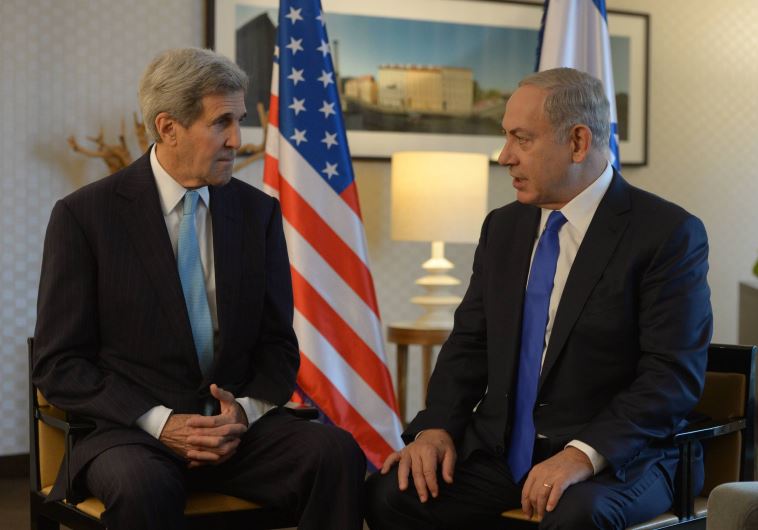
ShowImage (15)Netanyahu and Kerry meeting in Berlin. (photo credit:AMOS BEN-GERSHOM/GPO)

And now the diplomatic dance begins, again.

After three weeks of runaway terrorism on the streets, UN Secretary-General Ban Ki-moon arrived for a quick visit midweek; US Secretary of State John Kerry – after meeting with Prime Minister Benjamin Netanyahu on Thursday in Berlin – is expected to meet on Saturday with Palestinian Authority President Mahmoud Abbas in Amman, along with Jordan’s King Hussein; EU foreign policy chief Federica Mogherini is doing the same; and the French are floating various proposals to take to the UN Security Council.

All predictable, all the traditional steps taken in a time of Mideast crisis.

Ban did what Ban does in these situations – he comes, meets with both sides, issues platitudes about the need for both sides to show restraint, and declares how important it is to keep that light of hope burning.

The UN secretary-general dutifully fulfilled his role in the script. Netanyahu obliged by meeting politely with Ban, who then went on to meet politely with Abbas, to what appears to be absolutely no effect. It’s a dance whose steps – and way of ending – are known far in advance.

Jerusalem does not take Ban’s efforts overseriously, as the organization that he heads is seen as a big part of the problem rather than the solution.

Witness Wednesday’s one-sided resolution adopted by UNESCO, the UN’s cultural heritage agency, condemning “Israeli aggression” on the Temple Mount and declaring that the Jewish holy sites of Rachel’s Tomb and the Cave of the Patriarchs are an “integral part of Palestine.”

Similar disdain, to a certain extent, characterizes Israel’s view of the EU’s efforts. Netanyahu will listen to Mogherini, and lament both Abbas’s incitement and the EU’s acceptance of it, but will place little stock in the EU’s ability to play a constructive role in calming down the situation.

Brussels is not seen in Jerusalem as a particularly honest broker on all things Palestinian but, rather, as the institution that nurtures – perhaps more than any other – the hope among the Palestinians that if they press long enough and hard enough, the international community will deliver to them what they publicly say they want: a Palestinian state along the pre-1967 borders with east Jerusalem as its capital, and some kind of “fair and just” accommodation for the refugees.

The very skeptical Israeli view of the EU in any diplomatic process is reinforced by steps taken by France, which this week considered bringing a resolution to the UN Security Council to place international observers on the Temple Mount.

This idea, which Israel would never accept, and which even Jordan and the Palestinians have apparently rejected, is born of a burning French diplomatic desire to always do something, anything, in the Mideast – especially when there seems to be a stalemate or vacuum.

It is also the product of sour relations currently prevailing between Paris and Jerusalem, as well as a lingering French hope for the internationalization of Jerusalem – for the establishment of a corpus separatum in Jerusalem under a special international regime – which France hopes to be a part of.

So with the UN out, the EU out, and France out, that leaves the US.

But it is not as if Jerusalem is harboring any hopes that Kerry will be able to ride in and save the day.

From Jerusalem’s perspective the US track record in the region is not sterling, and though it appreciates Washington’s desire to help, there is little illusion that high-profile, high-level meetings will have any immediate effect on the ground.

And while Jerusalem is not waiting for Kerry with baited breath, it was clear from the beginning that he would get involved. An uptick in terrorism and violence leads to a well-worn pattern in Washington: condemnations of the terrorism, then statements that anger Israel about proportionality or settlements, followed by calls for restraint on both sides, and then meetings with the leaders.

But this current spurt of terrorism and violence is different from previous rounds, in that there is no identifiable organization – such as Hamas and Fatah’s Tanzim militia – to hold directly responsible for the bloodshed. This time it is more amorphous, individual terrorists incited by calls for Jewish blood on Facebook and from various leaders, going out to kill Jews.

The lack of a clear organizational structure behind the terrorism makes it more difficult for the security services to stop, because it is much more difficult to gather intelligence on an individual who grabs a knife and goes out to kill than on attacks directed by an organization.

Also, there is not one person seemingly in control who may be pressured to cease the violence.

It is not as if Kerry can talk to Abbas and convince him to issue a call to his people to “hold your horses,” and the horses will obediently be held. Abbas does not have anything near that type of control – many of the horses simply do not heed him.

This time around, thankfully, neither the State Department nor Kerry are inflating expectations; they are not talking about Kerry’s separate meeting with the leaders as a potential breakthrough for restarting the diplomatic talks and bringing a peace deal in a number of months.

Washington, it should be remembered, is still engaged in its own Mideast policy reassessment, a policy reassessment brought about after the breakdown of the Kerry-led peace talks in April 2014, and re-announced after Netanyahu’s preelection statement – which he later retracted – of less than full fealty to the notion of a two-state solution.

Rather, this time the bar has been set low, with the goals very limited.

State Department spokesman John Kirby said on Wednesday that the meetings would deal with “practical ways in which political breathing space can be had to help end the violence.”

No overreaching there, just looking for breathing space. The breathing space that Kirby mentioned but did not elaborate upon is likely to be an attempt – in discussions with Netanyahu, Abbas and especially Jordan’s King Abdullah – to come up with a clear set of procedures for governing the Temple Mount.

The Temple Mount has – like so many times over the last century – been the spark to violence against Jews. To douse the fire, there will be some need to deal with the spark, but this has to be done in a way where both Israel and the Palestinians can say that they have not given in.

In recent days Kerry has spoken about the need for clarity. Everyone talks about the status quo on the Temple Mount, but there is little understanding of what that entails.

“Israel understands the importance of the status quo and… our objective is to make sure that everyone understands what that means,” Kerry said at press conference on Monday in Madrid, adding that “we are not seeking a new change or outsiders to come in; I don’t think Israel or Jordan wants that, and we’re not proposing it. What we need is clarity.”

The new “clarity” is expected to involve enhanced coordination and cooperation with Jordan, possibly even more Jordanian representatives on the site, in such a way as to undercut the spurious charge that Israel is somehow threatening al-Aksa Mosque.

Former National Security Council head Yaakov Amidror said in an Israel Radio interview this week that he had little expectation regarding Kerry’s meeting with Netanyahu or Abbas, because the US has little impact on the Palestinians – which is true.

But the US does have leverage on Jordan, and this leverage may now be needed to get Abdullah to take a greater role in day-to- day administration and involvement at the site – if only as a way to suck the oxygen out of the lie propelling the current round of terrorism: that Israel is endangering al-Aksa.

Palestinian terrorism is not random

October 23, 2015

Palestinian terrorism is not random, Israel Hayom, Yoram Ettinger, October 23, 2015

Unlike national liberation movements, Palestinian terrorism has deliberately, institutionally, and systematically targeted Arab and Israeli noncombatants, sometimes hitting combatants.

Palestinian terrorism has haunted Arab societies in Jordan (especially during the 1968-1970 era of PLO terrorism), Lebanon (particularly during the 1971-1982 civil wars), Kuwait (during the 1990 invasion by Saddam Hussein), Iraq (until 2002, as an arm of Saddam Hussein’s ruthless domestic oppression), Syria (until 2012, bolstering Bashar Assad’s regime) and currently in Egypt (collaborating with the Muslim Brotherhood terror organization). Pro-U.S. Arab regimes consider Palestinian terrorism a clear and present danger, never fighting on behalf of Palestinians. Sometimes these regimes launch severe military blows (1970 Black September in Jordan) and expulsions (300,000 expelled from Kuwait), showering them with rhetoric, but not resources.

Since the establishment of the Palestinian Authority in 1993, Palestinian terrorism has afflicted the Arabs of Judea, Samaria and Gaza, denying the Palestinians civil liberties and instituting a corrupt, oppressive reign of horror. It prompted most Christians to flee from Ramallah (home of Palestinian Authority President Mahmoud Abbas’ headquarters), Bethlehem and Beit Jallah. In addition, Muslim emigration from the Palestinian Authority has increased since 2000. While Egypt prevents emigration from Gaza through Sinai, Gaza’s Arabs have emigrated, in increasing numbers, via the Mediterranean. Moreover, Palestinians flow across Jerusalem’s municipal lines, escaping Abbas’ tyranny to receive Israeli residency, social benefits and human rights.

Palestinian terrorists have targeted pro-U.S. Arab regimes and “the arrogant, infidel, Great Satan,” the U.S., joining the ayatollahs in Iran (since the toppling of the shah in 1979), Taliban, al-Qaida, Islamic State and other Islamic terror organizations. Osama bin Laden’s role model and spiritual mentor, Abdullah Azam, was from a village in Samaria.

Palestinian terrorism is a modern-day branch of Islamic terrorism, which has plagued the Middle East — and beyond — since the appearance of Islam in the seventh century. The current intensification of Islamic terrorism throughout the Middle East provides a tailwind to Palestinian terrorism.

Palestinian terrorism has inspired terror cells in Europe, Africa, Asia and the American continent, including sleeper cells in the U.S.

Anti-Jewish Palestinian terrorism has been a Middle East fixture since at least the 1920s, well before the 1948 establishment of Israel and the 1967 return of Jewish communities to Judea and Samaria. It’s well-documented collaboration with Nazi Germany sought to prevent the existence — not reduce the size — of the Jewish state. The political guideline of contemporary Palestinian terrorism, the Palestinian Covenant, was published in 1964, three years before the reunification of Jerusalem.

Palestinian terrorism is nurtured by 23 years of Palestinian hate education in kindergartens, schools, mosques and media — the most effective means of producing terrorists. It was established by Abbas (then Yasser Arafat’s chief deputy) in 1993, highlighting the fundamentals of Islam that serve to intensify Palestinian terrorism: the supremacy of Islam over all other religions; the permanent state of war between the abode of Islam and the abode of the “infidel”; the inadmissibility of “infidel” sovereignty over Waqf lands, which are divinely ordained to Islam; the sublime honor of sacrificing one’s life on behalf of Islam’s war against the “infidel”; and the provisional nature of agreements concluded with “infidels.”

Palestinian terrorism has been encouraged by Abbas’ systematic policy of naming streets, squares, monuments and sport tournaments in honor of terrorists, and extending generous financial assistance to their families.

Palestinian terrorism, an endemic feature in the Middle East, represents writing on the wall, warning us all of the destabilizing, anti-Western, terroristic nature of the proposed Palestinian state. An Israeli withdrawal from the mountain ridge of the Golan Heights would provide a platform for Islamic terrorists to traumatize northern Israel. But an Israeli withdrawal from the mountain ridges of Judea and Samaria would provide Muslim terrorists a platform to topple the Hashemite regime in Jordan and target Tel Aviv, Jerusalem, Ben-Gurion Airport and 80% of Israel’s population and infrastructure.

Palestinian terrorism is fueled by the inherently immoral “moral equivalence” between Israeli counterterrorism and Palestinian terrorism, which grossly misrepresents Middle East reality. It is fueled by foreign aid to the Palestinian Authority, which funds hate education. It is rewarded by calls to negotiate with the Palestinian Authority, while Abbas promotes hate education. It is emboldened by Western pressure for further Israeli concessions and Western denial of Israel’s moral high ground in the physical high ground of Judea and Samaria.

In order to defeat Palestinian terrorism, it is necessary to defy political correctness and shift gears, instead of chasing individual terroristic mosquitoes, the terroristic swamp needs to be drained. A large-scale, disproportionate, pre-emptive military operation needs to be launched throughout Judea and Samaria and Arab neighborhoods in Jerusalem. Any (U.S. and Israeli) direct or indirect contact with and assistance to the Palestinian Authority needs to be conditioned upon an end to hate education. Families and communities of terrorists need to be severely punished for failing to exercise communal responsibility.

To frustrate Palestinian terrorism, which aims to set Israel on a path of retreat, Israel should proclaim a constructive response, expanding Jewish construction in Jerusalem, Judea and Samaria. While it would trigger short-term international pressure, it would yield long-term strategic respect, as documented by the legacy of Prime Ministers David Ben-Gurion, Levi Eshkol, Golda Meir, Menachem Begin and Yitzhak Shamir, who defied much more severe international pressure with slimmer military and commercial resources at their disposal.

‘The mufti planned to build crematorium in Dotan Valley’

October 23, 2015

‘The mufti planned to build crematorium in Dotan Valley’, Israel Hayom, Daniel Siryoti, Erez Linn, October 23, 2015

144559783633038330a_bGrand Mufti Haj Amin al-Husseini with Adolf Hitler in Berlin | Photo credit: AFP

Journalists and historians say Jerusalem Grand Mufti Haj Amin al-Husseini’s contribution to encouraging Hilter to pursue the extermination of Jews in Europe cannot be disregarded • White House: Inflammatory accusations on both sides need to stop.

The controversy over Prime Minister Benjamin Netanyahu’s remarks on Jerusalem Grand Mufti Haj Amin al-Husseini’s role in the extermination of European Jewry has promoted veteran journalist Haviv Kanaan to recall the malicious plan the mufti devised.

Kanaan published an article in Haaretz in 1970 in which he reviewed the senior Muslim clergyman’s actions in 1942, when the Jewish community in then-British Mandate Palestine was preparing for the possibility of a Nazi invasion. Kanaan said that in 1968, while researching his article, he met with Faiz Bay Idrisi, a senior Arab officer in the Mandate Police, who spoke of al-Husseini’s intention to build a crematorium in the northwest Samarian hills.

“Even today, as I recall what I heard from police officials and mufti supporters, chills go through my body,” Idrisi told Kanaan at the time, recalling how in case of a German invasion “Haj Amin Husseini was gearing to enter Jerusalem at the head of the Muslim Arab Legion squadron he’d created for the Third Reich. The mufti’s plan was to build a huge Auschwitz-like crematorium in the Dotan Valley, near Nablus, to which Jews from Palestine, Iraq, Egypt, Yemen, Syria, Lebanon, and North Africa would be imprisoned and exterminated, just like the Jews in the death camps in Europe.”

This should come as no surprise in light of al-Husseini’s known views and actions during the Holocaust, and prior to it.

Haj Amin al-Husseini was born in Jerusalem in 1895 to a wealthy family of landowners. His father also served as the grand mufti of Jerusalem and his uncles headed the Arab Higher Committee in British-Mandate Palestine.

Al-Husseini was appointed grand mufti in 1921. An inflammatory address he gave in August 1929 sparked mass anti-Jewish violence, which resulted in the massacre of dozens of Jews by Arab mobs.

John Chancellor, the British high commissioner at the time, held al-Husseini responsible for the massacres.

Shortly after Hitler’s rise to power, al-Husseini sent a message to the German envoy in Jerusalem, expressing support for the new Nazi regime. He received generous funding from the Nazis in return.

In 1937, al-Husseini was ousted from office. He fled to Lebanon, and from there to Syria, all while maintaining his ties with the Nazi regime. In 1941, the Muslim clergyman arrived in Berlin, where he met with Hitler and the senior Nazi leadership, who assured him that once the Middle East is conquered, “Germany’s sole purpose would be to obliterate the Jewish population occupying the Arab space under the auspices of the British.”

Another voice lending merit to Netanyahu’s remark is author Wolfgang Schwanitz, who penned the book “Nazis, Islamists, and the Making of the Modern Middle East.” Schwanitz also argues that Hitler’s meeting with al-Husseini played a critical role in inspiring the Holocaust.

“It’s a historical fact that the grand mufti was an accomplice in this. … He was the top non-European adviser to Hitler on the process of eliminating Europe’s Jews,” Schwanitz said. “It would be absurd to discount the mufti’s role in encouraging Hitler and other Nazi officials to carry out the final solution.”

Meanwhile, the White House on Thursday addressed the controversial remarks surrounding the mufti’s role in the Holocaust.

“There was no doubt as to who was responsible for the Holocaust, which involved the systematic murder of six million Jews,” said White House Deputy Press Secretary Eric Schultz. “Inflammatory actions and accusations on both sides could fuel the violence even further. This needs to stop.”

Lies, lies and whoppers in the Middle East

October 23, 2015

Lies, lies and whoppers in the Middle East, Washington Times, Wesley Pruden, October 22, 2015

10222015_2015-10-22-19-23-278201_c0-0-1800-1049_s561x327Secretary of State John Kerry. (Associated Press

ANALYSIS/OPINION:

A diplomat, as any deputy assistant associate undersecretary could tell you, is a public servant paid to lie for his country. Lies are the hard currency in the land of the girly men.

The truth is rarely heard above the rattle and din of the teacups in the lounges where the masters of the art gather to collect their strength after a long day’s work in the vineyards of falsification, where Israel usually gets the shaft plunged to the hilt.

The knife has become the weapon of choice in the Palestinian war against Israeli civilians, brandished as if it were a holy scimitar of the avenging Allah. The dean of a university in Gaza characterizes this campaign of the short knives as “military operations,” and urges that it be aimed at women and children.

“The Jews of Palestine are fair game today, even the women,” the dean, Subhi al-Yazji, a learned doctor of Koranic studies, told an interviewer on Hamas television. “Every single Jew in Palestine is a combatant — even the children, breastfed on hatred for the Palestinian people.”

Just who is promoting this villainy launched from the shadows is clear to everyone, but it’s not polite in the well-behaved precincts of the West to say so. But we can be reassured, because John Kerry, the secretary of state and the grand master of moral equivalence, is on the job. He spent four hours Thursday with Israeli Prime Minister Benjamin Netanyahu in Berlin about how to “defuse” the violence. Their conversation was conducted as the knives conducted their own deadly business on the streets.

Before they sat down Mr. Kerry made the ritual condemnation of the assault on the Jews, composed of equal parts blarney and buncombe, and bravely urged an end to “all incitement and violence.” This softly worded admonition by the secretary of State naturally must include the Israelis who have done nothing but offer their Jewish flesh for the Palestinian blade. “There is no question,” said Mr. Netanyahu, “that this wave of attacks is driven directly by incitement by Hamas, incitement from the Islamist movement in Israel and incitement, I am sorry to say, from President Abbas and the Palestinian Authority.”

This was plain and unvarnished, what everybody knows to be true, but for reasons best known to him President Obama and his men (and women) won’t say anything like that. Perhaps they have a fear of cold steel in the ribs, too. What Mr. Kerry offers is this can of diplomatic yah-yah from the archives of claptrap at the State Department:

“I come directly from several hours of conversation with Prime Minister Netanyahu and I would characterize that conversation as one that gave me a cautious measure of optimism that there may be some things that may be in the next couple of days put on the table which would have an impact — I hope. I don’t want to be excessive in stating that, but I am cautiously encouraged.” There are a dozen lies somewhere in that thin treacle of organic gluten-free fat-added diet marshmallow, but only a diplomat could find them.

The moment cries for someone to say something real, and we get that from the secretary of state. And this: “We have to stop the incitement, we have to stop the violence.” Well, duh. He said he had talked to [Mr.] Abbas and Jordan’s King Abdullah, who are trusted to oversee the Temple Mount in Jerusalem, source of the latest Palestinian complaining. Abbas and Abdullah have assured him of their commitment to calm. Of course they do. And if you can’t trust a trusty, as a famous Southern governor caught between two fires once said, who can you trust?

The purveyors of calm work in parallel with the inciters of blood lust. This week a Jordanian teacher, from whom in other places you would expect something more, posted on the Internet a video of his 8-year-old daughter brandishing a knife, held up like a crucifix of the faith, declaring, “I want to stab a Jew.”

Mr. Netanyahu, who has no fear of saying what he thinks, nevertheless caught a little flak this week in Israel for speaking of some of the dark work of those who encouraged Hitler to proceed with the Holocaust. Hitler’s evil was unique, a professor at Hebrew University in Jerusalem told Mr. Netanyahu, and assigning blame to others makes him a Holocaust denier. Such a “dangerous distortion” of history “downplays” the Holocaust, the leader of the opposition in the Knesset told him.

Mr. Netanyahu was speaking a perfectly obvious truth, but we’re not supposed to notice what’s going on. It’s not diplomatic.

US praises role of Iranian-backed Shiite militias in Baiji operation

October 22, 2015

US praises role of Iranian-backed Shiite militias in Baiji operation, Long War Journal, October 22, 2015

Over the past several days, US officials have celebrated the capture of Baiji from the Islamic State. While doing so, they have praised the role that Iranian-supported Shiite militias have played in capturing the strategic central Iraqi city. These are the same militias that are responsible for killing hundreds of US soldiers just a few years ago, and many of these militia leaders are listed as Specially Designated Global Terrorists. Additionally, the US is continuing to provide air support to aid these groups.

Both the US military and the Obama administration’s Deputy Special Presidential Envoy to the Global Coalition to Counter ISIL (the outdated acronym for the Islamic State) issued statements that praised the role the Shiite militias played in recapturing Baiji.

Brett McGurk, the Deputy Special Presidential Envoy for the Global Coalition to Counter ISIL [another acronym for the Islamic State], tweeted that the “US commends progress by Iraqi Security Forces and popular mobilization forces [emphasis ours] against ISIL terrorists in Baiji.” He also confirmed that the US has launched around 130 airstrikes in support of these groups since August.

McGurk’s plaudits for the role that the “popular mobilization forces” have played in Baiji was echoed by the US military, which called these units “Shiia [sic] security forces.”

Army Major Mike Filanowski, an officer in the Combined Joint Task Force-Operation Inherent Resolve (CJTF-OIR), said that “The people who did the heavy lifting [in Baiji] were the Iraqi special forces.” He continued by saying, “they not only secured the [Baiji] oil refinery, but also the power plant to the north all the way up to the al-Fatah Bridge.” While the Iraqi special forces did help capture the refinery, they were not the only forces doing the “heavy lifting.”

The Department of Defense press release that quoted Filanowski admitted that the Popular Mobilization Committee (also called Popular Mobilization Units or Popular Mobilization Forces), was conducting operations.

“In the last three days, a special operations team from the elite Counterterrorism Service spearheaded the attack,” the DoD statement said. “The team worked with Iraqi army soldiers, Popular Mobilization Front forces — essentially Shiia security forces — and federal police” [emphasis ours].

So while the US commends the Iraqi Security Forces and the Popular Mobilization Committee, it is also lauding designated terrorists and a Foreign Terrorist Organization. The Popular Mobilization Committee is led by Abu Mahdi al Muhandis, a former commander in the Badr Organization who was listed by the US government as a Specially Designated Global Terrorist in July 2009. The US government described Muhandis, whose real name is Jamal Jaafar Mohammed, as “an advisor to Qassem Soleimani,” the commander of the Qods Force, the external operations wing of the Iranian Revolutionary Guards Corps (IRGC).

The Iranian-backed Shiite militias that played a prominent role in the assault on Baiji include: Asa’ib al Haq (League of the Righteous), whose leader Qais al Khazali is thought to be involved in the murder of five US soldiers in Karbala in 2007; Hezbollah Brigades, which is listed as a Foreign Terrorist Organization by the US government; Harakat al Nujaba, which recently called for the expulsion of US troops from Iraq; Harakat al Nujaba, which is led by Akram Abbas al Kaabi, a Specially Designated Global Terrorist; Kata’ib Imam Ali, led by Shebl al Zaydi, who is close to Qods Force commander Qassem Soleimani; Kata’ib Sayyid al Shuhada, which is commanded by Mustafa al Sheibani, who is also a Specially Designated Global Terrorist; and Badr Corps, another large militia supported by Iran. For more information the role these militias played in the retaking of Baiji, including photographs and video of Iraqi forces operating alongside these militias, see LWJ report, Iraqi Army, Shiite militias report success in Baiji.

Sadly, this behavior by US officials is nothing new. Earlier this year, General (retired) John Allen, the former Special Presidential Envoy for the Global Coalition to Counter ISIL, claimed that the US is only supporting so-called moderate Shiite militas, and not the “extremist elements.” Allen’s statement is below:

With regard to militias, it’s really important to understand that the militias are not just a single monolithic entity. There are the militias that you and I are used to hearing that have close alignments with Iran. Those are the extremist elements, and we don’t have anything to do with that. But there are elements of the Shia militias that volunteered last year to try to defend Iraq from the onslaught of Daesh [Islamic State] who were called to arms by Grand Ayatollah Sistani, and those elements, or the Popular Mobilization Force, as they are known, have been subordinated to the Iraqi higher military campaign or command. And they will provide maneuver capacity and additional firepower to the Iraqi Security Forces as we continue to build them out, as we continue to build the professionalization of the Iraqi forces.

So the fact that militias are involved and tribes are involved in this part of the campaign, this part of the implementation of supporting Iraq ultimately to recover the country, should not alarm us. We just need to ensure that we manage the outcome of this. Prime Minister Abadi’s been clear that these organizations within the Popular Mobilization Force, the Shia volunteers, will eventually either transition into the security forces themselves or go home. That’s the solution that he intends and I think that that’s a supportable outcome. So for now – this goes back to the point that you made about urgency – urgency is an important factor here in helping us to focus on supporting the Iraqis, the tribes, and the Popular Mobilization Force to take those actions necessary to defeat Daesh locally.

Allen said that the fact that the US is supporting the Popular Mobilization Committee “should not alarm us.” Except it should alarm us. Because as we detailed, the organization’s operational leader is a Specially Designated Terrorist, and its most effective militias are Iranian pawns that are responsible for killing hundreds of US soldiers and remain openly hostile to the US.

Israel must leave the UN

October 22, 2015

Israel must leave the UN, Israel Hayom, Judith Bergman, October 22, 2015

The U.N. is abusive. Just like an abused spouse who is unable to ‎fight back because the abuser is so much bigger, stronger, or simply vicious and uninterested in ‎fostering anything positive in the relationship, Israel needs to face that facts and leave the U.N.‎

***********************

UNESCO — the United Nations Educational, Scientific, and Cultural Organization — stated in a ‎resolution on Tuesday that it condemned Israel for what it called the “aggression and illegal ‎measures taken against the freedom of worship and access of Muslims to Al-Aqsa mosque and ‎Israel’s attempts to break the status quo since 1967.” It also “deeply deplores the recent ‎repression in East Jerusalem, and the failure of Israel, the Occupying Power, to cease the ‎persistent excavations and works in East Jerusalem particularly in and around the Old City.” It ‎also called for “prompt reconstruction of schools, universities, cultural heritage sites, cultural ‎institutions, media centers and places of worship that have been destroyed or damaged by the ‎consecutive Israeli wars on Gaza.” Finally, UNESCO now considers the Cave of the Patriarchs in ‎Hebron and Rachel’s Tomb in Bethlehem to be Muslim sites.‎

Initially, the resolution had been drafted to include the Western Wall as an Islamic ‎site also, or rather as an extension of Al-Aqsa mosque, but this was dropped after ‎widespread condemnation. Only six countries voted against the resolution — the United States, ‎Britain, Germany, the Netherlands, the Czech Republic and Estonia.‎

One can hardly exaggerate the extent to which UNESCO has lost its way. The organization and most of its member states have been ravaged by utter derangement. For the ‎U.N. to so unequivocally and unabashedly aid the ongoing Arab effort to delegitimize the Jewish ‎connections to Judaism’s holiest sites in Israel is an act of supreme perfidy. ‎

Although it is far from the first time that UNESCO commits this kind of blatant Israel-bashing, ‎the timing of this particular resolution, its duplicitous and smearing content, at a time when ‎Arabs in Israel are stabbing, shooting and car-ramming Jews for sport and celebrating with ‎candies afterward, is beyond anything that civil discourse can properly convey. The resolution ‎amounts to a match being thrown on an already raging fire, further augmenting the incitement ‎and the lies of the Palestinians regarding the Temple Mount.

However, who is truly surprised by this? UNESCO has worked consistently against Israel for over ‎‎40 years and even the current decision to designate Rachel’s Tomb a Muslim site has a very ‎recent precursor. Five years ago, in 2010, UNESCO categorized Rachel’s Tomb as a “Muslim ‎mosque” and criticized Israel’s decision to include both it and the Cave of the Patriarchs in ‎Hebron on its list of national heritage sites. UNESCO furthermore made it clear that it views ‎both sites as Palestinian. Rachel’s Tomb is the third holiest place in Judaism and a Jewish ‎pilgrimage site. It meant nothing to UNESCO that Rachel’s Tomb had never been a mosque. At ‎the time, only the U.S. voted against this absurd decision.‎

What the above means is that the decision to designate the Western Wall as a Muslim site may have ‎been put on ice for now, but that efforts to have it designated as such will certainly be resumed at a more opportune time. ‎

At universities across the world, students are taught that the U.N. is an instrument of world ‎order, a respectable international body of member states who have it as their ultimate goal to ‎follow the precepts of international law. The U.N. Charter is studied diligently by law students ‎everywhere, as if what it says has any meaning at this point in time. Member states prolong the ‎life of this disgrace of an institution by continuing to support it with their citizens’ tax money ‎and diplomats — the more-than-willing executioners of all these shameful policies — give it ‎credibility by treating it as an honorable institution. ‎

The U.N. is an instrument of world disorder and it lost credibility decades ago when it voted to ‎equate Zionism with racism. That vote was instrumental in legitimizing and stoking the anti-‎Semitic hatred that is now sweeping away sanity and decency everywhere, where the latter ‎should rather be the governing norm. ‎

The denigration and dehumanization of Israel and the Jewish people is ongoing and met with ‎general silence or worse — with tacit or explicit approval. The pernicious, perfidious mainstream ‎media reporting of the current terror onslaught and the demonstrations of “solidarity” with the ‎murders of Jews in Israel in Sweden and Denmark recently, as well as on select U.S. university ‎campuses, are ugly and openly skewed and derisive of Israel at a time when anti-Semitic ‎hatred has finally become socially acceptable, even trendy in certain circles.‎

Israel has no need for the U.N. It is the U.N. that needs Israel. If there were no Jewish people, ‎no Israel, the U.N. would have to invent it. Israel needs to turn its back on the U.N. and simply ‎walk away. There can be no “dialogue” with an organization that so openly allies itself with ‎our enemies. ‎

The U.N. is abusive. Just like an abused spouse who is unable to ‎fight back because the abuser is so much bigger, stronger, or simply vicious and uninterested in ‎fostering anything positive in the relationship, Israel needs to face that facts and leave the U.N.‎

There is Nothing to Negotiate

October 22, 2015

There is Nothing to Negotiate, American ThinkerDan Calic, October 21, 2015

(But shouldn’t Israel commit suicide to satisfy Abbas, the US, the EU, the UN and others? It would be the warm and fuzzy thing to do. — DM)

Some hard realities need to be faced about the Middle East “peace process.” The US, EU, UN and others have said the “settlements” are an obstacle to peace. The Arabs point to the “occupation.”

However, neither of these are the core issue…. and frankly, they never have been. Why? Keep in mind there was no “occupation” or “settlements” in 1948 when the surrounding Arab nations attacked the fledgling Jewish nation one day after declaring independence.

Moreover, where were settlements or occupation in 1967?

So if it isn’t the “occupation,” or “settlements,” what is the real issue? While many consider these to be legitimate issues, the Arabs are using them as a deliberate smokescreen.

The core issue is the Muslim’s rejection of Israel’s right to exist. It’s as simple as that. This is the main reason why the first attempt at a two-state solution (the 1947 UN partition plan) was not successful. The Muslims would not allow a Jewish state on land which they consider theirs. Its size or borders didn’t matter. It was, and remains, its mere existence.

Case in point: in 2000 when Yasser Arafat met with Israeli Prime Minister Ehud Barak under the auspicious of President Bill Clinton at Camp David ll, the real Muslim goal became evident.

During those discussions Barak made an unprecedented offer to Arafat. He was willing to turn over 95% of Judea/Samaria, commonly called the “West Bank.” He okayed the return of many of the so-called “refugees” and offered compensation for others. He was willing to split Israel in two by virtue of a contiguous road between Judea/Samaria and the Gaza Strip.

Plus, he offered to divide Jerusalem, which included handing most of the Old City over to the Muslims.

President Clinton felt Barak went above and beyond his expectations in an effort to achieve a breakthrough in the decades old conflict. Yet in the end, Arafat rejected it, without even making a counter offer. Why? An agreement would require compromise, which Muslims viewed as giving in to American demands. From their point of view this was (and remains) unacceptable, thus his rejection of the offer.

President Clinton was furious with Arafat, telling him “I am a failure and you have made me one.”

These days, with Arafat long gone, Mahmoud Abbas is in charge of the PA and considered by the U.S., EU, and others to be “sincere” and a “moderate.” However, very little has changed since the days of Arafat.

In some respect things have worsened. For example Abbas has repeatedly said he will not recognize Israel as a Jewish state. This in spite of Israel’s repeated willingness to recognize ‘Palestine’ as a state, side by side with Israel.

Abbas’s refusal to accept the Jewish state of Israel is reflective of some longstanding Muslim views.

For example-

  • Muslim thinking has always been once they have controlled someplace, it’s considered theirs forever. It doesn’t matter if they get defeated in war. They view anyone in control of “their” land as “occupiers,” who need to be driven out or destroyed. To back away from this position is seen as compromise, which is unacceptable in Muslim thinking for at least two reasons.
  • Compromise is seen as weakness. Weakness is intolerable in their culture. Keep in mind the Saudi flag contains the official credo of Islam (“there is no god but Allah, and Mohammed is his messenger”) which includes the image of a sword. The clear inference being they prefer to die upholding their beliefs than live by compromise.
  • Plus, compromise, from a fundamentalist perspective is also viewed as breaking a foundational tenet of the faith. Breaking a tenet of the faith is considered blasphemy, which is punishable by death in Islam.

Mahmoud Abbas has acted in accordance with these views. When one understands how Muslim’s view anyone in control of land they consider theirs, you understand his actions. It also becomes clear the conflict is not about borders. The Jews are seen as “occupiers” of Muslim land. A Jewish state has no right to exist on “Muslim” land.

If there is any doubt of this take a look at the charters of the PLO, Hamas, or Fatah, which is the party Mahmoud Abbas is president of. Moreover, all three, the PLO, Hamas, and Fatah by virtue of their emblems leave no doubt their goal is not a two-state solution. Each emblem shows only one state — Palestine, covering all of Israel. The goal of each group is the complete elimination of Israel. Every inch of land which makes up Israel today is considered “occupied Palestine.”

Why aren’t the voices criticizing Israel for “settlement” activity also demanding the charter of Abbas’s party reflect peaceful co-existence with Israel, instead of its destruction?

In order for a two-state solution to be achieved negotiations are required. Negotiations by their very nature require compromise. How is Israel supposed to negotiate when its very existence is considered unacceptable?

There is nothing to negotiate.


Leader Outlines Major Observations in JCPOA Implementation

October 21, 2015

Leader Outlines Major Observations in JCPOA Implementation, Tasnim News Agency (Iran), October 21, 2015

139406041520538615968453

[T]hroughout the 8-year period of implementing the JCPOA, imposing any sanctions, at any level and under any pretext –such as the “recurring and fabricated allegations of terrorism and human rights violation – by any of the parties to the talks”, will be tantamount to breach of the JCPOA and the administration will be obligated to take the necessary measures under the Clause 3 of the Iranian Parliament’s plan and cease the JCPOA activities.

*********************

TEHRAN (Tasnim) – Supreme Leader of the Islamic Revolution Ayatollah Seyed Ali Khamenei in a letter to President Hassan Rouhani highlighted nine main points that the administration will need to take note of regarding the course of implementing a final nuclear deal with six world powers.

In the letter, Ayatollah Khamenei appreciated the efforts made by the country’s different bodies involved in the course of nuclear negotiations with the Group 5+1 (Russia, China, the US, Britain, France and Germany) and the consequent efforts to evaluate the deal.

The Leader, however, noted that the nuclear agreement, dubbed the Joint Comprehensive Plan of Action (JCPOA), contains “ambiguities, structural weak points and multiple points that could inflict heavy losses on the country” at present and in the future in case of lack of strict and constant vigilance.

Ayatollah Khamenei then explicated the observations that the administration should make about the JCPOA and its implementation.

The first point in the Leader’s letter was the necessity for the full termination of the anti-Iran sanctions under the JCPOA.

Since the purpose of Iran’s approval to the nuclear negotiations was the removal of “cruel economic and financial sanctions”, and given the fact that the termination of the sanctions has been subjected to completion of Iran’s undertakings, there needs to be “firm and sufficient guarantees” to avert the other side’s breach, Ayatollah Khamenei underlined.

The US president and the European Union must declare that the anti-Iran sanctions have been “fully lifted”, the Leader noted.

The second observation in the letter was the categorical rejection of imposition of any new sanctions against Iran, which the Leader described as a breach of the JCPOA in which case the Iranian administration would be obligated to stop implementing the deal.

Third, the Leader further said, throughout the 8-year period of implementing the JCPOA, imposing any sanctions, at any level and under any pretext –such as the “recurring and fabricated allegations of terrorism and human rights violation – by any of the parties to the talks”, will be tantamount to breach of the JCPOA and the administration will be obligated to take the necessary measures under the Clause 3 of the Iranian Parliament’s plan and cease the JCPOA activities.

The rest of the observations are as follows:

4. Measures to renovate the Arak plant, which should keep its heavy (water) nature, will begin only after signing a definite and safe contract on an alternative plan and sufficient guarantee for its implementation.

5. The trade of the available enriched uranium with the yellowcake (a type of uranium concentrate powder) with a foreign government will take place when a secure contract with sufficient guarantees is signed. The mentioned trade and exchange (of materials) should occur gradually and in multiple times.

6. In accordance with the bill passed by the Majlis (parliament), a necessary plan should be devised and meticulously discussed by the Supreme National Security Council (SNSC) for mid-term development of (the country’s) nuclear energy industry, including ways to make progress in the next 15 years, leading to the production of 190,000 SWUs (Separative Work Units).

7. The Atomic Energy Agency of Iran (AEOI) should organize research and development in different aspects in such a way that at the end of the 8-year period, there will be no technological shortages for achieving the level of enrichment as accepted in the JCPOA.

8. As for ambiguities in the JCPOA, it should be stressed that the other side’s interpretation is not accepted, and that the reference (for interpretation) is the text of the negotiations.

9. The existence of complexities and ambiguities in the JCPOA and the possibility of breach of commitments and deception on the part of the other side, especially the US, necessitate that a strong, observant and smart committee be formed to monitor the progress of works, fulfilment of the other side’s commitments and  realization of the observations mentioned above. The committee’s arrangement and responsibilities should be formulated and approved by the SNSC.