Posted tagged ‘Foreign Policy’

Immigration or an IPhone

February 25, 2016

Immigration or an IPhone, Front Page Magazine, Daniel Greenfield, February 25, 2016

male-refugees

The public argument between Apple and the FBI over cracking the encryption on an iPhone used by the San Bernardino Muslim terrorists is one of those ongoing civil liberties debates that negotiate the terms on which we are asked to sacrifice our civil liberties for the sake of Muslim immigration.

We have already made a thousand accommodations and we will make a thousand more. There will be more databases, naked scanners, eavesdropping, vans that can see through walls, backdoors to every server, registrations, warrantless searches, interceptions and regulations. There will be heavily armed police on the streets. And then curfews and soldiers. These things exist in Europe. They’ll come here.

Some libertarians will argue that we should have none of this and no restrictions on immigration. That we should just shrug off each terror attack and move on with our lives.

Eventually though there will be a terror attack that we can’t shrug off and that can’t be minimized by using the cheap statistical trick of comparing Terror Attack X to the number of people who die every year from cancer. Or there will just be an endless parade of daily attacks, bombings, stabbings or shootings, as in Israel, which create a constant climate of terror that will preclude any hollow rhetoric about the number of people falling off ladders each year or getting struck by lightning.

Some hawks will cheer every terror fighting measure short of closing the door on the root cause of the problem. They would rather see every American wiretapped, strip searched and monitored every hour of the day then just stop the flow of Muslim terrorists into this country.

The encryption methods of an iPhone, like the question of how many ounces there are in your tiny bottle of mouthwash, would not be much of an issue, if Muslim migration did not make it one.

Terrorists adapt to the terrain. They use the native population as protective coloration. They can find a way to transform a shoe, a tube of toothpaste or instant messaging on a game console into a terror tool. Just as the left can ‘politicize’ everything, Muslim terrorists can ‘terrorize’ everything. When everything is a potential terrorist tool, then there can be no such thing as privacy or civil rights.

Muslim immigration is forcing us to constantly choose between our lives and our civil liberties. It’s a Catch 22 decision with no good choices. Terrorists push governments toward totalitarianism so that their own alternative totalitarian state starts to seem like a less terrible alternative. But the refusal to fight terrorism also makes the totalitarian state of the terrorists more viable.

With every Muslim terror attack, successful or only attempted, they win and we lose. The pressure of terror attacks discredit Western ideologies and worldviews, both on the right and the left. Each attack helps generate new converts for Islam and more political influence for Islamist organizations.

Vociferous debates over the choice between civil liberties and security make it seem as if we have to choose between our worldviews because something in our society is the problem. It isn’t.

We do not have an American terror network problem. The Amish aren’t using iPhones or obscure apps to coordinate terror attacks. We have a Muslim terror network problem. It’s not because of the Methodists that we have to weigh our mouthwash or take our shoes off and put them in a greasy plastic tray at the airport. It’s because 19 Muslims entered this country, hijacked our airplanes and murdered thousands of Americans. Guantanamo Bay is not an issue because Buddhists are at war with America. It’s an issue because Muslim terrorists are at war with America.

We do not have an iPhone encryption problem or a shoe problem or a mouthwash problem. We have a Muslim terror problem.

Whatever decision is made about iPhone encryption will not be the last word. The simple reality is that privacy carries too high a price as long as we have large numbers of people in this country who want to kill us in equally large numbers. If we want our privacy back, it’s not the FBI that is standing in our way. It’s the religious organizations that are paid to bring Muslim “refugees” to this country. It’s the liberal, libertarian and even conservative voices that think there is something wrong with pausing the mass migration of the group that is disproportionately responsible for our terror problem. It’s the media that would rather discuss anything and everything than discuss the problem we are really dealing with.

The source of this problem is not whether the FBI handled the iPhone correctly or whether Apple should be obligated to build a way for law enforcement to access its devices. These arguments would exist even without Muslim terrorism, but they would lack the same level of life and death urgency.

This is not an iOS problem. It’s an immigration problem.

The San Bernardino massacre by Muslim terrorists would not have happened without Muslim immigration. The security flaw here was not in the work of FBI agents or of Apple programmers, but of our immigration laws. Just as we cannot and will not intercept every single Muslim terrorist who finds a way to hide explosives in his underwear, shoes, soda or laptop, we will not ever be able to crack every single encrypted Muslim terrorist device. And their underwear bombs and encrypted iPhones would not be an issue if we did not have Muslim terrorists in America in the first place.

Instead of discussing the Islamic root cause, we put stress on our own competing institutions, technology providers face off with law enforcement, hawks and civil libertarians berate each other as if they were each part of the threat. But we are not the problem here. They are the problem.

The only backdoor that should be at issue here is the one that Muslim terrorists use to enter America. We don’t need to violate everyone’s rights to close it. We just need the political will to do the common sense thing and shut down the source of the threat. Either that or give up on our privacy.

Our choice is very simple. We can have external security or an internal police state. But neither of the above is not an option. We can have open borders that fill our country with criminals, but that means that eventually any livable middle class neighborhood will have a cop on every corner. We can have airport security for the people coming into this country. Or we can have airport security for everyone.

Ongoing Muslim migration makes a police state inevitable. But to avoid the perils of profiling and the appearance of discrimination, it will be a universal police state that will strip away rights from everyone without regard to guilt or innocence in the hopes of averting the next Muslim terror attack.

The only way to protect our lives and our freedoms from Muslim terrorism and its consequences is by shutting down Muslim immigration. If we fail to do this, then we will lose our lives and our liberties.

Canadian PM: ‘Islam is compatible with secular West’

February 22, 2016

Canadian PM: ‘Islam is compatible with secular West’, Israel National News, Ari Yashar, February 22, 2016

Canadian Prime Minister Justin Trudeau of the Liberal Party has already made a number of eyebrow-raising statements since taking office last November, but on Sunday CIJ News revealed yet another questionable sentiment he raised twice in TV interviews in recent months.

In the two interviews, both with CBC, Trudeau insisted that Islam is “not incompatible with the Western secular democracy.”

In the most recent interview on January 31, he said “we need to make sure that we’re working with communities like the Muslim community, for example, to demonstrate that Islam is not incompatible with free and open Western societies.”

The statement echoed his words from another interview last November 24, when he said, “Canadians are quick to point out that ISIS is wrong, that Islam is not incompatible with the Western secular democracy, a free place like Canada.”

CIJ News went further in documenting the trend by pointing out a video message from Trudeau to the annual Reviving the Islamic Spirit convention at the Metro Toronto Convention Center last December 25-27.

In the message, Trudeau said the convention “is also about celebrating our shared beliefs in justice, fairness, equality of opportunity and acceptance. The work you do in communities across the country is what builds and strengthens our multicultural fabric.”

Trudeau’s stance towards the Islamic world has been raising question marks. Last Tuesday he was grilled in parliament for proposing to give UNRWA $15 million despite its well-documented ties to the Hamas terrorist organization in Gaza, and largely ignored the question on the topic.

In more questionable behavior vis-a-vis Hamas, Trudeau appointed Omar Alghabra as Parliamentary Secretary to the Minister of Foreign Affairs; Alghabra was previously the head of the radical Canadian Arab Federation (CAF), which ran afoul of the state for its open support of Hamas.

Last month amid heavy concerns that jihadists and rapists have infiltrated the massive influx of migrants from the Middle East to the West, Trudeau defended his policy of mass immigration, saying he is confident in people who “don’t think a lot about politics, don’t think a lot about terrorism.”

Palestinians: Kerry and the Game of Obfuscation

February 22, 2016

Palestinians: Kerry and the Game of Obfuscation, Gatestone InstituteKhaled Abu Toameh, February 22, 2016

♦ “intifada” is simply a further phase in a larger plan to destroy Israel. When the plan began officially, with the establishment of the PLO in 1964, there were no “settlements” — not until after the June 1967 War — so what exactly were the Palestinians planning to “liberate”?

♦ The current conflict is not about “defending” any mosque from being contaminated by the “filthy feet” of Jews: it is about seeing Israel forced to its knees. Abbas and others seek to reap delicious political fruits from this “intifada.”

♦ Here is a novel idea: Kerry could put pressure on the Palestinian and Jordanian leadership to cease anti-Israeli incitement and indoctrination. Now that would be pressure well applied.

♦ Abbas is expected to become a partner in the fight against ISIS and radical Islamist groups. All well and good. Why then is he not expected to stop cheering on and glorifying young Palestinians who attack Jewish Israelis?

U.S. Secretary of State John Kerry is back in town. This time he is meeting with Jordanian and Palestinian leaders about “ongoing security issues in the region and continued tensions between Israel and the Palestinians.”

For those not involved in political newspeak, here is a translation:

“Ongoing security issues” = the Islamic State terror group (ISIS).

“Tensions between Israel and the Palestinians” = the ongoing wave of Palestinian stabbing, car-ramming and shooting attacks that began in October 2015.

Jordan and the Palestinian Authority (PA) fighting ISIS? Now that’s an idea! Jordanian King Abdullah and PA President Mahmoud Abbas ending “tensions” between Israel and the Palestinians? Let’s think about that.

Kerry comes back, but never calls a spade a spade. The “tensions” to which he deceptively alludes are knifings and car-rammings. And what is the biggest spade that Kerry avoids calling by its name? The new generation of Palestinians brainwashed to believe that Israel can be defeated with knives and car-attacks.

This “intifada” is simply a further phase in a larger plan to humiliate and destroy Israel. This plan began officially, with the establishment of the Palestine Liberation Organization (PLO), in May 1964. At that time there were no “settlements” — not until after the June 1967 War — so what exactly were the Palestinians planning to “liberate”?

The plan continued in 1974, at the twelfth session of the Palestinian National Council in Cairo, with the 10-point “Phased Plan” (see Appendix below for full text of the Phased Plan). Article 2 called for “armed struggle” (terrorism) to establish “an independent combatant national authority” that is “liberated” from Israeli rule.

Contrary to Palestinian leaders’ pap, the current conflict is not about “defending” any mosque from being contaminated by the “filthy feet” of Jews: it is about seeing Israel forced to its knees. Abbas and others seek to reap delicious political fruits from this “intifada.”

That is why, in his meeting with Kerry, Abbas made it clear that he intends to pursue unilateral moves to impose a solution on Israel, with the help of the international community.

Abbas also told Kerry that he intends to continue with his efforts to seek a UN Security Council resolution condemning Israel over “settlement construction.”

Never mind that on Palestinian maps, all of Israel is regarded as one big “settlement.”

1271Palestinian Authority leaders, official television, schools and media outlets often display maps showing Palestine stretching from the River Jordan to the Mediterranean Sea. The maps do not show the existence of Israel.

But back to Kerry. His “tensions” imply two sides engaged in some kind of a dispute that has aggravated a situation and strained relations between them, instead of what it really is: Palestinians openly trying to supplant Israelis — the entire state.

So the game of obfuscation continues. No doubt, we will witness more pressure on Israel to make concessions that will supposedly ease the “tensions.”

Kerry and his friends either do not “get it” or do not want to “get it.” Palestinians are waging an out-and-out war against Israel with the goal of making Israelis suffer to a point at which they will beg their leaders to capitulate. In the Palestinian view, such behavior pays off royally.

It is a Palestinian commonplace that the two previous uprisings — in 1987 and 2000 — brought major achievements to the Palestinians.

The first “intifada” led to Israel’s recognition of the PLO as the “sole legitimate representative of the Palestinians” — a move that was followed by the signing of the Oslo Accords and the creation of the Palestinian Authority.

The second “intifada,” the Palestinians argue, led to Israel’s full withdrawal from the Gaza Strip in the summer of 2005.

And so we arrive at the newest wave of attacks. As the saying goes: Step-by-step.

Kerry would like to see an end to the Palestinian attacks on Israeli Jews. The only problem is that his vacuous rhetoric prevents him from having a snowball’s chance in a Middle Eastern summer from attaining that goal.

Let us also not underestimate Palestinian Authority rejectionism. On the eve of the Kerry-Abbas meeting, Palestinian Authority officials were quoted as saying that they did not expect anything positive to come out of the talks “because the U.S. remains biased in favor of Israel.”

As always, the Palestinian stance is, “My way or the highway.”

Moreover, Kerry is dreaming if he thinks that President Mahmoud Abbas or King Abdullah are able to stop the attacks on Israelis. Neither has the mandate or the credibility to do so. In any case, they and their media outlets are too busy with their anti-Israeli ranting to do much on that score.

Thus far, not a word has been uttered by either of the two Arab leaders that could be even vaguely interpreted by their people as “stop killing Israelis.” In the Palestinian Looking Glass, it is Israel that is responsible for the deadly attacks. After all, claims that are untrue about Israelis “storming and desecrating the Al-Aqsa Mosque and other Islamic holy sites” are provocative, to say the least.

Here is a novel idea: Kerry could put pressure on the Palestinian and Jordanian leadership to cease anti-Israeli incitement and indoctrination. Now that would be pressure well applied. And it does not even require funding.

President Abbas is expected to become a partner in the fight against ISIS and radical Islamist groups. All well and good. Why then is he not expected to stop cheering on and glorifying young Palestinians who attack Jewish Israelis?

When Kerry and his crew finally wake up to the fact that it is precisely this incitement that is driving Palestinians into the open arms of ISIS, Hamas and other terror groups, perhaps, finally, we will be able to hope for “easing tensions in the region.”

Meanwhile, Kerry is back blathering about peace in the Middle East. Unfortunately, he seems incapable of calling a spade a spade — especially when that spade’s name is Palestinian prevarication.

What to Expect in Iran

February 22, 2016

What to Expect in Iran, Gatestone InstituteJagdish N. Singh, February 22, 2016

♦ “The destruction of Israel is non-negotiable.” — Mohammad Neza Naghdi, Commander of Iran’s Basij paramilitary force.

♦ Sanctions relief will mainly benefit Ayatollah Khamenei and members of the Revolutionary Guards: they control up to one-third of Iran’s economy.

♦ Part of the Iranian regime’s grand strategy is to inflict “death to America” and replace it with its own radical version of Islamic governance. Ayatollah Khamenei himself called for America’s destruction amid nuclear negotiations.

♦ Officials also believe Iran is indirectly funding the Islamic State (IS) in the Sinai. “Suitcases of cash” are sent directly to Hamas officials in the Gaza Strip; part of the money is then transferred to IS.

♦ Iran now poses an even greater threat. If democracies today continue their present policies towards Iran, it will only embolden Iran’s regime to continue its quest to obtain nuclear weapons as well as its terrorism and human rights violations.

Humanity seldom seems to learn its lessons. The governments of the world’s leading democracies appear to be suffering from this predicament in their nuclear dealings with the Islamic Republic of Iran. To avoid catastrophe, democracies need quickly to correct their course.

One of the fatal blunders of Western democracies is their repeated commitment to appeasing and delaying action against aggressive regimes. Between the two World Wars, despite plenty of evidence of the widely-declared global racist agenda of Germany’s Adolf Hitler, democratic powers waited to take action until it was too late. Hitler was able to carry out a genocide that continues to haunt many nations.

Today, Western democratic governments, with their Eastern counterparts such as India, seem on a similar course in dealing with the Islamic Republic of Iran.

The domestic and international agenda of the Khomeinist government is publicly documented. Since the Iranian Revolution of 1979, part of the regime’s open grand strategy is to inflict “death to America,” the leader of the free world, and replace it with its own radical version of Islamic governance. Under the current Supreme Leader Ayatollah Ali Khamenei and his Islamic Revolutionary Guards Corps (IRGC), Iran has been gaining influence across the Middle East, Latin America, the Caribbean and South Asia. Despite nuclear talks with the West, Iran’s goal of “death to America” remains. The Ayatollah himself even called for America’s destruction amid nuclear negotiations.

Currently, Iran is a major player in aiding the autocratic regime of Basher al-Assad in Syria, the Houthis in Yemen, Hezbollah in Lebanon, Palestinian Islamic Jihad and Hamas in the West Bank and Gaza and the Islamic State (IS) in Egypt’s Sinai Peninsula.

To advance its imperial agenda, Iran has proceeded to develop its conventional and nuclear ballistic missile program. According to Director of National Intelligence James Clapper, Iran has “one of the largest inventories of ballistic missiles in the Middle East.”

In line with Iran’s missile development program, Iran’s Revolutionary Guard Navy Rear Commander, Ali Fadavi, announced: “Based on the fifth five-year plan, we should materialize our objective of mass-producing military speedboats with the speed of 80 knots per hour… and are equipped with missiles with a range of 100km; the vessels no one can catch.”

Aside from its military aspirations, since the fall of the Shah in 1979, successive Iranian governments have voiced their plans to annihilate the State of Israel, the only pluralist democracy in the Middle East, and an effective military deterrent to Iran’s designs in the region.

Hostile messages have been pouring forth from Iran. Mohammad Neza Naghdi, Commander of the Basij paramilitary force, stated in clear terms in April 2015, that, “The destruction of Israel is non-negotiable.”

Major General Yahya Rahim Safavi, a former IRGC commander and a top military aide to Khamenei, warned in May 2015, that “More than 80,000 missiles are ready to rain down on Tel Aviv and Haifa.”

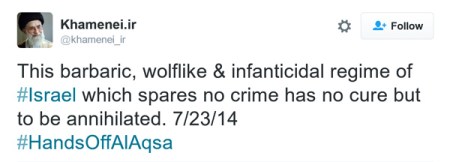
As late as November, Iran’s Supreme Leader Khamenei himself tweeted, “This barbaric, wolflike & infanticidal regime of #Israel which spares no crime has no cure but to be annihilated.”

1477

Bewilderingly, Western democracies have chosen to overlook Iran’s speeches and actions. They chose instead to appease the regime. Last July, despite genuinely serious reservations expressed by international strategic and military experts (including retired American military officers), the United States, United Kingdom, France and Germany – the four democracies in the P5+1 — concluded a nuclear deal with themselves that they proposed to Iran. Iran so far has not signed the deal, and apparently even if it did, according to the U.S. Department of State, the deal would not be legally binding.

Tehran will greatly benefit financially from the terms of the nuclear agreement in the months to come. Under the administration of President Barack Obama, nuclear sanctions against Iran have been lifted. To advance the deal and make it more appealing to Iran, the president has also agreed to pay Iran a $1.7 billion settlement for $400 million in “frozen” assets held in the United States since 1981.

The Society for Worldwide Interbank Financial Telecommunication (SWIFT), “the electronic bloodstream of the global financial system,” had disconnected 15 Iranian banks from its system in 2012. after coming under pressure from both the United States and the European Union at the height of efforts to curb Iran’s nuclear ambitions. Today, SWIFT is ready to let those banned banks, including the Central Bank of Iran, use its system once again. Iran now has an even greater ability to fund its terrorist proxies around the world.

European political and business leaders have been rushing to Tehran to sign new agreements. On January 28, in Paris, Iran’s President Hassan Rouhani and France’s President Francois Hollande signed major business deals, including a joint venture between car-makers PSA Peugeot Citroen and Iran’s Khodro. Iran is in the process of buying 118 Airbus passenger planes to update its aging fleet. The construction group Bouygues and the French airport operator ADP are now set to build an extension for Tehran’s airport, while Vinci, another construction firm, has been commissioned to design, build and operate new terminals for the Mashhad and Isfahan airports. The French oil company Total has agreed to buy Iranian crude oil, and agreements in shipping, health, agriculture and water provision have also been signed.

Democratic India is also cultivating relations with Iran. In a meeting in May, India’s Minister of Road Transport and Highways, Nitin Gadkari, and Iranian Transport and Urban Development Minister, Abbas Ahmad Akhoundi signed a Memorandum of Understanding on India’s participation in the development of the Chabahar Port in Iran.

The Chabahar project will impart strategic leverage to India and its access to Afghanistan and energy-rich Central Asia by bypassing Pakistan. The distance between the Chabahar Port and Gujarat – India’s westernmost state, located near the Persian Gulf, is less than the distance between Delhi and Mumbai. Transit times are estimated to be reduced by a third. Indian firms have already agreed to lease two existing berths at the port and operate them as container and multi-purpose cargo terminals.

The Chabahar project, New Delhi calculates, will be highly beneficial. As India has invested over $2 billion in Afghanistan, the Indian government plans to link the Chabahar port with the Zaranj-Delaram road it built in Afghanistan, thereby opening alternative routes to Afghanistan and enhancing access to regional and global markets.

Russia and China, permanent members of the UN Security Council, are also strengthening their cooperation with Iran. Both Russia and China adopted a policy of ambivalence towards Iran and saw to it that sanctions imposed by the West were not too tough. They also repeatedly blocked attempts at sanctioning Iran’s ally, the current Syrian regime, out of concern over financial ties in the region.

China is also capitalizing on the lifting of sanctions against Iran. Chinese President Xi Jinping rushed to Iran after the so-called nuclear agreement to discuss a 25-year strategic cooperation plan. In a landmark deal worth up to $600 billion, Xi committed to increase trade between the two nations during the next decade. Beijing and Tehran also agreed to enhance security cooperation through intelligence-sharing, counter-terror measures, military exchanges and coordination. Incidentally, despite international sanctions, China-Iran trade increased from $3 billion in 2001 to more than $50 billion in 2014.

Given its fanatical and sectarian ideological agenda, Iran is likely to use the new funds to boost its armament program and ongoing clandestine terror acts. Sanctions relief will mainly benefit Khamenei and members of the IRGC: they control up to one-third of Iran’s economy.

Iran now poses an even greater threat to the entire civilized world. The pattern of Tehran’s behavior shows the government can never be trusted on any promises it makes not to advance its nuclear weapons program. Khamenei has made an open declaration that Tehran will not allow effective inspections of its military sites or interviews with its nuclear scientists.

The links of the IRGC’s Qods Force with Hezbollah, Hamas, Palestinian Islamic Jihad, the Houthis and other terror militias pose a major threat to peace and stability in the Middle East.

Hezbollah’s networks have expanded over the years, infiltrating Latin America and the Caribbean through Shiite cultural centers in the region. According to an official Argentine report, Tehran has established its terrorist, intelligence and operational networks throughout Latin America as far back as the 1980s. Iran’s intelligence activities in the region are being conducted directly by Iranian officials or through its proxy, Hezbollah. Criminal activity may already be underway in Brazil, Colombia, Chile, Paraguay, Uruguay, Suriname and Trinidad and Tobago. Iran’s involvement in the cocaine trade has bolstered the regimes regional access and strengthened ties with its allies in Venezuela, Ecuador, Bolivia and elsewhere.

According to senior Western intelligence officials, the IRGC has transferred tens of millions of dollars to Hamas to be used for weapons, military equipment and training, and that Iran also delivers arms and funds to Hamas through the Red Sea and the Sinai. Officials also believe Iran is indirectly funding the Islamic State (IS) in the Sinai. “Suitcases of cash” are sent directly to Hamas officials in the Gaza Strip; part of the money is then transferred to IS.

Tehran’s links with Hamas and IS are part of a grander strategy of using proxy forces to gain hegemony over the Middle East and undermining American allies such as Egypt and Israel. In Lebanon, Iraq and Syria, Iran seeks to preserve its influence. By fighting IS, Iran strengthens existing pro-Iran regimes and maintains its relevance in the region.

While Iran does support IS indirectly in the Sinai, the government’s goal is to weaken the current Egyptian regime and the Sunni Arab alliance between Egypt, Saudi Arabia and Jordan. It has no problem with IS gaining strength in the Sinai right now. If IS does gain more power in the Sinai, Iran can use it to impose its own agenda in the future. Tehran evidently wants to use IS victories against Sunni states as an opportunity to take over.

Iran also supports the Gaza-based terror group al-Sabireen [“The Patient Ones”], established in the wake of previous tensions between Iran, Hamas and Islamic Jihad. The group has about 400 followers and its emblem is identical to that of Hezbollah. Each member receives a monthly salary of $250-$300, while senior members receive at least $700. Annually, the terror group receives a budget of $10 million from Iran, smuggled in suitcases through tunnels along the border with Egypt. Potential members are wooed by al-Sabireen through familiar channels of philanthropy and education. The group’s publications refer to the United States as “the source of superpower terrorism,” and its slogan is, “The road to the liberation of Palestinian goes through Karbala” — a Shiite holy city in Iraq.

Al-Sabireen has extended its operations from the Gaza Strip to the West Bank and Jerusalem with Iran’s backing. Hisham Salim, the founder of al-Sabireen, admitted that his group is directly financed by Iran. “We have an armed branch whose goal is to wage war on the Israeli occupation everywhere,” Salim said. “Within this framework we have members in the West Bank and Jerusalem.”

The Obama administration has forged ahead with its Iran policies despite knowing the regime’s support of global terrorism. U.S. President Barack Obama himself spoke about Iran’s terror activities in a press conference last year. “Now, we’ll still have problems with Iran’s sponsorship of terrorism; its funding of proxies like Hezbollah that threaten Israel and threaten the region; the destabilizing activities that they’re engaging in, including place like Yemen,” he said, adding that the nuclear “deal is not contingent on Iran changing its behavior. Its not contingent on Iran suddenly operating like a liberal democracy.”

History urges those living in democracies today to rein in their governments and correct their fatal Iran policies. The world cannot afford to overlook the damage of these governments. If democracies today continue their present policies towards Iran, it will only embolden Iran’s regime to continue its quest to obtain nuclear weapons as well as its terrorism and human rights violations.

Newsmax Prime | Raymond Ibrahim and Nonie Darwish discuss the latest US airstrike in Libya

February 22, 2016

Newsmax Prime | Raymond Ibrahim and Nonie Darwish discuss the latest US airstrike in Libya, Newsmax TV via You Tube, February 19, 2016

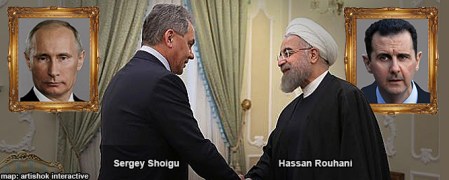
Shoigu in Tehran to rescue Putin’s plan from Assad’s Iranian-backed obstructionism

February 22, 2016

Shoigu in Tehran to rescue Putin’s plan from Assad’s Iranian-backed obstructionism, DEBKAfile, February 22, 2016

Shoigu_Ruhani

President Vladimir Putin this week mounted a rescue operation to unsnarl his blueprint for a solution of the Syrian crisis from the blockage placed in its path by none other than Bashar Assad. The Syrian ruler won’t hear of Moscow’s proposals for ending the war, or even the cessation of hostilities approved last week in Munich by the 17-member Syria Support Group.

DEBKAfile reports that the strains between Moscow and Damascus this week have blown back onto the working relations between the Russian, Syrian and Iranian military commands running the war in Syria.

US Secretary of State John Kerry, referring to the lack of progress toward a ceasefire during a visit to Amman Sunday, Feb. 21, pointed mainly at the Syrian opposition. Its High Negotiations Committee insists first on an end to the sieges, a halt on Russian bombardment and the inclusion of the jihadist Nusra Front in the ceasefire.

But, according to our sources, the main monkey wrench has been thrown into the mix by Assad.

When Putin discovered that the Syrian ruler had won the secret backing of Tehran in h is refusal, he decided to send the supreme commander of the Russian campaign in Syria, Defense Minister Gen. Sergei Shoigu, to Tehran Sunday, Feb. 21, with a personal message for President Hassan Rouhani.

Gen. Shoigu laid before Rouhani the extent to which Russian intervention had turned the tide of the Syrian war in favor of the regime, and the great advantages of a political resolution that would end the conflict in a way that enhanced Russian and Iranian influence in the region to the maximum.

The Russian general stressed that at the end of the proposed political process, Assad would be required to step down. This concurrence was incorporated in the Putin-Obama deal for working together to solve the Syrian crisis.

But Rouhani was unmoved, according to the statement he issued at the end of the interview.

“The crisis in Syria can only be solved through political negotiation and respect for the rights of the country’s government and people, who are those taking the final decision regarding its future,”  he said.

This was taken in Moscow as Iran’s rejection of at least one element of the Putin plan – imposing a solution on Assad – but not the plan in its entirety. This qualified response was meant to nudge Moscow closer to Teheran and Moscow and pull away from Washington.

The Shoigu mission therefore did not lessen the strains between Russia, Iran and Assad – at least for now, according to DEBKAfile’s sources.

Although all the parties concerned agree that the war must be ended by political means, those means are the subject of controversy between Moscow and its allies. The Russians are seeking a staged advance towards the final goal by first scaling down military operations, the while gradually refocusing their efforts on political and diplomatic arrangements.

But Syrian and Iranian leaders want to keep the focus on the military course.

Moscow wants the Assad regime to make concessions for paving the way to a cease-fire, and to accept a transitional government taking over in Damascus with representation for the opposition. The Syrian dictator would then gradually transfer his powers to the stand-ins as they assume responsibility for the various branches of government.

But both Assad and Tehran are adamantly opposed to a transitional government being installed – or any other political steps being pursued – before the rebel forces are totally defeated in non-stop military operations – first in the north and then in the south.

Neither the Syrian ruler nor Iran show any sign of relenting, or appreciating that the dramatic progress achieved in the past month by Syrian army, Iranian and Hizballah forces were down to Russian military support and especially its air campaign against their enemies. They feel safe in their intransigence because they assume that Putin can’t afford to abruptly pull his military support from under their feet to make them bow to his demands.

After five months in which Moscow and the Russian air force have provided the Iranian leadership and Assad with signal victories on the ground, President Putin has been brought up short by the same Iranian-Syrian negative obstructionism, that has defied every effort to end the brutal five-year war, which has cost 470,000 lives, left 1.9 million injured, displaced half the country’s population of 23 million and left a Syria ravaged beyond recognition.

Off Topic | President Donald Trump and Vice President Ben Carson

February 21, 2016

President Donald Trump and Vice President Ben Carson, Dan Miller’s Blog, February 21, 2016

(The views expressed in this post are mine and do not necessarily reflect those of Warsclerotic or its other editors. — DM)

President Trump and Vice President Carson will be an excellent team. Each has qualities the other lacks: Carson is modest and soft spoken, Trump is not. Trump knows how business works and how to negotiate deals. Carson does not. Both love America and want to help us to make her great again.

Trunp ground game

Donald Trump interview, February 18th:

https://www.youtube.com/watch?v=4rcALd00L5k

Not Donald Trump, but how some see him:

Recent speech by Ben Carson:

Not Ben Carson, but how some see him:

All too often, our perceptions of candidates are based, not on what they actually say and do, but on what opposing candidates and their supporters claim.

Oh well.

Here are Newt Gingrich’s remarks on Trump’s future after his South Carolina Republican primary win.

Don’t want Trump/Carson? Then let’s just keep things the way they are because the country’s in the very best of hands. Isn’t it?

Excuse me. I need some medicine.

Libya disaster: Have Western leaders learned anything?

February 20, 2016

Libya disaster: Have Western leaders learned anything? Investigative Project on Terrorism via Fox News, Pete Hoekstra, February 19, 2016

(Please see also, Exclusive: Obama Refuses to Hit ISIS’s Libyan Capital. — DM)

That the U.S. has launched airstrikes against ISIS in Libya should demonstrate once and for all the total disaster of the NATO-led adventure to overthrow Muammar al-Qaddafi in 2011.

Libya devolved into a failed state when NATO assisted Qaddafi’s radical jihadist opponents in killing him and then promptly abandoned the country. Left in the wake were two rival governments competing for power, which created space for Islamists to turn Libya into a cesspool of extremism.

Former Secretary of State Hillary Clinton continues to call the debacle American “smart power at its best.” Other presidential candidates still argue that it was the right thing to do.

How will the West ever learn anything if it can’t identify its most obvious failures?

Libya has no central functioning government that can provide security for its citizens. ISIS fights to expand its caliphate along the Mediterranean to points as close as 200 miles from Europe’s vulnerable southern border. It controls Qaddafi’s hometown of Sirte. It has imposed Shariah law in the areas under its control. It exploits Libya as a base to export weapons, jihadists and ideology to Europe, other African countries and the Middle East.

Benghazi and Derna, which have long been hotbeds of radicalism, provided more fighters per capita to Afghanistan and Iraq than nearly any other area in the world. The difference between then and now is that Qaddafi kept the lid on the garbage can long before 2002-2003, when he became a reliable U.S. ally against radical Islam. He changed his behavior, gave up his nuclear weapons program, paid reparations to the victims of his atrocities and provided invaluable intelligence that disrupted numerous Islamist terror plots.

It represented a massive foreign policy success, and the U.S. thanked him by facilitating his murder.

Similarly, the West embraced former Egyptian President Hosni Mubarak in his struggles against Islamist forces, and then it threw him under the bus. Both Qaddafi and Mubarak did everything asked of them, but they ended up dead or in jail.

Any leader would really need to ask why he should trust NATO or the West. Is there any question why Syrian dictator Bashar al-Assad does not negotiate an end to his country’s civil war and clings to Iran and Russia to keep him in power?

Iran cheated on its nuclear program for years. As a result, the U.S. gifted it with more than $100 billion – including $1.7 billion in U.S. taxpayer dollars – and it hasn’t changed its behavior in the slightest. In addition to its military ambitions, Iran will most assuredly spend the money on supporting Assad and its terrorist proxies throughout the Middle East, Africa and, yes, Europe.

I’m amazed by some of the statements now coming from the coalition. The French defense minister is concerned about ISIS fighters blending in with refugees crossing the Mediterranean. Talk about restating the obvious. The British want troops to identify friendly militias in order to avoid targeting them in future airstrikes. Has something changed where we have improved the vetting of “moderate” militia groups?

NATO failed miserably in Libya and in Syria the first time around. What’s different now?

The only official who seems to make any sense is U.S. Secretary of Defense Ash Carter, who said recently, “The Libyans don’t welcome outsiders intruding on their territory.” He was referring to ISIS, but he might as well have been talking about the West. Libyans have not forgotten that NATO all but vanished once Qaddafi was killed.

Western foreign policy is in disarray. The scariest part is that supposed leaders don’t even know it, and therefore they can’t admit to previous mistakes. Allies that brought stability to the region are gone. Former and current antagonists benefited from Western incompetence.

Who would have predicted six years ago that those rulers battling Islamist terror would be deposed and that those committing it would become the West’s new friends?

NATO snatched defeat from the jaws of victory in Libya. Refugees flood Europe. Terrorist attacks continue to spread geographically and in lethality. The Syrian civil war rages on. Iran lavishes its newfound wealth on its nuclear program and campaign of global terror.

Is it any wonder that citizens in Western countries are frustrated and angry with those in positions of authority?

‘Senior Official’ of Iran-Russia-Syria Alliance Brags About Subverting U.S. Diplomacy

February 17, 2016

‘Senior Official’ of Iran-Russia-Syria Alliance Brags About Subverting U.S. Diplomacy, Washington Free Beacon, Morgan Chalfant, February 17, 2016

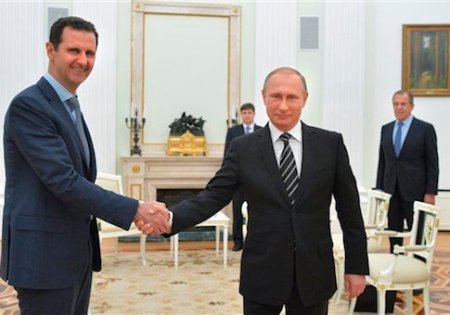
FILE - In this file photo taken on Tuesday, Oct. 20, 2015, Russian President Vladimir Putin, center, shakes hand with Syrian President Bashar Assad as Russian Foreign Minister Sergey Lavrov, right, looks on in the Kremlin in Moscow, Russia. When Russian Foreign Minister Sergey Lavrov said his country is ready to aid Syrian rebels fighting Islamic State militants on the ground, rebel commanders scoffed at the notion, pointing out that Russian aircraft were pounding rebel bases in central and northern Syria on daily basis. (Alexei Druzhinin, RIA-Novosti, Kremlin Pool Photo via AP, File)

FILE – In this file photo taken on Tuesday, Oct. 20, 2015, Russian President Vladimir Putin, center, shakes hand with Syrian President Bashar Assad as Russian Foreign Minister Sergey Lavrov, right, looks on in the Kremlin in Moscow, Russia. (Alexei Druzhinin, RIA-Novosti, Kremlin Pool Photo via AP, File)

A “senior official” of the military alliance between Iran, Russia, and Syria that is currently waging a ground offensive in Aleppo boasted about subverting U.S. diplomacy in a recent interview with an U.S. newspaper.

The official told the Wall Street Journal that military forces from Iran, Russia, and Syria would use a recent ceasefire deal brokered by world powers—including the United States—not to take steps towards a peaceful resolution of the Syrian war, but to consolidate their military gains.

The Journal reported:

“These allies are together in the same command center, working, planning and coordinating their operations in the battlefield,” said a senior official in the Iran-Russia-Syrian regime military alliance. “Retaking Aleppo will restore the regime’s strength and control over Syria; toppling the regime is now a thing of the past.” A cease-fire as proposed by world powers in Munich last week, he said, would simply be a pause for the Iran-led ground forces to consolidate recent territorial gains.

Thousands of fighters organized by Iran—including Hezbollah, the Islamic Revolutionary Guard Corps, and Shia fighters from Afghanistan, Iraq, and other countries—have launched the assault on Aleppo alongside Syrian army forces. Emboldened by Russian airstrikes, the fighters have been able to advance on Syria’s largest city.

There is some doubt regarding whether the ceasefire will be implemented at all. The deal was established by global powers on Friday, though neither Assad nor the Syrian opposition formally signed off on it. The deal was supposed to allow humanitarian aid to be sent to Syria and commence peace negotiations. The United States hoped that the ceasefire would be implemented in a week’s time.

Hours before the ceasefire was announced, Assad vowed to retake Syria in its entirety in an interview published by AFP.

Iran has put billions of dollars toward backing Assad, and Russia has launched a military intervention in Syria to back the Assad regime under the guise of fighting terrorist groups.

While the Obama administration has long said that Assad must be removed from power, the United States has softened that stance since 2011, when the Syrian civil war began. Secretary of State John Kerry said in December that the administration was not seeking a “regime change” in Syria following a meeting with Russian President Vladimir Putin.

“The United States and our partners are not seeking so-called regime change,” Kerry said then, indicating that world powers were focused on achieving a peace process in which “Syrians will be making decisions for the future of Syria.”

Both Russia and Iran have resisted any effort to oust Assad.

Saudi Arabia, Yemen and the Politicized UN

February 16, 2016

Saudi Arabia, Yemen and the Politicized UN, Gatestone InstituteRichard Kemp and Jasper Reid, February 16, 2016

♦ The UN’s assertion that the Saudi-led coalition has committed war crimes in Yemen is unlikely to be true. UN experts have not been to Yemen, depending instead on hearsay evidence and analysis of photographs.

♦ The UN has a pattern of unsubstantiated allegations of war crimes against the armed forces of sovereign states. Without any military expertise, and never having visited Gaza, a UN commission convicted the Israel Defense Force of deliberately targeting Palestinian civilians in the 2014 conflict. It was an assessment roundly rejected by America’s most senior military officer, General Martin Dempsey, and an independent commission.

♦ The Houthis have learned many lessons from Hamas and Islamic Jihad in Gaza, groups also supported by Iran. Those lessons include the falsification of civilian casualty figures and their causes. The UN swallowed the fake Gaza figures hook, line and sinker, and are now making the same error in Yemen.

♦ The Houthis exploit gullible or compliant reporters and human rights groups to facilitate their propaganda, including false testimony and fabrication of imagery.

♦ Forensic analysis shows that rather than deliberately targeting civilians, the Saudis and their allies have taken remarkable steps to minimize civilian casualties.

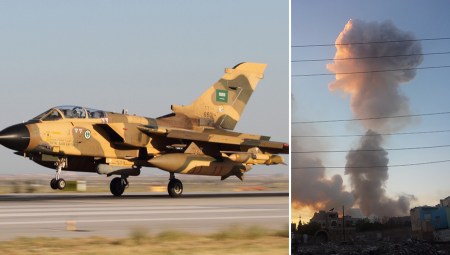
The United Nations, Amnesty International and other groups have accused the Saudi-led coalition of war crimes in Yemen. A leaked UN report claims the bombing campaign against Iranian-supported Houthi insurgents seeking violently to topple the legitimate government of Yemen has conducted deliberate, widespread and systematic attacks on civilian targets.

If the UN’s assertion is true, and the coalition is deliberately and disproportionately killing thousands of innocent civilians, it is a war crime. But it is unlikely to be true. The UN has produced no actual evidence of war crimes. None of their allegations is based on investigation on the ground. Their experts have not been to Yemen, depending instead on hearsay evidence and analysis of photographs.

The UN has a pattern of unsubstantiated allegations of war crimes against the armed forces of sovereign states. Only last year, without any military expertise, and never having visited Gaza, a UN commission convicted the Israel Defense Force of deliberately targeting innocent Palestinian civilians in the 2014 conflict. It was an assessment roundly rejected by America’s most senior military officer, General Martin Dempsey, the Chairman of the Joint Chiefs of Staff.

Dempsey’s own findings were confirmed by an independent commission of experienced senior military officers and officials from nine countries. The High Level Military Group found that Israel had not committed war crimes, but had in fact set a bar for avoiding civilian casualties so high that other armed forces would struggle to reach it.

Moreover, last September the UN said that a US airstrike against a hospital in Kunduz, Afghanistan, was “inexcusable” and “possibly a war crime.” Few military forces in the world take greater precautions to prevent civilian casualties on the battlefield than the US. Anyone who has actually experienced combat knows that while such incidents are tragic, when carried out by Western forces, they are far more likely to be the result of human error or the chaos of battle than deliberate war crimes.

There is every reason to believe that the UN is again crying wolf. There is no doubt that thousands are dying in Yemen in horrific circumstances. But we cannot just accept the UN’s figures and its attribution of the proportion of deaths being inflicted by the Saudi coalition. Most of the data comes from the Houthi insurgents, either directly or via non-governmental organizations (NGOs), and is simply accepted as fact. The Houthis have learned many lessons from Hamas and Palestinian Islamic Jihad in Gaza, groups also supported by Iran. Those lessons include the falsification and distortion of civilian casualty figures and their causes. The UN swallowed the fake Gaza figures hook, line and sinker, and are now making the same error in Yemen.

As with Israel’s defensive campaign in Gaza in 2014, and the continued U.S. military support to the Afghan regime, the Saudis’ war to defend the government of Yemen and curb Iranian aggression in the region is lawful and legitimate. Therefore, the illegality of civilian deaths must be assessed according to the laws of armed conflict, in particular whether adequate precautions were taken to avoid them, whether they were proportionate to the military objectives and whether they were necessary to achieve legitimate military goals. The UN cannot possibly make such judgements without a more far-reaching and thorough investigation, and especially not on the basis of information provided by Saudi Arabia’s enemies and by interpreting photographs.

Most of us do not like the way that the Saudi regime runs their country according to the strict application of Islamic Sharia law, and we abhor their record on human rights. But the Saudi military ethos is well known and understood by Western military leaders, including from the U.S. and UK, who have worked closely with them for many years. The reality is, as our officers currently serving alongside them will attest, that the Saudis and their allies are not deliberately trying to kill innocent civilians. Indeed, they are doing their best to minimize civilian casualties. The question is whether their best is good enough.

Saudi Arabia and its coalition allies have the most sophisticated Western combat equipment, including planes, attack helicopters, drones and precision-guided munitions. But they lack battle experience. The exception to this is the Emirati forces within the coalition. They have had many years of combat experience alongside Western militaries, including in Somalia, Kosovo, Libya and Afghanistan. Because of that, they have acquitted themselves in Yemen with great professionalism and effectiveness at sea, on the ground and in the air.

But the lack of experience of the other coalition members puts them many years behind our own forces in wielding the highly complex 21st century capabilities of intelligence, surveillance, reconnaissance, communication and targeting.

Yet the coalition faces the same tough challenges that we face on battlefields everywhere. Their Houthi adversaries fight according to the well-developed doctrine of their backers, the Iranian Quds Force. Like Hizballah, Hamas, the Taliban, Al Qaeda and the Islamic State, their techniques include deliberately killing civilians, fighting from within the population and forcing innocents to become human shields.

1474

Completely ignoring the laws of war, they exploit their enemies’ adherence to them. They lure their opponents to attack and kill civilians. They exploit gullible or compliant reporters, international organizations and human rights groups to facilitate their propaganda, including false testimony and systematic fabrication of imagery. The aim is to instigate international condemnation in order to constrain their militarily superior enemies.

We have seen credible forensic analysis of strikes in Yemen that directly contradict the findings of the UN. Forensic analysis shows that rather than deliberately targeting civilians, the Saudis and their allies have taken remarkable steps to minimize civilian deaths. Of note, they have learned much from Israel’s conduct of operations in Gaza. This has included the use of guided munitions to conduct precision attacks against insurgents while seeking to reduce collateral damage.

Why would coalition forces spend vast amounts of money in a cripplingly expensive conflict firing precision strike munitions, and put their valuable pilots at risk, if they wanted to massacre civilians? Why not use much cheaper unguided munitions or Assad’s indiscriminate barrel-bombs?

The overwhelming majority of civilian deaths caused by the Saudi-led coalition have been due not to deliberate targeting, but to inexperienced pilots and unsophisticated intelligence and targeting capabilities in the face of an enemy that fights from within the civilian population. And to that the friction, confusion, stress and fog of war that leads even the most sophisticated, experienced and restrained military forces, such as American, British and Israeli, to sometimes kill civilians unintentionally. Contrary to the UN’s claim, this is unlikely to amount to war crimes.

Like every conflict in the Middle East, the war in Yemen is almost intractable, takes a heavy toll on innocent civilians, and is unlikely to end in anything approaching a perfect solution. But Saudi Arabia and its allies are making considerable efforts to restore stability to the country and its legitimate government.

Instability in Yemen undermines Western interests, including oil supplies. Instability also allows Al Qaeda and the Islamic State — proven and lethal threats to the US and the West — to flourish there.

By confronting the Houthis in Yemen, Saudi Arabia is also confronting Iran, which represents an even greater threat to the region and to the world. Emboldened by U.S. President Barack Obama’s nuclear deal, enriched by the release of billions of dollars of previously frozen funds, encouraged by the imminent boost in oil revenues, Iranian imperial aggression is today rampant in Iraq, Syria, Lebanon and Yemen.

However unpalatable to many, Saudi Arabia is and will remain a vital ally of the West. We must continue to support them in the fight in Yemen. We must not allow the false, ill-informed and increasingly shrill condemnations by the UN, human rights groups and the media to undermine Saudi’s fighting effectiveness as they have sought to do against other legitimate government forces fighting lawless insurgents in so many other places.