Posted tagged ‘Foreign Policy’

Libya Being Taken Over by ISIS was Everyone’s Fault Except Obama’s

March 11, 2016

Libya Being Taken Over by ISIS was Everyone’s Fault Except Obama’s, Front Page Magazine, Daniel Greenfield, March 11, 2016

crying-barry-obama

Nothing is ever Obama’s fault. Ever. Even when he did it.

Like the time he illegally invaded Libya by lying to everyone from the UN to Americans, leading to the killing of an American ambassador and Al Qaeda, the Muslim Brotherhood and ISIS taking over large parts of the country… as had been predicted. But it’s not his fault. Really.

But Obama says today of the intervention, “It didn’t work.” The U.S., he believes, planned the Libya operation carefully—and yet the country is still a disaster.

We did a good job… and yet we failed. It must be someone’s fault.

“The social order in Libya has broken down,” Obama said, explaining his thinking at the time. “You have massive protests against Qaddafi. You’ve got tribal divisions inside of Libya…. We worked with our defense teams to ensure that we could execute a strategy without putting boots on the ground and without a long-term military commitment in Libya.”

Who could have predicted that regime change in a country where the order had broken down, without putting boots on the ground, would lead to complete chaos? No one could have predicted it. No one.

“So we actually executed this plan as well as I could have expected: We got a UN mandate, we built a coalition, it cost us $1 billion—which, when it comes to military operations, is very cheap. We averted large-scale civilian casualties, we prevented what almost surely would have been a prolonged and bloody civil conflict. And despite all that, Libya is a mess.”

I poured gasoline on the haystacks. Then I started shooting off firecrackers. I tied torches to pigs and sent them running around the barn. And despite all that, the barn is on fire.

It was a great plan Obama had.

1. Lie to the UN

2. Build a coalition of countries willing to sign their names without doing anything

3. Spend $1 billion to let Islamic terrorists take over the country

4. Somehow the “prolonged and bloody civil conflict” you claimed to be trying to prevent is still going on and on…

And it’s not Obama’s fault. No way.

Mess is the president’s diplomatic term; privately, he calls Libya a “shit show,” in part because it’s subsequently become an isis haven—one that he has already targeted with air strikes. It became a shit show, Obama believes, for reasons that had less to do with American incompetence than with the passivity of America’s allies and with the obdurate power of tribalism.

“I’m not competent. All my allies suck. Also the tribal country we bombed is all tribal and stuff and who could have predicted that?”

“When I go back and I ask myself what went wrong,” Obama said, “there’s room for criticism, because I had more faith in the Europeans, given Libya’s proximity, being invested in the follow-up,” he said.

Yes, the only thing that Obama blames himself for… is passing the blame to Europe.

Will Obama Try to Blackmail Israel?

March 11, 2016

Will Obama Try to Blackmail Israel?

by Shoshana Bryen

March 11, 2016 at 5:00 am

Source: Will Obama Try to Blackmail Israel?

  • President Obama is looking at the fires he lit in the Middle East and North Africa, and desperately hoping to salvage something, anything, from the conflagration before he leaves office. Israel will be pushed to provide at least one “victory.”
  • Iran has come closer to nuclear weapons competence in the past eight years. And Obama’s abandonment of dissidents and pro-democracy advocates in Cuba, Venezuela, China, Turkey and Iran paves the way for waves of repression and bloodshed around the world.
  • It is estimated that more than 17,000 civilians were killed in Iraq in 2014, four times as many as 2012, after the U.S. withdrew its combat forces. This is a far cry from 2011, when Obama announced the U.S. was leaving a “sovereign, stable and self-reliant Iraq.”
  • He needs to find a “success.” Cue the Middle East “peace process.”

As Vice President Biden arrived in Israel this week, word leaked about yet another “peace plan” designed by the Obama administration. There isn’t much new in it. According to The Wall Street Journal, the U.S. might support a UN Security Council resolution calling on “both sides to compromise on key issues,” and it might involve the Middle East Quartet. Israel would be told to stop building in the territories and recognize East Jerusalem as the capital of a Palestinian State. The Palestinians would be told to recognize Israel as a Jewish state and give up the “right of return” for the original 1948/49 refugees and their descendants.

Just do it and voila! Problem solved.

As Vice President Biden arrived in Israel this week, word leaked about yet another “peace plan” designed by the Obama administration. (Image source: Israel Prime Minister’s Office)

Why and why now? Because President Obama is looking at the fires he lit in the Middle East and North Africa, and desperately hoping to salvage something, anything, from the conflagration before he leaves office and needs another job. Israel will be pushed to provide at least one “victory.” Consider the list of Administration failures right now and the terrible destruction they have entailed:

In his first foreign visit, President Obama opened the door in Egypt to an uprising not only of “Google people” in Tahrir Square, but also to the Muslim Brotherhood. Brotherhood representatives were front and center at the President’s speech in Cairo’s Al-Azhar University, to the dismay of longtime ally Hosni Mubarak. After Mubarak’s overthrow, the White House pressed for the inclusion of the Brotherhood in Egyptian elections despite its history of terrorism. Since then, the U.S. and Egypt have been unable to find a way to communicate constructively, despite Egypt’s increasing closeness to Israel and their joint interest in controlling the terrorist Hamas and Iranian-sponsored jihadis in Sinai.

The Muslim Brotherhood was emboldened in Syria by its successes in Egypt.

The Syrian civil war and the rise of ISIS — both in some measure precipitated by the U.S. withdrawal from Iraq – have killed upwards of 350,000 people (more than 55,000 in 2015) and displaced nearly 4 million more. Chemical weapons, starvation, beheadings and aerial bombing are weapons of choice by various sides. Russia is calling the shots (literally) in Syria, while Turkey, Qatar and Saudi Arabia continue to fund various jihadi groups, and Iran operates freely in both Iraq and Syria. Hezbollah, despite taking enormous casualties in Syria, continues to add to its missile arsenal in Lebanon.

This is a far cry from 2011, when President Obama announced the U.S. was leaving a “sovereign, stable and self-reliant Iraq.” An Iraqi non-governmental organization estimated that more than 17,000 civilians were killed there in 2014, double the number from the previous year and four times as many as 2012, after the U.S. withdrew its combat forces.

Lebanon, Jordan, and Turkey have all been destabilized by an influx of refugees from Syria and Iraq. Lebanon, a fragile country of less than 4.5 million people divided into Shiites, Sunnis, Christians and Druze, now has more than one million Syrian refugees.

Afghanistan was the “good war” in President Obama’s narrative. At West Point at the end of 2009, President Obama announced an additional deployment of 30,000 American soldiers to stabilize Afghanistan and nuclear-armed Pakistan. Six years later — 15 years after we got there — American military leaders told him the Afghan government still couldn’t survive without a continuing American military presence. Since the administration decided to leave a contingent of nearly 10,000 soldiers for an indefinite period of time, the Taliban has refused to continue peace talks with the Afghan government, and we’re looking at another bloody summer. Terrorist bombs in Pakistan are a daily occurrence.

Libya was supposed to be a test of our “responsibility to protect.” It also had, from the President’s point of view, the benefit of “leading from behind” and having “no boots on the ground.” After successfully ousting Moammar Gaddafi — who had turned his WMD program over to US and UK intelligence, kept al-Qaeda from moving from Egypt to Western North Africa, and paid reparations for terrorism — the U.S. acknowledged as many as 30,000 Libyan deaths in two months of war.

The war in Mali was a direct result of the demise of the Gaddafi government and the raiding of government weapons depots by al-Qaeda-supported Tuareg forces. Only the direct involvement of French troops saved the government there. The deaths of U.S. Ambassador Christopher Stevens, Sean Smith, Tyrone S. Woods, and Glen Doherty are attributable to the rise of al-Qaeda there as well. Today, there are as many as 1700 armed gangs across Libya and ISIS controls Sirte, a city of more than 100,000. The Pentagon is drawing up plans for U.S. military action to force ISIS out, we are again bombing Libya and there are American Special Forces on the ground.

Meanwhile, the U.S. bombed an al-Shabaab training base in Somalia this week, killing more than 150 members of the group.

Iran has come closer to nuclear weapons competence in the past eight years. And President Obama’s abandonment of dissidents and pro-democracy advocates in Cuba, Venezuela, China, Turkey and Iran paves the way for waves of repression and bloodshed around the world.

The widespread wreckage and carnage that accrues to President Obama’s policies and fantasies should disqualify him from further activity on the international stage when his term ends. But since retirement doesn’t appear in the offing, he needs to find a “success.”

Cue the Middle East “peace process.”

Shoshana Bryen is Senior Director of the Jewish Policy Center.

Our ISIS Problem is also our Saudi Arabia Problem

March 9, 2016

Our ISIS Problem is also our Saudi Arabia Problem, WNDWilliam Murray, March 8, 2016

H/t The Counter Jihad Report

ISIL, or ISIS, now calling itself the Islamic State, is part of a continuing Sunni Muslim problem. Here is some real history to counter current media perceptions paid for by Saudi Arabia and other Gulf states.

Ask the media or any Democratic or Republican senator, and they will tell you that Shiite Muslims (or Shia) are the greatest threat faced by Western civilization today. Besides Sen. John McCain, current presidential candidates Sens. Ted Cruz and Marco Rubio have referred to the Shiite threat in virtually every stump speech, often citing the “Shia Crescent” that runs from Iran through Iraq and Syria and ending in Lebanon. Rubio constantly refers to “our Sunni allies such as Saudi Arabia” and has suggested the creation of a Sunni state in Syria. Apparently, the senator is, as is former Secretary of State Hillary Clinton, unaware that there is already a Sunni state in northern Syria, and it is run by the Islamic State, otherwise known as ISIS or ISIL.

The Sunni Islamic State does have a competitor in Syria, al-Nusra, which is part of al-Qaida and also a Sunni terror organization. The Army of Islam operating in Syria is also a Sunni terror organization supported by Saudi Arabia and Turkey. During battles between al-Nusra and the Islamic State, American-led coalition aircraft have supported Sunni al-Nusra, which is al-Qaida. Which Sunni group to back in the Syrian civil war is always a question for the White House.

In 2015 most of the 17,000 civilians killed in Iraq died at the hands of Sunni terrorists. That is 10 times the number killed in the Sunni terror attack on 9/11. The attacks on the World Trade Center and the Pentagon were conducted by al-Qaida, a Sunni terror organization. The first terror attack on the Trade Center in 1993 was financed by Khalid Sheikh Mohammed, a Sunni cleric also associated with the Sunni terror group al-Qaida.

The 9/11 attack was planned by al-Qaida from Afghanistan, which at the time was controlled by the Taliban, a Sunni Muslim group dedicated to the elimination of Shiites and Christians.

Sunni groups, many funded by interests inside Saudi Arabia and Qatar, declared responsibility for the 2004 Madrid train bombings killing 191 and wounding over 1,800. A Sunni group took responsibility for the 2005 London bus bombings killing 52 and wounding 700. Sunni terror groups were responsible for the massacre of 334 people including 186 children during the 2004 attack on a school in Beslan, Russia, and also the Moscow theater attack in 2002. The various Paris attacks, including the 2015 Charlie Hebdo magazine and Jewish deli attacks over three days and a later attack in November on a theater and restaurants that killed 130, were conducted by the Islamic State, a Sunni Muslim organizations.

The Fort Hood terror attack in 2009 killing 13 plus an unborn child was conducted by Maj. Nidal Hasan, a Sunni Muslim connected to a “vetted” Sunni imam, Anwar al-Awlaki, who was allowed to speak at the Pentagon and Congress. Al-Awlaki and his son, both U.S. citizens, were killed by a drone strike though a death warrant issued by President Obama to shut him up lest he embarrass those at the Pentagon who had “vetted” him. He had been the imam at the Virginia mosque attended by some of the 9/11 hijackers.

There have been numerous “minor” terror attacks against Western targets, such as the 2013 Boston Marathon bombings that killed “only” three and wounded 264. The bombers were brothers from a family of Sunni Muslims who had immigrated legally to the United States from Chechnya, Russia. Other “small” attacks by Sunni Muslims in the United States include the following: A Sunni Muslim convert killed one at a Little Rock military recruiting center in 2009, and four Marines were killed by a Sunni Muslim immigrant in Chattanooga in 2015. Other attacks such as against a 2002 El Al ticket counter at Los Angeles International Airport have been downplayed as only three died.

Most recently in the United States was the 2015 San Bernardino massacre, which was carried out by a Sunni Muslim couple connected to Saudi Sunni extremists and influenced by the Islamic State. A total of 14 were killed and 22 wounded.

In Asia the 2002 Bali bombings that killed 202 mostly Australian tourists was orchestrated Jemaah Islamiyah, a Sunni Muslim organization seeking Shariah law in that nation. Sunni groups have bombed numerous churches in the Philippians, and Thailand suffers almost daily deaths by Sunni Muslim separatist organizations that want a breakaway state under Shariah law. China suffers numerous attacks from Sunni groups every year.

The most noted attack in India by Sunni Muslims from Pakistan was in 2008 when 10 members of Lashkar -e-Taiba, conducted 12 coordinated shooting and bombing attacks over four days, killing 164 people and wounding 308. A landmark hotel, the Taj Mahal Palace, was nearly completely destroyed.

The mass beheadings of 21 Egyptian Christians in Libya that outraged the press in the United States for a few days in 2015 were conducted by a Sunni terror group. All of the slaughter in this Hillary Clinton established “democracy” is being conducted by three Sunni Muslim factions.

Back to the “Shia threat” alluded to by Hillary Clinton, McCain, Cruz and Rubio as well as Secretary of Defense Ash Carter. The last large scale Shia attack against the West was in 1983 against a military target in Lebanon at the U.S. military barracks, killing 299 American and French servicemen.

I have left Israel out of this analysis because it faces a Sunni threat from the south in Gaza and a Shia threat to the north. In line with the theology of the two groups, Sunni-oriented Hamas normally attacks civilian targets while Shia Hezbollah usually attacks military targets.

With this history, why does the Obama administration, like the Bush administration before it, as well as both liberal and conservative members of Congress and virtually all presidential candidates, say the greatest threat is from Shia Muslims?

The simple answer is that Saudi Arabia is Sunni Muslim, and most of the financing for Sunni extremist groups has come from Saudi Arabia, which is “our ally.” The initial funding for the revolt in Syria, which handed us the Islamic State problem, came from Saudi Arabia. Over $2 billion in arms were moved into Syria from Turkey and prepositioned before the initial Sunni uprising that to this day Obama and McCain insist was a secular revolt.

Some contend that only private elements within Saudi Arabia supported ISIS and never the Saudi government. Although Saudi Arabia may not directly support or fund ISIS, Saudi Arabia gives legitimacy to ISIS extremist ideology. Saudi textbooks are used in the ISIS-controlled schools in Syria and Iraq.

If we want to cut off the real head of the snake, the Islamic ideology that threatens the world through al-Qaida and the Islamic State today, we must shut down the educational funding source – and that is Saudi Arabia. Saudi Arabia runs a close second to North Korea on human rights abuses and should be treated to the same sanctions and boycotts. All Saudi-printed literature and all funding of mosques and schools in the United States and Europe should be banned at once.

To stop ISIS, which is actually the second generation of al-Qaida, we must dig out the root which is Saudi Arabia.

Note: The preceding were William J. Murray’s prepared remarks for The Awakening, Orlando, Florida, March 5, 2016.

Donald Trump’s message to Lower Slobbovia

March 8, 2016

Donald Trump’s message to Lower Slobbovia, Washington Times, 

(Hey! Wait a minute! Trump might change things. We can’t have that! — DM)

GOP_2016_Trump.JPEG-0c383_c0-434-5184-3456_s885x516Republican presidential candidate Donald Trump speaks during a campaign rally Monday, March 7, 2016, in Madison, Miss. (AP Photo/Brynn Anderson)

Ringling Brothers, ever on the hunt for the latest wild man from Borneo with two heads and three feet, should move the greatest show on earth into the Big Top and charge admission. Everybody wants to watch, even if the faint of heart complain that the sight of it all makes them leave the tent with wet pants.

Reuters, the British news service, reports that foreign diplomats are alarmed by the Donald’s “inflammatory and insulting public statements.” The folks in Foggy Bottom, who are trained to view with alarm and never have to learn to point with pride, are stumped for what to tell them. “As the Trump rhetoric has continued,” one of the officials tells Reuters, “and in some cases ‘amped’ up, so too have concerns by certain leaders around the world.” Three officials who were willing to talk about the shortage of fainting couches in the frightened precincts of the world, declined to say exactly where these precincts are, but conceded that some of them were in India, South Korea, Japan and Mexico.

But leaders in Britain, France and Canada have indeed gone public with their not-so-private fears. The economics minister of Germany, who you might think would be devoting full attention to the swarms of migrants from the Islamic world threatening to make Muslims of Germans, says the Donald threatens peace and prosperity.

A spokesman for the Mexican embassy wouldn’t confirm that any Mexican diplomat had complained to anyone in Washington about Trump fatigue, but observed that its top diplomat, Claudia Ruiz Massieu, had called Mr. Trump “ignorant” and, of course, “racist,” and his plan to build a wall to keep Mexicans at home was “absurd.” The fear of such a wall is that it might actually work, as such a wall has worked in Israel, and hamper the dumping of an excess of Mexicans.

Foreign governments in the past have always kept their criticisms of American elections muted. There’s something of an agreement among the gentlemen (and ladies) in striped pants. If the prime minister of Lower Slobbovia, for example, won’t say anything in public about a scary candidate in America, maybe an American president won’t say anything about the mayhem and abuse in Lower Slobbovian elections.

Foreign criticism is thus mostly hyperventilation; diplomats must have someone to complain to, and to report that he said something in what used to be called “cables” to the Home Office. Now everything is sent via email, secure or, in the case of a famous former American secretary of State, not so secure. However, diplomats from countries where everyone must mind his tongue lest it be removed with a rusty knife, never quite learn how America works, and think the U.S. government can control what a candidate, like everyone else, is allowed to say.

Donald Trump scares these foreign diplomats because they think he might mean what he says about forcing the rest of the world to do their share of the heavy lifting required to keep the free world more or less free. In fits of candor, some diplomats concede concerns that the United States might become “more insular” under President Trump, who has threatened to repeal or revise trade agreements and push allies to take a larger role in facing up to the radical Islamic threat in the Middle East.

“European diplomats are constantly asking about Trump’s rise with disbelief and now with growing panic,” a senior NATO official tells Reuters. “With the European Union facing a [serious] crisis, there’s more than the usual anxiety about the United States turning inward when Europe needs American support more than ever.”

Gen. Philip Breedlover, the senior U.S. commander in Europe, says he’s getting more questions than usual about how American elections work. “And I think they see a very different sort of public discussion than they have in the past.”

Indeed they do, and if these foreign diplomats in Washington had been paying closer attention to what’s going on in the United States, particularly in the flyover country that is as foreign to American elites as it is to the rest of the world, they would have seen the phenomenon of 2016 coming. Donald Trump did not come out of nowhere, like a summer squall that ruins the picnic.

The great Republican unwashed feel betrayed. So do many Democrats, as Bernie Sanders could tell you. The wheel that goes around comes around, and it may be about to crush anyone who doesn’t get out of the way. That’s the message to be sent to Lower Slobbovia.

Iran Threatens to Walk Away From Nuke Deal After New Missile Test

March 8, 2016

Iran Threatens to Walk Away From Nuke Deal After New Missile Test, Washington Free Beacon, March 8, 2016

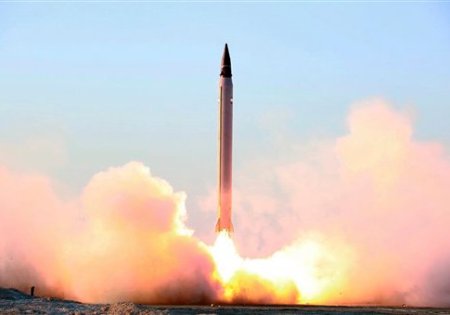
FILE - This file picture released by the official website of the Iranian Defense Ministry on Sunday, Oct. 11, 2015, claims to show the launching of an Emad long-range ballistic surface-to-surface missile in an undisclosed location. Iran tested a ballistic missile again in November 2015, a U.S. official said Dec. 8, describing the second such test since this summerís nuclear agreement. The State Department said only that it was conducting a "serious review" of such reports. The test occurred on Nov. 21, according to the official, coming on top of an Oct. 10 test Iran confirmed at the time. The official said other undeclared tests occurred earlier than that, but declined to elaborate. The official wasnít authorized to speak on the matter and demanded anonymity. (Iranian Defense Ministry via AP)

FILE – This file picture released by the official website of the Iranian Defense Ministry on Sunday, Oct. 11, 2015, claims to show the launching of an Emad long-range ballistic surface-to-surface missile in an undisclosed location. Iran tested a ballistic missile again in November 2015, a U.S. official said Dec. 8, describing the second such test since this summerís nuclear agreement. The State Department said only that it was conducting a “serious review” of such reports. The test occurred on Nov. 21, according to the official, coming on top of an Oct. 10 test Iran confirmed at the time. The official said other undeclared tests occurred earlier than that, but declined to elaborate. The official wasnít authorized to speak on the matter and demanded anonymity. (Iranian Defense Ministry via AP)

Iranian leaders now say that they are poised to walk away from the deal if the United States and other global powers fail to advance the Islamic Republic’s “national interests.”

*************************

Iran on Tuesday again threatened to walk away from the nuclear agreement reached last year with global powers, hours after the country breached international agreements by test-firing ballistic missiles.

Iran’s most recent ballistic missile test, which violates current U.N. Security Council resolutions, comes a day after the international community’s nuclear watchdog organization disclosed that it is prohibited by the nuclear agreement from publicly reporting on potential violations by Iran.

Iranian leaders now say that they are poised to walk away from the deal if the United States and other global powers fail to advance the Islamic Republic’s “national interests.”

“If our interests are not met under the nuclear deal, there will be no reason for us to continue,” Abbas Araqchi, Iran’s deputy foreign minister, warned during remarks delivered to a group of Iranian officials in Tehran.

“If other parties decide, they could easily violate the deal,” Araqchi was quoted as saying by Iran’s state-controlled media. “However, they know this will come with costs.”

Araqchi appeared to allude to the United States possibly leveling new economic sanctions as a result of the missile test. The Obama administration moved forward with new sanctions earlier this year as a result of the country’s previous missile tests.

Iran’s latest missile test drew outrage from longtime regime critics on Capitol Hill.

“The administration’s response to Iran’s new salvo of threatening missile tests in violation of international law cannot once again be, it’s ‘not supposed to be doing that,’” Sen. Mark Kirk (R., Ill.) said in a statement. “Now is the time for new crippling sanctions against Iran’s Islamic Revolutionary Guard Corps, Ministry of Defense, Aerospace Industries Organization, and other related entities driving the Iranian ballistic missile program.”

House Majority Leader Kevin McCarthy (R., Calif.) warned that the nuclear agreement has done little to moderate Iran’s rogue behavior.

“Far from pushing Iran to a more moderate engagement with its neighbors, this nuclear deal is enabling Iran’s aggression and terrorist activities,” McCarthy said in a statement. “Sanctions relief is fueling Iran’s proxies from Yemen to Iraq to Syria to Lebanon. Meanwhile, Khamenei and the Iranian regime are acting with impunity because they know President Obama will not hold them accountable and risk the public destruction of his nuclear deal, the cornerstone of the president’s foreign policy legacy.”

McCarthy went on to demand that the Obama administration step forward with new sanctions as punishment for the missile test.

Meanwhile, the U.S. State Department had difficulty Monday explaining why the nuclear agreement limits public reporting by the International Atomic Energy Agency, or IAEA, on potential deal violations by Iran.

Yukiya Amano, the IAEA’s chief, disclosed on Monday that his agency is no longer permitted to release details about Iran’s nuclear program and compliance with the deal. The limited public reporting is a byproduct of the nuclear agreement, according to Amano.

When asked about these comments again Tuesday, a State Department official told the Free Beacon that the IAEA’s reports would continue to provide a complete picture of Iran’s nuclear program, though it remains unclear if this information will be made publicly available.

“There isn’t less stringent monitoring or reporting on Iran’s nuclear program,” the official said. “The IAEA’s access to Iran’s nuclear program and its authorization to report on it has actually expanded. It’s a distortion to say that if there is less detail in the first and only post-Implementation Day IAEA report then that somehow implies less stringent monitoring or less insight into Iran’s nuclear program.”

While the IAEA “needs to report on different issues” under the final version of the nuclear agreement, the agency continues to provide “a tremendous amount of information about Iran’s current, much smaller nuclear program,” the source maintained.

The IAEA’s most recent February report—which was viewed by nuclear experts as incomplete and short on detail—“accurately portrays the status of Iran’s nuclear program,” including its efforts to uphold the nuclear deal, the official added.

“We expect this professional level of reporting to continue in the future,” the official said.

Turkey and Saudi Arabia hit back for the Obama-Putin Syrian pact

March 5, 2016

Turkey and Saudi Arabia hit back for the Obama-Putin Syrian pact, DEBKAfile, March 5, 2016

Zaman_4.3.16Headline of last issue of Turkey’s Zaman before government takeover

Turkey and Saudi Arabia have taken separate steps to break free from Washington’s dictates on the Syrian issue and show their resistance to Russia’s highhanded intervention in Syria. They are moving on separate tracks to signal their defiance and frustration with the exclusive pact between Presidents Barack Obama and Vladimir Putin which ostracizes Riyadh and Ankara on the Syrian question.

Turkey in particular, saddled with three million Syrian refugees (Jordan hosts another 1.4 million), resents Washington’s deaf ear to its demand for no-fly zones in northern and southern Syria as shelters against Russian and Syrian air raids.

Last year, President Reccep Erdogan tried in desperation to partially open the door for a mass exit of Syrian refugees to Europe. He was aghast when he found that most of the million asylum-seekers reaching Europe were not Syrians, but Muslims from Africa, Afghanistan and Pakistan, in search of a better life in the West. Most of the Syrians stayed put in the camps housing them in southern Turkey.

Even the Turkish intelligence agency MIT was hard put to explain this setback.  According to one partial explanation, organized crime gangs of Middle East dope and arms smugglers, in which ISIS is heavily represented, seized control of the refugee traffic heading to Europe from Libya, Iraq and Syria.
This human traffic netted the gangs an estimated $1 billion.

Turkey was left high and dry with millions of Syrian refugees on its hands and insufficient international aid to supply their needs. No less painful, Bashar Assad was still sitting pretty in Damascus.

Finding Assad firmly entrenched in Damascus is no less an affront for Saudi Arabia. Added to this, the Syrian rebel groups supported by Riyadh are melting away under continuing Russian-backed government assaults enabled by the Obama-Putin “ceasefire” deal’

The oil kingdom’s rulers find it particularly hard to stomach the sight of Iran and Hizballah going from strength to strength both in Syria and Lebanon.

The Turks threatened to strike back, but confined themselves to artillery shelling of Syrian areas close to the border. While appearing to be targeting the Kurdish YPD-YPG militia moving into these areas, the Turkish guns were in fact pounding open spaces with no Kurdish presence. Their purpose was to draw a line around the territory which they have marked out for a northern no-fly or security zone.

Saturday, March 5, President Erdogan proposed building a “new city” of 4,500 square kilometers on northern Syrian soil, to shelter the millions of war refugees. He again tried putting the idea to President Obama.

The Saudi Defense Minister, Deputy Crown Prince Mohammed bin Salman put together a more high-risk and comprehensive scheme. Its dual purpose is to hit pro-Iranian Hizballah from the rear and forcied [Sic] the two big powers to treat Riyadh seriously as a player for resolving the Syrian imbroglio.

The scheme hinged in the cancellation of a $4 billion Saudi pledge of military aid to the Lebanese army, thereby denying Hizballah, which is a state within the state and also dominates the government, access to Saudi funding. But it also pulled the rug from under Lebanon’s hopes for combating ISIS and Al Qaeda’s Nusra Front, which have grabbed a strip of Lebanese territory in the northern Beqaa Valley.

The Saudi action, by weakening the Lebanese military and its ability to shore up central government in Beirut, risks tipping Lebanon over into another civil war.

The London Economist commented that this Saudi step against Lebanon seems “amateurish.” Under the young prince (30), “Saudi Arabia sometimes acts with bombast and violence that makes it look like the Donald Trump of the Arab World,” in the view of the magazine.

But the Saudi step had a third less obvious motive, a poke in the eye for President Obama for espousing Iran’s claim to Middle East hegemony. Resentment on this score is common to the Saudi royal house and the Erdogan government.

As a crude provocation for Washington, the Turkish president ordered police Friday, March 4, to raid Turkey’s largest newspaper Zaman, after an Istanbul court ruling placed it under government control.

The newspaper released its final edition ahead of the raid declaring the takeover a “shameful day for free press” in the country. A group of protesters outside the building was dispersed with tear gas, rubber bullets and water cannons.

Zaman is owned by the exiled Muslim cleric Felhullah Gulen, who heads the powerful Hizmet movement, which strongly contests Erdogan government policies. A former ally of the president, the two fell out years ago. In 1999, after he was accused of conspiring to overthrow the government in Ankara, Gulen fled to the United States.

Today, the exiled cleric runs the Hizmet campaign against the Turkish president from his home in Pennsylvania, for which he has been declared a terrorist and many of his supporters arrested.

The takeover of Zaman was intended both as a blow by Ankara against Muslim circles opposed to the Erdogan regime and as an act of retaliation against the United States, for harboring its opponents and sidelining Turkey from Obama administration plans for Syria.

Oddly enough, the Turkish president finds himself in a position analogous to Egyptian President Abdel-Fatteh El-Sisi, who is at war with the Muslim Brotherhood, a movement which enjoys Obama’s support.

Israeli Prime Minister Binyamin Netanyahu has his own dilemmas. Struggling to keep his balance while walking a tight rope on the Syrian situation between Israel’s longstanding ties with Washington and handling the Russian tiger lurking next door, he is in no hurry to welcome Erdogan’s determined overtures for the resumption of normal relations.

Turkey is in trouble with both major world powers and, after living for five years under hostile abuse from Ankara, Israel does not owe Erdogan a helping had for pulling  him out of the mess.

Palestinians: The Right Time to Take Big Steps?

March 4, 2016

Palestinians: The Right Time to Take Big Steps? Gatestone InstituteBassam Tawil, March 4, 2016

♦ Despite the “official” surveys taken among Palestinians, which show support for Hamas, the residents of the West Bank are terrified that Hamas will gain control and destroy our lives and property, the way they did in the Gaza Strip.

♦ The BDS organizations are trying to boycott products made in the West Bank, which only throws masses of Palestinians out of good jobs in an effort to force Israel into a hasty withdrawal that has no chance of taking place. The Israelis and everyone else remember all too well that the last Israeli withdrawals — from southern Lebanon and the Gaza Strip — led to the terrorist takeover of the vacuums created.

♦ Ikrima Sabri, the former Mufti of Jerusalem, often said that Palestinians were better off with the Jews in charge of Al-Aqsa mosque and Jerusalem, because in the future they could be removed and killed off, but if the Crusaders returned to Jerusalem — such as an international commission headed by the French — it would be harder to get rid of them.

During a visit to Berlin, German Chancellor Angela Merkel told Israel’s Prime Minister Benyamin Netanyahu that now is not time to move forward with the “two-state solution” and the establishment of a Palestinian state.

Merkel, evidently seeing Israel as a dam protecting Europe from Islamist extremists, told Netanyahu that while the Germans recognized the terrorist threat faced by Israel, and that a peace process had to be advanced based on two states for two peoples, now was not the right time to take big steps.

1494Agreed: It’s not a good time to establish a Palestinian state. Pictured: Israeli Prime Minister Benjamin Netanyahu and German Chancellor Angela Merkel address a press conference in Berlin, Germany, on February 16, 2016. (Image source: Israel Government Press Office)

The Palestinians living in the Gaza Strip are well aware that they are hostages of the terrorist organizations, in particular Hamas. Jibril Rajoub, a senior official in the Palestinian Authority (PA), told Al-Jazeera TV the same thing just last week.

The Palestinians in the West Bank, regardless of public declarations, also secretly support security collaboration with Israel, which protects us from radical Islamist terrorism. Therefore, despite the “official” surveys taken among Palestinians, which show support for Hamas, the residents of the West Bank are terrified that Hamas will gain control and destroy our lives and property the way they did in the Gaza Strip. We do want a Palestinian state, but one that will preserve the lifestyle and accomplishments we have built over the years — not a state that will have them fall to the horrors of Hamas and ISIS.

In light of the quiet, passive public support for the regime of Mahmoud Abbas, Hamas is inciting Palestinians against it. Hamas, in an attempt to overthrow the Palestinian Authority, is portraying Abbas’s security forces as traitors who transmit information to Israel.

Like Germany — and unlike Sweden and France — Britain has recently instituted a more balanced policy. The UK has begun to fight the anti-Israel BDS (Boycott, Divestment and Sanctions) organizations. Matthew Hancock, Britain’s Minister for the Cabinet Office, who coordinates activities between various government ministries, is advancing protocols to prevent the ongoing boycotts by the British establishment.

These BDS organizations are trying to boycott products made in the West Bank, but the boycott only throws masses of Palestinians out of good jobs and great benefits in an effort to force Israel into a hasty withdrawal that has no chance of taking place. The Israelis and everyone else remember all too well that the last Israeli withdrawals — from southern Lebanon and the Gaza Strip — were nothing more than case-studies for the terrorist takeover of the vacuums created, exactly the same way as the U.S. withdrawal from Iraq made room for the Islamic State (ISIS).

As Palestinians we know that the BDS may or may not harm Israel, but it does untold damage to the Palestinians who support their families by working in the settlement factories and would otherwise be unemployed and then, as a scarcity of jobs will have been created, hired by various terrorists. When the SodaStream factory moved out of the West Bank, 500 Palestinians lost their well-paid jobs.

In view of the current U.S. helplessness in dealing with the Russians, Iranians and Syrians, the Obama administration has now chosen to bare its fangs at Israel. Despite what are apparently his predictable personal objections, U.S. President Barack Obama is expected to sign into law the Trade Facilitation and Trade Enforcement Act, which includes anti-BDS provisions. It introduces new policy language by including all “Israeli-controlled territories” as part of Israel. Meanwhile, the American customs authority is still continuing to enforce a 20-year-old law, marking products made in the West Bank and hurting Palestinians. Labeling products hurts the Palestinians, who then are driven look for work in the eager arms of the terrorist organizations radicalizing the region.

The French, as usual, slither and shift. A number of months ago, they tried to build up steam for an international commission of inquiry into the Al-Aqsa mosque. Both the Israelis and the Palestinians objected.

Ikrima Sabri, the former Mufti of Jerusalem, often said that Palestinians were better off with the Jews in charge of Al-Aqsa mosque and Jerusalem, because in the future they could be removed and killed off, but if the Crusaders returned to Jerusalem through the back door — such as an international commission headed by the French — it would be harder to get rid of them.

The French, fearing for their lives at the hands of their own local Islamist enclaves, are in dire straits and doggedly try one maneuver after another to appease them. In desperation, they have proposed peace negotiations for the Palestinians and Israel “with international mediation.” They even brazenly suggested that if the negotiations failed, they would recognize the Palestinian state. The outcome is written on the wall: the Palestinians, who will have no reason to negotiate, will fall over themselves rushing to the conference, then automatically veto every proposal or possible compromise, and then receive the promised recognition of Palestine.

The French are masters of diplomatic flimflam: on the one hand, they will do anything to appease their own Islamists at the expense of Israel, and on the other, they know full well neither Israel nor any other Western country will accept their self-serving suggestion. The French keep revealing their duplicity again and again. They refuse to designate Iranian-backed Hezbollah as a terrorist organization; they instead call it a “political party,” despite its full participation in slaughtering Sunni Muslims in Syria. Hezbollah is also one of the main actors pushing the countless asylum-seekers (and occasional ISIS operative) flooding Europe, Turkey and Jordan.

The atrocities committed today in the Middle East are the direct result of the refusal of Europe (including France) and the United States to intervene, and the stunning silence of the Arab states. Unwilling to fight ISIS, they are more than willing to condemn, slander and criticize Israel, while the Middle East slips into anarchy.

The result for us Palestinians will be bloodletting, either in the Hamas-Fatah rivalry, or as collateral damage in the Israelis’ war against Islamist terrorism, or, when the Palestinian Authority falls, at the hands of ISIS and Al-Qaeda and the Al-Nusra Front as they sweep through the Jordan Valley on their way to attack Israel.

Al-Jazeera TV is also trying to serve its master, Qatar, radicalize the Palestinians by saying that the Palestinian Authority’s security coordination with Israel, which benefits everyone here by keeping out Islamic terrorists, is betraying the Palestinian cause. In addition, Israeli intelligence, by saying that a seaport for Hamas should be built is, for some mysterious reason, trying to kill off the Palestinian Authority by strengthening Hamas. Both the Egyptians and we Palestinians — and even the Israelis — do not need Hamas strengthened at our expense. Hamas and the many other extremist organizations that have infiltrated the Gaza Strip, including ISIS, are what enable Israelis to justify their security concerns as well as those regarding peace negotiations with the Palestinians, and that prevent a withdrawal from the West Bank. Given the current situation in the Middle East, Angela Merkel was correct. It is not the right time now to take big steps.

Off Topic | Deserve Hillary? Then vote for her

March 3, 2016

Deserve Hillary? Then vote for her, Dan Miller’s Blog, March 3, 2016

(The views expressed in this post are mine and do not necessarily reflect those of Warsclerotic or its other editors. — DM)

Democrats have done a bang up job for their people for the last fifty years. Want more of the same? Vote for Hillary.


https://www.youtube.com/watch?v=BFXwg7U_-DU


How about Mit Romney? Surely, he must be right. After all, the proud godfather of ObamaCare did so well in 2012. His part of the video starts at 23:00.


https://www.youtube.com/watch?v=JfTtyBStFHQ


So, all of you RINOs who prefer Hillary to Trump, have at it. Heck, with the RINOs and the Dems in charge, the country will stay in the very best of hands.


How American Soldiers Used Pig’s Blood and Corpses to Fight Muslim Terrorism

February 26, 2016

How American Soldiers Used Pig’s Blood and Corpses to Fight Muslim Terrorism, Front Page Magazine, Daniel Greenfield, February 26, 2016

(Wouldn’t that suggest that terrorists are Muslims? Unthinkable! — DM)

mn


A century before American soldiers fought Muslim terrorism in the Middle East, they fought it in the Philippines. Their attackers were Moro Muslims whose savage fanaticism appeared inexplicable. A formerly friendly Muslim might suddenly attack American soldiers, local Muslim rulers promised friendship while secretly aiding the terrorists and the yellow left-wing press at home seized on every report of an atrocity to denounce American soldiers as murderers whose honor was forever soiled.

Much of what went on in that conflict, including the sacrifices of our soldiers, has been forgotten. The erasure has been so thorough that the media casually claims that the American forces did not use pig corpses and pig’s blood to deter Muslim terrorists. Media fact checks have deemed it a “legend”.

It’s not a legend. It’s history.

The practice began in the Spanish period. A source as mainstream as the New Cambridge History of Islam informs us that, “To discourage Juramentados, the Spaniards buried their corpses with dead pigs.”

Juramentados was the Spanish term for the Muslim Jihadists who carried out suicide attacks against Christians while shouting about Allah. American forces, who had little experience with Muslim terrorists, adopted the term and the Spanish tactics of burying Muslim terrorists alongside dead pigs.

It was a less sensitive age and even the New York Times blithely observed that, “The Moros, though they still admire these frenzied exits from the world, have practically ceased to utilize them, since when a pig and a man occupy a single grave the future of the one and the other are in their opinions about equal.”

The New York Times conceded that the story “shocked a large number of sensitive people,” but concluded that, “while regretting the necessity of adopting a plan so repugnant to humane ideas, we also note that the Moros can stop its application as soon as they choose, and therefore we feel no impulse either to condemn its invention or to advise its abandonment. The scheme involves the waste of a certain amount of pork, but pork in hot climates is an unwholesome diet, anyhow, and the less of it our soldiers and other ‘infidels’ in the Philippines have to eat the better for them.”

Colonel Willis A. Wallace of the 15th Cavalry claimed credit for innovating the practice in March 1903 to dissuade the Muslim terrorist who believed that “every Christian he kills places him so much closer in contact with the Mohammedan heaven.”

“Conviction and punishment of these men seemed to have no effect,” Colonel Wallace related. After a “more than usually atrocious slaughter” in the marketplace, he had the bodies of the killers placed on display and encouraged “all the Moros in the vicinity who cared to do so to come and see the remains”.

“A great crowd gathered where the internment was to take place and it was there that a dead hog, in plain view of the multitude, was lifted and placed in the grave in the midst of the three bodies, the Moro grave-diggers themselves being required to do this much to their horror. News of the form of punishment adopted soon spread.”

“There is every indication that the method had a wholesome effect,” Colonel Wallace concluded.

Colonel Wallace was certainly not the only officer to bury pigs with Muslim terrorists in the Philippines, though he was apparently the only one to discuss it in such great detail.

Medal of Honor winner Colonel Frank West buried three pigs with three Muslim terrorists after the murder of an American officer. He appears to have done so with the approval of General Perishing. Some stories mention Colonel Alexander Rodgers of the 6th Cavalry becoming so celebrated for it that he was known to Moro Muslims as “The Pig”. One contemporary account does describe him burying a pig with the corpse of a Muslim terrorist who had murdered an American soldier.

Rear Admiral Daniel P Mannix III had contended that, “What finally stopped the Juramentados was the custom of wrapping the dead man in a pig’s skin and stuffing his mouth with pork”.

Media fact checks have claimed that General John “Black Jack” Perishing would not have offended Muslims by authorizing such a course of action and that any claims of his involvement are also a legend.

General Perishing however wrote in his autobiography that, “These Juramentado attacks were materially reduced in number by a practice that the Mohamedans held in abhorrence. The bodies were publicly buried in the same grave with a dead pig. It was not pleasant to have to take such measures, but the prospect of going to hell instead of heaven sometimes deterred the would-be assassins.”

We can be certain then that the practice of burying Muslim terrorists with pigs was indeed real and fairly widespread. Was pig’s blood also used on Muslim terrorists as a deterrent to prevent attacks?

The Scientific American described just such an event. In a hard look at the area, it wrote of a place where, “Polygamy is universally practiced and slavery exists very extensively. Horse stealing is punishable by death, murder by a fine of fifty dollars. The religion is Mohamedan.”

A Muslim terrorist, the magazine wrote, “will suddenly declare himself ‘Juramentado’, that is inspired by Mohammed to be a destroyer of Christians. He forthwith shaves his head and eyebrows and goes forth to fulfill his mission.”

The Scientific American described how a Muslim terrorist who had disemboweled an American soldier was made an example of. “A grave was dug without the walls of the city. Into this the murderer was unceremoniously dropped. A pig was then suspended by his hind legs above the grave and the throat of the animal cut. Soon the body lay immersed in gore… a guard stood sentry over the grave until dusk when the pig was buried side by side with the Juramentado.”

“This so enraged the Moros that they besieged the city. Matters became so grave that General Wood felt called upon to disperse the mob resulting in the death of a number of Moros.”

It is clear from these accounts which encompass General Perishing’s autobiography, the New York Times and the Scientific American that the use of pig corpses and pig’s blood in the Philippines was not a legend, but fact. It was not carried out by a few rogue officers, but had the support of top generals. It was not a single isolated incident, but was a tactic that was made use of on multiple occasions.

American forces in the Philippines faced many of the same problems that our forces do today. But they were often free to find more direct solutions to them. When Muslim rulers claimed that they had no control over the terrorists whom they had sent to kill Americans, our officers responded in kind.

“Shortly after General Bates’ arrival on the island, the Sultan sent word that there were some half dozen Juramentados in Jolo over whom he had no control. General Bates replied, ‘Six hundred of my men have turned Juramentado and I have no control over them.’”

Another version of this story by Rear Admiral Mannix III had Admiral Hemphill dispatching a gunboat to shell the Sultan’s palace and then informing him that the gunboat had “turned Juramentado”. As with pig corpses and blood, such blunt tactics worked. Unfortunately political correctness makes it difficult to utilize them today. And political correctness carries with it a high price in American lives.

It is important that we remember the real history of a less politically correct time when American lives mattered more than upsetting those whom the New York Times deemed “sensitive people” and what another publication dismissed as the “sensitive spirit” of the Muslim terrorist.

But as that publication suggested, “It is not necessary to go into spasms about the insult to the Mahometan conscience. Every Christian that walks the earth is a living insult to that ‘sensitive spirit’”.

“The murderer may feel that he is unduly treated by being defiled with the touch of the swine, but he can avoid it by refraining from becoming a practical Juramentado. Our sympathies, if anywhere, are with the innocent pig slaughtered for such a purpose and buried in such company.”

These days we do not bury pigs with Muslim terrorists. Our political and military leaders shudder at the thought of Muslims accusing us of blasphemy. And so instead we bury thousands of American soldiers.

Fundamentalists and Revolutionary Guards steal Iran’s elections

February 26, 2016

Fundamentalists and Revolutionary Guards steal Iran’s elections, DEBKAfile, February 26, 2016

Rafsanjani_RouhaniOpposition leaders to Khamenei Hashemi Rafsanjani (l.) and President Hassan Rouhani

US President Barack Obama and Secretary of State Kerry fondly hoped that the nuclear agreement signed with Iran would bring to the surface a new type of leader – more liberal and less liable to restart the nuclear program – in the twin elections taking place in the Islamic Republic Friday, Feb. 26.

They are in for a disappointment, say DEBKAfile’s Iran analysts.

But one change is almost certain. The Iranian voter will be choosing for the first time on one day a new parliament (Majlis) and the Assembly of Experts, the only body competent to choose the republic’s next supreme leader. The incumbent, 75-year-old Ayatollah Ali Khamenei, is not expected to outlast the four-year term of the next Assembly of Experts. He has been struggling with prostate cancer for more than five years. Treatment and surgery have failed to halt its spread to other parts of his body. And strong medication is necessary to keep him looking alert and vigorous in his public appearances.

Speculation is already rife in Tehran about who the next Assembly of Experts will choose as his successor.

Seen from the perspective of Iran’s Islamic regime, the supreme leader’s overarching duty is to continue the legacy of its revolutionary founder, Ayatollah Ruhollah Khomeini and his successor, Ali Khamenei.

Rather than meeting the expectations of the US president, his main job is to continue strengthening Iran on its path of religious extremism, ideological subversion, export of the Shiite revolution (by terror) and the continuation of the nuclear program.

The biggest political bombshell of the election campaign was a proposal by former President Hashemi Rafsanjani to establish a national leadership council now, instead of choosing a new leader later. This was intended to replace the single dictatorial rule of the supreme leader by a collective leadership.

Iran’s fundamentalists, especially the powerful Revolutionary Guards Corps (IRGC), were in uproar about a proposal they viewed as so dangerous for the regime that they threatened to confiscate the Rafsanjani clan’s extensive property and put him on trial for corruption and fraud.

His beloved son Mahdi has already been in jail for months on those charges.

But Rafsanjani is not easily cowed. He knew that if he backed down, the extremists would crack down on him still harder.

So this week, he announced that he had pulled the strings which gave Hassan Rouhani victory in the last presidential election. And, in the campaign leading up to the Assembly of Experts vote, he threw his support behind a moderate cleric, Hassan Khomeini, who happens to be the grandson of the Islamic regime’s iconic founder.

The IRGC and radical mullahs thereupon launched an offensive to thwart what they believed to be Rafsanjani’s dangerous plan to establish a triumvirate with Rouhani and Khomeini Junior to head a future government.

Senior radical clerics, such as ayatollahs Ahama Alam-Alhoda, Mohammad Mesbah-Yazdi, Ahmad Jannati, and Mohammad Yazi, slandered him and fought to remove his candidates for the twin slates.

They branded the former president and members of a “reformist” list as British agents, a particularly malicious charge because the UK is still seen in Iran as a symbol of colonialism and meddler in foreign politics.

Ayatollah Khamenei himself harshly denounced “foreign agents” as “addicted to foreign influence,” who should be barred from the Assembly of Experts.

Young Khomenei saw the light and withdrew his candidacy for its membership. But Rafsanjani stood out to the last as a central figure in the two campaigns, even after a majority of the candidates condemned as “moderates and reformists” were barred from the elections.

In the end, the two slates were left with no more than 30 moderate candidates out of a total of 3,000 vying for the 375 seats in the two bodies.

Their defeat as a group was predestined, and the two elections leave Iran more politically and religiously radicalized than before.

A key figure expected to take center stage in the new parliament is Gholam-Ali Haddad-Adel, whose daughter is married to Khamenei’s mover-and-shaker son. Another is Haddad-Adel, one of Khamenei’s top advisers, who heads a faction of religious fundamentalists and IRGC officers. He is the frontrunner to succeed Ali Larijani as Speaker of the next Majlis.

They are all expected to gang up to prevent President Rouhani from running for a second term when it runs out in two years – contrary to the Obama administration’s hopes. They will also do their best to make him a lame duck and whipping boy for all the country’s economic ills for the remainder of his presidency.

He will find the new parliament less cooperative than the outgoing House under Larijani when he tries to introduce liberal policies.

Unofficial results of the two elections are expected to be released Friday night. The extremists and hardliners have engineered them so that they will win big and set Iran on a course that it is even more radical than before on such key issues as its nuclear weapons program and intervention in Syria and other Middle East conflicts. They will keep the feud with Saudi Arabia alive and pursue every possible means of venting their bottomless hatred of Israel and seeking its destruction.