Posted tagged ‘Erdogan’

Poetry in Erdogan’s Turkey: Jihad in, Satire out

April 26, 2016

Poetry in Erdogan’s Turkey: Jihad in, Satire out, Clarion Project, Uzay Bulut, April 26, 2016
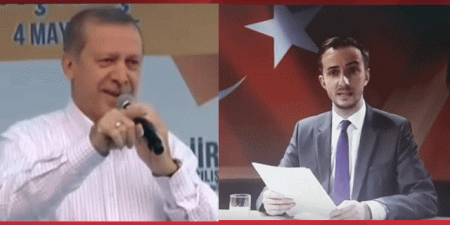
Erdogan-Jan-Bohmermann-HPTurkish President Recep Tayyip Erdogan (left) reads a poem about violent jihad in May, 2015, at a public opening ceremony in the province of Siirt. The Turkish government has called a satirical poem about Erdogan by German comedian Jan Bohmermann (right) a ‘serious crime against humanity.’

On March 8, the Turkish Minister of Finance Naci Agbal read verses from a poem titled Amentu (“I believe”) by Ismet Ozel. The verses recall the Turkish -Greek war in 1920s in Anatolia and refer to the Greeks as kafirs (infidels).

“The adhan (call to prayer) is no longer heard. The cross has been erected on minibars (mosque pulpit),

The kafir Greek has flown his flag on mosques, on everywhere

Then come, my brother, join our hands altogether

Let’s explode the bombs and silence the [church] bells everywhere.”

While the finance minister of Turkey, a country that fancies itself as a candidate for EU membership, read these verses during his speech at Turkey’s parliament, the Turkish prime minister, Ahmet Davutoglu, met with his Greek colleague, Alexis Tsipras, in Izmir and told him, “Let’s remove the word ‘war’ from our relations.”

Apparently, the poem which openly calls for “exploding the bombs and silencing the [church] bells everywhere” is perfectly fine according to Turkish-Islamic standards. No state authority or prosecutor has demanded the minister be brought to account for reading it.

At the same time, the satirical, obscene poem read by the German comedian, Jan Bohmermann, which was critical of Turkish President Recep Tayyip Erdogan, however, put the Turkish government in an extreme state of rage.

On March 31, Bohmermann “offered to illustrate impermissible ‘abusive criticism,’ saying, ‘You’re not allowed to do this,’ and read the poem on German TV. Besides its crude sexual references, the piece accused Erdogan of repressing minorities and mistreating Kurds and Christians,” reported Reuters.

If there were a normal government in Turkey ruled by somewhat democratic people, the poem by the German artist would never be a matter of such a frantic debate.

Some people would just laugh at it, others would be disturbed. Some would think it was an intriguing example of artistic expression; others would think it was done in poor taste. Wise ones in Turkey would probably try to learn lessons from it: “Why is that artist criticizing or even mocking us like that? Maybe we are at fault and we should change our ways.” All in all, the poem would probably be in the news for a few days, and then be mostly forgotten.

But above all, the artist would never be exposed to any criminal prosecution for reading a poem that contained profanity but that did not call for violence in any way, shape or form.

The Turkish government authorities could have as well ignored the poem and focused on the real problems of the country – including why the perpetrators who sell Yazidi women in the southeastern province of Gaziantep, Turkey were recently acquitted of any crime.

In December, 2015, the German NDR and SWR TV channels produced footage documenting the slave trade being conducted by the Islamic State (ISIS) through a liaison office in the province of Gaziantep in Turkey, near the border with Syria.

On April 17, 2016, the Turkish newspaper Hurriyet reported that the Gaziantep police department had raided the said office and found $310,000, many foreign (non-Turkish) passports and 1,768 pages of Arabic receipts that demonstrate the transfer of millions of dollars between Turkey and Syria.

Six people were brought to court for their involvement in crimes including “being members of an armed terrorist organization.” But the complainant, the Gaziantep Bar Association, was not even invited to attend the hearings that lasted for only 16 days.

“We learnt the ruling accidentally. The court made the decision of acquittal without looking into the documents found by police,” said Bektas Sarkli, the head of the Gaziantep Bar Association, adding that they will go for an appeal.

Apparently, in Turkey, selling Yazidi women and children is not a very big deal. The real “crime,” according to the Turkish government, is the poem of Bohmermann.

Numan Kurtulmus, the deputy Prime Minister of Turkey, and the spokesperson of the government, called the poem a “serious crime against humanity.”

The comedian, who now stands accused of “insulting a foreign leader,” a crime in Germany, could face jail time for reciting a satirical poem on German television. The “sensitive” Turkish government prefers to prosecute those who recite “offensive” poems, but not the ISIS members who sell Yazidi women and children.

Erdogan, too, made a complaint against Bohmermann as a private person on charges of “being insulted by the poem.”

Ironically, in 1999, Erdogan, then mayor of Istanbul, spent four months in jail after a conviction for religious incitement through a poem he publicly read. The poem by the pan-Turkic author Ziya Gokalp (1876 – 1924) had an overtly violent message:

“The mosques are our barracks, the domes our helmets, the minarets our bayonets and the faithful our soldiers.”

In July, 2011, Erdogan, who was then prime minister, read the same verses at Turkey’s parliament.

In May, 2015, at a public opening ceremony in the province of Siirt, President Erdogan read the poem once more (see video below) – this time together with his supporters.

The poem openly called for jihad – but according to the Islamic ideology, if violence will bring about the Islamization of the victims or their descendants, it is not criminal.

Many Islamists do not see jihad as a crime. For their scriptures openly command them “to chop off heads and fingers and kill infidels wherever they may be hiding.”

Historically and today, the expansionist Islamist raids against non-Muslim peoples are accompanied by mass murders, mass rapes, sex slavery, forced conversions, looting, plundering, mass deportations and so on.

Hence, what the rest of the world would describe as “genocide,” “massacre,” “terrorism” or “ethnic cleansing,” many Islamists describe as “righteous” ways of spreading Islam and of liberating “infidel” lands as well as a good deed (halal) that will open the “doors of Heaven.”

The problem in general seems to be that according to the Islamist mindset, anything inside Islamic scriptures or sharia law such as beating, raping, throat-slitting, beheading, crucifying or selling women as sex slaves is acceptable and not a crime.

But anything outside sharia such as Christmas, a satirical poem, a cartoon of Mohammad and free speech is a crime and must be dealt with by the full force of the law.

The key point is to see the enormous differences between the Islamist ideology — which aims for supremacism, global caliphate and death to or subjugation of non-Muslims — and Western civilization, which protects and even encourages intellectual dissent, free expression and human freedom.

Under German law, prosecutions for insulting a foreign leader can only take place with the express permission of the German government. Although there are currently attempts to pass a bill to abolish the law before Bohmermann’s case can come to court, the Merkel government decided to allow the prosecution to take place.

Sadly, Germany chose to disregard this gigantic civilizational difference and has taken a noxious step to kneeling down to the stealthy threats of Islamists.

Dutch Newspaper Publishes Front Page Cartoon Mocking Erdogan After The Arrest Of Dutch Journalist

April 26, 2016

Dutch Newspaper Publishes Front Page Cartoon Mocking Erdogan After The Arrest Of Dutch Journalist, Jonathan Turley’s Blog, Jonathan Turley, April 26, 2016

Netherlands cartoon

Erdogan (like Vladimir Putin) is the face of modern authoritarianism — promising prosperity in exchange for the dismantling of basic civil liberties. The question is whether the West will rally to the side of free speech in time to stop these leaders from returning the world to the age of criminalized speech and censorship.

***************************

As Western leaders like Angela Merkel cave into the authoritarian demands of Turkish President Recep Tayyip Erdogan in crushing free speech, journalists and cartoonists are fighting back. After a Dutch journalist was arrested in Turkey this weekend for allegedly insulting President Recep Tayyip Erdogan, the most-read newspaper in the Netherlands threw down the gauntlet and published a front-page editorial cartoon that shows Erdogan as an ape crushing Europe’s free speech. Since Erdogan demands the prosecution of journalists even outside of Turkey who insult him, the publication could force another confrontation with the aspiring dictator. In the meantime, the West (including the United States) continue to prop up Erdogan as he destroys secular government in Turkey, arrests journalists, and denies the most basic forms of free speech.

The cartoon, entitled “the long arm of Erdogan” was published by the populist daily De Telegraaf, has an ape with Erdogan’s face squashing a woman who appears to be Ebru Umar, the Dutch writer who was arrested in Turkey on Sunday. In the cartoon, the Turkish president is standing on a rock labeled “Apenrots” — a Dutch term meaning “monkey rocks” that is used to refer to the Dutch Foreign Ministry but can also refer to a place where one dominant individual holds power.

It will now to interesting to watch whether the government follows Merkel’s lead in profusely apologizing to Erdogan for the exercise of free speech and/or attempts to bring charges of some kind in the case. The problem for Western leaders who have been leading the rollback on free speech is that citizens are beginning to see the implications of the loss of this defining right for Western Civilization. We have previously discussed the alarming rollback on free speech rights in the West, particularly in France (here and here and here and here and here and here) and England ( here and here and here and here and here and here and here and here and here and here). Much of this trend is tied to the expansion of hate speech and non-discrimination laws. We have seen comedians targeted with such court orders under this expanding and worrisome trend. (here and here).

Erdogan (like Vladimir Putin) is the face of modern authoritarianism — promising prosperity in exchange for the dismantling of basic civil liberties. The question is whether the West will rally to the side of free speech in time to stop these leaders from returning the world to age of criminalized speech and censorship.

Turkey Blackmails Europe on Visa-Free Travel

April 24, 2016

Turkey Blackmails Europe on Visa-Free Travel, Gatestone InstituteSoeren Kern, April 24, 2016

♦ The European Union now finds itself in a classic catch-22 situation. Large numbers of Muslim migrants will flow to Europe regardless of whether or not the EU approves the visa waiver for Turkey.

♦ “If visa requirements are lifted completely, each of these persons could buy a cheap plane ticket to any German airport, utter the word ‘asylum,’ and trigger a years-long judicial process with a good chance of ending in a residency permit.” — German analyst Andrew Hammel.

♦ In their haste to stanch the rush of migrants, European officials effectively allowed Turkey to conflate the two very separate issues of a) uncontrolled migration into Europe and b) an end to visa restrictions for Turkish nationals.

♦ “Why should a peaceful, stable, prosperous country like Germany import from some remote corner of some faraway land a violent ethnic conflict which has nothing whatsoever to do with Germany and which 98% Germans do not understand or care about?” — German analyst Andrew Hammel.

♦ “Democracy, freedom and the rule of law…. For us, these words have absolutely no value any longer.” — Turkish President Recep Tayyip Erdogan.

Turkey has threatened to renege on a landmark deal to curb illegal migration to the European Union if the bloc fails to grant visa-free travel to Europe for Turkey’s 78 million citizens by the end of June.

If Ankara follows through on its threat, it would reopen the floodgates and allow potentially millions of migrants from Africa, Asia and the Middle East to flow from Turkey into the European Union.

Under the terms of the EU-Turkey deal, which entered into effect on March 20, Turkey agreed to take back migrants and refugees who illegally cross the Aegean Sea from Turkey to Greece. In exchange, the European Union agreed to resettle up to 72,000 Syrian refugees living in Turkey, and pledged up to 6 billion euros ($6.8 billion) in aid to Turkey during the next four years.

European officials also promised to restart Turkey’s stalled EU membership talks by the end of July 2016, and to fast-track visa-free access for Turkish nationals to the Schengen (open-bordered) passport-free zone by June 30.

1534Turkish President Recep Tayyip Erdogan (left) has boasted that he is proud of blackmailing EU leaders, including European Commission President Jean-Claude Juncker (right), into granting Turkish citizens visa-free access to the EU and paying Turkey billions of euros.

To qualify for the visa waiver, Turkey has until April 30 to meet 72 conditions. These include: bringing the security features of Turkish passports up to EU standards; sharing information on forged and fraudulent documents used to travel to the EU and granting work permits to non-Syrian migrants in Turkey.

The European Commission, the administrative arm of the European Union, said it would issue a report on May 4 on whether Turkey adequately has met all of the conditions to qualify for visa liberalization.

During a hearing at the European Parliament on April 21, Marta Cygan, a director in the Commission’s migration and home affairs unit, revealed that to date Ankara has satisfied only 35 of the 72 conditions. This implies that Turkey is unlikely to meet the other 37 conditions by the April 30 deadline, a window of fewer than ten days.

According to Turkish officials, however, Turkey is fulfilling all of its obligations under the EU deal and the onus rests on the European Union to approve visa liberalization — or else.

Addressing the Council of Europe in Strasbourg on April 19, Turkish Prime Minister Ahmet Davutoglu said that Turkey has now reduced the flow of migrants to Greece to an average of 60 a day, compared to several thousand a day at the height of the migrant crisis in late 2015. Davutoglu went on to say that this proves that Turkey has fulfilled its end of the deal and that Ankara will no longer honor the EU-Turkey deal if the bloc fails to deliver visa-free travel by June 30.

European Commission President Jean-Claude Juncker has insisted that Turkey must meet all 72 conditions for visa-free travel and that the EU will not water down its criteria. But European officials — under intense pressure to keep the migrant deal with Turkey alive — will be tempted to cede to Turkish demands.

EU Migration Commissioner Dimitris Avramopoulos on April 20 conceded that for the EU it is not a question of the number of conditions, but rather “how quickly the process is going on.” He added: “I believe that at the end, if we continue working like this, most of the benchmarks will be met.”

European officials alone are to blame for allowing themselves to be blackmailed in this way. In their haste to stanch the rush of migrants to Europe, they effectively allowed Turkey to conflate the two very separate issues of a) uncontrolled migration into Europe and b) an end to visa restrictions for Turkish nationals.

The original criteria for the visa waiver were established in December 2013 — more than two years before the EU-Turkey deal — by means of the so-called Visa Liberalization Dialogue and the accompanying Readmission Agreement. In it, Turkey agrees to take back third-country nationals who, after having transiting through Turkey, have entered the EU illegally.

By declaring that the visa waiver conditions are no longer binding because the flow of migrants to Greece has been reduced, Turkish officials, negotiating like merchants in Istanbul’s Grand Bazaar, are running circles around the hapless European officials.

Or, as Turkish President Recep Tayyip Erdogan recently proclaimed: “The European Union needs Turkey more than Turkey needs the European Union.”

The European Union now finds itself in a classic Catch-22 situation. Large numbers of Muslim migrants will flow to Europe regardless of whether or not the EU approves the visa waiver.

Critics of visa liberalization fear that millions of Turkish nationals may end up migrating to Europe. Indeed, many analysts believe that President Erdogan views the visa waiver as an opportunity to “export” Turkey’s “Kurdish Problem” to Germany.

Bavarian Finance Minister Markus Söder, for example, worries that due to Erdogan’s persecution of Kurds in Turkey, millions may take advantage of the visa waver to flee to Germany. “We are importing an internal Turkish conflict,” he warned, adding: “In the end, fewer migrants may arrive by boat, but more will arrive by airplane.”

In an insightful essay, German analyst Andrew Hammel writes:

“Let’s do the math. There are currently 16 million Turkish citizens of Kurdish descent in Turkey. There is a long history of discrimination by Turkish governments against this ethnic minority, including torture, forced displacement, and other repressive measures. The current conservative-nationalist Turkish government is fighting an open war against various Kurdish rebel groups, both inside and outside Turkey.

“This means that under German law as it is currently being applied by the ruling coalition in the real world (not German law on the books), there are probably something like 5-8 million Turkish Kurds who might have a plausible claim for asylum or subsidiary protection. That’s just a guess, the real number could be higher, but probably not much lower.

“If visa requirements are lifted completely, each of these persons could buy a cheap plane ticket to any German airport, utter the word ‘asylum,’ and trigger a years-long judicial process with a good chance of ending in a residency permit.”

Hammel continues:

“There are already 800,000 Kurds living in Germany. As migration researchers know, existing kin networks in a destination country massively increase the likelihood and scope of migration…. As Turkish Kurds are likely to arrive speaking no German and with limited job skills, just like current migrants, where is the extra 60-70 billion euros/year [10 billion euros/year for every one million migrants] going to come from to provide them all with housing, food, welfare, medical care, education and German courses?

And finally, “the most important, most fundamental, most urgent question of all”:

“Why should a peaceful, stable, prosperous country like Germany import from some remote corner of some faraway land a violent ethnic conflict which has nothing whatsoever to do with Germany and which 98% Germans do not understand or care about?”

Turkish-Kurdish violence is now commonplace in Germany, which is home to around three million people of Turkish origin — roughly one in four of whom are Kurds. German intelligence officials estimate that about 14,000 of these Kurds are active supporters of the Kurdistan Workers’ Party (PKK), a militant group that has been fighting for Kurdish independence since 1974.

On April 10, hundreds of Kurds and Turks clashed in Munich and dozens fought in Cologne. Also on April 10, four people were injured when Kurds and Turks fought in Frankfurt. On March 27, nearly 40 people were arrested after Kurds attacked a demonstration of around 600 Turkish protesters in the Bavarian town of Aschaffenburg.

On September 11, 2015, dozens of Kurds and Turks clashed in Bielefeld. On September 10, more than a thousand Kurds and Turks fought in Berlin. Also on September 10, several hundred Kurds and Turks fought in Frankfurt.

On September 3, more than 100 Kurds and Turks clashed in Remscheid. On August 17, Kurds attacked a Turkish mosque in Berlin-Kreuzberg. In October 2014, hundreds of Kurds and Turks clashed at the main train station in Munich.

In an essay for the Financial Times titled “The EU Sells Its Soul to Strike a Deal with Turkey,” columnist Wolfgang Münchau wrote:

“The deal with Turkey is as sordid as anything I have ever seen in modern European politics. On the day that EU leaders signed the deal, Recep Tayyip Erdogan, the Turkish president, gave the game away: ‘Democracy, freedom and the rule of law…. For us, these words have absolutely no value any longer.’ At that point the European Council should have ended the conversation with Ahmet Davutoglu, the Turkish prime minister, and sent him home. But instead, they made a deal with him — money and a lot more in return for help with the refugee crisis.”

Veiling Women: Islamists’ Most Powerful Weapon

April 20, 2016

Veiling Women: Islamists’ Most Powerful Weapon, Gatestone InstituteGiulio Meotti, April 20, 2016

♦ The first victim of the Islamist war in Algeria was a girl who refused the veil, Katia Bengana, who defended her choice even as the executioners pointed a gun at her head. In 1994, Algiers literally awoke to walls plastered with posters announcing the execution of unveiled women.

♦ In April 1947, Princess Lalla Aisha gave a speech in Tangiers and people listened astonished to that unveiled girl. In a few weeks, women throughout the country refused the scarf. Today Morocco is one of the freest countries in the Arab world.

♦ In the mid-1980s, sharia law was implemented in many countries, women in the Middle East were placed in a portable prison and in Europe they resumed the veil to reclaim their “identity,” which meant the refusal of assimilation to Western values and the Islamization of many European cities.

♦ First veils were imposed on women, then Islamists began their jihad against the West.

Laurence Rossignol, France’s Minister for the Family, Children and Women’s Rights, sparked a furor about the Islamic veil proliferating in her country, when she compared headscarved women to “American negroes who accepted slavery.” In addition, Elisabeth Badinter, one of France’s most famous feminists, even called for boycotting Europe’s fashion companies, such as Uniqlo and Dolce & Gabbana, which are developing Islamically correct clothes (in 2013, Muslims spent $266 billion dollars on clothing, and the figure could reach $484 billion by 2019).

A new trend is also emerging in Western popular culture, which was almost invisible in the media a decade ago: headscarved women are now also present in television programs such as MasterChef.

The mainstream culture now considers veiling women “normal.” Air France recently called on its female employees to wear veils while in Iran. The government of Italy recently veiled nude sculptures at Rome’s Capitoline Museum during a visit by Iran’s President Hassan Rouhani, out of “respect” for his sensibilities.

In the Arab-Islamic world, however, for a long time covered women were the exception.

It is hard to believe that, until the early 1990s, the majority of women in Algeria were not veiled. On May 13, 1958 at Place du Gouvernement in Algiers, dozens of women tore off their veils. Miniskirts invaded the streets.

Iran’s Revolution reversed this trend: the first scarf appeared at the beginning of the 1980s with the rise of the Islamic movements in Algeria’s universities and poor neighborhoods. The hijab was distributed by the Iranian Embassy in Algiers.

In 1990, Algeria was on the edge of a long season of death and fear: a civil war, with the specter of Islamist breakthrough (100,000 dead). People knew that something terrible was going to happen by counting the number of veils in the streets.

The first victim of the Islamist war in Algeria was a girl who refused the veil, Katia Bengana. She defended her choice even as the executioners pointed a gun at her head. In 1994, Algiers literally awoke to walls plastered with Islamist posters announcing the execution of unveiled women. Today, very few women dare to leave their house without a hijab or chador.

Look at the photographs of Kabul in the 1960s, 1970s and 1980s, and you will see many unveiled women. Then came the Taliban and covered them. The emancipation in Morocco was sparked by Princess Lalla Aisha, the daughter of Sultan Mohamed Ben Youssef, who took the title of king when the country proclaimed independence. In April 1947, Lalla gave a speech in Tangiers and people listened astonished to that unveiled girl. In a few weeks, women throughout the country refused the scarf. Today Morocco is one of the freest countries in the Arab world.

1558Look at the photographs of Kabul in the 1960s, 1970s and 1980s, and you will see many unveiled women. Then came the Taliban and covered them.

n Egypt, back in the 1950s, President Gamal Abdel Nasser took to television to mock the Muslim Brotherhood’s request to veil the women. His wife, Tahia, did not wear a scarf, even in official photographs. Today, according to the scholar Mona Abaza, 80% of Egyptian women are veiled. It was only in the 1990s that the strict Wahhabi version of Islam arrived in Egypt, through millions of Egyptians who went to work in Saudi Arabia and other Gulf countries. Meanwhile, Islamist political movements gained ground. Then Egyptian women began sporting the veil.

In Iran, the traditional black veil covering Iranian women from head to ankles, invaded the country under Ayatollah Khomeini. He asserted that the chador is the “banner of the revolution” and imposed it on all the women.

Fifty years earlier, in 1926, Reza Shah had provided police protection to women who had chosen to refuse the veil. On January 7, 1936, the Shah ordered all the teachers, the wives of ministers and government officials “to appear in European clothes.” The Shah asked his wife and daughters to go unveiled in public. These and other Western reforms were supported by Shah Muhammad Reza Pahlavi, who succeeded his father in September 1941, and instituted the ban on veiled women in public.

In Turkey, Mustafa Kemal Ataturk harangued female crowds, pushing them to set an example: taking off the veil meant hastening the necessary rapprochement between Turkey and Western civilization. For fifty years, Turkey refused the veil — until 1997, when the government headed by the Islamist Necmettin Erbakan abolished the ban on the veil in public places.

Turkey’s Erdogan used the veil to encourage the rampant Islamization of the society.

In contrast, Tunisia’s President, Habib Bourguiba, issued a circular banning the wearing of hijab in schools and public offices. He called the veil “odious rag,” and promoted his country as one of the most enlightened Arab nations.

It was not only the Muslim world that for a long time refused this symbol. Before the spread of radical Islam, the miniskirt, a symbol of Western culture, could also be seen all over the Middle East. There are many photographs to remind us of that long period: the unveiled stewardesses in skirts of the Afghan airline (what an irony that Air France today wants to veil them); the beauty contest that King Hussein of Jordan organized at Hotel Philadelphia; the Iraqi female football team; the Syrian female athlete Silvana Shaheen; the unveiled Libyan women marching in the streets; the female students at the Palestinian Birzeit University and the Egyptian girls on the beach (at that time, a burkini would have been rejected as a cage).

Then, in the mid-1980s, everything suddenly changed: Sharia law was implemented in many countries, women in the Middle East were placed in a portable prison, and in Europe they resumed the veil to reclaim their “identity,” which meant the refusal of assimilation to Western values and the Islamization of many European cities.

First veils were imposed on women, then Islamists began their jihad against the West.

First we betrayed these women by accepting their slavery as a “liberation,” then Air France started veiling women while in Iran as a form of “respect.” It is also revealing of the hypocrisy of most of Western feminists, who are always ready to denounce the “homophobic” Christians and “sexism” in the U.S., but keep silent about the sexual crimes of radical Islam. In the words of the feminist Rebecca Brink Vipond, “I won’t take the bait of a patronizing call for feminists to set aside their goals in America to address problems in Muslim theocracies.” These are the same feminists who abandoned Ayaan Hirsi Ali, the brave Dutch-Somali dissident from Islam, to her own defenses even after she found refuge in the U.S.: they prevented her from speaking at Brandeis University.

For how long we will maintain our ban on female genital mutilation (FGM)? A study just published in the U.S. suggests that allowing some “milder” forms of female mutilation, which affect 200 million women in the world, is more “culturally sensitive” than a ban on the practice, and that a ritual “nick” of girls’ vaginas could prevent a more radical disfiguring practice. The proposal didn’t come from Tariq Ramadan or an Islamic court in Sudan, but from two American gynecologists, Kavita Shah Arora and Allan J. Jacobs, who published the study in one of the most important scientific journals, the Journal of Medical Ethics.

It is a testament to the depths that can be reached in what the French “new philosopher,” Pascal Bruckner, called “the tears of White men” with their masochism, cowardice and cynical relativism. Why not also justify the Islamic stoning of women who are said to commit adultery? It is as if we cannot capitulate quickly enough.

Turkey Builds Mega-Mosque in U.S., Blocks Churches in Turkey

April 18, 2016

Turkey Builds Mega-Mosque in U.S., Blocks Churches in Turkey, Gatestone Institute, Uzay Bulut, April 18, 2016

(Please see also, The loss of Jewish rights on the Temple Mount – cause and effect. — DM)

♦ As yet another enormous mosque has opened in the U.S. (funded by the Turkish government), Christians in Turkey are waiting for the day when Turkish state authorities will allow them freely to build or use their churches and safely pray inside them.

♦ In Turkey, some churches have been converted to stables or used as storehouses. Others have been completely destroyed. Sales of churches on the internet are a common practice.

♦ Meanwhile, Turkish President Erdogan said during the opening ceremony of the Maryland mosque that the center was important at a time of an “unfortunate rise in intolerance towards Muslims in the United States and the world.”

♦ How would Muslims feel if mosques in Mecca were put up for sale on the internet, turned into stables, or razed to the ground? How would they feel if a Muslim child were beaten in the classroom by his teacher for not saying “Jesus is my Lord and Savior?” How would they feel if they continually received violent threats or insults for just attempting peacefully to worship in their mosques?

On April 2, a gigantic Ottoman style of mosque was opened in Lanham, Maryland by the president of Turkey, Recep Tayyip Erdogan. The mosque, according to Turkish officials, is “one of the largest Turkish mosques built outside Turkey.”

Funds to build it, as reported by the Turkish pro-government newspaper, Sabah, came from Turkey’s state-run Presidency of Religious Affairs, known as the Diyanet, as well as Turkish-American non-profit organizations.

The mosque is actually part of a larger complex, commonly referred to as “Maryland kulliye.” Akulliye, as such Islamic compounds were called in Ottoman times, is a complex of buildings, centered on a mosque and composed of various facilities including a madrassa (Islamic religious school).

Erdogan recited verses from the Quran inside the mosque after the mosque was opened.

Meanwhile, thousands of miles away from the American soil, in Turkey, Christians have for decades been deprived of the right to build their places of worship.

The 2015 report by Turkey’s Association of Protestant Churches revealed many violent, repressive and discriminatory practices against Protestant Christians in Turkey. According to the report, hate crimes, physical and verbal assaults as well as threats against Protestant Christians were commonplace in 2015 — as in previous years.[1]

“No development with regard to uncovering the perpetrators of these actions has occurred despite making known the content of the threats, the telephone numbers, email addresses, Facebook profiles and YouTube links of those making the threats in an official complaint,” according to the report.

Christians also experience many problems in the compulsory “religion and ethics” classes, which are mostly about indoctrinating schoolchildren in the teachings of Islam. An obligatory declaration of faith is one of the more serious problems facing Christians.

“The section for religious affiliation on the identity cards forces people to declare their faith and increases the risk of facing discrimination in every arena of life,” said the report. “For example, those who want to be exempt from mandatory religious instruction do not have the right to leave the religion line blank because they have to prove they are Christian in order for their children to be exempt from religion classes.”

Eleven-year-old Huseyin Bayram, for instance, a student at a primary school in Diyarbakir, converted to Protestant Christianity with his family in 2008. But because he was still officially registered as a Muslim, he had to take the compulsory Islamic class at school.

In 2010, Huseyin’s family lodged a complaint against the teacher of their child’s mandatory Islamic religious class, stating that the teacher slapped the child in the classroom.

Huseyin said that the teacher had asked the entire class to say the Islamic shahada (“There is no god but Allah. Muhammad is the messenger of Allah) three times; he did not do so. When the teacher asked him why, he said: “Sir, I go to the church. I do not know shahada and I do not want to learn it.”

The teacher, however, rejected the claims of beating: “I did not know the child was a Christian. I asked him the question that I ask to everyone.”

Like all other cities in present-day Turkey, Diyarbakir — called Dikranagerd or Dikrisagerd by the Armenian community — has a long history of Christianity.

After the division of the Roman Empire, Anatolia — from the Greek word “Anatole” meaning “east” or “sunrise” — became part of the Byzantine Empire. By the fourth century CE, Western and central Anatolia were overwhelmingly Christian and the inhabitants predominantly spoke Greek. A magnificent Christian civilization was established throughout centuries — until the territory was invaded first by the Seljuk Turks and later by the Ottoman Empire.

The year 1915 marked the peak of the Christian genocide, in Diyarbakir as well. “Most of the Armenians living inside the city were trapped,” wrote the Reverend Dr. George A. Leylegian, “and neighborhood by neighborhood, the Ottomans pillaged property and killed the helpless Dikranagerdtsis with nearly full-proof [sic] entrapment. The gendarmes sealed off each street and then raided the houses without reproach.”

Being a candidate for the European Union has not changed Turkey’s attitude towards churches and Christians.

This March, many places in Diyarbakir — including the Surp Giragos Armenian Apostolic and the Armenian Catholic churches — were expropriated by the Turkish government, as well as the Surp Sarkis Chaldean Church, the Virgin Mary Ancient Assyrian Church, and the city’s Protestant church.

Protestant Christians still experience serious problems establishing places of worship.

“Applications for opening a place of worship are rejected or left in a never-ending bureaucratic process. Previous applications that received either no response or a negative response are a clear indication of this situation…

“Apart from some exceptions, Christian congregations are prevented from using historical church buildings for Sunday services or holiday celebrations; these buildings are held by government institutions and are used for purposes other than church services.”

The Istanbul Protestant Church, for instance, officially requested that the Meryem Ana (Mother Mary) Church — in the hands of the city of Kayseri and used in the past as a sports center — be assigned to Christians living in Kayseri to meet their needs for a place of worship.

“No written response to this request has been given. However, in meetings with city officials, it was indicated unofficially that the church would be turned into a mosque or used as a museum. The church continued its efforts on this issue in 2015.”

1553The Istanbul Protestant Church officially requested last year that local Christians be allowed to worship in the Meryem Ana (Mother Mary) Church — in the hands of the city of Kayseri and used in the past as a sports center. City officials indicated that the church would instead be turned into a mosque or used as a museum.

The city of Caesarea, today called Kayseri, was where Saint Krikor Lusavoric — or Saint Gregory the Illuminator (A.D 257-331), the patron saint and first official head of the Armenian Apostolic Church — was raised and adopted Christianity as his religion.

King Tiridates III of Armenia, under leadership of Saint Gregory, proclaimed Christianity the state’s official religion in 301. Armenia thus became the first nation to adopt Christianity as its official religion.

“If Mecca is considered to be sacred for Muslims,” according to the website of Foundation of Kayseri Surp Krikor Lusavoriç Armenian Church, “Kayseri is the same for Armenians being the first city where Christianity was adopted.”

“Kayseri had a robust Armenian presence up until the 1970’s,” wrote the author Aris Nalci. “Today, there are no active Armenian churches in the city, except for the Krikor Lusavorich Church located in the city center. “In 1915, there were more than 50,000 Armenians living in this large trade city; in 1965, it is said that 130 families still remained. Now, however, there are only a few Armenians left.”

Today, the last traces of Christianity in Kayseri are about to be extinguished.

The Agape Church Association in the city of Ordu also recently applied to Turkish state authorities to be able to use the historic Tasbasi Orthodox Church as its church. The provincial director of culture and tourism affairs rejected the application, saying that “the church will be used as an archeology museum.”

Ordu, or Kotyora in Greek, was an ancient Greek town in the northern region of Anatolia historically known as Pontus (which means “sea” in Greek).

Throughout centuries, Christians thrived in the city — until the Islamic invasion of the region. The Christian inhabitants of Ordu were also victims of the Greek and Armenian genocides perpetrated by Muslim Turks between 1913 and 1923.

“There are stories,” wrote the historian Sam Topalidis, “of Armenians from Ordu being huddled into boats only to be later thrown overboard into the Black Sea to drown.”

After deportations, mass murders, death marches, rapes and other atrocities — as well as the 1923 forcible population exchange between Greece and Turkey — Ordu has almost become devoid of its Christian population, as have all other Anatolian cities.

“Similar experiences over many years have rooted the belief in the Protestant community that the legal procedures to establish or build a church are practically impossible to meet and that this right only exists on paper,” reported the Association of Protestant Churches.

Sales of churches on the internet are a common practice.

The Assyrian Mor (Saint) Yuhanna church in the province of Mardin and the historic Saint John Greek church in Bursa were put up for sale by title owners in June, 2015.

In January, 2016, another historic Greek church in the province of Kayseri was offered for sale on the internet.

On February, 2016, a 300-year-old Armenian Catholic Church in the province of Bursa was listed on an internet shopping site by a real estate agent. Its price was 1.5 million dollars.

Giving the titles of churches to private individuals was one of the policies of the Armenian genocide, said the researcher Nevzat Onaran.

“In 1915, the lives and right to property of Armenians were destroyed. The churches put up on sale today are a declaration of the fact that the process of devastation that the [Ottoman Turkish] Committee of Union and Progress government started in 1915 is still going on.”

This policy has targeted not only Armenians, but all other non-Muslim peoples in Anatolia.

Some churches have been converted to stables or used as storehouses. Others have been completely destroyed.

As Muslims in the United States have built yet another enormous mosque with Turkey’s help, Christians in Turkey are waiting for the day when Turkish state authorities will allow them freely to build or use their churches and safely pray inside them.

In the meantime, Turkish President Erdogan said during the opening ceremony of the Maryland mosque that the center was important at a time of an “unfortunate rise in intolerance towards Muslims in the United States and the world.”

Christians in Turkey have been going through not only the most intense feelings of intolerance and hatred, but also unending attacks and even murders. The Christian culture and civilization in Anatolia is on the way to total annihilation.

“Particulars gleaned from studying earlier centuries help us as Westerners to perceive the unique relationship between the religion and politics and, hopefully, to understand its modern-day manifestations better,” wrote the scholar Judy Henzel.

Today Cappadocian Greek in Turkey is a dead language. Many local languages of indigenous Christians — including Pontic Greek, Western Armenian, Suret (Assyrian Neo-Aramaic), Turoyo (Western Assyrian), and Hertevin (Eastern Aramaic) — are on the verge of extinction. It is not only places of worship that are destroyed or left to devastation in Turkey, it is an entire civilization to which the West owes so much.

In that, not only the aggression of Muslim authorities, but also the apathy of many Muslim locals have played a large part.

How would Muslims feel if their mosques in Mecca were put up for sale on the internet? Or turned into stables? Or razed to the ground? How would they feel if a Muslim child were beaten in the classroom by his teacher for not saying “Jesus is my Lord and Savior?”

How would Muslims feel if they continually received violent threats or insults for just attempting peacefully to worship in their mosques? Or if they were always to live in fear of violence? Or if they were systematically treated as if they were second-class citizens — in their indigenous lands where their ancestors once ruled?

As these issues are not discussed in Muslim countries, similar crimes are committed repeatedly — day in and day out. Apparently, one of the most obvious changes that political Islam causes in one’s psyche is the loss of empathy.

Before Muslim political or religious leaders lecture the world about the non-existent threat of “Islamophobia” or “intolerance against Muslims” in the West, they might take moral responsibility and address the real abuses against Christians in their home countries, including the intense Christian- and Jew-hatred, and the actual Christian genocide — both physical and cultural — that is happening across the Muslim world.

_____________________

[1] Protestant Christians, like other Christian denominations in Turkey, do not enjoy the right to freely share their faith with people, or train their religious leaders. Protestant communities specifically do not have the right to organize as congregations, because they are not recognized as legal entities. The report gives detailed information about all of these daily discriminatory actions against Protestant Christians.

Merkel Offers Erdoğan The Head of German Comedian In Final Surrender Of Free Speech

April 18, 2016

Merkel Offers Erdoğan The Head of German Comedian In Final Surrender Of Free Speech, Jonathan Turley’s Blog, Jonathan Turley, April 18, 2016

(Another loss for western civilization and another win for the Islamists and the functional equivalent of Sharia law. — DM)

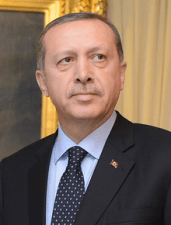
220px-recep_tayyip_erdogan (1)


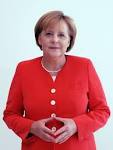
angela-merkel

Chancellor Angela Merkel’s decision to first apologize to authoritarian Turkish President Recep Tayyip Erdoğan for a satirical poem and then approve the prosecution of the comedian is a shocking and chilling disgrace. Merkel, who hails from the former Communist East Germany, has never been a reliable ally to free speech but the crackdown on comedian Jan Boehmermann has shocked the West. Even with the recent rollback of free speech rights in Europe, Merkel’s actions (and the cringing response of ZDF television) has been wake up call for all civil libertarians.

Under German law, Chancellor Angela Merkel’s government had to approve a criminal inquiry. While she said that her government would move to repeal the controversial and little-used Article 103 of the penal code, which concerns insults against foreign heads of state, this would not happen until 2018. The provision (dating back to 1871) on defamation of organs and representatives of foreign states, states:

(1) Whosoever insults a foreign head of state, or, with respect to his position, a member of a foreign government who is in Germany in his official capacity, or a head of a foreign diplomatic mission who is accredited in the Federal territory shall be liable to imprisonment not exceeding three years or a fine, in case of a slanderous insult to imprisonment from three months to five years.

It is a ridiculous law that denies the very essence of free speech. Yet it was used successfully by Shah of Persia against a Cologne newspaper in 1964. It was also sued by hen-Swiss President, Micheline Calmy-Rey to prosecution a Swiss man living in Bavaria after he posted offensive comments Calmy-Rey, on the internet. Despite these outrageous cases, Germany has retained the law.

Moreover, Merkel’s fawning apology to Erdoğan, one of the world’s rising totalitarians, was widely viewed as the final capitulation of Western leaders to the calls for greater censorship and speech regulation.

We have seen the erosion of liberties in Turkey after the election of President Recep Tayyip Erdoğan and his coalition of Islamic parties. Just last month, we discussed the arrest of Mehmet Emin Altunses, 16, who allegedly committed the crime of “insulting” Erdoğan. calling people who use birth control “traitors” and saying Muslims discovered America, you are not allowed to be disrespectful or insulting in discussing Erdoğan. Then there was the prosecution of model and former Miss Turkey Merve Buyuksarac, 26, for criticizing Erdogan for quoting a few lines from a poem called the “Master’s Poem” from weekly Turkish satirical magazine Uykusuz. Erdoğan’s totalitarian measures have earned him the nickname “Buyuk Usta” (the Big Master). Even a joking reference to Gollum and Erdoğan is enough to land you in jail today in Turkey.

Böhmermann will now have to prove that his poem was satire about free speech, rather than a deliberate insult — a bizarre standard since satire is often insulting and insults are part of free speech, particularly with regard to political leaders.

Merkel recently denounced the poem was “deliberately offensive” and ZDF television abandoned both free speech and its presenter in pulling Böhmermann’s weekly satire programme last week.

Despite her public apology and statement, Merkel insisted “The presumption of innocence applies” to Boehmermann.

For his part, Böhmermann used humor to respond to his own government’s persecution and told fans he planned to spend his break studying “freedom of the press and freedom of art in greater detail while traveling through North Korea.” He said that his decision to take a break was intended to allow “the public and the Internet can return to focusing on the important things in life, like the refugee crisis (and) cat videos.”

Merkel needs Turkey to take back refugees and has added $6 billion in aid to her sacrifice of free speech to keep Erdoğan happy.

It is important to note that Merkel is not alone in abandoning free speech. Despite its effort to spin the scandal, ZDF, the German network that airs Neo Magazine Royale, showed no courage or principle in taking the offending poem off the web. It then tried to maintain that it “respects” Böhmermann and will support him in any legal defense against the Turkish government.

We have previously discussed the alarming rollback on free speech rights in the West, particularly in France (here and here and here and here and here and here) and England (here and here and here and here and here and here and here and here and here and here). Much of this trend is tied to the expansion of hate speech and non-discrimination laws. We have seen comedians targeted with such court orders under this expanding and worrisome trend. (here and here).

Merkel has plunged Germany into this rising sea of censorship and criminalized speech. Fortunately, polls show Germans are opposed to her and this appeasement of Erdogan. Perhaps the case will serve to focus Germans and Europeans in general on the diminishing protections for free speech in the West. If nothing else, the attempt to imprison a comedian for insulting an authoritarian leader should capture the dire status of free speech in Europe.

Israel, Turkey, Russia and Egypt

April 17, 2016

Israel, Turkey, Russia and Egypt, Gatestone InstituteShoshana Bryen, April 17, 2016

(A blast from the past:

— DM)

♦ In 2011, the UN Palmer Commission Report found the blockade of Gaza — jointly administered with Egypt — to be legal, and said Israel owed Turkey neither an apology nor compensation.

♦ Lifting the Israel/Egypt embargo on Gaza would empower Hamas, and thereby the Muslim Brotherhood, Iran and ISIS — which would seem an enormous risk for no gain.

Turkish sources assert that Turkish-Israeli governmental relations are about to come out of the deep freeze. But this is a reflection of Turkey’s regional unpopularity and glides over Turkish demands for Israel to end the blockade of Gaza. To meet Turkey’s condition, Israel would have to abandon the security arrangement it shares with Egypt — which has increased Israel’s security and has begun to pay regional dividends. To restore full relations between Israel and Turkey would irritate Russia, with which Israel has good trade and political relations, and a respectful series of understandings regarding Syria. Israel’s relations with the Kurds are also at issue here.

After the 2010 Mavi Marmara flotilla — in which Turkey supported the Hamas-related Turkish organization, the IHH, in its effort to break the blockade of Gaza — Turkey made three demands of Israel: an Israeli apology for the deaths of Turkish activists; a financial settlement; and lifting the Gaza blockade, which Turkey claimed was illegal. The last would provide IHH with the victory it was unable to achieve with the flotilla.

1080 (1)The Turkish-owned ship Mavi Marmara took part in a 2010 “Gaza flotilla” attempting to break Israel’s naval blockade of Gaza, which is in place to prevent the terrorist group Hamas from bringing arms into Gaza. (Image source: “Free Gaza movement”/Flickr)

In 2011, however, the UN Palmer Commission Report found the blockade of Gaza — jointly administered with Egypt — to be legal, and said Israel owed Turkey neither an apology nor compensation. In 2013, at the urging of President Obama and to move the conversation off the impasse, Prime Minister Netanyahu did apologize for the loss of life and agree to discuss compensation. While President Obama was pleased, Prime Minister Erdogan repaid the gesture by denigrating Israel on Turkish television and announcing he would force the end of the blockade. Israel’s condition — that the office of Hamas in Ankara be closed — was ignored.

Nevertheless, in February 2014, Turkish Foreign Minister Ahmet Davutoglu told Turkish television that Israel and Turkey were “closer than ever” to normalizing relations.” In December 2015, it was more of the same. And in February 2016, there was yet another announcement of imminent restoration of government-to-government ties. In March, Kurdish sources said Turkey was demanding weapons from Israel, but that Israel wanted to ensure that Turkey would not use them against Kurdish forces.

Israel finds itself in an odd position — choosing among those who want its cooperation.

Israel and Egypt have come to a deep understanding of the sources of instability and insecurity in Sinai, and the relationship between Hamas in Gaza and its primary sponsor, Iran, as well as ISIS. Former IDF Chief of Staff Benny Gantz told inFOCUS magazine recently:

Coordination between us is very high and very important because we have identical interests. Period. The way to achieve them might look different, but Egypt is a very important country. It is crucial to the world to ensure its stability – progress in the fight against ISIS that is present in Sinai, and protecting the Suez Canal, and other things… They are all good reasons for Egypt to take these responsibilities seriously and do something about the threats. I’m very happy to see what they’re doing. It is a good track.

This month, Egypt and Saudi Arabia upgraded relations with Egypt, ceding back to the Saudis two islands that Saudi Arabia had given Egypt in 1950 to help Egypt fight Israel in the Red Sea. According to a report in the Egyptian daily al-Ahram, as reported by the Jerusalem Post, the Egyptian government informed Israel of the parameters of the deal, noting that Riyadh would be obligated to honor all of Egypt’s commitments in the peace treaty with Israel, including the presence of international peacekeepers on the islands and freedom of maritime movement in the Gulf of Aqaba. Israel approved the deal “on condition that the Saudis fill in the Egyptians’ shoes in the military appendix of the peace agreement,” according to Defense Minister Moshe Yaalon.

This makes Saudi Arabia an active partner in the Camp David Accords. And it follows on the heels of the Gulf Cooperation Council (GCC) labeling Hezbollah “a terror organization” without the weasel words the Europeans used to condemn only the “military wing” of the organization.

In the face of these developments, it is hard to imagine a benefit that would accrue to Israel by negating the Israel-Egypt blockade of Gaza on behalf of Turkey.

Russia presents a similar series of circumstances. Relations between Russia and Turkey have taken a nosedive over the Syrian civil war, particularly after Turkey shot down a Russian plane. But even before that, Turkey’s support of Sunni jihadist organizations was a thorn in the side of Russia, which still fears Sunni jihad inside southern Russia.

Russia has goals in Syria and Israel also has requirements. In his inFOCUS interview, former Chief of Staff Gantz noted:

The [Israeli] Prime Minister and Chief of Staff [Gantz’s successor] flew to Russia and had some important of discussions of intentions, deconfliction, and we expressed our interests… stability, preventing terrorist activity… preventing armament that will go from Iran through Syria to Hezbollah, or from Russia to Syria and then to Hezbollah…. People can see what it is that Israel does once in a while when it has to protect itself.

Add to this Israel’s generally good economic and political relations with Russia and, again, it is hard to see the benefit that would accrue to Israel by forging closer relations with Turkey while Russia and Turkey are doing a slow burn.

Turkey is doing a faster burn on the Kurds. Having waged a fierce war against Kurdish separatists in southern Turkey, the Turkish government has taken military action against the Kurds of Iraq and Syria to prevent Kurdish forces from connecting two enclaves — one in Iraq and one in Syria — that could form the geographic beginning of an independent Kurdistan.

Even at the peak of Israeli-Turkish relations, Israel’s support of the Kurds has been a relatively open political secret. Although the Israeli government consistently denies providing weapons, reputable sources suggest, at a minimum, training for Kurdish forces. Most recently, Israel acknowledged buying oil from Kurdish sources in Northern Iraq, and IsraAid, an Israeli humanitarian organization, provided assistance to Kurdish refugees fleeing ISIS. Prime Minister Netanyahu has publicly supported the establishment of a Kurdish state.

For Israel to trade its increasingly important relations with Russia, with Egypt — and thereby with Saudi Arabia — and with the Kurds for Turkish political approval and a promise to buy Israeli natural gas would seem to be a bad deal. For Israel to accompany that with the lifting of the Israel/Egypt embargo on Gaza that would empower Hamas — and thereby the Muslim Brotherhood, Iran and ISIS — would seem an enormous risk for no gain.

Frank Gaffney: Erdogan Transformed Turkey into an ‘Islamist Police State’ That Is No Longer a ‘Reliable NATO Ally’

April 15, 2016

Frank Gaffney: Erdogan Transformed Turkey into an ‘Islamist Police State’ That Is No Longer a ‘Reliable NATO Ally,’ Breitbart, John Hayward, April 15, 2016

Erdogan Breitbart

Center for Security Policy founder and Sen. Ted Cruz (R-TX) foreign-policy adviser Frank Gaffney joined host Stephen K. Bannon on Breitbart News Daily Friday morning to talk about the recent proclamation of “Islamic unity” from Turkish President Recep Tayyip Erdogan, whose country will now assume the chairmanship of the Organization of Islamic Cooperation (OIC) for two years.

Gaffney argued that Erdogan’s statement was actually an example of taqqiya, the Muslim practice of lying for the greater good of the faith, and Erdogan’s true agenda was Islamic supremacism.

“I think what he’s trying to tell us is different from what he’s trying to tell his own people,” Gaffney said of Erdogan’s proclamation. “He’s telling us that he’s all about solidarity, and tolerance, and ecumenicalism, and we all need to pull together, and so on.”

“But the main message he’s been sending to his own people, for something like 13 years now, is Islamic supremacism,” Gaffney continued. “It has nothing to do with [singing] ‘Kumbaya’ with infidels. It is about forcing them to submit, in the classic tradition of sharia.”

He described Erdogan as “Muslim Brotherhood old Islamist who believes, at the end of the day, that he is going to be the new Caliph.”

“He is going to create a neo-Ottoman Empire. And anything that is communicated to the West – in various international fora, or through proclamations, or through other means – is what is known, in the traditions of sharia, as taqqiya – that is, essentially, lying for the Faith. And I think this should be discounted as such,” said Gaffney.

Gaffney explained that it’s not just permitted, but “obligatory,” for followers of the Islamic supremacist doctrine to “dissemble, to deceive the unbeliever, and to use deception as Mohammed did – the perfect Muslim – to triumph over the infidel, and to successfully create conditions under which they will be effectively enslaved, or reduced to a dhimmi status.”

He thought the Turkish president’s carefully crafted message would play well to Western media and government, which are suffused with the endless hope that “there’s a degree of moderation on the part of people like Erdogan, or others in the Muslim Brotherhood movement – the global jihad movement, for that matter.”

“It just ain’t so,” Gaffney argued. “This is a guy who has transformed his country, let’s be clear, from a secular democratic nation – a Muslim one to be sure, but definitely in the secular tradition of Ataturk – into what is now an Islamist police state.”

“Particularly people in the press, who are trying to portray this in the most rose-colored glass mode, should understand what he’s doing to the press in Turkey,” Gaffney stressed. “He’s crushing it, unless it bends to his will.”

He noted that Erdogan is famous for having said “Democracy is like a bus – you take it to your destination, and then you get off.”

“He’s long since gotten off, internally,” Gaffney warned. “We should be under no illusion: he is not aligned with us. He is aligned with the Islamists around the world – with Iran, with China, with Hamas of course. This is a guy who is no longer, in his country, a reliable NATO ally. And that’s the unvarnished and unhappy truth.”

Breitbart News Daily airs on SiriusXM Patriot 125 weekdays from 6:00AM to 9:00AM EST.


Op-Ed: Merkel submits to Erdogan on freedom of expression

April 15, 2016

Op-Ed: Merkel submits to Erdogan on freedom of expression, Israel National News, Giulio Meotti, April 15, 2016

Germany has not tested its freedom of expression so deeply since the saga of Mozart’s Idomeneo in 2006 when the Deutsche Oper Company canceled the opera because there was the severed head of Muhammad in it and that could offend the largest Islamic community in Europe. The director, Hans Neuenfels, then asked: “Where will it all end if we allow ourselves to be artistically blackmailed?”.

The answer came this week with the case of Jan Böhmermann, the famous comedian who mocked Turkish president Recep Erdogan. “What I’m going to read is not allowed” said Böhmermann on ZDF, the German public network. His poetry routine suggests that Erdogan watches child porn movies while he enjoys “repressing minorities and beating up Christians”.

The prosecutor of Mainz, in the Rhineland-Palatinate, received more than twenty complaints from private citizens which forced him to open a case against Böhmermann under paragraph 103 of the Penal Code, which provides three years of imprisonment for insulting a foreign head of state. Chancellor Angela Merkel has condemned the poem, calling it a “deliberate insult” and wanted to phone Turkey’s Prime Minister Ahmet Davutoglu to appease the wrath of Ankara.

Then came Erdogan’s personal complaint against Böhmermann who, according to Deputy Prime Minister Numan Kurtulmus, committed a “grave crime against humanity” and “offended 78 million Turks”, no less. The case could go to the Constitutional Court in Karlsruhe. Not satisfied with imprisoning Turkish journalists, President Erdogan wants to imprison Germans as well.

Three weeks ago, another German video sparked Turkish protests. Meanwhile, the ZDF removed the video of Jan Böhmermann, even before the Turkish protests. If Merkel has sided with the Turks, the German press is united around Böhmermann.

Mathias Döpfner, the editor of the Springer publishing giant, defended the comedian and criticized Merkel, although Döpfner is her supporter: “As written by Michel Houellebecq in his masterpiece on the self-sacrifice of the West: Submission.” Demonstrations were held under the offices of the ZDF in Turkey. Former Finance Minister of Greece, Yanis Varoufakis, commented: “Europe first lost its soul, then lost its sense of humor”.

“Böhmermann is not very brave and this story is bigger than he is” said Henryk Broder, born in 1946 in Katowice, Poland, and today one of the most popular writers of Germany who writes for Die Welt and Bild Zeitung, in an interview with me. “He didn’t show up to withdraw the Grimm Award. I would have been there to say these people: ‘F*** you’”. The German Max Mauff actor was presented at the ceremony with a picture of Böhmermann and the word “missing”.

“Böhmermann behaved like a dhimmi, but we must show solidarity” – continues Broder – “This is a case of governmental interference in the freedom of expression. We face the contradictory policy of Angela Merkel, who said is said in favor of freedom of expression but then takes action against it.

“When the book by Thilo Sarrazin ‘Germany abolishes itself’ appeared in 2010, it was disqualified by Merkel as ‘defamatory’ and ‘not useful’. There is no such thing as ‘good’ and ‘bad’ satire. In communist East Germany it was the party who was left to decide what should be published and this is in Merkel’s DNA, she is a daughter of Eastern Germany.  At that time they called it ‘socialization’. Merkel wants Erdogan to do the dirty work for her on migrants, so she doesn’t want a comedian to spoil relations with Turkey”.

In Turkey, Article 299 of the Criminal Code provides four years in prison for those who insult the President (Can Dündar and Erdem Gül, director and editor in chief of Cumhuriyet, now face a trial). Yesterday Deutsche Welle explained that there are 2,000 pending legal cases involving defamation of Erdogan. The defendants are artists, journalists, academics and cartoonists. The same punishment is now evoked in Germany against a comedian.

The cultural-geographical border of Europe has always been drawn on the Bosphorus and not on the Turkish border. Böhmermann’s case moved that border nearer to Ankara.

Turkey’s Circus in Washington

April 12, 2016

Turkey’s Circus in Washington, Gatestone InstituteBurak Bekdil, April 12, 2016

(Please see also, Germany Moves To Remove Anti-Erdogan Poem And Merkel Calls Turkey To Apologize. — DM)

♦ During his visit to Washington, Turkish President Recep Tayyip Erdogan’s security guards harassed and physically assaulted journalists trying to cover the event; they also forcibly attempted to remove several journalists, although they were on the guest list.

♦ An American reporter attempting to film the harassment received a kick in the chest.

♦ Against this backdrop, Erdogan kept on adding to his own ridicule. “I am not at war with the press,” he said in an interview with CNN International. Then he went on: “We have never done anything to stop freedom of expression or freedom of press.

Turkish President Recep Tayyip Erdogan’s increasing Third-Worldish authoritarianism is taking new turns: it is now visible outside Turkey.

At the same time as Erdogan was heading for Washington for a nuclear security summit, the two journalists who he asserted last year “will pay a heavy price” had to stand trial at a second hearing on charges of espionage and terrorism, and with life sentences hanging over their heads. Their “espionage and terrorism” activity concerned a story they ran in May 2015 detailing how Turkish intelligence was transporting weapons to Islamist fighters in Syria.

“This is a tug of war between Turkish democrats and autocrats,” Can Dundar, one of the “spy/terrorists” told The Wall Street Journal. “The Western world has been supporting Erdogan for years and we were telling them that this was the wrong decision, not only for Turkey, but also for the Western world.”

The case had already turned into a diplomatic row between Turkey and a number of European Union nations, after Erdogan lashed out at the foreign consuls-general who attended the first court hearing in a show of solidarity with the journalists.

Meanwhile, Turkish paranoia around insane claims that the entire world has joined hands to conspire against Turkey’s supreme leader appeared once again. Senior government officials have been slamming Twitter, and claiming it “censored” a hashtag created for Erdogan by removing #WeLoveErdogan from its top trending tweets.

“I’m asking Twitter officials: Who instructed you to remove the #WeLoveErdogan hashtag? Was it a country, a person, a terrorist organization, or someone else?” Justice Minister Bekir Bozdag told reporters just a day before Erdogan arrived in Washington. “I am of the opinion that this is one part of a global operation conducted against our president.”

Apparently, Twitter is not the only conspirator against the Turkish leader. Turkey’s foreign ministry summoned the German ambassador and asked him to remove from the internet a German satire program poking fun at Erdogan, thus causing a diplomatic dust-up with Germany.

The Germans, as every free country would, refused to censor the satire. Ironically, of course, Erdogan’s attempt at censorship spurred a huge surge of online interest in the video, which by March 31 had attracted more than four million views — ten times the program’s usual audience. Once again, Erdogan’s repressive manners turned into self-ridicule.

Then came the Turkish circus in Washington. On March 31, Erdogan was scheduled to speak at the Brookings Institution. His security guards harassed and physically assaulted journalists trying to cover the event; they also forcibly attempted to remove several journalists, although they were on the guest list. According to Reporters Without Borders (RSF), the Brookings staff prevented them from ejecting the reporters.

One Turkish journalist, Adem Yavuz Arslan, was kicked out of the building while checking in. A senior Brookings official eventually escorted Arslan back in, but, as Erdogan’s security guards continued to “verbally harass, insult and threaten” him, Brookings had to assign its own security guard to the seat next to him. “Erdogan’s guards are not committing these barbaric acts against independent media on their own,” Arslan told Reporters Without Borders. “I’m pretty confident they have their orders.” But that was not the entire show.

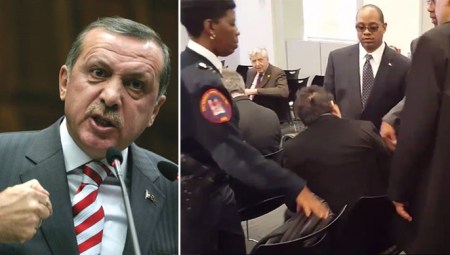
1548When Turkish President Recep Tayyip Erdogan (left) gave a speech at the Brookings Institution in Washington last month, his security guards harassed, threatened and assaulted numerous journalists trying to cover the event. Pictured at right, a police officer steps in to protect a Turkish journalist from Erdogan’s guards

According to press reports, several other journalists were involved in the tussle with Erdogan’s security guards. Another Turkish journalist, Emre Uslu, said that outside the event he was kicked in the leg by Erdogan’s bodyguards and was prevented from attending the speech.

An American reporter attempting to film the harassment received a kick in the chest. The National Press Club was outraged. “We have increasingly seen disrespect for basic human rights and press freedom in Turkey,” the president of the Club, Thomas Burr, said. “Erdogan doesn’t get to export such abuse.”

Against this backdrop, Erdogan kept on adding to his own ridicule. “I am not at war with the press,” he said in an interview with CNN International. Then he went on: “We have never done anything to stop freedom of expression or freedom of press. On the contrary, the press in Turkey had been very critical of me and my government, attacking me very seriously. And regardless of those attacks, we have been very patient in the way we have responded to those attacks.”

As Aykan Erdemir, a former opposition member of the Turkish parliament [now a fellow at the Foundation for Defense of Democracies in Washington], said, Erdogan can be a “toxic asset”: “Heads of state don’t want to be in the same photo with him …”