Posted tagged ‘Economy’

The rout of the globalists

June 24, 2016

The rout of the globalists, American ThinkerPatricia McCarthy, June 24, 2016

Brexit prevailed and our globalist elites are shocked!  The rest of us are shocked that they are shocked.  The elites of the globalist world are shocked by the candidacy of Donald Trump.  What is wrong with this picture?  It is a loud shout-out re: the  willful blindness of those globalist elites…like Cameron, Obama, Kerry, etc.  Obama threatened the Brits: if they voted for Brexit, they would “go to the end of the queue.”  What a thug our misguided President is – and an ignorant one at that.  The Brits just gave Obama the back of their hand.

None of the  UK toffs, or the American lib elites thought this would happen.  How fun to see them so discombobulated.  But who on earth could believe the people of the Britain could possibly be happy with what has happened to their country?  They have been overrun by immigrants from vastly different cultures who demand and get submission to their religious mandates.They are being out-populated by the birthrates of those immigrants.  Entire neighborhoods are now governed by Sharia law. British citizens are daily victimized by the few but venal among those immigrants. And still, the elites of the world believed that the UK would vote to stay in the EU!  Can there be any question about the cluelessness of our self-regarded betters?

People who have been taught to feel entitled want free stuff from the people who earn what they desire.  Poor economies feel entitled to the perks that productive nations produce.  Greece thought, once it became a member of the EU, that  it could spend like Britain and now they are both broke and in debt, (Greek debt, $351b, UK debt $1.6 t) like the US (US debt, $19t). Obama has doubled our debt.  American taxpayers are his ATM just like they were for the Clintons and will be again if Hillary is elected.

Cameron has come forward to resign.  He backed the wrong horse. It will be interesting to see how this plays out. Was this subterfuge?  Did he really support the Remain camp?  Will he be coddled into staying in office?  London, wholly in the Remain camp,  is like NY, SF, LA and DC; bubbles like the one Pauline Kael inhabited when she was so shocked that Nixon had won and she knew no one who had voted for him.  Like NY, SF, LA and DC, it is the wealthy and powerful elites who are so, so willing to surrender their rights, their freedoms and their country’s sovereignty to be politically correct.  Support the Islamists, trash the Christians; Orlando was about guns, not terrorism.  Give us a break!

We have been sold down the river by members of some elite, juvenile fraternity of submission to nonsense.  Radical Islamists submit themselves to an utterly, brutal, murderous unreformed “faith.”  The Orlando shooter is a perfect example of what submission hath wrought.  The dems who staged that silly sit-in about guns are a laughingstock to all Americans who actually pay attention to facts and reality.

The Left’s response to Orlando is an hysterical defense of Islam and an even more hysterical move to repeal the Second Amendment .  Who are these people?  If Brexit is not a wake-up call for Americans, then we are truly mind-numbed.  Trump may be a jerk but he is not Hillary.  She is  America’s version of the UK elite,  ready to sell us out for the deadly imposition of political correctness.  Think before you vote.  Our lives  and the future of this once great nation depend upon who is elected in November.

Newt Gingrich Full Interview with Maria Bartiromo Fox Business (5/22/2016)

May 23, 2016

Newt Gingrich Full Interview with Maria Bartiromo Fox Business (5/22/2016) via YouTube

https://www.youtube.com/watch?v=qWHPZ8SwxGw

Sean Hannity Full One-on-One Interview with Donald Trump (2/18/2016)

February 19, 2016

Sean Hannity Full One-on-One Interview with Donald Trump (2/18/2016), Fox News via You Tube, February 18, 2016

(Trump discusses the Israel – “Palestine” situation and the mess Obama has made beginning at 11:05 during the interview. The rest is very good too. — DM)

https://www.youtube.com/watch?v=4rcALd00L5k

Germany: Migrants In, Germans Out – The Death of Property Rights

September 27, 2015

Germany: Migrants In, Germans Out – The Death of Property Rights, Gatestone InstituteSoeren Kern, September 27, 2015

  • Hamburg city officials say that owners of vacant real estate have refused to make their property available to the city on a voluntary basis, and thus the city should be given the right to take it by force.
  • “The proposed confiscation of private land and buildings is a massive attack on the property rights of the citizens of Hamburg. It amounts to an expropriation by the state [and a] “law of intimidation.” — André Trepoll, Christian Democratic Union.
  • “If a property is confiscated… a lawsuit to determine the legality of the confiscation can only be resolved after the fact. But the accommodation would succeed in any event.” — Tübingen Mayor Boris Palmer.
  • Officials in North Rhine-Westphalia seized a private resort in the town of Olpe to provide housing for up to 400 migrants
  • “I find it impossible to understand how the city can treat me like this. I have struggled through life with grief and sorrow and now I get an eviction notice. It is a like a kick in the stomach.” — Bettina Halbey, 51-year-old nurse, after being notified that she must vacate her apartment so that migrants can move in.
  • The landlord is being paid 552 euros ($617) for each migrant he takes in. By cramming as many migrants into his property as possible, he stands to receive payments of more than 2 million euros a year from government.
  • “Considering that migrants cannot afford to rent new properties… moves must be initiated in which higher income households purchase or build more expensive accommodations for themselves in order to free up the less expensive housing for migrants.” — The Berlin Institute for Urban Development, the Housing Industry and Loan Associations
  • “I saw an unbelievable situation: the elderly volunteer lifted the table halfway, looked at the migrant and moved his head asking the migrant to lend a hand. The migrant paused for a moment and then just walked away.” — Firsthand account, refugee shelter.

German authorities are applying heavy-handed tactics to find housing for the hundreds of thousands of migrants and refugees pouring into the country from Africa, Asia and the Middle East.

With existing shelters filled to capacity, federal, state and local authorities are now using legally and morally dubious measures — including the expropriation of private property and the eviction of German citizens from their homes — to make room for the newcomers.

German taxpayers are also being obliged to make colossal economic sacrifices to accommodate the influx of migrants, many of whom have no prospect of ever finding a job in the country. Sustaining the 800,000 migrants and refugees who are expected to arrive in Germany in 2015 will cost taxpayers at least at least 11 billion euros ($12 billion) a year for years to come.

As the migration crisis intensifies, and Germans are waking up to the sheer scale of the economic, financial and social costs they will [be] expected to bear in the years ahead, anger is brewing.

In Hamburg, the second-largest city in Germany, municipal officials on September 23 introduced an audacious bill in the local parliament (Hamburgische Bürgerschaft) that would allow the city to seize vacant commercial real estate (office buildings and land) and use it to house migrants.

City officials argue the measure is necessary because more than 400 new migrants are arriving in Hamburg each day and all the existing refugee shelters are full. They say that owners of vacant real estate have refused to make their property available to the city on a voluntary basis, and thus the city should be given the right to take it by force.

The measure, which will be voted upon in the Hamburg parliament within the next two weeks, is being applauded by those on the left of the political spectrum. “We are doing everything we can to ensure that the refugees are not homeless during the coming winter,” Senator Till Steffen of the Green Party said. “For this reason, we need to use vacant commercial properties.”

Others argue that efforts by the state to seize private property is autocratic and reeks of Communism. “The proposed confiscation of private land and buildings is a massive attack on the property rights of the citizens of Hamburg,” said André Trepoll of the center-right Christian Democratic Union (CDU). “It amounts to an expropriation by the state.” He said the proposed measure is a “law of intimidation” that amounts to a “political dam break with far-reaching implications.” He added: “The ends do not justify any and all means.”

The leader of the Free Democrats (FDP) in Hamburg, Katja Suding, said that the proposed law is an “unacceptable crossing of red lines… Such coercive measures will only fuel resentment against refugees.”

In Tübingen, a town in Baden-Württemberg, Mayor Boris Palmer (also of the Green Party), is making offers to rent or buy vacant properties to house migrants. But he is also threatening to confiscate the property of landlords who dare to reject his offer. In an interview with the newspaper Die Welt, Palmer said:

“In the written offers, I advise that the Police Law (Polizeigesetz) gives us the possibility, in cases of emergency, to confiscate homes for several months. The law provides for seizure in emergencies. I want to avoid this, but if there is no other way, I will make use of this law.”

When asked if he was afraid of lawsuits, Palmer said:

“No. The Police Law has clear rules. When the town is threatened with homelessness, empty homes may be confiscated. This emergency can happen when accommodations are overcrowded and we continue to receive 50 new migrants in Tübingen. If a property is confiscated, we would order immediate enforcement. That is to say, a lawsuit to determine the legality of the confiscation can only be resolved after the fact. But the accommodation would succeed in any event.”

In February 2015, officials in North Rhine-Westphalia (NRW) seized a private resort in the town of Olpe to provide housing for up to 400 migrants. The initial plan was for the town to purchase the resort from its Bavarian owners and rent it to NRW, but NRW officials decided to confiscate the property instead. According to NRW Interior Minister Ralf Jäger, properties may be seized whenever there is a “threat to public order and safety,” and the threat of mass homelessness among migrants fits the bill.

In Nieheim, another town in NRW, Mayor Rainer Vidal is using a legal maneuver called “right of repossession” (Eigenbedarf) to terminate the leases of German citizens living in state-owned apartment buildings so that migrants can move in.

On September 1, 51-year-old Bettina Halbey, who has been living in her apartment for more than 16 years, received a letter notifying her that she must vacate her apartment by May 2016 so that migrants can move in. Halbey was shell-shocked:

“I’m completely taken by surprise. I find it impossible to understand how the city can treat me like this. I cannot come to grips with this situation. I have struggled through life with grief and sorrow and now I get an eviction notice. It is a like a kick in the stomach.”

Halbey, a nurse, says that it will be difficult for her to find another place to live: “I have a dog and a cat. Many landlords will not even consider renting to me.”

1263Out with the old, in with the new… German authorities are using legally and morally dubious measures — including the eviction of German citizens from their homes — in an attempt to find housing for hundreds of thousands of migrants arriving this year.

In the same building, a single mother with two children has been given until August 2016 to move out of her apartment, also to make room for migrants. Initially, she had been ordered to vacate the property by November 2015, but her eviction was delayed to allow her daughter to finish the school year without interruption.

In an interview with the newspaper Westfalen-Blatt, Vidal, an independent who does not belong to any political party, said: “I know this is an unconventional measure. But as a community, we have an obligation to provide housing for migrants.” He said he wanted to turn the entire apartment building into housing for migrants. Vidal said it would not be financially viable to house them anywhere else.

In some cases, landlords are evicting long-time residents because the government is offering them more money to house migrants than they are receiving in rent from existing tenants.

In Braunsbedra, a small town in the state of Saxony-Anhalt, a landlord evicted dozens of residents from an apartment building to make way for migrants. According to local media, the landlord, Marcus Skowronek, is being paid 552 euros ($617) for each migrant he takes in. By cramming as many migrants into his property as possible, he stands to receive payments of more than 2 million euros a year from local and regional governments.

When reporters from public broadcaster Mitteldeutscher Rundfunk visited the property to interview Skowronek, he said:

“I am asking you to leave the premises. You are banned (Hausverbot) from entering the building. Please leave the property. I am sorry. Otherwise I will have to call the police. Please go.”

In Berlin, the Institute for Urban Development, the Housing Industry and Loan Associations (Berliner Institut für Städtebau, Wohnungswirtschaft und Bausparwesen, IFS) has warned that, given the influx of so many migrants, the demand for housing will outstrip supply for many years to come. Of the 285,000 building permits approved in 2014, only 56,000 were apartments in multi-unit buildings of the kind that are suitable for migrants.

The IFS is now calling for the initiation of a process in which Germans who are currently living in inexpensive housing, but who can afford more expensive accommodations, move out of their existing homes to make way for migrants. According to the IFS:

“Considering that migrants cannot afford to rent new properties, the vast majority can only afford cheaper housing, a chain reaction of moves (Umzugsketten) must be initiated in which higher income households purchase or build more expensive accommodations for themselves in order to free up the less expensive housing for migrants.”

The IFS does not explain why Germans who are living within their means should suddenly be expected to take on debt to purchase a more expensive home.

Germans are not only being evicted from their homes to make way for migrants, they are also being removed from their schools.

In Lübbecke, another town in NRW, teachers and students were given less than 24 hours to vacate the Jahn-Realschule, a secondary school for 150 students, so that the building can be used to house 300 migrants.

The school principal, Marion Bienen, said that municipal authorities notified her at 5:30 pm on Tuesday, September 15, that last day of classes at the school would be Wednesday, September 16. Students were ordered immediately to remove all of their belongings from the premises and to take a week off until alternative classrooms could be found. Bienen said:

“My students are also human beings. You cannot treat them this way. They were given 15 minutes to remove their belongings from the classroom. Then they had to get out. The evacuation was as during wartime…. There were no discussions. No one forewarned us.”

The Center for Economic Studies, a think tank based in Munich, has published a report warning that most of the migrants arriving in Germany lack the most basic qualifications to find work in the country. This implies that they will become long-term wards of the state and thus a drag on the German economy. The report advises lowering the minimum wage as a way to prevent a surge in the unemployment rate:

“To ensure that the refugee crisis does not lead to an ongoing financial overload for the German taxpayer, refugees must find paid employment as soon as possible, so that they can contribute to their own livelihoods. It is feared that many of them will not be able to find employment at the minimum wage of 8.50 euros because their productivity simply is too low. Therefore, the minimum wage should be lowered, so that the unemployment rate does not go up.”

Meanwhile, politicians are demanding that German citizens do more to ensure that the migrants feel at home. But a first-hand account of the goings-on in a refugee shelter articulates the frustration felt by many Germans that this is a one-way street:

“For about a week now, 500 migrants and refugees are being housed in the gym in our neighborhood. So I went over there because I wanted to see the conditions there with my own eyes. There were about ten vehicles belonging to the Red Cross and volunteers.

“Older men over 60 were unloading tables and benches from the trucks, cleaning them with a bucket of water and cloth, and then carrying them into the hall….

“What made me really angry was to see the incredible lethargy of the young men. All of them in their 20s and 30s, all sitting there, smoking and looking at their cell phones, while the 60-year-old volunteers where laboring away….

“While I was watching how the Red Cross volunteers were working and no one was helping them, I saw an unbelievable situation: an elderly gentleman was trying to carry a table into the hall when a refugee returned from the city center with a shopping bag. The elderly volunteer lifted the table halfway, looked at the migrant and moved his head asking the migrant to lend a hand. The migrant paused for a moment and then just walked away. I could hardly believe what I saw.”

Swedes’ Homes May Be Confiscated to Accommodate Asylum Seekers

September 25, 2015

Swedes’ Homes May Be Confiscated to Accommodate Asylum Seekers, Gatestone InstituteIngrid Carlqvist, September 25, 2015

(Possible confiscation of homes is only a minor part of the story. The rest is worse. — DM)

Translation of the original text: Svenskarnas bostäder kan konfiskeras till förmån för asylsökande.

  • In 1992, the “Threat and Risk Assessment Commission” established that the government should have the option to seize property, especially summer homes, from the Swedish people in a time of crisis.
  • Despite Sayadi’s commission of three rapes and his sexual molestation of young girls, as well as his systematic criminal activity, he received only a four-year prison sentence, and will not have to face deportation.
  • Husein wants a Swedish passport so he can go back to Somalia, the country he claims to have escaped from — to “visit his mom and establish business contacts.”
  • “The situation affects everyone who lives and stays in our little county. The climate has grown tougher, many people feel scared and unsafe and with that comes the risk of increased xenophobia, antagonism and exclusion.” — From a letter to the government from Örkelljunga County leaders. The county swiftly received criticism from the mainstream media, and the Immigration Service let it be known that they have no intention of helping Örkelljunga.

August 3: Ahmad El-Moghrabi, 21, who has no driver’s license, was indicted for driving like a madman through the city of Malmö in February, and nearly killing a mother and baby. On February 11, he drove a luxury Mercedes at high speed, with some other Arab men as passengers, one of whom is a well-known extremist, when the police tried to pull the car over. Instead of stopping, El-Moghrabi sped away at about 150 km/h on the busy inner city street of Amiralsgatan, where the speed limit is 40 km/h.

The police chase ended when El-Moghrabi hit some parked cars. Three people were injured, and the mother and baby sustained life-threatening injuries after being crushed between the cars.

El-Moghrabi fled the scene, but was apprehended later. He has been charged with gross negligence, grievous bodily harm, fleeing the scene of an accident, and driving without a license. His own explanation to the rampage was that he did not want to be caught by the police, as his license had been revoked.

August 3: It was reported that 2000 third-world immigrants are seeking asylum in Sweden — each week. The largest groups were Syrians, then Afghans, stateless people, Eritreans and Somalis. The Immigration Service now reports that there are close to 50,000 asylum seekers living in various housing and rental facilities, and more are on their way to a country that already suffers from a major housing shortage.

The question is: Where will they live? More and more people are now worrying that the government will confiscate the homes of Swedes and give them to asylum seekers. In 1992, the “Threat and Risk Assessment Commission” (Hot- och riskutredningen) established that the government should have the option to seize property, especially summer homes, from the Swedish people in a time of crisis. In early September, editorial columnist Anna Dahlberg ofExpressen, one of Sweden’s largest dailies, urged Swedes to “make way” and “hand over the keys to their apartments to those in greater need.”

August 3: Another shooting took place in the violence-stricken city of Malmö. No one was hurt this time, but the police found empty shell casings on Rasmusgatan Street in the Seved area, one of Malmö’s “no go-zones,” where a majority of the inhabitants are of foreign descent. The area is known for its open drug trade, and over the last few years, a large number of shootings and grenade attacks have occurred there. (On June 12, a hand grenade was thrown, and four people were wounded.) In an attempt to bring down the crime rate, local authorities gave the police permission on August 12 to place four cameras in the area to film events around the clock.

August 5: The Stockholm police department caused an uproar with a shocking story about everyday life in immigrant-heavy suburbs such as Tensta-Rinkeby, Hjulsta, Kista and Husby. Youth gangs regularly attack police by using lasers to blind them, and throwing rocks and firebombs. Criminal gangs resolve conflicts by shooting at each other in public places, risking the lives of innocent people who may be in their way. Police officer Nikolina Bucht wrote in a columnin the daily Svenska Dagbladet that it is time to “take back the area from the criminals and protect all the respectable people who have their neighborhoods destroyed, their cars set on fire and feel unsafe.” She wrote:

“Last week my colleagues got a call about a sudden cardiac arrest in Rinkeby. … When they arrive at the scene, they are met by about ten young people who are provoked by their mere presence, turn aggressive and mask their faces. The police are forced to focus on the rock throwing instead of going up to the apartment and starting CPR. He had to wait for several minutes extra before he got help, time that could have saved his life. This was not an isolated event.”

August 7: A Somali refugee, Mohamed Husein, complained he has not yet received a Swedish citizenship. Somalis must wait three years longer than others for citizenship, as they cannot prove their identity. Husein wants a Swedish passport so he can go back to the country he claims to have escaped from — to “visit his mom and establish business contacts.”

August 10: It was reported that a 15-year-old pregnant girl, who six weeks prior traveled with her boyfriend to Syria, had been captured by the Islamic State (ISIS). How the girl managed to travel without a passport or identification papers remains a mystery. Swedish media made no effort to sort out why she would object to living with ISIS. Her boyfriend is reported to have joined an al-Qaeda-affiliated group.

August 11: The law journal Dagens Juridik reported that a 19-year-old girl was taken into custody, in accordance with the LVU law (“Care of Young Persons Special Provisions Act”), after her family threatened to subject her to honor violence. Social service workers on the island of Gotland applied for “administered care” after the girl, in spite of threats, had escaped from the shelter where she was living and moved back with her family. The court stated that the investigation showed that the girl’s desire to return is rooted in her upbringing, which has taught her that the honor of the family is more important than her individual rights. She may also feel guilt, because she thinks she is dishonoring the family by not being with them. According to the court, the girl’s behavior should be considered socially disruptive under the definition of the LVU law, and therefore, she needs to be protected.

August 14: Two men, 21 and 26 years of age, were remanded, suspected of two of the many recent hand grenade attacks in Malmö. At the same time, another 26-year-old was remanded for attempted murder and possession of an illegal weapon, both of which occurred in Rasmusgatan, in Malmö’s “no-go” Seved neighborhood.

Early that morning, police also discovered two hand grenades in Adelgatan, in central Malmö. One had exploded, and the other one failed to work. A large area was barricaded and several buildings had to be evacuated. The police suspected the incident could be linked to a car bomb that had detonated in Malmö two days earlier. Malmö has experienced the most bomb attacks of all Scandinavian cities: this year alone, 20 bombings have taken place.

August 12: A 43-year-old Iranian citizen, Ramin Sayadi, was sentenced to four years in prison for three rapes and two counts of sexual molestation of young girls. Sayadi also sold the girls large quantities of prescription narcotics such as Tramadol, Ritalin and Subutex. The police investigation showed that he had close to 1,000 customers. When the girls became addicted to the drugs, he took advantage of them sexually. The police believe there are many more victims who have not come forward. Detective inspector Jan-Åke Stendahl told daily Göteborgs-Postenthat the man had over 200 contacts listed in his mobile phone, and a majority of the numbers belonged to young girls. Sayadi was caught in May of last year, walking around Gothenburg’s central station trawling for customers.

Despite his systematic criminal activity, he received only a four-year prison sentence, and will not have to face deportation.

August 14: A so-called unaccompanied refugee child was prosecuted on rape charges. The act took place on the night of January 10, in a youth home in Västerbotten in northern Sweden. The suspect is a native of Afghanistan and claims to be 17 years old. The police believe he raped the woman when she was in a drunken stupor, and therefore in what the law calls a “particularly vulnerable situation.”

August 17: The police issued an international arrest warrant for a Congolese citizen, Loran Guy Mogi, 23, wanted for the murder of his ex-girlfriend, Therese Eriksson, 23, of Vårgårda. Eriksson had been found dead four days earlier in Mogi’s apartment, but he had fled the scene. She was killed by blows to the head and body. After a week on the run, Loran Guy Mogi was apprehended at a refugee facility in the German city of Hannover. He has since been remanded pending trial. According to the prosecutor, Robert Beckard, Mogi has pled not guilty to the murder charge, but admits that he beat Eriksson and may thus have caused her death.

August 18: The media website Avpixlat wrote that an Algerian man, who has not lived in Sweden for six years, is entitled to financial aid to cover doctor’s visits and the cost of his medicine. The man came to Sweden in the 1990s, but never worked or paid taxes there. Six years ago, he returned to Algeria, but in April of this year, he suddenly appeared in Sweden again to seek emergency health care. He underwent two surgeries at taxpayer expense, and considered himself entitled to financial aid for the cost of his medicine and several doctor’s visits. The municipality of Gothenburg had ruled against the request, but an administrative court now ruled that since the man has no income or assets, he is entitled to aid.

August 18: Five representatives of the Church of Sweden wrote, in an op-ed in the Swedish dailyDagens Nyheter, that the church should also be open to Muslims. The article astonished and angered Christians. Stefan Gustavsson, secretary general of the Swedish Evangelical Alliance,pointed out that Islam, Judaism and Christianity promote three radically different versions of what happened to Jesus:

  • Islam: Jesus did not die.
  • Judaism: Jesus died but was not resurrected.
  • Christianity: Jesus died and was resurrected.

These different versions cannot all be true, Gustavsson points out, and urges the Church of Sweden to awake from their Sleeping Beauty-slumber and start taking big questions seriously:

“The religion relativism that is now widespread throughout the Church of Sweden is not just an intellectual dead end, it is an insult to the Christians of Iraq and Syria who face forced conversion and who are willing to give their lives for their faith in Jesus Christ.”

But the Church of Sweden persists, and on August 30, it invited imam Mohammad Muslim Eneborg to take part in high mass. Before he converted, the imam was named Åke Daniel Eneborg and he was a left-wing activist.

August 24: Former member of parliament Thoralf Alfsson (Sweden Democrats) wrote on his blog that the Immigration Service had hired no fewer than 1,200 people during the last year. Earlier, in August 2014, the Immigration Service had about 5,000 employees; in August 2015 that figure was 6,200. This means that the wage costs have increased by 50 million kronor (about $5.9 million) a month. In all, the Immigration Service’s staff now cost Swedish taxpayers 250 million kronor ($29.6 million USD) a month, or 3 billion kroner ($360 million) a year.

Aside from skyrocketing costs, Alfsson questions why so many people of foreign descent find employment with the Immigration Service. He writes: “I can’t but wonder what kind of screening process the Immigration Service have in regard to the people they hire. Could there be employees with residency status in Sweden who use a fake identity? Are there ISIS-sympathizers among the employees?” And there are.

Social commentator and author Merit Wager, who frequently publishes anonymous posts from Immigration Service employees, wrote in an August 21 blog post that authorities now no longer take rejected asylum seekers into custody, due to attacks from left-wing extremists. That is why the IKEA-murderer, who had received a deportation order, was not in custody, a failure that led to the death of two innocent people in the heart of the Swedish idyll. One Immigration Service employee said:

“Years ago, the Immigration Service was often heavily criticized by various left-wing groups who wanted to ‘protect’ the asylum seekers who had been found lacking in reasons for protection and targeted for deportation. Sometimes there were big demonstrations and now and again Immigration Service buildings were vandalized. Today these actions have ceased almost completely. The reason is very simple – the Immigration Service has hired the activists. They are now officials at the authority! I’ve met several people who are quite open about their backgrounds in these activist groups. The reason the Immigration Service hires them is that they state on their CVs exactly what the government wants to hear – that they have a ‘burning engagement in human rights issues.'”

August 24: A police van was attacked with a hand grenade in the Stockholm suburb of Tumba. Four policemen were in the vehicle at the time. If it had not been for the fact that the vehicle was armored, the incident could have ended in a bloodbath. The attack began when several people threw rocks at police officers, and a fire was set at the local police station. Moments later, the hand grenade was thrown and landed about five feet from the police van. No one was injured, but the vehicle sustained 105 holes from shrapnel. Despite intense police efforts, the perpetrators of this attempted murder have not yet been apprehended.

1262A police van is riddled with shrapnel (left) from a hand grenade attack in Stockholm on August 24. The four policemen in the vehicle at the time could have been killed if the van had not been armored. At right, the Malmö police bomb squad disarms a hand grenade found in Landskrona, on September 22.

August 25: Local politicians in small southern county of Örkelljunga (population 10,000) wrote a desperate letter to the government; its signatories begged for help in solving the problems brought by the wave of asylum seekers. The Immigration Service has opened housing in Örkelljunga for about 250 asylum seekers in apartments, a former motel, and a number of private family residences — including housing for unaccompanied refugee children. An additional 100 units may open up in the Åsljungagården Hotel.

The local politicians wrote in their letter that crime rates have risen and that the police have been called on a number of occasions. Rape, assault, battery and shoplifting are mentioned, as is the temporary closing of the Centrumhuset youth center. At the largest housing facility, an old motel, there are 90 adults and children. The mix of various ethnic groups is said to have led to riots, threats and hunger strikes. The letter states:

“The situation affects everyone who lives and stays in our little county. The climate has grown tougher; many people feel scared and unsafe and with that comes the risk of increased xenophobia, antagonism and exclusion.”

The county swiftly received criticism from the mainstream media, and August 27 the Immigration Service let it be known that they have no intention of helping Örkelljunga. Immigration Service Press Officer Fredrik Bengtsson, quoted in the daily Helsingborgs Dagblad, was especially angry about the county’s criticism concerning different groups being placed together:

“If one thinks along the lines of placing asylum seekers any other way, you’re on a slippery slope. Separate housing for Christians and Muslims is not something we have in society. We have freedom of religion, and that applies to housing as well. You have to stop for a moment and think about it, because that’s not how we do things in society.”

August 26: Swedes heard the news that politicians in the nation’s three largest cities want to offer courses in “self-care and sexual matters” to gypsy women beggars. Stockholm, Gothenburg and Malmö are applying for 8.7 million kronor (just over $1 million USD) from the European Social Fund, for the project, and hope to reach 250 women. Twice a week they will attend class and get food, free health checkups and free hygiene- and sanitary articles and condoms. They will also receive compensation for “loss of work income.” Local politicians from opposition parties in Stockholm criticized the project strongly.

August 28: “Afrikas Horn,” an immigrants’ organization, reports another “Swedish” ISIS-warrior killed in battle. The man was in his thirties and originally from Somalia, but lived in the immigrant-heavy area of Vivalla in Örebro. The man was apparently one of three who have repeatedly traveled to join ISIS, but were twice intercepted in Turkey and sent back to Sweden. The man is the fourth resident of Örebro who has died as an ISIS terrorist. The chairman of Afrikas Horn tells the local paper Nerikes Allehanda that “the family is in mourning.”

August 28: Ali Khoddami, once an asylum seeker to Sweden, was sentenced to prison for defrauding an elderly woman. Khoddami worked in home care services and tricked Inga Lill, a 90-year-old woman suffering from dementia, out of millions of kronor. By pretending to be the woman’s friend, Khoddami was able to take over her bank accounts and move into her house, along with his family. He used her savings of two million kronor (about $240,000 USD) for luxury items, as well as several cars. Khoddami also managed to persuade Lill to sign over her house — her childhood home built by her father — to him. The house is apparently worth five million kronor ($590,000 USD). It was only after Khoddami put Lill, who has no living relatives, in a nursing home that the fraud was uncovered. The District Court sentenced Khoddami to 2.5 years in prison and fined him 7 million kronor ($830,000) plus interest and damages.

August 28: There were reports that people-smugglers have, over a short period of time, dumped 100 asylum seekers in the Gothenburg area. Pernilla Wallin, unit manager of the application unit at the Immigration Service for the Western Region, told Swedish Public Television that she never thought the situation would escalate like this and that the circumstances are “exceptional.” The Immigration Service is now desperately looking for “external contractors who want to bid on temporary housing for asylum seekers.”

Army is breaking, let down by Washington

August 3, 2015

Army is breaking, let down by Washington, Stars and Stripes, Robert H. Scales, August 2, 2015

(Last year I also wrote a depressing article on the lamentable combat readiness of our military. It’s here at my blog and here at Warsclerotic. The situation has continued to deteriorate. How could Obama’s America help to protect freedom, particularly against an enemy whose name must not be mentioned, without a combat effective military — even if Obama wanted to do it? — DM)

image militaryU.S. paratroopers with the 173rd Airborne Brigade load a M119A2 howitzer at the 7th Army Joint Multinational Training Command’s Grafenwoehr Training Area, Germany, July 28, 2015.
GERTRUD ZACH/U.S. ARMY

Last month, Gen. Ray Odierno, outgoing Army chief of staff, and Gen. Mark Milley, his successor, testified to the difficulties faced by the Army. I’d like to make the same points by telling a story.

When I was a boy, tonsillitis was a dangerous illness. In 1952, it kept me in Tokyo General Hospital for weeks. I shared a cramped ward with dozens of soldiers horribly maimed in Korea. The hospital had only one movie theater. I remember watching a Western sandwiched between bandage- and plaster-wrapped bodies. I remember the antiseptic smells, the cloud of cigarette smoke and the whispers of young men still traumatized by the horrors of the war they had just left.

My dad came from Korea to visit me, and I recall our conversations vividly. At the time he was operations officer for the 2nd Engineer Battalion. He told me how poorly his men were prepared for war. Many had been killed or captured by the North Koreans. During the retreat from the Yalu River, some of his soldiers were in such bad physical shape that they dropped exhausted along the road to wait to be taken captive.

“We have no sergeants, son,” he told me, shaking his head, “and without them we are no longer an Army.”

In the early ’70s, I was the same age as my Korean-era dad. I had just left Vietnam only to face another broken Army. My barracks were at war. I carried a pistol to protect myself from my own soldiers. Many of the soldiers were on hard drugs. The barracks were racial battlegrounds pitting black against white. Again, the Army had broken because the sergeants were gone. By 1971, most were either dead, wounded or had voted with their feet to get away from such a devastated institution.

I visited Baghdad in 2007 as a guest of Gen. David Petraeus. Before the trip I had written a column forecasting another broken Army, but it was clear from what Petraeus showed me that the Army was holding on and fighting well in the dangerous streets of Baghdad. Such a small and overcommitted force should have broken after so many serial deployments to that hateful place. But Petraeus said that his Army was different. It held together because junior leaders were still dedicated to the fight. To this day, I don’t know how they did it.

Sadly, the Army that stayed cohesive in Iraq and Afghanistan even after losing 5,000 dead is now being broken again by an ungrateful, ahistorical and strategically tone-deaf leadership in Washington.

The Obama administration just announced a 40,000 reduction in the Army’s ranks. But the numbers don’t begin to tell the tale. Soldiers stay in the Army because they love to go into the field and train; Defense Secretary Ash Carter recently said that the Army will not have enough money for most soldiers to train above the squad level this year. Soldiers need to fight with new weapons; in the past four years, the Army has canceled 20 major programs, postponed 125 and restructured 124. The Army will not replace its Reagan-era tanks, infantry carriers, artillery and aircraft for at least a generation. Soldiers stay in the ranks because they serve in a unit ready for combat; fewer than a third of the Army’s combat brigades are combat-ready.

And this initial 40,000-soldier reduction is just a start. Most estimates from Congress anticipate that without lifting the budget sequestration that is driving this across-the-board decline, another 40,000 troops will be gone in about two years.

But it’s soldiers who tell the story. After 13 years of war, young leaders are voting with their feet again. As sergeants and young officers depart, the institution is breaking for a third time in my lifetime. The personal tragedies that attended the collapse of a soldier’s spirit in past wars are with us again. Suicide, family abuse, alcohol and drug abuse are becoming increasingly more common.

To be sure, the nation always reduces its military as wars wind down. Other services suffer reductions and shortages. But only the Army breaks. Someone please tell those of us who served why the service that does virtually all the dying and killing in war is the one least rewarded.

My grandson is a great kid. He’s about the same age I was when I was recovering at Tokyo General. Both of his parents served as Army officers, so it’s no wonder that in school he draws pictures of tanks and planes while his second-grade classmates draw pictures of flowers and animals. The other day he drew a tank just for me and labeled it proudly “Abrams Tank!”

Well, sadly, if he follows in our footsteps, one day he may be fighting in an Abrams tank. His tank will be 60 years old by then.

At the moment I’d rather he go to law school.

Robert H. Scales, a retired Army major general, is a former commandant of the U.S. Army War College.

The emperor is stark naked

July 22, 2015

The emperor is stark naked, Israel Hayom, Judith Bergman, July 22, 2015

It did not take the Europeans long to approve the Iran nuclear deal. On Monday, less than a week ‎after the deal was finalized, the European Union had already given its blessing. Given the fact that the EU is a massive body consisting of 28 countries that rarely agree on any foreign policy ‎issues, certainly not those of such a magnitude, it is rather noteworthy that they could find such sweet ‎unison over the most infamous political deal since Chamberlain’s deal with Hitler.

‎”It is a balanced deal that means Iran won’t get an atomic bomb,” French Foreign Minister Laurent Fabius ‎said, “It is a major political deal.”

Sure it is.

Especially for the likes of France and Germany, which can barely contain themselves at the ‎prospect of doing business with the Iranian regime. It has been 12 years since the Europeans could legally ‎engage in trade with the genocidal, misogynistic, homophobic and generally murderous regime of the ‎mullahs and they are not wasting any time, now that the opportunity has resurfaced.

In fact, the ink was barely dry on the nuclear deal when German Vice Chancellor Sigmar Gabriel — who ‎also happens to be economy and energy minister and is therefore as senior a German official as Germany could get without ‎actually sending Angela Merkel herself — rushed himself and a group of representatives from German ‎companies and industry groups onto a plane for a three-day visit to Iran. ‎

Trying, yet utterly failing, to make the trip appear a little more dignified than the simple naked greed that ‎it represents, the vice chancellor “urged Iran at the start of [the] three-day visit to improve its relationship ‎with Israel if it wanted to establish closer economic ties with Germany and other Western powers,” ‎according to Reuters.

If Germany wanted Iran to take that poor show of accommodating Israeli concerns seriously, it might ‎have tried to contain itself just a little longer to at least see whether the U.S. Congress approves the ‎deal. However, as we all know, time is money and the Germans are well known for being efficient.

Yet, the Germans are far from the only ones lining up for immediate business with the Iranians. Fabius is due to visit Iran next week. “I find it completely normal that ‎after this historic deal was signed, France and Iran should restart normal relations,” Fabius said. Before ‎the sanctions took effect, French companies Peugeot and Renault were making billions of euros from ‎their involvement with the Iranian auto industry. Similarly, French company Total was heavily involved in ‎the oil sector. France is not missing a beat in bringing this lucrative trade back into la République.

The French employers’ federation, MEDEF, is due to visit Iran in September. So is Austria. The EU, which is ‎eager to find alternative suppliers of energy at a time when relations with Russia are rather tense, may ‎reopen an EU delegation in Tehran.

Notice how the European political elites consider it, in the French foreign minister’s words, “completely ‎normal” to do business with a heinous regime like Iran, which breaks every single rule in the book of human rights, the bible from which the Europeans pedantically lecture Israel ‎on every possible occasion. It is ostensibly in the name of those very same human rights that the EU wants to boycott Israeli products in order to avoid choking on an Israeli orange from beyond the ‎Green Line.‎

Yet these days the streets of Europe are eerily quiet and completely devoid of protests, as the citizens of ‎Europe demonstrably could not care less about the fact that their countries will now once again be trading ‎in a major way with the Iranian regime.

Where is the outrage, as it becomes increasingly clear that the EU, out of commercial ‎considerations for the lucrative trade and oil flowing from such a deal, has supported the agreement with ‎Iran? Where are the boycotts, divestment and sanctions? Where are the flotillas?

What European lawmaker, bureaucrat or ordinary citizen cares at all that women and children, political ‎prisoners and homosexuals are tortured and summarily executed in Iran, when Iranian oil and money will ‎now flow freely into the EU? ‎Is it of any concern to any of the European that Iran is a regime with genocidal intentions toward Israel and cares for ‎nothing but its own survival?‎

The hypocrisy and the double standards have become so thick and obvious that Hans Christian Andersen’s proverbial emperor is walking stark naked through the streets of Europe. However, should a ‎child appear to point out that the emperor is not wearing any clothes, no one would care to listen.

US finds peeling back the Iran sanctions onion no easy task

June 10, 2015

US finds peeling back the Iran sanctions onion no easy task, Israel Hayom, June 10, 2915

(For Obama, principles are as flexible as words.

Humpty words

— DM)

143393177342310791a_bU.S. Treasury Secretary Jacob Lew | Photo credit: Reuters

Under the sanctions developed over decades, hundreds of companies and individuals have been penalized not only for their roles in the country’s nuclear program but also for ballistic missile research, terrorism, human rights violations and money laundering.

Officials say the administration can meet its obligations because of how it interprets nuclear sanctions.

For example, they say measures designed to stop Iran from acquiring ballistic missiles are nuclear-related because they were imposed to push Iran into the negotiations. Also, they say sanctions that may appear non-nuclear are often undergirded by previous actions conceived as efforts to stop Iran’s nuclear program.

***********************

The Obama administration may have to backtrack on its promise that it will suspend only nuclear-related economic sanctions on Iran as part of an emerging nuclear agreement, officials and others involved in the process told The Associated Press Tuesday.

The problem derives from what was once a strong point of the broad U.S. sanctions effort that many credit with bringing Iran to the negotiating table in the first place.

Administration officials vehemently reject that any backtracking is taking place, but they are lumping sanctions together, differently from the way members of Congress and critics of the negotiations separate them.

Under the sanctions developed over decades, hundreds of companies and individuals have been penalized not only for their roles in the country’s nuclear program but also for ballistic missile research, terrorism, human rights violations and money laundering.

Now the administration is wending its way through that briar patch of interwoven economic sanctions.

The penalties are significant. Sanctioned foreign governments, companies or individuals are generally barred from doing business with U.S. citizens and businesses, or with foreign entities operating in the American financial system. The restrictions are usually accompanied by asset and property freezes as well as visa bans.

Negotiators hope to conclude a final nuclear deal by June 30. According to a framework reached in April, the U.S. will be required to lift sanctions that are related to Iran’s nuclear program but could leave others in place. President Barack Obama can suspend almost all U.S. measures against Iran, though only Congress can revoke them permanently.

“Iran knows that our array of sanctions focused on its efforts to support terrorism and destabilize the region will continue after any nuclear agreement,” Treasury Secretary Jack Lew told a gathering of American Jews in a weekend speech. U.S. officials will “aggressively target the finances of Iranian-backed terrorist groups and the Iranian entities that support them,” he said, including the Lebanese militant group Hezbollah and Iran’s Quds Force.

The Treasury Department’s sanctions point man, Adam Szubin, has been tasked with sorting out the mess, according to U.S. officials, though no clear plan has yet been finalized.

Officials say the administration can meet its obligations because of how it interprets nuclear sanctions.

For example, they say measures designed to stop Iran from acquiring ballistic missiles are nuclear-related because they were imposed to push Iran into the negotiations. Also, they say sanctions that may appear non-nuclear are often undergirded by previous actions conceived as efforts to stop Iran’s nuclear program.

The officials who provided information for this story spoke only on condition of anonymity because they were not authorized to speak publicly on the private discussions.

After years of negotiations, U.S. officials believe a deal is within reach that for a decade would keep Iran at least a year from being able to build a nuclear weapon.

In return, the U.S. would grant billions of dollars in relief from sanctions that have crippled Iran’s economy. But the whole package risks unraveling if the U.S. cannot provide the relief without scrapping sanctions unrelated to Iran’s nuclear program.

Administration officials say they are examining a range of options that include suspending both nuclear and some non-nuclear sanctions, a step that would face substantial opposition in Congress and elsewhere. Under one scenario, the U.S. could end non-nuclear restrictions on some entities, then slap them back on for another reason. But Iran could then plausibly accuse the U.S. of cheating on its commitments.

U.S. President Barack Obama has spoken about Iran potentially recouping up to $150 billion in assets trapped overseas. The process for how that would take place is still being worked through, said officials.

The Iranian Central Bank may prove the most glaring example of the administration’s dilemma, and officials acknowledge there is no way to give Iran the sanctions relief justified by its compliance without significantly easing restrictions on the institution.

The bank underpins Iran’s entire economy, and for years the U.S. avoided hitting it with sanctions, fearing such action would spread financial instability and raise oil prices. By late 2011, with Iran’s nuclear program advancing rapidly, Obama and Congress did order penalties, declaring the bank a “primary money laundering concern” and linking its activity to ballistic missile research, terror financing and support for Syrian President Bashar Assad.

The effects were far-reaching: Petroleum exports fell by 60%, Iran suffered runaway inflation, cash reserves dried up and industrial output in several sectors plummeted. And Iran agreed to talk about its nuclear program with the United States and five other world powers.

Now that the nuclear agreement is so close, Iran wants these sanctions lifted. The administration officials say all sanctions on the bank are nuclear-related.

Lew told the Jewish conference in New York that a nuclear accord would include the suspension of all “secondary” oil, trade and banking restrictions — those that apply to U.S. and non-U.S. banks, as well as foreign governments.

Many of these measures overlap with American sanctions tied to Iran’s nuclear program, and that has officials considering new sanctions to keep certain Iranian institutions under pressure.

Eliminating the secondary sanctions across the board could have wide-ranging implications, making it easier for Iran’s Revolutionary Guard Corps and its police, intelligence services and paramilitary groups to do business.

That possibility has Iran’s rivals in the region, including Israel and the Sunni monarchies of the Middle East, gravely worried.

“I share their concern,” Gen. Martin Dempsey, the Joint Chiefs of Staff chairman, said Tuesday in Jerusalem.

“If the deal is reached and results in sanctions relief, which results in more economic power and more purchasing power for the Iranian regime, it’s my expectation that it’s not all going to flow into the economy to improve the lot of the average Iranian citizen,” he said.

“I think they will invest in their surrogates. I think they will invest in additional military capability.”

Iran’s Revolutionary Guard is under U.S. sanctions because of its proliferation of weapons of mass destruction. But because the U.S. views the corps as so pernicious, the administration is considering new measures to help block it from meddling in the internal conflicts of Iraq, Lebanon, Syria and Yemen.

Of the 24 Iranian banks currently under U.S. sanctions, only one — Bank Saderat, cited for terrorism links — is subject to clear non-nuclear sanctions. The rest are designated because of nuclear and ballistic missile-related financing, while several are believed to be controlled by the Revolutionary Guard.

Will they be cleared for business with the world? U.S. officials still cannot say one way or another. Congress, too, has not received a list of banks and institutions that would be released from sanctions under the deal.

If the United States cannot deliver on its promises, it could take the blame for a collapse of the years-long negotiations toward a nuclear deal, putting the world — in the words of Obama and other U.S. officials — on a path toward military confrontation. At the same time, an Iran unburdened by sanctions could redouble efforts toward nuclear weapons capacity, while international unity and the global sanctions architecture on Tehran fray.
Rouhani: Saving environment starts with sanctions removal

June 9, 2015

Rouhani: Saving environment starts with sanctions removal, Al-MonitorArash Karami, June 8, 2015

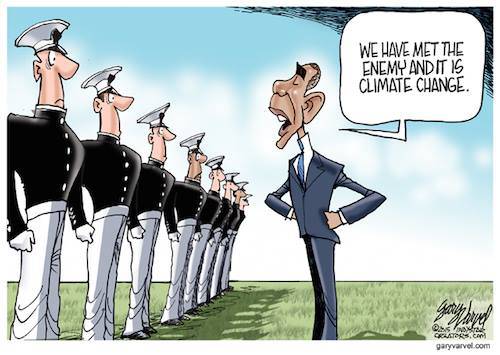
(Human rights, Iranian missiles, Iranian threats, Iranian proxies, theocratic dictatorship? Those are not relevant to the deal. But whatever may help the environment and therefore stop climate change is my top priority — Obama.

enemy

— H/t Freedom is just another word. — DM)

Rouhani’s comments linking the country’s various environmental problems and employment woes to the nuclear negotiations and sanctions relief have upset conservatives, who believe the administration is too eager to resolve the dispute and too optimistic about what the deal means for the country.

**********************

Iranian President Hassan Rouhani has been criticized for suggesting that once a comprehensive nuclear deal is made it will open the door to improving the country’s environmental problems. “The oppressive sanctions must be removed so that investment can come and the problems of the environment, employment, industry and drinkable water are resolved,” Rouhani said at a ceremony on June 7 commemorating Environment Week in Iran.

Rouhani described the sanctions as “a small fever … that at the beginning no attention was paid to this fever, but when the sick person fell ill and was not able to move anymore, we sought a remedy for the illness. Some did not know the reason of the sanctions but step by step, the problems became larger.”

Rouhani added that while “the oppressive sanctions must be removed,” this does not mean “that we must submit to the unreasonable wants of others.”

Iran and five permanent members of the UN Security Council plus Germany (P5+1) are working through the final details of a comprehensive deal that would see Iran reduce its nuclear activity in return for sanctions relief, particularly banking sanctions that have hurt the country’s ability to sell its oil and conduct trade and have prevented Western investment in the country.

But Rouhani’s comments linking the country’s various environmental problems and employment woes to the nuclear negotiations and sanctions relief have upset conservatives, who believe the administration is too eager to resolve the dispute and too optimistic about what the deal means for the country.

In an article titled, “The water, wind, soil and forests have also been tied to sanctions,” the conservative Javan newspaper criticized Rouhani’s latest comments. The article said, “Despite experts warning of not connecting domestic issues of the country to the nuclear issue and negotiations, at this ceremony Rouhani once again suggested that with the removal of sanctions not only will investment become fluid in Iran but the issues of the environment, youth employment, water and banking will be [resolved].”

The article continued that Rouhani’s comments “resulted in many experts becoming surprised and a few hours afterward many hostile Western networks and media … took this point and broadcast this to show [that] sanctions have brought Iran to its knees.”

In an article sarcastically titled, “Solving all the problems is tied to the negotiations, even drinking water,” the Kayhan newspaper also criticized Rouhani. Kayhan repeated Javan’s warning that analysts have warned of not tying the nuclear negotiations to domestic issues and cast doubt that so many problems could be resolved with the removal of sanctions. Kayhan wrote, “Stranger than anything else, Rouhani said the removal of sanctions would increase the water levels.”

Kayhan said, “The issue of sanctions is one the most important obstacles for the negotiators because the Americans do not want to remove sanctions, which is a tool to apply pressure on Iran.”

According to his previous statements, Iran’s Supreme Leader Ayatollah Ali Khamenei, who has final say on the nuclear program, has warned Iranian officials about being optimistic regarding the sanctions and has emphasized focusing on domestic capabilities instead.

On April 29, he said, “The key to solving economic issues is not in Lausanne, Geneva or New York,” three locations where the Iran and P5+1 nuclear talks have taken place under the Rouhani administration. “Without a doubt, sanctions and pressure cannot stop organized and planned efforts to increase domestic production.”


US Diplomats Reveal EU Sanctions Assault After Iran Deal

June 9, 2015

US Diplomats Reveal EU Sanctions Assault After Iran Deal, Israel National News, Ari Yashar, June 9, 2015

EU flagEU flag (illustration)Flash 90

Israel has been fighting the Iran nuclear deal due to the great danger it poses, but senior Western officials have revealed it is also doing so because once a deal is reached, the European Union (EU) and UN are planning a diplomatic offensive targeting the Jewish state.

The political assault is meant to force Israel into returning to yet more peace talks with the Palestinian Authority (PA) and making dangerous concessions in the process – and reportedly the EU already has a list of sanctions ready to force Israel to bend.

A senior Western diplomat told Ma’ariv in a report published Tuesday that “a diplomatic attack against Israel is expected soon that will surprise even the pessimists in Jerusalem.”

“In the (UN) Security Council, in western capitals and at EU headquarters, they are just waiting for the Iran deal to be signed and for it to be approved by the American Congress,” warned the diplomatic source.

It appears that the waiting period will likely expire in September, at which time a UN General Assembly will open in tandem with the first shots of the diplomatic barrage against Israel.

Diplomatic sources familiar with Western European positions vis-a-vis Israel said the EU already has a list ready, itemizing sanctions against Israel in the fields of trade, agriculture, science and culture.

That list is to be translated into an economic assault – unless Israel presents a new set of concessions it is willing to make for a new round of peace talks, after the last set of talks was torpedoed by the PA signing a unity deal with the Hamas terrorist organization.

“S‭enior officials in Jerusalem are aware of the existence of sanctions documents at EU headquarters, some of which have even fallen into their hands,” one diplomatic source revealed to Ma’ariv.

The source added that US President Barack Obama’s threat made in an Israeli interview this month, according to which he may cut US support for Israel at the UN, specifically was referring to “the sanctions file” against Israel which is currently biding its time at the EU headquarters.

The US is reportedly weighing its responses, as the current Israeli government does not appear to be likely to launch a new series of peace talks after the massive failure of the last round, and the PA’s unilateral moves in the international arena in breach of the 1993 Oslo Accords that founded it.

“The make-up of the government is such that no faction or minister will stand up to the lack of an initiative from Prime Minister (Binyamin) Netanyahu,” a diplomat from New York told Ma’ariv. “The coming months will be difficult for Israel. This time Israel will pay a heavy price for continued stagnation. This time, it is also uncertain if Uncle Sam will succeed in saving Israel, and maybe he won’t want to do so.”