Posted tagged ‘Department of Defense’

US-backed rebels handed over equipment to al Qaeda in Syria

September 26, 2015

US-backed rebels handed over equipment to al Qaeda in Syria, Long War Journal, September 26, 2015

Al-Nusrah-in-Aleppo-300x169

[T]he Jaysh al Fateh alliance, which is led by Al Nusrah and its closest jihadist allies, has captured more territory from Assad’s regime this year than the Islamic State has.

Not only has al Qaeda thwarted America’s first efforts under the overt $500 million train and equip program, which is managed by the US military, it has also taken out rebels who received unofficial support from the US intelligence community.

*****************************

US-backed rebels in the so-called “New Syrian Forces” (NSF) have turned over at least some of their equipment and ammunition to a “suspected” intermediary for Al Nusrah Front, US Central Command (CENTCOM) conceded in a statement released late yesterday. The coalition-provided supplies were given by the rebels to Al Nusrah, an official branch of al Qaeda, in exchange for “safe passage within their operating area.

The “NSF unit contacted Coalition representatives and informed us that on Sept. 21-22 they gave six pick-up trucks and a portion of their ammunition to a suspected Al Nusrah Front intermediary, which equates to roughly 25 percent of their issued equipment,” CENTCOM spokesperson Col. Patrick Ryder said. “If accurate, the report of NSF members providing equipment to Al Nusrah Front is very concerning and a violation of Syria train and equip program guidelines.”

While Ryder left open the possibility that the report is not accurate, he did not offer any explanation for why the NSF unit would lie about giving the equipment to Al Nusrah. The admission further jeopardizes the unit’s ability to receive American arms in the future.

Rebels belonging to Division 30, a group supported by the US, suffered losses immediately upon entering the Syrian fray earlier this year.

More than 50 members of Division 30 were sent into Syria in July. But Al Nusrah quickly thwarted their plans, even though the US-backed rebels intended to fight the Islamic State, Al Nusrah’s bitter rival. A number of Division 30 fighters were captured or killed within days of embarking on their mission.

Al Nusrah released a statement at the time saying that Division 30 is part of an American scheme that is opposed to the interests of the Syrian people. Al Qaeda’s branch accused the group of trying to form “the nucleus” of a “national army” and blasted the attempt to bolster the “moderate opposition.”

Al Nusrah also attacked Division 30’s headquarters in Azaz, a city north of Aleppo. The US responded with airstrikes, killing a number of jihadists, but the damage to the limited US effort was done. US officials said earlier this month that only four or five rebels were left in the fight. Dozens of additional US-supported rebels have entered the war in recent weeks, according to US military officials.

Not only has al Qaeda thwarted America’s first efforts under the overt $500 million train and equip program, which is managed by the US military, it has also taken out rebels who received unofficial support from the US intelligence community.

Al Nusrah Front has consistently resisted the West’s meager attempts to build a reliable opposition force. Late last year, al Qaeda’s branch pushed the Syrian Revolutionaries Front (SRF), which had reportedly received some support from the West, out of its strongholds in the Idlib province. The SRF’s demise helped pave the way for Al Nusrah and its allies in the Jaysh al Fateh (“Army of Conquest”) coalition to capture much of Idlib beginning in late March.

After being vanquished, SRF head Jamaal Maarouf accused Al Nusrah’s emir, Abu Muhammad al Julani, of being a “Kharijite” (or extremist). This was an about-face in the relationship, as the SRF and Al Nusrah had previously fought side-by-side. Maarouf also publicly lamented the limited support he had received from the West.

Earlier this year, Al Nusrah also took the fight to Harakat Hazm (the Hazm Movement) outside of Aleppo. Despite receiving Western support, including US weaponry, Hazm had fought alongside the jihadists in the past and its leaders had praised Al Nusrah. Regardless, it was eventually forced to disband under Al Nusrah’s relentless pressure. Hazm’s remaining members were folded into other rebel groups.

It is suspected that American-made anti-tank TOW missiles fell into al Qaeda’s hands as a result of the battle against Hazm. The weapons were used during the jihadists’ successful assault on Idlib in March, as well as during other key confrontations with the Assad regime.

Recent events demonstrate that the US is consistently underestimating al Qaeda’s presence and capabilities in Syria, and does not have a true strategy for the multi-sided conflict. The rebels who have gone through the train and equip program are supposed to fight the Islamic State and not, according to public accounts, Al Nusrah. But it is Al Nusrah, which has been seeded with al Qaeda veterans in its upper ranks and is openly loyal to al Qaeda emir Ayman al Zawahiri, that has interfered with the US effort.

The US apparently did not anticipate Al Nusrah blocking Division 30’s first foray into northern Syria in July. The al Qaeda branch did so not to support Abu Bakr al Baghdadi’s men, but because it is opposed to any US presence in the country. The US has targeted individual al Qaeda commanders in Syria, especially those believed to pose an immediate threat to the West, but has not sought to degrade the Al Nusrah-led wing of the anti-Assad insurgency. However, the Jaysh al Fateh alliance, which is led by Al Nusrah and its closest jihadist allies, has captured more territory from Assad’s regime this year than the Islamic State has.

Satire|Special Forces To Change ‘Free The Oppressed’ Motto After Complaints From Afghans Holding Sex Slaves

September 26, 2015

Special Forces To Change ‘Free The Oppressed’ Motto After Complaints From Afghans Holding Sex Slaves, Duffel Blog, Bombsquad, Jack S. McQuack, and Jay-B contributed, September 26, 2015

(This fits right in with Saudi Arabia’s new job in the UN Human Rights Council, except that’s not satire. — DM)

Special operations Soldiers listen to the complaints and stories of Afghan detainees at Farrah, Afghanistan May 27.

Special operations Soldiers listen to the complaints and stories of Afghan detainees at Farrah, Afghanistan May 27.

In addition to the change in motto, the Army band has also been directed to record a new version of the “Ballad of the Green Berets,” which was recorded during the Vietnam War. An initial draft of the lyrics include: “Silver wings upon their chest / These are men, America’s best / One hundred slaves get raped today / But all ignored by the Green Beret.”

**********************

FORT BRAGG, N.C. — Top Army leaders have ordered its elite Special Forces unit to change its motto from the Latin “De Opresso Liber” (To liberate the oppressed) to something that would be more culturally sensitive, after a large number of Afghans holding child sex slaves have complained.

“We want to make sure we are not offending our coalition partners and not judging them based on our own biases,” said Col. Dwight S. Barry, a Pentagon spokesperson. “At the end of the day, we just have to respect that raping young boys and mutilating female genitals is just a part of their culture.”

Started in 1952, Army Special Forces chose its Latin motto of “De Opresso Liber” at a time when the U.S. was heavily focused on freeing people around the world from the chains of Soviet Communism. Now decades later, Army leaders want operators to be more aware of cultural differences they may not understand in Iraq, Afghanistan, and Berkeley, California.

The move comes in the wake of numerous complaints from Afghan men, who have chided U.S. military officials over previous run-ins with Special Forces soldiers unaware of the ancient Afghan custom of “bacha bazi.” The practice, which literally translates to “boy play,” consists of chaining children to beds, taking off their clothes, and then sexually assaulting them until they scream “bingo.”

Anger over U.S. military insensitivity toward “bacha bazi” is not the only issue in which Afghans have raised concern. The use of Special Forces “night raids” on high value targets has aroused suspicion among many locals in the past, and U.S. troops expressing discomfort around opium-addicted Afghan policemen as they throw acid in the faces of young girls has strained coalition partnerships.

In one high-profile incident, two Special Forces soldiers beat up an American-backed militia commander after they had learned he had raped a young boy and beat up his mother, a practice which goes back centuries and is perfectly normal in Afghan society. Fortunately, one of the American soldiers decided to leave the Army after the incident, while the other is being kicked out.

“I thought we were all about liberating the oppressed?” said Bob Samuelson, a former weapons sergeant with Army Special Forces. “How is it right for the Army to kick someone out who was literally trying to do that, and free a young boy from assault?”

The Pentagon just recently learned the motto included a typo for decades, and the actual English translation is “to free the oppressors,” according to a senior defense official.

Officials are currently weighing a number of potential mottos as replacements, which include “Tolerate Iniustitia (Tolerate Injustice)” and “Ad Dissimulare (To Turn a Blind Eye).”

In addition to the change in motto, the Army band has also been directed to record a new version of the “Ballad of the Green Berets,” which was recorded during the Vietnam War. An initial draft of the lyrics include: “Silver wings upon their chest / These are men, America’s best / One hundred slaves get raped today / But all ignored by the Green Beret.”


Russian marines join Hizballah in first Syrian battle – a danger signal for US, Israel

September 24, 2015

Russian marines join Hizballah in first Syrian battle – a danger signal for US, Israel, DEBKAfile, September 24, 2015

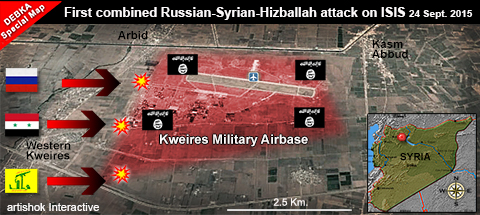
KweirisAir480

[T]he most ominous aspect for the US and Israel of the Russian attack on the Syrian airbase is that Russian marines were combined with Syrian and Hizballah special forces.

*********************

Before dawn on Thursday, Sept. 24, Russian marines went into battle for the first time since their deployment to Syria, DEBKAfile’s military and intelligence sources reveal. Russian Marine Brigade 810 fought with Syrian army and Hizballah special forces in an attack on ISIS forces at the Kweiris airbase, east of Aleppo.

This operation runs contrary to the assurances of President Vladimir Putin to Prime Minister Binyamin Netanyahu on Sept. 21 – just three days ago – that Russian forces in Syria were only there to defend Russian interests and would not engaged in combat with the Syrian army, Hizballah or Iranian troops.

The ISIS force defending the air base is dominated by Chechen fighters under the command of Abu Omar al-Shishani, who is considered one of the terrorist organization’s leading commanders in the last two years. The 27-year-old al-Shishani hails from the Chechen enclave of Pankisi in Georgia, like many others who joined ISIS from 2012.

However, targeting Chechen fighters was not the only reason for the order given by Russian command in Syria to attack the air base.  In DEBKA Weekly 678 of September 11, we predicted that the first Russian mission in Syria would be to break the Syrian rebel siege on Aleppo, Syria’s second-largest city.

As their first step, the Russians would have to prevent the cutoff of highway 5, running from Aleppo to Damascus, and keep it open for Syrian army reinforcements and military equipment to the city.

The offensive to regain Kweiris airbase that fell to ISIS in mid-June is the first step in the implementation of Russia’s operational plan for the Aleppo area.

Meanwhile, little substance was to be found in the reports appearing, mainly in the United States, suggesting that Putin, disappointed by the Obama administration’s unwillingness to send the US Air Force to collaborate with Russia in the fight against ISIS, would try to talk Obama round if and when they meet on the sidelines of the UN General Assembly on September 28.

According to DEBKAfile’s sources, these reports were spread to cover up the serious crisis in the US war against ISIS.

While Russia poured troops and advanced hardware into Syria, establishing bases and launching offensive action, the US anti-Islamic State effort suffered a heavy blow with the decision of Obama’s ISIS war czar, Gen. John Allen, to step down in early November.

Sources close to the general were quoted as referring to his frustration “with the White House micromanagement of the war and its failure to provide adequate resources.”’

The fact that the Russian forces launched their attack on ISIS shortly after the announcement of Allen’s upcoming resignation shows that Putin is not waiting for US cooperation in the war on the Islamist terrorists.    That said, DEBKAfile’s military sources point out that the most ominous aspect for the US and Israel of the Russian attack on the Syrian airbase is that Russian marines were combined with Syrian and Hizballah special forces.

For the first time in 41 years, since the 1974 war of attrition against the IDF on the Golan, Russian troops are fighting alongside Syrian forces. It is also the first time that a world power like Russia is willing to go into battle with an acknowledged terrorist group, such as Hizballah.

Our sources point out that the joint attack was completely counter to the tone and the content of the comments exchanged by Putin and Netanyahu at their summit.

A full report on Russian military activity and strategic objectives in Syria, and a rundown of the content of the Putin-Netanyahu talks in Moscow appear in the coming issue of DEBKA Weekly out Friday, September 25.

U.S. soldiers ordered to ignore Afghan allies’ abuse of boys

September 21, 2015

U.S. soldiers ordered to ignore Afghan allies’ abuse of boys, Jihad Watch, Robert Spencer, September 20, 2015

(“It’s their culture, so it’s cool. Don’t get involved.” The (non-Islamic) Islamic State is also a manifestation of Islamic culture. Should our we be required to ignore it as well? — DM)


What are we in Afghanistan for, if not to stand for our own values and the principles of human rights? Instead, U.S. officials are aiding and abetting the destruction of these boys’ lives — and in the case of Lance Corporal Buckley, sacrificing our own troops. This is beyond shameful.

“Those are the ones brought near in the Gardens of Pleasure, a company of the former peoples and a few of the later peoples, on thrones woven, reclining on them, facing each other. There will circulate among them young boys made eternal with vessels, pitchers and a cup from a flowing spring.” — Qur’an 56:11-18

“And they will be given to drink a cup whose mixture is of ginger, a fountain within Paradise named Salsabeel. There will circulate among them young boys made eternal. When you see them, you would think them scattered pearls. And when you look there, you will see pleasure and great dominion.” — Qur’an 76:17-20

Gregory-Buckley

“U.S. Soldiers Told to Ignore Afghan Allies’ Abuse of Boys,” by Joseph Goldstein, New York Times, September 20, 2015:

KABUL, Afghanistan — In his last phone call home, Lance Cpl. Gregory Buckley Jr. told his father what was troubling him: From his bunk in southern Afghanistan, he could hear Afghan police officers sexually abusing boys they had brought to the base.

“At night we can hear them screaming, but we’re not allowed to do anything about it,” the Marine’s father, Gregory Buckley Sr., recalled his son telling him before he was shot to death at the base in 2012. He urged his son to tell his superiors. “My son said that his officers told him to look the other way because it’s their culture.”

Rampant sexual abuse of children has long been a problem in Afghanistan, particularly among armed commanders who dominate much of the rural landscape and can bully the population. The practice is called bacha bazi, literally “boy play,” and American soldiers and Marines have been instructed not to intervene — in some cases, not even when their Afghan allies have abused boys on military bases, according to interviews and court records.

The policy has endured as American forces have recruited and organized Afghan militia to help hold territory against the Taliban. But soldiers and Marines have been increasingly troubled that instead of weeding out pedophiles, the American military was arming them in some cases and placing them as the commanders of villages — and doing little when they began abusing children.
Gregory Buckley Sr. believes the policy of looking away from sexual abuse was a factor in his son’s death.

“The reason we were here is because we heard the terrible things the Taliban were doing to people, how they were taking away human rights,” said Dan Quinn, a former Special Forces captain who beat up an American-backed militia commander for keeping a boy chained to his bed as a sex slave. “But we were putting people into power who would do things that were worse than the Taliban did — that was something village elders voiced to me.”

The policy of instructing soldiers to ignore pedophilia by their Afghan allies is coming under new scrutiny, particularly as it emerges that service members like Captain Quinn have faced discipline, even career ruin, for disobeying it.

After the beating, the Army relieved Captain Quinn of his command and pulled him from Afghanistan. He has since left the military.

Four years later, the Army is also trying to forcibly retire Sgt. First Class Charles Martland, a Special Forces member who joined Captain Quinn in beating up the commander….

The American policy of nonintervention was intended to maintain good relations with the Afghan police and militia units the United States has trained to fight the Taliban. It also reflected a reluctance to impose cultural values in a country where pederasty is rife, particularly among powerful men, for whom being surrounded by young teenagers can be a mark of social status.

Some soldiers believed that the policy made sense, even if they were personally distressed at the sexual predation they witnessed or heard about.

“The bigger picture was fighting the Taliban,” a former Marine lance corporal reflected. “It wasn’t to stop molestation.”

Still, the former lance corporal, who spoke on condition of anonymity to avoid offending fellow Marines, recalled feeling sickened the day he entered a room on a base and saw three or four men lying on the floor with children between them. “I’m not a hundred percent sure what was happening under the sheet, but I have a pretty good idea of what was going on,” he said.

But the American policy of treating pedophilia as a cultural issue has often alienated the villages whose children were being preyed upon. The pitfalls of the policy emerged clearly as American Special Forces soldiers began to form Afghan Local Police militias to hold villages that American forces had retaken from the Taliban in 2010 and 2011.

By the summer of 2011, Captain Quinn and Sergeant Martland, both Green Berets on their second tour in northern Kunduz Province, began to receive dire complaints about the Afghan Local Police units they were training and supporting.

First, one of the militia commanders raped a 14- or 15-year-old girl whom he had spotted working in the fields. Captain Quinn informed the provincial police chief, who soon levied punishment. “He got one day in jail, and then she was forced to marry him,” Mr. Quinn said.

When he asked a superior officer what more he could do, he was told that he had done well to bring it up with local officials but that there was nothing else to be done. “We’re being praised for doing the right thing, and a guy just got away with raping a 14-year-old girl,” Mr. Quinn said.

Village elders grew more upset at the predatory behavior of American-backed commanders. After each incident, Captain Quinn would gather the Afghan commanders and lecture them on human rights.

Soon another commander absconded with his men’s wages. Mr. Quinn said he later heard the commander had spent the money on dancing boys. Another commander murdered his 12-year-old daughter in a so-called “honor killing” for having kissed a boy.“There were no repercussions,” Mr. Quinn recalled.

In September 2011, an Afghan woman, visibly bruised, showed up at an American base with her son, who was limping. One of the Afghan police commanders in the area, Abdul Rahman, had abducted the boy and forced him to become a sex slave, chained to his bed, the woman explained. When she sought her son’s return, she herself was beaten. Her son had eventually been released, but she was afraid it would happen again she told the Americans on the base.

She explained that because “her son was such a good-looking kid, he was a status symbol” local commanders coveted, recalled Mr. Quinn, who did not speak to the woman directly but was told about her visit when he returned to the base from a mission later that day.

So Captain Quinn summoned Abdul Rahman and confronted him about what he had done. The police commander acknowledged that it was true, but brushed it off. When the American officer began to lecture about “how you are held to a higher standard if you are working with U.S. forces, and people expect more of you,” the commander began to laugh.

“I picked him up and threw him onto the ground,” Mr. Quinn said. Sergeant Martland joined in, he said. “I did this to make sure the message was understood that if he went back to the boy, that it was not going to be tolerated,” Mr. Quinn recalled….

Sergeant Martland, who received a Bronze Star for valor for his actions during a Taliban ambush, wrote in a letter to the Army this year that he and Mr. Quinn “felt that morally we could no longer stand by and allow our A.L.P. to commit atrocities,” referring to the Afghan Local Police.

The father of Lance Corporal Buckley believes the policy of looking away from sexual abuse was a factor in his son’s death, and he has filed a lawsuit to press the Marine Corps for more information about it.

Lance Corporal Buckley and two other Marines were killed in 2012 by one of a large entourage of boys living at their base with an Afghan police commander named Sarwar Jan.

Mr. Jan had long had a bad reputation; in 2010, two Marine officers managed to persuade the Afghan authorities to arrest him following a litany of abuses, including corruption, support for the Taliban and child abduction. But just two years later, the police commander was back with a different unit, working at Lance Corporal Buckley’s post, Forward Operating Base Delhi, in Helmand Province.

Lance Corporal Buckley had noticed that a large entourage of “tea boys” — domestic servants who are sometimes pressed into sexual slavery — had arrived with Mr. Jan and moved into the same barracks, one floor below the Marines. He told his father about it during his final call home.

Word of Mr. Jan’s new position also reached the Marine officers who had gotten him arrested in 2010. One of them, Maj. Jason Brezler, dashed out an email to Marine officers at F.O.B. Delhi, warning them about Mr. Jan and attaching a dossier about him.

The warning was never heeded. About two weeks later, one of the older boys with Mr. Jan — around 17 years old — grabbed a rifle and killed Lance Corporal Buckley and the other Marines.

Lance Corporal Buckley’s father still agonizes about whether the killing occurred because of the sexual abuse by an American ally. “As far as the young boys are concerned, the Marines are allowing it to happen and so they’re guilty by association,” Mr. Buckley said. “They don’t know our Marines are sick to their stomachs.”

The one American service member who was punished in the investigation that followed was Major Brezler, who had sent the email warning about Mr. Jan, his lawyers said. In one of Major Brezler’s hearings, Marine Corps lawyers warned that information about the police commander’s penchant for abusing boys might be classified. The Marine Corps has initiated proceedings to discharge Major Brezler.

Russia gearing up to be first world power to insert ground forces into Syria

September 1, 2015

Russia gearing up to be first world power to insert ground forces into Syria, DEBKAfile, September 1, 2015

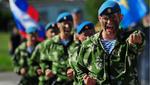
Russian_airborn_troops_syria_1.9.15Russian airborne troops for Syria

Despite strong denials from Moscow, Russian airborne troops are preparing to land in Syria to fight Islamic State forces. The surprise attack on Monday, Aug. 31, by ISIS forces on the Qadam district of southern Damascus, in which they took over parts of the district – and brought ISIS forces the closest that any Syrian anti-Assad group has ever been to the center of the Syrian capital – is expected to accelerate the Russian military intervention.

Moscow is certainly not ready to endanger the position of President Bashar Assad or his rule in Damascus, and views it as a red line that cannot be crossed. If Russia intervenes militarily in this way, Russia will be the first country from outside the Middle East to send ground forces into the Syrian civil war.

DEBKAfile’s military sources report that discussions by the Russo-Syrian Military Commission, which was established last month in Moscow to coordinate the intervention, accelerated during the last few days.

Our intelligence sources point out that the concerted activities of the commission are taking place amid the nearly complete paralysis of the US Central Command-Forward-Jordan (CCFJ), where operations against the rebels in southern Syria, including those holding positions across from Israel’s Golan, are coordinated. Officers from Jordan, Saudi Arabia, Qatar and Israel are attached to the CCFJ.

Most of the operations of the CCFJ have been halted due to a conflict that erupted between the Syrian rebels and the U.S. Central Command, CENTCOM. The US military is opposed to the rebels cooperating with Al-Qaeda-linked groups, such as the Al-Nusra front, while the rebels claim that this cannot be avoided fir they are to defeat the forces of Bashar Assad and Hizballah.

The paralysis of the CCFJ is spurring the Russians to try to show that their “central command” for Syria is operating without any difficulties.

In recent weeks, the Russians have taken four military steps related to Syria:

1. On Aug. 18, six of Russia’s advanced MIG-31 Foxhound interceptor aircraft landed at the Syrian Air Force’s Mezze Airbase, which is the military section of Damascus international airport. After the fighters landed, they were immediately followed by giant Russian Antonov AN-124 Condor cargo planes carrying 1,000 of Russia’s 9M133 Kornet anti-tank missiles.

The advanced jets are intended to serve as air support for the Russian units that arrive in Syria.

2. Before the Russian planes landed in Damascus, Moscow reached an agreement with Washington for the removal of NATO’s Patriot missile batteries from Turkey. The removal was carried out gradually during the month of August, thus preventing the possibility that NATO Patriot missiles could hit Russian fighters carrying out operations in Syrian airspace.

3. During the last week of August, a large number of Russian troops, mostly logistical teams whose job is to lay the groundwork for the arrival of the combat units, arrived in Syria. The troops were seen in Damascus and in Jablah district of Lattakia province, where the Russian forces are building a military base.

4. Our intelligence sources also report that Moscow has started to supply Damascus with satellite imagery of the ground situation on the different fronts.

DEBKAfile’s military and intelligence sources report that all of these preparatory steps by Moscow for the introduction of ground forces are being carried out in coordination with Washington and Tehran.

The more that the three capitals tighten their coordination in support of Assad, the sooner the Russian intervention is expected to take place.

Some deal: Iran will soon be able to kill 90 percent of our population

August 13, 2015

Some deal: Iran will soon be able to kill 90 percent of our population, Newsday, Lawrence J. Hass, August 13, 2015

Iran has tested how to conduct an EMP attack, such as by attaching a nuclear weapon to an orbiting satellite or launching a nuclear-armed missile into the atmosphere from a ship.

Iranian military leaders have endorsed an EMP attack against America, according to secret Iranian military documents that Pentagon officials have translated, and the Pentagon’s North American Aerospace Defense Command is moving back into Cheyenne Mountain in Colorado because it can resist an EMP attack.

Those who, in light of this deal and Iran’s missile and EMP work, nevertheless dismiss the “Death to America” threats from Iran as just political rhetoric might heed the words of former Israeli Foreign Minister Abba Eban: “It is our experience that political leaders do not always mean the opposite of what they say.”

********************

Just four days after U.S.-led global powers and Iran completed their nuclear deal, Ayatollah Ali Khamenei, Iran’s supreme leader, reaffirmed the “Death to America” mantra that has pervaded his regime since its establishment in 1979, stating, “The entire country is under the umbrella of this great movement.” Iran has killed hundreds of Americans in the Middle East, both directly and through its terrorist proxies. It has threatened U.S. regional interests by funding anti-Israeli terrorists, propping up Syria’s terror-backing Bashar al-Assad and de-stabilizing U.S.-backed governments.

Moving forward, this deal will enable Tehran to threaten U.S. security more directly in at least two ways: First, Iran could deploy a nuclear warhead on one of its ballistic missiles and fire it at the United States. Iran is building increasingly sophisticated ballistic missiles, with its Shahab-3 able to reach Israel, and the Sejjil that it’s developing capable of reaching Italy and Poland.

Tehran also announced plans to build missile silos in what experts consider a precursor to deploying longer range missiles.

Second, Iran could detonate a nuclear device over the United States in an electromagnetic pulse attack that destroys our electric grid, putting the nation in the dark for months and eventually leaving 90 percent of Americans dead from disease or starvation.

Iran has tested how to conduct an EMP attack, such as by attaching a nuclear weapon to an orbiting satellite or launching a nuclear-armed missile into the atmosphere from a ship.

Iranian military leaders have endorsed an EMP attack against America, according to secret Iranian military documents that Pentagon officials have translated, and the Pentagon’s North American Aerospace Defense Command is moving back into Cheyenne Mountain in Colorado because it can resist an EMP attack.

That Iran can develop nuclear weapons under the deal, making these two scenarios plausible, is clear; the only question is when.

For starters, the deal is time-limited and, as restrictions end in 10-15 years, Iran can pursue two paths to a bomb – enriching uranium to weapons-grade levels or building plutonium-producing reactors, or both.
But Tehran need not wait that long because international inspectors will be hard-pressed to confirm that Iran is abiding by the deal’s restrictions on how much uranium it’s enriching, how many centrifuges it’s operating, and what it may be doing at secret sites that the world has not yet discovered.

That’s because rather than “anywhere, anytime” inspections, Iran will have 24 days to comply with requests from the International Atomic Energy Agency to visit a suspected undeclared site, during which Iran can move, hide, or destroy evidence of its nuclear progress.

If Iran refuses to allow a site visit after 24 days, global leaders likely would begin further negotiations with Iran that would give the latter weeks more to clean up a site.

But Tehran need not wait that long because international inspectors will be hard-pressed to confirm that Iran is abiding by the deal’s restrictions on how much uranium it’s enriching, how many centrifuges it’s operating, and what it may be doing at secret sites that the world has not yet discovered.

That’s because rather than “anywhere, anytime” inspections, Iran will have 24 days to comply with requests from the International Atomic Energy Agency to visit a suspected undeclared site, during which Iran can move, hide, or destroy evidence of its nuclear progress.

If Iran refuses to allow a site visit after 24 days, global leaders likely would begin further negotiations with Iran that would give the latter weeks more to clean up a site.

Nor, under this deal, must Tehran reveal the military-related dimensions of its nuclear work to date, leaving the world dangerously ignorant of how close it already is to developing and deploying a nuclear weapon and also leaving inspectors without a baseline against which to judge Iranian compliance in the future.

Moreover, the $100 billion to $150 billion in sanctions relief will give Iran a huge windfall to develop a more robust infrastructure for nuclear weapons production – either quickly by evading the weak inspections regime or more patiently by waiting about a decade until the world frees Iran of all restrictions.

Those who, in light of this deal and Iran’s missile and EMP work, nevertheless dismiss the “Death to America” threats from Iran as just political rhetoric might heed the words of former Israeli Foreign Minister Abba Eban: “It is our experience that political leaders do not always mean the opposite of what they say.”

The Iran-North Korea Axis of Atomic Weapons?

August 13, 2015

The Iran-North Korea Axis of Atomic Weapons? Forbes OpinionClaudia Rosett, August 13, 2015

(I have been beating this drum for years and this is among the best articles on the subject I have read. It is clearly past time for the Obama Administration to “come clean” on what it knows about the Iran – North Korea axis. Congress should reject the current “deal” with Iran if it does not do so, fully and promptly. — DM)

President Obama has been telling Congress and the American public that the Iran nuclear deal — the Joint Comprehensive Plan of Action — “cuts off all Iran’s pathways to the bomb.” That’s not true. One of the most dangerous aspects of this deal is that it does not sever the longtime alliance between Tehran and Pyongyang. If there has indeed been cooperation between these two regimes on nuclear weapons, it’s time not only for Iran to come clean, but for the Obama administration to stop covering up.

******************

As U.S. lawmakers debate the Iran nuclear deal, they are rightly concerned about Iran’s refusal to disclose its past work on nuclear weapons. Not only does this refusal deprive inspectors of a baseline for monitoring Iran’s compliance; it also deprives Congress of information about the networks that Iran’s regime might most readily employ should it choose to secretly continue its quest for  the nuclear bomb.

On that note, it should also concern Congress that Tehran is not alone in hiding information on Iran’s history of developing nuclear weapons. Whatever President Obama and his negotiating team might know about such matters, they have been — to put it mildly — less than diligent about informing the American public.

An honest accounting would quite likely reveal something that many press reports have alleged, but U.S. administration officials have never publicly confirmed: A history of nuclear weapons collaboration between Iran and nuclear-proliferating North Korea.

Don’t take my word for it. Let us turn instead to an in-depth article published on August 4, 2003 by a staff writer of the Los Angeles Times under the headline “Iran Closes In on Ability to Build a Nuclear Bomb.” The reporter was no junior correspondent. The article was the product of a three-month international investigation by a veteran investigative reporter, previously a member of a Pulitzer-Prize winning team at the New York Times, Douglas Frantz.

Drawing on “previously secret reports, international officials, independent experts, Iranian exiles and intelligence sources in Europe and the Middle East,” Frantz wrote that “North Korean military scientists recently were monitored entering Iranian nuclear facilities. They are assisting in the design of a nuclear warhead, according to people inside Iran and foreign intelligence officials.”

Frantz added: “So many North Koreans are working on nuclear and missile projects in Iran that a resort on the Caspian coast is set aside for their exclusive use.”

Perhaps Frantz should recycle that article to Secretary of State John Kerry, who while testifying to a congressional panel last month was asked about its allegations by Rep. Christopher Smith, and ducked the question.

Frantz might have a better chance of getting Kerry’s attention; Frantz now works for Kerry. In 2009, then-Senator Kerry hired Frantz as deputy staff director and chief investigator of the Senate Foreign Relations Committee. Frantz returned briefly to newspaper work in 2012, as national security editor of The Washington Post. Frantz was then hired once again to work under Kerry, this time at the State Department, where Frantz has worked since 2013 as Assistant Secretary in charge of the Bureau of Public Affairs.

At State, Frantz’s portfolio includes engaging “domestic and international media to communicate timely and accurate information with the goal of furthering U.S. foreign policy and national security interests as well as broadening understanding of American values.”

But it appears that as a State Department advocate of a free and well-informed press, Frantz himself is not free to answer questions from the press about his own reporting on North Korea’s help to Iran in designing a nuclear warhead. The State Department has refused my repeated requests to interview Frantz on this subject. Last year, an official at State’s Bureau of Public Affairs responded to my request with an email saying, “Unfortunately Assistant Secretary Frantz is not available to discuss issues related to Iran’s nuclear program.” This June I asked again, and received the emailed reply: “This is indeed an important topic for Doug, but he feels that speaking about his past work would no longer be appropriate, since he is no longer a journalist.”

The real issue, of course, is not the career timeline of Douglas Frantz, but the likelihood, past and future, of nuclear collaboration between Iran and North Korea. Frantz may no longer be a journalist, but it’s hard to see why that should constrain him, or his boss, Secretary Kerry, from speaking publicly about important details of Iran’s illicit nuclear endeavors — information which Frantz in his incarnation as a star journalist judged credible enough to publish in a major newspaper.

If Frantz needs to protect his sources, by all means let him do so. He need not name his contacts inside Iran, or the “foreign intelligence officials” who gave him his scoop. If Frantz’s story was accurate, then presumably the administration has its own sources for such information. Recall that in June, with reference to Iran’s past work on nuclear weapons — the “possible military dimensions” of its nuclear program — Kerry told reporters “We know what they did. We have no doubt. We have absolute knowledge with respect to the certain military activities they were engaged in.”

So, what precisely were those activities, and Congress might want to ask Frantz, or his boss, Secretary of State Kerry, if information available to the U.S. administration supports Frantz’s story of North Korean-Iran collaboration on nuclear warheads. If so, then surely it’s time for the administration to lift the classified veil and share the blockbuster details not only with Congress, but with American voters — who deserve to know a lot more of the history that might yet shape the future of this “historic” Iran nuclear deal.

Of course, the real problem for the Obama administration is that an officially confirmed story of Iran-North Korea collaboration on nuclear warheads could spell further trouble for winning congressional approval of this nuclear deal. North Korea is a rogue state which despite sanctions has long served as a munitions back shop for Iran. If that business has included tutorials on nuclear warhead design, that is very bad news. North Korea has already conducted three nuclear tests, has been threatening a fourth, and appears to be producing bomb fuel — both plutonium and highly enriched uranium — for a nuclear arsenal which by the estimates of various experts could within a few years include dozens of warheads. Under the Iran nuclear deal, Iran would emerge with a lot more money to browse such wares.

According to public statements this year by a number of senior U.S. military officials, North Korea has also acquired the ability –untested, but dangerous — to mount miniaturized nuclear warheads on ballistic missiles. In other words, North Korea is becoming a full service shop for nuclear weapons, including the materials and technology to make them and the means to deliver them.

North Korea has a long record of peddling its weapons and related technology abroad, from conventional arms to missiles to the notorious caper in which North Korea helped Iran’s client state, Syria, build an entire clandestine nuclear reactor for no apparent use except to produce plutonium for nuclear weapons (that reactor was nearing completion when it was destroyed in 2007 by an Israeli air strike). Iran and North Korea are longtime allies, veteran smugglers and since the early days of Iran’s 1979 Islamic revolution have been prolific partners in weapons traffic.

Nor has Frantz been the only journalist to report that Iran and North Korea have worked together on nuclear weapons. For years, there have been reports in the media of Iranian officials attending North Korean nuclear tests, and North Koreans turning up at nuclear weapons research facilities in Iran. In testimony July 28th at a joint subcommittee hearing of the House Committee on Foreign Affairs, a former Congressional Research Service specialist on Asia, Larry Niksch, provided a list of respected news services that have published stories on Iran-North Korea nuclear cooperation. Among them were Reuters, Germany’s Der Spiegel and Suddeutsche Zeitung, Japan’s Kyodo News and Sankei Shimbun. and Australia’s Sydney Morning Herald. Broadly, these stories have cited sources such as foreign intelligence agencies and Iranian defectors.

The staple element missing from this picture is any official U.S. confirmation that Iran and North Korea have worked together on nuclear matters. The Obama administration has confirmed dealings between Iran and North Korea in conventional arms and missiles. But, as Niksch stated, “On nuclear collaboration there has been a virtual blackout of public information.”

When asked about allegations of Iran-North Korea nuclear ties, Obama administration officials either retreat behind the classified veil, or deflect the question. A standard response is that they take such allegations “seriously” and will look into them. From that process, to date, no significant public information has emerged.

The likely reason for this cone of silence is that for more than two decades, American presidents have tried to defang first North Korea’s nuclear program, and now Iran’s, by concocting nuclear deals that don’t hold up. In the process, Presidents Clinton, Bush (in his second term) and now President Obama, have each in turn tried to minimize disclosures that could derail their various nuclear deals. The unfortunate result is that instead of stopping nuclear proliferation, they have collectively run cover for some of the most virulent ties between Iran and North Korea. In doing so, they have deprived the American public of information important to assessing any nuclear deal with either North Korea or Iran.

Some secrecy may be necessary to protect intelligence sources and methods. That should not excuse any American president or his team from failure to alert the public to the extent of the Iran-North Korea connection, or refusal to comment in any meaningful way on allegations of nuclear weapons cooperation between Tehran and Pyongyang.

President Obama has been telling Congress and the American public that the Iran nuclear deal — the Joint Comprehensive Plan of Action — “cuts off all Iran’s pathways to the bomb.” That’s not true. One of the most dangerous aspects of this deal is that it does not sever the longtime alliance between Tehran and Pyongyang. If there has indeed been cooperation between these two regimes on nuclear weapons, it’s time not only for Iran to come clean, but for the Obama administration to stop covering up.

Analysis: Arabs see US-trained anti-Islamist force as only fit to ‘play paintball’

August 6, 2015

Analysis: Arabs see US-trained anti-Islamist force as only fit to ‘play paintball’, Jerusalem PostAriel Ben Solomon, August 6, 2015

ShowImage (7)AN ISIS member rides on a rocket launcher in Raqqa in Syria two months ago. (photo credit:REUTERS)

The deal with Iran and the cooperation with Iranian forces against Islamic State, include “Shi’ite militias that are no less criminal.”

*********************

The Arab world perceives the dramatic failure of the small US-trained Syrian rebel force as a further indication that it cannot be a reliable ally against the Iran led Shi’ite axis.

A US defense official, who spoke to Reuters on condition of anonymity, said on Tuesday that at least five Syrian rebels it has trained are believed to have been captured by the Nusra Front.

That followed an attack by the Nusra Front on Friday thought to have killed one member of the so-called “New Syrian Forces,” in what would be their first battlefield casualty.

The incidents underscore the extreme vulnerability of the New Syrian Forces, a still tiny group estimated to number less than 60, who only deployed to the battlefield in recent weeks.

The Pentagon is far behind on its goals to train around 5,000 fighters a year.

Kirk Sowell, principal of Uticensis Risk Services, a Middle East-focused political risk firm, who closely follows Arab media summed it up this way on Twitter: “Pentagon: Arab media are laughing at you.”

Sowell posted a broadcast by pro-opposition Orient News, which expressed astonishment as to why the US would send in a force of only 50 to 60 fighters to help destroy Islamic State.

Aymenn Jawad al-Tamimi, a fellow at the Middle East Forum who closely follows Islamist opposition groups in Syria and Iraq, told The Jerusalem Post that “for many Sunni Arabs and Syrian Sunni Arab rebels in particular, this train-and-equip program has had no credibility from the outset.”

This is because the notion of fighting Islamic State while ignoring regime forces does not make sense for them, said Tamimi.

“US policymakers’ sense of reality on the ground is seriously in question with the apparent failure to anticipate a clash with the Nusra Front, which has a notable presence in the Azaz district into which the force of 50-60 men was inserted,” he continued.

Since the US has targeted Nusra Front in air strikes it is not surprising that the group would view a US backed group as a threat, he said.

Middle East researcher Ali Bakir, who also writes for Arab publications, told the Post on Wednesday that “no one in the Arab world takes this program seriously; I mean you would need around 50 to 60 people to play paintball but definitely not to fight Islamic State.”

“There is a profound general perception in the Arab world that the Obama administration is no less responsible than Iran and Russia in the Syrian crisis,” he said.

The deal with Iran and the cooperation with Iranian forces against Islamic State, include “Shi’ite militias that are no less criminal.”

This situation is increasingly seen in the Arab world as siding with the Shi’ites at the expense of the vast majority of Muslims, he asserted.

The US administration is more concerned about not jeopardizing the Iran deal than helping the Syrian people, Bakir added.

Obama gives ISIS ally veto power over US air strikes on ISIS

August 3, 2015

Obama gives ISIS ally veto power over US air strikes on ISIS, Front Page Magazine, Daniel Greenfield, August 3, 2015

turkey-2erdoganwhitehouse

The war against the JayVee team that has captured large chunks of Syria, Iraq and Libya is going really well. Secretary of State John Kerry and White House Minister of Information Mohammed Saeed al-Sahaf assure us that the un-Islamic terrorist group whose name must not be mentioned will shortly be crushed.

Meanwhile Obama keeps trying to negotiate with the Taliban, the other group of misogynistic mass-murdering Islamists he had vowed to defeat back in his first term.

The administration is celebrating a coup in finally getting Turkey to get on board and allow the US to use an air force base for air strikes on ISIS. But as Commander Dyer points out, there’s a slight problem.

1.  The Obama administration refuses to define a territorial or operational objective.

2.  U.S. forces aren’t sure whom they’ll be allowed to shoot at.

Well it’s not like we need to know what we’re fighting for or how we’re going to fight. The important thing is that Obama got a crazy Islamist dictator who built himself a billion dollar palace while terrorizing his people to agree to let the US use an air force base.

As long as he gets to decide who we bomb.

The US Air Force could use the Incirlik air force base in Turkey but had to allow Turkish oversight of the targets it would strike in Syria and Iraq from Incirlik.

That is a slight tiny problem because the Turkish regime loves terrorists almost as much as Iran and has a history of secret ties to ISIS.

According to the Guardian on 25 July, a U.S.-led raid on an ISIS compound in May 2015 unearthed a treasure trove of documentation on this connection.  Turkish middlemen have been funding ISIS for months, to the tune of millions of dollars, by buying oil from the guerrillas – implicitly with the knowledge and support of the Turkish government.

The Jerusalem Post reported one Islamic State member said Turkey, a member of NATO, provided funds for the terrorist group.

“Turkey paved the way for us. Had Turkey not shown such understanding for us, the Islamic State would not be in its current place. It [Turkey] showed us affection. Large [numbers] of our mujahedeen received medical treatment in Turkey,” said the man, who was not identified.

The topic of Turkey’s involvement with ISIS remains controversial and has led to a conflict between Turkish law enforcement, which tried to expose government weapons shipments, and the Erdogan regime.

Even Joe Biden said it not long ago, before being forced to apologize.

So Obama has given an ally of ISIS oversight of US air strikes against ISIS. And it gets even more schizophrenic because the US is now involved with the PKK, a Kurdish Marxist liberation group, which Turkey is bombing.

So yes, the war will be won any day. Meanwhile Pakistan will be hosting peace talks with the Taliban. You know, the country which was pretending to be our ally while harboring Osama bin Laden.

Don’t worry. I’m sure the Caliph of ISIS probably isn’t living in a mansion in downtown Istanbul. Yet.

“This caliphate will take over the entire world and behead every last person that rebels against Allah”

August 1, 2015

“This caliphate will take over the entire world and behead every last person that rebels against Allah,”  Front Page Magazine, Daniel Greenfield, August 1, 2015

(But of course, as all good little Obamabots know, the Islamic State it not Islamic. Please see also, Despite Bombing Campaign, Islamic State No Weaker Than a Year Ago. — DM)

isis_map


The Un-Islamic JayVee team that Obama is trying to fight has a big plan. Behead all non-Muslims. Rule the world.

The undated document, titled “A Brief History of the Islamic State Caliphate (ISC), The Caliphate According to the Prophet,” seeks to unite dozens of factions of the Pakistani and Afghan Taliban into a single army of terror.  It includes a never-before-seen history of the Islamic State, details chilling future battle plans, urges al-Qaeda to join the group and says the Islamic State’s leader should be recognized as the sole ruler of the world’s 1 billion Muslims under a religious empire called a “caliphate.”

“Accept the fact that this caliphate will survive and prosper until it takes over the entire world and beheads every last person that rebels against Allah,” it proclaims. “This is the bitter truth, swallow it.”

Unlike al-Qaeda, which has targeted terror attacks on the United States and other western nations, the document said Islamic State leaders believe that’s the wrong strategic goal. “Instead of wasting energy in a direct confrontation with the U.S., we should focus on an armed uprising in the Arab world for the establishment of the caliphate,” the document said.

First the Muslim world. Then the world. It’s a straightforward strategy, one that Osama bin Laden flirted with but never truly committed to. Though he celebrated the Arab Spring, ISIS would reap its rewards.

Retired Defense Intelligence Agency Director Lt. Gen. Michael Flynn, who also reviewed the document, said it “represents the Islamic State’s campaign plan and is something, as an intelligence officer, I would not only want to capture, but fully exploit. It lays out their intent, their goals and objectives, a red flag to which we must pay attention.”

The failure to target the radical Islamic ideas behind the group has given its fighters the opportunity to spread, Flynn said. “If I were in their shoes, I would say,’We are winning, we are achieving our objectives,’” Flynn said. “They have demonstrated an incredible level of resiliency and they will not be defeated by military means alone.”

We have yet to try defeating them by military means.