Posted tagged ‘Belgium’

Op-Ed: EXPOSE: Belgium accepted Islamization for electoral reasons

March 29, 2016

Op-Ed: EXPOSE: Belgium accepted Islamization for electoral reasons, Israel National News, Giulio Meotti, March 29, 2016

The conversation opens with a proverb: “In the land of the blind the one-eyed is a king, but not in Belgium, where those who have tried to raise the alarm have been left alone.” These are the words of Alain Destexhe, a prominent figure among the liberals in Brussels, former secretary of Médecins Sans Frontières and president of the International Crisis Group.

He is also author of “Lettre aux progressistes qui flirtent avec l’islam réac” (a letter to the progressives who flirt with reactionary Islam – Editions du Cerisier),  a letter-pamphlet that Destexhe dedicated to Philippe Moureaux, the man considered responsible for the transformation of a large suburb of Brussels into the European hub of Islamic holy war.

Two days ago, the Belgian Prime Minister, Charles Michel, said that Moureaux bears a “huge responsibility.”

“For twenty years, he reigned in a sort of conspiracy of silence” continues Destexhe as he talks to us. “At the heart of this system was the powerful Philippe Moureaux, mayor of Molenbeek, media darling, who has had a real moral and political domination over Brussels’ policy. He has created a climate of intellectual terror against the few who dared to stand up. Philippe Moureaux had realized that the future of socialism would depend on the immigrants who would become, symbolically, the new proletariat”.

But who is Moureaux? Professor of Philosophy at the University of Liege, Senator, Director of the Institut Emile Vandervelde (the think tank of the Socialist Party), deputy prime minister in the Martens government, but since 1983 city councilor and then, more importantly, mayor of Molenbeek for twenty years (1992- 2012). Son of minister Charles Moureaux, Philippe has long been the darling of the anti-racist left. The “loi Moureaux”, the Moureaux law, is in fact the rule that in 1981 criminalized acts inspired by xenophobia.

Nicknamed “Moustache” for his mustache, married to a Muslim Tunisian woman, Philippe Moureaux, even before becoming mayor of Molenbeek, had always boasted of defending the rights of immigrants. He included, for the first time in the history of Belgium, Muslim representatives in municipal and regional lists. This scion of the Belgian policy has been the mayor of Molenbeek for so long that the strategic suburb has come to be embodied in Isis’ plans.

His pro-Arab sympathies date back to the war in Algeria, when Moureaux defended the representatives of the Algerian National Liberation Front, also secretly hiding them in the heights of Lustin, in the Namur region.

Merry Hermanus, activist of the Socialist Party in Brussels for decades, also has accused Moureaux: “Without the immigrant populations, the Socialist Party would have been reduced to eight percent of the electorate in Brussels. We have become prisoners.” A few days ago, Moureux published his book, “The Truth About Molenbeek”. He wrote it after the massacres of November 13, in Paris, when the political class began to question his leadership of the Brussels ghetto. In the volume, Moureaux refers to “my Muslim brothers,” writes that one of the engines of jihadism is our “Islamophobia” and punishes “a society that treats immigrants like the Jews before the war”.

“Multiculturalism has failed because we have allowed them to exclude themselves without integrating communities, causing a fragmentation of society,” tells me Alain Destexhe, former Secretary General of Doctors Without Borders. “We’re talking about Belgian citizens who reject the values of our country. Salah Abdeslam is a typical example of a guy who could lead a comfortable life. He had a decent salary and a guaranteed job for life “.

Why did you write the Lettre aux progressistes qui flirtent avec l’islam réac? To denounce the left that you could not criticize, while we were becoming the first country in Europe in number of jihadists and Brussels the weakest link in the fight against this reactionary Islam.

It was an electoral strategy: Moureaux used immigrants to stay in power. Today half of the officers in local councils and in Parliament of the Socialist Party are of foreign origin.

Why did they never demand conditions to give citizenship to immigrants? “It was a political electoral pact. Legal immigration (and illegal) was encouraged. Family reunification was facilitated. There was the granting of voting rights to foreigners, the fight against racism became the new paradigm of political discourse. And more: frequent visits to mosques, subsidies to Muslim associations, the provision of services to the Koranic schools, participation in the festival Eid El Kebir, anti-Israeli marches”.

When he was mayor, Moureaux also urged people to avoid driving during Ramadan, so as not to offend Muslims.

“Most politicians chose not to listen to sermons that became increasingly radical and in this climate radical organizations such as the Belgian Islamic Centre and others have prospered freely. Molenbeek has thus become the fastest growing area of the Brussels region of Belgium. The population of the district increased by 12 percent in 5 years and 30 percent in 15 years. The Islamization is taking place before our eyes. Already 30 percent of Brussels is Islamic”.

And there’s not only Molenbeek: “There are Anderlecht, Brussels City, Schaerbeek, Saint-Josse and Forest. When I was Secretary of Doctors Without Borders, in the ’90s, I often worked in Molenbeek. The population was already largely of immigrant origin, but nobody was trying to assert its own Islamic identity, like today. Women were not wearing the veil, no one asked halal food in schools, few went to the mosque. For this reason, if I look at Belgium today, I am very pessimistic. Perhaps it is too late”.

Why Belgium is Ground Zero for European Jihadis

March 23, 2016

Why Belgium is Ground Zero for European Jihadis

by Soeren Kern March 23, 2016 at 6:00 am

Source: Why Belgium is Ground Zero for European Jihadis

  • Growing numbers of Belgian Muslims live in isolated ghettos where poverty, unemployment and crime are rampant. In Molenbeek, the unemployment rate hovers at around 40%. Radical imams aggressively canvass in search of shiftless youths to wage jihad against the West.
  • “When we have to contact these people [European officials] or send our guys over to talk to them, we’re essentially talking with people who are… children. These are not pro-active, they don’t know what’s going on. They’re in such denial. It’s such a frightening thing to admit their country is being taken over.” — American intelligence official.
  • “Returned Syria fighters are a huge threat… It is absolutely unbelievable that our governments allow them to return… Every government in the West, which refuses to do so [lock them up], is a moral accessory if one of these monsters commits an atrocity. … Our citizens are in mortal danger if we do not restore control over our own national borders.” — Dutch MP Geert Wilders.

The terrorist attacks on the airport and metro in Brussels are casting a spotlight, once again, on Belgium’s ignominious role as a European haven for jihadists.

Several distinct but interconnected factors help explain why Brussels, the political capital of Europe, has emerged as the jihadist capital of Europe.

Scenes from the jihad on Belgium: The aftermath of yesterday’s bomb attacks at the Brussels airport (left) and a metro station (right).

Large Muslim Population

The Muslim population of Belgium is expected to reach 700,000 in 2016, or around 6.2% of the overall population, according to figures extrapolated from a recent study by the Pew Research Center. In percentage terms, Belgium has one of the highest Muslim populations in Western Europe.

In metropolitan Brussels — where roughly half of Belgium’s Muslims currently live — the Muslim population has reached 300,000, or roughly 25%. This makes Brussels one of the most Islamic cities in Europe.

Approximately 100,000 Muslims live in the Brussels district of Molenbeek, which has emerged as the center of Belgian jihadism.

Parallel Societies

Belgium’s radical Islam problem originated in the 1960s, when Belgian authorities encouraged mass migration from Turkey and Morocco as a source of cheap labor. They were later followed by migrants from Egypt and Libya.

The factories eventually closed, but the migrants stayed and planted family roots. Today, most Muslims in Belgium are the third- and fourth-generation offspring of the original migrants. While many Belgian Muslims are integrated into Belgian society, many others are not.

Growing numbers of Belgian Muslims live in marginal districts — isolated ghettos where poverty, unemployment and crime are rampant. In Molenbeek, the unemployment rate hovers at around 40%. Radical imams aggressively canvass the area in search of shiftless youths to wage jihad against the West.

Salafism

As in other European countries, many Muslims in Belgium are embracing Salafism — a radical form of Islam — and its call to wage violent jihad against all nonbelievers for the sake of Allah.

Salafism takes its name from the Arabic term salaf, which means predecessors or ancestors — meaning of Mohammed. Salafists trace their roots to Saudi Arabia, the Mohammed’s birthplace. They glorify an idealized vision of what they claim is the true, original Islam, practiced by the earliest generations of Muslims, including Mohammed and his companions and followers, in the 7th and 8th centuries. The aim of Salafism is to recreate a pure form of Islam in the modern era.

This goal presents serious problems for modern, secular and pluralistic states. A recent German intelligence report defined Salafism as a “political ideology, the followers of which view Islam not only as a religion but also a legal framework which regulates all areas of life: from the state’s role in organizing relations between people, to the private life of the individual.”

The report added: “Salafism rejects the democratic principles of separation of state and religion, popular sovereignty, religious and sexual self-determination, gender equality and the fundamental right to physical integrity.”

Although Salafists make up only a small fraction of Europe’s burgeoning Muslim community, authorities are increasingly worried that many of those attracted to Salafi ideology are impressionable young Muslims who may be receptive to calls for violence in the name of Islam.

Sharia4Belgium

Before the rise of the Islamic State, the best-known Salafist group in Belgium was Sharia4Belgium, which played an important role in radicalizing Belgian Muslims.

Sharia4Belgium was outlawed in February 2015, when its leader, Fouad Belkacem, was sentenced to 12 years in prison. A partial archive of the group’s former website can be found at the Internet Archive. There Sharia4Belgium issues an invitation to all Belgians to convert to Islam and submit to Sharia law or face the consequences. The text states:

“It is now 86 years since the fall of the Islamic Caliphate. The tyranny and corruption in this country [Belgium] has prevailed; we go from one scandal to another: Economic crises, paedophilia, crime, growing Islamophobia, etc.

“As in the past we [Muslims] have saved Europe from the dark ages, we now plan to do the same. Now we have the right solution for all crises and this is the observance of the divine law, namely Sharia. We call to implement Sharia in Belgium.

“Sharia is the perfect system for humanity. In 1,300 years of the Islamic state we knew only order, welfare and the protection of all human rights. We know that Spain, France and Switzerland knew their best times under Sharia. In these 1,300 years, 120 women were raped, which is equal to 120 women a day in Europe. There were barely 60 robberies recorded in 1,300 years.

“As a result, we invite the royal family, parliament, all the aristocracy and every Belgian resident to submit to the light of Islam. Save yourself and your children of the painful punishment of the hereafter and grant yourself eternal life in paradise.”

A cache of the background image for the Sharia4Belgium website has the black flag of jihad flying above the Belgian Parliament. Until recently, the Sharia4Belgium YouTube page (also shut down) was used to incite Muslims to jihad. The group had posted videos with titles such as, “Jihad Is Obligatory,” “Encouraging Jihad,” “Duelling & Guerrilla Warfare,” and “The Virtues of Martyrdom.” Thus Sharia4Belgium paved the way for the Islamic State in Belgium.

Belgian Jihadists

One of the smallest countries in Western Europe, Belgium has become Europe’s biggest per capita source of jihadists fighting in Syria and Iraq. According to data provided by Interior Minister Jan Jambon on February 22, 2016, 451 Belgian citizens have been identified as jihadists. Of these, 269 are on the battlefields in Syria or Iraq; 6 are believed currently to be on their way to the war zone; 117 have returned to Belgium; and 59 attempted to leave but were stopped at the border.

According to Jambon, 197 of the jihadists are from Brussels: 112 are in Syria while 59 have returned to Belgium. Another 195 jihadists are from Flanders: 133 are in Syria while 36 have returned.

Belgium is the EU’s leading supplier of jihadists to the Islamic State per capita: around 40 jihadists per million inhabitants, compared to Denmark (27), Sweden (19), France (18), Austria (17), Finland (13); Norway (12), UK (9.5), Germany (7.5) and Spain (2).

Official Incompetence?

During the past 24 months, at least five jihadist attacks have been linked to Belgium. In May 2014, jihadists attacked the Jewish Museum in Brussels. In August 2014, a jihadist with links to Molenbeek attacked an Amsterdam-to-Paris train. In January 2015, Belgian police carried out an anti-jihadist raid in Verviers, Belgium.

In November 2015, it emerged that two of the eight jihadists who struck Paris were residents of Brussels. Police on March 18 arrested Salah Abdeslam, a Belgian-born French national of Moroccan origin, for his role in the Paris attacks. He had been months on the run. On March 22, jihadists once again struck Brussels.

After the Paris attacks in November 2015, Belgian Prime Minister Charles Michel said: “There is almost always a link with Molenbeek. That’s a gigantic problem. Apart from prevention, we should also focus more on repression.”

Interior Minister Jambon added:

“We don’t have control of the situation in Molenbeek at present. We have to step up efforts there as a next task. I see that [Molenbeek] Mayor Françoise Schepmans is also asking our help, and that the local police chief is willing to cooperate. We should join forces and ‘clean up’ the last bit that needs to be done, that is really necessary.”

The latest attack in Brussels, however, indicates that Belgian authorities still do not have the jihadist problem under control.

A Belgian counterterrorism official said that due to the small size of the Belgian government and the large numbers of ongoing investigations, virtually every police detective and military intelligence officer in the country was focused on international jihadi investigations. He added:

“We just don’t have the people to watch anything else and, frankly, we don’t have the infrastructure to properly investigate or monitor hundreds of individuals suspected of terror links, as well as pursue the hundreds of open files and investigations we have. It’s literally an impossible situation and, honestly, it’s very grave.”

An American intelligence official reportedly said that working with security officials there was like working with children:

“Even with the EU in general, there’s an infiltration of jihadists that’s been happening for two decades. And now they’re just starting to work on this. When we have to contact these people or send our guys over to talk to them, we’re essentially talking with people who are — I’m just going to put it bluntly — children. These are not pro-active, they don’t know what’s going on. They’re in such denial. It’s such a frightening thing to admit their country is being taken over.”

In November 2015, the New York Times published a scathing analysis of Belgian incompetence. It emerged that a month before the Paris attacks, Molenbeek Mayor Schepmans received a list with the names and addresses of 80 jihadists living in her district. The list included two brothers who would later take part in the November 13 attacks in Paris.

According to the Times, Schepmans said: “What was I supposed to do about them? It is not my job to track possible terrorists. That is the responsibility of the federal police.” The Times continued: “The federal police service, for its part, reports to the interior minister, Jan Jambon, a Flemish nationalist who has doubts about whether Belgium — divided among French, Dutch and German speakers — should even exist as a single state.”

An Artificial State

Belgium, nestled between France, Germany, Luxembourg and the Netherlands, was established in 1830 to serve as a neutral buffer state between the geopolitical rivals, France and Germany. Belgium’s role as a buffer state effectively came to an end after the end of the Second World War and the subsequent move toward European integration. Over time, Brussels emerged as the de facto capital of the European Union.

For the past three decades, Belgium has faced an existential crisis due to growing antagonism between the speakers of Dutch and French. One observer wrote:

“The country operates on the basis of linguistic apartheid, which infects everything from public libraries to local and regional government, the education system, the political parties, national television, the newspapers, even football teams. There is no national narrative in Belgium, rather two opposing stories told in Dutch or French. The result is a dialogue of the deaf.”

This dysfunction extends to Belgian counter-terrorism. The New York Times observed:

“With three uneasily joined populations, Belgium has a dizzying plethora of institutions and political parties divided along linguistic, ideological or simply opportunistic lines, which are being blamed for the country’s seeming inability to get a handle on its terrorist threat.

“It was hardly difficult to find the two Molenbeek brothers before they helped kill 130 people in the Paris assaults: They lived just 100 yards from the borough’s City Hall, across a cobblestone market square in a subsidized borough-owned apartment clearly visible from the mayor’s second-floor corner office. A third brother worked for Ms. Schepmans’s borough administration.

“Much more difficult, however, was negotiating the labyrinthine pathways that connect — and also divide — a multitude of bodies responsible for security in Brussels, a capital city with six local police forces and a federal police service.

“Brussels has three Parliaments, 19 borough assemblies and the headquarters of two intelligence services — one military, one civilian — as well as a terrorism threat assessment unit whose chief, exhausted and demoralized by internecine turf battles, resigned in July but is still at his desk.

“Lost in the muddle were the two brothers, Ibrahim Abdeslam, who detonated a suicide vest in Paris, and Salah, who is the target of an extensive manhunt that has left the police flailing as they raid homes across the country.”

The language issue also affects integration. As a Washington Post analysis explains, “Many jobs in Brussels require knowledge of French, Flemish or Dutch, and now sometimes English, too, while most immigrants speak mostly Arabic and some French. That has blocked integration.”

Open Borders

The so-called Schengen Agreement, which allows for passport-free travel throughout most of the European Union, has allowed jihadists posing as migrants to enter Europe through Greece and make their way to northern Europe virtually undetected.

In an interview with Breitbart London, Dutch Politician Geert Wilders, currently on trial in the Netherlands for free speech, said:

“Returned Syria fighters are a huge threat. They are dangerous predators roaming our streets. It is absolutely unbelievable that our governments allow them to return. And it is incredible that, once returned, they are not imprisoned.

“In the Netherlands, we have dozens of these returned jihadists. Our government allows most of them to freely walk our streets and refuses to lock them up. I demand that they be detained at once. Every government in the West, which refuses to do so, is a moral accessory if one of these monsters commits an atrocity.

“The government must also close our national borders. The European Union’s Schengen zone, where no border controls are allowed, is a catastrophe. The Belgian Moroccan Salah Abdeslam, the mastermind of last November’s bloodbath in Paris, travelled freely from Belgium to the Netherlands on multiple occasions last year.

Wilders concluded: “This is intolerable. Open borders are a huge safety risk. Our citizens are in mortal danger if we do not restore control over our own national borders.”

Soeren Kern is a Senior Fellow at the New York-based Gatestone Institute. He is also Senior Fellow for European Politics at the Madrid-based Grupo de Estudios Estratégicos / Strategic Studies Group. Follow him on Facebook and on Twitter. His first book, Global Fire, will be out in 2016.

Trump: We have to be very careful who comes into our country

March 22, 2016

Trump: We have to be very careful who comes into our country, Fox News via You Tube, March 22, 2016

Belgium: Muslims Riot, Attack Police After Paris Jihad Murderer Arrested

March 20, 2016

Belgium: Muslims Riot, Attack Police After Paris Jihad Murderer Arrested

ByPamela Geller on March 19, 2016

Source: Belgium: Muslims Riot, Attack Police After Paris Jihad Murderer Arrested | Pamela Geller

Europe is betting its future on the proposition that the overwhelming majority of the huge numbers of Muslims it is importing are “moderates” and will become loyal citizens. If that were true, however, why do things like this happen? Why weren’t the Muslims in Molenbeek out cheering the police as they apprehended the Paris jihad murderer Salah Abdeslam? And why hadn’t they already turned him in?

“Violence Breaks Out in Molenbeek After Paris Suspect’s Arrest,” by Abigail R. Esman, Investigative Project,  March 18, 2016 (thanks to Patrick):

The most wanted terrorist in Europe, considered the mastermind in November’s multi-targeted attack in Paris that left 130 people dead, was arrested Friday by Belgian authorities.

But residents in the Molenbeek district of Brussels, where Saleh Abdeslam was captured, didn’t breathe a sigh of relief. Within hours, the district, which has a majority Muslim population, erupted into riots. Dozens of Abdeslam’s fans attacked police with bottles, stones, and other objects, local press reported, angered by the arrest of their “hero.”

The situation is developing.

Worse yet, Belgian newspaper De Morgen reported (subscription only) that “the whole neighborhood” knew where Abdeslam was ever since the Paris attacks.  Nobody tipped off authorities.

The violence and code of silence over Abeslam’s hideout is not as surprising as it might seem. As we’ve noted previously, the Paris attacks were hatched in Molenbeek, in addition to the 2015 attack on the satirical magazine Charlie Hebdo‘s offices.

Longtime Belgian Mayor: A Godfather of Jihad?

November 27, 2015

Longtime Belgian Mayor: A Godfather of Jihad? Gatestone InstituteStefan Frank, November 27, 2015

  • “Instead of bombing Raqqah, France should be bombing Molenbeek.” — Eric Zemmour, French journalist.
  • No one, at least outside Belgium, is talking about Molenbeek’s long-time anti-Semitic mayor and the alliance with radical Islamists that secured his power.
  • The majority of the terrorists who have appeared in Europe in recent times originated from a single neighborhood, six square-kilometers in size — an astounding concentration.
  • “[T]here are more veiled women here in Molenbeek than in Casablanca.” — Resident interviewed by investigative reporter Gilles Gaetner.
  • The many shops run by Jews suddenly disappeared in 2008 after harassment and threats by local “youths.” How did Mayor Moureaux react? By accusing Belgian Jews of wanting to deny Muslims the “right to diversity.”
  • It is supposed to be Israel’s fault when the Arabs of Belgium — and especially those of Molenbeek — have a bad reputation? This type of anti-Semitic resentment is unfortunately not only typical for Moureaux, but for his entire party.

The Molenbeek district of Brussels is considered Europe’s “terrorist factory.” At least three of the perpetrators of the November terrorist attacks in Paris came from there: Ibrahim Abdeslam, Abdelhamid Abaaoud and the remaining fugitive Salah Abdeslam. The list does not stop there. The Viennese daily newspaper “Die Presse” writes:

“Molenbeek already made headlines for the first time in 2001: Abdessatar Dahmane, the murderer of the Afghan war hero and horror of the Taliban, Ahmed Schah Massoud, was also a regular at the Islamic center at 18 Rue du Manchester, known for its radical views; as well as Hassan El Haski, who was presumed behind the attacks in Casablanca (41 dead in 2003) and Madrid (200 victims in 2004). The weapons that were used in the attacks on the French satirical paper “Charlie Hebdo” in January 2015 came from Molenbeek. The French jihadist Mehdi Nemouche, who caused a bloodbath in the Brussels Jewish Museum the previous year, lived here. In August 2015, Ayoub El Khazzani started out from here on his attempt to attack a train from Amsterdam to Paris.”

The two jihadists killed by Belgian police in January, in Verviers, came from Molenbeek. The terrorist Amedy Coulibaly, who attacked the HyperCacher kosher supermarket in Paris, also spent time in Molenbeek.

The majority of the terrorists who have appeared in Europe in recent times originated from a single neighborhood, six square-kilometers in size — an astounding concentration. Belgium is, in relation to the size of its population, the greatest European exporter of fighters for the Islamic State in Iraq and Syria (ISIS). Most of them — at least 48 — come from Molenbeek. “Instead of bombing Raqqah,” says the French journalist Eric Zemmour, “France should be bombing Molenbeek.”

More than half the population of Molenbeek is Muslim; a quarter come from Morocco — such as the Paris attackers. “You know, there are more veiled women here in Molenbeek than in Casablanca,” says a resident interviewed by investigative reporter Gilles Gaetner of the French news portal “Atlantico.” Gaetner does consider that “surely an exaggeration,” but admits: “When one walks the streets of this Brussels district, with its nearly 96,000 residents, one is overcome by a bizarre impression. Not only would you think you were no longer in the Kingdom of Belgium, but an oppressive atmosphere reigns here.”

Foreign reporters are only now discovering Molenbeek. Those who have to live there have been complaining about the conditions there for a long time. The following excerpt is from a report by the Belgian weekly magazine Le Vif L’Express from 2011:

Buildings in danger of collapsing, street corners that are becoming landfills, a parked car rusts away in a parking lot: Urban renewal would be helpful here. “This is a gangster district. Here you get beat up for five Euros,” says Karim. The shopkeeper is not happy. He talks about how he recently chased a teenager with a knife in his hand, who had stolen cigarettes. This scene took place just steps away from the Ribaucourt subway station. “The Rue Piers is not safe at this hour,” says a young woman, who after 6pm either makes sure she is accompanied home, or else takes a taxi. She has been living with friends in an apartment in the district for three years. The apartment is large, and not too expensive. “But I am always vigilant,” she says. Especially when she is wearing a skirt. “Insults, spitting, groping: I have experienced that.” Other residents are moving out. “My house was burglarized twice within one year,” says a witness. “When I go to the supermarket around the corner, I double-lock the door and turn on the alarm.”

Testimonials to a city in fear. Much of the responsibility for this apparently rests with Philippe Moureaux, member of the Socialist Party (Parti Socialiste), who was mayor of Molenbeek from 1992 until 2012. Confronted with the complaints of his citizens, he regularly denied the unsustainable conditions in his town: “It makes me angry when people pick out tiny details and lie about them,” he said in the quoted report. Molenbeek is “not the Bronx;” the problems with criminality only concern a small number of streets, said Moureaux.

Then Moureaux showed his true colors: “Molenbeek is a symbol that certain people want to destroy. But only over my dead body.” Certain people? Does the mayor actually believe in a conspiracy against his district of misery? One does not have to search for long to realize that Moureaux, on whose initiative Belgium passed an “anti-racism law” in 1981, is an anti-Semite — not exactly common even in Belgium. At the same time, he downplays and supports the violence of young Muslims — also against Jews.

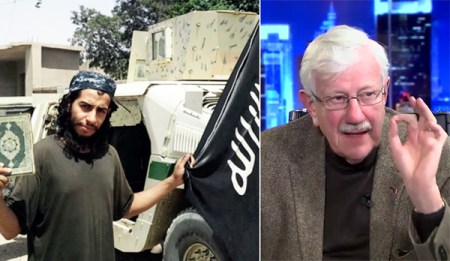
1365Abdelhamid Abaaoud (left), suspected by French authorities of masterminding this month’s terrorist attacks in Paris, is — like many terrorists in Europe — from Molenbeek, Belgium. Philippe Moureaux (right) was mayor of Molenbeek for 20 years, thanks to his alliance with radical Islamists.

There was heavy rioting in 2009 during Ramadan in Molenbeek. Muslim youths set up barricades made of burning tires, set cars ablaze, threw rocks at firefighters who came to put out fires and, equipped with rocks and crowbars, looted stores. According to unconfirmed reports, the police received the following order: “Do not provoke them, do not search them, do not intervene, even if dozens of them come together, do not issue warnings for harassment, not even if they throw rocks at you.”

Jewish shop-owners were also harassed other than at Ramadan. In 2008, the Flemish magazine Dag Allemaal reported on “youths” yelling, “The Jews are our worst enemies,” in the streets of Molenbeek. There used be many stores run by Jews on the Rue du Prado and the Chaussée de Grand in Molenbeek, but in 2008, with the exception of one furniture store, they suddenly disappeared. And nobody seemed bothered by this, especially not Mayor Moureaux.

None of the Jews wanted to speak with the Dag Allemaal reporter, out of fear of reprisals. The one exception was a man whom the paper referred to as “René.” René ran a barbershop for over 30 years in the Chaussée de Gand. Then came a series of acts of violence. It began with graffiti on his shop’s windows: “Sale youpin” (“dirty Jew”) and other anti-Semitic slogans. Later on, six Muslim youths stormed into his shop, destroyed the furnishings and punched René in the face. He called the police. An hour later, the youths returned in order to “punish” him; they broke all the mirrors. For more than 35 years, René had built up a large and loyal customer base, but after this attack, most people were afraid to visit his shop. He had no other choice but to close it.

How did Moureaux react? By accusing Belgian Jews of wanting to deny Muslims the “right to diversity.” That is what he said in 2008, in the weekly paper Le Vif L’Express. It was a report with the title: “Enquête Moureaux, Shérif de Molenbeek, drogué du pouvoir – Son islamo-municipalisme” (“The Moureaux Investigation: Sheriff of Molenbeek, addicted to power — His Islamo-municipalism”). That he was “addicted to power” (“drogué du pouvoir”) were his own words. The paper described him as a “soaring intellectual, university professor and brilliant minister, who resides in the beautiful Uccle district.”

But back to Moureaux’s Jews: At 20 years old, Moureaux was a Marxist, he said, and never accepted anybody’s right to diversity; but he “evolved”: “What changed my mind were talks with the representatives of the Jewish community. It saddens me today to see how they deny the Muslims the right to diversity.”

This “right to diversity” was not granted to citizens by Moureaux during Ramadan. In a press release with the title, “Ramadan regulations for everyone,” Moureaux appealed to citizens in August 2011 to stop driving into the center of Molenbeek in the afternoon during the month of Ramadan, because Muslims are doing their shopping there.

In January 2015, after the massacre of the staff of the satirical magazine Charlie Hebdo and the murder of four Jews in Paris’s HyperCacher supermarket, the now-retired mayor gave an interview to Maghreb TV, a channel broadcast via the internet, the target audience for which is North Africans in Belgium. After he made an appeal not to hold all Muslims responsible for the actions of a few terrorists, it got wild:

“Many have an interest in dividing us. … Unfortunately, these people can be found everywhere. There is a contagion of the problems of the Middle East, in the Near East, the Israeli-Palestinian problem, which leads to some having an interest in provoking local disagreements, like a reflex to what happens over there. … It will be said that it is coming from both sides. But it is obvious that they are trying to create hatred for Arabs here in the West, in order to justify the policies of the state of Israel, policies that appear unacceptable to me.”

It is supposed to be Israel’s fault when the Arabs of Belgium — and especially those of Molenbeek — have a bad reputation? This type of anti-Semitic resentment is unfortunately not only typical for Moureaux, but for his entire party. In March 2013, the Socialists of Molenbeek issued an invitation to an event titled: “What if we freely and calmly spoke about Zionism?” On the invitation flyer was an anti-Semitic caricature, drawn in the style of Der Stürmer, by the Arabic neo-Nazi “Zéon.” After loud protests, the Socialists cancelled the event — on the grounds that the aspired-to “calm” discussion was unfortunately no longer possible.

Many examples can be listed to show what an anti-Semitic environment prevails in Molenbeek. In the official town magazine, “Molenbeek Info,” one can find a text in which the Stalinist Party of Work calls for a celebration in honor of Dr. Hanne Bosselaers, who had just returned from Gaza: “Everybody come!” In Molenbeek, you need to know, there is a hospital run by Stalinists under the name “Medicine for the People” (“Medécine pour le peuple”), which in 2013 initiated a “partnership” with Al-Quds Hospital in Gaza. Consequently, Bosselaers had a lot to talk about. For example: “The Palestinians want us to boycott Israel.”

And what did Dr. Bosselaers have to say about Hamas?

“Behind the attempt of some of our politicians to cast the Palestinian resistance organization in a negative light lies a political goal. Certain circles keep pointing out the “Islamic character” of Hamas, in the hope of keeping the population from forming solidarity with the Palestinians…. The Palestinian resistance is much greater than Hamas, and it is completely up to the Palestinians to decide which form of resistance they choose against their oppressors.”

Welcome to Molenbeek. The jurist Etienne Dujardin recently wrote in the news portal Levif.be that the conditions in Islamist terror districts such as Molenbeek, Verviers or Saint Denis also had something to do with the deliberate efforts of some politicians, who find welcome campaign workers in radical Islamic circles:

“[p]arties have been practicing a form of cronyism based on elections; they all used the same radical mosques as mouthpieces for their election campaigns. Some saw them as a massive pool of easily available votes.”

And that is how it seems Mayor Moureaux observed that he could personally profit from the transformation of Molenbeek into a bastion of jihad. As he himself lives in a wealthy district, he was able to reject with great arrogance citizens who complained about excessive crime. He won elections by catering to radical Islam. Once again, the rule is confirmed: If someone agitates against Israel, it is always a symptom of other serious character flaws in that person. Behind the anti-Israel agitation of Moureaux lay a corrupt mayor, who only cared for his office and his income; who, as he himself said, was “addicted to power.” That his town was transforming into a hell of criminality, anti-Semitism and Sharia, he either did not care about or actually welcomed. Those who fled from Molenbeek could no longer participate; and those who moved there liked what Moureaux was doing: encouraging Islamization and agitating against Israel and Jews. This is how Molenbeek became, during the term in office of just one man, what it is today.

Originally published in German in slightly different form by Audiatur Online.

Brussels Placed at Highest Alert Level; Subway Is Closed

November 21, 2015

Brussels Placed at Highest Alert Level; Subway Is Closed, New York Times, 

22brussels-web-master675Belgian soldiers patrolled a nearly deserted street on Saturday in central Brussels, after the government raised the country’s threat level to its highest. Credit Youssef Boudlal/Reuters

BRUSSELS — The Belgian authorities halted public transit, canceled soccer games and warned citizens to avoid shopping centers, airports, train stations and concerts in the Brussels region early Saturday, warning that the capital was vulnerable in the wake of the Paris terrorist attacks.

The Belgian government’s threat analysis unit raised the country’s threat level to 3 on Monday, warning of a “possible and likely threat.” On Friday night, it raised the threat level to 4 for the capital region, Prime Minister Charles Michel announced.

“Level 4 means that the threat is serious and imminent,” Mr. Michel told reporters on Saturday. “The raising of the threat is a result of information, relatively precise, of a risk of an attack similar to the one that unfolded in Paris.” He said the threat involved “multiple individuals capable of striking a number of sites with weapons and explosives, maybe at the same time.”

At least four of the Paris attackers lived in the Brussels area.
manhunt-for-paris-attackers-1447609607029-master495-v17

Abdelhamid Abaaoud, who is believed to have been the chief planner and who died in a police raid outside Paris on Wednesday, lived in the Molenbeek neighborhood, as did Ibrahim Abdeslam, one of the suicide bombers, and his brother Salah, who is at large. Another suicide bomber, Bilal Hadfi, lived in the Neder-Over-Heembeek district.

The arrests of two other Belgians in connection with the attacks have further raised alarm here.

A person who was arrested on Friday in Brussels has been charged with “participation in terrorist attacks and participation in the activities of a terrorist organization,” a federal magistrate, Eric Van der Sijpt, announced on Saturday.

A search of the person’s house came up with a weapon, but no explosives, Mr. Van der Sijpt said. He did not name the person, but several Belgian newspapers described him as a 39-year-old Moroccan who lives in the Jette section of Brussels, gave help to Salah Abdeslam after the attacks and has a brother who is fighting in Syria. The government had already arrested two other Belgians, accusing them of helping Mr. Abdeslam by driving him from Paris to Brussels.

Also on Saturday, Turkish authorities arrested an Islamic State militant at a luxury hotel in Antalya, along with two others. They identified him as Ahmad Dahmani, 26, a Belgian of Moroccan descent, and said he was trying to illegally cross the border into Syria.

“We believe that Dahmani was in contact with the terrorists who perpetrated the Paris attacks,” said a Turkish official who spoke on condition of anonymity, in line with government protocol.

Mr. Dahmani arrived from Amsterdam on Nov. 14 — the day after the Paris attacks. “There is no record of the Belgian authorities having warned Turkey about Dahmani — which is why there was no entry ban,” the official said, adding, “Had the Belgian authorities alerted us in due time, Dahmani could have been apprehended at the airport.”

The storming on Friday of a hotel in Bamako, Mali, added to the anxieties in Belgium. Six Belgians were held hostage in the hotel, of whom four were released and two were killed, Foreign Minister Didier Reynders said on Saturday.

Mr. Michel, in his news conference, said the suspension of service on the Brussels Métro would be reassessed on Sunday afternoon.

“We ask you to remain peaceful and avoid panic,” Mr. Michel said. “It is a serious situation and we are trying with the security forces to do everything to keep the situation under control.”

Earlier in the week, Mr. Michel said he would push legal changes to make it easier to capture and try suspected terrorists operating in Belgium and seek constitutional changes to extend, to 72 hours from 24 hours, the period terrorism suspects can be held by the police without charge.