Posted tagged ‘Arab nations’

Qatar’s Shopping Spree to Buy and Displace the West?

November 11, 2016

Qatar’s Shopping Spree to Buy and Displace the West? Gatestone Institute,Giulio Meotti, November 11, 2016

Qatar sits on the executive board of the United Nations Educational, Scientific and Cultural Organization (UNESCO), the UN agency that has just erased 3000 years of Jewish history in Jerusalem, and has set its sights on the main chair at UNESCO: as the successor of UNESCO’s secretary general, Irina Bokova.

Human rights organizations have already promoted a campaign to prevent Qatar’s Kawari from taking the UNESCO seat. Citing a vast amount of anti-Semitic material present at the Doha Book Fair, Kawari’s flagship, the Simon Wiesenthal Center launched a campaign against his candidacy.

Qatar is the puppeteer behind UNESCO’s anti-Semitic resolution on Jerusalem, and a world center of Islamic extremism. Qatar does not make a secret of trying to submit Western culture to the Muslim crescent.

The Soviet Union, during the Cold War, invested in propaganda operations in the West to subvert capitalism and democracy. Communism found precious allies in the so-called “useful idiots” who facilitated Soviet work in academia, newspapers and publishing houses. Political Islam has been using the same convenient outlets and mechanisms to spread Islamic sharia law in the West.

The old role of Soviet propaganda has now been taken up by Islamic regimes. Qatar, for instance, is not only interested in buying large segments of Europe’s economy (Hochtief, Volkswagen, Porsche, Canary Wharf and Deutsche Bank), but also in playing a key role in Europe’s culture.

Qatar sits on the executive board of the United Nations Educational, Scientific and Cultural Organization (UNESCO), the UN agency that has just erased 3000 years of Jewish history in Jerusalem, and has set its sights on the main chair at UNESCO: as the successor of UNESCO’s secretary general, Irina Bokova.

The favorite for this race is, in fact, the former minister of culture of Qatar from 2008 to 2016, Hamad bin Abdulaziz al Kawari, who currently serves as “cultural adviser to the Emir,” Sheikh Tamim bin Hamad Al Thani. In 2017, the UNESCO leadership is supposed to go to a representative of the Arab world, according to the rule of geographic rotation; Kawari will have to defeat the candidacy of a Lebanese and an Egyptian.

Kawari recently landed in Rome, apparently to start his promotional tour, and he met with its mayor, Virginia Raggi, who received the Islamic emirate’s delegation. Kawari received an honorary degree from Tor Vergata University, Rome’s second most important university. The photo of the ceremony speaks volumes about political Islam’s level of penetration in Europe’s academic culture. Abdullah Bin Hamad Al Attiyah, Qatar’s former deputy prime minister, even spoke at Tor Vergata.

2037Qatar’s Hamad bin Abdulaziz al Kawari (center), who serves as “cultural adviser to the Emir,” is pictured receiving an honorary degree from Rome’s Tor Vergata University last month. (Image source: Askanews video screenshot)

Kawari also had a meeting with Italy’s minister of culture, Dario Franceschini and minister of education, Stefania Giannini.

Last June, Kawari was also in the Vatican to meet with Pope Francis and sign an agreement between the Vatican Apostolic Library and the Qatar Foundation for Education. Kawari, fluent in Arabic, English and French, is an affable man of the world, at home in Paris, where he graduated from Sorbonne University; his climb to the leadership of UNESCO has the support of the rulers of the Gulf and Saudi Arabia.

Human rights organizations have already promoted a campaign to prevent Kawari from taking the UNESCO seat. Citing a vast amount of anti-Semitic material present at the Doha Book Fair, Kawari’s flagship, the Simon Wiesenthal Center launched a campaign against his candidacy. In a letter to Kawari, Shimon Samuels, Director for International Relations of the Wiesenthal Center, said the material on display every year in Doha “violates the values promoted by Unesco“.

Samuels listed at least 35 anti-Semitic titles, including nine editions of the anti-Semitic forgery The Protocols of the Elders of Zion, four editions of Mein Kampf by Adolf Hitler, and four editions of Henry Ford’s The International Jew. “From this point of view, Doha is far from Paris,” said Samuels, referring to the general headquarters of UNESCO.

Qatar is the puppeteer behind UNESCO’s anti-Semitic resolution on Jerusalem, and a world center of Islamic extremism. Doha just held a meeting between the Palestinian Authority’s leader, Mahmoud Abbas, and the heads of Hamas, a terrorist organization devoted to the destruction of the State of Israel. Qatar does not make a secret of trying to submit Western culture to the Muslim crescent. The only question is, which country’s culture will UNESCO erase next?

The Qatari royal family is now much involved in “the arts.” According to the BBC, “To take a recent example, the Qatari royal family sponsored the Tate’s Damien Hirst retrospective. It’s now moved to Doha, where Tate director Nicholas Serota attended the official launch.” Major works by Warhol, Bacon, Rothko, Koons and Hirst are all thought to have made their way to Qatar.

Qatar is buying academic chairs in Europe’s universities, such as the pact between Doha and Rome’s Tor Vergata. What is the university presumably expected to do for Qatar in exchange for that? Qatar academic purchases are also the subject of Le Monde’s investigation entitled, “Tariq Ramadan: le sphinx,” which details how Tariq Ramadan, the well-known European Muslim intellectual, was been able to obtain a chair at the University of Oxford. Mediapart, the French leftist magazine, ran a long exposé about Tariq Ramadan as “Qatar’s showcase.”

The Qatari monarchy, in 2015 alone, donated £11 million to renew Oxford’s St Antony’s College, where Tariq Ramadan works. Sheikha Moza, the wife of Emir Al Thani, inaugurated the magnificent building designed by the late architect, Zaha Hadid.

Qatar also financed the creation of an Islamic section at the Bloomsbury publishing house and the “Doha Debates” program that aired on the BBC. It would be interesting to know how Qatar’s sharia can find agreement with the sybaritic Bloomsbury’s British culture.

The attorney-general of Qatar also signed an agreement with the president of Sorbonne University, Philippe Boutry, in Paris, for the enrollment of hundreds of migrants from the Middle East. The Sorbonne accepted 600,000 euros a year, for three years.

Many British universities also receive large donations from Qatar. University College London, for example, has an archeology campus in Qatar. The Qatar Development Fund recently donated $4.3 million to the Margaret Thatcher Scholarship Trust at Oxford University.

Qatar is also having a shopping spree in American universities, and is funding their university departments in the Arabian desert. Universities such as Cornell, Carnegie Mellon, Georgetown, Texas A&M and Virginia Commonwealth have all signed agreements with Emir Al Thani. Each will receive $320 million dollars a year.

Students of American Universities based in Doha are also invited to attend the sermons of Yusuf al-Qaradawi, the spiritual mentor of the Muslim Brotherhood, who is known for his hate-ridden religious edicts. The Simon Wiesenthal Center has called it “outrageous” for Cornell University to decide to open a campus in Doha while the kingdom funds Hamas’s war against Israel.

The Financial Times once called Qatar “the world’s most aggressive deal hunter.” Emir Al Thani is now promoting a takeover of Western culture. But very few in Europe seem to care about that. Is it because “it is difficult to avoid its money and influence“, especially for an economically depressed Europe? With their telling silence, are they simply aligning with Qatar’s sharia rulers, and hoping they will chosen to be bought out next?

El-Sissi against the Arab world

October 31, 2016

El-Sissi against the Arab world, Israel Hayom, Dr. Reuven Berko, October 31, 2016

(How different would the situation be now if Obama, Clinton et al had supported Sisi’s “coup” rather than Morsi and the Muslim Brotherhood? — DM)

The attitude of the Arab Gulf states toward Egypt under President Abdel-Fattah el-Sissi is a good example of the insanity of considerable parts of the Arab world, whose twisted suicidal reasoning is unclear to many people outside it.

Given the American wipeout in the Middle East, leaders of the Persian Gulf states are very well aware that the only support they can expect against the expected Iranian aggression on the Arabian Peninsula comes from Egyptian military might. Nevertheless, megalomania, hypocrisy, double talk, and in particular a divisive and violent radical Islamist agenda are leading the Arab leaders to saw off the very branch they sit on.

The competition for hegemony, a tangle of conflicting economic and political interests and defensive manipulations, along with drives for expansion and survival, are leading the Gulf states to arm and fund the radical Sunni terrorist movements in Syria and Iraq to check the growth and terrorism of Shiite Iran, whose military provocations and threat to the Sunni Arab Gulf states is increasing.

But in effect they are encouraging Islamic terrorism in Egypt.

Turkey and Qatar have not accepted the loss of former President Mohammed Morsi and the Muslim Brotherhood, and have not relinquished their dream of an Islamic empire. The Saudis, because of their money, reject Egypt as the “Arab mother state.” Mistaken U.S. policy confers transient status on el-Sissi’s regime. All of Egypt’s attempts to ingratiate itself with Saudi Arabia — the military guarantees, the delegations, and the gifts of the Tiran and Sanafir islands — failed to do the trick.

There is an Arab proverb that says, “Starve your dog so he will obey you.” While battling Iran, the Gulf states are inciting for el-Sissi to be ousted while supplying stingy amounts of money and fuel just to humiliate him and keep him “alive,” beaten, and needy — a thug who can attack Tehran for them. While the Al Jazeera network presents the Egyptian president as a sex criminal, an agent of Iran, Israel, and America, a corrupt official who sells weapons to the Houthi rebels in Yemen, the Egyptian government is vulnerable to incitement and terrorism from the Muslim Brotherhood and their protectors in the Gulf (Al Jazeera), flooding, monstrous demographics (thanks to the Islamic ban on birth control), inflation, shortages of fuel, sugar, rice and raw materials, as well as the threat of the water level in the Nile River dropping and a hit to its $55 billion tourism industry.

To encourage his suffering, restive, exposed-to-incitement people, el-Sissi told them that he lived for a decade with nothing in the refrigerator other than a bottle of water. In response, the Saudi king mocked him, delayed shipments of fuel and visas to Saudi Arabia for Egyptians and made threats that el-Sissi would fall, like then-President Hosni Mubarak. In response to the intra-Arab scheming, el-Sissi invited the Russians to conduct a joint military exercise and recently voted against the Arabs — and with Iran, Russia and Syria — in the U.N. Security Council on a solution to the Syrian crisis, knowing that the fall of Syrian President Bashar Assad and the success of the Islamists would make him the next target. If the Gulf states don’t change their policy soon, they’ll wind up getting a refrigerator full of explosives from him.

Iran’s Chess Board

June 3, 2016

Iran’s Chess Board, Front Page MagazineCaroline Glick, June 3, 2016

official_photo_of_hassan_rouhani_7th_president_of_iran_august_2013

Even if Obama’s successor disavows his actions, by the time Obama leaves office, America’s options will be more limited than ever before. Without war, his successor will likely be unable to stem Iran’s rise on the ruins of the Arab state system.

********************

Reprinted from jpost.com.

Strategic thinking has always been Israel’s Achilles’ heel. As a small state bereft of regional ambitions, so long as regional realities remained more or less static, Israel had little reason to be concerned about the great game of the Middle East.

But the ground is shifting in the lands around us. The Arab state system, which ensured the strategic status quo for decades, has collapsed.

So for the first time in four generations, strategy is again the dominant force shaping events that will impact Israel for generations to come.

To understand why, consider two events of the past week.

Early this week it was reported that after a two-year hiatus, Iran is restoring its financial support for Islamic Jihad. Iran will give the group, which is largely a creation of the Iranian Revolutionary Guard Corps, $70 million.

On Wednesday Iranian media were the first to report on the arrest of a “reporter” for Iran’s Al-Alam news service. Bassam Safadi was arrested by Israel police in his home in Majdal Shams, the Druse village closest to the border with Syria on the Golan Heights. Safadi is suspected of inciting terrorism.

That is, he is suspected of being an Iranian agent.

There is nothing new about Iranian efforts to raise and run fronts against Israel within its territory and along its borders. Iran poses a strategic threat to Israel through its Hezbollah surrogate in Lebanon, which now reportedly controls the Lebanese Armed Forces.

In Gaza, Iran controls a vast assortment of terrorist groups, including Hamas.

In Judea and Samaria, seemingly on a weekly basis we hear about another Iranian cell whose members were arrested by the Shin Bet or the IDF.

But while we are well aware of the efforts Iran is making along our borders and even within them to threaten Israel, we have not connected these efforts to Iran’s actions in Iraq and Syria. Only when we connect Iran’s actions here with its actions in those theaters do we understand what is now happening, and how it will influence Israel’s long-term strategic environment.

The big question today is what will replace the Arab state system.

Syria, Iraq, Lebanon, Yemen and Libya no longer exist. On their detritus we see the fight whose results will likely determine the fates of the surviving Arab states, as well as of much of Europe and the rest of the world.

Israel’s strategic environment will be determined in great part by the results of Iran’s actions in Iraq and Syria. While Israel can do little to affect the shape of events in these areas, it must understand what they mean for us. Only by doing so, will we be able to develop the tools to secure our future in this new strategic arena.

Until 2003, Saddam Hussein was the chief obstacle to Iran’s rise as the regional hegemon.

US forces in Iraq replaced Hussein until they left the country in 2011. In the meantime, by installing a Shi’ite government in Baghdad, the US set the conditions for the rise of Islamic State in the Sunni heartland of Anbar province on the one hand, and for Iran’s control over Iraq’s Shi’ite-controlled government and armed forces on the other.

Today, ISIS is the only thing checking Iran’s westward advance. Ironically, the monstrous group also facilitates it. ISIS is so demonic that for Americans and other Westerners, empowering Iranian-controlled forces that fight ISIS seems a small price to pay to rid the world of the fanatical scourge.

As former US naval intelligence analyst J.E. Dyer explained this week in an alarming analysis of Iran’s recent moves in Iraq published on the Liberty Unyielding website, once Iranian- controlled forces defeat ISIS in Anbar province, they will be well placed to threaten Jordan and Israel from the east. This is particularly the case given that ISIS is serving inadvertently as an advance guard for Iran.

In Syria, Iran already controls wide swaths of the country directly and through its surrogates, the Syrian army, Hezbollah and Shi’ite militias it has fielded in the country.

Since the start of the war in Syria, Israel has repeatedly taken action to block those forces from gaining and holding control over the border zone on the Golan Heights.

Prime Minister Benjamin Netanyahu’s surprising recent announcement that Israel will never relinquish control over the Golan came in response to his concern that in exchange for a cease-fire in Syria, the US would place that control on the international diplomatic chopping block.

A week and a half ago, Iran began its move on Anbar province.

On May 22, Iraqi forces trained by the US military led Iraq’s offensive to wrest control over Fallujah and Mosul from ISIS, which has controlled the Sunni cities since 2014. Despite the fact that the lead forces are US-trained, the main forces involved in the offensive are trained, equipped and directed by Iran.

As Iraqi forces surrounded Fallujah in the weeks before the offensive began, Qassem Soleimani, the commander of the Revolutionary Guards’ Quds forces, paid a public visit to the troops to demonstrate Iran’s dominant role.

The battle for Fallujah is a clear indication that Iran, rather than the US, is calling the shots in Iraq. According to media reports, the Pentagon wanted and expected for the forces to be concentrated in Mosul. But at the last minute, due to Soleimani’s intervention, the Iraqi government decided to make Fallujah the offensive’s center of gravity.

The Americans had no choice but to go along with the Iranian plan because, as Dyer noted, Iran is increasingly outflanking the US in Iraq. If things follow their current course, in the near future, Iran is liable to be in a position to force the US to choose between going to war or ceasing all air operations in Iraq.

On May 7, Asharq al-Awsat reported that the Revolutionary Guards is building a missile base in Suleimaniyah province, in Iraqi Kurdistan.

A senior IRGC general has made repeated visits to the area in recent weeks, signaling that the regime views this as an important project. The report further stated that Iran is renewing tunnel networks in the region, built during the 1980-88 Iran-Iraq War.

Dyer warned that depending on the type of missiles Iran deploys – or has deployed – to the base, it may threaten all US air operations in Iraq. And the US has no easy means to block Iran’s actions.

To date, commentators have more or less agreed that US operations in Iraq and Syria make no sense. They are significant enough to endanger US forces, but they aren’t significant enough to determine the outcome of the war in either territory.

But there may be logic to this seemingly irrational deployment that is concealed from view. A close reading of David Samuels’s profile of President Barack Obama’s Deputy National Security Adviser Ben Rhodes published last month in The New York Times, points to such a conclusion.

Samuels described Rhodes as second only to Obama in his influence over US foreign and defense policy. Rhodes boasted to Samuels that Obama’s moves toward Iran were determined by a strategic course he embraced before he entered office.

A fiction writer by training, Rhodes’s first “national security” job was as the chief note taker for the Iraq Study Group.

Then-president George W. Bush appointed the group, jointly chaired by former secretary of state James Baker and former congressman Lee Hamilton, in 2006, to advise him on how to extricate the US from the war in Iraq.

In late 2006, the ISG published its recommendations.

Among other things, the ISG recommended withdrawing US forces from Iraq as quickly as possible. The retreat was to be enacted in cooperation with Iran and Syria – the principle sponsors of the insurgency.

The ISG argued that if given the proper incentives, Syria and Iran would fight al-Qaida in Iraq in place of the US. For such action, the ISG recommended that the US end its attempts to curb Iran’s nuclear program.

Responsibility for handling the threat, the ISG recommended, should be transferred to the US Security Council.

So, too, the ISG recommended that Bush pressure Israel to withdraw from the Golan Heights, Jerusalem and Judea and Samaria in the framework of a “peace process.”

Such action too would serve to convince Iran and Syria that they could trust the US and agree to serve as its heirs in Iraq.

Bush of course, rejected the ISG’s recommendations.

He decided instead to sue for victory in Iraq. Bush announced the surge in US forces shortly after the ISG published its report.

But now we see, that through Rhodes the Iraq Study Group’s recommendation became the blueprint for a new US strategy of retreat and Iranian ascendance in Iraq and throughout the Middle East.

The chief components of that strategy have already been implemented. The US withdrawal from Iraq in 2011 left Iran as the new power broker in the country. The nuclear pact with Iran facilitated Iran’s transformation into the regional hegemon.

Against this strategic shift, the US’s minimalist campaigns in Iraq and Syria against ISIS make sense.

The US forces aren’t there to defeat ISIS, but to conceal Iran’s rise.

When ISIS is defeated in Anbar and in Raqqa in Syria, its forces are liable to turn west, to Jordan.

The US is currently helping Jordan to complete a border fence along its border with Iraq. But then ISIS is already active in Jordan.

And if events in Iraq and Syria are any guide, where ISIS leads, Iran will follow.

Iran’s strategic game, as well as America’s, requires Israel to become a strategic player.

We must recognize that what is happening in Iraq is connected to what is happening here.

We need to understand the implications of the working alliance Obama has built with Iran.

Even if Obama’s successor disavows his actions, by the time Obama leaves office, America’s options will be more limited than ever before. Without war, his successor will likely be unable to stem Iran’s rise on the ruins of the Arab state system.

In this new strategic environment, Israel must stop viewing Gaza, Judea and Samaria, the Golan Heights and Lebanon as standalone battlefields. We must not be taken in by “regional peace plans” that would curtail our maneuver room. And we must bear in mind these new conditions as we negotiate a new US military assistance package.

The name of the game today is chess. The entire Middle East is one great board. When a pawn moves in Gaza, it affects the queen in Tehran.

And when a knight moves in Fallujah, it threatens the queen in Jerusalem.

That Kissinger Promise and Obama’s Fulfillment

May 30, 2016

That Kissinger Promise and Obama’s Fulfillment, The Jewish PressVic Rosenthal, May 30, 2016

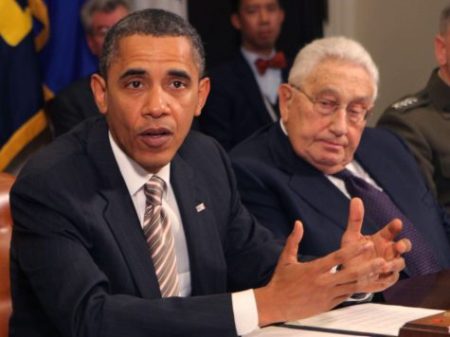
Obama-Kissinger-e1464550543436Pres. Obama seated with Henry Kissinger

{Originally posted to the author’s website, Abu Yehuda}

Old realpolitiker Henry Kissinger was in the news recently when he sat down with Donald Trump, to give him the benefit of his experience. It brought to mind Kissinger’s numerous attempts to get Israel out of the territories it conquered in 1967, before, during and – especially – after the Yom Kippur War.

Kissinger went to Iraq in December of 1975 to try to wean the regime away from the Soviet Union and improve relations with the US. In a discussion with Sa’dun Hammadi, the Iraqi Foreign Minister, Kissinger suggested that American support for Israel was a result of Jewish political and financial power, promised that the US would work to force Israel back to pre-1967 boundaries, and indicated that while the US would not support the elimination of Israel, he believed that its existence was only temporary. Here is an excerpt (the whole thing is worth reading):

I think, when we look at history, that when Israel was created in 1948, I don’t think anyone understood it. It originated in American domestic politics. It was far away and little understood. So it was not an American design to get a bastion of imperialism in the area. It was much less complicated. And I would say that until 1973, the Jewish community had enormous influence. It is only in the last two years, as a result of the policy we are pursuing, that it has changed.

We don’t need Israel for influence in the Arab world. On the contrary, Israel does us more harm than good in the Arab world. You yourself said your objection to us is Israel. Except maybe that we are capitalists. We can’t negotiate about the existence of Israel, but we can reduce its size to historical proportions. I don’t agree that Israel is a permanent threat. How can a nation of three million be a permanent threat? They have a technical advantage now. But it is inconceivable that peoples with wealth and skill and the tradition of the Arabs won’t develop the capacity that is needed. So I think in ten to fifteen years, Israel will be like Lebanon—struggling for existence, with no influence in the Arab world.  [my emphasis] …

Kissinger also promised that aid to Israel, which he presented as a result of Jewish political influence, would be significantly reduced. He indicated that legal changes in the US – he must have been referring to the creation of the Federal Electoral Commission in 1974 to regulate campaign contributions – would attenuate Jewish power and therefore American support for Israel. Naturally, he didn’t foresee the Israel-Egypt peace agreement, which permanently established a high level of military aid to both countries.

He further promised that the US would support a PLO-run Palestinian state if the PLO would accept UNSC resolution 242 and recognize Israel. This of course is what (supposedly) happened in the Oslo accords.

Kissinger insisted that “No one is in favor of Israel’s destruction—I won’t mislead you—nor am I.” But his hint that a smaller Israel might not survive is clear. Surely he understood that a pre-1967-sized Israel (within what Eban called “Auschwitz lines”) would have no chance of surviving, simply because of the strategic geography of the area.

Kissinger was wrong about the Arabs developing the capability to challenge Israel, but their place has been taken by soon-to-be-nuclear Iran and its proxies, who are significantly more dangerous than the Arab states ever were.

US policy, however, has kept more or less the same shape, except that the hypocrisy of insisting that the US supports the existence of Israel but in a pre-1967 size is even more glaring. The substitution of the PLO for the Arab states as the desired recipient of the land to be taken from Israel has barely made a ripple either in America or among the Arabs, suggesting that the policy is more about Israel giving up land than about the Arabs getting it.

The original motivation for Kissinger’s promises was supposedly the desire of the US to replace the Soviet Union as the patron of the Arab states. After the collapse of the USSR and the end of the Cold War in 1991, however, there was no change in policy. Although the Oslo Accords were initiated by left-wing Israelis, the US eagerly embraced them, and the so-called ‘peace process’ became a permanent stick to beat Israel with.

President Obama is especially adept at emphasizing support for Israel’s existence while at the same time demanding that Israel make concessions that would make her continued existence impossible. Apparently agreeing with Kissinger about Jewish power, Obama has worked to reduce the pro-Israel influence of American Jews in numerous ways, such as by providing access to the White House for groups like J Street and the Israel Policy Forum, while marginalizing traditional Zionist organizations like ZOA.

Kissinger’s almost anti-Semitic claim that US support for Israel is bought with Jewish money was probably untrue in 1975 and is even less so today, when a large proportion of American Jews, including wealthy ones, have chosen their liberal or progressive politics over Zionism. The coming struggle over the introduction of a pro-Palestinian plank into the Democratic platform is an indication that the party and with it, many of its Jewish supporters, is moving toward Obama’s position.

The Obama Administration’s program to extricate itself from the Middle East by empowering Iran as the new regional power has given a new impetus to the policy of shrinking Israel. Iran sees Israel as a major obstacle to its hegemony, for both geopolitical and religious/ideological reasons, and is committed to eliminating the Jewish state. Obama found it necessary to restrain Israel from bombing Iran’s nuclear facilities at least once (in 2012), and seems to be prepared to sacrifice Israel in order to achieve his goal of establishing Iranian regional dominance.

Some would go even further and say that Obama’s primary ideological goal is to eliminate Israel and the Iranian gambit is a means to this end, but that is highly speculative! Or maybe it’s a matter of two birds with one stone.

Henry Kissinger didn’t do us any favors, but I think the anti-Israel thread in American policy would have been strong enough without him, running from Truman’s Secretary of State George C. Marshall all the way to Obama’s stable of anti-Zionists like Rob Malley and Ben Rhodes.

Today Israel is long gone from the Sinai, more recently from Gaza, and probably only thanks to the disintegration of Syria, still holding the Golan Heights. I would like to believe that PM Netanyahu was correct when he said that Israel will never leave the Golan. Regarding Judea, Samaria and Jerusalem, I expect that we are about to begin a very difficult time, as the Obama Administration is likely to mount a campaign in its last days to fulfill Kissinger’s promise to the Arabs at long last.

Sisi and Mideast Peace

May 21, 2016

Sisi and Mideast Peace, American ThinkerC. Hart, May 21, 2016

Egyptian President Abdel Fatah al-Sisi’s speech on Tuesday, May 18, set ripples through Israel’s political establishment. Speaking in the southern city of Assiut, Sisi signaled to the Arab world, the Palestinians, and Israel that it is time for an historic breakthrough in peace negotiations.

Responding immediately to Sisi’s comments, Israeli Prime Minister Benjamin Netanyahu stated that he is open to working with Egypt and Arab states towards advancing the peace process, not only with the Palestinians but with the peoples of the Middle East region.

Netanyahu’s comments come on the heels of a visit to Israel by French Foreign Minister Jean-Mark Ayrault. The two men met but disagreed on how to advance peace.

France insists on hosting an international parley to force Israel and the Palestinians to come to the peace table. Israel is against the French initiative.

Netanyahu would like to go beyond the Israeli-Palestinian conflict and work directly with moderate Arab states on a comprehensive peace deal. Sisi could be instrumental in building an Arab coalition for peace which would dismiss or weaken the divisive French initiative, releasing Israel from conceding to European demands.

Former Israeli ambassador to Egypt, Zvi Mazel, is currently working as a Research Fellow at the Jerusalem Center for Public Affairs (JCPA). He is a Middle East expert who has represented Israel’s Ministry of Foreign Affairs as former Ambassador to Sweden and Romania, as well. This writer asked Mazel if Sisi’s comments were spontaneous or were released at this time for political reasons because he wants to strengthen Egypt’s position in the region by helping Israel.

“I don’t think there is a big design… I think that Sisi understands what is going on in the Middle East and he is identifying according to his view — a kind of possibility of advancing the peace process.”

Egypt, Saudi Arabia, the Gulf countries, and Israel have common enemies: Iran and Islamic State. Already there have been discreet diplomatic and business ties between Israel and these nations

According to Mazel, Sisi is also emerging as a strong respected leader among Egyptians despite the Western media’s portrayal of him as a dictator similar to former Egyptian President Hosni Mubarak.

“Sisi sees himself as a president quite stable among his people. I know that this is not the way they think in the Western media — New York Times and company. They see him as a kind of military dictator; absolutely not! He’s a good man. He’s not Mubarak. He’s Sisi.”

Mazel explains that Egypt is on the way to economic sustainable development. This is what Sisi has been focused on over the past two years and he is seeing success. Unemployment has gone down, despite the fact that almost 90 million people live in Egypt and the country is poor.

“He has started something quite positive, and Sisi thinks that the time has come for Egypt to be in the international arena.”

What that means, according to Mazel, is that Egypt’s current role is still minor. Sisi is asking Israelis and Palestinians to go forward, yet he, himself, does not have a plan. But, in the future, Egypt could emerge as a larger player in the region.

Mazel is pragmatic about the short-term. “It’s a positive step for Egypt, but it is not going to change the world.”

Current peace advances that are being prepared for release are not a positive development for Israel: (a) the French Initiative; (b) a document showing the obstacles to Israeli-Palestinian peace efforts soon to be reported by the Quartet; (c) the 2002 Arab Peace Initiative that, despite being outdated, is still considered a serious option by the Arab world.

In the coming days, the Arab League plans to meet and discuss the Israeli-Palestinian conflict. Mazel thinks that Sisi’s statement was good timing for that meeting, but otherwise, was not connected to a bigger scheme.

However, on Wednesday, May 18, American Secretary of State John Kerry arrived in Egypt one day after Sisi gave his emotional speech. Some analysts believe that the U.S. is behind Sisi’s bold words, in an effort to circumvent the French from becoming a new power broker in the Middle East.

The question is whether Sisi’s encouragement will lead to Israel courting the Arab nations and the Arab nations courting Israel, while by-passing the Palestinians. Mazel thinks that kind of change is slow in coming, because the Arabs continue to entrench themselves in old positions that favor Palestinian demands.

Refusing to sit down and negotiate with Israel, the Palestinians have insisted on preconditions which the Arab League has accepted. They demand that Israel agree on the right of return for so-called Palestinian “refugees” to Israeli land; that Israel withdraw to the 1967 borders; and, that Israel stop building in West Bank settlements (Judea and Samaria). Palestinian President Mahmoud Abbas also expects Israel to release hundreds of Palestinian prisoners, who have blood on their hands, serving time in Israeli jails because of terrorist attacks against the Israeli population.

So far, these unresolved issues have kept Abbas away from face-to-face negotiations with Netanyahu. However, his real diplomatic scheme is to get the international community to affirm the Palestinian position and force Israel to concede to Palestinian demands. Right now, Abbas sees the best venue to accomplish his goal as a French-sponsored future peace conference, followed by a stinging UN anti-Israel resolution.

Meanwhile, the future pressure on Israel will be to immediately stop settlement construction in order to get the peace process going. Mazel declares, “Absolutely not… we have to go on! Half a million people live there. And, they are the shield of Israel. We continue to build until there is peace.”

Mazel has a real problem with the demands of the Arab League, as well. “The Arab Peace Initiative is more or less the same as the Palestinian attitude. The ‘right of return’ is still there. It should be taken completely out. Most importantly, the Palestinians and the Arabs should recognize a Jewish State in Israel.”

Mazel is also not sure that Netanyahu’s insistence on widening his government, to provide greater stability, is a wise idea. Reportedly, Yisrael Beytenu Chairman Avigdor Liberman will soon become Israel’s new Defense Minister as Netanyahu brings several more ministers into his coalition. Mazel thinks this will not provide a wider diplomatic envelope; nor, will it help change European or Arab attitudes towards Israel; nor will it end the Boycott-Divestment-Sanctions (BDS) movement against Israel.

Then there is U.S. President Barack Obama’s failed Middle East policy, which includes his lackluster support of American allies in the region. Mazel says this policy cannot continue.

“It cannot be like that, because America is the most important power in the world… And, whoever will win the presidency, whether it will be Mrs. Clinton or Trump, both of them are in a certain way connected to the Middle East.”

Mazel believes that with 22 countries and more than 300 million people living in the region, the next U.S. president will be more engaged in leading the nations into greater stability.

In the meantime, currently 80% of the Egyptian people support Egyptian President Sisi. His nation has already made peace with Israel (along with Jordan). Helping Israel to extend an olive branch to other Arab countries will encourage Egypt to take up an important leadership role in a region that continues to be embroiled in major upheaval and violence.


Perception as deterrence – Israel’s new Defense Minister

May 20, 2016

Perception as deterrence – Israel’s new Defense Minister, American ThinkerRon Jager, May 20, 2016

The recent news that Avigdor Liberman, a former Israeli Foreign Minister and head of the Yisrael Beiteinu party, a small right-wing party, will replace Moshe “Bogie” Ya’alon as the new Israeli defense minister  and has been portrayed by the Israeli media and their elitist opinion makers with dismay and stupefaction.  In Tel-Aviv, a city known for its progressive and leftist inclination, many muttered that the municipality should start opening up the air raid shelters as Lieberman’s appointment hit the airwaves. Lieberman, a politician feared and despised by the Israeli left, is being demonized and delitigitimized even before his appointed has gone into effect. Yet the potential appointment of Avigdor Lieberman as Defense Minister has thrown the whole Palestinian leadership and Israeli Arab politicians into a frenzy, making the reaction by Israel’s leftist elite seem mild. Claiming that Israel is adopting characteristics of a fascist regime and calling for the boycott of Israel; stating that “the Israeli government is sending a message to the world that Israel prefers extremism, dedication to the occupation and settlements over peace,” and encouraging blatant racism, are only a fraction of the derogatory and slanderous accusations against a veteran politician who has been democratically elected.

The potential appointment of Avigdor Lieberman to the position of Defense Minister may very well herald a new and more effective deterrence against the Palestinians’ desire to get up in the morning and murder a Jew. The Palestinian Arab perception of Lieberman as a person who believes in the sanctification of power, ruthlessness, violence, and ignorance with murderous potential can very well be exactly what will cause the Palestinians to adopt a more realistic assessment of what a negotiated settlement will look like.

This is their dilemma, and this is their choice. Either continue and deny reality, taking their chances with a Defense Minister who is perceived as having no problems with employing a strict crackdown wherever Palestinian terror erupts, who has no qualms about enforcing strict rules of engagement, making it crystal clear that Israel’s strategy is based on the adage of our Sages, “If someone rises to kill you, kill him first,” or begin to negotiate seriously and honestly to achieve a sustainable peace agreement with Israel. The perception of Avigdor Lieberman by the Palestinian Arabs could very well facilitate this change.

As Israel’s strategic deterrence and capabilities have been proven to be highly effective in recent years with land, sea, and air strategic capabilities becoming literally impenetrable, the main task facing Israel’s Defense Minister will be primarily in the Palestinian theatre. The Middle East, being a region highly susceptible to a cultural disposition to base one’s reaction on who how one perceives one’s enemy, may very well bring the Palestinian Arab leadership to fold their cards and start the arduous and unavoidable process of negotiating with Israel.

For the majority of the past eight years, President Obama and State Department “experts” have been treating the Israeli-Palestinian conflict as the central generator of political upheaval ravaging the Middle East. They do not realize just how marginal the conflict with the Palestinian Arabs has become or understand that as far as the Sunni Arab nations of the Middle East, the future Palestinian State, should it be established, will be just another failed Arab nation in perpetual conflict with its own people and with her neighbors.

As far as the Palestinian Authority (PA) that resides in Ramallah is concerned, the lack of legitimacy in the eyes of their own people is only exceeded by the widespread and institutionalized corruption by its leaders, sustained by international funding from the United States and the European Union. Having rejected over the years any possibility of a negotiated settlement, the PA leadership have proven without a doubt that they have no intention of reaching any agreement.. The only goal of the Palestinian Arab leadership has been to gain territories and use them for the next attack aimed at minimizing and weakening Israel. Apart from that, there is nothing: No democracy, no economy, no law and no future for the Palestinian Arabs other than being in a perpetual cycle of meaningless and unsuccessful conflict with Israel. Israel will continue to move ahead and forge alliances with Sunni Arab neighbors and the Palestinian Arabs will wallow in their misery as they continue to deny reality and believe in their own made-up propaganda narrative.

The unprecedented political changes having taken place in the Middle East in recent years mainly due to Obama’s irresponsible and failed strategic policy decisions have resulted in new emerging alliances between Israel and her neighbors. Despite the challenges that Iran continues to pose to Israel and the potential of her leaders who might use the conflict with Israel as a means of rallying political support in her war with the Sunni Arab nations, the threat of renewed conventional conflict between Israel and her Arab neighbors has been downgraded, while more realistic scenarios envision a greater focus on economic cooperation and regional stability. Although it is far too early to predict the success of the new political alliances and strategic order that will eventually emerge from the changes in the Arab world, the inherent asymmetry of the conflict between Israel and the Palestinian Arabs will maintain this conflict on low burner for the foreseeable future with sporadic eruptions of terror and limited missile attacks similar to what that the Israeli population has had to endure in recent years.


Britain’s “Routine and Commonplace” Anti-Semitism

May 2, 2016

Britain’s “Routine and Commonplace” Anti-Semitism, Gatestone Institute, Richard Kemp and Jasper Reid, May 2, 2016

♦ Each of these politicians accused of anti-Semitism was voted into power by an electorate who knew exactly what their views were. Had they not held these views, they would not have been elected.

♦ “Anti-Semitism isn’t just tolerated in some sections of the British Muslim community; it’s routine and commonplace.” — Mehdi Hasan, British Muslim political journalist.

♦ The consequences of Western politicians’ continued weakness and appeasement are far greater than encouraging anti-Semitism and undermining the State of Israel. It is the fatal and irreversible descent of their own countries.

Battle-hardened British soldiers were moved to tears by the horrors they witnessed at the Nazi charnel house of Bergen-Belsen when they liberated the concentration camp in April 1945. Yet seventy years after thousands of troops fought and died to destroy the regime that murdered six million Jews, the scourge of anti-Semitism is again on the march across Europe.

In just one week, a British student leader, a Labour Party constituency MP, a London council leader, a member of Labour’s National Executive Committee and even Labour leader Jeremy Corbyn have all been accused of being mired in Jew-hatred.

It is the tip of the iceberg. Each of these people was voted into power by an electorate that knew exactly what their views were. Had they not held these views they would not have been elected.

All are on the political left, but the problem does not stop there. The cancer of Jew-hatred today spreads from right to left throughout European nations and in all supranational bodies including the European Union and the United Nations. It is led by politicians, human rights groups and the media, whose contorted worldview has contaminated ordinary people on a scale unimaginable possibly even to the arch-propagandist Dr. Josef Goebbels himself.

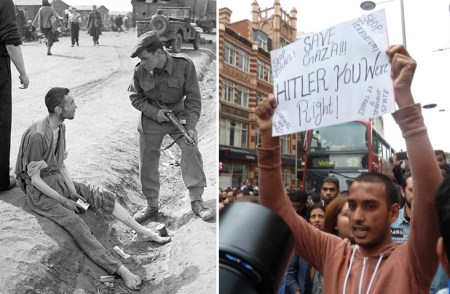
1575Seventy years after thousands of British troops fought and died to destroy the regime that murdered six million Jews, the scourge of anti-Semitism is again on the march. Left: A British soldier talks to an emaciated prisoner after the liberation of Bergen-Belsen in April 1945. Right: An anti-Israel protestor in London holds up a sign saying “Hitler you were right,” in July 2014.

In the 21st Century, outside the Middle East, it is hard to express hatred of Jews publicly. So Jew-haters everywhere have adopted a proxy: the Jewish state. Israel is the acceptable target of their hate. That is why Labour MP Naz Shah’s “solution,” with chilling echoes of Reinhard Heydrich, was to “transport” all the Jews out of Israel, with the obvious implication that this would be done forcibly and violently.

It is why National Union of Students President Malia Bouattia advocated violence against Israel and accused the international media of being “Zionist-led.” It is why Muhammed Butt, a London Labour council leader, shared a Facebook post denouncing Israel as “a terrorist state like ISIS.” It is why former London Mayor and Labour National Executive member Ken Livingstone sought to discredit Zionism by his assertion that Hitler supported it.

Where does all this hatred come from? Its long lineage begins with the Muslim prophet Muhammed and its modern form pre-dates Hitler. Back in the 1920s and 30s, murderous Arab gangs attacked Jewish communities in post-Ottoman, British Mandated Palestine and tried to drive them into the sea. They were stopped by Britain’s Captain Orde Wingate, who taught the Jews to defend themselves, fighting alongside British troops.

A few years later Amin al-Husseini, Grand Mufti of Jerusalem, made a deal with Hitler to bring the final solution to the Middle East, but the German advance was halted in its tracks at El Alamein by General Montgomery’s Eighth Army. As soon as the State of Israel was established, 68 years ago this month, by resolution of the United Nations, five Arab armies fell on her with the intent of annihilation. They failed, and ever since have been trying to destroy the Jewish state by military assault and terrorism in all its forms.

Recognizing their collective inability to eliminate Jews from their historic homeland by force, the Arabs have waged a pernicious and all-pervading propaganda war to demonize the Jewish State. Their lies have included the blatant falsehoods that Jewish communities in Judea and Samaria are illegal under international law; that the Israeli government operates an oppressive apartheid state; that the IDF is strangling Gaza under an unprovoked and illegal siege; that successive Israeli administrations have been the sole obstacle to peace in the Middle East; and that Israeli security forces deliberately murder innocent Palestinians in Gaza and the West Bank.

Understanding that the might of the pen is magnified by the flash of the sword, the Palestinian leadership and their Iranian paymasters have frequently used violence to seize international attention. Provoking the Israelis into killing Palestinian people to ensure global condemnation was the true purpose behind the Gaza rocket wars and the recent wave of murderous knife attacks and car-rammings.

Why does the West pander to this religiously inspired hatred and bigotry? There are three fundamental reasons. First, Europe especially is consumed by imperial guilt. Those that are seen to have been historically oppressed and exploited can today do no wrong; Westerners must prostrate themselves at their feet.

Second, every European country depends on Arab oil for its continued existence and relishes the return of its petrodollars through arms sales and massive investment into their economies.

Third, Western governments understand the power of their ever-increasing Islamic populations. They fear the extremism of those who reject Western values and want to violently replace them with the ways of Islamic sharia law. And they calculate the mathematics of the Muslim vote at the ballot box.

They know that among these communities there is widespread and innate hatred of Jews and of Israel. Mehdi Hasan, a British Muslim political journalist, has confirmed: “anti-Semitism isn’t just tolerated in some sections of the British Muslim community; it’s routine and commonplace.” Our politicians believe that by appeasement they will satiate the blood lust of the jihadists and gain the support of Muslim voters.

This is why we see Western leaders condemning Israel for insufficient restraint while defending itself from lethal Hamas rockets, when they know full well Israel has done all it can to avoid civilian deaths. It is why not one single EU member state had the courage to vote against the false condemnation of Israel for war crimes in the UN Human Rights Council last year. It is why the British government unequivocally asserts that Jewish settlements in the West Bank are illegal when it knows they are not. It is why Prime Minister David Cameron, a friend and supporter of the Jewish state, accused Israel of turning the Gaza Strip into a ‘prison camp’ when he knew it had not.

These false and malicious condemnations fuel hatred of Israel and of Jewish people everywhere. They are driven and intensified by a media that is dominated by strident, virulent and unyielding anti-Israel bias.

What of the future? Imperial guilt in Europe shows no sign of diminishing. In fact, the ideology behind it is gaining strength as the EU seeks to undermine national identity in its drive for ever-closer union and the creation of a superstate.

Despite developing energy technologies, there is no prospect of significantly reduced dependence on Middle Eastern oil in the foreseeable future. And with the vast influx of refugees from Muslim countries into Europe, the urge to appease their anti-Semitic and anti-Israel attitudes can only increase dramatically.

This means Israel and the Jews are going to come under even more intolerable pressure, leading to a greater exodus of Jews from many Western nations and the increasing international isolation of the Jewish state.

But there is an alternative. It is that Western political leaders find the courage to reject the virulent anti-Israel prejudice. To speak what they know to be the truth about the situation in the Middle East. To stop encouraging Palestinian leaders to believe their campaign against Israel is going to achieve its goal of destroying the Jewish state. And rather than supporting Palestinian hate with Western dollars, to impose sanctions against their racist and destructive behaviour.

The consequences of Western politicians’ continued weakness and appeasement are far greater than encouraging anti-Semitism and undermining the State of Israel. It is the fatal and irreversible descent of their own countries. By allowing this anti-Semitic hatred, they are betraying the millions of citizens who have fought and died to oppose the sort of malevolent ideologies that are now incubating it.

Lebanon, Christians, Under Islamist Threat

April 24, 2016

Lebanon, Christians, Under Islamist Threat, Gatestone InstituteShadi Khalloul, April 24, 2016

♦ Islamic jihadist groups are threatening Lebanese Christians and demanding that they submit to Islam. Lebanon’s Christians, descendants of Aramaic Syriacs, were the majority in the country a mere 100 years ago.

♦ aad Hariri, a Sunni Muslim politician supported by Saudi Arabia, has invited every Lebanese party to his office to sign a document confirming that Lebanon is an Arab state. This is clearly intended to turn Lebanon into yet another officially Arab Muslim state.

♦ The next step will be to ask that the constitution of Lebanon be changed so that the country be ruled by Sharia law, as with many other Arab and Islamic states, including the Palestinian Authority (PA). The PA constitution declares: “The principles of Islamic Sharia shall be the main source of legislation.”

Recent upheavals in Lebanon are making local Christians communities worry about their existence as heirs and descendants of the first Christians. Christians in the Middle East now are facing a huge genocide — similar to the Christian genocide the followed the Islamic conquest of the Middle East in the 7th century A.D.

Islamic jihadist groups are threatening Lebanese Christians and demanding that they submit to Islam. Lebanon’s Christians, descendants of Aramaic Syriacs, were the majority in the country a mere 100 years ago.

The demand for Christians to convert to Islam was one of the declarations issued by ISIS and other Islamic groups hiding in the mountainous border between Syria and Lebanon.

Saad Hariri, a Saudi-backed Sunni Muslim politician and the son of assassinated Prime Minister Rafik Hariri, recently invited every Lebanese party to his office to sign a document confirming that Lebanon is an Arab state. Arab state equals Islamic laws, as with all members of the Arab League. Why is it so important to Hariri or to the Sunni and Islamic world to include Lebanon as an Arab state and cancel its current name as a Lebanese state only?

And why do the Arab states, including the Palestinian Authority (PA), refuse to recognize Israel, with its 80% Jewish majority, as Jewish state, while at the same time trying to impose the definition of an Arab state on Lebanon, whose population is 35% non-Arab Christians?

There are approximately one million Syriac Maronites left in Lebanon, as well as another 700,000 Christians belonging to other churches. In addition, more than eight million Syriac Maronites live in the diaspora. These eight million Christians fled over the centuries because of persecution by Muslims, often conquerors of the Christian homeland. Lebanon was never a strictly Arab or Muslim. But that is the step that Saad Hariri, as a milder face of the expansionist ISIS ideology, would have us take — under the guise of a modern, moderate, Sunni secular front.

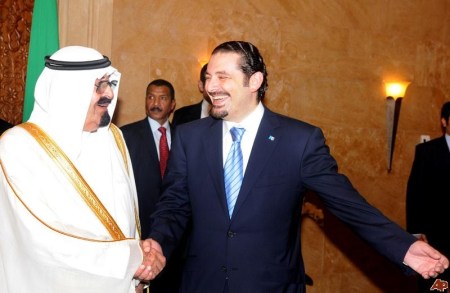
1560Saad Hariri, a Saudi-backed Sunni Muslim politician in Lebanon, recently invited every Lebanese party to his office to sign a document confirming that Lebanon is an Arab state. Pictured above: Saad Hariri (right) with the late Saudi King Abdullah (left) in 2014.

Hariri’s request reveals what the Islamic world is planning for Lebanon, Israel and eventually Europe and the United States. World powers need to protect Christian, Jewish and other minorities in Middle East. Both Lebanon and Israel must remain homelands for persecuted minorities in Middle East — a Christian homeland in Lebanon and a Jewish homeland in Israel — connected to each other geographically, assisting each other economically, and perhaps soon with a peace agreement that could form a peaceful bridge in culture and human rights between the West and the East.

Bashir Gemayel, the great Christian Maronite Lebanese leader who was assassinated after being elected president in 1982, warned the West during Lebanese Civil War that if the Islamic forces fighting against Christians win, they would continue to the Western World, as they are, in fact, doing at present.

This agreement for an Arab Lebanese state being requested by the Sunni leadership is clearly intended to turn Lebanon into yet another officially Arab Muslim state. It aims to negate the rights of the original people in the land, just as the original Christian Copts of Egypt have been overrun, and the Aramaic Syriac Christians of Iraq have been overrun. In Lebanon, the original people of the land are the Aramaic-Phoenician Christians — especially the Maronites — who still preserve Syriac (the language Jesus spoke) as their sacred language. A full 95% of Lebanese villages are still called by Syriac Aramaic names. Islam and the Arabic language came to Lebanon late from Arabian Peninsula, after the seventh century.

Hariri’s wished-for step might also be supported by the Shiite Muslim party of Hizballah: both the Sunnis and the Shiites are Islamic. The next step will be to ask that the constitution of Lebanon be changed so that the land of the cedars is ruled by Sharia law, as with many other Islamic states, including the Palestinian Authority. Article 4 in the constitution of the future Palestinian state clearly notes: “The principles of Islamic Sharia shall be the main source of legislation.”

Implementing Islamic Sharia law means having Muslim sovereignty and control over the Aramaic Christian community.

If this Islamic ideology, implemented by so many countries, is not racism, then what is racism?

Why does the free world, including the churches and secular Western leaders, keep silent and demonize only Jewish Israel for protecting itself from the same threat and ideology?

“Speak the truth and the truth will set you free.” The Christians of Lebanon and entire Middle East can save their existence only by adopting this sacred sentence.

Fatah Official Jamal Muhaisen: The U.S. Is No. 1 Enemy of the Palestinians and Arab-Islamic Nation

March 31, 2016

Fatah Official Jamal Muhaisen: The U.S. Is No. 1 Enemy of the Palestinians and Arab-Islamic Nation, MEMRI TV via You Tube, March 31, 2016

https://www.youtube.com/watch?v=ML1ffCpd-pQ

Jordanian Writer: The Arabs Lag Behind In All Areas – As The World Moves Forward

March 3, 2016

Jordanian Writer: The Arabs Lag Behind In All Areas – As The World Moves Forward, MEMRI, March 3, 2016

On January 6, 2016, Jordanian journalist, writer, and political analyst Jihad Al-Mansi wrote in the Jordanian dailyAl-Ghad, under the title “Careful, The Car Is In Reverse!”, about what he termed Arab society’s position at the bottom of global rankings in science, culture, human and women’s rights, and the war on corruption. He added that it lags behind the rest of the quickly advancing world which “has overtaken us by centuries, perhaps millennia.”

Calling on the Arabs to wake up, take responsibility for their situation and stop blaming others for their problems, he said that instead they should invest their financial and human resources in advancing future generations, because it is no longer possible to rectify the situation of the current generation.

Following are excerpts from his article:[1]

27032Jihad Al-Mansi (Source: Ammonnews.net)

“The world is developing, in the philosophical, scientific, social, creative, educational, and cultural sense; it is on the verge of breaking free of backward gender-driven thinking…

“This is taking place in countries far from our Arab region. There, they are developing scientifically and culturally, competing for the top position in all human indices. At the same time, we, in this region of the world, remain at the bottom of these indices – and some of our countries are absent from them altogether.

“The Nobel laureates in peace, medicine, chemistry, physics, economics, and literature include people from all [countries] – but we Arabs are rarely among them, and for the most part sit in the audience [during the awards ceremonies] or watch them on TV…

“Our only way of consoling ourselves is to reminisce and to recall [Muslim researchers and philosophers such as] Al-Razi,[2] Al-Farabi,[3] Ibn Sina,[4] Al-Kindi,[5] Ibn Rushd,[6] Ibn Khaldun,[7] and others. We do so in disregard of the fact that most of these people, in whom we take pride for human and cultural reasons, were not Arab, and most of them were stoned [to death] or imprisoned, and some had their books burned or were accused of heresy…

“Our problem does not end at [our failure to win] a Nobel Prize. It is manifested much more in the fact that we hold no respectable position on any index or metric concerning freedom of thought, human rights, media, gender, environment, water, or war on corruption; our countries often come last in every field.

“When we participate in the Olympic Games, our countries promote the motto ‘honor for [merely] participating.’ When we want to try for an Olympic medal, our solution is to grant citizenship to [foreign] athletes to do so. We are not among those on the winner’s podium – and if we are, our representation is miniscule. We celebrate every gold medal won by a Comoro Islander as if he had liberated Jerusalem. Kenya, Guinea, or Sierra Leone have medaled 10 times and aim for more – while we and our 22 countries rejoice at [winning] just one. This is despite the fact that the income of some of our countries, and maybe all of them, surpasses that of Kenya, Sierra Leone, and others. But [our] billions in income are squandered on purchasing [sporting] clubs, as we refrain from investing in [our own] human, ideological, and athletic resources.

“We are regressing, instead of progressing, in all fields: We fail in sports; we have no presence in the arts; politically, we execute the agendas of the superpowers and major enterprises, like pawns that move when expected and remain silent when demanded to do so. Economically, we are not welfare states; ideologically, we are influenced, not influencers; with regard to humanity, we reject the other rather than accept him. We accuse anyone who disagrees with us of being an infidel, and think that we’re always right and the world is conspiring against us, never asking ourselves the logical question: Why would the world do this, when we are of no consequence in global, cultural, and human enterprise? We avoid the real answer, and cannot acknowledge that it is we who conspire against ourselves, killing each other and shedding each other’s blood on pretexts based on a legacy that is 1,500 years old, more or less, [pretexts] that are intended to sow ethnic and religious conflicts among the streams and sects…

“Gentlemen, our car is in reverse, and is not moving forward – as the world has overtaken us by centuries, perhaps millennia. We have missed the boat for this generation, and it is beyond rectifying. Will we wake up and invest our financial and human resources to help the coming generations? Will we?”


Endnotes:

[1] Al-Ghad (Jordan), January 6, 2016.

[2] Abu Bakr Al-Razi (865-92) – Persian philosopher who wrote in Arabic and was one of the preeminent physicians of the Muslim world.

[3] Abu Nasr Al-Farabi (872-950) – Muslim mathematician, scientist, physician, and philosopher who also made contributions in psychology, sociology, cosmology, logic, and music. He was known as The Second Teacher, since he was seen as second in knowledge only to Aristotle.

[4] Abu ‘Ali Hussein Ibn Al-Sina aka Avicenna (980-1035) – Persian physician, philosopher, and scientist who was called “one of the greatest thinkers and medical scholars in history” by historian George Sarton.

[5] Abu Yousuf Al-Kindi (801-873) – Arab Muslim philosopher, mathematician, musician, and physician who was called “the Philosopher of the Arabs” and is considered the father of Arab and Islamic philosophy.

[6] Abu Al-Walid Ibn Rushd, aka Averroes (1126-1198) – Muslim physician and philosopher. Born and worked in Cordoba, Spain, and was highly influential on medieval European philosophy.

[7] ‘Abd Al-Rahman Ibn Khaldun (1332-1406) – prominent Arab historian and historiographer. Considered one of the fathers of historiography and sociological and economic research.