Why Iran’s supreme leader fears gender equality

Posted April 1, 2017 by danmillerinpanama
Categories: Feminists, Iran - human rights, Iran - regime change, Iran and women, Iran and young girls, Iranian Islam, Iranian penal code, Iranian resistance, Iranian resistance and women, Khamenei

Tags: , , , , , , , , ,

Why Iran’s supreme leader fears gender equality, American Thinker, Hassan Mahmoudi, April 1, 2017

(Many Western “feminists” complain about their abject misery and don “pussy hats” to make their points. They ignore the far worse situations of their sisters in Islamist regimes such as the Islamist Republic of Iran, while proclaiming the benefits of Islamist fundamentalism. — DM) 

The mullahs of Iran and their fundamentalist disciples are not only the enemy of the people of Iran, but also the enemies of all Middle East nations and the entire world.

In particular, in so far as it concerns women, fundamentalism targets and jeopardizes all the achievements that women have made to date.

Therefore, confronting the Iranian regime should be the immediate goal of women’s struggle all over the world. Women’s international sisterhood and solidarity demands that they support the fight against the fundamentalist regime of Iran.
**************************

For the ayatollahs, women’s rights are a matter of puppetry, with yes-women parroting whatever the mullahs’ line for the day is. For Iran’s real women’s rights champions, the picture is very different. They can demonstrate why the ayatollahs are terrified of equality.

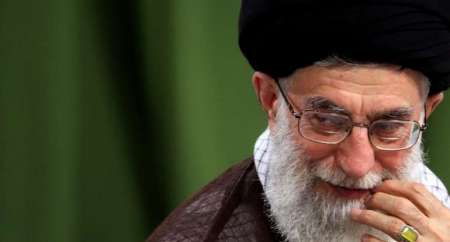
Iran’s Supreme Leader Ali Khamenei, in his address to the nation on the occasion of Nowruz, the Persian New Year, claimed that gender equality is a “Zionist plot” aiming to corrupt the role of women in society. He told a meeting of religious speakers in Tehran that Iranians should resist feminist ideas last March 20.

Khamenei claimed that men and women are equal in the “ascendance of spiritual positions, the power of leadership, and the capability to lead humankind.”

For Khamenei, the occasion of Nowruz, or any national celebration or religious holiday, is nothing but a cynical means of safeguarding his dictatorship. So of course he can make preposterous claims as he did above. In ayatollah-ruled Iran, women’s rights are not about empowering women but just another way to lie to society about state policies. Nothing explains it better than to use the maxim of Adolf Hitler, who said: Make the lie big. Make it simple. Keep saying it, and eventually people will believe it. The ayatollahs use this maxim. But the people in Iran and especially women have never believed his words.

In other contexts, the ayatollah has sung a different tune.

Khamenei said: “the effort to establish equality between men and women was “one of the biggest intellectual mistakes” of the Western world.”

Grotesquely enough, Khamenei has quislings in state women’s groups who echo his sentiment, expressing approval.

One is Minou Aslani, head of the Women’s Basij organization in Iran, affiliated with the Iran Revolutionary Guards Corps (IRGC), which cracks down on women for any sign of independence. It has called the promotion of gender equality illegal and demanded that the country’s powerful judiciary take action against people who speak out against such state-sponsored discrimination, according to the semiofficial Mehr news agency. On Dec. 06, 2016, she condemned efforts to increase the number of women in parliament. Pushing for greater female participation threatens to “distort” the identity of Iran’s women, she said.

Her ‘thinking’ couldn’t be less like those of normal women’s rights activists operating under great pressure in Iran. In a roundtable discussion called Women in Leadership, the Experience of the Iranian Resistance, Mrs. Maryam Rajavi the President-elect of National Council of Resistance of Iran expressed the authentic reality. I have permission to reprint her thinking in full and share it now:

The Iranian women’s struggle for freedom and equality has lasted one-and-a-half centuries. Iranian and Western historians who have studied the developments of the past 150 years in Iran have clearly attested to this reality.

Over this span of time, we have seen vanguard women who rose up and proved their competence in various arenas despite the reigning culture and policies of tyranny and misogyny. This phenomenon was most significantly demonstrated in women’s courageous participation in the anti-dictatorial struggles over this period.

Women’s struggle is essentially the best and most comprehensive indicator of progress in a given society. How can we measure the advances of a society towards real progress and development? The answer is to the extent it endeavors to achieve freedom and equality.

In the absence of gender equality, any political, economic or social progress would be ineffective, fleeting, or reversible.

From this vantage point, the uprisings which led to the 1979 overthrow of the Shah in Iran marked a major leap forward through women’s remarkable and extensive participation in street demonstrations. This new phenomenon unveiled the Iranian people’s widespread desire for progress. At the same time, it revealed a shocking contradiction:

One the one hand, the ruling regime quickly adopted regressive and despotic policies and caused appalling backwardness. On the other hand, the Iranian society was broadly seeking freedom and democracy, and sought to make social progress and advancements.

Such contradiction led in the first step to a major clash. The barbarity and savagery of the new regime drenched the Iranian revolution in blood.

The Role of Women in the Iranian Resistance

Women’s active participation in confrontation with the mullahs’ religious fascism formed the corner stone and foundation of resistance against the regime.

Quantitatively, women’s participation in this struggle was extensive since the outset. Qualitatively, they were brave, efficient and selfless.

Tens of thousands of women were tortured or executed in the struggle against the ruling fundamentalist regime. These events were particularly transpiring in the 1980s.

If women did not have powerful motivations, and if they had not set their sights on a bright and magnificent horizon, they would have definitely been intimidated by the merciless tortures and massacres that were unprecedented in our contemporary history. But, instead, the clampdown made them even more determined and resolute.

Women’s role rapidly became more pronounced in the post-revolution developments in Iran. They became the pivotal force of the movement.

Today, women hold key and leadership positions in the resistance movement. They make up more than 50 percent of the members of the Resistance’s parliament-in-exile.

The guiding principles of women’s role in the Iranian Resistance can be summarized as the following:

First, the struggle of the women of this movement for equality has been deeply intertwined and connected to the broader struggle for freedom in Iran. Therefore, it has targeted the ruling dictatorship, which is a religious tyranny, while combating its forced religious edicts, misogyny and inhumane discriminations.

Second, they have waged a foundational struggle against objectification of women while defying the gender-based ideology that forms the central tenet of inequality.

Third, women have recognized their mission and mandate in leading this movement while discovering and subsequently implementing in practice the fact that the hegemonic role of women in this perseverance provides a liberating force and propeller.

Fourth, the pioneering women have linked their struggle to the efforts and struggle of the resistant and equality-seeking men of the movement. They see it as an important part of their responsibilities to support the men of the movement in the struggle against inequality and against patriarchal thinking and culture.

The Emergence of Islamic Fundamentalism

Iranian women have gained many valuable experiences in their struggle against the ruling religious tyranny, which is the source of Islamic fundamentalism.

A cursory review of the history of the origins of fundamentalism and its essence will aid us in explaining this point more clearly.

Since the late 18th century and early 19th century, in the geographical region that hosts most of the Islamic countries – extending from North Africa to the Caucuses, Central Asia and the Indian Ocean – under the shadow of major political, social and technological developments in the world, the people engaged in struggles to change their destiny. They sought to gain freedom, independence, rule of the law, as well as economic and social progress. Why did this wave wash over Islamic countries?

In such a setting, several destructive factors set the groundwork for the emergence of Islamic fundamentalism. Ignorance, lack of education and backwardness are, of course, some of the contributing factors. Additionally, however, one can mention the interventions and mistakes committed by western governments in these countries, whose catastrophic effects, including invasions and the displacement of peoples and destruction of national social institutions of the countries of the region produced deep antipathy and a sense of resentment toward western countries. This fact has been verified today by quite a few western thinkers and even politicians.

Western governments gave support to dictatorial regimes and thus destroyed the middle class, produced an uneven economic and social growth, and eliminated nationalist parties and freedom-loving movements in these countries.

The Defining Impact of the Iranian Regime

The ascendance to power of Khomeini and his allies in exceptional and unique historical circumstances marked the exact moment when Islamic fundamentalism as we know it entered the global stage. This was a horrendous power-thirsty and profoundly misogynous force founded on religious discrimination. It instituted its backward sharia laws as a mechanism to establish a religious tyranny, and became a model of governance for fundamentalist groups.

In reality, dictatorships like the previous regime of Iran were too weak and corrupt to be able to stand against the waves of people who demanded freedom and particularly against the power of women and youths.

So, instead, religious fundamentalists undertook the mission to crack down on and suppress them.

The Essence of Fundamentalism

At its core, what does Islamic fundamentalism want to oppose or stand against? Is it the world of Islam lining up against the West or in particular against Christianity and Judaism?

The answer is NO. The truth is that the real dispute is not between Islam and Christianity, Islam and the West, or Shiites and Sunnis. It is, rather, a confrontation between freedom and subjugation, and between equality and injustice.

Islamic fundamentalism, in essence, represents a backlash against the overwhelming tendency of the peoples of the region, especially women and youth, towards freedom, democracy and equality.

Enmity against Women

It should now be clear why fundamentalism focuses its wrath and violence against women more than anyone else. It is because women’s emancipation was the central theme of the demands of the enormous tide of people who sought a new order, freedom and equality.

Women emerged as a new force in the 1979 revolution in Iran and played a remarkable role.

For this reason, the role of women rapidly evolved and became more prominent in the course of the developments after the revolution, turning into the pivotal force of movement and struggle.
They were in the frontlines of resistance in torture chambers; they were in the front lines of demonstrations during the 2009 uprising; and they were in the front lines of the command structure in the National Liberation Army of Iran.

In contrast to this, enmity to women lies at the heart of Islamic fundamentalism and suppression of women is the central component for the suppression of the entire society.

Why did the mullahs need to revive the laws of past millennia in the final years of the 20th Century?

Why did they commit such inconceivable crimes under the name of Islam?

The answer is because they faced a widespread and general desire that could only be confronted and contained by naked oppression.

The Iranian regime innovated most of the cruelties and evil crimes that were later

The Iranian Resistance and its vanguard women launched their fight against a regime which not only was the enemy of the people of Iran but the main threat to the entire Middle East.

We have been warning since three decades ago that Islamic fundamentalism is a global threat.

Over the past 15 years, this threat has emerged in the form of terrorism and conflicts in the Middle East.

Today, we can see that European capitals have not remained immune from terrorist crimes carried out by fundamentalists. Wherever fundamentalists guided by the mullahs enter the scene, their terrorism and destruction quickly begins.

In conclusion, I would like to underscore the imperative and necessity for the entire world to confront this ominous phenomenon.

The mullahs of Iran and their fundamentalist disciples are not only the enemy of the people of Iran, but also the enemies of all Middle East nations and the entire world.

In particular, in so far as it concerns women, fundamentalism targets and jeopardizes all the achievements that women have made to date.

Therefore, confronting the Iranian regime should be the immediate goal of women’s struggle all over the world. Women’s international sisterhood and solidarity demands that they support the fight against the fundamentalist regime of Iran.

Cartoons and Video of the Day

Posted April 1, 2017 by danmillerinpanama
Categories: Humor

Tags:

Latma-TV via YouTube


H/t Power Line


H/t Vermont Loon Watch


H/t Town Hall


The way forward on the Iran Nuclear Deal under President Trump | TheHill

Posted April 1, 2017 by Joseph Wouk
Categories: Uncategorized

Source: The way forward on the Iran Nuclear Deal under President Trump | TheHill

The way forward on the Iran Nuclear Deal under President Trump

The way forward for the Iran nuclear deal under President Trump is to tighten enforcement of the Joint Comprehensive Plan of Action (JCPOA, aka, the nuclear deal) and impose sanctions on Iran’s ballistic missile program rather than dismantle the JCPOA.

Breaking News

On Mar. 26, 2016 at an American Public Affairs Committee (AIPAC) meeting, coauthor Raymond Tanter heard Vice President Mike Pence declare, “After decades of simply talking about it, the president of the United States is giving serious consideration to moving the American embassy from Tel Aviv to Jerusalem.”

If President Trump were to relocate the U.S. embassy to Jerusalem, however, it is likely to be opposed by many American allies like Saudi Arabia that are important in pushing back against Iran in the region.  The relocation of the U.S. Embassy to Israel distracts from the greater issue of how to restrain Iran’s malevolent influence in the Middle East in the context of the JCPOA.

In prior years, AIPAC policy conferences focused on hot topics like the Iran nuclear deal; the 2017 conference, however, centered on adjusting to new realities like the JCPOA. Issues considered at one of this year’s breakout sessions dealt with “Holding Iran Accountable,” and the discussion centered on conversations between two types of pundits in Washington: those focused on the Iran nuclear deal and those on non-JCPOA topics like non-nuclear sanctions, ballistic missile testing, state-sponsorship of terrorism, arms shipments to Hezbollah (Party of God), and human rights violations by Iran.

The key matter at hand remains the way forward for the Iran nuclear deal under President Trump. He has already indicated an unwillingness to accept the deal as written under the auspices of the previous administration and the other major powers.

Issues

There are several topics the Trump administration confronts regarding the JCPOA: heavy water, inspections, compliance, and nuclear sanctions. Heavy water reactors permit use of natural uranium as fuel, while light water reactors require enriched uranium, which is much more difficult to produce. As a member of Congress, President Trump’s Director of Central Intelligence Agency, then-Rep. Mike Pompeo cosponsored a bill passed by the House on July 13, 2016, that prevents Iran from purchasing heavy water from the United States.

Inspections of Iran’s nuclear facilities are necessary to ensure compliance, so Iran is unable to “breakout,” “sneakout,” or “creepout.” The last one concerns both open and covert, legal and illicit activities designed to negate JCPOA restrictions prior to the agreed-upon time in which Tehran would be able to do so.

In prepared remarks before the House Foreign Affairs Subcommittee on the Middle East and North Africa, Michael Eisenstadt of The Washington Institute for Near East Policy (TWI) testified that although Iran’s missiles are conventionally armed, many could deliver a nuclear weapon if Iran were to ever acquire such a capability. While the nuclear accord will likely defer such an eventuality, it did not impose new constraints on Iran’s missile program.On the contrary, UNSCR 2231 of July 20, 2015, loosened them, with provisions for lifting them in eight years, if not sooner.

In exchange for Tehran’s agreement to the nuclear deal, the Obama administration granted Iran flexibility for ballistic missile testing. UNSCR 2231 certified the deal, replacing the prohibition with accommodating language: “Iran is called upon not to undertake any activity related to ballistic missiles designed to be capable of delivering nuclear weapons.”

As reported by The Hill, on May 31, 2016, Sens. Robert Menendez, (D-NJ) and Mark Kirk, (R-IL), introduced legislation in 2015 that would extend the sanctions law for 10 years. Sen. Kelly Ayotte, (R-NH), backed by 18 other GOP senators, introduced a separate bill to extend the law through 2031 and require new sanctions tied to Iran’s ballistic missile program.

On Mar. 23, House and Senate legislators introduced bills that would increase sanctions on Iran for its ballistic missile tests and other destructive behavior. Tzvi Kahn, a senior Iran analyst at the Foundation for Defense of Democracies, states that, “The two bills are consistent with U.S. obligations under the 2015 nuclear deal, represent a bipartisan effort to advance an objective that both President Trump and President Obama have endorsed: deterring Tehran’s non-nuclear aggression in the region.”

The foregoing issues were raised in the context of candidate Trump’s stated view that the Obama administration negotiated badly: At one time, he called for tearing up the nuclear deal: “My number one priority is to dismantle the disastrous deal with Iran,” coauthor Tanter heard Trump tell the AIPAC Policy Conference in Mar. 2016. Immediately after the election, on Nov. 14, 2016, however, one of Trump’s advisors said if Trump cannot renegotiate its terms, he may kill it.

Soon, President Trump must decide whether to extend executive order waivers the Obama administration used to suspend some of the non-nuclear sanctions imposed on Iran and how scrupulously to hold the Iranian regime to account for infractions of the JCPOA. On Mar. 1, 2017, Laurence Norman of the Wall Street Journal reported that European officials are growing in confidence President Trump will not shred the nuclear accord. “The test of that will come in May, when the president must decide whether to extend executive waivers that the Obama administration used to suspend some sanctions.”

The Way Forward

In testimony before the House Foreign Affairs Committee on Feb. 17, 2017, David Albright, President of the Institute for Science and International Security and a former weapons inspector whom the Trump administration has consulted on the Iran nuclear deal, testified at a congressional hearing entitled “Iran on Notice.”

Albright’s bottom line: “The Trump administration appears committed to maintaining the JCPOA. This decision makes good sense. But the administration also recognizes that if the deal is to survive and serve U.S. national security interests, the JCPOA needs to be more strictly enforced and interpreted, and its most significant weaknesses need to be corrected.” We concur with the views of Albright as a point of departure for President Trump to consider, per some of his short-term steps.

First, insist Iran create and implement a strategic trade control system that meets international standards and will be subject to review by the Joint Commission mentioned in the JCPOA; second, plug the loopholes in the JCPOA, including ambiguities that permit Iran to obtain heavy water that has not been approved by the “Procurement Working Group;” third, draw on the expertise of the U.S. Department of Justice to pursue extradition and prosecution of  those involved in outfitting Iran’s nuclear, missile, or conventional weapons programs in defiance of U.S. laws and sanctions.

In short, the way forward for the Iran nuclear deal under President Trump is to renegotiate the JCPOA, rather than dismantle it.

Dr. Raymond Tanter served as a senior member on the National Security Council staff in the Reagan-Bush administration and is now Professor Emeritus at the University of Michigan. Edward Stafford is a retired Foreign Service officer; he served in Political-Military Affairs at the State Department, as a diplomat with the U.S. Embassy in Turkey, and taught at the Inter-American Defense College.

With Turks out, Raqqa operation is short of tanks

Posted April 1, 2017 by Joseph Wouk
Categories: Uncategorized

Source: With Turks out, Raqqa operation is short of tanks

DEBKAfile Exclusive Analysis April 1, 2017, 11:33 AM (IDT)
Turkish tanks deployed in Syria

Turkish tanks deployed in Syria

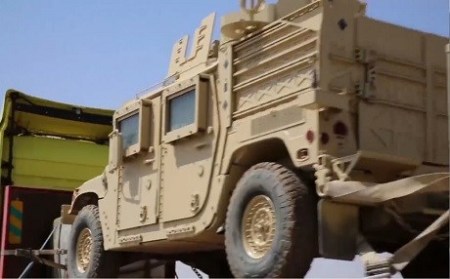
US armored Humvees driving this week from Iraqi Kurdistan to Syria
Except for one missing factor, the United States is in advanced preparations for the operation to oust the Islamic State from Raqqa, its Syrian stronghold, as Mission Mosul winds down in Iraq. Tuesday, March 28, a large convoy of trucks, with the KRG numbers plates of the semiautonomous Kurdish government of Iraq, crossed into Syria at the Semalka border post. Some were heavily laden with arms and ammunition; others hauled armored personnel carriers.

debkafile’s military sources report that the convoys were carrying the war materiel a US airlift is dropping at the KRG capital of Irbil. It includes quantities of heavy submachine guns and light artillery for the Syrian Democratic Forces which are about to lead the US-backed assault on Raqqa.
Two-thirds of the 50,000-60,000-strong SDF consists of Syrian YPG Kurdish militiamen (which can muster up to 75,000 fighters with reserves); the other third are Arab tribesmen from northern Syria.

Three days later, on March 30, Ankara suddenly announced the termination of Operation Euphrates Shield, which was launched with the Turkish invasion of Aug. 24, 2016 and its occupation of 6,000sq,km of land in northern Syria, including later the town of Al Bab, north of Aleppo.

While Ankara claimed Thursday that the Euphrates Operation was terminated after accomplishing its mission, our military sources report that the Turkish army missed its three main objectives:

1. It failed to lay down a 650sq.km security zone ranging from the Turkish-Syrian-Iraqi triangle at one end to the Mediterranean,atn the other.

2. The key Syrian town of Manbij remained in the hands of the SDF i.e. Kurdish control.

3. Turkish troops were unable to dislodge the YPG forces strung along the Turkish border.

Turkey was forced to abandon those objectives by a combined ultimatum slapped down by the US and Russia to cut short its Operation Euphrates, debkafile’s military and intelligence sources report.

The Kurdish heads of the SDF had warned the two powers that they would undertake to lead the Raqqa offensive only on two conditions: First, they demanded guarantees that the Turkish troops deployed to their rear would not take advantage of their absence to seize defenseless Kurdish towns and lands and; secondly, that the Turkish army would not take part in the Raqqa offensive, in any shape or form.

Over and above the official statement, Ankara was also obliged to pledge that Turkish forces would not advance one inch outside their current lines in northern Syria.
To give their ultimatum teeth, American troops took up positions at Manbij opposite Turkish lines, while the Russians moved a unit into the eastern Syrian Kurdish enclave of Afrin facing the Turkish border.

American weapons shipments were meanwhile arriving to arm the SDF force preparing to storm Raqqa. It was then discovered that by excluding any Turkish military role in the operation (as they did for the Mosul offensive), the Americans had left the Kurdish fighters without a tank force for leading the assault. This could have been provided by the Turkish army.

The importance of tanks for the operation is assessed by comparing the military challenges posed by the Mosul and Raqqa offensives.

The battle for Mosul is already going into its seventh month – and still not over – although it is being fought against 2,000 ISIS jihadis by 100,000 Iraq troops backed by American elite forces and heavy artillery.
More than 3,000 jihadists are present to defend Raqqa, according to intelligence estimates put before the US command planners of the operation. They include local Arab tribesmen some of whom they hope may desert, although this is far from certain.
Military experts watching American preparations for the Raqqa operation find that the US planners’ estimate that no more than 15,000 troops are needed capture Raqqa is over-optimistic; and without a tank force, even massive US air support may not be enough to win the day. The APCs the Americans are flying in for the Kurdish units are too few.

At the same time, a decision in Washington to supply tanks would certainly be met with Russian and Turkey objections. It would moreover set the operation back by several months while Kurdish crews are taught how to use them in operational combat.

Iran: A “Paper Tiger”

Posted April 1, 2017 by danmillerinpanama
Categories: Iran - civil unrest, Iran - regime change, Iran and Israel, Iran and President Trump, Iran and Syria, Iran military, Iran scam, Iranian dissidents, Iranian military sites, Iranian missiles, Iranian nukes, Iranian propaganda video, Iranian resistance, Iranian Revolutionary Guard, Iranian technology, Israeli airstrikes, US airstrikes

Tags: , , , , , , , , , , , , , , , ,

Iran: A “Paper Tiger,” Iran Focus, March 31, 2017

(What would Russia do? Please see also, Iran’s Elections: A Breaking Crisis? — DM)

London, 31 Mar – While Iran calls for the destruction of Israel, according to some experts, an American or Israeli attack against the Islamic Republic’s nuclear and military sites would be fairly easy to execute. This is because, although Iran points to technological advancement in their military, it is actually has overextended itself in Syria.

A report published in March by the Middle East Media Research Institute (MEMRI), noted Iran has backed off their provocations against U.S. Navy vessels, and has even ceased their threats to sink these ships in the Persian Gulf. The report continued, “The slogan ‘death to America’ has disappeared almost entirely from the official discourse of regime spokesmen, including Iranian Supreme Leader Ali Khamenei himself, as have public burnings of the American flag.”

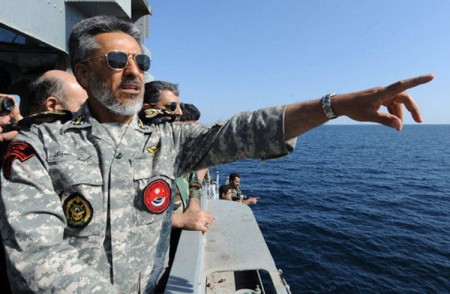
Fars News Agency reported on March 26, that deputy chief of staff of Iran’s armed forces, Brigadier General Masoud Jazayeri, warned the U.S. to be more careful about its warship movements in the Persian Gulf, which is a softer warning than we’ve heard in the past from Iranian leaders.

President and founder of MEMRI, Yigal Carmon, has stated that Iran’s claims of domestic development of military technologies are “complete nonsense,” but said that the country’s acquisition of North Korean missiles is concerning. Carmon said further, that Iran imports North Korean missiles and renames them to give the impression that they were domestically developed.

He explained that Iranian media publishes stories every few weeks about success of their military programs. One such story in January 2013, announced that Iran’s Space Agency had sent a monkey into space, yet pictures of the monkey before and after the “mission” failed to match up. “Iran does not create any quality military equipment, they only are able to buy from abroad. What do they invent to counter U.S. ships? All they are able to come up with is suicide speed boats,” he said.

Iran has also “displayed what they claimed to be domestically built submarines, but when we saw the picture that they put out, we saw that the size would be good for the Baltimore aquarium,” said Carmon.

The ballistics test Iran conducted in January failed. Carmon believes that Iran poses no real challenge to the U.S. “If the U.S. or Israel attack Iran’s nuclear sites and military targets, it will be a done deal,” he said.

A comparison of American and Iranian financial resources may bolster this argument. Fox News columnist Jonathan Adelman, an international studies professor at the University of Denver, wrote in February, “Look at the figures. The American GDP of over $18 trillion is more than 40 times the GDP of Iran ($450 billion)…. Given all this, the fear of Iran getting nuclear weapons still remains real. But, even more real is the notion that the biggest power in the world, plus three significant regional powers (Israel, Egypt and Saudi Arabia), could handle Iran if they would put their minds to it.”

Iran sank $6 billion annually of its resources into the Syrian Civil War, according to Bloomberg News.

Dr. Harold Rhode, a distinguished senior fellow at the Gatestone Institute, and a former U.S. Defense Department official, has stated that while America is strong both militarily and internally, Iran and North Korea “appear strong, but are weak and rotten inside.” Rhode said that while Iran is trying to develop nuclear weapons, it is destroying its country by inaction on domestic problems such as its water crisis. London-based NGO Small Media published a study in March 2016, saying that Iran “faces an unprecedented crisis of water resources that threatens to render vast swathes of the country near-uninhabitable within the coming decades.”

A dangerous opium drug problem is also facing Iran. Rhode speculated that Iranian authorities could crack down on drugs, but ignore it instead, in order “to keep the people preoccupied so they don’t concern themselves with overthrowing the government.”

Rhode believes the American or Israeli approach should be one of strength, but said, “Do we need to have a massive invasion [of Iran]? No. We must show that this regime cannot do what is necessary to keep themselves in power.”

There are alternatives to “actual physical attacks,” such as electronic warfare, when it comes to confronting Iran, according to MEMRI’s Carmon.

Rhode said other options should be considered before putting troops on the ground, including bringing about regime change. “We live in very stable societies, we expect changes to come slowly, but that is not how it works in totalitarian societies like Iran. The moment the people see the regime has lost its ability and willingness to keep itself in power, the regime will topple very quickly, as happened to the shah in 1979. The shah was not willing to do what was necessary to put down the rioting,” he said, and called Iran a “potentially a paper tiger” adding that it is “our job to encourage regime change—and we can.”

Iran’s Elections: A Breaking Crisis?

Posted April 1, 2017 by danmillerinpanama
Categories: Iran - regime change, Iran and President Trump, Iran scam, Iranian dissidents, Iranian elections, Iranian resistance, Iranian Revolutionary Guard, Khamenei

Tags: , , , , , , ,

Iran’s Elections: A Breaking Crisis? American Thinker, Shahriar Kia, April 1, 2017

(If and to the extent that this analysis is correct, we should provide clandestine assistance to the Iranian resistance, both in and outside Iran. In view of the hostility between the current Iranian regime and the Arab League, it might well be willing to do its part. — DM)

The 12th presidential election in Iran will be held on May 19th. These polls are taking place at a time when the regime in Tehran, and especially Supreme Leader Ali Khamenei, are facing three distinct crises.

a)  Khamenei, suffering from prostate cancer, sees his days as numbered and must designate a successor. From March 2015 he has held various sessions with senior regime and Revolutionary Guards (IRGC) officials for this very purpose. Khamenei insists that his successor be clarified prior to his death.

b)  A major policy overhaul in Washington following the end of Obama’s tenure. This has terrified Iran and placed this regime in intense isolation on the international stage and across the region in the face of Arab and Islamic countries.

c)  The presidential election crisis in May.

Khamenei, witnessing his establishment coming to its knees during the 2009 uprisings, is extremely concerned about a repeat scenario. In such circumstances, the possibility of his entire regime crumbling at the hands of a revolting population is very serious and even likely. Khamenei is weighing how to properly engineer the elections while not providing any pretext for popular upheaval.

In contrast to the viewpoints of various parties in the West, the rifts inside Khamenei’s faction and those supporting Iranian President Hassan Rouhani does not arise from a difference between two so-called “moderate” and/or “hardline” mentalities. The fact is that the sham election is a dispute over two solutions aimed at safeguarding and maintaining a religious dictatorship in power, furthering their expansionism and ambitions.

Both factions, including Khamenei and the current formerly represented by the influential Ali Akbar Hashemi Rafsanjani, believe in resorting to a domestic crackdown, obtaining nuclear weapons, meddling in the internal affairs of other countries such as Iraq and Syria, and using instability and terrorism leverage as a tool to pursue their foreign policy. The only difference is how to advance in their goal to realize these objectives. Therefore, when we are talking about two factions, we must not mistakenly compare the Iranian regime with today’s advanced democracies.

Khamenei is considered very weak due to the current crises his regime is facing. In contrast to last year, when he constantly lashed out at Rouhani for the deal sealed to curb Iran’s nuclear program and similar initiatives sought for other purposes, Khamenei refused to mention Iran’s current political crises. Furthermore, following the major U.S,-Iran policy change, Khamenei has set aside his stereotype threats against the U.S. and maintained a state of hesitancy in his remarks.

Khamenei and Election Engineering

Candidates for Iran’s presidential elections will register from April 11th to the 16th. The ultraconservative Guardian Council, a 12-man body directly and indirectly appointed by Khamenei himself, will weigh the candidates’ qualifications from April 17th to the 27th. The elections are scheduled for May 19th.

Iran’s presidential elections always feature a large number of candidates. However, the main candidates from the two main factions must receive Khamenei’s explicit or implicit approval.

“Rouhani’s candidacy was confirmed after gaining the approval of the establishment’s senior officials,” according to the Ebtekar daily.

By establishing the “Popular Party of Revolutionary Forces” and the membership of the same individuals who elevated firebrand Mahmoud Ahmadinejad as president from the ballot boxes back in 2005, Khamenei has revealed signs of how he has engineered the upcoming elections.

In his “Nowruz” message marking the Iranian calendar New Year, Khamenei came to admit his role in the results of the 2009 presidential election.

“I entered the 2009 [presidential election] and stood firm,” he said. In his remarks, Khamenei warned about the May election by stipulating, “I will stand firm and intervene.”

It is worth noting the IRGC command, and especially Quds Force chief Qassem Suleimani, are seeking the candidacy of Ibrahim Reisi, who is also considered one of Khamenei’s options as his successor. Khamenei has yet to reach a final decision over Reisi’s candidacy in the May elections. If he registers as a candidate and fails to become president, his chances of succeeding Khamenei will be severely undermined. And if Khamenei seeks to select Reisi as the next president at all costs, he faces the severe possibility of instigating nationwide uprisings.

What is the Forecast?

Naturally, due to the numerous different elements facing Khamenei and his regime’s factions, forecasting even the near future is quite a challenging task. However, there are three different scenarios facing Khamenei:

1) Eliminating Rouhani and selecting a candidate meeting his standards, and that of the IRGC.

2) Rouhani is severely weakened after losing Rafsanjani, considered a major pillar in the regime’s apparatus. He will be reappointed as president on the condition of succumbing to the hegemony of Khamenei and the IRGC.

3) Rouhani views Khamenei weak in the balance of power and stands as a major opponent against his faction.

Of course, Khamenei prefers to realize the first scenario. If concerns of nationwide uprisings cancel this possibility, he will give in to the second scenario.

Although Rouhani is in favor of the third scenario, considering the society’s powder keg conditions and losing the support of Rafsanjani, such a turn of events would be considered dangerous for both the regime’s factions. This outcome can bring an end to the public’s fear of the regime’s domestic crackdown machine and ignite a new nationwide uprising. This is a red line for both of Iran’s factions.

Those supporting Khamenei, and especially the IRGC, seek to eliminate Rouhani from these elections. However, Khamenei cannot take very bold measures and officially oppose Rouhani’s candidacy. When confirming Rouhani’s candidacy, Khamenei asked him to hold coordinating meetings with Sulemani and IRGC chief Mohammad Ali Jafari. This request brings us closer to the second scenario.

However, the Iranian people and their organized opposition, symbolized in the National Council of Resistance of Iran (NCRI), consider such elections under the mullahs’ regime as baseless and demand free and fair elections held under the United Nations auspices. Such polls are only possible through regime change in Iran and establishing a democratic system.

The Deep State’s War on Ezra Cohen-Watnick

Posted March 31, 2017 by danmillerinpanama
Categories: Benghazi cover-up, Deep state, Ezra Watnick-Cohen, General Flynn, Lt. Gen. H.R. McMaster, National Security Council

Tags: , , , , ,

The Deep State’s War on Ezra Cohen-Watnick, The Point (Front Page Magazine), Daniel Greenfield, March 31, 2017

In totalitarian systems where the media does nothing but churn out propaganda, people learn to read between the lines. You understand what is really going on by inferring what they don’t want you to know from what they do what you to know.

The interesting thing about the current political conflict is which key anti-terrorist Trump figures are being targeted. Flynn was a major target. Then Gorka. The case of Gorka made the targeting obvious. You can tell the targeting when if the first attack fails, they come back with a second one.

Now there’s Ezra Watnick-Cohen. He showed up in the news recently when McMaster attempted to replace him with an establishment infiltrator.

President Donald Trump has overruled a decision by his national security adviser, Lt. Gen. H.R. McMaster, to sideline a key intelligence operative who fell out of favor with some at the Central Intelligence Agency, two sources told POLITICO.

On Friday, McMaster told the National Security Council’s senior director for intelligence programs, Ezra Cohen-Watnick, that he would be moved to another position in the organization.

The conversation followed weeks of pressure from career officials at the CIA who had expressed reservations about the 30-year-old intelligence operative and pushed for his ouster.

But Cohen-Watnick appealed McMaster’s decision to two influential allies with whom he had forged a relationship while working on Trump’s transition team — White House advisers Steve Bannon and Jared Kushner. They brought the matter to Trump on Sunday, and the president agreed that Cohen-Watnick should remain as the NSC’s intelligence director, according to two people with knowledge of the episode.

Cohen-Watnick was brought onto Trump’s transition team and then the NSC by a leading critic of the CIA: retired Lt. Gen. Michael Flynn, who was Cohen-Watnick’s boss at the Defense Intelligence Agency and preceded McMaster as national security adviser.

Cohen-Watnick and Flynn “saw eye to eye about the failings of the CIA human intelligence operations,” said a Washington consultant who travels in intelligence circles. “The CIA saw him as a threat, so they tried to unseat him and replace him with an agency loyalist,” the operative said.

Specifically they tried to replace Cohen-Watnick with a woman at the center of the Benghazi mess.

Two sources within the White House tell me that last week McMaster had interviewed a potential replacement for Cohen-Watnick: longtime CIA official Linda Weissgold. Weissgold apparently had a good interview with McMaster, as she was overheard saying as she left the White House she would next have to “talk to Pompeo”—as in Mike Pompeo, the director of the CIA. But Weissgold was never offered the job; days later, Trump himself overruled the effort to move Cohen-Watnick out of his senior director role.

During the Obama administration Weissgold served as director of the CIA’s Office of Terrorism Analysis. She was among those who briefed Congress following the Benghazi terrorist attack in 2012, a team of intelligence and military experts who reportedly earned the nickname “the dream team” within the administration.

In her position at OTA, she was also involved directly in drafting the now infamous Benghazi talking points, which government officials revised heavily to include factually incorrect assessments that stated the attackers were prompted by protests. According to the House Select Committee on Benghazi’s report, Weissgold testified she had changed one such talking point to say that extremists in Benghazi with ties to al Qaeda had been involved in “protests” in the Libyan city, despite the fact that no such protests had occurred there on the day of the attack.

McMaster’s interview of Weissgold last week raised eyebrows beyond the White House, with members of the congressional oversight committees expressing concerns about Weissgold to top officials in the White House and the intelligence community.

If at first you don’t succeed, try again. Now Ezra Watnick-Cohen is at the center of the latest manufactured scandal. 

A Jewish security official has been named as the confidential source of House Intelligence Committee chairman Devin Nunes (R-CA) following claims that US President Donald Trump and his aides were swept up in surveillance by US intelligence agencies, The New York Times revealed Thursday.

Citing unnamed US officials, the Times identified the White House official as “Ezra Cohen-Watnick, the senior director for intelligence at the National Security Council.”

Why would you not believe “unnamed officials”?

But what we are seeing very obviously is some of the shape and texture of the war based on who is being targeted and why. While those doing the targeting are “unnamed”, their targets are named. And that tells us also about those doing the targeting. Any enemy action reveals something about the enemy, his motives, his nature and his goals. That is how wars of this kind must be understood.

The Real Winner in the Russia Investigations Is Iran

Posted March 31, 2017 by danmillerinpanama
Categories: 2016 elections and Russia, Alleged Russian hacking, America vs Russia, Democrats and Russia, Iran and President Trump, Iran scam, Iranian Revolutionary Guard, Russia and Iran, Russia and Trump, Russia and U.S., Russophobia, Trump and Putin, Trump and Russia, US Congress

Tags: , , , , , , , , , , , , ,

The Real Winner in the Russia Investigations Is Iran, PJ Media, Roger L Simon, March 30, 2017

The best interests of the United States would be to woo Russia away from these maniacs — and we very well could have.  We are, at least for now, still the world’s biggest GNP and control a great deal of the global economy.  Greedy despots like Putin know that as well as anybody.  They may not feel good about it, but to some degree they might play with us.  And if they wanted to enough, if we sweetened the pot enough, they’d even disengage from the mullahs, leaving them with no ally of value, no substantial defender.

Trump — or some people close to him — may have had this in mind when they started speaking with the Russians way back in the Paleolithic Era of the transition days.  They’d have been fools not to.  They wouldn’t have been doing their duty to the United States or to the civilized world for that matter.

Now Trump or his people can no longer even consider making such inroads. They would be accused immediately of treason or something close. The possibility of separating the Russians from Iran has been destroyed by these investigations — first by the House, now by the Senate, and always by the media.

*****************************

While the Evil Party and the Stupid Party continue to bludgeon each other into extinction over whether Putin was manipulating our election, the real winner from our politicians’ current endless Russia-fixation is the Islamic Republic of Iran.

Sound like a stretch? Not at all. The reasons should be evident.

Russia is not rich. It currently ranks 12th  in overall GNP, about even with Australia, which has roughly one-seventh Russia’s population. It’s a dismal 47th in per capita GNP — unimpressive, to say the least, for the world’s largest country with immense natural resources spread over 11 time zones.

And things have not been looking up. Their population has been declining since 1991.  The price of oil — by far their largest export -0 is down.  Making matters worse, Donald Trump, allegedly Putin’s best friend, has opened the U.S. energy spigots, threatening to drive that price even lower. (Putin would have done a lot better with Hillary’s anti-fracking position, assuming that wasn’t a phony.)

Yes, they have a powerful nuclear arsenal with potent missiles to deliver them, but Russia needs friends, badly — especially to shore up its forces in the seemingly never-ending civil war in Syria. Enter Iran.  From Reuters Monday:

Iran’s president met Russia’s prime minister on Monday in a bid to develop a warming relationship that has been greatly strengthened by both sides’ involvement on the same side of the war in Syria.

Beginning a visit to Moscow, President Hassan Rouhani told Prime Minister Dmitry Medvedev: “I hope that a new turning-point in the development of our relations will be reached.”

Iranian arms purchases and Russian investment in the Iranian energy sector are likely talking points for Rouhani, less than two months before Iran’s May 19 presidential election.

Iranian media say he will discuss several economic agreements – potentially valuable prizes for the moderate leader [sic], who is keen to show his people that Iran is benefiting from its 2015 deal with world powers to rein back its nuclear programme in returning for an easing of international sanctions.

Aside from Reuters’ credulous nonsense that Rouhani is in any way moderate, where did all the mullahs’ new deal-making money come from in the first place?  Well, we know.  Iran, for reasons still unfathomable, received huge amounts — sometimes in cold, hard cash — from the Obama administration after the Iran deal and later apparently to preserve it. (The contents of that deal, unknown to all but a few, are what really deserve a congressional investigation, not the present kangaroo court.) What did the mullahs do with the cash? Help their impoverished citizens or buy $10 billion worth of modern weapons from the Russians? Well, we know that too. Obama’s deal helped create a match made in Hell.

And the worse part of this Hellish match is Iran, not Russia (although she’s no picnic).  Vladimir Putin is obviously a dictatorial plutocrat with massive ambitions, but he’s more or less sane.  The mullahs of Iran are also dictatorial plutocrats, but they’re not (sane).  Some of them believe absolutely delusional theories dreamed up in the seventh century and have set out to prove them true — in Iran, in Syria, in Yemen, in North Korea, in South America,  and on and on.  They are as crazy as ISIS and far more dangerous because they already have a large country from which to enact their imperialist/millennialist fantasies.

The best interests of the United States would be to woo Russia away from these maniacs — and we very well could have.  We are, at least for now, still the world’s biggest GNP and control a great deal of the global economy.  Greedy despots like Putin know that as well as anybody.  They may not feel good about it, but to some degree they might play with us.  And if they wanted to enough, if we sweetened the pot enough, they’d even disengage from the mullahs, leaving them with no ally of value, no substantial defender.

Trump — or some people close to him — may have had this in mind when they started speaking with the Russians way back in the Paleolithic Era of the transition days.  They’d have been fools not to.  They wouldn’t have been doing their duty to the United States or to the civilized world for that matter.

Now Trump or his people can no longer even consider making such inroads. They would be accused immediately of treason or something close. The possibility of separating the Russians from Iran has been destroyed by these investigations — first by the House, now by the Senate, and always by the media. They go on and on even though there has been no genuine evidence of collusion between the Trump team and the Russians. By now it’s like a bad mini-series that somehow wound its way onto your Netflix queue and you can’t get rid of it. Eventually, I suppose, someone, somewhere will be caught with his or her hand in the cookie jar.  It will be highly ambiguous and most likely for minor personal gain, but nevertheless he or she will will be endlessly excoriated in the press, ever anxious to prove themselves right.  But it will all be a meaningless waste of time in the end.

Meanwhile, Iran has won big.

Still, there has been one valuable piece of information to emerge from this pointless muddle.  Which leads me to a last question.  Who, in the final analysis, spied more on our government — Putin or Obama?  I bloviate. You decide.

Iran’s Foiled Bahrain Plot

Posted March 31, 2017 by danmillerinpanama
Categories: Bahrain, Hezbollah, Iran and terror, Iranian proxies, Iranian Revolutionary Guard, Iranian terrorist funding

Tags: , , , , ,

Iran’s Foiled Bahrain Plot, American Thinker, Amir Basiri, March 31, 2017

Members of an Iran-backed terrorist cell were arrested by Bahrain authorities over the weekend, all being accused of planning assassinations aimed at targeting senior government officials. There are reasons to believe this cell is responsible for a February bus bombing that left several policemen wounded.

Iran’s Revolutionary Guards (IRGC) provided military training for six of the arrested suspects, while the Iraqi Hizb’allah terrorist organization — funded by Iran — trained five other members, according to the BNA, Bahrain’s state news agency. Three other cell members received their training inside Bahrain.

This occurred parallel to a call made by U.S. House of Representatives Speaker Paul Ryan suggesting the Trump administration to issue further sanctions on Iran and most specifically target the IRGC, describing the entity as “Iran’s army of terror.”

The speaker went to make a very specific call that will raise the stakes with Iran and place the IRGC where it belongs.

“I think we should designate them as a terrorist organization,” he added.

 The Tunisian Foreign Ministry has also voiced its concerns and strongly condemned all measures causing insecurity and instability in Bahrain, and making it clear its government stands beside Manama.

According to a Bahrain Interior Ministry statement, two exiled Bahrain nationals currently living in Iran were coordinating the terrorist cell’s activities. Mortada Majid al-Sanadi is one such individual, who also happens to be designated as global terrorist by the U.S. State Department.

A similar IRGC and Lebanese Hizb’allah plot aimed at launching terrorist attacks across Bahrain was foiled by the country’s authorities.

Bahrain had in the past also arrested 47 individuals, all accused of having links to “terrorist elements in Iran,” who in November 2015 blueprinted plans to carry out imminent attacks throughout the country. Bahrain recalled its ambassador from Iran a month later in response to a raid targeting a bomb-making workshop discovered in Bahrain. A significant number of individuals were also arrested due to suspected ties with the IRGC.

Through the course of Sunday’s arrests, Bahrain security forces also seized a large quantity of explosives manufactured domestically, alongside communications equipment and different weapons, all from the homes of the detained suspects. Iranian sponsored proxies, not enjoying a remarkable report card, are now further accused of providing support to local Bahraini cells in building bombs.

Lebanese Hizb’allah leader Hassan Nasaralah has reportedly provided the main suspect in Sunday’s arrests, known as Ali Ahmed Fakhwari, a whopping $20,000 to provide necessary funding to wreak havoc through terrorist attacks across Bahrain, according to the wired BNA report.

Bahrain had earlier this month also announced the discovery of a 54-man group of individuals suspected of being involved in attacks targeting security forces. Such plots included planning a prison break in January and obtaining automatic weapons.

Iran has a history of plotting and conducting terrorist and sectarian attacks across the globe recently, mostly through a network of proxies including the likes of the Lebanese Hizb’allah, the IRGC Quds Force, Shiite extremists in Iraq, the Houthis in Yemen, and Shiite foot-soldiers dispatched from Pakistan and Afghanistan toSyria. Iran’s terror plots and attacks have targeted various countries including Cyprus, Egypt, Georgia, India, Thailand, and others. Hizb’allah was specifically accused of being behind a July 2012 bus bombing in Bulgaria, that resulted in five Israeli tourists and the driver being killed.

U.S. authorities were also able to foil an Iranian plot aimed at assassinating the Saudi Arabian ambassador to the U.S. in Washington back in October 2011, while Iran was also pursuing plans to bomb the Israeli and Saudi embassies in the U.S. capital.

Former UN ambassador John Bolton recently put it best emphasizing how Iran is the world’s main state sponsor of terrorism. As the war against Daesh (ISIS/ISIL) ends in victory against the group, the regime in Iran should be next on the list, as Tehran arms and finances Sunni and Shiite terrorists under the banner of Islam, he said. The mullahs are truly the epicenter of a global terrorist network, Bolton added.

Recent developments emphasize how the spotlight needs to be shone on Iran and its dangerous meddling in the region, described by the Iranian opposition National Council of Resistance of Iran (NCRI) as far more dangerous than the mullahs’ nuclear program.

As Speaker Paul Ryan explained, the NCRI in a recent statement also emphasized on the necessity to campaign “all assets to place the IRGC and all affiliated proxy groups in terrorist lists of the United Nations, United States and European Union; referring Iran’s Middle East crimes dossier to the UN Security Council; adopting binding resolutions to expel the IRGC and proxy groups from the region; and ending all political and economic relations with Tehran are amongst such measures.”

With crucial presidential elections just around the corner for Iran, rest assured the regime will resort to more such warmongering across the region in attempts to place a lid and cloak all domestic crises that bear the potential of inflating into 2009-like uprisings.

New York students instructed to debate exterminating Jews

Posted March 31, 2017 by Peter Hofman
Categories: Uncategorized

Tags:

Forcing children to argue for genocide and annihilation depraved and the very definition of evil.

It’s child abuse.    343314161-Final-Solution-homework-assignment

The evil is compounded by the fact that there is no real diversity of opinion of thought. Can you point to anywhere in academia – where opposition to jihad and sharia is debated and/or encouraged.

There is no discussion, no instruction, no education about the gravest threat to our freedom and Western civilization but exterminating the Jews – yes, let’s talk about hat.

By – on March 31, 2017

Source: New York students instructed to debate exterminating Jews – Geller Report

New York Education Commissioner MaryEllen Elia said she sees how an assignment asking students to argue in support of the Holocaust could prompt critical thinking.


Upstate New York students debate exterminating Jews

By Susan D. Harris, American Thinker, March 30, 2017:

The New York education commissioner defended a local teacher’s assignment asking students to argue in favor of exterminating Jews.  It sounds incomprehensible, but MaryEllen Elia, speaking in Syracuse, N.Y. (Onondaga County) this past Thursday morning, did just that.  It seems especially hideous, contemporarily, since that city’s Jewish Community Center has been under lockdown three times this year: twice for bomb threats and most recently for a vaguely described “threat of violence.”

The education commissioner was addressing an assignment given by a teacher in neighboring Oswego County this past February.  The teacher, Michael DeNobile, gave the assignment as part of the Oswego County CiTi/BOCES New Vision program.  According to local reporter Julie McMahon, the students were asked to “put themselves in a Nazi leaders’ shoes and argue for or against the ‘Final Solution’ to exterminate Jewish people.”

It seems that only two students were disturbed by this request.  Jordan April and Archer Shurtliff (neither are Jewish) are both seniors at Oswego County high schools participating in the New Vision program.  The program allows students to take college-level classes on the SUNY Oswego campus.  April and Shurtliff brought their concerns directly to DeNobile, higher administrators, and even the Anti-Defamation League (ADL).  The two girls’ goal was “to make sure no other student would be asked to argue in favor of killing Jews again.”  They also asked for the New Vision program to retract the assignment completely.  They were unsuccessful.  In exchange for their complaints, however, the entire class was given the opportunity to choose their own alternative project.  Only three students took advantage of that, including April and Shurtliff.

Education commissioner Elia held strong to her support of the assignment, citing critical thinking as the supposed learning tool, saying, “I think it’s certainly a question where you want students to think on both sides and analyze … which position a person is taking.”  Student Archer Shurtliff, in a separate interview, stated conversely that “it’s settled opinion[.] … [Y]ou can’t say that Jews deserve to die.  It should be a settled thing.”

Dogged local reporter McMahon posted the actual homework assignment on Syracuse’s online news website.  Eerily, it was stamped “Top Secret” in red at the top.  McMahon writes:

The assignment itself notes that the point is “not for you to be sympathetic to the Nazi point of view[.] … Ultimately, this is an exercise on expanding your point of view by going outside your comfort zone and training your brain to logistically [sic] find the evidence necessary to prove a point, even if it is existentially and philosophically against what you believe,” the assignment says.

(Ironically, Oswego County is home to “Safe Haven Holocaust Refugee Shelter Museum,” which commemorates America’s only refugee camp for victims of WWII.  In 1944, nearly 1,000 refugees were housed in the army barracks there as “guests” of President Roosevelt.  According to previous newspaper reports, approximately 900 of them were Jewish.  Strangely, the words “Jew” and “Jewish” are apparently mentioned only once on the museum’s website.)

ADL education director Beth Martinez said the whole thing is “deeply troubling,” adding that students should never be given an assignment “that even hints at their [sic] being ‘two sides’ to the ‘Final Solution’ / Holocaust.”  Martinez said she was notified by Roseann Bayne, the assistant superintendent for the CiTi program, that the assignment was still being offered along with an alternative.

Martinez cited Common Core as a catalyst for pushing students to argue from a perspective from which they do not agree.  This sounds benign at first glance – until you see an example like this, where a student is asked to justify mass murder as part of a learning experience.  One can only hope such a thing would be outside most people’s “comfort zone” and remain there.

The fight is definitely not over for two 17-year-old girls who had the guts to take on a monumental task: teaching some seriously misguided adults that “critical thinking” does not mean abandoning all human decency at the schoolhouse door.