Essay: Bibi the Strategist?

Posted September 5, 2016 by Joseph Wouk
Categories: Uncategorized

Source: Australia/Israel & Jewish Affairs Council | Essay: Bibi the Strategist?

Sep 5 2016

Israeli foreign policy under Netanyahu

Lazar Berman

In June, the Israeli journalist Amir Tibon wrote an article for Politico detailing Israeli Prime Minister Binyamin Netanyahu’s long-standing and bitter fights with Israel’s defence leaders. Former IDF chiefs of staff and spymasters described Netanyahu as messianic, driven by personal calculations, and incapable of protecting Israel’s interests. His former defence minister, Moshe Yaalon, said the Prime Minister’s conduct had caused him to lose faith in Netanyahu, and ex- Shin Bet Chief Yuval Diskin said he “represents six years of constant failures.”

What, then, might Diskin have made of the accord Netanyahu reached with Turkey right around the time the Politico piece appeared? Six years after Turkey withdrew its ambassador from Israel and took to obsessively condemning the Jewish state, Netanyahu convinced Turkish President Recep Tayyip Erdogan to drop his key demands and agree to resume full diplomatic relations with Israel. That victory for Netanyahu’s statecraft is one example of many that highlight an enduring contradiction between his reputation for ineptitude and his record of achievement. And considering what Israel is up against, almost any foreign-policy success would be noteworthy.

Since Netanyahu regained the premiership in 2009, Israel has faced a multitude of challenges – from Turkey’s hostile turn, to Iran’s nuclear program, to Hamas’ cross-border tunnels, to rocket attacks on civilians, to a rash of terrorist knifings and automobile attacks. Any one of them would try the sharpest strategic thinkers. What’s more, Egypt and Syria both collapsed into turmoil during his time in office. The civil war in Syria turned Israel’s quietest border into an ungoverned zone filled by rival jihadist groups. The fall of Hosni Mubarak in Egypt meant that a Muslim Brotherhood government temporarily bordered the Gaza Strip and could give aid to its Palestinian faction, Hamas. And while Egypt’s current leader, Abdel-Fattah Al-Sissi, has since fought Hamas aggressively, the Sinai Peninsula has become an ungoverned home to terrorists who pledge allegiance to ISIS.

Then there’s the United States. With the election of Barack Obama, America’s approach to the Middle East changed in drastic ways. Determined to build bridges to the Muslim world, Obama saw Israeli settlements as the central obstacle to peace with the Palestinians. Thus, he instituted a policy of maintaining “daylight” between Washington and Jerusalem in hopes of wearing down Israel’s supposed obstinacy on settlements. To make matters worse, Obama and his advisers evinced a strong animus against Netanyahu that only escalated as time progressed.

Washington scaled back its influence at the same moment that Sunni-Shia, tribal, and ethnic battles began gutting Arab states. Iran capitalised on the resulting power vacuum to expand its reach in Iraq, Syria, Lebanon, and beyond. As for Iran’s nuclear program, Obama and the Islamic Republic entered into the P5+1 Joint Comprehensive Plan of Action. What has become known simply as “the Iran deal” has both enriched and rehabilitated the regime, while leaving its nuclear program largely intact and free from serious scrutiny.

How has Netanyahu handled this dizzying constellation of threats?


The Border with Syria

Problems generated by the Syrian civil war have exploded outward in every direction. To name a few: Refugees have spilled over into Jordan, Lebanon, Iraq, Turkey, and Europe. Terrorist groups inside Syria, especially ISIS, pose a strategic threat to Iraq, Jordan, and Egypt. Additionally, ISIS continues to carry out major terrorist attacks in the heart of Europe.

Yet Israel, on Syria’s western border, remains effectively out of the fray.

Although Syria was long an enemy of Israel, its collapse posed a major strategic challenge for Israeli leaders. Before Syria spiralled out of control, Israel had hoped for (and repeatedly tried to attain) a peace agreement with Damascus. With the Syrian state in chaos, this was no longer even a remote possibility. And with ISIS taking the lead in the fight against Assad, it was clear that Israel couldn’t support either side. In any event, Israel had to deal with more immediate threats emerging from the meltdown. Some of the terrorist groups fighting Assad – including the Al-Nusra Front and the Yarmouk Martyrs Brigade – had gained a foothold along Israel’s Golan Heights border with Syria.

There were (and are) still more complicating factors. Mortar fire from the conflict occasionally strays into Israel. Druze residents of the Israeli Golan Heights maintain close ties to family members and other co-religionists on the Syrian side and have vowed to take action if jihadist groups threaten Syrian Druze. And Hezbollah and Iran have tried to take advantage of the chaos to open a new front against Israel in the Golan.

Through it all, Israel has stayed safe. Israel has reached a stable – though officially unconfirmed – understanding with rebel groups on its border. These groups, including some jihadist factions, know they don’t have to protect their western flank from Israel. In return, they refrain from attacking Israel and keep others from doing so as well. In coordination with IDF forces on the border, rebel groups hand over wounded fighters and civilians to be treated in Israeli hospitals. Israel has also transferred aid to these groups, but it is unclear if this goes beyond food and medicine. There is likely intelligence-sharing as well.

Israel is also involved in protecting threatened Druze communities in Syria. “The State of Israel is acting on behalf of the Syrian Druze. These matters are being carried out quietly, and without publicity,” said Israeli Druze lawmaker Ayoub Kara in 2015.

When Russian forces entered the fight in September 2015 in support of Assad, new difficulties arose. While Turkey made an enemy out of Putin by downing a Russian plane that had strayed toward its airspace, Israel refrained from firing on the two occasions Russian jets flew over Israel. Top-level Israeli military and political leaders coordinate with their Russian counterparts to make sure Israel and Russia don’t fire on each other.

Notably, however, Netanyahu has failed to convince the Russians to keep advanced missiles out of Hezbollah hands. Hezbollah and Iran are doing all they can to strengthen their posture against Israel while Syria bleeds. Though Israel has not been able to stop Russian shipments to Iran and Syria, it has been bombing weapons convoys heading into Lebanon without inviting reprisals from Hezbollah, Syria, or Iran.

Israel’s Air Force also interfered with Hezbollah’s plan to threaten Israel from the Golan Heights. On January 18, 2015, Israeli jets struck a convoy moving through the Syrian side of the Golan Heights, killing six Hezbollah men and an Iranian Revolutionary Guards Corps general. One of the Hezbollah dead was the son of senior member Imad Mughniyeh. The convoy was reportedly part of a joint Iran/Hezbollah effort to develop a new unit that would kidnap Israelis, fire rockets, and attack soldiers. But Hezbollah made do with one attack on an IDF vehicle, killing an officer and a soldier.


Turkey

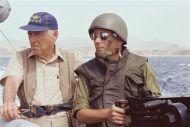
In May 2010, Israel committed what seemed to be a catastrophic blunder. As part of a campaign to weaken Israel’s blockade on Gaza, a Turkish NGO organised a flotilla in hopes of either reaching the coastal strip or forcing Israel into an embarrassing mistake. IDF naval commandos succeeded in stopping the flotilla. But a group of activists on one ship, the Mavi Marmara, set upon the soldiers with stockpiled knives and pipes. In the ensuing struggle, nine Turkish activists were killed and ten Israeli commandos wounded. World reaction came down hard.

Relations with Turkey, already tense, deteriorated. Turkey expelled Israel’s ambassador and recalled its own. It threatened to deploy its navy to accompany future flotillas and to prevent Israeli “exploitation” of natural gas in the Mediterranean. Both sides flexed their muscles, with Israeli jets allegedly approaching Turkish naval forces and Turkish ships sailing provocatively close to Israeli waters.

Yet after the Mavi Marmara incident, the flotilla problem, expected to get worse, dissipated. Under Netanyahu, Israel used diplomacy, espionage, and appeals to international law to nullify the threat. When the NGO organised another flotilla in 2011, it never got out of port. Israel managed to create deep and broad international opposition to the campaign. Parties ranging from the UN and the Middle East Quartet to France and Canada came out against the planned voyage. Even Turkey’s Foreign Minister said that organisers should reconsider their plans.

Israel easily intercepted the one vessel that managed to sail toward its waters, with no violence or international opprobrium. A subsequent flotilla attempt in 2015 was also intercepted by Israel with no cost in blood or diplomatic standing.

Netanyahu has since developed a strategic partnership with Turkey’s rivals, Greece and Cyprus. The relationship was fed by massive Israeli and Cypriot natural-gas discoveries. A proposed “East Med Pipeline” would link Israel, Cyprus, Greece, and Italy, and the Bulgarian government has also thrown in its support. Not insignificantly, the project would bypass Turkey, foiling its ambitions to become the natural-gas hub for Europe. The rebalance has also produced fruitful military partnerships. In 2013, Israel’s Air Force joined its American, Greek, and Italian counterparts in Israel’s largest-ever multinational air-war training manoeuvres. Cancelled joint manoeuvres between Israel and Turkey were quickly replaced by exercises between the American, Israeli, and Hellenic navies.

Netanyahu, however, always kept the restoration of ties with Turkey as a strategic goal. In 2013, Obama arranged a telephone call between Netanyahu and Erdogan. The Israeli PM apologised “for any errors that could have led to loss of life” in the Mavi Marmara raid. The two leaders came to terms on compensation. Erdogan walked back comments criticising Israel and agreed not to prosecute Israeli officials for their part in the incident. And Netanyahu won on his major strategic concern: The Gaza blockade would remain firmly in place.

Ultimately a bumbling Turkey, not Israel, would become isolated. In 2016, Turkish officials, looking for a new source of natural gas in the wake of tensions with Russia, sat down to talks with the Israelis. On June 29, Israel approved the reconciliation agreement. Israel agreed to pay US$20 million to the families of those killed on the Mavi Marmara.

Not surprisingly, Netanyahu received bitter criticism about the deal. “Netanyahu cares for Gaza and not for our soldiers,” said Zahava Shaul, whose son Oron was killed in Operation Protective Edge in Gaza, his body still held by Hamas. Education Minister Naftali Bennett said the deal harms Israel’s resilience and national honour.

Netanyahu, knowing such attacks would come, maintained that it was in Israel’s strategic interest to resume ties with a powerful Muslim state from a position of strength.


Sunni Neighbours

Despite the conflagrations in the region, Israel’s ties with Sunni Arab states have generally grown stronger with Netanyahu in office. Shared concerns over Iran’s nuclear program and growing strength have paved the way for quiet but effective cooperation.

In Saudi Arabia, Iran’s most potent Arab foe, Israel sees a counterweight. Jerusalem has therefore offered greater leeway to the Saudis on various defence and strategic matters. In 2011, Israel gave the green light to Germany for the sale of Leopard 2 tanks to Riyadh. And when Egypt wanted to hand over the strategic Red Sea islands of Tiran and the Sanafir Islands to Saudi Arabia, Israel registered no objection, noting that it had received written assurances from Riyadh that its freedom of passage would be guaranteed. In July, a retired Saudi General and ex-government adviser visited Israel publicly and met with Knesset members and senior Foreign Ministry officials.

Israel’s relations with Sissi’s Egypt have similarly grown warmer, after the brief but dangerous rule of Mohammed Morsi. Israel’s Deputy Chief of Staff Yair Golan has in fact called recent intelligence cooperation between the two countries “unprecedented.” In 2011 and 2013, Netanyahu assented to an increase in Egyptian troops in the Sinai to combat jihadist forces. When Egyptian jets violated Israeli airspace in 2015, defence officials dismissed it as “minor.” For the first time ever, Egypt voted for Israel at the UN, supporting its membership in a committee on outer space. Cairo returned its envoy to Israel in February 2016, filling a vacancy that had lingered since 2012. In July 2016, Egyptian Foreign Minister Sameh Shoukry came to Israel for a rare and cordial public visit.

Israel’s security and economic relationship with its eastern neighbour, Jordan, has continued on relatively sure footing. In December 2015, the two countries unveiled an US$800 million plan to build a canal to save the Dead Sea. A month earlier, Israel’s Interior Ministry initiated a program to bring 1,500 Jordanian citizens to work in hotels in Eilat. Israel’s gas finds have also led to economic cooperation. In April 2015, Netanyahu approved a 15-year, US$500 million natural-gas deal with Jordan.

Israel also gave the Jordanian military 16 Cobra helicopters to help in its fight against the Islamic State. And the two countries maintain close intelligence ties, especially regarding terrorist groups in Syria.

It’s worth noting that in late 2015, Israel announced plans to open a diplomatic office in a renewable-energy agency in the United Arab Emirates, Israel’s first diplomatic presence in the Persian Gulf region since 2000.


Africa

In July 2016, Netanyahu returned from a resoundingly successful tour of Africa. The trip highlighted growing relationships that had previously passed below the media radar. Netanyahu walked away from the trip with real accomplishments. Ethiopia and Kenya publicly supported restoring Israel’s observer status at the African Union, which had ended in 2002. Muslim-majority Guinea renewed ties with Israel that had been suspended since 1967. Finally, Tanzania said it planned to open an embassy in Israel.

In strengthening these ties, Netanyahu sees an opportunity to gain allies and shatter the Palestinians’ automatic majority in international fora. “It might take a decade, but we will change the automatic majority against Israel. That’s something that has never been possible in the past,” he said. A lofty goal, perhaps even too ambitious, but it shows his interest in original solutions in dealing with the Palestinians.


Palestinians

A long-term peace deal with the Palestinians is simply not in the offing. Until the Palestinian leadership has more to gain from recognising Israel’s right to exist than it does from claiming victimhood, a lasting peaceful solution is a dream. Thus the problem remains unsolved, with all that entails: rockets, terrorism, lawfare and international condemnation.

On the other hand, since the Israeli victory in the Second Intifada, Palestinians outside of Gaza have not been able to threaten the State of Israel in any serious way. Periodic outbreaks of violence inevitably lead commentators to warn that the third intifada has arrived, but these episodes fail to gain widespread support. Nor do the attacks change anything for the Palestinians. As ghastly as the attacks are, they are strategically ineffective.

The Palestinian Authority’s major effort against Israel has taken place in international bodies, and while this causes headaches, it has failed to change anything on the ground. Initiatives hailed as game-changers have raised expectations without much to show for it. The Palestinian plan to gain full recognition as a UN member state, for example, ran into opposition from Western leaders, and stalled. PA President Mahmoud Abbas succeeded in gaining recognition only as a non-member observer state. The “diplomatic tsunami” Israel was supposed to face never materialised.

In April 2015, the PA made good on its threat to join the International Criminal Court, but even Palestinians understood there would be no action against Israel. “I don’t want to disappoint our people, but the ICC procedures are slow and long and might face lots of obstacles and challenges and might take years,” said PA Foreign Minister Riad Malki.

In the meantime, Abbas’s approval plummeted; it reached 16% in 2015.

Palestinians have lost faith in their national movement. Young Palestinians who attack Israelis “are battling … the growing Palestinian realisation that their national movement has no answers, no narrative or political vision that offers a way forward to better days,” wrote the Times of Israel‘s Haviv Rettig Gur. “These young killers are striving, in their kamikaze fervour, to rekindle the idea among Palestinians that straightforward victory remains possible, if only because the alternative – the possibility that Israel cannot be dislodged, that the nostalgic vision of an undivided, unfettered Palestine cannot be reclaimed – is simply too monstrous to accept.”

But in Gaza, the menace of Hamas continues to grow even in the face of Israeli operations meant to damage the group and restore deterrence. The organisation’s willingness to fight Israel every few years shows that Israel has not been able to deter it for long. What’s more, Hamas comes back improved in every round. It has developed the Nuhba Force, several thousand strong, to carry out raids through tunnel networks into Israeli territory. In 2014, Hamas forces killed 66 soldiers during Operation Protective Edge. It even managed to shut down international traffic into Ben Gurion Airport for a day. The range of Hamas’ rockets is expanding, and it’s now able to threaten Tel Aviv and Jerusalem almost at will.


Iran

Hamas isn’t the only threat that Netanyahu has failed to stymie. Despite years of effort, he was powerless to prevent the P5+1 powers from concluding an Iranian nuclear deal in 2015. Netanyahu was the most vocal world leader opposing the deal, and he was willing to let the already cold relationship with Obama get worse as he pressed his case. He made a series of high-profile speeches condemning the deal, including a controversial March 2015 address to a joint meeting in Congress, against the wishes of the White House and most of the Democratic Party. It was all to no avail.

There were some bright spots in the campaign against Iran. Somebody – many think the Israelis – orchestrated a series of assassinations against Iranian nuclear scientists. The Stuxnet computer virus, allegedly jointly developed by Israel and the United States, wreaked havoc on Iranian computers at the Natanz uranium facility in 2009 and 2010.

Yet, the dangerous deal is now a reality. Since it was reached, Iran has enjoyed the release of billions of dollars in frozen assets, encouraged by the United States. America is even buying millions of dollars’ worth of heavy water from Iran. The country’s nuclear program remains a threat.

With two major exceptions, Hamas and Iran, Israel has been on a successful foreign-policy streak under Netanyahu. How has it managed to navigate flotillas, wars on its borders, tensions with powerful former allies, and terrorist threats? For one, its leadership has shown patience – something not traditionally seen as an Israeli strength. Decision-makers have not run after solutions that aren’t there. They have been comfortable letting situations emerge, showing a confidence that policy will be flexible enough to change with events. Netanyahu didn’t panic over Erdogan’s newfound hostility. He was willing to suffer insults while keeping the door open for Turkey’s return. And when the time came, Netanyahu showed diplomatic finesse.

Netanyahu has also managed to analyse complex situations and determine the country’s interests. Israel wisely chose not to pick a side between Assad and the rebels. The willingness to risk working with rebel groups on its borders and provide humanitarian aid served the country well.

At the same time, Israeli policy has been firm. Netanyahu was willing to strike deep inside Syria and Lebanon to keep weapons out of Hezbollah’s hands. Rebel groups on the Golan know that if they begin attacking Israel, they will face a painful response.

What, then, about Hamas and Iran? What do these problems tell us about Netanyahu’s decisions? Though often portrayed as a warmonger, Netanyahu is extremely cautious around military campaigns.

Netanyahu, recall, did whatever he could to avoid a ground incursion in Gaza in 2012. After eight days of bombing, he made significant concessions to Hamas in order to end the flare-up instead of deploying ground troops. He also sought repeated cease-fires before ordering a ground invasion in 2014. And despite massive support for an expanded push into Gaza, Netanyahu made do with a limited incursion to deal with Hamas’ tunnel network.

In dealing with Hamas, he has also shown some of the other traits mentioned above – patience, for example. The Palestinian Authority isn’t coming back any time soon, and Hamas is an entity Israel knows how to pressure. Remove Hamas and you would get the chaos of rival Islamist groups. Whether this approach is wise remains debatable. Israelis are frustrated by the lack of clear victories in Gaza. But, still, Netanyahu has not sought to invent a solution that doesn’t exist.

On Iran, Netanyahu unquestionably failed to achieve his desired outcome. Again, perhaps he was too cautious about taking action to disable Iran’s nuclear program. In any event, Obama was determined to reach a deal. So why did Netanyahu come to Washington and criticise Obama’s unstoppable policy before the US Congress? As critics have noted, the speech risked alienating Democrats and damaged whatever trust remained between him and Obama. But from Netanyahu’s perspective, the vocal effort against the nuclear deal cost him little that wasn’t already lost. He angered congressional Democrats who weren’t well-disposed to him in the first place, and Obama had already decided that Netanyahu was part of the problem.

Netanyahu’s campaign against the Iran deal did reap some benefits. Millions of Americans saw him on TV eloquently making his case in front of hundreds of applauding congressmen. And he gained credibility among Sunni Arab partners who were equally concerned about Iran’s nuclear program.

Like any leader, Netanyahu makes some decisions for domestic political gain and some for reasons that are hard to discern at all. But critics fail to appreciate the complexity of the challenges facing Israel, and how it is forced to quickly adapt to changes that render existing assumptions meaningless. Under Netanyahu, Israel has managed to stay out of wars that sucked others in, improve its diplomatic position while isolating rivals, remain flexible on policies but firm on red lines, and keep its residents safe. In the Middle East, and increasingly beyond, these are no small accomplishments.

Lazar Berman is a writer and researcher based in Israel, focusing on military theory, Middle East security, and Kurdish affairs. © Commentary magazine, reprinted by permission, all rights reserved

IDF attacks in Syria

Posted September 4, 2016 by Peter Hofman
Categories: Uncategorized

Tags: ,

IDF attacks in Syria IDF forces attacked Syrian mortar enclavements in retaliation for mortar bombing in Central Golan Heights

Kobi Finkler, 04/09/16 22:27

Source: IDF attacks in Syria – Defense/Security – News –


IDF forces attacked Syrian mortar enclavements in retaliation for the mortar which fell in the center of the Golan Heights earlier today(Sunday).

“The IDF sees the Syrian administration as responsible for what is going on in its territory and will not accept any attempt to weaken Israel’s sovereignty or to harm the security of its inhabitants.” said the army spokesman.

In the afternoon a mortar bomb exploded in the center of the Golan Heights today. There were no injuries and no damage was reported.

Military sources said that the bombing was fallout from the ongoing civil war raging in Syria.

DHS Secretary Jeh Johnson addresses ISNA, Muslim group linked to Hamas and the Muslim Brotherhood

Posted September 4, 2016 by danmillerinpanama
Categories: Department of Homeland Security, Islamists in America, Sharia law

Tags: , ,

DHS Secretary Jeh Johnson addresses ISNA, Muslim group linked to Hamas and the Muslim Brotherhood, Jihad, Robert Spencer, September 4, 2016

Also speaking was Yasir Qadhi, who has taught that Muslims can seize the property of non-Muslims in jihad: “The life and property of a mushrik [one who worships others besides Allah] holds no value in the state of jihad….which means if they don’t say la illaha illa Allah, their lives and property are halal” — that is, permitted to be taken by the Muslims.

Dalia Mogahed was speaking as well. Obama’s former adviser on Muslim affairs once appeared on a British television show aired by the pro-Sharia group Hizb ut-Tahrir, where she said: “Sharia is not well understood and Islam as a faith is not well understood.” How have we misunderstood Islamic law? We have associated it with “maximum criminal punishments” and “laws that…to many people seem unequal to women.” The Western view of Sharia was “oversimplified,” she claimed: most Muslim women worldwide, she said, associate it with “gender justice.”

Another speaker was Tariq Ramadan. French journalist Caroline Fourest in Brother Tariq notes that Ramadan is “remaining scrupulously faithful to the strategy mapped out by his grandfather [Muslim Brotherhood founder Hasan al-Banna], a strategy of advance stage by stage” toward the imposition of Islamic law in the West. She explains that he invests words like “law” and “democracy” with subtle and carefully crafted new definitions, permitting him to engage in “an apparently inoffensive discourse while remaining faithful to an eminently Islamist message and without having to lie overtly — at least not in his eyes.”

And then there is the celebrated Khizr Khan. Intelius records that Khizr Khan has worked at Hogan Lovells Llp. According to the Washington Free Beacon, “Hogan Lovells LLP, another U.S. firm hired by the Saudis, is registered to work for the Royal Embassy of Saudi Arabia through 2016, disclosures show. Robert Kyle, a lobbyist from the firm, has bundled $50,850 for Clinton’s campaign.” The Free Beacon added that the Saudi government has “supplied the Clinton Foundation with millions. The Kingdom of Saudi Arabia has given between $10 and $25 million to the foundation while Friends of Saudi Arabia has contributed between $1 and $5 million.”

Why is the DHS Secretary appearing among this rogue’s gallery? The answer is obvious: because he shares their agenda.

Johnson-Khan-ISNA

“The Islamic Society of North America (ISNA) was established in July 1981 by U.S-based members of the Muslim Brotherhood with a background as leaders of the Muslim Students Association (MSA). As author and terrorism expert Steven Emerson puts it, ISNA “grew out of the Muslim Students Association, which also was founded by Brotherhood members.” Indeed, Muslim Brothers would dominate ISNA’s leadership throughout the Society’s early years. Striving “to advance the cause of Islam and serve Muslims in North America so as to enable them to adopt Islam as a complete way of life,” ISNA was highly dependent upon Saudi funding during its early years.” — from Discover the Networks

From the Investigative Project on Terrorism:

In its latest filing before the federal district court in Dallas on behalf of the Islamic Society of North America (ISNA) and its affiliate organization, the North American Islamic Trust (NAIT) in the Hamas-terrorism financing case, the ACLU has made a noteworthy admission.

Rather than deny that there is copious evidence tying ISNA and NAIT to Hamas and the Muslim Brotherhood, the brief argues that such evidence is merely dated. In a curious footnote on page 7, the reply states:

Assuming the authenticity of documents’ dates, the most recent documents to mention either ISNA or NAIT are dated 1991, Gov. Exhs. 3-3 and 3-85, but the majority of the documents are older. Almost all of the numerous exhibits that purport to show financial transactions and that contain any mention of ISNA or NAIT are dated 1988 and 1989 (there are two dated 1990), almost a decade before the majority of the overt acts the government alleges in support of its conspiracy charges against the HLF defendants.

So ISNA and NAIT are not saying that the documents tying their organizations to Hamas are “inauthentic,” but that the problem with the evidence is just that it is old. Then, even more curiously, the reply goes on to argue something that the government has not even alleged:

Even if the “evidence” provided some basis for alleging criminality against petitioners, the government’s discussion of it shows the government utterly fails to grasp the singular weight and consequence that an official accusation of criminal conduct carries in our criminal justice system and in our society.

But, of course, the government has not charged ISNA or NAIT with criminal conduct, or the two groups would be indicted in their own right, rather than un-indicted co-conspirators who worked with the Holy Land for Relief and Development (HLF), the defendant and alleged Hamas-front. The reply brief then, as Shakespeare might write, “doth protest too much.”

Satire?| Obama Ratifies Treaty on Sharia Law

Posted September 4, 2016 by danmillerinpanama
Categories: Civilization jihad, Climate change, Hijrah, Iran scam, Islam and Christianity, Islam and honor, Islam and human rights, Islam in Saudi Arabia, Islamic immigration, Islamic refugees, Islamic supremacy, Islamists in America, Islamophobia, Obama and Islamists, Obama's America 2016, Political Islam, Right and wrong sides of history, Satire, Saudi Arabia, Sharia law, Turkey, U.S. Constitution, U.S. Senate, United Nations

Tags: , , , , , , , , , , , , , , , , , , , , , , ,

Satire?| Obama Ratifies Treaty on Sharia Law, Dan Miller’s Blog, September 4, 2016

(The views expressed in this post are mine and do not necessarily reflect those of Warsclerotic or its other editors. — DM)

Having personally ratified the Iran Scam Treaty and the Climate Change Treaty with China, President Obama today met with Turkish, Saudi and Iranian heads of state to ratify a new treaty making Sharia Law binding in the United States. Please see also, The West Needs Sharia Law – Pakistani cleric. Obama, a renowned constitutional scholar, quickly rejected objections by Senate leaders that “He shouldn’t oughta do that because it’s our job” by reminding them that He is the President and is therefore empowered by the Constitution to do whatever pleases Him.

TOTUS Seal

Here is the text of President Obama’s statement on ratification of the Sharia Law Treaty, provided by The Incomparably Honorable I. M. Totus, Teleprompter of the United States:

My beloved Islamist colleagues, men, women and whatever: today, with great pleasure and a heart-felt desire for a better future for all, I today ratified a treaty with The Republic of Turkey, the Kingdom of Saudi Arabia and the Islamic Republic of Iran making Sharia Law officially binding in America just as it is in those great progressive, humanitarian nations.

As United Nations Secretary General Ban Ki-moon recently stated, the debate about the horrors of man-made climate change is over and the issue is settled. So be it with any debate over My success in preventng Iran from using nuclear weapons and, indeed, over My constitutional powers as your humble President. I have settled those matters as well, as all loyal Americans must agree.

Sharia Law will make America a far happier and better place for all including, most importantly, refugees coming to our shores in increasing numbers from other Islamist nations. I can think of no better way to welcome them than by guaranteeing them the dignity, honor and freedoms under Sharia Law they so richly and justly deserve.

For too long has America based its laws on flawed Judeo-Christian principles. But that’s not who we are; we have a long, honorable and mutually beneficial history with Islam and many if not most of our best citizens are Muslims. The treaty I ratified today will finally put us on the right side of history. It will also facilitate My brilliant countering violent extremism initiative by encouraging an honest discussion of Sharia law, long rejected by “America First” nationalists and other Islamophobes who despise Allah and His one true Religion of Peace.

I am confident that all loyal Americans will be happy to abide by our Sharia Laws; common sense steps will be taken to encourage all to do so. Observers from Turkey, Saudi Arabia and Iran will soon come to America to assist us in implementing whatever encouragements may be needed.

We should all thank the three other splendid freedom loving nations which also ratified the new treaty and encourage all other nations of the world to join us as soon as possible.

Thank you and have a pleasant day.

Hated by many Americans until now, The Islamic Republic of Iran has shown that it is a truly glorious example of Islamist democracy in action, where Sharia Law is enforced, followed and enjoyed by all.

hangings_in_iran

With Obama leading the way as always, we are joining them. Just look at the Iranians depicted in the following Iranian propaganda video! They are proud, happy, peaceful, patriotic and loving despite the shameful efforts of America in the past and, indeed, of some war-mongering Americans today, to humble and destroy them and their beloved nation.

No longer will that happen. The President has spoken! This will be the most beneficial and longest lasting of all of His many great leaps forward to make America a country of which He, His beautiful wife Michelle and all other good people can and will be truly proud.

It is anticipated that President Obama will soon issue an executive order changing the name of the country from The United States of America to The Islamist Republic of Obama. The flag of the new Islamist Republic of Obama will combine the best elements of the flags of the Islamic Republic of Iran, the Republic of Turkey and the Kingdom of Saudi Arabia. A photo of Obama as the bringer of true Islamic peace and understanding will be superimposed over the other flag elements.

Obama:

Obama death to America

Iran:
Iranian flag

Turkey:
Flag_of_Turkey.svg

Saudi Arabia:
saudi flag

Oh well.

what me worry

Was it Something he Said?

Posted September 4, 2016 by danmillerinpanama
Categories: Obama goes to China

Tags:

Was it Something he Said? Power Line, Scott Johnson, September 4, 2016

The Chinese government found a new way to express its contempt for Barack Obama and the United States yesterday. The authorities snubbed Obama upon his arrival in Hangzhou before the start of the G20 conference. According to the Guardian: “[Obama] was forced to disembark from Air Force One through a little-used exit in the plane’s belly after no rolling staircase was provided when he landed in the eastern Chinese city on Saturday afternoon.”

And that’s not all! “When Obama did find his way on to a red carpet on the tarmac below there were heated altercations between US and Chinese officials, with one Chinese official caught on video shouting: ‘This is our country! This is our airport!’” I think that’s what Secretary of State John Kerry calls nineteenth-century thinking.

The Guardian quotes the New York Times report: “The reception that President Obama and his staff got when they arrived here Saturday afternoon was bruising, even by Chinese standards.”

Was it something he said? The Guardian considers the possibilities, including the possibility that Obama declined the standard red carpet treatment. I think we can rule that out. The execrable Susan Rice didn’t have a face-saving explanation ready to offer. Rice commented: “They did things that weren’t anticipated.”


New Iran Music Video: Allah Destroys US Fleet in Persian Gulf

Posted September 4, 2016 by danmillerinpanama
Categories: Iranian propaganda video

Tags:

New Iran Music Video: Allah Destroys US Fleet in Persian Gulf, Clarion Project, September 4, 2016

Iran-Music-Video-USS-Vincennes-IPFrom the Iranian propaganda video ‘We Resist to the Last Drop of Blood’ (Photo: Video screenshot)

Ramping up its rhetoric against America, Iran released a propaganda music video (see below) depicting the destruction of the U.S. Fifth Fleet , including all its personnel, through a miracle of Allah.

The seven-minute video titled “We Resist to the Last Drop of Blood” was produced for the Art Bureau’s Soureh Film Club, which is owned by the Islamic Propagation Organization.

The head of the organization is appointed directly by Iran’s Supreme Leader, Ali Khamenei. The film, which cost $385,000 (12 billion rials) to produce is being shared on Iranian media and social media.

The video centers around an incident which occurred on July 3, 1988, when the U.S. Navy accidentally shot down Iran Air flight 655, killing all 290 people on board.

Iran-Music-Video-USS-Vincennes-Inside(Photo: Video screenshot)

Mistaking the commercial airliner as an Iranian fighter jet ready to attack, the USS Vincennes shot a surface-to-air missile at the airliner. The Iranian regime claims that the plane was intentionally shot down.

Lyrics sung in the video proclaim: “If I’m patient, it doesn’t mean I’m apathetic / the world has seen I’m always a fighter / … Oh warship, your loud roar does not scare me … / If you dare come near me, I will break your legs.”

After the airlineliner and the beach are attacked by the Americans in the video, what remains, among other remnants of defiance, is what looks like a nuclear power plant in the background to which the camera pans a number of times.

The U.S. Fifth Fleet currently patrols the Persian Gulf. Attacks against the Islamic State (ISIS/ISIL) in Iraq and Syria are launched almost daily from the aircraft carrier the USS Harry S. Truman, which is part of the fleet.

Experts: Iran’s Decision to Fortify Nuke Site With S-300 Missiles Is ‘Very Peculiar’

Posted September 4, 2016 by Joseph Wouk
Categories: Uncategorized

Source: Experts: Iran’s Decision to Fortify Nuke Site With S-300 Missiles Is ‘Very Peculiar’ | Jewish & Israel News Algemeiner.com

Satellite view of the Fordo facility near Qom, Iran. Photo: DigitalGlobe.

Satellite view of the Fordo facility near Qom, Iran. Photo: DigitalGlobe.

JNS.org – On Aug. 28, Iranian state television broadcast live images of Russian-made, highly advance S-300 surface-to-air missiles being transported by trucks to the Fordo nuclear facility south of Tehran.

The move by Iran to further fortify one of its most secretive nuclear sites has led to questions over its intentions at the site, while also raising doubts about their commitment to the Joint Comprehensive Plan of Action (JCPOA) or Iran nuclear deal that was agreed to by Iran and the world powers last July.

During the weapons delivery, Iran’s Supreme Leader Ayatollah Ali Khamenei said in a speech, “Continued opposition and hype on the S-300 or the Fordo site are examples of the viciousness of the enemy. The S-300 system is a defense system, not an assault one, but the Americans did their best for Iran not to get hold of it.”

The S-300 surface-to-air-missile was initially developed under the old Soviet Union, and its newer variants are regarded as the most potent anti-aircraft missile systems in the world.

Russia began delivering the highly advanced S-300 missile system last April, just months after many international sanctions were lifted against the Islamic Republic as a result of the nuclear deal.

The deal to supply Iran with the S-300 was originally signed in 2007, but was held up for several years due to international sanctions as well as objections by the US and Israel, that argued it would make a possible military strike on the site more difficult. There have also been concerns the system could end up in the hands of Iranian-backed terror groups such as Hezbollah.

“As per the nuclear agreement, very little is being done at Fordo,” he said. “So you have to scratch your head and wonder why the heck they did this at Fordo instead of Natanz [uranium enrichment plant], where, after all, there are 5,060 centrifuges and where they are not underground.”

The Fordo nuclear site, located 60 miles south of Tehran and built 300 feet below a mountain, was initially built in secret by Iran until satellite imagery forced the Islamic Republic to acknowledge its existence in 2009. In 2011, Iran told the International Atomic Energy Agency (IAEA), the United Nations nuclear watchdog, that it was planning to produce medium-enriched uranium, up to about 20 percent, at the site, which Western powers feared could be easily enriched into weapons-grade uranium.

Under the nuclear deal, Iran is not permitted to enrich uranium at the site for 15 years and its remaining 1,044 centrifuges allowed at the site will only by permitted for scientific research.

Elevated suspicion

Ilan Berman, vice president of the American Foreign Policy Council think tank, told JNS.org this move elevates suspicion over what Iran is doing at Fordo.

“This certainly raises questions over their transparency and what they are using the site for,” Berman said. “This move tells you this is an important strategic site for Iran and they have serious doubts that the military option [for the US or Israel] is not off the table.”

Berman added he thinks this is a good indication how fragile the Iranians think the deal is, and that Fordo matters a lot to them.

Iranian Brigadier General Farzad Esmaili, commander of the Islamic Revolutionary Guards Corps’ (IRGC) air defense force, told Iranian state TV recently that, “Our main priority is to protect Iran’s nuclear facilities under any circumstances.”

However, Esmaili did not indicate whether or not the system was yet operational, only adding: “Today, Iran’s sky is one of the most secure in the Middle East.”

Representative Lee Zeldin (R-NY), a member of the House Committee on Foreign Affairs, told JNS.org, “This development begs the question that if Iran didn’t need S-300 surface-to-air missiles to protect Fordo before the Iran Nuclear Deal was implemented, why would it be necessary now? This is just further evidence that the unsigned ‘political commitment’ called the Joint Comprehensive Plan of Action (JCPOA) was not what it was hyped to be, unless, of course, you are Iran or Russia.”

Berman explained the real culprit here are the Russians, who see bolstering Iran’s defenses as a key part of their overall strategy in the Middle East.

“For Russia, which is relying on Iran for its campaign in Syria and more things, Moscow wants Iran more secure, not less,” he said. “A stronger Iran is better for them.”

The situation concerning the Fordo site comes amid further questions over the legitimacy of the nuclear deal with the P5+1 (US, UK, France, Germany, China and Russia) and Iran’s behavior.

The deal

A report, released by the Washington-based Institute for Science and International Security on Sept. 1, which based its information from several government officials involved in the negotiations, indicated the US and its international partners agreed “in secret” to allow Iran to evade certain restrictions in the landmark nuclear deal in order for the Islamic Republic to meet its Jan. 16 deadline for international sanctions relief.

“The exemptions or loopholes are happening in secret, and it appears that they favor Iran,” said David Albright, a former United Nations weapons inspector and co-author of the report, Reuters reported.

Among the exceptions outlined, two allowed Iran to exceed the deal’s limits on the quantity of low-enriched uranium (LEU), which can be used to make highly-enriched and weapons-grade uranium.

Additionally, a US Defense Department report in early August stated that Iran has gradually improved both its cyber abilities and developed more advanced ballistic missiles since the singing of the nuclear deal with world powers in July 2015.

The Islamic Republic now has a “substantial inventory of missiles capable of reaching targets throughout the region, including US military bases and Israel,” the Pentagon said in an unclassified summary, Bloomberg News reported.

The Washington Institute’s Clawson believes that Iran may have placed the missiles at Fordo as a political statement.

“Domestic politics is driving this more than anything else,” he said. “Their presidential election is coming up next year and this is a way for them to show how tough they are.”

Despite the move by Iran to bolster the defense at one of its most secretive nuclear sites, Berman does not believe the US or the international community will do much to confront this.

“We are going to let this pass just like we let the Russian use of Iranian airspace pass as well,” said Berman, referring to Russia’s move to conduct airstrikes in Syria from a military base in Iran.

“You are seeing a lot of disjointed policy. There is nothing to deal with a rapidly expanding Iran-Russia relationship either in the US or Israel,” he added.

Was Israel’s satellite sabotaged on US rocket pad?

Posted September 4, 2016 by danmillerinpanama
Categories: Cape Canaveral, Israeli satellite, Sabotage

Tags: , ,

Was Israel’s satellite sabotaged on US rocket pad? DEBKAfile, September 4, 2016

SpaceX_Falcon_9_Amos_6_1.9.16

Representatives of Spacecom owned by Israeli Eurocom and Israeli Aerospace Industry, which manufactured Amos 6, their largest satellite to date, don’t expect to be invited to take part in the investigation.

************************

A day after Israel’s Amos-6 communications satellite was lost in a highly unusual explosion/fast fire of the SpaceX’s Falcon 9 rocket and its Amos 6 satellite payload at Cape Canaveral, some Israel aerospace industry experts are beginning to suspect sabotage. They are keeping their suspicions to themselves pending an investigation in which NASA ad the US Air Force will be taking part.

An explosion or fire occurring during a standard pre-launch static test prior to the engine igniting may be unique. These Israeli experts can’t recall any space satellite disasters happening at that particular stage.

Immediately after the event, SpaceX founder Elon Musk said an “anomaly happened around the upper-stage oxygen tank wile propellant was being loaded into the vehicle.”

Two days later, Saturday, Sept. 3, Musk attributed the loss to a “fast fire” rather than an explosion.

Representatives of Spacecom owned by Israeli Eurocom and Israeli Aerospace Industry, which manufactured Amos 6, their largest satellite to date, don’t expect to be invited to take part in the investigation.

Those circles resent Elon Musk’s reference to an “anomaly,” which they see as a euphemism to disguise the cause of the mishap.

American experts are speculating about a large, black. unidentified object picked up by video footage hovering in the sky at the moment the fireball rose over the Cape Canaveral launching pad.

Some are suggesting it was a large bird which happened to be flying past; others say the object is much too big and too fast for any known bird.

In Israel, some informed sources suggest that the reason for the Amos 6 satellites destruction is far from technical and may never come to light.

They cite the only previous SpaceX failure, which occurred in June, 2015, when a Falcon 9 rocket carrying supplies to the International Space Station exploded just a few minutes after launch. The company set up an inquiry team composed of 11 staff members and one FAA official, but never released details of its findings.

Three causes for the Amos 6 loss are postulated by Israeli sources:

1. The stiff competition among the companies of the eight nations that manufacture satellites. The last in the Amos series of communications satellites, produced at a cost of $200 million, was the most sophisticated produced so far. Some international competitor may have decided to push Israel out of the contest by destroying its newest product. This has indeed set Israel’s satellite industry back for years.

2. The other motive may be connected with the fact that Amos 6 was to have been Facebook’s first satellite. CEO Mark Zuckerberg had announced that Amos 6, scheduled for launch into geostationary orbit on Sept. 3, would have opened large parts of sub-Saharan Africa to direct internet.

Its loss has forced Zuckerberg to put his plan on hold.

This plan went well with the largely covert Israel drive in the last three years to expand its ties across the Africa. The Facebook project fitted in well this policy an added dimension and spurt.

3.  Spacom had just signed a $285 sale contract with Beijing Xinwei Technology that was contingent on its successful launch into orbit of Amos 6 Saturday. One of Israel’s competitors may have been after the Chinese contract.

The West Needs Sharia Law – Pakistani cleric

Posted September 3, 2016 by danmillerinpanama
Categories: Civilization jihad, Clash of civilizations, Combatting violent extremism, Contempt for America, Department of Homeland Security, Donald Trump, Freedom of religion, Freedom of speech, Hijrah, Islam - submission, Islam and human rights, Islamic conquests in Europe, Islamic hatred of others, Islamic history, Islamic immigration, Islamic perversions, Islamic refugees, Islamic supremacy, Islamist moral values, Islamist vetting, Islamists in America, Koran, Mecca Islam, Medina Islam, Newt Gingrich, Obama and Islamists, Political Islam, Sharia law

Tags: , , , , , , , , , , , , , , , , , , , , , , , , , , ,

The West Needs Sharia Law – Pakistani cleric, Dan Miller’s Blog, September 3, 2016

(The views expressed in this article are mine and do not necessarily reflect those of Warsclerotic or its other editors. — DM)

According to a leading Pakistani imam, Islamists need to convince western civilizations that Sharia law is good and that we need it to root our the evils which possess us. His wise words must be music to Obama’s ears.

In a recent article, leading Pakistani cleric Maulana Zahidur Rashdi noted that Islam and the West are indeed in a clash of civilizations, as argued by U.S. presidential candidate Donald Trump and former Speaker of the House Newt Gingrich.

The article, titled “The Cultural and Civilizational Struggle Between Islam and the West,” was published by Roznama Islam, an Urdu-language daily published from Karachi and Lahore, which is known for advocating Islamist causes and pro-jihad arguments.

Maulana Zahidur Rashdi is a leading Islamic scholar who frequently writes in newspapers and has visited several countries to preach Islam, especially Saudi Arabia, the UAE, Bangladesh, Iran, Kenya, Iran, Uzbekistan, India, the U.K., Canada, the U.S., and others.

. . . .

“[Our Intellectuals See It Not As A War Of Civilization But As] A War Of Interests … Between The Developed And The Developing Countries, In Which Muslim Countries And Nations Are The Underdogs Due To Lack Of Progress”

“‘Newt Gingrich, the former speaker of the U.S. House of Representatives, has said that those Muslims who believe in shari’a should be expelled from America. Before this, U.S. presidential candidate Donald Trump had too demanded a ban on the entry of Muslims into America. Newt Gingrich… has said in an interview: Western civilization is in a state of war. Shari’a is not compatible with the Western civilization, and we will gladly accept those Muslims who do not believe in shari’a. Newt Gingrich has also proposed monitoring mosques in America along with imprisoning individuals who visit websites of extremist organizations.

Accordingly,

“The West’s standpoint is very clear in that it is not ready to accept the enforcement of shari’a. In response to this, it is our responsibility to point out the errors of the Western civilization based on the common collective interests of human society and revealed [Islamic] teachings, to clarify the damages caused to human society by it [the Western civilization], and to bring forth benefits and necessities of Islamic Shari’a through reason and logic…”

President Obama has contended that America should not bar immigrants or refugee seekers who favor the imposition of Sharia law; that’s not who we are. Perhaps He does not want to stop His thus far successful efforts to end our terrorist shortage. In July of last year, Obama

condemned the terrorist attack in France that killed 84 people and denounced politicians who have suggested that Muslims be subjected to extra scrutiny in the United States because of their religion.

“In the wake of last night’s attacks, we’ve heard more suggestions that all Muslims in America be targeted or tested for their beliefs,” Obama said. The president appeared to be referring to former House speaker Newt Gingrich’s call on Fox News to deport all Muslims who follow sharia law.

Without mentioning Gingrich by name, Obama called his suggestion of a religious test “repugnant and an affront to everything we stand for as Americans.” [Emphasis added.]

“We cannot give in to fear or turn on each other or sacrifice our way of life,” Obama said. “We cannot let ourselves be divided by religion, because that is exactly what the terrorists want.”

Alas, some Muslims reject governmental adoption of Sharia law. Raheel Raza recently took issue with CNN commentator Sally Kohn, who had tried to defend Sharia law.

Raza’s response came after Kohn recently pretended to be an Islamic theologian and lectured the public on how “progressive” sharia law allegedly is:

“There is a difference between personal, spiritual Sharia and the political incorporation of Sharia into law,” Kohn stated. “And within both, there are progressive interpretations as well as more fundamentalist conservative interpretations. So the word Sharia doesn’t mean one thing.” [Emphasis added.]

Kohn then blasted Donald Trump for “not knowing” what sharia law really stands for. This is likely when Raza’s radar went up, considering that the Muslim activist has first-hand knowledge about sharia law and the threat it poses.

Raza, who at great personal risk travels the world to educate people on the dangers of sharia law and who has worked for decades to wrestle her faith from the hands of extremists, thinks it odd that a progressive would defend the very Islamic tenets that promote homophobia, anti-Semitism, and the subjugation of women.

In an open letter to Kohn published on the Huffington Post, Raza writes:

Political commentator Sally Kohn has made several statements regarding sharia law, which were not only offensive but dangerous. In using her voice to propagate this liberal apologist position, she is doing a great disservice to progressive reform-minded Muslims like myself. Her words are an affront to me, a female Muslim activist, as I have made it my life’s mission to educate others on this topic and to wrestle back my religion from the clutches of extremists who wish to make sharia the law of the land. And I would be happy to debate her on this topic. [Emphasis added.]

As an openly gay woman, Ms. Kohn would be killed, jailed or persecuted under sharia law. As a devout Muslim woman, I – along with many true progressive Muslims – rightly view sharia, as it is practiced today, as an archaic distortion of Islamic law.

In a very diplomatic way, Raza suggests that perhaps Kohn doesn’t know as much about Islamic law as she thinks she does, and then offered up the following “brief lesson in sharia”:

What many sharia laws and statutes have in common are the following. They are:

· Homophobic
· Anti-semitic
· Anti-women
· Advocate amputations and stoning
· Preach killing of apostates
· Uphold the Blasphemy Law (which could get me killed)

“This homophobic, anti-woman, repressive sharia is no longer confined to the mosque or to majority Muslim nations,” Raza writes before providing the example of England’s 100 sharia councils that have been allowed to harm women in the West.

“As a woman, and as someone who enjoys the freedoms and liberties that are systematically assaulted by sharia law, Sally Kohn needs to think twice before defending this oppressive, perverse practice.”

“Words are powerful — so Sally, I beg you and others to stop defending the indefensible and to stand with us, not them,” the Muslim activists concluded.

It is typical of progressives, so willfully blind, that they hurt the very people they claim to champion. Sadly, progressives like Kohn would rather propagate left-wing lies about Islam without regard to how many people get hurt in the process, than actually learn from the people who know best.

Obama may think that Sharia law is good and that we need it, but rejects any “honest discussion” about it.

Would Iman Obama agree with Sally Kohn and Pakistani imam Rashdi that western cultures need the enlightenment that Sharia law brings? Then, perhaps we could become enlightened and progressive (but I repeat myself) like Saudi Arabia, Turkey and Iran. Saudi Arabia recently sentenced a man to ten years in jail and two thousand lashes for “tweeting” about being an atheist.

The hardline Islamic state’s religious police in charge of monitoring social networks found more than 600 tweets denying the existence of God, ridiculing Koranic verses, accusing all prophets of lies and saying their teaching fuelled hostilities…

Turkey is enjoying an epidemic of child rape. The Islamic Republic of Iran likes to have mass executions and, when convenient, throws homosexuals off tall buildings.

gays off hall building

Stoning, pursuant to Sharia law, is also popular in Iran.

Of course, it has to be done only in conformity with Iran’s Sharia law, generally after a “confession.”

And on and on and on. Never mind, though, Iran is very technologically advanced, doubtless due to scientific guidance provided by its ayatollahs based on the teachings of Mohammad. Indeed, Grand Ayatollah Naser Makarem Shirazi recently promised that the “Hidden Imam” will arrive soon, and in “a vessel like a space ship.”

Islamic Hijrah, migrating from Islamic countries to non-Islamic countries, is a way of conquest by political Islam — by Islamists. With it, comes Sharia law. If you haven’t the time or inclination to watch any of the other videos, please watch this one. Yes, it’s thirty minutes long, but well is worth the time.

Perhaps, by extending hands of welcome to more Islamist immigrants and refugees who seek to conquer us and “help” us by bringing Sharia law with them, we will accept that only based on Islamist teachings can we

clarify the damages caused to human society by it [the Western civilization], and . . . bring forth benefits and necessities of Islamic Shari’a through reason and logic…”

Obama would be very proud of them, and of us for imposing no religious ideological tests.

Military brass told numerous US soldiers in Afghanistan to ignore child sex abuse by Afghan “allies”

Posted September 3, 2016 by danmillerinpanama
Categories: Afghanistan, Islamic perversions, Justice, U.S. Military

Tags: , , ,

Military brass told numerous US soldiers in Afghanistan to ignore child sex abuse by Afghan “allies”, Jihad Watch, 

Women are so despised and devalued in Islamic culture that it leads to this sort of thing. And even though this article says that Muslim clerics and the Taliban object to the practice, the Qur’an says that in Paradise, the blessed will be attended not only by the famous virgins, but by boys like pearls as well:

“Those are the ones brought near in the Gardens of Pleasure, a company of the former peoples and a few of the later peoples, on thrones woven, reclining on them, facing each other. There will circulate among them young boys made eternal with vessels, pitchers and a cup from a flowing spring.” — Qur’an 56:11-18

“And they will be given to drink a cup whose mixture is of ginger, a fountain within Paradise named Salsabeel. There will circulate among them young boys made eternal. When you see them, you would think them scattered pearls. And when you look there, you will see pleasure and great dominion.” — Qur’an 76:17-20

And the U.S. military leadership was so intent on pursuing our futile, fruitless, wasteful, pointless misadventure in Afghanistan that they became accessories to this behavior. The whole lot of them should be dishonorably discharged.

Jason-Brezler

“Navy analysis found that a Marine’s case would draw attention to Afghan ‘sex slaves,’” by Dan Lamothe, Washington Post, September 1, 2016:

Last fall, the Navy Department had a controversial disciplinary case before it: Maj. Jason C. Brezler had been asked by Marine colleagues to submit all the information he had about an influential Afghan police chief suspected of abusing children. Brezler sent a classified document in response over an unclassified Yahoo email server, and he self-reported the mistake soon after. But the Marine Corps recommended that he be discharged for mishandling classified material.

The Navy Department, which oversees the Marine Corps, had the ability to uphold or overturn the decision. However, rather than just looking at the merits of the case, Navy officials also assessed that holding new hearings on the case would renew attention on the scandal surrounding child sex abuse in Afghanistan, according to military documents newly disclosed in federal court.

The documents, filed Tuesday in a lawsuit by Brezler against the Navy Department and Marine Corps, also show that Marine and Navy officials in Afghanistan were aware in 2012 of allegations of abuse against children by the Afghan police chief but that the chief was allowed to keep his position in Helmand province anyway. This became a major issue after a teenage boy who worked for the chief — and allegedly was abused by him — opened fire on a U.S. base Aug. 10, 2012, killing three Marines and badly wounding a fourth.

The five-page legal review, written last October by Lt. Cmdr. Nicholas Kassotis for Vice Adm. James W. Crawford III, the judge advocate general of the Navy, recommended that the Marine Corps’ actions against Brezler be upheld. Calling for a new administrative review, known as a Board of Inquiry, would delay actions in the case another six to nine months and possibly increase attention on the case, “especially in the aftermath of significant media attention to the allegations regarding the practice of keeping personal sex slaves in Afghanistan,” Kassotis wrote. A month later in November, acting assistant Navy secretary Scott Lutterloh upheld the Marine Corps’ decision.

Brezler’s case has drawn new attention in recent months as critics of presidential candidate Hillary Clinton have compared her email controversy to Brezler’s, noting that the officer’s military career is on the brink of being over. He sued the Marine Corps and Navy Department in 2014, saying that he was a victim of reprisal for discussing his case with a member of Congress, and it has languished in court since. Brezler wants to block his dismissal, which is now on hold.

Navy and Marine Corps officials declined to discuss the case or the new documents filed in it, citing the pending litigation. A spokesman for the Justice Department, which is handling the lawsuit for the government, also declined to comment.

The Navy Department’s observation about Brezler’s case was made as another U.S. service member’s career was in jeopardy because of his response to alleged child sex abuse in Afghanistan. In that instance, Army Sgt. 1st Class Charles Martland made headlines after the Army decided last year to involuntarily separate him from the service because of a reprimand he had received for hitting an Afghan Local Police (ALP) official in 2011 after the man laughed about kidnapping and raping a teenage boy. The Army overturned its decision in April and allowed Martland, a Green Beret, to stay in the military after Rep. Duncan D. Hunter (R-Calif.) intervened.

The Martland case opened a dialogue in which numerous veterans of the war in Afghanistan said they were told to ignore instances of child sex abuse by their Afghan colleagues. The Defense Department’s inspector general then opened an investigation into the sexual assault reports and how they were handled by U.S. military officials who knew about them.

Brezler’s attorney, Michael J. Bowe, said Wednesday in an email that his client is entitled to a “real review” of his case — “not a whitewash designed to avoid uncomfortable press stories about child rape by our ‘partners’ in Afghanistan.

“Our service members deserve better,” he added….

Indeed.