Archive for the ‘Syrian war’ category

Netanyahu phones Putin for clarifications on the South Syrian ceasefire

February 24, 2016

Netanyahu phones Putin for clarifications on the South Syrian ceasefire, DEBKAfile, February 24, 2016

PutinBibi2-480

Prime Minister Binyamin Netanyahu phoned President Vladimir Putin Wednesday Feb. 24, to find out how the partial Syrian ceasefire due to go into effect Saturday Feb. 27 will affect Israel’s northern border security. According to the Kremlin statement, “The two leaders discussed the Middle East and reached agreement to hold a number of high-level contact meetings.”

Agreement was also reached on “a range of contact [meetings] on the high and highest level, taking into consideration the 25tyh anniversary of the establishment of diplomatic relations between the two countries,” the communiqué went on to say.

The language and content of this communiqué struck DEBKAfile’s diplomatic sources as oddly off the point compared with statements that came after past conversations.

It is hard to believe that the Russian President, while deeply immersed in tense exchanges with President Barack Obama and Iran’s Hassan Rouhani for tying up the ends of the approaching Syrian ceasefire, would give his attention to the celebration of a historic event.

The words did however convey the impression that the Russian leader was making an effort to calm Israel’s apprehensions about the coming stage of the Syrian crisis.

According to our sources, Netanyahu put in the call to Putin when he learned that the Russian and American presidents had agreed to get the partial ceasefire started in southern Syria, namely on the front closest to the borders of Israel and Jordan.

Israeli and Jordanian military officials have been trying to get a picture of how these arrangements would work and affect their national security, but Washington and Moscow are similarly tightlipped on information. This is also the reaction the Israeli Foreign Ministry’s Director General Dore Gold found when he called on Russian Foreign Minister Sergei Lavrov in Moscow on Feb. 18. The minister was polite but avoided direct answers to questions.

Israel is most deeply troubled by the possibility that Syrian army, Iranian and Hizballah forces currently in offensive momentum in South Syria will exploit the cessation of hostilities to advance towards its Golan border with hostile intent.

With only three days to go before the truce goes into effect, Israel has still not received any clear answers about whether the Russian air force will continue to strike Syrian rebel elements deemed “terrorists” unabated in close proximity to its northern borders.

US officials have tried in the last 24 hours to assuage Israel’s concerns, but they are no more forthcoming with clear information than the Russians.

Netanyahu therefore picked up the phone to the Russian president, with whom he maintains a friendly dialogue, to find out what was ahead in the wake of the truce and to ask for guarantees that Syrian, Iranian and Hizballah forces would not permitted to take advantage of the lull to gain ground.

The prime minister also asked Putin about the huge $14bn arms deal in negotiation with Tehran.

He is most unlikely to have been appeased by the bone the Russian president threw him about a joint celebration of an anniversary. The record is not assuring. In early January, Putin promised Netanyahu that he would make sure that Hizballah forces would not be part of the Russian-backed Syrian army offensive in the South. But then, on Jan. 27, a large Hizballah force entered the southern town of Daraa and Russian air strikes drew ever closer to the Israeli border, until explosions could be heard in Israel from a distance of no more than a few hundred meters.

IDF, Russian, Iranian forces on war alert for Hizballah attack on Israel – and backlash

December 31, 2015

IDF, Russian, Iranian forces on war alert for Hizballah attack on Israel – and backlash, DEBKAfile, December 31, 2015

Gerhard-Conrad

The IDF and all of the armies involved in the Syrian civil war, namely those of Russia, Syria and Iran, went on their highest war alert on Thursday, Dec. 31 when all their intelligence organizations reported that Hassan Nasrallah could not be stopped from attacking Israel, in revenge for the assassination of Samir Quntar in Damascus on December 20.

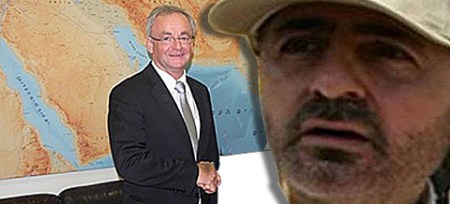
More than one intermediary visited Beirut to avert the Hizballah attack and its deadly fallout, including a former senior officer of the German BND foreign intelligence service. According to DEBKAfile’s intelligence sources, Gerhard Conrad, late of the BND and incumbent director of the European Union’s Intelligence and Situation Center, was given this urgent mission by Chancellor Angela Merkel.

He came away from a meeting with Nasrallah on Dec. 29, with the news that the Hizballah chief was not open to persuasion and the attack was already underway.

Conrad has excellent connections in the Arab world, especially in Syria and Lebanon. Seven years ago, he acted as intermediary between Israel and Hizballah for negotiating the recovery of the bodies of two fallen IDF soldiers, Eldad Regev and Ehud Goldwasser, in exchange for the handover of that same Hizballah high-up Samir Quntar and other jailed and convicted Arab terrorists.

The German spy-diplomat then established personal connections with a shadowy figure, Wafik Safa, who is in charge of Hizballah’s intelligence and security network and a close crony of Nasrallah.

Conrad used those connections again in 2011 to broker the release of Gilead Shalit from Hamas captivity.

It was Safa he arranged for him to meet Nasrallah in Beirut Tuesday. He found the Hizballah chief unshakeable in his determination to make Israel pay for Quntar’s death, even at the cost of a painful backlash against the Shiite group’s terrorists in Syria and Lebanon.

He was unmoved by the warning issued by Israel’s chief of staff, Lieut. Gen. Gady Eisenkott, on Monday, just hours before the Conrad mission.  Eisenkott said, “Just as we have proven in the past, we know how to strike anyone who wishes to harm us. Our enemies know they will suffer grave consequences if they try to undermine our security.”

Upon receipt of the German emissary’s report on the meeting, Eisenkott, his deputy, Maj. Gen. Yair Golan, and OC Northern Command, Maj. Gen. Aviv Kochavi, inspected the preparedness of the IDF’s northern border defenses for all contingencies.

They took into account a scenario, whereby Nasrallah would take advantage of the stormy weather forecast for the weekend in Syria, Lebanon and Israel, to strike Israel, in the knowledge that the heavy rain and snow would impede Israeli air force activity and give the Hizballah operation a tactical edge.

Russian military and Iranian Revolutionary Guard forces in Syria have taken into account that a Hizballah attack will not go unanswered by Israel and that the IDF would most likely hit back at Hizballah on Syrian soil, thus ushering in the New Year with a new whirlwind.

State Dept. counts ‘bringing peace’ to Syria as a 2015 win

December 28, 2015

State Dept. counts ‘bringing peace’ to Syria as a 2015 win, Politico, December 28, 2015

(Does that mean that Obama’s America won’t accept any more Syrian refugees and that those already there will be sent home? — DM)

The State Department is counting “bringing peace” to Syria as one of its wins in 2015.

A boastful recap of the State Department’s accomplishments, written by spokesman John Kirby, includes the bold subheadline of “Bringing Peace, Security to Syria” above a more modest entry talking about U.S. aid for those affected by the country’s turmoil and the U.S. push for a political transition from President Bashar Assad.

While Secretary of State John Kerry has played an integral role in the Syrian peace talks, the country remains embroiled in a nasty civil war and terrorized by the Islamic State.

“The United States and many members of the international community have stepped up to aid the Syrian people during their time of need — the United States has led the world in humanitarian aid contributions since the crisis began in 2011,” Kirby said.

Kirby wrote that the Syrians have “borne a heavy load” but that under Kerry’s stewardship the United Nations passed a U.S.-sponsored resolution to create a road map for Syria going forward.

The apparent declaration of a win echoes comments from President Barack Obama, who has been heavily criticized for calling the Islamic State a “JV team” in a January 2014 article and for calling the group’s territorial expansion efforts “contained,” just days before the Paris attacks.

Kirby also explicitly touched on the Islamic State, also called ISIL, saying that the U.S. is “winning [the] fight against violent extremists.”

“Although challenges remain, we have made positive strides over the last year, including in our fight against ISIL,” Kirby said. “This forward progress will only continue as more countries pledge resources to the anti-ISIL effort and as citizens around the world increasingly reject ISIL’s misguided ideology.”

Kirby cited the White House Summit on Countering Violent Extremism, hosted in February, which he called “monumental.”

Other things the State Department is counting as wins: re-establishing ties with Cuba, protecting the Arctic, clinching the Iran nuclear agreement, stopping the Ebola outbreak, committing to U.N. development goals, securing a free trade deal, preserving ocean health, and reaching the climate agreement.

Tehran names Raafat Al-Bakkar as new Hizballah Golan terror ring chief

December 28, 2015

Tehran names Raafat Al-Bakkar as new Hizballah Golan terror ring chief, DEBKAfile, December 28, 2015

NasrallaBagdadi480

Tehran Monday, Dec. 28, further ramped up the tension between its Lebanese proxy Hizballah, whose leader Sunday threatened to avenge the death of Samir Quntar, and Israel, which is conducting a military exercise along its northern borders. Four days after Quntar was assassinated in Damascus, Tehran appointed a successor to carry on building a new terrorist network for striking Israel from the Golan.

This successor is revealed by DEBKAfile’s exclusive sources as a Lebanese called Raafat Al-Bakkar, about whom very little is known. According to our sources, the Iranians spotted Al-Bakkar as promising talent earlier this year, shortly after the Israeli air strike which on Jan. 18 killed Iranian Gen. Ali Dadi and the high-profile Hizballah leader Jihad Moughniyeh. They were caught touring the Golan around Quneitra in search of a site for a terrorist base. Al-Bakkar was sent to Tehran at that time for a course in building and running terrorist networks, and this week he was given charge of the new “National Resistance on the Golan” organization for deep strikes inside Israel.

When Nasrallah boasted Sunday that his jihadists were already on their way to punish Israel, he was looking forward to the arrival of Quntar’s successor.

See DEBKA files’ earlier report from Sunday, Dec. 27.

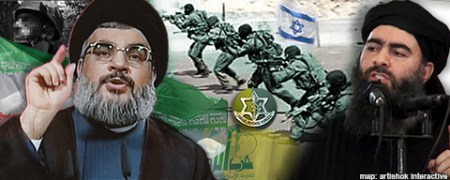
IDF Chief of Staff Lt. Gen. Gady Eisenkott explained why it was necessary to bring forward the launching of the new Commando Brigade by two months, when he addressed the formation ceremony on Sunday, Dec. 27, at the Ein Harod National Park: “The Commando Brigade is more necessary than ever in light of the threats from Hizballah and the Islamic State,” he said, in reference to the boasts heard in the last 48 hours from Hassan Nasrallah and Abu Bakr Al Baghdadi.

The Chief of Staff introduced Col. David Zini as the first commander of the new Brigade.

The ceremony took place shortly after the Hizballah chief Hassan Nasrallah said, “Revenge for the death of Samir Quntar is on the way… The orders have been given and execution is in the hands of resistance fighters on the ground… The Israelis are worried and rightly so – those on the borders [soldiers] and those inside the country…. We shall not let the blood of our Jihadi fighters and brothers to be spilled anywhere in the world,” he said.

DEBKAfile’s military sources report: Analysis of the kinds of threats posed by Hizballah (and ISIS) at this time, which are likely to focus more on terrorism than on tank or infantry border incursions, persuaded IDF leaders of the need for a new framework for bringing under one roof some of the top-notch, highly-trained, experienced, well-armed and determined fighting men who are willing to take on new challenges.

The self-styled Islamic State’s “caliph” Abu Bakr Al-Baghdadi, also devoted special attention to Israel, or rather “the Jews,” in his first audio speech in seven months Saturday, Dec. 26, the day before Nasrallah sounded off. His message was similar to that of his Shiite enemy, albeit in his own inimitable style:

The Islamic State would soon be in Palestine to establish an Islamic state there, he said, “Jews, soon you shall hear from us in Palestine which will become your grave… The Jews thought we had forgotten Palestinian… Not at all, Jews…The pioneers of the jihadist fighters are getting closer every day.”

If and when the Shiite Hizballah and Sunni ISIS make good on their similar but separate threats – or sooner – they will encounter Israel’s new Commando Brigade. Its fighting men are trained for combat in miscellaneous conditions of terrain, day or night, under deep cover. They are equipped with high-tech equipment, most of it classified, for gathering visual and electronic intelligence, communications, photography and targeting. They may either kill terrorists or take them captive.

In a word, these elite troops will hit the enemy in his back yard or at home, and blow the threats heard from Hizballah and ISIS leaders’ back on their own forces.

The 89th Commando Brigade is composed of four battalions:

Duvdevan specializes in operating amidst an Arab population under deep cover for locating and arresting terror suspects.

Egoz is a special kind of infantry battalion, whose commandos operate solo or in very small teams behind enemy lines, especially across the Syrian and Lebanese borders.

Maglan is skilled in the use of weaponry designed for precision operations against high quality enemy targets. These elite fighters go deep inside enemy territory to gather intelligence and use their specialized technology, exclusive for the use of this unit, for devastating assaults.

Rimon members are desert fighters who gained their experience in the terrain of the Gaza Strip and Egypt. Their experience as back-up for operations against drug smugglers is invaluable for urban combat in civilian environments.

Excluded from the new brigade are the separate IDF commando units: Sayeret Matkal, Shayetet 13 (Navy), the Oketz unit which trains dogs for anti-terror work, and Yahalom, of the Engineering Corps.

Arch terrorist Samir Quntar’s two secret Iranian controllers died with him

December 24, 2015

Arch terrorist Samir Quntar’s two secret Iranian controllers died with him, DEBKAfile, December 24, 2015

Kuntar480

The Hizballah leader Hassan Nasrallah’s eulogy for Samir Quntar at his funeral Monday, Dec. 21 was not only brief but also untraditional. After blaming Israel in a few short sentences for assassinating him, Nasrallah said he would laud the dead terrorist’s deeds and qualities on another occasion.

That was hardly the tribute the Hizballah would normally have awarded a senior operative killed by Zionist missiles.

DEBKAfile’s intelligence and counterterrorism sources explain this odd behavior by events leading up to the rocket strike.

The Druze arch terrorist had of late transferred his services from Hizballah to the Iranian Revolutionary Guards. He kept up his connections in Hizballah, but took orders from the Iranians in preference to instructions from Nasrallah and the commander of Hizballah operations in Syria, Mustafa Badr al-Din.

The Iranian command in Damascus provided him with two apartments in the Jamaran district south of the Syrian capital, where he lived and worked. But he was also given two Iranian handlers, officers of Gen. Qassem Soleimani’s Al Qods Brigades.

The two Iranian officers died in the rocket attack Sunday, Dec. 20, along with Quntar and his deputy, Farhan Issam Sha’alan, head of the “Syrian National Resistance on the Golan” organization, which was just then getting ready to launch attacks deep inside Israeli territory.

DEBKAfile’s exclusive sources name the two Iranian officers as Mohammed Riza Fahemi and Mir Ahmad Ahmadi. Their coffins were flown to Tehran the day after the assassination.

Wednesday, Dec. 23, the IDF raised the level of alert another notch on the Golan, the Lebanese and Syrian borders and on the main roads of northern Israel, in view of signs that the Iranian leadership was bent on avenging the loss of the arch-terrorist and the two Iranian intelligence officers.

Our Iranian and intelligence sources report that high Iranian officials had concluded that Israel had targeted Quntar to get at Tehran, rather than Hizballah. It was seen as a warning from Jerusalem that if the new terrorist network that the Druze terrorist had established, in partnership with Syria and Hizballah, went into action against Israel, Iran would pay a price: more elements of its military and intelligence structure in Syria would be targeted. Iran’s leaders also decided, according to those sources, that the deaths of Quntar and two Iranian officers must not go unpunished.

But the rushed eulogy and unceremonious funeral also had a hidden context. Although the dead man was a member of the Druze faith, the ceremony was conducted according to Shiite rites at Hizballah’s main center of worship, the Shite Hosniyeh mosque in southern Beirut. The hundreds of thousands of Syrian, Lebanese and Israeli Druze who witnessed the ceremony were appalled to discover that Quntar had deserted his ancestral faith and converted to Shiite Muslim.

DEBKAfile’s intelligence and counterterrorism sources have learned that the terrorist kept his conversion a deep secret, known to no one in the Druze community, only to a handful of top Iranian and Hizballah officials. Since the secret has come out, his compatriots in Syria, Lebanon and the Golan feel they were cheated by Iranian and Hizballah agents into following Quntar, in the false belief that he headed an autonomous Druze group, when in fact he was a renegade and the minion of a Shiite power.

Get Ready for a “Bigger Powers That Be Attack”!

December 24, 2015

Get Ready for a “Bigger Powers That Be Attack”! Zero Point via You Tube, December 24, 2015

(??????????? — DM)


https://www.youtube.com/watch?v=Xu-De2J9WSc


According to the blurb following the video,

The so-called Islamic State (ISIS) is armed with biological and chemical weapons but Europeans don’t take the existential threat seriously, according to a European Union parliament document..

Israeli experts last week also said ISIS is armed with weapons forbidden by the Geneva Convention and that it is a state in every sense of the word, with its own currency, a university and even license plates..

The London Express reported that the parliamentary report states that ISIS “may be planning to try to use internationally banned weapons of mass destruction in future attacks.” The document was prepared by the Parliament’s political analyst following the ISIS massacres in Paris last month..

ISIS has been trafficking in chemical weapons and also is able to manufacture them by putting together a team of experts with degrees in chemistry and physics..

The EU report, quoted by the Express, states:

Chemical, biological, radiological or nuclear substances (CBRN) have been carried undetected into the European Union. Interpol’s monthly CBRN intelligence reports show numerous examples of attempts to acquire, smuggle or use CBRN materials..

At present, European citizens are not seriously contemplating the possibility that extremist groups might use chemical, biological, radiological or nuclear (CBRN) materials during attacks in Europe. Under these circumstances, the impact of such an attack, should it occur, would be even more destabilizing..

Experts at an Israeli conference said that ISIS is a genuine state even if it not recognized by others, Globes reported..

It controls approximately one-third of Syria’s land, nearly 10 million people and earns approximately $300 million in day from the sale of oil it has confiscated in Iraq and Syria..

Besides its well-publicized black flag and army of barbaric terrorists, ISIS runs courts, schools, welfare agencies and even issues license plates. One of the experts said, “There is no precedent for anything like this in the past 100 years”..

Dr. Ronen Yitzchak, head of the Middle East Dept. at the Western Galilee College, said that the Western coalition has succeeded in seriously damaging the infrastructure of ISIS and in limiting its expansion.

However, he added:

Despite weaknesses in the organization, it will not disappear and will continue to be present for many years. The Islamic State is not a temporary episode. It will continue to present a danger to the West and the entire world..

Terror will worsen in Europe, whether it is because of terrorists who are there now or because of those who be recruited in the future..

ISIS has succeeded in recruiting cells in dozens of countries, “something that has never been seen in terror groups,” Yitzchak said..

ISIS has its own currency, has minted gold and silver coins and soon will introduce bronze coins..

Its radical Islamic school system forbids studies in music, arts and Western subjects such as psychology..

The expert panel also revealed that every family is required to “contribute” one male adult to fight in the ISIS army, which comprises estimated 35,000-50,000 men…

Russia brings over heavy T-90 tanks to boost three Syrian warfronts

December 6, 2015

Russia brings over heavy T-90 tanks to boost three Syrian warfronts, DEBKAfile, December 6, 2015

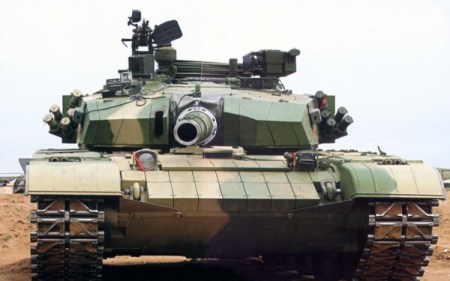
russian-tank-army-t-90-Syria_12.15

On Wednesday, Dec. 2, Russia started transferring dozens of advanced T-90 tanks to Syria, DEBKAfile’s military and intelligence sources report. They were moved immediately to two Syrian army fronts fighting rebel forces at the two most important cities, Aleppo and Damascus, and are expected to be sent to beef up the combined Syria, Iranian, Hizballah army poised to recover Palmyra from the Islamic State.

The shipment to the capital was delivered into the hands of the 4th armored division, Syria’s republican guard commanded by Gen. Ali Maher Assad, the younger brother of President Bashar Assad.

The attack on Palmyra in country infested by ISIS forces was scheduled to have begun two weeks ago but was delayed for the arrival of the heavy Russian tanks, among other reasons.

The T-90 weighs 46.5 tons and has a range of 375 kilometers, with an average speed of 45 km per hour under battle conditions or 65 km per hour on roads. It has three layers of defensive systems: composite armor plates on the turret; Kontact-5 third-generation explosive reactive armor on its front, sides, and turret that reduces penetration by kinetic energy bombs; and the “Shtora,” or curtain, an electro-optical active protection system that enables the tank to jam the systems of antitank missiles.

The T-90 also has 12 smoke mortars, a 125 mm cannon and AT-11 Sniper guided antitank missiles. The tank has proven itself in battle in recent years in Russia’s wars in Georgia and Chechnya against forces not unlike the Syrian rebels.

Until last week, Russia kept only a few T-90 tanks in Syria, mainly to protect its military bases around Latakia.

The new shipment, say Western military sources which are monitoring Russian movements, will eventually replace a large part of the Syrian army’s fleet of around 500 operational tanks, mostly T-72s – at least half of which are positioned to defend the capital.

But the pace of delivery will be dictated above all by the time needed for Russian instructors to retrain Syrian tank crews from scratch in the use of T-90s in battle conditions.

It should be noted meanwhile that, while the Syrian rebels have antitank missiles able to take out the T-72, they do not have advanced missiles capable of stopping the much heavier, reactively armed T-90. But  the Islamic State does, having captured US-made antitank missiles from the Iraqi armored divisions put to flight in June 2014. Some of those advanced missiles may be presumed to have been passed to ISIS forces in Syria.

For now, the Russian general staff shows no sign of preparing for a wide-scale operation against ISIS in Syria, so the newly-delivered T-90s are not immediately threatened from that quarter.

As far as Israel is concerned, the main worry is that Russian instructors will also be assigned to train Iranian and Hizballah tank crews in the use of the advanced T-90. Once they get hold of these tanks, they will be able to attain their objective of beefing up the Iranian-Hizballah front against Israeli defenses from southern Syria and the Syrian Golan.

Israeli finds cause for concern in the constant expansion of the Russian military presence and involvement in Syria. Preparations for a very long stay are signified by new developments every few days. A permanent Russian military presence in Syria would give Iran and Hizballah cover for a standing military buildup in Syria. This would confront Israel’s vital strategic interests with a major challenge.

Satire| Enraged Pope Vows To Enlist In The French Foreign Legion

November 17, 2015
Enraged Pope Vows To Enlist In The French Foreign Legion, The Duffel Blog, November 17, 2015

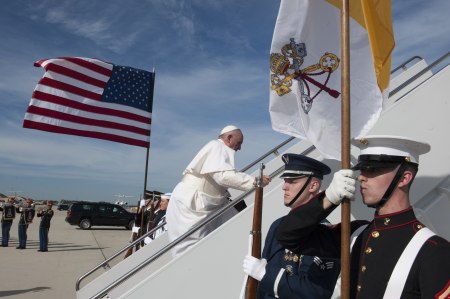
Pope joins French Foreign LegionPHOTO CREDIT: US AIR FORCE

VATICAN CITY — Pope Francis has vowed to enlist in the French Foreign Legion and deploy to Syria, an unprecedented move prompted by a series of terrorist attacks by ISIS, Duffel Blog has learned.

Officials confirm that the Pope has declared himself a “conscientious objector to the existence of ISIS” and plans to take part in direct combat. Though his Eminence must first obtain an age-waiver and graduate from boot camp; a feat other heads of state can only hope to match.

Jacques Trudeau, Commandant of the Swiss Guard, assured Duffel Blog that the Pope was deadly serious. “His Eminence has been doing burpees for over four hours,” he said. “I haven’t seen him this worked up since New Orleans claimed they ‘eradicated veterans’ homelessness.”

Pope Francis has also reversed his stance on gun manufacturers and declared them Christians again. “His Holiness’s views have evolved,” a Vatican spokesperson explained, “Now is perhaps a good time to be in the company of Western merchants of death, yes?”

The Pontifex also criticized America for its legislative gridlock surrounding the war against the terrorist group. Sources confirmed that he spiritually guided former Speaker John Boehner (R-Ohio) to pass the Fiscal Year 16 Defense Authorization, but was unable to push further and call for a new Authorization For Use of Military Force.

The Pope instead took matters into his own hands and has declared a Holy Authorization of Force for all Western forces.

“These mongrels attacked a pillar of French culture: American death metal bands,” the Pope declared in a press conference. “Divine justice must be served, and I intend it to be a full-course meal.”


Israel’s Risk Aversion Problem

October 2, 2015

Israel’s Risk Aversion Problem, Town Hall, Caroline Glick, October 2, 2015
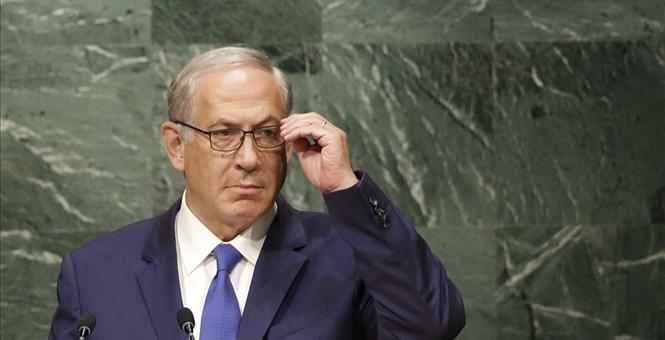
Netanyahu and glasses

Because his strategy is based on ideological beliefs rather than power calculations rooted in reality, Obama’s position cannot be swayed by evidence, even when evidence shows that his administration’s policies endanger US national security.

The more Israel allows other actors to determine the nature of the emerging regional order, the less secure Israel will be. The more willing we are to take calculated risks today the greater our ability will be to influence the future architecture of regional power relations and so minimize threats to our survival in the decades to come.

***********************

On Wednesday the Obama administration was caught off guard by Russia’s rapid rise in Syria. As the Russians began bombing a US-supported militia along the Damascus-Homs highway, Secretary of State John Kerry was meeting with his Russian counterpart, Sergei Lavrov, at the UN. Just hours before their meeting Kerry was insisting that Russia’s presence in Syria would likely be a positive development.

Reacting to the administration’s humiliation, Republican Sen. John McCain said, “This administration has confused our friends, encouraged our enemies, mistaken an excess of caution for prudence and replaced the risks of action with the perils of inaction.”

McCain added that Russian President Vladimir Putin had stepped “into the wreckage of this administration’s Middle East policy.”

While directed at the administration, McCain’s general point is universally applicable. Today is no time for an overabundance of caution.

The system of centralized regimes that held sway in the Arab world since the breakup of the Ottoman Empire nearly a century ago has unraveled. The shape of the new order has yet to be determined.

The war in Syria and the chaos and instability engulfing the region are part and parcel of the birth pangs of a new regional governing architecture now taking form. Actions taken by regional and global actors today will likely will influence power relations for generations.

Putin understands the opportunity of the moment.

He views the decomposition of Syria as an opportunity to rebuild Russia’s power and influence in the Middle East – at America’s expense.

Russia isn’t the only strategic player seeking to exploit the war in Syria and the regional chaos. Turkey and Iran are also working assiduously to take advantage of the current absence of order to advance their long term interests.

Turkish President Recep Tayyip Erdogan is exploiting the rise of Islamic State in Syria and Iraq to fight the Kurds in both countries. Erdogan’s goal is twofold: to prevent the establishment of an independent Kurdistan and to disenfranchise the Kurds in Turkey.

As for Iran, Syria is Iran’s bulwark against Sunni power in the Arab world and the logistical base for Tehran’s Shi’ite foreign legion Hezbollah. Iranian dictator Ali Khamenei is willing to fight to the bitter end to hold as much of Syrian territory as possible.

Broadly speaking, Iran views the breakup of the Arab state system as both a threat and an opportunity.

The chaos threatens Iran, because it has radicalized the Sunni world. If Sunni forces unite, their numeric advantage against Shi’ite Iran will imperil it.

The power of Sunni numbers is the reason Bashar Assad now controls a mere sixth of Syrian territory. To prevent his fate from befalling them, the Iranians seek to destabilize neighboring regimes and where possible install proxy governments in their stead.

Iran’s cultivation of alliances and proxy relationships with Hamas, the Muslim Brotherhood and al-Qaida, and its phony war against Islamic State all point to an overarching goal of keeping Sunni forces separated and dependent on Tehran.

The Iranian regime also fears the prospect of being overthrown by its domestic opponents. To counter this threat the regime engages in large-scale and ever escalating repression of its perceived foes.

Iran’s nuclear program also plays a key role in the regime’s survival strategy. As Khamenei and his underlings see things, nuclear weapons protect the regime in three ways. They deter Iran’s external foes. They increase domestic support for the regime by enriching Iran which, no longer under international sanctions, sees its diplomatic and economic prestige massively enhanced due to its nuclear program.

Finally, there is Iran’s war with Israel and the US. A nuclear-armed Iran is a direct threat to both countries.

And this, too, is a boon for the mullacracy. From the regime’s perspective, fighting Israel and the US serves to neutralize the Sunni threat to the regime. The more Iran is seen as fighting Israel and the US the more legitimate it appears to Sunni jihadists.

This then brings us to the Americans. Like the Russians, the Turks and the Iranians, President Barack Obama and his associates are strategic players. Unlike those powers however, the administration is moved not by raw power calculations but by ideological dictates.

Obama and his advisers are convinced that the instability and radicalization of states and actors throughout the region is the consequence of the actions of past US administrations and those of America’s regional allies – first and foremost, Israel and Egypt. The basis for this conviction is the administration’s post-colonial ideological underpinnings.

Because his strategy is based on ideological beliefs rather than power calculations rooted in reality, Obama’s position cannot be swayed by evidence, even when evidence shows that his administration’s policies endanger US national security.

This brings us to Israel.

Israel has limited power to influence regional events.

It cannot change its neighbors’ values or cultures. Israel can however limit its neighbors’ ability to harm it and expand its ability to deter would be aggressors by among other things, using its power judiciously to influence now forming power balances between various regional and world actors.

Israel has followed this model in Syria with notable success.

At an early stage of the war our leaders recognized that aside from the Kurds, who have no shared border with us, there are no viable actors in Syria that are not dangerous to Israel. As a result, Israel has no interest in the victory of one group against others.

The only actor in Syria that Israel has felt it necessary to actively rein in is Hezbollah. So it has acted repeatedly to prevent Hezbollah from using its operational presence in Syria as a means for augmenting its offensive capabilities in Lebanon.

The problem with this strategy is that it has ignored the fact that from Hezbollah’s perspective, there is no operational difference between Lebanon and Syria.

The war in Syria spread to Lebanon years ago.

Now, with Iranian and Russian assistance, Hezbollah is beginning to develop the industrial capacity to bypass Israel and independently produce advanced weapons inside Lebanon. This rapid industrialization of Hezbollah’s military capabilities requires Israel to end its respect for the all-but-destroyed international border and take direct action against Hezbollah’s capabilities in Lebanon.

This brings us to Hezbollah’s boss, Iran. For the past several years, the same caution that has led Israel to grant de facto immunity to Hezbollah forces in Lebanon has led to Israel’s passivity and deference to the Obama administration in relation to Iran’s nuclear program.

With regard to Iran’s nuclear installations, the strategy of passivity has largely been forced onto an unwilling political leadership by Israel’s military leaders.

For the past several years, the IDF’s General Staff has refused to support the government’s position on Iran’s nuclear program.

Our military leaders have justified their insubordination by arguing that if Israel takes independent action against Iran’s nuclear program it will undermine its bilateral relations with the US, which they consider more important than preventing Iran from acquiring nuclear weapons.

Although under the best of circumstances, the IDF’s position would be unacceptable from the perspective of democratic norms of governance, since the ideologically driven Obama administration took power seven years ago, the military’s position has imperiled the country.

So long as Obama – or the ideology that informs his actions – remains in power in Washington, US security guarantees towards Israel will have no credibility.

The IDF’s assessment that ties to the US are more important than preventing Iran from becoming a nuclear power will remain incorrect, and dangerously so.

Today is Israel’s opportunity to shape the future of the Middle East by not only preventing Iran from becoming a nuclear power, but by preventing a regional nuclear arms race.

The closer Iran comes to emerging as a nuclear power, the more Sunni regimes, including Islamic State, will seek their own nuclear capabilities. It goes without saying that the more regional actors have nuclear weapons, the more dangerous the region becomes for Israel, and indeed for the world as a whole.

For many Israelis, the story of the week wasn’t Russia’s air strikes against US-allied forces in Syria. It was PLO chief and Palestinian Authority President Mahmoud Abbas’s speech at the UN General Assembly.

Leftists expressed horror in the face of Abbas’s threat to end the PLO’s adherence to the agreements it signed with Israel in the 1990s (and has stood in material breach of ever since). The government insisted, for its part that the reason the peace process has not brought peace is because Abbas and his PLO refuse to negotiate with Israel.

Unfortunately, both sides’ responses to Abbas’s speech indicate that Israel has lost all semblance of strategic purpose in regard to the Palestinians.

Fifteen years ago this week, on September 28, 2000, the Palestinians opened their terrorist war against Israel. Ever since it has been clear that no Palestinian faction is interested in living at peace with Israel.

Despite this, for the past 15 years, Israel has refused to reconsider its strategic allegiance to the false notion that it has the ability to influence the hearts and minds of the Palestinians and bend them in the direction of peace.

This delusional thinking is what caused the IDF’s General Staff to convene immediately after Operation Protective Edge ended and try to figure out how to rebuild Gaza.

Ever since the cease-fire came into force, Hamas has diverted all the assistance it has received from Israel and the international community not to rebuild Gaza, but to rebuild its military capacity to harm Israel. And yet, from the IDF’s perspective, ever since the war ended our most urgent task has been to save Hamas and the Palestinians alike from reckoning with the price of their aggression.

Likewise, Israel continues to insist that we have a strategic interest in peace with the PLO. Even if this is true in theory, chances are greater that unicorns will fall from the sky and prance through Jerusalem’s Old City than that the PLO will agree to make peace with Israel.

Our continued defense of the PLO as a legitimate actor harms our ability to secure other strategic interests that are achievable and can improve Israel’s regional position. These interests include securing transportation arteries in Judea and Samaria and strengthening Israel’s military and political control over the areas. These interests have only grown more acute in recent years with the rise of jihadist forces throughout the region and among the Palestinians themselves.

This brings us back to McCain and his strategic wisdom.

Israel must not allow the risks of action to lure us into strategic paralysis that imperils our future.

The more Israel allows other actors to determine the nature of the emerging regional order, the less secure Israel will be. The more willing we are to take calculated risks today the greater our ability will be to influence the future architecture of regional power relations and so minimize threats to our survival in the decades to come.
The pope’s misguided defense of Islam

September 24, 2015

The pope’s misguided defense of Islam, Front Page Magazine, Daniel Greenfield, September 24, 2015

pope_francis_in_march_2013


The Pope could have used his forum in Congress to call attention to the plight of Christians.

Unlike Communist Cuba, America hasn’t seized and nationalized Catholic churches and schools. It hasn’t locked up Catholic clergy or installed surveillance equipment in their homes. It hasn’t denounced the Catholic church as “exploiters” and “fascists”. And yet Pope Francis, who had few criticisms of Cuba, came to Congress to denounce the collision between Americans and Indians, and to urge the United States to take in illegal aliens without regard for the law.

There’s a condemnation of the death penalty. Never mind that in the US, the death penalty is used after extensive appeals against some of the worst monsters imaginable, unlike Cuba, where it was used to massacre political opponents of the Castro crime family. And condemnations of selling weapons. Much of this is couched in vague language, but it’s still a sharp contrast from the visit to Cuba.

The Pope even threw in a backhanded defense of Islam…

Our world is increasingly a place of violent conflict, hatred and brutal atrocities, committed even in the name of God and of religion. We know that no religion is immune from forms of individual delusion or ideological extremism. This means that we must be especially attentive to every type of fundamentalism, whether religious or of any other kind…

But there is another temptation which we must especially guard against: the simplistic reductionism which sees only good or evil; or, if you will, the righteous and sinners.

No religion is technically immune from anything if you mean that some members of it might misbehave. But that’s misleading language that tries to avoid the reality by setting up a strawman.

No country is immune from violating human rights, but there’s a big difference between David Cameron and Adolf Hitler. There’s also a huge difference between most religions and Islam when it comes to “violent conflict, hatred and brutal atrocities” committed in the name of religion. Especially when we focus in on the contrast between Western religions in the free world… and Islam.

There’s also a simplistic reductionism in reducing unpleasant truths to strawmen. There are clear cases of evil that have to be addressed. To say that does not mean an inability to see anything except black and white.

To say that no religion is immune to brutal atrocities is true and meaningless. We might as well say that no one human being is immune to evil. It doesn’t get us any closer to dealing with the reality of evil people out there.

It’s easy to talk around problems and Islam is the most talked-around problem today. But the plight of Christians in the Middle East deserves more than more ‘talking around’. Instead of elitist lectures, they need a moral authority to forcefully advocate intervention on their behalf by making it clear that they face genocide. And that it’s up to the West to make Christianity in the region sustainable or evacuate its last remnants.

It’s a much more vital issue than Global Warming, which the Pope mentions repeatedly.

The Pope could have used his forum in Congress to call attention to the plight of Christians in the region and demand action. Instead he talked generally about Syrian refugees, most of whom are Muslims.

Advocates are hoping for more.

Now that Pope Francis is in his first day of his two-day visit to Washington, D.C., advocates for persecuted Christians in the Middle East are urging the pontiff to speak out forcefully on their plight in his meeting with President Obama Wednesday and in his historic address to Congress the following day.

“I’m hoping the Pope points out that thousands of Christians are persecuted, denied their fundamental rights, and killed because of their faith [in the Middle East],” George Marlin, chairman of Aid to the Church in Need USA, told me.

Marlin, who has written a much-praised book on the subject of Christian persecution in the Middle East, emphasized that “someone has to bang pots and pans on this issue. The Administration is not doing it. The national media is not doing it. If the Pope brings this up, it makes front-page news worldwide.”

“If Pope Francis calls it genocide before Congress, there will be a moral clarity added to this issue and it will bring a new ray of hope to persecuted Christians,” said Taimoorazy, herself a refugees from Iran who came to the U.S. in 1991, “The whole world will now be paying attention.”

In underscoring why the Pope must use the word “genocide,” she cited the fact that the Assyrian Christian population in the Middle East was 1.6 million prior to 2003 and “now we only have 300,000.”

I suppose it’s not as important as the critiques of capitalism and Global Warming and illegal aliens and the death penalty.