Archive for the ‘Saudi Arabia’ category

Resolving the Syrian war is not the silver bullet for stopping ISIS

August 29, 2015

Resolving the Syrian war is not the silver bullet for stopping ISIS, DEBKAfile, August 29, 2015

(Please see also, Pentagon Not Targeting Islamic State Training Camps. — DM)

jISIS_mobile_defense_of_SVBIED_8.15ISIS “mobile defense SVBIED” in action in Iraq

President Obama may likewise offer King Salman all sorts of assistance for standing up to ISIS, but he will find no buyers in Riyadh for his failed policy of reliance on Saudi Arabia’s rival, Iran, for liquidating the Islamist threat looming against the oil kingdom from neighboring Iraq.  Neither is US aid much use for stemming the tide of pro-ISIS radicalism spreading among young Saudi men.

As matters stand today, therefore, the Islamic State faces no tangible threat – even if Iran does go ahead and achieve a nuclear bomb.

**************************

The war to stop the Islamic State in Iraq and the Levant (ISIS) has entered a dark tunnel. And with it the bottomless conflicts in Syria, Yemen, Libya and Iraq. The search for a ray of light moves next week from Moscow to Washington, when Saudi King Salman Bin Abdulaziz makes his first visit as monarch for talks with President Barack Obama.

The three worried Arab rulers received in the Kremlin Tuesday, Aug. 25, by President Vladimir Putin could only talk in circles: Egyptian President Abdel-Fatteh El-Sisi,is  embattled on three fronts, Sinai, his border with Libya and Cairo; Jordan’s King Abdullah II – is wedged between two wars; and UAE Crown Prince Sheikh Mohamed bin Zayed Al Nahyan, has sent his army to fight the Yemen insurgency alongside Saudi Arabia.

For them, resolving the Syrian conflict looked like the silver bullet, the key to ending all their troubles. But whichever Russian or Iranian plans and ideas they considered for a way forward, they were all forced to come back to the same impasse. Even Putin and Obama can’t get around or ignore two solid facts:

1. In the year since the US built an international coalition for fighting ISIS, the brutal Islamists have not been cut down; they have instead been empowered to seize more turf outside their Iraqi and Syrian conquests, such big oil fields in Libya, an ascending threat to Egypt and big plans for Lebanon.

2. A major letdown has followed on the high hopes reposed in Iran. The nuclear deal negotiated with the six world powers – and the elevated regional status conferred on Iran – hinged closely on US expectations that Tehran would put up effective military resources for tackling ISIS.

But the Revolutionary Guards, the popular Syrian and Iraqi forces the Guards established,and  the Afghan and Pakistani Shiite militias they imported – none have proved a match for ISIS and jihadi tactics.

In Syria, ISIS stands fast, unthreatened in the terrain, towns and oil fields they have captured, in the past year – excepting only on fringe fronts, where they have been forced back by local Kurdish rebel fighters.

Hizballah is a big part of the disappointment. It was supposed to serve as a bulwark against ISIS invading eastern Lebanon from Syria. Instead, these Lebanese Shiite fighters, allies of Assad’s army, are bogged down in a bitter battle for the strategic Syrian town of Zabadani, after failing to breach Syrian rebel defenses in forays from the south, the north or the center.

The door is therefore open for the Islamist State to march into Hizballah’s strongholds in the Lebanese Beqaa valley and head north to the port of Tripoli for a foothold on the Mediterranean.

Whether Bashar Assad stays or goes, which might have made a difference at an early stage of the Syrian insurgency, is irrelevant now that his army and allied forces are in dire straits.

In Iraq, the forces fighting ISIS are equally stumped. The jihadis are in control of a deadly string of  strategic towns, Ramadi, Faluja, the refinery city of Baiji, Mosul, and most of the western province of Anbar, including Haditha which commands a key stretch of the Euphrates River.

Here, too, the Islamist terrorist army’s lines remain intact, unbroken either by the undercover Jordanian Special Forces campaign 200 km inside Anbar, albeit backed by US and Israeli military and intelligence assistance; by the “popular mobilization committees” set up by the Iranian general Abu Mahdi al-Muhandis, deputy of the Al Qods chief Qassem Soleimani, or less still by US-trained Iraqi army units.

This week, the impasse spurred two combatants into chilling escalations:

— Iran began shipping its solid propellant missile, Zelzal-3B (meaning “earthquake”), across the border into Iraq, in the hope that this powerful projectile, with a range of 250km , would give the Revolutionary Guards their doomsday weapon for tipping the scales against ISIS.

— The Islamists, for their part, embraced a new tactic, known in the west as “SVBIED mobile defense.” Scores of armed vehicles are packed tight with hundreds of tons of explosives and loosed against military convoys on the move and static enemy positions and bases.

This tactic quickly proved itself by killing the 10th Iraqi Division’s chief, deputy and its command staff, as well as the deputy chief of Iraqi forces in Anbar.

In Moscow last week, Putin offered his three Middle East guests Russian nuclear reactors, arms, joint pacts for fighting terror and assorted ideas for the future of Bashar Assad. But he too had no practical proposals for bringing the Islamic State down.

President Obama may likewise offer King Salman all sorts of assistance for standing up to ISIS, but he will find no buyers in Riyadh for his failed policy of reliance on Saudi Arabia’s rival, Iran, for liquidating the Islamist threat looming against the oil kingdom from neighboring Iraq.  Neither is US aid much use for stemming the tide of pro-ISIS radicalism spreading among young Saudi men.

As matters stand today, therefore, the Islamic State faces no tangible threat – even if Iran does go ahead and achieve a nuclear bomb.

Egypt bids for two advanced French helicopter carriers – counterweight to the Iranian navy

August 27, 2015

Egypt bids for two advanced French helicopter carriers – counterweight to the Iranian navy, DEBKAfile, August 27, 2015

mistral-_Saint-Nazaire_western_France_May_25_2015Mistral carriers at Saint-Nazaire shipyard

Egypt is in advanced negotiations with France for two highly advanced French Mistral class assault-cum-helicopter carrier ships that were originally destined for the Russian Navy. DEBKAfile’s military and intelligence sources report that this deal, if it goes through, will substantially beef up the regional lineup of the Saudi, Egyptian and Israeli navies. The new vessels would enable it to contest Iranian naval challenges in the Mediterranean, the Red Sea and the Persian Gulf, and alter the balance of strength between the opposing sides.

Saudi Arabia and the United Arab Emirates have given presidents Abdel-Fatteh El-Sisi and Francois Hollande pledges to fund the transaction at $800 million per carrier.

The Mistrals will join the missile ships of Saudi Arabia, Egypt and Israel and six Dolphin submarines which, according to foreign sources, are capable of firing nuclear-tipped ballistic missiles. Their delivery comes at a time of strengthening strategic ties among Egypt, Saudi Arabia, the UAE and Israel.

The Egyptian navy stands to own the most advanced warships of any Middle East power. The French vessels may also be used as aircraft carriers, because their decks are designed to carry fighter jets as well as helicopters. The only nations maintaining this type of vessel in the region are outsiders – the US, which deploys a Wasp class helicopter for marines; Russia, the ageing Moskva class copter carrier, and France.

Originally ordered from France by the Russian Navy, the pair of Mistrals was never delivered owing to the sanctions the European Union imposed on Moscow after the Ukraine invasion.

It is a multi-purpose warship, able to accommodate 16 “European Tiger” four-bladed, twin-engined attack helicopters, four large landing craft for dropping 450 marines on shore, 70 armored vehicles, including 14 heavy AMX Leclerc assault tanks.

These figures are flexible. If necessary, the French carriers can handle an expanded complement of 900 marines and 40 tanks. It is also a command ship geared to maintain communications with military forces located anywhere in the world. It also carries a 69-bed field hospital. The Mistral has a maximum speed of 18 knots and maximum range of 20,000 miles.

Our World: The anti-peace administration

August 12, 2015

Our World: The anti-peace administration, The Jerusalem PostCaroline B. Glick, August 11, 2015

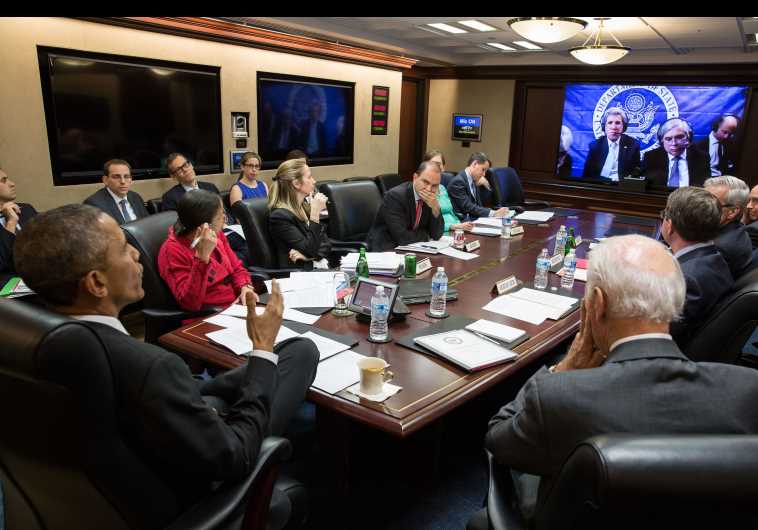
ShowImage (9)President Barack Obama, Vice President Joe Biden, and White House aides receive an update from Secretary of State John Kerry and Secretary of Energy Ernest Moniz via teleconference in Lausanne. (photo credit:WHITE HOUSE)

The US has striven to achieve peaceable relations between the states of the Middle East for nearly 70 years. Yet today, US government is disparaging the burgeoning strategic ties between the Sunni Arab states and Israel.

In a briefing to a delegation of visiting Israeli diplomatic correspondents in Washington last week, a senior Obama administration official sneered that the only noticeable shift in Israel-Arab relations in recent years is that the current Egyptian government has been coordinating security issues “more closely” with Jerusalem than the previous one did.

“But we have yet to see that change materialize in the Gulf.”

If this is how the US views the state of Israel’s relations with the Arabs, then Israel should consider canceling its intelligence cooperation with the US. Because apparently, the Americans haven’t a clue what is happening in the Middle East.

First of all, to characterize the transformation of Israeli-Egyptian relations as a mere question of “more closely” coordinating on security issues is to vastly trivialize what has happened over the past two years.

Before then Egyptian defense minister Abdel Fattah el-Sisi overthrew the US-backed Muslim Brotherhood regime headed by Muhammad Morsi in July 2013, there was a growing sense that Morsi intended to vacate Egypt’s signature to the peace deal with Israel at the first opportunity. Just a month after Morsi ascended to power in January 2013, the Muslim Brotherhood began threatening to review Egypt’s continued commitment to the peace treaty.

The main reason Morsi did not cancel the peace deal with Israel was that Egypt was bankrupt. He needed US and international monetary support to enable his government to pay for imported grain to feed Egypt’s destitute population of 90 million.

During his year in power, Morsi used Hamas as the Brotherhood’s shock troops. He embraced Iran, inviting president Mahmoud Ahmadinejad to visit Cairo in February 2013.

If Morsi were still in power today, with its $150 billion in sanctions relief Iran would have been in a position to support Egypt’s economy. So it is possible that if Morsi were still president, he would have felt he had the financial security to walk away from the peace treaty.

In happy contrast, under Sisi, Israeli-Egyptian ties are closer than they have ever been. Just last week Egyptian diplomats told Al Ahram that Israel’s support was critical for building administration support for Sisi.

Over Ramadan, Egyptian television broadcast a pro-Jewish mini-series.

Israel is closely working with the Egyptians on defeating the growing threat of Islamic State, Hamas and other Islamic terrorist groups waging a bloody insurgency against the regime in Sinai.

Last summer, it was due to the close coordination between Sisi and Israel that the US failed to force Israel to accept Hamas’s cease-fire terms, as those were represented by the Islamist regimes of Qatar and Turkey.

In part due to Israel’s critical support for Sisi’s government, and in part owing to their opposition to Iran’s rise as a regional hegemon armed with nuclear weapons, Saudi Arabia, the UAE and Jordan have all joined Egypt in viewing Israel as a strategic partner and protector.

Last year Saudi Arabia together with the UAE and Jordan supported Israel and Egypt in opposing Hamas and its American, Turkish and Qatari defenders. Had it not been for this massive Arab support, it is very likely that Israel would have been forced to accept the US’s demands and grant Hamas control over Gaza’s international borders.

In June, as negotiations between the US and the other five powers and Iran were moving toward an agreement, the Council on Foreign Relations in New York hosted a meeting between then incoming Foreign Ministry director general Dore Gold and retired Saudi General Anwar Eshki, a former advisor to the Saudi ambassador to the US. The two revealed that over the previous 18 months, they had conducted five secret meetings to discuss Iran.

Although President Barack Obama harangued Israel in his speech at American University last Wednesday, claiming that the Israeli government is the only government that has publicly opposed his nuclear deal with the Iranians, Monday US congressmen now shuttling between Egypt and Israel told Israeli reporters that Egypt opposes the nuclear deal.

As for the Gulf states, according to the US media, last week they told visiting US Secretary of State John Kerry that they support the nuclear deal.

Kerry addressed his counterparts in the Gulf Cooperation Council.

But the fact is that the only foreign minister who expressed such support was Qatari Foreign Minister Khaled al-Attiyah. To be sure, Attiyah was charged to speak for all of his counterparts because Qatar holds the GCC’s rotating chairmanship. But given that Qatar has staked out a pro-Iranian foreign policy in stark contrast to its neighbors and GCC partners, Attiyah’s statement is impossible to take seriously without the corroboration of his colleagues.

As for Qatar’s statement of support, Qatar has worked for years to cultivate good relations with Iran. It might have been expected therefore that Attiyah’s endorsement of the deal would have been enthusiastic. But it was lukewarm at best.

In Attiyah’s words, Kerry promised that the deal would place Iran’s nuclear sites under continuous inspections. “Consequently,” he explained, “the GCC countries have welcomed on this basis what has been displayed and what has been talked about by His Excellency Mr. Kerry.”

The problem of course is that Kerry wasn’t telling the truth. And the Arabs knew he was lying. The deal does not submit Iran’s nuclear sites to a rigorous inspection regime. And the GCC, including Qatar, opposes it.

In his briefing with Israeli reporters, the high-level US official rejected the importance of the détente between Israel and its Arab neighbors because he claimed the Arabs have not changed their position regarding their view of a final peace deal between Israel and the Palestinians.

But this is also nonsense. To be sure, the official position of the Saudis and the UAE is still the so-called Arab peace initiative from 2002 which stipulates that the Arabs will only normalize relations with Israel after it has ceded Jerusalem, Judea, Samaria and the Golan and allowed millions of foreign-born Arabs to freely immigrate to the shrunken Jewish state. In other words, their official position is that they will only have normal relations with Israel after Israel destroys itself.

But their official position is no longer their actual position. Their actual position is to view Israel as a strategic ally.

The senior official told the Israeli reporters that in order to show that “their primary security concern is Iran,” then as far as the Arabs are concerned, “resolving some of the other issues in the region, including the Palestinian issue should be in their interest. We would like to see them more invested in moving the process forward.”

In the real world, there is no peace process. And the Palestinian factions are fighting over who gets to have better relations with Iran. Monday we learned that PA leader Mahmoud Abbas wishes to visit Iran in the coming months in the hopes of getting the money that until recently was enjoyed by his Hamas rivals.

Hamas for its part is desperate to show Tehran that it remains a loyal client. So today, no Palestinian faction shares the joint Israeli-Saudi-Egyptian interest in preventing Iran from becoming a nuclear armed regional hegemon.

The administration showed its hand in that briefing with the Israeli reporters last week. For all their talk about Middle East peace, Obama and his advisors are not at all interested in achieving it or of noticing when it has been achieved.

The day after the deal

August 9, 2015

The day after the deal, Israel Hayom, Prof. Eyal Zisser, August 9, 2015

(Please see also, Russia and US woo Saudis to help save Assad – albeit putting Israel and Jordan in danger from S. Syria.– DM)

[Soleimani] wanted Russia and Iran to agree on the division of the Middle East in a way that would serve their clients in the region (among them, Assad) and check their joint enemies (the Islamic State). After figuring that out, they probably moved on to the next topic: how to marginalize America in the region. As a means to both ends, Russia will continue to serve as Assad’s protector (despite his many crimes), all the while providing Iran with international backing. But above all it will send arms to Iran, to the Syrian regime, and if needed, to Hezbollah.

***********************

Over the weekend it transpired that Maj. Gen. Ghasem Soleimani, the commander of Iran’s Quds Force, had visited Moscow two weeks ago and met with President Vladimir Putin. The Quds Force, in case you forgot, is in charge of the Iranian Revolutionary Guards’ clandestine operations (including terrorism). The Quds Force is responsible for providing aid to Hezbollah and Hamas as well as to Syrian President Bashar Assad and the Houthi rebels in Yemen. In light of his direct involvement in terrorism, the international community imposed sanctions on Soleimani, including travel restrictions.

Only last week, at a hearing on Capitol Hill, U.S. Secretary of State John Kerry vowed that the U.S. will make sure the sanctions on Soleimani would stay in effect and that the Obama administration would counter Iran’s efforts to destabilize the Middle East. But no one takes Kerry seriously anymore. While Kerry continues to engage Iran’s unimportant Foreign Minister Mohammad Javad Zarif, the real wheeling and dealing is actually in Moscow.

Soleimani did not go to Moscow because he had tickets to the Bolshoi. Rather, he arrived because he wanted to discuss “the day after the nuclear deal” with Putin. Namely, he wanted Russia and Iran to agree on the division of the Middle East in a way that would serve their clients in the region (among them, Assad) and check their joint enemies (the Islamic State). After figuring that out, they probably moved on to the next topic: how to marginalize America in the region. As a means to both ends, Russia will continue to serve as Assad’s protector (despite his many crimes), all the while providing Iran with international backing. But above all it will send arms to Iran, to the Syrian regime, and if needed, to Hezbollah.

The Russians, unlike the Iranians, don’t consider Israel to be an enemy state. But as a famous Russian official once said: “When you chop wood, chips fly.” Israel has become the latest chip — the collateral damage. Soleimani’s visit is just the tip of iceberg. It shed light on the not-so-secret deals that are being negotiated in the wake of the “Vienna nuclear agreement.” Europe, as usual, is focused on profit and its corporate executives are already traveling in droves to Tehran to ink deals. There are also political deals Iran wants to secure, which are as important for Tehran. Their price, however, will be measured in blood rather than in euros or dollars.

No one in the Middle East, it seems, is keen on parsing each and every provision in the nuclear deal. Nor is there an attempt to see whether, in the grand scheme of things, it is will have been a worthwhile endeavor some 10 or 15 years from now, when its key elements expire. In this region, what counts is the way this agreement is perceived here and now — and what really matters to people is the way it is portrayed in the media. Under that criteria, Iran is the victor and America is the vanquished, because it caved to Iran. The deal, according to how the media has portrayed it, is a crushing political blow to Israel and the moderate Arab states, led by Saudi Arabia.

This knockout victory will likely produce a new Iranian-American partnership. At the very least, the two nations will mend fences. This will alienate many of Washington’s clients, who will have to look elsewhere for a more reliable ally. Egypt and the Saudis have already realized this and turned to Russia for aid and arms, figuring it would be more trustworthy than the “staff of this broken reed” (Isaiah 36:6).

Saudi Arabia is reportedly sending feelers to see if there is a deal to be had with Russia and Iran. Under the terms of the proposed deal, Saudi Arabia would withhold aid to the Syrian rebels if Iran ends its rogue presence in the state. Such a deal would secure Assad a victory over the insurgents, or a least ensure his regime survives.

The ongoing developments have caused panic, but not over the rising clout of Iran and Russia. The White House, it seems, is fretting over the possibility that Congress may vote against the Iran deal and further tarnish Obama’s image.

Russia and US woo Saudis to help save Assad – albeit putting Israel and Jordan in danger from S. Syria

August 9, 2015

Russia and US woo Saudis to help save Assad – albeit putting Israel and Jordan in danger from S. Syria, DEBKAfile, August 9, 2015

Lavrov_Kerry_and_al-Jubeir-_Doha_3.8.15Lavrov, Kerry, Al-Jubeir at Doha

[N]either Israel nor Jordan has been co-opted to this big power initiative, as though they are not concerned. However, both have a big stake in Saudi Arabia’s next decisions. If Riyadh is won over by US-Russian blandishments and goes back on its decision to boycott Assad, the Saudi-Israeli-Jordanian effort to support Syrian rebel control of southern Syria will fall apart. This will open up both countries to new perils on their  northern borders.

************************

Building on the nuclear accord signed in Vienna last month, the Obama administration has been in close communion with Moscow and Tehran on regional moves to save the Assad regime, as the key to their next regional policies, including a united front against the Islamic State.. Saudi Arabia and its Gulf partners are being assiduously wooed to join the new alignment being set up for this purpose. The live wire in getting them all together is Omani Foreign Minister Khalid bin Mohamed Al-Attiyah, the secret broker who brought Iran and the United States to the negotiating table for a nuclear accord. This was first reported in the last DEBKA Weekly.

Wednesday, Aug. 7, Obama threw out his first hint on this development: “The window has opened a crack for us to get a political resolution in Syria, partly because both Russia and Iran, I think, recognize that the trend lines are not good for Assad,” he said. “Neither of those patrons are particularly sentimental; they don’t seem concerned about the humanitarian disaster that’s been wrought by Assad and this conflict over the last several years, but they are concerned about the potential collapse of the Syrian state. And that means, I think, the prospect of more serious discussions than we’ve had in the past.”

The US president then affirmed more strongly in a CNN interview Sunday, Aug. 9:  “Is there the possibility that having begun conversations around this narrow issue [the nuclear accord with Iran] that you start getting some broader discussions about Syria, for example, and the ability of all the parties involved to try to arrive at a political transition that keeps the country intact and does not further fuel the growth of ISIL and other terrorist organizations? I think that’s possible,” Obama said. “But I don’t think it happens immediately.”

The administration and its prospective partners are united by the will to destroy ISIS – in its Syrian stronghold, for starters – but are divided on much else, DEBKA file reports. And so the process is moving forward in careful steps.

Their initial focus is on Syria, the bloody battleground which in less than five years has left at least 300,000 dead and more than 10 million people homeless.

The plan the group started out with in the last ten days was a swap as simple as it was ruthless: Saudi Arabia and the United Arab Emirates would slow their assistance to Syrian rebel groups, against whom President Bashar Assad’s army and allies would hold their fire; Iran, for its part, was to start withdrawing its support from the Yemeni Houthis insurgents.

The informal truce in Syria would be the stage for the Assad regime and rebel groups to start discussing a new government with room for opposition parties. The Islamists of the Islamic State and Al Qaeda’s Nusra Front would not be invited.

In Yemen, Tehran would cut back on the arms and intelligence which have enabled the Houthi insurgents to stand up to the combined forces of Saudi Arabia, the UAE and Egypt. The pro-Western Yemeni President Abd Rabo Mansour Hadi would be restored to his palace in Sanaa and invite the insurgent leader, Abdu Malik Al-Houthi, to discuss his partnership in a new government.

This deal was tantamount to a joint US-Russian guarantee of Bashar Assad survival in power in return for a Tehran-Riyadh compact for Hadi’s reinstatement in Sanaa.

These arrangements were debated back and forth in exchanges, some semi-secret, among the leading actors for most of July. The visit to Riyadh of the Syrian intelligence chief Maj. Gen. Ali Mamlouk was set up by Moscow as a major push forward.

The plan was for the entire enterprise to be brought out in the open and sealed in Doha, Qatar, Tuesday, Aug. 3 at a conference attended by US Secretary of State John Kerry, Russian Foreign Minister Sergey Lavrov, Saudi Foreign Minister Adel Al-Jubeir and other top Gulf diplomats.

Iranian Foreign Minister Mohammed Javad Zarif was not there. But he put a strong oar into the proceedings by calling in at Muscat, Oman the day before the conference and subsequently on Friday Aug. 7. Assad also kept his hand in by sending his foreign minister Walid Moallem to Tehran and Muscat last week.

But then, at Doha, just as the package was ready to unveil, the Saudi foreign minister pulled away and blew it up with two provisions: a) Riyadh would not countenance Bashar Assad being allowed to stay in office, and: b) Saudi Arabia would not do business with any representative of the Assad regime.

This put a large spoke in the main wheel of the initiative and also scuttled some of the secondary plans depending on it.

But by then, a lot was happening in the Yemeni and Syrian war arenas:

1. Saudi and UAE armored forces had landed in Aden and were closing in on the Yemeni capital, Sanaa. The Houthi rebels, trained and armed by Iran, were forced to retreat without negotiations on their future role in government.

2. Syrian rebel leaders, sensing the approaching betrayal, sent a secret delegation to Tehran to discuss terms for opening negotiations with Assad. They too were left at sea about the deals in play among Washington, Moscow, Tehran and Riyadh over their future.

Saturday, Aug.8, the Russians, egged on by the Americans, set about winning Riyadh into the fold, Foreign Minister Al-Jubeir was invited to pay a visit to Moscow Tuesday, Aug. 11, for talks about the Syrian conflict and the war on the Islamic State.

Refusing to accept that the new initiative had been grounded in Doha, Moscow presented the visit as continuing the ongoing dialogue on the issues raised at that encounter.

DEBKAfile’s military and intelligence sources note that neither Israel nor Jordan has been co-opted to this big power initiative, as though they are not concerned. However, both have a big stake in Saudi Arabia’s next decisions. If Riyadh is won over by US-Russian blandishments and goes back on its decision to boycott Assad, the Saudi-Israeli-Jordanian effort to support Syrian rebel control of southern Syria will fall apart. This will open up both countries to new perils on their  northern borders.

Report: Iran orders Hezbollah not to retaliate now because finalizing nuclear deal

August 5, 2015

Report: Iran orders Hezbollah not to retaliate now because finalizing nuclear deal, Jerusalem PostAriel Ben Solomon, August 5, 2015

Iran instructed Hezbollah not to respond to reported Israeli Air Force strikes last week because it wants to focus on finalizing the nuclear deal with world powers, a Saudi newspaper reported on Wednesday.

Tehran does not want an escalation now that could risk the release of funds that will flow in from frozen assets as sanctions relief kicks in as the deal is finalized, sources told Al-Watan.

The unconfirmed report could well be false and part of the ongoing media battle going on between Sunni states such as Saudi Arabia and the Iran Shi’ite axis.

Iran will get access to over $100 billion of assets frozen abroad, US officials say, equivalent to a quarter of its annual output. The inflow may start around the end of this year, after Tehran is certified in compliance with the deal.

The alleged Israel Air Force drone attack last week struck a vehicle on the outskirts of the Druse village of Hader, near the Golan Heights. The UK-based Syrian Observatory for Human Rights said that five people were killed in the attack – two members of Hezbollah and three from the Syrian National Defense Forces, a pro-government militia.

The observatory added that the cell was led and supervised by Kuntar, who was traded by Israel in 2008 in exchange for the bodies of two Israeli reservists killed by Hezbollah in 2006.

A second strike targeted a Lebanese military installation near the Syrian border, wounding six, according to Arab media reports.

Other sources told the Saudi paper that the Shi’ite group aims to cover up its inability to protect its fighters in Syria and particularly from Israeli attacks.

In January, Israel carried out a helicopter attack in Quneitra province that killed a top Iranian Revolutionary Guard general and several Hezbollah members including the son of the group’s late military commander, Jihad Mughniyeh.

Meanwhile, Hezbollah recently arrested a Lebanese engineer who was allegedly an Israeli spy and turned him over to Lebanese authorities, a security force told the Lebanese Daily Star newspaper in a report on Wednesday.

He was recruited and trained in Europe by Israelis, according to the source,

‘Terrible’ Iran deal makes Israeli strike inevitable

July 15, 2015

‘Terrible’ Iran deal makes Israeli strike inevitable, BreitbartJoel B. Pollak, July 14, 2015

GettyImages-451830874-640x480

The nuclear deal reached with Iran on Tuesday is clouded by uncertainty about whether the Iranian regime will live up to its relatively weak commitments. One outcome is almost certain, however: Israel will launch a pre-emptive strike against Iran, hoping to weaken the regime and stop, or slow, its nuclear program.

Israel will attack–possibly by year’s end–because there is no other way to disrupt Iran’s advance to regional hegemony, which will become unstoppable once the deal’s provisions–especially the non-nuclear provisions–begin to take effect.

Despite what the Obama administration and its media supporters are saying, there is almost no doubt that the Iran deal, should it survive Congress, will enable Iran to become a nuclear power.

President Barack Obama himself admitted as much in April, when he defended the provisional deal signed in Lausanne by admitting it allowed Iran to reach “breakout” shortly after the ten-year (now eight-year) expiration date. The only question is whether Iran will move that date forward and risk the meager diplomatic consequences of breaking the deal.

There are Israeli analysts–a minority–who believe that Israel can live in the shadow of a nuclear-armed Iran, at least for a while. After all, Israel has developed a lethal “second-strike” capacity, in the form of nuclear missiles aboard Dolphin-class submarines programmed to target Iran. That leaves the Iranian regime to weigh the odds of surviving an Israeli counterattack versus the chances of causing the end of the world as they know it. From a fanatical religious perspective, it is a win-win scenario–but cooler, or less pious, heads may prevail.

The problem is that the Iran deal goes so much further than the nuclear issue alone. The Iranians shrewdly bargained for a host of late concessions: an end to the international arms embargo, the lifting of a ban on ballistic missile technology, and an accelerated schedule of sanctions relief that will pour over $100 billion into depleted Iranian coffers. The regime knew that Obama would not walk away–that he had committed his political career to a deal, and he was already dismissing all other alternatives, severely undermining his own leverage.

Israel just might find a way to live with a nuclear Iran, but it cannot live with a nuclear Iran and an array of turbo-charged Iranian proxies on its borders.

Iran has already renewed its support for Palestinian terror groups in Gaza, and the U.S. has quietly allowed Iranian-backed Hezbollah to regroup in Lebanon, even as it has been weakened by losses in the Syrian civil war. Flush with cash, armed with advanced new weapons, and perhaps equipped with nuclear contaminants, these groups will pose an ever-greater threat to Israel’s security–and soon.

That is why the alternative that Israeli Prime Minister Benjamin Netanyahu presented to Congress–and he did present an alternative to the present deal, though Obama pretended not to notice–included three provisions: “first, stop its aggression against its neighbors in the Middle East; second, stop supporting terrorism around the world; and third, stop threatening to annihilate my country, Israel–the one and only Jewish state.” None of those referred directly to the Iranian nuclear program. Obama ignored Netanyahu’s suggestions and forged ahead.

An Israeli strike might not stop the Iranian nuclear program. But it could stall that program, and create a renewed sense of vulnerability around the regime, which was near collapse as recently as 2009. Israel could also make Iran pay a direct cost for arming Hezbollah, Hamas, and other terror groups–a cost historically borne by the civilians of southern Lebanon or Gaza. It could project a conventional deterrent that would affect Iran here and now, as opposed to a nuclear deterrent whose effect might only be felt after an atomic exchange (i.e. not at all).

For Israel, the costs of such an attack on Iran–even a successful one–could be severe. It would be condemned and isolated internationally. It might suffer thousands of rocket attacks from Lebanon and Gaza. It may lose thousands of soldiers and civilians in a ground war.

Obviously the consequences will be less damaging–or more bearable–if the pre-emptive strike is successful. The reason Israelis are willing to take the risk at all is twofold. First, they have done it before (Iraq 1981; Syria 2007). Second, the alternative–thanks to the Iran deal–looks far worse.

The Obama administration has done all it can to prevent an Israeli pre-emptive strike, from leaking Israeli attack scenarios to denying Israel air space over Iraq. As a result, the only realistic bombing plans–whether Israel targets Iran’s nuclear and political installations directly, or detonates an electromagnetic pulse (EMP) over the country–involve a Doolittle Raid-style attack from which Israel’s pilots will not expect to return, or a landing in Saudi Arabia. The latter was once a non-starter, but–ironically–Obama’s overtures to Iran have made it possible.

The Saudis are expected to respond to the Iran deal by seeking nuclear weapons of their own. But the monarchy could also strike an alliance with Israel–perhaps even a grand bargain.

The Saudis could give Israel landing rights, logistical support, and intelligence. In return, Israel could accept Saudi Arabia’s proposal for a Palestinian state roughly along the “1967 lines”–plus Saudi control of Jerusalem’s Muslim holy sites, which would cement the royal family’s legitimacy. (Ironically, Obama, by provoking war, would enable Arab-Israeli peace.)

The clock is ticking, however. Before the Iran deal, it was thought that Israel could only carry out a pre-emptive strike in the time period before Iran actually became a nuclear power. Now, the deadlines are even shorter, and more complex.

Israel would need to attack before Russian S-300 surface-to-air missiles, already sold to Iran, can be delivered and activated. It would also need to attack while Hezbollah and Hamas are still weak, war-weary and cash-strapped–i.e. before sanctions relief delivers billions to Iran’s regional war and terror efforts.

Israel must also be wary of attacking too soon. It will not attack in the next ten days, for example, because they coincide with a religious period of mourning for historic defeats. It would also make little sense for Israel to attack while Congress is debating the Iran deal.

But Israel will attack before it loses the option. It will do so because the purpose of Israeli statehood is to enable Jews to defend themselves, and not rely on the help or mercy of others.

Obama wants to build a new legacy, but Netanyahu has inherited an old legacy–one he cannot ignore.

The Iran Delusion: A Primer for the Perplexed

July 8, 2015

The Iran Delusion: A Primer for the Perplexed, World AffairsMichael J. Totten, Summer 2015

Totten_Iran

US foreign policy in the Middle East is focused on two things right now: containing ISIS and preventing Iran from acquiring nuclear weapons. These are both worthy goals, but if sanctions are lifted on Iran as part of a nuclear deal, whether or not it gets the bomb, Tehran will certainly have more money and resources to funnel to Hezbollah, the Assad regime, Iraq’s Shia militias, the Houthis in Yemen, and—perhaps—to Saudi Arabia’s disaffected Shia minority. The region will become even less stable than it already is. ISIS and al-Qaeda will likely grow stronger than they already are.

**************************

The chattering class has spent months bickering about whether or not the United States should sign on to a nuclear deal with Iran, and everyone from the French and the Israelis to the Saudis has weighed in with “no” votes. Hardly anyone aside from the Saudis, however, seems to recognize that the Iranian government’s ultimate goal is regional hegemony and that its nuclear weapons program is simply a means to that end.

What do these shatter zones have in common? The Iranian government backs militias and terrorist armies in all of them. As Kaplan writes, “The instability Iran will cause will not come from its implosion, but from a strong, internally coherent nation that explodes outward from a natural geographic platform to shatter the region around it.”

That’s why Iran is a problem for American foreign policy makers in the first place; and that’s why trading sanctions relief for an international weapons inspection regime will have no effect on any of it whatsoever.

Iran has been a regional power since the time of the Persian Empire, and its Islamic leaders have played an entirely pernicious role in the Middle East since they seized power from Mohammad Shah Reza Pahlavi in 1979, stormed the US Embassy in Tehran, and held 66 American diplomats hostage for 444 days.

In 1982, they went international. When the Israelis invaded Lebanon to dislodge Yasir Arafat’s Palestine Liberation Army, Iranian Revolutionary Guard Corps commanders forged a network of terrorist and guerrilla cells among their coreligionists in Lebanon’s Shia population.

Hezbollah, the poisoned fruit of these efforts, initially had no name. It was a hidden force that struck from the shadows. It left a hell of a mark, though, for an organization of anonymous nobodies when it blew up the American Embassy in Beirut and hit French and American peacekeeping troops—who were there at the invitation of the Lebanese government—with suicide truck bombers in 1983 that killed 368 people.

When Hezbollah’s leaders finally sent out a birth announcement in their 1985 Open Letter, they weren’t the least bit shy about telling the world who they worked for. “We are,” they wrote, “the Party of God (Hizb Allah), the vanguard of which was made victorious by God in Iran . . . We obey the orders of one leader, wise and just, that of our tutor and faqih [jurist] who fulfills all the necessary conditions: Ruhollah Musawi Khomeini. God save him!”

The Israelis fought a grinding counterinsurgency against Hezbollah for 18 years in southern Lebanon before withdrawing in 2000, and they fought a devastating war in 2006 along the border that killed thousands and produced more than a million refugees in both countries. Hezbollah was better armed and equipped than the Lebanese government even then, but today its missiles can reach Tel Aviv, Jerusalem, and even the Dimona nuclear power plant all the way down in the southern part of the country. 

Until September 11, 2001, no terrorist organization in the world had killed more Americans than Hezbollah. Hamas in Gaza isn’t even qualified as a batboy in the league Hezbollah plays in.

Hezbollah is more than just an anti-Western and anti-Jewish terrorist organization. It is also a ruthless sectarian Shia militia that imposes its will at gunpoint on Lebanon’s Sunnis, Christians, and Druze. It has toppled elected governments, invaded and occupied parts of Beirut, and, according to a United Nations indictment, assassinated former Lebanese Prime Minister Rafik Hariri.

Hezbollah is, for all intents and purposes, the foreign legion of Iran’s Revolutionary Guard Corps. The parts of the country it occupies—the northern Bekaa Valley, the Israeli border region, and the suburbs south of Beirut—constitute a de facto Iranian-controlled state-within-a-state inside Lebanon. 

After the United States demolished Saddam Hussein’s Sunni-dominated regime in 2003, Iran’s rulers duplicated their Lebanon strategy in Iraq by sponsoring a smorgasbord of sectarian Shia militias and death squads that waged war against the Iraqi government, the American military, Sunni civilians, and politically moderate Shias. 

Unlike Lebanon—which is more or less evenly divided between Christians, Sunnis, and Shias—Iraq has an outright Shia majority that feels a gravitational pull toward their fellow Shias in Iran and a revulsion for the Sunni minority that backed Hussein’s brutal totalitarianism and today tolerates the even more deranged occupation by the Islamic State, also known as ISIS. 

The central government, then, is firmly aligned with Tehran. Iran’s clients don’t run a Hezbollah-style state-within-a-state in Iraq. They don’t have to. Now that Hussein is out of the way, Iraq’s Shias can dominate Baghdad with the weight of sheer demographics alone. But Iran isn’t content with merely having strong diplomatic relations with its neighbor. It still sponsors sectarian Shia militias in the center and south of the country that outperform the American-trained national army. They may one day even supplant Iraq’s national army as the Iranian Revolutionary Guard Corps has more or less supplanted the Iranian national army. Iraq’s Shia militias are already the most powerful armed force outside the Kurdish autonomous region and ISIS-held territory.

When ISIS took complete control of the city of Ramadi, the capital of Anbar Province, in May of 2015, the Iraqi soldiers tasked with protecting it dropped their weapons and ran as they had earlier in Mosul, Tikrit, and Fallujah. So Iraq’s central government tasked its Iranian-backed Shia militias with taking it back. 

On the one hand, we can hardly fault Baghdad for sending in whatever competent fighting force is available when it needs to liberate a city from a psychopathic terrorist army, but the only reason ISIS gained a foothold among Iraq’s Sunnis in the first place is because the Baghdad government spent years acting like the sectarian dictatorship that it is, by treating the Sunni minority like second-class citizens, and by trumping up bogus charges against Sunni officials in the capital. When ISIS promised to protect Iraq’s Sunnis from the Iranian-backed Shia rulers in Baghdad, the narrative seemed almost plausible. So ISIS, after being vomited out of Anbar Province in 2007, was allowed to come back.

Most of Iraq’s Sunnis fear and loathe ISIS. They previously fought ISIS under its former name, al-Qaeda in Iraq. But they fear and loathe the central government and its Shiite militias even more. They’d rather be oppressed by “their own” than by “the other” if they had to choose. But they have to choose because Iran has made Iraq its second national project after Lebanon.

It doesn’t have to be this way. At least some of the tribal Sunni militias would gladly fight ISIS as they did in the past with American backing. If they did, residents of Ramadi, Fallujah, and Mosul would view them as liberators and protectors rather than potential oppressors, but Tehran and Baghdad will have none of it.

“All attempts to send arms and ammunition must be through the central government,” Adnan al-Assadi, a member of Parliament, told CNN back in May. “That is why we refused the American proposal to arm the tribes in Anbar. We want to make sure that the weapons would not end up in the wrong hands, especially ISIS.”

That may appear reasonable on the surface, but ISIS can seize weapons from Shia militias just as easily as it can seize weapons from Sunni militias. The real reason for the government’s reluctance ought to be obvious: Iraq’s Shias do not want to arm Iraq’s Sunnis. They’d rather have ISIS controlling huge swaths of the country than a genuinely popular Sunni movement with staying power that’s implacably hostile to the Iranian-backed project in Mesopotamia.

The catastrophe in Iraq is bad enough, but the Iranian handiwork in Syria is looking even more apocalyptic nowadays. ISIS wouldn’t even exist, of course, if it weren’t for the predatory regime of Bashar al-Assad, and the close alliance that has existed between Damascus and Tehran since the 1979 revolution that brought the ayatollahs to power.

Syria’s government is dominated by the Alawites, who make up just 15 percent of the population. Their religion is a heterodox blend of Christianity, Gnosticism, and Shia Islam. They aren’t Shias. They aren’t even Muslims. Their Arab Socialist Baath Party is and has always been as secular as the Communist Party was in the Soviet Union (and it was in fact a client of the Soviet Union). A marriage between an aggressively secular Alawite regime and Iran’s clerical Islamic Republic was hardly inevitable, but it’s certainly logical. The two nations had a common enemy wedged between them in Saddam Hussein’s Iraq, and both have been threatened by the region’s Sunni Arab majority since their inception. 

Hezbollah is their first child, and the three of them together make up the core of what analyst Lee Smith calls the Resistance Bloc in his book, The Strong Horse. The Party of God, as it calls itself, wouldn’t exist without Iranian money and weapons, nor would it exist without Damascus as the logistics hub that connects them. And it would have expired decades ago if Syria hadn’t conquered and effectively annexed Lebanon at the end of the Lebanese civil war in 1990.

Every armed faction in Lebanon, including Hezbollah, signed on to the Syrian-brokered Taif Agreement, which required the disarmament of every militia in the country. But the Assads governed Lebanon with the same crooked and cynical dishonesty they perfected at home, and as the occupying power they not only allowed Hezbollah to hold onto its arsenal, but also allowed Hezbollah to import rockets and even missiles from Iran.

“For Syria,” historian William Harris wrote in The New Face of Lebanon, “Hezbollah could persist as both a check on the Lebanese regime and as a means to bother Israel when convenient.”

The Party of God is now a powerful force unto itself, but it rightly views the potential downfall of the Assad regime as the beginning of its own end. The fact that Assad might be replaced by the anti-Shia genocidaires of ISIS compelled its fighters to invade Syria without an exit strategy—with the help of Iranian commanders, of course—to either prop up their co-patron or die.

Rather than going all-in, the Iranians could have cut their losses in Syria and pressured Assad into leaving the country. ISIS would be hiding under rocks right now had that happened. Hardly any Sunnis in Syria would tolerate such a deranged revolution if they had no one to revolt against. But the Resistance Bloc will only back down if it’s forced to back down. If ISIS devours Syria and Iraq as a result, then so be it.

And while the Resistance Bloc is fighting for its survival in the Levant, it’s expanding into the Arabian Peninsula.

The Shia-dominated Houthi movement took control of Yemen’s capital, Sanaa, earlier this year following the revolution that toppled former President Ali Abdullah Saleh, and its fighters are well on their way to taking the port city of Aden, in the Sunni part of the country.

The Houthis, of course, are backed by Iran.

They’re no more likely to conquer every inch of that country than Iran’s other regional proxies are to conquer every inch of anywhere else. Shias make up slightly less than half of Yemen’s population, and their natural “territory” is restricted to the northwestern region in and around the capital. Taking and holding it all is likely impossible. No government—Sunni, Shia, or otherwise—has managed to control all of Yemen for long. 

And the Saudis are doing their damnedest to make sure it stays that way. Their fighter jets have been pounding Houthi positions throughout the country since March.

Saudi Arabia is more alarmed at Iranian expansion in the region than anyone else, and for good reason. It’s the only Arab country with a substantial Shia minority that hasn’t yet been hit by Iranian-backed revolution, upheaval, or sectarian strife, although events in Yemen could quickly change that.

In the city and province of Najran, in the southwestern corner just over the Yemeni border, Shias are the largest religious group, and they’re linked by sect, tribe, and custom to the Houthis.

Not only is the border there porous and poorly defined, but that part of Saudi Arabia once belonged to Yemen. The Saudis conquered and annexed it in 1934. Najran is almost identical architecturally to the Yemeni capital, and you can walk from Najran to Yemen is a little over an hour. 

Will the Houthis be content to let Najran remain in Saudi hands now that they have Iranian guns, money, power, and wind at their back? Maybe. But the Saudis won’t bet their sovereignty on a maybe.

Roughly 15 percent of Saudi Arabia’s citizens are Shias. They’re not a large minority, but Syria’s Alawites are no larger and they’ve been ruling the entire country since 1971. And Shias make up the absolute majority in the Eastern Province, the country’s largest, where most of the oil is concentrated. 

Support among Yemen’s Sunnis for al-Qaeda in the Arabian Peninsula—the most dangerous branch of al-Qaeda on earth—is rising for purely sectarian reasons just as it has in Syria and Iraq. Iran can’t intervene anywhere in the region right now without provoking a psychotic backlash that’s as dangerous to Tehran and its interests as it is to America’s.

If Iranian adventurism spreads to Saudi Arabia, watch out. Everywhere in the entire Middle East where Sunnis and Shias live adjacent to one another will have turned into a shatter zone.

The entire world’s oil patch will have turned into a shatter zone.

US foreign policy in the Middle East is focused on two things right now: containing ISIS and preventing Iran from acquiring nuclear weapons. These are both worthy goals, but if sanctions are lifted on Iran as part of a nuclear deal, whether or not it gets the bomb, Tehran will certainly have more money and resources to funnel to Hezbollah, the Assad regime, Iraq’s Shia militias, the Houthis in Yemen, and—perhaps—to Saudi Arabia’s disaffected Shia minority. The region will become even less stable than it already is. ISIS and al-Qaeda will likely grow stronger than they already are.

We’re kidding ourselves if we think that won’t affect us. It’s not just about the oil, although until every car in the world is powered by green energy we can’t pretend the global economy won’t crash if gasoline becomes scarce. We also have security concerns in the region. What happens in the Middle East hasn’t stayed in the Middle East now for decades. 

The head-choppers of ISIS are problematic for obvious reasons. Their leader, Abu Bakr al-Baghdadi, said, “I’ll see you in New York,” to American military personnel when they (foolishly) released him from Iraq’s Camp Bucca prison in 2004. But the Iranian-led Resistance Bloc has behaved just as atrociously since 1979 and will continue to do so with or without nuclear weapons.

US involvement in Syria and Iraq is minimal now, but even the little we are doing makes little sense. We’re against ISIS in both countries, which is entirely fine and appropriate, but in Iraq we’re using air power to cover advances by Shia militias and therefore furthering Iranian interests, and in Syria we’re working against Iranian interests by undermining Assad and Hezbollah. Meanwhile, the nuclear deal Washington is negotiating with Tehran places a grand total of zero requirements on Iran’s rulers to roll back in their necklace of shatter zones.

We don’t have to choose between ISIS and Iran’s revolutionary regime. They’re both murderous Islamist powers with global ambitions, and they’re both implacably hostile to us and our interests. Resisting both simultaneously wouldn’t make our foreign policy even a whit more complicated. It would, however, make our foreign policy much more coherent.
US blocks attempts by Arab allies to fly heavy weapons directly to Kurds to fight Islamic State

July 2, 2015

US blocks attempts by Arab allies to fly heavy weapons directly to Kurds to fight Islamic State, The Telegraph (UK), Defence Editor, July 1, 2015

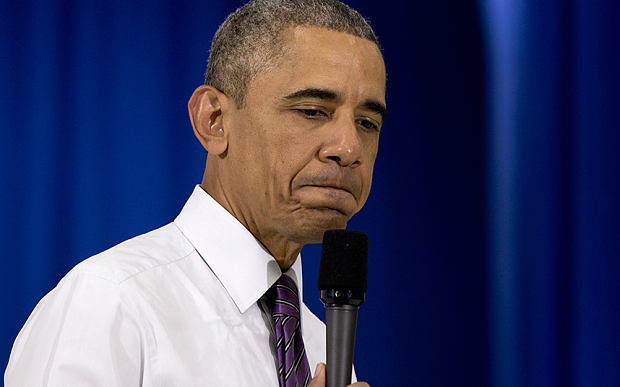
Barack-Obama-_3361379bPresident Barack Obama pauses speaks at Taylor Stratton Elementary School in Nashville Photo: AP

The United States has blocked attempts by its Middle East allies to fly heavy weapons directly to the Kurds fighting Islamic State jihadists in Iraq, The Telegraph has learnt.

Some of America’s closest allies say President Barack Obama and other Western leaders, including David Cameron, are failing to show strategic leadership over the world’s gravest security crisis for decades.

They now say they are willing to “go it alone” in supplying heavy weapons to the Kurds, even if means defying the Iraqi authorities and their American backers, who demand all weapons be channelled through Baghdad.

High level officials from Gulf and other states have told this newspaper that all attempts to persuade Mr Obama of the need to arm the Kurds directly as part of more vigorous plans to take on Islamic State of Iraq and the Levant (Isil) have failed. The Senate voted down one attempt by supporters of the Kurdish cause last month.

The officials say they are looking at new ways to take the fight to Isil without seeking US approval.

“If the Americans and the West are not prepared to do anything serious about defeating Isil, then we will have to find new ways of dealing with the threat,” said a senior Arab government official. “With Isil making ground all the time we simply cannot afford to wait for Washington to wake up to the enormity of the threat we face.”

Kurdish-weapons_3361377bKurdish Peshmerga fighters train on a weapon during a training session with British military advisers

The Peshmerga have been successfully fighting Isil, driving them back from the gates of Erbil and, with the support of Kurds from neighbouring Syria, re-establishing control over parts of Iraq’s north-west.

But they are doing so with a makeshift armoury. Millions of pounds-worth of weapons have been bought by a number of European countries to arm the Kurds, but American commanders, who are overseeing all military operations against Isil, are blocking the arms transfers.

One of the core complaints of the Kurds is that the Iraqi army has abandoned so many weapons in the face of Isil attack, the Peshmerga are fighting modern American weaponry with out-of-date Soviet equipment.

At least one Arab state is understood to be considering arming the Peshmerga directly, despite US opposition.

The US has also infuriated its allies, particularly Saudi Arabia, Jordan and the Gulf states, by what they perceive to be a lack of clear purpose and vacillation in how they conduct the bombing campaign. Other members of the coalition say they have identified clear Isil targets but then been blocked by US veto from firing at them.

“There is simply no strategic approach,” one senior Gulf official said. “There is a lack of coordination in selecting targets, and there is no overall plan for defeating Isil.”

Western leaders increasingly accept that the “war on Isil” has not gone well, from the moment last year Mr Obama called the group a “JV [junior varsity] team” of jihadists compared with al-Qaeda. At that point, Isil had seized Fallujah, which US forces took in a bloody battle in 2004. It went on to take much of western Iraq and large areas of Syria, and in May took Ramadi, the capital of Anbar province.

Britain is moving closer to expanding its role in the war. The Government on Wednesday gave its strongest indication yet that MPs will be given a new vote on whether to bomb Isil in Syria.

Michael Fallon, the Defence Secretary, said it was “illogical” that British planes were able to hit extremists in Iraq but not across the border.

Any decision to bomb in Syria would have to be approved by MPs. In 2013, the Prime Minister lost a vote for British military action in Syria. However, Mr Fallon said: “It is a new Parliament and I think new Members of Parliament will want to think very carefully about how we best deal with Isil, and the illogicality of Isil not respecting the borderlines.”

Mr Fallon suggested that a bombing campaign could be mounted in revenge for the terror attacks in Tunisia if a link could be proved between the killer and Isil in Libya. Britain would only take military action in Libya “where we think there is an imminent threat, a very direct to British lives or, for example, to British hostages”, he said.

Senior Whitehall sources did not distance themselves from Mr Fallon’s comments but insisted there was no immediate prospect of military action.

The Telegraph understands that Mr Cameron is concerned that Labour might force the Government into another defeat over Syria.

Who is Responsible for the Atrocities in the Muslim World?

June 27, 2015

Who is Responsible for the Atrocities in the Muslim World? The Gatestone InstituteUzay Bulut, June 27, 2015


  • If colonialism were the main problem, Muslims, too, still are, colonizers — and not particularly “humanitarian” ones, at that.
  • Islamic jihad and Islamic violence; the sanctioning of sex slavery; dehumanization of women; hatred and persecution of non-Muslims have been commonplace in the Islamic world ever since the inception of the religion. Deny everything and blame “the infidel.”
  • But is it America that tells these men to treat their wives or sisters as less than fully human? If we want to criticize the West for what is going on in the Muslim world, we should criticize it for not doing more to stop these atrocities.
  • Trying to whitewash the damage that the Islamic ideology has done to the Muslim world, while putting the blame of Islamic atrocities on the West, will never help Muslims face their own failures and come up with progressive ways to resolve them.

Every time the ISIS, Boko Haram, Iran, or any terrorist group in the Muslim world is discussed, many people tend to hold the West responsible for the devastation and murders they commit. Nothing could be farther from the truth. Blaming the failures in the Muslim world on Western nations is simply bigotry and an attempt to shift the blame and to prevent us from understanding the real root cause of the problem.

When these Islamic terrorist groups abduct women to sell them as sex-slaves or “wives;” conduct mass crucifixions and forced conversions; behead innocent people en masse; try to extinguish religious minorities and demolish irreplaceable archeological sites, the idea that this is the fault of the West is ludicrous, offensive and wrong.

Western states, like many other states, try to protect the security of their citizens. What they essentially need, therefore, are peaceful states as partners with which they can have economic, commercial and diplomatic relations. They do not need genocidal terrorist groups that destroy life, peace and stability in huge swaths across the Muslim world.

Western states also have democratic and humanitarian values, which Islamic states do not. The religious and historical experiences of the Western world and the Islamic world are so enormously different that they ended up having completely different cultures and values.

The West, established on Jewish, Christian and secular values, has created a far more humanitarian, free and democratic culture. Sadly, much of the Muslim world, under Islamic sharia law, has created a misogynistic, violent and totalitarian culture.

This does not mean that the West has been perfect and sinless. The West still commits some appalling crimes: Europe is guilty of paving the way for the slaughter of six million Jews in the Holocaust, and for still not protecting its Jewish communities. Even today, many European states contort logic to recognize Hamas, which openly states that it aims to commit genocide against Jewish people.

The West, however, accepts responsibility for the failures in its own territories: for instance, not being able to protect European women from Muslim rapists. These men have moved to Europe to benefit from the opportunities and privileges there, but instead of showing gratitude to European people and government, they have raped the women there, and tried to impose Islamic sharia law.

If we want to criticize the West for what is going on in the Muslim world, we should criticize it for not doing more to stop these atrocities.

The West, and particularly the U.S., should use all of its power to stop them — especially the genocides committed against Jews, Christians and other non-Muslims in the Muslim world.

We should also criticize the West — and others, such as the United Nations and its distorted Gaza War report — for supporting those who proudly commit terrorist attacks against Israeli civilians, and we should criticize the West for not siding with the state of Israel in the face of genocidal Jew-hatred.

We should criticize the West for letting Islamic anti-Semitism grow in Europe, making lives unbearable for Jews day by day.

We should criticize the West for having accepted without a murmur the Turkish occupation of Northern Cyprus for more than 40 years.

We should also criticize the West for leaving the fate of Kurds, a persecuted and stateless people, to the tender mercies of Turkey, Iran, Iraq and Syria — and now the Islamic State (ISIS). On June 25, ISIS carried out yet another deadly attack, killing and wounding dozens of people in the Kurdish border town of Kobani, in Syrian Kurdistan.

And we should criticize especially the current U.S. government for not being willing to take serious action to stop ISIS, Boko Haram and other extremist Islamic groups.[1]

The list could go on and on. Moreover, it would not be realistic to claim that these groups or regimes all misunderstand the teachings of their religion in exactly the same way.

It would also not be realistic to claim that the West has created all these hundreds of Islamic terror groups across the Muslim world.

The question, then, is: Who or what does create all these terrorist groups and regimes?

In almost all parts of the Muslim world, systematic discrimination, and even murder, are rampant — especially of women and non-Muslims. Extremist Islamic organizations, however, are not the only offenders. Many Muslim civilians who have no ties with any Islamist group also commit these offenses daily. Jihad (war in the service of Islam) and the subjugation of non-Muslims are deeply rooted in the scriptures and history of Islam.

Ever since the seventh century, Muslim armies have invaded and captured Jewish, Christian, Hindu, Buddhist and Zoroastrian lands; for more than 1400 years since, they have continued their jihad, or Islamic raids, against other religions.

Many people seem to be justifiably shocked by the barbarism of ISIS, but Islamic jihad does not belong just to ISIS. Violent jihad is a centuries-long tradition of Islamic ideology. ISIS is just one jihadist army of Islam. There are many.

All of this is an Islamic issue. The free West has absolutely nothing to do with the creation and preservation of this un-free culture.

The West has, on the contrary, been the victim of Islamic military campaigns and imperialistic pursuits: Christian peoples of Europe have been exposed to Ottoman invasions and subjugation for centuries. The fall of Byzantine Empire marked the peak of Islamic Jihad in Christian lands. Many places in Europe — including Greece, Bulgaria, Albania, Bosnia, Croatia, Hungary, Serbia, and Cyprus, among others — were all invaded and occupied by the Ottoman armies. Other targets, including Venice, Austria, and Poland, had to fight fierce defensive wars to protect their territories.

The historical and current troubles in the Muslim world are not, therefore, problems “imported” from an outside source; they are internal cultural and political problems, which Muslim regimes and peoples have reproduced for centuries.

Some of the things that women in Saudi Arabia may not do were listed in The Week magazine: Saudi women are not allowed to “go anywhere without a male chaperone, open a bank account without their husband’s permission, drive a car, vote in elections, go for a swim, compete freely in sports, try on clothes when shopping, enter a cemetery, read an uncensored fashion magazine and buy a Barbie and so on.”

Of course, there is nothing specific in Islamic scriptures about cars, fashion magazines or Barbie Dolls. But there is enough there that indicates why all of these abuses, and more, are widespread across the Islamic world, and why the clerics, imams and muftis approve them.

The central issue is to see how the lines that the Islamic theology draws seed the soil in which this kind of discrimination systematically buds, why it is extolled and how it is advocated.

Saudi Arabia is not the only Muslim country where women are dehumanized. Throughout almost the almost the entire Muslim world — including Turkey, considered one of the most “liberal” Muslim countries — women are continually abused or killed by their husbands, ex-husbands, boyfriends, fathers, brothers or other males. [2]

Is it America that tells these men to treat their wives or sisters as less than fully human?

Is the West really what stops them from respecting human rights or resolving their political matters through diplomatic and peaceful ways? Are Muslims too stupid to make wise decisions, and act responsibly? Why should Americans or Europeans have evil wishes for the rest of the world?

Demonizing Western nations — even after all of their cultural, scientific and rational progress — is simply pure racism.

“The belief that the West is always guilty is among the dozen bad ideas for the 21st century,”wrote the Australian pastor, Dr. Mark Durie. “This irrational and unhelpful idea is taught in many schools today and has become embedded in the world views of many. It is essentially a silencing strategy, sabotaging critical thinking.”

Another term that prevents one from understanding the root causes of the conflicts in the Muslim world is “moral relativism” — a politically correct term that really means moral cowardice.

Defending “moral relativism” and saying that “all cultures are equal” really means saying a culture that encourages child marriages, beating women and selling girls on slave markets has a value equal to a culture that respects women and recognizes their rights, and which renounces wanton violence.

Another popular target of blame for the failures in the Muslim world is historical British colonialism.

If colonialism were the main problem, however, Muslims, too, were, and still are, colonizers — and not particularly “humanitarian” ones, at that. The Muslim colonizers do not even seem to have contributed much to the culture of the places they invaded and colonized. In fact, they have actually delayed the progress of the areas they colonized. The printing press, for instance, came to the Ottoman territories almost 200 years later than to Europe.

“Books… undermine the power of those who control oral knowledge, since they make that knowledge readily available to anyone who can master literacy,” wrote Professor Daron Acemoglu and James Robinson. This threatened to undermine the existing status quo, where knowledge was controlled by elites. The Ottoman sultans and religious establishment feared the creative destruction that would result. Their solution was to forbid printing.” [3]

“European Empires — the British, French and Italians — had a short-lived presence in North Africa and the Middle East compared with the Ottoman Empire, which ruled over that region for more than 500 years,” said the historian Niall Ferguson.

“The culture that exists in the greater Middle East and North Africa today bears very, very few resemblances to the culture that Europeans tried to implement there, beginning in the late 19th century and carrying on through to the mid-20th century.

“You can’t say it is the fault of imperialism and leave out the longest living empire in the Middle East, which was the Ottoman Empire, a Muslim Empire, which went back much farther than any of the European Empires mentioned in that piece.”

Muslim states continue to occupy and colonize various territories — including Kurdistan, Baluchistan and the northern part of Cyprus, an EU member state.

“One of the most tragic consequences of the 1974 Turkish invasion,” according to the Ministry of Foreign Affairs of the Republic of Cyprus, “and the subsequent illegal occupation of 36.2% of the territory of the Republic of Cyprus, is the violent and systematic destruction of the cultural and religious heritage in the occupied areas.

“Hundreds of historic and religious monuments in various regions of the occupied areas have been destroyed, looted and vandalized. Illegal ‘excavations’ have been carried out and cultural treasures have been stolen from museums and private collections and were sold abroad.”

Muslim groups and regimes continue to persecute indigenous peoples such as Assyrians, Chaldeans, Mandaeans, Shabaks, Copts, Yezidis, and Bedoon, among many others.

“A substantial segment of the Bedoon population lives with the constant threat of deportation hanging over it,” according to the analyst Ben Cohen. “Around 120,000 Bedoon live without nationality and with none of the rights that flow from citizenship.”

“Its members cannot obtain birth or marriage certificates, or identity cards, or driving licenses. They are banned from access to public health and education services. Their second-class status means they have no access to the law courts in order to pursue their well-documented claims of discrimination. And on those rare occasions that they summon the will to protest publicly—as they did in 2011, when demonstrators held signs bearing slogans like, ‘I Have a Dream’—the security forces respond with extraordinary brutality, using such weapons as water cannons, concussion grenades, and tear gas with reckless abandon.”

It is not the West or Israel committing these crimes against the Bedoon community; it is Kuwait, a wealthy Islamic state, which treats defenseless people as if they are slaves.

In Qatar, another wealthy Islamic state, Nepalese migrants building a football stadium, “[h]ave died at a rate of one every two days… This figure does not include the deaths of Indian, Sri Lankan and Bangladeshi workers…. The Nepalese foreign employment promotion board said that 157 of its workers in Qatar had died between January and mid-November” last year. In 2013, the figure for that period was 168.”

1131The family of a Nepalese migrant worker, who died in Qatar, prepares to bury him. Nepalese laborers in Qatar are forced to work in dangerous conditions, and die at the rate of one every two days. (Image source: Guardian video screenshot)

“In Libya, naturalisation is only open to a man if he is of Arab descent,” reported the United Nations High Commissioner for Refugees (UNHCR). “And many Akhdam in Yemen, a small ethnic minority who may be descendants of African slaves, are reportedly unable to obtain citizenship.”

Is that not apartheid?

In Kuwait, only Muslim applicants may seek naturalization, while Libya’s nationality law allows for the withdrawal of nationality on the grounds of conversion from Islam to another religion.”

Is that not apartheid? Apartheid laws seem to reign over many places in the Muslim world.

Trying to whitewash the damage the Islamic ideology has done to the Muslim world, while putting the blame of Islamic atrocities on the West, will never help Muslims face their own failures and come up with progressive ways to resolve them.

“All the world’s Muslims have fewer Nobel Prizes than Trinity College, Cambridge. They did great things in the Middle Ages, though,” wrote the evolutionary biologist Richard Dawkins on Twitter, after which other Twitter users piled on to criticize him.

It seems that having oil reserves, per capita, that dwarf anything available to Western countries does not create leading scientific nations.

What holds Muslims back when they have unmatched advantages of underground treasures? Why did the scientific revolution not happen in the Muslim world? Why has much of Islamic history been marked by aggressive jihad?

Islamic jihad and Islamic violence; the sanctioning of sex slavery; dehumanization of women; hatred and persecution of non-Muslims and homosexuals; suppression of free speech; and forced conversions have been commonplace in the Islamic world ever since the inception of the religion.

Many teachings in the Islamic scriptures, as well as the biographies of the founder of the religion, set up the parameters where these abuses not only occur but remain protected on a gigantic scale. These are the teachings that have become the culture of the Muslim world.

Sadly, most Muslims have wasted much time, energy and resources on killing and destruction, but — with the exception of some civilization’s most dazzling artistic splendors — not on scientific and cultural advancement.

Recently, Sheikh Hamad bin Jassim bin Jaber al-Thani, the former Prime Minister of Qatar, said that claims that Qatar paid bribes to win the hosting rights of the 2022 World Cup were “not fair” and stemmed from the West’s Islamophobia and racism towards Arabs.

Recent events indicate that he was, at best, “misinformed.”

Deny everything and blame “the infidel” for your shortcomings. Nothing is more important than your honor, and nothing worse than your shame.

If Muslims wish to create a brighter future, nothing is stopping us but ourselves. We should learn to analyze critically our present and our past.

Human rights activists and academics in the West are lying to Muslims about their culture, and bashing and threatening America, Europe or “Zionism” for the problems of Muslims; this can never lead to any positive developments in the Muslim world. It is the Islamic culture and religious ideology that are responsible for these problems

If there is ever going to be an enlightenment, reform or renaissance in the Muslim world, only a hard look and hard questioning can be its starting point.

_________________


[1] Also the Muslim Brotherhood, Islamic Republic of Iran, al-Qaeda, Al-Badr, al-Gama’a al-Islamiyya, Islamic Jihad, al-Nusra Front, Hizb-ut-Tahrir, Al Ghurabaa, Al-Itihaad al-Islamiya, Al-Mourabitoun, Abdullah Azzam Brigades, Jaish al-Muhajireen wal-Ansar, Jamaat Ul-Furquan, Jamaat-ul-Ahrar, Jamaat-ul-Mujahideen Bangladesh, Jamiat al-Islah al-Idzhtimai, Great Eastern Islamic Raiders’ Front, Al-Shabaab, Abu Sayyaf, Tehreek-e-Nafaz-e-Shariat-e-Mohammadi, Supreme Military Majlis ul-Shura of the United Mujahideen Forces of Caucasus, to name just a few.

[2] See: “Gender Equality Gap Greatest in Islamic Countries, Survey Shows“, by Patrick Goodenough, October 29, 2014; “The Treatment of Women In Islam,” by Rachel Molschky, October 7, 2013; “Women Suffer at the Hands of Radical Islam“, by Raymond Ibrahim, January 9, 2014; “As Muslim women suffer, feminists avert their gaze“, by Robert Fulford, National Post; Ayse Onal, a leading Turkish journalist, says in her book, Honour Killing: Stories of Men Who Killed, that in Turkey alone honour killings average about one a day — 1,806 were reported in the period between 2000 and 2005.

[3] Daron, Acemoglu & Robinson, James (2012), Why Nations Fail: The Origins of Power, Prosperity, and Poverty, Crown Publishing Group.