Archive for the ‘Palestinians’ category

Cleric Who Banned Killing Jews Sets Record Straight: Jihad against Brothers of Apes and Pigs a Duty

November 4, 2015

Cleric Who Banned Killing Jews Sets Record Straight: Jihad against Brothers of Apes and Pigs a Duty, MEMRI TV via You Tube, November 4, 2015


According to the blurb following the video,

In a video from February that has been circulating on social media platforms in recent days (https://www.youtube.com/watch?v=77bqz…), Jordanian cleric Ali Hassan Al-Halabi said that killing Jews is not permissible, adding that the Jews “don’t attack you if you don’t attack them.” On November 3, Sheikh Al-Halabi posted two lengthy videos in which he rebutted criticism by political rivals, especially from the Muslim Brotherhood. In the new videos, Sheikh Al-Halabi referred to Jews as “the brothers of apes and pigs” and said that Jihad against them is a duty, but that the Muslims are not up for the task right now, and must prepare first.

Our World: Showdown at the OK Corral

November 3, 2015

Our World: Showdown at the OK Corral, Jerusalem Post, Caroline Glick, November 2, 2015

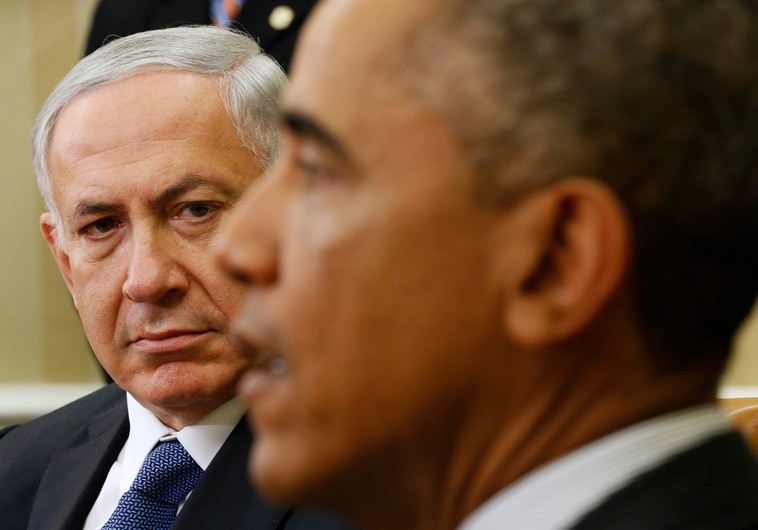
ShowImage (16)US President Barack Obama meets with Prime Minister Benjamin Netanyahu at the White House, October 1, 2014. (photo credit:REUTERS)

Whatever he says before the cameras next week when he meets with Netanyahu, Obama has no intention of letting bygones be bygones.

Prime Minister Benjamin Netanyahu’s meeting with US President Barack Obama next week is likely to look less like a rapprochement than a showdown at the OK Corral.

The flurry of spy stories spinning around in recent weeks makes clear that US-Israel relations remain in crisis.

Two weeks ago, The Wall Street Journal published a fairly detailed account of the US’s massive spying operations against Israel between 2010 and 2012.

Their purpose was to prevent Israel from attacking Iran’s nuclear installations. The Journal report, which was based on US sources, also detailed the evasion tactics the Obama administration employed to try to hide its covert nuclear talks with Iran from Israel. According to the report, the administration was infuriated that through its spy operations against Iran, Israel discovered the talks and the government asked the White House to tell it what was going on.

Over the past several days, the Israeli media have reported the Israeli side of the US spying story.

Friday Makor Rishon’s military commentator Amir Rapaport detailed how the US assiduously wooed IDF senior brass on the one hand and harassed more junior Israeli security officials on the other hand.

Former IDF chiefs of General Staff Lt.-Gens. Gabi Ashkenazi and Benny Gantz were given the red carpet treatment in a bid to convince them to oppose Israeli strikes on Iran’s nuclear installations. More junior officials, including officers posted officially to the US were denied visas and subjected to lengthy interrogations at US embassies and airports in a bid to convince them to divulge information about potential Israeli strikes against Iran.

Sunday, Channel 2 reported that the IDF’s Intelligence Directorate’s information security department just issued guidance to all IDF soldiers and officers warning them about efforts by the CIA to recruit them as US agents.

These stories have been interpreted in various ways. Regardless of how they are interpreted, what they show is that on the one hand, the Obama administration has used US intelligence agencies to weaken Israel’s capacity to harm Iran and to actively protect Iran from Israel. And on the other hand, Israel is wary of the administration’s efforts to weaken it while strengthening its greatest foe.

These stories form the backdrop of next week’s meeting between Netanyahu and Obama – the first they will have held in more than a year. They indicate that Obama remains committed to his policy of weakening Israel and downgrading America’s alliance with the Jewish state while advancing US ties with Iran. Israel, for its part, remains deeply distrustful of the American leader.

This Israeli distrust of Obama’s intentions extends far past Iran. Recent statements by Obama and Secretary of State John Kerry have convinced Israel that during his last 15 months in office, Obama intends to abandon US support for Israel at the UN Security Council, and to ratchet up pressure and coercive measures to force Israel to make irreversible concessions to the Palestinians.

From Netanyahu’s perspective, then, the main strategic question is how to prevent Obama from succeeding in his goal of weakening the country.

The implementation of Obama’s deal with Iran deal will form a central plank of whatever strategy the government adopts.

As far as Obama and his allies see things, the nuclear accord with Iran is a done deal. On October 21, House Minority Leader Nancy Pelosi hosted a reception for Democratic congressmen attended by White House Chief of Staff Denis McDonough to celebrate its official adoption.

Unfortunately for Pelosi and her colleagues, Iran is a far more formidable obstacle to implementing the deal than congressional Republicans. As Yigal Carmon, president of the Middle East Media Research Institute (MEMRI), explained in a report published on his organization’s website last week, at no point has any Iranian governing body approved the nuclear deal. Iran’s parliament, the Majlis, and its Guardians’ Council have used their discussions of the agreement to highlight their refusal to implement it. More importantly, as Carmon explains, contrary to US media reports, in his October 21 letter to Iranian President Hassan Rouhani, Iran’s Supreme leader Ayatollah Ali Khamenei did not give his conditional approval to the deal. He rejected it.

Carmon explained that the nine conditions Khamenei placed on his acceptance of the nuclear deal render it null and void. Among other things, Khamenei insisted that all sanctions against Iran must be permanently canceled. Obama couldn’t abide by this condition even if he wanted to because he cannot cancel sanctions laws passed by Congress.

He can only suspend them.

Khamenei also placed new conditions on Iran’s agreement to disable its centrifuges and remove large quantities of enriched uranium from its stockpiles.

He rejected inspections of Iran’s military nuclear installations. He insisted that Iran’s Arak heavy water reactor must remain capable of producing heavy water in contravention of the deal. And he insisted that at the end of the 15-year lifetime of the deal Iran must have sufficient uranium enrichment capability to enable it to develop bombs at will.

As Carmon noted, the US and EU have announced that they will suspend their nuclear sanctions against Iran on December 15 provided that by that date, the UN’s International Atomic Energy Commission certifies that Iran has upheld its part of the bargain.

By that date, in conformance with their interpretation of the nuclear deal, the US and the EU expect for Iran to have reduced the number of centrifuges operating at the Natanz facility from 16,000 to 5,060 and lower enrichment levels to 3.67%; reduce the number of centrifuges at Fordow to a thousand; remove nearly all its advanced centrifuges from use; permit the IAEA to store and seal its dismantled centrifuges; reduce its stockpile of enriched uranium to 300kg.; remove the core from the Arak reactor and disable it; and submit to agreed monitoring mechanisms of its nuclear sites.

Carmon noted that Iran has taken no steps to fulfill any of these conditions.

With Khamenei’s rejection of the nuclear deal and Iran’s refusal to implement it, there are two possible ways the US and the EU can proceed.

First, as Carmon suggests, Obama and the EU may renew nuclear talks with Iran based on Khamenei’s new position. These talks can drag out past Obama’s departure from office. When they inevitably fail, Obama’s successor can be blamed.

The other possibility is that Iran will implement some component of the deal and so allow Obama and the EU to pretend that it is implementing the entire deal. Given the US media’s failure to report that Khamenei rejected the nuclear pact, it is a fair bet that Obama will be able to maintain the fiction that Iran is implementing the deal in good faith until the day he leaves office.

So what is Israel to do? And how can Netanyahu use his meeting with Obama next week to Israel’s advantage? Israel has two policy options going forward. First, it can highlight the fact that Iran is not implementing the deal, just as Israel took the lead in highlighting the dangers of the nuclear accord with Iran over the past year. This policy can potentially force Obama onto the defensive and so make it harder for him to go on the offensive against Israel at the UN and other venues in relation to the Palestinians.

But then, it is far from clear that Obama will be deterred from adopting anti-Israel positions at the UN even if Israel succeeds making an issue of Iranian noncompliance with the nuclear deal.

Moreover, if Netanyahu leads the discussion of the Iran’s bad faith, as he drove the discussion of the nuclear deal itself, he will reinforce the already prevalent false assessment in the US that a nuclear Iran threatens Israel but is not dangerous for the US.

This incorrect assessment has made a lot of Americans believe that by seeking to prevent Iran from acquiring nuclear weapons, Israel is advancing is own interests at America’s expense.

The other policy option is the one that Defense Minister Moshe Ya’alon indicated Israel is pursuing in his meeting last week with his counterpart Defense Secretary Ashton Carter. At the Pentagon Ya’alon declared, “The Iran deal is a given. Our disputes are over.”

The downside of this position is that it indicates that Israel accepts the legitimacy of a deal that Iran is not implementing and that would imperil Israel’s national security even if Iran were implementing it.

Its upside is that it takes Israel out of the US debate regarding the nuclear deal. To the extent that opponents of Obama’s Iran policy are willing to lead the fight against the deal themselves, Israel could do worse than to take a step back and plot its own course on Iran, independent of the US policy discussion.

It is hard to know which line of action makes more sense. But as the spy stories demonstrated, one thing is clear enough. Whatever he says before the cameras next week when he meets with Netanyahu, Obama has no intention of letting bygones be bygones.

Russia warns that Syria war could become a ‘proxy war’

November 1, 2015

Russia warns that Syria war could become a ‘proxy war’ BreitbartJohn J. Xenakis, November 1, 2015

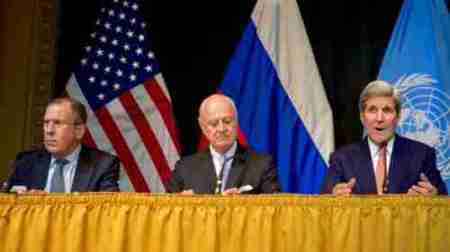
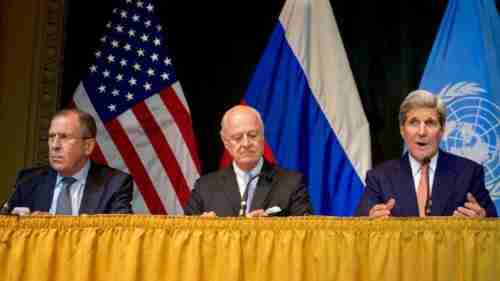
g151031bL-R: Sergei Lavrov, United Nations Special Envoy for Syria Staffan de Mistura, and John Kerry in Vienna on Friday (state.gov)

Russia has poured millions of dollars of heavy weapons into Syria, and is now sending in Russian troops to establish bases there. Recently, Russia launched 27 cruise missiles from the Caspian Sea to targets in Syria. Iran is pouring new troops into Syria. Iran has also given Lebanon’s Hezbollah terrorist group a great deal of money, and Hezbollah has sent thousands of troops into Syria to support Syria’s president Bashar al-Assad.

Al-Assad’s genocidal attacks on innocent Syrian Sunnis, killing hundreds of thousands and forcing millions from their homes, has caused Sunni jihadists from all of the world to fight against al-Assad, Russia, Hezbollah, and Iran in Syria. Along the way, these jihadists formed the so-called Islamic State (IS or ISIS or ISIL or Daesh).

And now, on Friday, Russia’s Foreign Minister Sergei Lavrov made a pronouncement that Barack Obama was going to trigger a “proxy war” in Syria by sending in 50 special operations forces, as we reported yesterday.

You can’t make this stuff up.

Thanks to Iran, Russia, al-Assad and Hezbollah, there are now tens of thousands of foreign troops fighting each other in Syria, with al-Assad in particular supported by massive amounts of foreign weapons.

But somehow, those tens of thousands of foreign fighters don’t make it a “proxy war,” but America’s 50 special forces troops do.

You can’t trust any garbage that comes out of Lavrov’s mouth, or out of al-Assad’s mouth, or out of Vladimir Putin’s mouth, but I listen to BBC, al-Jazeera, FOX, CNN, and other media sources all the time, and I see these news anchors report this crap with a straight face all the time. I don’t know whether it is more sickening to watch those fatuous news anchors, or to watch the fawning Secretary of State John Kerry suck up to Lavrov and Putin, which has happened in issues involving Ukraine, Iran’s nuclear development, and Syria.

All this verbiage is coming out of a meeting in Vienna whose purpose is to find a “political solution” to the Syria problem. With hundreds of thousands of Syrian migrants pouring into Europe, and with hundreds of ISIS militants returning to Russia to fight Putin, there is a lot of pressure to find a “political solution.” But this week’s announcement that Iran will fully enter the war in Syria on the side of the Syrian regime makes any “political solution” farther away than ever. On the contrary, Saudi Arabia and other Gulf countries will never agree to anything like the emerging situation. Actions by Russia and Iran, intervening militarily in Syria, is an emerging disaster, likely triggering a sectarian Sunni versus Shia war throughout the region. BBC and International Business Times and Reuters

Syria’s civil war and Generational Dynamics

In the 12 years that I’ve been doing this, I’ve posted about 4,000 articles with hundreds of Generational Dynamics predictions.

In 2011, when the Syrian civil war began, I said that the war should fizzle within a year or two. Of all the hundreds of Generational Dynamics predictions, this is the one where I’ve clearly been (depending on how you look at it) either wrong or poorly described.

Syria’s last generational crisis war was civil war that climaxed in 1982 with the massacre at Hama. There was a massive uprising of the 400,000 mostly Sunni citizens of Hama against Syria’s president Hafez Assad, the current president’s father. In February, 1982, Assad turned the town to rubble, 40,000 deaths and 100,000 expelled. Hama stands as a defining moment in the Middle East. It is regarded as perhaps the single deadliest act by any Arab government against its own people in the modern Middle East, a shadow that haunts the Assad regime to this day.

(As a related matter, the civil war in Lebanon also climaxed that year, with the bloody massacre at Sabra and Shatila occurring in September 1982. And it occurred as the Iran/Iraq war was ongoing, three years after Iran’s bloody Great Islamic Revolution in 1979. At that time, much of the Mideast was re-fighting World War I and the collapse of the Ottoman Empire, 60 years earlier.)

So, in 2011, I said that the civil war in Syria would fizzle, and could not turn into a crisis civil war. And that’s both wrong and true. There are too many survivors who remember the 1982 slaughter, and do not want to see it repeated. And so there’s been no massive anti-government uprising, as there was in 1982, and Bashar al-Assad’s Shia/Alawite troops have been fighting half-heartedly, with many soldiers defecting or deserting.

But the war did not fizzle.

It should have fizzled in 2011 or 2012, but Hezbollah and Iran starting pouring troops in to support al-Assad. And foreign fighters from around the world arrived to fight al-Assad and to form ISIS. That’s not something that Generational Dynamics could have predicted.

Earlier this year, it looked like al-Assad’s army was near collapse. In July, a desperate al-Assad gave a national speech in which he admitted he was losing. The war should have fizzled this year. But now, Russia and Iran are pouring tens of thousands more troops into Iran to bolster al-Assad. And that also is not something that Generational Dynamics could have predicted.

So the problem for me is: How should I have characterized the situation in 2011? The prediction that it wouldn’t turn into a crisis civil war was correct, but the war did not fizzle, because it turned into a proxy war.

Well, I don’t think there’ll be a next time, but if there is, I’ll try to characterize the situation differently, without simply using the word “fizzle.” NPR (1-Feb-2012)

Generational Dynamics and crisis civil wars

I write about a number of civil wars going on in the world today, so this is a good time to discuss civil wars from the point of view of Generational Dynamics.

Among generational crisis wars, an external war is fundamentally different than a civil war between two ethnic groups. If two ethnic groups have lived together in peace for decades, have intermarried and worked together, and then there is a civil war where one of these ethnic groups tortures, massacres and slaughters their next-door neighbors in the other ethnic group, then the outcome will be fundamentally different than if the same torture and slaughter is rendered by an external group. In either case, the country will spend the Recovery Era setting up rules and institutions designed to prevent any such war from occurring again. But in one case, the country will enter the Awakening era unified, except for generational political differences, and in the other case, the country will be increasingly torn along the same ethnic fault line.

The period following the climax of a crisis war is called the “Recovery Era.” One path that the Recovery Era can take is that the leader of one ethnic group decides that the only way to prevent a new civil war is for him to stay in power, and to respond to peaceful anti-government demonstrations by conducting massive bloody genocide, torture and slaughter of the other ethnic group, in order to maintain the peace. (Dear Reader, I assume you’ve grasped the irony of the last sentence.)

For example, in a July article about Burundi, I described how Burundi’s Hutu president Pierre Nkurunziza was using such violence to quell Tutsi protests, supposedly to avoid a repeat of the 1994 Rwandi-Burundi genocidal war between Hutus and Tutsis.

As another example, in a June article about Zimbabwe, I described how Zimbabwe’s president Robert Mugabe was even worse. His 1984 pacification campaign was known as “Operation Gukurahundi” (The rain that washes away the chaff before the spring rain). During that campaign, accomplished with the help of Mugabe’s 5th Brigade, trained by North Korea, tens of thousands of people, mostly from the Ndebele tribe, were tortured and slaughtered. Later, Mugabe single-handedly destroyed the country’s economy by driving all the white farmers off the farms, resulting in one of the biggest hyperinflation episodes in world history.

That is what Bashar al-Assad is doing in Syria. Fearing a Sunni uprising, like the one in 1982, al-Assad is conducting a massive “peace campaign” by slaughtering and displacing millions of innocent Sunnis. As I wrote above, this should have fizzled in 2011 or 2012, but it’s turned into a proxy war, and it’s a disaster for the Mideast and the world.

But none of the above three examples is a crisis civil war. A crisis war has to come from the people, not from the politicians. So, for example, there’s a massive crisis civil war going on today in Central African Republic (CAR), between the Muslim ex-Seleka militias fighting Christian anti-Balaka militias.

Unlike the previous examples, CAR is in a generational Crisis era. CAR’s last generational crisis war was the 1928-1931 Kongo-Wara Rebellion (“War of the Hoe Handle”), which was a very long time ago, putting CAR today deep into a generational Crisis era, where a new crisis war is increasingly likely. That’s why the CAR is a genuine crisis civil war, and won’t fizzle out. In fact, it won’t end until it has reached some kind of explosive conclusion — of the kind we described in Hama or Sabra and Shatila. ( “2-Oct-15 World View — Violence resurges in Central African Republic crisis war”)

Generational Dynamics and war between Palestinians and Israelis

I’ll discuss one more example — not a civil war, but very similar to a civil war, with the same kinds of issues.

In the last few years, there have been three non-crisis wars between Israelis and Palestinians in Gaza. In each case, the Israelis destroyed Hamas’s infrastructure, ending the war. The war began again each time when Hamas’s infrastructure was rebuilt.

But the point I want to make is that these three non-crisis wars were all directed by politicians. Palestinians attacked when the leadership told them to, and stopped attacking when the leadership told them to stop.

What I have been describing in numerous articles recently is that there is emerging a major, fundamental, historic change.

In the emerging situation, young people today are no longer willing to listen to these leaders. According to the CIA World Fact Book, 20% of Gaza’s population are in the 15-24 age range, and so are 21% of the West Bank — about 200,000 males in each territory, or 400,000 young males total.

On the Israeli side, there are over 600,000 young males in the same age range. There have been unconfirmed reports of young Israelis also disgusted with the leadership. It is possible that, like the young Palestinians, they are willing to take matters into their own hands.

So in this environment, what could happen next? The last three Gaza wars were non-crisis wars, but the next one could be a crisis war between Israelis and Palestinians.

How can a crisis war begin? How about if those 200,000 young male Gazans blow holes in the walls, pour across into Israel and start killing Israeli citizens en masse in their homes and villages? And how about if they are joined by those 200,000 young male Palestinians on the West Bank, who start with the Jewish settlers and continue with the Jews in Jerusalem. And how about if the young Israeli males strike back and start killing Palestinians in their homes and villages?

Israel’s tanks and bombers would not be of much use. You can’t bomb Jerusalem, and you can’t bomb Israeli villages and settlements to kill Palestinians.

That is the difference. That is what a generational crisis war is like. It is not two tanks shooting at each other. It is hand to hand combat in homes, neighborhoods and streets by people armed with sticks and knives. It is what happened in Central African Republic last year, it is what happened in Rwanda in 1994, in Bosnia in 1994, and in Palestine in 1947.

And by the way, that assumes that the bloody mess stays confined to Israel and the Palestinian territories. The Palestinians are likely to be joined by tens or hundreds of thousands from Jordan, Lebanon and Egypt.

The recent widely reported changes in the attitudes and behaviors of young Palestinians is a sign that this kind generational crisis war is coming.
ISIS trying to co-opt Palestinian jihad against Israel as part of its own cause

October 24, 2015

ISIS trying to co-opt Palestinian jihad against Israel as part of its own cause, BreitbartEdwin Mora, October 24, 2015

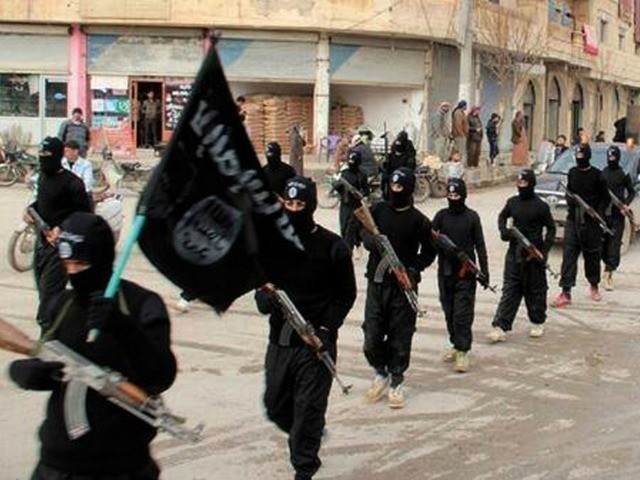
isis-marching-AP-640x480AP Photo/Militant Website, File

The Islamic State (ISIS/ISIL), through several of its media organs, has expressed support for the deluge of Palestinian terrorist attacks currently plaguing Israel, calling for more.

new report by the Washington, D.C.-based Middle East Media Research Institute (MEMRI) Jihad and Terrorism Threat Monitor argues the new outbursts of support for Palestinian terrorism is an attempt to commandeer the cause as part of its own.

ISIS considers itself the authority in political and religious matters for all Muslims, with its Caliphate backing Sunnis who fight its enemies.

ISIS regards the Muslim Brotherhood’s movements and affiliates, such as the terrorist group Hamas, as too pragmatic and not radical enough. “In much of the Islamic world, when there are various approaches, the radical one tends to trump those deemed to be weaker,” notes The Jerusalem Post.

According to a poll conducted by the Arab Center for Research and Policy Studies in Doha, Qatar, late last year, nearly one-quarter of Palestinians had positive views of ISIS. However, “the pro-ISIS presence within the Palestinian territories should not be exaggerated. It is primarily limited to small and divided pro-IS groups in Gaza,” Middle East Forum fellow Aymenn Jawad al-Tamimi told The Jerusalem Post.

That being said, ISIS “does not need to have an operational presence on the ground in Israel to be effective, as its propaganda over the Internet can serve as an incitement tool for more attacks,” declares the Post.

ISIS has embarked upon a media campaign that involves the release of a series of videos in support of the ongoing terrorist attacks in Israel and encouraging the Palestinians to carry out more lone wolf assaults, the new report by MEMRI reveals.

As he congratulates the Palestinian attackers on their recent attacks on the Jews, the narrator of a nine-minute video declares:

Oh mujahideen, we call on you to prepare yourselves spiritually and materially to strike terror and fear into the hearts of the Jews. … Know that the soldiers of Islam are fighting here in Iraq, Syria, Khorasan, and West Africa, but their sights are set on Bayt Al-Maqdis [Jerusalem].

The footage was released by ISIS’ information office in Mosul, Iraq’s second largest city. Mosul fell to ISIS in June 2014. Khorasan is an ancient name for a region that covers large parts of Afghanistan, Pakistan, Iran, India, and other surrounding countries.

The MEMRI report noted that “a substantial part of these videos is dedicated to ideological attacks on Hamas and Fatah.”

“Fatah has become an agent of the infidel Jews and Christians, while Hamas is doing the bidding of the Shi’ites [Iranians] and Alawites [the regime of Syrian dictator Bashar al-Assad],” said the report.

The Middle East Forum’s Tamimi told the The Jerusalem Post that ISIS rhetoric in support of the deteriorating security situation on the ground in Israel fueled by the Palestinian attacks is an effective means to make headlines.

It also “fits in with [the] idea of supporting the cause of Muslims everywhere,” said Tamimi who closely monitors Islamist opposition groups in Iraq and Syria.

ISIS has established a foothold in Iraq, Syria, Libya, Egypt, and other regions and is expanding its presence across the globe, with its affiliates pushing for power as far as its Khorasan ProvinceAfghanistan.

“Arab youth in the Palestinian territories and Israel are influenced by the storm waging in neighboring countries and are willing to join the call to action and seek martyrdom for the sake of their cause,” notes the Post.

“But for now, Islamic State is more of an observer to the violence waging in Israel as local groups such as Hamas have the advantage in claiming the terror as its own because of proximity and its experience waging war against Israel, not only in words,” it adds.

Murder as politics

October 24, 2015

Murder as politics, The Washington Times, Louis Rene Beres, October 22, 2015

Even as growing numbers of Palestinian terrorists stab madly at Israeli men, women, and children, much of the world still endorses creation of “Palestine.” Such mindless support continues, moreover, despite the fact that the Palestinians themselves reject any sort of two-state solution. Indeed, the latest such poll (September 2015), conducted by Palestinian research organizations, concluded that almost half the resident Arabs strongly favor the use of armed force and generalized violence against Israeli noncombatants.

For the most part, western news reports notwithstanding, knife wielding attackers are not “lone wolves.” Rather, they have been conspicuously spurred on by vitriolic PA incitements, and by carefully synchronized calls from the mosques to murder “The Jews.”

The Palestinian Authority shares with Hamas the irredentist vision of a one-state solution. There is nothing hidden or ambiguous about this true plan for Israel’s disappearance. It is plainly codified on the official maps of both factions, where Israel is identified only as “Occupied Palestine.”

For virtually all Arab forces in the Middle East, the conflict with Israel is never about land. It is about God, and about always-related promises of personal immortality. It is about power over death.

For the Palestinians, their carefully sanitized public rhetoric notwithstanding, the enemy is not the Israelis (that term is just subterfuge, for the media), but “The Jews.” The screaming young Palestinian, who strikes indiscriminately with his serrated blade, fully expects to become a “martyr.” He only risks “death” in order not to die.

There is more. A Palestinian state — any Palestinian state — would rapidly be taken over by ISIS, or by related jihadi adversaries. Already, ISIS is operating in parts of Syria that could bring it to the critical borders of Israel’s Golan Heights. Significantly, it has also set recognizable operational sights on Jordan and West Bank (Judea/Samaria).

Over the next several months, and even while the Palestinian Authority continues to orchestrate more “Third Intifada” attacks on Israelis, ISIS will commence its fated march westward, across Jordan, ending up at the eastern boundaries of West Bank. These boundaries, of course, would represent the territorial margins of what PA/Fatah both already affirm as the geographic heart of “Palestine.”

Palestinian forces, primarily Fatah, would then yield to ISIS, and to its local proxies. Fatah would then have to choose between pleading with the Jewish State to become an ally against a now-common foe, or abandoning all its residual military operations to the IsraelDefense Forces directly. Arguably, without IDF assistance in such desperate circumstances, “Palestine” wouldn’t stand a chance.

One additional irony ought to be noted. In Israel, Prime Minister Benjamin Netanyahu has long made acceptance of any Palestinian state contingent upon prior Palestinian “demilitarization.” Should the Palestinian Authority and Hamas somehow accede to this problematic expectation, it could make ISIS’ predictable destructions in the area much easier to carry out. Paradoxically, a “Palestine” that had properly stood by its pre-state legal concessions to Israel, could effectively increase the overall danger posed to both Palestinians and Israelis.

What about Jordan? Under pertinent international law, the Hashemite Kingdom has incurred certain binding obligations regarding joint cooperation with Israel against terrorism. These obligations, as reinforcing complements to more generally binding legal rules, are expressly codified at the 1994 Treaty of Peace Between the State of Israel and the Hashemite Kingdom of Jordan.

Could this treaty still have any palpable effect upon Jordan’s capacity to militarily block anticipated ISIS advances?

Not at all. The more generic problem of enforcing treaties had already been identified back in the 17th century, by Thomas Hobbes. Said the English philosopher, in his “Leviathan,” a work well known to America’s founding fathers: “Covenants, without the Sword, are but words …”

From the 17th century onward, the world political system has been anarchic, or, in Hobbesian terms, a “state of nature.” In the anarchic Middle East, especially, considerations of raw power routinely trump international law. Here, too, truth here may be counter-intuitive. On those endlessly perplexing matters concerning Palestinian statehood, for example, it is finally time to understand that “Palestine‘s” true enemy in the region is not Israel, but rather a hideously sordid amalgam of Islamist Arab forces. Going forward, any further Palestinian advances toward statehood would likely be solely to the longer-term tactical advantage of ISIS.

Is this the sort of statehood cause that should be enthusiastically supported in Washington, and in most European capitals? It is, but only if we should first want to see an expansion of “Third Intifada” terror to the homeland. Not likely.

If you like Syria, Iraq, and Afghanistan, you’ll love “Palestine.”

Diplomacy: Looking for ways to douse the spark

October 23, 2015

Diplomacy: Looking for ways to douse the spark, Jerusalem PostHerb Keinon, October 23, 2015

(They “dance around in a ring and suppose, but the secret sits in the middle and knows,” with apologies to Robert Frost. — DM)

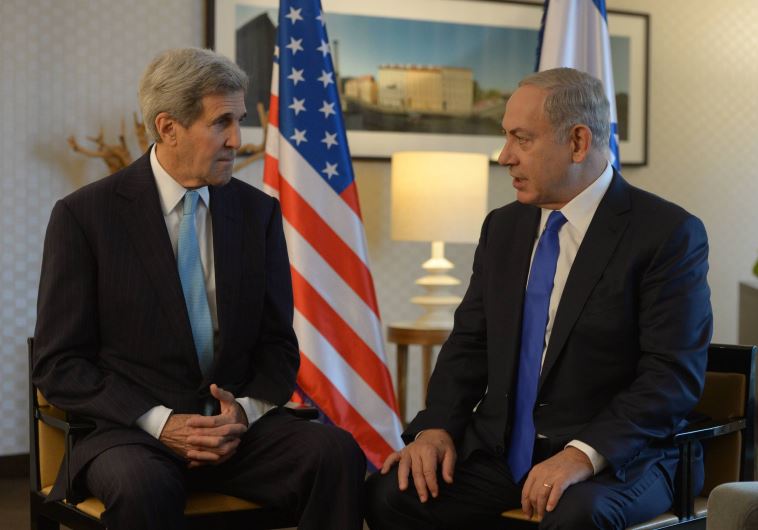
ShowImage (15)Netanyahu and Kerry meeting in Berlin. (photo credit:AMOS BEN-GERSHOM/GPO)

And now the diplomatic dance begins, again.

After three weeks of runaway terrorism on the streets, UN Secretary-General Ban Ki-moon arrived for a quick visit midweek; US Secretary of State John Kerry – after meeting with Prime Minister Benjamin Netanyahu on Thursday in Berlin – is expected to meet on Saturday with Palestinian Authority President Mahmoud Abbas in Amman, along with Jordan’s King Hussein; EU foreign policy chief Federica Mogherini is doing the same; and the French are floating various proposals to take to the UN Security Council.

All predictable, all the traditional steps taken in a time of Mideast crisis.

Ban did what Ban does in these situations – he comes, meets with both sides, issues platitudes about the need for both sides to show restraint, and declares how important it is to keep that light of hope burning.

The UN secretary-general dutifully fulfilled his role in the script. Netanyahu obliged by meeting politely with Ban, who then went on to meet politely with Abbas, to what appears to be absolutely no effect. It’s a dance whose steps – and way of ending – are known far in advance.

Jerusalem does not take Ban’s efforts overseriously, as the organization that he heads is seen as a big part of the problem rather than the solution.

Witness Wednesday’s one-sided resolution adopted by UNESCO, the UN’s cultural heritage agency, condemning “Israeli aggression” on the Temple Mount and declaring that the Jewish holy sites of Rachel’s Tomb and the Cave of the Patriarchs are an “integral part of Palestine.”

Similar disdain, to a certain extent, characterizes Israel’s view of the EU’s efforts. Netanyahu will listen to Mogherini, and lament both Abbas’s incitement and the EU’s acceptance of it, but will place little stock in the EU’s ability to play a constructive role in calming down the situation.

Brussels is not seen in Jerusalem as a particularly honest broker on all things Palestinian but, rather, as the institution that nurtures – perhaps more than any other – the hope among the Palestinians that if they press long enough and hard enough, the international community will deliver to them what they publicly say they want: a Palestinian state along the pre-1967 borders with east Jerusalem as its capital, and some kind of “fair and just” accommodation for the refugees.

The very skeptical Israeli view of the EU in any diplomatic process is reinforced by steps taken by France, which this week considered bringing a resolution to the UN Security Council to place international observers on the Temple Mount.

This idea, which Israel would never accept, and which even Jordan and the Palestinians have apparently rejected, is born of a burning French diplomatic desire to always do something, anything, in the Mideast – especially when there seems to be a stalemate or vacuum.

It is also the product of sour relations currently prevailing between Paris and Jerusalem, as well as a lingering French hope for the internationalization of Jerusalem – for the establishment of a corpus separatum in Jerusalem under a special international regime – which France hopes to be a part of.

So with the UN out, the EU out, and France out, that leaves the US.

But it is not as if Jerusalem is harboring any hopes that Kerry will be able to ride in and save the day.

From Jerusalem’s perspective the US track record in the region is not sterling, and though it appreciates Washington’s desire to help, there is little illusion that high-profile, high-level meetings will have any immediate effect on the ground.

And while Jerusalem is not waiting for Kerry with baited breath, it was clear from the beginning that he would get involved. An uptick in terrorism and violence leads to a well-worn pattern in Washington: condemnations of the terrorism, then statements that anger Israel about proportionality or settlements, followed by calls for restraint on both sides, and then meetings with the leaders.

But this current spurt of terrorism and violence is different from previous rounds, in that there is no identifiable organization – such as Hamas and Fatah’s Tanzim militia – to hold directly responsible for the bloodshed. This time it is more amorphous, individual terrorists incited by calls for Jewish blood on Facebook and from various leaders, going out to kill Jews.

The lack of a clear organizational structure behind the terrorism makes it more difficult for the security services to stop, because it is much more difficult to gather intelligence on an individual who grabs a knife and goes out to kill than on attacks directed by an organization.

Also, there is not one person seemingly in control who may be pressured to cease the violence.

It is not as if Kerry can talk to Abbas and convince him to issue a call to his people to “hold your horses,” and the horses will obediently be held. Abbas does not have anything near that type of control – many of the horses simply do not heed him.

This time around, thankfully, neither the State Department nor Kerry are inflating expectations; they are not talking about Kerry’s separate meeting with the leaders as a potential breakthrough for restarting the diplomatic talks and bringing a peace deal in a number of months.

Washington, it should be remembered, is still engaged in its own Mideast policy reassessment, a policy reassessment brought about after the breakdown of the Kerry-led peace talks in April 2014, and re-announced after Netanyahu’s preelection statement – which he later retracted – of less than full fealty to the notion of a two-state solution.

Rather, this time the bar has been set low, with the goals very limited.

State Department spokesman John Kirby said on Wednesday that the meetings would deal with “practical ways in which political breathing space can be had to help end the violence.”

No overreaching there, just looking for breathing space. The breathing space that Kirby mentioned but did not elaborate upon is likely to be an attempt – in discussions with Netanyahu, Abbas and especially Jordan’s King Abdullah – to come up with a clear set of procedures for governing the Temple Mount.

The Temple Mount has – like so many times over the last century – been the spark to violence against Jews. To douse the fire, there will be some need to deal with the spark, but this has to be done in a way where both Israel and the Palestinians can say that they have not given in.

In recent days Kerry has spoken about the need for clarity. Everyone talks about the status quo on the Temple Mount, but there is little understanding of what that entails.

“Israel understands the importance of the status quo and… our objective is to make sure that everyone understands what that means,” Kerry said at press conference on Monday in Madrid, adding that “we are not seeking a new change or outsiders to come in; I don’t think Israel or Jordan wants that, and we’re not proposing it. What we need is clarity.”

The new “clarity” is expected to involve enhanced coordination and cooperation with Jordan, possibly even more Jordanian representatives on the site, in such a way as to undercut the spurious charge that Israel is somehow threatening al-Aksa Mosque.

Former National Security Council head Yaakov Amidror said in an Israel Radio interview this week that he had little expectation regarding Kerry’s meeting with Netanyahu or Abbas, because the US has little impact on the Palestinians – which is true.

But the US does have leverage on Jordan, and this leverage may now be needed to get Abdullah to take a greater role in day-to- day administration and involvement at the site – if only as a way to suck the oxygen out of the lie propelling the current round of terrorism: that Israel is endangering al-Aksa.

Coverage of Palestinian “Stabbing Intifada” Sets New Lows

October 22, 2015

Coverage of Palestinian “Stabbing Intifada” Sets New Lows, Investigative Project on Terrorism, October 22, 2015

1250 (2)IDF graphic

Imagine if social media lit up with Israeli memes justifying or endorsing the vigilante violence; “When in doubt, take them out.” Imagine public rallies featuring Israeli children brandishing symbols of this violence.

Would reporters write stories explaining the roots of this attitude? Would they try to balance their reports by explaining the Israeli anger and frustration? Would news outlets issue misleading headlines, minimizing the attackers’ responsibility for the violence? Would the State Department advise “both sides” to tone down their rhetoric?

More likely, a chorus of global condemnation would rain down on Israel, with demands that such reckless incitement halt immediately. And that would be justified.

*********************************

Israelis have a new cause for horror.

In addition to the fear and anger stemming from a wave of wanton stabbing and vehicle attacks on Israelis during the past month – and there were at least two more Thursday, including two Palestinians armed with knives who tried to board a bus full of children – they now are dealing with the horror and shame of realizing an innocent Eritrean migrant fell victim Monday to panic and rage.

When an Arab killed a soldier at a Be’er Sheva bus station, grabbed his victim’s gun and opened fire, a security guard mistook 29-year-old Haftum Zarhom for a second attacker and shot him. Some bystanders, believing he was a terrorist, then beat the wounded Zarhom, who later died from the gunshot.

Israeli leaders reacted swiftly, announcing Monday twin IDF and national police investigations to identify the perpetrators and indict them.

In an attack, people “should evacuate the area and let the emergency services do their job,” Prime Minister Benjamin Netanyahu said. “No one will take the law into his own hands. That’s the first rule.”

Defense Minister Moshe Yaalon called for the perpetrators to be arrested.

“We must bring the attackers to justice,” Yaalon said. “No one should behave this way, even when there is great anger and sadness.”

By late Wednesday, four suspects were in custody.

This does not reduce the tragedy of Zarhom’s death, but it does reinforce a message to Israeli society that mob violence is wrong and will not be tolerated. But is a message with which most Israelis already wholeheartedly agree, and they have expressed their deep revulsion and anger at previous acts of lawless violence and terrorist acts by Jewish terrorists against Arabs in years past—from Baruch Goldstein’s massacre in a Hebron mosque to the horrific killing of the 18-month-old Ali Dawabsheh and subsequent death of his mother in a firebombing of their home in the West bank three months ago. Newspaper editorials and politicians from left to right uniformly expressed outrage at such despicable actions. Watching the Israeli news one can see the deep sense of shame that the Israeli public feels.

Just for a moment, imagine if Israeli leaders had reacted differently. What if they tried to rationalize the death, saying the people who set on Zarhom were striking a blow for their people and merely acting out of understandable anger and frustration? They’ve been living under siege for a long time, subjected to the prospect that they could be attacked at any time, on virtually any street in their homeland.

1251

Imagine if social media lit up with Israeli memes justifying or endorsing the vigilante violence; “When in doubt, take them out.” Imagine public rallies featuring Israeli children brandishing symbols of this violence.

Would reporters write stories explaining the roots of this attitude? Would they try to balance their reports by explaining the Israeli anger and frustration? Would news outlets issue misleading headlines, minimizing the attackers’ responsibility for the violence? Would the State Department advise “both sides” to tone down their rhetoric?

More likely, a chorus of global condemnation would rain down on Israel, with demands that such reckless incitement halt immediately. And that would be justified.

Yet journalists and government officials are engaging in all these exercises in reacting to the wanton acts of slaughter Palestinians are carrying out daily. Palestinian society – from the PA leadership to U.S.-subsidized education ministries to nearly the entire Palestinian media have engaged for decades in horrific incitement to terrorism and the demonization of Jews similar to the way Nazis demonized Jews. But yet, a review of Washington Post stories since 2013 finds none which focused primarily or explored the depth of this incitement that drives this latest outbreak of violence.

The State Department continues to walk back comments by Secretary of State John Kerry and his chief spokesman, John Kirby, in which they falsely connected the violence to Israeli settlements and also gave life to the lie that really sparked the attacks. Palestinians, led by Palestinian Authority (PA) President Mahmoud Abbas, have stoked passions for weeks by claiming Israel was changing the “status quo” at Muslim holy sites above Jerusalem’s Temple Mount and diminishing Muslim access.

In fact, the Israelis have not changed the status quo one iota on the Temple Mount since they captured the Eastern part of Jerusalem in the defensive Six Day War. From 1948-67, Jews and Christians were denied any access to the Christians sites in Old Jerusalem and the Jews were denied access to the most holy site in their religion, the Western Wall of the Jewish Temple built by King Herod and destroyed by the Romans in 70 A.D. When General Moshe Dayan captured the Old City in June 1967, he handed over administration of the Temple Mount with the two great mosques, revered by Muslims around the world, to the Waqf, a religious trust that included Jordanian officials and Palestinians. Jews were not allowed to pray on the Temple Mount but could visit as tourists. To this day, successive Israeli administrations have scrupulously upheld this status quo.

But many Palestinian leaders began to fabricate incendiary allegations that Israel was changing the status quo, even alleging plots to raze the two mosques in order to build the Third Temple. While a crazy handful of Jewish fanatics promote this idea, they are a fringe of a fringe enjoying no credibility. Figures just released by the Israeli Ministry of Foreign Affairs show that nearly 4 million Muslims visited Haram Al Sharif in the past year, compared to about 200,000 Christians and 12,000 Jews.

But the rhetoric from Abbas makes it sound like the area is under assault, and that violence against Israelis is justified to protect holy sites.

“The Al-Aqsa [Mosque] is ours… and they have no right to defile it with their filthy feet,” Abbas said in a speech last month on PA TV, and translated by Palestinian Media Watch. “We will not allow them to, and we will do everything in our power to protect Jerusalem… We bless every drop of blood that has been spilled for Jerusalem, which is clean and pure blood, blood spilled for Allah, Allah willing. Every martyr (Shahid) will reach Paradise, and everyone wounded will be rewarded by Allah.”

He reinforced that message during his speech at the United Nations, accusing Israel of trying to seize control of the area from an Islamic trust that has been in place since before Israel controlled Jerusalem in 1967. “The Palestinian people will not allow the implementation of this illegal scheme,” Abbas said. Israel’s actions are aggravating “the sensitivities of Palestinians and Muslims everywhere.”

Last week, Abbas falsely claimed that Israel was executing “our children in cold blood” after video emerged of a young Palestinian lying wounded in the street. The boy isn’t dead, he was released from an Israeli hospital Sunday, and Abbas failed to mention that his injuries came after he stabbed a 13-year-old boy moments earlier, critically wounding him.

Abbas’ Fatah party, meanwhile, extols its “martyrs” on social media. We are a nation that dies a Martyrdom-death with a smile on its face,” an Oct. 14 on the Rafah Fatah party Facebook page said.

A children’s program on Palestinian television last week hailed those attacking people on Israel’s streets as “the young heroes who have sacrificed their lives for Jerusalem, and who carried out all those great heroic acts. We love them and kiss their hands, because they are true heroes,” a Middle East Media Research Institute (MEMRI) report shows.

Any restrictions on Muslim access to the holy sites have come in response to violence by Palestinians, or out of concern violence might erupt. The issue, journalist Jeffrey Goldberg recently explained, is rooted in a Palestinian rejection of Jews’ rights to be at their most sacred site, or even to be in the land at all.

The New York Times fed into this incitement bypublishing a story which erroneously called into question the very foundation of Judaism’s claim on Jerusalem. A correction followed after the article triggered immediate criticism on social media and elsewhere.

On Monday, State Department spokesman Mark Toner finally gave a clear statement that this “status quo” has not been altered. “Israel has made it clear that they do not intend to and have not changed the status quo” at the Temple Mount, Toner said. “And I think perhaps what we’re talking about is just clarity on all sides, and that includes the Palestinian side, that there is no change in the status quo, that all sides need to recognize that, make every effort possible to reduce tensions…”

Despite this statement, Hanan Ashrawi, a member of the Palestine Liberation Organization’s executive committee, repeated the canard. “We know that Israel is changing the status quo in Haram al-Sharif,” she said. “They say no, they’re not.”

During the peak of the bloodshed, Ashrawi chose to stoke anger.

Some news stories may refer to isolated examples of the inflammatory rhetoric coming from Palestinian leaders and media, but major U.S. news outlets thus far have failed to devote a story to the depth and consistency of Palestinian incitement.

Meanwhile, headlines and stories about Palestinian attacks repeatedly are phrased in ways that minimize the fact that Palestinians are attacking Israelis, often elderly Israelis, at will. When Palestinian casualty figures are cited, often there is no distinction to show how many were killed or injured carrying out an attack, said Gilead Ini, a senior research analyst for the Committee for Accuracy in Middle East Reporting in America (CAMERA).

He blames an entrenched media narrative that holds Israel responsible, no matter what is taking place on the ground. “It’s worse than ever, or as bad as ever,” he said.

New examples seem to emerge almost every day. Among them:

MSNBC reporter Ayman Mohyeldin was corrected on air after witnessing security forces shoot a Palestinian as he raced toward the Damascus Gate intent on attacking. Mohyeldin told viewers the man was unarmed, when even the anchor could see the man’s knife. MSNBC then had to apologize for airing maps purportedly showing the loss of Palestinian land to Israel since 1946. The network acknowledged that the maps were “completely wrong.”

When a Palestinian mob torched Joseph’s Tomb in Nablus, CNN’s original headline merely reported that the site “Catches Fire” with no one responsible.

An example Ini believes epitomizes the news media’s consistent minimizing of Palestinian culpability in violence is this Sept. 14 New York Times story by Diaa Hadid. Israeli citizen Alexander Levlovich, 64, was killed when his car was struck by a hail of stones thrown by young Palestinians and crashed. The Times story, however, says the youth were throwing stones at “the road he was driving on,” as if the road was the target and Levlovich’s death an unfortunate accident.

There’s a tendency among some journalists to avoid directly ascribing blame to Palestinians, even in clear acts of violence like this, Ini said. “Journalists are supposed to scrutinize. In this case, I believe they are doing the exact opposite of their jobs: they are protecting Palestinians from scrutiny.”

Commensurate acts of violence by Israelis against Palestinians are relatively few and far between, Ini said. But when they do occur, such as the recent arson attack against a Palestinian home that killed a woman and her baby, they trigger a series of stories about Israeli society and whether it is growing more intolerant.

“We are not seeing the same” stories about racist statements and incitement by Palestinian leaders, he said, and that “warps the world’s view of the conflict.” In addition, journalists go out of their way to “understand roots of anger that drives violence against Israelis.” But in the few instances in which Israelis attack Palestinians, a double standard applies and that same attempts at perspective never materialize.

Besides journalists failing to hold Palestinians accountable for their actions via a deliberate refusal to report on their incitement, there is another byproduct of this one-sided affair. Palestinians end up being rewarded for incitement, terrorism and rampant bloodshed.

France proposed sending an international force to quell tensions on the Temple Mount. UNESCO proposed a resolution making the Western Wall, among Judaism’s most significant sites, to be part of the Al Aqsa mosque. The Palestinian Authority is demanding full control over Jews who visit the Temple Mount.

Meanwhile, the Palestinian narrative receives massive media coverage despite this uprising’s roots in a manifestly fabricated conspiracy. There is no international penalty, no moral condemnation. This all but guarantees that the current wave of stabbings, terrorism and vicious anti-Semitic incitement against Israelis will continue.

Al-Aqsa Preacher: Jews Will Worship the Devil, Then be Exterminated by Muslims

October 20, 2015

Al-Aqsa Preacher: Jews Will Worship the Devil, Then be Exterminated by Muslims, Truth Revolt, October 19, 2015

(A true man of Islamic peace. — DM)

“The Children of Israel will all be exterminated, the Anti-Christ will be killed and the Muslims will live in comfort for a long time.”


According to Palestinian Media Watch, Sheikh Khaled Al-Mughrabi, who teaches Islam twice a week in the Al-Aqsa Mosque, said in his lesson this week that Jews are destined to build a Temple outside the area of the Temple Mount, where they will worship the Devil. At the End of Time, Muslims will seek out the Jews everywhere and exterminate them. The Sheikh cited the well-known hadith which foretells that one day Jews will hide from Muslims, but the rock and the tree will call out: “O Muslim, there is a Jew behind me, come and kill him”:
“The Children of Israel will be forced – they will not concede – they will be forced to change their plans to build the Temple inside the structure of the Al-Aqsa Mosque and will have to build it outside the Al-Aqsa Mosque…
A Temple of heresy to worship the Devil. Why? Because the Anti-Christ won’t appear unless this Temple is built and the Devil is worshipped there…
[At the End of Days] we will follow the Jews everywhere. They will not escape us. They will not be able to escape us. The rock and tree will speak, according to the Hadith (tradition) of the Prophet [Muhammad]… and it is a reliable promise from the Prophet according to which the tree and the rock will speak and say: ‘O Muslim, there is a Jew behind me, come and kill him.’ The Children of Israel will all be exterminated, the Anti-Christ will be killed and the Muslims will live in comfort for a long time.”
This isn’t the first time Sheikh Khaled Al-Mughrabi has incited Jew-hatred in his sermons in the mosque. Palestinian Media Watch has reported on many other instances.

ISIS Fires Up Palestinians

October 19, 2015

ISIS Fires Up Palestinians, Gatestone InstituteBassam Tawil, October 19, 2015

  • The current wave of stabbings of Jews in Israel is an attempt to imitate Islamic State terrorists, who have been using knives to behead many Muslims and non-Muslims. In most attacks, the Palestinian terrorists focused on the victims’ throats and necks. They are trying to replace Islamic State jihadis as the chief “butchers” of humans in the Middle East.
  • How can our leaders in Ramallah accuse Jews of “contaminating” the Aqsa Mosque with their “filthy feet” at a time when our youths burn a religious site such as Joseph’s Tomb? Palestinian Authority security forces, which maintain a tight grip on Nablus, did nothing to prevent the arson attack.
  • The attacks are an attempt to erase history so that Jews will not be able to claim any religious ties to the land. This is exactly what the Islamic State is doing in Syria and Iraq.
  • Mahmoud Abbas and other Palestinian leaders are lying. This is not a struggle against “occupation” or a wall or a checkpoint. This is an Islamic State-inspired jihad to slaughter Jews and wipe Israel off the face of the earth.

By now, it has become clear that our young Palestinian men and women have learned a lot from the Islamic State (ISIS) terror group.

This new “intifada” that some Palestinians are now waging against Israel should be seen in the context of the wider jihad that is being waged by the Islamic State, Hamas, Islamic Jihad, Boko Haram and Al-Qaeda against the “infidels, Zionists, apostates, Crusaders” and against non-extremist Muslims.

The tactics employed by Palestinian youths over the past two weeks show that they are doing their utmost to copy the crimes and atrocities committed by the Islamic State in Syria, Iraq, Libya and other Arab countries.

Although the Islamic State is not physically present in the West Bank or Jerusalem (largely thanks to the efforts of the Israel Defense Forces and other Israeli security agencies), there is no denying that its spirit and ideology are hovering over the heads of many of our young men and women.

The current wave of stabbings of Jews in Israel and the West Bank is an attempt to imitate Islamic State terrorists who have been using knives to behead many Muslims and non-Muslims during the past two years.

Like the Islamic State, many of the Palestinian terrorists who recently stabbed Jews saw themselves as jihadis acting in the name of Allah, the Quran and the Prophet Mohammed. This was evident by the Palestinian terrorists’ cries of “Allahu Akbar!” [“Allah is Greater!”] as they pounced on their victims. Our young men and women must have been watching too many videos of Islamic State jihadis shouting “Allahu Akbar!” as they beheaded or burned their victims.

The stabbing attacks that were carried out in the past two weeks were actually attempts to slit the throats of Jews, regardless of their age and gender. In most instances, the terrorists were aiming for the upper part of the body, focusing on the victims’ throats and necks. The Palestinian terrorists are now trying to replace Islamic State jihadis as the chief “butchers” of human beings in the Middle East. For now, they seem to be partially successful in their mission.

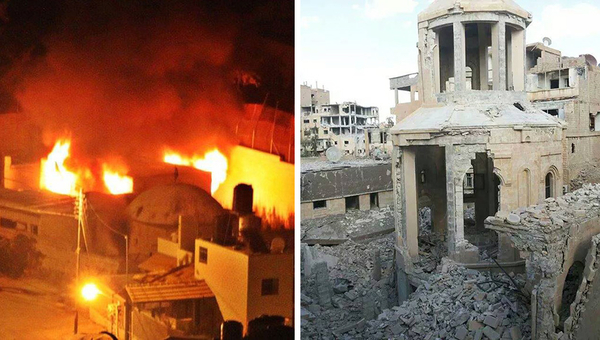
Our young men and women have learned from the Islamic State not only the practice of stabbing the “infidels,” but also how to destroy religious sites. On Thursday night, scores of Palestinians attacked and torched Joseph’s Tomb in the West Bank city of Nablus, in scenes reminiscent of the Islamic State’s destruction of ancient and holy sites in Syria and Iraq.

1309Last week, Palestinians torched Joseph’s Tomb in Nablus (left), in scenes reminiscent of the Islamic State’s destruction of holy sites in Syria and Iraq, such as the Armenian Church in Deir Zor (right).

The shrine was set on fire for no reason other than that it is revered as the tomb of a Jewish biblical figure. This is a site frequented by Jewish worshippers, although it is under the control of the Palestinian Authority (PA) and its security forces in Nablus. It is worth noting that agreements signed between Israel and the Palestinians guarantee access for Jewish worshippers to Joseph’s Tomb, and there were assurances to the Israelis that the PA could be trusted to safeguard the site.

What the Palestinians did to Joseph’s Tomb is no different from what the Islamic State and other terrorist groups have been doing to holy sites and archaeological sites in Syria and Iraq. The Palestinians who attacked Joseph’s Tomb were obviously influenced by the crimes of the Islamic State against religious and ancient sites.

What is still not clear is why the Palestinian Authority security forces, which maintain a tight grip on Nablus, did nothing to prevent the arson attack.

How can our leaders in Ramallah accuse Jews of “contaminating” the Aqsa Mosque with their “filthy feet” at a time when our youths burn a religious site such as Joseph’s Tomb?

This is not the only Jewish holy site that has been targeted by Palestinians in recent years. While our leaders are screaming day and night about Jews “invading” and “desecrating” the Aqsa Mosque, Palestinians from Bethlehem have been throwing stones, petrol bombs and explosive devices at Rachel’s Tomb near the city. This has been going on for several years now, in an attempt to kill Jewish worshippers and the Israeli soldiers guarding Rachel’s Tomb.

The attacks on Joseph’s and Rachel’s Tombs in Nablus and Bethlehem are part of a Palestinian-Islamic campaign to destroy Jewish holy sites and deny any Jewish link to the land. The attacks are an attempt to rewrite history so that Jews will not be able to claim any religious ties to the land. This is exactly what the Islamic State is doing these days in Syria and Iraq: “erasing history that lets us to learn from the past.”

The terror campaign that we have been waging against Israel in the past few weeks shows that the Islamic State and Islamic fundamentalism and fascism have invaded the minds and hearts of many of our young men and women. We have turned the conflict with Israel into a jihadi war, the goal of which is to slaughter Jews, erase their history and expel them from this part of the world. This is not an intifada. This is brutal killing spree targeting Jews of all ages, including a 13-year-old boy, a 72-year-old woman and a 78-year-old man.

President Mahmoud Abbas and other Palestinian leaders are lying to us — and the rest of the world — when they describe the stabbing attacks against Jews as a “peaceful popular resistance.” This is not a struggle against “occupation” or a wall or a checkpoint. It is time to recognize that this is an Islamic State-inspired jihad to slaughter as many Jews as possible and wipe Israel off the face of the earth. When and if the Islamic State is finally eliminated or disappears, the Palestinians will emerge as the successors of one of the most brutal and murderous Islamic gangs that has surfaced in modern history.

An Islamist Intifada

October 18, 2015

An Islamist Intifada, American ThinkerJonathan F. Keiler, October 18, 2015

The history of phony Palestinian Arab nationalism inevitably has led back to this point, revealing the violence for what it is: a war against Jews, and ultimately against anybody else who refuses to submit.

***************************

The current Palestinian Arab “uprising” against Israel appears to be a mostly Islamist offensive, not different in any significant ideological way from radical Islamist movements like ISIS, al-Qaeda, and Hezb’allah.  The idea that it is motivated by Israeli policies, the stalled “peace process,” or Palestinian Arab nationalism is nothing but propaganda, and the laziness and bias of the international press and political classes.

The violence is motivated by the Palestinian Authority’s deliberate agitation, which knowingly taps into the Arab masses deep-seated hatred of Jews and other infidels.  The Authority has a parochial interest in diverting the attention of the masses from its own corruption and incompetence.  It also wants to insulate itself against its Hamas rival in Gaza, which correctly sees the Authority for the hapless and rotten organization it is and would replace it with an incompetent and corrupt Islamist entity in the West Bank.

What neither the Palestinian Authority nor Hamas wants is independence, having rejected every opportunity to create a viable Palestinian Arab state.  The Authority, like all Palestinian Arab leadership since the 1930s, has rejected every opportunity to create a Palestinian state, despite claiming that purpose.  Correspondingly, Gaza is already a wholly independent Palestinian territory, but Hamas also laughably still claims it is “occupied” by Israel.  This patently idiotic assertion is nonetheless accepted as truth by the international left, many governments, and most likely the current occupant of the White House.

Still, Palestinian Arabs in the recent past have consistently played the nationalist card.  The first and second Palestinian intifadas could be characterized as nationalist uprisings, at least to the extent that the stated motivations of Arab leadership and the masses was to end Israeli occupation of the West Bank and Gaza.  The name of the uprisings, “intifada,” or “shaking off” in Arabic, suggested as much.  Predictably, though the Palestinian Arabs succeeded in ending the occupations of Gaza and most of the West Bank, they rejected the fruits of victory.

The uprisings demonstrated the disingenuous nature of Palestinian nationalism.  They furthered supposed Palestinian Arab national aspirations by intensifying international support of Palestinian goals and winning Israeli territorial concessions, but because of Palestinian disinterest in an actual state, these gains have led nowhere.

The result of the first intifada was the Oslo Accords, the withdrawal of the Israeli military from most populated parts of the West Bank, and the establishment of the Palestinian Authority.  If the Palestinian Arabs had any real interest in ending the conflict with Israel and establishing a real national polity, this could have led to a state in the West Bank and Gaza.  However, when Israel offered Yasser Arafat just that, accompanied by further Israeli territorial concessions, he rejected the offer and instead launched another intifada.

The second intifada was manufactured by Arafat, and also erupted over false claims of an Israeli violation of Arab sensitivities on the Jerusalem’s Temple Mount.  But with Arafat’s guidance, it quickly adopted the rhetoric of nationalist occupation.  The extreme violence of the second intifada, which cost Israel almost ten times the losses of the first intifada, also resulted in a tangible gain for the Palestinian Arabs: the abandonment of Israeli communities in Gaza and the Israeli military’s full retreat from that enclave.  When the Israelis departed, they intentionally left behind valuable infrastructure that the Palestinians could have used to build their nation.  In addition, the international community lavished aid and investment on the newly independent territory, which might have tried to transform itself into an Arab Singapore.

But again, the Palestinian Arabs rejected the opportunity.   They destroyed the abandoned Israeli infrastructure in typical self-destructive fits of “rage,” embezzled hundreds of millions of dollars’ worth of international aid, and launched a series of pathetic military offensives against Israel, designed to make their own people suffer.

Under Arafat’s successor Mahmoud Abbas (who remains in charge of the Palestinian Authority in the tenth year of a four-year term), and later under Hamas (after they kicked Abbas and his Fatah Party out), the Palestinians have ludicrously continued to claim that Gaza is occupied.

What is most interesting about the current uprising is that the Palestinians appear to have mostly abandoned any pretense of fighting for a state, and instead have now fully joined the Islamist wave sweeping the Middle East.  Other than Abbas’s posturing, the violence is relatively leaderless, at least in terms of traditional Palestinian Arab political organizations, and driven by Islamist youth.  This uprising, like the second intifada, was instigated by Abbas’s repeated lies about Israeli actions and intentions regarding holy sites in Jerusalem.  But it is persisting in that vein, as radicalized Palestinian Islamists attack Jews in the name of protecting Islam.

Thus, the current violence is less of a piece with the first and second intifadas as it is with the Arab revolts in Mandated Palestine during the 1930s.  Those uprisings were religious, based also on supposed threats posed to Islamic holy sites, with little nationalist motivation.  That’s because in the 1930s there was no Palestinian national movement, there being no such thing as a Palestinian historically, ethnically, or culturally.  To the extent there was any national element to the revolts, it was of the pan-Arab variety – a movement that has proven to be as chimeric as Palestinian nationalism.

In theory, the religious nature of this revolt should put “Palestine’s” many supporters in the West in a more difficult position.  The basis of Western support of Palestine, from the BDS movement to formal recognition to the “peace process,” has been the idea that the conflict between Israel and the Arabs is nationalist, not religious.  As a national conflict, the left and liberal Western governments take the side of the “indigenous” people (Palestinian Arabs), as opposed to the colonial occupiers (Israelis).  But with Palestinians adopting the ideas of the most radical Islamists, this ought to challenge that narrative.  And it reflects reality, because from the 1930s until today, there never has been an authentic Palestinian national movement, as opposed to a basically Islamist desire to rid the Middle East of its only non-Islamic polity.

Hamas has always been an assertively an Islamist organization, openly embracing terror; hostage-taking; public executions of infidels and heretics; and tyranny, both political and religious.  But it also claims to want to vindicate Palestinian national aspirations, which allows some governments and leftists in general to ignore Hamas’s Islamist nature and accept its partial self-depiction as a “resistance movement” to (nonexistent) Israeli occupation.   Likewise, Hezb’allah, the Shia-Islamist terror organization, also self-depicts as a resistance movement to nonexistent Israel occupation (Israel having totally quit Lebanon over 15 years ago).  This nationalist cover allows Western leftist politicians like Jeremy Corbyn (Britain’s new Labor leader) to embrace these groups .

It has also allowed Western leaders like President Obama and Secretary of State Kerry to divorce the Israeli-Palestinian Arab conflict from the larger war on terror.  They prefer to depict it as a local nationalist phenomenon, in which Israeli occupation – rather than Jews simply trying to live as Jews – drives Arab terror.  So far, true to form, the White House and State Department are sticking with that story with the current violence, blaming Israel and the Palestinian Arabs equally, and willfully ignoring the facts of Abbas’s incitement and the Islamist motivations of Arab murderers.

The history of phony Palestinian Arab nationalism inevitably has led back to this point, revealing the violence for what it is: a war against Jews, and ultimately against anybody else who refuses to submit.