Archive for the ‘Palestinian terrorists’ category

The Palestinians: Refugee Camps or Terrorist Bases?

July 21, 2016

The Palestinians: Refugee Camps or Terrorist Bases? Gatestone InstituteKhaled Abu Toameh, July 21, 2016

♦ The 450,000 Palestinians in Lebanon are still banned from several professions, especially in the fields of medicine and law. They refer to these restrictions as apartheid measures. The Lebanese apartheid measures against Palestinians are rarely mentioned in the Western media and international human rights groups. The UN does not seem overly concerned about this discrimination.

♦ Palestinian refugee camps in Lebanon have become in the past few decades bases for various innumerable militias and terrorist groups.

♦ The United Nations Relief and Works Agency for Palestinian Refugees, UNRWA, is formally in charge of the refugee camps in Lebanon, including those that are now providing shelter to Islamist terrorists.
♦ The Lebanese authorities are increasingly running out of patience with the growing Islamist threat.

ISIS is on the mind of the Palestinian Authority (PA) leadership. Top PA officials have expressed concern that jihadi groups, including ISIS, have managed to infiltrate Palestinian refugee camps in Lebanon.

Lebanese authorities are also worried — so worried that they have issued a stiff warning to the Palestinians: Stop the terrorists or else we will take security into our own hands.

According to Lebanese security sources, more and more Palestinians in Lebanon have joined ISIS and the Al-Qaeda-affiliated Al-Nusra Front, a Sunni Islamist militia fighting against Syrian government forces. In response, the Lebanese security forces have taken a series of measures in a bid to contain the problem and prevent the two Islamist terror groups from establishing bases of power in the Palestinian refugee camps in Lebanon.

According to some reports, dozens of Palestinians from Lebanon who joined ISIS and Al-Nusra Front have been killed or wounded in Syria in recent months. Most of those who were killed have been buried in Syria, the reports said.

Alarmed by the success of ISIS and Al-Nusra Front in recruiting dozens of Palestinians to their ranks, the Palestinian Authority leadership this week sent Azzam Al-Ahmed, a senior advisor to President Mahmoud Abbas, to Beirut for urgent talks with Lebanese government officials on ways of containing the escalation. The PA leadership fears that the heightened activities of the two terrorist groups in the refugee camps will force the Lebanese army to launch a massive military operation to get rid of the terrorists, who pose an immediate threat to Lebanese national security.

Al-Ahmed, who is in charge of the Lebanon Portfolio in the Palestinian Authority, held a series of meetings with Lebanese government officials in a bid to avoid a security showdown between the Lebanese army and the Palestinians living in the country’s refugee camps. Following a meeting with Lebanese Interior Minister Nihad Al-Mashnouk, the Palestinian envoy said that the talks focused on the need to take “joint steps to ensure security stability in the Palestinian refugee camps.” According to Al-Ahmed, the talks also dealt with ways to prevent certain parties, especially ISIS and Al-Nusra Front, from exploiting the Palestinian refugee camps to threaten Lebanon’s security interests.

Lebanese security officials have reported direct contacts between ISIS leaders in Syria and some senior Islamist figures in the Ain Al-Hilweh refugee camp, the largest camp in Lebanon, with a population of more of than 120,000 — half of them refugees who fled Syria since 2011. The officials said that one of the commanders of ISIS in Syria, Abu Khaled Al-Iraqi, has stepped up his contacts with Palestinians in Ain Al-Hilweh in recent weeks, in preparation for launching terrorist attacks against Lebanese targets. The Lebanese have named a number of Palestinians from Ain Al-Hilweh evidently serving as ISIS representatives in Lebanon: Emad Yasmin, Helal Helal, Abed Fadda, Nayef Abdullah and Abu Hamzeh Mubarak.

Last week, Palestinian sources revealed that one of the jihadi leaders in Ain Al-Hilweh, Omar Abu Kharoub, nicknamed Abu Muhtaseb Al-Maqdisi, was killed while fighting alongside ISIS in Syria. The sources said that he is only one of hundreds of Palestinians from Lebanon who have joined ISIS and the Al-Nusra Front.

The Lebanese government has informed the Palestinian Authority leadership in Ramallah that at least 300 jihadi terrorists are now barricaded inside Ain Al-Hilweh. “The situation has become intolerable and we can no longer turn a blind eye to this threat,” the Lebanese warned the PA.

The Islamist terrorists who have found shelter inside Ain Al-Hilweh have repeatedly warned the Lebanese authorities against launching a military attack against the refugee camp.

In a recent sermon for Friday prayers, Sheikh Abu Yusef Aqel condemned Lebanon’s mistreatment of its Palestinian population. He pointed out that under Lebanese law, Palestinians are banned from working in 72 professions. Referring to reports in the Lebanese media about the threats emerging from the Palestinian camps, Sheikh Aqel said:

“If these (Lebanese) media outlets were really affiliated with the resistance, as they claim, they would have focused on the suffering of a people that was displaced from its homeland more than 70 years ago. They would also have focused on the fact that Lebanon bans this people from working in 72 professions.”

Aqel is referring to the circumstance that until a decade ago, a total of seventy-two professions were restricted to Lebanese only. The Lebanese government issued a memorandum on June 7, 2005 permitting Palestinians refugees to work in fifty of these seventy-two professions. However, Palestinians in Lebanon are still banned from several types of jobs, especially in the fields of medicine and law. The 450,000 Palestinians living in Lebanon refer to these restrictions as apartheid measures.

The Lebanese apartheid measures against Palestinians are rarely mentioned in the Western media and international human rights groups. The United Nations does not seem overly concerned about this discrimination, apparently because it is practiced by an Arab country against Arabs.

Lebanon has never been comfortable with the presence of the Palestinians on its soil. That is precisely why the authorities have turned the twelve Palestinian refugee camps in Lebanon into ghettos. These ghettos are off-limits to the Lebanese security forces. As a result, these camps have become in the past few decades bases for various innumerable militias and terrorist groups. Until a few years ago, the major Palestinian Fatah faction was the dominant group controlling the refugee camps in Lebanon. No longer. Today, it has become evident that many other groups such as Hamas, Islamic Jihad, ISIS and Al-Qaeda have established bases of power inside the camps.

It is worth mentioning that the United Nations Relief and Works Agency for Palestinian Refugees (UNRWA) is formally in charge of the refugee camps in Lebanon, including those that are now providing shelter to Islamist terrorists.

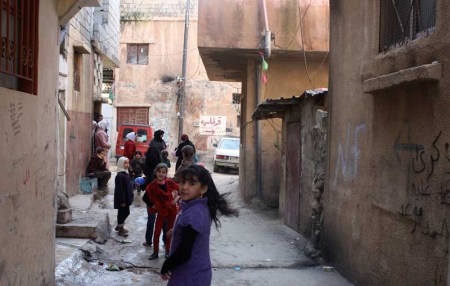
1705The Wavel refugee camp for Palestinians, near Baalbek in Lebanon, which is administered by UNRWA. (Image credit: European Commission DG ECHO)

Back to PA anxiety. Undoubtedly, the Palestinian Authority leadership is concerned that many of its erstwhile loyalists in Fatah have defected to the various jihadi terror groups. These groups are now posing a major threat not only to Lebanon’s security and stability, but also to the PA and its president, Mahmoud Abbas, who feel helpless in the face of the Islamist tsunami sweeping the Palestinian refugee camps in Lebanon.

Abbas and his PA have clearly lost control over the millions of Palestinians living in the neighboring Arab countries, including Lebanon, Syria and Jordan. This is in addition to the fact that Abbas and the PA have nearly no control over Palestinian refugee camps in the West Bank and Gaza Strip, where various jihadi groups and other secular militias and gangs are now in control.

The hands of the Palestinian Authority leadership are now tied: the PA cannot regain control over the refugee camps in the West Bank, Gaza Strip and the Arab countries. There is also nothing that Abbas can do to stop the residents of these camps from joining ISIS, Al-Qaeda, Hamas and Islamic Jihad.

All what is left for Abbas to do is to try and prevent a catastrophe from falling on the heads of the Palestinians in these camps, especially Lebanon, where the Lebanese authorities are increasingly running out of patience with the growing Islamist threat.

“The Lebanese army will not allow terrorism to find a safe place in Ain Al-Hilweh or any other part of Lebanon,” cautioned a Lebanese security source. “We will not allow Ain Al-Hilweh to become a hotbed for terrorism and be used as a launching pad to explode the situation in Lebanon. We will face any such attempt with force and firmness.”

The Palestinians’ biggest fear now is that Ain Al-Hilweh will meet the same fate as the Nahr Al-Bared refugee camp in Lebanon, which was almost entirely destroyed by the Lebanese army in 2007. Then, the presence of Islamist terrorists belonging to the Fatah Al-Islam group inside Nahr Al-Bared triggered heavy clashes during which the Lebanese army used artillery and helicopter gunships to attack the camp, home to some 40,000 Palestinians. At least 158 people were killed and hundreds wounded in the fighting, which also left many families homeless.

Busy with more pressing issues, Abbas was unable to make the trip to Lebanon himself. What is the urgent business that prevented him from showing up in person to try to prevent catastrophe for his people in Lebanon? His grand tour, an end-game bid to win support for an international Middle East peace conference that would choke Israel into submission.

Abbas is next slated for Paris, where on July 22 he is scheduled to meet with President François Hollande to discuss the latest French initiative to “solve” the Israeli-Palestinian conflict. Hollande might do better to turn inward to consider how his own country will manage the latest wave of Islamist terrorism. Abbas, for his part, is unlikely to broach with Hollande the incendiary situation in the Palestinian refugee camps, where ISIS and Al-Qaeda are gaining the upper hand.

The Case for Kurdish Statehood

July 11, 2016

The Case for Kurdish Statehood, Investigative Project on Terrorism, Noah Beck, July 11, 2016

1691

Why has the West been so supportive of Palestinian nationalism, yet so reluctant to support the Kurds, the largest nation in the world without a state?

The Kurds have been instrumental in fighting the Islamic State (ISIS); have generously accepted millions of refugees fleeing ISIS to the Kurdistan Regional Government (KRG); and embrace Western values such as gender equality, religious freedom, and human rights. They are also an ancient people with an ethnic and linguistic identity stretching back millennia and have faced decades of brutal oppression as a minority. Yet they cannot seem to get sufficient support from the West for their political aspirations.

The Palestinians, by contrast, claimed a distinct national identity relatively recently, are less than one-third fewer in number (in 2013, the global Palestinian population was estimated by the Palestinian Authority to reach 11.6 million), control land that is less than 1/15th the size of the KRG territory, and have not developed their civil society or economy with nearly as much success as the Kurds. Yet the United Nations, the European Union, the Arab League, and other international bodies have all but ignored Kurdish statehood dreams while regularly prioritizing Palestinian ambitions over countless other global crises.

Indeed, in 2014 the UK and Sweden joined much of the rest of the world in recognizing a Palestinian state. There has been no similar global support for a Kurdish homeland. Moreover, Kurdish statehood has been hobbled by U.S. reluctance to see the Iraqi state dismantled and by regional powers like Turkey, which worries that a Kurdish state will stir up separatist feelings among Turkish Kurds.

With an estimated worldwide population of about 35 million (including about 28 million in the KRG or adjacent areas), the Kurds are the fourth-largest ethnic group in the Middle East (after the Arabs, Persians, and Turks), and have faced decades of persecution as a minority in Turkey, Iran, and Iraq.

The 1988 “Anfal” attacks, which included the use of chemical weapons, destroyed about 2,000 villages and killed at least 50,000 Kurds, according to human rights groups (Kurds put the number at nearly 200,000). Several international bodies have recognized those atrocities as a genocide.

The Kurds in Turkey have also suffered oppression dating back to Ottoman times, when the Turkish army killed tens of thousands of Kurds in the Dersim and Zilan massacres. By the mid-1990s, more than 3,000 villages had been destroyed and 378,335 Kurdish villagers had been displaced and left homeless, according to Human Rights Watch.

The drive for Kurdish rights and separatism in Iran extends back to 1918, and – during its most violent chapter – cost the lives of over 30,000 Kurds, starting with the 1979 rebellion and the consequent KDPI insurgency.

A 2007 study notes that 300,000 Kurdish lives were lost just in the 1980s and 1990s. The same study states that 51,000 Jews and Arabs were killed in the Arab-Israeli conflict from 1950 until 2007 (and, because that total includes wars with Israel’s Arab neighbors, Palestinians are a small fraction of the Arab death toll).

Perhaps because of the Kurds’ own painful history, the KRG is exceptionally tolerant towards religious minorities and refugees. The KRG has embraced its tiny community of Jews, and in 2014, the Kurds rescued about 5,000 Yazidis trapped on Mount Sinjar after fleeing attempted genocide by ISIS. Last November, the Kurds recaptured the Sinjar area from ISIS, liberating hundreds more Yazidis from vicious oppression.

The KRG absorbed 1.8 million refugees as of December, representing a population increase of about 30 percent. The KRG reportedly needs $1.4 to 2.4 billion to stabilize the internally displaced people in its territory.

“Most of the refugees [in the KRG] are Arab Sunnis and Shia, Iranians, Christians, and others,” Nahro Zagros, Soran University vice president and adviser to the KRG’s Ministry of Higher Education, told the  IPT. “Yet there is no public backlash from the Kurds. And of course, we have been helping the Yazidi, who are fellow Kurds.”

The Kurdish commitment to gender equality is yet another reason that Kurdish statehood merits Western support. There is no gender discrimination in the Kurdish army: their women fight (and get beheaded) alongside the men. Last December, Kurdistan hosted the International Conference on Women and Human Rights.

The Kurds are also the only credible ground force fighting ISIS, as has been clear since the ISIS threat first emerged in 2014. ISIS “would have totally controlled the Baji oil field and all of Kirkuk had the [Kurdish] Peshmerga not defended it,” said Jay Garner, a retired Army three-star general and former Army assistant vice chief of staff who served during “Operation Provide Comfort” in northern Iraq. “Losing Kirkuk would have changed the entire war [against ISIS], because there are billions of dollars [per] week in oil flowing through there. The Iraqi army abandoned their equipment [while the Kurds defended Kirkuk, which has historically been theirs].”

Masrour Barzani, who heads the KRG’s intelligence services, says that Kurdish independence would empower the Kurds to purchase the type of weapons they need without the delays that currently hobble their military effort against ISIS. Under the present arrangement, Kurdish weapons procurement must go through Iraq’s Shia-led central government, which is also under heavy Iranian influence.

Besides bolstering the fight against ISIS, there are other geopolitical reasons for the West to support Kurdish statehood: promoting a stable partition of Syria, containing Iran, balancing extremist forces in the Middle East, and giving the West another reliable ally in a volatile region.

Now that Syria is no longer a viable state, it could partition into more sustainable governing blocs along traditional ethnic/sectarian lines with Sunni Arabs in the heartland, Alawites in the northwest, Druze in the south, and Kurds in the northeast. KRG leader Masrour Barzani recently argued that political divisions within Iraq have become so deep that the country must transform into “either confederation or full separation.”

Southeast Turkey and northwest Iran also have sizeable Kurdish areas that are contiguous with the KRG, but those states are far from disintegrating, and would aggressively resist any attempts to connect their Kurdish areas to the future Kurdish state. However, the Kurdish areas of former Syria should be joined to Iraqi Kurdistan as a way to strengthen the fledgling Kurdish state and thereby weaken ISIS.

In a recent article, Ernie Audino, the only U.S. Army general to have previously served a year as a combat adviser embedded inside a Kurdish Peshmerga brigade in Iraq, notes that Iran currently controls the Iraqi government and Iran-backed fighters will eventually try to control Kurdistan. He also makes the point that Western support for the Kurdish opposition groups active in Iran would force the Iranian regime to concentrate more on domestic concerns, effectively weakening Iran’s ability to pursue terrorism, expansionism, and other destabilizing activities abroad.

Because the Kurds are religiously diverse moderates who prioritize their ethno-linguistic identity over religion, a Kurdish state would help to balance out the radical Mideast forces in both the Shiite and Sunni camps. The Kurds are already very pro-American, thanks to their Western-leaning values, the U.S.-backed-no-fly zone, and the 2003 toppling of Saddam Husssein that made the KRG possible.

A Kurdish state would also have excellent relations with Israel, another moderate, non-Arab, pro-Western democracy in the region. Israeli Prime Minister Benjamin Netanyahu endorsed Kurdish independence in 2014, and Syrian Kurds – after recently declaring their autonomy – expressed an interest in developing relations with Israel.

By contrast, the Palestinian Authority slanders Israel at every opportunity: Abbas recently claimed in front of the EU parliament that Israel’s rabbis are trying to poison Palestinian drinking water. The Authority raises Palestinian children to hate and kill Jews with endless anti-Israel incitement coming from schools, media, and mosques. Palestinians have also shown little economic progress in the territories that they do control, particularly in Gaza, where Palestinians destroyed the greenhouses that donors bought for them in 2006 and instead, have focused their resources on attacking Israel with tunnels and rockets.

By almost any measure, a Kurdish state deserves far more support from the West. After absorbing millions of Syrian refugees while fighting ISIS on shrinking oil revenue, the KRG is battling a deepening financial crisis. Aggravating the situation, Iraq’s central government has refused – since April 2015 – to send the KRG its share of Iraqi oil revenue. The economic crisis has cost the KRG an estimated $10 billion since 2014.

U.S. Rep. Ed Royce, R-Calif., chairman of the House Foreign Affairs Committee, introduced House Resolution 1654 “to authorize the direct provision of defense articles, defense services, and related training to” the KRG. Fifteen months later, the bill is still stuck in Congress.

Helping the Kurds should be an even bigger priority for the European Union, which absorbs countless new refugees every day that ISIS is not defeated. If the EU were to fund the KRG’s refugee relief efforts and support their military operations against ISIS, far fewer refugees would end up on their shores.


Cartoons of the Day

June 30, 2016

H/t Town Hall

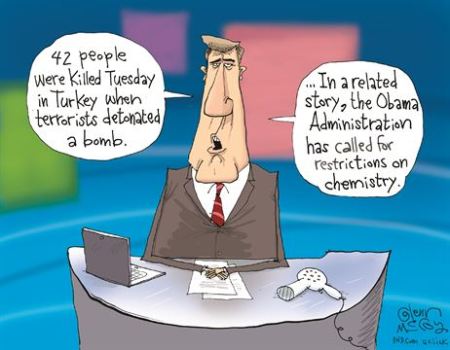
Ban chemistry


H/t Joopklepzeiker

False-Alarm-21


ISIS-Jordan cell linked to Tel Aviv terror attack

June 10, 2016

ISIS-Jordan cell linked to Tel Aviv terror attack, DEBKAfile, June 9, 2016

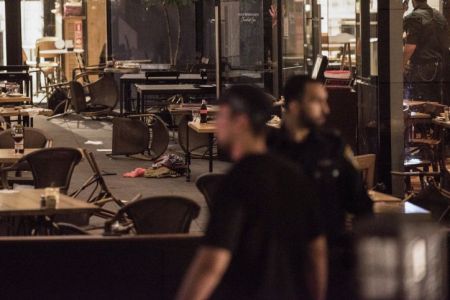
Israeli medical and security forces at the scene where a suspect terrorist opened fire at the Sarona Market shopping center in tel Aviv, on June 8, 2016. The suspect shot and wounded 9 people, one of them critically injured, in a suspected terror attack in the center of the city. Photo by Ben Kelmer/Flash90 *** Local Caption *** ?? ???? ???? ????? ????? ????? ??? ???? ???????

Israeli medical and security forces at the scene where a suspect terrorist opened fire at the Sarona Market shopping center in tel Aviv, on June 8, 2016.

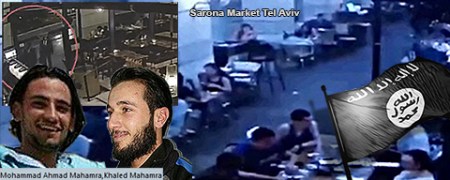
Khaled al-Mahmara, one of the two Palestinian cousins who opened fire at the Sarona Market in Tel Aviv Wednesday night, killing three Israelis and injuring 17, was a member of a secret ISIS cell at al-Mutah University in al Karak, Jordan. He was in a mission to lead mass terror attacks in Israel, to be orchestrated from Jordan.

DEBKAfile terrorism experts report that this university has become a hotbed of extremist Islamist terrorists with cells that are almost all linked operationally or ideologically to the Islamic State.

Muhammad Al-Dala’een, the son of a Jordanian Parliament member, who crossed the border from Jordan to Iraq and joined the terror organization, blew himself up 10 months ago in a suicide attack near Mosul. Al-Dala’een was a student at al-Mutah University.

Eight months ago, a Jordanian officer started shooting at a police training facility, murdering three foreign instructors – two Americans and a South-African. This officer, Captain Anwar Abu Zaid, was a graduate of al-Mutah University and proven by an investigation to be tied to clandestine ISIS terror cells operating there.

DEBKAfile sources say that Jordanian General Intelligence has been co-opted to the Israeli investigation of the Tel Aviv outrage. Both agencies view the Sarona Market attack as a continuation of the wave of ISIS attacks that began on Monday at Jordanian Intelligence Headquarters in the Baqaa Palestinian camp near Amman, which left five intelligence officers dead.

TerrorMaxBrener480

DEBKAfile reported Wednesday:

Two terrorists, dressed in white button-down shirts, ties and black pants, both from Yatta village in southern Mount Hebron, entered a restaurant near the Sarona Market in Tel Aviv on Wednesday and ordered food, then took out Karl Gustav sub-machine guns and started shooting at people seated inside the restaurant.

As a result, in one of the most harrowing shooting attacks in the current wave of Palestinian terror, at least 3 Israelis were murdered and 4 fighting for their lives in the Ichilov Hospital operating rooms. Two more are slightly and moderately wounded.

One of the two terrorists was captured and the other wounded and transferred to a hospital.

Tel Aviv District Police chief Chico Edry said that there is currently no information regarding more terrorists, and called for the residents of Tel Aviv to return to normal. This call, other than the attempt to reassure, is of no great value, because just as Commander Edry had no prior information on the shooting attack, he has no information on what is going to happen in the next hours and days.

Commander Edry also exposes the fact that Israeli security forces did not detect the news running through the social networks since Wednesday morning, claiming that an armed terrorist squad has reached Tel Aviv with the intent to carry out a terror attack.

The fact is that these terrorist were declared missing by the PA a day ago. One would assume that the word of their disappearance did not reach the ears of the GSS and the Military Intelligence who are usually coordinated with their counterparts in Ramallah.

There is no doubt that this attack was well planned for a long time.

The terrorists were armed with two Karl Gustav sub-machine guns, cartridges and knives. It appears they had excellent preliminary intelligence: The Sarona Market has countless entrances and exits and in fact it is impossible to check those entering or leaving the compound.

The proximity to the Defense Ministry and to the IDF Headquarters, the two most secure Israeli facilities, located in the Kirya in Tel Aviv, makes the compound a target of terrorist attacks. With these attacks the Palestinians wish to demonstrate that they can reach these facilities and the surrounding area.

Undoubtedly, there was someone who armed the terrorists, instructed them how to load the weapons, manipulate jams and change cartridges, and how to choose the seating at the restaurant from which they observed the victims prior to the attack.

The fact that the terrorists split and then opened fire on two fronts slightly apart, indicates that someone trained them on a method that will produce the maximum number of Israeli casualties. Their intention was to escape after the attack in two different directions, while sowing panic among the general public in the area.

MSNBC Slams Israel’s ‘Extreme Right-Wing’ Government in Wake of Terror Attack

June 9, 2016

MSNBC Slams Israel’s ‘Extreme Right-Wing’ Government in Wake of Terror Attack, NewsbustersKyle Drennen, June 8, 2016

(Please see also, ‘Uneaten birthday cakes next to pools of blood’.  

The MSNBC transcript does not suggest that the attack had anything to do with Ramadan, or even mention Ramadan. — DM)

During live MSNBC coverage of a terrorist attack in Tel Aviv in the 3 p.m. ET hour on Wednesday, NBC correspondents Ayman Mohyeldin and Martin Fletcher took turns blaming Israel’s “right-wing” government for Palestinian “frustration.”

Mohyeldin ranted: “…in terms of the context of what has been happening in the occupied Palestinian territories, the occupation, the shift of Israeli politics, including now the current government, more to the right, to what has been described by Israelis as even more of an extreme right-wing government, some of the measures that have taken place in the West Bank, the siege that continues in Gaza, all of those continue to fester.”

He then argued those policies created “the sense of depravation, the sense of frustration, the lack of any clarity on a political process”and declared: “There’s a tremendous amount of frustration among Palestinians who live in the occupied West Bank coupled with the shift of Israeli politics to the right, and that has led to even further measures of what Palestinians say is oppression in the occupied West Bank.”

Anchor Kate Snow replied: “A boiling point, perhaps.” She then turned to Fletcher and asked: “I just wonder whether this will be a call to action on – on both sides.” Fletcher responded: “Will it lead either side towards any movement towards peace or understanding that they need to make real progress? Probably not.”

He then joined Mohyeldin in hitting Israel:

I mean, as Ayman said, the Israeli government – you know, we keep – every few years we say, “Oh, this is the most right-wing government in Israel’s history,” and it just keeps getting more right-wing.So the chances that there’s going to be a move towards peace as a result of a violent shooting is probably the wrong conclusion. If anything, with the new defense minister, Avigdor Liberman, really an extremely right-winger, he will be – a settler himself – he will be calling, clearly as a defense minister, for a strong response of some kind.

Here is a transcript of the June 8 exchange:

Tel Aviv massacre

AYMAN MOHYELDIN: But in the bigger picture, in terms of the context of what has been happening in the occupied Palestinian territories, the occupation, the shift of Israeli politics, including now the current government more to the right to what has been described by Israelis as even more of a extreme right-wing government, some of the measures that have taken place in the West Bank, the siege that continues in Gaza, all of those continue to fester.

And as a result, the sense of depravation, the sense of frustration, the lack of any clarity on a political process that would lead to a – some kind of peace process, if you will, all of that has been brewing for the past several months. It’s been systematic for the last several years in terms of the ongoing occupation, but really, what we’ve seen is a spike, as Martin [Fletcher] was saying, in the past nine months with these wave of attacks. That has been a huge factor in why we are seeing this sudden spike.

There’s a tremendous amount of frustration among Palestinians who live in the occupied West Bank coupled with the shift of Israeli politics to the right, and that has led to even further measures of what Palestinians say is oppression in the occupied West Bank. The lack of any progress on the front with Gaza, it has been just a very – it’s been a recipe of disaster.

KATE SNOW: A boiling point, perhaps. Martin, as we – I’m trying to think back, and we’ve heard so much about the knife attacks that have happened last fall, I think, that was the last big spate of them – but is this – if you can put this in context, how significant is an event like this? And we’re talking about three people dead, multiple injuries. I mean, it looks a lot like what we saw in Paris, although not on the same scale. I guess I just wonder whether this will be a call to action on – on both sides.

MARTIN FLETCHER: Well, probably not much will change in the situation because of this. Because it was feared, the Palestinian – different Palestinian groups are trying to do this kind of thing. But it’s a shock, certainly to the Israeli public. It’s a shock because Tel Aviv is always sort of a rather hip, cool place outside the mainstream of the violence. Occasionally it reaches Tel Aviv with devastating effect. There have been bus bombs in Tel Aviv over the years and the attacks like this, but they have been far and few between.

The – I mean, from the point of view of the attackers, this was a successful attack that will shock the Israelis, but actually, will it change anything? Will it lead either side towards any movement towards peace or understanding that they need to make real progress? Probably not. I mean, as Ayman said, the Israeli government – you know, we keep – every few years we say, “Oh, this is the most right-wing government in Israel’s history,” and it just keeps getting more right-wing. So the chances that there’s going to be a move towards peace as a result of a violent shooting is probably the wrong conclusion. If anything, with the new defense minister, Avigdor Liberman, really an extremely right-winger, he will be – a settler himself – he will be calling, clearly as a defense minister, for a strong response of some kind.

MOHYELDIN: And this will be, correct me if I’m wrong, but really the first test on the security front for this new right-wing coalition government that was just formed within the last couple of weeks. This is the first, certainly the first significant major incident that has happened since this government has come into formation. And so I suspect, as Martin was saying, you’re going to hear tough talk in terms of measurements, in terms of if they identify and conclude that this is in fact the result of a Palestinian terrorist group or if a Palestinian individual was acting out.

(…)

State Department Funds Televised Call for Boycotting Israel; The New York Times Is Amused

June 7, 2016

State Department Funds Televised Call for Boycotting Israel; The New York Times Is Amused, Algemeiner, Ira Stoll, June 6, 2016

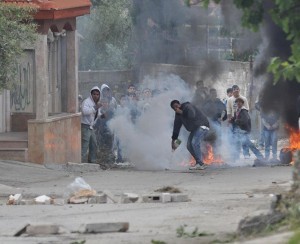
Palestinian-riots-300x244Palestinian rioters. Photo: Wikipedia.

The State Department is using American taxpayer dollars to finance Palestinian Arabs celebrating violent attacks on Israelis and advocating a boycott of Israel and the division of its capital city.

Where’s the outrage?

Not in the New York Times, which treats the topic as subject for a light-toned feature article about what it describes as a Palestinian “reality television show.”

The show features contestants who “run” for the job of Palestinian president. TheTimes article reports that “the three finalists all had similar platforms: Boycott Israel. Designate East Jerusalem as the capital of Palestine.”

Later, the Times reports, almost in passing, that the television program “broadcast on the Maan satellite network to large audiences in Gaza, the West Bank and elsewhere in the Arab world — was funded mostly by a State Department grant.”

The dollar amount of the grant is unreported by the Times. Also unreported by the Times is what the members of Congress who hold the spending power under the Constitution think about the idea of having taxpayer money used to broadcast, across the Middle East, calls to boycott Israel.

An NBC news article on the program quoted one of the contestants celebrating the role of women in the “revolution and resistance — they were throwing stones.” The NBC article also included a contestant’s call for a “’right of return,’ or the right for Arabs driven from their communities in 1948 when the State of Israel was established to go back.” Never mind that some of those Arabs left of their own free will or at the urging of neighboring Arab states, or that their “return” would, as a practical matter, be a way of destroying the Jewish state.

The Algemeiner did what the New York Times did not do, which is contact a major American Jewish organization for its view on the wisdom of spending taxpayer dollars to spread this message.

The president of the Zionist Organization of America, Morton Klein, told The Algemeiner that he found the State Department funding for the television program “astonishing,” and “shocking.” He said that if the State Department were found to be funding an Israeli television program advocating extremist views, there would be an uproar. In this case, however, “not a peep — the only peep is from Ira Stoll.”

“Where is the media and Congress screaming about this?” Mr. Klein asked.

It’s a good question, and one in which the Times shows a disappointing lack of interest in answering, or even in asking.

The Old Generals’ Old Plan

May 31, 2016

The Old Generals’ Old Plan, Front Page MagazineCaroline Glick, May 31, 2016

al-aqsa_martyrs_brigade

Originally published by the Jerusalem Post

The Israeli Left is a one trick pony. As it sees things, all of Israel’s problems – with the Palestinians, with the Arab world, with Europe and with the American Left – can be solved by giving up Judea and Samaria and half of Jerusalem (along with Gaza which we gave up already).

Once Israel does this, the Left insists, then the Palestinians, the Arab world, Europe and Bernie Sanders voters will love us as they’ve never loved us before.

The events of the past quarter century have shown the Left’s position to be entirely wrong. Every time Israel has given the Palestinians land, it has become less secure. The Arabs have become more hostile.

The West has become more hostile. The Palestinians have expanded their demands.

Because of their negative experience with the Left’s policy, most Israelis reject it. This is why the Right keeps winning elections.

Given the failure of its plan, the Left could have been expected to abandon it and strike out on a different course. But it didn’t. Instead it has tried to hide its continued allegiance to its failed withdrawal strategy by pretending it is something else.

A central component of the Left’s concealment strategy is its use of former generals.

Over the past quarter century, and particularly since the Palestinians began demonstrating in 2000 that they have no interest in a state living side by side with Israel, the Left has carted out retired generals at regular intervals to proclaim that continued allegiance to the Left’s failed policy of withdrawal is not irrational.

Every couple of years, a new initiative of former generals – often funded by the EU – is published.

Each in turn uses whatever the popular memes of the day may be to repackage their call for withdrawal from Judea and Samaria and the partition of Jerusalem.

The media, itself dominated by the Left, backs these initiatives. The retired war heroes are paraded before the cameras and presented to the public as responsible adults who have grudgingly entered the political fray, despite their aversion to it, because of their patriotism. Just as they heeded the call of duty and led forces in wars of earlier generations, so today, we are told, they heed the call again, in yet another last-ditch effort to save the country.

Just in time for Avigdor Liberman’s swearing in as defense minister, a new group of old generals released a new version of their old, discredited plan.

A group calling itself “Commanders for Israeli Security” has mobilized an impressive roster of 214 generals that have signed on to a new position paper called “Security First: Changing the rules of the game, a plan to improve Israel’s security-diplomatic position.”

The group has a great website replete with a highend web commercial that has been flooding social media feeds for the past several days. The ad shows a person ripping up a “Peace Now” bumper sticker and replacing it with a call for “Security now, peace later.”

Their plan, the ad proclaims, will improve Israel’s security, strengthen its international position, repair the cleavages in Israeli society and set the conditions for future negotiations with the Palestinians.

Unfortunately, like every leftist plan to date, if the generals get their way and the government takes their advice, the results will be precisely the opposite of what they promise. As has been the case with every other well-packaged withdrawal plan, Israel’s security will be harmed. Our international position will be wrecked. Bernie Sanders voters along with the Europeans will expand their devotion to bashing Israel. And the Sunni Arab states that now flock to us will again abandon us.

The generals’ new package involves opening their plan with a hawkish call for continued Israeli security control over Judea and Samaria, until the Palestinians decide to make peace with us.

But as we soon see, that was just throat clearing.

Having established their sober-mindedness, the generals turn to the Left’s unchanging fantasy.

They call for the government to formally relinquish Israel’s sovereign rights over the vast majority of Judea and Samaria and eastern Jerusalem.

They call for the government to permanently stop respecting the property rights of Jews in the areas of Judea and Samaria outside of the security perimeter.

The more than one hundred thousand Jews who live in those areas, they insist, must be denied all right to property, save the right to sell whatever they now own.

They must not be allowed to build anything – no new houses; no new communities; no new infrastructure.

As for the communities inside the perimeter, the generals insist that those should be permitted to continue respecting Jewish property rights, within limits, albeit. For instance, those communities must not be permitted to expand beyond their current construction boundaries. In other words, Jews can build up, but not out.

Jerusalem, which they believe should never have been unified in 1967, should be effectively partitioned.

The generals call for the municipal government to stop administering the city as a unified mixed Jewish and Arab city. Instead, they say, the city should set up a separate governing authority for Arab neighborhoods in eastern, northern and southern Jerusalem. That separate authority should be responsible for all planning and zoning activities in Arab neighborhoods as well as the education system and every other aspect of the daily lives of the Arabs of the city.

Gaza, which has been operating as a Hamas state since 2007, is also brought in from the cold. The generals call for the government to continue to supply Gaza with everything that Hamas demands – water, electricity, employment in Israel, a Hamas-controlled port. They even call for Israel to allow Europe to pay the salaries of Hamas terrorists.

Moreover, the generals recommend that the government announce that Gaza, Judea and Samaria and partitioned Jerusalem are one political entity, despite the fact that they aren’t.

The generals insist that by taking these steps, Israel will prove its devotion to peace and keep the dream of a Palestinian state alive. As a consequence, they say, the Palestinians will be happy and stop trying to murder Israelis. The Arab world will line up to sign peace treaties with Israel. Europe along with Bernie Sanders’ voters will bury the hatchet and embrace Israel.

The problem with the generals’ newest plan and the ones its replaces is that they all ignore basic facts.

There is no Palestinian constituency for peace with Israel. The more Israel offers the Palestinians, the less interested they are in settling.

By announcing that Israel renounces its claims to Judea, Samaria and Jerusalem, and treating the Jews east of the 1949 cease-fire lines as second class citizens, the generals will not only widen Israel’s social cleavages. They will tell the Palestinians that they are right to feel contempt for us. The worse they behave, the more we will offer them. The more Jews they murder, the more the Jews will turn against one another.

As for improving Israel’s international position, it is hard to understand why the generals refuse to learn the lessons of the Gaza withdrawal. Despite the fact that Israel uprooted 24 Jewish communities in Gaza and northern Samaria, and removed its military forces from the area, without exception, the international community insists that Israel still “occupies” Gaza. How can the generals expect the world to act more fairly towards a more limited withdrawal plan from Judea and Samaria and Jerusalem? As for Gaza, Operation Protective Edge brought out into the open the fact that Egypt, Saudi Arabia, the UAE and other Arab states support Israel in its war against Hamas. They do so because they fear Islamic State and Iran more than they hate Israel, whose power they trust.

If Israel announces its intention of leaving Judea and Samaria, which the Arabs know will become a Hamas enclave faster than Gaza did, the Arab faith in Israel’s power will diminish. As a consequence, if Israel follows the generals’ advice our relations with the Sunnis will worsen, not improve.

It is a tragedy for Israel that the generals have allowed the Left to use them in this way. Their role in perpetuating Israel’s destructive adherence to the devastating two-state policy model diminishes their past contributions and endangers Israel’s future.

Israel and the Palestinians: What the media won’t report

May 29, 2016

Israel and the Palestinians: What the media won’t report, Gatestone Institute via YouTube, May 28, 2016

Worrying about Israel’s “moral compass”

May 25, 2016

Worrying about Israel’s “moral compass” | Anne’s Opinions, 25th May 2016

Ever since Deputy Chief of Staff Gen. Yair Golan warned Israel against becoming “morally corrupt”, and newly-resigned Defence Minister Moshe “Bogie” Yaalon expressed dismay at Israel’s loss of its moral compass, the world has been equally watching us with bated breath, looking for signs of imminent Nazism and racism to appear in Israeli society.

For the BBC of course this was manna from Heaven. BBC Watch reports on the BBC’s “World Have Your Say” radio program where they wondered aloud at this very moral compass that Israel looks set to lose. As you might expect, there was no such pondering about other, much more violent countries:

… However, BBC audiences have not been invited to ponder the question of whether the citizens of Austria (or America, Hungary, France, Switzerland, Finland or Denmark) have lost their moral compass en masse.

That question was posed –literally – in relation to a country which the BBC has long portrayed as ‘lurching’ to the right of the political map – regardless of the inaccuracy of that framing.

The May 20th edition of the BBC World Service radio programme ‘World Have Your Say’ (titled “Has Israel Lost its ‘Moral Compass’?“, from 00:48) based its discussion around the resignation of Israel’s Minister of Defence on the same day and presenter Anu Anand was joined by four telephone interviewees.

Towards the end of the item, as Gregg Roman [Director of the Middle East Forum – Ed.] tried to provide listeners with insights into the Israeli political scene, Anand interrupted and refocused the discussion on the programme’s real topic:

“But can I just move you guys back to the…the….you know, the talk about how Israel is losing its values. I do understand there are heavy politics involved, but perhaps for a global audience…”

The BBC of course is not the only media outlet shedding crocodile tears for Israel’s worrying morality though they are a leading influence. As one reads media articles, social media posts, talkbacks on articles, or watches and hears TV and radio programs, the effect on the average Israeli is suffocating and infuriating.

A golden oldie but as relevant as ever

I am therefore very thankful that I came across Vic Rosenthal’s (aka Abu Yehuda) excellent two-part series on this very subject which should be required reading for all pro-Israel advocates.

In part I of Adjusting the Moral Compass he describes the origin of this discussion on morality, which was the incident of the IDF soldier Elor Azaria who shot dead an (apparently) incapacitated terrorist after a knife attack. He then places this discussion of morality into a historical context and also locates where Israel sits on the world stage:

On the one side, we have the primarily secular academic, cultural, military, legal and media elites, mostly Ashkenazim whose families have been in Israel for generations, who have become increasingly vocal, even frantic, about what they call ‘undemocratic’, ‘racist’, ‘ultra-nationalist’, ‘fascist’ and ‘theocratic’ trends in society.On the other side – now a majority – are found many religious Israelis and those of Mizrachi or Soviet origin, who believe that the elites are anti-Zionist, self-hating, bigoted against religious people and ignorant about the true nature of our enemies.

Both sides believe that the other, if not reined in, will destroy the state.

The real issue is the degree to which our moral system should be universal or tribal.

Universalism, the belief that we are obligated to treat all human beings alike regardless of who they are has reached its apogee in Europe and the US, where no crime is more detested than ‘racism’.

Universalist ethics are opposed to tribalism, which prioritizes one’s own tribe, religious group or nation. There was no Enlightenment in the Islamic world, and Middle Eastern cultures are still highly tribalistic; so much so that attempts to create modern states while ignoring ethnic, religious and tribal realities have been (e.g., Syria and Lebanon) spectacular failures. One way to characterize the moral system of a culture is by where it falls on the universalism-tribalism axis.

Former Israeli Supreme Court Chief Justice Aharon Barak tried to force Israel into the mold of a European or American “state of its citizens.” In the name of democracy, the Court opposed attempts to maintain a special status for Jews or Judaism. Foreign interests like the American New Israel Fund and the Union for Reform Judaism, as well as European-financed NGOs support this universalist vision, even to the point of calling for changes in our flag and national anthem because they don’t speak to our Arab citizens.

Of course they don’t. Why should they, in a Jewish state?

The environment is changing and the cultural organism must change too, if it is to adapt to it. In our new environment, a strongly universalist morality is not an advantage; it constitutes unilateral moral disarmament. Our state won’t survive as a copy of the US or Sweden (indeed, the pressures are such that neither the US nor Sweden may survive in their present form).

That doesn’t mean that we need to give up democratic government or adopt all the cultural practices of our neighbors, like their misogyny, religious coercion, or beheadings and barrel bombs. It doesn’t imply that we ought to view ourselves as superior to non-Jews or that we should deny non-Jews that live among us their civil rights.

What it does mean is that our objective should be a state that unashamedly prioritizes Jewish people, culture, religion and values.

In Part II Vic speaks of the consequences of moral equivalence, of applying a universalist belief to an area where tribalism rules:

The psychological consequences of our European-style ‘fairness’ on our tribal enemies are also counterproductive. They understand our ‘goodness’ as weakness, and take maximum advantage of it. It does not make them admire us or wish for peace; rather, it generates contempt and encourages them to continue using violent tactics.

What is true of our rules for warfare and counterterrorism also applies to our public diplomacy and other areas. Our leaders express an understanding of the supposed Palestinian need for a state and desire to sit down with them and negotiate a peace deal, while the Arabs publish maps on which Israel does not appear and educate their children to love martyrdom above all. We provide surgery in our best hospitals to the relatives of leaders of Hamas and the PLO, while they encourage their people to pick up a knife and stab a Jew.

One of the implications of a universalist morality is that there is no such thing as an enemy in the traditional sense. If anyone should be considered an enemy it would be the leaders of Hamas and the PLO; yet our doctors save the lives of their relatives. In this view even terrorists have rights, and the people of Gaza and the Arabs of Judea and Samaria shouldn’t be punished collectively for what their leaders do. After all, everyone is an individual and everyone has human rights.

Israelis have taken this European approach even further. Because of our (historically inappropriate) guilt complex toward the Palestinians, we might say that “everyone has human rights especially the Palestinians.”

But what if we realign our moral system to see the conflict in tribal terms?

This is war and the Palestinians are the enemy. Who speaks like this in Israel today?

You don’t supply water, electricity, food and cement to an enemy population, especially one which has no desire to overthrow its leadership. And the Palestinians, both in Gaza and Judea/Samaria have defined themselves as an enemy, by their choice of leaders, by what they teach in their schools and say in their official and social media, and in their popular support and enthusiastic participation in terrorism against Jews.

Collective punishment? Of course they should be punished collectively, because their guilt as an aggressor is collective.

Now before anyone gets outraged at the politically incorrect but (in my opinion) morally correct assertiveness expressed by Vic Rosenthal, let us just remind ourselves of a very similar instance that happened just last week – in New York. A knife-wielding man was shot dead – and guess what? There was no UN resolution or condemnation of New York cops, there were no editorials or programs on the BBC expressing hypocritical concern at the morality of the US. It was taken as a given that an armed man will be shot dead. As the Algemeiner reports on the “disproportionate response to the New York attacker“:

“Knife-wielding man shot dead in midtown Manhattan” was the headline making the rounds on the Internet last week. The man with the knife had not shouted “Allahu Akbar,” nor was he attempting to commit a terror attack. He was simply an apparently inebriated individual, identified as Gary Conrad, who went into a Food Emporium, where he allegedly became “aggressive and belligerent.”

According to NYPD Chief of Department James O’Neill, “He was swearing at the people in the store, swearing at the workers in the store.” Swearing, imagine that. What a lethal menace!

A police officer called to the scene began struggling with Conrad, who pulled out a knife. Police officers ordered him to drop the knife, but he continued to approach them with the knife in his hand. At that point, O’Neill said, an officer and a sergeant opened fire on Conrad.

They did not shoot him once. They did not merely aim to neutralize him by shooting him in the legs or his arms. They shot him an incredible nine times. He was pronounced dead at the scene.

Had this taken place in Israel, and had this man not been called Gary Conrad, but Mohammed, and had he not been merely an inebriated loon but a terrorist out to slash Jews, international outrage would have poured forth in torrents from the front page of every single news outlet and the mouth of every opinion maker worth his salt. The “disproportionate force” claim would have been thrown about and every self-respecting journalist would have asked why Israel had to kill the man — shooting him no fewer than nine times — instead of simply neutralizing him by shooting him in the legs or the arms and then taking him to hospital.

So far, not a single news report has questioned the judgment of the NYPD. No American liberal has come forth in self-righteous indignation, asking whether killing this man, who, after all, was not threatening to blow up the Food Emporium or stab anyone, may have been slightly on the disproportionate side.

Let us stop beating ourselves about the head and bewailing our loss or lack of morality, and instead we should be proud of just how well Israel and Israelis comport themselves while under the most extreme threat of constant attack and annihilation. We compare well not just in comparison to our degenerate neighbours, but compared to every Western country on earth.

Of course there is always room for improvement, and we cannot sit back and think we are saints, but nevertheless we have much to be proud of in our democracy, our enlightenment and yes, our morality.

Update: Lawrence in the comments provides us with another excellent link: Why some Jews are afraid of their inner-Nazi. It expresses similar sentiments to Abu Yehuda in a more concise manner. Go and read!

Secretary-General Of Palestinian Presidency Delivers Speech On Behalf Of President ‘Abbas: In Fighting For Palestine, Our People ‘Loves Death More Than Life’

May 24, 2016

Secretary-General Of Palestinian Presidency Delivers Speech On Behalf Of President ‘Abbas: In Fighting For Palestine, Our People ‘Loves Death More Than Life’ MEMRI, May 24, 2016

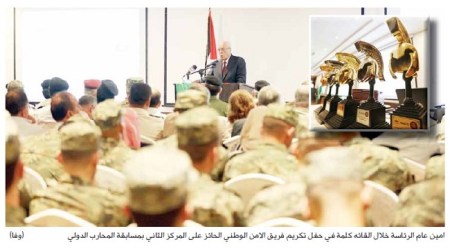
On May 22, 2016, Palestinian Presidency Secretary-General Al-Tayeb ‘Abd Al-Rahim delivered a speech on behalf of Palestinian President Mahmoud ‘Abbas to a group of Palestinian National Security Forces. The speech was part of a ceremony celebrating their second-place win in the international 8th Annual Warrior Competition, which took place in Jordan on May 2-6, 2016.[1]

In his speech, ‘Abd Al-Rahim condemned attempts to intimidate the Palestinian people and divert it from its path, and called such attempts futile, as “our [Palestinian] people loves death more than life.” He added that the National Security Forces victory was a step on the way to establishing an independent Palestinian state, and rejected the notion of establishing a separate independent entity in Gaza, or a state with temporary borders in the West Bank alone.

The following are excerpts from the speech:

28164Abd Al-Rahim speaking at the ceremony (Al-Ayyam, PA, May 23, 2016)

“Today we celebrate the Palestinian man, who suffers a lack of means and opportunity, but has will power and is determined to keep the Palestinian flag flying so that it [the flag] remains in the hearts of peace-loving and liberty-loving peoples. We were very happy with this victory [in the Warrior Competition], and the honorable president and commander-in-chief, president Abu Mazen [Mahmoud ‘Abbas], has expressed his esteem for the brothers who won this award and his pride in their achievements. Many commanders in Arab military institutions have also expressed their pride in this new Palestinian man, who is always new and always renewing [himself].

“The occupation wagered that we would forget our cause and that, as the generations passed, we would dissolve into the societies around us… However, the occupation was the first to realize that each new generation was more determined and had a stronger desire to achieve the goals that the martyrs had died for in the distant and the near past and [are still dying for] in the present. Our blood is still being spilled at the roadblocks and the checkpoints by the gangs of settlers and the extremist soldiers of the occupation, some of whom have acknowledged that they do not act according to moral standards when facing our people and children…

“Occupiers are always destined to fail. This fact should be in our minds forever. We must always cling to hope. Our morale will not be influenced or shaken by anything. We will not grow soft or deviate towards personal interests for the sake of dubious goals such as establishing a state or an emirate in Gaza, or establishing a state with temporary borders in the West Bank. We must always tirelessly stick to our truth, and our faith in victory must never falter. It is the faith in our hearts that will lead us to our rights and to the realization of our righteous and legitimate goals…

“Every achievement is a step on the road to establishing an independent state and strengthens our belief that the future is ours, that tyrants will disappear, and that the aggressors will end up in the trash bin of history. Indeed, they are trying to intimidate us today with people who threatened to strike Gaza or the Aswan Dam [a reference to incoming Israeli defense minister Avigdor Liberman], but these threats are hollow as we are a people who loves death more than life when it fights for Palestine.”[2]

Endnotes:

[1] The Annual Warrior Competition is a combat-oriented competition held at the King Abdullah II Special Operations Training Center (KASOTC) in Amman (Warriorcompetition.com).

[2] Al-Hayat Al-Jadida (PA), May 23, 2016.