H/t The Jewish Press
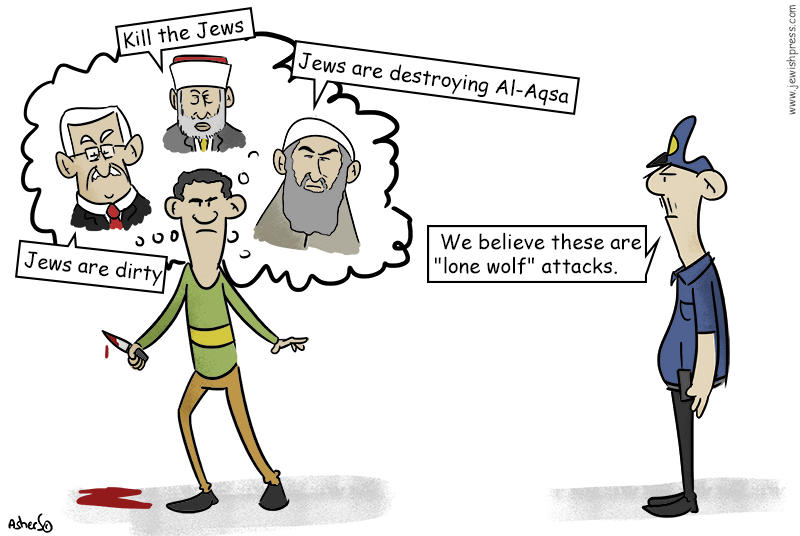
H/t The Jewish Press
Mother of Killed Palestinian Terrorist Pulls Out Knife in Interview, Threatens to Carry Out Attack, Middle East Media Research Institute, October 26, 2015
According to the blurb following the video,
Umm Muhammad Shamasne, whose son Muhammad was killed while perpetrating a terror attack on a bus in Jerusalem on October 12, was recently interviewed in her home by the Lebanese Al-Quds TV channel. Offering the interviewer candy to celebrate her son’s martyrdom, Umm Muhammad Shamasne said that she hoped her other sons would follow in his footsteps, and pulled out a knife, threatening: “My deeds will speak louder than words.” The interview aired on October 22, 2015.
The Holocaust is OVER, The Gatestone Institute, Shoshana Bryen, October 25, 2015
Israel’s Prime Minister, Benjamin Netanyahu, set off a firestorm on October 21 by saying that the Mufti of Jerusalem had actually planted the idea of exterminating the Jews in Hitler’s mind; that Hitler would have simply ousted them from Europe.
Scholars, academicians, politicians, friends and enemies of Jews, Israel, and Netanyahu leapt to the barricades. The Washington Post had the story on the front page. Twitter and blogs have overflowed with it. The Chancellor of Germany found it oddly necessary to say, “Germany is responsible for the Holocaust.”
But enough about who, between two long-dead anti-Semites, was the worst. It is a distraction and provides cover for today’s racists and those who would destroy Israel.
Palestinian agitator Saeb Erekat used the tumult to weigh in. In the latest Palestinian effort to rewrite history, he said, “Palestine’s efforts against Nazis, are deep-rooted part of our history.”
Palestinian Authority (PA) strongman Mahmoud Abbas, a Holocaust denier at least since his PhD days (and now in the 10th year of his four-year term, so he cannot be called “President”) did not say anything on that subject. He does, however continue to incite Palestinians to kill Jews. Right now, today, this minute.
Abbas has been lying about threats to the status quo on the Temple Mount, and proposing his own change: The Jews, he said, have no right to “desecrate” the mosque with their “filthy feet.” He then assures those Palestinians who go out to kill Jews — because they understood the recommendation to be officially sanctioned — that, “Every drop of blood spilled in Jerusalem is pure, every shahid [martyr] will reach paradise, and every injured person will be rewarded by God.”
Also, right now, today, this minute, the United Nations is labeling one of the oldest existing symbols of Jewish patrimony in the Land of Israel — the Tomb of Rachel, wife of the biblical patriarch Jacob — as a Muslim holy site. The U.S., U.K., Germany, Netherlands, Czech Republic, and Estonia voted against this surreal piracy. But 26 other countries voted in favor of a resolution, totally fraudulent, that condemned Israel for aggression and illegal measures taken against the “freedom of worship and access” of Muslims to Al-Aqsa mosque and Israel’s “attempts to break the status quo since 1967.”
The UN had not a word, however, about the Muslims who burned the Jewish holy site at Joseph’s Tomb last week. This omission raises a different question: the same Joseph is also a prophet in Islam; what are they doing firebombing his tomb?
In addition, right now, today, this minute, the State of Israel is under physical and political attack, and its best ally, the United States, is largely absent. Secretary of State John Kerry admonished, “We continue to urge everybody to exercise restraint and restrain [sic] from any kind of self-help in terms of the violence, and Israel has every right in the world to protect its citizens, as it has been, from random acts of violence.”
No self-help? Kerry specifically said it; he meant that if the government shows up and kills the terrorist before he kills, fine, but he does not want Israelis to take their defense into their own hands. That is not the way defense is done in America, and it is not the way it is done in Israel. The United States is abandoning a core American value in pursuit of the chimera of Israeli-Palestinian “peace.”
Right now, this minute, young Palestinian children are being marinated in Jew-hatred by their parents and by their society. Watch a beautiful little girl with a large knife tell her approving father, “I want to stab a Jew.” Watch a Palestinian children’s TV program in which a girl of about 10, her hair covered, draped in a Palestinian shawl, tell other children that the “martyrs” are “grown up kids.” She compares their number to the number of dead Israelis. “It’s almost like a game,” she says.
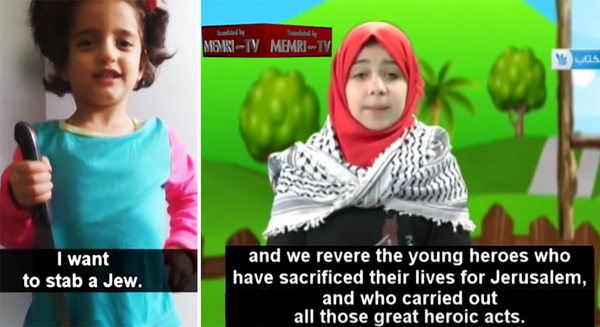 (Image source: MEMRI)
In 2000, before the so-called “second intifada,” the New York Times wrote about Yasser Arafat’s summer “war-game camps” in Gaza, teaching young Palestinian children how to prepare for the battle they would fight. That is fifteen years of learning to kill Jews — and fifteen years of creating child soldiers: a violation of the UN Convention on Child Soldiers, and one reason so many young Palestinians are primed for violence. Any Palestinian now under the age of, say, 23 could have had that “training.” In the summer of 2015, tens of thousands of teenagers in Gaza participated in these “summer camps” to learn from their Hamas teachers to kill Jews.
Even before that — since the Palestinians created their own school curriculum 21 years ago, in 1994, under the Oslo Accords — Palestinian children have been exposed to lies, incitement to violence and raw anti-Semitism, in the schools of the Palestinian Authority and UNRWA. Palestinians under the age of 30 spend most of their formative years in schools that deny the legitimacy of the State of Israel and that deny any connection of the Jews to the land.
We are currently seeing the results of the long-term abuse of Palestinian children by their parents and teachers — abetted by the United Nations.
There have been many calls for the U.S. to defund the Palestinian Authority, either completely or in part. This week Congress, in rare bipartisan agreement, took up part of the challenge, stripping $80 million from $370 million of U.S. economic aid to the Palestinian Authority.
History provides a framework for understanding today’s politics. The Mufti of Jerusalem was not only a kindred spirit of Hitler; he spent much of the war in Berlin as the guest of like-minded practitioners of Jew-hatred. If what happened in the 1930s and 1940s, however, is allowed to turn our attention from the current threats to the Jewish State, we will have granted them a belated victory they do not deserve.
The Inversion of Reality in Israel, American Thinker, Ricki Hollander, October 25, 2015
The perpetrator is turned into the victim.
*************************
For ten years, I’ve spent the Jewish holidays in Jerusalem, joining multitudes from all over Israel and abroad who flock here to celebrate. It is a period of festivity, with concerts and events throughout the city. From my apartment outside the Old City, I watch Jews streaming to the Western Wall as generations before them have done, and Christian tourists who come to celebrate the Feast of the Tabernacles.
This year, the holiday begins with the usual exuberance, but events take a dark turn as streets turn into murder scenes, and paranoia grips the city.
Exhorted by their leaders to defend Islam’s holy sites, Palestinians are fed lies about marauding Jews planning to take over the Al-Aqsa mosque. President Mahmoud Abbas, Israel’s purported peace partner, calls on Palestinians to prevent Jews from “defiling” the Temple Mount “with their filthy feet.” He promises that “every martyr will be placed in Paradise.” His call is repeated by political and religious leaders on TV and social media, illustrated with graphic images of bloody knives.
As if on cue, Palestinians eager to find that promised paradise leave their homes with butcher knives to seek out Jewish victims. A young Israeli couple are ambushed and killed before their children. A vicious attack on a family returning from the Western Wall leaves two dead. The gruesome scene is filmed by Arab onlookers who casually watch the victims die, sipping Coke and refusing to help.
Within days, a wave of violence has engulfed the city. The festive streets filled with holiday celebrants have become eerily deserted. No one knows when or where the next knifing will occur.
I am awakened one night by the sharp staccato of gunfire, followed by the long wailing of ambulances come to evacuate the latest stabbing victim, a 15-year-old boy, and his assailant, Fadi Aloun, shot dead by police. On his Facebook page is Aloun’s declaration that he intends to become a shahid (martyr). Film clips show him walking along the train tracks after the attack, while Jewish youths behind the guardrail point him out as the perpetrator, telling arriving patrolmen to shoot.
Palestinian sources proclaim that “Martyr Aloun” was “murdered in cold blood.” The Globe and Mail follows, reporting that Aloun “was accosted … by a mob of Israelis, who accused him of carrying out a stabbing some time before” and “prodded” police to kill him. The perpetrator is turned into the victim.
In the ensuing days, sounds of sirens and helicopters become a constant backdrop. They signify new attacks and more casualties. Regular radio programming is pre-empted with news that comes around the clock. Reports of “incidents” are not confined just to Jerusalem now. They are coming from all over the country – Tel Aviv, Petach Tikvah, Jaffa, Afula. High schools are closed in Jerusalem – not enough security guards. Jerusalem’s mayor says residents should carry weapons for self-protection. Those who do venture out look over their shoulders. Some sport baseball bats or umbrellas. I buy pepper spray, one of the last available vials.
An acquaintance, Tzvi, recounts his own brush with terrorism: he is walking and chatting with his friend Daniel in the Old City, when suddenly Daniel keels over and falls to his knees, head forward and bleeding, dazed and unaware. Tzvi whips around to see a petite Arab girl standing directly behind Daniel with arm raised, grasping a butcher’s knife, about to bury it in Daniel’s back. In that second of panic, an unarmed Tzvi fends off the assailant by swinging his laptop at her head. She staggers back, then lunges forward again with her knife, as if possessed. He swings again, shouting, “An attack!” and yells at Daniel to shoot the attacker who, despite the blows, is still wildly lunging with her knife. The police hear the shot, come running, and hold down the assailant, who is still fighting, screaming that she wants to die. Medics treat Daniel and his attacker on the spot before transferring them to hospital.
The terrorist is Shorouq Dwayyat, an 18-year-old student who, before stabbing Daniel, implored her mother on Facebook not to mourn her when she becomes “a shahid for Allah.” Palestinians, however, report that Dwayyat was attacked by Jewish “settlers” who ripped off her headscarf. They show a video of her lying on the ground surrounded by Israeli police. NPR airs a report interviewing Dwayyat’s family, who say they’ve heard that Shorouq’s hijab was removed. They insist she is incapable of stabbing anyone and declare that Palestinian rage is stoked by three things – “the Al-Aqsa Mosque,” protecting Islamic rights,” like wearing our hijab,” and “Israeli attacks on children and others.” The report gives no voice to the victims.
On one particularly brutal day of violence, two teenage cousins, Ahmed and Hassan, walk through the streets with knives, looking for victims. They slash an Israeli man and then come upon a 13-year-old boy riding his bicycle. They throw him down and repeatedly stab him, leaving him nearly dead. Much of this shocking barbarism can be seen on surveillance film made public. A CCTV clip also shows Israeli police approaching Hassan, who rushes at them with knife aloft. He is shot dead. Ahmed runs into the street and is struck by a car. Cell phone footage shows him afterward, lying with his legs bent beneath him, blood on the ground. Someone is heard cursing him.
The story quickly becomes inverted. The Palestinian prime minister calls Hassan’s shooting an “assassination in cold blood.” Abbas’s spokesman blames the Israeli government for Hassan’s “execution.” In a televised speech, President Abbas accuses Israel of “executing our children in cold blood, just as they did to the boy Ahmad Manasra and to other children in Jerusalem and elsewhere.”
Inconveniently for Abbas, Ahmad is filmed, alive and well in an Israeli hospital. Prime Minister Netanyahu calls the Palestinian leadership out, accusing them of lying to encourage more violence. Yet some Western media continue to distort the story. An NBC website article conveys the false Palestinian claims as credible and questions the accounts of Israeli spokesmen in a he-said, she-said scenario, despite clear-cut footage of the perpetrators chasing their victims and charging toward police with a knife.
With each attack, the facts are twisted by Palestinian media and leaders. Terrorists shot or killed in self-defense are held up as victims of Israeli savagery. Truth is turned on its head.
The story continues to be distorted here, too. The reality of knife-wielding Palestinians shot in self-defense becomes a “cycle of violence.” Victim and perpetrator are equated, distinctions blurred.
Headlines mislead: MSNBC describes an armed Palestinian lunging at security officers as “Man shot after rushing past police in Jerusalem.” The LA Times declares “Four Palestinians Killed in Israeli Violence” while USA Today writes “Israelis Kill 4 as Violence Surges” without noting that the four killed were actively engaged in violence.
The president’s spokesperson parrots Palestinian accusations of excessive force and terrorism by Israelis. Secretary of State John Kerry blames the outbreak of Palestinian violence on “massive” Israeli settlement building.
I feel I’ve entered an alternate universe, where black is white and perpetrator and victim are reversed. Palestinian lies and incitement are downplayed or concealed. Truth has become a casualty, along with the innocents who have been wounded and killed by those brainwashed by hate rhetoric.
The Palestinian Jihad: Lies, Lies and More Lies, Gatestone Institute, Bassam Tawil, October 24, 2015
Palestinian leaders in the West Bank and Gaza Strip are calling it a “peaceful popular resistance.” They are referring, of course, to the latest wave of stabbings, shootings and vehicular attacks against the Jews in Israel.
In the view of our leaders — and, unfortunately, many in the international community — this is a “peaceful popular resistance,” an uprising, or an “intifada,” like two previous uprisings we had in 1987 and 2000.
What is happening these days in the Palestinian territories and Israel, however, is anything but a “peaceful popular resistance.” First, we are not seeing anything “popular.” We are not seeing, as before, thousands of Palestinians participating in the violence or protests. These attacks are not protests launched by villagers, residents of refugee camps and members of professional unions in the Palestinian territories.
What we are seeing are pure terrorist attacks carried out mostly by impressionable young men and women whose hearts and minds have been poisoned by the inflammatory rhetoric and incitement of Palestinian leaders, mosques, the media, Facebook and other social media. The terrorists who carry knives or firearms to murder Jews are usually, it seems, disturbed youngsters, who have been fired up by the pervasive atmosphere of hate poured over them daily by their leaders and these leaders’ media outlets. The current terrorists are not part of an armed group such as the Tanzim or the Fatah Al Aqsa Martyrs Brigade, nor a “popular resistance,” a street gang, or any organized movement.
Contrary to what Palestinian leaders have been telling us, not to mention the rest of the world, these terrorists do not believe in any form of “peaceful and popular resistance” against Israel. After all, there is nothing peaceful or popular about stabbing or shooting Jews waiting at a bus stop or driving their cars on their way to work or back home. Surely, there is nothing peaceful about murdering a Jewish couple in front of their four children, or stabbing and seriously wounding a 13-year-old boy riding his bicycle on the streets of Jerusalem.
This is, bluntly, just another wave of terrorism: targeting Jews for being Jews. The terrorists and their apologists do not distinguish between a Jew living in the city of Beersheba, and a Jew from a settlement in the West Bank. In the eyes of the Palestinian leaders and media, these Jews are all “settlers” living in “occupied territories.” To many of them, and as they repeatedly tell us, all of Israel is “occupied territory.”
Official Palestinian maps continue to present Palestine as occupying all of Israel. And there are continual attempts erase history Jewish presence. Last July, Rachel’s Tomb, the burial site of a Jewish Matriarch was attacked by explosives launched from slingshots. And just last week Joseph’s Tomb, the burial site of a Jewish Patriarch, was torched. These are the same methods al-Qaeda and Da’esh (ISIS) have been using in Bamiyan and Palmyra to try to obliterate any evidence of a pre-Islamic presence other ancient sites. These attack were accompanied by requests from six Arab states — Algeria, Egypt, Kuwait, Tunisia, Morocco ad the United Arab Emirates — to have UNESCO declare the Rachel’s Tomb, and Western Wall — a retaining wall and all that is left of the Jews’ Second Temple that the Romans destroyed in 70 CE — part of the Muslim Temple Mount under Palestinian control. The last request was removed before the vote, but in a grotesque rewrite of history, UNESCO did declare that two other Jewish holy sites, Rachel’s Tomb and the Cave of the Patriarchs, were Muslim holy sites.
In addition, the official media of the Western-funded Palestinian Authority have been referring to the Jewish victims of the current wave of terrorism as “settlers.” A 73-year-old woman who lives in the Western part of the city and who was stabbed at Jerusalem’s central bus station two weeks ago was described as a “settler.” Similarly, two Jews who were stabbed and wounded in the city of Ra’anana, on the outskirts of Tel Aviv, were also described by Abbas’s media outlets as “settlers.” Their city, Ra’anana, well within the “1967 line,” has also been described by most Palestinian media outlets and journalists as a “settlement.”
What does all this show? The answer is very simple: Most Palestinians continue to see Israel as one big settlement that needs to be uprooted and destroyed. It also shows that these Palestinians do not draw a distinction between a Jew living a West Bank settlement and a Jew living in an Israeli city inside Israel. The Jewish victims of this wave of terrorism are all “settlers” and “colonialists” who deserved what happened to them because they are “living on stolen land.” This is the message that the Palestinian Authority, Hamas and other Palestinian groups are sending to the Palestinians and the rest of the world: that “settlers” are “legitimate” targets that deserve to be slaughtered and shot dead by a people fighting for “independence and freedom.”
The appropriate term for the current wave of terrorism is “jihad” (holy war). The attacks on Jews in Israel and the West Bank are part of the global jihad that has been waging for many years against Jews in particular, non-Muslims in general and even against other Muslims who might not agree with a differing version of Islam.
Almost all the terrorists involved in these recent attacks are affiliated with Hamas and Islamic Jihad, two jihadi groups whose main goal is to destroy Israel by murdering and intimidating Jews. Like Islamic State and Al-Qaeda, the two Palestinian groups are also seeking to create an Islamic caliphate governed by Islamic sharia law.
This jihad is not aimed at “ending occupation” or protesting against misery and checkpoints. Rather, it is a jihad designed to drive the Jews out of the region. Period. The terrorists and their sponsors do not see a difference between an Israeli soldier and an Israeli baby. They do not see a difference between a “left wing Jew” and a “right wing Jew.” The terrorists do not ask their victims about their political affiliation before sticking a knife into them.
This is a wave of terrorism based on lies, lies and more lies. Palestinian leaders, including Abbas and his Fatah faction, have been lying to us for months about the nature of the visits of Jews to the Haram al-Sharif, or Temple Mount. They told Palestinians that the Jews are “invading” and “desecrating” Islamic holy sites with the purpose of destroying them. By doing so, Abbas and his officials in the Palestinian Authority and Fatah have actually been urging Muslims to join the jihad against the Jews.
 Palestinian Authority President Mahmoud Abbas (right) ignited competition among radical groups as to which faction could incite the most violence. Left: official PA media incite Palestinians, from a young age, to murder Jews.
After the wave of terrorism began, the Palestinian leaders continued to lie about the circumstances surrounding the death of the terrorists. The leaders are now telling us that most of the terrorists were, in fact, innocent civilians who were shot dead by Israel while they were on their way to buy food for their families or going to work. The Palestinian leaders are lying when they tell us that the terrorists were killed as part of a new Israeli policy of “field executions” against young Palestinian men and women. Lying and distorting the truth has become an integral part of the jihad against Jews. The campaign of lies, distortion and fabrications is not less serious than the terror attacks. There is no difference between a Palestinian leader who incites and lies, and a terrorist who grabs a knife and takes to the street to murder a Jew.
It is time for us to open our eyes and see the reality as it is: this is yet another phase of the worldwide jihad against all the “infidels” and “enemies of Islam.” Those who are murdering Jews today do not hesitate to murder other non-Muslims tomorrow, especially those who are seen as Israel’s friends such as the U.S. and most nations in the West. So let us put things in context and start calling the wave of terrorism by its real name, not an “intifada” or a “peaceful popular resistance.” It is a jihad.
Fatah on the verge of eruption, Ynet News, Alex Fishman, October 23, 2015
As long as Tanzim militants did not walk around brandishing their weapons in public, Israel and the PA turned a blind eye. Now, they are emerging as a significant and central player, fervently courted by the Fatah leadership. Those seeking to inherit Abbas’ seat need the Tanzim divisions on their side. The mounting tensions, the political situation and the anarchy on the street are pushing both Tanzim militants and those courting them to take more extreme positions, and call for an armed conflict against Israel.
***************************************
IDF troops that entered Shuafat refugee camp this week had to withdraw after encountering dozens of armed militants; this is only an example of what might happen when Fatah’s armed wing, Tanzim, joins the fight against Israel. And they won’t do with just knives: There are thousands of weapons all over East Jerusalem.
When senior Palestinian security officials want to mock their Israeli colleagues, they remind them that just in Qalandiya – an area controlled by Israel – there are at least 400 M-16 rifles. That figure does not incluide other weapons – guns, explosives and grenades – that are in the hands of militant groups there. Some of these groups are affiliated with Fatah’s Tanzim, some are affiliated with other organizations, and others belong to criminal organizations – all operating in this no man’s land, where no law applies.
These militants have no problem with appearing on camera, on Channel 2 for example, just as they had no quams about opening fire at an IDF force that went into Qalandiya last Saturday to arrest a wanted man who already spent a year and a half in prison.
“So are YOU going to go in there and get the weapons out, or are you going to leave it to us?” the Israeli security officials respond in anger whenever anyone accuses them of sitting on their hands and doing nothing – implying that the Israeli security forces are afraid to enter a refugee camp under their control in order to demilitarize the Tanzim.
 A Tanzim militant (Photo: AP)
Even Israel admits that there is an arsenal of some 3,000 weapons inside the Shaufat refugee camp. The figure includes M-16 and kalashnikov assault rifles, grenades, and IEDs (improvised explosive devices).
Last Saturday night, an army force entered the camp to take measurements of a home set to be demolished. Several dozen militants surrounded the building and made it abundantly clear that they were willing to die in order to stop the structure from being demolished. This is the mood in Palestinian neighborhoods of Jerusalem. The army will have to come back there, with more forces, in order to complete preparations. And now it’s clear that demolishing terrorists’ homes – a countermeasure promised by the Israeli government – will entail fighting dozens of militants who have been left unchecked for years.
Tanzim power structure
Israeli security officials tend to dismiss the knife-wielding terrorists, presenting them as proof of the weakned status of the more established Palestinian terrorist organizations. Except that for a Muslim, the knife is the symbol of the fight for the holy places, in the spirit of the “sword of Islam.” Muslims don’t view the use of a knife as an act of desperation and wretchedness, but an act of bravery. So the less friction on the Temple Mount – which would lead to the lowering of religious tensions – the less stabbing attacks we’ll have.
In the current wave of violence, the stabbing attacks are just ripples in the ocean. The statistics surrounding these “lone-wolf attacks” don’t accurately reflect the level of violence accumulating on the Palestinian street. Israeli security officials are more concerned with these massive tidal waves that have a far bigger potential of dangerously erupting.
Indeed, when the IDF prepares to face a long-term wave of violence, it takes into consideration the eventuality that at any given moment- and without prior warning – thousands of militants in the West Bank, mostly affiliated with Fatah’s Tanzim, could join the fight.
In its early days, Tanzim was a secret organization compiled of local political activists, students, and released prisoners, which executed Fatah’s policies: Be it social activities, organizing support rallies for the regime, or rioting against Israel. Later, during the second intifada, Tanzim’s militants committed terror attacks against Israeli security forces and civilians, including the terror attack in Kibbutz Metzer, where five people were murdered – including a mother and her two children.
The basic structure of the organization remains, and nowadays it serves as Fatah’s “shadow army” operating on the Palestinian street, alongside the PA’s security forces.
However, the ties between the heads of Tanzim and the Mukataa in Ramallah are growing weaker by the day. Abbas’ security forces can’t enter some of the refugee camps because the Tanzim militants kick them out.
 A Tanzim militant (Photo: AP)
Two months ago, when there was talk of the day after Abbas, Tanzim threatened the heads of Fatah that if it didn’t get its share of the leadership pie, they would launch attacks against Palestinian security facilities and take them by force.
Tanzim’s militants are spread over ten districts of the West Bank. East Jerusalem is one of these districts. Each district is divided into sub-districts, and then further divided into neighborhoods, villages, ect. The smallest unit is the “Jannah,” and it that might also be a bunch of huts outside a village. Every such unit – from the district to the Jannah – has commanders. Today, when these groups sense Abbas’ weakness and the crumbling of his regime, they go out on the street armed, in broad daylight. This is an act of defiance not just against the Palestinian Authority, but also against Israel.
After the second intifada, Israel and the Palestinian Authority, under the auspices of the Americans, signed a pardon agreement for wanted militants. The agreement dictated that the Fatah militants who fought as part of the Al-Aqsa Martyrs’ Brigades during the second intifada would cease their involvement in terrorism and disarm. Israel, in return, would stop pursuing them. It turns out that some of the armed Tanzim militants of today are the same wanted militants from the distant past – the same ones who committed not to carry arms. So even that agreement has fallen apart.
The arson at Joseph’s Tomb last weekend might have been an anti-Jewish provocation, but it also demonstrated how little regard the Palestinian militant groups have for the Palestinian security forces. Joseph’s Tomb is only 400 meters away, in a straight line, from a central Palestinian security forces base. The perpetrators acted against the PA’s interests, and right under its nose. They just don’t give the Palestinian security forces the time of day.
 Tanzim militants (Photo: AP)
As long as Tanzim militants did not walk around brandishing their weapons in public, Israel and the PA turned a blind eye. Now, they are emerging as a significant and central player, fervently courted by the Fatah leadership. Those seeking to inherit Abbas’ seat need the Tanzim divisions on their side. The mounting tensions, the political situation and the anarchy on the street are pushing both Tanzim militants and those courting them to take more extreme positions, and call for an armed conflict against Israel.
Jibril Rajoub, for example, is one of the ten candidates to succeed Abbas. When this wave of violence just started, Rajoub was still urging the Palestinian security forces to hold a dialogue with Israel and now, this week, he changed his tune to a far more extreme position, encouraging the knife-wielding terrorists, as if he was competing with Hamas over who has the most inflammatory rhetoric. Rajoub wants to win back the hearts and minds of the Palestinian people, Israeli officials explain, and the Palestinian people want blood. Rajoub views himself as one of the leaders of Tanzim, and this kind of rhetoric only serves to increase his popularity on the Palestinian street.
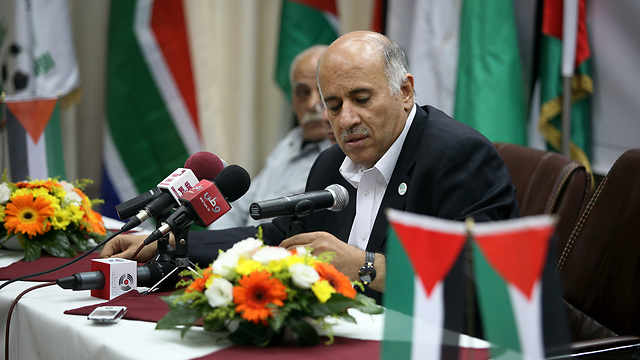 Jibril Rajoub, rising in popularity on the Palestinian street (Photo: Amit Shabi)
Several of Abbas’ potential successors even formed coalitions to bring Tanzim to their side. For example, the coalition of Abbas’ rivals, headed by Mohammed Dahlan, which also includes Yasser Abed Rabbo (the former secretary-general of Fatah’s executive committee, who was removed from office) and Salam Fayyad (the former Palestinian prime minister who was also removed from office). This coalition seeks to bring in Marwan Barghouti, who is imprisoned in Israel, as a symbol. It also has money, and a lot of it, that Dahlan brought with him from the Gulf monarchies, in order to buy Tanzim’s loyalty.
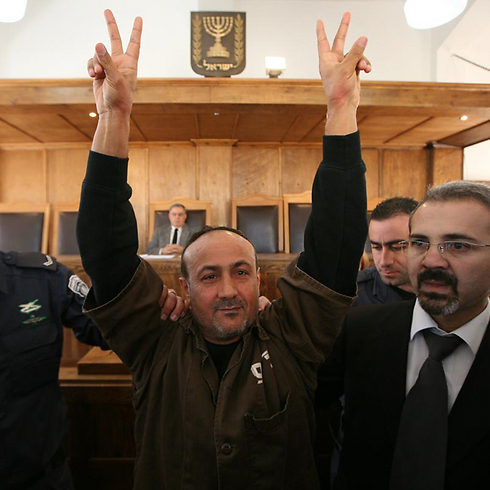 Marwan Barghouti, a symbol (Photo: Gil Yohanan)
Then there’s also the group of Abbas allies, like Majid Faraj, the head of the Palestinian security forces, and Saeb Erekat, the chief negotiator with Israel.
They face other potential candidates to succeed Abbas, like Muhammad al-‘Alul – the former governor of Nablus and one of the more senior members of the Tanzim leadership, who’s been there since the first intifada.
All of these candidates have their sights on the militant organization, trying to appropriate it. The fight for Tanzim creates a kind of conduct and comments that are becoming more and more extreme.
Eisenkot’s West Bank forum
This week, Abbas finally realized the kind of trap he walked into. In a desperate attempt to stop the escalation, he tried to reframe the fight with a new slogan: “Smart Resistance.” Wednesday’s editorial in the PA’s mouthpiece Al-Hayat al-Jadida warns against the situation getting out of control, which could hurt the Palestinian people’s quality of life. The term “third intifada” is not mentioned.
Abbas’ former slogan, “Peaceful Resistance,” is no longer relevant. As long as the resistance only included stone-throwing, rioting, and Molotov cocktails, Abbas would congratulate the “shahids” who committed these actions. He was against terrorism in principle, but not to this kind of activity. But the moment the PA started encouraging violence of any kind – it was inviting that escalation. And when the knives started appearing and Abbas was unwilling to condemn the stabbers, it came back to him like a boomerang. The Palestinian street no longer accepts the PA’s authority. Young rioters don’t heed the calls of the Palestinian security forces, Hamas, or anyone else for that matter. That is why the PA leadership is now talking about a “Smart Resistance”: To bring the knives back into the kitchen, because the Palestinians will pay dearly for this escalation. But it appears Abbas has already missed the train.
 Stone throwers: ‘Peaceful resistance’; Knife-wielding attackers:’Smart resistance’ (Photo: AP)
In war games held by the IDF’s Central Command on the eve of Abbas’ speech at the UN General Assembly meeting last month – with Israeli officials worried about an inflammatory speech that would set the Palestinian street on fire – the army drilled several scenarios of a loss of control over the West Bank.
The first scenario: A wave of lone-wolf attackers dragging the entire Palestinian street into all-out violence. This scenario is defined as low-level violence, and it is unfolding right now.
The second scenario was of a violent outburst inside the refugee camps that would enlist Tanzim to an armed struggle that would set the West Bank on fire. This is the scenario currently worrying Israel’s defense establishment. That is why Defense Minister Moshe Ya’alon instructed the army to prepare for long-term deployment of increased forces in the West Bank, including the possibility of switching out the conscript soldiers in the West Bank with reservists, to allow the army to resume its regular training schedule.
Assignments for the reservists have already been determined, and starting December they too will be deployed in the West Bank. There will be a price to pay for the reservists – there’ll make more mistakes out in the field – but the army has been on high alert in the West Bank for a month now, and it is unclear when that would end. So calling up the reserves at this point appears like a necessary step.
 Abbas welcomed stone-throwing rioters (Photo: EPA)
Facing constantly increasing levels of terrorism, the IDF’s General Staff is also focusing on preparing long-term plans. Chief of Staff Gadi Eisenkot holds at least three weekly meetings with a team of senior officers who rose up the ranks while fighting terrorism in the West Bank. Among them is Deputy Chief of Staff, Maj.-Gen. Yair Golan, who was the commander of the Judea and Samaria Division; the head of Army Intelligence, Maj.-Gen. Herzl Levy, who was the commander of the Jenin Brigade; the head of the Operations Branch, Maj.-Gen. Nitzn Alon, who was the commander of the Judea and Samaria Division and the GOC Central Command; the current GOC Central Commander, Maj.-Gen. Roni Numa; COGAT Maj.-Gen.
Yoav Mordechai; the head of the Operations Division, Brig.-Gen. Aharon Haliva, who commanded over the Tulkarm-Qalqilya sector; and of course the current Judea and Samaria Division commander, Brig.-Gen. Lior Carmeli, who served in the past as the head of the Jenin Brigade. Not to mention Shin Bet chief Yoram Cohen and the commander of the Shin Bet’s Jerusalem District, in charge of the West Bank, who served in Hebron for 17 years.
The army wants to send a message that it put its best people on the job – senior officers with the most experience fighting against the Palestinians in the West Bank that the army has. There’s more than a subtle hint here to the attempts of politicians to challenge the defense establishment’s judgment with bizarre ideas, meant solely to bring the situation to a boiling point in order to create a new reality on the ground vis-à-vis the Palestinians.
For example, Bayit Yehudi Minister Uri Ariel’s call to stop the transfer of funds to the Palestinian Authority. On paper, this is an innocuous and logical proposal. They owe over NIS 1.5 billion to the Israel Electric Corporation, so why do we need to pay their bills? After all, those funds are also paying the stipends given to families of terrorists.
Except that army officials who are in communication with the Palestinian security forces have received a very clear message from them: Don’t you dare touch our tax money. If the funds don’t come in, there will be no money to pay policemen’s salaries. No salaries? Those policemen won’t be out in the field or worse – they’ll join the ranks of Tanzim or Hamas.
And this is what Minister Ariel and his ilk want: Anarchy.
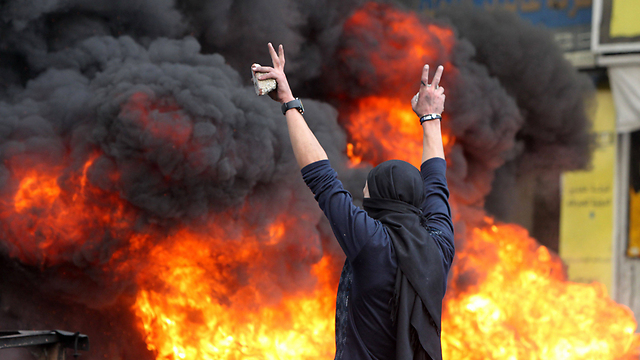 Anarchy (Photo: AFP)
The defense establishment is fighting tooth and nail to stop the approval of a proposal from right-wing ministers to impose a blockade on the West Bank. The government has accepted the defense establishment’s position. The ball is now in the prime minister’s court. The moment Netanyahu caves in and surrenders to the pressure coming from the extreme right – the IDF will no longer be able to stop an all-out armed conflict.
It was no coincidence that the defense minister – in a speech he made this week – chose to speak against the inciters, the “price tag” people, and the like. The defense establishment is aware of the potential threat of Jewish violence. The most effective weapon the defense minister has against Jewish extremists in the West Bank is Israeli public opinion, which won’t accept such conduct from hawkish ministers and settler leaders on the ground.
The heads of the Palestinian security forces are having a hard time keeping their men in line. There were already several “rebellions” by Palestinian security personnel who tried to commit attacks – and were thwarted. The heads of the Palestinian security forces are pleading with Israel to minimize the amount of casualties in clashes with Palestinians, to keep out of Area A, and not deny them the funds to pay salaries.
Snipers instead of aerial fire
On October 16, Palestinian security forces arrested two terror cells: One belonging to Hamas and the other to the Popular Front for the Liberation of Palestine. According to intelligence obtained by the PA, the Hamas cell planned to commit a big terror attack meant to rile up the Palestinian street and weaken the Palestinian Authority.
Israel has no reason to doubt the credibility of this report. A similar incident occurred, on a much larger scale, on the eve of Operation Protective Edge. At the time, the Shin Bet exposed a Hamas plot including dozens of operatives planning to commit several major terror attacks against Israel and the Palestinian Authority in an effort to bring down Abbas.
Hamas is currently fighting on three separate fronts, leading a different policy in each of them. In Jerusalem, Hamas is working to take over the Temple Mount. In the West Bank, it’s making every effort to execute a large-scale terror attack that would serve as the final nail in the coffin for the Palestinian Authority as it is today. The large sums of money feeding the propaganda Hamas is spreading through social media as well as traditional media is coming from Istanbul, from the Hamas headquarters in Turkey.
 Clashes on the Gaza border (Photo: Reuters)
Saleh Al-Aruri, who was exiled to Qatar by the Turkish government several months ago, has returned to Istanbul with the Turks’ consent, and is leading Hamas’ a campaign of propaganda and incitement under the slogan “Stab, stab!” This message is falling on attentive ears not just in East Jerusalem and among Palestinians illegally staying in Israel, but also in the West Bank, mostly in the Hebron area, where quite a few stabbing attacks occurred over the past week.
In recent days, the incitement coming out of Turkey has been working to change the focus from stabbing attacks to vehicular attacks. Hamas believes the stabbing attacks have exhausted themselves, even though there were quite a few of them taking place in the West Bank this week, mostly in the Hebron area. The vehicular attacks are far more effective. And, indeed, there has been a rise in vehicular attacks in recent days.
In the Gaza Strip, on the other hand, Hamas lets the Palestinians to blow off steam, but keeps it under control, and stops, by all means possible, any rocket fire at Israel. Twelve Gazans have been killed in clashes with IDF forces on the border fence and in airstrikes, without any response from Hamas.
The field is flooded with IDF snipers, and over the past few days protesters have failed to cross the border fence. The IDF is also trying not to give Hamas a reason to change its policy in the Gaza Strip. When snipers fired from inside the Strip, hitting an Israeli vehicle, the army considered a targeted strike from the air. But out of operative considerations, the IDF decided instead to hit back with sniper fire. By the way, these Gazan snipers were part of an organization that broke away from Hamas.
Hamas is playing these three different games with a lot of caution and without any confusion. The organization’s basic assumption is that Israel won’t launch another conflict in the Gaza Strip over a terror attack initiated by Hamas in the West Bank.
The Palestinian security forces were not the only ones arresting Hamas operatives in the West Bank. The IDF conducted its own raids, arresting both military and political figures. One such political figure was Hassan Yousef, who is considered the head of Hamas in the West Bank, and who Israel accuses of incitement. But what these arrests are actually meant to do is signal Hamas that Israel will trample the organization’s presence in the West Bank, just as it did during Operation Brother’s Keeper, after the kidnapping and murder of the three yeshiva students in the summer of 2014.
During a situation assessment meeting held in Israel after the arrests, one of the officers compared dealing with Hamas to going to the family health center. Every once in a while, people like Hassan Yousef need to be brought in to see how much weight he gained, how high he got and check his mental state. A sort of litmus paper for the way the wind blows in the West Bank. The problem is that at this family health center, there are no innocent babies or kind nurses. The players in the triangle of Israel-West Bank-Gaza have already realized that the era of knife-wielding attackers could very well be one day remembered as normal compared to what the Palestinian street knows, could and might do.
Palestinian terrorism is not random, Israel Hayom, Yoram Ettinger, October 23, 2015
Unlike national liberation movements, Palestinian terrorism has deliberately, institutionally, and systematically targeted Arab and Israeli noncombatants, sometimes hitting combatants.
Palestinian terrorism has haunted Arab societies in Jordan (especially during the 1968-1970 era of PLO terrorism), Lebanon (particularly during the 1971-1982 civil wars), Kuwait (during the 1990 invasion by Saddam Hussein), Iraq (until 2002, as an arm of Saddam Hussein’s ruthless domestic oppression), Syria (until 2012, bolstering Bashar Assad’s regime) and currently in Egypt (collaborating with the Muslim Brotherhood terror organization). Pro-U.S. Arab regimes consider Palestinian terrorism a clear and present danger, never fighting on behalf of Palestinians. Sometimes these regimes launch severe military blows (1970 Black September in Jordan) and expulsions (300,000 expelled from Kuwait), showering them with rhetoric, but not resources.
Since the establishment of the Palestinian Authority in 1993, Palestinian terrorism has afflicted the Arabs of Judea, Samaria and Gaza, denying the Palestinians civil liberties and instituting a corrupt, oppressive reign of horror. It prompted most Christians to flee from Ramallah (home of Palestinian Authority President Mahmoud Abbas’ headquarters), Bethlehem and Beit Jallah. In addition, Muslim emigration from the Palestinian Authority has increased since 2000. While Egypt prevents emigration from Gaza through Sinai, Gaza’s Arabs have emigrated, in increasing numbers, via the Mediterranean. Moreover, Palestinians flow across Jerusalem’s municipal lines, escaping Abbas’ tyranny to receive Israeli residency, social benefits and human rights.
Palestinian terrorists have targeted pro-U.S. Arab regimes and “the arrogant, infidel, Great Satan,” the U.S., joining the ayatollahs in Iran (since the toppling of the shah in 1979), Taliban, al-Qaida, Islamic State and other Islamic terror organizations. Osama bin Laden’s role model and spiritual mentor, Abdullah Azam, was from a village in Samaria.
Palestinian terrorism is a modern-day branch of Islamic terrorism, which has plagued the Middle East — and beyond — since the appearance of Islam in the seventh century. The current intensification of Islamic terrorism throughout the Middle East provides a tailwind to Palestinian terrorism.
Palestinian terrorism has inspired terror cells in Europe, Africa, Asia and the American continent, including sleeper cells in the U.S.
Anti-Jewish Palestinian terrorism has been a Middle East fixture since at least the 1920s, well before the 1948 establishment of Israel and the 1967 return of Jewish communities to Judea and Samaria. It’s well-documented collaboration with Nazi Germany sought to prevent the existence — not reduce the size — of the Jewish state. The political guideline of contemporary Palestinian terrorism, the Palestinian Covenant, was published in 1964, three years before the reunification of Jerusalem.
Palestinian terrorism is nurtured by 23 years of Palestinian hate education in kindergartens, schools, mosques and media — the most effective means of producing terrorists. It was established by Abbas (then Yasser Arafat’s chief deputy) in 1993, highlighting the fundamentals of Islam that serve to intensify Palestinian terrorism: the supremacy of Islam over all other religions; the permanent state of war between the abode of Islam and the abode of the “infidel”; the inadmissibility of “infidel” sovereignty over Waqf lands, which are divinely ordained to Islam; the sublime honor of sacrificing one’s life on behalf of Islam’s war against the “infidel”; and the provisional nature of agreements concluded with “infidels.”
Palestinian terrorism has been encouraged by Abbas’ systematic policy of naming streets, squares, monuments and sport tournaments in honor of terrorists, and extending generous financial assistance to their families.
Palestinian terrorism, an endemic feature in the Middle East, represents writing on the wall, warning us all of the destabilizing, anti-Western, terroristic nature of the proposed Palestinian state. An Israeli withdrawal from the mountain ridge of the Golan Heights would provide a platform for Islamic terrorists to traumatize northern Israel. But an Israeli withdrawal from the mountain ridges of Judea and Samaria would provide Muslim terrorists a platform to topple the Hashemite regime in Jordan and target Tel Aviv, Jerusalem, Ben-Gurion Airport and 80% of Israel’s population and infrastructure.
Palestinian terrorism is fueled by the inherently immoral “moral equivalence” between Israeli counterterrorism and Palestinian terrorism, which grossly misrepresents Middle East reality. It is fueled by foreign aid to the Palestinian Authority, which funds hate education. It is rewarded by calls to negotiate with the Palestinian Authority, while Abbas promotes hate education. It is emboldened by Western pressure for further Israeli concessions and Western denial of Israel’s moral high ground in the physical high ground of Judea and Samaria.
In order to defeat Palestinian terrorism, it is necessary to defy political correctness and shift gears, instead of chasing individual terroristic mosquitoes, the terroristic swamp needs to be drained. A large-scale, disproportionate, pre-emptive military operation needs to be launched throughout Judea and Samaria and Arab neighborhoods in Jerusalem. Any (U.S. and Israeli) direct or indirect contact with and assistance to the Palestinian Authority needs to be conditioned upon an end to hate education. Families and communities of terrorists need to be severely punished for failing to exercise communal responsibility.
To frustrate Palestinian terrorism, which aims to set Israel on a path of retreat, Israel should proclaim a constructive response, expanding Jewish construction in Jerusalem, Judea and Samaria. While it would trigger short-term international pressure, it would yield long-term strategic respect, as documented by the legacy of Prime Ministers David Ben-Gurion, Levi Eshkol, Golda Meir, Menachem Begin and Yitzhak Shamir, who defied much more severe international pressure with slimmer military and commercial resources at their disposal.




 anneinpt
 artaxes
 danmillerinpanama
 davidking1530
 Peter Hofman
 Joseph Wouk
 Peter
Peter Louisiana Steve
 WarSclerotic
Recent Comments