There is a bear in the woods… Power Line,
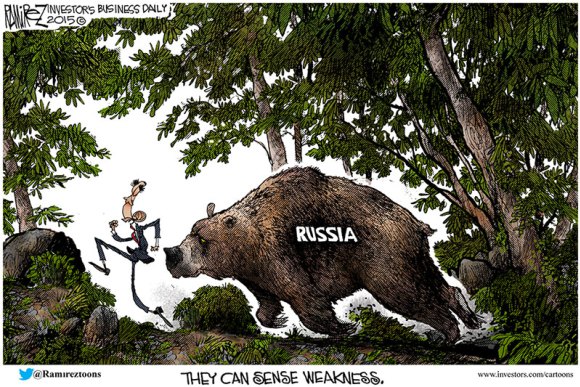
Vladimir Putin thinks Barack Obama has mush for brains, but that’s not the worst of it. Michael Ramirez updates the bear in the woods theme.
There is a bear in the woods… Power Line,
Vladimir Putin thinks Barack Obama has mush for brains, but that’s not the worst of it. Michael Ramirez updates the bear in the woods theme.
Russia Missile Attacks Embarrass Obama, Warn Israel, American Thinker, Jonathan Keiler, October 9, 2015
Beyond heaping yet another humiliation on Obama and signaling American admirals to keep their distance, the missile attack probably also sent a very pointed message to Israel. Israel currently deploys four advanced German-made and Israeli equipped Dolphin submarines, with two more on the way.
******************************
Russia’s October 7 cruise missile bombardment of anti-Assad Syrian rebels from ships stationed nearly 1000 miles away was probably the most expensively ineffectual display of military firepower since Bill Clinton launched a similar strike against al Qaeda in 1998. Clinton’s feckless and spendthrift action was supposedly in retaliation for the embassy bombings in Tanzania and Kenya and succeeded by most accounts in wiping out a few empty tents with several tons of explosives and several million dollars’ worth of advanced ordnance.
It is unlikely that Vladimir Putin’s strike did much damage to Syrian rebels either. But unlike Clinton (and the current Democrat in the White House) Putin doesn’t use force to shirk greater national responsibilities, he uses it to pursue clear strategic objectives. In this case, the Russian decision to launch brand-new Kalibr-NK missiles from the Caspian Sea fleet was clearly intended as yet another poke in the eye to President Obama, and a demonstration of Russian firepower, from diminutive but still dangerous Russian warships.
The 26 missiles were launched by three patrol boats and a frigate (a warship smaller than a destroyer.) Russian spokesmen claimed all landed within nine feet of their targets, a degree of accuracy probably not needed against dispersed irregular infantry, but necessary to hit opposing warships, like those flying American flags. The Syrian rebels served as live practice targets for the Russian missile crews, who got to shoot off the new and previously unproven (in combat) missile.
Beyond heaping yet another humiliation on Obama and signaling American admirals to keep their distance, the missile attack probably also sent a very pointed message to Israel. Israel currently deploys four advanced German-made and Israeli equipped Dolphin submarines, with two more on the way. Most analysts presume that these advanced boats are intended to penetrate the Persian Gulf in the event of war with Iran, and from their launch cruise missiles in support of Israeli air action.
However, several years ago, in this article I proposed that the Israeli purpose was probably otherwise. Israeli is widely presumed to have equipped the subs with Israeli Popeye turbo cruise missiles with a range similar to that of the Russian Kalibr-NK. With such a weapon, Israeli subs need not make the long and dangerous journey to the Persian Gulf, but could launch from off the coast of Syria, the missiles following a flight plan very similar to those the Russian weapons took (but in reverse) where they could strike targets across northern Iran.
If I could conceive of such a plan, so could Russian intelligence services, which have probably backed this idea with hard, but secret intelligence. The Russian attack is a clear signal to Israel, demonstrating that cruise missiles which can go from the eastern Mediterranean to Iran can go the other way too. It is unlikely that it was a message lost on the Israelis, and more evidence that Russia’s movement in to the Syrian arena is proving disastrous for America and her allies.
Right Turn Opinion Our ‘Baghdad Bob’ president, Washington Post, Jennifer Rubin, October 7, 2015
(Ms. Rubin is WaPo’s token conservative. Do go to the link and read the generally unfavorable comments about her article. — DM).
So it has come to this: We now can recognize that Carter was not malicious or indifferent to American influence; he was simply slow to catch on. If Carter, widely regarded as the weakest foreign policy president of the second half of the 20th century, looks good in comparison, you can understand how daft is Obama’s worldview. Had he been in Carter’s shoes, I suppose he would have cheered rather than take steps to mitigate imperialistic aggression. Umm, thank goodness Carter was in the White House and not Obama? Yes, it has come to that.
****************************
Mohammed Saeed al-Sahaf, better known as “Baghdad Bob,” was the unintentionally hilarious Iraqi information minister who, no matter what evidence to the contrary, emphatically predicted evisceration of U.S. forces during the Iraq war and denied any news suggesting otherwise. As NBC News recalled, “His last public appearance as information minister was on April 8, 2003, the day before the fall of Baghdad, when he said that the Americans ‘are going to surrender or be burned in their tanks. They will surrender, it is they who will surrender.’ ”
Baghdad Bob now seems to be the model for the Obama White House. Ramadi falls to the Islamic State? No bother, we are winning! Russia invades Ukraine? Russian President Vladimir Putin — take this! — is on the “wrong side of history,” is only going to “wreck his country’s economy and continue Russia’s isolation,” was “desperate” to talk to Obama (and the next day commenced bombing U.S.-backed rebels in Syria) and is about to get “stuck in a quagmire” in Syria. Russia moves more forces into Syria, changing the dynamic in the Middle East? President Obama brushes it aside. Putin is acting out of “weakness,” you see. Next thing you know, the Russians will have to “surrender or be burned in their tanks.”
One is tempted to assume, is hopeful even, that the president and his spokesmen don’t believe what they are saying. It is less frightening to imagine this is ham-handed excuse-mongering for a failed foreign policy than to imagine Obama thinks things are going swimmingly. If Obama actually believes we have Putin just where we want him, why not concede all of Ukraine — or the rest of the former Soviet Union, even. If it’s to our advantage to have Russia prop up Syrian President Bashar al-Assad and destroy the U.S.-backed rebels, then we should be thrilled Russia is now being invited into Iraq to bomb the Islamic State. For that matter, why not welcome Iranian domination of Iraq and a new Shiite-Russian-Iranian crescent?
This is the bizarre parallel universe in which U.S. marginalization is good, chaos is nothing to worry about, the worst human rights offenders are our partners and traditional U.S. allies (Israel, Sunni states, even Turkey) will just have to lump it. It’s a world in which the system of nation-state sovereignty is subsumed to zones of influence — without the United States getting a zone. About the only politician willing to buy into such insanity is Donald Trump, who thinks it is a swell idea to have Putin fighting the Islamic State (except he is not fighting the Islamic State).
You can see why conservatives consider Obama a sharp departure from decades of American foreign policy under Democratic and Republican presidents. Instead of acting as a guarantor of the West’s security, the friend of free peoples and a check against rogue states, we rationalize weakness and abandon innocents. We tend to describe the president’s foreign policy as “feckless,” but it is worse: It is monstrous.
Even Jimmy Carter woke up, it is said, when the Soviets invaded Afghanistan. He did not think it was a good thing that the Soviets were invading an independent nation or that the West should huff and puff but take no action.
To the contrary, in what was surely the best speech of his presidency, Carter told the country: “This invasion is an extremely serious threat to peace because of the threat of further Soviet expansion into neighboring countries in Southwest Asia and also because such an aggressive military policy is unsettling to other peoples throughout the world. This is a callous violation of international law and the United Nations Charter. It is a deliberate effort of a powerful atheistic government to subjugate an independent Islamic people.” Unlike Obama, Carter grasped the danger in letting aggressors succeed: “The United States wants all nations in the region to be free and to be independent. If the Soviets are encouraged in this invasion by eventual success, and if they maintain their dominance over Afghanistan and then extend their control to adjacent countries, the stable, strategic, and peaceful balance of the entire world will be changed. This would threaten the security of all nations including, of course, the United States, our allies, and our friends.” He went on to announce a series of concrete steps — “defer further consideration of the SALT II treaty,” “delay opening of any new American or Soviet consular facilities, and most of the cultural and economic exchanges,” “halt or to reduce exports to the Soviet Union,” suspend licensing of “high technology or other strategic items,” end grain sales, pull out of the Olympics and “provide military equipment, food, and other assistance to help Pakistan defend its independence and its national security against the seriously increased threat it now faces from the north.”
More important, unlike Obama, who is emphatic that we stay on the path of slashing our military, Carter began repairing our military and extending covert efforts, as historian Arthur Herman recalls:
The first was pledging that US defense spending would rise by 4.6 percent per year, every year for five years, starting in 1980. This shocked and infuriated his fellow Democrats — and greased the wheels for President Ronald Reagan’s military buildup. (In the event, Reagan wound up increasing defense outlays less than Carter had planned.)
The second step came in the 1980 State of the Union Address, with announcement of the Carter Doctrine: The United States would use military force if necessary to defend our interests in the Persian Gulf.
To back this up, the president authorized the creation of the first Rapid Deployment Force — the ancestor of US Central Command or CENTCOM, the wheelhouse from which the United States would direct Desert Storm in 1991 and the fall of Saddam Hussein a decade later, and which keeps the Straits of Hormuz, vital to global energy markets, safe and open today.
The last step was authorizing the first covert military aid to Afghan guerrillas fighting their Soviet occupiers. That marked the start of the Soviet quagmire in Afghanistan — a major landmark in the ultimate undoing of the Soviet Union.
You see, a “quagmire” happens only when a power is confronted, stalls and undergoes unjustified losses. Otherwise, it is called a successful invasion.
So it has come to this: We now can recognize that Carter was not malicious or indifferent to American influence; he was simply slow to catch on. If Carter, widely regarded as the weakest foreign policy president of the second half of the 20th century, looks good in comparison, you can understand how daft is Obama’s worldview. Had he been in Carter’s shoes, I suppose he would have cheered rather than take steps to mitigate imperialistic aggression. Umm, thank goodness Carter was in the White House and not Obama? Yes, it has come to that.
In an opinion piece published August 25, 2015 in the London-based Saudi daily Al-Sharq Al-Awsat, Amir Taheri, a prominent Iranian analyst, author and columnist, compared Obama’s policy towards Iran to the policies of Kennedy, Nixon and Reagan in their dealings with the U.S.’s main rivals in their day – the USSR and China. Taheri wrote that, in making the deal with Iran, Obama wishes to portray himself as an heir to the tradition established by these presidents of defusing conflict through diplomacy and negotiations. He noted, however, that these leaders negotiated from a position of strength, and pursued a detente with America’s enemies only after the latter had fulfilled important American demands and changed key elements of their policies. For example, Kennedy negotiated with the USSR only after forcing it to remove the nuclear sites from Cuba; Nixon’s normalization with China came only after the latter had turned its back on the Cultural Revolution and abandoned its project of exporting communism, and Reagan engaged with the Soviets only after taking military measures to counter the threat they posed to Europe. Moreover, says Taheri, the U.S. warmed its relations with China and the USSR only after they abandoned their absolute enmity towards it and began regarding it as a rival and competitor rather than a mortal enemy that must be destroyed.
Conversely, says Taheri, Obama demanded nothing of the Iranians before commencing negotiations, not even the release of U.S. hostages. Moreover, he pursued rapprochement with Iran despite the absence of any positive change in this country’s hardline policies and ideologies. On the contrary, America’s overtures only encouraged Iran’s worst tendencies, as reflected in a sharp rise in human rights violations within Iran and in its continued support for terror groups and for Assad’s regime in Syria. The detente with America did not even cause Iran to abandon its calls of death to America, Taheri notes. He concludes “Kennedy, Nixon and Reagan responded positively to positive changes on the part of the adversary,” whereas “Obama is responding positively to his own illusions.”
The following are excerpts from his article:
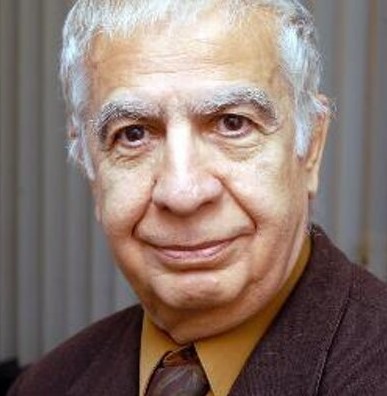 Amir Taheri (Image: Twitter.com/amirtaheri4)
JFK Forced Russia To Remove Its Missiles From Cuba; Obama Obtained Nothing Tangible And Verifiable
“Promoting the ‘deal’ he claims he has made with Iran, President Barack Obama is trying to cast himself as heir to a tradition of ‘peace through negotiations’ followed by US presidents for decades. In that context he has named Presidents John F. Kennedy, Richard Nixon and Ronald Reagan as shining examples, with the subtext that he hopes to join their rank in history.
“Obama quotes JFK as saying one should not negotiate out of fear but should not be afraid of negotiating either. To start with, those who oppose the supposed ‘deal’ with Iran never opposed negotiations; they oppose the result it has produced… In one form or another, Iran and the major powers have been engaged in negotiations on the topic since 2003. What prompted Obama to press the accelerator was his desire to score a diplomatic victory before he leaves office. It did not matter if the ‘deal’ he concocted was more of a dog’s dinner than a serious document. He wanted something, anything , and to achieve that he was prepared to settle for one big diplomatic fudge.
“Is Obama the new JFK? Hardly. Kennedy did negotiate with the USSR but only after he had blockaded Cuba and forced Nikita Khrushchev to blink and disband the nuclear sites he had set up on the Caribbean island. In contrast, Obama obtained nothing tangible and verifiable. Iran’s Atomic Energy chief Ali-Akbar Salehi put it nicely when he said that the only thing that Iran gave Obama was a promise ‘not to do things we were not doing anyway, or did not wish to do or could not even do at present.’
“JFK also had the courage to fly to West Berlin to face the Soviet tanks and warn Moscow against attempts at overrunning the enclave of freedom that Germany’s former capital had become. With his ‘Ich bin ein Berliner‘ (I am a citizen of Berlin), he sided with the people of the besieged city in a long and ultimately victorious struggle against Soviet rule. In contrast Obama does not even dare call on the mullahs to release the Americans they hold hostage. Instead, he has engaged in an epistolary courting of the Supreme Guide and instructed his administration in Washington to do and say nothing that might ruffle the mullahs’ feathers.
Nixon Extracted Far-Reaching Concessions From China; Obama Has Only Encouraged The Worst Tendencies Of The Khomeinist Regime
“No, Obama is no JFK. But is he heir to Nixon? Though he hates Nixon ideologically, Obama has tried to compare his Iran ‘deal’ with Nixon’s rapprochement with China. Again, the comparison is misplaced. Normalization with Beijing came after the Chinese leaders had sorted out their internal power struggle and decided to work their way out of the ideological impasse created by their moment of madness known as The Great Proletarian Cultural Revolution. The big bad wolf of the tale, Lin Biao, was eliminated in an arranged air crash and the Gang of Four defanged before the new leadership set-up in Beijing could approach Washington with talk of normalization.
“At the time the Chinese elite, having suffered defeat in border clashes with the USSR, saw itself surrounded by enemies, especially after China’s only ally Pakistan had been cut into two halves in an Indo-Soviet scheme that led to the creation of Bangladesh. Hated by all its neighbors, China needed the US to break out of isolation. Even then, the Americans drove a hard bargain. They set a list of 22 measures that Beijing had to take to prove its goodwill, chief among them was abandoning the project of ‘exporting revolution’.
“Those of us who, as reporters, kept an eye on China and visited the People’s Republic in those days were astonished at the dramatic changes the Communist leaders introduced in domestic and foreign policies to please the Americans. In just two years, China ceased to act as a ’cause’ and started behaving like a nation-state. It was only then that Nixon went to Beijing to highlight a long process of normalization. In the case of Iran, Obama has obtained none of those things. In fact, his ‘deal’ has encouraged the worst tendencies of the Khomeinist regime as symbolized by dramatic rise in executions, the number of prisoners of conscience and support for terror groups not to mention helping Bashar Al-Assad in Syria.
Reagan Had No Qualms About Calling The USSR ‘The Evil Empire’; Obama Is Scared Of Offending The Mullahs
“No, Obama is no Nixon. But is he a new Reagan as he pretends? Hardly. Reagan was prepared to engage the Soviets at the highest level only after he had convinced them that they could not blackmail Europe with their SS20s while seeking to expand their empire through so-called revolutionary movements they sponsored across the globe. The SS20s were countered with Pershing missiles and ‘revolutionary’ armies with Washington-sponsored ‘freedom fighters.’
“Unlike Obama who is scared of offending the mullahs, Reagan had no qualms about calling the USSR ‘The Evil Empire’ and castigating its leaders on issues of freedom and human rights. The famous phrase ‘Mr. Gorbachev, tear down that wall!’ indicated that though he was ready to negotiate, Reagan was not prepared to jettison allies to clinch a deal.
“Obama has made no mention of Jimmy Carter, the US president he most resembles. However, even Carter was not as bad as Obama if only because he was prepared to boycott the Moscow Olympics to show his displeasure at the invasion of Afghanistan. Carter also tried to do something to liberate US hostages in Tehran by organizing an invasion of the Islamic Republic with seven helicopters. The result was tragicomic; but he did the best his meagre talents allowed. (NB: No one is suggesting Obama should invade Iran if only because if he did the results would be even more tragicomic than Carter’s adventure.)
“On a more serious note, it is important to remember that dealing with the Khomeinist regime in Tehran is quite different from dealing with the USSR and China was in the context of detente and normalization. Neither the USSR nor the People’s Republic regarded the United States as ‘enemy’ in any religious context as the Khomeinist regime does. Moscow branded the US, its ‘Imperialist’ rival, as an ‘adversary’ (protivnik) who must be fought and, if possible, defeated, but not as a ‘foe’ (vrag) who must be destroyed. In China, too, the US was attacked as ‘arch-Imperialist’ or ‘The Paper Tiger’ but not as a mortal foe. The slogan was ‘Yankee! Go Home!'”
China And USSR Moderated Their Virulent Hate For U.S,; In Iran The Slogan Is Still ‘Death To America’
“In the Khomeinist regime, however, the US is routinely designated as ‘foe’ (doshman) in a religious context and the slogan is ‘Death to America!’ Supreme Guide Ali Khamenei has no qualms about calling for the ‘destruction’ of America, as final step towards a new global system under the banner of his twisted version of Islam. Tehran is the only place where international ‘End of America’ conferences are held by the government every year. The USSR and China first cured themselves of their version of the anti-American disease before seeking detente and normalization. That did not mean they fell in love with the US. What it meant was that they learned to see the US as adversary, rival, or competitor not as a mortal foe engaged in a combat-to-death contest. The Islamic Republic has not yet cured itself of that disease and Obama’s weakness may make it even more difficult for that cure to be applied.
“Détente with the USSR and normalization with China came after they modified important aspects of their behavior for the better. Kennedy, Nixon and Reagan responded positively to positive changes on the part of the adversary. In the case of the USSR positive change started with the 20th congress of the Communist Party of the Soviet Union in which Khrushchev denounced Joseph Stalin’s crimes, purged the party of its nastiest elements, notably Lavrentiy Beria, and rehabilitated millions of Stalin’s victims.
“In foreign policy, Khrushchev, his swashbuckling style notwithstanding, accepted the new architecture of stability in Cold War Europe based on NATO and the Warsaw Pact. Kennedy, Johnson and, later, Nixon and President Gerald Ford had to respond positively. In the late1980s, the USSR offered other positive evolutions through Glasnost and Perestroika and final withdrawal from Afghanistan under Mikhail Gorbachev. Again, Reagan and President George Bush (the father) had to respond positively.
“In the case of China we have already noted the end of the Cultural Revolution. But China also agreed to help the US find a way to end the Vietnam War. Beijing stopped its almost daily provocations against Taiwan and agreed that the issue of the island-nation issue be kicked into the long grass. Within a decade, under Deng Xiaoping, China went even further by adopting capitalism as its economic system.
“There is one other difference between the cases of the USSR and China in the 1960s to 1990s and that of the Khomeinist regime in Tehran today. The USSR had been an ally of the United States during the Second World War and its partner in setting up the United Nations in 1945. Although rivals and adversaries, the two nations also knew when to work together when their mutual interests warranted it. The same was true of the Chinese Communist Party which had been an ally of the US and its Chinese client the Kuomintang during the war against Japanese occupation when Edgar Snow was able to describe Mao Zedong as ‘America’s staunchest ally against the Japanese Empire.’ In the 1970s, Washington and Beijing did not find it strange to cooperate in containing the USSR, their common rival-cum-adversary as they had done when countering Japan.
“In the case of the Islamic Republic there is no sign of any positive change and certainly no history of even tactical alliance with the US.
“Unless he knows something that we do not, Obama is responding positively to his own illusions.”




 anneinpt
 artaxes
 danmillerinpanama
 davidking1530
 Peter Hofman
 Joseph Wouk
 Peter
Peter Louisiana Steve
 WarSclerotic
Recent Comments