Archive for the ‘Obama’ category

Rouhani: Saving environment starts with sanctions removal

June 9, 2015

Rouhani: Saving environment starts with sanctions removal, Al-MonitorArash Karami, June 8, 2015

(Human rights, Iranian missiles, Iranian threats, Iranian proxies, theocratic dictatorship? Those are not relevant to the deal. But whatever may help the environment and therefore stop climate change is my top priority — Obama.
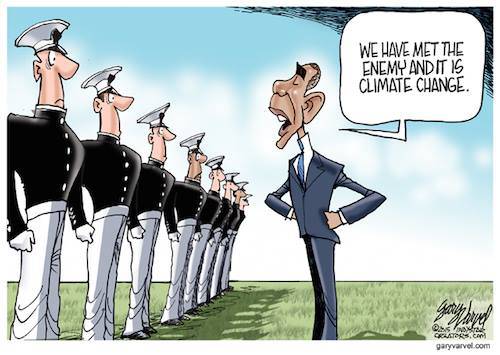
enemy

— H/t Freedom is just another word. — DM)

Rouhani’s comments linking the country’s various environmental problems and employment woes to the nuclear negotiations and sanctions relief have upset conservatives, who believe the administration is too eager to resolve the dispute and too optimistic about what the deal means for the country.

**********************

Iranian President Hassan Rouhani has been criticized for suggesting that once a comprehensive nuclear deal is made it will open the door to improving the country’s environmental problems. “The oppressive sanctions must be removed so that investment can come and the problems of the environment, employment, industry and drinkable water are resolved,” Rouhani said at a ceremony on June 7 commemorating Environment Week in Iran.

Rouhani described the sanctions as “a small fever … that at the beginning no attention was paid to this fever, but when the sick person fell ill and was not able to move anymore, we sought a remedy for the illness. Some did not know the reason of the sanctions but step by step, the problems became larger.”

Rouhani added that while “the oppressive sanctions must be removed,” this does not mean “that we must submit to the unreasonable wants of others.”

Iran and five permanent members of the UN Security Council plus Germany (P5+1) are working through the final details of a comprehensive deal that would see Iran reduce its nuclear activity in return for sanctions relief, particularly banking sanctions that have hurt the country’s ability to sell its oil and conduct trade and have prevented Western investment in the country.

But Rouhani’s comments linking the country’s various environmental problems and employment woes to the nuclear negotiations and sanctions relief have upset conservatives, who believe the administration is too eager to resolve the dispute and too optimistic about what the deal means for the country.

In an article titled, “The water, wind, soil and forests have also been tied to sanctions,” the conservative Javan newspaper criticized Rouhani’s latest comments. The article said, “Despite experts warning of not connecting domestic issues of the country to the nuclear issue and negotiations, at this ceremony Rouhani once again suggested that with the removal of sanctions not only will investment become fluid in Iran but the issues of the environment, youth employment, water and banking will be [resolved].”

The article continued that Rouhani’s comments “resulted in many experts becoming surprised and a few hours afterward many hostile Western networks and media … took this point and broadcast this to show [that] sanctions have brought Iran to its knees.”

In an article sarcastically titled, “Solving all the problems is tied to the negotiations, even drinking water,” the Kayhan newspaper also criticized Rouhani. Kayhan repeated Javan’s warning that analysts have warned of not tying the nuclear negotiations to domestic issues and cast doubt that so many problems could be resolved with the removal of sanctions. Kayhan wrote, “Stranger than anything else, Rouhani said the removal of sanctions would increase the water levels.”

Kayhan said, “The issue of sanctions is one the most important obstacles for the negotiators because the Americans do not want to remove sanctions, which is a tool to apply pressure on Iran.”

According to his previous statements, Iran’s Supreme Leader Ayatollah Ali Khamenei, who has final say on the nuclear program, has warned Iranian officials about being optimistic regarding the sanctions and has emphasized focusing on domestic capabilities instead.

On April 29, he said, “The key to solving economic issues is not in Lausanne, Geneva or New York,” three locations where the Iran and P5+1 nuclear talks have taken place under the Rouhani administration. “Without a doubt, sanctions and pressure cannot stop organized and planned efforts to increase domestic production.”
 

US Diplomats Reveal EU Sanctions Assault After Iran Deal

June 9, 2015

US Diplomats Reveal EU Sanctions Assault After Iran Deal, Israel National News, Ari Yashar, June 9, 2015

EU flagEU flag (illustration)Flash 90

Israel has been fighting the Iran nuclear deal due to the great danger it poses, but senior Western officials have revealed it is also doing so because once a deal is reached, the European Union (EU) and UN are planning a diplomatic offensive targeting the Jewish state.

The political assault is meant to force Israel into returning to yet more peace talks with the Palestinian Authority (PA) and making dangerous concessions in the process – and reportedly the EU already has a list of sanctions ready to force Israel to bend.

A senior Western diplomat told Ma’ariv in a report published Tuesday that “a diplomatic attack against Israel is expected soon that will surprise even the pessimists in Jerusalem.”

“In the (UN) Security Council, in western capitals and at EU headquarters, they are just waiting for the Iran deal to be signed and for it to be approved by the American Congress,” warned the diplomatic source.

It appears that the waiting period will likely expire in September, at which time a UN General Assembly will open in tandem with the first shots of the diplomatic barrage against Israel.

Diplomatic sources familiar with Western European positions vis-a-vis Israel said the EU already has a list ready, itemizing sanctions against Israel in the fields of trade, agriculture, science and culture.

That list is to be translated into an economic assault – unless Israel presents a new set of concessions it is willing to make for a new round of peace talks, after the last set of talks was torpedoed by the PA signing a unity deal with the Hamas terrorist organization.

“S‭enior officials in Jerusalem are aware of the existence of sanctions documents at EU headquarters, some of which have even fallen into their hands,” one diplomatic source revealed to Ma’ariv.

The source added that US President Barack Obama’s threat made in an Israeli interview this month, according to which he may cut US support for Israel at the UN, specifically was referring to “the sanctions file” against Israel which is currently biding its time at the EU headquarters.

The US is reportedly weighing its responses, as the current Israeli government does not appear to be likely to launch a new series of peace talks after the massive failure of the last round, and the PA’s unilateral moves in the international arena in breach of the 1993 Oslo Accords that founded it.

“The make-up of the government is such that no faction or minister will stand up to the lack of an initiative from Prime Minister (Binyamin) Netanyahu,” a diplomat from New York told Ma’ariv. “The coming months will be difficult for Israel. This time Israel will pay a heavy price for continued stagnation. This time, it is also uncertain if Uncle Sam will succeed in saving Israel, and maybe he won’t want to do so.”

Leaked Information: Khamenei’s Lies Exposed

June 9, 2015

Leaked Information: Khamenei’s Lies Exposed, Front Page Magazine, June 9, 2015

(?????????????????? — DM)

1.29.13-Ayatollah-Ali-Khamenei-431x350

[W]hat the ayatollah is announcing to the media — that basically the Islamic Republic does not desire to seal a final nuclear deal with the six world powers — is not the truth.  The leaked information (in Persian language) indicates that the Supreme Leader has already instructed the nuclear negotiating team and his advisors to ignore his public statements and seal the final nuclear deal.

******************

Iran’s paramount religious leader can be described as one of the longest-ruling dictators in the Middle East who still enjoys the throne. An ideologue and a Shiite Islamist, he is also a shrewd Machiavellian politician.

Although he attempts to project himself to the Muslim world as a united religious leader who pursues truth, faith, and honesty, his double-faced character can easily be detected in the discrepancies among his statements and policies.

When Khamenei came to power, he lacked the charisma of his predecessor, Ayatollah Ruhollah Khomeini. To rule, he continued the major policies of his predecessor, relying on hard power and hardliners to suppress domestic opposition, making different statements to the public than in private, and funding Shiite or non-Shiite extremists groups in the region such as Hezbollah and the Houthis.

In addition, he created the Office of the Supreme Leader, comprised of close advisors and excluding the presidential and other major offices in order to further consolidate his power and prevent the leaking of information. The Islamic Republic’s major domestic and foreign policy decisions are made in the small gilded circle of his office and he is the final decision-maker of the country.

To rule, the ayatollah began wielding power without being held accountable. In order to do so, his government pre-select a handful of candidates to become president. Presidents do not have any actual power, but would be held accountable, blamed for any gaffes such as economic mismanagements and failure in nuclear talks, among other things. This system has so far worked for the ayatollah.

His predecessor and founder of the Islamic Republic came to power by promising people that oil revenues will be distributed among the population and that people do not have to pay for major bills such as electricity or water (in a speech that he gave in Behesht e Zahra). The videos and audios of that speech were removed from public access. Now, one can even be punished or executed by the Islamic Republic if the government finds that particular speech in one’s possession.  Ayatollah Khamenei also continued this dual policy of deceiving the public.

Most recently, with regards to the marathon nuclear negotiations, Mr. Khamenei’s double standards have become more obvious due to leaked information.

In less than a month, the six world powers (known as the P5+1; the United States, China, Germany, United Kingdom, France, and Russia) and the Islamic Republic will be reaching the deadline for their marathon nuclear talks, marking one the lengthiest international negotiations of our generation.

The position and opinion of the Islamic Republic’s paramount leader, Ayatollah Ali Khamenei, on the nuclear negotiations and the terms of the final nuclear deal can be characterized as the most crucial factor in determining whether a final deal will be reached by the end of June or not.

Khamenei recently stated, “We will never yield to pressure… We will not accept unreasonable demands… Iran will not give access to its (nuclear) scientists,” he added, “They say we should let them interview our nuclear scientists. This means interrogation… I will not let foreigners talk to our scientists and to interrogate our dear children… who brought us this extensive (nuclear) knowledge… We will not allow the privacy of our nuclear scientists or any other important issue to be violated.”

Nevertheless, what the ayatollah is announcing to the media — that basically the Islamic Republic does not desire to seal a final nuclear deal with the six world powers — is not the truth.  The leaked information (in Persian language) indicates that the Supreme Leader has already instructed the nuclear negotiating team and his advisors to ignore his public statements and seal the final nuclear deal.

The Supreme Leader’s double-standards and the difference in what he states publicly and what he instructs behind the scenes, indicate that he indeed needs the final nuclear deal and he will be more likely willing to allow inspections in order to obtain the deal. Ayatollah Khamenei is cognizant of the fact that the final nuclear deal is geopolitically, economically, and ideologically a win for him. Iran’s nuclear infrastructure will not be dismantled, Iran’s break-time to become a nuclear state will shrink from one year to zero in the next few years, Iran’s economy will be strengthened, and the US will likely ignore Iran’s increasing influence and their proxy wars in the region because of the nuclear deal.

Khamenei is being disingenuous with the public and other nations for several reasons. First of all, The fact that Iran’s negotiating team are continuing with the talks, sitting at the same table with Obama administration’s diplomats, and the fact that there is contradiction between what the Supreme Leader and his advisors stated publicly and behind the scenes indicates that Khamenei is giving a green light to the nuclear team to get a nuclear agreement from the White House, the major player in the talks.  Secondly, by showing that Iran is not in need of such a deal, Khamenei is giving leverage to the Iranian negotiating team to obtain more concessions from the West.

Khamenei attempts to publicly show that he is a strong religious and nationalistic leader who is totally against foreign inspection and monitoring of his country. Finally, he desires to project the picture that he is not desperate for the final nuclear deal in order to get as many concessions as he can from the Obama’s administration. And so far, his tactics and dual policies have worked for him in further strengthening his throne and power.

Soup Sandwich: Obama and His National Security Team Has no Plan to Combat ISIS

June 9, 2015

Soup Sandwich: Obama and His National Security Team Has no Plan to Combat ISIS, ISIS Study Group, June 9, 2015

(This appeared in an e-mail this morning from Foreign Policy Strategy Report:

Wait, where is everybody? Several hundred U.S. soldiers and Marines at al Asad air base in Iraq are standing by, ready to train some Iraq soldiers. But those Iraqi troops have stopped showing up, leaving the Americans all alone at the sprawling base. FP’s John Hudson, Lara Jakes and Paul McLeary report that across Iraq, there seem to be more U.S. trainers than recruits, with only 2,600 Iraqi soldiers currently receiving training from about 3,000 U.S. military personnel.

While the training has dried up, at the G-7 summit in Germany, President Barack Obama maintained that the United States and its allies must speed up the training of the Iraqi security forces….even, presumably, if they aren’t showing up.

— DM)

President Obama did some talking about the Islamic State (IS) after the G-7. Of note is that he admitted to not having an actual strategy in combatting IS and the threat it poses to the free world. In typical fashion he fails to hold himself accountable for his actions and points the finger at everybody but himself. He’s known about the threat of IS for since 2010 when Baghdadi’s guys initiated the “Breaking the Walls Campaign” in Iraq (which the Long War Journal did a great job of covering btw). This quote from our illustrious President was quite telling:

“I don’t want to put the cart before the horse. We don’t have a strategy yet,”

Obama: No ‘complete strategy’ yet on training Iraqis
http://www.cnn.com/2015/06/08/politics/obama-abadi-iraq-germany-g7/

And here’s President Obama’s press conference after the G-7 (we recommend fast-forwarding to the 18:00 mark to get to the good stuff):


The President comes off as well-versed in “saying the right things” when it comes to things like Greece, healthcare or raising minimum wage. However, he starts stumbling the minute someone asks about IS. At around the 19:00 mark of the aforementioned video he said that we’re making “progress” in pushing IS back, but then goes on to say that as we “secure” an area they move into other areas the Iraq Security Forces/Popular Mobilization Committee (ISF/PMC) left. This is the President’s definition of “winning” the fight against IS. We’re sorry if this offends his supporters (not really), but what’s happening on the ground in Syria, Iraq, Lebanon and Yemen isn’t the US “winning” this fight against IS, Iran or al-Qaida (AQ).

His “solution” to the problem being an acceleration of training up the ISF is smoke and mirrors, really. You can train the ISF up all you want and it won’t make any difference because at its core both the IA and Iraqi Police (IP) have been purged of their most capable commanders and replaced by incompetent officers. The fact that the IA is now 80% Shia further alienates itself from the Sunni Arab and Kurd communities. Even Secretary of Defense Ash Carter stated all the training in the world can’t help the IA due to the cowardice that’s endemic throughout the force. As much as the Iranian regime denied this and pushed back against Carter’s assessment, IRGC-Qods Force commander GEN Suleimani shares many his beliefs in the poor state of the IA – and that’s a big reason why Suleimani has been influencing the establishment of the Iraqi National Guard by working to ensure that the ranks are filled with Shia militia personnel. Oh, and btw, a lot of those “fresh troops” the President was referring to are already being put through the meat grinder in places like Bayji and Ramadi – and the results aren’t pretty.

Iranian Regime, GOI Take Issue With US SECDEF’s Assessment that IA are Cowards
http://isisstudygroup.com/?p=6707

ash-carter-300x169

SECDEF Ash Carter is the only guy in the Obama administration who seems to “get it” – too bad the powers that be forced him to walk back his accurate assessment on the cowardice seen throughout the IA
Source: Wall Street Journal

Again, none of this is surprising to our readers who’ve been with us since the beginning of our site. President Obama had a quasi-strategy of sorts that we covered in last summer’s “Obama’s ISIS Strategy: Failed Before it Started” that was followed up by “Another Reason Obama’s ISIS Strategy Has Already Failed.” To the uninitiated, the Obama strategy called for trainers and the arming of so-called “moderates” in Syria while supporting an Iraqi Army (IA) that has taken on sectarian characteristics. He’s banking on doing the bare minimum to basically run out the clock so that he can say he “didn’t deploy combat troops to Iraq.” In other words, he has a plan alrighHe’s been very untruthful because he’s dramatically increased the US military footprint in Iraq since last summer. Their situation is also much more dangerous now than it ever was during the OIF-era thanks to the restrictive ROE he slapped our brethren with prior to authorizing their deployment. Additionally, his term “no boots on the ground” is misleading because those “advisors/trainers” we’ve deployed are all ground troops – many of which are located in bases currently under siege such as al-Asad Airbase or Habbaniyah. If these aren’t American “combat troops,” then what are they, aid workers? Bystanders? The Obama administration may give the “trainer” label on our guys being deployed to Iraq, but the inconvenient truth of the matter is that they all have either “US ARMY” or “US MARINES” tags on their uniforms.

Obama’s ISIS Strategy: Failed Before it Started
http://isisstudygroup.com/?p=1730

Another Reason Obama’s ISIS Strategy Has Already Failed
http://isisstudygroup.com/?p=1757

US-Backed Syrian Group Disbands – But Were They Ever Truly “Moderate” to Begin With?
http://isisstudygroup.com/?p=5286

It was painful to watch President Obama – the alleged “leader” of the free world – have a hard time answering some pretty easy questions asked about US policy to combat IS. President Obama and his national security team had more than a few years to develop a strategy – but didn’t. Why is that? Its because President Obama doesn’t want his domestic agenda to get sidetracked by things like the foreign-policy arena. He just points the finger at everybody else saying “its their fault” while not formulating any real solution. He’s on his 7th year in office and still blames his predecessor for everything. Coming from military backgrounds ourselves, we were taught that a leader doesn’t make excuses. He makes things happen. A leader doesn’t keep rolling with a plan if it clearly isn’t working. A leader will adjust accordingly and inspire his subordinates to press on. That’s what a leader does. We’re not seeing that from this President. As we’ve stated earlier in this article, he’s just trying to “run out the clock” of his second term so that this will become the “next guy’s problem.” Unfortunately for him, it doesn’t work that way. His inaction and arrogance has directly led to the rise of IS, and his current policies have allowed the terror organization to expand into other locales such as Yemen, Libya, Egypt, Tunisia, Iraq, Afghanistan, Pakistan and the North Caucasus region. History won’t look so kindly on him as the current American media. The public will see this manifest itself in the next administration, when our country gets attacked on our home soil – again. Of course there’s the hope that the American people will finally realize this is what a “hope and change” foreign policy is all about before its too late. But we doubt it.

Screen-Shot-2015-06-08-at-2.21.59-PM-300x173

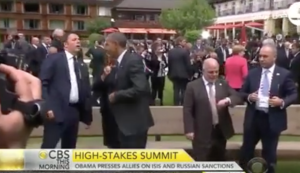
Oh yeah, President Obama knew PM Abadi was next to him and acted as if he wasn’t there – kinda like his approach to foreign policy
Source: CBS News

If you want additional details on the lead up to the rise of IS, then check out the history lesson we put together for President Obama’s counterpart Rand Paul, who is just as naive on foreign policy as he is:

Rand Paul Needs a History Lesson..
http://isisstudygroup.com/?p=6782

Links to Other Related Articles:

Defeating The Islamic State
http://isisstudygroup.com/?p=1708

Egypt Atmospherics
http://isisstudygroup.com/?p=614

Super Power Poker – Live From Iran

June 9, 2015

Super Power Poker – Live From Iran, Clarion Project via You Tube, June 9, 2015

The stakes are the highest they’ve ever been. Nuclear Iran. The US, Iran, Saudi Arabia and Israel play for the security of the world. This is the ultimate hold’em game. Who holds the aces, who will go all in, who is bluffing and who has a tell that will leave them with nothing but a mushroom cloud. No nukes for Iran.


Syria Asks IAEA for Help Converting Nuclear Reactor

June 8, 2015

Syria Asks IAEA for Help Converting Nuclear Reactor, Jewish Press, Hana Levi JulianJune 8, 2015

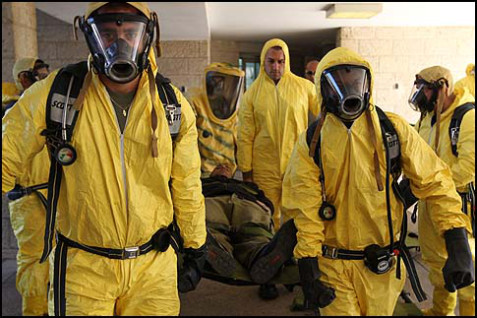
The border police run an exercise, while they train for chemical , biological or atomic. warfare. Feb 14 2011.  Photo by Nati Shohat/Flash90. *** Local Caption *** îâá éøåùìéí  àéîåï àáë çìéôåú îéâåï àéîåï úéøâåì úøâéì Israeli’s Border Police training for chemical, biological, and nuclear attacks. Photo Credit: Nati Shohat / Flash 90

IAEA head Yukiya Amano told reporters Monday that Syria has told the agency it would ship the higher-grade uranium abroad.

However, it is not clear where Syria would ship the higher-grade uranium — Iran is Syria’s closest ally – and neither is it clear what grade its uranium currently is.

**********************

The regime of Syrian President Bashar al-Assad has asked the United Nations International Atomic Energy Agency for help with a nuclear reactor near Damascus, international media agencies reported Tuesday.

The UN agency is studying the Syrian request to help convert the reactor, which currently runs on highly-enriched uranium, into one that uses lower grade nuclear fuel.

IAEA head Yukiya Amano told reporters Monday that Syria has told the agency it would ship the higher-grade uranium abroad.

However, it is not clear where Syria would ship the higher-grade uranium — Iran is Syria’s closest ally – and neither is it clear what grade its uranium currently is.

Low enriched uranium is defined as that which is enriched to less than five percent of fissile purity. Weapons quality uranium is enriched above 20 percent but that which is used to fuel an atomic bomb is enriched to 90 percent.

Amano said the IAEA is studying the request and has yet to make a decision.

Cartoon of the day

June 8, 2015

H/t joopklepzeiker

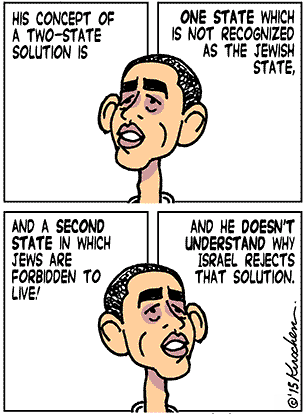
Obama Palestinian

Directive 11: Obama’s Secret Islamist Plan

June 8, 2015

Directive 11: Obama’s Secret Islamist Plan, Front Page Magazine, Daniel Greenfield, June 8, 2015

Obama-450x240

What little we know about the resulting classified 18-page report is that it used euphemisms to call for aiding Islamist takeovers in parts of the Middle East. Four countries were targeted. Of those four, we only know for certain that Egypt and Yemen were on the list. But we do know for certain the outcome.

Obama’s insistence that human rights be made a core national security interest paved the way for political and military interventions on behalf of Islamists. Obama had never been interested in human rights; his record of pandering to the world’s worst genocide plotters and perpetrators from Iran to Turkey to Sudan made that clear. When he said “human rights”, Obama really meant “Islamist power.”

********************

Behind the rise of ISIS, the Libyan Civil War, the unrest in Egypt, Yemen and across the region may be a single classified document.

That document is Presidential Study Directive 11.

You can download Presidential Study Directive 10 on “Preventing Mass Atrocities” from the White House website, but as of yet no one has been able to properly pry number 11 out of Obama Inc.

Presidential Study Directive 10, in which Obama asked for non-military options for stopping genocide, proved to be a miserable failure. The Atrocities Prevention Board’s only use was as a fig leaf for a policy that had caused the atrocities. And the cause of those atrocities is buried inside Directive 11.

With Obama’s typical use of technicalities to avoid transparency, Directive 11 was used to guide policy in the Middle East without being officially submitted. It is possible that it will never be submitted. And yet the Directive 11 group was described as “just finishing its work” when the Arab Spring began.

That is certainly one way of looking at it.

Directive 11 brought together activists and operatives at multiple agencies to come up with a “tailored” approach for regime change in each country. The goal was to “manage” the political transitions. It tossed aside American national security interests by insisting that Islamist regimes would be equally committed to fighting terrorism and cooperating with Israel. Its greatest gymnastic feat may have been arguing that the best way to achieve political stability in the region was through regime change.

What little we know about the resulting classified 18-page report is that it used euphemisms to call for aiding Islamist takeovers in parts of the Middle East. Four countries were targeted. Of those four, we only know for certain that Egypt and Yemen were on the list. But we do know for certain the outcome.

Egypt fell to the Muslim Brotherhood, which collaborated with Al Qaeda, Hamas and Iran, before being undone by a counterrevolution. Yemen is currently controlled by Iran’s Houthi terrorists and Al Qaeda.

According to a New York Times story, Obama’s Directive 11 agenda appeared to resemble Che or Castro as he “pressed his advisers to study popular uprisings in Latin America, Eastern Europe and Southeast Asia to determine which ones worked and which did not.”

The story also noted that he “is drawn to Indonesia, where he spent several years as a child, which ousted its longtime leader, Suharto, in 1998.”

The coup against Mubarak with its coordination of liberals, Islamists and the military did strongly resemble what happened in Indonesia. The most ominous similarity may be that the Muslim mobs in Indonesia targeted the Chinese, many of whom are Christians, while the Muslim mobs in Egypt targeted Coptic Christians.

Both were talented groups that were disproportionately successful because they lacked the traditional Islamic hostility to education, integrity and achievement. Islamist demagogues had succeeded in associating them with the regime and promoted attacks on them as part of the anti-regime protests.

Chinese stores were looted and thousands of Chinese women were raped by rampaging Muslims. Just as in Egypt, the protesters and their media allies spread the claim that these atrocities committed by Muslim protesters were the work of the regime’s secret police. That remains the official story today.

Suharto’s fall paved the way for the rise of the Prosperous Justice Party, which was founded a few months after his resignation and has become one of the largest parties in the Indonesian parliament. PJP was set up by the Muslim Brotherhood’s local arm in Indonesia.

His successor, Bacharuddin Jusuf Habibie, was more explicitly Islamist than Suharto and his Association of Muslim Intellectuals (ICMI) conducted a campaign against Christians, Hindus and Buddhists. It helped purge non-Muslims from government while Islamizing the government and Indonesia’s key institutions.

Habibie had been the Chairman of ICMI and ICMI’s Islamists played a key role in moving Suharto out and moving him in. It was obvious why Obama would have considered the Islamization of Indonesia and the purge of Christians under the guise of democratic political change to be a fine example for Egypt.

While we don’t know the full contents of Directive 11 and unless a new administration decides to open the vaults of the old regime, we may never know. But we do know a good deal about the results.

In its own way, PSD-10 tells us something about PSD-11.

Obama’s insistence that human rights be made a core national security interest paved the way for political and military interventions on behalf of Islamists. Obama had never been interested in human rights; his record of pandering to the world’s worst genocide plotters and perpetrators from Iran to Turkey to Sudan made that clear. When he said “human rights”, Obama really meant “Islamist power”.

That was why Obama refused to intervene when the Muslim Brotherhood conducted real genocide in Sudan, but did interfere in Libya on behalf of the Brotherhood using a phony claim of genocide.

Positioning Samantha Power in the Office of Multilateral Affairs and Human Rights at the National Security Council was part of the process that made over the NSC from national security to servicing a progressive wish list of Islamist terrorist groups that were to be transformed into national governments.

Power, along with Gayle Smith and Dennis Ross, led the Directive 11 project.

Secret proceedings were used to spawn regime change infrastructure. Some of these tools had official names, such as “The Office of The Special Coordinator For Middle East Transitions” which currently reports directly to former ambassador Anne Patterson who told Coptic Christians not to protest against Morsi. After being driven out of the country by angry mobs over her support for the Muslim Brotherhood tyranny, she was promoted to Assistant Secretary of State for Near Eastern Affairs.

“The Office” is still focused on “outreach to emergent political, economic and social forces in Egypt, Tunisia, and Libya” even though counterrevolutions have pushed out Islamists in Egypt and Tunisia, while Libya is in the middle of a bloody civil war in which an alliance of the Muslim Brotherhood and Al Qaeda controls the nation’s capital.

But even as Morsi’s abuses of power were driving outraged Egyptians into the streets, Gayle Smith, one of the three leaders of Directive 11, reached out to the “International Union of Muslim Scholars”, a Muslim Brotherhood group that supported terrorism against American soldiers in Iraq and which was now looking for American support for its Islamist terrorist brigades in the Syrian Civil War.

The men and women responsible for Directive 11 were making it clear that they had learned nothing.

Directive 11 ended up giving us the Islamic State through its Arab Spring. PSD-11’s twisted claim that regional stability could only be achieved through Islamist regime change tore apart the region and turned it into a playground for terrorists. ISIS is simply the biggest and toughest of the terror groups that were able to thrive in the environment of violent civil wars created by Obama’s Directive 11.

During the Arab Spring protests, Egyptian Foreign Minister Ahmed Aboul Gheit had told Hillary Clinton that his government could not hand over power to the Muslim Brotherhood. “My daughter gets to go out at night. And, God damn it, I’m not going to turn this country over to people who will turn back the clock on her rights.”

But that was exactly what Hillary Clinton and Obama were after. And they got it. Countless women were raped in Egypt. Beyond Egypt, Hillary and Obama’s policy saw Yazidi women actually sold into slavery.

Directive 11 codified the left’s dirty alliance with the Muslim Brotherhood into our foreign policy. Its support for Islamist takeovers paved the way for riots and civil wars culminating in the violence that birthed ISIS and covered the region in blood.

And it remains secret to this day.

Shoshana Bryen: The Kurds: A Guide for U.S. Policymakers

June 7, 2015

Shoshana Bryen: The Kurds: A Guide for U.S. Policymakerssecurefreedom via You Tube, June 5, 2015

Shoshana Bryen, Senior Director, Jewish Policy Center; Former Senior Director for Security Policy, Jewish Institute for National Security Affairs (JINSA):


Israel’s Revenge Is That “We Are Still Here”

June 7, 2015

Israel’s Revenge Is That “We Are Still Here” The Legal Insurrection, June 7, 2015

My wife and I are back, after an intense two weeks in Israel.

From the Lebanese to Gaza borders, from the Mediterranean Sea to Judea and Samaria, from the cool evenings of Jerusalem to the heat of the Negev Desert, from an apartment in the Jewish Quarter of the Old City of Jerusalem to Bedouin villages in the north and south, from university campuses to military bases, from faculty to students, from Jews to Muslims … I can’t say we saw it all, but we saw a lot.

I’ve documented most of our big events in daily posts, with the exception of our emotional meetings with the families of Edward Joffe and Leon Kanner, students killed in the 1969 Supersol supermarket bombing by Rasmea Odeh; that post is coming, but I still have new photos, documents and information I have to work through.

Here are my 5 Big Takeaways from the trip:

1. Our Revenge Is That “We Are Still Here”

Near the start of our trip, we visited Moshav Avivim straddling the Lebanese border, where we met Shimon Biton, a survivor of the 1970 bazooka attack on a school bus by the Popular Front for the Liberation of Palestine.

Biton, who was six and one-half years old, lost his father in the attack, and himself was shot point blank range by the terrorists when they realized he survived the bazooka attack.  Ten days before we met Biton, he was reunited for the first time in 45 years with the nurse who helped save him.  (Featured Image)

When we asked whether he ever wanted revenge, Biton told us that the revenge was that “we are still here and building for another 70 families.”

Moshav-Aviviv-Shimon-Biton-e1432683043370[Shimon Biton, Moshav Avivim, Israel]

When we related that story to numerous people we met along the rest of the trip, heads vigorously shook up and down.  It struck a chord, since almost every Israeli has a relative or friend impacted by terror.

Despite several decades of terrorism, particularly intense during the Second Intifada, and a world campaign against it, the People of Israel are still there.

The will to resist is underestimated.  Israel has a longer-term view, and a history.  It will not give in to boycotts, or Obama, or outside pressure that puts its security at risk.

2. “I don’t like Bibi, BUT….”

For whatever the reason, most of the people with whom we interacted self-identified as center-left or left.

There was no shortage of criticism of Israeli Prime Minister Benjamin Netanyahu: He’s egotistical, he doesn’t keep his tough promises, he is only interested in his own political survival, he’s a liar, his pre-election comment about Arab voting was shameful, and so on.

Yet with only a couple of exceptions, the negative comments always were followed with a big BUT.

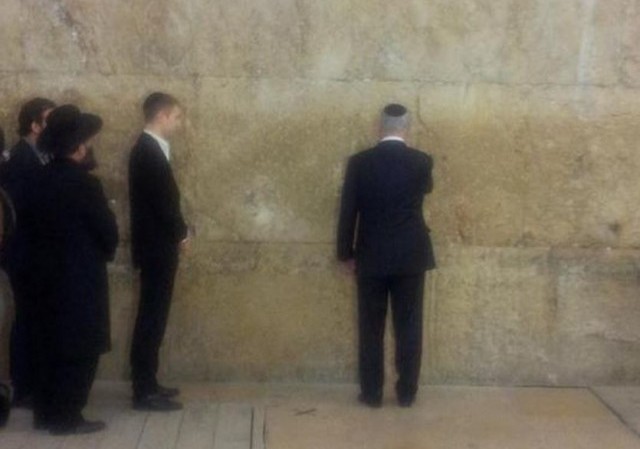
Benjamin-Netanyahu-at-Western-Wall-post-election-2015-e1426681806959[Israeli Prime Minister Benjamin Netanyahu at Western Wall after 2015 election victory.]

But he is the only Israeli politician who has the stature to handle the world pressure; but I don’t envy the position he is in with so many forces against us; but [opposition leader Yitzhak “Bougie” Herzog] Bougie is weak and no one will fear him; and so on.

These opinions pretty much were reflected in polling and the election results — Many people may not like Netanyahu, but he is the only Israeli politician capable of standing up for Israel in a hostile world.

3. I don’t like Obama, no BUTs about it

Polling in Israel shows Obama is hugely unpopular.  Our anecdotal interactions with Israelis confirmed that polling.

I  can’t recall anyone, from left to right, who had anything nice to say about Obama.  The most consistent theme was that Obama is naive and weak, and that naivitee and weakness had resulted in disaster in the Arab world as it encouraged the most aggressive Islamist elements.

They see Syria falling apart with al-Qaeda or ISIS groups likely to control large parts of the country; or if not, then Iran in control. There are no good outcomes for Israel’s Golan Heights border. Along the Lebanese border there is Hezbollah, and in Gaza Hamas and increasingly even more radical Salafist-ISIS groups.

Against this background of being surrounded by a sea of increasing threats resulting from Obama administration policy, not a single person thought the Iran nuclear deal made any sense, or trusted the Obama administration on it.

In other words, Israelis live in the real world, not the world of Obama’s delusional hope.  And they don’t appreciate Obama taking risks with their lives.

4. Are we really that popular in the United States?

The anti-Israel Boycott, Divestment and Sanctions movement was a frequent topic of conversation, almost always brought up by us as part of describing the type of coverage at Legal Insurrection.  This coincided with what I consider an irrational panic the past two weeks in the Israeli press and political discourse about BDS (more on that in a later post.)

I tried to explain that there is a complete disconnect between the BDS movement in the U.S. and the vast majority of Americans.  Gallup and Pew polling shows Israel at or near historical highs in terms of Israel’s favorability both abolutely and relative to favorability of Palestinians.  The gap between those who pick Israel over Palestinians when the question forces a choice, also is historically high.

Virtually every Israeli we met was shocked that Israel is actually so popular in the United States.  Even Israelis who have extensive American contacts and visit the U.S.

That’s not all so surprising.  Both the U.S. and Israeli media focus on the negative, though for different reasons.  The U.S. media long has had in implicit anti-Israel bias, compounded by the rise of left-leaning new media, while the Israeli media competes for readers with a “sky is falling” outlook.

(added) Israel’s enormous popularity among Americans is a strategic asset.  That strategic asset needs to be used more effectively to minimize the damage from the narrow but influential slices of the American population — radical faculty, some students, and mainstream journalists — who have explicit or implicit anti-Israel biases. The American people as a whole are the “Israeli Lobby.”

5. The Next War is Only a Matter of Time

While we were in Jerusalem, Israel underwent a national defense drill, including sirens warningof incoming rockets.

Our tour along the Gaza border, particularly near Sderot, also reflected preparation for the next round of rocket fire through reinforcing key civilian infrastructures, such as schools.

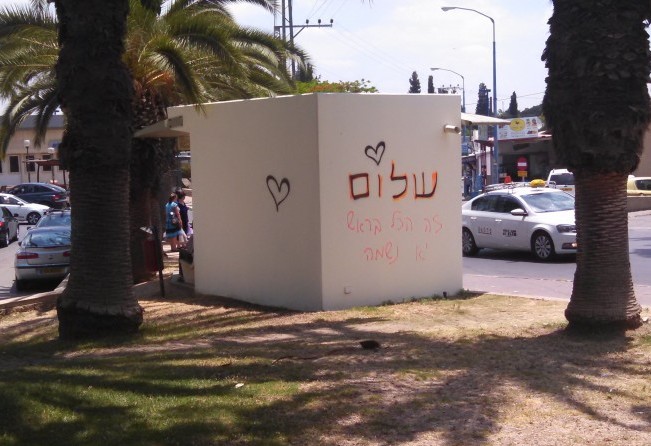
Sderot-Israel-bomb-shelter-street-e1433110130989[Sderot, Israel, street bomb shelter with “Shalom” grafitti]

There was a pervasive feeling that the calm cannot last.  And sure enough, while we were there and just after we left, rockets were fired from Gaza to Israel by Salafists suffering from a Hamas crackdown, and groups competing with Hamas for control.

That’s the logic of the region in which Israel lives: Radical groups retaliate against each other by firing rockets at … Israel.

The next war is coming.  Every Israeli knows it. It’s only a matter of time.

*  *  *  *  *

Those are my big takeaways.  I hope you enjoyed the coverage.

We will be back in Israel, hopefully next year.