Archive for the ‘Obama’ category

Obama Puts Fear Before Facts on Iran

August 6, 2015

Obama Puts Fear Before Facts on Iran, Bloomberg View, The Editors, August 5, 2015

(Please see also, Iran Already Sanitizing Nuclear Site, Intel Warns. — DM)

The pact is not a treaty: A future president and Congress might overturn it, arguing that it was sealed without proper consideration. And history often looks with disgust at causes built on fear, especially if they go awry. Obama wouldn’t want to face the kind of scorn he heaped on George W. Bush today.

***********************

President Barack Obama took to the airwaves today, aiming to sell Congress and the American people on the wisdom of his nuclear deal with Iran. He had a case to make but chose not to make it. He decided instead to cast legitimate criticism of his pact as ignorant warmongering. 

A few examples:

“We have achieved a detailed arrangement that permanently prohibits Iran from obtaining a nuclear weapon.” Actually, the deal’s restrictions end abruptly after 15 years, with some of the constraints on uranium enrichment fading away after just 10. Late in the speech, Obama made the case that much can change in a decade and that the West could be in a stronger position then to continue to block Iran’s nuclear desires. But the temporary nature of the deal remained disguised.

“Many of the same people who argued for the war in Iraq are now making the case against the Iran nuclear deal.” Certainly the Iraq war was sold on spurious grounds and had tragic results. Certainly Republicans and Democrats alike were far too credulous in accepting the Bush administration’s rationale. But these facts have absolutely nothing to do with this agreement.

“Before the ink was even dry on this deal, before Congress even read it, a majority of Republicans declared their virulent opposition.” That’s true, but ignores that opponents had plenty of time to study the draft agreement reached last spring. The real problem is that Congress still hasn’t read the entire accord, its side agreements and the inspections plan negotiated by the International Atomic Energy Agency. Even Secretary of State John Kerry says there are aspects of the deal he has never seen.

“If there is a reason for inspecting a suspicious undeclared site anywhere in Iran, inspectors will get that access even if Iran objects. This access can be with as little as 24 hours’ notice.” The key words here are “as little as.” Iran can draw that process out for as long as 24 days if it so chooses. Foreign Minister Javad Zarif says some military sites will remain off-limits to IAEA personnel.

“If, as has also been suggested, we tried to maintain unilateral sanctions, beefen them up … we’d have to cut off countries like China from the American financial system. And since they happen to be major purchasers of our debt, such actions could trigger severe disruptions in our own economy, and, by way, raise questions internationally about the dollar’s role as the world’s reserve currency.” Rejection by Congress could cause the sanctions regime to fray. Lawmakers should weigh this. The idea that it might cripple the U.S. economy is absurd.

“I’ve had to make a lot of tough calls as president, but whether or not this deal is good for American security is not one of those calls, it’s not even close.” Maybe this deal is the best chance to delay the mullahs’ race to the bomb and keep the Middle East out of a nuclear arms race. But the case is anything but open-and-shut. It’s hard to see what the president gains from denying this.

Well, perhaps one thing: Obama may hope that denigrating those who disagree with him will rally Democrats in Congress to support a veto of any measure of disapproval. Tactics aside, it would be far better to win this fight fairly. The pact is not a treaty: A future president and Congress might overturn it, arguing that it was sealed without proper consideration. And history often looks with disgust at causes built on fear, especially if they go awry. Obama wouldn’t want to face the kind of scorn he heaped on George W. Bush today.

Obama’s Strategy Of Equilibrium

August 6, 2015

Obama’s Strategy Of Equilibrium, Middle East Media Research Institute, Yigal Carmon and Alberto M. Fernandez, August 5, 2015

(The conflict between Shiite and Sunni factions has been going on since shortly after the death of Mohamed. Obama is not likely to bring reconciliation. — DM)

This article will analyze the strategy of creating an equilibrium between Sunnis and Shiites as a means to promote peace in the Middle East. It will examine the meaning of the strategy in political terms, how realistic it is, and what its future implications might be on the region and on the United States.

“It is worth noting that the first Islamic State created in the Middle East in the last 50 years was not the one created in the Sunni world in 2014 and headed by Abu Bakr al-Baghdadi.” Rather, it was the Islamic Republic of Iran created in 1979 by Ayatollah Ruhollah Khomeini and currently ruled by his successor, Supreme Leader Ali Khamenei, who maintains – even following the Iran deal – the mantra “Death to America,” continues to sponsor terrorism worldwide, and commits horrific human rights violations.

********************

Introduction

In an interview with Thomas Friedman of The New York Times (“Obama Makes His Case on Iran Nuclear Deal,” July 14, 2015), President Obama asked that the nuclear deal with Iran be judged only by how successfully it prevents Iran from attaining a nuclear bomb, not on “whether it is changing the regime inside of Iran” or “whether we are solving every problem that can be traced back to Iran.” However, in many interviews he has given over the last few years, he has revealed a strategy and a plan that far exceed the Iran deal: a strategy which aims to create an equilibrium between Sunnis and Shiites in the Muslim world.

President Obama believes that such an equilibrium will result in a more peaceful Middle East in which tensions between regional powers are reduced to mere competition. As he told David Remnick in an interview with The New Yorker, “…if we were able to get Iran to operate in a responsible fashion…you could see an equilibrium developing between Sunni, or predominantly Sunni, Gulf states and Iran in which there’s competition, perhaps suspicion, but not an active or proxy warfare” (“Going the Distance,” January 27, 2014).

In discussing the Iran deal, the President recalled President Nixon negotiating with China and President Reagan negotiating with the Soviet Union in order to explain the scope of his strategy for the Middle East and the Muslim world. President Obama seeks, as did Presidents Reagan and Nixon with China and the Soviet Union, to impact the region as a whole. The Iran deal, even if major, is just one of several vehicles that would help achieve this goal.

This article will analyze the strategy of creating an equilibrium between Sunnis and Shiites as a means to promote peace in the Middle East. It will examine the meaning of the strategy in political terms, how realistic it is, and what its future implications might be on the region and on the United States.

The Meaning Of The Equilibrium Strategy In Political Terms

Examining the strategy of equilibrium requires the recollection of some basic information. Within Islam’s approximately 1.6 billion believers, the absolute majority – about 90% – is Sunni, while Shiites constitute only about 10%.  Even in the Middle East, Sunnis are a large majority.

What does the word “equilibrium” mean in political terms? In view of the above stated data, the word “equilibrium” in actual political terms means empowering the minority and thereby weakening the majority in order to progress toward the stated goal. However, the overwhelming discrepancy in numbers makes it impossible to reach an equilibrium between the two camps. Therefore, it would be unrealistic to believe that the majority would accept a policy that empowers its adversary and weakens its own historically superior status.

Implications For The Region

Considering the above, the implications of the equilibrium strategy for the region might not be enhancing peace as the President well intends; rather, it might intensify strife and violence in the region. The empowered minority might be persuaded to increase its expansionist activity, as can be already seen: Iran has extended its influence from Lebanon to Yemen. Iranian analyst Mohammad Sadeq al-Hosseini stated in an interview on September 24, 2014, “We in the axis of resistance are the new sultans of the Mediterranean and the Gulf. We in Tehran, Damascus, [Hizbullah’s] southern suburb of Beirut, Baghdad, and Sanaa will shape the map of the region. We are the new sultans of the Red Sea as well” (MEMRITV Clip No. 4530). Similarly, in a statement dedicated to the historically indivisible connection between Iraq and Iran, advisor to President Rouhani Ali Younesi stressed that, “Since its inception, Iran has [always] had a global [dimension]; it was born an empire” (MEMRI Report No. 5991).

In view of this reality, this strategy might create, against the President’s expectations, more bitterness and willingness on the part of the majority to fight for their status. This has already been realized; for example, when Saudi Arabia intervened in Yemen after facing the Houthi/Shiite revolution, which it perceived as a grave danger to its survival, and created a fighting coalition within a month to counter it. Similarly, Saudi Arabia has previously demonstrated that it regards Bahrain as an area where any Iranian attempt to stir up unrest will be answered by Saudi military intervention. According to reports, Saudi Arabia has been supporting the Sunni population in Iraq, and in Lebanon, a standstill has resulted because Saudi Arabia has shown that it will not give up – even in a place where Iranian proxy Hizbollah is the main power. Hence, the strategy of equilibrium has a greater chance of resulting in the eruption of regional war than in promoting regional peace.

Implications For The United States

Moreover, this strategy might have adverse implications for the United States and its interests in the Sunni Muslim world: those countries that feel betrayed by the strategy might, as a result, take action against the United States – hopefully only politically (such as changing international alliances) or economically. These countries might be careful about their public pronouncements and might even voice rhetorical support to U.S. policy, as the GCC states did on August 3, but the resentment is there.

Realpolitik Versus Moral Considerations

The analysis presented here is based on principles of realpolitik: in politics, one does not align with the minority against the majority. However, sometimes other considerations take precedence. Morality is such an example: the Allies could not refrain from fighting Nazi Germany because it was a majority power – ultimately, they recognized the moral obligation to combat the Third Reich. However, with regard to the Middle East, the two adversaries are on equal standing: the Islamic Republic of Iran is no different than the Wahhabi Kingdom of Saudi Arabia. President Obama and Secretary Kerry would be wrong to think that Mohammad Javad Zarif, the sophisticated partygoer in New York City, represents the real Iran. Zarif, his negotiating team, and President Rouhani himself, all live under the shadow and at the mercy of the Supreme Leader, the ayatollahs, and the IRGC.

“It is worth noting that the first Islamic State created in the Middle East in the last 50 years was not the one created in the Sunni world in 2014 and headed by Abu Bakr al-Baghdadi.” Rather, it was the Islamic Republic of Iran created in 1979 by Ayatollah Ruhollah Khomeini and currently ruled by his successor, Supreme Leader Ali Khamenei, who maintains – even following the Iran deal – the mantra “Death to America,” continues to sponsor terrorism worldwide, and commits horrific human rights violations.

Cartoons of the day

August 6, 2015

H/t Freedom is just another word


wanted

deal

Iranian negotiator discusses talks with Moniz

August 6, 2015

Iranian negotiator discusses talks with Moniz, Al Monitor, Arash Karami, August 5, 2015

(A sweet deal between good friends. — DM)

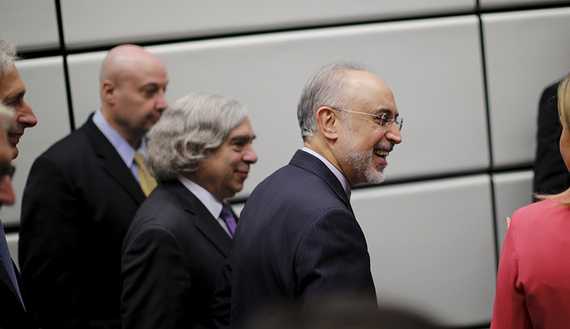
REUTERS/Carlos Barria

Salehi said that he was asked to join the nuclear talks when the discussions on the Natanz enrichment facility reached a dead end. Salehi said he would only join the talks if Moniz, his American counterpart, did as well. According to Salehi, this was approved by Undersecretary Wendy Sherman and Deputy Foreign Minister Abbas Araghchi, which he described as “the communications link between America and Iran.”

*****************

One of the most popular American negotiators in Iranian social media was US Energy Secretary Ernest Moniz. The Massachusetts Institute of Technology (MIT) professor emeritus and former director of the MIT Laboratory for Energy and the Environment joined the nuclear talks between Iran and five permanent members of the UN Security Council plus Germany (P5+1) to discuss the technical aspects of the nuclear deal with the head of Iran’s Atomic Energy Organization, Ali Akbar Salehi.

In an interview with an Iranian newspaper, Salehi spoke about the negotiations and his relationship with Moniz. Just as Moniz was picked to lead the technical negotiations due to his nuclear expertise, Salehi, an MIT graduate, is one of the few individuals to have held important positions for three consecutive administrations — a sign that he has the trust of Supreme Leader Ayatollah Ali Khamenei.

Salehi first denied accusations that former hard-line nuclear negotiator Saeed Jalili was not a serious negotiator. Salehi was Iran’s foreign minister at the time and said that when he was at the meetings with the Supreme National Security Council, Jalili’s negotiating positions were in line with the country’s positions and that “he did not go rogue.”

According to Salehi, the reason for the deadlock during that time was the differences among the P5+1. Specifically, the EU3 (France, United Kingdom and Germany) saw their positions and interests separate from the E3 (US, Russia and China). He said that even when European Union Chief Catherine Ashton reached a point of agreement with Iran on one issue, one country would oppose it and throw everything off. This is why Iran agreed to bilateral talks with the United States in Oman.

Salehi said that he was asked to join the nuclear talks when the discussions on the Natanz enrichment facility reached a dead end. Salehi said he would only join the talks if Moniz, his American counterpart, did as well. According to Salehi, this was approved by Undersecretary Wendy Sherman and Deputy Foreign Minister Abbas Araghchi, which he described as “the communications link between America and Iran.”

Salehi said he and Moniz did not know each other well when they were at MIT, but when they first met during the talks, “there was a feeling that he has known me for years.” Salehi added, “A number of my classmates are now Mr. Moniz’s experts.”

According to Salehi, Moniz entering the talks was important because Salehi expressed that he had been sent with “full authority” to sign off on all technical issues in the nuclear negotiations and Moniz had told him that he had the same authority. He added, “If the negotiations did not take place with the Americans, the reality is that it would not have reached a conclusion. No [other] country was ready to sit with us and negotiate for 16 days with their foreign minister and all of its experts.”

Salehi said that one of the more difficult times negotiating with Moniz was after they reached an agreement on a particular issue. Moniz would take it to the other members of P5+1, who would then make their own requests.

It was also reported that Moniz had given Salehi a gift for the birth of his granddaughter — clothes and a toy embossed with MIT logos. Salehi said that he had also brought gifts for Moniz — Iranian honey and trail mix of Iranian nuts.


Analysis: Arabs see US-trained anti-Islamist force as only fit to ‘play paintball’

August 6, 2015

Analysis: Arabs see US-trained anti-Islamist force as only fit to ‘play paintball’, Jerusalem PostAriel Ben Solomon, August 6, 2015

ShowImage (7)AN ISIS member rides on a rocket launcher in Raqqa in Syria two months ago. (photo credit:REUTERS)

The deal with Iran and the cooperation with Iranian forces against Islamic State, include “Shi’ite militias that are no less criminal.”

*********************

The Arab world perceives the dramatic failure of the small US-trained Syrian rebel force as a further indication that it cannot be a reliable ally against the Iran led Shi’ite axis.

A US defense official, who spoke to Reuters on condition of anonymity, said on Tuesday that at least five Syrian rebels it has trained are believed to have been captured by the Nusra Front.

That followed an attack by the Nusra Front on Friday thought to have killed one member of the so-called “New Syrian Forces,” in what would be their first battlefield casualty.

The incidents underscore the extreme vulnerability of the New Syrian Forces, a still tiny group estimated to number less than 60, who only deployed to the battlefield in recent weeks.

The Pentagon is far behind on its goals to train around 5,000 fighters a year.

Kirk Sowell, principal of Uticensis Risk Services, a Middle East-focused political risk firm, who closely follows Arab media summed it up this way on Twitter: “Pentagon: Arab media are laughing at you.”

Sowell posted a broadcast by pro-opposition Orient News, which expressed astonishment as to why the US would send in a force of only 50 to 60 fighters to help destroy Islamic State.

Aymenn Jawad al-Tamimi, a fellow at the Middle East Forum who closely follows Islamist opposition groups in Syria and Iraq, told The Jerusalem Post that “for many Sunni Arabs and Syrian Sunni Arab rebels in particular, this train-and-equip program has had no credibility from the outset.”

This is because the notion of fighting Islamic State while ignoring regime forces does not make sense for them, said Tamimi.

“US policymakers’ sense of reality on the ground is seriously in question with the apparent failure to anticipate a clash with the Nusra Front, which has a notable presence in the Azaz district into which the force of 50-60 men was inserted,” he continued.

Since the US has targeted Nusra Front in air strikes it is not surprising that the group would view a US backed group as a threat, he said.

Middle East researcher Ali Bakir, who also writes for Arab publications, told the Post on Wednesday that “no one in the Arab world takes this program seriously; I mean you would need around 50 to 60 people to play paintball but definitely not to fight Islamic State.”

“There is a profound general perception in the Arab world that the Obama administration is no less responsible than Iran and Russia in the Syrian crisis,” he said.

The deal with Iran and the cooperation with Iranian forces against Islamic State, include “Shi’ite militias that are no less criminal.”

This situation is increasingly seen in the Arab world as siding with the Shi’ites at the expense of the vast majority of Muslims, he asserted.

The US administration is more concerned about not jeopardizing the Iran deal than helping the Syrian people, Bakir added.

A New Age of Theory

August 6, 2015

http://www.jewishmediaresources.com/1768/a-new-age-of-theoryAugust 7, 2015

The recently signed p5+1 nuclear deal with Iran is based on another beautiful theory: The nicer the United States is to the Iranian mullahs, the more she caves into their demands and acknowledges their valid reasons for hating America, the more they will seek to be like us and want to be good citizens of the world. President Obama has literally bet the fate of the world on that conjecture.

The theory that the Iranian theocracy will be transformed by kindness betrays another failure of progressive theorists from the French Revolution to the present: They view religion as “irrational,” and cannot fathom that anyone else takes its claims seriously. That Iran’s Islamic Revolution really seeks world conquest for Islam is too absurd to countenance as an explanation of regime behavior.

**********************

Alexis de Tocqueville’s explanation of the descent of the French Revolution into the Terror, in The Old Regime and the Revolution, emphasized the outsized role that men of letters played in French political discourse prior to the Revolution. These writers, as described by de Tocqueville, had a decided preference for “general and abstract theories of government” and a tendency “to trust in them blindly.” Since they dwelt at “an almost infinite distance from practice . . . no experience tempered the ardors of their natures; nothing warned them of the obstacles that existing facts might place before them.”

With the passage of time, “they . . . became much bolder in their innovations, fonder of general ideas and systems, more contemptuous of old wisdom, and still more confident of their individual reason. . . ,” writes de Tocqueville.

We live in another such age of theory, writes Alain Finkelkraut. Take for example the lunatic claim that Jews are committing genocide against the Palestinians. Under Israeli rule of the West Bank from 1967 to 1992, life expectancy leaped by 50% — from 48 to 72; infant mortality dropped by 75%; seven universities were built where none had existed, and Palestinian illiteracy was reduced to a fraction of that in neighboring Egypt and Syria; and the West Bank, as of 1992, had the fourth fastest growing economy in the world. If that be genocide, it was genocide of a decidedly peculiar sort.

But, explains Finkelkraut, Europeans have theory according to which Jews are uniquely capable of genocide today. And in an age of theory, a beautiful theory trumps a thousand unruly facts. What’s the theory? Because Jews were the victims of the Holocaust, not its perpetrators, they never learned of the danger of turning one’s fellow human beings into the dehumanized “Other.” From which it follows that Jews dehumanize Palestinians and are committing genocide against them. Never mind the facts.

The recently signed p5+1 nuclear deal with Iran is based on another beautiful theory: The nicer the United States is to the Iranian mullahs, the more she caves into their demands and acknowledges their valid reasons for hating America, the more they will seek to be like us and want to be good citizens of the world. President Obama has literally bet the fate of the world on that conjecture.

Neither tens of thousands chanting “Death to America” nor Supreme Leader Khameini’s insistence that Iran will continue to fight American arrogance even after the deal because hatred of America is the very raison d’etre of the regime register with supporters of the theory.

The theory that the Iranian theocracy will be transformed by kindness betrays another failure of progressive theorists from the French Revolution to the present: They view religion as “irrational,” and cannot fathom that anyone else takes its claims seriously. That Iran’s Islamic Revolution really seeks world conquest for Islam is too absurd to countenance as an explanation of regime behavior.

Another Obama theory holds that even rabid anti-Semites, like the Iranian mullahs, will not act upon their hatreds to the harm of their “rational” interests. But history proves the opposite: The Nazis diverted vital war material in an effort to wipe out Hungarian Jewry in Auschwitz.

The attachment to theory over empirical evidence is evidenced in the way that Left policy prescriptions remain constant despite their repeated failures. What Walter Russell Mead calls the Blue Model of governance – high taxes, high regulation, and generous public union pensions – is failing everywhere. From mid-size California cities to Detroit, Chicago, and most recently, Puerto Rico, it has led to literal bankruptcy.

A vicious cycle sets in of higher taxes to pay pensions based on fantastical assumptions followed by the flight of business and jobs to lower tax states followed by yet higher taxes on those remaining to compensate for the lost business and jobs. Eventually, Blue Model cities and states experience the highest income inequality, as the population divides between extremely high earners, on the one hand, and the menial workers who serve them and welfare recipients, on the other.

The Obama administration has now set out to increase Muslim immigration, despite Europe’s dystopian experience, which has left it poised to become an extension of the Maghreb by the end the century, with an increasingly radicalized and unassimilated Muslim population taking over.

The theories of the Left are unmoored from reality because they have less to do with seeking to make life better than with the emotional reaffirmation they offer their proponents. Every Democratic candidate, for instance, will call for universal pre-school education, despite 50 years of evidence that Head Start early intervention has no lasting impact.

Similarly, every Democratic candidate will advocate heavy government investment in abundant, renewable “green” energy – such as ethanol, the production of which actually creates more pollution than it saves – even though “green energy” consistently proves to be economically unviable and a drag on economic productivity in the form of higher energy costs. Billions of dollars of taxpayer money, however, will inevitably find their way into the pockets of “green energy” crony capitalists.

The attraction of “renewables” is primarily the feeling of moral virtue they confer on proponents. And the same is true of Head Start and calls for a $15/and hour minimum wage, which would only ensure that orders at McDonald’s will be taken by a machine and not by some striving high-school kid eager to earn money for college or a poor, single-mother with no marketable skills. Estimates of the American jobs likely lost if the minimum wage were to rise to $15/hour range from 3,000,000 to 6,000,000, most of them to low-wage earners. But how deliciously virtuous must legislators feel enacting minimum wage laws.

THOSE WHO PREFER THEORY over history and facts do not just produce bad policy: They are subject to a profoundly illiberal, even totalitarian, temptation. That was De Tocqueville’s subject. Their theory of government is that “smart” people – i.e., theoreticians like themselves — ought to run the show. A corollary is that all smart people will reach similar “rational” conclusions, and that those who don’t are either fools or evil. Not surprisingly, when human beings and reality fail to conform to their theories, they turn ornery. Think Pol Pot.

Hostility to free markets and a profound ambivalence towards representative democracy are part and parcel of the preference for abstractions. The former are too irrational and chaotic. Markets give equal value to the desires of the not-so-bright. Central planning, by contrast, is much more rational, or so it seems, until one considers its unbroken record of failure. Just think of resource rich Venezuela, where years of socialist rule have made both food and toilet paper scarce.

Similarly the flaw of representative democracy is that fools and geniuses alike have one vote. The preferred form of municipal government for early American Progressives was unelected city managers, above the fray of partisan politics. And those same early Progressives created the modern administrative state, whose rule-making by unelected bureaucratic “experts,” has become virtually indistinguishable from the law-making power conferred exclusively upon Congress by the Constitution.

Self-styled progressive Barack Obama is perfectly comfortable ruling by executive decree and through administrative agencies, like the Environmental Protection Agency, which seeks to impose by rule-making what could never pass in Congress.

Obama’s progressive ancestor, President Woodrow Wilson, famously declared the U.S. Constitution, with its federal system and checks and balances between the three branches, to be an outmoded document for the modern age, and called for a much more powerful unitary executive.

Progressive thinkers have little patience for the rules of procedure of representative democracy or its allocation of decision-making authority. Only results matter and that the smart people make the decisions – be they judges, agency bureaucrats, or the president himself. Neither Court President Aharon Barak in his heyday nor Justice Anthony Kennedy more recently showed the slightest concern over whom appointed them philosopher-king to determine the nature of human dignity.

The assumption that those who disagree are either stupid or evil undercuts the fundamental democratic value of tolerance. On issues like anthropogenic climate change, modern progressive are ever eager to declare the debate over, and even advocate criminal penalties for global warming deniers. (This at a time when many climate scientists are forecasting a mini-Ice Age based on lower solar activity.)

Anyone who follows nutrition and health reports knows how wildly fluctuating the best scientific advice is. How much more unlikely is the discussion to be over in the vastly more complex area of climate, involving up to twenty different scientific disciplines and in which controlled experiments are impossible.

Not by accident are the most progressive institutions in American society – the universities – those with the most restrictive speech codes designed to regulate various and sundry “micro-aggressions” in speech.

The Orwellian argument of the late Brandeis philosopher Herbert Marcuse that “new and rigid restrictions” on certain teachings that protect the oppressive status quo are required for true freedom of thought to flourish only represents the outer limit of where the preference for abstractions over human reality can lead.
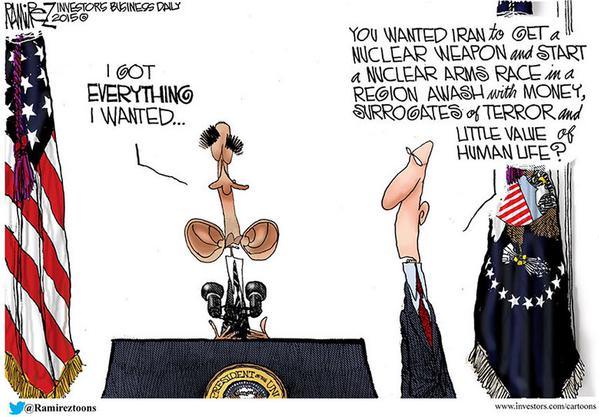
Morning Joe panel blasts Obama on Iran speech as condescending small ball

August 6, 2015

Morning Joe panel blasts Obama on Iran speech as condescending small ball, Washington Free Beacon via You Tube, August 6, 2015


Mark Moyar: Lurching without direction

August 5, 2015

Mark Moyar: Lurching without direction, Power Line, Mark Moyar, August 5, 2015

Because crisis management focuses on reducing symptoms rather than eliminating causes, its practitioners typically resort to half measures and token gestures. By demonstrating that the White House is “doing something,” symbolic actions often suffice to alleviate press scrutiny and public pressure for action, at least temporarily. They seldom remedy the problem that they were ostensibly addressing.

**********************

Mark Moyar is Visiting Scholar at The Foreign Policy Initiative and the author, most recently, of the important new book Strategic Failure: How President Obama’s Drone Warfare, Defense Cuts, and Military Amateurism Have Imperiled America. We invited Mark to write something for us bearing the subject of his book. He has responded with this column:

Last year, shortly before Barack Obama fired him, Secretary of Defense Chuck Hagel chided America’s President for “lurching from crisis to crisis without direction.” The treatment of foreign policy as an exercise in ad hoc crisis management has characterized Obama’s entire Presidency, as indeed it has every Democratic Presidency of the last half century. Fixated on domestic affairs and reluctant to assert American power overseas, Democrats from Lyndon Johnson to Barack Obama have viewed foreign policy challenges as nuisances to be kept off the front page of the New York Times, rather than problems to be solved through a coherent grand strategy.

Whereas a good strategy drives an active foreign policy, crisis management is inherently reactive. International problems reach the President’s attention mainly when they generate inordinate press coverage or cause a spike in unfavorable polling. Active adversaries, like North Vietnam in 1964 and Russia and ISIS in 2015, have consistently beaten a reactive United States to the punch and dodged the counterpunches.

Because crisis management focuses on reducing symptoms rather than eliminating causes, its practitioners typically resort to half measures and token gestures. By demonstrating that the White House is “doing something,” symbolic actions often suffice to alleviate press scrutiny and public pressure for action, at least temporarily. They seldom remedy the problem that they were ostensibly addressing.

In the case of Syria, Obama rejected recommendations from his cabinet to arm moderate Syrian rebels until 2013, by which time most of the moderate rebels had been killed or co-opted by extremists. He then decided to train and equip rebel forces in such small numbers and with such restrictions on their activities as to render them insignificant. When ISIS advances compelled Obama to restart American training of Iraqi forces, Obama put a ceiling on the number of U.S. trainers that limited throughput to 3,000 trainees per year, too few to make a difference in the war against ISIS or to lessen the influence of the 100,000 Iraqi Shiite militiamen whom the Iranians were training.

In Afghanistan, Obama authorized a troop surge, but began withdrawing troops much earlier than his generals advised, preventing completion of the military’s counterinsurgency campaign and discouraging Afghans from siding with the pro-American government. In Libya, Obama joined a NATO campaign against Muammar Gadhafi after international outrage about Gadhafi’s atrocities reached fever pitch, but his refusal to send American military forces to help secure the peace or protect American interests led to the collapse of central governance and the killing of the U.S. ambassador at Benghazi.

Of the recent additions to the administration’s list of token gestures and half measures, the most flagrant offender is Obama’s nuclear deal with Iran. Less well known is his response to the crisis of Russian expansionism. For more than a year, Eastern European allies and American critics—some of them within the Obama administration—have been calling for tougher American actions to discourage further Russian advances. Obama finally made his token gesture at the end of June, announcing that the United States would send American troops and heavy weaponry to several eastern European countries.

The joy that the initial announcement may have brought the eastern Europeans quickly faded when they saw the fine print, which was issued by U.S. ambassador to NATO Douglas Lute. The United States, Lute explained, was not going to deploy forces to eastern Europe on a permanent basis. “The tanks are empty, the … vehicles are empty, and will be parked, stored and maintained in training areas across the six Eastern most allies for training purposes,” Lute said. “Then the soldiers, on exercise after exercise, will be flown in.” One doubts that the Latvians will feel secure, or the Russians will feel deterred, by empty American vehicles and occasional visits from jet-setting American soldiers.

Many of Obama’s token gestures and half measures are clearly intended to keep simmering crises from boiling over until Obama leaves office. Administration spokesmen have repeatedly said that defeating ISIS will be a “multiyear” effort. The diluted U.S. military presence in Afghanistan is scheduled to last until the end of Obama’s term. Most of the fallout from Obama’s bad Iran deal will not hit ground until someone else occupies the White House. Obama and his proxies will no doubt craft stories explaining how his successor’s errors undid all of his foreign policy masterstrokes.

The President’s tokenism also serves one of the few national security objectives that Obama has pursued with any consistency, the diminution of American military power. The White House ramped up drone strikes in Pakistan and Yemen as a means of diverting the American people’s attention and showing that the United States could still do damage to terrorists without large military forces. While boasting about the number of people killed by drones, Obama quietly forced through drastic reductions in the armed services and withdrew American forces from critical regions. The drone strikes, in actuality, succeeded mainly in killing low-level fighters and antagonizing the Pakistani and Yemeni governments to the point that the United States eventually had to discontinue most strikes.

If one believes that Obama’s foreign policy should be driven by mitigation of immediate crises, particularly those that might detract from perceived domestic achievements such as Obamacare and environmental regulation, then there may be cause for optimism about the next year and a half. If, on the other hand, one believes that Obama’s foreign policy should be driven by protection of America’s enduring national security interests, then there is cause only for worry. Obama’s remaining months in office will give America’s enemies time and space to accumulate strength. The continuance of passivity and tokenism may even invite audacious provocations from enemies seeking to steal more sheep before a more vigilant shepherd comes along.

Iran Already Sanitizing Nuclear Site, Intel Warns

August 5, 2015

Iran Already Sanitizing Nuclear Site, Intel Warns, Bloomberg View&  August 5, 2015

The U.S. intelligence community has informed Congress of evidence that Iran was sanitizing its suspected nuclear military site at Parchin, in broad daylight, days after agreeing to a nuclear deal with world powers.

For senior lawmakers in both parties, the evidence calls into question Iran’s intention to fully account for the possible military dimensions of its current and past nuclear development. The International Atomic Energy Agency and Iran have a side agreement meant to resolve past suspicions about the Parchin site, and lawmakers’ concerns about it has already become a flashpoint because they do not have access to its text.

Intelligence officials and lawmakers who have seen the new evidence, which is still classified, told us that satellite imagery picked up by U.S. government assets in mid- and late July showed that Iran had moved bulldozers and other heavy machinery to the Parchin site and that the U.S. intelligence community concluded with high confidence that the Iranian government was working to clean up the site ahead of planned inspections by the IAEA.

The intelligence community shared its findings with lawmakers and some Congressional staff late last week, four people who have seen the evidence told us. The Office of the Director of National Intelligence briefed lawmakers about the evidence Monday, three U.S. senators said.

“I am familiar with it,” Senate Intelligence Committee Chairman Richard Burr told us Tuesday. “I think it’s up to the administration to draw their conclusions. Hopefully this is something they will speak on, since it is in many ways verified by commercial imagery. And their actions seem to be against the grain of the agreement.”

Burr said Iran’s activities at Parchin complicate the work of the IAEA inspectors who are set to examine the site in the coming months. IAEA’s director general, Yukiya Amano, was in Washington on Wednesday to brief lawmakers behind closed doors about the side agreements.

“They are certainly not going to see the site that existed. Whether that’s a site that can be determined what it did, only the technical experts can do that,” Burr said. “I think it’s a huge concern.”

A senior intelligence official, when asked about the satellite imagery, told us the IAEA was also familiar with what he called “sanitization efforts” since the deal was reached in Vienna, but that the U.S. government and its allies had confidence that the IAEA had the technical means to detect past nuclear work anyway.

Another administration official explained that this was in part because any trace amounts of enriched uranium could not be fully removed between now and Oct. 15, the deadline for Iran to grant access and answer remaining questions from the IAEA about Parchin.

Senate Foreign Relations Committee Chairman Bob Corker told us Tuesday that while Iran’s activity at Parchin last month isn’t technically a violation of the agreement it signed with the U.S. and other powers, it does call into question Iran’s intention to be forthright about the possible military dimensions of its nuclear program.

“The intel briefing was troubling to me … some of the things that are happening, especially happening in such a blatant way,” he said. “Iran is going to know that we know.” He added the new information gave him “a lot of concerns” about Iran coming clean on military dimensions of its nuclear work.

According to the overall nuclear agreement, sanctions relief for Iran can come only after the IAEA and Iran resolve their outstanding concerns about possible military dimensions of past and current work. But the agreement does not specify how the issue must be resolved, only that it be resolved to the IAEA’s satisfaction.

Several senior lawmakers, including Democrats, are concerned that Iran will be able to collect its own soil samples at Parchin with only limited supervision, a practice several lawmakers have compared to giving suspected drug users the benefit of the doubt to submit specimens unsupervised. Iran’s sanitization of the site further complicates that verification.

Democratic Senator Chris Coons, a member of the Foreign Relations Committee, told us Tuesday that this area is part of why he is undecided on supporting the Iran deal.

“I have concerns about the vigorous efforts by Iran to sanitize Parchin,” he said. “I’ve gotten some reassurance about how difficult it is for them to effectively conceal what we know to have been their illicit nuclear weapons developments there.”

Coons said he was most concerned about the integrity of the IAEA inspection process going forward and not as concerned about figuring out what happened in the site in the past: “We know what the Iranians did at Parchin.”

David Albright, the president of the Institute for Science and International Security, obtained a commercially available image of the Parchin site taken by satellites on July 26 that shows renewed activity at the Parchin site. He told us there are two new large vehicles, alterations ongoing to roofs of two of the buildings and new structures near two of the buildings.

“You have to worry that this could be an attempt by Iran to defeat the sampling, that it’s Iran’s last-ditch effort to eradicate evidence there,” he said. “The day is coming when they are going to have to let the IAEA into Parchin, so they may be desperate to finish sanitizing the site.”

The facility, outside of Tehran, first came to the attention of the international community in 2004 when news reports surfaced that it was being used to test explosives for a nuclear warhead.

A 2007 U.S. National Intelligence Assessment concluded that Iran halted this kind of work in 2003. Between 2005 and today, Iran has allowed IAEA inspectors access to Parchin — a vast complex with dozens of buildings — on only five occasions. In 2012, Abright’s group reported on satellite imagery that it said showed efforts to clean up evidence of an explosives testing chamber there.

Representative Ed Royce, the Republican chairman of the House Foreign Affairs Committee, said that Amano had told him in recent conversations that the IAEA had “thousands of pages of documentations on tests to weaponize a nuclear device.” Royce added, “For a long time, they have been altering sites.”

The IAEA has documented this as well. The agency’s report from May 29 this year said there was  satellite imagery of vehicles, equipment and “probable construction materials” at Parchin. The report said, “The activities that have taken place at this location since February 2012 are likely to have undermined the Agency’s ability to conduct effective verification.”

Secretary of State John Kerry has said that the U.S. government has “absolute knowledge” about what Iran has done in the past. Ahead of the vote on the agreement next month, many lawmakers don’t share Kerry’s confidence. Iran would seem to have its doubts as well, since it’s still trying to cover its tracks.

Obama negotiator says she didn’t see final Iran ‘side deals’

August 5, 2015

Obama negotiator says she didn’t see final Iran ‘side deals,’ The Hill, Kristina Wong, August 5, 2015

(Were the secret agreements on which Kerry, et al, were “fully briefed” and hence know “exactly” what they say also “rough drafts?” Unlike Ms. Sherman, Kerry testified that he had not seen the secret agreement(s).– DM)

shermanwendy_052715gettyGetty Images

[L]ater in the hearing, she walked back her comments about not seeing the final arrangements. 

“I was shown documents that I believed to be the final documents, but whether there were any further discussions…” she added before being cut off by another question by Sen. Pat Toomey (R-Pa.). Later, she said responded, “I have” when asked whether she saw the final versions of the deals.

****************

The only Obama administration official to view confidential “side deals” between Iran and the International Atomic Energy Agency (IAEA) admitted Wednesday she and her team have only seen rough drafts.

“I didn’t see the final documents. I saw the provisional documents, as did my experts,” said Wendy Sherman, a lead U.S. negotiator for the deal, at a Senate Banking Committee hearing.  

Sherman, undersecretary of State for political affairs, said she was only allowed to see the confidential deals “in the middle of the negotiation” when the IAEA “wanted to go over with some of our experts the technical details.” 

She maintained the deals — which focus on with Iran’s prior work on a bomb and access to Iran’s Parchin military site — are still confidential and can’t be submitted to Congress.

Sherman said the U.S. did not protest to the confidentiality of the agreements, despite the Iran Nuclear Agreement Review Act demanding all related agreements, because the administration wanted the IAEA to respect the confidentiality of their agreements with the U.S.

“We want to protect U.S. confidentiality … this is a safeguards protocol. The IAEA protects our confidential understandings … between the United States and the IAEA,” she said.

However, later in the hearing, she walked back her comments about not seeing the final arrangements.

“I was shown documents that I believed to be the final documents, but whether there were any further discussions…” she added before being cut off by another question by Sen. Pat Toomey (R-Pa.). Later, she said responded, “I have” when asked whether she saw the final versions of the deals.

She also argued they could not be submitted to Congress because the administration does not have the deals, and that the Senate had “every single document” the administration has.

Sherman emphasized she would brief Senators later Wednesday afternoon in a classified session on everything she knows about the deal.

A similar briefing for House lawmakers last week did not assuage concerns for Rep. Ed Royce (R-Calif.), chairman of the House Foreign Affairs Committee, who sent a letter to Secretary of State John Kerry on Monday calling on the administration to submit the deals.

She also noted that IAEA Director General Yukiya Amano was meeting with the Senate Foreign Relations Committee later in the afternoon.

Although she said the U.S. did not ask or pressure Amano to conduct the briefing, she suggested it was a gesture beyond what the IAEA is obligated to do.