Archive for the ‘Obama – rogue president’ category

CAUTION – includes satire |Diversity training will bring peace through submission, Insha’Obama

November 29, 2015

Diversity training will bring peace through submission, Insha’Obama, Dan Miller’s Blog, November 28, 2015

(The views expressed in this article may, or may not, be mine. They do not necessarily reflect those of any sane person or entity. — DM)

Our most prestigious universities now require diversity training for everyone coddled by un-Islamic aberrations based on Christian, Jewish, sexist and white privilege. Obama, bravely leading as always from the front, will follow them to combat Islamophobic speech and thought which He recently decreed to be felonies.

During His Thanksgiving address this year, Obama likened the current crop of Syrian and other Islamic refugees to the Pilgrims who came to America many years ago.

This Thanksgiving, President Obama is calling for Americans to lend a helping hand to another group of pilgrims fleeing persecution.

“Nearly four centuries after the Mayflower set sail, the world is still full of pilgrims – men and women who want nothing more than the chance for a safer, better future for themselves and their families,” Obama said in his weekly address Thursday. “What makes America America is that we offer that chance.”

HuffPo

No-who-we-are

Racist-Horse

Note: Although much of the following is true, parts are not. For example, even in Obama’s America Islamophobic thought is not yet a felony and the tale about Sally Snookums related toward the end remains the stuff of fantasy. In Muslim and incipient Muslim countries reality is different, so we need to emulate them. That will be change that we Obama can believe in.

Academia

American fascism

According to an article at The Amerian Interest,

With their campuses rocked by social justice protests, anxious Ivy League presidents are trying to appease campus radicals with huge payouts to left-wing identity programs. Peter Salovey, the president of Yale, apologized to protesters (“we failed you”) and wrote a campus-wide letter promising to create a new “university center” for the study of “race ethnicity, and other aspects of social identity.” He also pledged to double the budget for the African American, Native American, Asian American, and Hispanic cultural centers, and to devote new resources to “educating our community about race, ethnicity, diversity, and inclusion.”

Not to be outdone, Brown University President Christina Paxson has answered protests by unveiling a $100 million program for creating “a just and inclusive campus community.” Among the budget items: “expand mentoring resources for students of color, LGBTQ+ students, and first generation college students”; create “workshops” to “foster greater awareness and sensitivity on issues of race, ethnicity, sexual orientation and gender identity and expression”; and “promote university-wide research and academic programming on Power, Privilege, Identity and Structural Racism.”

The rest of Obama’s America

Since academia is only part of the problem, the wise humanitarian outreach programs undertaken there (with the exception of those to comfort LGBTQ+ students which Muslims consider offensive) must be expanded to reach all problem people and areas. Doing so is Obama’s principal duty as America’s Commander in Chief and Supreme Leader. I have altered the excerpt from the article at The American Interest quoted above to reflect what Obama and His friends would probably try to do if they thought they could get away with it:

With many states rocked by Islamophobia and demands that widows and three year old orphans be banned, President Obama is increasing payouts to such anti-discrimination groups as the Council on American-Islamic Relations, the Muslim Brotherhood and other Muslim-identity programs. Allegedly “radical” mosques such as those shown below will also be given badly needed infusions of Federal funds.

Mosque Interactive

Obama has (again) apologized to Islamists (“we failed you”) and promised to create new state centers for the study of religious ethnicity and other aspects of social identity. He has also pledged to at least double the budgets for Islamic cultural centers, including those at the mosques indicated above, and to devote new resources to educating our community about religious and racial ethnicity, diversity, and inclusion.

He has also unveiled state-wide programs for creating just and inclusive communities.Among the budget items: expand mosques to provide increased mentoring resources for Muslim youth; create diversity workshops with mandatory attendance by all deemed to be on paths to becoming Islamophobic felons, to foster greater awareness and sensitivity on issues of religion, peace, ethnicity and expression; and to promote state-wide research and academic programming on Power, Privilege, Religious Identity and other types of Structural Racism.

These (along with His historic nuke deal with The Islamic State Republic of Iran) will be His most enduring legacies.

There is also hope in Obama’s America for the few refugees who may be neither widows nor three year old orphans.

Others can be adopted. Here are some adorable Syrian refugees:

syrian_refugees_7

Adorable, cuddly Syrian refugees to a good home. Attention liberal millionaires. Do you want your very own gang of Syrian Refugees (TM) to loiter around your home, throw things at you and beat you up?

Here are a whole bunch for you to take home. Yes, I’m looking at you, J.K. Rowling. Or Isaac Herzog. There’s so many that every passionately outraged leftist bigwig can have his own bunch. You just better be ready to cook for them and bring them everything while they throw it in your face.

You’ll notice the shortage of actual women and kids. The media makes a point of focusing on those, but the majority are young men. Just like Obama’s “unaccompanied children” border rush. But those are facts and we don’t need facts. Just outrage and lots of love.

So take them in. Step up for the cause. The Hungarian police will happily ship a dozen angry Syrian refugees to your home. What you do with them or what they do with you, is up to you.

Don’t be shy; there are plenty for everyone.

https://www.youtube.com/watch?v=X2rmA9A7CEM

https://www.youtube.com/watch?v=F0HggGGnX0Y

What could possibly go wrong?

Eurabia is doing very well

Although Germany has health problems, they have nothing to do with Islam.

The influx of more than one million asylum seekers from Africa, Asia and the Middle East is placing unprecedented strain on Germany’s healthcare system.

Hospitals, clinics and emergency rooms across Germany are being filled to capacity with migrants suffering maladies of all kinds, and medical personnel, including thousands of volunteers, are increasingly complaining of burnout.

Diseases are also reappearing that have not been seen in Germany for years. German public health officials are now on the lookout for Crimean Congo hemorrhagic fever, diphtheria, Ebola, hepatitis, HIV/AIDS, malaria, measles, meningitis, mumps, polio, scabies, tetanus, tuberculosis, typhus and whooping cough. As refugee shelters fill to overflowing, doctors are also on high alert for mass outbreaks of influenza and Norovirus. [Emphasis added.]

Compounding the challenge, tens of thousands of migrants arriving in Germany — particularly migrant children — have not been immunized, and German doctors are finding that needed vaccines are not readily available due to a lack of supply. Some German parents are panicking that there are not enough vaccines to immunize their own children.

. . . .

German hospitals are also being forced to hire a virtual army of interpreters so that doctors can communicate with asylum seekers, who speak dozens of languages, dialects and variants.

At the same time, German hospitals are increasing security to protect doctors and nurses from violent attacks by migrants who are unhappy with the medical treatment they are receiving.

Sweeden, also a haven of happiness for Muslim refugees, has the right idea. Sadly, some object. The Public Service Director of Sweeden’s public television has responded to their Islamophobic nastiness:

The Public Service director, Safa Safiyari, who recently introduced Dirawi to a large press gathering, came to Sweden at the age of 14. In newspaper articles, he has spoken about how he does not feel “fancy” enough for the Swedish archipelago; and how, in 2001, when he got to do current affairs shows for young people about “all the injustices in Sweden,” it felt as if it were revenge for all the injustices he said he has experienced in Sweden and that still characterize his life.

The announcement that a person such as Dirawi, who professes to be of the Islamic faith and who according to Islamic scholars must believe that the celebration of the birth of Christ is a heathen tradition, will be Christmas Host, sparked widespread expressions of anger and disappointment on social media. Comments were posted on Twitter, such as: “Public Television has declared war on Christian Sweden by choosing Muslim Gina Dirawi as Christmas Host! It is shameful!” And, “If things continue down this road, by next Christmas, Christmas ham will be banned.”

Safa Safiyari told the daily Göteborgs-Posten, that Swedish Public Television had been prepared for all kinds of reactions: “We have chosen Gina Dirawi as Christmas Host based on her competence, her comedic talents and experience in large television broadcasts. When we hire our Christmas Hosts, religious belief is not something we inquire about.” [Emphasis added.]

In order to take full advantage of the great opportunities coming to our shores, we need to help Islamophobes by jailing and reeducating them to make them understand that Islam is the true religion of peace; all others just pretend to be and are therefore fake.

Progress is already being made

In Obama’s America, Yes We Can and We Can’t Wait! Here’s just one small but hopeful example of what we have already done and will do again: a young Islamophobe named Sally Snookums was successfully reeducated and learned to apologize for her Islamophobic expressions of displeasure at having been raped by a Muslim. Here are pictures of Sally before and after her reeducation:

Before

Before

After

After

Just as Sally has been cured of Islamophobia and no longer goes about demanding to be raped, there is hope for all who wish to be true feminists. Don’t forget: Muslims are kind and generous, asking nothing for themselves. They only want to guide and help us to reclaim and restore the best of what has sadly become a decadent civilization.

https://www.youtube.com/watch?v=cdHg9TADZyA

The future of Obama’s America is bright

Once Obama’s sacred mission has been accomplished, there will be no more talk of “Islamic invasions” and “riots.” We are completely safe and have nothing to fear but fear itself and the Islamophobic FBI.

The FBI has roughly 1,000 active Islamic State probes inside the U.S. and new reports have revealed that at least 48 of those suspects are considered so high-risk that the bureau has deployed elite surveillance teams to track them.

The squads, known as mobile surveillance teams or MST are following the men and women, who are believed to be radicalized, 24 hours a day in case they plan to commit any acts of terrorism, Fox News reported.

With the help of the Organization of Islamic Cooperation — “whose founding charter seeks to propagate ‘legitimate jihad’ and ‘the norms of Islamic Shari’ah,'” our vetting process will prove to be just as successful and unnecessary as it has been in Europe; all peaceful Muslim widows, their three year old orphans and everyone else will be greeted, not spurned.

Conclusions

Since in Obama’s America the security threats posed by Islamophobia are also well on their way to resolution, we will soon succeed in our quest for the happiness of Eurabia. What a blessing it will be!

Nevertheless, much still remains for Obama’s America to accomplish. We must continue to devote our undivided attention to the perils of climate change — what a powerful rebuke that will be to such perpetrators of senseless, random workplace violence as the Non Islamic State!

https://www.youtube.com/watch?v=L1izwU0DYpg

We must also continue our putsch push for common sense gun control, while focusing on women’s health as required by Sharia Law and the Holy Quran upon which it is divinely based. Then, and only then, can we be truly proud of our country.

Finally, here is Grandpa Jones’ well deserved tribute to Obama:

Cartoons of the day

November 19, 2015

H/t Vermont Loon Watch

a-lie


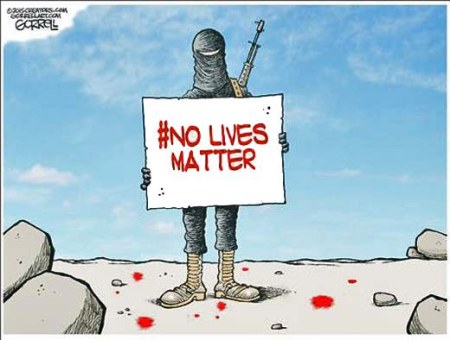
no-lives

H/t Freedom is just another word

war-on
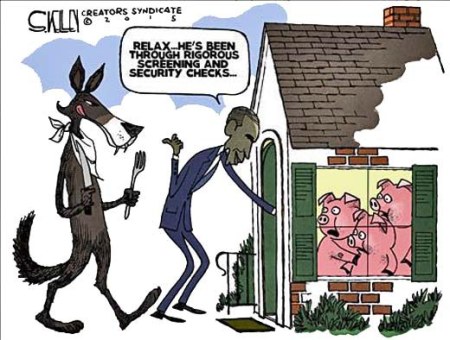
screening

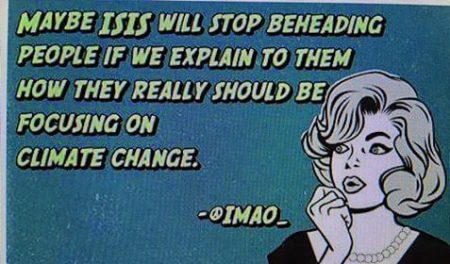
maybe

The West has developed a dangerous concern for ‘proportionality.’

October 20, 2015

The West has developed a dangerous concern for ‘proportionality.’ National Review, Victor Davis Hanson, October 20, 2015

The question is not only whether the Obama administration, in private, favors the cause of the radical Palestinians over a Western ally like Israel, but also whether it is even intellectually and morally capable of distinguishing a democratic state that protects human rights from a non-democratic, authoritarian, and terrorist regime that historically has hated the West, and the United States in particular — and is currently engaged in clear-cut aggression.

**************************

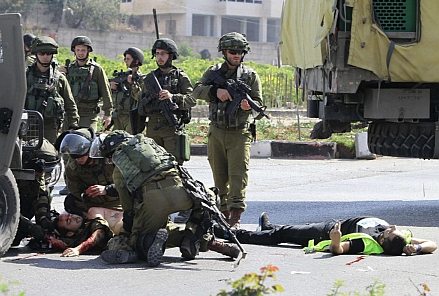
In the current epidemic of Palestinian violence, scores of Arab youths are attacking, supposedly spontaneously, Israeli citizens with knives. Apparently, edged weapons have more Koranic authority, and, in the sense of media spectacle, they provide greater splashes of blood. Thus the attacker is regularly described as “unarmed” and a victim when he is “disproportionately” stopped by bullets.

The Obama State Department has condemned the use of “excessive” Israeli force in response to Palestinian terrorism. John Kirby, the hapless State Department spokesman, blamed “both” sides for terrorism, and the president himself called on attackers and their victims to “tamp down the violence.”

In short, the present U.S. government — which is subsidizing the Palestinians to the tune of hundreds of millions of dollars a year — is incapable of distinguishing those who employ terrorist violence from the victims against whom the terrorism is directed. But why is the Obama administration — which can apparently distinguish those who send out drones from those who are blown up by them on the suspicion of employing terrorist violence — morally incapable of calling out Palestinian violence? After all, in the American case, we blow away suspects whom we think are likely terrorists; in the Israeli instance, they shoot or arrest those who have clearly just committed a terrorist act.

Two reasons stand out.

One, Obama’s Middle East policies are in shambles. Phony red lines, faux deadlines, reset with Putin, surrendering all the original bargaining chips in the Iranian deal, snubbing Israel, cozying up to the Muslim Brotherhood, dismissing the threat of ISIS, allowing Iraq to collapse by abruptly pulling out all American troops, giving way to serial indecision in Afghanistan, ostracizing the moderate Sunni regimes, wrecking Libya, and setting the stage for Benghazi — all of these were the result of administration choices, not fated events. One of the results of this collapse of American power and presence in the Middle East is an emboldened Palestinian movement that has recently renounced the Oslo Accords and encouraged the offensive of edged weapons.

Mahmoud Abbas, the subsidized president of the self-proclaimed Palestinian State, and his subordinates have sanctioned the violence. Any time Palestinians sense distance between the U.S. and Israel, they seek to widen the breach. When the Obama team deliberately and often gratuitously signals its displeasure with Israel, then the Palestinians seek to harden that abstract pique into concrete estrangement.

Amid such a collapse of American power, Abbas has scanned the Middle East, surveyed the Obama pronouncements — from his initial Al Arabiya interview and Cairo speech to his current contextualizations and not-so private slapdowns of Netanyahu — and has wagered that Obama likes Israel even less than his public statements might suggest. Accordingly, Abbas assumes that there might be few consequences from America if he incites another “cycle of violence.”

The more chaos there is, the more CNN videos of Palestinian terrorists being killed by Israeli civilians or security forces, the more NBC clips of knife-wielding terrorists who are described as unarmed, and the more MSNBC faux maps of Israeli absorption of Palestine, so all the more the Abbas regime and Hamas expect the “international community” to force further Israeli concessions. The Palestinians hope that they are entering yet another stage in their endless war against Israel. But this time, given the American recessional, they have new hopes that the emerging Iran–Russia–Syria–Iraq–Hezbollah axis could offer ample power in support of the violence and could help to turn the current asymmetrical war more advantageously conventional. The Palestinians believe, whether accurately or not, that their renewed violence might be a more brutal method of aiding the administration’s own efforts to pressure the Israelis to become more socially just, without which there supposedly cannot be peace in the Middle East.

But there is a second, more general explanation for the moral equivalence and anemic response from the White House. The Obama “we are the ones we’ve been waiting for” administration is the first postmodern government in American history, and it has adopted almost all the general culture’s flawed relativist assumptions about human nature.

Affluent and leisured Western culture in the 21st century assumes that it has reached a stage of psychological nirvana, in which the Westernized world is no longer threatened in any existential fashion as it often was in the past. That allows Westerners to believe that they no longer have limbic brains, and so are no longer bound by Neanderthal ideas like deterrence, balance of power, military alliances, and the use of force to settle disagreements. Their wealth and technology assure them that they are free, then, to enter a brave new world of zero culpability, zero competition, and zero hostility that will ensure perpetual tranquility and thus perpetual enjoyment of our present material bounty.

Our children today play tee-ball, where there are no winners and losers — and thus they are schooled that competition is not just detrimental but also can, by such training, be eliminated entirely. Our adolescents are treated according to the philosophy of “zero tolerance,” in which the hero who stops the punk from bullying a weaker victim is likewise suspended from school. Under the pretense of such smug moral superiority, our schools have abdicated the hard and ancient task of distinguishing bad behavior from good and then proceeding with the necessary rewards and punishments. Our universities have junked military history, which schooled generations on how wars start, proceed, and end. Instead, “conflict resolution and peace studies” programs proliferate, in which empathy and dialogue are supposed to contextualize the aggressor and thus persuade him to desist and seek help — as if aggression, greed, and the desire for intimidation were treatable syndromes rather than ancient evils that have remained dangerous throughout history.

Human nature is not so easily transcended, just because a new therapeutic generation has confused its iPhone apps and Priuses with commensurate moral and ethical advancement. Under the canons of the last 2,500 years of Western warfare, disproportionality was the method by which aggressors were either deterred or stopped. Deterrence — which alone prevented wars — was predicated on the shared assumption that starting a conflict would bring more violence down upon the aggressor than he could ever inflict on his victim. Once lost, deterrence was restored usually by disproportionate responses that led to victory over and humiliation of the aggressive party.

The wreckage of Berlin trumped anything inflicted by the Luftwaffe on London. The Japanese killed fewer than 3,000 Americans at Pearl Harbor; the Americans killed 30 times that number of Japanese in a single March 10, 1945, incendiary raid on Tokyo. “They have sown the wind, and they shall reap the whirlwind” was the standard philosophy by which aggressive powers were taught never again to start hostilities. Defeat and humiliation led to peace and reconciliation.

The tragic but necessary resort to disproportionate force by the attacked not only taught an aggressor that he could not win the fight he had started, but also reminded him that his targeted enemy might not be completely sane, and thus could be capable of any and all retaliation.

Unpredictability and the fear sown by the unknown also help to restore deterrence, and with it calm and peace. In contrast, predictable, proportionate responses can reassure the aggressor that he is in control of the tempo of the war that he in fact started. And worse still, the doctrine of proportionality suggests that the victim does not seek victory and resolution, but will do almost anything to return to the status quo antebellum — which, of course, was disadvantageous and shaped by the constant threat of unexpected attack by its enemies.

Applying this to the Middle East, the Palestinians believe that the new American indifference to the region and Washington’s slapdowns of Netanyahu have reshuffled relative power. They now hope that there is no deterrent to violence and that, if it should break out, there will be only a proportionate and modest response from predictable Westerners.

Under the related doctrine of moral equivalence, Westerners are either unwilling or unable to distinguish the more culpable from the more innocent. Instead, because the world more often divides by 55 to 45 percent rather than 99 to 1 percent certainty, Westerners lack the confidence to make moral judgments — afraid that too many critics might question their liberal sensitivities, a charge that in the absence of dearth, hunger, and disease is considered the worst catastrophe facing an affluent Western elite.

The question is not only whether the Obama administration, in private, favors the cause of the radical Palestinians over a Western ally like Israel, but also whether it is even intellectually and morally capable of distinguishing a democratic state that protects human rights from a non-democratic, authoritarian, and terrorist regime that historically has hated the West, and the United States in particular — and is currently engaged in clear-cut aggression.

Cartoon of the day

October 17, 2015

H/t Power Line

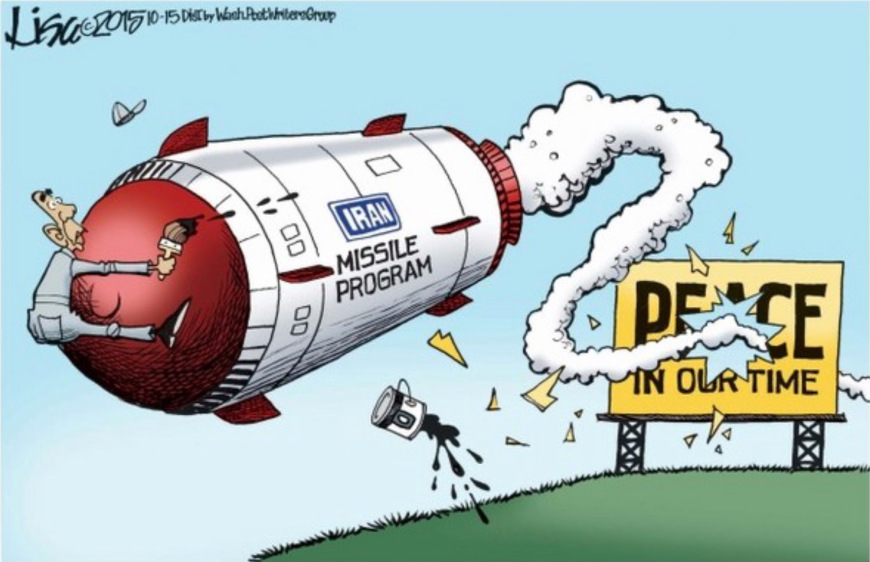
Obama-Missile-copy

Propaganda!

October 17, 2015

Propaganda! Gates of ViennaMC, October 16, 2015

stabbingisrael

So we are told endlessly that Islam is a ‘religion of peace’, and that the flood of Islamic warriors knocking at the gates of Europe consists of ‘refugees’ fleeing war. And you know what? It works. Germans (and Swedes) are already swamped, overwhelmed even, but thanks to effective propaganda they do not see the truth before their eyes. However, the indigenous poor are less distracted. They have to live with the filth and violence, but they have no voice; they are shouted down as ‘racist’ and offered no platform.

It is propaganda at play which keeps the Merkels and Obamas of this world in power. Truth is hidden behind a smokescreen of mendacious words: words such as ‘hope’, ‘change’, ‘progress’, ‘liberal’, ‘Democrat’ and ‘Republican’. These words have become Orwellian doublespeak, a stinking hole of corruption, a rotten miasma emanating from a mass grave — ours!

*************************************

I get very bored when people tell me (which is often) that “Israel murders Palestinians”. Whilst it is true that Palestinians get murdered in Israel, what this statement fails to comprehend is that Israelis get gaoled for murdering anybody, including Palestinians, as in any civilized Western country, but unlike most Middle Eastern countries including the Palestinian Authority (PA).

The difference here is the relentless propaganda to demonise Israel.

Jews have been demonised down through the centuries; it is a historical fact. Every evil regime persecutes Jews, and in every aspiring evil regime, there is an increase in the persecution of Jews.

That said, most people are not born with Jew-hatred embedded in their psyche. It is placed there by nurture, which is essentially propaganda.

Jews particularly open themselves to negative propaganda. A minority of Jews are arrogant and self-righteous in a singularly narrow and offensive way, as can be seen from recent comments on this website. They, too, are mostly reacting to propaganda. They expect tolerance, but are not prepared to be tolerant in return.

It is this dichotomy which is at the heart of the East-West problem. In the West we are all taught to tolerate other people’s peccadilloes (within reason), but this does not tend to occur elsewhere, and certainly not in the Middle East.

Intolerance is a human emotion based on fear, it is thus a prime target of propaganda. Has a ‘white African” president of the USA increased or decreased racial tensions in the USA?

When a President says one thing (“I am a Christian”) but acts like he is a Muslim, it causes confusion and fear. We then need oceans of propaganda and not a little dissimulation to patch the gaping hole in his credibility. As an outsider, one gets the impression that the real, actual ruler of the USA is the (possibly criminal) Islamic organisation CAIR, and that the citizens of the USA are fed layer upon layer of lies and trickery to ensure the current political status quo. A status quo of a non-violent coup d’état.

Propaganda as such started in the UK. In 1906 the British Government did a secret deal with France calling for the UK to side with France in the case of another war with Germany. It should be remembered that relations between UK and France had been hostile for centuries, and after the Fashoda incident; not particularly warm, so this deal was kept under wraps.

When the time came for fulfilment of this obligation in 1914, the UK government had to ‘cover up’ its motives, so they created the ‘poor little Belgium’ story of rape and pillage by German soldiers.

Thus Britain went to war on the back of lies and deceit, and many young men paid for it with their lives.

In 1919 Edward Bernays basically merged propaganda and commercial advertising, using various manipulative techniques to ‘bend’ public perception on issues such as women smoking in public. The idea was to get you, the victim, to spend your money on something you would not normally spend it on.

With the advent of radio, advertising (and thus propaganda) became big business.

Political propaganda grew alongside of commercial propaganda. The human brain is wired such that we are creatures of habit, and this can be used for propagandistic purposes. If, by constant repetition, a meme, true or false, is embedded in the brain, it becomes a truism. Thus most people can be cynically manipulated, for example, to equate Jews (Israelis) with rats, and subsequently be convinced of the need for pest control. The rest is history.

So we are told endlessly that Islam is a ‘religion of peace’, and that the flood of Islamic warriors knocking at the gates of Europe consists of ‘refugees’ fleeing war. And you know what? It works. Germans (and Swedes) are already swamped, overwhelmed even, but thanks to effective propaganda they do not see the truth before their eyes. However, the indigenous poor are less distracted. They have to live with the filth and violence, but they have no voice; they are shouted down as ‘racist’ and offered no platform.

So how did ‘racism’ become the number one social crime? The answer lies in the spin given to Nazi doctrine in the immediate postwar period. The German people were taught by the Nazi propaganda ministry to ‘blame’ their hardships on Jewish bankers and capitalists, especially the defeat in 1918. Yes, the racism behind this was very old and already embedded in society; all that was needed was for the blame to be projected onto all Jews, not on those who were actually guilty (as, of course, a few were, along with their many non-Jewish colleagues). It was also necessary to demonize Slavs, as it was their lands that were required as lebensraum, the expansion of Aryan Germany into their god-given rightful living space.

At the same time as the Nazis were manipulating Germans, the Russian KGB was penetrating the media and education systems of the free Western world. In the immediate postwar period, the benign racism of the interwar period was amplified, by continuous distortion of the Nazi example, into the number one ‘hate crime’ of postmodernism. Nazi racism was focused on political and social need; modern ‘racism’ is a whites-only crime focused on the political needs of the KGB and its cultural Marxist successors.

The demise of Western cultures is predicated by the fear of the accusation of ‘racism’, with its negative associations with Nazism. This is the overarching victory of modern propaganda. It is this set of distortions that projects guilt onto an otherwise rational target group. I am not guilty of ‘white supremacy’, because the whole premise of the accusation of white supremacy is built upon the idea that we are all born equal, and that all cultures are equal. This concept is unproven, and moreover cannot be proven — except, that is, by propaganda. It is the product of a very clever and cynical set of lies and distortions aimed at bringing down Judeo-Christianity, the very root of Western success.

Part and parcel of modern propaganda technique is the necessity of omission. Whilst facts can be reported as such, the omission of pertinent data can render the report truthful but dishonest. So we see with the reporting in Germany of conditions in areas invaded by the latest wave of migrants. How is the Goebbels-era reporting of Jewish issues any different to the Merkel era reporting of immigration issues? One was negative and invented lies, the other was positive — because it left out anything derogatory — thus creating an untruth. The Goebbels lies preceded a war. What will be the result of the Merkel distortions?

The German people have just been shafted to the tune of hundreds of billions of Euros: the cost of open borders. And over the next ten years Merkel’s migrant lies are going to cost many more trillions of euros. One guess as to who will have to pay.

Hitler’s socialism was very expensive, for which reason he had to acquire the gold reserves of Austria, Czechoslovakia and Poland. How will Merkel cope?

It is propaganda at play which keeps the Merkels and Obamas of this world in power. Truth is hidden behind a smokescreen of mendacious words: words such as ‘hope’, ‘change’, ‘progress’, ‘liberal’, ‘Democrat’ and ‘Republican’. These words have become Orwellian doublespeak, a stinking hole of corruption, a rotten miasma emanating from a mass grave — ours!

Does the PA have a strategy?‎

October 11, 2015

Does the PA have a strategy?‎ Israel Hayom, Richard Baehr, October 11, 2015

Abbas may sense that a reconciliation between Israel and the ‎Obama administration is not at hand this time around. The obvious and petty ‎boycott of Netanyahu’s speech at the U.N. certainly supports that thesis. This president ‎carries grudges. In Israel’s case, he seems to have come into office carrying one. ‎With the president in full-time legacy-building mode in his last 16 months in office ‎‎(the climate treaty and executive action on gun control are next up), it is hard to ‎believe that he will simply accept defeat and an inability to influence the Israeli-‎Palestinian conflict in the time he has left. ‎

************************

A third intifada has not yet been officially designated by Haaretz or The New York ‎Times or National Public Radio, though it may feel as if one is underway, when ‎over 60% of Israelis in the latest public opinion survey say they now fear for their ‎personal safety. So too, there is no evidence yet that the wave of Palestinian ‎attacks or — new to this current campaign — the attempted mass crossings from Gaza, ‎have peaked. ‎

Certainly, the reporting on the current events in Israel reflects old habits about ‎how most journalists cover stories of Palestinian violence and Israeli responses. ‎Two standbys always work. One if that there is “a cycle of violence” ( a pox on both ‎your houses), always leaving unclear who the original perpetrators were in an ‎individual attack or group of attacks. A second is to keep a daily scorecard of the ‎comparative body counts, especially when there are more Palestinian casualties ‎and fatalities than Israeli, courtesy of Israeli police or soldiers responding to ‎stabbing attacks, not all of which prove lethal before the attacker is neutralized. ‎This narrative leads to the inevitable charge of disproportionality, one that has ‎become the principal media assault on Israeli responses to terror emanating from ‎Gaza in recent years. As in every other instance in recent years, Haaretz is playing ‎its appointed role of feeding the many international journalists in the country with ‎the “truth in English” as it sees it, and as the international media want to receive ‎and see it, confirming all their established biases about Israel behavior.

For Israeli ‎responses to the current violence to be “fair” and proportional, the comparative ‎Jewish and Arab body counts would need to be more in balance than in prior ‎years. When the current campaign of attacks on Israelis began, The New York Times ‎relegated the story to it its interior pages. Once a few Palestinians were killed by ‎Israeli police, the story became front page news.‎

Any attack on Arabs by an Israeli is always highlighted since it removes any ‎attempt by Israel to argue it is the victim of attacks. It also buttresses the PA’s ‎charges that Israelis, whether in security roles or settlers, are willing executioners, ‎committing crimes against Palestinians. Regardless of how infrequent these individual attacks by Israelis ‎are, they serve to solidify the cycle of violence theme. The Israeli government can ‎condemn these attacks and capture the perpetrators, but it makes no difference. ‎The PA, meanwhile, will applaud the heroism of their new martyrs protecting the ‎holy places on the Temple Mount from an invasion of stinking Jewish filth.‎

The current wave of Arab attacks followed a Palestinian Authority incitement ‎campaign with language such as that above, in which President Mahmoud Abbas, ‎seemingly the president for life, though only elected to a four year term, ‎condemned Israel’s campaign to change the status of the Temple Mount, for which ‎there is no evidence whatsoever. U.S. Secretary of State John Kerry, probably in ‎seclusion and being treated with antidepressants since being denied the Nobel ‎Peace Prize for his abject surrender to the Iranians in Geneva, has acknowledged ‎to Israeli Prime Minister Benjamin Netanyahu that the Americans understand there is no ‎Israeli effort underway to reshape any policy regarding behavior on the Temple ‎Mount. Kerry can probably blame Yasser Arafat’s Nobel Peace Prize for the peace ‎prize medal he did not receive (and likely would not have tossed away). The ‎selection committee was probably not anxious to have the Iranians make them look ‎like fools in years to come once they violated the nuclear deal as Arafat tossed Oslo ‎aside when it was inconvenient. ‎

The naked demagoguery of Abbas’ continually repeated lies about Israeli plans for ‎the Temple Mount will always have the desired affect on the many young men on ‎whom the PA can depend to take to the streets and do their part to protect the ‎‎”holy places” for a fee. While there is no consensus on the degree of PA control ‎over the attacks, the Palestinians certainly know where their rhetoric leads.‎

The question, though, is why the Palestinians have chosen this point in time to ‎overheat the situation, resulting in the loss of both Israeli and Palestinian lives.‎

The answer offered by most analysts so far is that the PA wanted to draw ‎international attention back to its grievances with Israel, which most basically ‎begins with the continued existence of the State of Israel. For many months, ‎relations between Israel and the United States, never very good at any time during ‎the Obama years, have become much more fractious as a result of the ‎disagreement between the two countries over the wisdom of America’s ‎spearheading the effort to make all the concessions required as achieve the ‎nuclear deal with Iran by the ‎P5+1 group of nations. ‎

In prior administrations, when relations between the two countries hit a rough ‎patch over some policy disagreement, typically there was an effort made by both ‎parties to try to restore the historic relationship. In the Obama years, the White ‎House has had problems with Israel on pretty much everything — whether to ‎impose new sanctions on Iran, inhibiting Israeli steps targeting Iran’s nuclear ‎program, the nuclear deal itself, and of course the peace process with the ‎Palestinians, the breakdown of which was blamed on Israel by the administration. ‎In no prior administration has the public rhetoric and off-the-record commentary ‎about Israel and its elected leader been so consistently hostile. A boycott of Netanyahu’s speech to a joint meeting of Congress was supported by the ‎administration, which pulled Vice President Joe Biden from attendance. Near a quarter ‎of all Democrats in Congress chose to observe the boycott. The administration ‎doubled down on its boycott campaign when Kerry and ‎Ambassador Samantha Power were instructed not to attend ‎Netanyahu’s recent speech to the U.N. General Assembly. It makes sense that the president has never condemned the Boycott, Divestment and Sanctions campaigns targeting Israel on American ‎college campuses. He would probably be leading them if he were now a student. ‎

In any case, Abbas may sense that a reconciliation between Israel and the ‎Obama administration is not at hand this time around. The obvious and petty ‎boycott of Netanyahu’s speech at the U.N. certainly supports that thesis. This president ‎carries grudges. In Israel’s case, he seems to have come into office carrying one. ‎With the president in full-time legacy-building mode in his last 16 months in office ‎‎(the climate treaty and executive action on gun control are next up), it is hard to ‎believe that he will simply accept defeat and an inability to influence the Israeli-‎Palestinian conflict in the time he has left. ‎

Abbas has resorted to the strategy that always works to get his cause back in the ‎news — get some of his people killed by Israel, and blame it on Israeli over-reaction ‎and trigger-happy behavior. Maybe Obama will then show his disgust with Israel ‎and commit to not vetoing new measures targeting Israel at the U.N. Security ‎Council, including establishing a plan for Israeli withdrawal from the West Bank ‎and Jerusalem. ‎

It is also possible that Obama planned to lower the temperature of the American-‎Israeli relationship now that the Iran deal had not been blocked by Congress. The prime minister had been invited to the White House next month, and reportedly ‎the president planned to show up. If Abbas thought this was the new glide path, ‎then throwing a monkey wrench into the mix with new violence would certainly ‎complicate things. Obama’s press secretary, Josh Earnest, gave a particularly awful ‎response when questioned about the new wave of Palestinian violence this week, ‎suggesting he had not been advised to turn any page:‎

“The United States condemns in the strongest possible terms ‎violence against Israeli and Palestinian civilians. We call upon ‎all parties to take affirmative steps to restore calm and refrain ‎from actions and rhetoric that would further enflame tensions ‎in that region of the world. We continue to urge all sides to find ‎a way back to the full restoration of the status quo at the ‎Temple Mount in Haram al-Sharif, the location that has ‎precipitated so much of the violence that we’ve seen there.”

In other words, both sides are guilty for attacking the other’s ‎civilians, and somehow a change in the status of the Temple ‎Mount (Israel’s doing) was the root cause of the new problems. ‎

When the administration’s top spokesperson makes this kind ‎of comment, do you think Abbas will decide to ease ‎up on the violence accelerator?

Op-Ed: Chaos and 2nd Cold War, Part II: Israel’s Nuclear Strategy

October 11, 2015

Op-Ed: Chaos and 2nd Cold War, Part II: Israel’s Nuclear Strategy, Israel National News, Prof. Louis René Beres, October 11, 2015

(Part I is available here. — DM)

Israel should now be calculating the exact extent or subtlety with which it should consider communicating key portions of its nuclear posture and positions. Naturally, Israel should never reveal any too-specific information about its nuclear strategy, its nuclear hardening, or even its nuclear yield-related capabilities. Still, sometimes, the duty of finely-honed intelligence services should not be to maximize strategic secrecy, but rather, to carefully “share” certain bits of pertinent information.

**********************************

How will Russia respond to any ramped up American uses of force in the Middle East, and, more plausibly, vice-versa?  One must assume that Jerusalem is already asking these key questions, and even wondering whether, in part, greater mutualities of interest could sometime exist with Moscow than with Washington.

To wit, Prime Minister Benjamin Netanyahu met with Russia’s President Vladimir Putin in September 2015. Among other things, the Israeli leader must  be calculating: 1)Will the Obama Administration’s incoherent retreat from most of the Middle East point toward a more permanent United States detachment from the region; and 2) If it does, what other major powers are apt to fill the resultant vacuum? Just as importantly, and as an obvious corollary to (2), above, the prime minister should be inquiring: “How will the still-emerging Cold War II axis of conflict impact America’s pertinent foreign policy decisions?”

There are some additional ironies yet to be noted. Almost certainly, ISIS, unless it is first crushed by U.S. and/or Russian-assisted counter-measures, will plan to march westward across Jordan, ultimately winding up at the borders of West Bank (Judea/Samaria). There, ISIS Jihadists could likely make fast work of any still-posted Hamas and Fatah forces, in effect, taking over what might once have become “Palestine.” In this now fully imaginable scenario, the most serious impediment to Palestinian statehood is not Israel, but rather a murderous band of Sunni Arab terrorists.[16]

What about the larger picture of “Cold War II?” Israeli defense planners will need to factor into their suitably nuanced calculations the dramatically changing relationship between Washington and Moscow. During “Cold War I,” much of America’s support for the Jewish State had its most fundamental origins in a perceived need to compete successfully in the Middle East with the then Soviet Union. In the progressive development of “Cold War II,” Jerusalem will need to carefully re-calculate whether a similar “bipolar” dynamic is once again underway, and whether the Russian Federation might, this time around, identify certain strategic benefits to favoring Israel in regional geo-politics.

In all such strategic matters, once Israel had systematically sorted through the probable impact of emerging “superpower” involvements in the Middle East, Jerusalem would need to reassess its historic “bomb in the basement.” Conventional wisdom, of course, has routinely pointed in a fundamentally different policy direction. Still, this “wisdom” assumes that credible nuclear deterrence is simply an automatic result of  physically holding nuclear weapons. By the logic of this too-simplistic argument, removing Israel’s nuclear bomb from the “basement” would only elicit new waves of global condemnation, and would likely do so without returning any commensurate security benefits to Jerusalem.

Scholars know, for good reason, that the conventional wisdom is often unwise. Looking ahead, the strategic issues facing Israel are not at all uncomplicated or straightforward.  Moreover, in the immutably arcane world of Israeli nuclear deterrence, it can never really be adequate that enemy states merely acknowledge the Jewish State’s nuclear status. Rather, it is also important that these states should be able to believe that Israel holds usable nuclear weapons, and that Jerusalem/Tel-Aviv would be willing to employ these usable weapons in certain clear, and situationally recognizable, circumstances.

Current instabilities in the Middle East will underscore several good reasons to doubt that Israel could ever benefit from any stubborn continuance of deliberate nuclear ambiguity. It would seem, too, from certain apparent developments already taking place within Mr. Netanyahu’s “inner cabinet,” that portions of Israel’s delegated leadership must now more fully understand the bases of any such informed skepticism.

In essence, Israel is imperiled by compounding and inter-related existential threats that justify its fundamental nuclear posture, and that require a correspondingly purposeful strategic doctrine. This basic need exists well beyond any reasonable doubt. Without such weapons and doctrine, Israel could not expectedly survive over time, especially if certain neighboring regimes, amid expanding chaos,  should soon become more adversarial, more Jihadist, and/or less risk-averse.

Incontestably, a purposeful nuclear doctrine could prove increasingly vital to coping with various more-or-less predictable strategic scenarios for Israel, that is, those believable narratives requiring preemptive action, and/or an appropriate retaliation.

Typically, military doctrine carefully describes how national forces should fight in various combat operations. The literal definition of “doctrine” derives from Middle English, from the Latin doctrina, meaning teaching, learning, andinstruction. Though generally unrecognized, the full importance of doctrine lies not only in the several ways that it can animate and unify military forces, but also in the uniquely particular fashion that it can transmit certain desired “messages.”

In other words, doctrine can serve an increasingly imperiled  state as a critical form of communication, one directed to its friends, and also to its foes.

Israel can benefit from just such broadened understandings of doctrine. The principal security risks now facing Israel are really more specific than general or generic. This is because Israel’s extant adversaries in the region will likely be joined, at some point, by: (1) a new Arab state of “Palestine;” and/or by (2) a newly-nuclear Iran. It is also because of the evidently rekindled global spark of “bipolar” or “superpower” adversity, and the somewhat corollary insertion of additional American military forces to combat certain new configurations of Jihadi terror.

For Israel, merely having nuclear weapons, even when fully recognized in broad outline by enemy states, can never automatically ensure successful deterrence. In this connection, although starkly counter-intuitive, an appropriately selective and thoughtful end to deliberate ambiguity could improve the overall credibility of Israel’s nuclear deterrent.  With this point in mind, the potential of assorted enemy attack prospects in the future could be reduced by making available certain selected information concerning the safety of  Israel’s nuclear weapon response capabilities.

This crucial information, carefully limited, yet more helpfully explicit, would center on the distinctly major and inter-penetrating issues of Israeli nuclear capability and decisional willingness.

Skeptics, no doubt, will disagree. It is, after all, seemingly sensible to assert that nuclear ambiguity has “worked” thus farWhile Israel’s current nuclear policy has done little to deter multiple conventional terrorist attacks, it has succeeded in keeping the country’s enemies, singly or in collaboration, from mounting any authentically existential aggressions. This conclusion is not readily subject to any reasonable disagreement.

But, as the nineteenth-century Prussian strategic theorist, Karl von Clausewitz, observed, in his classic essay, On War, there may come a military tipping point when “mass counts.” Israel is already coming very close to this foreseeable point of no return. Israel is very small.  Its enemies have always had an  undeniable advantage in “mass.”

More than any other imperiled state on earth, Israel needs to steer clear of such a tipping point.

This, too, is not subject to any reasonable disagreement.

Excluding non-Arab Pakistan, which is itself increasingly coup-vulnerable, none of Israel’s extant Jihadi foes has “The Bomb.”  However, acting together, and in a determined collaboration, they could still carry out potentially lethal assaults upon the Jewish State. Until now, this capability had not been possible, largely because of insistent and  persistently overriding fragmentations within the Islamic world. Looking ahead, however, these same fragmentations could sometime become a source of special danger to Israel, rather than remain a continuing source of  national safety and reassurance.

An integral part of Israel’s multi-layered security system lies in the country’s ballistic missile defenses, primarily, the Arrow or “Hetz.” Yet, even the well-regarded and successfully-tested Arrow, now augmented by the newer and shorter-range iterations of “Iron Dome,” could never achieve a sufficiently high probability of intercept to meaningfully protect Israeli civilians.[17] No system of missile defense can ever be “leak proof,” and even a single incoming nuclear missile that somehow managed to penetrate Arrow or corollary defenses could conceivably kill tens or perhaps hundreds of thousands of Israelis.[18]

In principle, at least, this fearsome reality could be rendered less prospectively catastrophic if Israel’s traditional reliance on deliberate ambiguity were suitably altered.

Why alter? The current Israeli policy of an undeclared nuclear capacity is unlikely to work indefinitely. Leaving aside a Jihadi takeover of already-nuclear Pakistan, the most obviously unacceptable “leakage” threat would come from a nuclear Iran. To be effectively deterred, a newly-nuclear Iran would require convincing assurance that Israel’s atomic weapons were both (1) invulnerable, and (2) penetration-capable.

Any Iranian judgments about Israel’s capability and willingness to retaliate with nuclear weapons would then depend largely upon some prior Iranian knowledge of these weapons, including their expected degree of protection from surprise attack, as well as Israel’s expected capacity to “punch-through” all pertinent Iranian active and passive defenses.

Jurisprudentially, at least, following JCPOA in Vienna, a  nuclear weapons-capable Iran is a fait accompli. For whatever reasons, neither the “international community” in general, nor Israel in particular, had ever managed to create sufficient credibility concerning a once-timely preemptive action. Such a critical defensive action would have required very complex operational capabilities, and could have generated Iranian/Hezbollah counter actions that might have a  very significant impact on the entire Middle East. Nevertheless, from a purely legal standpoint, such preemptive postures could still have been justified, under the authoritative criteria of anticipatory self-defense, as permitted under customary international law.

It is likely that Israel has undertaken some very impressive and original steps in cyber-defense and cyber-war, but even the most remarkable efforts in this direction will not be enough to stop Iran altogether. Earlier, the “sanctions” sequentially leveled at Tehran – although certainly better than nothing – could have had no tangible impact on effectively halting Iranian nuclearization.

Strategic assessments can sometimes borrow from a Buddhist mantra. What is, is. Ultimately, a nuclear Iran could decide to share some of its nuclear components and materials with Hezbollah, or with another kindred terrorist group. Ultimately, amid growing regional chaos, such injurious assets could find their way to such specifically U.S- targeted groups as ISIS.

Where relevant, Israeli nuclear ambiguity could be loosened by releasing certain very general information regarding the availability and survivability of appropriately destructive  nuclear weapons.

Israel should now be calculating the exact extent or subtlety with which it should consider communicating key portions of its nuclear posture and positions. Naturally, Israel should never reveal any too-specific information about its nuclear strategy, its nuclear hardening, or even its nuclear yield-related capabilities. Still, sometimes, the duty of finely-honed intelligence services should not be to maximize strategic secrecy, but rather, to carefully “share” certain bits of pertinent information.

What about irrational enemies? An Israeli move from ambiguity to disclosure would not likely help in the case of an irrational nuclear enemy. It is even possible, in this regard, that particular elements of Iranian leadership might meaningfully subscribe to certain end-times visions of a Shiite apocalypse. By definition, any such enemy would not necessarily value its own continued national survival more highly than any other national preference, or combination of preferences. By definition, any such enemy would present a genuinely unprecedented strategic challenge.

Were its leaders to become authentically irrational, or to turn in expressly non-rational directions, Iran could then effectively become a nuclear suicide-bomber in macrocosm.  Such a profoundly destabilizing strategic prospect is improbable, but it is also not inconceivable. A similarly serious prospect exists in already-nuclear Pakistan.

To protect itself against military strikes from irrational enemies, especially those attacks that could carry existential costs, Israel will need to reconsider virtually every aspect and function of its nuclear arsenal and doctrine. This is a strategic reconsideration that must be based upon a number of bewilderingly complex intellectual calculations, and not merely on ad hoc, and more-or-less presumptively expedient political judgments.

Removing the bomb from Israel’s basement could enhance Israel’s strategic deterrence to the extent that it would heighten enemy perceptions of the severe and likely risks involved. This would also bring to mind the so-called Samson Option, which, if suitably acknowledged, could allow various enemy decision-makers to note and underscore a core assumption. This is that Israel is prepared to do whatever is needed to survive. Interestingly, such preparation could be entirely permissible under governing international law, including the 1996 Advisory Opinion of the International Court of Justice.[19]

Irrespective of  its preferred level of ambiguity, Israel’s nuclear strategy must always remain oriented toward deterrence, not to actual war-fighting.[20] The Samson Option refers to a policy that would be based in part upon a more-or-less implicit threat of massive nuclear retaliation for certain anticipated enemy aggressions.  Israel’s small size means, inter alia, that any nuclear attack would threaten Israel’s very existence, and could not be tolerated. Israel’s small size also suggests a compelling need for sea-basing (submarines) at least a recognizably critical portion of its core nuclear assets,

From a credibility standpoint, a Samson Option could make sense only in “last-resort,” or “near last-resort,” circumstances. If the Samson Option is to be part of a convincing deterrent, as it should, an incremental end to Israel’s deliberate ambiguity is essential. The really tough part of this transformational process will lie in determining the proper timing for such action vis-a-vis Israel’s security requirements, and in calculating authoritative expectations (reasonable or unreasonable) of the “international community.”

The Samson Option should never be confused with Israel’s overriding security objective: To seek stable deterrence at the lowest possible levels of military conflict. As a last resort, it basically states the following warning to all potential nuclear attackers:  “We (Israel) may have to `die,` but (this time) we won’t die alone.”

There is a related observation. In our often counter-intuitive strategic world, it can sometimes be rational to pretend irrationality. The nuclear deterrence benefits of any such pretended irrationality would depend, at least in part, upon an enemy state’s awareness of Israel’s intention to apply counter-value targeting when responding to a nuclear attack. But, once again, Israeli decision-makers would need to be aptly wary of ever releasing too-great a level of specific operational information.

In the end, there are specific and valuable critical security benefits that would likely accrue to Israel as the result of a purposefully selective and incremental end to its historic policy of deliberate nuclear ambiguity.   The right time to begin such an “end”  has not yet arrived. But, at the precise moment that Iran verifiably crosses the nuclear threshold, or arguably just before this portentous moment, Israel should  promptly remove The Bomb from its “basement.”

When this critical moment arrives, Israel should already have configured (1) its presumptively optimal allocation of nuclear assets; and (2) the extent to which this preferred configuration should now be disclosed. Such strategic preparation could then enhance the credibility of Israel’s indispensable nuclear deterrence posture.

When it is time for Israel to selectively ease its nuclear ambiguity, a second-strike nuclear force should be revealed in broad outline. This robust strategic force – hardened, multiplied, and dispersed – would need to be fashioned so as to recognizably inflict a decisive retaliatory blow against major enemy cities. Iran, it follows, so long as it is led by rational decision-makers, should be made to understand that the actual costs of  any planned aggressions against Israel would always exceed any expected gains.

In the final analysis, whether or not a shift from deliberate ambiguity to some selected level of nuclear disclosure would actually succeed in enhancing Israeli nuclear deterrence would depend upon several complex and intersecting factors. These include, inter alia, the specific types of nuclear weapons involved; reciprocal assessments and calculations of pertinent enemy leaders; effects on rational decision-making processes by these enemy leaders; and effects on both Israeli and adversarial command/control/communications operations. If  bringing Israel’s bomb out of the “basement” were to result in certain new enemy pre-delegations of nuclear launch authority, and/or in new and simultaneously less stable launch-on-warning procedures, the likelihood of unauthorized and/or accidental nuclear war could then be substantially increased.

Not all adversaries may be entirely rational. To comprehensively protect itself against potentially irrational nuclear adversaries, Israel has no logical alternative to developing an always problematic conventional preemption option, and to fashion this together with a suitable plan for subsequent “escalation dominance.” Operationally, especially at this very late date, there could be no reasonable assurances of success against many multiple hardened and dispersed targets. Regarding deterrence, however, it is noteworthy that “irrational” is not the same as “crazy,” or “mad,” and that even an expectedly irrational Iranian leadership could still maintain susceptible preference orderings that are both consistent and transitive.

Even an irrational Iranian leadership could be subject to threats of deterrence that credibly threaten certain deeply held religious as well as civic values. The relevant difficulty here for Israel is to ascertain the precise nature of these core enemy values. Should it be determined that an Iranian leadership were genuinely “crazy” or “mad,” that is, without any decipherable or predictable ordering of preferences, all deterrence bets could then have to give way to preemption, and possibly even to certain plainly unwanted forms of war fighting.

Such determinations, of course, are broadly strategic, not narrowly jurisprudential. From the discrete standpoint of international law, especially in view of Iran’s expressly genocidal threats against Israel, a preemption option could still represent a permissible expression of anticipatory self-defense. Again, however, this purely legal judgment would be entirely separate from any parallel or coincident assessments of operational success. There would be no point for Israel to champion any strategy of preemption on solely legal grounds if that same strategy were not also expected to succeed in specifically military terms.

Growing chaotic instability in the Middle East plainly heightens the potential for expansive and unpredictable conflicts.[21] While lacking any obviously direct connection to Middle East chaos, Israel’s nuclear strategy must now be purposefully adapted to this perilous potential. Moreover, in making this adaptation, Jerusalem could also have to pay special attention not only to the aforementioned revival of  major “bipolar” animosities, but also, more specifically and particularly, to Russia’s own now-expanding nuclear forces.

This cautionary warning arises not because augmented and modernized Russian nuclear forces would necessarily pose any enlarged military threat to Israel directly, but rather because these strategic forces could determine much of the way in which “Cold-War II” actually evolves and takes shape. Vladimir Putin has already warned Washington of assorted “nuclear countermeasures,” and recently test launched an intercontinental nuclear missile.[22] One such exercise involved a new submarine-launched Bulava missile, a weapon that could deliver a nuclear strike with up to 100 times the force of the 1945 Hiroshima blast.

Current adversarial Russian nuclear posturing vis-à-vis the United States remains oriented toward the Ukraine, not the Middle East.[23] Nevertheless, whatever happens to U.S.-Russian relations in any one part of the world could carry over to certain other parts, either incrementally, or as distinctly sudden interventions or escalations. For Jerusalem, this means, among other things, an unceasing obligation to fashion its own developing nuclear strategy and posture with an informed view to fully worldwide power problems and configurations.

Whether looking toward Gaza, West Bank (Judea/Samaria), Iran, Lebanon, Iraq, Jordan, Egypt, or Syria, Israel will need to systematically prioritize existential threats, and, thereafter, stay carefully focused on critically intersecting and overriding factors of global and regional security. In all such meticulously careful considerations, both chaos and Cold War II should be entitled to occupy a conspicuous pride of place.

Sources:

[16] A further irony here concerns Palestinian “demilitarization,” a pre-independence condition of statehood called for by Israeli Prime Minister Benjamin Netanyahu. Should Palestinian forces (PA plus Hamas) ever actually choose to abide by any such formal legal expectation, it could makes these forces less capable of withstanding any foreseeable ISIS attacks. Realistically, however, any such antecedent compliance would be highly improbable. See, for earlier legal assessments of Palestinian demilitarization, Louis René Beres and (Ambassador) Zalman Shoval, “Why a Demilitarized Palestinian State Would Not Remain Demilitarized: A View Under International Law,” Temple International and Comparative Law Journal, Winter 1998, pp. 347-363; and Louis René Beres and Zalman Shoval, “On Demilitarizing a Palestinian `Entity’ and the Golan Heights: An International Law Perspective,” Vanderbilt Journal of Transnational Law, Vol. 28, No. 5, November 1995, pp. 959-972.

[17] There is another notable and more generic (pre-nuclear age) risk of placing too-great a reliance on defense. This is the risk that a corollary of any such reliance will be a prospectively lethal tendency to avoid taking otherwise advantageous offensive actions. Recall, in this connection, Carol von Clausewitz On War:  “Defensive warfare…does not consist of waiting idly for things to happen. We must wait only if it brings us visible and decisive advantages. That calm before the storm, when the aggressor is gathering new forces for a great blow, is most dangerous for the defender.” See: Carl von Clausewitz, Principles of War, Hans W. Gatzke, tr., New York: Dover Publications, 2003, p. 54.

[18] For early authoritative accounts, by the author, of expected consequences of a nuclear attack, see: Louis René Beres, Apocalypse: Nuclear Catastrophe in World Politics (Chicago: University of Chicago Press, 1980); Louis René Beres, Mimicking Sisyphus: America’s Countervailing Nuclear Strategy (Lexington, Mass., Lexington Books, 1983); Louis René Beres, Reason and Realpolitik: U.S. Foreign Policy and World Order (Lexington, Mass., Lexington Books, 1984); and Louis René Beres, Security or Armageddon: Israel’s Nuclear Strategy (Lexington, Mass., Lexington Books, 1986).

[19] See: “Summary of the Legality of the Threat or Use of Nuclear Weapons,” Advisory Opinion, 1996, I.C.J., 226 (Opinion of 8 July 1996). The key conclusion of this Opinion is as follows: “…in view of the current state of international law, and of the elements of fact at its disposal, the Court cannot conclude definitively whether the threat or use of nuclear weapons would be lawful or unlawful in an extreme circumstance of self-defense, in which the very survival of a State would be at stake.”

[20] This advice was a central recommendation of the Project Daniel Group’s final report,  Israel’s Strategic Future (ACPR, Israel, May 2004: “The overriding priority of Israel’s nuclear deterrent force must always be that it preserves the country’s security without ever having to be fired against any target. The primary point of Israel’s nuclear forces must always be deterrence ex ante, not revenge ex post.” (p. 11). Conceptually, the core argument of optimizing military force by not resorting to any actual use pre-dates the nuclear age. To wit, Sun-Tzu, in his ancient classic, The Art of War, counseled: “Supreme excellence consists of breaking the enemy’s resistance without fighting.”

[21] Once again, Prussian military thinker, Carl von Clausewitz, had already highlighted the generic (pre-nuclear age) dangers of unpredictability, summarizing these core hazards as matters of “friction.”

[22] ICBM test launches are legal and permissible under the terms of New START, It does appear, however,  that Russia has already developed and tested a nuclear-capable cruise missile with a range of 500-5500 KM, which would be in express violation of the Intermediate Nuclear Forces Treaty (INF). At the same time, current research into the U.S. Conventional Prompt Global Strike Program seeks to circle around INF Treaty limitations, by employing a delivery vehicle trajectory that is technically neither ballistic nor cruise.

[23] Russia, of course, is operating much more openly and substantially in Syria, but here, in the Middle East theatre, at least, Moscow’s public tone toward Washington is somewhat less confrontational or adversarial.


Op-Ed: Chaos and 2nd Cold War, Part I: Israel’s Nuclear Strategy

October 11, 2015

Op-Ed: Chaos and 2nd Cold War, Part I: Israel’s Nuclear Strategy, Israel National News,Prof. Louis René Beres, October 9, 2015

To fashion a functional nuclear strategy would be difficult for any state in world politics, but it could be especially challenging for one that keeps its bomb more-or-less securely “in the basement.” Now, as the Middle East descends into an ever more palpable chaos,[1] Israel will have to make certain far-reaching decisions on this very complex task.

Among other nuanced and widely intersecting concerns, Jerusalem’s decisions will need to account for a steadily hardening polarity between Russia and the United States.

Here, almost by definition, there will be no readily available guidebook to help lead the way. For the most part, Israel will need to be directed by an unprecedented fusion of historical and intellectual considerations. In the end, any resultant nuclear strategy will have to represent the prospective triumph of mind over mind, not merely of mind over matter.[2]

Conceivably, at least for the Jewish State that is smaller than America’s Lake Michigan, an emergent “Cold War II” could prove to be as determinative in shaping its national nuclear posture as coinciding regional disintegration. Still, a new Cold War need not necessarily prove disastrous or disadvantageous for Israel. It is also possible, perhaps even plausible, that Jerusalem could sometime discern an even greater commonality of strategic interest with Moscow, than with Washington.

To be sure, any such stark shift of allegiance in Israeli geo-political loyalties ought not to be intentionally sought, or in any way cultivated for its own sake. Moreover, on its face, it would currently be hard to imagine in Jerusalem that a superpower mentor of both Syria and Iran could somehow also find strategic common ground with Israel. Yet, in these relentlessly tumultuous times, any normally counter-intuitive judgments could, at least on rare occasions, prove surprisingly correct.

Credo quia absurdum. “I believe because it is absurd.” In these tumultuous times, certain once preposterous counter-intuitive judgments should no longer be dismissed out of hand. Moreover, in seeking to best understand the Israel-relevant dynamics of any renewed Washington-Moscow bipolar axis of conflict, Jerusalem will need to consider the prospects for a conceivably “looser” form of enmity.

In other words, looking ahead, it would seem realistic that a now “restored” superpower axis might nonetheless reveal greater opportunities for cooperation between the dominant “players.” Understood in the traditional language of international relations theory, this points toward a relationship that could become substantially less “zero-sum.”[3]

By definition, regarding zero-sum relationships in world politics, any one state’s gain is necessarily another state’s loss. But in Cold War II, it is reasonable to expect that the still-emerging axis of conflict will be “softer.” Here, for both major players, choosing a cooperative strategy could sometimes turn out to be judged optimal.[4]

Recognizing this core difference in superpower incentives from the original Cold War, and to accomplish such recognition in a timely fashion,  could prove vitally important for Israel. In essence, it could become a key factor in figuring out what should or should not be done by Jerusalem about any expected further increments of regional nuclear proliferation, and about Iran.

Iranian nuclearization remains the single most potentially daunting peril for Jerusalem. In this regard, virtually nothing has changed because of the recent Iran Nuclear Agreement (Joint Comprehensive Plan of Action, Vienna, 14 July, 2015).[5] To the contrary, in a situation fraught with considerable irony, Iran’s overall strategic latitude will actually have been expanded and improved by the terms of this concessionary pact.[6] Most plainly, these Iranian enhancements are the permissible result of a now no-holds-barred opportunity for transfer of multiple high-technology weapons systems, from Moscow to Tehran.

For the foreseeable future, the nuclear threat from Iran will continue to dwarf all other recognizable security threats.[7] At the same time, this enlarging peril could be impacted by certain multi-sided and hard to measure developments on the terrorism front.  In more precisely military terminology, these intersecting terror threats could function “synergistically,” or as so-called “force multipliers.”

The “whole” of the strategic danger now facing Israel is substantially greater than the simple arithmetic sum of its parts.[8] This true combination could include a persistently shifting regional “correlation of forces,”[9] one that would continue to oscillate menacingly, and also to the  observable benefit of Israel’s mortal enemies, both state and sub-state.

In Jerusalem and Tel-Aviv, serious derivative questions should now be addressed. What does this changing set of adversarial developments mean for Israel in very specifically operational and policy terms? Above all, this configuration of enmity should warn that a steady refinement and improvement of Israel’s nuclear strategy must be brought front and center. For Israel, there can be no other reasonable conclusion, not only because of ominous developments in Iran, but also because of the growing prospect of additional nuclear weapon states in the region, including perhaps Egypt, and/or Saudi Arabia.

Despite U.S. President Barack Obama’s continuing support for a “world free of nuclear weapons,” all of the world’s existing nuclear weapon states are already expanding and modernizing their nuclear arsenals. As of the end of September 2015, the world’s total inventory of nuclear warheads was reliably estimated as 17,000.[10] What Israel must also bear in mind is that this American president’s notion that nuclear weapons are intrinsically destabilizing, or even evil, makes no defensible intellectual sense.

It is plausible, rather, that only the perceived presence of nuclear weapons in the arsenals of both original superpowers prevented World War III. Equally convincing, Israel, without its atomic arsenal – whether ambiguous, or declared – could never survive, especially in a region that may soon combine further nuclear spread with steadily undiminished chaos.

Israel will have to decide, in prompt and sometimes inter-related increments, upon the precise extent to which the nation needs to optimize its composite national security policies on preemption, targeting, deterrence, war fighting, and active defense. A corollary imperative here must be to deal more purposefully with the complicated and politically stubborn issues of “deliberate ambiguity.” Going forward, it will not serve Israel’s best interests to remain ambiguous about ambiguity.

To date, at least, it seems that this longstanding policy of “opacity” (as it is also sometimes called) has made perfectly good sense. After all, one can clearly assume that both friends and enemies of Israel already acknowledge that the Jewish State holds persuasive military nuclear capabilities that are (1) survivable; and (2) capable of penetrating any determined enemy’s active defenses. Concerning projections of nuclear weapon survivability, Israel has made plain, too, its steady and possibly expanding deployment of advanced sea-basing (submarines).

Thus far, “radio silence” on this particular “triad” component has likely not been injurious to Israel. This could change, however, and rather quickly. Here, again, there is no room for error. Already, in delivering his famousFuneral Speech, with its conspicuously high praise of Athenian military power, Pericles had warned: “What I fear more than the strategies of our enemies, is our own mistakes.”[11]

Thus far, there have been no expressed indications that Israel’s slowly growing force of Dolphin-class diesel submarines has anything at all to do with reducing the vulnerability of its second-strike nuclear forces, but any such policy extrapolations about Israeli nuclear retaliatory forces would also be problematic to dismiss.[12]

Also significant for Israel’s overall security considerations is the refractory issue  of “Palestine.” A Palestinian state, any Palestinian state, could pose a serious survival threat to Israel, in part, as a major base of operations for launching increasingly lethal terrorist attacks against Israeli citizens. A possibly more important “Palestine” security issue for Israel lies in an even larger generalized potential for creating a steadily deteriorating correlation of regional forces. More specifically, any such deterioration could include various destabilizing “synergies,” that is, tangible interactive effects resulting from instabilities already evident  in Iraq and Syria, and from a manifestly concomitant Iranian nuclearization.

Leaving aside the various possibilities of any direct nuclear transfer to terrorists, a Palestinian state would  itself remain  non-nuclear. But, when viewed together with Israel’s other regional foes, this new and 23rd Arab state could still have the stunningly consequential effect of becoming a “force multiplier,” thereby impairing Israel’s already-minimal strategic depth, and  further rendering the Jewish State vulnerable to a thoroughly diverse panoply of both conventional and unconventional attacks. Here, for a variety of easily determinable reasons, a “merely” non-nuclear adversary could still heighten the chances of involving Israel in assorted nuclear weapons engagements,[13] including, in the future, a genuine nuclear war.[14]

What, then, should Israel do next about its core nuclear posture, and about its associated “order of  battle?”  How, exactly, should its traditionally ambiguous nuclear stance be adapted to the increasingly convergent and inter-penetrating threats of Middle Eastern chaos, Iranian nuclearization, and “Palestine?” In answering these difficult questions, Jerusalem will have to probe very carefully into the alleged American commitment to “degrade” and “destroy” ISIS(IS).  However well-intentioned, this pledge, especially if actually carried out effectively, could simultaneously aid both Syria’s President Assad, and the surrogate Shiite militia, Hezbollah.[15]

___________________________

[1] Although composed in the seventeenth century, Thomas Hobbes’Leviathan still offers an illuminating and enduring vision of chaos in world politics. Says the English philosopher in Chapter XIII, “Of the Naturall Condition of Mankind, as concerning their Felicity, and Misery:”  during chaos, a condition which Hobbes identifies as a “time of Warre,”  it is a time “…where every man is Enemy to every man… and where the life of man is solitary, poore, nasty, brutish, and short.” At the time of writing, Hobbes believed that the condition of “nature” in world politics was less chaotic than that same condition existing among individual human beings -because of what he called the “dreadful equality” of individual men in nature being able to kill others – but this once-relevant differentiation has effectively disappeared with the global spread of nuclear weapons.

[2] The core importance of literally thoughtful military doctrine – of attention to the complex intellectual antecedents of any actual battle – had already been recognized by early Greek and Macedonian armies. See, on this still-vital recognition, F.E. Adcock, The Greek and Macedonian Art of War (Berkeley, CA: University of California Press, 1962), especially Chapter IV.

[3] For much earlier, but still useful, scholarly assessments of polarity in world politics, by this author, See: Louis René Beres, “Bipolarity, Multipolarity, and the Reliability of Alliance Commitments,” Western Political Quarterly, Vol. 25, No. 4, December 1972, pp. 702-710; Louis René Beres, “Bipolarity, Multipolarity, and the Tragedy of the Commons,” Western Political Quarterly, Vol. 26, No. 4, December 1973, pp. 649-658; and Louis René Beres, “Guerillas, Terrorists, and Polarity: New Structural Models of World Politics,”Western Political Quarterly, Vol. 27, No.4., December 1974, pp. 624-636.

[4] Of course, in the context of any non-zero-sum game, ensuring enforceable agreements between the players (here, the United States and Russia) could still prove more-or-less decisively problematic.

[5]  See Louis René Beres, “After the Vienna Agreement: Could Israel and a Nuclear Iran Coexist?”  IPS Publications, IDC Herzliya, Institute for Policy and Strategy, Israel, September 2015.

[6] Significantly, this agreement also violates two major treaties, the 1968Non-Proliferation Treaty (NPT), and the 1948 Genocide Convention. The first violation has to do with subverting the NPT expectation that all non-nuclear state signatories must remain non-nuclear for a period of “indefinite duration.” The second violation centers on codified U.S. indifference to Genocide Convention obligations concerning responsibility to enforce the prohibition against “incitement to genocide.” In both cases, moreover, per article 6 of theU.S. Constitution – the “Supremacy Clause” – these violations are ipso factoalso violations of U.S. domestic law.

[7] See Louis René Beres, “Like Two Scorpions in a Bottle: Could Israel and a Nuclear Iran Coexist in the Middle East?” The Israel Journal of Foreign Affairs, Vol. 8., No. 1., 2014, pp. 23-32. See, also: Louis René Beres and (General/USAF/ret.) John T. Chain, “Living With Iran: Israel’s Strategic Imperative,” BESA Perspectives Paper No. 249, May 28, 2014, BESA Center for Strategic Studies, Israel. General Chain was Commander-in-Chief, U.S. Strategic Air Command.

[8] See Louis René Beres, “Core Synergies in Israel’s Strategic Planning: When the Adversarial Whole is Greater than the Sum of its Parts,” Harvard National Security Journal, Harvard Law School, June 2, 2015.

[9] See Louis René Beres, “Understanding the Correlation of Forces in the Middle East: Israel’s Urgent Strategic Imperative,” The Israel Journal of Foreign Affairs, Vol. IV, No. 1 (2010). Russia’s Putin, of course, is accustomed to thinking in such strategic terms; in the Soviet days, “correlation of forces” was already a tested yardstick for measuring Moscow’s presumptive military obligations.

[10] Se: Hans M. Kristensen, “Nuclear Weapons Modernization: A Threat to the NPT?”  Arms Control Today, Arms Control Association, September 2015, 11 pp.

[11] From the Funeral Speech of 431 BCE, near the outbreak of the Peloponnesian War, when Sparta first invaded Attica. For greater detail, see:Thucydides, The Speeches of Pericles, H.G. Edinger, tr., New York: Frederick Ungar Publishing Co., 1979), 68 pp.

[12] On nuclear sea-basing by Israel (submarines) see: Louis René Beres and (Admiral/USN/ret.) Leon “Bud” Edney, “Israel’s Nuclear Strategy: A Larger Role for Submarine Basing,” The Jerusalem Post, August 17, 2014; and Professor Beres and Admiral Edney, “A Sea-Based Nuclear Deterrent for Israel,” Washington Times, September 5, 2014. Admiral Edney was NATO Supreme Allied Commander, Atlantic.

[13] Such engagements could include assorted enemy attacks on Israel’sDimona nuclear reactor. Already, in both 1991 and 2014, this small reactor came under combined missile and rocket attack from Iraq and Hamas aggressions, respectively. For fully authoritative assessments of these attacks, and related risks, see: Bennett Ramberg, “Should Israel Close Dimona? The Radiological Consequences of a Military Strike on Israel’s Plutonium-Production Reactor,” Arms Control Today, Arms Control Association, May 2008, pp. 6-13.

[14] Naturally, the risks of a nuclear war would be expected to increase together with any further regional spread of nuclear weapons. In this connection, returning to the prophetic insights of Thomas Hobbes, back in the seventeenth century (see Note #1, above), Leviathan makes clear that the chaotic condition of nature is substantially worse among individual human beings, than among states. This is because, opines Hobbes, also in Chapter XIII, within this particular variant of chaos, “…the weakest has strength enough to kill the strongest….” Now, however, with the spread of nuclear weapons, the “dreadful equality” of Hobbesian man could be replicated, more or less, in the much larger and more consequential arena of world politics.

[15] “Everything is very simple in war,” advises Clausewitz, “but the simplest thing is also very difficult.” See: Carl von Clausewitz, On War.

The cipher in the White House

October 11, 2015

The cipher in the White House, Washington TimesWesley Pruden, October 8, 2015

3f7c81114649b52c830f6a706700a75e_c0-0-4712-2746_s561x327

Mr. Obama, humiliated by Vladimir Putin’s seizure of the initiative in the Middle East, seems not to understand what has happened to him. No one fears him or respects him. He has become a harmless cipher in an empty suit in the affairs of serious men. The nation pays the price.

************************

ANALYSIS/OPINION:

Perhaps it’s not fair to blame Barack Obama for the mess he’s making. The Middle East is where chaos was invented, after all, and perhaps not even the collection of incompetents and boobs the president has installed in the White House could make things this bad. Maybe it’s someone else’s fault. He blames the Jews.

When Mr. Obama promised the United Nations General Assembly earlier this month “a different type of leadership,” he prescribed “a leadership strong enough to recognize that nations share common interests and people share a common humanity.” That’s all very nice, and Mr. Obama should buy the world a Coke (or at least a Perrier in a glass bottle). He may have a profitable post-White House career waiting for him writing treacle for greeting cards.

Well-meaning he may be (or not), but he doesn’t have a clue about how such leadership would deal with people who do not share the common humanity. Some people have no humanity, but are the bastard progeny of an alien species of an evil planet in a cosmos, far, far away from our own.

Israel, which has seen pain and death in every guise, was stunned this week by a round of stabbings and shootings, including the murder of an American and his Israeli wife, seated in their car on the road near Nablus, by Palestinian gunmen who required their four children — aged 9, 7, 4 and 4 months — watch while their mother and father bled out their lives. The brutes fled, leaving the terrified children to deal with the terror and the gruesome aftermath of unspeakable cruelty.

The Palestinians celebrated the slaying with what Palestinian newspapers described as “joy” over the “heroics” of the gunmen. They put up photographs of their grim work on Twitter and Facebook. In Washington, the government of the “leader from behind” said it was “monitoring” the violence with a “growing sense of alarm.” The leader from behind hoped the perpetrators would be “swiftly brought to justice.”

Senior officials at the White House viewed with alarm, and pointed with pride at the moral equivalence served at the State Department. “We are deeply concerned about recent violence and escalating tensions in the West Bank and Jerusalem, and we condemn in the strongest terms violence against Israeli and Palestinian civilians.”

And then, with its reserves of decency spent, comes the “but” that everyone knew was on the way. “We call upon all parties to take affirmative steps to restore calm, and refrain from actions and rhetoric that would further escalate tensions.” Memo to Israel: “This means you.” Those parents with their four children should have known their presence on the road was a provocation. Why else assess the not-so-subtle blame for both killer and prey? The super-sleuths in Foggy Bottom are still trying to figure out whether the slaying of the couple on the road, with their four children watching, was an “act of terror.” Why not ask the 9-year-old?

President Obama and his friends dismiss as canard the logical conclusion of a reasonable man that this president just doesn’t like Jews very much, and scorns Israelis in particular.

Israeli President Benjamin Netanyahu demonstrated with devastating effect his dilemma in getting a fair hearing for Israel at the U.N. When he observed that only 70 years after the Holocaust, Iran, guaranteed by Mr. Obama’s deal to get a nuclear bomb, threatens anew to annihilate the Jewish state. There was no response from the General Assembly audience — not a cheer, not even a rumble of applause, nothing but the silence of frightened churls. Mr. Netanyahu did not disturb the silence while 44 seconds ticked off the clock. The only movement in the hall was the squirming in the ranks of the West by the occasional delegate with still a remnant of shame.

The same audience had wildly cheered President Obama the day before as he took a victory lap for his deal with the mullahs, and for making sure a docile Congress took nothing away. The delegates now sat again in stony silence when Mr. Netanyahu observed that Iran continues to spread fear and terror, opposing every interest of America and the democracies, and works without rest toward establishing dominion over the region. Worst of all, there was no silence more profound and more frightening than in the ranks of the American delegates.

Mr. Obama, humiliated by Vladimir Putin’s seizure of the initiative in the Middle East, seems not to understand what has happened to him. No one fears him or respects him. He has become a harmless cipher in an empty suit in the affairs of serious men. The nation pays the price.

Obama Admin’s Iran Point Man Promotes Anti-Israel Conspiracy Theories

October 8, 2015

Obama Admin’s Iran Point Man Promotes Anti-Israel Conspiracy Theories, Washington Free Beacon, October 8, 2015

(Surprising? Nope. — DM)

eyrestate__2_Alan Eyre / Twitter

A State Department official closely involved in the Obama administration’s Iran push has been promoting publications from anti-Semitic conspiracy sites and other radical websites that demonize American Jewish groups and Israel, according to sources and documents obtained by the Washington Free Beacon.

Alan Eyre, the State Department’s Persian-language spokesman and a member of the negotiating delegation that struck a nuclear deal with Iran earlier this year, has in recent months disseminated articles that linked American-Jewish skeptics of the deal to shadowy financial networks, sought to soften the image of Iranian terrorists with American blood on their hands, and linked deal criticism to a vast “neoconservative worldview.”

Eyre described the one article, penned by the anti-Israel conspiracy theorist Stephen Walt, as having an “interesting thesis.”

Insiders who spoke to the Free Beacon about Eyre’s private postings pointed to a pattern of partisanship and called it a sign that key officials at the State Department are biased against the state of Israel. Such criticism has dogged the team Obama since the early days of the administration.

Eyre regularly briefed U.S. officials at the negotiating table and was responsible for proofreading draft texts of the recent Iranian nuclear agreement.

While Eyre has a public Facebook page officially sponsored by the State Department, screenshots taken from his private personal account obtained by the Free Beacon include content that insiders described as concerning.

In one Feb. 13 posting, when Iran talks were at a critical stage, Eyre disseminated a link to an article praising Iranian Quds Force Chief Ghassem Suleimani, who is directly responsible for the deaths of Americans abroad.

Image-1

Suleimani, who is listed as a terrorist by the U.S. State Department, will have international sanctions against him waived under the parameters of the nuclear accord.

In another posting from Feb. 5, Eyre links to the website LobeBlog, which is viewed by critics as anti-Israel and regularly attacks neoconservative pundits.”

The article Eyre links to, “Who Are the Billionaires Attacking Obama’s Iran Diplomacy,” attacks opponents of the Iranian deal and insinuates that wealthy Jewish donors are behind this push.

The article puts particular emphasis on the Israel Project (TIP), a non-profit advocacy organization run by Josh Block, a longtime Democrat, and claimed that wealthy Jewish individuals were behind a stealth campaign to kill the deal. TIP is portrayed as playing a crucial role in discrediting the deal and convincing lawmakers to take a stance against it.

The article was penned by a former ThinkProgress blogger, Eli Clifton, who was forced out of the Center for American Progress-backed blog following a scandal in which several writers accused Iran deal critics of being “Israel firsters.”

Image-2

In another posting, Eyre links to an article by Stephen Walt, co-author of the book The Israel Lobby, which has been branded by the Anti-Defamation League (ADL) as an “anti-Jewish screed.”

Walt lashes out in the piece at neoconservative critics of the Iran deal, writing that “no one should listen to their advice today.”

Eyre linked to the piece with the comment, “interesting thesis.” He then quoted Walt at length, according to a screenshot:

The real problem is that the neoconservative worldview — one that still informs the thinking of many of the groups and individuals who are most vocal in opposing the Iran deal — is fundamentally flawed. Getting Iraq wrong wasn’t just an unfortunate miscalculation, it happened because their theories of world politics were dubious and their understanding of how the world works was goofy.

Image-3

Eyre also appeared to express disappointment online in March, when Sen. Tom Cotton and 46 other Republican lawmakers penned an open letter to Iran opposing the nuclear talks.

Eyre links to a March 9 Washington Post article by Paul Pillar, an Israel critic who backs boycotts of the Jewish state, titled ‘The misguided, condescending letter from Republican senators to Iran.’ He then opined in the post, “Seriously. Can someone write them a letter telling them that the most fundamental duty of Congress is to pass a budget?”

Image-4

At least one of Eyre’s Facebook friends has quibbled with his postings.

When Eyre linked to a Talking Points Memo article claiming that “49 percent of Republicans don’t believe in evolution,” one critic commented: “This post is total crap. Some 300 people were polled, and the polling criteria were, of course, not specified. This outfit has a deserved reputation as a left-leaning, professionally anti-Republican Flak Tank.”

Eyre dismissed that criticism, responding, “If you are going to fact check every incendiary posting I put up, it is going to detract from the sum total of my facebook-derived frivolity.”

In addition to his postings, Eyre has appeared as a keynote speaker at the National Iranian American Council’s Washington, D.C., conference.

The council, which has been accused as serving as a pro-Tehran lobbying shop, has helped the Obama administration disseminate pro-Iran talking points and champion the deal in the public sphere. Its top officials also have insinuatedthat Jewish lawmakers who oppose the deal have more loyalty to Israel than America.

One senior official at a Washington, D.C., pro-Israel organization expressed disappointment but not surprise at Eyre’s posting.

“The easiest way to explain the State Department’s behavior toward the Middle East is to assume that they don’t like the Israelis very much and they have this romantic fascination with Iran,” the source said. “That’s what you’re seeing here.”

“Of course they can’t admit that out loud, because the American people believe exactly the opposite, so they do it through passive-aggressive Facebook posts and occasional slips of the tongue about how moderate and sophisticated the Iranians are,” the source added.

A State Department spokesman declined to comment on Eyre’s personal postings when contacted by the Free Beacon.

“Alan Eyre is the Department’s Persian Language Spokesperson,” the official said. “In that capacity, he maintains his official page on Facebook here,” the spokesman continued, providing a link to the page.

The Facebook page in question, however, is separate from Eyre’s public-facing personal page referenced by the State Department, which said it had no knowledge of the second page.

“We’re not aware of any such content that you refer to posted on that account,” the official said.

The official did not respond to follow-up requests asking for comment from Eyre on the postings.