Archive for the ‘Netanyahu’ category

Democrats seek to undo political damage of the Iran Deal

November 12, 2015

Democrats seek to undo political damage of the Iran Deal, Legal Insurrection, November 12, 2015

The New White House Meme About Bibi: He Doesn’t Understand.
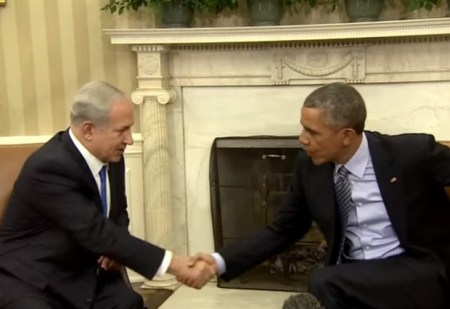
2015-11-12_090314_Netanyahu_Obama-620x426

[T]he nuclear deal has done tremendous political damage to the Democrats. And while much of the media is portraying Netanyahu’s D.C. visit as Netanyahu’s chance to mend fences, I think it’s been Obama’s.

Polling shows that despite the tensions between Obama and Netanyahu, which Jonathan Tobin correctly characterizes as being exacerbated by Obama, bipartisan support for Israel is strong and growing. Obama and Congressional Democrats are quite aware of this.


****************************

The New White House Meme About Bibi: He Doesn’t Understand.

In a look at the history of the tensions between President Barack Obama and Israeli Prime Minister Benjamin Netanyahu, The New York Times several days ago started with an interesting anecdote.

For President Obama, it was a day of celebration. He had just signed the most important domestic measure of his presidency, his health care program. So when Prime Minister Benjamin Netanyahu of Israel arrived at the White House for a hastily arranged visit, it was likely not the main thing on his mind.

To White House officials, it was a show of respect to make time for Mr. Netanyahu on that day back in March 2010. But Mr. Netanyahu did not see it that way. He felt squeezed in, not accorded the rituals of such a visit. No photographers were invited to record the moment. “That wasn’t a good way to treat me,” he complained to an American afterward.

The tortured relationship between Barack and Bibi, as they call each other, has been a story of crossed signals, misunderstandings, slights perceived and real. Burdened by mistrust, divided by ideology, the leaders of the United States and Israel talked past each other for years until the rupture over Mr. Obama’s push for a nuclear agreement with Iran led to the spectacle of Mr. Netanyahu denouncing the president’s efforts before a joint meeting of Congress.

It’s interesting because this is not at all how I remembered it. I remember that the lack of attention to the meeting was perceived as an intentional slight of Netanyahu. A quick check of the contemporaneous reporting confirmed this.

(Later when describing the meeting the article says that the situation was “made worse by exaggerated stories of shabby behavior in Israeli news media.” I don’t know that exaggerations were necessary.)

Reuters: In a sign of lingering tensions, the Obama administration withheld from Netanyahu some of the usual trappings of a White House visit. Press coverage of the Oval Office talks was barred, and the leaders made no public statements afterward.

Jackson Diehl of The Washington Post (who was, in fact, quoted by Prof. Jacobson at the time): Finally, Obama has added more poison to a U.S.-Israeli relationship that already was at its lowest point in two decades. Tuesday night the White House refused to allow non-official photographers record the president’s meeting with Netanyahu; no statement was issued afterward. Netanyahu is being treated as if he were an unsavory Third World dictator, needed for strategic reasons but conspicuously held at arms length. That is something the rest of the world will be quick to notice and respond to. Just like the Palestinians, European governments cannot be more friendly to an Israeli leader than the United States.

New York Magazine: It was an ominous signal when the White House didn’t provide photos or briefings after the much-anticipated meeting between President Obama and Israeli Prime Minister Benjamin Netanyahu earlier this week. After Joe Biden was blindsided by a surprise Israeli announcement of a new East Jerusalem housing project a couple of weeks earlier, the Obama administration was clearly sending a message of extreme displeasure.

BBC: But the White House had no immediate comment on their content. In a break with convention, reporters were not invited to witness the pair shake hands at the start of their discussions. It was a pointed contrast with the traditional public welcome for Israeli leaders at the White House, the BBC’s Steve Kingstone in Washington reports.

New York Time editorial a few days later: Mr. Obama was right to demand that Mr. Netanyahu repair the damage. Details of their deliberately low-key White House meeting (no photos, no press, not even a joint statement afterward) have not been revealed. We hope Israel is being pressed to at least temporarily halt building in East Jerusalem as a sign of good faith. Jerusalem’s future must be decided in negotiations.

In none of these accounts, was there any mention of the signing of Obamacare, (which did take place earlier that day.) The “low-key” approach to the meeting between the leaders was reported as a deliberate attempt by the administration to signal its displeasure with Netanyahu. I saw no indication that the administration tried to fight that impression at the time.

My best guess is that the New York Times reporters were simply writing the administration’s revisionist account of the events in 2010, without doing the necessary due diligence to ensure that the information they were given was accurate.

Still the article is mostly well-reported covering both sides. There are a few significant omissions (this and this, for example), but the article tries very hard to make the case that any tension between Obama and Netanyahu is the result not of malice, but of Netanyahu misunderstanding Obama. Perhaps the clearest expression of this came in a a description of meetings between Obama and American-Jewish leaders:

In those meetings, Mr. Obama expressed distress. “He bore his soul about how much he cares about Israel,” Mr. Foxman said. “It was painful, hurtful. ‘I care about Israel, I love Israel.”‘ Why did Mr. Netanyahu not understand?

So yes, I think we have a new meme, Obama is pro-Israel but misunderstood. The question is why the administration is so sensitive right now.

I have an idea.

First consider where the Democratic party is nearly one year before the next presidential election.

As Aleister noted recently, the Democrats have lost 12 governorship, 69 House seats, 14 Senate seats and over 900 local legislative seats in 7 years under Obama. While Obama’s personal popularity hovers just a little below 50%, this represents a widespread rebuke to his governance. Remember, his two signal achievements, Obamacare and the Iran nuclear deal were unpopular. As everyone sees increasing health insurance rates and the consequences of the nuclear deal are reported, voters will have reminders of schemes that were enabled by legislative manipulation lacking popular support.

The Sun-Sentinel reported on Saturday on the significance of the Obama-Netanyahu meeting:

The region is home to an estimated 500,000 Jewish residents — sizable enough to tip the results in the biggest swing state in the country. Florida awards 29 electoral votes, more than 10 percent of the total needed to win the presidency.

Changing the outcome “doesn’t require a majority shift,” said Steven Abrams, a county commissioner who was Palm Beach County chairman for Newt Gingrich’s unsuccessful 2012 presidential campaign. “The Jewish vote only needs to change by a percent or two or three in order to make a difference in the outcome of the state.” …

“I have three words: Iran nuclear deal,” Abrams said, referring to the Obama administration’s controversial effort to prevent Iran from developing a nuclear weapon. “It’s one of President Obama’s major initiatives. It’s not a small policy. And it’s a very prominent policy for Jewish voters and many Jewish Democrats and many more Jewish independents are not enthralled by it, and those are targeted voters.”

To be sure the Sun-Sentinel quoted several Democrats saying otherwise, but the nuclear deal according to polling throughout the summer is extremely unpopular.

A Quinnipiac poll in August found that voters in the crucial swing states Ohio, Pennsylvania and Florida opposed the deal by a ratio of greater than 2 to 1. And every time Iran arrests an American or stops cooperating with the terms of the nuclear deal, the deal will be in the news and everyone involved in making the deal will look worse. Even many of the senators who supported the deal and defied popular opinion to block a vote on the deal made persuasive cases about the dangers of the deal.

In terms of Jewish opinion, it’s fascinating that not a single Jewish federation backed the deal. Too many of them, for sure took no position, but none supported the deal. Aside from J-Street, not a single major Jewish organization backed the deal. (The question as to whether J-Street is primarily a Jewish organization is a different question.) Even the ADL, which is now headed by a former Obama staffer, Jonathan Greenblatt, opposed the deal. If nothing else, suggests a strong consensus in the organized Jewish community that the nuclear was a bad deal that endangers Israel.

This suggests that the nuclear deal has done tremendous political damage to the Democrats. And while much of the media is portraying Netanyahu’s D.C. visit as Netanyahu’s chance to mend fences, I think it’s been Obama’s.


So even if cynical in the extreme, the meme that Obama loves Israel but his love was misunderstood by Bibi makes perfect sense. It’s a way of tidying up the past and putting the best face on a contentious relationship.

It is also a pose one would expect the president to strike if he were trying to woo back Jewish voters who are concerned about the threats to Israel presented by the nuclear deal.

Although much of the media has portrayed Netanyahu’s trip to the United States as his bid to mend relations with the administration and more generally with Democrats, there is evidence that the opposite dynamic is in play.

In addition to Obama’s “misunderstood” meme, Jennifer Rubin observed that in the wake of the nuclear deal 16 Democratic senators – 14 of whom supported the deal – are “scrambling for cover” and urging Obama to extend and strengthen the “Memorandum of Understanding” governing the terms of American security assistance to Israel in the face of the Iranian threat. Democratic Whip, Rep. Steny Hoyer, who supported the nuclear deal, has released a letter calling on the United States and its partner to ensure that Iran is held accountable for any cheating.

Polling shows that despite the tensions between Obama and Netanyahu, which Jonathan Tobin correctly characterizes as being exacerbated by Obama, bipartisan support for Israel is strong and growing. Obama and Congressional Democrats are quite aware of this.
Cartoon of the day

November 11, 2015

H/t Hope n’ Change

slings-and-narrows-1

Shortly before the Obama-Netanyahu summit, ISIS hit Americans in Jordan

November 9, 2015

Shortly before the Obama-Netanyahu summit, ISIS hit Americans in Jordan, DEBKAfile, November 9, 2015

Isis_Jordan480

After the Islamic State succeeded in downing a Russian airliner that took off from Sharm El-Sheikh on October 31, causing the deaths of all 224 passengers and crew, the terrorist organization Monday, Nov. 9, put a US military target in its crosshairs. A captain in the Jordanian police opened fire in the cafeteria of the Special Operations Training Center outside the Jordanian capital, Amman, where American instructors train Iraqi troops to fight ISIS. Two trainers from the US and one from South Africa were initially reported killed and another six wounded, including two more Americans and four Jordanians.

A Jordanian government spokesman said later Monday that the number of fatalities had risen to eight, without specifying how many foreigners.

The gunman did not survive. He was variously reported to have committed suicide after the assault or killed by Jordanian troops.

The modus operandi resembled the “green on blue” insider attacks committed in Afghanistan by al Qaeda and Taliban “insiders” against American and British troops serving at the same base.

Jordan’s Al-Rai newspaper identified the shooter as Anwar Abu Ubayd, but other news outlets said his name was Anwar Abu Zaid.

If the downing of the Russian plane rocked the regime of Egyptian President Fattah El-Sisi, there is no doubt that Monday’s attack will shake King Abdullah’s Hashemite throne.

The attack, furthermore, demonstrated that ISIS is rapidly approaching Israel’s borders with Syria in the north, Egypt in the south and Jordan in the east. The assault gained particular attention as it was carried out just hours before the summit Monday between Israeli Prime Minister Binyamin Netanyahu and US President Barack Obama at the White House in Washington.

They met for the first time after more than a year and after a major row over the Iranian nuclear accord. Both leaders made statements strongly indicating that they had determinedly buried the hatchet and were looking to the future of strong and amicable ties and expanded US support for Israel’s security.

A large part of their two-hour conversation was undoubtedly devoted to the threat posed by ISIS, on which they concur.

Until now, Jordan had been home to the most important and secure US forward base for the war on ISIS in Iraq and Syria.  US air strikes come from bases in Turkey, but more than 10,000 ground troops and special operations forces troops are present in Jordan. The kingdom serves as a training, operations and logistical center for US missions in Iraq and Syria, and for that purpose a command center, the US Central Command Forward-Jordan, was established outside Amman.

Until now, ISIS had not managed to infiltrate Jorda for attacks capable of destabilizing Abdullah’s rule. Numerous infiltration and terrorist attacks were thwarted by Jordanian intelligence and security. The Jordanian authorities focused primarily on keeping the jihads out of the refugee camps housing Syrians and Iraqis in flight from war zones, but this came at the expense of efforts to block the threat from reaching inside the Hashemite kingdom and its security facilities.

Their first success will no doubt embolden ISIS to keep on pressing its advantage. Immediately following Monday’s shooting, Jordan’s military went into high alert nationwide and along its borders. The US, Russia, Egypt, Jordan and Israel are all boosting their vigilance as the threat from ISIS continues to grow. But no one can reliably predict where the Islamist terrorists strike next.

Biden: “no excuse” for Israelis talking about Obama and Kerry in “derogatory terms”

November 9, 2015

Biden: “no excuse” for Israelis talking about Obama and Kerry in “derogatory terms,” Front Page Magazine, Daniel Greenfield, November 9, 2015

bald_biden

There’s no excuse for Tehran Joe Biden ever talking about international policy. There’s also no excuse for Israelis or anyone else not referring to Obama in derogatory terms.

But Biden chose to get on his high horse anyway…

“There is no excuse, there should be no tolerance for any member or employee of the Israeli administration referring to the president of United States in derogatory terms. Period, period, period, period!”

“There is no justification for an official Israeli voice degrading the secretary of state, who has worked so hard, for so long for the security of Israel,” Biden continued.

Three periods. That’s a lot of periods.

Biden seems to have forgotten the time his regime’s staffers decided to refer to Netanyahu as “chickenshit” or Obama’s live mic moment while slamming Netanyahu.

John Kerry has worked for the “security of Israel” by pressuring Israel to release large numbers of terrorists. Can Israeli victims of terror degrade Kerry… or just suffer because of him?

Meanwhile here are the comments, made by Baratz before his appointment, that Biden described as “terrible”.

After President Barack Obama reacted to the speech delivered by Netanyahu in Congress in March, Baratz wrote: “This is what modern anti-Semitism looks like in western liberal countries. And of course, it comes with a lot of tolerance and understanding toward Islamic anti-Semitism. So much tolerance and understanding, until they are even willing to give them nukes.”

In October of 2014, he wrote about a speech in which Secretary of State John Kerry “made a connection between Israel and ISIS.” He wrote commented sarcastically:  “After his term as secretary of state he is certain to have a flourishing career in one of the stand-up comedy clubs in Kansas City, Mosul, or the Holot detention facility.” Elsewhere, he reportedly said Kerry had “the mental age of a 12-year-old.”

So Baratz called Obama a bigot who panders to Muslim terrorists and suggested that Kerry was an idiot and a joke.

Is stating obvious facts really such a terrible thing?

But like all social justice warriors, Obama Inc. excels at pretending to be deeply hurt and offended by its victims. Biden’s fake outrage is as real as his hair. Maybe Biden should take himself to a safe room.

“We simply will not,” Biden said, “permit Iran to acquire a nuclear weapon. Period. Period.”

Is it just me or do Biden’s periods seem insincere?

Nothing personal about Obama’s consistent hostility toward Israel

November 9, 2015

Nothing personal about Obama’s consistent hostility toward Israel, Human Rights Voices, Anne Bayefsky, November 9, 2015

barack-obama-and-binyamin-009President Obama with Prime Minister Netanyahu (file photo)

Much ink has been spilled blaming the state of U.S.–Israel relations on the poor personal rapport between President Obama and Prime Minister Netanyahu. The fact is that huggable Barney the Purple Dinosaur could have been Israel’s elected leader, and the relations would have been equally hostile.

For seven decades from the moment of Israel’s birth – through five wars, one campaign, eight operations, two “uprisings,” and years of terrorism – Palestinian Arabs have done everything possible to avoid living peacefully side by side with a Jewish state.

This isn’t ancient history. It’s today.

Here is Palestinian leader Mahmoud Abbas speaking to the U.N. Human Rights Council in Geneva on October 28, 2015:

    The situation . . . as a result of the continued Israeli occupation and its practices is the worst and most critical since 1948. . . . How long will this protracted Israeli occupation of our land last? After 67 years for how long do you think it is possible for it to continue? . . . Seventy years of suffering, injustice, oppression, and deprivation, and the perpetuation of the longest occupation known to mankind in modern history.

The Palestinian narrative has never varied: Israel has been built on occupied Arab territory – not since 1967, but since 1948. That’s why Palestinians claim a “right of return” whose very purpose is their ideal “one-state solution” – one state where Jews are demographically outnumbered.

Standing in the way of the Palestinians’ one-state goal has been Israel’s and America’s unwavering commitment to a negotiated final resolution of the conflict. A negotiated resolution would legitimize each side and leave both parties still standing.

Hence, the Arab side has sought to eschew negotiations in two ways: first, directly, by the use of force; and, second, indirectly, by insisting on externally imposed “solutions” via multilateral entities where Israel is outnumbered – such as the United Nations.

This isn’t fantasy. It’s fact.

Here is Abbas at the U.N. General Assembly on September 30, 2015: “It is no longer useful to waste time in negotiations.”

In contrast, here is Netanyahu at the U.N. General Assembly on October 1, 2015: “I am prepared to immediately, immediately, resume direct peace negotiations with the Palestinian Authority without any preconditions whatsoever.”

So when President Obama announced on November 6, 2015, via Rob Malley, Middle East coordinator at the National Security Council, that there was an allegedly “new” “reality” in which “the parties are not going to be in a position to negotiate a final status agreement” during his presidency, he was adopting the Palestinian playbook.

This means the president will not spend his final year doing the only thing that would move the ball forward – namely, pressuring Abbas to choose diplomacy and negotiations over violence and third-party coercion. Rather, Obama will attempt to impose his will on Israel, the U.N. being the obvious modus operandi. After all, this president chose the Security Council over Congress on the Iran deal. He can let the Council do the dirty work on Israel, too. Indeed, over the past month, Samantha Power, the U.S. ambassador to the U.N., has been laying the groundwork for just such a treacherous strategy.

Back up to October 3, 2015. A knife-wielding Palestinian attacked Adele Banita, a young Israeli mother, while she walked in Jerusalem’s Old City with her husband Aharon, two-year old son, and infant daughter. Adele lived to tell the tale, supported by video evidence. Her 21-year-old husband lay dying, her son was wounded, and she suffered multiple stab wounds. With a knife still lodged in her body, she cried out for help to nearby Arab shopkeepers, who looked on. Instead of coming to her aid, they spit on her, laughed, told her to die, and stood by. A Jewish man who came to the family’s aid was knifed to death.

But on October 22, 2015, Samantha Power made this shocking statement to the Security Council: “In Jerusalem, shoppers and merchants are on edge. . . . Said an Arab shopkeeper in the old city, ‘When I prepare the juice, I am scared to cut the oranges in case someone sees me with the knife and shoots me.'”

Rather than tell the real-life story of the actual Arab shopkeepers and their pathologically violent Jew-hatred, Ambassador Power peddled the tale of an Arab shopkeeper’s imagining himself to be a victim – in the same place as Banita’s real killers.

Power continued by calling on “both parties” to “exercise restraint.” The Palestinians heard loud and clear the message of moral relativism and impunity for Palestinian incitement.

Days later, on November 3, 2015, Riyad Mansour, the Palestinian ambassador to the U.N., wrote a formal letter to the U.N. claiming that, in October, Palestinian “bodies were returned with missing corneas and other organs, further confirming past reports about organ harvesting by the occupying Power from the Palestinian victims of its brutality.”

Add to this Power’s statement to the Security Council on October 16, 2015, in which she explained that Jews living in settlements (on what is legally disputed territory whose ownership is subject to negotiations) and Jews dying at the hands of “frustrated” terrorists were part of a “cycle of escalation.”

Not surprisingly, the Palestinians’ murderous rampage continues.

Anyone who believes that the president’s toxic foreign policy on Israel is a mere personal vendetta against a foreign leader he doesn’t like is giving Obama far too little credit. His foreign policy has never wavered: He sought “daylight” between himself and Israel. He has achieved a chasm.

The only question left is how much more blood the president can extract from Israel in his last twelve months.

No good news in the Mid East for Obama or Netanyahu when they meet Monday

November 8, 2015

No good news in the Mid East for Obama or Netanyahu when they meet Monday, DEBKAfile, November 8, 2015

Obama_Bibi2480

After more than a year, Israeli Prime Minister Benyamin Netanyahu meets President Barack Obama at the White House on Monday, Nov. 9, with the deck heavily stacked against him – and not just because of the Islamic State, which is a universal bane, or Obama’s Iran policy – or even the evaporation of the peace process with the Palestinians. This time, Netanyahu is not getting a dressing-down over the disappearance of the two-state solution, because even the US president has decided to shelve it for the remainder of his presidency which ends in January 2017.

This is not because the Netanyahu government has missed any chances for talks with the Palestinians, as the Israeli opposition loudly claims, but because it is unrealistic.

Palestinian Authority Chairman Abu Mazen (Mahmud Abbas), who lost all credibility on the Palestinian street long ago, has been quietly but continuously encouraging the continuous Palestinian wave of terror by knives, guns and cars.

The Israeli prime minister had his most promising card snatched from him just ten days before he traveled to Washington. He had intended presenting the US president with the quiet alliance he had formed with key moderate Arab governments as a viable alternative for the deadlocked Palestinian peace process, with the promise of a measure of stability for its members in the turbulence around them.

However, the linchpin Egyptian President Abdel-Fatteh El-Sisi’s position was suddenly shaken up badly by the downing of the Russian passenger plane over Sinai on Oct. 31, presenting him with his most dangerous crisis since he took power in 2013.

In addition, the security situation in Syria, including along Israel’s northern border, especially the Golan, has gone from bad to worse – especially since Russia built up its military presence in Syria.

Israel has been forced to forego most of its red lines for defending its security as no longer relevant. Although no Israeli official says so openly, Israel’s military options in Syria have shrunk, and even the overflights by its air force flights for keeping threats at bay are seriously restricted..

Iran and Hizballah, under Russian air cover, have been slowly but surely making gains in their attempt to retake southern Syria from the rebels and hand it over to the army of Syrian President Assad.

Israel is still insisting that it will not allow the deployment of Iranian or Hizballah forces on the Syrian side of the Golan, but these statements are losing their impact. If the coalition of Russia, Iran, Syria and Hizballah defeats the rebels in southern Syria and moves in up to its border, Israel will find it extremely difficult to prevent this happening.

It would also mark the end of more than three years of investment and building of ties with various elements in southern Syria as part of a strategic decision to transform those groups into a buffer between Israel and Iran in the Golan area.

Netanyahu’s struggle against the nuclear deal with Iran was not just aimed at Washington’s recognition of Iran’s nuclear program, but ever more at Obama’s acknowledgement of Iran as America’s strategic partner and leading Middle East power. But in this respect, the US president is most likely chafing over the setbacks to his own cherished plan, as a result of four developments:

1. Iran has plunged more deeply than ever predicted into the Syrian conflict. For the first time since the 19th century, Iran has not only sent its military to fight beyond its borders, but it is coordinating its moves with Moscow, not Washington.

Even if Israel needed to turn to the US administration for a helping hand against Iran, it would have no address because Washington too has been displaced as a power with any say in the Syrian picture.

2. Although the alliance by Israel and moderate Arab countries was designed by Netanyahu to serve as a counterweight to the US-Iranian partnership,  that alliance too is far from united on Syria:  Egyptian President El-Sisi, for example, supports President Bashar Assad, and is in favor of keeping him in power in Damascus.

3. The Islamic State continues to go from strength to strength in Syria and the Sinai Peninsula which share borders with Israel as well as in Iraq.

4. Israel’s political, defense and intelligence elite have badly misread or missed altogether four major events in the region:

  • Assad’s persistent grip on power
  • The deep Russian and Iranian military intervention in Syria
  • The strengthening of ISIS
  • The eruption of a new, deadly Palestinian campaign of terror which strikes unexpectedly in every town, highway and street.

These errors are taking their toll on Israel’s security, wellbeing and prestige.

Even if Israeli Prime Minister Netanyahu and US President Obama, like Defense Minister Moshe Yaalon and Secretary of Defense Ashton Carter, do reach an agreement on Israel’s security needs for the coming years and US military assistance, such an agreement may not withstand the test of Middle East volatility. The rapidly changing conditions are for now all to the detriment of the US and Israel.

Cartoon of the day

November 8, 2015

H/t The Jewish Press

You-First

Keeping up warm relations

November 6, 2015

Keeping up warm relations, Israel Hayom, Shlomo Cesanam, November 6, 2015

(Please see also, Obama rules out Israeli-Palestinian peace deal before leaving office. — DM)

Two state is deadScience and Technology Minister Ofir Akunis, seen with Defense Minister Moshe Ya’alon in the Knesset, says the two-state solution is “dead.” | Photo credit: Noam Revkin-Fenton

The imminent meeting between Prime Minister Benjamin Netanyahu and U.S. President Barack Obama won’t repair their soured ties, but it’s clear that their face-offs are on hold as Israel and the U.S. prepare to deal with Middle East instability.

*********************

Two weeks ago, Defense Minister Moshe Ya’alon met with his American counterpart Defense Secretary Ashton Carter. The defense secretary accompanied Ya’alon everywhere: to a memorial service at the Israeli Embassy marking 20 years since the assassination of former Prime Minister Yitzhak Rabin, on a visit to the American Cyber Command at Fort Meade, in a dialogue with students and to a laid-back meal at the Pentagon, at which a military choir performed “Jerusalem of Gold” accompanied by a violinist. The Americans promise that the warm welcome Ya’alon received will continue — even if not with the same intensity — for another two days, when Prime Minister Benjamin Netanyahu is scheduled to land in Washington, ahead of a Monday meeting with U.S. President Barack Obama at the White House.

The meeting will not obliterate the soured relations between the two leaders. They “did not have a chance to meet” this year, but they did manage to publicly face off on important issues and policies. The main bone of contention is of course the understandings reached between six world powers on Iran’s nuclear program. Nevertheless, it is clear to everyone that the confrontations are over as is the discussion of whether the tension between the two leaders harmed the relations between their respective nations. Both sides agree that the threats, challenges and mutual interests supersede the various disagreements, and that new arrangements must be made for the future.

The agenda of the meeting will address coordination on a strategic outlook for the region. Two specific issues are up for discussion: Preserving Israel’s qualitative advantage over the rest of the countries in the region, and American aid to strengthen Israel during the next 10 years. The aforementioned edge was created as a result of the nuclear deal with Iran and the “compensation packages” the U.S. handed out to its allies in the Persian Gulf — first and foremost Saudi Arabia, but also countries like Jordan and Egypt. The aid comes in the form of information, technology, financial aid, weapons and ammunition.

The American aid will be provided under a 10-year plan. Former President George W. Bush signed the last aid deal, which expires at the end of 2017. Israel expects to fill up a “shopping cart” with items that already appear on a long list of requests, including a bump in the amount of defense assistance from $3.1 billion to $4 billion.

Since the deal will only take effect two years from now, diplomatic officials are discussing two separate lists: one for the long term, and a second that will give Israel the help it needs to preserve its advantage. The goals of the meeting between Netanyahu and Obama are based on the assumption that the Middle East is unstable, and will remain so for the next decade. That assumption is backed up by reports from teams of professionals in both the U.S. and Israel.

The bottom line, a member of Israel’s Diplomatic-Security Cabinet said this week, is that “the U.S. and Israel are in sync. They see eye to eye on the existing situation and have identical assessments of the changing situation in the region.”

Both Israel and the U.S., for example, agree that even after the Iran nuclear deal, the Tehran regime is no less dangerous. They both know that the Iranian money that was unfrozen when the sanctions were lifted, is already going to fund terrorism.

Netanyahu and Obama are going to talk about strategy, as the proposals for aid to bolster Israel are already known. But because in our region it is hard to know what the day will bring, both sides have built a model according to which “a variety of measures to provide a variety of solutions to a variety of threats” must be offered. The discussion in the White House will deal with all of the security ties between the two countries: Long-term financial aid; cooperation on cybersecurity; air, land, sea, and satellite power; intelligence; technological and defense development, including more Iron Dome batteries and similar defense systems, and the promotion of solutions that are still being developed. On everything relating to the immediate and broad-scale answer, Israel is asking for a way of defending itself against long-range and precision-guided missiles.

Netanyahu and Obama will also have to decide whether the time has come to strike a reciprocity deal — a defense pact between the two nations — that does not include a requirement to inform each other of certain covert actions, such as an attack on Iran. A deal like that would provide an answer for any scenario in which Iran breaks through to a nuclear bomb before the deal on its nuclear program is up.

“We left Gaza — and what did we get?”

But the headaches do not end there. When Netanyahu returns from the U.S., he will be facing two other important events: passing the state budget, which will among other things determine the defense budget, and the scheduled release of convicted spy Jonathan Pollard from a U.S. prison, which will mark the end of a long dispute with the Americans on the Pollard matter.

In Jerusalem, Netanyahu’s meeting with Obama is seen with utmost importance. Many officials at the diplomatic echelon argue that the meeting explains Netanyahu’s conduct these past few weeks: his measured responses to events in the field, the ban on MKs visiting the Temple Mount, the delay on committee discussions about construction in Jerusalem, and his remark that comparatively speaking, he is the prime minister who has allowed the least amount of building in Judea and Samaria.

On the other hand, Netanyahu is not hiding his official policy that Palestinian Authority President Mahmoud Abbas is not a partner with whom a peace deal can be made and that for now, Israel’s security and defense prowess in Judea and Samaria must be solidified without any visible changes.

The opposition and some media outlets have voiced criticism of Ya’alon, who is being accused of wanting to “manage” the conflict with the Palestinians and of directing “a policy of carrots” rather than finding a solution to it. Netanyahu, on the other hand, is accused of marking time and cultivating a vision in which we will “always live by the sword.”

The criticism is local, but it echoes throughout the world. That is why it was important to Netanyahu to issue a reply this week: “I’m not deceiving the public. We are living in the heart of radical Islam, and no policy we adopt will turn our neighbors into Norwegians or Swedes. We withdrew from every last [inch] of the Gaza Strip and didn’t get peace, [we got] rockets and terrorism. Therefore — with an arrangement or without one — we will always need the IDF to protect ourselves.”

Netanyahu is arriving in Washington as the head of a narrow right-wing government, most of whose members oppose a two-state solution. A member of his own Likud party, Science, Technology and Space Minister Ofir Akunis, said twice this week — at a weekend cultural event in Beersheba and at a Likud conference in Kfar Saba — that “the two-state solution is dead.”

According to Akunis, “the idea is irrelevant and is no longer at all possible.”

The understandings and agreements between Israel and the U.S. are also tied into the American and European demand to “end the occupation” at any price and “prevent apartheid.” While the security and defense factor is in place, Israel has no solution when it comes to the world’s demands on the Palestinian issue.

Our World: Showdown at the OK Corral

November 3, 2015

Our World: Showdown at the OK Corral, Jerusalem Post, Caroline Glick, November 2, 2015

ShowImage (16)US President Barack Obama meets with Prime Minister Benjamin Netanyahu at the White House, October 1, 2014. (photo credit:REUTERS)

Whatever he says before the cameras next week when he meets with Netanyahu, Obama has no intention of letting bygones be bygones.

Prime Minister Benjamin Netanyahu’s meeting with US President Barack Obama next week is likely to look less like a rapprochement than a showdown at the OK Corral.

The flurry of spy stories spinning around in recent weeks makes clear that US-Israel relations remain in crisis.

Two weeks ago, The Wall Street Journal published a fairly detailed account of the US’s massive spying operations against Israel between 2010 and 2012.

Their purpose was to prevent Israel from attacking Iran’s nuclear installations. The Journal report, which was based on US sources, also detailed the evasion tactics the Obama administration employed to try to hide its covert nuclear talks with Iran from Israel. According to the report, the administration was infuriated that through its spy operations against Iran, Israel discovered the talks and the government asked the White House to tell it what was going on.

Over the past several days, the Israeli media have reported the Israeli side of the US spying story.

Friday Makor Rishon’s military commentator Amir Rapaport detailed how the US assiduously wooed IDF senior brass on the one hand and harassed more junior Israeli security officials on the other hand.

Former IDF chiefs of General Staff Lt.-Gens. Gabi Ashkenazi and Benny Gantz were given the red carpet treatment in a bid to convince them to oppose Israeli strikes on Iran’s nuclear installations. More junior officials, including officers posted officially to the US were denied visas and subjected to lengthy interrogations at US embassies and airports in a bid to convince them to divulge information about potential Israeli strikes against Iran.

Sunday, Channel 2 reported that the IDF’s Intelligence Directorate’s information security department just issued guidance to all IDF soldiers and officers warning them about efforts by the CIA to recruit them as US agents.

These stories have been interpreted in various ways. Regardless of how they are interpreted, what they show is that on the one hand, the Obama administration has used US intelligence agencies to weaken Israel’s capacity to harm Iran and to actively protect Iran from Israel. And on the other hand, Israel is wary of the administration’s efforts to weaken it while strengthening its greatest foe.

These stories form the backdrop of next week’s meeting between Netanyahu and Obama – the first they will have held in more than a year. They indicate that Obama remains committed to his policy of weakening Israel and downgrading America’s alliance with the Jewish state while advancing US ties with Iran. Israel, for its part, remains deeply distrustful of the American leader.

This Israeli distrust of Obama’s intentions extends far past Iran. Recent statements by Obama and Secretary of State John Kerry have convinced Israel that during his last 15 months in office, Obama intends to abandon US support for Israel at the UN Security Council, and to ratchet up pressure and coercive measures to force Israel to make irreversible concessions to the Palestinians.

From Netanyahu’s perspective, then, the main strategic question is how to prevent Obama from succeeding in his goal of weakening the country.

The implementation of Obama’s deal with Iran deal will form a central plank of whatever strategy the government adopts.

As far as Obama and his allies see things, the nuclear accord with Iran is a done deal. On October 21, House Minority Leader Nancy Pelosi hosted a reception for Democratic congressmen attended by White House Chief of Staff Denis McDonough to celebrate its official adoption.

Unfortunately for Pelosi and her colleagues, Iran is a far more formidable obstacle to implementing the deal than congressional Republicans. As Yigal Carmon, president of the Middle East Media Research Institute (MEMRI), explained in a report published on his organization’s website last week, at no point has any Iranian governing body approved the nuclear deal. Iran’s parliament, the Majlis, and its Guardians’ Council have used their discussions of the agreement to highlight their refusal to implement it. More importantly, as Carmon explains, contrary to US media reports, in his October 21 letter to Iranian President Hassan Rouhani, Iran’s Supreme leader Ayatollah Ali Khamenei did not give his conditional approval to the deal. He rejected it.

Carmon explained that the nine conditions Khamenei placed on his acceptance of the nuclear deal render it null and void. Among other things, Khamenei insisted that all sanctions against Iran must be permanently canceled. Obama couldn’t abide by this condition even if he wanted to because he cannot cancel sanctions laws passed by Congress.

He can only suspend them.

Khamenei also placed new conditions on Iran’s agreement to disable its centrifuges and remove large quantities of enriched uranium from its stockpiles.

He rejected inspections of Iran’s military nuclear installations. He insisted that Iran’s Arak heavy water reactor must remain capable of producing heavy water in contravention of the deal. And he insisted that at the end of the 15-year lifetime of the deal Iran must have sufficient uranium enrichment capability to enable it to develop bombs at will.

As Carmon noted, the US and EU have announced that they will suspend their nuclear sanctions against Iran on December 15 provided that by that date, the UN’s International Atomic Energy Commission certifies that Iran has upheld its part of the bargain.

By that date, in conformance with their interpretation of the nuclear deal, the US and the EU expect for Iran to have reduced the number of centrifuges operating at the Natanz facility from 16,000 to 5,060 and lower enrichment levels to 3.67%; reduce the number of centrifuges at Fordow to a thousand; remove nearly all its advanced centrifuges from use; permit the IAEA to store and seal its dismantled centrifuges; reduce its stockpile of enriched uranium to 300kg.; remove the core from the Arak reactor and disable it; and submit to agreed monitoring mechanisms of its nuclear sites.

Carmon noted that Iran has taken no steps to fulfill any of these conditions.

With Khamenei’s rejection of the nuclear deal and Iran’s refusal to implement it, there are two possible ways the US and the EU can proceed.

First, as Carmon suggests, Obama and the EU may renew nuclear talks with Iran based on Khamenei’s new position. These talks can drag out past Obama’s departure from office. When they inevitably fail, Obama’s successor can be blamed.

The other possibility is that Iran will implement some component of the deal and so allow Obama and the EU to pretend that it is implementing the entire deal. Given the US media’s failure to report that Khamenei rejected the nuclear pact, it is a fair bet that Obama will be able to maintain the fiction that Iran is implementing the deal in good faith until the day he leaves office.

So what is Israel to do? And how can Netanyahu use his meeting with Obama next week to Israel’s advantage? Israel has two policy options going forward. First, it can highlight the fact that Iran is not implementing the deal, just as Israel took the lead in highlighting the dangers of the nuclear accord with Iran over the past year. This policy can potentially force Obama onto the defensive and so make it harder for him to go on the offensive against Israel at the UN and other venues in relation to the Palestinians.

But then, it is far from clear that Obama will be deterred from adopting anti-Israel positions at the UN even if Israel succeeds making an issue of Iranian noncompliance with the nuclear deal.

Moreover, if Netanyahu leads the discussion of the Iran’s bad faith, as he drove the discussion of the nuclear deal itself, he will reinforce the already prevalent false assessment in the US that a nuclear Iran threatens Israel but is not dangerous for the US.

This incorrect assessment has made a lot of Americans believe that by seeking to prevent Iran from acquiring nuclear weapons, Israel is advancing is own interests at America’s expense.

The other policy option is the one that Defense Minister Moshe Ya’alon indicated Israel is pursuing in his meeting last week with his counterpart Defense Secretary Ashton Carter. At the Pentagon Ya’alon declared, “The Iran deal is a given. Our disputes are over.”

The downside of this position is that it indicates that Israel accepts the legitimacy of a deal that Iran is not implementing and that would imperil Israel’s national security even if Iran were implementing it.

Its upside is that it takes Israel out of the US debate regarding the nuclear deal. To the extent that opponents of Obama’s Iran policy are willing to lead the fight against the deal themselves, Israel could do worse than to take a step back and plot its own course on Iran, independent of the US policy discussion.

It is hard to know which line of action makes more sense. But as the spy stories demonstrated, one thing is clear enough. Whatever he says before the cameras next week when he meets with Netanyahu, Obama has no intention of letting bygones be bygones.

Ex- senior adviser:”Obama wanted to show Muslims, US isn’t close to Israel.”

October 31, 2015

Ex- senior adviser:”Obama wanted to show Muslims, US isn’t close to Israel.” Front Page Magazine, Daniel Greenfield, October 31, 2015

(Here’s another interesting clip from the Rubin article:

In sum, Ross (not to mention the former Israeli ambassador to the United States, Michael Oren) confirms a good deal of what Obama apologists deny. It turns out the Iran deal really does not stop Iran from getting the bomb. It turns out Obama was guilty of the bigotry of low expectations, never really wanting to hold the Palestinians to account. And from the get-go, he sought to shove Israel away from the United States. It was not Prime Minister Benjamin Netanyahu’s “fault” that the relationship deteriorated. It was by design.

— DM)


obama_netanyahu_1_2

Jennifer Rubin has an excerpt from an interview with Dennis Ross, a former senior adviser to Obama.

“When the president comes in, he thinks we have a major problem with Arabs and Muslims. And he sees that as a function of the Bush administration — an image, fairly or not, that Bush was at war with Islam. So one of the ways that he wants to show that he’s going to have an outreach to the Muslim world is that he’s going to give this speech in Cairo. So he wants to reach out and show that the US is not so close to the Israelis, which he thinks also feeds this perception. That’s why there’s an impulse to do some distancing from Israel, and that’s why the settlement issue is seized in a way.”

It’s not news, but it is confirmation that Obama deliberately sought to alienate and distance Israel. And would have done so regardless of who was the Prime Minister of Israel.

The popular meme among Obama supporters and Israel Laborites is to claim that Netanyahu ruined the relationship. But ruining the relationship was a strategic White House decision.