Archive for the ‘Muslim Brotherhood’ category

Calls to Kill Pres. Al-Sisi and Egyptian Journalists on Turkey-Based Muslim Brotherhood TV Channels

February 3, 2015

Calls to Kill Pres. Al-Sisi and Egyptian Journalists on Turkey-Based Muslim Brotherhood TV Channels, MEMRI TV via You Tube, January 30, 2015

(Please see also Egypt’s fight, America’s apathy. — DM)

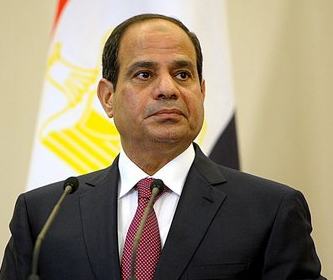
In this compilation of video clips from Muslim Brotherhood TV channels, various Egyptian clerics and commentators call to kill Egyptian President Abd Al-Fattah Al-Sisi and the journalists who support him. Cleric Salama Abd Al-Qawi said, on Rabea TV, that anyone who killed Al-Sisi would be doing a good deed, cleric Wagdi Ghoneim told Misr Alan TV that “whoever can bring us the head of one of these dogs and Hell-dwellers” would be rewarded by Allah, and commentator Muhammad Awadh sai, on Misr Alan TV, that the punishment for the “inciting coup journalists” was death. The programs aired on January 10 and 26, 2015.


Open Jihad Declared in Egypt Following State Dept. Meeting with Muslim Brotherhood-Aligned Leaders

January 30, 2015

Open Jihad Declared in Egypt Following State Dept. Meeting with Muslim Brotherhood-Aligned Leaders, Washington Free Beacon, January 30, 2015

(Please see also Calls To Kill President Al-Sisi And Egyptian Journalists On Muslim Brotherhood TV Channels. — DM)

Mideast Egypt US El-Sissi

The Muslim Brotherhood called for “a long, uncompromising jihad” in Egypt just one day after a delegation of the Islamist group’s key leaders and allies met with the State Department, according to an official statement released this week.

Just days after a delegation that included two top Brotherhood leaders was hosted at the State Department, the organization released an official statement calling on its supporters to “prepare” for jihad, according to an independent translation of the statement first posted on Tuesday.

The statement also was issued just two days before a major terror attack Thursday in Egypt’s lawless Sinai region that killed at least 25.

“It is incumbent upon everyone to be aware that we are in the process of a new phase, where we summon what is latent in our strength, where we recall the meanings of jihad and prepare ourselves, our wives, our sons, our daughters, and whoever marched on our path to a long, uncompromising jihad, and during this stage we ask for martyrdom,” it states.

Preparation for jihad is a key theme of the Brotherhood’s latest call for jihad.

An image posted with the statement shows two crossing swords and the word “prepare!” between them. Below the swords it reads, “the voice of truth, strength, and freedom.” According to the statement, “that is the motto of the Dawa of the Muslim Brotherhood.”

The statement also invokes the well-known Muslim cleric Imam al-Bana, who founded the Brotherhood and has called for the death of Jews.

Imam al-Bana prepared the jihad brigades that he sent to Palestine to kill the Zionist usurpers and the second [Supreme] Guide Hassan al-Hudaybi reconstructed the ‘secret apparatus’ to bleed the British occupiers,” the statement says.

The Brotherhood’s renewed call for jihad comes at a time when current Egyptian President Abdel Fattah al-Sisi is cracking down on the group and imprisoning many of its supporters, who notoriously engaged in violence following the ouster of Brotherhood-ally Mohamed Morsi.

Egypt experts said the timing of this declaration is an embarrassment for the State Department.

“The fact that the Brotherhood issued its call to jihad two days after its meeting at the State Department will be grist for endless anti-American conspiracy theories about a supposed partnership between Washington and the Brotherhood,” said Eric Trager, a fellow at the Washington Institute for Near East Policy (WINEP). “The State Department should have foreseen what an embarrassment this would be.”

One member of that U.S. delegation, a Brotherhood-aligned judge in Egypt, posed for a picture while at Foggy Bottom in which he held up the Islamic group’s notorious four-finger Rabia symbol, according to his Facebook page.

“Now in the U.S. State Department. Your steadfastness impresses everyone,” reads an Arabic caption posted along with the photo.

Other members of that group included Gamal Heshmat, a leading member of the Brotherhood, and Abdel Mawgoud al-Dardery, a Brotherhood member who served as a parliamentarian from Luxor.

When asked on Tuesday evening to comment on the meeting, a State Department official told the Washington Free Beacon, “We meet with representatives from across the political spectrum in Egypt.”

The official declined to elaborate on who may have been hosted or on any details about the timing and substance of any talks.

The meeting was described by a member of the delegation, Maha Azzam as “fruitful,” according to one person who attended a public event in Washington earlier this week hosted by the group.

The call for jihad, while surprising in light of the Brotherhood’s attempts to appear moderate, is part and parcel of organization’s longstanding beliefs, Trager said.

“Muslim Brothers have been committing violent acts for a very long time,” Trager explained. “Under Morsi, Muslim Brothers tortured protesters outside the presidential palace. After Morsi’s ouster, they have frequently attacked security forces and state property. “

“But until now, the official line from the Brotherhood was to support this implicitly by justifying its causes, without justifying the acts themselves,” he added. “ So the Brotherhood’s open call to jihad doesn’t necessarily mean a tactical shift, but a rhetorical one.”

Terrorism expert and national security reporter Patrick Poole said he was struck by the clarity of the Brotherhood’s call.

“It invokes the Muslim Brotherhood’s terrorist past, specifically mentioning the ‘special apparatus’ that waged terror in the 1940s and 1950s until the Nasser government cracked down on the group, as well as the troops sent by founder Hassan al-Banna to fight against Israel in 1948,” he said.

“It concludes saying that the Brotherhood has entered a new stage, warns of a long jihad ahead, and to prepare for martyrdom,” Poole said. “Not sure how much more clear they could be.”

Poole wondered if the call for jihad would convince Brotherhood apologists that the group still backs violence.

“What remains to be seen is how this announcement will be received inside the Beltway, where the vast majority of the ‘experts’ have repeatedly said that the Brotherhood had abandoned its terrorist past, which it is now clearly reviving, and had renounced violence,” Poole said. “Will this development be met with contrition, or silence? And what says the State Department who met with these guys this week?”

The State Department did not respond to a request for comment before press time.

The Imaginary Islamic Radical

January 28, 2015

The Imaginary Islamic Radical, Front Page Magazine, Daniel Greenfield, January 28,2015

(Ask Secretary Kerry.

Please see also Muslim Brotherhood-Aligned Leaders Hosted at State Department. — DM)

iraqstill-450x281

Our problem is not the Islamic radical, but the inherent radicalism of Islam. Islam is a radical religion. It radicalizes those who follow it. Every atrocity we associate with Islamic radicals is already in Islam. The Koran is not the solution to Islamic radicalism, it is the cause.

******************

The debate over Islamic terrorism has shifted so far from reality that it has now become an argument between the administration, which insists that there is nothing Islamic about ISIS, and critics who contend that a minority of Islamic extremists are the ones causing all the problems.

But what makes an Islamic radical, extremist? Where is the line between ordinary Muslim practice and its extremist dark side?

It can’t be beheading people in public.

Saudi Arabia just did that and was praised for its progressiveness by the UN Secretary General, had flags flown at half-staff in the honor of its deceased tyrant in the UK and that same tyrant was honored by Obama, in preference to such minor events as the Paris Unity March and the Auschwitz commemoration.

It can’t be terrorism either. Not when the US funds the PLO and three successive administrations invested massive amounts of political capital into turning the terrorist group into a state. While the US and the EU fund the Palestinian Authority’s homicidal kleptocracy; its media urges stabbing Jews.

Clearly that’s not Islamic extremism either. At least it’s not too extreme for Obama.

If blowing up civilians in Allah’s name isn’t extreme, what do our radicals have to do to get really radical?

Sex slavery? The Saudis only abolished it in 1962; officially. Unofficially it continues. Every few years a Saudi bigwig gets busted for it abroad. The third in line for the Saudi throne was the son of a “slave girl”.

Ethnic cleansing? Genocide? The “moderate” Islamists we backed in Syria, Libya and Egypt have been busy doing it with the weapons and support that we gave them. So that can’t be extreme either.

If terrorism, ethnic cleansing, sex slavery and beheading are just the behavior of moderate Muslims, what does a Jihadist have to do to be officially extreme? What is it that makes ISIS extreme?

Our government’s definition of moderate often hinges on a willingness to negotiate regardless of the results. The moderate Taliban were the ones willing to talk us. They just weren’t willing to make a deal. Iran’s new government is moderate because it engages in aimless negotiations while pushing its nuclear program forward and issuing violent threats, instead of just pushing and threatening without the negotiations. Nothing has come of the negotiations, but the very willingness to negotiate is moderate.

The Saudis would talk to us all day long while they continued sponsoring terrorists and setting up terror mosques in the West. That made them moderates. Qatar keeps talking to us while arming terrorists and propping up the Muslim Brotherhood. So they too are moderate. The Muslim Brotherhood talked to us even while its thugs burned churches, tortured protesters and worked with terrorist groups in the Sinai.

A radical terrorist will kill you. A moderate terrorist will talk to you and then kill someone else. And you’ll ignore it because the conversation is a sign that they’re willing to pretend to be reasonable.

From a Muslim perspective, ISIS is radical because it declared a Caliphate and is casual about declaring other Muslims infidels. That’s a serious issue for Muslims and when we distinguish between radicals and moderates based not on their treatment of people, but their treatment of Muslims, we define radicalism from the perspective of Islamic supremacism, rather than our own American values.

The position that the Muslim Brotherhood is moderate and Al Qaeda is extreme because the Brotherhood kills Christians and Jews while Al Qaeda kills Muslims is Islamic Supremacism. The idea of the moderate Muslim places the lives of Muslims over those of every other human being on earth.

Our Countering Violent Extremism program emphasizes the centrality of Islamic legal authority as the best means of fighting Islamic terrorists. Our ideological warfare slams terrorists for not accepting the proper Islamic chain of command. Our solution to Islamic terrorism is a call for Sharia submission.

That’s not an American position. It’s an Islamic position and it puts us in the strange position of arguing Islamic legalism with Islamic terrorists. Our politicians, generals and cops insist that the Islamic terrorists we’re dealing with know nothing about Islam because that is what their Saudi liaisons told them to say.

It’s as if we were fighting Marxist terrorist groups by reproving them for not accepting the authority of the USSR or the Fourth International. It’s not only stupid of us to nitpick another ideology’s fine points, especially when our leaders don’t know what they’re talking about, but our path to victory involves uniting our enemies behind one central theocracy. That’s even worse than arming and training them, which we’re also doing (but only for the moderate genocidal terrorists, not the extremists).

Secretary of State Kerry insists that ISIS are nihilists and anarchists. Nihilism is the exact opposite of the highly structured Islamic system of the Caliphate. It might be a more accurate description of Kerry. But the Saudis and the Muslim Brotherhood successfully sold the Western security establishment on the idea that the only way to defeat Islamic terrorism was by denying any Islamic links to its actions.

This was like an arsonist convincing the fire department that the best way to fight fires was to pretend that they happened randomly on their own through spontaneous combustion.

Victory through denial demands that we pretend that Islamic terrorism has nothing to do with Islam. It’s a wholly irrational position, but the alternative of a tiny minority of extremists is nearly as irrational.

If ISIS is extreme and Islam is moderate, what did ISIS do that Mohammed did not?

The answers usually have a whole lot to do with the internal structures of Islam and very little to do with such pragmatic things as not raping women or not killing non-Muslims.

Early on we decided to take sides between Islamic tyrants and Islamic terrorists, deeming the former moderate and the latter extremists. But the tyrants were backing their own terrorists. And when it came to human rights and their view of us, there wasn’t all that much of a difference between the two.

It made sense for us to put down Islamic terrorists because they often represented a more direct threat, but allowing the Islamic tyrants to convince us that they and the terrorists followed two different brands of Islam and that the only solution to Islamic terrorism lay in their theocracy was foolish of us.

We can’t win the War on Terror through their theocracy. That way lies a real Caliphate.

Our problem is not the Islamic radical, but the inherent radicalism of Islam. Islam is a radical religion. It radicalizes those who follow it. Every atrocity we associate with Islamic radicals is already in Islam. The Koran is not the solution to Islamic radicalism, it is the cause.

Our enemy is not radicalism, but a hostile civilization bearing grudges and ambitions.

We aren’t fighting nihilists or radicals. We are at war with the inheritors of an old empire seeking to reestablish its supremacy not only in the hinterlands of the east, but in the megalopolises of the west.

Video: Steve Coughlin Counterterror Training Education and Analysis

January 24, 2015

Video: Steve Coughlin Counterterror Training Education and Analysis, Counter Jihad Report, January 24, 2015

(Long videos, well worth watching at leisure. — DM)

622022286

Center for Security Policy, September 13, 2012

Over more than a decade following 9/11, MAJ Stephen Coughlin was one of the US government’s most astute and objective analysts, and an expert in the connections between Islamic law, terrorism and the jihadist movement around the globe.

Through knowledge of published Islamic law, MAJ Coughlin had a demonstrated ability to forecast events both in the Middle East and domestically and to accurately assess the future threat posture of jihadist entities before they happen.

He has briefed at the Pentagon, for national and state law enforcement and intelligence agencies, and on Capitol Hill for Members of Congress. Today, he is a Senior Fellow at the Center for Security Policy. His book, Catastrophic Failure, will be released in late 2012.

With this series of presentations, the general public has access to a professional standard of intelligence training in order to better understand the jihadist threat.


Part 1: Lectures on National Security & Counterterror Analysis (Introduction)


Part 2: Understanding the War on Terror Through Islamic Law:


Part 3: Abrogation and the ‘Milestones’ Process:


Part 4: Muslim Brotherhood, Arab Spring & the ‘Milestones’ Process:


Part 5: The Role of the OIC in Enforcing Islamic Law:

The Muslim Brotherhood Inquiry: What’s Happening?

January 23, 2015

The Muslim Brotherhood Inquiry: What’s Happening? The Gatestone InstituteSamuel Westrop, January 23, 2015

There are several reasons the British government may be publishing only the “principal findings” of the report. First, some of the information gathered will have been done so by the intelligence services, so there are assets and agreements to protect. Another is the possibility that by revealing the scope of the Muslim Brotherhood network in full, the government would be revealing its own partnerships with Brotherhood organizations, and providing insights into the vast amount of public funds that has filled the coffers of Brotherhood charities.

The British government will publish only the “principal findings” of an inquiry commissioned by the British government into the activities of the Muslim Brotherhood in Britain, according to a report in the Financial Times.

Although the former head of the MI6, Sir Richard Dearlove, has described the Brotherhood as being, “at heart, a terrorist organization,” Brotherhood organizations in the UK have, nevertheless, long enjoyed the support of government ministers and taxpayers’ money.

Previous media statements have indicated that the report written for the inquiry, first commissioned in April 2014, has since sparked a great deal of argument between government ministers and officials and has led to a lengthy delay.

The biggest point of contention has reportedly focused on concerns over the expected reaction of Saudi Arabia and the United Arab Emirates — both of which have recently designated the Muslim Brotherhood and some of its front groups as terrorist organizations – if the inquiry’s report is perceived to be a whitewash.

London, it seems, has long been an important hub for the Muslim Brotherhood. Over the past 50 years, Brotherhood members have established dozens of Muslim Brotherhood front organizations, including lobby groups, charities, think tanks, television channels and interfaith groups.

The secretary-general of the International Organization of the Muslim Brotherhood, for example, Ibrahim Munir, is a resident of London. In 2013, the Egyptian newspaper Al-Masry al-Youm reported that Munir was providing funds to the Egyptian Brotherhood through British Brotherhood groups such as the Muslim Welfare House — but under the guise of fundraising for Palestinians in Gaza.

This government inquiry was established to examine not just the activities of the Muslim Brotherhood in Britain, but to understand better the workings of the worldwide Brotherhood network. This network is both big and nebulous. The inquiry sought to examine the network comprehensively, including the Brotherhood’s collaboration with other Islamic groups, such as Jamaat-e-Islami, a South Asian Islamist network that also has a strong presence in Britain.

Why, then, has the report been delayed?

The question that has dominated most British media reports of the inquiry’s findings has centered on the allegation of terrorism. The relationship between Western governments and the Brotherhood on this point has long appeared murky. In 2002, for instance, the United States government shut down the Holy Land Foundation, a Muslim Brotherhood fundraising group for the Hamas terrorist organization. And in 2011, FBI Director Robert Mueller told the Permanent Select Committee on Intelligence of the House of Representatives: “I can say at the outset that elements of the Muslim Brotherhood both here and overseas have supported terrorism.”

At the same time, however, both the Bush and Obama administrations also sought to woo the Muslim Brotherhood. One anonymous Palestinian official, quoted in Asharq Al-Awsat, claimed: “The Americans mistakenly think that moderate political Islam, represented by Muslim Brotherhood, would be able to combat radical Islam.”

The inconsistency seems to have revolved around the Muslim Brotherhood’s connection to Hamas. Although Hamas’s 1988 covenant asserts that, “The Islamic Resistance Movement is one of the wings of Muslim Brotherhood in Palestine,” Western governments have nevertheless treated Hamas and the Brotherhood as unconnected entities — despite a wealth of evidence to the contrary.

In the United Kingdom, Muslim Brotherhood and Hamas networks appear to overlap heavily. In 2005, for instance, the British government handed over the running of London’s Finsbury Park mosque to the Muslim Association of Britain [MAB]. The Muslim Association of Britain was founded by Muslim Brotherhood activists including Kemal Helbawi, who described the Israel-Palestinian conflict as “an absolute clash of civilisations; a satanic programme led by the Jews and those who support them, and a divine programme carried [out] by Hamas … and the Islamic peoples in general.”

One of the trustees appointed to run the Finsbury Park mosque was Muhammad Sawalha, a fugitive Hamas commander who, according to BBC reports, is “said to have masterminded much of Hamas’s political and military strategy” from London. Yet the police and local government continue to fund the mosque with tens of thousands of pounds of taxpayers’ money.

898Muhammad Sawalha, a fugitive Hamas commander who is “said to have masterminded much of Hamas’s political and military strategy” from London, is a trustee of the Finsbury Park mosque, which receives tens of thousands of pounds of taxpayers’ money. (Image source: inminds YouTube video screenshot)

By ignoring both the operational and ideological relations between the Brotherhood and Hamas, Western governments have been able to claim a dedication to opposing terrorism while at the same time courting Islamist allies, ostensibly to help fight the jihadist threat. By 2009, for instance, the British government provided the Muslim Welfare House, mentioned earlier, with £48,000 of “counter-extremism” funds. To this day, leading Islamist charities, established by Brotherhood figures, continue to receive millions of pounds of taxpayers’ money.

The Muslim Brotherhood, without Hamas, has worked hard to present itself as a benign organization. It is the government’s apparent failure to demonstrate adequate evidence of connections to terrorism, some critics argue, that has led to the delay in publishing the inquiry’s report. The prominent newspaper journalist, Peter Oborne, has claimed that the report “had discovered no grounds for proscribing the Muslim Brotherhood as a terrorist group… Publication of the report as originally written would infuriate the Prime Minister’s Saudi allies — and not just them. The United Arab Emirates have long been agitating for the defenestration of the Brothers…. The reason [for the delay] is simple: money, trade, oil, in a number of cases personal greed.”

Peter Oborne, a supporter of the Muslim Brotherhood, was, in fact, echoing the line taken by the Brotherhood itself. British Brotherhood operatives, such as Anas Al-Tikriti, recently placed an advertisement in the Guardian newspaper that claimed, “this review is the result of pressure placed on the British government by undemocratic regimes abroad, such as Saudi Arabia and the United Arab Emirates.” The letter was signed by a number of senior Brotherhood activists, MPs, Peers and journalists — including Peter Oborne.

The “Saudi pressure” argument serves a useful purpose. There is not a lot that can undermine a government inquiry so much as an accusation of political leverage and foreign financial influence. Both Saudi Arabia and the UAE regard the Muslim Brotherhood as a threat, and would like to see it suppressed. But neither the Saudis nor the Emiratis are naïve: both have worked to influence the British government for decades and both know how Westminster works. Hence, both know that it is extremely unlikely that the British government would ban the Muslim Brotherhood.

All that said, it is still possible to ignore Hamas and nevertheless link the Brotherhood to violence. In September 2010, the Supreme Guide of the Muslim Brotherhood, Mohamed Badie, advocated violent jihad against the United States, and declared that, “the improvement and change that the [Muslim] nation seeks can only be attained through jihad and sacrifice and by raising a jihadi generation that pursues death just as the enemies pursue life… The U.S. is now experiencing the beginning of its end, and is heading towards its demise.” In 2013, Muslim Brotherhood members and supporters in Egypt attacked 70 Coptic Christian churches, and more than 1000 homes and businesses of Coptic Christian families were torched.

Banning the Brotherhood, however, is difficult for another reason. Security analyst Lorenzo Vidino writes:

“Muslim Brotherhood-linked groups in each country work according to a common vision — but in complete operational independence, making the Brotherhood an informal global movement. It’s what makes designating the whole movement a terrorist organisation virtually impossible in the UK, as authorities knew from the very beginning. But the lack of a ban does not equal an exoneration or an endorsement — hardly the general tone of the review.”

If the delay in the report’s release has been the product of political wrangling at all, the debate within Westminster is most likely over the influence of the Brotherhood upon extremism and radicalization, and with which groups the government should continue to work.

There is already some indication that changes are taking place. On December 18, 2014, the government announced publicly that two Brotherhood-linked Islamic charities, Islamic Help and the Muslim Charities Forum, were to lose their government grants over links to extremism. The Department for Communities and Local Government stated that it would not fund any group “linked to individuals who fuel hatred, division and violence.” This loss of funding followed a Gatestone Institute report investigating the Muslim Charities Forum’s links to extremism, which was subsequently picked up by mainstream British media.

Also in December, Islamic Relief, after being placed on terror lists by both the governments of the UAE and Israel, published an “independent audit,” claiming there was “absolutely no evidence” to link the charity to terrorism.

The British government, which has provided over £3 million of funding to Islamic Relief since 2013, offered little comment, but did publish, at the end of December, a document revealing that the UK government would match £5 million of donations to Islamic Relief until 2016.

Herein lies the contradiction. The Muslim Charities Forum is essentially a project of Islamic Relief. The present chairman of the Muslim Charities Forum, in fact, is Hany El Banna, who founded Islamic Relief, the leading member body of the Muslim Charities Forum. Islamic Relief, as the Gatestone Institute has previously revealed, has given platforms to the same extremists as those promoted by the Muslim Charities Forum, an act that led to its loss of funding. Why would the British government discard one charity while embracing the other? Is this perhaps a sign of further sleight-of-hand to come? Rather than sanction the Brotherhood as a whole, is the government likely in future to work only with sections of the Islamist network?

We have seen such posturing before. In 2009, Britain’s Labour government cut ties with the Muslim Council of Britain after some of its officials became signatories to the Istanbul Declaration, a document that calls for attacks on British soldiers and Jewish communities. The government has continued, however, to work with and fund interfaith groups partly managed by MCB figures and Istanbul Declaration signatories.

There are several reasons the British government may be publishing only the “principal findings” of the report. First, some of the information gathered will have been done so by the intelligence services, so there are assets and agreements to protect. Another is the possibility that by revealing the scope of the Muslim Brotherhood network in full, the government would be revealing its own partnerships with Brotherhood organizations, and providing insights into the vast amount of public funds that has filled the coffers of Brotherhood charities.

In spite of the expectedly unexciting report, the global Muslim Brotherhood still seems worried. Even the most benign report could damage the legitimacy upon which the Brotherhood thrives. Although unlikely, visas for Brotherhood residents in Britain could be revoked, and the report could produce a domino effect — sparking inquiries in other European countries. Evidently, the Brotherhood attaches great importance to its political and diplomatic connections and influence.

Because of the uncertainty surrounding the report, media misinformation and Brotherhood propaganda have been spreading. Back in April 2014, the British government’s announcement of the inquiry produced a great deal of noise. The actual scope of the inquiry and the possible consequences, however, were left to the imaginations of the many commentators and conspiracy theorists.

Consequently, just as the full findings of the report are unclear, so is its significance. If certain sections of the Brotherhood are declared unsuitable, it seems that the report might provide a useful opportunity for the British government — aided by new statutory powers for the Charity Commission and proposed new counter-extremism powers — to crack down on those parts of the Muslim Brotherhood which serve to accrue financial and political support for Hamas.

Thus far, for the government, the Muslim Brotherhood inquiry has been a PR disaster. The eventual publication of the inquiry’s report could provide an opportunity for the British government to end its continued support and funding for Britain’s Muslim Brotherhood charities, and to stop treating Brotherhood operatives as representatives of Britain’s Muslim community. It would indeed be a shame if the only outcome of the inquiry were an even cozier realignment with the Muslim Brotherhood’s activities.

Sisi’s Brave New Egypt?

January 21, 2015

Sisi’s Brave New Egypt? Front Page Magazine, January 21, 2015

El-Sisi

Originally published by PJ Media.

Egyptian President Abdel Fattah al-Sisi continues to be the antithesis of longstanding mainstream media portrayals of him.

First there was his historic speech where he, leader of the largest Arab nation, and a Muslim, accused Islamic thinking of being the scourge of humanity—in words that no Western leader would dare utter. This remarkable speech—which some say should earn him the Nobel Peace Prize—might have fallen by the wayside had it not been posted on my website and further disseminated by PJ Media’s Roger L. Simon, Michael Ledeen, Roger Kimball, and many others, including Bruce Thornton and Robert Spencer.

Instead, MSM headlines on the day of and days after Sisi’s speech included “Egypt President Sisi urged to free al-Jazeera reporter” (BBC, Jan 1), “Egyptian gays living in fear under Sisi regime” (USA Today, Jan. 2), and “George Clooney’s wife Amal risks arrest in Egypt” (Fox News, Jan. 3).

Of course, the MSM finally did report on Sisi’s speech—everyone else seemed to know about it—but, again, to portray Sisi in a negative light. Thus, after briefly quoting the Egyptian president’s call for a “religious revolution,” the New York Times immediately adds:

Others, though, insist that the sources of the violence are alienation and resentment, not theology. They argue that the authoritarian rulers of Arab states — who have tried for decades to control Muslim teaching and the application of Islamic law — have set off a violent backlash expressed in religious ideas and language.

In other words, jihadi terror is a product of Sisi, whom the NYT habitually portrays as an oppressive autocrat—especially for his attempts to try to de-radicalize Muslim sermons and teachings (as discussed in this article).

Next, Sisi went to the St. Mark Coptic Cathedral during Christmas Eve Mass to offer Egypt’s Christian minority his congratulations and well wishing. Here again he made history as the first Egyptian president to enter a church during Christmas mass—a thing vehemently criticized by the nation’s Islamists, including the Salafi party (Islamic law bans well wishing to non-Muslims on their religious celebrations, which is why earlier presidents—Nasser, Sadat, Mubarak, and of course Morsi—never attended Christmas mass).

Accordingly, the greetings Sisi received from the hundreds of Christians present were jubilant. His address was often interrupted by applause, clapping, and cheers of “We love you!” and “hand in hand”—phrases he reciprocated. Part of his speech follows:

Egypt has brought a humanistic and civilizing message to the world for millennia and we’re here today to confirm that we are capable of doing so again. Yes, a humanistic and civilizing message should once more emanate from Egypt. This is why we mustn’t call ourselves anything other than “Egyptians.” This is what we must be—Egyptians, just Egyptians, Egyptians indeed! I just want to tell you that Allah willing, Allah willing, we shall build our nation together, accommodate each other, make room for each other, and we shall like each other—love each other, love each other in earnest, so that people may see… So let me tell you once again, Happy New Year, Happy New Year to you all, Happy New Year to all Egyptians!

Sisi stood side-by-side with Coptic Christian Pope Tawadros II—perhaps in remembrance of the fact that, when General Sisi first overthrew President Morsi and the Muslim Brotherhood, Pope Tawadros stood side-by-side with him—and paid a heavy price: the Brotherhood and its sympathizers unleashed a Kristallnacht of “reprisals” that saw 82 Christian churches in Egypt attacked, many destroyed.

It is also significant to recall where Sisi came to offer his well-wishing to the Christians: the St. Mark Cathedral—Coptic Christianity’s most sacred church which, under Muhammad Morsi was, for the first time in its history, savagely attacked, by both Islamists and the nation’s security (see pictures here).

Once again, all of this has either been ignored or underplayed by most mainstream media.

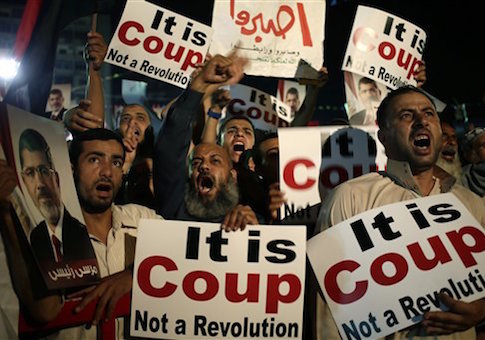
There is, of course, a reason the MSM, which apparently follows the Obama administration’s lead, has been unkind to Sisi. One will recall that, although Sisi led the largest revolution in world history—a revolution that saw tens of millions take to the streets and ubiquitous signs and banners calling on U.S. President Obama and U.S. ambassador to Egypt Anne Patterson to stop supporting terrorism (i.e., the Brotherhood)—U.S. leadership, followed by media, spoke only of a “military coup” against a “democratically elected president,” without pointing out that this president was pushing a draconian, Islamist agenda on millions who rejected it.

So what is the significance of all this—of Sisi? First, on the surface, all of this is positive. That Sisi would criticize the Muslim world and Islamic texts and thinking—in ways his Western counterparts could never—and then continue his “controversial” behavior by entering the Coptic Christian cathedral during Christmas mass to offer his greetings to Christians—a big no-no for Muslim leaders—is unprecedented. Nor can all this be merely for show. In the last attack on a Coptic church, it was two Muslim police officers guarding the church who died—not the Christian worshipers inside—a rarity.

That Sisi remains popular in Egypt also suggests that a large percentage of Egyptians approve of his behavior. Recently, for instance, after the Paris attacks, Amru Adib, host of Cairo Today, made some extremely critical comments concerning fellow Muslims/Egyptians, including by asking them “Are you, as Muslims, content with the fact that today we are all seen as terrorists by the world?… We [Egyptians] used to bring civilization to the world, today what? — We are barbarians!  Barbarians I tell you!” (More of Adib’s assertions here.)

That said, the others are still there—the Muslim Brotherhood, the Salafis, those whom we call “Islamists,” and their many sympathizers and allies.

Worst of all, they have that “corpus of [Islamic] texts and ideas” that has been “sacralized over the centuries” (to use Sisi’s own words) to support them—texts and ideas that denounce Sisi as an “apostate” deserving of death, and thus promising a continued struggle for the soul of Egypt.

Meet the honor brigade, an organized campaign to silence debate on Islam

January 17, 2015

Meet the honor brigade, an organized campaign to silence debate on Islam, Washington Post, Asra Q. Nomani, January 16, 2015

(It’s encouraging to read that a few actually moderate Muslims are slowly bringing modest changes to a few who practice the Religion of the Perpetually Offended and Violent. However, much more and a long time will be needed before significant numbers of “moderate” and “non-extremist” Muslims begin to accept freedoms for themselves and for others and to reject Sharia law in its present and historic form.  Until then?– DM)

[W]e need a new interpretation of Islamic law in order to change the culture. This would require rejecting the eight schools of religious thought that dominate the Sunni and Shiite Muslim world. I propose naming a new one after ijtihad, the concept of critical thinking, and elevating self-examination over toxic shame-based discourse, laws and rules.

********************

“You have shamed the community,” a fellow Muslim in Morgantown, W.Va., said to me as we sat in a Panera Bread in 2004. “Stop writing.”

Then 38, I had just written an essay for The Washington Post’s Outlook section arguing that women should be allowed to pray in the main halls of mosques, rather than in segregated spaces, as most mosques in America are arranged. An American Muslim born in India, I grew up in a tolerant but conservative family. In my hometown mosque, I had disobeyed the rules and prayed in the men’s area, about 20 feet behind the men gathered for Ramadan prayers.

Later, an all-male tribunal tried to ban me. An elder suggested having men surround me at the mosque so that I would be “scared off.” Now the man across the table was telling me to shut up.

“I won’t stop writing,” I said.

It was the first time a fellow Muslim had pressed me to refrain from criticizing the way our faith was practiced. But in the past decade, such attempts at censorship have become more common. This is largely because of the rising power and influence of the “ghairat brigade,” an honor corps that tries to silence debate on extremist ideology in order to protect the image of Islam. It meets even sound critiques with hideous, disproportionate responses.

The campaign began, at least in its modern form, 10 years ago in Mecca, Saudi Arabia, when the Organization of Islamic Cooperation — a mini-United Nations comprising the world’s 56 countries with large Muslim populations, plus the Palestinian Authority — tasked then-Secretary General Ekmeleddin Ihsanoglu with combating Islamophobia and projecting the “true values of Islam.” During the past decade, a loose honor brigade has sprung up, in part funded and supported by the OIC through annual conferences, reports and communiques. It’s made up of politicians, diplomats, writers, academics, bloggers and activists.

In 2007, as part of this playbook, the OIC launched the Islamophobia Observatory, a watchdog group based in Jiddah, Saudi Arabia, with the goal of documenting slights against the faith. Its first report, released the following year, complained that the artists and publishers of controversial Danish cartoons depicting the prophet Muhammad were defiling “sacred symbols of Islam . . . in an insulting, offensive and contemptuous manner.” The honor brigade began calling out academics, writers and others, including former New York police commissioner Ray Kelly and administrators at a Catholic school in Britain that turned away a mother who wouldn’t remove her face veil.

“The OIC invented the anti-‘Islamophobia’ movement,” says Zuhdi Jasser, president of the American Islamic Forum for Democracy and a frequent target of the honor brigade. “These countries . . . think they own the Muslim community and all interpretations of Islam.”

Alongside the honor brigade’s official channel, a community of self-styled blasphemy police — from anonymous blogs such as LoonWatch.com and Ikhras.com to a large and disparate cast of social-media activists — arose and began trying to control the debate on Islam. This wider corps throws the label of “Islamophobe” on pundits, journalists and others who dare to talk about extremist ideology in the religion. Their targets are as large as Israeli Prime Minister Benjamin Netanyahu and as small as me.

The official and unofficial channels work in tandem, harassing, threatening and battling introspective Muslims and non-Muslims everywhere. They bank on an important truth: Islam, as practiced from Malaysia to Morocco, is a shame-based, patriarchal culture that values honor and face-saving from the family to the public square. Which is why the bullying often works to silence critics of Islamic extremism.

“Honor brigades are wound collectors. They are couch jihadis,” Joe Navarro, a former supervisory special agent in the FBI’s behavioral analysis unit, tells me. “They sit around and collect the wounds and injustices inflicted against them to justify what they are doing. Tragedy unites for the moment, but hatred unites for longer.”

In an e-mail exchange, the OIC’s ambassador to the United Nations denied that the organization tries to silence discussion of problems in Muslim communities.

The attacks are everywhere. Soon after the Islamophobia Observatory took shape, Sheik Sabah Ahmed al-Sabah, the emir of Kuwait, grumbled about “defamatory caricatures of our Master and Prophet Muhammad” and films that smear Islam, according to the OIC’s first Islamophobia report.

The OIC helped give birth to a culture of victimization. In speeches, blogs, articles and interviews widely broadcast in the Muslim press, its honor brigade has targeted pundits, political leaders and writers — from TV host Bill Maher to atheist author Richard Dawkins — for insulting Islam. Writer Glenn Greenwald has supported the campaign to brand writers and thinkers, such as neuroscientist and atheist Sam Harris, as having “anti-Muslim animus” just for criticizing Islam.

“These fellow travelers have made it increasingly unpleasant — and even dangerous — to discuss the link between Muslim violence and specific religious ideas, like jihad, martyrdom and blasphemy,” Harris tells me.

Noticing the beginnings of this trend in December 2007, a U.S. diplomat in Istanbul dispatched a cable to the National Security Council, the CIA, the Defense Intelligence Agency and various State Department offices. The cable said the OIC’s chief called supporters of the Danish cartoons of Muhammad “extremists of freedom of expression” and equated them with al-Qaeda.

Most of the criticism takes place online, with anonymous bloggers targeting supposed Islamophobes. Not long after the cable, a network of bloggers launched LoonWatch, which goes after Christians, Jews, Hindus, atheists and other Muslims. The bloggers have labeled Somali author Ayaan Hirsi Ali, a born Muslim but now an atheist opponent of Islamic extremism, an “anti-Muslim crusader.” Robert Spencer, a critic of extremist Islam, has been called a “vicious hate preacher” and an “Internet sociopath.” The insults may look similar to Internet trolling and vitriolic comments you can find on any blog or news site. But they’re more coordinated, frightening and persistent.

One prominent target of the honor brigade’s attacks was Charlie Hebdo, the French newspaper where several staffers were recently killed by Islamic extremists. According to some accounts, as the killers massacred cartoonists, they shouted: “We have avenged the prophet Muhammad.” The OIC denounced the killings, but in a 2012 report, it also condemned the magazine’s “Islamophobic satires.” Its then-secretary general, Ihsanoglu, said the magazine’s “history of attacking Muslim sentiments” was “an outrageous act of incitement and hatred and abuse of freedom of expression.”

Charlie Hebdo is not the only evidence that, to self-appointed defenders of the faith, a call to kill the message can very easily become a plan to kill the messenger. In January 2011, a security officer for the governor of Pakistan’s Punjab province, Salman Taseer, assassinated him after Taseer defended a Christian woman accused of blasphemy. In court, supporters laid flowers on the shoulders of the assassin in approval.

Murderers like him would be much harder to radicalize in a climate that welcomed debate about Islam rather than seeking revenge on its critics. But in so many Muslim communities now, saving face trumps critical thinking and truth-telling. This is why reform from within Islam is so difficult. In my experience, if you try to hold the community accountable, you’re more likely to be bullied and intimidated than taken seriously.

When Rupert Murdoch recently tweeted, “Maybe most Moslems peaceful, but until they recognize and destroy their growing jihadist cancer they must be held responsible,” he was criticized for indelicately saying all Muslims were responsible for the acts of a few. But I do believe we bear collective responsibility for the problems in our communities.

After my threatening meeting at Panera, I kept advocating for women’s rights in the mosque and in the bedroom. Among other things, I argued that Muslim women have the right to orgasm, an intimacy too often denied in societies with a tradition of female genital mutilation.

Then came the death threats. In the fall of 2004, my parents and my son picked me up after I spoke at a conference. “Somebody wants to kill you,” my father said from behind the wheel of our gold Dodge Caravan, his voice trembling. The death threat was posted on Muslim WakeUp!, a now-defunct progressive Web site. The offender told the FBI that he would stop harassing me, and he did. More prosaic taunts in the past decade have called me a “Zionist media whore,” a “House Muslim” and many other unprintable insults.

Two years ago, Zainab Al-Suwaij, executive director of the American Islamic Congress, was so battered by online attacks aimed at silencing her that she experienced a physical response to the stress and anxiety, and ended up in an emergency room. When I met her in her office near the White House, she pulled up her sleeves to show me the marks left by IV injections that the hospital staff had administered to get her necessary fluids.

“The attacks just killed me,” Al-Suwaij said, wearily.

Bullying this intense really works. Observant members of the flock are culturally conditioned to avoid shaming Islam, so publicly citing them for that sin often has the desired effect. Non-Muslims, meanwhile, are wary of being labeled “Islamophobic” bigots. So attacks against both groups succeed in quashing civil discourse. They cause governments, writers and experts to walk on eggshells, avoiding important discussion.

For my part, I have continued to write, calling on American Muslims to root out extremism in our communities and arguing that certain passages of the Koran are too antiquated for our times. As I see it, the injunction to “stand out firmly for justice even against . . . your kin” is our divine “See something, say something” mandate. But too often, this passage is misused as a justification for attacking our own.

While we still have a long way to go, I have seen progress since I started calling for women’s rights in mosques and challenging the extremism I saw in American Muslim communities. Our mosque in Morgantown, a mostly male congregation, elected its first female president a few years ago, and she was largely accepted as a leader. But most women still shuffle through the back door and pray in a separate balcony.

Four years ago, the Muslim Public Affairs Council, an advocacy group, announced programs to discuss “taboo topics” such as homosexuality, interfaith marriage and extremism. Recently, young Muslim leaders in Northern Virginia started an initiative to create mosques that promote assimilation, interfaith harmony and women’s rights. Later this month, a new group, the Women’s Mosque of America, will hold a female-led prayer service in Los Angeles, a rare event in Muslim communities.

Next month, the Obama administration will hold a conference on challenging violent extremism, and President Obama last year called on Muslim communities to “explicitly, forcefully and consistently reject the ideology of al-Qaeda and ISIL.” But his administration isn’t framing extremism as a problem directly tied to Islam. Last month, by contrast, Egyptian President Abdel Fatah al-Sissi acknowledged that there was an ideology problem in Islam and said, “We need to revolutionize our religion.”

When I heard Sissi’s words, I thought: Finally.

Beyond these statements, though, we need a new interpretation of Islamic law in order to change the culture. This would require rejecting the eight schools of religious thought that dominate the Sunni and Shiite Muslim world. I propose naming a new one after ijtihad, the concept of critical thinking, and elevating self-examination over toxic shame-based discourse, laws and rules. Such a project could take the power out of the hands of the status quo clerics, politicians and experts and replace it with a progressive interpretation of faith motivated not by defending honor but acting honorably.
Don’t ignore the writing on the wall

January 16, 2015

Don’t ignore the writing on the wall, Israel Hayom, Yoram Ettinger, January 16, 2015

(It’s much easier and much less stressful to look forward to hope and change. Briefly. –DM)

Since the 1993 Oslo Accord, Western democracies have refrained from reading the writing on the Palestinian (Mahmoud Abbas and Hamas) wall: hate education in grades K-12; unprecedented terrorism; systematic noncompliance with agreements; naming squares, streets and tournaments after terrorists; monthly allowances for families of terrorists; responding to Israeli withdrawals with intensified terror.

Hitler’s master plan was outlined in 1925-26 in the two volumes of the supremacist, anti-Jewish “Mein Kampf” (“My Struggle”), which is currently a best-seller in the Muslim world, particularly in Iran and the Palestinian Authority.

***************

In 539 B.C.E., Babylonian King Belshazzar ignored the writing on the wall — as interpreted by the Prophet Daniel — and was, therefore, annihilated by the Persians (Daniel 5).

In 2015, Western civilizations must read the writing on the wall, desist from ambiguity, denial and political correctness and embrace clarity, realism and political incorrectness, in order to survive and overcome the clear and present lethal threat of Islamic takeover, which is gathering momentum via demographic, political and terroristic means.

History proves that Western ambiguity and the refusal to identify enemies — due to ignorance, gullibility, oversimplification, appeasement, delusion and wishful thinking — have taken root, yielding major strategic setbacks and painful economic and human losses. When it comes to reading the writing on the wall, Western eyesight has been far from 20:20, dominated by modern day Belshazzars, ignoring modern day Daniels.

For example, during the 1930s, the writing was on the wall in glaring letters: Germany abrogated the Treaty of Versailles, which called for German disarmament, reparations and territorial concessions; German military spending skyrocketed, military conscription was reintroduced and the Rhineland was remilitarized; Germany withdrew from the League of Nations and annexed Austria. Still, on September 30, 1938, British Prime Minister Neville Chamberlain signed the Munich Pact, declaring “peace for our time.” He refused to recognize Hitler’s strategic, global, supremacist goal, assuming that Hitler’s appetite could be satisfied with a tactical, limited gain in Czechoslovakia’s Sudetenland, signing a “peace accord” that triggered the “war of all wars.”

Hitler’s master plan was outlined in 1925-26 in the two volumes of the supremacist, anti-Jewish “Mein Kampf” (“My Struggle”), which is currently a best-seller in the Muslim world, particularly in Iran and the Palestinian Authority.

During 1977-79, U.S. President Jimmy Carter did not read the writing on the wall, supporting the Ayatollah Ruhollah Khomeini’s battle against the Shah of Iran, who was, in fact, the U.S.’s policeman in the Persian Gulf. Overwhelmed by denial and wishful thinking, and heavily influenced by the U.S. foreign policy establishment, Carter ignored the litany of sermons delivered by Khomeini, which exposed the Iranian cleric as an enemy of Western civilization and civil liberties. He despised the U.S. and aligned himself with the enemies of the U.S., while protected by a Palestinian PLO praetorian guard. Thus, the U.S. betrayal of the Shah eliminated a most effective and loyal strategic partner of the U.S., gave rise to the most lethal, conventional and nonconventional threat to vital U.S. interests in the Persian Gulf, the Middle East and beyond and generated a robust tailwind to Islamic terrorism.

In 1990, on the eve of Saddam Hussein’s invasion of Kuwait, the U.S. stated that an Iraq-Kuwait military clash would be an intra-Arab, rather than a U.S., concern. The Bush/Baker administration assumed that “the enemy of my enemy [Iran] is my friend [Iraq],” supplying Saddam with dual-use sensitive systems, providing him with $5 billion loan guarantees and concluding a U.S.-Iraq intelligence sharing agreement. The 1990 policy of denial triggered a conventional conflict, a $1.25 trillion cost to the U.S. taxpayer, 4,500 U.S. military fatalities, a surge of anti-U.S. Islamic terrorism and a dramatic destabilization of the Persian Gulf.

Since the 1993 Oslo Accord, Western democracies have refrained from reading the writing on the Palestinian (Mahmoud Abbas and Hamas) wall: hate education in grades K-12; unprecedented terrorism; systematic noncompliance with agreements; naming squares, streets and tournaments after terrorists; monthly allowances for families of terrorists; responding to Israeli withdrawals with intensified terror.

In 2011, Western democracies denied the eruption of an Arab tsunami, welcoming the violence on the Arab Street as an Arab Spring that would transition the Arabs toward democracy. The Obama administration embraced the Muslim Brotherhood (while giving a cold shoulder to Gen. Abdel-Fattah el-Sissi), refusing to recognize its well-documented intra-Arab terrorism, the offshoot of its motto: “Allah is our objective; the Quran is the constitution; the prophet is our leader; jihad is our way; death for the sake of Allah is our wish.”

The 2015 failure to carefully read the Iranian writing on the wall could produce a nuclear conflict that would cost the U.S. taxpayer trillions of dollars, incur an unprecedented level of fatalities, spark a tidal wave of Islamic terrorism throughout the globe, including in the U.S., decimate the pro-U.S. Arab regimes in the Persian Gulf and Jordan, create an unprecedented disruption of the supply of Persian Gulf oil, further radicalization of the anti-U.S. regime in Venezuela with ripple effects in Latin America, including Mexico, and additional tectonic eruptions of insanity throughout the globe.

At stake is not only freedom of expression and the safety of European Jewry, but the survival of Western democracies.

Solidarity demonstrations and eloquent speeches will not spare Western democracies the wrath of Islamic terrorism and domination, unless accompanied by clarity, realism and the willingness to take military, legislative and political action to thwart the writing on the walls of the mosques: submission of humanity to the Prophet Muhammad; submission of the Christian, Hindu, Buddhist, Sikh and Jewish kuffar (“infidel”) to Muslims and to Shariah laws; jihad — holy war on behalf of Islam — is the duty of Muslims; waqf — Muslim land — is ordained by Allah; Dar al-Islam (the residence of Islam) must take over Dar al-Harb (the residence of war); and Islam-sanctioned taqiyya (dissimulation, deception and concealment of inconvenient data) aimed at shielding Islam and “believers” from “disbelievers.”

Isolated incidents or global war?

January 16, 2015

Isolated incidents or global war? Israel Hayom, Dore Gold, January 16, 2015

[V]irtually all these radical Islamic leaders see themselves as in no less than a civilizational battle with the West. There have been those who do not want to depict this struggle in this way, including those in the West who, out of political correctness, refuse to discuss the threat of radical Islam.

***************

In response to the first attack in Paris on the offices of the French satirical magazine Charlie Hebdo, a member of a jihadi forum, affiliated with ISIS, wrote a very striking explanation as to why France in particular was targeted. As is usual in the jihadi world, which seeks to return to the early days of Islam centuries ago, history played an important role in his thinking: “France was one part of the Islamic land and it will be Islamic again.

What was he talking about? For years, global jihadi organizations have issued calls to retake al-Andalus, the Arabic name for Spain and those parts of the Iberian peninsula when they were held by the Muslims from 711 until 1492. This last summer ISIS members produced a video calling for the liberation of al-Andalus. But, it is often forgotten that shortly after the conquest of Spain, an Arab army crossed the Pyrenees and occupied territories that today are part of France. Having captured Bordeaux, it was met and defeated in 732 by a Frankish army led by Charles Martel at the Battle of Tours — some 200 miles from Paris. Even after this historical battle, Arab armies did not halt their efforts to seize French territory. They in fact reached Lyons and threatened to occupy all of Provence. In fact, parts of France remained under Islamic rule until 759, when Narbonne, the main base of the invading Arab armies, fell.

Whether or not the attack in France was motivated by such historical memories, the passion to recover lost territories that were once under Islamic rule is a theme running through most of the organizations associated with the global jihadist network. It was no less than Hassan al-Banna, the founder of the Muslim Brotherhood, who first articulated this theme: “Andalusia, Sicily, the Balkans, South Italy and Roman Sea Islands were all Islamic lands that had to be restored to the homeland of Islam; the Mediterranean and Red Sea should equally be part of the Islamic Empire as they were before.” Al-Banna’s writings, which are to this day still revered by most of the radical Islamic movements, are available on the internet today in Arabic and even in English.

In recent times, this ideological orientation of the Muslim Brotherhood has been best represented by Sheikh Yusuf Qaradawi, who is based in Qatar. Regarded by many as the highest spiritual authority in the Muslim Brotherhood, Qaradawi appeared on Qatari television in 2007 and declared: “I expect that Islam will conquer Europe without resorting to the sword or fighting. It will do so by means of da’wa (proselytizing) and ideology.” The only geographic points he mentioned in relationship to this expansion of the Islamic realm were as follows: “The conquest of Rome — the conquest of Italy, and Europe — means that Islam will return to Europe once again.”

Qaradawi, who appeared weekly on Al Jazeera, gave his patronage to a Muslim Brotherhood facility in a French chateau where Islamists used to train European Imams. Thousand of young Muslims were bussed into this retreat center. In short, Qaradawi’s ideas had multiple platforms through which they could spread.

There were other organizations that took Qardawi’s declarations a step further. Hamas, which is after all the Palestinian branch of the Muslim Brotherhood, has also made similar statements. Sheikh Younus al-Astal, who has had a leading role within the supreme religious body of Hamas (the Association of the Religious Scholars of Palestine) gave the following sermon in 2008 that was broadcast on Hamas television: “Very soon, Allah willing, Rome will be conquered, just like Constantinople was, as was prophesied by our Prophet Muhammad.” He then spoke about how the “Islamic conquests … will spread through Europe in its entirety” and beyond.

Dabiq, a journal published by ISIS, also deals with the conquest of Rome. The journal recently put on its cover a picture of Saint Peter’s Square in Rome; the editors manipulated the photograph and put the flag of ISIS on the obelisk in the center. The journal also quotes the founder of al-Qaida in Iraq, Abu Musab al-Zarqawi, as saying: “We fight here while our goal is Rome.” Before he led the insurgency in Iraq against the U.S. and its allies, Zarqawi actually set up a terrorist network for operations on European soil.

Recep Tayyip Erdogan’s Turkey, under the ruling AKP Party, has also taken up the cause of recovering lost Islamic lands. In 2004, a U.S. State Department official sent a cable to Washington warning that at an event held at the AKP’s main think tank, he heard the idea voiced that Turkey’s role is to spread Islam in Europe, and “avenge the defeat at the siege of Vienna in 1683.” The cable linked a high level Turkish official with this view. It was made public by WikiLeaks.

What all these statements teach us is that virtually all these radical Islamic leaders see themselves as in no less than a civilizational battle with the West. There have been those who do not want to depict this struggle in this way, including those in the West who, out of political correctness, refuse to discuss the threat of radical Islam. They also cling to the mistaken idea that the Muslim Brotherhood can become an ally against al-Qaida and its affiliates.

Last week, on January 9, the American journal National Review published emails, leaked from an Al Jazeera producer, about the attacks in France. He sought to play down the significance of the terror in Paris, rejecting the notion that this was a “civilizational attack on European values.” He insisted that no one knows the motivation behind the attacks, suggesting perhaps that it was a reaction to France’s military actions against ISIS, or its operations in Libya and Mali.

In other words, the Al Jazeera producer did not want his network to admit that the attack in Paris was motivated by an aggressive Islamist ideology, but rather preferred to blame Western policies, which if it became widely accepted would cripple its leaders and deny them the self-confidence to take any effective action. That is what has largely happened until now. It is no wonder that Al Jazeera, whose headquarters is located in Qatar, has been correctly described as the satellite channel of the Muslim Brotherhood.

In contrast, Ghassan Charbel, the editor-in-chief of Al Hayat, the leading newspaper in the Arab world, on Monday refused to play down the Paris attacks as a unique, one-time event: “No one can disregard the scale of the problem and the extent of the threat any more.” Defying the political correctness of many of the world’s capitals, he bravely told the truth about what was happening: “What is clear is that the Paris attack is just the opening shot of a global war that the Islamist extremists will be waging in the West and the rest of the world.” He had no qualms about saying that the problem was the threat of radical Islam. Until the West internalizes his warning of what it is facing, unfortunately a new wave of attacks in the West will only be a matter of time.

Millions March in Paris; Gov’ts & Media Scrub Islamist Motive

January 13, 2015

Millions March in Paris; Gov’ts & Media Scrub Islamist Motive, Clarion Project, Meira Svirsky, January 12, 2015

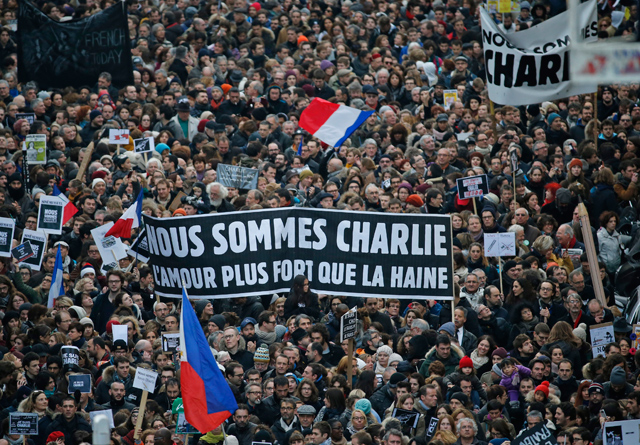
France-We-Are-Charlie-Reuters-IPA banner that reads ‘We Are Charlie’ at the march in Paris in support of slain journalists from the Charlie Hebdo magazine. (Photo: © Reuters)

[T]he Islamists will have won on many accounts. The fact that leaders of the Western world have demurred to differentiate between Islam and Islamism (the implementation of Islam on a political level, including the instituting of sharia law) due to desire not to offend Muslims or be labelled racists means that they will not implement the measures needed to stamp out the Islamist ideology and its resulting violence.

**************

By refusing to censor themselves and bow to the requests of sharia law, the publishers of Charlie Hebdo refused to be part of this sabotage.The Western world needs to take up their gauntlet.

World leaders joined a march of one and a half million people today in Paris in a show of unity to the 17 slain in the Islamist terrorist attacks across France last week.

“Unity against extremism” was the theme in Paris’ Republique plaza, as reflected in the words of France Prime Minister Manuel Valls, who said Saturday, “We are all Charlie, we are all police, we are all Jews of France.”

The French prime minister was referring to the attacks on theCharlie Hebdo magazine on Wednesday that left 10 journalists and 2 policemen dead, another policewoman dead in a separate attack on Thursday and four hostages killed in a take-over of a kosher mini-market on Friday.

Two brothers armed with AK-47s along with another gunmen stormed the Charlie Hebdo magazine’s offices after deeming cartoons they had published offensive to Islam. The magazine’s headquarters had been firebombed in 2011 for the same “offense.” The magazine had police protection and its editor, who was killed in the attack, employed a policeman as a personal bodyguard.

In a video of the attack as it played out afterwards on the street  taken by a Parisian who had escaped to the roof of a neighboring building, the attackers could be heard shouting “Allahu Akhbar” (“God is Great” in Arabic) as they shot a policeman on the street, then finishing him off at point blank while he lay wounded.

Witnesses also reported hearing the gunmen yell, “We have avenged the Prophet Mohammed.”

As explained by British Islamist Anjem Choudary – and as well understood by the French president as well as every other world leader who will be attending Sunday’s rally — insulting the prophet of Islam is a crime punishable by the death penalty according to sharia (Islamic) law.

Which make it even more surprising that, in one of Francois Hollande’ s first statements following the attack on the magazine, the French president said, “These madmen, fanatics, have nothing to do with the Muslim religion.”

The White House press secretary Josh Earnest, took the obfuscation one step further when he kept referring to the attack as “violence,” prompting his CNN interviewer to pin him down saying, “Josh, when you talk about countering the message, you keep using the word violence. I mean, this is an act of terrorism, that’s what the president of France called it — an act of terrorism … Do you see this as an act of terrorism, and is this something that has to be condemned on that level?”

To which Earnest replied obscurely, “Based on what we know right now, it does seem that’s what we’re confronting here. And this is an act of violence that we certainly do condemn, and if based on this investigation it turns out to be an act of terrorism, then we would condemn that in the strongest possible terms, too.”

After the beheading of journalist James Foley,  U.S. President Barack Obama declare that the Islamic State “is not Islamic.”  Following this stance, Obama initially released a statement which read, “I strongly condemn the horrific shooting at the offices of Charlie Hebdo magazine in Paris that has reportedly killed 12 people.”

Later, he managed to refer to the attack simply as “terrorism.”

For their part, many media outlets were busy scrubbing the frames of the video where “Allahu Akhbar” could be heard. The New York Times originally reported a quote from a survivor of the magazine attack, Sigolène Vinson, a freelancer who was at the magazine’s office that morning and later spoke to French media.

Relating how she thought she would be killed when one of the attackers put a gun to her head, Vinson reported that the gunman said instead, “I’m not going to kill you because you’re a woman. We don’t kill women, but you must convert to Islam, read the Quran and cover yourself.”

The quote was short-lived on the Times, who later edited Vinson’s quote from the attacker to read, “Don’t be afraid, calm down, I won’t kill you. You are a woman. But think about what you’re doing. It’s not right.”

CNN, for their part, managed to question whether the kosher store was chosen by the Islamist attacker for anti-Semitic reasons since “many Muslims shopped there” and because there were a “variety of shops” in the non-Jewish neighborhood.  The network chose to ignore a widely circulated report by a French reporter who spoke to the terrorist by phone. “He said he did it to defend oppressed Muslims, especially in Palestine, and he chose a kosher supermarket because it served Jews,” said the French reporter.

Amid the reporting was the recurring question asked by the media, “What can be done?” as well as the implied answer given by the French president when he said, “France has not seen the end of the threats it faces” – an answer unfortunately relevant to the rest of the Western world.

Hollande’s response will, regrettably, be the correct assessment if those in charge refuse to face the reality of the threat: Failure to address the “Islamist” component of the terrorism that is striking the West is not only disingenuous but erects an impenetrable barrier to overcoming it.

And so, the Islamists will have won on many accounts. The fact that leaders of the Western world have demurred to differentiate between Islam and Islamism (the implementation of Islam on a political level, including the instituting of sharia law) due to desire not to offend Muslims or be labelled racists means that they will not implement the measures needed to stamp out the Islamist ideology and its resulting violence.

“Everyone is focusing on the fact that that the jihadists went after cartoonists,“  said Clarion Project’s national security analyst Ryan Mauro in an interview on national news (see below for full interview). Yet, “there is always going to be a target [emanating] from this ideology that says that ‘Things like this are so illegal undersharia that they must be retaliated against violently in order to make societies conform to our belief system of sharia.’”

Our leaders must realize that speaking about terror motivated by Islamist ideology does not connote anti-Muslim sentiment.

“The issue we face is not, as Islamist groups falsely claim in the United States – ironically the very ones invited to the White House, Homeland Security, Department of Justice, and State Department — that using the term Islamic terrorism connotes a generalization that all Muslims are terrorists any more than using the term “Hispanic drug cartels” means that all Hispanics are druggies or that the term “Italian mafia” means that all Italians are mobsters or that the term “German Nazis” mean that all Germans were Nazis, “ writes Steve Emerson of the Investigative Project on Terrorism.

“The term Islamic terrorism means just that: terrorist attacks with an Islamic motivation — whether they attempts to silence critics of Islam, impose Sharia, punish Western ‘crusaders,’ commit genocide of non-Muslims, establish Islamic supremacy (or a Caliphate), or destroy any non Muslim peoples (e.g. the Jews and Christians) that are ‘occupying Muslim lands,’” says Emerson.

Failure to identify the Islamist ideology driving terrorism necessarily means we will not succeed in our battle against it. Moreover, we will be willingly complicit in our demise.

If we don’t want to be part of that, the events in France teach us, “Don’t censor yourself,” says Mauro. “Recognize that this attack is a means to an end. Victory for them isn’t the attack itself, the victory comes when we censor ourselves. Because they are not powerful enough to enforce their form of sharia governance upon us, what they can do is to intimidate us into implementing it on ourselves.”

In a document recovered from a 1991 meeting which outlines the Muslim Brotherhood‘s strategic goals for North America, the founders of the Islamist movement in America wrote, “The Ikhwan[Muslim Brotherhood] must understand that their work in America is a kind of grand jihad in eliminating and destroying the Western civilization from within and ‘sabotaging’ its miserable house by their hands and the hands of the believers…”

By refusing to censor themselves and bow to the requests of sharialaw, the publishers of Charlie Hebdo refused to be part of this sabotage.

The Western world needs to take up their gauntlet.