Archive for the ‘Multiculturalism’ category

Lessons from Europe’s Immigrant Wave: Douglas Murray Cautions America

July 24, 2017

Lessons from Europe’s Immigrant Wave: Douglas Murray Cautions America, Investigative Project on Terrorism, Abigail R. Esman, July 24, 2017
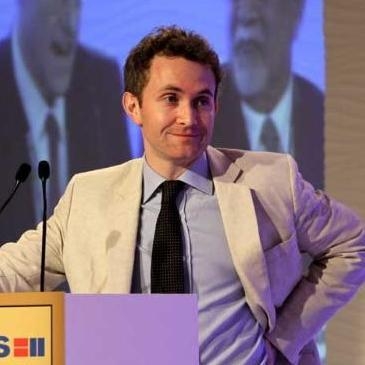
Douglas Murray has long voiced his concern about the growing influence of Muslim culture on the West. The associate editor of Britain’s Spectator, a frequent contributor to the Wall Street Journal, and the founder of the Centre for Social Cohesion, a think tank on radical Islam, he has built an international reputation for his opposition to the demographic changes of the West and the threats to its traditions. In his latest book, The Strange Death of Europe: Immigration, Identity, Islam (Bloomsbury, 2017), he attacks all of these subjects as they relate to the current crisis of migration from the Middle East.

It is a controversial book, particularly for Americans and Jews, but one which also makes important arguments against the multiculturalist ideal. That ideal, which once led much of domestic policy across Europe and the United States, has proven not only a failure, but a threat to the values and national security of Western civilization.

The Investigative Project on Terrorism recently spoke with Murray about his book and the concerns that drove him to write it.

Abigail R. Esman: As an American, a Jew, and an immigrant myself to the Netherlands, there are aspects of your arguments against immigration and asylum that are troublesome to me. I come from a country where we are all immigrants, or our parents or grandparents were likely immigrants. You talk for instance of families where “neither parent speaks English as a first language,” yet my husband is Australian and I am American and neither of us speaks Dutch as a first language. So naturally, I come at these arguments with some concern. Are you saying, basically, close the borders?

Douglas K . Murray: It’s only for me to diagnose what’s happening – to see the truth about what is going on. Policy makers will make their own decisions. I have obviously broad views on it, which is that I think you can’t continue at the rate we have now, and I think you have to be choosy about the people you bring in. But you are right, and there are two groups of people who have had trouble with some of the basic things in this book: one is people of Jewish background, and others who come from nations of immigrants, like America. But Britain isn’t a nation of immigrants – we have been a static society with all the benefits and ills that this brings. And I think it is dishonest to say it is the same thing. I realize people who are predominantly Jewish have a particular sensitivity to it, but I think that that’s a particular issue. And why do we say one migration is just like the other It’s like saying because two vehicles went down the same road they are the same vehicle.

ARE: How is it different?

DKM: In the UK, when Jewish migration happened more than a century ago, the main thing was integration, integration into the society, wanting desperately to be part of British society. Why do synagogues in the UK have a portrait of the Queen? And after services, they often sing the British national anthem. It’s very moving. It’s an effort to demonstrate this is what we are and this is what we want to be. You’d be hard pressed to find a mosque with a picture of the queen who sing the anthem.

ARE: That element of integration is crucial, I agree. In America, in fact, immigrants in the past and often even today are eager to give their children Anglicized names: “Michael,” not “Moishe,” “Henry,” not “Heinrich.” Yet you do not see the name changes in Muslims these days. Why do you think that is?

DKM: Because there is less of a feeling to integrate. They want to stay with the country they’ve left but not deal with its economics. Some people find it flattering – that people want to move to your country – they say well, it shows what a wonderful place we are. No, it shows that your economics work better.

ARE: You also write about Muslim enclaves in Europe where “the women all wear some form of head covering and life goes on much as it would if the people were in Turkey or Morocco.” How is that different than, say, Chinatowns, or Orthodox Jewish neighborhoods in America and say, Belgium, where women wear wigs and men have peyas, or sidelocks?

DKM: The example of Chinatown-like places is a good comparison. These are places that are mini-Chinas, they are enjoyed and liked by people because they are a different place. Well, if people want to have a mini-Bangladesh, that’s one vision of a society. It’s not the vision we were sold in Europe. It was not meant to be the case that portions of our cities were meant to become totally different places. In the 1950s the British and other European authorities said we have to bring people into our countries and we will get a benefit in labor. But if they had said that the downside is that large portions of the area would be unrecognizable to their inhabitants, there would have been an outcry.

And the issue of them being different from Hasidic communities – you’re right, they are similar. You can go to Stamford Hill in North London and see most of the men in hats and so on and that’s because that’s an enclave that wants to keep to itself. That raises questions: one, people don’t mind that, for several reasons – one is the recognition that Orthodox men don’t cause troubles. We don’t have cases of Orthodox men going out and cutting off people’s heads. If four Jewish men from Stamford Hill had blown up buses some years back there would be concern about these enclaves.

And also those enclaves are not growing. If it was the case that these enclaves were becoming areas where all the city was hat-wearing Orthodox Jews, then people would say wait, what is that? You can applaud that or abhor it, but it’s important to mention.it.

ARE: In the Netherlands, which has some of the toughest immigration policies in the world, people from certain countries are required to take “citizenship” courses before they can even enter Dutch borders. They have to learn the language, they have to learn about Dutch values, and that no, you can’t throw stones at Jews and gay people and that gay marriage is legal and women wear short dresses. Would you recommend other countries take on the Dutch policy of citizenship courses?
DKM: I make this point in the book. You say we could have done more and better, but the fundamental thing is that none of it was ever expected in the first place. No one ever thought that we would be in the situation we are now in. We didn’t expect them to stay. That’s a very big misunderstanding. Why wouldyou ask people to become Dutch citizens if you expect them to go home in five years? Why if you only expect them to stay in Britain for only 10 years? But then we realized they would stay and then we said, “we have to let them practice their own culture.” But for us to have acted as you suggest we would have had to know [at the time].

So yes, I think it’s a bare minimum for Europe to have the Dutch policy, even at this very late stage. I’m of the inclination that this is too little too late, but I wish everyone luck with it.

ARE: What about Yazidi women, Syrian Christians?

DKM: Again, it comes down to the Jewish question – because people think that every refugee is like a Jew from Nazi Germany. But if you were to think of a group that was facing an attempt to wipe them off the face of the earth then yes, you’d have the Yazidis. But there are people on all sides of the Syrian civil war, which are a minority of people coming to Europe – these are people fleeing sectarian conflict, but none of them are fleeing an effort to wipe them out as a people. So the lazy view, and it is quite often pushed by Jewish groups which I think is a mistake – is to suggest that it is similar to Nazi Germany. And I wish more care were taken in this.

ARE: Is this in your mind a way of stopping radical Islam? Because so many of the radicalized Muslims are actually converts. How would it help?

DKM: We know that people who convert to anything tend to be fundamentalist. But the important thing is, if you were pliable to be converted, available to be converted, then it raises the question of what kind of Islam do we have in these countries? If it were people finding Sufism, rather than hardcore Salafism, maybe it would be different. I have a friend who is a Muslim who was on a trip some years ago who told me the story of introducing a Muslim woman to one of the senior clerics at Al-Azhar and she wouldn’t shake his hand. He asked her why not. She said, “Because I’m Muslim.” So he asked her how long she’d been a Muslim, and she said “Six years.” He said, “I’ve been a Muslim for eight decades.” And then he turned and said to his friend in Arabic, “What kind of Muslims are you making in Britain?”

ARE: One thing the American Muslim community seems to have over its European brethren is its successful integration into society. Yet at the same time, some of the worst of the radicals are in fact American-born. We have people like Linda Sarsour, who wears the mantle of feminism, but who is really a Trojan horse for the Islamists. She has said things like “Our number one and top priority is to protect and defend our community. It is not to assimilate and lease any other people in authority.” What are the dangers of that kind of message?

DKM: I once spent an evening with Linda Sarsour. She is a very unpleasant, very radical girl. Filled with hate. I was the one having to defend America to Americans in an American audience against an American opponent. What she told that night was all lies, which you would tell either because you are dumb, which she isn’t, or because you want to spread propaganda, which she does.

I just think she is of a type. There are various sides to the issue that are important. There’s an “us” question and a “them” question. The “them” question is, what do people like that believe, what are they doing and how vile are they? But in a way, the “us” question is bigger. Why do we let them do this? What is wrong with America at this time in its history that an obvious demagogue like her can end up leading a feminist march [the 2017 Women’s March]? That’s an illness of America. She’s just a symptom of that.

ARE: And similarly, the Rushdie affair was effective in quashing further expression and criticism related to Islam. And Charlie Hebdo took that to an extreme. We haven’t had anything that severe, but there were the South Park threats and the attempted attack on the Mohammed cartoon contest in Garland. You blame European politicians and media for failing to recognize that those who were shouting “fire” were in fact the arsonists. This seems to be a global challenge – that any criticism or critique of Islam gets shouted down as inherently bigoted. In the U.S., the Southern Poverty Law Center places Maajid Nawaz on a list of “anti-Muslim extremists” for criticizing some tenets of the faith and advocating modernization and reform. In Europe the facts are very pessimism-causing. At the same time, though, there was certainly support for Charlie Hebdo, though you seem to deny it in your book, after the shootings. What’s the proper response to that form of a heckler’s veto?

DKM: I agree with the point. The only ways to reject the assassin’s veto is for civil society to be stronger on the question, for governments to ensure that people deemed to have ‘blasphemed’ are protected (as in the case of Rushdie) and that those who incite violence against them (such as Cat Stevens during the Rushdie affair) are the ones who find themselves on the receiving end of prosecutions. That and – obviously – ensuring that blasphemy laws aren’t allowed in through the back door via new ‘hate speech’ laws and the like.

ARE: In the chapter on multiculturalism, you describe interest groups which “were thrown up that claimed to represent and speak for all manner of identity groups.” These self-appointed voices then become the go-to groups for government. To keep the money flowing, they make the problems facing their community appear worse than they really are.” Is that a universal behavior for interest groups? We certainly see that in the U.S. with CAIR and ISNA.

DKM: Every group is vulnerable to that. With every human rights achievement, there are always some people left on the barricades. And the ones who linger on the barricades linger on without any home to go to. And you get these people who are stranded after it’s over and they have to hustle as if everything was as bad as it once was. Sometimes they are telling the truth; sometimes they wave a warning flag, but for the moment it seems particularly in America every group is claiming that this is basically 1938. It’s a tendency of every commune or group that wants awareness raised.

But it’s true, it’s especially prevalent of Muslim groups because if you keep claiming that you are the victim, then you never have to sort out your own house. And the groups that come to Europe and America, they never have to get their house in order if they spend all their time claiming they are victims of genocide and persecution and so on. And this is a familiar story.

ARE: So what would be your lesson, then, for America, especially in a book which clearly is about Europe?

DKM: Well, it is about Europe, certainly, but it’s connected to the debate America is now beginning to have. The first is to be careful with immigration. We’ve all had the same misunderstanding, the same thought that our societies are vast, immovable, unchanging things to which you could keep bringing people of every imaginable stripe and the results will always be the same. And I think that is just not the case, depending on the people who are in them. So we must take care with what kind of immigration we encourage, and at what pace, and that is something America should be thinking of, as everyone else should.

But America will have a harder time with this, because everyone in America has this vulnerability we don’t have in Europe, which is that we are all migrants. And you have the sense of ‘who am I to keep anyone out?’

ARE: I don’t think that’s the American view. I think it’s more that we all became part of this fabric, and we expect that the new immigrants will, too. But not all of them do.

DM: The whole thing actually seems to be unraveling, more than in Europe. In Europe, we don’t like to think in terms of racial terms. But all anyone in America talks about is race.

ARE: I don’t think so….

DKM: Maybe; but your vision of original sin in America seems to have become all so overwhelming. Your leading cultural figures, like Ta-Nehisi Coates, have this image of America born in terrible sin. The Atlantic’s front cover recently was all about slavery. You would get the impression that slavery only ended about 12 months ago. You are going over and over this in America – this endless sense of original sin. You are discussing reparations for slavery in 2017. You’d be hard-pressed to find publications in the UK calling for reparations to our past. Find me a mainstream publication that runs such a thing in Europe, even of WWII reparations.

So it’s symptomatic of something badly wrong at the structure of the public discussion.

ARE: Which suggests that we should do what?

DKM: What you have to listen out for is very straightforward: are the people raising such issues raising them because they want America to improve, or because they want America to end? I think this is a very central issue. Are you speaking as a critic, or as an enemy of the society in question? If you think the society can do no good, then you are speaking as an enemy. If you think there are things that have been done, that are wrong, that should be righted, campaign for them, speak out for them. Sometimes if you’re lucky you can get a posthumous rectification. But it sounds to me like a lot of this talk is from people who hate America. They don’t want to improve it. They want to end it.

So the lesson is – be careful about immigration. Be choosy. And another is a pretty straightforward one which is to work on the people who are there not to fall into the victim narratives of their special interest groups. And to focus on the “we.” I’ve always felt more optimistic for America in this regard, for the same reason I feel more optimistic than others do about France: because I think there is a very specific identity there, which it is possible to become a part of. I think it’s something other Western European countries, have not accomplished in the same way. So basically to strengthen their own identity.

ARE: Do you consider yourself a pessimist?

DKM: I think in Europe the facts are very pessimism-causing. I think it would be a strange person who would look at 12,000 people landing in Lampedusa, all young men, all without jobs, all without futures, and think, ‘That’s going to go really well. These are going to be just like the Jews of Vienna. These are going to be the receptacles of our culture.’ I don’t see it happening.
Orban: “Europe must regain sovereignty from the Soros empire,’ build border wall to stop ‘Muslimized Europe’

July 23, 2017

Orban: “Europe must regain sovereignty from the Soros empire,’ build border wall to stop ‘Muslimized Europe’ Jihad Watch

(Please see also, The Jewashing of George Soros. — DM)

Hungarian Prime Minister Viktor Orban has been long known to oppose allowing Muslim migrants into his country. Consequently, Hungary has experienced no “terror.” Nor has Poland, which has also restricted Muslim migration.

In 2015, Orban stated that Europe was in a “grip of madness” and warned that its “Christian identity” was threatened. Two years later, Europe has found itself in a crisis, with Sweden near civil war, Germany in dire straits with spiraling crime and billions of dollars of debt (which is still rising), and France suffering a series of deadly jihad massacres.

Back in April, Hungary announced its intention to build a second border wall to keep out migrants. Orban said at the time that “the first fence was a quick solution from the government, but not a perfect one as human traffickers come equipped with tools to cut it.” He called the new “high-tech” fence “far more serious and absolutely reassuring.”

Now Orban is rightly “calling on European nations to end their association with billionaire open-borders financier George Soros.” Orban once accused Soros of being the “strongest example of those who support anything that weakens nation states, they support everything that changes the traditional European lifestyle….These activists who support immigrants inadvertently become part of this international human-smuggling network.” In other words, Soros — who has declared himself to be “some kind of god,” and who “broke the bank of England,” benefits immensely from disrupting nation states.

Orban — who has been leading central European countries against mass immigration — highlighted his vision to save Europe from ultimate destruction via the hijrah:

In order for Europe to be able to live, it has to win back its sovereignty from the Soros Empire… Once this is done, migrants must be taken back outside the EU. It sounds strict, but those who came illegally, must be transported back.

“Orban: ‘Europe Must Regain Sovereignty From The Soros Empire’, Build Border Wall to Stop ‘Muslimized Europe,’” by Oliver JJ Lane, Breitbart, July 22, 2017:

Hungarian Prime Minister Viktor Orban has made an impassioned defence of European values and identity at the Bálványos Summer University camp in Romania Saturday, calling on European nations to end their association with billionaire open-borders financier George Soros.

Speaking at the 28th Bálványos Open University camp Saturday, which was this week was hailed as “one of the most important discussion forums of the Hungarian community” by Hungary’s deputy Prime Minister, Orban contributed to an apparently new tradition of the Hungarian PM using the event as a launch pad for pro-European rhetoric and policy.

Hitting out at the Hungarian-born billionaire George Soros, who stands accused by the Hungarian government of using his vast wealth to fund pro-mass migration organisations to create a “new, mixed, Muslimized Europe”, Orban said Brussels was in an “alliance against the people’s will” with the financier.

Laying out his vision for a future Europe without the influence of Soros, Orban said: ““In order for Europe to be able to live, it has to win back its sovereignty from the Soros Empire… Once this is done, migrants must be taken back outside the EU. It sounds strict, but those who came illegally, must be transported back,” Prime Minister Orbán said. “We have to admit that the European continent cannot remain unprotected.”

Discussing immigration to Hungary in a speech that came just days after his government announced the total requests submitted for Hungarian citizenships had hit one million, Orban said he would continue to oppose migrants “who could change the country’s cultural identity”.

As long as I remain the prime minister, the fence will stay in place. We will protect Hungary and Europe.

We can never be in solidarity with ideals, peoples and ethnic groups who set out with the goal to change European culture… because the end result is collapse……

Recognising that other Western and European nations were taking many migrants and seeing their cultures change as a result, Orban declared his nation’s borders open to like minded European, declaring that Hungary is a place where “Western European Christians will always be able to find security”….

NO groping, Damn it!

July 23, 2017

NO groping, Damn it! Power LineJohn Hinderaker, July 22, 2017

The Perchtoldsdorf signs are out of date in one respect. Here in the U.S., it is no longer true that men should stay out of women’s showers. The “enlightened” view of such matters is that men are perfectly welcome to shower with teenage girls and adult women, as long as they say, if asked, that they are “trans.” Watch for this sign of social progress to make its way to Austria before long.

*********************************************

American liberals want to take in lots of Islamic refugees from the Middle East and Africa, presumably because that policy has been so successful in Europe. This is, of course, a dubious premise, as we have noted many times.

This story comes from Austria, and it must be legit because it is reported in the Sun. Heh. As best I can tell, though, it is authentic:

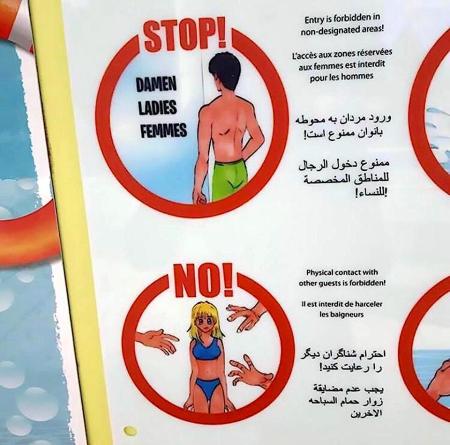
A swimming pool has stuck up signs targeted at migrants telling them not to grope women or enter the female changing room.

The signs were posted in a swimming pool in Perchtoldsdorf, a market town a short distance from the Austrian capital of Vienna.

Here is the sign, click to enlarge:

Apparently the signs have been posted because some Islamic refugees don’t understand–or, more likely, pretend not to understand–that men shouldn’t enter the ladies’ shower, and you’re not supposed to fondle women to whom you haven’t been introduced:

One sign shows a man entering the women’s dressing room with the word “STOP!” and “entry is forbidden in non-designated areas” written next to it.

Another sign show a picture of a young teen in a bikini with three hands seemingly wanting to grope her.

It reads “NO!” and explains that “physical contact with other guests is forbidden”.

And while the signs featured English, French and Arabic text, there was no German translation, with the sign clearly not intended for local visitors.

The Austrians assume, apparently, that their natives already understand that you aren’t supposed to fondle strange women.

The Perchtoldsdorf signs are out of date in one respect. Here in the U.S., it is no longer true that men should stay out of women’s showers. The “enlightened” view of such matters is that men are perfectly welcome to shower with teenage girls and adult women, as long as they say, if asked, that they are “trans.” Watch for this sign of social progress to make its way to Austria before long.

In the meantime, it is reasonable to wonder whether copying Angela Merkel’s refugee policy is a good idea for the U.S.

The Worst Ideological Enemy of the US is Now Europe

July 20, 2017

The Worst Ideological Enemy of the US is Now Europe, Gatestone Institute, Drieu Godefridi, July 20, 2017

The vast majority of these European courts — whether the European Court of Human Rights (ECHR) or the Court of Justice of the European Union (CJEU) — in their attempt to be moral and just, have dismissed the sovereign laws of Italy as irrelevant, and trampled the rights of the Italian state and ordinary Italians to approve who enters their country.

In Europe, Amnesty International and the like are, it seems, a new source of law.

Those who gave the Statue of Liberty to America in 1886 “to commemorate the perseverance of freedom and democracy in the United States” are willingly trampling their own people’s liberties today through courts of appointed, unelected, unaccountable ideologues. The danger is that, with the help of many doubtless well-intentioned, international NGOs, the EU will not stop at its shores.

Europe is the worst enemy of the US? You cannot be serious. Islamism, Russia, illegal immigrants… whatever, but surely not Europe! Are we not still together in NATO? Do we not conduct huge amounts of trade every day? Do we not share the same cultural roots, the same civilization, the same vision of the future? Did France not give the US her famous Statue of Liberty – “Liberty Enlightening the World?

Not anymore. In a sense, Europe looks like a continent where American Democrats have been in power for 30 years, not only in the European states, but also at the level of the European Union.

In the US, the political spectrum still spans a vast range of views between Democrats and Republicans, globalists and nationalists, pro-lifers and pro-choicers, pro-government control and pro-individuals’ control, and pro-whatever. Even today with a president and a Supreme Court clearly on the political “Right” these divisions, and the all-important separation of powers, allow for and encourage vigorous debate. By contrast, in Europe, at the “official” level, such a spectrum of views no longer exists.

In Western Europe, politically speaking, in the press and in universities, either you are on the “Left,” or you are a pariah. If you are a pariah, you are most likely to be prosecuted for “Islamophobia”, “racism”, discrimination or some other “trumped up” charge.

There are several reasons for this imbalance. One is the difference in political maturity between Europeans and Americans. Whereas “ordinary” American voters (not just the “elites”) understand that their Supreme Court is key to ensuring that fundamental constitutional freedoms are maintained for all, the Europeans have done the opposite. In the US, the constitutional right to “Life, Liberty and the pursuit of Happiness” is derived from the people — “from the consent of the governed.”

Consequently, when Justice Antonin Scalia of the US Supreme Court died, the US press wrote about him for weeks. “Ordinary citizens” in the US are deeply aware of judicial roles and their effect on judgements and legal precedents.

By contrast, in Europe, we now have two Supreme Courts: the European Court of Human Rights (ECHR) in Strasbourg, and the Court of Justice of the European Union (CJEU) in Luxembourg, in addition to national courts. There is, however, not one citizen in a million who can name a single judge of either the ECHR or the CJEU. The reason is that the nomination of those judges is mostly opaque, purely governmental and, in the instance of the ECHR, with no public debate. With the CJEU, appointments are also essentially governmental, with the sanction of the European Parliament, which is ideologically dominated by the Left.

In Europe, there are now two Supreme Courts: the European Court of Human Rights (ECHR) in Strasbourg, and the Court of Justice of the European Union (CJEU) in Luxembourg (pictured above), in addition to national courts. (Image source: Transparency International/Flickr)

The US has always welcomed immigrants, most of whom came to her shores via Ellis Island and went through a legal process for entry, led by the light of the torch of Lady Liberty. In recent years, especially since the advent of increased terrorism, the subject of illegal immigrants, migrant workers and the vetting of immigrants has become hotly debated.

By contrast, in Europe, the topic of “illegal” migrants is effectively forbidden. The continent has recently been invaded by millions of migrants — many apparently arriving under the false pretense of being refugees, even according to the United Nations.

One of the reasons is the open-door policy of German Chancellor Angela Merkel, who allowed over a million mostly Muslim migrants to enter Germany, not only without extreme vetting, but with no vetting at all.

There is, however, another, more structural cause for the current situation. In 2012, the ECHR enacted the so-called “HIRSI” ruling, named after the court case of Hirsi Jamaa and Others v. Italy, which states that the European states have the legal obligation to rescue migrants wherever they find them in the Mediterranean Sea — even just 200 meters away from the Libyan coast — and ferry them to the European shores, so that these people can claim the status of refugee.

When the Italian Navy intercepted illegal migrants in the Mediterranean Sea and sent them back to their point of origin, Libya, not only did the ECHR condemn Italy for this “obvious” breach of human rights; the Italians had to pay 15,000 euros ($17,000 USD) to each of these illegal migrants in the name of “moral damage”. This kind of money is equivalent to more than 10 years of income in Somalia and Eritrea (the countries of origin of Mr. Hirsi Jamaa and his companions). In 2016, Somalia’s GDP per capita was an estimated $400 USD; Eritrea’s $1,300.

Everyone, of course, heard about the HIRSI ruling. In Africa, especially, many understood that if they could reach the Mediterranean, Europe’s navies would now be obliged to ferry them directly to Europe. Before the HIRSI ruling, when people tried to reach the shores of Europe, hundreds every year tragically died at sea. After HIRSI, the objective is now simply to be intercepted. Consequently, hundreds of thousands attempt this journey — often with the help of non-governmental organizations (NGOs) such as Médecins Sans Frontières, whose activists wait for boats to appear at sea, just off the Libyan coast. We therefore presently have 5,000 unintercepted people dying at sea every year.

While Italy is “drowning” in refugees, Austria has deployed armored vehicles close to its border with Italy, to stop more migrants from coming north.

The vast majority of these European courts — whether the ECHR or the CJEU — in their attempt to be moral and just, have dismissed the sovereign laws of Italy as irrelevant, and trampled the rights of the Italian state and ordinary Italians to approve who enters their country.

Americans would do well to read the HIRSI decision; it is rather short and a perfect summary of current European jurisprudence. They will find that the ECHR does not hesitate to accept NGOs as an authoritative part of the process; the ECHR even quotes their statements as if fact or law. In Europe, Amnesty International and the like are, it appears, a new source of law.

The European people, of course, still share the common values of Western civilization. The “Visegrad Group” of countries in Central Europe, for instance — the Czech RepublicHungaryPoland and Slovakia — do not accept the German diktat to relocate Muslim refugees. Parts of Western Europe, such as the northern Flemish-speaking part of Belgium, are also pretty tired of the whole European mess, and Merkel will not embody the leadership of Germany forever.

Americans, therefore, would do well to understand that for the time being the “Cultural Left” is so deeply entrenched in Western Europe and the EU, that their worst ideological enemy is not the Middle East or Russia: it is Europe.

Those who gave the Statue of Liberty to America in 1886 “to commemorate the perseverance of freedom and democracy in the United States” are willingly trampling their own people’s liberties today through courts of appointed, unelected, unaccountable ideologues. The danger is, with the help of many, doubtless well-intentioned, international NGOs, the EU will not stop at its shores.

Drieu Godefridi, a classical-liberal Belgian author, is the founder of the l’Institut Hayek in Brussels. He has a PhD in Philosophy from the Sorbonne in Paris and also heads investments in European companies.

More Migrant Riots Hit France

July 18, 2017

More Migrant Riots Hit France, Front Page MagazineJoseph Klein, July 18, 2017

A majority of Europeans agree that the waves of immigration into their countries have been getting out of hand. However, for the elitist leaders in Europe, spearheaded by German Chancellor Angela Merkel, an open borders policy remains the Holy Grail. Opposing continued mass migration into Europe is tantamount to hate speech, they believe. Thus, Chancellor Merkel was overheard last fall on a hot mic asking Facebook CEO Mark Zuckerberg what more he planned to do to stop anti-immigrant posts. Facebook is cooperating with actions to remove comments that it claims “promote xenophobia.”

******************************

The European migration experiment is failing miserably. Self-declared “refugees” and migrants from Africa and the Middle East are importing their violence, chaos and regressive norms of behavior into formerly harmonious countries all over Western Europe. As Seth J. Frantzman wrote in the Jerusalem Post last December, “They hate the very society they have often chosen to migrate to. Their new society tolerated their intolerance and taught them that this new country provided such unfettered freedom that it should be destroyed.”

For example, while many French people were busy celebrating Bastille Day – a year after the tragic Islamist massacre in Nice – riots and violence reportedly broke out on the nights of July 13 and 14 in suburbs of Paris heavily populated by migrants. A policeman was badly wounded and 897 cars were burned. Hundreds of individuals were placed in custody.

There was also a riot in the streets of Paris a few days ago by a mob of angry Congolese. They were infuriated by a scheduled concert at Paris’s Olympia music hall by a Congolese artist thought to be too close to the government of the Democratic Republic of the Congo they detest. The concert was cancelled as a result of the clashes and threats of more violence. The Congolese living in Paris brought their tribal hatreds to the land that gave them the opportunity to leave such hatreds behind. They abused the freedoms they were afforded, turning on those freedoms by violently preventing an artistic performance from taking place.

These are far from isolated incidents of migrant violence in Western Europe this year. Indeed, all is not well for the Western traditions of pluralism and individual liberties in the multicultural sewer Europe is fast becoming. The number of vehicular killings, stabbings, shootings, sexual assaults, riots and car burnings has risen exponentially in France, the United Kingdom, Germany, Belgium, Sweden, Denmark and Norway, as the tide of migration has intensified. No-go zones have multiplied. Free speech is becoming a casualty of hecklers’ veto and misplaced multicultural sensitivities. Yet Europe continues to admit even more migrants without any adequate vetting.

“When people lose hope, they risk crossing the Sahara and the Mediterranean because it is worse to stay at home, where they run enormous risks,” Antonio Tajani, president of the European Parliament, said. “If we don’t confront this soon, we will find ourselves with millions of people on our doorstep within five years. Today we are trying to solve a problem of a few thousand people, but we need to have a strategy for millions of people.”

A majority of Europeans agree that the waves of immigration into their countries have been getting out of hand. However, for the elitist leaders in Europe, spearheaded by German Chancellor Angela Merkel, an open borders policy remains the Holy Grail. Opposing continued mass migration into Europe is tantamount to hate speech, they believe. Thus, Chancellor Merkel was overheard last fall on a hot mic asking Facebook CEO Mark Zuckerberg what more he planned to do to stop anti-immigrant posts. Facebook is cooperating with actions to remove comments that it claims “promote xenophobia.”

In the Netherlands, the police paid visits to people using social media to express their anti-mass migration views. One Dutch man described his encounter with the police. “They asked me to be careful about my Twitter behavior, because if there are riots, then I’m responsible,” the Dutch man said. He had tweeted: “The college of Sliedrecht has a proposal to receive 250 refugees in the coming 2 years. What a bad plan! #letusresist.” The police told him to watch his tone because his tweets “may seem seditious.”

Free speech is the enemy of both elitist governments, which believe they know what is best for their benighted “subjects,” and of extremists, who believe only they possess the truth and that the expression of contrary opinions is heresy. Elitist governments use their instruments of power to suppress free speech. The extremists use violence and play the race card against those they consider to be the so-called “oppressors” and their enablers.

Leftists who reject the pluralistic norms of capitalist, democratic Western societies encourage mass migration of unassimilated individuals from conflicting cultures to destabilize and then radically transform such democratic societies. Thus, we see twitter posts such as “We must #EndWhiteness with mass immigration.” And rather than express empathy with victims of immigrant violence, leftists have sided with the migrants in opposition to concerns of local citizens about public safety. This happened, for example, in Sweden a couple of years ago after an Algerian and a Syrian living in the same migrant center were jailed for each raping the same Swedish woman on the same night.

When they are not rioting themselves, such as in Hamburg earlier this month, left wing activists have also stoked immigrant violence for their own ends. The red-green axis of leftists and Islamists is alive and well.

The Acid Attacks of London’s Muslim No-Go Zones

July 17, 2017

The Acid Attacks of London’s Muslim No-Go Zones, Front Page Magazine, Daniel Greenfield, July 17, 2017

London is experiencing a splash of the acid test of diversity. That burning feeling on your face is the thrilling sensation of corrosive multiculturalism eating away at British communities.

********************************

Things are going smashingly well in Londonistan.

The City of London has the highest murder rate in the land. While the authorities launch investigations into pork being left at a mosque or a hijab supposedly being torn off, crime continues to rise.

Gun control has worked so wonderfully well that gun crime in London rose 42%. When gun control advocates insist that we should be more like the UK, London’s 2,544 gun crime offenses probably aren’t what they have in mind.

But gun control does work in London after a fashion. Those gang members who can’t lay their hand on a firearm must make do with a sharp blade. Knife crimes in London rose 24% to 12,074 recorded offences. 60 people were stabbed to death last year.

Why? Here’s a hint from the Metropolitan Police’s assistant commissioner. “There are complex social reasons why more young people are carrying knives and this cannot be solved by the police alone.”

Those complex social reasons would seem to involve stabbing other people. But like Islamic terrorism, stabbings in London are one of those things that can’t be solved by the police. Unlike people saying mean things about Muslims on Facebook and Twitter which the Met cops are well equipped to solve.

Still the authorities have been doing their best to tackle stabbings with a knife ban. Carry a knife without a “good reason” and you can get four years in prison. Good reasons for carrying knives include using it as a prop in a production of Romeo and Juliet, taking it to a museum or “religious reasons”. The ban, which covers “sword-sticks”, samurai swords and “zombie knives” that are sold to fight zombies, isn’t working.

But it’s working well enough that many of the gangs responsible for the violence are turning to acid.

Acid attacks in London rose from 162 in 2012 to 454 last year. There have already been 199 acid attacks this year. Five acid attacks just happened in London in the space of little more than an hour.

And so the obvious new solution is drain cleaner control.

The push is on to “license” corrosive substances while banning anyone from carrying drain cleaner unless they have a good reason. When the public is banned from buying drain cleaners, then finally everyone in London will be safe. It’s worked for guns and knives. Bound to work for acid. And being stuck with a clogged toilet, like Allah Akbar car rammings, is the price we must all pay for diversity.

It’s easy to blame and ban inanimate objects. And it avoids any discussion of the perpetrators.

Newham is the London borough with the highest number of acid attacks. It also has the second highest percentage of Muslims in the UK. 398 acid attacks occurred in 5 years in the area named as “the most ethnically diverse district in England and Wales”. 33% of Newham consists of non-UK passport holders.

But surely that’s some sort of random coincidence.

Except that the place with the third highest number of acid attacks is Tower Hamlets. Tower Hamlets is a Muslim no-go zone. It has one of the smallest native British populations in the country. 35% of the population is Muslim. Most of those are Bangladeshis with a healthy sprinkling of Somalis.

There were 84 acid attacks in what has been dubbed “The Islamic Republic of Tower Hamlets”.

Also, entirely by coincidence, Bangladesh has the highest rate of acid attacks in the world. But if anyone suggests that these two statistics are related, the Met police will investigate them for hate crimes.

The second highest acid attack location in London was Barking and Dagenham, a growing Muslim enclave which elected its first Muslim mayor whose plans include holding an Islamic festival “for the whole community—regardless of religion”.

Barking is a wonderful place where you have the choice to be Muslim or Muslim. Regardless of religion.

The native British population made up 80% of Barking in 2001. Now it’s fallen to less than half. According to the 2011 census figures, “All religious groups have increased except for Christian and Jewish religions”. This was where Islamists brandished signs reading, “British soldiers go to hell”.

Now why in the world might Barking be a haven for acid attacks?

Fifth on the acid list is Redbridge where the native British population fell by 40,844 in a decade. The last census showed British and Irish natives fleeing Redbridge while Pakistanis and Bangladeshis stormed in. The Christian and Jewish population fell while the Muslim population rose 11%. So did the acid attacks.

Pakistan has one of the highest rate of acid attacks in the world. It lags behind Bangladesh. But fortunately Redbridge boasts a diversity of both Pakistanis and Bangladeshis. And acid attacks.

But surely this is yet another unfathomable coincidence. Like 2 + 2 equaling 4.

Hackney, sixth on the list, was where a Sharia patrol pal of the Muslim beheaders of British soldier Lee Rigby, posted videos boasting “British people will never be safe on the streets of London.”

They certainly aren’t safe in Hackney.

At 14%, Islam is the second largest religious group in Hackney. The indigenous British population has fallen to 36%. That’s down from 44% in 2001. And, according to officials, it’s “reflective of Hackney’s increasing diversity which currently marks it out as the 6th most ethnically diverse borough in London after Newham, Redbridge, etc…”

Sixth in diversity and sixth in acid attacks.

Of the remaining four on the list, three, Croydon, Ealing and Hilingdon, were white minority or bare majority areas. Meanwhile Kensington and Chelsea, which have a decisive majority, have the lowest rate of acid attacks. So naturally the media has tried to blame the attacks on British natives.

But the numbers don’t lie.

London is experiencing a splash of the acid test of diversity. That burning feeling on your face is the thrilling sensation of corrosive multiculturalism eating away at British communities.

Banning guns, knives, drain cleaner, plungers and ostrich feathers won’t address the problem. The fallacy of gun control, knife control and acid control is that inanimate objects don’t kill people.

Guns don’t shoot themselves. Knives don’t unsheathe in broad daylight and stab pedestrians. Bottles of acid don’t knock on cars and then splash the occupants when they roll down the window.

Immigration imported acid attacks to the UK the way that it imported gangs of Muslim men stabbing waitresses in eateries while shouting, “This is for Allah”.

Allah and acid are both imports from the Muslim world.

Murders in London, like murders in most major American cities, are driven by gang violence. Behind the shootings, stabbings and acid attacks are gangs. Many of those gangs are made up of first and second generation migrants and settlers from the Muslim world. The UK’s prisons bulge with Muslim convicts. And these criminal gangs naturally feed recruits into Islamic terrorism as they do in Iraq and Syria.

Banning drain cleaner won’t stop acid attacks. Drain cleaner control is no solution. Migration control is.

Immigration from violent societies prone to terrorism is the acid that is eating away at Europe. Migration advocates have splashed acid on Britain, on America, on Australia and on Canada. The bombings and stabbings, the child rapes and acid attacks, are the burning sensation of the attack.

But the corrosive acid does its work in less sensational ways. When Britons no longer feel at home in their own communities, when mosques replace churches and synagogues, when Sharia patrols march through the streets, when English is drowned out by Urdu and Arabic in the streets, that is also the acid of immigration eating away at the flesh and bone of a nation.

Acid attacks don’t immediately kill. They maim and disfigure. Newham, Barking, Tower Hamlets and so much of London have been left maimed and disfigured so that longtime residents no longer know them.

Britannia has had acid splashed in her lovely face. Her clear features have been scarred and mutilated. Now, from London to Manchester, from Birmingham to Bradford, she suffers and burns.

A Month of Islam and Multiculturalism in Germany: June 2017

July 11, 2017

A Month of Islam and Multiculturalism in Germany: June 2017, Gatestone InstituteSoeren Kern, July 11, 2017

A 10-year-old girl from a former republic of the Soviet Union was raped by an asylum seeker from Ghana, but police and the local government allegedly suppressed information about the crime for more than two weeks.

A student sexually assaulted an 11-year-old girl and punched another boy in the face, breaking his glasses. At least six other students have been beaten bloody. The school’s leadership has refused to discipline the child, apparently because of his migrant background, and instead has lashed out at the parents for demanding a safe environment for their children.

Police in Lübeck suspect that refugees are taking over illegal drug trade in the city.

June 1. A Syrian migrant was stabbed to death in Oldenburg by another Syrian because he was eating ice cream during Ramadan. The murder, which occurred in broad daylight in a busy pedestrian shopping area, was just the latest example of Islamic law, Sharia, being enforced on German streets.

June 2. Around one million non-Europeans living in Germany are now on welfare, an increase of 124% in just one year, according to new statistics from the Federal Employment Agency (Bundesagentur für Arbeit). The top welfare beneficiaries are from: Syria (509,696); Turkey (276,399); Iraq (110,529) and Afghanistan (65,443).

June 2. Police temporarily halted the annual Rock am Ring music festival in Nürburg because of a possible jihadist threat. Authorities asked the 90,000 visitors to leave the concert grounds in a “controlled and calm” manner. The move was based on “concrete leads which do not allow us to eliminate a possible terror threat,” the police said.

June 3. Bavarian Interior Minister Joachim Herrmann called on Germany’s BfV domestic intelligence agency to begin surveilling minors suspected of being involved with Islamist groups:

“I would strongly urge for the age limit for surveillance to be lowered throughout Germany. Minors have already committed serious acts of violence. Normally, the domestic intelligence agency in Bavaria would not place children under surveillance. But if there is concrete evidence that a 12-year-old is with an Islamist group, we have to be able to monitor them, too.”

June 4. Mostafa J., a 41-year-old asylum seeker from Afghanistan, stabbed to death a five-year-old Russian at a refugee shelter in Arnschwang. The Afghan, who had been arguing with the boy’s 47-year-old mother, was shot to death by police after a standoff. It later emerged that the man had a criminal history in Germany and should have been deported but was not. In October 2009, for example, a court in Munich sentenced Mostafa J. to six years in prison for arson. In July 2011, he received a deportation order, but in 2014 he fooled a judge into believing that he had converted to Christianity and would be killed if he were deported to Afghanistan.

June 5. A study conducted by the Hanns Seidel Foundation, a think tank affiliated with Bavaria’s Christian Social Union, found that half the asylum seekers in Bavaria subscribe to classic anti-Semitic views about Jewish power. Around 60% of Afghans, 53% of Iraqis and 52% of Syrians said Jews wield too much influence.

June 7. A 27-year-old migrant from Syria stabbed and killed a Red Cross mental health counselor in Saarbrücken. The attacker and the psychologist allegedly got into an argument during a therapy session at a counselling center for traumatized refugees.

June 9. A court in Cottbus sentenced a 32-year-old Chechen migrant named Rashid D. to 13 years in prison for slitting his wife’s throat and throwing her out of the second-floor window of their apartment. The couple’s five children now live in Chechnya with their grandparents. The man was charged with manslaughter rather than murder because, according to the court, the “honor killing” was done in the heat of passion: the man thought that his wife had been unfaithful.

June 12. A 44-year-old migrant from Syria named Sultan K. was arrested at his home in Bullenhausen on charges of being a member of the Jabhat al-Nusra terrorist group. Police said that the man’s three brothers, Ahmed K. (51), Mustafa K. (41) and Abdullah K. (39), were also suspected of being members of al-Nusra. The arrest confirmed fears that jihadists posing as refugees have gained access to Germany.

June 12. Bavarian Interior Minister Joachim Herrmann called on three German states — Berlin, Bremen and North Rhine-Westphalia — to introduce random police spot checks. Local laws against “racial profiling” prohibit police in the three states from stopping and identifying individuals. Hermann called it a “blatant security gap that urgently needs to be closed.” He also said he wanted to see random checks extended in border areas, around airports, railway stations and rest-stops, as well as on highways that lead in and out of the country. At the moment, such checks are only allowed within 30 kilometers (20 miles) of German borders. Parliamentary spokesman Stephan Mayer said:

“The demand of Bavarian Interior Minister Joachim Herrmann to finally introduce so-called spot-checks in the states of Berlin, Bremen and North Rhine-Westphalia is completely and utterly justified. Given the basically open borders in Europe, random checks are a necessary instrument for preventing terrorists, criminals and illegal immigrants from entering the country.”

June 13. The newspaper, Bildposted on its website a film — “Chosen and Excluded: Jew Hatred in Europe” — that was censored by the Franco-German television outlet ARTE because it showed Islamic-animated anti-Semitism and Jew-hatred in all walks of European life. Julian Reichelt, Bild‘s online editor-in-chief, said:

“The TV documentary proves the rampant, in part socially acceptable Jew-hatred, for which there are only two words: disgusting and shameful. It is suspected that the documentary is not being shown on television because it is politically unsuitable and because the film shows an anti-Semitic worldview in wide parts of society that is disturbing. Our historical responsibility requires us to decisively counter the unspeakable truth that this film establishes.”

June 14. A 33-year-old migrant from Syria stabbed and seriously injured his ex-wife at a supermarket in Cologne. He also stabbed his 13-year-old son after the boy intervened to protect his mother.

June 15. A 21-year-old migrant from Nigeria went on a rampage after the manager of a public swimming pool in Rosenheim repeatedly told him that hygiene regulations prohibited him from swimming in his underwear. After police arrived, the Nigerian attacked an officer. He was arrested for refusing to obey a police officer.

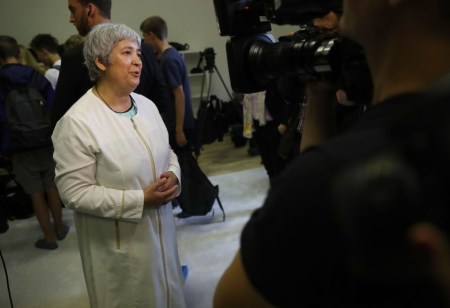
June 16. Germany’s first “liberal mosque” opened in Berlin. The Ibn Rushd-Goethe Mosque, which holds its services inside the St. Johannis Church in the Moabit district, was founded by Seyran Ates, a women’s rights activist who has been hailed by some as the “champion of modern Islam.” The mosque allows men and women to pray together and the Koran to be interpreted “historically and critically.” The mosque, which is open to everyone, including Alawite and Sufi Muslims, as well as homosexuals, has caused outrage in the Muslim world. Al-Azhar University in Cairo, Egypt, generally considered the leading authority on Sunni Islam, issued a fatwa warning against “religious innovation that is not approved by Islamic Sharia.” Turkey’s religious affairs agency, Diyanet, said that the mosque’s practices “do not align with Islam’s fundamental resources, principles of worship, methodology or experience of more than 14 centuries, and are experiments aimed at nothing more than depraving and ruining religion.” Ates, the mosque’s female imam, is now under 24-hour police protection.

Seyran Ates, a women’s rights activist who has been hailed by some as the “champion of modern Islam,” recently opened Germany’s first “liberal mosque” in Berlin, and serves as its imam. Due to the outrage this caused in the Muslim world, Ates is now under 24-hour police protection. (Photo by Sean Gallup/Getty Images)

June 17. In Cologne, a peace march organized by German Muslim groups to condemn terrorism and violence in the name of Islam had an extremely low turnout. Organizers had expected at least 10,000 participants, but actual turnout was estimated at between several hundred to about 3,500. Germany’s largest Islamic association, the Turkish-Islamic Union (DITIB) refused to take part in the march because it would “send the wrong signal to suggest that Muslims were mainly responsible for international terrorism.”

June 18. The parents of student at the Kronwerk Gymnasium, a school in Rendsburg, have been ordered to appear in court because they refused to allow their child to visit a nearby mosque as part of a geography class. The parents, who are not religious, said they did not want their child to be exposed to “religious indoctrination.” No one could be compelled to enter a sacred building against his or her own free will, they argued. The school insisted that the visit to the mosque was compulsory: “The school is designed to promote the openness of young people to cultural and religious diversity, the desire for international understanding and peace.” Each parent was fined €150 ($175), which they refused to pay. They are now being sued. The mosque in question belongs to the Milli-Görüs movement (IGMG), one of Europe’s largest Islamist organizations. According to Germany’s BfV domestic intelligence agency, the movement is extremist and virulently anti-Semitic.

June 18. Local authorities in Hereford reportedly covered up information about the rape of a ten-year-old girl at a refugee shelter in the city. The girl, who is from a former republic of the Soviet Union, was raped by an asylum seeker from Ghana, but police and the local government allegedly suppressed information about the crime for more than two weeks.

June 18. Muslims in Freiburg launched an online petition demanding that the city prohibit male supervisors from working at a female-only swimming pool in the city. The petition says that Muslim women who want a “break from everyday gazes” are unable to use the pool. The petition adds that the “presence and supervision of male staff is deeply reactionary and sexist” and calls for the “creation of a dialogue to promote mutual understanding and acceptance.” Facility managers at the Lorettobad said that it hired male supervisors because of a shortage of female personnel. The pool has been rocked by disputes between Muslims and managers who have been trying to enforce hygiene regulations at the facility: Muslim women have been angered after being told that they are not allowed to wear jeans and other street clothing while swimming, and also that they cannot consume food while in the pool. Some Muslim women have also been told that they have “too little control over their offspring” and that their children are “too wild” and are disturbing other guests. Muslims have reacted with such aggression that police repeatedly have been called to restore order at the pool.

June 19. Jakob Augstein, a German newspaper editor well known for his anti-Israel tirades, wrote an essay for Der Spiegel in which he expressed glee that so few Muslims attended an anti-terrorism rally in Cologne. He said that those Muslims who did attend were “Uncle Toms” and excessively subservient to their German “overseers.” He wrote:

“Terror is not a question of civil society, but one of politics. What is more important, however, is that the demonstration call was addressed to the Muslims in Germany. This is an impertinence. What does the average German Muslim have to do with terrorism? Nothing.

“Just because terrorists justify their crimes with Islam, there is still no special obligation for people of the Muslim faith to distance themselves from these crimes. On the contrary, the terrorists would be given an honor that is not theirs: they are taken seriously as representatives of Islam. But they are not…. Terrorism is a political and social phenomenon, not a religious one. There are more than 1.5 billion Muslims in the world. Should all of them demonstrate? If I were a Muslim, I would refuse such requests.”

June 20. Police in 14 German states raided the homes of three dozen people accused of posting hateful comments on social media. Most of the raids were said to have involved “right-wing incitement” while two of the raids involved “left-wing agitators.” The head of the Federal Criminal Police (BKA) Holger Münch said: “Our free society must not allow a climate of fear, threats or criminal violence to be found either on the street or on the internet.” Critics say the crackdown is part of an effort to suppress criticism of Chancellor Angela Merkel’s open door migration policy ahead of federal elections set for September 24, 2017.

June 20. In an essay published by Süddeutsche Zeitung, Benjamin Idriz, an imam in Bavaria, called on the German government to provide language training for imams so that they can become the “driving force behind integration and dialogue” in Germany:

“The demand for imams from around 2,700 municipalities in Germany is usually supplied by imams from abroad. Many of them are thus directly connected with foreign religious authorities and under foreign influence. Imams from abroad also hardly have sufficient language and cultural competence. They are therefore not conducive to the integration of the Muslims, nor do they meet the needs of the Muslim communities, especially among the younger generation. The demand for imams is enormous, and too much time has already been lost. We must begin before we lose the next generation.”

June 21. The parents of more than 20 fifth-graders at the Herder-Gymnasium, a school in Charlottenburg district of Berlin, initiated a boycott of the school over accusations that the school was not dealing with discipline and violence in class. The problem revolves around one male student who has been bullying his classmates since he arrived at the school last fall. The student has sexually assaulted an 11-year-old girl and punched another boy in the face, breaking his glasses. At least six other students have been beaten bloody. “Our concern is that our children be protected,” a father said. The school’s leadership has refused to discipline the child, apparently because of his migrant background, and instead has lashed out at the parents for demanding a safe environment for their children: “We deeply regret the fact that because of a single populist exception among the parents such serious damage has been done to the reputation of our school.”

June 22. Aydan Özoğuz, Germany’s commissioner for immigration, refugees and integration, admitted that “there has been a shift in perceptions” and that only a quarter to a third of the so-called refugees in Germany will enter the labor market over the next five years, and “for many others we will need up to ten.” In an interview with the Financial Times, she said that many of the first Syrian refugees to arrive in Germany were doctors and engineers, but they were succeeded by “many, many more who lacked skills.” The Times, citing statistics from the Federal Employment Agency, revealed that only 6,500 refugees of the more than two million who have been allowed into Germany during the past two years are enrolled in work training programs. “We don’t take in refugees according to their skills set,” Özoğuz said. “The only criteria should be to help people fleeing war and political persecution.”

June 22. Police in Lübeck suspect that refugees are taking over illegal drug trade in Schleswig-Holstein, the northernmost state in Germany. Since May there have been more than a dozen mass brawls involving Afghans, Iraqis, Syrians and North Africans armed with knives and batons. Some of those involved are known drug traffickers. “The middle level of drug trafficking is targeting migrants in the refugee shelters, promoting them as street vendors or couriers,” said Christian Braunwarth, spokesman for the Lübeck public prosecutor’s office. “Unfortunately, the economically weaker parts of society are vulnerable to such offers.”

June 23. A 37-year-old migrant from Syria sexually assaulted a ten-year-old girl in Tübingen. The girl was riding her bicycle when the man ambushed her from behind. Passersby who heard the girl scream rushed to her aid. Police said the man was a “prior offender” and was known to them. A “southern-looking” (südländisches Erscheinungsbildsexually assaulted a 23-year-old woman in broad daylight in Voerde. A 17-year-old German-Turk raped a 17-year-old woman in Stuttgart.

June 24. An 18-year-old Syrian asylum seeker shouting Allahu Akbar injured four people with a metal chain at the central bus station in Lünen. The initial police report described the perpetrator only as “an 18-year-old” and failed to mention that he had dedicated his attack to Allah. Dortmund police provided more details only after being pressed by a local newspaper.

June 25. A police officer in Duisburg asked a man to move his car, which was illegally parked. The man refused and began shouting at the officer. Within minutes, more than 250 people appeared at the scene and began harassing the police officer, who called for backup. More than 50 policemen and 18 police vehicles were required to resolve what began as a routine traffic procedure.

June 25. Four Iraqi men sexually assaulted three girls, aged 13, 15 and 16, at a public swimming pool in Kassel. A 35-year-old migrant from Romania sexually assaulted two girls, aged 12 and 13, at a public swimming pool in Stuttgart. The man was questioned and released.

June 26. The Berlin Labor Court ordered the city-state of Berlin to pay €6,900 ($7,900) — the equivalent of two months’ pay — to a Muslim teacher whose job application at a grammar school was rejected because she wears a headscarf. Berlin’s Neutrality Law (Neutralitätsgesetz) prohibits teachers from wearing conspicuous religious symbols at state schools, but the Federal Constitutional Court (Bundesverfassungsgericht) has ruled that a general prohibition of Muslim headscarves is unconstitutional unless there is a concrete threat to security. In February, the National Labor Court of Berlin-Brandenburg awarded a Muslim woman compensation of almost €8,600 ($9,800) after her job application was rejected because she wore a headscarf. The judges ruled that it was a violation of the Equal Treatment Act (Gleichbehandlungsgesetz).

June 27. A “southern-looking” (südländisch aussehenden) man raped a woman at a park in downtown Cologne. Two “dark-skinned” men (dunkelhäutigen Männersexually assaulted a 52-year-old woman in Hüfingen.

June 28. A 23-year-old migrant from Iraq was arrested in Immenstaad on Lake Constance on charges of being a war criminal. After the man — who arrived in Germany as a refugee at the height of the migrant crisis in late 2015 — reportedly threatened to kill a roommate at a migrant shelter in Böblingen, police found three mobile phones in his room. One of the phones contained a picture of him posing alongside the decapitated heads of six jihadists from the Islamic State. The photo was created sometime between December 2013 and September 2015 when the man was an Iraqi soldier. The Attorney General’s office in Stuttgart said the man was guilty of “mocking the slain combatants and degrading them in their death” which “should be seen as a war crime…according to the criminal code (Völkerstrafgesetzbuch and Strafgesetzbuch).”

June 29. Mohammad Hussain Rashwani, a 38-year-old migrant from Syria tried to behead 64-year-old Ilona Fugmann at a beauty salon in Herzberg. Less than a year earlier, Fugmann had offered Rashwani a job as a hair stylist at her salon and German media praised him as an exemplar of successful integration. Fugmann and her husband Michael were said to have bestowed “infinite goodness and magnanimity” toward Rashwani. In the weeks leading up to the attack, however, Mohammad reportedly had found it difficult to subordinate himself to his female boss. “I am still convinced that it is 100% correct to help other people, but we have to admit that in this case our attempts at integration have failed,” Michael concluded.

June 30. The German Parliament approved a controversial law to fine social media networks up to €50 million euros ($57 million) if they fail to remove so-called hate speech. The Network Enforcement Act (Netzwerkdurchsetzungsgesetz, NetzDG), commonly referred to as the “Facebook law,” gives social media networks 24 hours to delete or block “obviously criminal offenses” (offenkundig strafbare Inhalte) and seven days to deal with less clear-cut cases. German Justice Minister Heiko Maas said the measure to “end the internet law of the jungle.” Critics say the law will restrict free speech because social media networks, fearing high penalties, will delete posts without checking whether they are within the legal limits and should actually remain online. Others say the real purpose of the law is to silence criticism of the government’s open door migration policy, as well as multiculturalism and the rise of Islam in Germany, ahead of the federal elections on September 24, 2017.

Eastern Europe Chooses to Keep Western Civilization

July 7, 2017

Eastern Europe Chooses to Keep Western Civilization, Giulio Meotti, July 7, 2017

[I]t is critical that Eastern Europe continues to be a strong voice of dissent in the EU project. It might provide just the cultural confidence that European bureaucrats dramatically lack — at the peril of Europe itself.

**************************

“The greatest difference is that in Europe, politics and religion have been separated from one another, but in the case of Islam it is religion that determines politics” — Zoltan Balog, Hungary’s Minister for Human Resources.

It is no coincidence that President Donald Trump chose Poland, a country that fought both Nazism and Communism, to call on the West to show a little willingness in its existential fight against the new totalitarianism: radical Islam.

“Possessing weapons is one thing, and possessing the will to use them is another thing altogether”. — Professor William Kilpatrick, Boston College.

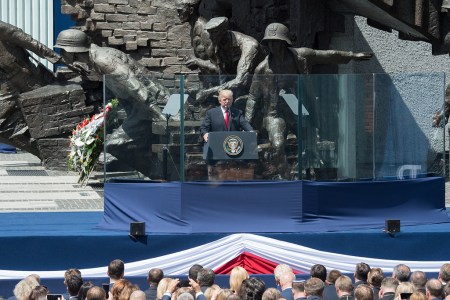
In a historic speech to an enthusiastic Polish crowd before the meeting of the G20 Summit leaders, US President Donald Trump described the West’s battle against “radical Islamic terrorism” as the way to protect “our civilization and our way of life”. Trump asked if the West had the will to survive:

“Do we have the confidence in our values to defend them at any cost? Do we have enough respect for our citizens to protect our borders? Do we have the desire and the courage to preserve our civilization in the face of those who would subvert and destroy it?”

Trump’s question might find an answer in Eastern Europe, where he chose to deliver his powerful speech.

President Donald Trump gives a speech in Warsaw, Poland, in front of the monument commemorating the 1944 Warsaw Uprising against the Germans, on July 6, 2017. (Image source: The White House)

After an Islamist suicide-bomber murdered 22 concert-goers in Manchester, including two Poles, Poland’s prime minister, Beata Szydło, said that Poland would not be “blackmailed” into accepting thousands of refugees under the European Union’s quota system. She urged Polish lawmakers to safeguard the country and Europe from the scourges of Islamist terrorism and cultural suicide:

“Where are you headed, Europe? Rise from your knees and from your lethargy, or you will be crying over your children every day”.

A few days later, the European Union announced that it would begin proceedings to punish Poland, Hungary and the Czech Republic for their refusal to accept migrants as the European Commission had decided under a 2015 scheme it created.

After Szydło’s speech, Zoltan Balog, Hungary’s Minister for Human Resources, declared:

“Islam is a major culture and religion, which we must respect, but Europe has a different identity, and it is clear that these two cultures are incapable of coexisting without conflict… The greatest difference is that in Europe, politics and religion have been separated from one another, but in the case of Islam it is religion that determines politics”.

That is why Viktor Orban has been labelled as “Europe’s enemy within” — because he spelled out what the President of the European Commission, Jean-Claude Juncker, will never do: “Keeping Europe Christian“.

These speeches from Visegrad officials — the European group made up of the Czech Republic, Poland, Hungary and Slovakia — are just two examples of deep ideological divisions between Western European countries and those in Central- and Eastern Europe.

There has been a growing tendency of Visegrad leaders to depict Islam as a civilizational threat to Christian Europe. If, in Western Europe, Christianity has been dramatically cast aside by public opinion and severely restricted by EU official rules, in Eastern Europe new polls reveal that Christianity is as robust and patriotic as ever. That is why Trump called Poland “the faithful nation“. That is why US Catholic magazines are openly asking if there is a “Christian reawakening” in Eastern Europe. Slovakia approved a law to prevent Islam from becoming an official state religion.

These Central- and Eastern European countries know that Western Europe’s multiculturalism has been a recipe for terror attacks, for a start. As Ed West of The Spectator noted:

“Not all of Europe, of course. Central Europe, chiefly Poland, Hungary and the Czech Republic, remain largely safe from the terror threat, despite the former in particular being a Nato player in the Middle East. It is precisely because the reasons for this are so obvious that they cannot be mentioned. Poland is 0.1 percent Muslim, most of whom are from a long-settled Tartar community, Britain is 5 percent, France 9 percent and Brussels 25 percent, and those numbers are growing”.

What is presumably “obvious” here is that Poland and Hungary are not hit by Islamic terror attacks because they have very few Muslims, while Belgium and UK it is the reverse. Europe would probably have been safer if it had followed Eastern Europe’s example.

Eastern Europe not only shows a greater understanding of Western culture than Western Europe does; these Eastern countries have also been far more generous to NATO, the bulwark of their independence and security. Culture and security go hand-in-hand: if you take your own culture and civilization seriously, you will be ready to defend them.

A brief look at the NATO’s members’ military spending as a percentage of GDP shows that Poland meets the 2% target, unlike all the Western European countries. Only five of NATO’s 28 members — the U.S., Greece, Poland, Estonia and the U.K. — meet the 2% target. Where is France? And Belgium? And Germany? And The Netherlands?

“Unlike most of its NATO and European peers,” Agnia Grigas, a senior fellow at the Atlantic Council, explained, “Poland has for the past two decades consistently viewed defense as a priority issue, and as a result, has been slowly but steadily emerging as the bedrock of European security”. Poland — unlike Belgium, Italy and other European countries — is not a “free rider” but a trustworthy partner to its US ally. Poland showed loyal support to the United States both in Afghanistan and Iraq, where its troops fought the Taliban and helped to topple Saddam Hussein.

It is no coincidence that President Trump selected Poland, a country that fought both Nazism and Communism, to call on the West to show a little willingness in its existential fight against the new totalitarianism: radical Islam.

“The West will continue to have the military edge for a good time to come, but possessing weapons is one thing, and possessing the will to use them is another thing altogether”, wrote William Kilpatrick, a professor at Boston College. “The West is strong militarily, but weak ideologically. It lacks civilizational confidence”.

That is why it is critical that Eastern Europe continues to be a strong voice of dissent in the EU project. It might provide just the cultural confidence that European bureaucrats dramatically lack — at the peril of Europe itself.

Giulio Meotti, Cultural Editor for Il Foglio, is an Italian journalist and author.

Can a Divided America Survive?

June 15, 2017

Can a Divided America Survive?, TownhallVictor Davis Hanson, June 15, 2017

(Good question. Can she? — DM)

History is not very kind to multicultural chaos — as opposed to a multiracial society united by a single national culture. The fates of Rwanda, Iraq and the former Yugoslavia should remind us of our present disastrous trajectory.

Either the United States will return to a shared single language and allegiance to a common and singular culture, or it will eventually descend into clannish violence.

Things are bad now. But our own history suggests that if we are not careful, they can get even worse.

***************************

The United States is currently the world’s oldest democracy.

But America is no more immune from collapse than were some of history’s most stable and impressive consensual governments. Fifth-century Athens, Republican Rome, Renaissance Florence and Venice, and many of the elected governments of early 20th-century Western European states eventually destroyed themselves, went bankrupt or were overrun by invaders.

The United States is dividing as rarely before. Half the country, mostly liberal America, is concentrated in 146 of the nation’s more than 3,000 counties — in an area that collectively represents less than 10 percent of the U.S. land mass. The other half, the conservative Red states of the interior of America, is geographically, culturally, economically, politically and socially at odds with Blue-state America, which resides mostly on the two coasts.

The two Americas watch different news. They read very different books, listen to different music and watch different television shows. Increasingly, they now live lives according to two widely different traditions.

Barack Obama was elected president after compiling the most left-wing voting record in the U.S. Senate. His antidote, Donald Trump, was elected largely on the premise that traditional Republicans were hardly conservative.

Red America and Blue America are spiraling into divisions approaching those of 1860, or of the nihilistic hippie/straight divide of 1968.

Currently, some 27 percent of all Californians were not born in the United States. More than 40 million foreign-born immigrants currently reside in the U.S. — the highest number in the nation’s history.

Yet widely unchecked immigration comes at a time when the country has lost confidence in its prior successful adherence to melting-pot assimilation and integration. The ultimate result is a fragmenting of society into tribal cliques that vie for power, careers and influence on the basis of ethnic solidarity rather than shared Americanness.

History is not very kind to multicultural chaos — as opposed to a multiracial society united by a single national culture. The fates of Rwanda, Iraq and the former Yugoslavia should remind us of our present disastrous trajectory.

Either the United States will return to a shared single language and allegiance to a common and singular culture, or it will eventually descend into clannish violence.

Does the unique American idea of federalism still work, with state rights and laws subordinate to federal law? We fought a Civil War that cost more than 600,000 lives in part to uphold the idea that individual states could not override the federal government.

Yet sanctuary cities declare that they can freely nullify federal immigration law. The California Senate passed a bill earlier this month that would prohibit the state from contracting with any firms that work on the federal government’s wall at the border with Mexico.

States such as California vow that they will ignore Washington and work directly with foreign nations to promote their own policies on global warming. Read carefully what some prominent Californians are saying about the federal government: It is not much different from what influential Confederate South Carolinians boasted about in 1860 on the eve of secession.

The national debt has almost doubled over the last eight years and at nearly $20 trillion is unsustainable.

Entitlement spending rose even as new taxes increased. The have-nots claim the haves make far too much money; the haves retort that they pay most of the income taxes while nearly half the country pays nothing.

Most Americans agree that the present levels of borrowing and spending cannot continue. But many believe that the tough medicine to cure the disease of chronic annual deficits and mounting debt is unacceptable.

America’s infrastructure and military are vastly underfunded, even though some voters want more subsidies for themselves and apparently others to pay for them.

America’s once-preeminent colleges and universities are fatally compromised. Universities charge far too much, resist reform, expect exemption from accountability, and assume their students must take on huge amounts of debt. Yet campuses can’t guarantee that their graduates are competently educated or that they will find jobs.

Illiberal attempts to end free speech, to sanction racial and gender segregation, and to attack rather than argue with opponents are disguised by euphemisms such as “safe spaces,” “trigger warnings” and various -isms and -ologies.

Behind the guise of campus activism and non-negotiable demands is the reality that too many students simply are unprepared to do their assigned work and seek exemption through protests in lieu of hard studying.

America barely survived the Civil War of 1861-65, the Great Depression of 1929-39, and the rioting and protests of the 1960s. But today’s growing divides are additionally supercharged by instant internet and social media communications, 24/7 cable news, partisan media and the denigration of America’s past traditions.

All Americans need to take a deep breath, step back and rein in their anger — and find more ways to connect rather than divide themselves.

They should assume their opponents are not all sinners, and that their supporters are not all saints.

Things are bad now. But our own history suggests that if we are not careful, they can get even worse.

European Art Contest (Vivid point)

June 4, 2017

European Art Contest (Vivid point), via e-mail

(I couldn’t find it on the internet, but it portrays Europe’s Islamisation problem very well — DM)

This art piece sums it all up…Europeans will regret letting in millions of Muslims to leech off their generous welfare systems, and then still foment terrorism against the very same people who are their hosts. The caption at the bottom explains where this originated. Look at it carefully and let it sink in. It is quite profound when understood.

Recently there was an amateur art contest in the Netherlands, and people were invited to create a work of art depicting the current era of multiculturalism in Europe – a depiction of their experience in the modern melting pot. This was the winner.