Archive for the ‘Libya’ category

Hillary’s Libya: Number of ISIS Fighters in Beleaguered Country Doubles

April 11, 2016

Hillary’s Libya: Number of ISIS Fighters in Beleaguered Country Doubles, Truth RevoltTiffany Gabbay, April 11, 2016

(Please see also, Obama: My Worst Mistake Was Not Planning For Day After Libya Intervention. — DM)

benghazi_reuse

It’s now the largest ISIS branch outside Iraq and Syria.

Fans of Hillary Clinton consistently cite the Democrat frontrunner’s tremendous “experience” and success as Secretary of State. They conveniently leave out the fact that Hillary’s Libya has doubled its number of ISIS militants and now boasts the largest ISIS branch outside Iraq and Syria.

The Associated Press reports that a US commander for Africa said the number of ISIS militants in Libya has doubled in the last year to roughly 6,000:

Army Gen. David Rodriguez heads US Africa Command. Rodriquez said local militias in Libya have had some success in trying to stop the Islamic State from growing in Benghazi and are battling the group in Sabratha. But he said decisions to provide more military assistance will wait for a national government.

The latest numbers for IS in Libya make it the largest Islamic State branch of eight that the militant group operates outside Iraq and Syria, according to US defense officials. The officials were not authorized to provide details of the group and spoke only on condition of anonymity.

The US has conducted two airstrikes in Libya in recent months targeting Islamic State fighters and leaders, but Rodriguez said that those are limited to militants that pose an “imminent” threat to US interests. He said it’s possible the US could do more as the government there takes shape.

The US and its allies are hoping that a UN-brokered unity government will be able to bring the warring factions together and end the chaos there, which has helped fuel the growth of the Islamic State. The US and European allies would like the new government to eventually work with them against IS.

While Rodriguez claims there is an insurgent effort among Libyans to fight off ISIS militants, their efforts have not worked very well.

“It’s uneven and it’s not consistent across the board,” Rodriguez told reporters at a Pentagon briefing. “We’ll have to see how the situation develops, but they [Libyan rebels] are contesting the growth of ISIS in several areas across Libya, not all of it.”

With then-Secretary of State Hillary Clinton at the helm, the Obama administration dismantled the Middle East and Maghreb rendering it more volatile and ripe for extremism than ever before.

Obama: My Worst Mistake Was Not Planning For Day After Libya Intervention

April 10, 2016

Obama: My Worst Mistake Was Not Planning For Day After Libya Intervention, Washington Free Beacon, April 10, 2016

(Let me count the . . . . DM)

Obama recently blamed French and British leaders in Jeffrey Goldberg’s Atlantic article for causing the chaos in Libya today by ignoring the country after the initial intervention.

******************

President Barack Obama said Sunday that his biggest failure as president was not planning for the aftermath of the 2011 intervention into Libya, after which the country became a failed state in which jihadists groups have gained strong footholds.

“[My worst mistake was] probably failing to plan for the day after for what I think was the right thing to do in intervening in Libya,” Obama said on Fox News Sunday.

In 2011, the U.S. joined a multi-state coalition of European and Arab countries to intervene militarily in Libya. The intervention was meant to prevent Libyan strongman Muammar Gaddafi from carrying out attacks against civilians.

Hillary Clinton was the primary advocate for intervening and persuaded a reluctant presidential cabinet to support the effort.

Obama let the Europeans take the lead with military operations in what he termed as an American strategy of “leading from behind.” Ultimately Gaddafi was killed in October of 2011 and his regime overthrown.

None of the intervening countries followed up with a plan to build a post-Gaddafi Libya, however, and the country steadily descended into chaos.

Several jihadist groups were able to entrench themselves in Libya in the following years, including the Islamic State, which has reportedly doubled its presence in Libya over the past year, causing some American policymakers to call for renewed military action in the North African country.

Obama recently blamed French and British leaders in Jeffrey Goldberg’s Atlantic article for causing the chaos in Libya today by ignoring the country after the initial intervention.

ISIS Commander Claims To Be In UK

March 31, 2016

ISIS Commander Claims To Be In UK, Investigative Project on Terrorism, March 31, 2016

(Please see also, ISIS’ European Matrix.– DM)

Al-Jazrawi is believed to be a Saudi who, according to Italy’s Il Tempo newspaper, is part of an effort by ISIS to transfer operations to Libya with a goal of attacking Europe.

********************

An ISIS commander with a reliable presence on Twitter claimed to be in Scotland or elsewhere in the U.K. this week.

Abu Amer al-Jazrawi posted a photo March 24 under a now-deleted account “Jazrawi_Dar3a,” showing Japanese food he claimed he was eating.

1450 (1)

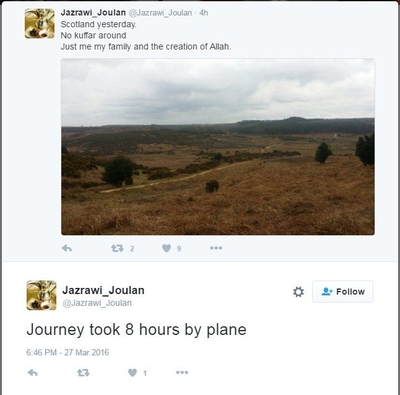
Three days later, al-Jazrawi posted a tweet from a different account, “Jazrawi_Joulan” claiming he was in Scotland along with a picture of a barren landscape similar to Scottish moors. “Scotland yesterday. No kuffar around,” he wrote. “Just my family and the creation of Allah.”

“Journey took 8 hours by plane,” he wrote in a separate tweet.

Wednesday, al-Jazrawi tweeted a notice of a meeting for Muslim converts in Crewe, England, which is located 36 miles south of Manchester.

Al-Jazrawi does not appear in the photos, and it is not known whether he was telling the truth about his location. But his tweets come at a time when the world is on alert against the threat from ISIS infiltration of Europe.

The task we face is not unlike that faced by Western intelligence agencies that must pore through thousands of pieces of information looking for facts.

Al-Jazrawi is believed to be a Saudi who, according to Italy’s Il Tempo newspaper, is part of an effort by ISIS to transfer operations to Libya with a goal of attacking Europe.

“Among the team of prominent jihadist elements there would be Abu Amer al-Jazrawi, a Saudi commander in the organization,” Il Tempo reported in February.

Al-Jazrawi was described by the Libyan newspaper Libya Herald described as ISIS leader Abu Bakr al-Baghdadi’s personal representative in Sirte, Libya.

Last year, ISIS announced that it created a continent-wide jihadist network to help slip jihadis undetected in and out of Europe, which the Investigative Project on Terrorism reported in December. Intelligence sources have since corroborated much of what ISIS announced in its “Black Flags” publications, evidenced by a New York Times report published this week.

The IPT has observed a pattern of bragging from al-Jazrawi, who tweeted during the Paris attacks last November, “Syrians were sent by Islamic state as special undercover sleeper cell agents.”

As it turned out, several of the members of the Paris/Brussels cell fought in Syria and infiltrated the flow of Syrian refugees into Europe.


Islamist Activist Asks Obama to Support Libyan AQ Group

March 18, 2016

Islamist Activist Asks Obama to Support Libyan AQ Group, Investigative Project on Terrorism, John Rossomando, March 18, 2016
1414

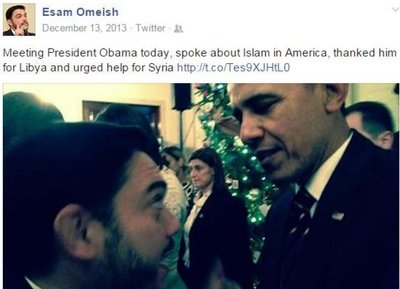
The revelation of his praise for Palestinians who chose “the jihad way” to liberation forced northern Virginia surgeon Esam Omeish to resign from a statewide immigration commission in 2007. But it hasn’t stopped him from enjoying red carpet treatment from Obama administration officials.

Omeish briefly drew national attention in 2007 when he was forced to resign from the Virginia immigration panel. The move resulted from Investigative Project on Terrorism (IPT) video showing him praising for Palestinians who chose the “jihad way” during a rally in 2000.

This was no slip of the tongue. At a different event two months earlier, Omeishcongratulated Palestinians who gave “up their lives for the sake of Allah and for the sake of Al-Aqsa. They have spearheaded the effort to bring victory upon the believers in Filastin, insha’allah [God willing]. They are spearing the effort to free the land of Filastin, all of Palestine, for the Muslims and for all the believing people in Allah.”

Nonetheless, high-ranking Obama administration officials engaged with him despite this and his praise for Hamas founder Sheikh Ahmed Yassin. They consulted with him on Libya and included him in other events aimed at engagement with the Muslim community and countering violent extremism.

Now, Omeish is hoping those contacts will help him persuade U.S. officials to change gears in Libya, shifting support from a secular political figure to one with links to al-Qaida. He spelled out those ambitions in a Feb. 29 letter addressed to President Obama posted on Omeish’s Facebook page.

It is co-signed by Emadeddin Z. Muntasser, secretary general of the Libyan American Public Affairs Council (LAPAC). Omeish is identified as the LAPAC president.

Before he was affiliated with the LAPAC, Muntasser was convicted in 2008 of failing to disclose connections between a charity he worked with and jihadist fundraising when he sought tax-exempt status for the charity.

Muntasser ran the Boston branch of the Al-Kifah Refugee Center, which is considered a precursor to al-Qaida, federal prosecutors have said. It was founded by Osama bin Laden’s mentor Abdullah Azzam. Under Muntasser’s leadership, Al-Kifah’s Boston office published a pro-jihad newsletter called Al-Hussam and distributed flyers indicating its support for jihadists fighting on the front lines in places such as Chechnya, Bosnia, Afghanistan and Algeria.

Muntasser’s charity, Care International, was “an outgrowth of and successor” to Al-Kifah, prosecutors say.

Omeish and Muntasser note in their letter that the U.S. has backed the “Libyan National Army,” led by Khalifa Hifter, a former general under dictator Muammar Gaddafi. That’s a bad idea, Omeish and Muntasser wrote, because “many in Libya believe [Hifter] has dictatorial aspirations …”

“He sounds like the Ahmed Chalabi of Libya,” said former Pentagon spokesman J.D. Gordon, a fellow at the Center for a Secure Free Society. “He wants America to fight his battles for him in order to gain the upper hand over his countrymen.”

However, the letter makes no mention of ties between the group Omeish endorses, the Revolutionary Council of Derna, and al-Qaida. Instead, he and Muntasser casts the group as an effective counter to ISIS because the council has “stripped [ISIS] from its social support. [ISIS]’s foreign presence and violent ways made them an evil that local Libyans themselves rejected and defeated” in Derna.

The council’s leaders included two men – Nasir Atiyah al-Akar and Salim Derbi –known to have had ties to al-Qaida.

After ISIS killed al-Akar, the Derna council eulogized him last June for his close ties to Abu Qatada, al-Qaida operative currently in Jordan. Defense Intelligence Agency (DIA) reports from 2012 connect Akar to Abdulbasit Azzouz, who was al-Qaida leader Ayman al-Zawahiri’s man in Libya at the time. Azzouz allegedly was involved with the attack on the U.S. consulate and CIA annex in Benghazi that left U.S. Ambassador Stevens and three other Americans dead.

Derbi, also killed fighting ISIS, previously belonged to the al-Qaida linked Libyan Islamic Fighting Group (LIFG) and commanded the Abu Salim Martyrs Brigade, which also has al-Qaida ties.

Egypt’s Al-Alam Al-Youm refers to the Revolutionary Shura Council as “a branch of al-Qaida.”

Despite his ongoing connections to key White House decision-makers, Omeish appears headed for disappointment this time.

His letter is not likely to be read by the president’s national security team, a White House source told the Investigative Project on Terrorism (IPT). The U.S. is prepared to support a “Government of National Accord” that is being developed, the White House said in a statement.

However, the Obama administration repeatedly has involved Omeish in policy deliberations about Libya.

White House logs show that Omeish visited nine times since 2011, including a Dec. 13, 2013 visit in which he was photographed with President Obama.

Omeish’s encounter with the president came during the White House’s annual Christmas party, a White House spokesperson said. President Obama never conducts policy discussions at such public meetings, the source said.

1415 (1)

Two photos appear on Omeish’s Facebook page showing him with U.N. Ambassador Samantha Power, widely considered an architect of the president’s Libya policy, where she advocated for military intervention. She notably helped draft PSD-11, a secret presidential directive that led to the U.S. supporting the Muslim Brotherhood in Libya among other places.

One photo shows Omeish meeting with Power in February 2012, when she worked as special assistant to the president and senior director for Multilateral Affairs and Human Rights at the National Security Council. The other photo posted the day Obama announced Power’s nomination as U.S. ambassador to the U.N. shows her standing next to Omeish.

White House officials thought enough of Omeish that they invited him to attend an April 2011 speech on Libya by President Obama at the White House. Omeish also attended the installation of Christopher Stevens, the late U.S. ambassador to Libya killed in the Sept. 11, 2012 Benghazi attack, and that of his successor, Deborah Jones, in 2013.

Omeish told The Washington Times following the Benghazi attack that he briefed Stevens before the ambassador began his duties in Tripoli.

Omeish and the Muslim Brotherhood

In addition to his comments about Palestinians and jihad, Omeish admits to prior personal involvement in the Muslim Brotherhood in the U.S. and served as president of the Muslim American Society, which has been described as the “overt arm” of the Brotherhood in America. His association with the Brotherhood likely dates back to his involvement in the Muslim Students Association (MSA) in the 1990s when he became the national organization’s president, which was founded by Brotherhood members in 1963.

Omeish endorsed Libya’s Muslim Brotherhood in a 2012 IRIN News article, stating that although it came in a distant second in Libya’s 2012 elections, it “may be able to provide a better platform and a more coherent agenda of national action.”

Libya’s Muslim Brotherhood subsequently failed to implement a coherent agenda and became deadlocked with its liberal rival, the National Forces Alliance, over establishing a working constitution.

Brotherhood members opposed building a strong Libyan military that could have helped rein in the militias that have since created havoc. Numerous militias tied to the Brotherhood have contributed to Libya’s instability. U.S. State Department officials contracted with the Brotherhood-linked February 17 Martyrs Brigade – a group that also had Al-Qaida ties – to provide security for the ill-fated U.S. consulate in Benghazi. A BBC report described the brigade as the best armed militia in eastern Libya. It additionally held al-Qaida sympathies, according to posts on its Facebook page. A State Department report called reliance on the February 17 militia in the case of an attack such as happened on Sept. 11, 2012 “misplaced.”

LAPAC is but one of an alphabet soup of groups that Omeish helped found as a result of the Arab Spring, aimed at affecting U.S. policy toward Libya.

This includes Libyan Emergency Task Force,(LETF), Libyan Americans for Human Rights, Libyan Council of North America (LCNA), Libyan American OrganizationAmerican Libyan Council, American Libyan Chamber of Commerce and Industry (ALCCI), Center for Libyan American Strategic Studies. Former Libyan Ambassador to the U.S. Ali Aujali appointed Omeish the official representative of the Libyan-American community, according to ALCCI’s old website.

LETF lobbied for the U.S. and the international community to establish a no-fly zone to keep Gaddafi from bombing rebellious cities in early 2011. Omeish’s LCNA worked to facilitate meetings between U.S. officials and Libyan rebels, including a meeting with John Kerry while he still was a U.S. senator. ALCCI  works with the Libyan embassy in Washington to “certify and support trade relations between Libya and the United States.”

It remains to be seen whether the advice from Omeish and Muntasser will be ignored. But their gambit, publicly posting their letter urging the president to support Islamists, indicates a confidence generated by years of access and consultation. That raises a host of troubling questions.
 

ISIS Now Possesses Anti-Aircraft Missiles; Can Reach Europe

March 13, 2016

ISIS Now Possesses Anti-Aircraft Missiles; Can Reach Europe, Clarion Project, March 13, 2016

Islamic-State-10-IP_1An Islamic-State fighter with a shoulder-held missile. (Photo: Islamic-State video screenshot)

The U.S. and U.N. have confirmed the Islamic State (ISIS/ISIL) in Libya now possesses shoulder-held missiles capable of downing civilian or military aircraft.

The admission puts planes in North and West Africa as well as all of Europe in danger.

The Islamic State’s stock of MANPADs (man portable air defense systems) originated from the stockpiles of weapons looted after Libya’s dictator Muammar Gaddafi was overthrown by rebels in 2011.

Gaddafi was believed to have possessed 20,000 MANPADs (Russian-made SA-7 and SA-16 models) by the time of his demise. An American team, acting in Libya after the coup, managed to locate and destroy 5,000 of the missiles.

The team leader, speaking on the condition of anonymity told The Independent, “There’s a large number still there in Libya, where some of the larger militia groups still maintain the stocks that they originally took control of back in 2011.” He acknowledged that others have been smuggled to extremist groups fighting in the Sinai, Syria, Nigeria and Mali.

“We might never know where they went,” he added.

After the Sept. 11, 2012 attack on the American consulate in Benghazi, which also housed a secret CIA post, intelligence sources — crucial to tracking these weapons – were lost. Two years later, the team pulled out of Libya entirely, as the deteriorating security situation turned into a full-fledged civil war and made operating there too dangerous.

This video (Courtesy: Dutch Safety Board) shows how an advanced surface-to-air missile hit Malaysian Airlines Flight 17 over Ukraine in 2014. This is a different launch system but shows the potency of such missiles.

(Video at the link — DM)

Analysts question why the weapons, which are clearly in the hands of terrorists have not been used to date, save for one confirmed instance in January 2014, when (according to Egyptian and Israeli officials) Ansar Bayt al-Maqdis used the weapon to shoot down an Egyptian military helicopter in the Sinai, killing five soldiers.

However, in February, the Islamic State in Libya claimed to have shot down a Libyan government MiG-23 fighter jet west of Benghazi while it was bombing an Islamist militia. While the Libyan government claims the plane went down due to “technical problems,” an analysis of a subsequent ISIS video of the incident by U.S. intelligence officials proved the Islamic State’s claim was most likely correct. The Islamic State also claims to have downed two other planes that the Libyan government said crashed since January because of technical problems.

In Libya, other warring factions each have good reason not to use the weapon, which would certainly stop flights in and out of the country and mean lack of supplies for each side. Arms smugglers also have reason to want the airports left open, with each missile selling for $12,000 on the black market.

But the real wildcat in this conflict is the Islamic State, which now controls a 150-mile swath of territory on Libya’s Mediterranean  coast, including the city of Sirte, a perfect place for the terror organization to regroup if defeated in Syria and Iraq and a base from which to expand into Europe, North and Sub-Saharan Africa.

Libya Being Taken Over by ISIS was Everyone’s Fault Except Obama’s

March 11, 2016

Libya Being Taken Over by ISIS was Everyone’s Fault Except Obama’s, Front Page Magazine, Daniel Greenfield, March 11, 2016

crying-barry-obama

Nothing is ever Obama’s fault. Ever. Even when he did it.

Like the time he illegally invaded Libya by lying to everyone from the UN to Americans, leading to the killing of an American ambassador and Al Qaeda, the Muslim Brotherhood and ISIS taking over large parts of the country… as had been predicted. But it’s not his fault. Really.

But Obama says today of the intervention, “It didn’t work.” The U.S., he believes, planned the Libya operation carefully—and yet the country is still a disaster.

We did a good job… and yet we failed. It must be someone’s fault.

“The social order in Libya has broken down,” Obama said, explaining his thinking at the time. “You have massive protests against Qaddafi. You’ve got tribal divisions inside of Libya…. We worked with our defense teams to ensure that we could execute a strategy without putting boots on the ground and without a long-term military commitment in Libya.”

Who could have predicted that regime change in a country where the order had broken down, without putting boots on the ground, would lead to complete chaos? No one could have predicted it. No one.

“So we actually executed this plan as well as I could have expected: We got a UN mandate, we built a coalition, it cost us $1 billion—which, when it comes to military operations, is very cheap. We averted large-scale civilian casualties, we prevented what almost surely would have been a prolonged and bloody civil conflict. And despite all that, Libya is a mess.”

I poured gasoline on the haystacks. Then I started shooting off firecrackers. I tied torches to pigs and sent them running around the barn. And despite all that, the barn is on fire.

It was a great plan Obama had.

1. Lie to the UN

2. Build a coalition of countries willing to sign their names without doing anything

3. Spend $1 billion to let Islamic terrorists take over the country

4. Somehow the “prolonged and bloody civil conflict” you claimed to be trying to prevent is still going on and on…

And it’s not Obama’s fault. No way.

Mess is the president’s diplomatic term; privately, he calls Libya a “shit show,” in part because it’s subsequently become an isis haven—one that he has already targeted with air strikes. It became a shit show, Obama believes, for reasons that had less to do with American incompetence than with the passivity of America’s allies and with the obdurate power of tribalism.

“I’m not competent. All my allies suck. Also the tribal country we bombed is all tribal and stuff and who could have predicted that?”

“When I go back and I ask myself what went wrong,” Obama said, “there’s room for criticism, because I had more faith in the Europeans, given Libya’s proximity, being invested in the follow-up,” he said.

Yes, the only thing that Obama blames himself for… is passing the blame to Europe.

French nuke carrier for sea-air drill with Egypt ahead of Libya offensive

February 29, 2016

French nuke carrier for sea-air drill with Egypt ahead of Libya offensive, DEBKAfile, February 29, 2016

Tahya_MisrFrench-built Egyptian frigate “Tahya Misr”

[T]he joint French-Egyptian naval-air force drill about to take place is the most substantial sign that a real operation to confront ISIS in Libya may finally be about to go forward.

***************************

The French nuclear-powered aircraft carrier Charles de Gaulle is steaming through the Red Sea on its way to the Mediterranean via the Suez Canal for joint maneuvers with the Egyptian navy in preparation for a reduced coalition offensive against Islamic State’s deepening grip on Libya. DEBKAfile’s military sources, reporting this, say it will be the Egyptian navy’s first joint exercise with a nuclear-powered aircraft carrier; and also the first drill to be conducted by the new Egyptian missile frigate Tahya Misr (Long Live Egypt!),  which underwent a series of exercises after it was delivered by the French DCNS naval shipbuilders last June.

The Charles de Gaulle departed the Persian Gulf Monday, Feb. 22 and is due to reach the eastern Mediterranean in the first week of March. The Egyptian frigate’s weapons systems can shoot down planes and ballistic missiles as well as striking naval or ground targets. Its weapons systems can shoot down planes and ballistic missiles as well as striking naval or ground targets. But the vessel has been stripped of its regular electronic warfare and satellite communications systems for the exercise – apparently after a quiet understanding between France, Egypt and Israel.

The Egyptian frigate was originally designed to secure the Suez Canal against potential terrorist attacks from the Islamic State networks in the Sinai Peninsula and their offshoots in the Canal cities of Port Said, Ismailia and Suez. The warship was moved into the Mediterranean after President Francois Hollande and Egyptian President Abdul-Fatteh El-Sisi moved forward on plans for a joint assault with Italy to root out ISIS positions in Libya.

The three powers have agreed to launch this offensive in late April or May, DEBKAfile’s military and counterterrorism sources report.

The joint naval exercise will meanwhile drill coordination between the French and Egyptian navies and air forces in readiness for the combat operation. They will practice landing fighter-bombers taking off from the Charles de Gaulle decks at air bases in Egypt’s western desert near the Libyan border, for refueling, reloading munitions or emergency landings, when damaged by enemy fire.

They will also rehearse joint marine landings from French and Egyptian warships.

Our sources report that the trilateral assault plan has undergone repeated revisions in recent weeks, mainly because President Barack Obama has had second thoughts about his initial scheme for the United States to lead the operation in Libya – this time from the front.

His first plan was for a large marine contingent to land on the Libyan coast under heavy air cover. But lately, he can’t decide whether to deploy any US troops at all and inclines towards leaving the main onus of the anti-ISIS campaign in Libya to European and Middle East armies.

A final decision is expected by our Washington sources to substantially scale down the original plan. The dithering in Washington has led to delays in Paris, Cairo, Rome and London on drawing up a final list of ISIS targets to be hit and the size of the invasion forces, although the operation is just weeks away and time is pressing.

Islamic State commanders, viewing this lack of resolve, are beginning to feel safe in their Libyan strongholds, after drawing confidence from the recent downsizing of coalition strikes against its forces and bases in Iraq and Syria.

Since a small coalition vanguard for the main offensive landed in Libya last year, nothing much as happened to hold back ISIS advances in Libya,  except for US drone strikes.

The White House spokesman Josh Earnest said this week that President Obama planned to address the terrorist organization’s advances in Libya with top military officials.

Also this week, Libyan military officials reported that 15 French Special Operations experts had been in Benghazi for the past two months, assisting Libyan national troops in fighting the extremists. According to another report, a “small number” of British advisers has joined US military operatives who are giving local militias “tactical training in Misrata.

However, the joint French-Egyptian naval-air force drill about to take place is the most substantial sign that a real operation to confront ISIS in Libya may finally be about to go forward.

Newsmax Prime | Raymond Ibrahim and Nonie Darwish discuss the latest US airstrike in Libya

February 22, 2016

Newsmax Prime | Raymond Ibrahim and Nonie Darwish discuss the latest US airstrike in Libya, Newsmax TV via You Tube, February 19, 2016

Libya disaster: Have Western leaders learned anything?

February 20, 2016

Libya disaster: Have Western leaders learned anything? Investigative Project on Terrorism via Fox News, Pete Hoekstra, February 19, 2016

(Please see also, Exclusive: Obama Refuses to Hit ISIS’s Libyan Capital. — DM)

That the U.S. has launched airstrikes against ISIS in Libya should demonstrate once and for all the total disaster of the NATO-led adventure to overthrow Muammar al-Qaddafi in 2011.

Libya devolved into a failed state when NATO assisted Qaddafi’s radical jihadist opponents in killing him and then promptly abandoned the country. Left in the wake were two rival governments competing for power, which created space for Islamists to turn Libya into a cesspool of extremism.

Former Secretary of State Hillary Clinton continues to call the debacle American “smart power at its best.” Other presidential candidates still argue that it was the right thing to do.

How will the West ever learn anything if it can’t identify its most obvious failures?

Libya has no central functioning government that can provide security for its citizens. ISIS fights to expand its caliphate along the Mediterranean to points as close as 200 miles from Europe’s vulnerable southern border. It controls Qaddafi’s hometown of Sirte. It has imposed Shariah law in the areas under its control. It exploits Libya as a base to export weapons, jihadists and ideology to Europe, other African countries and the Middle East.

Benghazi and Derna, which have long been hotbeds of radicalism, provided more fighters per capita to Afghanistan and Iraq than nearly any other area in the world. The difference between then and now is that Qaddafi kept the lid on the garbage can long before 2002-2003, when he became a reliable U.S. ally against radical Islam. He changed his behavior, gave up his nuclear weapons program, paid reparations to the victims of his atrocities and provided invaluable intelligence that disrupted numerous Islamist terror plots.

It represented a massive foreign policy success, and the U.S. thanked him by facilitating his murder.

Similarly, the West embraced former Egyptian President Hosni Mubarak in his struggles against Islamist forces, and then it threw him under the bus. Both Qaddafi and Mubarak did everything asked of them, but they ended up dead or in jail.

Any leader would really need to ask why he should trust NATO or the West. Is there any question why Syrian dictator Bashar al-Assad does not negotiate an end to his country’s civil war and clings to Iran and Russia to keep him in power?

Iran cheated on its nuclear program for years. As a result, the U.S. gifted it with more than $100 billion – including $1.7 billion in U.S. taxpayer dollars – and it hasn’t changed its behavior in the slightest. In addition to its military ambitions, Iran will most assuredly spend the money on supporting Assad and its terrorist proxies throughout the Middle East, Africa and, yes, Europe.

I’m amazed by some of the statements now coming from the coalition. The French defense minister is concerned about ISIS fighters blending in with refugees crossing the Mediterranean. Talk about restating the obvious. The British want troops to identify friendly militias in order to avoid targeting them in future airstrikes. Has something changed where we have improved the vetting of “moderate” militia groups?

NATO failed miserably in Libya and in Syria the first time around. What’s different now?

The only official who seems to make any sense is U.S. Secretary of Defense Ash Carter, who said recently, “The Libyans don’t welcome outsiders intruding on their territory.” He was referring to ISIS, but he might as well have been talking about the West. Libyans have not forgotten that NATO all but vanished once Qaddafi was killed.

Western foreign policy is in disarray. The scariest part is that supposed leaders don’t even know it, and therefore they can’t admit to previous mistakes. Allies that brought stability to the region are gone. Former and current antagonists benefited from Western incompetence.

Who would have predicted six years ago that those rulers battling Islamist terror would be deposed and that those committing it would become the West’s new friends?

NATO snatched defeat from the jaws of victory in Libya. Refugees flood Europe. Terrorist attacks continue to spread geographically and in lethality. The Syrian civil war rages on. Iran lavishes its newfound wealth on its nuclear program and campaign of global terror.

Is it any wonder that citizens in Western countries are frustrated and angry with those in positions of authority?

Exclusive: Obama Refuses to Hit ISIS’s Libyan Capital

February 18, 2016

Exclusive: Obama Refuses to Hit ISIS’s Libyan Capital, Daily Beast, Nancy A. Youssef, February 18, 2016

(Please see also, ISIS Leader Moves to Libya. — DM)

Islamic State in Libya

Despite the growing threat from the self-proclaimed Islamic State in Libya, the Obama administration has turned down a U.S. military plan for an assault on ISIS’s regional hub there, three defense officials told The Daily Beast. 

In recent weeks, the U.S. military—led by its Africa and Special Operations Commands—have pushed for more airstrikes and the deployment of elite troops, particularly in the city of Sirte. The hometown of former Libyan leader Muammar Gaddafi, the city is now under ISIS control and serving as a regional epicenter for the terror group.

The airstrikes would target ISIS resources while a small band of Special Operations Forces would train Libyans to eventually be members of a national army, the officials said.

Weeks ago, defense officials told The New York Times that they were crafting military plans for such strikes, but needed more time to develop intelligence so that they could launch a sustained air campaign on ISIS in Sirte.

But those plans have since been put on the back burner.

“There is little to no appetite for that in this administration,” one defense official explained.

Instead, the U.S. will continue to do occasional strikes that target high-value leaders, like the November drone strike that killed Abu Nabil al-Anbari, the then-leader of ISIS in Libya.

“There’s nothing close to happening in terms of a major military operation. It will continue to be strikes like the kind we saw in November against Abu Nabil,” a second defense official explained to The Daily Beast.

The division over what action the U.S. and the international community should take in Libya speaks to the uncertainty about when and where ISIS should be countered.

For Europe, Libya is uncomfortably close and already a jumping off point for migrants willing to take on the rough Mediterranean waters in search of asylum. ISIS pronouncements have previously pointed out that Rome is nearby.

For the United States, there are major concerns about allowing another ISIS hub to emerge in the region. The Libyan city of Sirte is under ISIS control and some believe the terror group seeks to turn Sirte into a center of operations, like Raqqa in Syria and Mosul in Iraq.

Leaders across Europe have hinted that more should be done in Libya but have fallen short on specifics. In an interview with Der Spiegel last month, the German envoy to Libya said: “We simply cannot give up on Libya.”

According to U.S. military figures, there are roughly 5,000 ISIS fighters in Libya, a spike from 1,000 just a few months ago. Defense officials believe that ISIS supporters are moving toward Libya, having found it increasingly difficult to travel to Iraq and Syria.

Perhaps because of that, Sirte, and areas around it, are increasingly falling victim to ISIS’s barbaric practices. And some are urging the international community not to wait until Sirte falls further under ISIS control, and filled with fighters mixed in with civilians.

According to this report, residents there cannot leave the city freely as ISIS fighters—many of them from Egypt, Chad, Niger, and Tunisia—inspect cars for signs of residents trying to escape. As in Raqqa and Mosul, residents do not have access to cellphone or Internet networks and live under an ISIS judicial system that issues death sentences to those who do not practice the terror group’s brand of Islam.

Moreover, in nearby cities like Ras Lanouf, ISIS is destroying oil installations, cutting off a key potential source of revenue for any newly cobbled unified Libyan government. ISIS has set its sights across the country, from Misrata in the west to Derna in the east.

Some fear the terror group is hunkering down in places like Sirte in preparation for a potential U.S. offensive.

The administration had said that it would not intervene until Libya, which now is governed by two rival governments on opposite sides of the country, had created a single entity to govern the state.

At a press conference Tuesday, during this year’s summit of the Association of Southeast Asian Nations, President Obama referred to United Nations efforts to help build a government in Libya, suggesting any military effort could create even more political fractures. On Sunday, a member of Libya’s Presidential Council announced that a list of 13 ministers and five ministers of state had been sent to Libya’s eastern parliament for approval.

But while the president said the U.S. would go after ISIS “anywhere it appeared,” he stopped short of saying the U.S. would expand its effort in Libya unilaterally.

“We will continue to take actions where we’ve got a clear operation and a clear target in mind. And we are working with our other coalition partners to make sure that as we see opportunities to prevent ISIS from digging in, in Libya, we take them. At the same time, we’re working diligently with the United Nations to try to get a government in place in Libya,” the president said. “And that’s been a problem.”

Some military officials believe Obama feels that France and Italy, which both have hinted at intervention, should take the lead on any military effort. Both countries were key to the NATO-led campaign in 2011 that led to Gaddafi’s fall. Still others believe the United States wants to limit its war against the Islamic State to Iraq and Syria.

Since Gaddafi’s death in October 2011, the state has become especially susceptible to outside extremists. With no tradition of an independently strong state military, militias have served as security forces and now are unwilling to disarm.

With no stable government or security forces, parts of Libya have become vulnerable to groups like ISIS looking for territory to set up a self-described caliphate.

As many as 435,000 of the country’s 6 million people are internally displaced, according a recent UN report. An estimated 1.9 million require some kind of humanitarian aid. And as of August, 250,000 migrants had entered, turning Libya into a key hub for those seeking to enter Europe.

Tuesday marked the five-year anniversary of Libya’s Arab Spring. It’s now considered a bittersweet day, rather than the beginning of a democratic movement the protests launched that day once promised.