Archive for the ‘Kurdish fighters’ category

The Islamic State Is Here to Stay

June 5, 2015

The Islamic State Is Here to Stay, VICE NewsAhmed S. Hashim, June 6, 2015

(Please see also, The Kurd-Shia War Behind the War on ISIS. — DM)

The victories against IS in early 2015 have proven ephemeral — or have been nullified by IS gains elsewhere. On Sunday, CIA director John Brennan said on Face the Nation, “I don’t see this being resolved anytime soon.” Assad’s vaunted offensives of February 2015 have fallen short as the regime faced stiff resistance from a wide variety of opposition fighters, including elements from IS. The failure was alarming in part because the campaign was designed and aided by both Hezbollah and the Iranians, two seemingly ascendant Shia powers.

************************

Just a few months ago, analysts and policy-makers were certain that the defeat of Islamic State (IS) forces was simply a matter of time.

Coalition airstrikes would degrade the group’s capabilities and eventually allow Iraqi forces and Kurdish Peshmerga — though discredited by their poor military showing in mid-2014 — to push back the extremists. And indeed, IS fighters were ejected from Tikrit in March 2015 by the Iraqi army and thousands of motivated fighters from Shia militias. In Kobani in northern Syria, IS fighters were defeated by Syrian Kurdish fighters. Elsewhere in the country, the regime of Bashar al-Assad was going on the offensive with help from Hezbollah and advisers from the Iranian Revolutionary Guard.

The Islamic State, however, rose like a phoenix from the ashes of every setback. And today, the situation is not so rosy.

The victories against IS in early 2015 have proven ephemeral — or have been nullified by IS gains elsewhere. On Sunday, CIA director John Brennan said on Face the Nation, “I don’t see this being resolved anytime soon.” Assad’s vaunted offensives of February 2015 have fallen short as the regime faced stiff resistance from a wide variety of opposition fighters, including elements from IS. The failure was alarming in part because the campaign was designed and aided by both Hezbollah and the Iranians, two seemingly ascendant Shia powers.

The situation in Iraq is just as complicated, something that the Obama administration appears either oblivious to or reluctant to acknowledge. Much of the US strategy continues to hinge on what is increasingly a mirage: a unified, albeit federal, Iraq under the control of Baghdad. Meanwhile, the resilience of IS is greatly enhanced by the ability of its military forces to innovate and adapt faster on the ground than its lackluster opponents.

In light of the constant aerial strikes by the US and its allies, IS has dispersed and made its forces more mobile, no longer presenting dense concentrations of fighting men as it did when it seized Mosul in mid-2014. Instead, when IS seized Ramadi in May 2015, it made use of inclement weather and sent several small units from different directions simultaneously into the city aided by suicide bombers. Moreover, the fact that the group faced ill-equipped and poorly motivated Sunni fighters in and around Ramadi did not do anything for Baghdad’s standing with the country’s already alienated Sunni community, which had pleaded for arms while caught between the unfathomable brutality of IS and revengeful Shia militias.

Many Sunnis are now angling for their own “super-region,” one that would have considerable independence from Baghdad. The problem? In order to have it, the Sunnis would need to first defeat IS. Currently, they’re unable to do so because they lack the resources; despite all the talk from Baghdad and Washington about arming Sunni tribes, Baghdad is not actually keen to do so.

And besides, the Sunnis seem relatively ambivalent about defeating IS. They took an unequivocal stance between late 2006 and 2009, when they joined with the Americans and the Iraqi government to deal the Islamist militants what was then seen as a decisive blow. Now, however, despite Sunnis’ resentment and fear of IS, the Islamists’ existence is seen as a kind of insurance policy against Shia revanchism should Baghdad succeed in retaking the three Sunni provinces of Anbar, Salahuddin, and Ninevah.

(Please see video at the link. — DM

The “victory” of the Iraqi government in Tikrit was more propaganda than reality; a few hundred IS fighters managed to inflict considerable damage on the Shia militias that had been mobilized to fight alongside the Iraqi army, then withdrew because they were outnumbered and wished to avoid being surrounded. The IS forces in Tikrit simply felt that they had done enough damage; there was no need to waste further assets in an untenable situation.

Militarily, the Iraqi Shia militias are better motivated and more dedicated than the regular army. Anecdotal information out of Baghdad suggests that Iraqi Shias are wondering whether the government should invest more effort building these forces into an effective and more organized parallel army. Even that parallel army, however, might be reluctant to commit to any significant long-term offensive to reclaim provinces full of “ungrateful” Sunnis.

But the Shia are willing to die to defend what they have, and there is increased sentiment among the Shia in central Iraq and Baghdad, along with the southern part of the country, that they would be better off without the Sunnis. There also exists the belief that the Kurds have more or less opted out of the Iraqi state despite the fact that they maintain a presence within the government in Baghdad. The Shia would seemingly not be sorry to see them exit the government in a deal that would settle as best as possible divisions of resources and territory. However, whether the Kurds would take the plunge and opt for de jure rather than de facto independence is a question that is subject to regional realities — How would Ankara and Tehran react? — rather than merely a matter of a deal between Baghdad and Erbil.

The Islamic State will continue to be a profound geopolitical problem for the region and the international community, and a long battle lies ahead. Syria and Iraq are more or less shattered states; it is unlikely that they will be put back together in their previous shapes. If Assad survives 2015, it will be as head of a rump state of Alawites and other minorities protected by Hezbollah, Iran, and Alawite militias. Shia Iraq will survive, and will possibly dissociate itself from the nettlesome Sunni regions. The Kurds will go their own way step by step. The international community is currently at a loss for how to stem the flow of foreign fighters to the IS battlefields — and even more serious is the growing sympathy and admiration for the group in various parts of the world among disgruntled and alienated youth.

If the US is serious about defeating IS, it needs to take on a larger share of the fight on the ground. This means more troops embedded with regular Iraqi forces in order to bring about better command, control, and coordination. It also means advisors who can continue to train these forces so that they improve over time. If this is not done, the regular Iraqi military will continue to be nothing more than an auxiliary to the more motivated — and pro-Iranian — Shia militias. Currently, militia commanders are giving orders to the regular military; that cannot be good for morale.

This month, the Islamic State celebrates the first anniversary of its self-declared caliphate. The group has little reason to fear it will be the last.

The Kurd-Shia War Behind the War on ISIS

June 5, 2015

The Kurd-Shia War Behind the War on ISIS, The Daily BeastMat Wolf, June 5, 2015

1433495718557.cachedAhmed Jadallah/Reuters

“We could see outright civil war,” Farhan Siddiqi, a research fellow on international politics and national security at the Middle East Research Institute (MERI), tells The Daily Beast. Siddiqi says he believes the Kurds and the Shia central government would face domestic and international pressure to avoid such a conflict, but if cooler heads failed a hypothetical conflict could escalate into something even worst than the current ISIS war.

********************

In a dusty town near the Iranian border, the terror group was defeated, but the victors are at each other’s throats.

JALAWLA, Iraq — Behind Iraq’s front lines against the so-called Islamic State, Kurdish and Shia factions already are drawing a blueprint for what could be the region’s next major conflict.

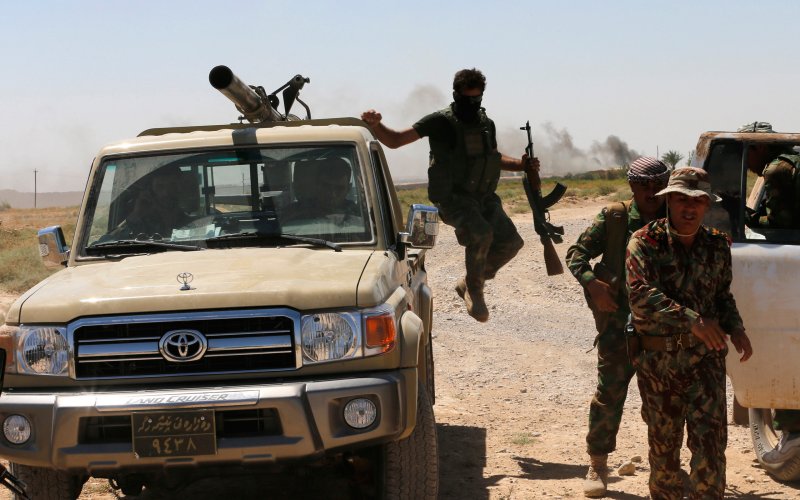
In the city of Jalawla in Iraq’s Diyala province, near the Iranian border approximately 80 miles east of Baghdad, Kurdish forces have given the boot to the Shia militia they previously allied with to take the city from ISIS in a bloody November battle. Last month, the commanding Kurdish Peshmerga general in Jalawla threatened to start shooting if the Shia refused to leave the city immediately.

“This area is ours now, and that’s not changing,” Brig. Gen. Mahmoud Sangawi told The Daily Beast. He added that Jalawla, an abandoned city that previously had 83,000 people and was 80 percent Sunni Arab in 2003, would soon have a Kurdish mayor. Sangawi bragged that henceforth the city would also be called by its new Kurdish moniker, “Golala.”

Not so fast, say the Shia militias. They were recruited in the name of a fatwa from Iraqi Grand Ayatollah Ali al-Sistani in June 2014, following the Iraqi army’s humiliating loss of Mosul, Iraq’s second largest city, virtually without a fight. Many are trained and advised by Iranians, and they have been the spearhead of Baghdad’s efforts to recover lost territory in the name of the national government.

The Kurds, meanwhile, have fought hard to protect, consolidate and indeed expand areas they consider “their” territory.

“They [the Kurds] need to recognize this region is Iraq,” says Ali Khorasani, the commander of the Hashd al-Shaabi militias that Sangawi’s Peshmerga expelled from Jalawla. Hashd al-Shaabi is the Arabic term for Popular Mobilization Units, the name preferred by the volunteer Shia militias.

Khorasani said the Kurds “are strong, and they’re very organized, and our relationship was good, but now our relationship has problems.” And that appears to be an understatement. When asked if Kurdish moves in the region might lead to another war, Khorasani replied tersely: “Maybe.”

For now, Khorasani’s unit has been dispersed to the south of Jalawla around a town called Sadiya. It’s only a five-minute drive from Jalawla, but Kurdish forces are limiting access to Sadiya and prevented us from going there. Khorasani spoke to The Daily Beast by phone.

The ISIS blitz of northern and central Iraq one year ago sent the on-paper highly trained and well-equipped Iraqi army scrambling, and led to the sacking of controversial Shia Prime Minister Nouri al-Maliki. He was widely criticized for his sectarian policies that alienated the country’s Sunni Arabs, who are now the main support base for ISIS.

The Iraqi army’s retreat also opened the door for Kurdish forces to seize large swaths of territory abandoned by government forces.

Now, the central government’s inability to deal decisively with ISIS in Anbar province and its loss of the Anbar provincial capital Ramadi has seen the Kurds acting even more brazenly in anticipation of an independence push. Iraqi Kurdistan President Masoud Barzani has promised a long-awaited Kurdish independence referendum.

“Certainly an independent Kurdistan is coming,” Barzani said on a visit to Washington D.C. on May 6. “It will take place when the security situation is better and when the fight against ISIS is over.”

“We could see outright civil war,” Farhan Siddiqi, a research fellow on international politics and national security at the Middle East Research Institute (MERI), tells The Daily Beast. Siddiqi says he believes the Kurds and the Shia central government would face domestic and international pressure to avoid such a conflict, but if cooler heads failed a hypothetical conflict could escalate into something even worst than the current ISIS war.

Since the summer of 2014, the Kurds have increased their territory by 40 percent, most notably around the oil-rich city of Kirkuk, often called the “Kurdish Jerusalem.” Today Kirkuk has a Kurdish population of around 50 percent combined with large groups of Arabs and Turkmens. The city and its outlying territories were frequent targets of “Arabization” by the Saddam Hussein regime, a policy meant to shift the ethnic balance of power there as he waged a genocidal war against the rebellious Kurds. Now they want the city back, but Arab families who have lived there for decades have no place to go.

Areas like Jalawla are a different matter. It is closer to Baghdad than to the Iraqi Kurdish capital Erbil. It, too, was the target of waves of Arabization, but it has been a majority Arab city for decades. By Sangawi’s own admission the population was less than 10 percent Kurdish in 2003.

“The Baath regime had a process of oppressing the Kurdish people. They had to change their names to Arab names or leave the city,” Sangawi says. “When filling out forms they had to register as Arab. In 1970, 32 percent of this city was Kurdish. The city was only 8 percent Kurdish at the time of the American invasion in 2003. The Arabs tried to rob the Kurds of their land.”

Today, Jalawla has been completely abandoned by its civilian inhabitants, many of whom supported ISIS, according to Sangawi. Feral dogs dart in front of Peshmerga convoys and Kurdish graffiti proclaims the city part of Kurdistan. The immediate surrounding area of the town—dusty flat fields speckled with palm groves—clashes with the green, mountainous terrain often associated with Kurdistan, and syncs up more with stereotypically Arab lands.

Parts of Jalawla, especially the former ISIS command center on high ground overlooking the city, have been reduced to rubble. However, a spring bloom of un-manicured pink desert roses has overrun the walls and sidewalks, offsetting the many bullet holes and craters that otherwise dot the settlement.

“One-hundred and ten Peshmerga died in the fighting. When ISIS came in here they left many IEDs and explosives on the roads,” says Sangawi.

But the November fighting wasn’t the area’s first battle, and likely not its last. The Kurdish-Arab rift in the city goes back over a millennium.

Golala, Jalawla’s Kurdish name, means the “land of flowers.” Its Arabic title’s etymology is more grisly. In 637 AD, Arab Muslim forces during the early Islamic conquest of the Middle East won a decisive battle here against a Zoroastrian Persian force. A popular tale in the region holds the Arabs named the location Jalawla from an Arabic verb meaning to cover or to fill, as so many Zoroastrian corpses filled the landscape.

Sangawi knows this tale, and says he considers the Zoroastrians the Kurds’ forebears before Arabs took their territory—a perfect and historically convenient parable for Kurdish claims on the region.

Dark haired with a round face, thick droopy mustache and rosy cheeks, the 63-year-old Sangawi at first comes across as a friendly grandfatherly type, albeit one who travels with an entourage equipped with RPGs and machine guns. And most grandfathers don’t blithely threaten former heads of state.

“We’ve killed lots of people, a lot of them like Maliki,” he says of the former Iraqi prime minister, who said in a TV interview last month that anyone wishing to break up Iraq would create a “river of blood.”

“Maliki can eat shit,” Sangawi chuckles.

Sangawi’s been with the Peshmerga since the 1970s and has jumped around the Kurds’ various political parties, at one point even becoming a Marxist before joining up with the Patriotic Union of Kurdistan (PUK), the party of former Iraqi President Jalal Talabani.

Compared to Sangawi’s stance of bold antagonism, Khorasani is more conciliatory. The 45-year-old says he was in the legal profession before volunteering for the militia, and he makes a point of saying how the liberation of Jalawla was a joint effort. Even before then, he adds, the Kurds and Shia Arabs could find common cause.

“This is Iraq. We used to be united. They opposed the former regime and so did we,” he laments. “We were one.”

But Sangawi counters: “We were both against Saddam Hussein. We fought together. However, when the Shias came to power they treated us the same as Saddam Hussein, that’s why we don’t have a good relationship now.”

Siddiqi, at the Middle East Research Institute, says that the new Baghdad government under Prime Minister Haider al-Abadi has shown a willingness to negotiate and be more accommodating to Iraq’s minorities, but the country’s age-old tensions still run deep.

“Saddam Hussein is gone, but his authoritarianism still survives along all levels of Iraqi society,” Siddiqi says. “It remains to be seen if the government becoming more accommodating will reduce calls for independence.”

If a conflict were to occur, he adds, the Hashd al-Shaabi would be at the forefront of any government pushback against the Kurds. “The central government could easily call on the Shia militias it’s currently using against ISIS, using religious pretexts and slogans to drive them forward,” he says.

The central Iraqi government has already come under fire for its use of the militias, whose religious zealotry exacerbates sectarian tensions in Iraq. The government’s operation to retake the Sunni-majority Ramadi was originally named “At Your Service, Hussein,” in honor of a major Shia historical and religious figure. Human Rights Watch has also raised concerns that the Hashd al-Shaabi have committed serious human rights abuses while ostensibly fighting ISIS.

Siddiqi says the international community, including the central government’s main ally, Iran, would be wary of seeing another war in the region. “Iran wants peace, it does not want Iraq to become another Syria or another Yemen,” he says, adding that although opposed on many issues, the U.S. and Iran have tacit tactical cooperation in Iraq these days, and neither would support a Shia-Kurd conflict.

If a fight did occur, Siddiqi says he believes world powers would do their best to take a “hands-off” approach to avoid further escalation. If Kurdish independence were to succeed, he continues, it would only be accomplished via an agreement with Baghdad, not another war.

But far from Tehran and the beltway, on the dusty plains of disputed Jalawla, Sangawi says he’s ready for that war, drawing little distinction between Shia Hashd al-Shaabi and Sunni ISIS, and viewing them both as his people’s ancient enemies.

“The Shia militias believe if they kill ISIS they’re going to heaven, and ISIS believes if they kill the Shia people they are going to go to heaven,” Sangawi declares. “They fight over religion, not for land.”

“For me, if they attack me I will attack them, because this is my land. If they come to this land, of course I will fight them.”

Strategic Failures, the US and the Fall of Ramadi

May 21, 2015

Strategic Failures, the US and the Fall of Ramadi, Clarion ProjectRyan Mauro, May 21, 2015

Islamic-State-Victory-Parade-HPIslamic State fighters celebrate their take over of Ramadi with a victory ‘parade.’ (Photo: Islamic State social media)

The U.S. must correct its strategy by sidelining Iranian-backed militias and terrorists, leveraging influence with the Iraqi government and significantly increasing assistance to the Anbar tribes, Kurds, Iraqi government and to the persecuted Christian minority that is forming its own self-defense force.

Recent history has shown that the Iraqi government will choose the U.S. over Iran if compelled.

********************

The Islamic State (ISIS) has captured Ramadi, the capital of Iraq’s Anbar Province, reportedly “terrifying” Iraqi officials who now foresee a “tsunami of international terror.” It is an important achievement for the terrorist group aimed at pre-empting a potential Sunni tribal uprising.

The Sunni tribes in Anbar Province were critical to the success of the 2007 “surge” that ousted the Islamic State’s predecessor, Al-Qaeda in Iraq. The deterioration in the relationship between these tribes and the central Iraqi government was likewise critical to the terrorists’ comeback in Iraq.

The Islamic State remembered these lessons and acted quickly as the Iraqi government began training tribal fighters and the U.S. defense budget allotted $179 million to Kurdish and Sunni tribal forces. The U.S. forgot these lessons and has long rejected Sunni and Kurdish pleas for direct aid to fight the Islamic State.

The Obama Administration is now planning to change course and directly arm and train the Iraqi Sunni tribes after the fall of Ramadi. The White House previously chose to work only through the central Iraqi government that has given the Kurds and Sunnis inadequate support.

A delegation of 11 Sunni tribal leaders, including Sheikh Ahmed Abu Risha, the President of the Anbar Awakening Council, flew to the U.S. on January 18 to plead for direct assistance. Former President George W. Bush called Abu Risha and listened to his complaints for 20 minutes and offered to help. Administration officials were less willing. One tribal official said, “I wouldn’t call it the ‘cold shoulder,’ but it certainly was a cool one.”

The Obama Administration told them that it would only work through the elected central government. Its viewpoint was that working with forces outside the government’s authority undermines the Iraqi leadership and threatens the country’s unity.

That standpoint ignores what was learned after the fall of Saddam Hussein. Nothing threatens Iraq’s unity and the government’s authority more than instability. Direct U.S. aid to the Sunni tribes helped save Iraq from disintegration into sectarian enclaves ruled by terrorists and militias.

The Islamic State struck Ramadi during a sandstorm that delayed American air support. Former U.S. Central Command advisor Ali Khedery says that a Kurdish member of parliament informed him that 6,000 Iraqi Security Forces fled when faced with a mere 150 Islamic State fighters. About 500 Iraqi security personnel and civilians died in two days. The Iraqi officials spoke straight forwardly and  admitted that the current strategy is failing.

The Pentagon says it has finished training about 7,000 Iraqi Security Forces and another 3-4,000 are in the process of training, but training won’t solve the problem of collapsing Iraqi forces. The U.S. trained the Iraqis from 2003 until the withdrawal in 2011. The strategy of waiting for the Iraqi security forces to become strong enough to stabilize the country is the same strategy that failed before the surge.

Iraqi personnel flee because they don’t want to die for a lost cause or to fight for a replacement worse than the Islamic State.

The Iraqi Security Forces face a fundamental disadvantage when battling the Islamic State: They want to live and their enemies want to die. This disadvantage is further compounded by a lack of confidence. If given the choice to die fighting in a losing battle or to flee and perhaps regroup later with better chances of victory, they will choose the latter.

An Anbar official placed the blame on the Iraqi government, telling CNN, “If 10% of the government’s promises had been implemented, Ramadi would still in our hands and the Islamic State wouldn’t dare to be anywhere near the city.”

Iraqi Sunnis are faced with a terrible choice. The Iranian-backed Shiite militias are often nicknamed “Shiite ISIS” because their crimes are comparable to ISIS but are less known by the West because they aren’t broadcasted. However, the Anbar Provincial Council is officially welcoming them now out of desperation and perhaps an awareness that their opposition will be ignored anyway.

The Shiite militias should be expected to mistreat the local Sunnis the second after the Islamic State is expelled or even during the fighting. Tribal support is far from unanimous. The son of the largest tribe’s leader is in the U.S. asking for support right now and bluntly warned that sending the Shiite militias into Anbar Province “will cause a civil war.”

The New York Times has noticed the change in American attitude towards the Shiite militias. Pentagon spokesperson Col. Steve Warren said, “As long as they’re controlled by the central Iraqi government, there’s a place for them.” Yet, only two months ago, Central Command Commander General Austin said, “I will not—and I hope we will never—coordinate or cooperate with Shiite militias.”

The U.S. must correct its strategy by sidelining Iranian-backed militias and terrorists, leveraging influence with the Iraqi government and significantly increasing assistance to the Anbar tribes, Kurds, Iraqi government and to the persecuted Christian minority that is forming its own self-defense force.

Recent history has shown that the Iraqi government will choose the U.S. over Iran if compelled.

In March, the U.S. withheld support to Iraqi forces fighting the Islamic State in Tikrit because of the involvement of Iranian-backed militias and the Revolutionary Guards Corps. The Iranian proxies stalled and could move no further, displaying the value of U.S. air support. The Iraqis chose America and the Iranians were removed from the battle. U.S. aid delivered the victory that the Iranians could not.

The Iraqis had been asking for U.S. for more help including possibly advisors on the ground since October 2013. By March 2014, the Iraqis were asking for airstrikes on the Islamic State. The Islamic State blitz into Iraq began in June.

The Iraqi ambassador complained that the U.S. had denied requests for help including Apache helicopter sales, thereby putting Iraq “in an uncomfortable position in seeking support from whoever is available on the ground.” He emphasized that the “U.S. is our strategic partner of choice.”

Iran opposed the return of U.S. soldiers on the ground in Iraq as advisors. The Iranian-backed cleric Moqtada al-Sadr threatened to attack the advisors and two other Iranian-backed militias alsoforcefully opposed U.S. involvement. The Iraqi government went ahead anyway.

Even now, Iraqi Prime Minister Haider al-Abadi is in Russia and talking to China and Iran about delivering arms that the U.S. refuses to provide.

The U.S. needs to give the Iraqi government a clear choice: Iran or us.

The Iraqi government should be put on notice. If it is willing to restrain the Shiite militias and work with us to disband them, then we will provide all necessary aid. We will help negotiate with the Sunni tribes so their local forces operate within a national framework.

If the Iraqi government chooses Iran, then we will cut our aid and redirect it towards our Sunni, Kurdish and Christian partners while maintaining contact with friendly Shiites. We will not act as the air force for Iranian proxies. If necessary, we will talk about a role for the forthcoming Arab force led by Egypt to replace yours.

It is positive news that the Obama Administration is reversing its stance and will directly help the Sunni tribes, but the anti- Islamic State strategy requires an anti-Iran strategy.

Shia Militia Leader Explodes Over Possibility of U.S. Support for Kurdish Forces

April 30, 2015

Shia Militia Leader Explodes Over Possibility of U.S. Support for Kurdish Forces, Center for Security PolicyKyle Shideler, April 30, 2015

In the United States, the Obama Administration finds itself on the same side of the argument as Moqtada Al-Sadr, opposing the bill to permit arms for Kurdish forces.

******************

Shia leader Moqtada Al-Sadr, head of the Jaish al-Mahdi (JAM), issued a stark denunciation of the U.S. Defense Bill currently in front of the U.S. House of Representatives this week, threatening to fight U.S. interests both in Iraq and overseas, in the event that the bill passed.

Al Sadr opposes the bill, because it would authorize the direct transfer of military aid to Kurdish Peshmerga and Sunni tribal forces in order to fight the Islamic State, outside of the direct control of the central government in Baghdad.

“The U.S. House of Representatives intends to pass a draft law on Iraq making each sect independent from the other, and this will be the beginning of Iraq’s division,” Sadr said in a statement. If the U.S. passes such law, “then we will be obliged to lift the freeze on the military wing which is tasked with (fighting) the American side, to start hit the U.S. interests in Iraq and even abroad possibly,” Sadr warned.

Al Sadr’s JAM was one of the primary Shia militia forces used by Iran during Operation Iraqi Freedom, and responsible the deaths of numerous American fighting men and women. Iraq has primarily leaned on the use of Shia militias, operating under the rubric of the Popular Moblization Forces, but many of the 30,000+ militia fighters operate under direct command and control from the Iranian Islamic Revolutionary Guards Corps.

The Baghdad government, which is heavily supported by Iran, has also vocally opposedthe measure:

We will reject the arming of the Peshmerga directly by the US,” Iraq’s Defense Minister Khalid Al-Obeidi, told Rudaw on Thursday.

Kurdish forces have repeatedly complained that aid designated for use by their forces has repeatedly been redirected by the Baghdad government to Shia militias, some of whom are responsible for sectarian war crimes. Kurdish forces have also expressed concern over the entry of Shia forces into areas viewed by the Kurds as traditionally Kurdish, such as Kirkuk.

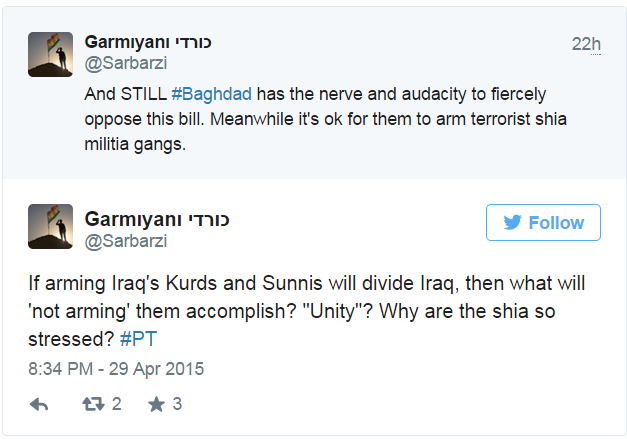
Supporters of the Peshmerga took to twitter to complain about the double standard:

garmiyani-tweet

In the United States, the Obama Administration finds itself on the same side of the argument as Moqtada Al-Sadr, opposing the bill to permit arms for Kurdish forces. As State Department Spokeswoman Marie Harf confirmed yesterday:

QUESTION: Yes. Do you have any comment about this draft resolution at the Armed Services Committee that calls for the recognition of the Sunni fighters and the Kurdish Peshmerga forces as a country, and so they can be – directly receive aid and weapons from the U.S., not through the central government?

MS HARF: I saw that. I saw that. And to be very clear: The policy of this Administration is clear and consistent in support of a unified Iraq, and that we’ve always said a unified Iraq is stronger, and it’s important to the stability of the region as well. Our military assistance and equipment deliveries, our policy remains the same there as well, that all arms transfers must be coordinated via the sovereign central government of Iraq. We believe this policy is the most effective way to support the coalition’s efforts.

So we look forward to working with congress on language that we could support on this important issue, but the draft bill, as you noted, in the House – this is very early in the process here for the NDAA – as currently written on this issue, of course, does not reflect Administration policy.

By opposing the direct arming of Sunni and Kurdish forces (and the Kurdish forces in particular), the administration is continuing a policy arc in the region that continues to serve the interests of the Iranians because it creates a dynamic where the only viable players are either Sunni jihadists (whether Islamic State, or in the case of Syria, Al Qaeda-linked groups such as Jabhat al-Nusra), or Iranian-backed forces, such as Assad and the Shia militias operating in Iraq, who are no less committed enemies of the United States.  Bringing supplies directly to Kurdish forces will give the United States a third option to positively affect the outcome of events in Iraq without requiring the modus vivendi with the Iranians.

The U.S. Is Providing Air Cover for Ethnic Cleansing in Iraq

March 29, 2015

The U.S. Is Providing Air Cover for Ethnic Cleansing in Iraq, Foreign Policy MagazineMichael Weiss, Michael Pregent, March 28, 2015

(Don’t worry! Be Happy! Obama is in charge so everything will come up roses for sure.

Just ask Obama, the all-wise, all-knowing. He will set it right, as soon as Iran uses the nukes she deserves. — DM)

464763530_iraq2michaelweiss

American warplanes have begun bombing the Islamic State-held Iraqi city of Tikrit in order to bail out the embattled, stalled ground campaign launched by Baghdad and Tehran two weeks ago. This operation, billed as “revenge” for the Islamic State (IS) massacre of 1,700 Shiite soldiers at Camp Speicher last June, was launched without any consultation with Washington and was meant to be over by now, three weeks after much triumphalism by the Iraqi government about how swiftly the terrorist redoubt in Saddam Hussein’s hometown was going to be retaken.

U.S. officials have variously estimated that either 23,000 or 30,000 “pro-government” forces were marshaled for the job, of which only slender minority were actual Iraqi soldiers. The rest consisted of a consortium of Shiite militia groups operating under the banner of Hashd al-Shaabi, or the Population Mobilization Units (PMU), which was assembled in answer to afatwah issued by Iraq’s revered Shiite cleric Ayatollah Ali Sistani in June 2014 following ISIS’s blitzkrieg through northern Iraq. To give you a sense of the force disparity, the PMUs are said to command 120,000 fighters, whereas the Iraqi Army has only got 48,000 troops.

Against this impressive array of paramilitaries, a mere 400 to 1,000 IS fighters have managed to hold their ground in Tikrit, driving major combat operations to a halt. This is because the Islamic State is resorting to exactly the kinds of lethal insurgency tactics which al Qaeda in Iraq (its earlier incarnation) used against the more professional and better-equipped U.S. forces. BuzzFeed’s Mike Giglio has ably documented the extent to which IS has relied upon improvised explosive devices, and just how sophisticated these have been. Even skilled explosive ordnance disposal teams — many guided by Iranian specialists — are being ripped apart by what one termed the “hidden enemy” in Tikrit.

Because IS controls hundreds of square miles of terrain in Iraq, it has an unknown number of bomb manufacturing plants, and because it knows the terrain so well, it’s been able to booby-trap houses and roads. Even Shiite prayer beads left lying on the ground are thought to be rigged to explosives. One Kurdish official told Giglio that the Kurdish Peshmerga fighters alone have “defused or detonated more than 6,000 IEDs along their 650-mile front with ISIS since the war began in August.”

The toll this has taken on the militias is extraordinary. Cemetery workers in Najaf told the Washington Post that as many as 60 corpses are arriving per day. Former Defense Intelligence Agency officer Derek Harvey tweeted last week that an Iraqi Shiite source told him the number of militia war dead from the Tikrit offensive so far may be as high as 6,000. So the militias’ triumphalism, much of it no doubt manufactured by Iran’s propaganda machine, proved to be misplaced. Jeffrey White, another former DIA analyst now at the Washington Institute for Near East Policy, notes “there’s a failure of will on the part of the militias and government forces. They just didn’t have the sufficient desire and determination to take the fight forward given the casualties they’ve been sustaining.”

So now, the same Iraqi government which earlier dismissed the need for U.S. airpower had to put in an eleventh-hour request for it, lest an easy victory descend into embarrassing folly. But the past few months ought to have shown that even indirectly relying on Iranian agents to conduct a credible ground war against Sunni extremists was always a lousy idea for three reasons: those agents hate the United States and have threatened to attack its interest in Iraq; they’re guilty of IS-style atrocities themselves; and they’re lousy at fighting an entrenched jihadist insurgency.

Chairman of the Joint Chiefs Martin Dempsey told Congress on March 3: “What we are watching carefully is whether the militias — they call themselves the popular mobilization forces — whether when they recapture lost territory, whether they engage in acts of retribution and ethnic cleansing.” He needn’t watch any longer. They are engaging in exactly that.

The crimes of war

On March 10, the United Nations Office of the High Commissioner for Human Rights (OHCHR) released a comprehensive study of human rights violations committed by both IS and pro-Iraqi forces. The Islamic State, OHCHR concluded, has likely committed genocide against the Yazidis, a ethno-religious minority in Iraq, in a catalogue of war crimes and crimes against humanity that include gang-rape and sexual slavery. But OHCHR’s language is equally unambiguous in condemning the other side on the battlefield: “Throughout the summer of 2014,” the report noted, “[PMUs], other volunteers and [Shiite] militia moved from their southern heartlands towards [Islamic State]-controlled areas in central and northern Iraq. While their military campaign against the group gained ground, the militias seem to operate with total impunity, leaving a trail of death and destruction in their wake.” [Italics added.]

Sunni villages in Amerli and Suleiman Bek, in the Salah ad-Din province, have been looted or destroyed by militiamen operating on the specious assumption that all inhabitants once ruled by IS must be IS sympathizers or collaborators. Human Rights Watch has also lately discovered that the “liberation” of Amerli last October — another PMU/Iranian-led endeavor, only this one abetted by U.S. airstrikes in the early stages — was characterized by wide-scale abuses including the looting and burning of homes and business of Sunni residents of villages surrounding Amerli. The apparent aim was ethnic cleansing. Human Rights Watch concluded, from witness accounts, that “building destruction in at least 47 predominantly Sunni villages was methodical and driven by revenge and intended to alter the demographic composition of Iraq’s traditionally diverse provinces of Salah al-Din and Kirkuk.”

Sunnis weren’t the only demographic subjected to collective punishment. A 21-year-old Shiite Turkmen from the Yengija village was “burned with cigarettes and tied to a ceiling fan” by militants of Saraya Tala’a al-Khorasani, another Iran-backed militia. He told Human Rights Watch: “They kept saying, ‘You are ISIS,’ and I kept denying it. They were beating me randomly on my face, head, shoulders using water pipes and the butts of their weapons…. They went to have lunch and then came back and beat us for an hour and half. Later that night they asked me if I was Shia or Sunni. I told them I was Shia Turkoman and they ordered me to prove it by praying the Shia way…. They kept me for nine days.”

This account tracks with a mountain of social media-propagated video and photographic evidence showing that Iraq’s Shiite militias are behaving rather like the Islamic State — beheading and torturing people they assail as quislings, and then exhibiting these atrocities as a means of recruitment. More worrying, a six-month investigation by ABC News has found that U.S.-trained Iraqi Security Force personnel are also guilty of anti-Sunni pogroms, with officers from Iraq’s Special Forces shown in one video accusing an unarmed teenaged boy of being a shooter (a charge the boy denies) before opening fire on him.

Looking the other way

The Obama administration’s counterterrorism-driven policy for the Middle East, and a quietly pursued diplomatic reconciliation with Iran, has resulted in America’s diminishment of grave war crimes committed by Iran’s clients and proxies, and the problem is hardly just confined to Iraq. In Syria, for instance, the National Defense Force, a conglomerate of militias trained and equipped by Iran’s Revolutionary Guards Corps-Quds Force (IRGC) — a U.S.-designated terrorist entity — has been accused by the Syrian Network for Human Rights and the Euro-Mid Observer for Human Rights, of “[burning] at least 81 people to death, including 46 civilians; 18 children, 7 women, and 35 of the armed opposition fighters,” along with other pro-Assad forces. The State Department has offered condolences to Iran’s President Hasan Rouhani on the death of his mother; to date, it has not said a word about the immolation of these Syrians at the hands of a Quds Force-built guerrilla army.

All of which raises the question: Does the United States have a “common interest,” as Secretary of State John Kerry phrased it, with a regime in Tehran whose proxies are currently burning people alive in their houses, playing soccer with severed human heads, and ethnically cleansing and razing whole villages to the ground?

It really ought to surprise no one in the U.S. government that what amounts to an Iranian occupation of the Levant and Mesopotamia would lead to an increase in jihadist bloodletting. Dempsey has less of an excuse than most. A four-star general, he formerly commanded the First Armored Division in Baghdad, which in 2004 was the unit redirected, as it was about to go home, to fight the Shiite militias who had taken over Karbala and other southern cities, so he would have seen the precursor to the PMUs in action. Yet somehow managed to brief legislators that the Islamic Republic’s role in Iraq might yet prove “positive” — provided, that is, it didn’t lead to an uptick in sectarianism. This is like arguing that death wouldn’t be so bad if it didn’t result in being dead. It did not take much, however, for the scales to fall from Dempsey’s eyes. He took a helicopter tour of Baghdad last week and noticedthe “plethora of flags, only one of which happens to be the Iraqi flag,” The rest, he told reporters to evident dismay, belonged to Shiite militias. (He might have also added that posters of Ayatollah Ruhollah Khomeini and Ayatollah Ali Khamenei are now omnipresent in the Iraqi capital where ones of Saddam Hussein used to be.)

Everyone from Gen. David Petraeus to Kurdish intelligence chief Masrour Barzani is acknowledging the obvious: that Shiite militias pose more of a long-term threat to the stability of Iraq than does the Islamic State. Even Ayatollah Sistani has made noises lately about the rampant abuses committed by the “volunteers” he assembled through a religious edict.

While it is true that most Iraqis do not wish to live in a state of vassalage to Iran, it also true that most of the “units” in the PMUs are well-known subsidiaries of the Quds Force. “The indoctrination they’ve been getting is anti-American, Khomeinist ideology,” said Phillip Smyth, an expert on Shiite militias and author of a comprehensive survey of them put out by the Washington Institute for Near East Policy. “Sectarianism has been promoted whether we like it or not.”

According to Chris Harmer, a former U.S. Naval officer and now an analyst at the Institute for the Study of War, there really is no dressing up who the supposed “good guys” in Iraq now are. “They killed hundreds of Americans during the war,” Harmer said. “These are not ‘affiliated’ organizations — they are same guys, the same organizations. And can you find me anybody stupid enough to say that what Iran wants is a stable, unified, secular, non-sectarian Iraq?”

The enemies of our enemy are our enemy

Indeed, quite apart from having American blood on their hands and American interests furthest from their mind, Shiite militias — following Tehran’s favorite playbook — have also taken to conspiratorially blaming the United States for inventing and militarily supporting the Islamic State, while decrying any American anti-IS involvement in Iraq. Take, for instance, the Badr Corps, headed by Hadi al-Amiri, the commander of Hashd al-Shaabi, and a man infamous for “using a power drill to pierce the skulls of his adversaries,” or so the State Department found in a 2009 cable to Washington, which also alleged that al-Amiri “may have personally ordered attacks on up to 2,000 Sunnis.” (Despite this grim record, al-Amiri was invited to the Obama White House in 2011 when he was Iraq’s transportation minister.)

Lately al-Amiri taken to both boasting that Stuart Jones, the current U.S. ambassador to Iraq, personally offered him close air support, whilereprehending those Iraqis who “kiss the hands of the Americans and get nothing in return.” But when it comes to Tehran, he’s full of praise for the “unconditional” support his country has received. Now al-Amiri has found a more modest tongue. He told the Guardian’s Martin Chulov on March 26: “We did not ask for [U.S. airstrikes on Tikrit] and we have no direct contact with the Americans. From what I understand, Prime Minister Haidar al-Abadi made the request. However, we respect his decision.”

Kataeb Hezbollah may be the only Iraqi Shiite militia in Iraq to be designated a terrorist entity by the United States, but that hasn’t stopped it from driving around in Abrams tanks, Humvees, armored personnel carriers, MRAPs, and toting M4 and M16 rifles — all the accidental largesse of Uncle Sam, which has sent $1 billion in military equipment to Baghdad, but has no oversight as to which actors, foreign or domestic, ultimately receive what. An abundance of U.S. weapons hasn’t dissuaded Kataeb Hezbollah from openly inciting violence against the American-led coalition to destroy the Islamic State.

“Recently we had them accusing the United States of supplying [IS] via helicopters,” said Smyth. “Kataeb Hezbollah then came out with a bullshit article claiming that they shot down a British cargo plane carrying arms to [IS]. They also said they were going to move antiaircraft missile batteries in Anbar and north of Baghdad to counter U.S. airdrops to [IS]. Whenever they sense too much of a U.S. influence in Iraq, they start to threaten American soldiers.” Kataeb Hezbollah, it bears mentioning, is headed by Abu Mahdi al-Muhandis, an Iranian spy who is widely believed to have planned the bombings of both the U.S. and French embassies in Kuwait in the 1980s. There’s even a photograph of him holding up a Kuwaiti newspaper fingering him for this act of international terrorism. Kataeb Hezbollah has also been caught on video playing bongos with severed human heads.

Another prominent Shiite militia is Asaib Ahl al-Haq, or the League of the Righteous, which in 2007 set an ambush which killed 5 U.S. servicemen in Karbala. It, too, now also happily motors around Iraq in U.S. armored vehicles, some of them thought to have been stolen from the U.S. consulate in Basra. One unnamed U.S. official told Al Jazeera that Asaib was most recently responsible for burning down homes in Albu Ajil, a village near Tikrit in retaliation for massacres carried out by the Islamic State. It has also been implicated in the abduction and murder of Sheik Qassem Sweidan al-Janabi, one of the Sunni tribal leaders who worked cheek-by-jowl with U.S. forces in fighting al Qaeda in Iraq during the so-called Awakening period.

Remarkably, the demagogic Shiite cleric Muqtada al-Sadr, once the bane of U.S. forces in Baghdad, condemned al-Janabi’s murder — in language more severe than anything contrived by the U.S. State Department’s Marie Harf or Jennifer Psaki. “Did not I tell you that Iraq will suffer from the brazen militias?” al-Sadr was quoted as saying. “Did I tell you that the army must handle the reins?” Al-Sadr demanded that Shiite head-loppers be punished and actually backed up his rhetoric with action, suspending the participation of his own al-Salam Brigades and al-Yaom ak-Mawood military in ongoing operations. (He unsuspended these militias a week ago to help with the battle in Tikrit, but so far, because of the frozen nature of the ground campaign, none of the Sadrists have seen any real action.)

Assad’s friends in Iraq want to kill Americans

The Basij-ization of Iraq of was both inevitable, given the defunct and corrupted state of the U.S.-trained military, and Iran’s outsize influence in Baghdad even before ISIS conquered a third of the country. “When the Iraqi Army was destroyed last July, this was a gift to Iran to build up these militias,” Gen. Najim Jibouri, the former mayor and police chief of Tal Afar, a crucial Iraqi border town now held by the Islamic State, said in a recent interview. “A few days ago, Khaled al-Obaidi, Iraq’s minister of defense, went to Tikrit, but the militias wouldn’t allow him to enter. He had to stay in Samarra.”

All of which makes risible U.S. officials’ continued emphasis that there is no direct American coordination with Iran or its proxies. Gen. James Terry, the U.S. commander of the coalition, claims that the “ongoing Iraqi and coalition air strikes are setting the conditions for offensive action to be conducted by Iraqi forces currently surrounding Tikrit. Iraqi security forces supported by the coalition will continue to gain territory.”

One of the authors personally witnessed in Baghdad how the IRGC targets make their way into the U.S. targeting queue. Shiite militia commanders pass Quds Force-selected targets to Badr-affiliated Iraqi Security Force commanders on the ground (many of whom are, in fact, agents of the militias), who then pass them on as legitimate targets to Iraq’s Defense Ministry representatives in the Joint Operations Centers where U.S. advisors then put those targets into a queue for aerial sorties. This is the pattern of target development that U.S. forces tried to stop during the American occupation of Iraq — when there was actually a military strategy for countering Iranian influence in the country.

But this nefarious chain of putting intelligence into action — and making the United States do the dirty work — has been resurrected. Soleimani knows it, al-Muhandis knows it, al-Amiri and his Badr agents in the Iraq Security Forces know it — so, too, should the Pentagon, whatever claims to the contrary it puts out. Iranian intelligence operatives are now America’s eyes on the ground.

What does this mean for Tikrit? The Islamic State will no doubt be flushed from the city or bombed to death eventually, but it will be a tactical loss for IS, not a strategic one. They’ll still have Mosul and most of Anbar province. The Institute for the Study of War’s Chris Harmer notes that this will have a direct bearing on bigger fights ahead. “These militiamen will say, ‘This is how badly we got beat up in Tikrit, who wants to volunteer to storm that castle in Mosul?’”

Even if Iran’s proxies do end up massing on Mosul, they’ll remain the ultimate occupying force in post-Islamic State Tikrit. The Washington Post’s Loveday Morris tweeted on March 26 that Kataeb Hezbollah and Asaib Ahl al-Haq have now “suspended” their operations in the city, no doubt out of a desire to not appear to be coordinating with the hated United States. But once the Pentagon declares victory, the militias will no doubt try to hijack it and move right in to serve as the occupying force in Tikrit.

Despite reports on Thursday that three Shiite militias were “withdrawing” from operations in objection to U.S. airstrikes, now the news has come that they’ve called off their boycott, largely owing to another edict by Ayatollah Sistani. Even an alleged accidental hit by U.S. warplanes on Asaib Ahl al-Haq barely raised that militia’s pique, according to the New York Times. A Badr Corps representative also told the newspaper, “We haven’t retreated from our positions near Tikrit.” Still, others have indicated that they’re not going to let a good turn go unpunished and intend to strike at American soldiers in Iraq.

Akram al-Kabi, the leader of the Al Nujabaa Brigade, which has also fought with the Assad regime in Syria, has said: “We are staying in Tikrit, we are not leaving and we are going to target the American led coalition in Tikrit and their creation, ISIS.” Today, one of al-Kabi’s spokesmen reiterated thatthreat. Al-Kabi was once a deputy in Asaib Ahl al-Haq and was associatedwith that militia’s attacks against U.S. and British troops in 2008-2011, including an incident in which British contractors were abducted from the Iraqi Finance Ministry and later murdered. CENTCOM commander Gen. Lloyd Austin’s nevertheless briefed the Senate on Thursday with a straight face that “[c]urrently, there are no [Shiite] militia and as reported by the Iraqis today, no [PMU] in that area as well.” This is either propaganda or sheer ignorance about what is transpiring in Austin’s theatre of operations. The Guardian’s Chulov, who just returned from Tikrit, confirmed to one of the authors, in fact, that both al-Amiri and al-Muhandis were indeed in the center of the city on March 26.

Recrimination and resentment by these militias is no light matter. According to Politico, U.S. military planners are now worried that any decision to engage or isolate the Assad regime in Syria will encourage Iran or its cut-outs to attack the some 3,000 U.S. military trainers currently stationed in Iraq. It’s hard to tell where genuine concern bleeds into further excuse-making on the part of an Obama administration that has shown no intention of engaging or isolating the Assad regime, which is responsible for the vast majority of war dead and war crimes in Syria. Regardless, the result is the same: Washington is now behaving as if it needs Tehran’s permission to pursue its own anti-IS strategy, if it can even be called that.

You call this a plan?

“What strategy?” asks Chris Harmer. “We have only consequentially intervened in one part in Syria — Kobani. What’s the plan for countering [the Islamic State] there? Training 5,000 Syrian rebels per year. That is laughable when you consider the 200,000 dead from four years of attritional warfare, the four million refugees, and slow-motion destruction of the country. Five thousand doesn’t even get you into the ballgame. You have to have a significant portion of the population on your side. Moderate Syrians should be on our side. They’re saying the Americans are unreliable, they’re not on our side. This is why the moderate opposition has collapsed and the beneficiaries of that collapse have been al Qaeda, the Islamic State and Assad.”

The loss of confidence in the United States by moderate Sunnis in Syria is mirrored in Iraq. New polling data has confirmed that most Mosulawis, for instance, welcomed IS back into Iraq’s second city not out of ideological sympathy for the terror group, but out of deep-seated political grievances with the Iraqi government. Yet the Obama administration is doing next to nothing to redress these grievances. The Anbar tribal leader Sheikh Ahmed Abu Risha, whose charismatic brother was notoriously gunned down by al Qaeda just days after meeting with President George W. Bush in Baghdad in 2007, simply could not get a meeting with any significant official in White House during a 10-day tour of Washington last February. Vice President Joe Biden was good enough to drop in on a lesser confab, mainly to smile and pat them on the head and tell them to work constructively with the new government of Prime Minister Haider al-Abadi.

“Many of the people in Mosul will stand with [the Islamic State] if Shiite militias invade,” said Gen. Najim Jibouri. “Eighty percent of the population is does not like [IS], but if the militias are involved — 80 percent will stand very strong with [IS]. I told the Americans before, the image now is not like it was in 2003. Now the Sunni people want American forces. They will throw the flowers on them now, because the battle now is not between them and the United States and [IS], it’s between the Sunnis and Iran.” Yet far too many Sunnis still see the United States as aligned with Iran against them, Jibouri said.

Whether or not a nuclear agreement with Iran gets signed in Lausanne this weekend, whether or not Obama inaugurates a perestroika with Tehran as a result, the unshakable truth is that most of Iraq looks in the long term to remain a satrapy of the mullahs. This will only lead to further sectarian violence and civil war. “I met with almost two dozen national leaders in Iraq last week,” Ali Khedery, the longest consecutively serving U.S. diplomat in the Green Zone, told us. “I heard from Sunni, Shiite, Kurdish officials and virtually all of them told me that the real prime minster of the country is Qasem Soleimani and his deputy is Abu Mahdi al-Muhandis.”

The Kobani Precedent

March 25, 2015

The Kobani Precedent, [Bary] Rubin Center, March 25, 2015

(Whose side are “we” on in Iraq? Not the Kurds. Why not? Do “we” prefer an Iranian theocracy with nukes?– DM)

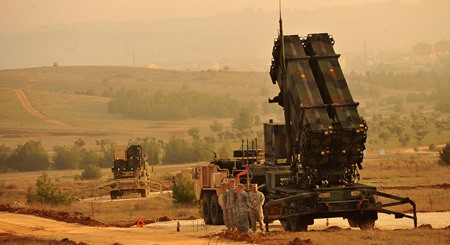
???????????????????U.S. Service members stand by a Patriot missile battery in Gaziantep, Turkey, Feb. 4, 2013, during a visit from U.S. Deputy Secretary of Defense Ashton B. Carter, not shown. U.S. and NATO Patriot missile batteries and personnel deployed to Turkey in support of NATO’s commitment to defending Turkey’s security during a period of regional instability. (DoD photo by Glenn Fawcett)

Unlike in Syria . . . in Iraq the US relates to the official government, mistakenly, as an ally.  This is leading to a potentially disastrous situation  whereby US air power is currently partnering with Iran-supported Shia militias against the Islamic State.

The most powerful of these militias have a presence in the government of Iraq. But they do not act under the orders of the elected Baghdad government, but rather in coordination with their sponsors in the Qods Force of the Iranian Revolutionary Guards Corps.

The Kurds, because of the existence among them of a secular, pro-western nationalist politics with real popular appeal, have unsurprisingly emerged as the only reliable partner.    On both the Shia and the Sunni sides, the strongest and prevailing forces are anti-western.

This reality is denied both by advocates for rapprochement with Iran, and by wishful-thinking supporters of the Syrian rebellion.  But it remains so.

*****************

Recently,  I attempted to undertake a reporting trip into the Kurdish Kobani enclave in northern Syria.  It would not have been my first visit, neither to Syria nor to Kobani.  For the first time, however, I found myself unable to enter.  Instead, I spent a frustrating but, as it turns out, instructive four days waiting in the border town of Suruc in south-east Turkey before running out of time and going home.

The episode was instructive because of what it indicated regarding the extent to which Kurdish control in the enclaves established in mid 2012 is now a fact acknowledged by all neighboring players, including the enemies of the Kurds.  This in itself has larger lessons regarding US and western policy in Syria and Iraq.

But I am getting ahead of myself.  First, let me complete the account of the episode on the border.    My intention had been to enter Kobani ‘illegally’ with the help of the Kurdish YPG and local smugglers.  This sounds more exciting than it is.    I have entered Syria in a similar way half a dozen times over the last two years, to the extent that it has become a not very pleasant but mundane procedure. This time, however, something was different.  I was placed in a local center with a number of other westerners waiting to make the trip. Then, it seemed, we were forgotten.

The westerners themselves were  an interesting bunch, whose varied presence was an indication of the curious pattern by which the Syrian Kurdish cause has entered public awareness in the west.

There was a group of European radical leftists, mainly Italians, who had come after being inspired by stories of the ‘Rojava revolution.’  A little noted element of the control by the Syrian franchise of the PKK of de facto sovereign areas of Syria has been the interest that this has generated in the circles of the western radical left.  These circles are ever on the lookout for something which allows their politics to encounter reality, in a way that does not bring immediate and obvious disaster.  As of now, ‘Rojava,’ given the leftist credentials of the PKK, is playing this role.  So the Europeans in question  wanted to ‘contribute’ to what they called the ‘revolution.’

Unfortunately, their preferred mode of support was leading to a situation of complete mutual bewilderment between themselves and the local Kurds.   Offered military training by their hosts, the radical leftists demurred.  They would not hold a gun for Rojava before they had seen it and been persuaded that it did indeed represent the peoples’ revolution that they hoped for.

Instead, they had a plan for the rebuilding of Kobani along sustainable and environmentally friendly lines, using natural materials  In addition, the health crisis and shortage of medicines in the devastated enclave led the radicals to believe that this might offer an appropriate context for popularizing various items of alternative and naturopathic medicine about which they themselves were enthusiastic.  (I’m not making any of this up).

All this had elicited the predictable reaction from the Kurds, who were trying to manage a humanitarian disaster and a determined attempt by murderous jihadis to destroy  them.  ‘Perhaps you could do the military training first and then we could talk about the other stuff?’ suggested Fawzia, the nice and helpful representative of the PYD who was responsible for us.  This led to further impassioned and theatrical responses from the Italians.

Apart from this crowd, there was a seasoned Chilean war reporter who looked on the leftists with impatience.  He was looking to get down to the frontlines south of Kobani, where the YPG was trying to cut the road from Raqqa to Aleppo at an important point close to the Euphrates.

Also, there was a polite and friendly lone American, a Baptist Christian, who had come to volunteer his services to the YPG.  That was us.

But as the days passed, it became clear that none of us appeared to be getting anywhere near Kobani any time soon.

The reasons given for the delay were plentiful, and unconvincing.  ‘It is the weather,’ Fawzia would say vaguely, ‘too much mud.’  But the presence of mud on the border in February was hardly a new development, so this couldn’t be the reason.

Finally, frustrated at the lack of information, I called a PKK friend based in Europe and asked for his help in finding out why we weren’t  moving.  He got back to me a little later.  ‘It seems the Turkish army is all over the border, more than usual. That’s the reason,’ he told me.

This was more plausible, if disappointing.  After four days on the border, I was out of time and set off back for Gaziantep and then home.  The Italians went to Diyarbakir to take part in a demonstration.  The Chilean and the American volunteer stayed and waited.

When I got back to Jerusalem, all rapidly became clear.  News reports were coming in about a large operation conducted by the Turkish army through Kobani and into Syria.  The operation involved the evacuation of the Turkish garrison at the tomb of Suleiman Shah, south of the enclave.  The American volunteer sent me a picture of the Turkish tanks on tank transporters driving though Suruc at the conclusion of the operation.

This operation was astonishing on a number of levels.

Despite stern Turkish denials, it could only have been carried out on the basis of full cooperation between the Turkish armed forces and the Kurdish fighters of the YPG in Kobani.  Obviously, any unauthorized entry of Turkish troops into the Kurdish canton would have meant an armed battle.

During the fight for Kobani last year, the Turkish government was very clearly quite content for the enclave to fall.  The Turkish army waited on the border, as the prospect of a generalized slaughter of the Kurds in Kobani came close to realization.

But of course, the slaughter didn’t happen.  In the end, the partnering of US air power with the competent and determined forces of the YPG on the ground delivered the first real defeat to the forces of the Islamic State in Syria.

This effective partnering has continued, and has now become the main military element in northern Syria in the battle against IS.

The combination of the YPG and the USAF is now nudging up to a second strategic achievement against the jihadis – namely, the cutting of the road from Tel Hamis to the town of al-Houl on the Iraqi border.   This road forms one of the main transport arteries linking the Islamic State’s conquests in Iraq to its heartland in the Syrian province of Raqqa.  If the links are cut, the prospect opens for the splitting of the Islamic State into a series of dis-connected enclaves.

The YPG-US partnership is particularly noteworthy, given that the YPG is neither more nor less than the Syrian representative of the PKK.  The latter, meanwhile, is a veteran presence on the US and EU lists of terror organizations.  Despite a faltering peace process, the PKK remains in conflict with Turkey, a member of NATO.

But the reality of the Kurdish-US alliance in northern Syria has clearly now been accepted by the Turks as an unarguable fait accompli, to the extent that they are now evidently willing to work together with the armed Syrian Kurds, where their interests require it.

It is an astonishing turnabout in the fortunes of the Kurds of Syria, who before 2011 constituted one of the region’s most brutally oppressed, and most forgotten minority populations.

This raises the question as to why this reversal of fortune has taken place.

Why is the YPG the chosen partner of the Americans in northern Syria, just as the Kurdish Pesh Merga further east is one of the preferred partners on the ground in Iraq?

The answer to this is clear, but not encouraging.  It is because in both countries, the only reliable, pro-western and militarily effective element on the ground is that of the Kurds.

Consider:  in northern Syria, other than the forces of the Islamic State, there are three other elements of real military and political import.  These are the forces of the Assad regime, the al-Qaeda affiliated Jabhat al-Nusra and the YPG.

In addition, there are a bewildering variety of disparate rebel battalions, with loyalties ranging from Salafi Islamism to Muslim Brotherhood style Islamism, to non-political opposition to the Assad regime.  Some of these groups operate independently.  Others are gathered in local alliances such as the Aleppo based Jabhat al-Shamiya (Levant Front), or the Syria-wide Islamic Front, which unites Salafi factions.

Despite the reported existence of a US staffed military operations room in Turkey, the latter two movements are either too weak, or too politically suspect (because of their Islamist nature), to form a potential partner for the US in northern Syria.

Nusra is for obvious reasons not a potential partner for the US in the fight against the Islamic State.  And the US continues to hold to its stated  goal that Bashar Assad should step down.  So the prospect of an overt alliance between the regime and the US against the Islamic State is not on the cards (despite the de facto American alliance with Assad’s  Iran-supported Shia Islamist allies in Iraq).

This leaves the Kurds, and only the Kurds, to work with.  And the un-stated alliance is sufficiently tight for it to begin to have effects also on Turkish-Kurdish relations in Syria, as seen in the Suleiman Shah operation.

But what are the broader implications of this absence of any other coherent partner on the ground?

The stark clarity of the northern Syria situation is replicated in all essentials in Iraq, though a more determined attempt by the US to deny this reality is under way in that country.

In Iraq, there is a clear and stated enemy of the US (the Islamic State), a clear and stated Kurdish ally of the west (the Kurdish Regional Government and its Pesh Merga) and an Iran-supported government which controls the capital and part of the territory of the country.

Unlike in Syria, however, in Iraq the US relates to the official government, mistakenly, as an ally.  This is leading to a potentially disastrous situation  whereby US air power is currently partnering with Iran-supported Shia militias against the Islamic State.

The most powerful of these militias have a presence in the government of Iraq. But they do not act under the orders of the elected Baghdad government, but rather in coordination with their sponsors in the Qods Force of the Iranian Revolutionary Guards Corps.

It is possible that the current partnering with Shia Islamist forces in Iraq is the result of a general US attempt now under way to achieve a historic rapprochement with Iran, as suggested by Michael Doran in a recent essay.  Or it may be that this reality has emerged as a result of poor analysis of the realities of the Levant and Iraq, resulting in a confused and flailing policy.  But either way, the result is an astonishing mess.

In northern Syria, the obvious absence of any partners other than the Kurds has produced a momentary tactical clarity.  But as the larger example of Iraq shows, this clarity is buried in a much larger strategic confusion.

This confusion, at root, derives from a failure to grasp what is taking place in Syria and in Iraq.

In both countries, the removal or weakening of powerful dictatorships has resulted in the emergence of conflict based on older, sub-state ethnic and sectarian identities.  The strength and persistence of these identities is testimony to the profound failure of the states of Syria and Iraq to develop anything resembling a sustainable national identity.  In both Syria and Iraq, the resultant conflict is essentially three-sided.  Sunni Arabs, Shia/Alawi Arabs and Kurds are fighting over the ruins of the state.

Because of the lamentable nature of Arab politics at the present time, the form that both Arab sides are taking is that of political Islam.   On the Shia side, the powerful Iranian structures dedicated to the creation and sponsorship of proxy movements are closely engaged with the clients in both countries (and in neighboring Lebanon.)

On the Sunni Arab side, a bewildering tangle of support from different regional and western states to various militias has emerged.  But two main formations may be discerned. These are the Islamic State, which has no overt state sponsor, and Jabhat al-Nusra, which has close links to Qatar.

In southern Syria, a western attempt to maintain armed forces linked to conservative and western-aligned Arab states (Jordan, Saudi Arabia) has proved somewhat more successful because of the close physical proximity of Jordan and the differing tribal and clan structures in this area when compared with the north.  Even here, however, Nusra is a powerful presence, and Islamic State itself recently appeared in the south Damascus area.

The Kurds, because of the existence among them of a secular, pro-western nationalist politics with real popular appeal, have unsurprisingly emerged as the only reliable partner.    On both the Shia and the Sunni sides, the strongest and prevailing forces are anti-western.

This reality is denied  both by advocates for rapprochement with Iran, and by wishful-thinking supporters of the Syrian rebellion.  But it remains so.  What are its implications for western policy?

Firstly, if the goal is to degrade the Islamic State, reduce it, split it, impoverish it, this can probably be achieved through the alliance of US air power and Kurdish ground forces.  But if the desire, genuinely, is to destroy the Islamic State, this can only be achieved through the employment of western boots on the ground.  This is the choice which is presented by reality.

Secondly, the desire to avoid this choice is leading to the disastrous partnering with Iraqi Shia forces loyal to Iran.  The winner from all this will be, unsurprisingly,  Iran. Neither Teheran nor its Shia militias are the moral superiors to Islamic State. The partnering with them is absurd both from a political and an ethical point of view.

Thirdly, the determination to maintain the territorial integrity of ‘Syria’ and ‘Iraq’ is one of the midwives of the current confusion.  Were it to be acknowledged that Humpty cannot be put back together again, it would then be possible to accurately ascertain which local players the west can partner with, and which it can not.

As of now, the determination to consider these areas as coherent states is leading to absurdities including the failure by the US to directly arm the pro-US Pesh Merga because the pro-Iranians in Baghdad object to this, the failure to revive relations with and directly supply Iraqi Sunni tribal elements in IS controlled areas for the same reason,  and the insistence on relating to all forces ostensibly acting on behalf of Baghdad as legitimate.

Ultimately, the mess in the former Syria and Iraq derives from a very western form of wishful thinking that is common to various sides of the debate in the west.  This is the refusal to accept that political Islam, of both Shia and Sunni varieties, has an unparalleled power of political mobilization among Arab populations in the Middle East at the present time, and that political Islam is a genuinely anti-western force, with genuinely murderous intentions.

For as long as that stark reality is denied, western policy will resemble our Italian leftist friends on the border, baffled and bewildered as they go about proposing ideas and notions utterly alien to and irrelevant to the local situation.

The reality of this situation means that the available partners for the west are minority nationalist projects  such as that of the Kurds (or the Jews,) and traditional, non-ideological conservative elites – such as the Egyptian military, the Hashemite monarchs, and in a more partial and problematic way, the Gulf monarchs.  Attempts to move beyond this limited but considerable array of potential allies will result in the strengthening of destructive, anti-western Islamist forces in the region, of either Sunni or Shia coloration.

As for the Syrian Kurds, they deserve their partnership with US air power, and the greater security it is bringing them.

The American Baptist volunteer, to conclude the story, made it across the border and is now training with the YPG.  He, at least, has a clear sense of who is who in the Middle East.  Hopefully, this sense will eventually percolate up to the policymaking community too.
Humor: Senseless, violent, random “extremism” is not Islamic

February 14, 2015

Senseless, violent, random “extremism” is not Islamic, Dan Miller’s Blog, Sen. Ima Librul, February 14, 2015

(The views expressed in this article are mine and those of my (imaginary) guest author. They do not necessarily represent the views of Warsclerotic or any other editor. — DM)

Editor’s note: This is a post by my (imaginary) guest author, the Very Honorable Ima Librul, Senator from the great State of Confusion Utopia. He is a founding member of CCCEB (Climate Change Causes Everything Bad), a charter member of President Obama’s Go For it Team, a senior member of the Senate Foreign Relations Committee and Chairman of the Meretricious Relations Subcommittee. 

Senator Librul is also justly proud of his expertise in interfaith dialogue, on the basis of which he has explained to the entire world that Islam is the religion of peace, grossly distorted by the non-Islamic Islamic State and other textual deviants. He was recently awarded the Obama Foundation’s cherished award for exemplary political correctness on the basis of his interfaith outreach. We are humiliated honored to have a post of this caliber by a quintessential Librul such as the Senator. Without further delay, here is the Senator’s article.

**********************

Almost no perpetrators of senseless, random, violent extremism are Muslims. Obama’s war on violent, random and senseless non-Islamic extremism will end the cycle of violence. Soon, all will come to trust and love us.

Here are just a few videos of non-Muslims engaged in extreme and senseless random violence.

The woman who was attacked was in the wrong place at the wrong time. She has only herself to blame and should have known better.

Like the senseless random attacks on Charlie Hedbo and a grocery store in France, this was also the fault of the alleged victim.

Even our best friends can do it.

Finally, here’s absolute proof of my analysis;

Whoops. Wrong video, but there is no proof that these folks were in any way motivated to engage in senseless, extremist and random violence by the religion of peace. Nobody is, and there is not one single word in the Holy Koran, other Muslim Holy texts or in Sharia law that so much as tolerates senseless, random extremist violence!

Besides, others do it too. Obama is absolutely right in not supporting savages like these bloodthirsty cowards in their efforts to murder innocent adherents to the religion of peace!

Senator Ted Cruz is wrong to claim that any senseless random violent extremism is Islamic.

***************

Editor’s comments:

Senator Librul is correct in stating that Islam does not promote senseless, random violence. However, he fails to explain why: Islamic violence is almost always directed against those viewed as enemies of Islam. It is therefore purposeful, not senseless. Nor, for the same reason, is it “random.” And, as I contend here, it is not “extremist.”

Here is a suggestion from one of Senator Librul’s many devoted followers:

As soon as we remove all deer crossing signs directing deer to dangerous places for highway crossings they will find safe places to cross instead. On a parallel theory, as we cease to attribute senseless, random “extremist” violence to Islam, there will be no violence of that type of which we can properly accuse Muslims.

As is his wont, Senator Librul hit the hammer on the head with the nail. The Center for American Progress most likely agrees. Although People for the Ethical Treatment of Animals (PETA) may disagree, Obama’s pup Bo has graciously offered to help.

Obama with Bo

Soon Bo, with Obama leading bravely as always from behind, will end senseless non-Islamic random violence. Then, the world will be a safer and better place in which we will all enjoy peace and happiness in our time. Right?

End random, senseless “extremist” Islamic violence? What’s that? Obama and Senator Librul deem there to be none and they are probably correct. So what’s the rush?

The infinitely wise Dear Leader of North Korea, Kim Chi-un, has proclaimed, “let us turn ours into a country of mushrooms!” “Our very own” infinitely wise Dear Leader Obama is doing His best to beat him to it.

North-Korea mushrooms

Obama’s task of mushrooming* will be easier, and not only because He has no doppelganger to pester Him. Of greatest importance, He already has a tremendous head start.

*To keep in the dark and feed a rich diet of manure.

Yazidis ask Israel for help

January 29, 2015

Yazidis ask Israel for help, Al-MonitorJacky Hugi, January 28, 2015

A man from the minority Yazidi sect stands guard at Mount Sinjar, in the town of SinjarA man from the minority Yazidi sect stands guard at Mount Sinjar, in the town of Sinjar, Dec. 20, 2014. (photo by REUTERS/Ari Jalal)

[I]t is an unusual overture of friendship for the government of Prime Minister Benjamin   Netanyahu, and it will be interesting to see if and how Israel takes up the gauntlet. Given the sensitivity of the matter, it is quite uncertain whether anyone will hear about it.

******************

“They have already killed many of us. What do we have to fear?” Lt. Col. Lukman Ibrahim responded when I asked him if he was afraid to openly communicate with an Israeli in a recent long-distance phone conversation from Tel Aviv to Sinjar, in northwestern Iraq, near the Syrian border. Ibrahim, a Yazidi militia officer, is hoping to obtain military aid from the State of Israel.

“The Arab countries do not recognize us, nor do they recognize you,” he said. “They are telling us that we are infidels. Why should we be afraid to talk to you, when even neighboring Arab countries have become our enemies? We regard you as a friendly state, with an opportunity for relations on the basis of neutrality and respect. We do not want more than that.”

Ibrahim, a journalist by profession, serves as an assistant to Marwan Elias Badl, one of the senior field commanders of the Sinjar Protection Forces, the Yazidi militia established ad hoc in August 2014 to halt the Islamic State (IS) onslaught against Yazidi population centers west of Mosul. The militia numbers some 12,000 fighters, most of them untrained, ordinary men who rushed to take up arms to thwart IS’ designs. A few of them are rank-and-file fighters, while some are officers with the Kurdish peshmerga. According to internal estimates, the IS militants killed thousands in their pogrom against the Yazidis. About 5,000 Yazidis are still being held by IS.

The Yazidis have no formal relations with Israel, nor an organized leadership. Yet they need aid, in particular military assistance, and they have chosen to make a public plea for help. “We appeal to the Israeli government and its leader to step in and help this nation, which loves the Jewish people,” said Ibrahim. “We would be most grateful for the establishment of military ties — for instance, the training of fighters and the formation of joint teams. We are well aware of the circumstances the Israelis are in, and of the suffering they have endured at the hands of the Arabs ever since the establishment of their state. We, too, are suffering on account of them.”

When asked what kind of weapons they needed, Ibrahim cited protective measures. “We are not acting against anyone,” he clarified. “And we do not covet other people’s land. We just want to protect ourselves. For example, [we need] armored [Humvees], machine guns and light weapons.”

Contact with Israel is a dirty business in this neighborhood, military contact all the more so. Be that as it may, in a reality where all levees have been breached and the worst appears to have already befallen the Yazidis, what could they possibly lose by seeking a rapport with Jerusalem?

The conversation with Ibrahim was not the only call with Sinjar. Majdal Rasho, a native of Sinjar, had settled in Germany and built his life there. He married and had a family, making a living as a manufacturing supervisor at a chocolate plant. In his spare time, he served as a photographer for TV stations broadcasting in the Kurdish language. He returned to Sinjar as a fighter, but also in his capacity as a video photographer for German TV networks.

“What I have seen here, I just can’t describe,” he said by phone from a battle zone. “Our people had no choice but to flee. We are not Arabs, nor are we Muslims. We see ourselves as sharing a fate with the Israelis, who went through similar pogroms. Those besieged on the mountain approached me and asked, ‘Maybe our Israeli brethren could lend a hand?’”

Yazidism is a religion with no more than a million followers. Its adherents are centered around Mosul and the Sinjar mountain range, in northern Iraq. Their largest diaspora in the West is in Germany, estimated to number some 100,000.

A common destiny with the Jews is a recurring theme in the Yazidis’ discourse. “What happened to us is the biggest genocide since the Holocaust of the Jews in Europe,” said Dr. Mirza Dinnay, a pediatrician based in Germany. “In the Holocaust, the goal was to annihilate an entire people, the Jews. IS has a similar plan — to exterminate an entire people, the Yazidis. No such extermination process had taken place in the past 500 years, with the exception of the Holocaust and what came to pass in Sinjar.”

Dinnay left Germany for Sinjar at the outbreak of the pogrom, leading a delegation of human rights activists. During one of the aid flights arranged by the Iraqi air force, a helicopter carrying food supplies and medication to the besieged Yazidis crashed. Some of the passengers aboard, among them Dinnay, were injured.

The communication between the Yazidis and the Israeli media has been coordinated by Idan Barir, 34, a researcher at the Tel Aviv University Yavetz School of Historical Studies. In the months since IS’ offensive against Yazidi population centers, Barir has become Israel’s top expert on the Yazidis, thanks to his extensive connections with members of the Yazidi community.

“I can think of a range of activities that Israel is experienced in that would not undermine the world order,” Barir told Al-Monitor. “For example, providing military assistance to the Yazidi forces in Sinjar who are crying out for cooperation and aid; setting up a field hospital for medical and psychological treatment of the casualties among the displaced in northern Iraq — not only Yazidis, by the way; sending humanitarian aid to displaced Yazidis in the refugee camps in Iraqi Kurdistan; absorption of a symbolic number of displaced Yazidis in Israel, with preference given to humanitarian, whether medical or mental, cases; incorporation of young Yazidis into military service in Israel; and support of civil initiatives aimed at strengthening and deepening ties between Israelis and Yazidis. It all depends on the decision made by the Israeli government, on its determination and goodwill.”

So far, Israel has not officially responded to such calls, which have yet to be fully formulated and have only recently began over the last few days. In fact, no formal request has come from the Yazidis for asylum as refugees. Barir is currently trying to find a way to reach decision-makers in Israel to pass on the messages from his faraway friends. Without a doubt, it is an unusual overture of friendship for the government of Prime Minister Benjamin Netanyahu, and it will be interesting to see if and how Israel takes up the gauntlet. Given the sensitivity of the matter, it is quite uncertain whether anyone will hear about it.

“It is a moral obligation to ring every bell and to do everything possible to stop the Yazidi tragedy,” said Attorney Zvi Hauser, the former Cabinet secretary in the most recent Netanyahu government (2009-13). “It is inconceivable that in the 21st century, someone’s attempt to eliminate an entire people, because of its faith and religion, is met with indifference.”

Hauser is the first senior figure in Israel who agreed to comment on the Yazidis’ call for help. As a private person, he refrained from reference to the Yazidis’ request for military aid, taking care to say nothing that might be interpreted as a promise. He believes, however, that Israel should favorably consider the Yazidis’ calls.

“The Yazidi narrative is evocative of ours. We, too, went through 2,000 years of existence without sovereignty, in the course of which we faced extermination schemes,” Hauser said. “Israel is a sovereign state, formed by an ethnic minority. It is the national manifestation of an ancient civilization. It would thus be appropriate to examine ways to establish relations and forge an alliance with them, if only to ensure a pluralistic Middle East. This issue has a universal aspect, as well. The development of human civilization is contingent on the diversity and multiplicity of [ethnic] groups and nations. Hence, the extinction of one of these would hurt not only the Yazidis, but also the entire fabric of human life.”


Kurdish Land-Grab Stuns Baghdad

January 27, 2015

Kurdish Land-Grab Stuns Baghdad, Newsweek and , January 27, 2015

peshmergaKurdish Peshmerga fighters keep watch during the battle with Islamic State militants on the outskirts of Mosul January 21, 2015. AZAD LASHKARI/REUTERS

A senior Kurdish federal official, who declined to be named, said that Peshmerga forces would never hand back areas captured after Isis’s march across northern Iraq, which brought the group to within miles of the semi-autonomous Kurdish region.

While the threat of Isis remains significant, Kurds may have to put their independence dreams on hold and the Iraqi government will worry about Kurdish territorial claims later. As the terror group continues to grow, both parties need each other and the radical Islamist threat will bind them together, at least for now.

******************

Kurdish forces launched a barrage of Grad missiles against Islamic State (Isis) positions inside Mosul last week, for the first time since Isis overran Iraq’s second-largest city in June last year, marking a dramatic shift in the Kurds’ battle against the terrorist group.

The bombardment was preceded by a large-scale Kurdish operation against Isis in northern Iraq, which saw 5,000 Kurdish fighters, supported by US-led coalition airstrikes, sweep around Mosul to recapture an area larger than the size of Andorra, Liechtenstein and San Marino combined.

In the offensive, Kurdish Peshmerga fighters killed over 200 Isis militants, ousting the group from almost 300 square miles of territory, capturing a number of areas contested with Baghdad. As they advanced, encircling Mosul on three sides and cutting vital Isis supply lines to the nearby towns of Tal Afar and Sinjar, the Kurdish forces began a counter-offensive that analysts worry may be the start of a territory war between the Kurdish capital, Erbil, and Baghdad.

The Kurdish forces captured Makhmour, to the east of the city; the towns of Zimar and Wannah, and several Arab villages located in the Sinjar Mountains, west of Mosul; and the area around Mosul Dam, in what amounts to a Kurdish land-grab backed by Western airstrikes.

Iraqi Kurds believe that the recaptured territory around the city is rightfully theirs while the Iraqi government “fears that the Kurds will use territory as leverage during political negotiations”, according to Ranj Alaaldin, a visiting scholar at Columbia University.

A senior Kurdish federal official, who declined to be named, said that Peshmerga forces would never hand back areas captured after Isis’s march across northern Iraq, which brought the group to within miles of the semi-autonomous Kurdish region. “All the current military operations that involve the Peshmerga are implemented in coordination with the international military coalition and the central government is aware of it, but, in the Kurdish areas, we will never ever let Arabs control them again,” the official warned. “We are not ready to fight, terrify our fighters’ souls to liberate these areas and hand them to a traitor who would sell it to the killers. We will not allow this scenario to take place again in these areas.”

While the Kurds argue that they have taken control of this territory to defend against Isis, many Iraqis believe that the Kurds will never give up what they have captured because of their ambitions for an independent state.

“In the chaos that followed the Isis assault on Iraq in June, the Iraqi army melted away from its positions throughout northeastern and northwestern Iraq and the Peshmerga swiftly moved in to take their place – taking control of the whole of Kirkuk,” she said.

Despite these aspirations, Iraqi officials seem content to let Kurdish forces claim the territory from Daesh (as Isis is also known), for now. “As long as we are not ready to move as far as to fight in Mosul, it would be better to let them (Kurds) re-control these areas rather than leave it at the hands of Daesh,” a senior Iraqi military officer said. “Now, we will not raise any political disputes. Let [the Kurds] drive the militants away from these areas and we will think about the consequences later,” he added.

Hamed al-Khudari, a senior Shia lawmaker, agreed that Iraqis should “clear our lands” and “talk about this [territorial dispute] later”. Nevertheless, analysts do not believe that the Iraqi government in Baghdad is capable of ousting Kurdish forces from the territory they have seized in the recent advance. “Baghdad cannot do much to kick out the Kurds from any territory they have captured,” says Wladimir van Wilgenburg, analyst on Kurdish politics for the Jamestown Foundation.

The Kurds’ success on the battlefield, coupled with rumours of a potential Iraqi operation in Mosul, has put Isis on the back-foot but also caused disagreement between Erbil and Baghdad. Differences remain over involvement in any potential operation to recapture Mosul. Masrour Barzani, the head of Kurdistan’s regional security council, has said that Mosul will soon be “liberated” from the terror group’s self-proclaimed caliphate. “I don’t think anyone would envy the situation the people of Mosul are in,” he said. “The terror of Isis is too much for anyone to handle.”

But Kurdish officials believe that the responsibility for the recapture of the predominantly Sunni-Arab city lies solely with Baghdad. “Peshmerga are now 8km away from Mosul but they will not fight inside the city,” the official, who declined to be named, said. “When it comes to liberating Mosul, its people have to fight, not anyone else. We will just support them because we do not want anyone to say that Kurds are fighting Arabs. The [Iraqi] government understands that Mosul is not our battle or Shiites’ battle. Arab Sunnis in Mosul have to take the initiative to liberate their areas.”

Whereas Kurdish officials believe that Baghdad should take leadership over the battle for the city, where citizens now live under the group’s radical version of Islamic law, Iraqi officials claim that the battle against “Daesh is everyone’s to fight. The main goal now for all Iraqis is to fight Daesh and drive them away from all the Iraqi lands, so we will not allow anyone to talk about these [territorial] issues”, says al-Khudari. “This [fighting against IS] is the responsibility of everyone including the central government, the Kurdish forces, the public crowd (Shia militias and volunteers) and the anti-IS Sunni tribes.”

The lack of Kurdish motivation to enter into a battle for Mosul alongside Iraqi forces is due to the knowledge that any fight would be a drawn-out and lethal affair, according to van Wilgenburg. “They know the battle is going to be very heavy if it has to involve street to street fighting,” he says.

“The Kurds are already assisting the fight in Mosul. They recently fired into the city.” Erbil and Baghdad both have “to be pragmatic”, says Gonul Tol, executive director at the Center for Turkish Studies at the Middle East Institute. Baghdad is focused on recapturing Isis-held territory as opposed to Kurdish territory while Kurds “do not want to get involved” in Mosul to avoid “igniting a Kurdish-Arab war”.

While the threat of Isis remains significant, Kurds may have to put their independence dreams on hold and the Iraqi government will worry about Kurdish territorial claims later. As the terror group continues to grow, both parties need each other and the radical Islamist threat will bind them together, at least for now.

John Bolton on WMAL 1-22-15

January 23, 2015

John Bolton on WMAL 1-22-15, via You Tube, January 22, 2015

(Audio only. Amb. Bolton speaks of PM Netanyahu’s address to Congress, no-go zones and Obama’s fantasies about Islamic terrorism, the Islamic State and Iran. — DM)