Archive for the ‘Kerry’ category
October 11, 2015
Does the PA have a strategy? Israel Hayom, Richard Baehr, October 11, 2015
Abbas may sense that a reconciliation between Israel and the Obama administration is not at hand this time around. The obvious and petty boycott of Netanyahu’s speech at the U.N. certainly supports that thesis. This president carries grudges. In Israel’s case, he seems to have come into office carrying one. With the president in full-time legacy-building mode in his last 16 months in office (the climate treaty and executive action on gun control are next up), it is hard to believe that he will simply accept defeat and an inability to influence the Israeli-Palestinian conflict in the time he has left.
************************
A third intifada has not yet been officially designated by Haaretz or The New York Times or National Public Radio, though it may feel as if one is underway, when over 60% of Israelis in the latest public opinion survey say they now fear for their personal safety. So too, there is no evidence yet that the wave of Palestinian attacks or — new to this current campaign — the attempted mass crossings from Gaza, have peaked.
Certainly, the reporting on the current events in Israel reflects old habits about how most journalists cover stories of Palestinian violence and Israeli responses. Two standbys always work. One if that there is “a cycle of violence” ( a pox on both your houses), always leaving unclear who the original perpetrators were in an individual attack or group of attacks. A second is to keep a daily scorecard of the comparative body counts, especially when there are more Palestinian casualties and fatalities than Israeli, courtesy of Israeli police or soldiers responding to stabbing attacks, not all of which prove lethal before the attacker is neutralized. This narrative leads to the inevitable charge of disproportionality, one that has become the principal media assault on Israeli responses to terror emanating from Gaza in recent years. As in every other instance in recent years, Haaretz is playing its appointed role of feeding the many international journalists in the country with the “truth in English” as it sees it, and as the international media want to receive and see it, confirming all their established biases about Israel behavior.
For Israeli responses to the current violence to be “fair” and proportional, the comparative Jewish and Arab body counts would need to be more in balance than in prior years. When the current campaign of attacks on Israelis began, The New York Times relegated the story to it its interior pages. Once a few Palestinians were killed by Israeli police, the story became front page news.
Any attack on Arabs by an Israeli is always highlighted since it removes any attempt by Israel to argue it is the victim of attacks. It also buttresses the PA’s charges that Israelis, whether in security roles or settlers, are willing executioners, committing crimes against Palestinians. Regardless of how infrequent these individual attacks by Israelis are, they serve to solidify the cycle of violence theme. The Israeli government can condemn these attacks and capture the perpetrators, but it makes no difference. The PA, meanwhile, will applaud the heroism of their new martyrs protecting the holy places on the Temple Mount from an invasion of stinking Jewish filth.
The current wave of Arab attacks followed a Palestinian Authority incitement campaign with language such as that above, in which President Mahmoud Abbas, seemingly the president for life, though only elected to a four year term, condemned Israel’s campaign to change the status of the Temple Mount, for which there is no evidence whatsoever. U.S. Secretary of State John Kerry, probably in seclusion and being treated with antidepressants since being denied the Nobel Peace Prize for his abject surrender to the Iranians in Geneva, has acknowledged to Israeli Prime Minister Benjamin Netanyahu that the Americans understand there is no Israeli effort underway to reshape any policy regarding behavior on the Temple Mount. Kerry can probably blame Yasser Arafat’s Nobel Peace Prize for the peace prize medal he did not receive (and likely would not have tossed away). The selection committee was probably not anxious to have the Iranians make them look like fools in years to come once they violated the nuclear deal as Arafat tossed Oslo aside when it was inconvenient.
The naked demagoguery of Abbas’ continually repeated lies about Israeli plans for the Temple Mount will always have the desired affect on the many young men on whom the PA can depend to take to the streets and do their part to protect the ”holy places” for a fee. While there is no consensus on the degree of PA control over the attacks, the Palestinians certainly know where their rhetoric leads.
The question, though, is why the Palestinians have chosen this point in time to overheat the situation, resulting in the loss of both Israeli and Palestinian lives.
The answer offered by most analysts so far is that the PA wanted to draw international attention back to its grievances with Israel, which most basically begins with the continued existence of the State of Israel. For many months, relations between Israel and the United States, never very good at any time during the Obama years, have become much more fractious as a result of the disagreement between the two countries over the wisdom of America’s spearheading the effort to make all the concessions required as achieve the nuclear deal with Iran by the P5+1 group of nations.
In prior administrations, when relations between the two countries hit a rough patch over some policy disagreement, typically there was an effort made by both parties to try to restore the historic relationship. In the Obama years, the White House has had problems with Israel on pretty much everything — whether to impose new sanctions on Iran, inhibiting Israeli steps targeting Iran’s nuclear program, the nuclear deal itself, and of course the peace process with the Palestinians, the breakdown of which was blamed on Israel by the administration. In no prior administration has the public rhetoric and off-the-record commentary about Israel and its elected leader been so consistently hostile. A boycott of Netanyahu’s speech to a joint meeting of Congress was supported by the administration, which pulled Vice President Joe Biden from attendance. Near a quarter of all Democrats in Congress chose to observe the boycott. The administration doubled down on its boycott campaign when Kerry and Ambassador Samantha Power were instructed not to attend Netanyahu’s recent speech to the U.N. General Assembly. It makes sense that the president has never condemned the Boycott, Divestment and Sanctions campaigns targeting Israel on American college campuses. He would probably be leading them if he were now a student.
In any case, Abbas may sense that a reconciliation between Israel and the Obama administration is not at hand this time around. The obvious and petty boycott of Netanyahu’s speech at the U.N. certainly supports that thesis. This president carries grudges. In Israel’s case, he seems to have come into office carrying one. With the president in full-time legacy-building mode in his last 16 months in office (the climate treaty and executive action on gun control are next up), it is hard to believe that he will simply accept defeat and an inability to influence the Israeli-Palestinian conflict in the time he has left.
Abbas has resorted to the strategy that always works to get his cause back in the news — get some of his people killed by Israel, and blame it on Israeli over-reaction and trigger-happy behavior. Maybe Obama will then show his disgust with Israel and commit to not vetoing new measures targeting Israel at the U.N. Security Council, including establishing a plan for Israeli withdrawal from the West Bank and Jerusalem.
It is also possible that Obama planned to lower the temperature of the American-Israeli relationship now that the Iran deal had not been blocked by Congress. The prime minister had been invited to the White House next month, and reportedly the president planned to show up. If Abbas thought this was the new glide path, then throwing a monkey wrench into the mix with new violence would certainly complicate things. Obama’s press secretary, Josh Earnest, gave a particularly awful response when questioned about the new wave of Palestinian violence this week, suggesting he had not been advised to turn any page:
“The United States condemns in the strongest possible terms violence against Israeli and Palestinian civilians. We call upon all parties to take affirmative steps to restore calm and refrain from actions and rhetoric that would further enflame tensions in that region of the world. We continue to urge all sides to find a way back to the full restoration of the status quo at the Temple Mount in Haram al-Sharif, the location that has precipitated so much of the violence that we’ve seen there.”
In other words, both sides are guilty for attacking the other’s civilians, and somehow a change in the status of the Temple Mount (Israel’s doing) was the root cause of the new problems.
When the administration’s top spokesperson makes this kind of comment, do you think Abbas will decide to ease up on the violence accelerator?
Categories: Appeasement, Death to Israel, Defense of Israel, Diplomacy, Dishonor, Filthy Jews, Foreign policy, Hamas, Islamic culture, Islamic supremacy, Islamism, Israel, Israeli media, Kerry, Netanyahu, Obama - Middle East, Obama - rogue president, Obama and Israel, Obama's America, Obama's anti-semitism, Obama's foreign failures, Obama's legacy, Obama's weakness, Palestinian Authority, Palestinian heroes, Palestinians, Settlements, Two state solution, Western media
Tags: Appeasement, Death to Israel, Defense of Israel, Diplomacy, Filthy Jews, Foreign Policy, Hamas, Islamic culture, Islamic supremacy, Islamism, Israel, Israeli media, Kerry, Netanyahu, Obama and Israel, Obama's America, Obama's anti-semitism, Obama's foreign failures, Obama's legacy, Obama's weakness, Palestinian Authority, Palestinian heroes, Palestinians, Settlements, Two state solution, Western media
Comments: Be the first to comment
October 3, 2015
Ban Ki-moon, Obama work to Humiliate Israel, Breitbart, Pamela Geller, October 3, 2015
 Andrew Burton/Getty Images
There has been such a mass (or maybe mess is more fitting) of bad news this week that it is not surprising that a number of shocking news items fell through the cracks — which is always the case with the running dogs in the media when the news reflects so very dreadfully on the community organizer in the White House.
Barack Obama was upstaged, upended and usurped by Russia’s Vladimir Putin this week, when, in one fell swoop, by his actions in Syria and speech at the United Nations, Putin took over the leadership role in the Middle East. Once again, Obama was “caught off guard.” That has become the rallying cry of his presidency.
Obama’s response? To further humiliate and denigrate our one steadfast and true ally.
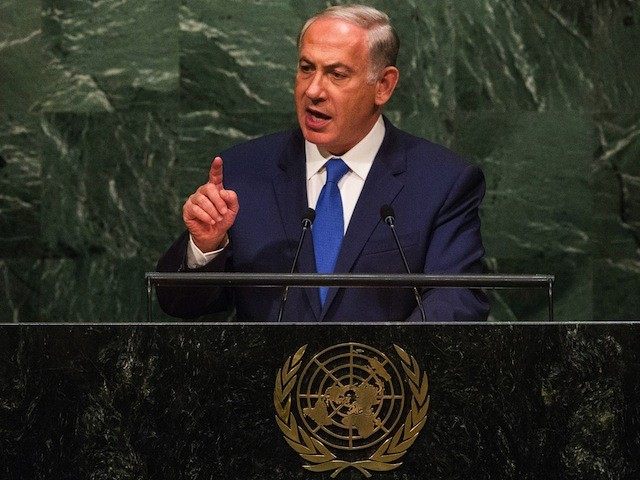
Breitbart News reported that Obama actually went so far as to call Secretary of State John Kerry and the U.S. Ambassador to the United Nations, Samantha Power, into a video conference just before Israel’s Prime Minister Benjamin Netanyahu delivered his historic and courageous speech to the UN General Assembly last Thursday.
The remnants of the U.S. delegation that did attend the speech pointedly did not applaud. The lowlife administration struck again. Obama was casting pearls before swine.
UN Secretary General Ban Ki-moon broke protocol and summarily left when Netanyahu came to the lectern. Deputy UNSG Jan Eliasson slipped into the chair. The UN Secretary General is always present when a head of state addresses the General Assembly. But they broke the rule to humiliate the Jewish people. He left. There is no way that Ban Ki-moon would have shown such disrespect had he not been given the idea or, at the very least, the sanction, by the Jew-hater in the White House.
Why? Why would Obama publicly snub our tried and true ally in the hottest region in the world? Because he is evil. He embodies the hatred of the good for being the good.
Meanwhile, Vladimir Putin has seized the initiative. After announcing that it was beginning operations against the Islamic State (ISIS), Russia is bombing our allies, Bashar Assad’s enemies, in Syria — not ISIS at all. “It’s one thing for us to be humiliated, but another for it to be shown to the world,” said Charles Krauthammer.
Put a fork in him: Barack Obama is done, and he has taken the United States, our allies, and freedom-loving peoples around the world with him. Now that Putin has so thoroughly shown him up, Obama’s only option now is to grovel. And he is groveling assiduously.
Obama’s surrender to the Russians this week has overturned the order of the Middle East and, by extension, the order of the entire world. He relinquished American hegemony in the Middle East–right after paving the way for a nuclear Iran. Obama’s subordinate role to the Russians in the “deconfliction” talks was stunning. Putin had Obama begging for “deconfliction” talks–and how quickly he turned over the deconfliction codes!
Deconfliction codes keep aircraft or missions apart to reduce the likelihood of so-called friendly fire. Has America ever done that before? According to Daniel Dombey in the Financial Times: “Two prior administrations, one of which was seen to be extraordinarily favourably disposed toward anything Israel, declined to do that.” That is, they declined to turn over the deconfliction codes to Israel at the start of the American invasion of the Iraq war and later. But when Russia demanded them, Obama jumped.
I don’t think that Bashar Assad should go. I never have. He kept the Christian and religious minorities safe, and if he goes, the Islamic State is the primary force in place to benefit from his fall. On Assad’s remaining in power as a bulwark against the Islamic State, Putin is right. Even a broken clock is right twice a day.
But this is much bigger than Assad. Obama’s turning the Middle East over to Russia and Iran is one of those terrible moments in history that you can point to, shaking your head in horror and saying, “If only…” Turning over the Middle East to Russia is a major historical blunder. That said, Putin is killing jihadists. Obama whines that Putin is killing the “opposition,” “our allies.” Who is Russia bombing? The 5 recruits that cost the US 500 million to train? “Moderate al Qaeda”? Jabhat al Nusra? #silverlining
The build-out of the Russian air base at Latakia has Russia flexing its muscles. Previously, Israel had a fairly free hand to carry out strikes against arms shipments that go from Iran through Syria to the Iranian-backed jihad group Hizb’Allah in Lebanon. But now the Russian presence in Syria severely limits Israel’s freedom of action.
What the future might hold as a result of Obama’s fecklessness, perfidy, and betrayal of Israel is anyone’s guess, but the catastrophic consequences of the Russia-Iran-Syria axis are far-reaching. The Islamic State is likely not only to survive, but to grow–and Ambassador John Bolton predicts that Putin and Iran’s Hassan Rouhani will eventually make a deal with them, reaching a modus vivendi with the Islamic State.
Catastrophe upon catastrophe, all courtesy of Barack Hussein Obama.
Categories: Assad, Ban Ki-Moon, Diplomacy, Dishonor, Foreign policy, Iran - Middle East, Iran - Syria war, Iran scam, Iranian proxies, Israel, John Bolton, Kerry, Middle East, Netanyahu, Obama - Middle East, Obama - rogue president, Obama and Israel, Obama's America, Obama's foreign failures, Obama's legacy, Putin, Russia - Middle East, Russia - Syrian war, United Nations
Tags: Assad, Ban Ki-Moon, Diplomacy, Foreign Policy, Iran - Middle East, Iran - Syria war, Iran Scam, Iranian proxies, Israel, John Bolton, Middle East, Netanyahu, Obama and Israel, Obama's America, Obama's foreign failures, Obama's legacy, Putin, Russia - Middle East, Russia - Syria war, United Nations
Comments: 12 Comments
October 3, 2015
The Moscow-Washington-Tehran Axis of Evil, Canada Free Press, Cliff Kincaid, October 3, 2015
(I am not posting this because I currently accept its conclusions or some of their bases. However, it’s frightening, interesting and has at least some food for thought. — DM)
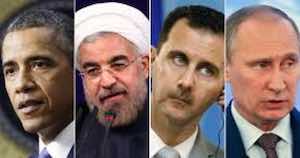
The conventional wisdom is that Vladimir Putin has blindsided Barack Obama in the Middle East, catching the U.S. off-guard. It’s another Obama “failure,” we’re told. “Obama administration scrambles as Russia attempts to seize initiative in Syria,” is how a Washington Post headline described it. A popular cartoon shows Putin kicking sand in the faces of Obama and Secretary of State John Kerry on a beach.
The conventional wisdom is driven by the notion that Obama has the best of intentions but that he’s been outmaneuvered. What if his intention all along has been to remake the Middle East to the advantage of Moscow and its client state Iran? What if he knows exactly what he’s doing? Too many commentators refuse to consider that Obama is deliberately working against U.S. interests and in favor of the enemies of the U.S. and Israel.
In his U.N. address, Obama said, “As President of the United States, I am mindful of the dangers that we face; they cross my desk every morning. I lead the strongest military that the world has ever known, and I will never hesitate to protect my country or our allies, unilaterally and by force where necessary.”
This is laughable. We still have a strong military, but the inevitable conclusion from what’s recently transpired is that he doesn’t want to protect the interests of the U.S. or its allies in the Middle East. This is not a “failure,” but a deliberate policy.
The trouble with conventional wisdom is the assumption that Obama sees things the way most Americans do. In order to understand Obama’s Middle East policy, it is necessary to consult alternative sources of news and information and analysis. That includes communist news sources.
A fascinating analysis appears in the newspaper of the Socialist Workers Party, The Militant, one of the oldest and most influential publications among the left. You may remember the old photos which surfaced of Lee Harvey Oswald selling copies of The Militant before he killed the American president.
The headline over The Militant story by Maggie Trowe caught my eye: “‘Reset’ with US allows Moscow to send arms, troops to Syria.” It was not about Hillary Clinton’s reset with Moscow years ago, but a more recent one.
Here’s how her story began: “Moscow’s rapid military buildup in Syria is a result of the ‘reset’ in relations forged with the Russian and Iranian governments by the Barack Obama administration. The deal—reshaping alliances and conditions from Syria, Iran and the rest of the Middle East to Ukraine and surrounding region—is the cornerstone of U.S. imperialism’s efforts to establish a new order in the Mideast, but from a much weaker position than when the now-disintegrating order was imposed after World Wars I and II.”
Of course, the idea that “U.S. imperialism” is served by giving the advantage to Russia and Iran is ludicrous. Nevertheless, it does appear that a “reset” of the kind described in this article has in fact taken place. The author writes about Washington’s “strategic shift to Iran and Russia” and the “downgrading” of relations with Israel and Saudi Arabia. She notes that Moscow “seeks more influence and control of the country [Syria] and its Mediterranean ports and a stronger political hand in Mideast politics.” Iran “has sent Revolutionary Guard Quds forces to help prop up Assad, and collaborates with Moscow on operations in Syria,” she notes.
It is sometimes necessary to reject the conventional wisdom and instead analyze developments from the point of view of the Marxists, who understand Obama’s way of thinking. They pretend that Obama is a pawn of the “imperialists” but their analysis also makes sense from a traditional pro-American perspective. Those who accept the evidence that Obama has a Marxist perspective on the world have to consider that his policy is designed to help Moscow and Tehran achieve hegemony in the region.
At the same time, the paper reported, “Since Secretary of State John Kerry’s congenial visit with Putin in May, it has become clear that Washington would accept Moscow’s influence over its ‘near abroad’ in Ukraine and the Baltics, in exchange for help to nail down the nuclear deal with Tehran.” Hence, Obama has put his stamp of approval on Russian aggression in Europe and the Middle East. This analysis, though coming from a Marxist newspaper, fits the facts on the ground. It means that more Russian aggression can be expected in Europe.
The wildcard is Israel and it looks like the Israeli government is being increasingly isolated, not only by Obama but by Putin. The story notes that Israeli Prime Minister Benjamin Netanyahu met with Putin in Moscow on September 21, saying his concern was to “prevent misunderstandings” between Israeli and Russian troops, since Israel has carried out airstrikes in Syrian territory targeting weapons being transported to the Iranian-backed Hezbollah terrorists in Lebanon.
Some reports indicated that Israel had set up a joint mechanism with the Russian military to coordinate their operations in Syria.
However, the Russian leader reportedly told Obama during their U.N. meeting that he opposes Israeli attacks in Syria. The Israeli newspaper Haaretz ran a story that Russia intends to “Clip Israel’s Wings Over [the] Syrian Skies.” The paper added that Putin’s remarks to Obama showed that despite Netanyahu’s meeting with Putin in Moscow, “Russia intends to create new facts on the ground in Syria that will include restricting Israel’s freedom of movement in Syrian skies.”
It hardly seems to be the case that Obama has been outsmarted in the Middle East, or that Putin and Obama don’t like each other. Instead, it appears that Obama is working hand-in-glove with Putin to isolate Israel and that Obama is perfectly content to let the former KGB colonel take the lead.
Israel has always been seen by most U.N. members as the real problem in the region. Obama is the first U.S. President to see Israel in that same manner and to act accordingly. This is why Putin has not caught Obama off-guard in the least. They clearly see eye-to-eye on Israel and Iran.
Don’t forget that Obama actually telephoned Putin to thank him for his part in the nuclear deal with Iran. The White House issued a statement saying, “The President thanked President Putin for Russia’s important role in achieving this milestone, the culmination of nearly 20 months of intense negotiations.”
Building off the Iran nuclear deal, it looks like the plan is for Russia and the United States to force Israel to embrace a U.N. plan for a nuclear-free Middle East. That would mean Israel giving up control of its defensive nuclear weapons to the world body. Iran will be able to claim it has already made a deal to prohibit its own nuclear weapons development.
Such a scheme was outlined back in 2005 in an article by Mohamed Elbaradei, the director-general at the time of the U.N.‘s International Atomic Energy Agency (IAEA). That’s the same body that is now supposed to guarantee Iranian compliance with the terms of the nuclear deal signed by Russia and the U.S.
Elbaradei argued there would have to be “a dialogue on regional security as part of the peace process,” to be followed by an agreement “to make the Middle East a nuclear-weapons-free zone.”
The “dialogue” appears to be taking place now, mostly under the authority and auspices of the Russian government, with President Obama playing a secondary role.
The obvious danger is that Israel would be forced to comply with the plan for a “nuclear-weapons-free-zone,” while Iran would cheat and develop nuclear weapons anyway.
Netanyahu told the U.N. that “Israel deeply appreciates President Obama’s willingness to bolster our security, help Israel maintain its qualitative military edge and help Israel confront the enormous challenges we face.”
This must be his hope. But he must know that Israel’s security is slipping and that the survival of his country is in grave danger in the face of this Moscow-Washington-Tehran axis.
Before Putin further consolidates his military position in the Middle East and Iran makes more progress in nuclear weapons development, Netanyahu will have to launch a preemptive strike on the Islamic state. “Israel will not allow Iran to break in, to sneak in or to walk in to the nuclear weapons club,” the Israeli Prime Minister said.
In launching such a strike before the end of Obama’s second presidential term, Israel would bring down the wrath of the world, led by Russia and the U.S., on the Jewish state.
Categories: Airstrikes, Assad, Communism, Death to America, Death to Israel, Defense of Israel, Diplomacy, Dishonor, Foreign policy, Free world, IAEA, Imperialism, Iran - Middle East, Iran - Syria war, Iran / Israel War, Iran nuke inspections, Iran scam, Iranian nukes, Iranian proxies, Iranian Threats, Israel, Israeli nukes, JCPOA, Kerry, Middle East, Netanyahu, Obama - Middle East, Obama - rogue president, Obama and Israel, Obama's America, Obama's legacy, Obama's motivations, P5+1, Peace in our time, Putin, Russia, Russia - Middle East, Russia - Syrian war, Russian Aggression, Saudi Arabia, Syria war, Treason, U.S. allies, U.S. politics, United Nations
Tags: Airstrikes, Assad, Communism, Death to America, Death to Israel, Defense of Israel, Diplomacy, Foreign Policy, Free world, IAEA, Imperialism, Iran - Israel war, Iran - Middle East, Iran - Syria war, Iran nuke inspections, Iran Scam, Iranian nukes, Iranian proxies, Iranian threats, Israel, Israeli nukes, JCPOA, Middle East, Netanyahu, Obama and Israel, Obama's America, Obama's legacy, Obama's motivations, P5+1, Peace in our time, Putin, Russia, Russia - Middle East, Russia - Syrian war, Russian aggression, Saudi Arabia, Syria war, Treason, U.S. Allies, U.S. politics, United Nations
Comments: 59 Comments
October 1, 2015
Nobel Prize Rumors Put Focus On Kerry-Iran Coziness, Washington Free Beacon, Adam Kredo, October 1, 2015
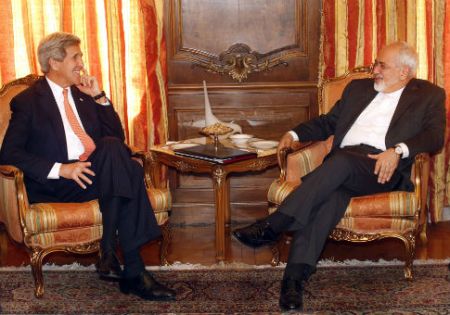 John Kerry and Mohammad Javad Zarif / AP
Growing speculation that John Kerry will receive a Nobel Peace Prize for finalizing the Iranian nuclear deal is generating renewed criticism of his close relationship with the Iranian foreign minister, Javad Zarif, a key public face for the theocratic regime who is rumored to be a probable co-recipient with Kerry.
Rumors have been circulating for months that Kerry and Zarif will be co-selected for the prize. The Stockholm International Peace Research Institute, a leading Swedish think-tank, recommended in July that the two be selected for the Nobel in 2016.
Lawmakers and Washington insiders who have worked for years on the Iran portfolio have reacted with shock to the rumors, telling the Washington Free Beacon in multiple interviews that both Kerry and Zarif are unfit to receive the prize.
“We have seen Nobel Prizes that appeared to be awarded to people who have acted staunchly to the detriment of Israel’s existence, and if that is their inclination this time, I think Secretary Kerry should be first runner up for the Nobel Prize, right behind the Ayatollah,” said Rep. Louie Gohmert (R., Texas).
The Nobel Prize speculation comes after months of reports describing warmth and comfort between the American and Iranian teams that sealed the final Joint Comprehensive Plan of Action.
The United States considers Iran to be the world’s leading state sponsor of terrorism and military officials have linked Tehran to the deaths of hundreds of American soldiers in Iraq.
The growing rumors have reignited criticism among insiders of Kerry’s coziness with top Iranian officials and of the deal more specifically.
“No one should be surprised if the Nobel Peace Prize committee ends up awarding the chief negotiators of a catastrophic agreement that preserves and legitimizes Iran’s ability to build nuclear arms, and unleashes over $100 billion for Iran to further fund Hezbollah, Hamas, Palestinian Islamic Jihad, and other terrorists who attack Israel,” said one senior GOP aide who has long worked on the issue.
Those who spoke to the Free Beacon both on and off the record said that Kerry and Zarif would make a mockery of the award. The recognition of Zarif in particular, a longtime Iranian regime insider known for his vociferous dislike of Israel, was particularly offensive to some observers.
“I assume they’ll win it. It will be announced in early-mid October, and then Kerry can resign in glory and join the Democratic presidential race,” said Bill Kristol, the prominent conservative commentator and editor of the Weekly Standard.
Like Kristol, other observers feel certain that the Nobel commission will grant the award to Kerry and Zarif either this year or next.
“American historians will judge Kerry as one of the worst secretaries of state in the country’s history, a man who ceded enormous parts of the globe to hostile American rivals and legitimized the Iranian nuclear program,” said one senior pro-Israel official who has been involved in the Iran fight but was not authorized to speak on record.
“It’s not a surprise that European elites, who find America’s rivals preferable to America and want to do business with Iran, are going to reward him for it,” the source said.
When asked this week to address the speculation, a spokesman for the Nobel Foundation declined to confirm who may or may not be in the running.
“The Nobel Foundation cannot comment, confirm, or deny rumors of the kind described in your email below,” the official said.
“According to the statutes of the Nobel Foundation and the prize awarding institutions of the Nobel Prize all nominations are classified information,” the official added, explaining that in some case nominators choose to reveal who they have nominated.
Nominations for the 2015 Nobel Prize had to be made before Jan. 31 of this year, before the nuclear deal was finalized. If chosen after this date, the nominees would be considered in the 2016 cycle.
“I think the work of the Nobel Committee of the Norwegian Parliament this year just got much easier,” Carl Bildt, the former Swedish prime minister, tweeted immediately after the nuclear agreement was announced in Vienna.
“A Nobel Peace Prize for John Kerry?” the Week asked the following day. “It could happen.”
Conservative commentators, such as National Review’s Jay Nordlinger, also picked up on the speculation.
“If the Norwegian Nobel Committee gives John Kerry the peace prize for the Iran deal, and Iran goes nuclear, will he throw away his Nobel medal?” Nordlinger asked in August, as criticism of the deal mounted.
Categories: Diplomacy, Dishonor, Foreign policy, Iran scam, Javad Zarif, Kerry, Nobel Peace Prize, P5+1
Tags: Diplomacy, Foreign Policy, Iran Scam, Javad Zarif, Nobel Peace Prize, P5+1
Comments: 1 Comment
September 27, 2015
Israel’s biggest fears are materializing, Israel Hayom, Boaz Bismuth, September 27, 2015
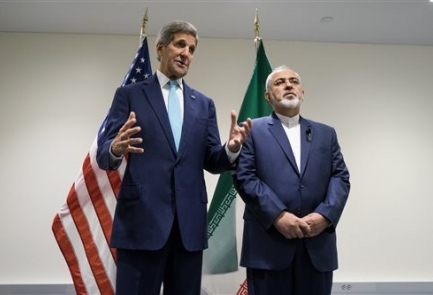 The Munich moment is upon us. U.S. Secretary of State John Kerry with Iranian Foreign Minister Mohammad Zarif at U.N. headquarters on Saturday | Photo credit: AP
Washington is reaching out to Russia, which is openly helping Syrian President Bashar Assad, who is working in conjunction with Iran, which in turn supports Hezbollah. Now Europe is prepared to talk to Assad, but what about us, for heaven’s sake?
Two years ago to the day, in September 2013, U.S. Secretary of State John Kerry compared Bashar Assad to Adolf Hitler, after the Syrian dictator once again used chemical weapons against his own people. “This is our Munich moment,” Kerry said at the time.
As far as the Americans were concerned, Assad had crossed a line. In those days (more like in those hours, actually), Washington briefly believed that a failure to respond to Assad’s actions would send a dangerous message to Iran regarding its nuclear ambitions.
“Will [Iran] remember that the Assad regime was stopped from those weapons’ current or future use, or will they remember that the world stood aside and created impunity?” Kerry asked at the time. History and retrospect have turned what may have been Kerry’s greatest speech into remarks entirely detached from reality.
The United States did not attack, Assad is still in power, and an ominous nuclear deal has been signed with Iran. It is no wonder that there is a new kind of atmosphere in the region, under American auspices. There are no more good guys and bad guys; everyone is a partner. And thanks to this new reality, Assad now has a renewed license to rule, after having received a license to kill.
Washington is reaching out to Russia, which is openly helping Assad in Syria, who is working in conjunction with Iran, which in turn supports Hezbollah. Europe (Angela Merkel), in the meantime, startled by its refugee crisis, is already prepared to talk with Assad; the same Assad who was compared to Hitler only two years ago. But what about us, for heaven’s sake?
Regretfully, Israel’s biggest fears are now materializing. Instead of being the architects and shaping a new reality in the Middle East, Washington is falling into line with the existing reality. Russia, Syria and Iran are enjoying the consequent vacuum. When the cat is away, the mice will play. Now, all of a sudden, even Hezbollah chief Hassan Nasrallah is letting himself go on television, beaming with joy. Aside from the 75 tanks Damascus is giving him, he now sees his two patrons (Damascus and Tehran) become partners with the West, without having to change one bit.
There is no diplomatic vacuum
The latest developments in Syria are not encouraging: Assad’s first target, with Russia’s help, is expected to be the Nusra Front rebel group, which not only threatens Assad but is also a bitter enemy of the Islamic State group. In other words, somewhat paradoxically, Islamic State could initially benefit from the Russian intervention in Syria.
And one final word about Iran’s rapprochement with the international community: We have been told repeatedly that this was only about the nuclear deal, but in reality we can see cooperation between the U.S. and Iran in Iraq and in the war against Islamic State. We can also see American-Iranian dialogue regarding Syria’s future, and on Saturday night we learned of a gigantic deal worth upwards of $21 billion between Iran and Russia. This time I am forced to agree with Secretary Kerry: This really does look like a Munich moment.
Categories: Al Nusrah, Death to Israel, Defense of Israel, Foreign policy, Free world, Hezbollah, Iran - Syria war, Iran scam, Iranian nukes, Iranian proxies, Islamic State, Israel, Jews, Kerry, Middle East, Netanyahu, Obama - Middle East, Obama and Israel, Obama's affinity for Iran, Obama's America, Obama's legacy, P5+1, Putin, Regime change, Russia, Russia - Syrian war, Syria - chemical weapons, Syria war
Tags: Al Nusrah, Death to Israel, Defense of Israel, Foreign Policy, Free world, Hezbollah, Iran - Syria war, Iran Scam, Iranian nukes, Iranian proxies, Islamic State, Israel, Jews, Middle East, Netanyahu, Obama and Israel, Obama's affinity for Iran, Obama's America, Obama's legacy, P5+1, Putin, Regime change, Russia, Russial - Syria war, Syria - chemical weapons, Syria war
Comments: Be the first to comment
September 22, 2015
Iran wants to renegotiate parts of the nuke “deal.” That may be good. Dan Miller’s Blog, September 22, 2015
(The views expressed in this article are mine and do not necessarily reflect those of Warsclerotic or those of its other editors. — DM)
Iran wants sanctions relief to be lifted, immediately, and not merely suspended. Iran should not get that. If it doesn’t, it may well terminate the “deal” unilaterally. If Iran gets what it wants, the Senate should review the “deal” as a treaty and reject it. Either outcome would be a substantial improvement over the current “deal” and the morass in which it is embedded.
This post is based on a September 21st article at Middle East Media Research Institute (MEMRI) titled “Expected September 28 NY Meeting Between P5+1 Foreign Ministers And Iran Could Signify Reopening Of Nuclear Negotiations To Address Khamenei’s September 3 Threat That If Sanctions Are Not Lifted, But Merely Suspended, There Will Be No Agreement.”
The MEMRI article cites statements by Supreme Leader Khamenei and one of his senior advisers, Ali Akbar Velayat. The latter said, on September 19th, “the nuclear negotiations are not over yet.” Khamenei has said much the same thing.
Khamenei said, in a September 3, 2015 speech to the Assembly of Experts, that he did not accept the terms of the agreement and demanded that the sanctions be immediately lifted rather than merely suspended; otherwise, he said, there would either be no agreement, or Iran too would merely suspend its execution of its obligations under the JCPOA.
. . . .
“Freezing or suspension [of the sanctions] is unacceptable to me… If they suspend [the sanctions], we too will suspend [what is incumbent upon us]. If we are to implement what [is required of us], the sanctions must be [actually] cancelled.
Iran has thus made clear that it will not abide by the nuke “deal” as written; unless it gets the changes it now demands, it will either terminate the deal or violate it. If, as seems likely for the reasons cited in the MEMRI article, the September 28th meeting involves discussion of the deal, it will either be renegotiated or it won’t be.
If the “deal” is not renegotiated, or is renegotiated and Iran does not get what it demands, it may very well terminate the deal. Iran has already received substantial sanctions relief, is already open for business and is already doing lots of it with many more nations than previously. Termination would be a rebuff to the “Great Satan,” would not damage Iran much economically and it could proceed with its “peaceful” nuke program without even farcical nuke self-inspections.
If The Obama administration and others cave and Iran gets what it demands or enough to satisfy it, the “deal” will be very different from what was previously presented to the Congress under the Corker legislation. That legislation purported to eliminate the constitutional requirement of approval of the “deal” by a two-thirds Senate majority before going into effect and permitted it to go into effect unless rejected by half of the membership of both houses; Obama promised to veto such a rejection and put the “deal” into effect. The House has disapproved the “deal” but the Senate has not acted because of Democrat fillibusters, urged by the White House. Under the new “deal,” the ability of the United States to “snap back” sanctions would be vitiated; a possible but very difficult if not impossible to accomplish, “snap back” had been among the reasons cited by many of those who favored the “deal” (often despite its many other flaws) for supporting it.
If a deal eliminating the “snap back” is struck, Obama, et al, may well claim that it’s none of the business of the Congress since, by virtue of the Corker legislation, it has already eliminated its constitutional authority to deal with the JCPOA as a treaty, regardless of any “minor” change.
I hope, but am less than confident, that both houses of the Congress will reject this contention vigorously and repeal the Corker legislation. Whatever benefits or other legitimacy the Corker legislation may once have been thought to have it no longer has. Repeal will probably require use of the “nuclear option” to invoke cloture to end a Democrat filibuster in the Senate. If — as seems likely — Obama vetoes the rejection, the Congress should state that it no longer considers itself bound by the Corker legislation. Next, the Senate should treat the renegotiated “deal” as a treaty, regardless of whether Obama agrees to send it to the Senate, and reject it. It should do so even if, as also seems likely, that requires use of the “nuclear option” to invoke cloture.
Obama has precipitated what may well become a constitutional crisis. If the Congress does its job, Obama will be the loser and America will be the winner — even if it becomes necessary to take out Iran’s nukes militarily.
Categories: Democrats, IAEA, Iran - sanctions relief, Iran nuke inspections, Iran scam, Iranian economy, Iranian military sites, Iranian nukes, Kerry, Khamenei, Nuclear option, Obama - rogue president, Obama's affinity for Iran, Obama's America, P5+1, Republicans, U.S. Congress, U.S. Constitution
Tags: Democrats, IAEA, Iran - sanctions relief, Iran nuke inspections, Iran Scam, Iranian economy, Iranian military sites, Iranian nukes, Khamenei, Nuclear option, Obama's affinity for Iran, Obama's America, P5+1, Republicans, U.S. Congress, U.S. Constitution
Comments: 1 Comment
September 22, 2015
Expected September 28 NY Meeting Between P5+1 Foreign Ministers And Iran Could Signify Reopening Of Nuclear Negotiations To Address Khamenei’s September 3 Threat That If Sanctions Are Not Lifted, But Merely Suspended, There Will Be No Agreement, MEMRI, September 21, 2015
(If the JCPOA is renegotiated, in any respect, will Congress get another opportunity to challenge it? If so, will a way be found to deal with it as a treaty? The answer to both questions should be yes. — DM)
The expected meeting between the P5+1 foreign ministers and Iranian Foreign Minister Zarif may be evidence of a shift in the White House position and also evidence that it intends to discuss the Iranian demand for further concessions from the superpowers.
****************
Recent reports indicate that the foreign ministers of the P5+1 are set to meet with Iranian Foreign Minister Javad Zarif in New York on September 28, 2015, on the margins of the UN General Assembly, to “examine the recent developments of the JCPOA.”[1]
On September 20, 2015, U.S. Secretary of State John Kerry said, at a joint press conference in Berlin with his German counterpart Frank-Walter Steinmeier, that he would meet Zarif in New York to discuss “Iran and other matters.”[2]
Additionally, Ali Akbar Velayati, a senior advisor to Iranian Supreme Leader Ali Khamenei and the head of Iran’s Center for Strategic Research, said on September 19, 2015 that “the nuclear negotiations are not over yet.”[3]
As will be recalled, Khamenei said, in a September 3, 2015 speech to the Assembly of Experts, that he did not accept the terms of the agreement and demanded that the sanctions be immediately lifted rather than merely suspended; otherwise, he said, there would either be no agreement, or Iran too would merely suspend its execution of its obligations under the JCPOA. He said: “We negotiated [with the Americans] in order to have the sanctions lifted, and the sanctions will be lifted. Now, if we are supposed to uphold this framework… this completely contradicts the reason for Iran’s participation in the talks to begin with. Otherwise, what was the point of our participation in the talks? We would have continued to do what we were doing [prior to the talks]… The fact that we sat down and held talks and made concessions on certain issues was mainly in order to have the sanctions lifted. If the sanctions are not going to be lifted, there will be no agreement… [Our] officials [i.e. Rohani’s government and his Ministry of Foreign Affairs] should make this clear…
“Freezing or suspension [of the sanctions] is unacceptable to me… If they suspend [the sanctions], we too will suspend [what is incumbent upon us]. If we are to implement what [is required of us], the sanctions must be [actually] cancelled. True, the other side says that some of the sanctions are not [up to them entirely] to be lifted. We say in response that [with regard to those sanctions] we will use our legal rights to freeze them. But regarding [the sanctions that are] in the hands of the American and European governments – those must be totally lifted.”[4]
The apparent meaning of all the above is that the nuclear negotiations, which Iran considers unfinished, will be reopened, with the aim of achieving the complete lifting of sanctions – instead of a mere suspension of them as was agreed in the JCPOA and adopted in UN Security Council Resolution 2231.
It will also be recalled that following Khamenei’s September 3 demands, on September 4 the White House responded; spokesman Josh Earnest said that Iran was charged with meeting its obligations under the JCPOA: “What we have indicated all along is that once an agreement was reached, as it was back in mid-July, that we would be focused on Iran’s actions and not their words, and that we will be able to tell if Iran follows through on the commitments that they made in the context of these negotiations. And that is what will determine our path forward here.
“We’ve been crystal clear about the fact that Iran will have to take a variety of serious steps to significantly roll back their nuclear program before any sanctions relief is offered – and this is everything from reducing their nuclear uranium stockpile by 98 percent, disconnecting thousands of centrifuges, essentially gutting the core of their heavy-water reactor at Arak, giving the IAEA the information and access they need in order to complete their report about the potential military dimensions of Iran’s nuclear program. And then we need to see Iran begin to comply with the inspections regime that the IAEA will put in place to verify their compliance with the agreement.
“And only after those steps and several others have been effectively completed, will Iran begin to receive sanctions relief. The good news is all of this is codified in the agreement that was reached between Iran and the rest of the international community. And that’s what we will be focused on, is their compliance with the agreement.”[5]
The expected meeting between the P5+1 foreign ministers and Iranian Foreign Minister Zarif may be evidence of a shift in the White House position and also evidence that it intends to discuss the Iranian demand for further concessions from the superpowers.
It should be clarified that agreement on the part of the U.S. to lifting the sanctions would constitute a fundamental change to the JCPOA. This is because lifting the sanctions, rather than suspending them, will render impossible a snapback in case of Iranian violations, and the guarantee of a snapback is one of the central justifications for the JCPOA, according to President Obama and Secretary of State Kerry.
Endnotes:
[1] Fars (Iran), September 21, 2015.
[2] State.gov, September 20, 2015.
[3] Fars (Iran), September 19, 2015. It should be mentioned that Majlis member Hamid Rasaei said that the language of the agreement signed by Abbas Araghchi that was delivered to Majlis committees was “a partial document with many translating errors and omissions.” He added that the government must present the agreement to the Majlis in the form of a draft law and that a Majlis committee is currently “examining a version that is neither a proposal nor a draft law.” Tasnim (Iran), September 20, 2015.
[5] Whitehouse.gov, September 4, 2015.
Categories: Foreign policy, Iran scam, Javad Zarif, JCPOA, Kerry, Khamenei, Obama's America, Obama's legacy, P5+1, U.S. Congress, U.S. Constitution
Tags: Foreign Policy, Iran Scam, Javad Zarif, JCPOA, Khamenei, Obama's America, Obama's legacy, P5+1, U.S. Congress, U.S. Constitution
Comments: 1 Comment
September 20, 2015
Migration Crisis: Germany Wants to Be “Miss Congeniality,” Gatestone Institute, Vijeta Uniyal, September 20, 2015
(Please see also, U.S. to Increase Admission of Refugees to 100,000 in 2017, Kerry Says. — DM)
- Chancellor Merkel today seems to be promising nothing less than absolution for Germany’s sins of the Holocaust. The problem is, of course, that Muslims are quite different from Jews.
- German media outlets have suppressed the stories of rampant rape and child abuse among the migrants housed in government-run accommodations.
- The editor-in-chief defended her decision to suppress the rape story on public TV broadcaster ZDF: “We don’t want to inflame the situation and spread the bad mood. [The migrants] don’t deserve it.” That the poor rape victim deserved justice was apparently of no concern to the broadcaster.
- Germany under Chancellor Merkel wants to play “Miss Congeniality” at the global scale, and wants Europe to pick up the tab.
Overwhelmed by the unprecedented influx of migrants, Germany has imposed temporary border controls. This temporary halt in new arrivals is “intended to give Germany a chance to catch its breath while at the same time ratcheting up the pressure on other European Union member states to accept a quota system for the distribution of asylum recipients across the bloc,”according to Interior Minister Joachim Herrmann of the German state of Bavaria on public radio. Germany’s move to tighten its border controls, however, is not going to halt millions of migrants already mobilized by Berlin’s suspension of existing asylum rules and its open border policy in the first place.
Horst Seehofer, the leader of Christian Social Union (CSU), the Bavaria-based sister party to Chancellor Angela Merkel’s Christian Democrats (CDU), painted a grim picture, saying that Merkel’s open border policy “was a mistake that will occupy us for a long time yet. I see no possibility of putting the stopper back into the bottle.”
German media is in lockstep with the government, giving happy-talk and a positive spin on migrant crisis of gigantic proportions hitting Europe.
German newspapers and media outlets have suppressed the stories of rampant rape and child abuse among the migrants housed in government-run accommodations. In a recent letter addressed to the Minister of Integration and Social Affairs in the state of Hesse, prominent women’s organizations have described the culture of rape and violence perpetuated by male migrants — right under the nose of German authorities. The letter states:
“It is a fact that women and children [at HEAE accommodation facility, under the supervision of Administrative District of Giessen] are unprotected. This situation is opportune to those men who already regard women as their inferior and treat unaccompanied women as ‘fair game.’ As a consequence, there are reports of numerous rapes, sexual assaults and increasingly of forced prostitution. … These are not isolated incidents.”
According to the letter, women were terrified to walk in the camp even during the day.
The letter, signed by leading officials organizing the settlement of the migrants in the state of Hesse, went virtually unreported in the German media.
For now, the German media can afford to ignore these crimes, committed in makeshift transit centers — away from the public eye. How do the media plan to suppress this reality once some of these criminals are released into communities? Here is a foretaste of the things to come:
Recently the Germany’s top public broadcaster ZDF refused to run a segment about a rape case on its prime time crime show, “Aktenzeichen XY,” which helps law enforcement to gather leads from the general public, on the grounds that the alleged fugitive was of a “darker skin” and might fit the profile of a migrant. The editor-in-chief, Ina-Maria Reize-Wildemann, defended her decision: “We don’t want to inflame the situation and spread the bad mood. [The migrants] don’t deserve it.” That the poor rape victim deserved justice was apparently of no concern to the broadcaster.
Mainstream media in Germany are not merely willing executioners of Merkel’s open border policy, they are ideological players committed to breaking any opposition to the plan.
 Commenting on Germany’s acceptance of hundreds of thousands of migrants, the popular mainstream newsmagazine Der Spiegel last week portrayed Chancellor Merkel as a Mother Theresa-like figure (left). Pictured at right, a German policeman leads a group of newly arrived migrants.
Germany wants to dictate its stand on migration to other EU member states. First Germany wrecked the existing legal framework by unilaterally suspending the Dublin Protocol, and now it wants Europe to shoulder a “fair share” of migrants who are stampeding into Europe — encouraged by Berlin’s irresponsible stance to begin with.
Chancellor Merkel today seems to be promising nothing less than absolution for Germany’s sins of the Holocaust. “The world sees Germany as a land of hope and opportunities,” she says. “That hasn’t always been the case.” The problem is, of course, that Muslims are quite different from Jews.
German politicians and EU Commissars, however, seem hell bent on imposing quotas on member states – harkening back to the heyday of Soviets jackboots running the Eastern bloc. It may only be a matter of time until some of the reluctant East European states start complying, possibly forced by economic threats and sanctions from Brussels and Berlin.
Germany under Chancellor Merkel wants to play “Miss Congeniality” at the global scale and wants Europe to pick up the tab.
Categories: Asylum seekers, Europe, European Union, Germany, Hijrah, Holocaust, Islamic immigration, Islamic jihad, Islamic supremacy, Islamism, Islamophobia, Kerry, Merkel, Multiculturalism, Political correctness, Syria war
Tags: Asylum seekers, Europe, European Union, Germany, Hijrah, Holocaust, Islamic immigration, Islamic Jihad, Islamic supremacy, Islamism, Islamophobia, Merkel, Multiculturalism, Political correctness, Syria war
Comments: Be the first to comment
September 18, 2015
What Iran Is Permitted To Do Under The JCPOA, Middle East Media Research Institute, Yigal Carmon, September 17, 2015
Support or opposition to the nuclear deal should be predicated on the text of the JCPOA.
Here are a few examples of what Iran can do under the JCPOA. These actions – permitted under the JCPOA – clearly contradict statements and arguments raised recently by administration officials.
Iran Can Pursue The Development Of A Nuclear Device And Key Nuclear Technologies
Under the JCPOA, Iran can conduct activities “which could contribute to the design and development of a nuclear explosive device” if these activities are “approved by the Joint Commission for non-nuclear purposes and subject to monitoring.”[1] If anything should have been totally and absolutely banned by this agreement it is activity suitable for the development of a nuclear device. President Obama’s declared rationale for the agreement is to distance Iran from a nuclear device. The JCPOA, under certain conditions allows even that.
Also nowhere in the JCPOA does Iran promise to refrain from development of key technologies that would be necessary to develop a nuclear device. To the contrary, Ali Akbar Salehi head of the Atomic Energy Organization of Iran stated that: “We are building nuclear fusion now, which is the technology for the next 50 years.”[2]
Iran Can Prevent The Inspection Of Military Sites
Under the JCPOA the IAEA cannot go wherever the evidence leads. The JCPOA allows Iran to reject a priori any request to visit a military facility. This exclusion was included in the JCPOA by introducing a limitation under which a request that “aims at interfering with military or other national security activities” is not admissible. [3]
The ban on visits to military sites has been enunciated by all regime figures from Supreme Leader Khamenei downwards. Supreme Leader Khamenei specified: “(The foreigners) shouldn’t be allowed at all to penetrate into the country’s security and defensive boundaries under the pretext of inspection, and the country’s military officials are not permitted at all to allow the foreigners to cross these boundaries or stop the country’s defensive development under the pretext of supervision and inspection.” [4]
Iranian Foreign Minister Javad Zarif said that such visits crossed a red line and were successfully rejected by Iran during the negotiations.[5] Supreme Leader Khamenei’s top adviser for international affairs Ali Akbar Velayati stated: “The access of inspectors from the IAEA or from any other body to Iran’s military centers is forbidden.”[6]
Administration spokespersons persist in claiming that military facilities will also come under inspection in total contradiction to the language of the JCPOA and the Iranian position.
There Will Be No Snap Back Of Sanctions
Under the JCPOA snap back is not automatic but will be dependent on UN Security Council approval.
Additionally, a declaration has been introduced into the JCPOA and thus became an integral part of the agreement, namely that “Iran has stated that it will treat such a re-introduction or re-imposition of the sanctions specified in Annex II, or such an imposition of new nuclear-related sanctions, as grounds to cease performing its commitments under this JCPOA in whole or in part.”[7] The inclusion of this clause in the agreement makes the reimposition of sanctions in the optimal case, the subject of litigation, when Iran can contend that the other side is in violation of the agreement.
Sanctions Duration On The Issue Of Missile Development Can Be Shortened To Less Than Eight Years
Under the JCPOA the sanctions on missile development need not remain in place for eight years but can be lifted earlier, namely whenever “the IAEA has reached the Broader Conclusion that all nuclear material in Iran remains in peaceful activities.”[8]
Arak Will Remain A Heavy Water And Hence A Plutonium Capable Facility; Iran’s Plutonium Pathway Was Not Totally Blocked
Arak houses Iran’s heavy water facility. Despite the vague wording in the JCPOA, (i.e. Iran will “redesign” and “modernize” the reactor),[9] it will also continue to operate partially as a heavy water facility a key element needed in plutonium production.
_______________________
[1] http://apps.washingtonpost.com/g/documents/world/full-text-of-the-iran-nuclear-deal/1651/
[2] Farsnews.com, August 9, 2015.
[3] JCPOA, Annex I, Q.74.
[5] Latimes.com, July 22, 2015
[7] JCPOA, Section I, Article C, Paragraph 26. See footnote 1 for link to text.
[8] JCPOA, Annex V, D.19. See footnote 1 for link to text.
[9] JCPOA, I.B.8. See footnote 1 for link to text.
Categories: Diplomacy, Dishonor, Foreign policy, IAEA, Iran nuke inspections, Iran scam, Iranian military sites, Iranian missiles, Iranian nukes, Kerry, Obama - rogue president, Obama's America, Obama's legacy, P5+1, Sanctions
Tags: Diplomacy, Foreign Policy, IAEA, Iran nuke inspections, Iran Scam, Iranian military sites, Iranian missiles, Iranian nukes, Obama's America, Obama's legacy, P5+1, Sanctions
Comments: Be the first to comment
September 17, 2015
Russian troops already engaged in battle against ISIS around Homs, DEBKAfile, September 17, 21015

Contrary to the impression conveyed by Moscow that Russian troops in Syria are not engaged in combat and that none of the sophisticated arms deliveries were destined to the Syrian army, new developments belie both these claims.
DEBKAfile’s military and intelligence sources report that on Wednesday, September 16, Russian R-166-0.5 (ultra) high-frequency signals (HF/VHF) vehicles were spotted on Highway 4, which links Homs and Aleppo. These vehicles, called “mobile war rooms” by the IDF and Western armies, were accompanied by BTR-82 troop carriers transporting Russian marines. The R-166-0.5 enables communication with forces located on battlefields as far as 1,000 kilometers away using high frequency and ultra-high frequency signals.
The communication systems are resistant to electromagnetic jamming so Russian forces operating deep inside Syria can report to their commanders at the main Russian base in Latakia or receive orders, intelligence data and even video from drones or planes.
Another feature is a cylinder on the side of the vehicle containing a folded antenna that can be raised to a height of 15 meters.
The R-166-0.5 is an integral part of Russia’s battlefield operations, so it would not be deployed unless long-distance troop movements were underway. The appearance of those vehicles in the Syrian theater provides a clear signal of Moscow’s intentions.
Our sources point out that during the past few days, fighters from the Islamic State in Iraq and the Levant (ISIS) succeeded in cutting off part of the highway between Homs and Aleppo for several hours. It marked a very dangerous development for the Syrian army and regime, because a permanent cutoff of Highway 4 would tighten the siege on Aleppo and possibly pave the way for the conquest of the second-largest city in Syria.
The movements by the armored vehicles show that the Russian troops are preparing to head into battle in order to prevent such a scenario.
Moscow has denied supplying new, sophisticated weapons to the Syrian army. However, a Syrian military source revealed Thursday, Sept. 17, that the Syrian military has recently started using new types of air and ground weapons supplied by Russia, underlining growing Russian support to Damascus that is alarming the United States and Israel. “New weapons – and new types of weapons – are being delivered,” said the source which described them as “highly accurate and effective.” The army had started using them in recent weeks having been trained in their use in Syria in recent months. “We can say they are all types of weapons – be it air or ground,” he said.
DEBKAfile’s military sources reveal that the Russian shipments for the Syrian army include MI-28 MIL assault helicopters (NATO-coded Havoc), an all-weather aircraft, which can also serve as an anti-tank weapon against the mostly US-made tanks fielded by ISIS and Al Qaeda’s Nusra Front Syrian arm.
Our military and intelligence sources point out that Moscow has given itself room to maneuver in terms of its declared goals, telling Washington and Jerusalem during the past few days that its troops will defend their own interests if there is a need to do so. Thus, Russia aims to use its forces in any way that it deems fit.
DEBKAfile’s sources in Washington report an ongoing debate within the Obama administration regarding whether to accept the proposal that was raised during the telephone conversations this week between Russian Foreign Minister Sergei Lavrov and US Secretary of State John Kerry.
Moscow proposed military-to-military talks on ways to prevent a confrontation between its troops in Syria and those of the US-led coalition, saying that the talks would provide a complete and clear understanding of Moscow’s intentions.
Unlike Kerry, who is in favor of taking the Russians up on their proposal, some circles in the administration feel that such talks would ultimately give Russia the green light for its military involvement and that Moscow is in the process of grabbing control of running all military operations in Syria, including those by other countries and groups.
Last week, Gen. Qassem Soleimani, commander of Iran’s al-Quds brigades, visited Moscow for the second time since April. DEBKAfile’s sources in Moscow point out that this time, unlike his previous visit, Soleimani met with Russia’s National Security Adviser Nikolai Patrushev and a number of generals directly connected to the buildup in Syria, but not with President Vladimir Putin.
The developments in Syria will also take center stage when Israeli Prime Minister Benyamin Netanyahu meets with Putin in Moscow on September 21.
Categories: Assad, Combat troops, Foreign policy, Iran - Syria war, Islamic State, Israel, Kerry, Middle East, Netanyahu, Obama's legacy, Putin, Russia - Syrian war, Syrian war
Tags: Assad, Combat troops, Foreign Policy, Iran - Syria war, Islamic State, Israel, Middle East, Netanyahu, Obama's legacy, Putin, Russia - Syrian war, Syrian war
Comments: 16 Comments






 anneinpt
 artaxes
 danmillerinpanama
 davidking1530
 Peter Hofman
 Joseph Wouk
 Peter
Peter Louisiana Steve
 WarSclerotic
Recent Comments