Archive for the ‘Kerry’ category

John Kerry’s New Terror Treason

March 30, 2016

John Kerry’s New Terror Treason, Front Page Magazine, Daniel Greenfield, March 30, 2016
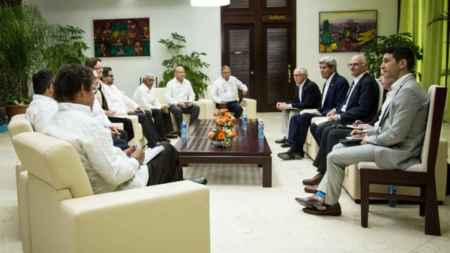
ko

Stop by your local post office and you might just see a poster of Rodrigo “Timochenko” Londono hanging next to the Most Wanted posters of bank robbers and fugitives. The State Department is offering a $5 million reward for information about the Communist terrorist leader.

But all the State Department had to do was ask Secretary of State Kerry. Obama did the wave with the Cuban dictator and Kerry met with Timochenko , the leader of FARC, a Marxist terrorist organization that appears on his own department’s list of foreign terrorist organizations a little above Al Qaeda.

Timochenko is a Communist who was trained at the USSR’s infamous Patrice Lumumba University. The State Department accuses him of ordering the kidnapping of Americans and responsibility for much of the cocaine that is smuggled into the United States. But none of that bothered Kerry who accepted a signed copy of a memoir by the terror group’s former leader which was addressed to “Senor” Kerry.

The signatures in Kerry’s new keepsake include Pablo Catatumbo, a FARC leader with a $2.5 million reward on his head from the State Department, who is wanted for “the production, manufacture, and distribution of hundreds of tons of cocaine to the United States and the world” and “the murder of hundreds of people who violated or interfered with the FARC’s cocaine policies.”Also signing Kerry’s book was Iván Márquez, who has a $5 million reward on his head for most of the same reasons.

Two of the men sitting opposite John Kerry had been convicted of forcing children to join the terror group as soldiers and sex slaves. FARC runs on thousands of child soldiers and sex slaves. Little girls as young as 7 and 9 were brought into the terror group whose fronts have a “quota” of women to fill. Families that refuse to turn over their daughters to FARC have been massacred as a warning to others.

Rape is a typical tactic for the military arm of the Colombian Communist Party. Children were seized from families. Others were “bought” from kidnappers operating in cities. Girls who became pregnant had their children forcibly aborted so the babies wouldn’t interfere with their job of servicing male fighters who protected the narcotics trade while keeping the dream of a Communist dictatorship alive.

But Kerry’s new Communist narcoterrorist chums also had American blood on their hands.

“Take them across the river and burn them.” That was how the lives of three left-wing American environmental activists had ended in the spring of 1999. Their killers were members of the FARC Marxist terror group. The victims were shot in the face after being tortured.

The Clinton administration had engaged in covert contacts with FARC terrorists even while the Marxist terrorists were helping move huge amounts of heroin and cocaine into the United States. Meanwhile it applied pressure on the Columbian government to negotiate with the terrorists by holding up weapons.

Congressman Dan Burton blasted the Clinton White House for “sitting down at the table with a group that actively seeks to wantonly kidnap and murder Americans.”

After the killings, Clinton’s press secretary warned that, “The United States will not rest until those who have committed these crimes have been brought to justice.” The US ambassador to Colombia stated that the United States, “cannot have direct contact with the FARC until it hands over those responsible for the crime.”

That comes as news to Secretary of State John Kerry. Last year, Obama Inc. said that it would not seek the extradition of FARC terrorists. It’s also possible that Obama may hand over Simon Trinidad, a FARC commander serving a sixty-year sentence for his role in taking three American hostages.  Freeing Trinidad has become a popular cause for American leftists.

The three hostages, Marc Gonsalves, Thomas Howes, and Keith Stansell, were held for 5 years until they were rescued. Their pilot, 56-year-old Tom Janis, a Vietnam veteran and Bronze Star recipient, was shot. He left behind a wife and four children. Tom is yet another Vietnam vet betrayed by John Kerry.

Mark Rich, David Mankins, and Rick Tenenoff, three missionaries, were kidnapped and murdered by FARC. As were two other missionaries, Tim Van Dyke and Steve Welsh. Frank Pescatore, a geologist, was kidnapped and murdered by FARC in 1996. The Marxist terrorists packed his body with lime and formaldehyde and tried to pretend that he was still alive in the hopes of collecting a ransom for him.

FARC attempted to murder US Ambassador Myles Frechette and the Deputy Assistant Secretary of Defense. It plotted to bomb President Clinton during his visit to Colombia. Agricultural scientist Thomas Hargrove was kidnapped and held by FARC for almost a year. His story inspired the movie Proof of Life. Eldon Lee Horton and Clyde Nolan Killgore, two American oil workers, were also held hostage by FARC. As was missionary Ray Rising. And bird watchers Peter Shen, Todd Mark and Louise Augustine, a former nun and retired schoolteacher. Tom Fiore, another bird watcher, escaped through the jungle.

In 2003, a FARC terrorist threw grenades at bars that Americans often visited. Five Americans were injured in the blast. Vance Vogeli described his reaction. “I looked down and there was blood.” That same year, FARC had tried to set off a car bomb near the US embassy and American hotels.

FARC’s war on America dates back to 1983 when the Marxist terror group took its first American hostage. Its last American hostage, Kevin Scott Sutay, an ex-Marine, was freed only a few years ago.

Now wanted FARC terrorists have met with Kerry and attended a baseball game with Obama. These are some of the most direct contacts possible. The indictments issued by Attorney General Ashcroft and Gonzalez are null and void. The rewards will eventually be erased by the State Department.

The Bush Administration had parted ways with Clinton’s pandering to terrorists. Instead it indicted FARC leaders and helped Colombia target them with smart bombs. Martin Caballero, a FARC commander who had plotted to bomb Clinton was blown away. As was Raul Reyes, who had been indicted in the abduction of the three American hostages.

But the victories against FARC have been thrown away once again. The peace deal gives FARC the breathing room it needs. At their meeting with Kerry, FARC leaders asked for American protection. And there is little doubt that they will receive it. Obama bailed out Cuba and intends to bail out its FARC terror group. Its American victims will never see justice. Instead their killers and torturers will thrive.

In an administration of endless lows, Secretary of State John Kerry has found a new low by meeting with wanted terrorists from a Marxist organization with American blood on its hands.

“This Cuba policy is also our Latin American policy,” Ben Rhodes boasted. Rhodes is the man who wrote Obama’s Cairo speech. The Cuba policy is solidarity with Communist enemies of the United States. Reversing JFK’s inaugural address, Obama and Kerry will pay any price, oppose any friend and support any foe in order to assure the death and defeat of liberty. That much they have pledged and done.

50 years after Kerry first turned traitor, his betrayal of the United States continues without end.
John Kerry to the World: Let’s Gang up on Israel

March 18, 2016

John Kerry to the World: Let’s Gang up on Israel, Stephen M. Flatlow, March 17, 2016

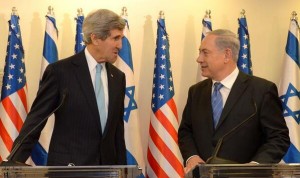
netanyahu-kerry-bibi-300x178 (1)Israeli Prime Minister Netanyahu with US Secretary of State John Kerry. Photo: GPO.

JNS.org – John Kerry has a new strategy for achieving Mideast peace: mobilize the international community to gang up on Israel.

That was the essence of the secretary of state’s disturbing remarks in Paris on March 13. Kerry declared that the Obama administration is “looking for a way forward” to bring about creation of a Palestinian state. He said that Palestinian statehood is “absolutely essential.”

Not just “an idea worth exploring;” not just “something to be considered’.” Rather, “absolutely essential.” Kerry and President Obama have made up their minds and will not consider any alternatives. They have decided that establishing an independent Palestinian state is the only solution to the Arab-Israeli conflict. It’s just a question of how to make it happen.

The administration’s attempts to pressure Israel into creating a Palestinian state obviously have not been successful so far. So Kerry is looking for new ways to harangue the Israelis. Standing next to a group of European foreign ministers at the Paris press conference, Kerry said: “There’s not any one country or one person who can resolve this. This is going to require the global community, it will require international support.”

Significantly, Kerry’s quest for an international alliance to pressure Israel comes on the heels of France’s recent announcement that it will try to convene an international conference to resolve the Israeli-Palestinian conflict. The French said that if the conference failed to produce a Palestinian state, they will go ahead and unilaterally recognize such a state. That’s the French idea of “negotiations.”

The French approach, which Secretary Kerry now seems to be moving towards, is reminiscent of similar proposals that were made back in 1985. Alarmed, then-Defense Minister Yitzhak Rabin flew to Washington to try to head off the convening what was being called an “international umbrella” for Mideast negotiations.

“Whenever anyone mentions umbrella, it reminds me of Chamberlain and Munich,” Rabin declared. For Rabin to invoke the memory of Chamberlain selling out to Hitler at Munich — and for Rabin to use those words at a press conference in Washington — vividly illustrates how dangerous he considered the ‘international’ proposal to be.

It’s not hard to understand why Rabin in 1985 opposed such a proposal, and it’s not hard to see why Israel’s leaders today oppose it, too. If Kerry succeeds in his strategy, such an international conference or umbrella would consist of a dozen or more Arab and European countries ganging up on Israel and demanding that the Israelis make unilateral concessions to the Palestinians. Knowing the Obama administration’s pro-Palestinian slant, one must assume that the US would side with the Arabs and Europeans.

The French — evidently with Kerry’s tacit approval, or perhaps even his encouragement–are pushing forward. French diplomat Pierre Vimont will be visiting Israel and the Palestinian Authority this week to promote France’s initiative. French Foreign Minister Jean-Marc Ayrault, appearing alongside Kerry at the press conference: “The conflict is getting worse and the status quo cannot continue.”

The conflict is getting worse? No, it’s not.

The status quo cannot continue? Yes, it can.

I am the last person in the world to minimize the reality of Palestinian terrorism. But there’s no way anybody can say the current attacks are worse than the weekly bus bombings of the 1990s. Israel’s strong military response put an end to the suicide bombings — which shows that if Israel does not fight with one hand tied behind its back, it can beat the terrorists.

And the status quo may not be the ideal solution, but show me a better one that’s feasible. Withdrawing to indefensible borders? Setting up an armed or soon-to-be-armed Palestinian state just a few miles from Jerusalem and Tel Aviv? In 1976, people were saying “the status quo cannot continue.” They were saying it 1986 and 1996 and 2006, too. Yet here we are, nearly 50 years after the 1967 war — and it has continued, because the alternatives have been worse.

Of course, what Kerry and French call the “status quo” is not at all the same as the status quo of the 1970s or 1980s. In 1995, Rabin withdrew from the areas where 98% of the Palestinians reside. For the past 21 years, the Palestinian Authority has functioned as a de-facto state in a large portion of Judea-Samaria. The only thing the PA lacks is a full-fledged army and the ability to import tanks and planes. And from Israel’s point of view, that’s not such a bad status quo.

So maybe it’s time for Kerry and his gang of would-be interveners to step back, take a deep breath, and face the fact that the slogans and ideas of the 1980s — “status quo,” “international umbrella” and the like — are just not suited to today’s reality.

Kerry to say Islamic State engaged in genocide

March 17, 2016

Kerry to say Islamic State engaged in genocide, Washington ExaminerPete Kasperowicz, March 17, 2016

Secretary of State John Kerry is expected to announce Thursday morning that he believes the Islamic State is committing genocide against Christians and others in Iraq and Syria, according to the Associated Press.

Kerry was set to deliver remarks at 9 a.m. from the State Department.

His remarks are a quick turnaround from Wednesday, when the State Department said it would miss today’s deadline under federal law for determining whether the terror group’s actions should be deemed genocide.

State: Kerry Needs More Evidence to Determine Genocide by ISIS and Assad

March 16, 2016

State: Kerry Needs More Evidence to Determine Genocide by ISIS and Assad, Washington Free Beacon, March 16, 2016

(Kerry is big on evidence. Just look at the Iran scam and nuke inspections. — DM)


State Department deputy spokesman Mark Toner said Wednesday that his boss, Secretary of State John Kerry, needs more evidence to determine if the Islamic State has committed genocide with its slaughter of thousands of innocents throughout the Middle East and North Africa.

Congress had set Kerry a deadline of March 17 to officially determine whether atrocities committed by ISIS constitute genocide, but Toner told reporters during the State Department’s daily press briefing that the department will not have a decision by that date.

“Determining these kinds of legal definitions, such as genocide and crimes against humanity, require a very detailed, rigorous legal analysis,” Toner said. “[Kerry] is a lawyer, and, of course, that’s going to weigh into [how he makes his decision].”

“There are a lot of lawyers on [Captiol] Hill, too,” Associated Press reporter Matt Lee said in response, referring to the House of Representatives unanimously voting 393-0 on Monday to pass a resolution labeling the barbarity ISIS has perpetrated against Christians and other religious minority groups in the Middle East as “genocide.”

Toner clarified that his “only point is that he [Kerry] wants to base his decision on the best evidence available, and he has requested additional evidence, information, in order to [do so].”

“It just seems like there is a lot of evidence already out there,” Lee said in response.

The international community has decried ISIS’ slaughter and enslavement of anyone who does not submit to its uncompromising brand of Sunni Islam, killing Muslims as well as other religious and ethnic groups.

The U.S. Holocaust Memorial Museum determined last year in a report that ISIS is guilty of carrying out genocide against the Yazidi religious minority in northern Iraq, a term the museum rarely uses.

“We believe Islamic State has been and is perpetrating genocide against the Yazidi people,” the report says. “Islamic State’s stated intent and patterns of violence against Shia Shabak and Shia Turkmen also raise concerns about the commission and risk of genocide against these groups.”

The jihadist group has also carried out brutal violence against Christians and other groups, with Muslims making up the highest number of its victims.

The European Parliament voted last month to describe ISIS’ atrocities in Iraq and Syria as genocide.

There has been some debate as to whether using the term “genocide” with ISIS in an official capacity would legally obligate the U.S. to take further action against the jihadist group, which some people have argued is why the Obama administration is reluctant to do so.

Toner made clear at Monday’s press briefing that no legal requirement comes with using the term, but he stressed the international community has an obligation under the United Nations to stop crimes against humanity and other such atrocities like the ones being committed by ISIS.

In addition to the resolution on genocide passed Monday, the House also voted 392-3 to pass a measure calling for the creation of an international tribunal to try the regime of Syrian president Bashar al-Assad for war crimes.

Assad triggered the Syrian civil war in 2011 by slaughtering his own people for peacefully protesting his authoritarian rule. He has since waged a war against the Syrian people who formed an opposition in response, resulting thus far in about 400,000 deaths and the displacement of millions of others.

Assad has received help from Iran, Lebanese Hezbollah, and Russia to stay in power.

Iran’s Free Hand in Testing Ballistic Missiles

March 16, 2016

Iran’s Free Hand in Testing Ballistic Missiles, Front Page MagazineJoseph Klein, March 16, 2016

rg

The United Nations Security Council met in an “emergency” closed door session on Monday March 14th to discuss Iran’s recent testing of ballistic missiles reportedly designed to be capable of delivering nuclear weapons. The words “Israel must be wiped out” were written in Hebrew on the side of the missiles. These most recent tests followed in the wake of missile tests conducted last fall, which the Security Council did nothing about at the time.

While North Korea was finally hit with more UN sanctions for its nuclear and missile tests, North Korea’s nuclear weapons collaborators in Iran continue to be let off the hook without even a slap on the wrist.

U.S. Ambassador to the UN Samantha Power told reporters, after the March 14th meeting produced no concrete results, that she will keep trying “no matter the quibbling that we heard today about this and that.” She said that Iran’s missile tests were “in defiance of provisions of UN Security Council Resolution 2231, the resolution that came into effect on January 16, on Implementation Day for the JCPOA [Joint Comprehensive Plan of Action].”

The quibbler in chief is Russia. Its UN ambassador said that Iran has not violated the resolution and that there was no need for any punitive measures against Iran.

The truth is that the Obama administration is now hoisted with its own petard. Ambassador Power complained that “Russia seems to be lawyering its way to look for reasons not to act rather than stepping up and being prepared to shoulder our collective responsibility.” Yet that would not have been as easy for Russia to do if the Obama administration had not allowed a loophole in the nuclear deal wide enough for Iran to fire a whole bunch of missiles through.

President Obama wanted the nuclear deal with Iran so badly that he gave in to Iran’s last minute demands to preserve its missile program. Iran insisted that all prior UN Security Council resolutions which had unambiguously prohibited Iran’s development, testing or procurement of ballistic missiles designed to be capable of delivering nuclear weapons must be terminated. Otherwise, Iran would not go forward with the JCPOA. To make matters worse, even though Iran had held the JCPOA hostage to its missile demands, the Obama administration also bowed to Iran’s insistence that its missile program would not be covered by the JCPOA itself. Thus, Iran would not be subject to the automatic “snap back” of sanctions when Iran is found to have violated the JCPOA, because its missile tests would be outside the scope of the JCPOA. In fact, the Obama administration agreed to language in the JCPOA to clarify that such separation of Iran’s missile program from the JCPOA was the intent. All reliance for dealing with Iran’s missile tests would be placed on the much weaker Security Council Resolution 2231.

The new Security Council Resolution 2231, which endorsed the JCPOA but drafted as separate from the JCPOA, used weaker language than the outright prohibition that had existed under the prior resolutions that were now superseded. Calling upon Iran to refrain from doing something is not the same as an enforceable ban. Moreover, even this insipid “call upon” language is included in an annex to the resolution. This annex is little more than a statement of intent by the parties negotiating with Iran, which Iran does not consider binding on itself.

The Obama administration missed the window of opportunity to clamp down on Iran’s missile testing when those tests were being conducted last fall. The previous Security Council resolutions that prohibited Iran’s missile program outright, and the sanctions regime against Iran, were then still in effect. Those resolutions were referenced in the JCPOA itself as still being binding until the JCPOA was actually implemented. Implementation in turn was dependent on verification of Iran’s compliance with certain commitments set forth in the JCPOA having to do with its enrichment and plutonium programs. Until the JCPOA’s formal implementation date of January 16, 2016, when those resolutions were terminated, the missile program ban had not been technically untethered from the JCPOA.

All the Obama administration had to do last fall was to declare Iran in breach of the JCPOA because the missile ban under those resolutions that Iran breached were effectively incorporated into the JCPOA until terminated. The sanctions were still in place. Iran’s assets were still frozen. Russia’s “lawyering” would have done it little good last fall when the United States still had the upper hand both legally and in practical terms. But President Obama frittered away the last real chance to hold Iran’s feet to the fire before the sanctions were lifted. He wanted the nuclear deal to go forward as a centerpiece of his “legacy” and let the next president worry about its fallout.

In fact, instead of pressing the case against Iran and threatening to walk away from the JCPOA when he had the leverage, Secretary of State John Kerry actually defended Iran’s position on its missile tests. “The issue of ballistic missiles is addressed by the provisions of the new United Nations Security Council Resolution (UNSCR), which do not constitute provisions of the Joint Comprehensive Plan of Action (JCPOA),” Kerry wrote in a letter to Senator Marco Rubio last September.  “Since the Security Council has called upon Iran not to undertake any activity related to ballistic missiles designed to be capable of delivering nuclear weapons, including launches using such ballistic missile technology, any such activity would be inconsistent with the UNSCR and a serious matter for the Security Council to review.”

Rubio raised his concern with Kerry that the language in the new Security Council resolution did not appear to require Iran to refrain from pursuing its ballistic missile tests. Rubio seized upon the weak “call upon” language discussed earlier as the basis for his concern. Kerry’s response was that “if Iran were to undertake them it would be inconsistent with the UNSCR and a serious matter for the Security Council to review.”

Senator Rubio had a right to be concerned. Kerry had deliberately agreed to a circular process to deal with Iran’s missile program violations, which was doomed to fail. To placate Iran, he kicked the can down the road until the JCPOA was actually implemented and the prior, much stronger Security Council missile resolutions that were initially tied into the JCPOA by reference went away. The separation of the JCPOA and the new Security Council resolution was completed as of the formal implementation date. Kerry had to know that once the JCPOA was implemented and in full force, with sanctions lifted and the missile program separated out from the JCPOA with its automatic “snap back” provisions, Russia would likely veto any separate sanctions resolution against its ally and missile purchaser based on Iran’s missile tests. The American people got suckered by President Obama’s reckless concessions.

Iran not only will have a pathway to nuclear enrichment sufficient to produce nuclear weapons when the deal’s restrictions sunset – if not before. Thanks to the Obama administration, Iran presently has a free hand to develop and test ballistic missiles capable of delivering those nuclear weapons along any pathway of attack it chooses.

Russia Reminds Obama: You Caved on Iran’s Missile Program, Bro

March 15, 2016

Russia Reminds Obama: You Caved on Iran’s Missile Program, Bro, Washington Free Beacon, Beacon Staff, March 15, 2016


https://www.youtube.com/watch?v=G-isxwtpw_U


Days after the latest Iranian ballistic missile test, Russia and Iran are telling the Obama administration that Iranian missile tests are not prohibited by the UN Security Council, as the administration argues.

Russia and Iran cited language about ballistic missiles that was changed during last summer’s nuclear negotiations in Vienna. UN Security Council Resolution 1929 had stated plainly: “Iran shall not undertake any activity related to ballistic missiles.” During the negotiations, Iran demanded the removal of this uncompromising language in favor of a new, softer formulation.

The Obama administration complied, resulting in the passage of a new UN Security Council Resolution after the Iran agreement was reached. The new resolution merely “calls upon Iran not to undertake any activity related to ballistic missiles.”

The change in language—from the “shall not” requirement of the original resolution to the “calls upon” suggestion of the new one—was the subject of intense questioning by Congress precisely due to the suspicion that the administration had provided a loophole Iran would use to justify missile development.

In one exchange, Sen. Robert Menendez (D., N.J.) pressed Secretary of State John Kerry to acknowledge that the change in language was substantive.

“The ban on Iranian ballistic missiles,” Menendez told Kerry, “has, in fact, been lifted. The new Security Council resolution is quite clear. Iran is not prohibited from carrying out ballistic missile work.” Kerry rejected Menendez: “That is not accurate … [Iran is] restrained from any sharing of missile technology, purchase of missile technology, exchange of missile technology, work on missiles.”

In response to the Obama administration’s announcement that it would pursue sanctions after Iran’s latest missile test, Russia’s UN Ambassador raised precisely the objection that Menendez and other critics of the deal did: Obama and Kerry removed the prohibition on Iranian ballistic missile work last summer, when they agreed to remove the “shall not” language from the relevant UNSC resolution.

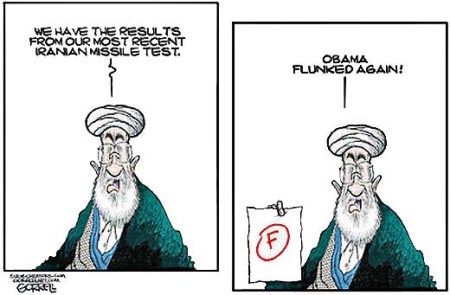
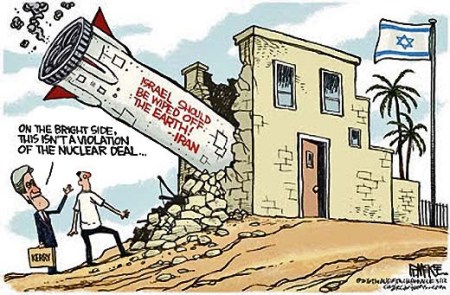
Cartoons of the Day

March 13, 2016

H/t Vermont Loon Watch

a-test
treaty

Syria Ceasefire Already Collapsing

March 8, 2016

Syria Ceasefire Already Collapsing, Front Page MagazineJoseph Klein, March 8, 2016

syria-bashar

The two week “cessation of hostilities” within Syria is about to run out. Negotiated by the United States and Russia, who were responsible for bringing the parties over which they have influence along, the lull was intended as a confidence building measure and as a way of getting critical humanitarian supplies to besieged and hard to reach areas of Syria. Talks between Syrian government and opposition representatives are supposed to resume in Geneva on March 9th.

Secretary of State John Kerry hailed the agreement to temporarily halt the violence in a conflict that has taken more than 250,000 lives as “a moment of promise.”  While there is evidence that the fighting has dropped noticeably overall since the cessation of hostilities went into effect on February 26, 2016, the violence never really stopped. On the second day alone of the lull, there were reportedly “35 breaches, 27 by violations by government forces, 8 by Russian forces,” according to the Syrian Network for Human Rights.

Airstrikes continued throughout Syria, some by Russia on the pretext that they were aimed at fighting ISIS and al Nusra. Rebel-held enclaves in and around Aleppo have come under particularly intense bombing attacks, said to be by Russian planes.

The Syrian Observatory for Human Rights said last Saturday that 135 people have lost their lives in areas where there was supposed to be a pause in hostilities. According to Israeli sources, the Syrian government has reportedly used chemical weapons against civilians since the cessation of hostilities were supposed to go into effect.

The United Nations has nevertheless been able to use the drop in hostilities to deliver some desperately needed humanitarian relief, although it has been stymied by bureaucratic obstacles put in the UN’s way by Syrian authorities. Sometimes, Syrian officials have gone so far as removing medical supplies from humanitarian convoys that had received permission to deliver their cargoes.

Perhaps the United States and Russia will push for an extension of the cessation of hostilities. Kerry and his Russian counterpart, Russian Foreign Minister Sergei Lavrov, have called for a prompt resumption of the peace talks in Syria, which would be hard to assemble if fighting resumes full throttle. They are evidently hoping that the partial success of the lull in fighting so far will provide momentum for successful talks. If so, they are dreaming. Kerry in particular is relying on the fatally flawed road map to a negotiated political solution in Syria that was laid out in last December’s UN Security Council Resolution 2258 (2015).  As I wrote last December when the resolution was adopted, the players were simply kicking the can down the road to no avail.

The Syrian regime, with Russia’s help, has made major military gains on the ground in recent months. Momentum is on its side. The opposition groups are losing negotiating leverage every day as a result of the regime’s advances and the opposition’s own internal divisions. Though the opposition is at least united on calling for Syrian President Bashar Al-Assad to step down immediately, they are whistling in the wind. Assad has no reason to go as long as Russia and Iran remain willing to stand behind him.

Russia has clearly changed the whole strategic situation in Syria by showing its willingness to engage militarily to the extent necessary to keep Assad in power as long as he serves their purposes. Just as President Obama foolishly dismissed the ISIS threat early on, his dismissal of Russia’s determination and capabilities was premature, to say the least.

The Obama administration’s vacillations in its Syrian policies, which left vacuums for both ISIS and Russia to fill, are now limiting its options going forward. Even in the unlikely case that President Obama now believes that the introduction of a large number of U.S. ground troops has become necessary to fight ISIS, give a nudge to Assad to abdicate and help stabilize what is left of Syria, the American people would not support the prospect of another protracted conflict in the Middle East.

Moreover, the Obama administration cannot even lead the way among its own allies, much less bridge the gap with Russia and Iran who remain committed to Assad. The administration’s efforts to assemble a real coalition of Arab nations willing to commit major ground troops to fight ISIS in tandem with our stepped up airstrikes have gone nowhere. Saudi Arabia and Qatar do not appear willing to cut off the flow of arms and money to the jihadists, whether or not they belong to ISIS or al Nusra. Saudi Arabia is even insisting on which opposition groups should officially represent the opposition in the Geneva talks, with little apparent pushback from the Obama administration.

Turkey is presenting its own headaches for the Obama administration. Its strongman president Recep Tayyip Erdogan accused the Obama administration of adopting a policy that has turned the Mideast into “a sea of blood.” He was particularly upset that the U.S. is relying on Kurdish fighters in Syria to help take on ISIS. The Kurds have been among the most effective ground forces we have to push back ISIS from territories it controls. Erdogan, however, regards the Kurds as terrorists who are more dangerous than ISIS. He blocked the Syrian Kurds from having any official representation in the Geneva peace talks, and is asking the U.S. to choose between Turkey and the Kurds as allies. The way Erdogan has been acting the last several years, we should tell him that unless he starts to fully cooperate and subordinate his parochial concerns to the global fight against ISIS, we will be prepared to support an independent Kurdistan right on his border. That should get his attention.

In short, the cessation of hostilities interlude, even if extended, will do nothing to change the underlying dynamics preventing a viable peace accord leading to the kind of inclusive Syrian government the Obama administration would like to see. However, to the extent lives have been saved and humanitarian relief has been allowed to get through for the first time, the pause in fighting has been a good thing in itself.

Kerry Announces New Plan not to Talk about Failed Ceasefire

March 1, 2016

Kerry Announces New Plan not to Talk about Failed Ceasefire, Front Page Magazine, Daniel Greenfield, March 1, 2016

kerrynuke_1

Long, talk [Sic] drink of failure John Kerry is on his second failed ceasefire in Syria in a matter of weeks. And he’s got a bold new plan for dealing with the fact that everyone is still shooting up Syria. Don’t ask, don’t tell.

John Kerry said on Monday he had agreed with his Russian counterpart not to discuss alleged violations of a cessation of hostilities plan in Syria… Speaking at a news conference with German Foreign Minister Frank-Walter Steinmeier, Kerry said he had talked with Russian Foreign Minister Sergei Lavrov and agreed not to “litigate … in a public fashion” the reports of violations on both sides.

So the plan is for Russia to keep violating the ceasefire while Kerry and the Europeans refuse to mention it. This is pure genius. They’ve really got Putin on the run now.

This will be followed by a bold plan to ignore any Iranian violations of the nuclear deal and just hold more negotiations to create a mechanism for privately resolving any violations.

And people said that John Kerry was unqualified to get a cup of coffee, let alone be America’s top diplomat. I bet that Kerry could get a cup of coffee almost without burning himself. But the ceasefire that isn’t, is producing all sorts of unintended results.

Over the past month, the Kremlin has turned up the dial once again in its low intensity war in Ukraine’s east.

In September 2015, when the Kremlin decided to intervene in Syria, it reduced the violence in the Donbas and reined in local fighters who opposed this course. Before September, ceasefire violations had averaged 70 to 80 fire incidents per day, before dropping to 30 to 40.

Can someone give Obama another Nobel Peace Prize? Maybe an even bigger one covered in diamonds. Because he deserves it. He really does.

North Korea’s Sanctions Loophole

February 29, 2016

North Korea’s Sanctions Loophole, Wall Street Journal, February 28, 2016

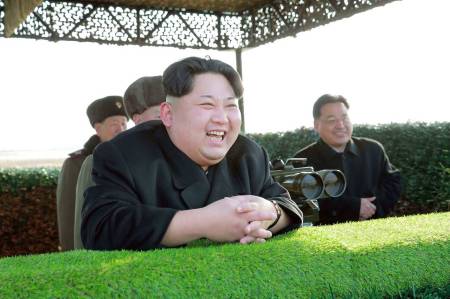
Happy KimThis undated picture released from North Korea’s official Korean Central News Agency on February 27, 2016 shows North Korean leader Kim Jong-Un smiling during the inspection of the test-fire of a newly developed anti-tank guided weapon at an undisclosed location. PHOTO: KCNA VIA KNS/AFP/GETTY IMAGES

The Obama Administration is touting the latest United Nations sanctions as a milestone against North Korea’s nuclear and missile programs. We’d like to believe it too, but a close look at the draft Security Council resolution offers many reasons to doubt.

The resolution would double the number of blacklisted North Korean individuals and state entities, adding Pyongyang’s atomic-energy and space agencies. Luxury goods banned from export to North Korea would grow to include watches, yachts and snowmobiles. A ban on sales of aviation fuel targets state-owned airline Air Koryo, while a ban on sales of rocket fuel targets Kim Jong Un’s missile program.

More significant are efforts to cut Pyongyang’s access to hard currency and smuggled weapons technology. The sanctions expand the list of banned arms and dual-use goods, and they require states to inspect all cargo transiting their territory to or from North Korea by sea, air or land. They would also squeeze North Korean mineral exports, including coal and iron ore, which in 2014 accounted for 53% of Pyongyang’s $2.8 billion in exports to China, per South Korean state figures.

Overall the blacklist of North Korean proliferators is growing by only 12 individuals and 20 entities to a total of 64; the U.N.’s former blacklist on Iran was far larger at 121. In any case, none of these matter if China won’t rigorously enforce them—which it has never done.

There are other loopholes and oversights. The nominal ban on North Korean mineral exports applies only to purchases that demonstrably fund illicit activities, rather than “livelihood purposes.” Yet money is fungible, so Chinese coal purchases excused on livelihood or humanitarian grounds will still channel hundreds of millions of dollars to the regime.

The sanctions also do nothing about the Chinese oil transfers that keep the Kim regime alive. Or Chinese purchases of textiles from mostly state-run North Korean factories that have quadrupled to $741 million a year since 2010 and recently ensnared Australian surf brand Rip Curl in a supply-chain controversy. Or the 50,000-plus North Korean laborers overseas, largely in China and Russia, earning some $230 million a year for their masters in Pyongyang.

U.S. officials say China has new incentive to back sanctions because it wants to block South Korea’s recent moves to deploy the U.S.-built Thaad missile-defense system. That may be why China wants to look cooperative, but the new sanctions aren’t enough to justify walking back on Thaad. China still views the North as a political buffer against South Korea, a thorn in the side of Japan and the U.S., and a diplomatic card to play at the U.N. So China has long played a double game of rhetorically deploring North Korea’s nuclear program while propping it up in practice.

The better way to squeeze the North is closer cooperation among Washington, Seoul and Tokyo to sanction Chinese banks that facilitate trade with Pyongyang. This worked a decade ago until the Bush Administration fell for more of China’s diplomatic promises. China won’t get serious about stopping North Korea until it sees that the U.S. and its allies are serious.