Archive for the ‘Japan’ category

North Korean Nukes, South Korea, Japan, China and Obama

September 10, 2016

North Korean Nukes, South Korea, Japan, China and Obama, Dan Miller’s Blog, September 10, 2016

(The views expressed in this article are mine and do not necessarily reflect those of Warsclerotic or its other editors. — DM)

On September 9th, North Korea conducted its fifth nuke test, of its most powerful nuke thus far. Can Obama get China to help make North Korea stop developing and testing nukes? Nope. China sees Obama, not as the representative of the world’s greatest power, but as a joke. He has no clout internationally and is a national embarrassment.

China and North Korea – a very short history

Here’s a link to an article I posted on June 25, 2013 about the Korean conflict. To summarize, China and the Democratic People’s Republic of Korea (North Korea) have a long history of acting together. China views the Republic of Korea (South Korea), which borders North Korea to the south and is an American ally, as a threat. She does not want reunification of the Korean peninsula under a government favorable to America.

When, on June 25, 1950, North Korea invaded South Korea with Russian aircraft, weaponry, training and other substantial support, China did not assist North Korea. North Korean forces pushed the South Korean government, as well as the few American military advisers (then under the command of the Department of State), south to the Pusan perimeter. Following General MacArthur’s unexpected and successful Inchon invasion which began on September 15th, American and other United Nations forces pushed the North Korean forces back north: MacArthur sent his by then greatly augmented forces east to Wonson and eventually managed to push North Korean forces to the northern side of the Yalu River. However, Chinese forces struck back en masse and MacArthur’s forces were driven back to Seoul.

Ever since bringing to an end MacArthur’s successes in the Korean Conflict, China has supported North Korea. She has opposed, and has then declined to enforce, significant sanctions responsive to North Korean nuclear and missile development and testing. While China may acquiesce in weak UN resolutions condemning North Korean provocations, she rarely goes beyond that.

China, Japan and the two Koreas

China has a long memory and still resents, bitterly, the lengthy period prior to and during World War II when Japan occupied significant parts of China. Ditto South Korea, all of which was under Japanese occupation for a lengthy period prior to and during World War II. Although China has substantial trade with both South Korea and Japan, she is more hostile to Japan than is South Korea; the latter two have substantial mutual interests transcending trade.

Perhaps the most important current dispute between China on the one hand, and Japan-South Korea-America on the other, involves the plans of Japan and South Korea to defend against North Korean missiles by the installation of THAAD anti-missile weapons provided by America. China’s stated reason for opposition to the THAAD system is that it could be used against Chinese, as well as North Korean, missiles. Why does China assert this objection unless she hopes to fire missiles at one or both of them? If China fires missiles at Japan and/or South Korea, they have every right to destroy her missiles and to respond in kind with U.S. assistance if requested.

President Obama

condemned Pyongyang’s fifth nuclear test today in the “strongest possible terms as a grave threat to regional security and to international peace and stability” as outraged lawmakers from both parties called for tougher action to stop North Korea’s nuclear program. [Emphasis added.]

That may well be all that Obama does — despite the warnings of Rep. Adam Smith (D-Wash.), the top Democrat on the House Armed Services Committee, that

we have to make it absolutely clear that if they engage in any military activity, they will be destroyed. We have to have a credible deterrent. That seems to be the only thing that will stop North Korea from engaging in military action… We have sanctioned them, and we should keep sanctioning them, but it’s not going to stop them from developing the nuclear weapons.” [Emphasis added.]

Obama won’t do that:

In a statement Friday, President Obama vowed to “take additional significant steps, including new sanctions, to demonstrate to North Korea that there are consequences to its unlawful and dangerous actions.”

Obama did not suggest what He might have in mind, beyond historically ineffective sanctions and condemnations “in the strongest possible terms,” to let North Korea know that there will be “consequences.”

A September 9th article at the New York Times provides an unpleasant analysis of the options Obama now has, and which His successor will have, in dealing with North Korea.

A hard embargo, in which Washington and its allies block all shipping into and out of North Korea and seek to paralyze its finances, risks confrontations that allies in Asia fear could quickly escalate into war. But restarting talks on the North’s terms would reward the defiance of its young leader, Kim Jong-un, with no guarantee that he will dismantle the nuclear program irrevocably.

For more than seven years, President Obama has sought to find a middle ground, adopting a policy of gradually escalating sanctions that the White House once called “strategic patience.” But the test on Friday — the North’s fifth and most powerful blast yet, perhaps with nearly twice the strength of its last one — eliminates any doubt that that approach has failed and that the North has mastered the basics of detonating a nuclear weapon.

Despite sanctions and technological backwardness, North Korea appears to have enjoyed a burst of progress in its missile program over the last decade, with experts warning that it is speeding toward a day when it will be able to threaten the West Coast of the United States and perhaps the entire country. [Emphasis added.]

. . . .

Mr. Obama has refused to negotiate with the North unless it agrees first that the ultimate objective of any talks would be a Korean Peninsula without nuclear arms. But Mr. Kim has demonstrated, at least for now, that time is on his side. And as he gets closer to an ability to threaten the United States with a nuclear attack, and stakes the credibility of his government on it, it may be even more difficult to persuade him to give up the program.

 In a statement Friday, Mr. Obama condemned the North’s test and said it “follows an unprecedented campaign of ballistic missile launches, which North Korea claims are intended to serve as delivery vehicles intended to target the United States and our allies.”

“To be clear, the United States does not, and never will, accept North Korea as a nuclear state,” he said.

Many experts who have dealt with North Korea say the United States may have no choice but to do so. [Emphasis added.]

“It’s too late on the nuclear weapons program — that is not going to be reversed,” William Perry, the defense secretary under President Bill Clinton during the 1994 nuclear crisis with North Korea, said in August at a presentation in Kent, Conn. The only choice now, he argued, is to focus on limiting the missile program. [Emphasis added.]

Obama has taken no significant steps to limit Iran’s continuing missile development and testing program. How can He limit that of North Korea without Chinese cooperation?

Yet the latest effort to do that, an agreement between the United States and South Korea to deploy an advanced missile defense system in the South, has inflamed China, which argues the system is also aimed at its weapons. While American officials deny that, the issue has divided Washington and Beijing so sharply that it will be even more difficult now for them to come up with a joint strategy for dealing with the North. [Emphasis added.]

China has been so vocal with its displeasure over the deployment of the American system that Mr. Kim may have concluded he could afford to upset Beijing by conducting Friday’s test. [Emphasis added.]

Fueling that perception were reports that a North Korean envoy visited Beijing earlier this week.

North Korea almost certainly sees this as an opportunity to take steps to enhance its nuclear and missile capabilities with little risk that China will do anything in response,” Evans J.R. Revere, a former State Department official and North Korea specialist, said in a speech in Seoul on Friday. [Emphasis added.]

The breach between China and the United States was evident during Mr. Obama’s meeting with President Xi Jinping last week. “I indicated to him that if the Thaad bothered him, particularly since it has no purpose other than defensive and does not change the strategic balance between the United States and China, that they need to work with us more effectively to change Pyongyang’s behavior,” Mr. Obama said, referring to the Terminal High Altitude Area Defense system, as the advanced missile defense project is known. [Emphasis added.]

North Korea and Iran

Iran and North Korea have a long history of cooperation in developing nukes and missiles with which to deliver them. In the past, Iranian scientists have been present at North Korean nuke tests, and vice versa. They have also assisted each other in the development of nukes and missiles.

Iran and North Korea have substantial reasons to cooperate: by virtue of the Iran scam, Iran now has lots of money but is at least minimally restricted in its nuke development. North Korea has little usable currency, needs whatever it can get, and no attempts to halt or even to limit its nuke development have worked.

A missile fired recently by North Korea bore a striking resemblance to an Iranian missile.

Photos released by North Korea of its launch of long-range ballistic missiles are the latest proof of the close military cooperation between Pyongyang and Tehran, an Israeli expert in the field told the news site IsraelDefense on Tuesday.

According to Tal Inbar — head of Space and UAV Research Centre at the Fisher Institute for Air & Space Strategic Studies — what was new in the photos was the shape of the warheads attached to the Nodong missiles, known in Iran as the Shahab-3.

Until now, such warheads — first detected by Inbar in Iran in 2010 — have not been seen in North Korea. At the time, Inbar dubbed them NRVs (or, “new entry vehicles”), which became their nickname among missile experts around the world. [Emphasis added.]

Inbar told IsraelDefense: “The configuration that we saw [on Tuesday] is identical to what we saw in Iran six years ago. In principle, its penetrating body (warhead) is identical to that of Scud missiles, but is mounted on the Shahab-3, and creates a more stable entity than other Shahab/Nodong warheads.”

Inbar said this was the third time that something of this nature had appeared in Iran before it did in North Korea. “But we must remember that the two countries engage in close cooperation where military and space-directed missiles are concerned,” he said. “It is thus possible that both plans and technology are being transferred regularly from one to the other.” [Emphasis added.]

Are North Korea and Iran rational? According to this New York Times analysis, North Korea is.

North Korea’s actions abroad and at home, while abhorrent, appear well within its rational self-interest, according to a 2003 study by David C. Kang, a political scientist now at the University of Southern California. At home and abroad, he found, North Korean leaders shrewdly determined their interests and acted on them. (In an email, he said his conclusions still applied.) [Emphasis added.]

“All the evidence points to their ability to make sophisticated decisions and to manage palace, domestic and international politics with extreme precision,” Mr. Kang wrote. “It is not possible to argue these were irrational leaders, unable to make means-ends calculations.” [Emphasis added.]

Victor Cha, a Georgetown University professor who served as the Asian affairs director on George W. Bush’s National Security Council, has repeatedly argued that North Korea’s leadership is rational.

I submit that the same analysis, applied to Iran, produces the same result. Iran’s leaders know what they want, and are sufficiently rational to achieve it; they did. Obama, not the leader of a dictatorial theocracy, is sufficiently irrational to believe that what he wants for the Islamic Republic of Iran is what America needs it to have. It is not.

Obama and Iran

Obama’s Iran scam would be farcical were it not potentially deadly. He did not do what would have been best for America and the free world in general — increase sanctions until Iran complied fully with UN resolutions on missile testing, ceased Uranium enrichment and disposed of the means to do it, ceased all nuke research as well as all nuke cooperation with North Korea and ceased supporting all terrorist groups, including Hezbollah and Hamas. Instead, perhaps considering Himself above such trivia, Obama sought little more than what He considered His greatest achievement — His legacy:
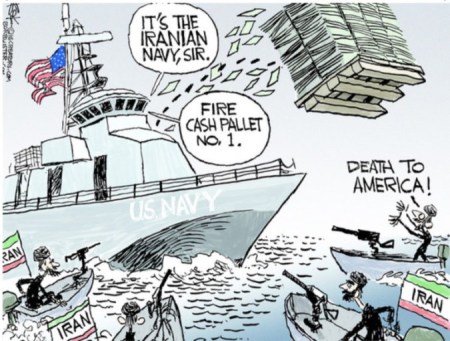
iranian-navy-copy-1

Conclusions

If Obama were viewed internationally as the powerful leader of the world’s most powerful nation, He might be able to get China to clamp down, severely and successfully, on North Korea’s nuke and missile development. Were China to reject His overtures, He could arrange for it to wish that it had acceded. That’s not who Obama is, as demonstrated by, among His other actions, entering into the Iran Scam deal with Iran.

Perhaps Kim Jong-un needs to dress like an Iranian mullah to convince Obama to give him a “deal” similar to the one He gave to Iran. He had better hurry: that won’t work with President Trump.

A Big Blast in North Korea, and Big Questions on U.S. Policy

September 9, 2016

A Big Blast in North Korea, and Big Questions on U.S. Policy, New York Times

GENEVA — North Korea’s latest test of an atomic weapon leaves the United States with an uncomfortable choice: stick with a policy of incremental sanctions that has clearly failed to stop the country’s nuclear advances, or pick among alternatives that range from the highly risky to the repugnant.

A hard embargo, in which Washington and its allies block all shipping into and out of North Korea and seek to paralyze its finances, risks confrontations that allies in Asia fear could quickly escalate into war. But restarting talks on the North’s terms would reward the defiance of its young leader, Kim Jong-un, with no guarantee that he will dismantle the nuclear program irrevocably.

For more than seven years, President Obama has sought to find a middle ground, adopting a policy of gradually escalating sanctions that the White House once called “strategic patience.” But the test on Friday — the North’s fifth and most powerful blast yet, perhaps with nearly twice the strength of its last one — eliminates any doubt that that approach has failed and that the North has mastered the basics of detonating a nuclear weapon.

Despite sanctions and technological backwardness, North Korea appears to have enjoyed a burst of progress in its missile program over the last decade, with experts warning that it is speeding toward a day when it will be able to threaten the West Coast of the United States and perhaps the entire country.

“This is not a cry for negotiations,” said Victor Cha, who served in the administration of President George W. Bush and now is a North Korea expert at the Center for Strategic and International Studies in Washington. “This is very clearly a serious effort at amassing real nuclear capabilities that they can use to deter the U.S. and others.”

Mr. Cha said the usual response from Washington, Seoul and Tokyo — for another round of sanctions — was not likely to be any more successful at changing the North’s behavior than previous rounds. That means Mr. Obama’s successor will confront a nuclear and missile program far more advanced than the one Mr. Obama began grappling with in 2009.

Mr. Obama has refused to negotiate with the North unless it agrees first that the ultimate objective of any talks would be a Korean Peninsula without nuclear arms. But Mr. Kim has demonstrated, at least for now, that time is on his side. And as he gets closer to an ability to threaten the United States with a nuclear attack, and stakes the credibility of his government on it, it may be even more difficult to persuade him to give up the program.

 In a statement Friday, Mr. Obama condemned the North’s test and said it “follows an unprecedented campaign of ballistic missile launches, which North Korea claims are intended to serve as delivery vehicles intended to target the United States and our allies.”

“To be clear, the United States does not, and never will, accept North Korea as a nuclear state,” he said.

Many experts who have dealt with North Korea say the United States may have no choice but to do so.

“It’s too late on the nuclear weapons program — that is not going to be reversed,” William Perry, the defense secretary under President Bill Clinton during the 1994 nuclear crisis with North Korea, said in August at a presentation in Kent, Conn. The only choice now, he argued, is to focus on limiting the missile program.

Yet the latest effort to do that, an agreement between the United States and South Korea to deploy an advanced missile defense system in the South, has inflamed China, which argues the system is also aimed at its weapons. While American officials deny that, the issue has divided Washington and Beijing so sharply that it will be even more difficult now for them to come up with a joint strategy for dealing with the North.

China has been so vocal with its displeasure over the deployment of the American system that Mr. Kim may have concluded he could afford to upset Beijing by conducting Friday’s test.

Fueling that perception were reports that a North Korean envoy visited Beijing earlier this week.

“North Korea almost certainly sees this as an opportunity to take steps to enhance its nuclear and missile capabilities with little risk that China will do anything in response,” Evans J.R. Revere, a former State Department official and North Korea specialist, said in a speech in Seoul on Friday.

The breach between China and the United States was evident during Mr. Obama’s meeting with President Xi Jinping last week. “I indicated to him that if the Thaad bothered him, particularly since it has no purpose other than defensive and does not change the strategic balance between the United States and China, that they need to work with us more effectively to change Pyongyang’s behavior,” Mr. Obama said, referring to the Terminal High Altitude Area Defense system, as the advanced missile defense project is known.

But Mr. Obama noted that sanctions had failed at having much effect. That is largely because the Chinese have left open large loopholes that have kept the North Korean economy alive and, by some measures, enjoying more trade than anytime in years.

In a recent paper, two researchers concluded that sanctions so far “have had the net effect of actually improving” North Korea’s procurement capabilities for its weapons program. To evade sanctions, the North’s state-run trading companies opened offices in China, hired more capable Chinese middlemen and paid higher fees to employ more sophisticated brokers, according to Jim Walsh and John Park, scholars at M.I.T. and Harvard respectively.

The sanctions, Mr. Cha noted, “are supposed to inflict enough pain so the regime comes back to the negotiation table, and that’s clearly not working; or it’s supposed to collapse the regime until it starves, and that’s not working either.”

“Unless China is willing to cut off everything, which they don’t appear willing to do, the sanctions may be politically the right thing to do and a requisite response, but they are not the answer to the problem,” he said.

That means the choices facing Mr. Obama’s successor will be stark. One option is to choke off all trade, in part by telling banks that conduct transactions with North Korea that they will be shut out of dealing in dollars around the world — an effective tactic against Iran before last year’s nuclear deal. But that would enrage the Chinese, and probably cut into cooperation on other issues.

At the same time, an attempt to intercept all shipping could quickly escalate into a full-blown conflict, something neither Mr. Obama nor the South Koreans and Japanese have been willing to risk.

On the other hand, reopening negotiations, which Donald J. Trump has indicated he is willing to consider, could mean paying North Korea again to freeze nuclear activities that the Bush administration and the Clinton administration had already rewarded them for stopping years ago.

The nuclear program dates back to Mr. Kim’s grandfather, Kim Il-sung, the country’s founder, who emerged from the Korean War more than 60 years ago mindful that the United States had considered using nuclear weapons in that conflict and determined to get his own arsenal.

The missile program also has a long history, mostly to deliver conventional arms. But now the two are converging, as the North races to develop a weapon small, light and durable enough to be launched into space and survive re-entry into the atmosphere.

The explosive energy unleashed during the test on Friday, estimated at 10 to 12 kilotons of TNT, was nearly twice that of the North’s last test, conducted in January, said Yoo Yong-gyu, a senior seismologist at South Korea’s National Meteorological Administration.

And the fact that North Korea’s fifth test came only eight months after its fourth is another indication that it is making fast progress toward fitting its ballistic missiles with nuclear warheads, said Choi Kang, a senior analyst at the Asan Institute. The North had waited about three years between each of its previous tests.

North Korea’s advances have unnerved its neighbors in South Korea and Japan, and Mr. Trump’s suggestion that the two nations should pay more for the United States to defend them has not helped.

In both South Korea and Japan, a small but increasingly vocal minority hasbegun to advocate developing nuclear weapons to counter the North instead of relying on the United States.

Cheong Seong-chang, a senior analyst at the Sejong Institute in Seongnam, south of Seoul, argued that a South Korean nuclear program might distract the North from its efforts to build a long-range missile capable of delivering a nuclear warhead to the mainland United States.

“If South Korea arms itself with nuclear weapons, North Korea will regard the South Korean nuclear weapons, not the distant American nukes, as the most direct threat to its security,” Mr. Cheong said.

The China Test

August 26, 2016

The China Test, Washington Free Beacon, August 26, 2016

U.S. Secretary of State Hillary Clinton, left, prepares to shake hands with China's Vice President Xi Jinping during a meeting at Diaoyutai State Guesthouse in Beijing, Thursday, May 3, 2012. (AP Photo/Jason Lee, Pool)

U.S. Secretary of State Hillary Clinton, left, prepares to shake hands with China’s Vice President Xi Jinping during a meeting at Diaoyutai State Guesthouse in Beijing, Thursday, May 3, 2012. (AP Photo/Jason Lee, Pool)

TOKYO—Anyone paying even passing attention to the news from East Asia knows that the rise of China has taken a bad turn in recent years, and that our closest allies in the region feel threatened by the increasingly belligerent policies of President Xi. It’s not clear, however, that even well informed Americans realize how dire the situation is. It’s time they paid better attention, because China’s lawless pursuit of resources and territory is coming to resemble nothing else so much as the behavior of the Japanese empire before World War Two—a disconcerting comparison I have heard more than once from analysts and government officials here, where I have been traveling with a group of journalists and policy experts on a trip arranged by the country’s Ministry of Foreign Affairs.

Xi’s strategic vision holds that much of the western Pacific—the area within the so-called “first island chain” that stretches south from the Japanese archipelago through the Philippines and Malaysia, and which includes the Yellow Sea, the East China Sea, and the South China Sea—is effectively a Chinese lake. The other sovereign countries that border this critical part of the world reside, in this view, within a Chinese version of Putin’s “near-abroad.” They must be taught to accept Chinese hegemony, and interlopers like the United States must be compelled to retreat to the “second island chain,” which stretches south from Japan through the Mariana Islands, which include Guam.

This deeply illiberal vision isn’t just talk. China is taking step after aggressive step to turn it into a de facto reality. In the East China Sea, China in 2013 declared an Air Defense Identification Zone that includes Japan’s Senkaku islands—a small chain to which China laid a belated claim after undersea natural resources were discovered nearby in the seventies. The U.S. government does not take a position on which country exercises sovereignty over the islands, but has made clear that because the islands are under Japanese administrative control, America is obligated to join its ally Japan in defending them.

Since the air defense zone has been declared, incursions by fleets of Chinese fishing boats—some of which appear to be crewed by ad hoc Chinese maritime militiamen—accompanied by armed vessels of the Chinese coast guard have skyrocketed in number. In the first week of this August alone, there were 18 intrusions into Japan’s territorial waters around the Senkakus by Chinese coast guard vessels, according to figures provided by the Japanese government.

In the South China Sea, Beijing has been more aggressive, seizing disputed islands and reefs, expanding its footprint with land reclamation projects, and building military installations atop the artificial terrain. Having learned a lesson by declaring an air defense zone in the East China Sea before they had the capacity to enforce it, the Chinese have held off with that step in this region. But that won’t last if China proceeds as expected with seizing and building a military facility atop Scarborough Shoal, an uninhabited piece of key terrain that, once built up, will complete a triangle of such installations in the area. After that, an enforceable air defense zone would likely be declared, assets of the U.S. military would operate at greatly increased risk, and Chinese ballistic missile submarines would sail with a lowered threat of U.S. monitoring, armed with missiles that could strike the U.S. mainland.

Everywhere that China is operating, affairs trend in the wrong direction for a rules-based international order. China’s goal is hegemony in the western Pacific. Once the U.S. is forced from the region and China’s neighbors have accommodated Beijing, it is not too hard to imagine that the People’s Republic will look to seize Taiwan.

Such developments are still in the future, but the coming year will be especially dangerous. Even though the Chinese military cannot yet defeat America in a conflict, China’s politburo is about to undergo a reshuffle. The possible instability incentivizes Chinese leaders to be provocative, in order to harness nationalist sentiment and stave off domestic threats to the regime. Moreover, the Chinese are very much aware that the Obama administration has little appetite for confrontation, and also that a new president, if tested aggressively shortly after taking office, could easily fail her exam.

The good news is that it is still not too late for China to be stopped without a war. The bad news is that this result will require unfaltering American resolve and leadership. Though America’s friends in the region have been pleased with the idea of the so-called “rebalancing” of U.S. military forces to reinforce assets in the Asia Pacific, they have been dismayed by how long it has taken the Obama administration to get serious about the Chinese test—and are worried that the White House itself still may not be serious enough to pass it. That President Obama has been considering declaring a policy of “No First Use” for America’s nuclear weapons dismays even the current leaders of Japan, who guide a country with a deeply ingrained anti-nuclear tradition but one that also relies on the U.S. nuclear umbrella for its survival.

China has a habit of testing American presidents soon after they take office. George W. Bush faced the issue of an American surveillance plane being forced down on Hainan Island in 2001, and Obama had to deal with an attempt by Chinese ships to block the passage of the U.S.S. Impeccable in international waters in 2009. The next president will certainly face another provocation in 2017, and a robust menu of responses must be planned now, before the crisis arrives.

There is a long list of American policies that stop short of armed action but that could also impose pain on the Chinese government and—most importantly—cause it to lose face before its own population, a matter of great concern to Chinese leaders. These could include U.S. recognition of Japan’s sovereignty over the Senkakus and allowing American general officers to travel to Taiwan, which is currently forbidden in an effort to avoid offending Beijing.

Most importantly, the next president must be prepared to draw the line on Chinese territorial expansions, none of which can now be rolled back, but which cannot be allowed to grow. A bold move worth considering is informing China that any effort to reclaim land on Scarborough will trigger a U.S. blockade of the shoal.

If the new administration passes its test and succeeds in deterring the Chinese from further expansionism in the short term, its long term strategy should focus on strengthening the network of America’s regional allies, building up their militaries, and encouraging them to work with one another—a devilishly complex task given the difficult and painful historical disputes among these countries. All of this will be difficult, and some of it quite risky, but the cost of inaction will be the dismantling of the international liberal order and its replacement by a new age of empires. The next American president will decide what the future holds.

Joe Biden to China: Curb North Korea or Japan Can Go Nuclear ‘Virtually Overnight’

June 26, 2016

Joe Biden to China: Curb North Korea or Japan Can Go Nuclear ‘Virtually Overnight’, Breitbart, Frances Martel, June 24, 2016

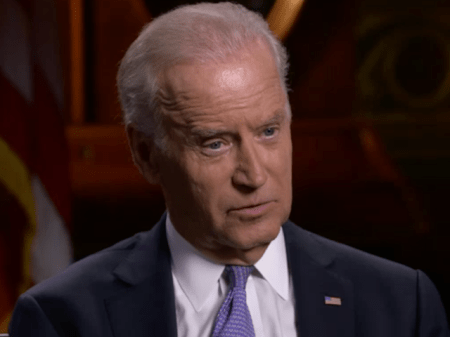
Joe Biden

Vice President Joe Biden warned China that the Japanese government may acquire nuclear weapons “virtually overnight” if the threat from North Korea becomes too grave, urging Beijing to do more to curb Pyongyang’s belligerence.

The Vice President’s comments echo those of presumptive Republican presidential nominee Donald Trump, who warned that Japan and South Korea acquiring nuclear weapons “is going to happen anyway” in controversial remarks issued in March. Japanese government officials and media responded to Trump’s comments much more severely than they have to Biden’s.

“What happens if Japan, who could tomorrow, could go nuclear tomorrow? They have the capacity to do it virtually overnight,” Biden told PBS host Charlie Rose in an interview broadcast Monday. He explained that he made this warning to Chinese President Xi Jinping personally while discussing the deployment of a Terminal High Altitude Area Defense (THAAD) system in South Korea to protect from a North Korean attack, a move that China has condemned vocally.

“When I tell President Xi, you have to understand we got a guy up there in North Korea who is talking about building weapons that can strike, nuclear weapons strike the United States and not only Hawaii and Alaska, but… the mainland of the United States,” he told Rose. “And I say, so we’re going to move up our defense system, and he says no, no, no, wait a minute, my military thinks you’re going to try to circle us.”

Biden suggested that China, a fellow communist country, “has the single greatest ability to influence North Korea.”

Japan has issued a tepid response to the remarks, with Japanese Deputy Chief Cabinet Secretary Hiroshige Seko telling reporters Friday that Japan simply “can never possess nuclear weapons.” Japan remains the only nation in the world to experience a nuclear weapon attack.

In March, Trump stated that both Japan and South Korea were likely to develop nuclear capabilities due to their access to advanced technology. “It’s going to happen, anyway. It’s only a question of time. They’re going to start having them, or we have to get rid of them entirely,” he said, suggesting that, should the move be inevitable, the United States should do more to curb its defense expenses in Asia protecting wealthy nations.

In response, Foreign Minister Fumio Kishida stated that Japan having nuclear capabilities was “impossible,” and national newspaper Asahi Shimbun described national leaders as responding with “bewilderment and unease.

The government of North Korea has behaved with extreme belligerence in 2016, beginning the year with the detonation of what they claimed was a hydrogen bomb and repeatedly launching missiles towards Japan (all have failed to reach their targets). Most recently, North Korea tested what are believed to be two Musudan ballistic missiles, with one reaching the greatest height the nation has yet to achieve on a test.

China responded to the new test by calling for North Korea to “act with caution and refrain from taking actions that may elevate tension on the Korean peninsula.” China recently backed expanded UN sanctions on North Korea, but has condemned U.S. and South Korean defense buildups in response to Pyongyang, claiming that the also put Beijing in the line of fire.

While China has kept its criticism of North Korea tepid and remained its largest trade partner, the volume of that trade has declined significantly. Imports from North Korea dropped 12.6 percent between May 2015 and May 2016, while exports to North Korea fell 5.9 percent in the same time period.

Cartoons of the day

December 5, 2015

H/t Power Line

PC-Shooting-copy
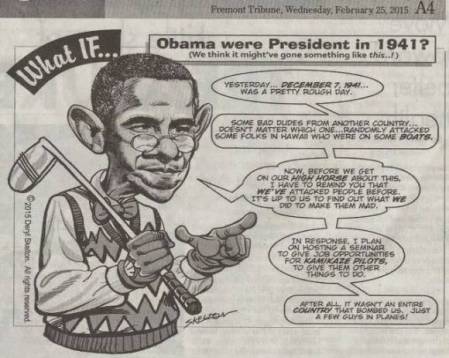
Obama-Prearl-harvor
Terror-attack

Dealing With the Iranian Death Cult

March 6, 2015

Dealing With the Iranian Death Cult, American ThinkerWarren Adler, March 2, 2015

The surprise attack on Pearl Harbor and the resultant bloodbath should stand as an example of how a rigidly brainwashed death cult like Iran will choose the apparent path of negotiation while hiding its lethal ambition under a camouflage of lies.

*****************

While Prime Minister Benjamin Netanyahu of Israel laid out a strong case for mistrusting Iranian intentions, he did not define the bedrock reason why Iran cannot be trusted. To do that, one must understand the captive mentality of the cult phenomena and how it distorts reason, brainwashes its adherents, and creates unquestioning followers.

For those of us with strong cognizant memories of the events before, during and after the stunning Japanese attack on Pearl Harbor on December 7th, 1941, the current negotiations with Iran to prevent this terror-sponsoring cultist state from developing a nuclear weapon seems chillingly similar.

Prior to that “day of infamy” as then President Franklin Roosevelt so aptly characterized it, the United States was locked in tense and complicated negotiations with Japan to settle conflicts that divided our two countries. They were many, involving a clash of perceived power divisions in the Pacific with underlying territorial and psychological issues leaving both countries at loggerheads.

The United States, satisfied that it had broken the Japanese military codes, felt secure enough that it could divine the Japanese positions on its statecraft and military plans. The Japanese, who had entered into a tripartite agreement with Hitler and Mussolini, felt secure in their military might and those of their Axis allies in the face of a largely militarily unprepared America to extract whatever concessions they were seeking from the United States.

It is true that America is not negotiating alone with Iran, but its position in the discussion and eventual outcome, by virtue of its historical leadership role, makes the comparison worth noting.

America in 1941 was facing comparative angst. President Roosevelt, who had promised to stay out of the war, was dealing with a reluctant public that had little appetite to enter the fray, although he had been persuaded by Winston Churchill to assist the Allies by providing armaments through the Lend-lease program. Even as negotiations with the Japanese proceeded, the Japanese had no intention of rapprochement and had actually been planning the assault on Pearl Harbor for many months before.

Worse, the American intelligence community was divided in their assessment of Japanese intentions and had not a clue about its cultist discipline. They were monstrously naive about the power of cult psychology and, unfortunately, they still are. Iran is run by death cult adherents operating under the guise of religion with all power, despite all the outward signs of alleged diversity, vested in one man.

Japan at that time was also being manipulated by cultists enmeshed in the doctrines of State Shinto, based on a degraded interpretation of the samurai Bushido code. They later initiated the suicide bomber pilot program, finding recruits eager to kill themselves for the emperor by smashing their planes into American ships. If that isn’t death cult conduct, then I’d like to know what is.

At the time of Pearl Harbor, Adolf Hitler, a charismatic and ruthless megalomaniac, had turned the Nazi Party into a brutal master race entitlement cult determined to make “Deutschland Uber Alles” a reality. Indeed, by then the Nazis had brainwashed the German people into the fanatic belief that they were going to fulfill that destiny in a thousand-year Reich, and Hitler had demonstrated his military prowess designed to reach that goal. He held total sway over the Germans, not unlike Ayatollah Khamenei and his cult followers in their control over Iran.

Nothing happens in Iran without the ayatollah’s approval. Indeed, the Islamic terrorist tentacles of the Iranian regime is considerable and unlikely to be deterred by mere negotiations. “Death to America” and “Death to Israel” are not just empty slogans. They are chosen statements of intent officially approved by the regime leader.

The State Shinto cult of emperor worship was manipulated by Japan’s power-hungry military to have the Japanese people believe in the inevitability of their own destiny to carve out their own empire in the Pacific. Indeed, they managed to persuade the revered Emperor Hirohito himself to agree to their machinations. His naive approval was all that was needed to bring the Japanese people on board, a typical cult scenario.

The weakest partner in this ménage a trois, Benito Mussolini, had earned himself some cred by an African adventure in Eritrea and North Africa.

Using the cult comparison, there seems to be little difference between Khomeini and Hitler, at least in terms of power. Hitler, like Khamenei today, calls the shots. Khamenei, his minions, and their vast network of Iranian-armed and financially-supported death cult Islamic terror cells is, by any rational measure, an existential danger to America, and certainly to Israel.

Indeed, nuclear bombs and long-range missiles in the hands of this cult could easily transform a mere perceived danger into a planetary disaster and fulfill their “death to” sloganeering.  Such power in the hand of the Iranian death cult will create a destructive capacity that by comparison makes Hitler’s armies seem like toy soldiers.

What history has taught us is that cults that have gained total power over their adherents will always use any means to gain their ends. They will employ any tactic that hastens their victory. They will lie, cheat, charm, brutalize, and kill anyone who stands in their way. They will demolish any obstacle that confronts them and inhibits their goals. They will dissimulate and deceive.

The idea that sanity will prevail when it comes to cult leaders is a false notion. Hitler, by the evidence of his suicide, appeared to have understood that death was a finality. Islamic terrorist’s have been brainwashed to believe that death, by sacrificing oneself to what they believe is their Prophet’s desire, is a continuation of physicality, offering perpetual pleasure through eternity in some imagined paradise.

The comparison with Pearl Harbor may seem farfetched and hysterical to some, but as 9/11 has illustrated, a cult in which adherents have no fear of death is a weapon of enormous power. Those who believe that leadership sanity and logic will prevail if Iran gets its bomb and actually uses it against their “Death to” objectives should understand that retaliation, which will surely come, could be welcomed by the Iranian perpetrators of the Jihad cult as a glorious suicide mission guaranteeing an entry ticket to their imagined paradise.

The surprise attack on Pearl Harbor and the resultant bloodbath should stand as an example of how a rigidly brainwashed death cult like Iran will choose the apparent path of negotiation while hiding its lethal ambition under a camouflage of lies.