Archive for the ‘Israel’ category

ISIS’ Sinai Attacks Show Real Threat to Hamas

July 3, 2015

ISIS’ Sinai Attacks Show Real Threat to Hamas, The Clarion ProjectRyan Mauro, July 3, 2015

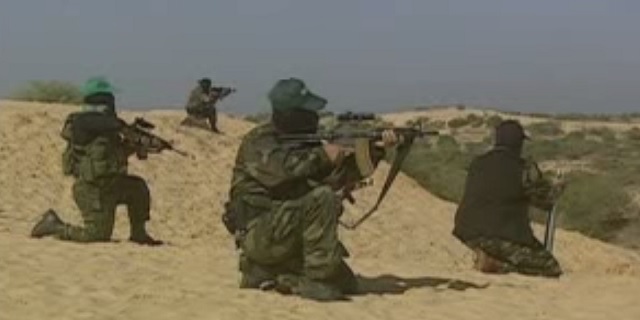
Hamas-640Hamas fighters (Photo: Video screenshot)

Should a full-blown war between Hamas and ISIS break out that makes Gaza look like Syria, the West mustn’t embrace Hamas as the better alternative. The minute differences between them should not be exaggerated out of a desire for a side to pick. They are the two manifestations of the same enemy.

*********************

The attacks on Egypt in the Sinai Peninsula by the Islamic State (ISIS) this week shows why its new vow to topple Hamas in the Gaza Strip should be taken seriously. Polls show that Palestinians have the highest level of sympathy for ISIS in the Arab world with the possible exception of Syria.

ISIS has killed at least 17 Egyptian security personnel (13 soldiers and 4 police officers) and injured 30 in coordinated attacks that reflect increasing sophistication.  The Egyptian military said 70 Islamist terrorists participated and five checkpoints were assaulted. ISIS claims it struck 15 sites all at once.

The Egyptian government immediately accused the Muslim Brotherhood of involvement as it has in the past. Egypt also claims Hamas, the Brotherhood’s Palestinian wing, is secretly supporting ISIS operations in the Sinai Peninsula. It has even threatened to attack Hamas in Gaza in response.

The Egyptian claims are questionable because of the open animosity between the two groups and ISIS’ new video pledging to conquer the Gaza Strip, but the Israeli military confirmed the links after Wednesday’s attacks. It identified two senior Hamas officials who advise ISIS and covertly arrange for hospital visits in Gaza for its injured operatives.

The Brotherhood denies involvement and its website has a statement urging Egyptians to reject violence, but the group’s double-talk is well-documented. It is simply false that the Brotherhood is completely non-violent and Brotherhood media outlets explicitly call for violence like that perpetrated by ISIS this week.

However, there does appear to be a division within the Brotherhood. Youth leaders and elements outside the country are advocating violent jihad, while the older generation repeatedly reaffirms the group’s non-violent stance in Egypt. It’s possible this is all a calculated deception. It’s also possible the rift is real and a faction would be willing to support ISIS against a common enemy.

One Brotherhood official, Mohamed Gaber, said it “seeks to use all expertise inside and outside the Brotherhood to achieve its goals at this stage,” referring to toppling the Egyptian government.

The Egyptian government’s crackdown on the Brotherhood makes it tempting for Hamas to support ISIS operations in the Sinai. Hamas may prefer a situation where its southern border is a battlefield between ISIS and Egyptian forces instead of a base for either. Plus, the Brotherhood uses every death as proof that Egypt’s crackdown is counter-productive and should end.

There are three possibilities: Claims of Hamas/Brotherhood links to ISIS in Sinai are simply wrong; the two groups simultaneously collaborate and fight with each other depending on circumstances; or there are elements within Hamas/Brotherhood that work independently with ISIS against the wishes of the leadership.

Whatever the truth is, the attacks in the Sinai show the threat to Hamas should be taken seriously.

A November 2014 poll found that the Palestinians are the most sympathetic population to ISIS in the Arab world. Only 4% view ISIS positively but if you include those who view it somewhat positively, it grows to nearly one-quarter of the population. However, another poll found that only 3% of Palestinians view ISIS’ gains positively and 88% view it negatively.

ISIS could capitalize on widespread dissatisfaction with Hamas and the situation in Gaza. ISIS’ message that Gaza is in bad shape because Hamas is not sufficiently implementing Sharia could resonate with Islamists who are struggling to understand why Hamas’ rule has not been blessed by Allah. The video also slams Hamas for being too soft on Israel.

A poll released last month shows that 50% of the population in Gaza—and an astounding 80% of the youth—want to leave. About 63% favor continuing rocket attacks on Israel. Another poll found that almost 25% would not vote if elections were held today.

Should a full-blown war between Hamas and ISIS break out that makes Gaza look like Syria, the West mustn’t embrace Hamas as the better alternative. The minute differences between them should not be exaggerated out of a desire for a side to pick. They are the two manifestations of the same enemy.
Israeli policymakers’ alarming over-reliance on Egypt to grapple with Hamas and ISIS

July 3, 2015

Israeli policymakers’ alarming over-reliance on Egypt to grapple with Hamas and ISIS, DEBKAfile, July 3, 2015

Sinai_fight_1.7.15Egyptian troops battle ISIS in Sinai

The statements coming from different Israeli spokesmen this week were not just at dangerous variance with the actual events but with one another, when it came to Egypt’s massive confrontation this week with ISIS close to Israel’s border, a fresh round of Palestinian West Bank anti-Israel terror and the ambivalent role played by Hamas extremists in all these events.

Coordinator of Government Activities in the Territories, Maj. Gen. Yoav Mordechai said in an Al Jazeera interview Thursday, July 2, that Israel had “clear evidence” of Hamas aiding the offensive the Islamic State’s Sinai affiliate launched against Egyptian positions in northern Sinai Wednesday.

The Israeli commander accused Hamas of giving “weapons and logistical support to the ISIS affiliate.”  He added “we have examples of Hamas commanders who actively participated in this assistance,” and named “Wael Faraj, a brigade commander of the military wing of Hamas…who smuggled wounded [ISIS fighters] from Sinai into Gaza,” and “Abdullah Kitshi …who trained operatives belonging to Wilayat Sinai.”

Asked about Israeli-Egyptian cooperation, Mordechai commented: “Egypt is a strong and independent country.”

The Defense Ministry’s strategic adviser Amos Gilead was more specific: He said Egypt was “a strong country of 90 million people with an army of half a million.” Gilead was sure that the Egyptians would do everything necessary for a determined war on ISIS.

Thursday, July 2, the day after the ISIS raid, the Egyptian military said it had killed 123 Islamic State gunmen in two days, 100 of which were killed on Wednesday. Egyptian bombers were then described as wiping out ISIS concentrations around the northern Sinai town of Sheikh Zuwaid. “The situation in northern Sinai is now under complete control,” said the Egyptian spokesman

All three officials were doing their best to put a good face on the Egyptian army’s reverses in its largest battle yet with ISIS, say DEBKAfile’s military sources. No one was ready to admit that the Islamic State’s Sinai branch had won this confrontation on points.

For two years, the Egyptian army has only chipped away at the edges of the threatening Islamist presence growing larger in the Sinai Peninsula, even through Israel suspended the restrictions of the 1979 peace accord and allowed Egypt to bring large military forces, tanks, artillery and helicopters into Sinai for a major campaign to expunge that presence. This has not happened although both the Egyptians and the IDF know the exact whereabouts of the Islamist terrorists’ bases.

Even while playing down the unwelcome outcome of the Wednesday battle, the IDF took the precaution of closing to traffic the main Israeli highway running parallel to the Egyptian border from Nitzana to the southern port of Eilat. The army in the south was also placed on high alert in case ISIS raiders crossed the border from Egyptian Sinai.

Then, on Friday afternoon, parts of southern Israel heard a red alert for rockets which the IDF estimated had come from Sinai, i.e. ISIS, rather than the Gaza Strip.

Israeli officials are at their most mixed up when they discuss Hamas – even after crediting that extremist Palestinian group with conducting a fresh surge of terrorist attacks on the West Bank and Jerusalem. In the past week, they murdered three Israelis – David Capra, Danny Gonen and Malachi Moshe Rosenfeld.

Yet, according to the mantra the IDF has taught accredited military correspondents, all Hamas wants is a long-term ceasefire so as to live in peace. They also trot out the official claims that the deadly attacks were the work of “lone wolves,” just as the persistent trickle of rocket fire from the Gaza Strip comes from “rogue” elements.

Israeli officials appear to have lost their way amid vain attempts to let Hamas off the terrorist hook.

Hamas’ own willingness to jump into bed with Egypt, Hizballah, Iran and ISIS – all at once – undoubtedly creates a confused picture about its shifting motives. However, Israeli policymakers must beware of falling into the dangerous trap of ambivalence and loss of focus.

President El-Sisi must realize by now that his army has missed the boat for a resounding one-strike victory against ISIS, because that enemy is no longer alone. Its association with Hamas is further bolstered by a secret pact with the Egyptian Muslim Brotherhood, the deadly foe of the El-Sisi administration.

Hamas, as the Brotherhood’s ideological offspring, in fact hosted Mahmud Izzat Ibrahim, head of the Brotherhood;s clandestine operational networks, which run from Libya through to Sinai.

This tripartite ISIS-Muslim Brotherhood-Hamas axis is currently in full momentum. Egypt is therefore in for a drawn-out bloody war.

Israeli policymakers would be foolish to depend on Cairo pull this red-hot iron out of the terrorist fire any time soon. They must find ways – the sooner the better – to grapple with the reality of a rampant Islamic State next door. ISIS is already in the process of overrunning the Gaza Strip; it is on the way to seizing expanding sections of the Sinai Peninsula. That territory will serve as a convenient base for Islamist raids against Israel.

If ISIS leaps further to hijack the coastal areas of Sinai, it may be necessary to fight a major war to preserve  the freedom of navigation in the Suez Canal and Israel’s southern exit through the Gulf of Aqaba.

Deadlines, red lines

July 3, 2015

Deadlines, red lines, Israel Hayom, Ruthie Blum, July 3, 2015

(Please see also, Iran’s Nuclear Negotiators Emboldened by Islamic Ideology: Cleric at (Iranian) Tashim News Agency. — DM)

The regime in Tehran has made its position clear. So has the White House. It will take a miracle — or a military strike — to prevent Iran from building nuclear bombs.

**********************

The deadline for a nuclear deal between the P5+1 powers and Iran was extended on Tuesday, when too many bones of contention remained unresolved on June 30. The new date set by the parties to finalize the “framework for an agreement” reached in Lausanne three months ago is July 7.

This means that there are four days to go before the current talks in Vienna bear fruit in the form of an official document. If such a piece of paper is signed, two leaders will feel particularly vindicated: U.S. President Barack Obama and Iranian President Hassan Rouhani — the former for playing out his fantasy of peace through diplomacy and the latter for delivering the goods to his boss, Ayatollah Ali Khamenei.

The rest of the world, however, will be in mortal peril. And Israel will be forced to act fast.

The only sliver of a silver lining in this otherwise black cloud is that Islamists sometimes play their cards wrong. Buoyed by the weakness of the West in the face of their fanaticism, they often take their visions of grandeur to heights that even American and European appeasers cannot accept. So by next week, it is possible that the Iranian negotiators will overstep their counterparts’ bounds, and everyone will return to the country from whence they came with nothing but another date and venue to show for their efforts.

But because the stakes are nuclear weapons in the hands of a mullah-led regime bent on global hegemony — and working toward it through proxy terrorist organizations — one cannot count on the above scenario.

A number of recent statements are cause for concern.

On Thursday, Iranian Foreign Minister Mohammad Javad Zarif told reporters: “The negotiations are moving forward and we should be hopeful. Today is a good day.”

This was an abbreviated version of what his deputy, Abbas Araqchi, said the day before in a TV interview: “A positive atmosphere is ruling the negotiations, and the spirit for going forward exists in all delegations, but this doesn’t mean that all delegations, including us, are ready to reach an agreement at any price.”

Araqchi also defined a “good deal” as one that would honor Khamenei’s “red lines.”

These were spelled out in a June 23 speech by Khamenei (and included in a June 30 Middle East Media Research Institute report): “In contrast to what the Americans are insisting on, we do not accept long-term restrictions for 10 to 12 years.

“Research, development and construction will continue. … They say, ‘Don’t do anything for 12 years,’ but these are particularly violent words, and a gross mistake.

“The economic, financial and banking sanctions — whether related to the Security Council or the American Congress and administration — must be lifted immediately with the signing of the agreement. The remainder of the sanctions will also be lifted within a reasonable time frame. The Americans are presenting a complex, convoluted, bizarre, and stupefying formula for [removing the] sanctions, and it is unclear what will emerge from it, but we are clearly stating our demands.

“The lifting of the sanctions must not depend on Iran carrying out its obligations. Don’t say, ‘You carry out your obligations and then the IAEA will approve the lifting of the sanctions.’ We vehemently reject this. The lifting of the sanctions must take place simultaneously with Iran’s meeting of its obligations. We oppose the delay of the implementation of the opposite side’s obligations until the [release of] the IAEA report [verifying that Iran has met its obligations], because the IAEA has proven repeatedly that it is neither independent nor fair, and therefore we are pessimistic regarding it.

“They say, ‘The IAEA should receive guarantees.’ What an unreasonable statement. They will be secure only if they inspect every inch of Iran. We vehemently reject special inspections [that are not customary for any country except Iran], questioning of Iranian personnel, and inspection of military facilities.

“Everyone in Iran — including myself, the government, the Majlis [parliament], the judiciary, the security apparatuses, and the military, and all institutions — want a good nuclear agreement … that is in accordance with Iran’s interests.

“Although we wish the sanctions lifted, we see them as [having brought us] a particular kind of opportunity, because they made us pay more attention to domestic forces and domestic potential.”

A few days later, on June 29, Obama’s deputy national security adviser, Ben Rhodes, gave an interview to The Atlantic’s Jeffrey Goldberg at the Aspen Ideas Festival.

When asked whether Obama believes a deal will exact change in Iran’s behavior, Rhodes replied: “We believe that an agreement is necessary … even if Iran doesn’t change. … That said, we believe that a world in which there is a deal with Iran is much more likely to produce an evolution in Iranian behavior than a world in which there is no deal. In fact … if the notion is that Iran has been engaged in these destabilizing activities under the last several years when they’ve been under the pressure of sanctions, clearly sanctions are not acting as some deterrent against them doing destabilizing activities in the region. … [T]he point is … in a world of a deal, there is a greater possibility that you will see Iran evolve in a direction in which they are more engaged with the international community and less dependent upon the types of activities that they’ve been engaged in.”

The regime in Tehran has made its position clear. So has the White House. It will take a miracle — or a military strike — to prevent Iran from building nuclear bombs.

German Intelligence Report Confirms CSP Report on Brotherhood Role in Anti-Israel Protests

July 2, 2015

German Intelligence Report Confirms CSP Report on Brotherhood Role in Anti-Israel Protests, Center for Security PolicyKyle Shideler, July 2, 2015

A recent article in the Jerusalem Post cites a recent German Intelligence report warning that hundreds of Hezbollah and Hamas operatives are present in Germany, and playing a role in stoking anti-Israel protests and tensions there. In particular the report, authored by Germany’s internal security agency known as Federal Office for the Protection of the Constitution (BfV) notes approximately 300 Hamas members present in Germany, and played a role in orchestrating anti-Semitic and pro-Hamas protests during Israel’s Operation Protective Edge:

“Hamas was successful” in mobilizing its organization and people outside of its core support to participate in anti-Israel protests, the BfV report said. There was “public anti-semitism at pro-Palestinian demonstrations” against Israel’s Operation Protective Edge, the agency said, adding, “It was noticeable that a large number of mostly young people with an immigrant background expressed themselves in an anti-Semitic and hate-filled way.”

This analysis by German intelligence serves as confirmation of a Center for Security Policy product produced during Operation Protective Edge, which cited the ability of Muslim Brotherhood front organizations to carry out mass protests on behalf of Hamas, some of which turned violent, in both Europe and the United States.

That report, entitled, “Command and Control The International Union of Muslim Scholars, The Muslim Brotherhood, and The Call for Global Intifada during Operation Protective Edge,” examined how instructions and messaging for Brotherhood activities flowed out of the pronouncements by Muslim Brotherhood chief jurist Yusuf Al-Qaradawi. The Center’s piece concluded:

An examination suggests that both the timing, and the content of numerous worldwide Gaza protests do indeed correspond with the timing and nature of the declarations issued by Yusuf al-Qaradawi and the International Union of Muslim Scholars, and echoed by formal Muslim Brotherhood channels regarding Operation: Protective Edge. In all cases there are signs of support for jihad, and specifically support for Hamas, and in many cases, the Muslim Brotherhood more generally. In cases where speakers’ statements could be acquired, there was a correlation with themes expressed by Qaradawi. In numerous cases protest organizers included groups with known ties to the global Muslim Brotherhood, and in some cases, direct ties to organizations established or affiliated with Qaradawi.

The Brotherhood’s apparatus has been designed, since the late 1980s, to quickly and rapidly support Hamas internationally, and it continues to fulfill that role.The BfV report should be taken to heart by Western intelligence agencies. Analysts should be encouraged to draw lessons from Hamas’ “successful” mobilization of political and public relations support, and recall that providing propaganda on behalf of a designated Foreign Terrorist Organization falls well within material support statutes.

How not to write about Iran

July 2, 2015

How not to write about Iran, The New York Times, Ishaan Tharoor, July 2, 2015

(The NY Times article is a good example of how not to write about Iran. History is important, but Iran’s more recent activities are even more important. That ancient Persia and its Islamic successors engaged in and supported terrorism is important, but that the Islamic Republic of Iran still does is more important. Please see also, Rouhani Threatens Nuclear Breakout. — DM)

In the Western imagination, Iran has long been a kind of bogeyman. It’s the land of hostage crises and headscarves. It was part of the Axis of Evil (whatever that was). Its leaders grouse about defeating Israel, an American ally. Its mullahs, say Iran’s critics, plot terror and continental hegemony.

Supporters of the ongoing talks in Vienna, where Iranian diplomats and their international counterparts are wrangling over a final agreement on Tehran’s nuclear program, are in part hoping to change this overwhelming narrative.

Rapprochement between Iran and the U.S., they argue, would signal a new era for U.S. relations in the Middle East — and, at the very least, put to rest fears of yet another American military escalation in the region.

But whether that changes the actual Western discourse around Iran is another matter. Every society or culture gets stereotyped in some way by others — but Iran, even before the rise of the Islamic Republic in 1979, has been a very conspicuous victim.

That’s in part a consequence of its history. As the inheritor of Persia’s ancient empires, Iran has been the Other — the enemy of the nominal “West” — since classical times and the famous wars with Greek city-states. In the 18th century, some European writers and thinkers popularized the image of a “decadent” and “despotic” Persia as an allegorical device to critique their own societies. A century later, as Europe’s empires gained in power, the Orientalist cliches hardened and served to bolster the West’s own sense of racial and moral superiority.

Even in the present day, many of the old tropes have been trotted out during the nuclear talks. While giving testimony to Congress in 2013, Wendy Sherman, a senior State Department official and lead negotiator with Iran, counseled caution when dealing with the Iranian regime because “deception is in their DNA.” The remarks, which infuriated Tehran, gestured at much older Western perceptions of Iranians as “wily” swindlers who cannot be trusted.

Sherman was hardly alone in conjuring up this stereotype: Those opposed to her efforts have also done the same. An editorial in the Wall Street Journal last year warned against “haggling in a Mideast bazaar” and embarking on a “Persian nuclear carpet ride.” This April, Michael Oren, Israel’s former U.S. ambassador, went on a cringe-worthy ramble about the crafty tricks of Persian rug salesmen.

“The Iranians are not just expert carpet merchants,” Oren wrote, stretching the ungainly metaphor to its frayed, tasseled edges. “They also deal in terror and endangering American allies.”

Other more nuanced assessments fall into similar traps, too. Earlier this week, James Stavridis, a retired U.S. admiral, top NATO official and the dean of the Fletcher School of Law and Diplomacy, painted a picture of the Iranian regime with the broadest brush he could possibly find.

“Tehran’s geopolitical strategy,” he wrote, “is taken directly from the playbooks of the first three Persian empires, which stretched over a thousand years.”

To no great surprise, this view of Iran as a mysterious realm, beholden to its past (and its vast store of carpets), irks some observers.

“Iran is an ancient civilization with a rich culture that definitely has roots in its old history,” Iranian-American journalist Negar Mortazavi tells WorldViews. “But to stereotype modern Iran and Iranians based on what happened thousands of years ago is wrong.”

Mortazavi argues that you would never see such simplistic, overreaching appraisals of American allies: “Do we view today’s Europe through the affairs of the Vikings? No. Do we look at Saudi Arabia through the lens of its old Islamic Empire when it was taking over the world? No.”

Arash Karami, the Iran editor of the Middle East news site Al-Monitor, dismisses the idea “that Iran has imperial ambitions in the Middle East simply because of its history.” He adds that “most Iranians only have a vague understanding” of the long-gone Achaemenid dynasty or the medieval Safavids.

The stereotypes in play seem to support the contention of some hawks that Iran is not a normal, rational state actor. Critics of the Islamic Republic may see nothing wrong with that, but these sorts of characterizations were being made well before the 1979 Islamic Revolution and the collapse of U.S.-Iran ties.

In a write-up published in January 1952, Time magazine named Iran’s democratically-elected Prime Minister Mohammed Mossadegh  as “Man of the Year.” The recognition was not particularly flattering. It sneeringly described Iran as “a mountainous land between Baghdad and the Sea of Caviar.” And it went on to attack both Mossadegh’s plan to nationalize Iran’s oil — at the expense of British and American energy interests — and the leader’s character.

Time actually called the Iranian politician “a strange old wizard.”

A year later, the Ivy League buddies of Time’s editors in the C.I.A. helped engineer a coup that ousted Mossadegh, scrapped Iran’s fledgling democracy, and re-installed the country’s monarchy as an American client. Memory of that event still informs the political conversation within Iran, but is rarely recognized in the West.

“In American media, it seems that either those wily Persians are calculating ‘chess masters’ outwitting the well-meaning Westerner,” says Karami, “or they’re bumbling idiots” who resent how “the West rules the Middle East.”

To be sure, there are many negative things that should be said about Iran’s political status quo — where a repressive theocratic government curbs dissent, jails journalists and actively supports armed proxies elsewhere in the Middle East. But you don’t need to start quoting Xenophon or Morier to get there.

“If you’re writing about a country of more than 77 million people,” says Kia Marakechi, news editor at Vanity Fair, “and the metaphors or signifiers you draw on come more from ‘Aladdin’ than a serious understanding of that nation’s politics and culture, you should probably hand the assignment to someone else.”

Obama Won’t Enforce Anti-BDS Provision Language in Trade Bill he just Signed

July 1, 2015

Obama Won’t Enforce Anti-BDS Provision Language in Trade Bill he just Signed, The Jewish PressLori Lowenthal Marcus, July 1, 2015

(To enforce the anti-BDS provisions of the legislation Obama just signed would be Islamophobic. Or something. — DM)

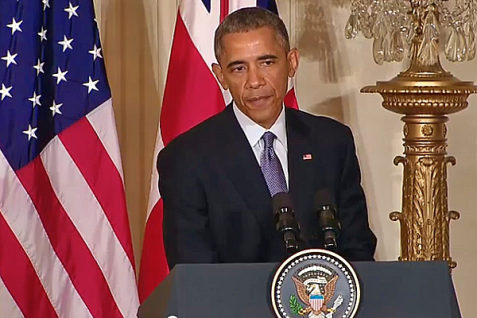
Obama (1)U.S. President Barack Obama Photo Credit: WhiteHouse.Gov screen capture

This week the United States officially put on notice its trade partners that it will not countenance boycotts or other economic warfare against Israel.

After signing the relevant trade legislation into law, however, the White House signaled to all its trade partners that they are still free to boycott goods made in the disputed territories, despite the clear language of the legislation the president signed.

This week the Trade Promotion Authority bill was passed by Congress and signed into law by President Barack Obama.

The TPA is primarily focused on international trade between the U.S. and Europe. It also included a section which addresses trade between the U.S. and Israel.

That part of the legislation, the U.S.-Israel Trade and Commercial Enhancement Act, bans boycotts and other means of economic warfare against Israel or the “Israeli-controlled territories.” This amendment, introduced by Rep. Peter Roskam (R-Ill-6) with bi-partisan co-sponsorship, was unanimously adopted into the PTA in April.

The passage of the TPA, including the anti-BDS section, should sound a death knell for the BDS (Boycott of, Divestment from and Sanctions against Israel) Movement. It should.

However, as pro-Israel Americans and Israelis learned only a few weeks ago in the Jerusalem passport case (Zivotofsky v. Kerry), there are certain spheres of international decision making over which the president has exclusive, or at least primary and controlling, control. Obama claims that international trade is one of those areas, even though Article 1, Section 8, clause 3, expressly gives Congress the power to regulate foreign commerce.

So even though the TPA is intended to act as a strong deterrent to European and other countries to pass and enforce boycotts of Israeli products, the White House has already signaled that it will not extend its protection to any goods produced in the disputed territories.

The anti boycott of Israel language in the TPA is: “actions by states, nonmember states of the United Nations, international organizations or affiliated agencies of international organizations that are politically motivated and are intended to penalize or otherwise limit commercial relations specifically with Israel or persons doing business in Israel or in Israeli-controlled territories.” [emphasis added.]

In a statement which Matt Lee of the Associated Press attributed to State Dept. spokesperson John Kirby, the administration made clear that despite signing the TPA, the position of the White House remains, as it has been, that the U.S. opposes boycotts of the State of Israel, but it also opposes the presence of Jews in the disputed territories of Judea and Samaria and the Golan Heights.

In the statement the administration argues that by “conflating Israel and ‘Israeli-controlled territories’ a provision of the Trade Promotion Authority legislation runs counter to longstanding U.S. policy towards the occupied territories, including with regard to settlement activity,” and says that every U.S. administration has opposed “settlement activity.”

It goes on to point out that the “U.S. government has never defended or supported Israeli settlements and activity associated with them and, by extension, does not pursue policies or activities that would legitimize them.”

The U.S. administration announced that it will not jeopardize the holy grail of the two-state solution by enforcing the U.S. law as written and which its leader signed. In the statement it claims that “both parties have long recognized that settlement activity and efforts to change facts on the ground undermine the goal of a two-state solution to the conflict and only make it harder to negotiate a sustainable and equitable peace deal in good faith.” It is on this basis, ostensibly to promote a peaceful solution to the Arab-Israeli conflict, that this administration

Professor Eugene Kontorovich of the Northwestern University School of Law analyzes several other provisions of the U.S-Israel trade aspect of the TPA which have been largely overlooked. In particular, Kontorovich points out, U.S. courts cannot recognize or enforce the judgment of any foreign court “that doing business in or being based in the West Bank or Golan Heights violates international law or particular European rules.”

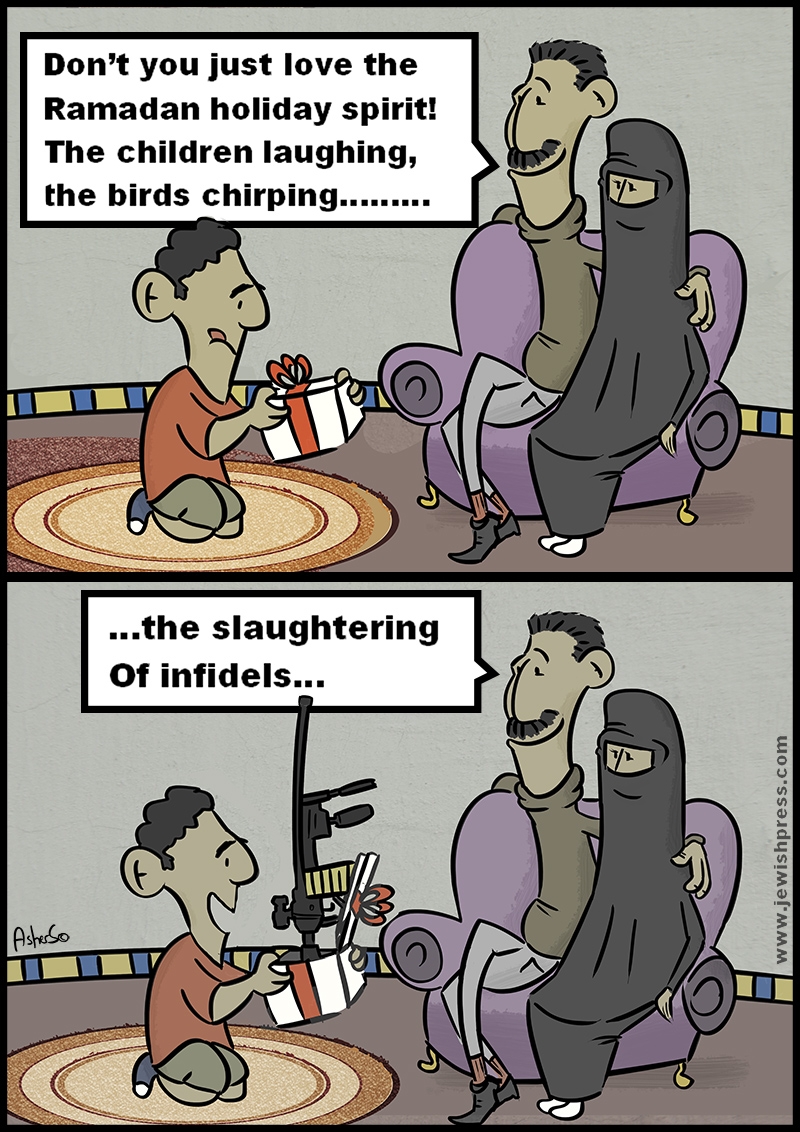
Cartoon of the day

July 1, 2015

H/t The Jewish Press


ramadan-spirit

Israeli border troops, US Mid East forces on alert after massive ISIS assault on Egyptian forces in Sinai

July 1, 2015

Israeli border troops, US Mid East forces on alert after massive ISIS assault on Egyptian forces in Sinai, DEBKAfile, July 1, 2015

Sinai_Attack_1.7.15ISIS attacks Egyptian Sinai positions

The Islamic State of Iraq and the Levant moved ominously close to Israel’s borders Wednesday, July 1 – not as predicted in the north, but in the south, from the Sinai Peninsula. There, ISIS followed up on its Ramadan terror outrages in France, Tunisia, Kuwait and Kobani, with a massive assault on Egyptian forces in the northern Sinai region of Sheikh Zuwaid close to the Israeli and Gaza Strip borders.

Not just a terrorist attack, ISIS launched a full-scale military assault, starting with mortar fire and suicide bombings against five Egyptian military checkpoints.

Using a tactic similar to that employed in the capture of the Iraqi town of Ramadi last month, ISIS gunmen followed this initial assault by riding in on minivans, backed by heavy mortar fire, to storm the positions held by stunned Egyptian troops. Altogether some 20 Egyptian army positions were attacked in and around Sheikh Zuwaid.

Egyptian troop reinforcements setting out from El Arish to the northeast to aid the beleaguered force, went up on mine and bomb traps secretly planted around their camps and police stations. Egyptian Apache assault helicopters striking the ISIS force themselves faced ground fire from shoulder-borne anti-air missiles.

Egyptian forces are reported to have sustained heavy casualties, at least 64 dead and many more wounded. The Islamists are additionally said to have taken Egyptian prisoners as hostages.

As the fighting grew fierce during Wednesday, Israel to shut its border crossings with Egypt and the Gaza Strip, and sent reinforcements south in case the jihadis launched an attack on Israel from northern Sinai.

Our military sources also report that US Middle East forces located in Jordan and at Sharm el-Sheikh are on the ready in case the Islamic State decides to attack the US officers and men at the Multinational Force facility in Sinai, which is located near the Sheikh Zuwaid battlefield.

The ISIS Sinai offensive is part and parcel of the reign of terror launched last Friday by Yassin Sahli when he beheaded his French boss, and Seifeddine Rezgui, who murdered 39 holidaymakers on a Tunisian beach. Standing ready for the Islamist offensive in Sinai were the jihadis of the Ansar Beit al-Maqdis, which recently declared Sinai a province of the Islamic State and took an oath of allegiance to Abu Bakr al-Baghdadi.

ISIS draws on two additional major sources for its fighting manpower: the infrastructure it established in turbulent Libya for training and arming jihadis to cross the Egyptian border into Sinai; and the fatal attraction its radicalizing ideology holds for young Muslims who are taught that the brutal murder of Islam’s foes is a cleansing and purifying act.

Palestinians: Why Salam Fayyad Lacks Popular Support

July 1, 2015

Palestinians: Why Salam Fayyad Lacks Popular Support, The Gatestone InstituteKhaled Abu Toameh, June 30, 2015

  • It is no secret that several senior Palestinian officials see themselves as potential successors to Abbas. Like his predecessor, Yasser Arafat, Abbas has stubbornly refused to share power with anyone. And like Arafat, he continues to run the Palestinian Authority as if it were his private fiefdom.
  • In Palestinian culture, it is more important if one graduates from an Israeli prison than from the University of Texas in Austin. A Palestinian who carries out an attack on Israel has more credentials among his people than one who studied at Harvard or Oxford universities.
  • It took Salam Fayyad too long to realize that no matter how many good things he does for his people, in the end he will be judged on the basis of his contribution to the fight against Israel, and not how much humanitarian and financial aid he provides.

In a surprise move, the Palestinian Authority (PA) has frozen the bank account of a non-profit organization headed by former Prime Minister Salam Fayyad.

The decision is seen in the context of PA President Mahmoud Abbas’s effort to undermine and discredit Fayyad. Abbas believes that Fayyad, who resigned in 2013, is seeking to replace or succeed him as president.

Following his resignation, the US-educated Fayyad established a Ramallah-based group called Future For Palestine. According to Fayyad, the group’s mission is to “enhance the resilience of Palestinian citizens in their homeland, especially in marginalized and severely impacted areas, by providing the basic development requirements.”

Abbas and the Palestinian Authority leadership did not like the idea from the beginning. Ever since Future For Palestine was established in August 2013, they have been working toward undermining the group and its founder, Fayyad.

The PA leadership is convinced that Fayyad is using the group to advance his own political goals and establish bases of power in the West Bank and Gaza Strip.

During the military confrontation between Israel and Hamas last year, Fayyad’s group launched acampaign to aid the residents of the Gaza Strip. The campaign included the purchase of tens of thousands of bottles of mineral water that were supposed to be dispatched to the Gaza Strip. The Palestinian Authority thwarted the campaign.

To justify the crackdown on Fayyad back then, the PA said that the former prime minister was part of a “conspiracy” to overthrow the Abbas regime. Some reports even suggested that Abbas had ordered his security forces to detain Fayyad for interrogation, but backtracked after threats from the US and several European governments.

Later, Abbas sent security officers to raid the offices of Future For Palestine and conduct a thorough search of its files. Some of Fayyad’s top aides were taken into custody and questioned about the sources of the group’s funding.

Last week, the campaign against Fayyad reached its peak when the Palestinian Authority announced that it has seized the assets of Future For Palestine, and accused the former prime minister of “money laundering.”

PA officials claimed that Fayyad’s group had received $10 million from the United Arab Emirates, a Gulf country that supports Abbas’s political enemy, ousted Fatah leader Mohamed Dahlan. The officials accused Dahlan and Fayyad of working together to topple the Abbas regime. Dahlan fled the West Bank several years ago after falling out with Abbas, who accused him of attempting to stage a coup against the Palestinian Authority leadership.

1135Former Palestinian Authority Prime Minister Salam Fayyad, pictured on January 25, 2013 at the World Economic Forum in Davos, Switzerland. (Image source: World Economic Forum)

Fayyad said this week that he is planning to take legal measures to cancel the decision to freeze his group’s assets. Denying the charge of “money laundering,” Fayyad added that Future For Palestine was operating within the framework of the law and did not commit any offense.

The decision to freeze the bank account of Future For Palestine came in the wake of increased talk about a behind-the-scenes power struggle to succeed the 80-year-old Abbas. The name of Fayyad has repeatedly surfaced as a potential successor to Abbas — a suggestion that has clearly enraged the Palestinian leader and his senior officials in Ramallah.

It is no secret that several senior Palestinian officials see themselves as potential successors to Abbas. These include, besides Dahlan, the chief of the PA’s General Intelligence Security Force in the West Bank, Majed Faraj, Palestinian Football Association Chairman Jibril Rajoub and Chief PLO negotiator Saeb Erekat.

Abbas believes that he has thus far succeeded in sidelining and discrediting at least two candidates: Fayyad and Dahlan. The charges made by Abbas against the two men are designed to depict them as agents of foreign countries who are plotting against him and the entire Palestinian people.

Like his predecessor, Yasser Arafat, Abbas has stubbornly refused to share power with anyone. And like Arafat, he continues to run the Palestinian Authority as if it were his private fiefdom.

Fayyad’s chances of succeeding Abbas are, anyway, very slim, if not non-existent. Fayyad is an independent figure who does not belong to Fatah, Hamas or any other political group. When he ran in the January 2006 parliamentary election at the head of the Third Way list, his group received two seats out of 132.

The reason most Palestinians did not vote for Fayyad is because he had not played any role in the “revolution” against Israel. In this culture, it is more important if one graduates from an Israeli prison than from the University of Texas in Austin. Fayyad did not participate in any armed attack on Jews and never supported the armed struggle against Israel. Nor did he send his son to throw stones or firebombs at Israelis. That is the real reason why people like Fayyad lack popular support.

If and when Abbas steps down, the only candidate who has a good chance of replacing him is one who was part of the “revolution.” A Palestinian who carries out an attack on Israel has more credentials among his people than one who studied at Harvard or Oxford universities. It took Salam Fayyad too long to realize that no matter how many good things he does for his people, in the end he will be judged on the basis of his contribution to the fight against Israel, and not how much humanitarian and financial aid he provides.

Oren blasts Iran nuclear deal: It’s not linked to changed Iranian behavior

June 30, 2015

Oren blasts Iran nuclear deal: It’s not linked to changed Iranian behavior, Washington Free Beacon via You Tube, June 29, 2015