Archive for the ‘Israel’ category

Palestinians: A World of Lies, Deception and Fabrications

November 7, 2015

Palestinians: A World of Lies, Deception and Fabrications, The Gatestone InstituteBassam Tawil, November 7, 2015

  • The only astonishing thing is that Abbas and the Palestinian leaders continue to refer to their wave of terrorism and bloodbath as a “peaceful, popular uprising.”
  • The terrorists were doubtless inspired by their president’s words. It is this kind of officially-sanctioned rhetoric that encourages young Palestinians to stab the first Jew they see.
  • This is not only a mountainous lie; it is an attempt on the part of the Palestinian Authority leadership to deceive the world into believing that Israeli security forces killed these poor innocent terrorists who were merely part of a peaceful protest. These “innocent” Palestinian men and women were “merely” in the process of trying to stab people to death.
  • The world in which Abbas and the Palestinian leadership live is a world of lies, fabrications and deception aimed at demonizing Israel and murdering Jews. The goal is not only to murder as many Jews as possible, but also to force Israel to its knees so that it will vanish as soon as possible.
  • Welcome to the world of the Palestinians, where we lie and then believe our own lies. And then want the rest of the world to believe them, too.

Sadly, the Palestinian Authority (PA) leaders are continuing to bury their heads in the sand and lying to everyone — from their people to the international community.

The current wave of Palestinian terrorism has entered its fourth week, but our leaders, above all the PA President Mahmoud Abbas, are continuing to talk about a “peaceful, popular uprising” against Israel. This wave of Palestinian stabbings, shootings and vehicular ramming has been anything but either “popular” or “peaceful.”

President Abbas and his top PLO and Fatah leaders have yet to explain to us what is peaceful and popular about stabbing an 80-year-old lady named Ruti Malka in Rishon Lezion, and a 70-year-old Jewish woman Jerusalem.

Instead of denouncing the terror attacks perpetrated by his people, Abbas continues to attack Israel for shooting the knife-wielding assailants to stop them. He has not missed one opportunity in the past four weeks to make false and libelous accusations against Israel. These include claims that Israelis are carrying out “summary executions” of “innocent” Palestinian men and women. In reality, these “innocent” Palestinian men and women were “merely” in the process of trying to stab people to death.

At two separate meetings of the PLO and Fatah leaderships in Ramallah this week, Abbas repeated his bogus charge that Israel is “committing war crimes” and working to “alter” the status quo on the Haram al-Sharif, or Temple Mount. He has also made these charges during meetingswith Western leaders and government officials in Ramallah and abroad.

Instead of appealing to his people to refrain from carrying out terrorist attacks, Abbas and the PLO and Fatah leaders “voiced appreciation for the heroic steadfastness” of the Palestinians who, he said, are “defending their holy sites and the national project.” The Palestinian leaders consider the terrorists who murdered and wounded scores of Israelis as “defenders” of Al-Aqsa Mosque in Jerusalem.

It was Abbas who said just a few days before the eruption of current wave of terrorism, that Palestinians “won’t allow Jews to contaminate, with their filthy feet, our holy sites.” He also stated that “every drop of blood that is spilled in Jerusalem is pure blood” and that the terrorists would go to Paradise.

The terrorists who took to the streets to commit murder were doubtless inspired by their president’s words. It is this kind of rhetoric, officially-sanctioned, that encourages young men and women to carry a knife and stab the first Jew they see. Abbas went so far as to tell the terrorists that it is their duty to “defend” the Islamic holy sites. He assured them that if they are killed by Israeli security forces, they will end up in Paradise.

Abbas’s firing up his people to murder is happening at a time as his Palestinian Authority-controlled media continues its massive campaign of firing up the same people to murder, while hailing terrorists as “martyrs” and “heroes.” At the same time, this media is promoting fraudulent conspiracy theories, such as the lie that Israeli soldiers and policemen have been “planting” knives next to the bodies of the terrorists.
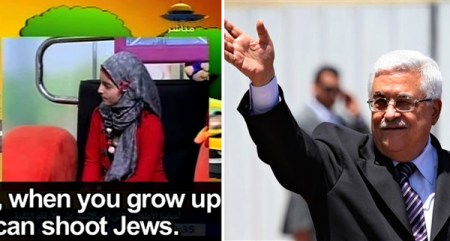
1280 (2)Palestinian Authority President Mahmoud Abbas (right) ignited competition among radical groups as to which faction could incite the most violence. Left: official PA media incite Palestinians, from a young age, to murder Jews.

This week, Abbas’s envoy to the UN, Riyad Mansour, repeated the old-new blood lie that Israel is harvesting the organs of dead Palestinians.

Such libels, lies and vilifications are intended to radicalize Palestinians still further and drive them towards pursuing their terrorist attacks against Israelis. Such defamation is also aimed at spreading hated against Jews around the world, thus endangering lives in the U.S., France, Britain and elsewhere.

Abbas and his PA and Fatah leaders and officials are working hard not only to demonize and delegitimize Israelis, but also, through lies and blood-libels, Jews everywhere.

The only astonishing thing is that Abbas and the Palestinian leaders continue to refer to their wave of terrorism and bloodbath as a “peaceful, popular uprising.” Not only is this a mountainous lie; it is an attempt on the part of the Palestinian Authority leadership to deceive the world into believing that Israel’s mighty security forces killed these poor innocent terrorists who were merely part of a peaceful protest against those awful Israeli “occupiers.”

Abbas knows very well that the terrorists were not participating in any “peaceful” demonstration in the West Bank or Jerusalem. He knows very well that the terrorists are “lone wolves” whom he himself has whipped up to murder Jews for no other reason than that they are Jews. Yet this knowledge has not stopped Abbas and the rest of the Palestinian leadership from continuing to lie to the world and their own people about the nature of these terrorist attacks.

In this regard, Abbas and the Palestinian leadership are following with the famous Arab Proverb, “He hit me and cried, and then came to complain.” The Palestinians involved in the current wave of terrorism against Israelis are the same ones complaining to the world about Israel. It is no surprise that many in the international community are rushing to endorse the false narrative of the Palestinian leadership.

In the twisted world of Abbas, there is no wave of stabbings and vehicular attacks against Jews. In the twisted world of Abbas, there are no terrorists. Stabbing elderly Jewish women and a 13-year-old Jewish boy, according to Abbas, is part of a “peaceful, popular” protest. In the eyes of Palestinian leaders, most of the terrorists who have been encouraged by Palestinian leaders to murder Jews are “innocent victims” who have had knives placed next to them by Israeli policemen and soldiers in order to frame them.

This is the world in which Abbas and the Palestinian leadership live. It is a world of lies, fabrications and deception aimed at demonizing Israel and murdering Jews. The ultimate goal is not only to murder as many Jews as possible, but also to force Israel to its knees in the hope that it will vanish as soon as possible.

Welcome to the world of the Palestinians, where we lie and believe our own lies. And then want the rest of the world to believe them, too.

Keeping up warm relations

November 6, 2015

Keeping up warm relations, Israel Hayom, Shlomo Cesanam, November 6, 2015

(Please see also, Obama rules out Israeli-Palestinian peace deal before leaving office. — DM)

Two state is deadScience and Technology Minister Ofir Akunis, seen with Defense Minister Moshe Ya’alon in the Knesset, says the two-state solution is “dead.” | Photo credit: Noam Revkin-Fenton

The imminent meeting between Prime Minister Benjamin Netanyahu and U.S. President Barack Obama won’t repair their soured ties, but it’s clear that their face-offs are on hold as Israel and the U.S. prepare to deal with Middle East instability.

*********************

Two weeks ago, Defense Minister Moshe Ya’alon met with his American counterpart Defense Secretary Ashton Carter. The defense secretary accompanied Ya’alon everywhere: to a memorial service at the Israeli Embassy marking 20 years since the assassination of former Prime Minister Yitzhak Rabin, on a visit to the American Cyber Command at Fort Meade, in a dialogue with students and to a laid-back meal at the Pentagon, at which a military choir performed “Jerusalem of Gold” accompanied by a violinist. The Americans promise that the warm welcome Ya’alon received will continue — even if not with the same intensity — for another two days, when Prime Minister Benjamin Netanyahu is scheduled to land in Washington, ahead of a Monday meeting with U.S. President Barack Obama at the White House.

The meeting will not obliterate the soured relations between the two leaders. They “did not have a chance to meet” this year, but they did manage to publicly face off on important issues and policies. The main bone of contention is of course the understandings reached between six world powers on Iran’s nuclear program. Nevertheless, it is clear to everyone that the confrontations are over as is the discussion of whether the tension between the two leaders harmed the relations between their respective nations. Both sides agree that the threats, challenges and mutual interests supersede the various disagreements, and that new arrangements must be made for the future.

The agenda of the meeting will address coordination on a strategic outlook for the region. Two specific issues are up for discussion: Preserving Israel’s qualitative advantage over the rest of the countries in the region, and American aid to strengthen Israel during the next 10 years. The aforementioned edge was created as a result of the nuclear deal with Iran and the “compensation packages” the U.S. handed out to its allies in the Persian Gulf — first and foremost Saudi Arabia, but also countries like Jordan and Egypt. The aid comes in the form of information, technology, financial aid, weapons and ammunition.

The American aid will be provided under a 10-year plan. Former President George W. Bush signed the last aid deal, which expires at the end of 2017. Israel expects to fill up a “shopping cart” with items that already appear on a long list of requests, including a bump in the amount of defense assistance from $3.1 billion to $4 billion.

Since the deal will only take effect two years from now, diplomatic officials are discussing two separate lists: one for the long term, and a second that will give Israel the help it needs to preserve its advantage. The goals of the meeting between Netanyahu and Obama are based on the assumption that the Middle East is unstable, and will remain so for the next decade. That assumption is backed up by reports from teams of professionals in both the U.S. and Israel.

The bottom line, a member of Israel’s Diplomatic-Security Cabinet said this week, is that “the U.S. and Israel are in sync. They see eye to eye on the existing situation and have identical assessments of the changing situation in the region.”

Both Israel and the U.S., for example, agree that even after the Iran nuclear deal, the Tehran regime is no less dangerous. They both know that the Iranian money that was unfrozen when the sanctions were lifted, is already going to fund terrorism.

Netanyahu and Obama are going to talk about strategy, as the proposals for aid to bolster Israel are already known. But because in our region it is hard to know what the day will bring, both sides have built a model according to which “a variety of measures to provide a variety of solutions to a variety of threats” must be offered. The discussion in the White House will deal with all of the security ties between the two countries: Long-term financial aid; cooperation on cybersecurity; air, land, sea, and satellite power; intelligence; technological and defense development, including more Iron Dome batteries and similar defense systems, and the promotion of solutions that are still being developed. On everything relating to the immediate and broad-scale answer, Israel is asking for a way of defending itself against long-range and precision-guided missiles.

Netanyahu and Obama will also have to decide whether the time has come to strike a reciprocity deal — a defense pact between the two nations — that does not include a requirement to inform each other of certain covert actions, such as an attack on Iran. A deal like that would provide an answer for any scenario in which Iran breaks through to a nuclear bomb before the deal on its nuclear program is up.

“We left Gaza — and what did we get?”

But the headaches do not end there. When Netanyahu returns from the U.S., he will be facing two other important events: passing the state budget, which will among other things determine the defense budget, and the scheduled release of convicted spy Jonathan Pollard from a U.S. prison, which will mark the end of a long dispute with the Americans on the Pollard matter.

In Jerusalem, Netanyahu’s meeting with Obama is seen with utmost importance. Many officials at the diplomatic echelon argue that the meeting explains Netanyahu’s conduct these past few weeks: his measured responses to events in the field, the ban on MKs visiting the Temple Mount, the delay on committee discussions about construction in Jerusalem, and his remark that comparatively speaking, he is the prime minister who has allowed the least amount of building in Judea and Samaria.

On the other hand, Netanyahu is not hiding his official policy that Palestinian Authority President Mahmoud Abbas is not a partner with whom a peace deal can be made and that for now, Israel’s security and defense prowess in Judea and Samaria must be solidified without any visible changes.

The opposition and some media outlets have voiced criticism of Ya’alon, who is being accused of wanting to “manage” the conflict with the Palestinians and of directing “a policy of carrots” rather than finding a solution to it. Netanyahu, on the other hand, is accused of marking time and cultivating a vision in which we will “always live by the sword.”

The criticism is local, but it echoes throughout the world. That is why it was important to Netanyahu to issue a reply this week: “I’m not deceiving the public. We are living in the heart of radical Islam, and no policy we adopt will turn our neighbors into Norwegians or Swedes. We withdrew from every last [inch] of the Gaza Strip and didn’t get peace, [we got] rockets and terrorism. Therefore — with an arrangement or without one — we will always need the IDF to protect ourselves.”

Netanyahu is arriving in Washington as the head of a narrow right-wing government, most of whose members oppose a two-state solution. A member of his own Likud party, Science, Technology and Space Minister Ofir Akunis, said twice this week — at a weekend cultural event in Beersheba and at a Likud conference in Kfar Saba — that “the two-state solution is dead.”

According to Akunis, “the idea is irrelevant and is no longer at all possible.”

The understandings and agreements between Israel and the U.S. are also tied into the American and European demand to “end the occupation” at any price and “prevent apartheid.” While the security and defense factor is in place, Israel has no solution when it comes to the world’s demands on the Palestinian issue.

Obama’s favorite Muslim dictatorships

November 5, 2015

Obama’s favorite Muslim dictatorships, Front Page Magazine, Daniel Greenfield, November 5, 2015

(Please see also, US senior commander says US will not provide arms ‘as of now’ to YPG units. And why isn’t Iran on the list?  — DM)

oy

Obama’s favorite Muslim dictatorships are the opposite of everything that America stands for. They are places where human rights are a myth and terrorism a virtue. They are everything that we should reject. But instead their tyrants and terrorists are the good friends of their man in the White House.

**************************

Michelle Obama is heading to Qatar, a state sponsor of just about every Islamic terrorist group you can name, on a mission of “gender parity” accompanied by late night comedian Conan O’Brien.

That makes sense since the idea of equal rights for women in Qatar is a joke.

Qatar charges rape victims with adultery, has no law against domestic violence and women need permission from their male guardian to get an education, a driver’s license, a job or to leave the country.

Women aren’t equal in Qatar. They’re property.

But Qatar is one of Obama’s favorite Muslim dictatorships. Secretary of State John Kerry recently launched an economic dialogue with Qatar. Qatar got a free pass to smuggle weapons past the NATO blockade of Libya even though the administration knew the weapons were going to terrorists.

While Qatar was buying weapons from Sudan, a country whose leader is wanted for crimes against humanity, to pass along to Islamic terrorists in Syria, the State Department was clearing Qatar to buy American weapons. Qatar was, of course, a Clinton Foundation donor.

The Reagan administration had cracked down on Qatar for illegally getting its hands on Stinger missiles. The first Bush administration had forced Qatar to destroy them. But these days we are the arms dealer for a nasty tyranny that has ties to terrorists. Or as the State Department report politely stated, “U.S officials are aware of the presence of Hamas leaders, Taliban members, and designated Al Qaeda and Islamic State financiers in Qatar.” These nice folks share a country with U.S. Central Command.

Khalid Shaikh Mohammed, the Al Qaeda bigwig who planned 9/11, was tipped off by a member of the Qatari royal family and the former Minister of the Interior which allowed him to escape.

That made it the perfect place to host the “moderate” Taliban for negotiations that went nowhere. It was also where Obama sent the 5 Taliban commanders after their release.

When meeting with the Emir, Obama claimed that “Qatar is a strong partner in our coalition to degrade and ultimately defeat ISIL.” But Qatar has allegedly funded and armed ISIS and other Al Qaeda groups. Islamic State financiers and supporters comfortably move around Qatar flying their ISIS freak flag.

Vice President Biden and Germany’s Development Aid Minister Gerd Mueller were forced to apologize for accusing Qatar of financing terrorists because some truths about our “ally” simply could not be spoken. Meanwhile an Egyptian intelligence document reportedly claimed that Qatar had provided anti-aircraft missiles to ISIS.

But Qatar is only Obama’s second favorite Muslim dictatorship and state sponsor of terror. Topping the list is Turkey, which just underwent another ugly Islamist election defined by accusations of fraud.

Obama had spoken of building a “model partnership” with Turkey between “a predominantly Christian nation and a predominantly Muslim nation”.  The United States, Obama said, is not “a Christian nation or a Jewish nation or a Muslim nation”. He suggested that “modern Turkey was founded with a similar set of principles.” But the Turkish Republic has long since been ground under the wheels of Erdogan’s Islamist Turkey whose model is the Ottoman Empire and whose ruler lives in a billion dollar palace.

A little insight into Erdogan’s view of Islam can be gained from the fact that Turkey’s tyrant was once sent to prison for reciting an Islamic poem with the infamous lines, “The mosques are our barracks, the minarets our bayonets, the domes our helmets and the believers our soldiers.” It’s not surprising that Erdogan’s Turkey supports most of the same Islamic terrorist groups as Qatar including Hamas.

While Turkey still has elections, it is increasingly an Islamist one-party state where the political opposition, journalists, prosecutors and even police can be locked up by the forces of the regime.

And much of that controversy stems from a criminal investigation into arms smuggling to terrorists.

Having helped create the mess in Syria, Turkey has become a waypoint for Syrian Muslims invading Europe. Once shunned by Germany, whose Turkish Muslim settlers are his strongest base of support, the refugee crisis sent Merkel and the Europeans with hat in hand to beg Erdogan to stop the invasion.

But Obama has always been Erdogan’s faithful friend. When the Islamist wanted to build mosques in this part of the world, Communist Cuba turned him down, but he got his $100 million mega mosque in Maryland.  Millions calls Erdogan another Hitler, but Obama calls him “my friend.”

Another friend of Obama is the Sultan of Brunei. Obama called the Sultan, “My good friend” and rolled out a $6 billion green energy financing scheme for Brunei and Indonesia; two Muslim countries that violate human rights like it’s a spectator sport.

While Obama was palling around with the Sultan of Brunei, his “good friend” was bringing back Sharia law complete with stoning gays. The Sultan also banned Christmas and the Chinese New Year while urging “all races” to unite under Islamic law.

African Christian countries that outlawed homosexuality had faced pressure and criticism from the White House, but Obama had no lectures on human rights to offer his good Islamist friend.

Neither did Hillary Clinton whose Clinton Foundation had received millions of dollars from the regime.

But the most explosive allegations about Brunei, like those about Qatar and Turkey, involve Al Qaeda. In one of the more controversial uses of the “super-injunction” in UK law, the ex-wife of the Sultan had filed a gag order against a British businessman involving allegations that the Sultan of Brunei had met with a senior member of Al Qaeda, funded the terror group and even that “the claimant knew or suspected from conversations with her ex–husband that there would be major terrorist attacks on the UK (7/7) and Israel.” There is of course no way to verify the truth of these allegations. But the Islamization of Brunei parallels the goals of groups such as Al Qaeda and ISIS.

Obama has many “good friends” among the tyrants and terrorists of the Muslim world. But one of them is both a tyrant and a terrorist whose illegal regime is heavily subsidized by American taxpayers.

Muslim terrorists in Israel stabbed an 80-year-old woman and a 71-year-old man just this week. They did it because the PLO’s media operation, under President Abbas, told them it was their way to paradise.

Or as Abbas, the dictator whom Obama described as “someone who has consistently renounced violence”, said, “We bless every drop of blood, that has been spilled for Jerusalem…blood spilled for Allah…Every Martyr will reach Paradise.”

The blood includes the blood of elderly women and children, and the blood of families murdered together. Every murder is funded by US foreign aid because every terrorist knows that he can count on a lifetime salary from the PLO. The PLO paid out $144 million to terrorists last year alone.

Some terrorists have even confessed that they tried to kill Israelis to be able to pay off their debts.

Hillary Clinton and the State Department were sued by terror victims for funding terrorism in Israel. But nothing has changed. And when American terror victims won a lawsuit against the PLO in America, Obama’s people stepped in to protect the interests of the PLO against its victims.

The PLO is funded by hundreds of millions in American foreign aid. Over the years, $4.5 billion was spent on promoting “Palestinian democracy”. There is now less democracy than ever because Obama’s PLO pal doesn’t bother with elections. He just takes the money and runs a totalitarian terror state.

Obama’s favorite Muslim dictatorships are the opposite of everything that America stands for. They are places where human rights are a myth and terrorism a virtue. They are everything that we should reject. But instead their tyrants and terrorists are the good friends of their man in the White House.

Op-Ed: Europe reacts to its impotence by taking it out on the Jews

November 5, 2015

Op-Ed: Europe reacts to its impotence by taking it out on the Jews, Israel National NewsGiulio Meotti, November 5, 2015

Germany’s Muslim population will quadruple to an astonishing 20 million within the next five years (2020), according to a demographic forecast by Bavarian lawmakers. The German government will receive 1.5 million asylum seekers in 2015, and possibly even more in 2016.

France’s Muslim Population will be more than 10 percent by 2030. And according to the study British Muslims in Numbers based on the 2011 census and undertaken by the Muslim Council of Britain, the British Muslim population already witnessed a 75 percent increase over the past ten years, an “unprecedented” population growth according to Prof David Voas of Essex University.

It is the same scenario everywhere in Europe. The “old continent” is experiencing a devastating phenomenon of demographic self-liquidation and spiritual immolation which has no precedent in the Western civilization’s history.

Europe is finding it impossible to control its borders against Muslim migrants. And how is Europe reacting to this existential and physical impotence? By taking it out on the Jews, or, by displacement, the Jewish State. This makes the Europeans feel good because they are making themselves look good to their Muslim populations by doing something they, the Muslim population, will approve of. They are thus appeasing their growing Muslim minorities of whom they are afraid by betraying, again, the Jewish people.

This is how to explain the fact that for the first time since Germany did so 70 years ago, the European Union has just imposed a special label on Jewish products.

This is how you explain the fact that Europe’s mainstream is condemning Israel’s security forces for defending herself in this new terror wave.

This is how you explain the fact that Europe is opening her trade to Iran’s anti-Semitic regime while imposing sanctions on the Jewish State.

This is how you explain the fact that, from Oxford to Bordeaux, hundreds of European academicians are undertaking a boycott of Israeli universities.

This is how you explain the fact that anti-Semitism has become the common currency on most of Europe’s streets.

Europe doesn’t want to live under the psychological burden of Auschwitz forever. All the Jews are living reminders of the moral failure of Europe and this leads to the projection of guilt and shame on Israel as “the occupier” and “the aggressor” and on the remaining European Jews.

Indeed, it’s a tragic but unavoidable process: an Islamicized and moribund Europe will be a Jew-free continent and it will lead the battle of delegitimation against the State of Israel.

Cleric Who Banned Killing Jews Sets Record Straight: Jihad against Brothers of Apes and Pigs a Duty

November 4, 2015

Cleric Who Banned Killing Jews Sets Record Straight: Jihad against Brothers of Apes and Pigs a Duty, MEMRI TV via You Tube, November 4, 2015


According to the blurb following the video,

In a video from February that has been circulating on social media platforms in recent days (https://www.youtube.com/watch?v=77bqz…), Jordanian cleric Ali Hassan Al-Halabi said that killing Jews is not permissible, adding that the Jews “don’t attack you if you don’t attack them.” On November 3, Sheikh Al-Halabi posted two lengthy videos in which he rebutted criticism by political rivals, especially from the Muslim Brotherhood. In the new videos, Sheikh Al-Halabi referred to Jews as “the brothers of apes and pigs” and said that Jihad against them is a duty, but that the Muslims are not up for the task right now, and must prepare first.

Our World: Showdown at the OK Corral

November 3, 2015

Our World: Showdown at the OK Corral, Jerusalem Post, Caroline Glick, November 2, 2015

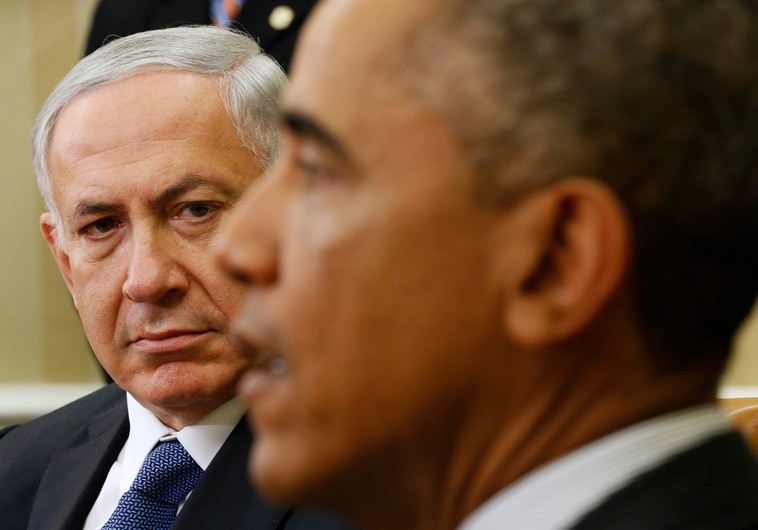
ShowImage (16)US President Barack Obama meets with Prime Minister Benjamin Netanyahu at the White House, October 1, 2014. (photo credit:REUTERS)

Whatever he says before the cameras next week when he meets with Netanyahu, Obama has no intention of letting bygones be bygones.

Prime Minister Benjamin Netanyahu’s meeting with US President Barack Obama next week is likely to look less like a rapprochement than a showdown at the OK Corral.

The flurry of spy stories spinning around in recent weeks makes clear that US-Israel relations remain in crisis.

Two weeks ago, The Wall Street Journal published a fairly detailed account of the US’s massive spying operations against Israel between 2010 and 2012.

Their purpose was to prevent Israel from attacking Iran’s nuclear installations. The Journal report, which was based on US sources, also detailed the evasion tactics the Obama administration employed to try to hide its covert nuclear talks with Iran from Israel. According to the report, the administration was infuriated that through its spy operations against Iran, Israel discovered the talks and the government asked the White House to tell it what was going on.

Over the past several days, the Israeli media have reported the Israeli side of the US spying story.

Friday Makor Rishon’s military commentator Amir Rapaport detailed how the US assiduously wooed IDF senior brass on the one hand and harassed more junior Israeli security officials on the other hand.

Former IDF chiefs of General Staff Lt.-Gens. Gabi Ashkenazi and Benny Gantz were given the red carpet treatment in a bid to convince them to oppose Israeli strikes on Iran’s nuclear installations. More junior officials, including officers posted officially to the US were denied visas and subjected to lengthy interrogations at US embassies and airports in a bid to convince them to divulge information about potential Israeli strikes against Iran.

Sunday, Channel 2 reported that the IDF’s Intelligence Directorate’s information security department just issued guidance to all IDF soldiers and officers warning them about efforts by the CIA to recruit them as US agents.

These stories have been interpreted in various ways. Regardless of how they are interpreted, what they show is that on the one hand, the Obama administration has used US intelligence agencies to weaken Israel’s capacity to harm Iran and to actively protect Iran from Israel. And on the other hand, Israel is wary of the administration’s efforts to weaken it while strengthening its greatest foe.

These stories form the backdrop of next week’s meeting between Netanyahu and Obama – the first they will have held in more than a year. They indicate that Obama remains committed to his policy of weakening Israel and downgrading America’s alliance with the Jewish state while advancing US ties with Iran. Israel, for its part, remains deeply distrustful of the American leader.

This Israeli distrust of Obama’s intentions extends far past Iran. Recent statements by Obama and Secretary of State John Kerry have convinced Israel that during his last 15 months in office, Obama intends to abandon US support for Israel at the UN Security Council, and to ratchet up pressure and coercive measures to force Israel to make irreversible concessions to the Palestinians.

From Netanyahu’s perspective, then, the main strategic question is how to prevent Obama from succeeding in his goal of weakening the country.

The implementation of Obama’s deal with Iran deal will form a central plank of whatever strategy the government adopts.

As far as Obama and his allies see things, the nuclear accord with Iran is a done deal. On October 21, House Minority Leader Nancy Pelosi hosted a reception for Democratic congressmen attended by White House Chief of Staff Denis McDonough to celebrate its official adoption.

Unfortunately for Pelosi and her colleagues, Iran is a far more formidable obstacle to implementing the deal than congressional Republicans. As Yigal Carmon, president of the Middle East Media Research Institute (MEMRI), explained in a report published on his organization’s website last week, at no point has any Iranian governing body approved the nuclear deal. Iran’s parliament, the Majlis, and its Guardians’ Council have used their discussions of the agreement to highlight their refusal to implement it. More importantly, as Carmon explains, contrary to US media reports, in his October 21 letter to Iranian President Hassan Rouhani, Iran’s Supreme leader Ayatollah Ali Khamenei did not give his conditional approval to the deal. He rejected it.

Carmon explained that the nine conditions Khamenei placed on his acceptance of the nuclear deal render it null and void. Among other things, Khamenei insisted that all sanctions against Iran must be permanently canceled. Obama couldn’t abide by this condition even if he wanted to because he cannot cancel sanctions laws passed by Congress.

He can only suspend them.

Khamenei also placed new conditions on Iran’s agreement to disable its centrifuges and remove large quantities of enriched uranium from its stockpiles.

He rejected inspections of Iran’s military nuclear installations. He insisted that Iran’s Arak heavy water reactor must remain capable of producing heavy water in contravention of the deal. And he insisted that at the end of the 15-year lifetime of the deal Iran must have sufficient uranium enrichment capability to enable it to develop bombs at will.

As Carmon noted, the US and EU have announced that they will suspend their nuclear sanctions against Iran on December 15 provided that by that date, the UN’s International Atomic Energy Commission certifies that Iran has upheld its part of the bargain.

By that date, in conformance with their interpretation of the nuclear deal, the US and the EU expect for Iran to have reduced the number of centrifuges operating at the Natanz facility from 16,000 to 5,060 and lower enrichment levels to 3.67%; reduce the number of centrifuges at Fordow to a thousand; remove nearly all its advanced centrifuges from use; permit the IAEA to store and seal its dismantled centrifuges; reduce its stockpile of enriched uranium to 300kg.; remove the core from the Arak reactor and disable it; and submit to agreed monitoring mechanisms of its nuclear sites.

Carmon noted that Iran has taken no steps to fulfill any of these conditions.

With Khamenei’s rejection of the nuclear deal and Iran’s refusal to implement it, there are two possible ways the US and the EU can proceed.

First, as Carmon suggests, Obama and the EU may renew nuclear talks with Iran based on Khamenei’s new position. These talks can drag out past Obama’s departure from office. When they inevitably fail, Obama’s successor can be blamed.

The other possibility is that Iran will implement some component of the deal and so allow Obama and the EU to pretend that it is implementing the entire deal. Given the US media’s failure to report that Khamenei rejected the nuclear pact, it is a fair bet that Obama will be able to maintain the fiction that Iran is implementing the deal in good faith until the day he leaves office.

So what is Israel to do? And how can Netanyahu use his meeting with Obama next week to Israel’s advantage? Israel has two policy options going forward. First, it can highlight the fact that Iran is not implementing the deal, just as Israel took the lead in highlighting the dangers of the nuclear accord with Iran over the past year. This policy can potentially force Obama onto the defensive and so make it harder for him to go on the offensive against Israel at the UN and other venues in relation to the Palestinians.

But then, it is far from clear that Obama will be deterred from adopting anti-Israel positions at the UN even if Israel succeeds making an issue of Iranian noncompliance with the nuclear deal.

Moreover, if Netanyahu leads the discussion of the Iran’s bad faith, as he drove the discussion of the nuclear deal itself, he will reinforce the already prevalent false assessment in the US that a nuclear Iran threatens Israel but is not dangerous for the US.

This incorrect assessment has made a lot of Americans believe that by seeking to prevent Iran from acquiring nuclear weapons, Israel is advancing is own interests at America’s expense.

The other policy option is the one that Defense Minister Moshe Ya’alon indicated Israel is pursuing in his meeting last week with his counterpart Defense Secretary Ashton Carter. At the Pentagon Ya’alon declared, “The Iran deal is a given. Our disputes are over.”

The downside of this position is that it indicates that Israel accepts the legitimacy of a deal that Iran is not implementing and that would imperil Israel’s national security even if Iran were implementing it.

Its upside is that it takes Israel out of the US debate regarding the nuclear deal. To the extent that opponents of Obama’s Iran policy are willing to lead the fight against the deal themselves, Israel could do worse than to take a step back and plot its own course on Iran, independent of the US policy discussion.

It is hard to know which line of action makes more sense. But as the spy stories demonstrated, one thing is clear enough. Whatever he says before the cameras next week when he meets with Netanyahu, Obama has no intention of letting bygones be bygones.

Russia warns that Syria war could become a ‘proxy war’

November 1, 2015

Russia warns that Syria war could become a ‘proxy war’ BreitbartJohn J. Xenakis, November 1, 2015

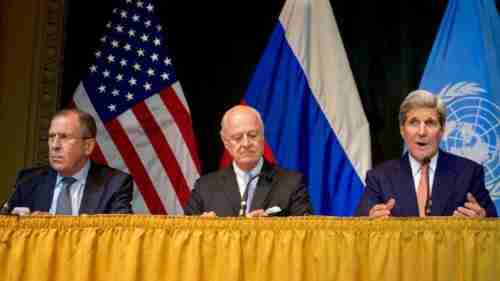
g151031bL-R: Sergei Lavrov, United Nations Special Envoy for Syria Staffan de Mistura, and John Kerry in Vienna on Friday (state.gov)

Russia has poured millions of dollars of heavy weapons into Syria, and is now sending in Russian troops to establish bases there. Recently, Russia launched 27 cruise missiles from the Caspian Sea to targets in Syria. Iran is pouring new troops into Syria. Iran has also given Lebanon’s Hezbollah terrorist group a great deal of money, and Hezbollah has sent thousands of troops into Syria to support Syria’s president Bashar al-Assad.

Al-Assad’s genocidal attacks on innocent Syrian Sunnis, killing hundreds of thousands and forcing millions from their homes, has caused Sunni jihadists from all of the world to fight against al-Assad, Russia, Hezbollah, and Iran in Syria. Along the way, these jihadists formed the so-called Islamic State (IS or ISIS or ISIL or Daesh).

And now, on Friday, Russia’s Foreign Minister Sergei Lavrov made a pronouncement that Barack Obama was going to trigger a “proxy war” in Syria by sending in 50 special operations forces, as we reported yesterday.

You can’t make this stuff up.

Thanks to Iran, Russia, al-Assad and Hezbollah, there are now tens of thousands of foreign troops fighting each other in Syria, with al-Assad in particular supported by massive amounts of foreign weapons.

But somehow, those tens of thousands of foreign fighters don’t make it a “proxy war,” but America’s 50 special forces troops do.

You can’t trust any garbage that comes out of Lavrov’s mouth, or out of al-Assad’s mouth, or out of Vladimir Putin’s mouth, but I listen to BBC, al-Jazeera, FOX, CNN, and other media sources all the time, and I see these news anchors report this crap with a straight face all the time. I don’t know whether it is more sickening to watch those fatuous news anchors, or to watch the fawning Secretary of State John Kerry suck up to Lavrov and Putin, which has happened in issues involving Ukraine, Iran’s nuclear development, and Syria.

All this verbiage is coming out of a meeting in Vienna whose purpose is to find a “political solution” to the Syria problem. With hundreds of thousands of Syrian migrants pouring into Europe, and with hundreds of ISIS militants returning to Russia to fight Putin, there is a lot of pressure to find a “political solution.” But this week’s announcement that Iran will fully enter the war in Syria on the side of the Syrian regime makes any “political solution” farther away than ever. On the contrary, Saudi Arabia and other Gulf countries will never agree to anything like the emerging situation. Actions by Russia and Iran, intervening militarily in Syria, is an emerging disaster, likely triggering a sectarian Sunni versus Shia war throughout the region. BBC and International Business Times and Reuters

Syria’s civil war and Generational Dynamics

In the 12 years that I’ve been doing this, I’ve posted about 4,000 articles with hundreds of Generational Dynamics predictions.

In 2011, when the Syrian civil war began, I said that the war should fizzle within a year or two. Of all the hundreds of Generational Dynamics predictions, this is the one where I’ve clearly been (depending on how you look at it) either wrong or poorly described.

Syria’s last generational crisis war was civil war that climaxed in 1982 with the massacre at Hama. There was a massive uprising of the 400,000 mostly Sunni citizens of Hama against Syria’s president Hafez Assad, the current president’s father. In February, 1982, Assad turned the town to rubble, 40,000 deaths and 100,000 expelled. Hama stands as a defining moment in the Middle East. It is regarded as perhaps the single deadliest act by any Arab government against its own people in the modern Middle East, a shadow that haunts the Assad regime to this day.

(As a related matter, the civil war in Lebanon also climaxed that year, with the bloody massacre at Sabra and Shatila occurring in September 1982. And it occurred as the Iran/Iraq war was ongoing, three years after Iran’s bloody Great Islamic Revolution in 1979. At that time, much of the Mideast was re-fighting World War I and the collapse of the Ottoman Empire, 60 years earlier.)

So, in 2011, I said that the civil war in Syria would fizzle, and could not turn into a crisis civil war. And that’s both wrong and true. There are too many survivors who remember the 1982 slaughter, and do not want to see it repeated. And so there’s been no massive anti-government uprising, as there was in 1982, and Bashar al-Assad’s Shia/Alawite troops have been fighting half-heartedly, with many soldiers defecting or deserting.

But the war did not fizzle.

It should have fizzled in 2011 or 2012, but Hezbollah and Iran starting pouring troops in to support al-Assad. And foreign fighters from around the world arrived to fight al-Assad and to form ISIS. That’s not something that Generational Dynamics could have predicted.

Earlier this year, it looked like al-Assad’s army was near collapse. In July, a desperate al-Assad gave a national speech in which he admitted he was losing. The war should have fizzled this year. But now, Russia and Iran are pouring tens of thousands more troops into Iran to bolster al-Assad. And that also is not something that Generational Dynamics could have predicted.

So the problem for me is: How should I have characterized the situation in 2011? The prediction that it wouldn’t turn into a crisis civil war was correct, but the war did not fizzle, because it turned into a proxy war.

Well, I don’t think there’ll be a next time, but if there is, I’ll try to characterize the situation differently, without simply using the word “fizzle.” NPR (1-Feb-2012)

Generational Dynamics and crisis civil wars

I write about a number of civil wars going on in the world today, so this is a good time to discuss civil wars from the point of view of Generational Dynamics.

Among generational crisis wars, an external war is fundamentally different than a civil war between two ethnic groups. If two ethnic groups have lived together in peace for decades, have intermarried and worked together, and then there is a civil war where one of these ethnic groups tortures, massacres and slaughters their next-door neighbors in the other ethnic group, then the outcome will be fundamentally different than if the same torture and slaughter is rendered by an external group. In either case, the country will spend the Recovery Era setting up rules and institutions designed to prevent any such war from occurring again. But in one case, the country will enter the Awakening era unified, except for generational political differences, and in the other case, the country will be increasingly torn along the same ethnic fault line.

The period following the climax of a crisis war is called the “Recovery Era.” One path that the Recovery Era can take is that the leader of one ethnic group decides that the only way to prevent a new civil war is for him to stay in power, and to respond to peaceful anti-government demonstrations by conducting massive bloody genocide, torture and slaughter of the other ethnic group, in order to maintain the peace. (Dear Reader, I assume you’ve grasped the irony of the last sentence.)

For example, in a July article about Burundi, I described how Burundi’s Hutu president Pierre Nkurunziza was using such violence to quell Tutsi protests, supposedly to avoid a repeat of the 1994 Rwandi-Burundi genocidal war between Hutus and Tutsis.

As another example, in a June article about Zimbabwe, I described how Zimbabwe’s president Robert Mugabe was even worse. His 1984 pacification campaign was known as “Operation Gukurahundi” (The rain that washes away the chaff before the spring rain). During that campaign, accomplished with the help of Mugabe’s 5th Brigade, trained by North Korea, tens of thousands of people, mostly from the Ndebele tribe, were tortured and slaughtered. Later, Mugabe single-handedly destroyed the country’s economy by driving all the white farmers off the farms, resulting in one of the biggest hyperinflation episodes in world history.

That is what Bashar al-Assad is doing in Syria. Fearing a Sunni uprising, like the one in 1982, al-Assad is conducting a massive “peace campaign” by slaughtering and displacing millions of innocent Sunnis. As I wrote above, this should have fizzled in 2011 or 2012, but it’s turned into a proxy war, and it’s a disaster for the Mideast and the world.

But none of the above three examples is a crisis civil war. A crisis war has to come from the people, not from the politicians. So, for example, there’s a massive crisis civil war going on today in Central African Republic (CAR), between the Muslim ex-Seleka militias fighting Christian anti-Balaka militias.

Unlike the previous examples, CAR is in a generational Crisis era. CAR’s last generational crisis war was the 1928-1931 Kongo-Wara Rebellion (“War of the Hoe Handle”), which was a very long time ago, putting CAR today deep into a generational Crisis era, where a new crisis war is increasingly likely. That’s why the CAR is a genuine crisis civil war, and won’t fizzle out. In fact, it won’t end until it has reached some kind of explosive conclusion — of the kind we described in Hama or Sabra and Shatila. ( “2-Oct-15 World View — Violence resurges in Central African Republic crisis war”)

Generational Dynamics and war between Palestinians and Israelis

I’ll discuss one more example — not a civil war, but very similar to a civil war, with the same kinds of issues.

In the last few years, there have been three non-crisis wars between Israelis and Palestinians in Gaza. In each case, the Israelis destroyed Hamas’s infrastructure, ending the war. The war began again each time when Hamas’s infrastructure was rebuilt.

But the point I want to make is that these three non-crisis wars were all directed by politicians. Palestinians attacked when the leadership told them to, and stopped attacking when the leadership told them to stop.

What I have been describing in numerous articles recently is that there is emerging a major, fundamental, historic change.

In the emerging situation, young people today are no longer willing to listen to these leaders. According to the CIA World Fact Book, 20% of Gaza’s population are in the 15-24 age range, and so are 21% of the West Bank — about 200,000 males in each territory, or 400,000 young males total.

On the Israeli side, there are over 600,000 young males in the same age range. There have been unconfirmed reports of young Israelis also disgusted with the leadership. It is possible that, like the young Palestinians, they are willing to take matters into their own hands.

So in this environment, what could happen next? The last three Gaza wars were non-crisis wars, but the next one could be a crisis war between Israelis and Palestinians.

How can a crisis war begin? How about if those 200,000 young male Gazans blow holes in the walls, pour across into Israel and start killing Israeli citizens en masse in their homes and villages? And how about if they are joined by those 200,000 young male Palestinians on the West Bank, who start with the Jewish settlers and continue with the Jews in Jerusalem. And how about if the young Israeli males strike back and start killing Palestinians in their homes and villages?

Israel’s tanks and bombers would not be of much use. You can’t bomb Jerusalem, and you can’t bomb Israeli villages and settlements to kill Palestinians.

That is the difference. That is what a generational crisis war is like. It is not two tanks shooting at each other. It is hand to hand combat in homes, neighborhoods and streets by people armed with sticks and knives. It is what happened in Central African Republic last year, it is what happened in Rwanda in 1994, in Bosnia in 1994, and in Palestine in 1947.

And by the way, that assumes that the bloody mess stays confined to Israel and the Palestinian territories. The Palestinians are likely to be joined by tens or hundreds of thousands from Jordan, Lebanon and Egypt.

The recent widely reported changes in the attitudes and behaviors of young Palestinians is a sign that this kind generational crisis war is coming.

Leader: Negotiation with US on Regional Issues Meaningless

November 1, 2015

Leader: Negotiation with US on Regional Issues Meaningless, Tasnim News Agency (Iranian), November 1, 2015

139408101241559676429254


While many consider the Joint Comprehensive Plan of Action (JCPOA) a major breakthrough in the improvement of ties between Iran and the West, the Leader has already made it clear that Tehran’s policy toward the US will remain unchanged regardless of the ultimate fate of the JCPOA.

***********************

TEHRAN (Tasnim) – Supreme Leader of the Islamic Revolution Ayatollah Seyed Ali Khamenei dismissed the idea of Iran-US negotiation on regional issues, saying the totally contrasting policies of the two countries and Washington’s attempts to impose its demands make such talks pointless.

In a meeting with the Foreign Ministry staffers in Tehran on Sunday, Ayatollah Khamenei underlined that Iran’s foreign policy is founded upon the Constitution, the long-term interests of the country and the Islamic Republic’s values, and that, consequently, they do not change in different administrations.

Different administrations would affect only the “tactics and executive initiatives” in carrying out the country’s foreign policy strategies, the Leader stressed.

The Supreme Leader then dismissed as a Western illusion the notion that Iran’s foreign policy has undergone a forcible change.

Imam Khamenei further referred to the US policies in West Asia as the root cause of the tense situation across the region, adding, “Unlike the view of certain individuals, the US is the main plank of the region’s problems, not part of a solution to the problems.”

The Leader then called on the Iranian foreign ministry officials, ambassadors and diplomats to stick to the tenets of the Islamic Republic’s foreign policy “firmly, mightily and gloriously”, so that foreigners and their followers inside the country would not pin hopes on a shift in Iran’s foreign policy.

Ayatollah Khamenei referred to Iran’s policies on Palestine, Syria, Iraq, Yemen and Bahrain, saying they differ from those of the US by “180 degrees”.

The root cause of insecurity in the region is Washington’s support for the Zionist regime of Israel and the terrorist groups, the Leader underscored.

Imam Khamenei then categorically dismissed the idea of negotiations with the US on regional issues.

“The Americans seek to impose their interests, not to settle problems. They want to impose 60, 70 percent of their demands via negotiations, and practically implement and impose the rest of their objectives illegally. Then what would negotiations mean?”

Elsewhere, Ayatollah Khamenei lauded Foreign Minister Mohammad Javad Zarif and other diplomats for handling nuclear talks with six world powers well, saying they could very well safeguard the country’s goals in the talks.

Iran and the Group 5+1 (Russia, China, the US, Britain, France and Germany) on July 14 reached a conclusion on a lasting nuclear agreement that would terminate all sanctions imposed on Tehran over its nuclear energy program after coming into force.

While many consider the Joint Comprehensive Plan of Action (JCPOA) a major breakthrough in the improvement of ties between Iran and the West, the Leader has already made it clear that Tehran’s policy toward the US will remain unchanged regardless of the ultimate fate of the JCPOA.

Doomed Russian jet did not issue a distress call: report

November 1, 2015

Doomed Russian jet did not issue a distress call: report, DEBKAfile, November 1, 2015

The Russian passenger plane that crashed in the Sinai Peninsula on Saturday did not send out any distress call, reports said Sunday, meaning that the plane suddenly blew up. A number of Israeli commentators continue to claim, like Egypt, that the pilots reported a technical problem to the Egyptian control tower, and that the plane broke in half during the flight. However, there is no basis to those reports.

Reports: IAF targets Hezbollah assets in Syria

October 31, 2015

Reports: IAF targets Hezbollah assets in Syria, Times of Israel, October 31, 2015

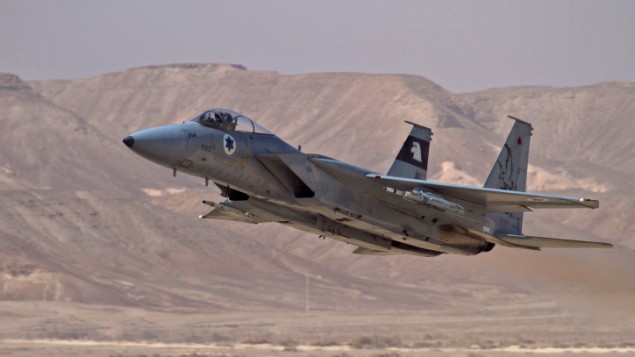
Israeli jet fighterAn Israeli fighter jet takes off during a training sortie in February 2010. (photo credit: Ofer Zidon/Flash90)

The Lebanese and Syrian media said Saturday that Israel Air Force warplanes have attacked targets in Syria linked to the Lebanon-based militant group Hezbollah. Reports varied, however, on the exact targets and location of the strikes.

According to a report on the Lebanese Debate website, six IAF jets carried out the strike over the Qalamoun Mountains region of western Syria, and targeted weapons that were headed for Hezbollah, Channel 10 said.

Syrian opposition groups, for their part, claimed Israeli planes had attacked targets in the Damascus area, in two strikes in areas where Hezbollah and pro-Assad forces were centered.

Syrian media, however, said that Israeli warplanes hit several Hezbollah targets in southern Syria.

Israel’s defense establishment declined to comment on the reports of the strikes, which would be the first since Russia boosted its involvement in the Syrian civil war.

Syrian and Iranian media reported Friday that Russia was carrying out air strikes against anti-Assad rebel forces on the Syrian side of the Golan Heights border with Israel.

The Jewish state has reportedly carried out several strikes on Syrian arms convoys destined for Hezbollah, although it routinely refuses to confirm such operations. It has, however, warned that it will not permit the Lebanon-based group to obtain what it calls “game-changing” advanced weaponry.

Prime Minister Benjamin Netanyahu said last month after meeting with Russian President Vladimir Putin in Moscow that Israel and Russia have agreed on a mechanism to avoid military confrontations between the two countries in Syria.

Russia, a key ally of Syrian President Bashar Assad, is in the midst of a military operation in the war-torn country, ostensibly to fight Islamic State militants who have seized huge swathes of territory. Critics however, claim that Russian airstrikes are targeting not only the fundamentalist group, but also Western-backed opposition groups who are seeking Assad’s ouster.

“My goal was to prevent misunderstandings between IDF forces and Russian forces. We have established a mechanism to prevent such misunderstandings. This is very important for Israel’s security,” Netanyahu told Israeli reporters during a telephone briefing from the Russian capital.

“Our conversation was dedicated to the complex security situation on the northern border,” the prime minister said. “I explained our policies in different ways to try to thwart the deadly weapons transfers from the Syrian army to Hezbollah — action actually undertaken under the supervision of Iran.”

Netanyahu said that he told Putin in “no uncertain terms” that Israel will not tolerate Tehran’s efforts to arm Israel’s enemies in the region, and that Jerusalem has taken and will continue to take action against any such attempts. “This is our right and also our duty. There were no objections to our rights and to what I said. On the contrary: there was readiness to make sure that whatever Russia’s intentions for Syria, Russia will not be a partner in extreme actions by Iran against us.”

Ahead of their meeting, as they made statements to the press, Netanyahu told Putin that Iran and Syria have been arming Hezbollah with advanced weapons, thousands of which are directed at Israeli cities. He also told his Russian host that Israel’s policy is to prevent these weapons transfers “and to prevent the creation of a terrorist front and attacks on us from the Golan Heights.”

In April, Defense Minister Moshe Ya’alon also warned that Israel would not let Iran equip Hezbollah with advanced weapons — a day after an alleged Israeli airstrike hit weapons depots in Syria.

Although Ya’alon did not discuss the airstrike that reportedly hit surface-to-surface missile depots, he declared that Israel would not allow Iran to supply arms to the terror group, which has a strong military presence in Lebanon as well as in Syria, the two countries lying on Israel’s northern borders.