Archive for the ‘Israel’ category

Bernie Sanders Invites Spain’s Anti-Semitic, Anti-Israel Party Leader to Democratic Convention

July 25, 2016

Bernie Sanders Invites Spain’s Anti-Semitic, Anti-Israel Party Leader to Democratic Convention, PJ MediaRon Radosh, July 24, 2016

sanders

Because of the tumult over the WikiLeaks revelations showing how the DNC worked to undermine Bernie Sanders’ candidacy in the Democratic primaries, few people have noticed the controversial guest that Sanders has invited to the Democrats’ convention.

Spanish newspaper ABC reported on July 22 that Paul Bustinduy, secretary of international relations of Spain’s far-left, anti-Semitic party Podemos, is Bernie’s guest.

Although Podemos came in third place in the June 26 Spanish national election, it is a political force to be reckoned with in Spain. Podemos had joined an alliance with other mostly leftist groups in a coalition called United We Can — this was the name Podemos ran under. The alliance included the  United Left, whose main component is members of the old Spanish Communist Party, which on its own has little support in Spain.

Composed of old Communists, Trotskyists, independent revolutionaries, Basque and Catalan nationalists, leftist urban intellectuals, and former supporters of the Socialist Party annoyed at what they perceive as its continuing compromises, United We Can models itself on the Marxist Greek party Syriza. Syriza brought the Greek economy to near total collapse.

To call Podemos blatantly anti-Semitic would not be a false accusation.

In Madrid, the party’s affiliate is called Ahora Madrid. The head of Madrid’s department of culture, Guillermo Zapata, who is a member, tweeted:

“ ‘How do you fit five million Jews in a SEAT 600 [a car]?’ Answer: ‘In an ashtray.’”

In 2012, he tweeted that Israel is “genocidal posing as an advanced democracy,” and resembles Assad’s regime in Syria.

Not surprisingly, United Left and Podemos support the international BDS campaign. They also supported the anti-Israel flotillas that attempted to sail to Gaza in support of Hamas in its war against Israel. They support virtually all measures the anti-Israel European left has proposed.

Podemos is so anti-Israel that it defends a notorious anti-Semitic Spanish magazine, El Jueves.

An English independent socialist internet magazine, Shiraz Socialist, recently ran an article aboutEl Jueves written by Yves Coleman, appropriately titled: “Spanish radical left tolerates anti-Semitism.”

Yves Coleman writes:

Following the publication of anti-Jewish and anti-Semitic cartoons in El Jueves on 10 February 2016, Pablo Iglesias (general secretary of Podemos) and David Fernandez, former member of the CUP in the Catalan Parliament, have, along with other personalities of the “political and cultural world,” signed a petition protesting against any possible complaint which could be filed against the anti-Semitic drawings published by El Jueves.

The magazine, Coleman notes:

… likes to play with the stereotypes of the Jew as a schemer, swindler and liar.

They regularly run cartoons of Jews wearing:

… either payots, long beards, a wide-brimmed hat and a black coat or an IDF military uniform.

One such cartoon, from another Spanish left-wing anti-Semitic group, depicts the “Stay out of Spain, Obama” protest. It shows Obama taking money from the Jews. In the Spanish left, Obama is viewed as an imperialist warmonger.

In another issue, they published the cartoon below about Israel, using the symbols of Hitler’s SS to indicate that Israel is composed of Nazis.

cartoon antisemitism

Although Spain is a nation in which few Jews live, it is also the European country in which anti-Semitic views are most widespread. Unfortunately, the magazine’s writers and editors, like Podemos, hold the same anti-Semitic views that exist among the French left, and especially exist in Jeremy Corbyn’s British Labor Party.

To be a leftist in Spain, France or Britain means that you support anti-Semites, condemn Israel, and feel comfortable comparing it as a nation to the Nazis.

While here, Mr. Bustinduy plans to meet with activists in the Latino community, trade unionists, and leaders of the Black Lives Matter movement — which itself is anti-Israel.

A day before the convention, on July 24, he will participate in a left-wing conference at the University of Pennsylvania called Democracy Rising.

His main purpose, however, is to give his support to Bernie Sanders’ efforts to force the Democratic Party to move much further to the left. Undoubtedly, Bustinduy will complain about the Sanders group’s one big failure: to put an anti-Israel position into the Democratic Party platform.

With most of the media concentrating on reaction to the WikiLeaks release, the invitation to Podemos will most likely go unnoticed. Is there anyone in the mainstream media who will ask Sanders why he offered this invitation to a leader of a Spanish anti-Semitic, anti-Israel political party?

Clinton VP tapped pro-terror Muslim leader for immigration seat

July 25, 2016

Clinton VP tapped pro-terror Muslim leader for immigration seat, Israel National News, David Rosenberg, July 25, 2016

(Please see also, Clinton VP Pick Tim Kaine’s Islamist Ties. — DM)

Kaine and his administration initially brushed off the criticism as mere Islamophobia.

Yet Omeish’s ties to terror and explicit support for violent Jihad quickly became apparent, ultimately leading Kaine to pressure Omeish to step down.

**************************

Virginia Senator and former Governor Tim Kaine has been the Democratic Party’s presumptive Vice Presidential nominee for just three days, yet the pick has already drawn fire from the pro-Israel community due in part to Kaine’s robust support for the Iran nuclear deal, his boycott of Israeli Prime Minister Binyamin Netanyahu’s address to Congress in 2015, and his ties to a left-wing NGO.

Now, a controversial appointment made during his tenure as Governor of Virginia has raised new questions about Kaine’s bona fides as a self-described “strongly pro-Israel Democrat”.

In 2007, then-Governor Kaine appointed Esam Omeish, a Libyan-born physician and then-president of the Muslim American Society, to Virginia’s Immigration Commission. This came despite Omeish’s history of ties and expressions of support for radical Islam and Jihadist terrorism.

Omeish is a long-time member of the Board of Directors of the Dar Al Hijrah mosque, which two of the 19 terrorists responsible for the 9/11 terror attacks attended, as friends of the mosque’s imam.

That imam was Anwar al-Awlaki, the radical Salafist cleric who later fled the United States and joined Al-Qaeda, after settling in Yemen.

In 2010, President Obama placed al-Awlaki on the CIA “kill list”, citing his orchestration of deadly terror attacks against Americans. In 2011 a US drone strike killed al-Awlaki in southeast Yemen.

But Omeish was not merely a congregant at the Dar Al Hijrah mosque where al-Awlaki preached; in 2000, he was vice president of the mosque and was responsible for vetting and hiring the radical cleric as the mosque’s imam.

The Muslim American Society, then headed by Omeish, had close ties to the Muslim Brotherhood, the Chicago Tribune reported in 2004, a description later validated by a federal report describing the group as “the overt arm of the Muslim Brotherhood in America.”

In addition to Omeish’s ties to radical Islam, his recorded comments prior to the 2007 appointment by Governor Kaine made his support for Jihadist terror even more explicit.

During a December 22, 2000 speech at a Jerusalem Day Rally in Lafayette Park, in Washington D.C., Omeish praised “the Jihad way” to “liberate your land”.

“We, the Muslims of the Washington metropolitan area, are here today in subfreezing temperatures to tell our brothers and sisters in Filastine [Palestine], that you have learned the way, that you have known that the Jihad way is the way to liberate your land. And we, by standing here today, despite the weather, and despite anything else, we are telling them that we are with you, we are supporting you, and we will do everything we can inshallah [Allah willing] to help your cause.”

In 2004, Omeish explicitly praised Hamas leader Sheikh Ahmed Yassin.

Governor Kaine’s selection of Omeish was criticized by state Republicans, who said the governor had failed to properly vet the appointee.

C. Todd Gilbert, a Republican delegate from Shenandoah County, wrote to the governor, noting the Muslim American Society’s “questionable origins”.

“I don’t know how a problem of this magnitude could have slipped through the Governor’s screening process,” Gilbert later said in a statement. “Even a cursory internet search about the appointee in question would have also easily identified him as a leader of a potentially radical northern Virginia mosque.”

Kaine and his administration initially brushed off the criticism as mere Islamophobia.

Yet Omeish’s ties to terror and explicit support for violent Jihad quickly became apparent, ultimately leading Kaine to pressure Omeish to step down.


Wrong and rude on Iran and Israel

July 24, 2016

Wrong and rude on Iran and Israel, Israel Hayom Richard Baehr, July 24, 2016

(Please see also, Clinton VP Pick Tim Kaine’s Islamist Ties. — DM)

The Democrats are out selling Tim Kaine as a solid citizen, experienced politician, and a great choice for vice president on the Hillary Clinton ticket — someone who could step in quickly as president if needed. The traditional pro-Israel community, led by the American Israel Public Affairs Committee, are undoubtedly preparing to signal their comfort with him as a Clinton running mate, much as they did with the supposedly pro-Israel Barack Obama, twice. Kaine has voted in favor of foreign aid; he has traveled to Israel; he voted in favor of funding some weapons systems for Israel; he has raised a lot of money from liberal Jews (running for governor, senator, and head of the Democratic National Committee). Therefore, he must be a great supporter of the U.S.-Israel relationship. So great in fact, that he was happy to take money from the J Street political action committee and accept its endorsement when he ran for Senate. AIPAC, J Street, Kaine, all one big happy family in the pro-Israel club.

Of course, on the Iran nuclear deal, the single most important foreign policy decision since the vote on the Iraq war in 2002, Kaine was not only wrong, but extraordinarily disrespectful to Israel’s prime minister. He chose to boycott Prime Minister Benjamin Netanyahu’s speech before a joint session of Congress on the issue in early 2015, saying that he thought Netanyahu’s aim was mainly to help himself with his own domestic politics in the Israeli elections, held two weeks later.

“There is no reason to schedule this speech [on March 3] before Israeli voters go to the polls on March 17 and choose their own leadership,” Kaine said in a statement, after describing how he’d worked to delay the event. “I am disappointed that, as of now, the speech has not been postponed. For this reason, I will not attend the speech.”

Let us assume for a moment that Netanyahu had two goals in mind for his speech — to make the case for healthy skepticism and opposition within Congress toward the Iran nuclear deal, which was near completion at the time, and help himself politically. This must have come as a shock to Kaine. Imagine a leader concerned both about the security of his country and his own political future. Good thing such considerations never entered the mind of any American president. Certainly Obama must never have allowed domestic political considerations to influence his policymaking or the timing of his decisions. The attempt to bury the Benghazi attack on September 11, 2012, presenting it as an event caused by some anti-Muslim message by some obscure American filmmaker was quickly adopted by all the administration spinners — from Susan Rice to then-Secretary of State Clinton. This spin was necessary for Obama to continue running for re-election on the campaign theme he had developed — the fact that he killed Osama bin Laden and saved General Motors. Blaming the filmmaker was of course complete and total nonsense.

And of course, Obama’s recent warning that Britain would be at “the back of the queue” to negotiate a trade agreement with the U.S. if it voted to leave the European Union, was not in any way an act of interference in another country’s politics — the kind of interference that might have drawn Kaine’s ire.

Kaine was one of only eight senators who boycotted Netanyahu’s speech. The others included both Vermont senators, Patrick Leahy and Bernie Sanders, two of the least supportive members of Congress when it comes to Israel. Sanders of course pushed for a new policy on Israel during his campaign for the Democratic nomination this year, and brought up the need for balance in terms of support for Israel and the Palestinians in the Brooklyn debate with Clinton, where his enthusiastic supporters went wild when he chastised Israel and its prime minister. At the moment, this sentiment is where the heart of the Democratic Party lies — on the hard left and hostile toward Israel. Two others who boycotted were Elizabeth Warren of Massachusetts and Sheldon Whitehouse of Rhode Island — two of the most passionate leftists in Congress.

One would not expect to find Kaine siding with Vermont’s two near Marxist senators and the most left-wing members of the House in boycotting Netanyahu. But then again, two Democratic senators who happen to be Jewish — Al Franken and Brian Schatz — also boycotted.

There must have been conversations between the administration and Democratic congressional leaders to ensure a decent sized boycott (in total about 20% of congressional Democrats boycotted the speech), and to provide enough names on the boycott list to protect possible future Democratic national figures, meaning, of course, Kaine.

Kaine is the very definition of a career politician. He served on the city council, then as mayor of Richmond, then as governor of Virginia, then as head of the Democratic National Committee and finally as senator. In 2008, he was on Obama’s short list for vice president. If he were to move up to the only positions he has not yet held — vice president and ultimately president, then his actions on Iran in 2015 might well be seen as a signal to movement Democrats — party activists — that he is not a predictable centrist but is capable of turning leftward on Israel.

This meant diverging from AIPAC, which at this point is a low-risk move since the organization seems never to lose the love regardless of members’ behavior or votes. Has AIPAC punished any Democrat for leading the charge, or applying pressure on other Democrats in the House or Senate, on the Joint Comprehensive Plan of Action?

In fact, for someone who started his political career as something of a social conservative on abortion and gay marriage, Kaine seems to have understood that he needed move leftward on these issues to have a chance at a national future. Republicans are attacked for their disunity, which is real. Democrats enforce their orthodoxy. Kaine’s voting record is 100% liberal on most scorecards, and despite this, some progressives consider him too moderate.

When the JCPOA came up for a vote in Congress, Kaine made up his mind quickly — in the first two weeks . One would have to be pretty gullible to think the senator had carefully weighed the pros and cons of the agreement before deciding.

Kaine’s announced support for the JCPOA likely made it easier for others to also buck AIPAC and support the president. Most remarkably, Kaine voted twice to support a filibuster in the Senate, so that a vote could not even be recorded on the JCPOA. It turns out that 58 senators opposed the agreement (all 54 Republicans, and 4 Democrats), but 60 votes were needed to force a vote in the Senate.

Obama did not want a vote, since he then would have been forced to veto the formal congressional opposition to the agreement since the House had already passed its opposition resolution. Kaine had been a co-sponsor of the Corker bill, therefore it is remarkable cynicism that he was not even willing to allow fellow senators to vote to formally express their opposition to the bill he co-sponsored.

If Kaine becomes vice president, he can be expected to do what is necessary to ensure he has a shot at the final step up the political ladder. Being pro-Israel won’t have much to do with it.

The President’s Beloved Islamic Grievance Monger

July 22, 2016

The President’s Beloved Islamic Grievance Monger, Front Page MagazineDiscover The Networks, July 22, 2016

linda-sarsour

Linda Sarsour – a well-trained grievance monger whose very livelihood is founded upon her ability to convince large numbers of people that they are victims of an irredeemably bigoted and oppressive American society. In short, she has a great deal in common with President Obama. No wonder she’s always welcome at the White House.

***********************

Linda Sarsour is a Palestinian-American community activist who since 2005 has served as executive director of the Arab American Association of New York (AAANY), which views the U.S. as a nation awash in racism and Islamophobia. She is also a board member of the Muslim Democratic Club of New York, whose mission is to help elect as many Democrats as possible to political office.

An outspoken critic of Israel, Sarsour supports the Boycott, Divestment & Sanctions (BDS) movement, a Hamas-inspired initiative that uses various forms of public protest, economic pressure, and court rulings to advance the Hamas agenda of permanently destroying Israel as a Jewish nation-state.

Vis-a-vis the ongoing Arab-Israeli conflict, Sarsour favors a one-state solution where an Arab majority and a Jewish minority would live together within the borders of a single country. She made clear her opposition to Israel’s existence as a Jewish state when she tweeted in October 2012 that “nothing is creepier than Zionism.”

Falsely maintaining that “Palestine existed before the State of Israel,” Sarsour seeks to help “bring back a Palestinian State for the Palestinian people.” To advance this agenda, Sarsour has tweeted images of fraudulent maps claiming to depict the “Palestinian loss of land” that supposedly occurred between 1946 and 2000.

As the head of AAANY, Sarsour has played a central role in pressuring the New York Police Department to terminate its secret surveillance of Muslim mosques and organizations suspected of promoting extremism or terrorism, and to curtail its use of “stop-and-frisk” anti-crime measures. In 2011 she worked in conjuction with Communities United for Police Reform, a coalition to advance the passage of the Community Safety Act (which expanded the definition of bias-based profiling and created an independent inspector general to review police policy in New York City). Sarsour also succeeded in pressuring City Hall to close New York’s public schools for the observance of the Islamic holidays Eid al-Fitr and Eid al-Adha.

In May 2012 Sarsour tweeted that the so-called “underwear bomber,” an al-Qaeda operative who on Christmas Day 2009 had tried to blow up a Detroit-bound passenger jet with explosives hidden inside his underwear, was actually a CIA agent participating in America’s “war on Islam.”

In a February 2015 appearance on Rachel Maddow‘s television program, Sarsour lamented that a nationwide epidemic of “Islamophobia” was responsible for “anti-sharia bills trying to ban us [Muslims] from practicing our faith,” “mosques being vandalized,” and Muslim “kids being executed” in the United States.

In August 2015 Sarsour spoke out in support of the incarcerated Palestinian Islamic Jihad member Muhammad Allan, a known recruiter of suicide bombers.

In October 2015, Sarsour posted on Twitter a photo of a young Palestinian boy clutching two stones as he stared down a group of Israeli soldiers, and labeled it “The definition of courage.” When numerous Twitter users, including Queens Councilman Rory Lancman, subsequently criticized Sarsour’s controversial post, she tweeted in response: “The Zionist trolls are out to play. Bring it. You will never silence me.”

On Melissa Harris-Perry‘s television program on December 12, 2015, Sarsour lamented the allegedly long list of “attacks on [Muslim] individuals and on mosques” that had been perpetrated by Americans who — by misperceiving all Muslims as potential terrorists — were themselves “engaging in terrorism against the innocent [Muslim] community that has nothing to do with [terrorism].” Sarsour also scoffed at the notion of Muslim integration into American society: “We can’t change who we are. This is how we look [with Muslim attire]. We can’t integrate and assimilate…. We’re gonna look like this when we walk out into the streets of our cities when we’re traveling in this country.”

According to CounterJihad.com, Sarsour “has attended numerous rallies sponsored by Al-Awdapromoted and solicited donations for their events, and … spoken at their rallies. Sarsour has also solicited donations for the Hamas-affiliated Palestine Children’s Relief Fund.

Over the years, Sarsour’s activism has extended also to racial matters within the United States. For instance, when the black, hoodie-donning Florida teenager Trayvon Martin was killed by a “white Hispanic” man in an infamous 2012 altercation, Sarsour penned an article titled “My Hijab Is My Hoodie” and declared herself “among the millions mourning the killing of Trayvon.” “Blacks in America continue to face racism on a daily basis,” she wrote, “from the workplace to interactions with law enforcement. And yet racism against African-Americans is publicly acknowledged as unacceptable…. Unfortunately, that’s not the case for Muslims in America. Bigotry against Muslims is quite acceptable.”

In the aftermath of an August 2014 incident where a white policeman in Ferguson, Missouri had shot and killed a violent black criminal named Michael Brown, Sarsour co-founded Muslims for Ferguson, to draw a parallel between the respective forms of oppression allegedly suffered by black and Muslim Americans.

According to a New York Times report, Sarsour is “deeply involved in the Black Lives Matter movement.”

In October 2011, Sarsour, who holds free-market economics in low regard, expressed, on behalf of “Muslim New Yorkers,” “solidarity and support” for the anti-capitalist Occupy Wall Street movement. In 2011 as well, the Obama Administration honored Sarsour as a “champion of change.” Thus far, she has visited the Obama White House on seven different occasions.

This, then, is Linda Sarsour – a well-trained grievance monger whose very livelihood is founded upon her ability to convince large numbers of people that they are victims of an irredeemably bigoted and oppressive American society. In short, she has a great deal in common with President Obama. No wonder she’s always welcome at the White House.


The UK’s Broken Labour Party

July 20, 2016

The UK’s Broken Labour Party, Gatestone Institute, Douglas Murray, July 20, 2016

(As the morass continues, how will the UK deal with its exit from the European Union? — DM)

♦ With the prospect of another Labour leadership election now gathering pace, tens of thousands more activists have joined the Labour party. It seems unlikely that they will be “moderates.”

♦ The election of an Islamist-sympathising, terrorist-sympathising, Israel-bashing hardliner at the head of the second largest party in the House of Commons undoubtedly changes the parameters of political discourse in the UK.

♦ However solidly Theresa May’s new Conservative government performs, it will always seem the point — so long as Corbyn is in office — that you are either for Britain or against it, for the Conservative party or against the country.

♦ A fractured and in-fighting opposition also means that there is no meaningful, organised voice challenging the government in Parliament. That principle — the principle on which our system is based — needs to work well even (perhaps especially) if you support the government of the day, because the government of the day needs to be kept alert to error and on top of sensible criticisms if it is going to pass the best legislation it can for the country.


Herbert Stein’s law, “Things that cannot go on, won’t,” is one of the best laws of politics. It works for fiscal issues and it usually works for politics as a whole. The British Labour party, however, is currently working to try to disprove this rule. To do them justice they are having a good stab at doing so, which suggests that the maxim should perhaps be re-written: “Things that cannot go on sometimes do.”

Consider the latest developments in the party’s recent unhappy history. Earlier this month the party’s specially commissioned inquiry into anti-Semitism within the party found the party not guilty of this bigotry for the second time in six months. Yet at the launch of these findings, a grassroots member of Jeremy Corbyn’s wing of the party verbally bullied a female Jewish Labour MP until she left in tears, and Jeremy Corbyn himself appeared to compare the Jewish state with ISIS. Although this episode captured some headlines, it was a mere footnote alongside the other catastrophes in the Labour party.

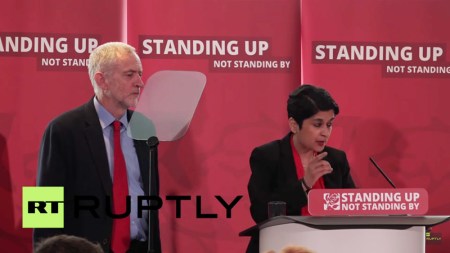
1678UK Labour party leader Jeremy Corbyn (left) appears at a press conference with left-wing campaigner Shami Chakrabarti (right), to present the findings of an inquiry into the Labour party’s anti-Semitism, June 30, 2016.

At the same time as this was going on, Labour MPs attempted a coup to get Jeremy Corbyn out of his position as head of the party. A carefully orchestrated set of resignations from his Shadow Cabinet came in every couple of hours until almost all of the Shadow Cabinet had resigned. Corbyn also lost the support of the deputy leader of the party, Tom Watson. A no-confidence motion saw 172 Labour MPs vote to say that they had no confidence in their party leader, while only 40 Labour MPs supported the party leader. This move meant that Jeremy Corbyn began to have significant trouble finding enough supporters in the Parliamentary Labour party to fill up his shadow cabinet. The joke in Westminster was that those few who did stay loyal to him would find themselves having to hold multiple briefs, so that somebody might easily find themselves being appointed Shadow Home Secretary and Shadow Foreign Secretary.

The trouble appears that all of Corbyn’s politics has a distinctly unfunny, nasty air. It emerged this week (from another declaration of no confidence in the leader) that earlier this year the Labour MP Thangam Debbonaire was both appointed and then sacked as the party’s Culture spokesperson, all within 24 hours and all without even being told, while she was undergoing treatment for cancer. Such stories of non-communication and cruelty towards individual MPs have fanned the rather understandable feeling that Jeremy Corbyn may not be suited to the highest peaks of politics.

Unfortunately for the Labour party, it is not only MPs who have a say. Under new rules unwisely drawn up under Corbyn’s predecessor, Ed Miliband, the Labour party can now be joined by anyone with £3 to spare. All such people then have the right to vote on who the Labour leader should be. Although the idea of having a say in any political party’s future for little more than the price of a cup of coffee may sound appealing, it also leaves a party open to the possibility of a hostile takeover from the most fanatical people in the country — whether they have the Labour party’s interests at heart or not. This is exactly what happened last year when Mr. Corbyn entered the Labour leadership race. Tens of thousands of people from the grassroots, who were soon to form themselves into the ‘Momentum’ movement, saw their chance to bring hard-left politics into the UK mainstream. Jeremy Corbyn won almost 60% of the vote in that election. In recent weeks, despite the formal no-confidence vote of the Labour MPs, this grassroots support for Corbyn only appears to have galvanised further. With the prospect of another Labour leadership election now gathering pace, tens of thousands more activists have joined the Labour party. It seems unlikely that they will be “moderates.”

Nevertheless, two “moderate” candidates for leader stepped forward, inevitably splitting the anti-Corbyn vote, until they seemed to realise this and one dropped out. Nevertheless, polls of party members suggest it looks overwhelmingly likely that in the coming weeks Corbyn will entrench his position by winning a landslide in a second ballot of the party’s members within a year.

Why does this matter? For two reasons. First, because the election of Corbyn has poisoned British politics. The election of an Islamist-sympathising, terrorist-sympathising, Israel-bashing hardliner at the head of the second largest party in the House of Commons undoubtedly changes the parameters of political discourse in the UK. However solidly Theresa May’s new Conservative government performs, it will always seem the point — so long as Corbyn is in office — that there is no party of the decent left available for the large proportion of voters who would like such a thing. This leaves countless patriotic, left-wing voters without a meaningful voice in Parliament.

A fractured and in-fighting opposition also means that there is no meaningful, organised voice challenging the government in Parliament. That principle — the principle on which our system is based — needs to work well even (perhaps especially) if you support the government of the day, because the government of the day needs to be kept alert to error and on top of sensible criticisms if it is going to pass the best legislation it can for the country.

The other reason why this principle matters is because it suggests that vested interests matter more than truth. Herbert Stein’s dictum lacked one crucial ingredient: people’s desire to look after themselves. There are Labour party MPs already looking for a way out, including looking to found a new party or parties. But they fear that way lies electoral oblivion. So they stay, in a party wracked with in-fighting and led by the most corrosive person their party has ever chosen in what had been a noble history. And all the while that person in charge of their party is busily mainstreaming the worst bigotries of our time. When pushed to decide between their morals and their careers, the dictum holds in the Labour party that things that cannot go on, find some way to do so.

Hezbollah’s Massive Arms Build-up in Lebanese Civilian Areas

July 19, 2016

Hezbollah’s Massive Arms Build-up in Lebanese Civilian Areas, Front Page MagazineJoseph Klein, July 19, 2016

hn

Every calendar quarter the United Nations Security Council holds an extensive debate on the Israeli-Palestinian “situation.” The Israeli and Palestinian UN representatives make speeches following the Secretary General’s report on the current status, which are normally predictable restatements of their respective positions. This time, however, Israel’s ambassador Danny Danon, addressing the Security Council at its July 12th meeting, presented new graphic evidence of Hezbollah’s alarming arsenal of rockets and missiles located in civilian areas of southern Lebanon.

Ten years ago, when Security Council Resolution 1701 was adopted, ending the war that had broken out between Israel and Hezbollah, the terrorist group was estimated to have had about 7000 rockets. The resolution called for Hezbollah and other armed groups not officially a part of the Lebanese government’s armed forces to relinquish their weapons. Instead, precisely the opposite has happened. Hezbollah never stopped its arms build-up, which has been funded and supplied principally from the world’s leading state sponsor of terror, Iran.

Hezbollah now has approximately 120,000 rockets and missiles aimed at Israeli civilian population centers.  By way of comparison, Ambassador Danon said that “more missiles are hidden underground in 10,000 square kilometers [of Lebanon] than the above-ground 4 million square kilometers” of the European North Atlantic Treaty Organization countries.

Referring to aerial satellite imagery, based on the latest Israeli intelligence, Ambassador Danon demonstrated to the members of the Security Council the location of rocket launchers and arms depots that Hezbollah had placed in civilian areas. “The village of Shaqra has been turned into a Hezbollah stronghold with one out of three buildings used for terror activities, including rocket launchers and arms depots,” Ambassador Danon said.  “Hezbollah has placed these positions next to schools and other public institutions putting innocent civilians in great danger.”

Hezbollah, aided and abetted by Iran, was “committing double war crimes,” the Israeli ambassador charged. “They are attacking civilians, and using Lebanese civilians as human shields,” he said. “We demand the removal of Hezbollah terrorists from southern Lebanon.”

Not surprisingly, Ambassador Danon’s presentation of irrefutable evidence of Hezbollah’s clear and present danger to Israeli and Lebanese civilians, and his demand for Security Council action, fell on deaf ears. In her own statement that followed Ambassador Danon’s remarks, U.S. Ambassador to the UN Samantha Power said not a word about what was just presented regarding Hezbollah. Instead, she stuck to her canned talking points that continue to draw a moral equivalence between acts of Palestinian terrorism and Israeli self-defense. “In recent months, there’s been a steady stream of violence on both sides of the conflict,” she said. Then Ambassador Power proceeded to criticize the building of Israeli settlements, as if again to draw a moral equivalence between housing construction and terrorism. She assailed what she called Israel’s “systematic process of land seizures, settlement expansions, and legalizations of outposts that is fundamentally undermining the prospects for a two-state solution.” All that Ambassador Power said about Lebanon was to decry the political stalemate in electing a new president and to state that “the United States is helping the Lebanese armed forces build the capabilities necessary to counter violent extremism and protect the Lebanese people.”  If the Obama administration were truly interested in countering “violent extremism” in Lebanon and protecting the Lebanese people, it would start by doing everything possible to eliminate the violent extremist threat posed by Hezbollah’s massive rearmament. That, in turn, would require the Obama administration to reverse its appeasement course towards Iran and tighten, not loosen, the financial screws on the regime.

There is no doubt where the bulk of Hezbollah’s funding and arms is coming from. Even Secretary of State John Kerry acknowledged last January Iran’s leading role in arming Hezbollah.

The terrorist organization’s chief Hasan Nasrallah boasted last month about Iran’s bankrolling its operations:

“We are open about the fact that Hezbollah’s budget, its income, its expenses, everything it eats and drinks, its weapons and rockets, are from the Islamic Republic of Iran,” Nasrallah was quoted by Hezbollah’s official Al Ahed newspaper as saying.  “As long as Iran has money we will have money. Hezbollah gets its money and arms from Iran, as long as Iran has money, so does Hezbollah. We extend gratitude to the Leader Imam, [His Eminence] Sayyed Khamenei, and to the leadership of the Islamic Republic and its government, president, scholars and people for their generous support which has never stopped.”

To add insult to injury, Nasrallah made his remarks while honoring the “martyrdom” of a top Hezbollah terrorist killed in Syria whom has been linked to the 1983 attack on the U.S. Marines barracks in Lebanon. That attack took the lives of 241 Americans. Now, Hezbollah is stronger than ever, with Iran’s “generous support.”

Iran continues to fund global terrorism, with its treasury being replenished thanks to the Obama administration’s largesse.

How Serious Is Sweden’s Fight against Islamic Terrorism and Extremism?

July 17, 2016

How Serious Is Sweden’s Fight against Islamic Terrorism and Extremism? Gatestone InstituteNima Gholam Ali Pour, July 17, 2016

♦ Jihadists who come to Sweden know that there are many liberal politicians looking for invisible “right-wing extremists”, and feminists who think what is really important is using “gender perspective” in the fight against extremism and terrorism.

♦ Perhaps the Swedish government has a secret plan to convince jihadists to become feminists? As usual, Swedish politicians have chosen to politicize the fight against extremism and terrorism, and address the issue as if it were about parental leave instead of Sweden’s security.

♦ “As soon as these people… say ‘Asylum’, the gates of heaven open.” — Inspector Leif Fransson, Swedish border police.

♦ Experts in Sweden’s security apparatus have clearly expressed that violent Islamism is a clear and present danger to the security of Sweden, but the politicized debate about Islamic terrorism and extremism does not seem capable of absorbing this warning.

Like all other European countries, Sweden is trying to fight against jihadists and terrorists, but it often seems as if the key players in Sweden have no understanding of what the threats are or how to deal with them.

In 2014, for instance, the Swedish government decided to set up a post called the “National Coordinator Against Violent Extremism.” But instead of appointing an expert as the national coordinator, the government appointed the former party leader of the Social Democrats, Mona Sahlin. Apart from Sahlin having a high school degree, she is mostly known for a corruption scandal. As a party leader of the Social Democrats, she lost the 2010 election, and as a minister in several Socialist governments, she has not managed to distinguish herself in any significant way. Göran Persson, who was Prime Minister of Sweden from 1996 to 2006, described Mona Sahlin this way:

“People believe she has a greater political capacity than she has. What comes across her lips is not so remarkable. Her strength is not thinking, but to convey messages.”

With such a background, it was no surprise that she was ineffective as National Coordinator Against Violent Extremism. But the fact that she used her high government agency to help her friends came as a shock to the Swedish public. Sahlin had hired her former bodyguard for a position at her agency and signed a false certificate that he earned $14,000 dollars monthly, so that he could receive financing to purchase a $1.2-million-dollar home.

Sahlin also gave the man’s relative an internship, even though the application had been declined. Before Sahlin resigned in May 2016, she said, “I help many of my friends.”

Despite the fact that Sweden has a Ministry of Justice responsible for issues that would seem far more related to violent extremism, Sweden has, for some reason, placed the agency to combat violent extremism under the Ministry of Culture.

While the U.S sees the fight against Islamic extremism as a security issue, Sweden evidently believes that combating violent extremism should be placed in a ministry responsible for issues such as media, democracy, human rights and national minorities. With such a delegation of responsibility, the government seems either to be trying to hamper efforts to combat violent extremism, or it does not understand the nature of the threat.

The lack of understanding of violent extremism, combined with politicizing the problem, has been evident, for instance, in Malmö, Sweden’s third largest city. After the November 2015 terrorist attacks in Paris, the city councilor responsible for safety and security in Malmö, Andreas Schönström, said that European right-wing extremism is a bigger threat than violent Islamism. And on June 5, 2016, Jonas Hult, Malmö’s security manager, wrote: “The right-wing forces in Malmö are the biggest threat.”

With such statements, one would think that perhaps Malmö is a city filled with neo-Nazi gangs. Not so. Malmö is a city that usually ends up in the news because of Islamic anti-Semitism or extremist activists working to destroy Israel. There have been no reports of any neo-Nazi movements in Malmö in the recent past.

When supporters of Pegida (an anti-Islamic migration political movement in Europe) came to Malmö, they had to be protected by the police due to thousands of extremist activists and Muslims protesting the presence of Pegida. Of Malmö’s residents, 43.2% were either born abroad or their parents were.

Further, the Social Democrat politicians have held local municipal power in Malmö since 1919. To say that Malmö is somehow a place where right-wing extremism is a threat is simply not based on facts. Instead of seriously combating violent extremism, many in Sweden have chosen — possibly imagining it easier — to politicize the problem.

Sweden also has not yet reached the point where the authorities distance themselves from violent extremism. The association Kontrakultur (a cultural and social association in Malmö)receives about $37,000 annually from the municipal cultural committee of Malmö. On its website, Kontrakultur writes that it cooperates with an organization called Förbundet Allt åt alla (“The Association Everything for Everyone”). This organization, in turn, according to the National Coordinator Against Violent Extremism, consists of violent extremist activists.

The idea that municipal funds should in no way go to organizations that cooperate with violent extremists is something not yet rooted in Sweden. In June 2016, for example, a 46-year-old Islamic State jihadi arrived in Malmö. He was taken into custody by the police for speedy deportation. But when he applied for asylum, the Swedish Migration Agency took over the matter to examine his asylum application, and ordered the deportation stopped. Inspector Leif Fransson of the border police described the situation:

“As soon as these people throw out their trump card and say ‘Asylum’, the gates of heaven open.”

In August 2015, the Swedish government submitted a document to Parliament outlining the Swedish strategy against terrorism. Among other things, the document stated:

“It is important that there is a gender perspective in efforts to prevent violent extremism and terrorism.”

Under the headline “Gender Perspective” in a committee directive from the Swedish government on the mission of the National Coordinator Against Violent Extremism you can observe:

“The violent extremist environments consist mainly of men, and in the extremist movements there are individuals who oppose gender equality and women’s rights. It is therefore important that there is a gender perspective in efforts to prevent violent extremism, and that norms that interact and contribute to the emergence of violent environments are effectively counteracted.”

Perhaps the Swedish government has a secret plan to convince jihadists to become feminists? But as usual, Swedish politicians have chosen to politicize the fight against extremism and terrorism, and address the issue as if it were about parental leave instead of Sweden’s security.

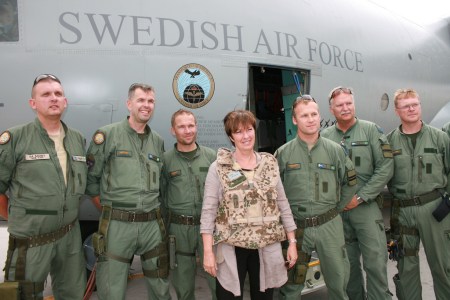
914Mona Sahlin, who was Sweden’s “National Coordinator Against Violent Extremism,” until she resigned in May amid corruption allegations, is shown posing with Swedish soldiers in Afghanistan in July 2010. The Swedish government’s directives to her agency stressed that it is “important that there is a gender perspective in efforts to prevent violent extremism.” (Image source: Social Democratic Party)

There is no evidence that “gender perspective” is relevant or useful in the fight against extremism and terrorism, yet we see that the Swedish government, in several documents related to terrorism and extremism, evidently believes that “gender perspective” is what should be used in the fight against those threats. This gives just some idea of how strenuously Sweden wants to disregard the problem, or even ask experts for help.

One might argue that this is because Sweden has never been exposed to Islamic terrorism or that extremism is not something that concerns the nation. Sweden has, however, had experience in facing Islamic terrorism. On December 11, 2010, a jihadist blew himself up in central Stockholm. Taimour Abdulwahab did not manage to hurt anyone, but Sweden got a taste of Islamic terrorism and has every reason to want to defend itself against more of it.

Islamic extremism is, unfortunately, becoming more widespread, especially in Sweden’s major cities. Gothenburg, for example, has been having major problems with it. In November 2015, there were reports that 40% of the 300 Swedish jihadists in Syria and Iraq came from Gothenburg. The only country that has, per capita, more of its citizens as jihadists in Iraq and Syria than Sweden, is Belgium.

As facts accumulate, there is much information indicating that Sweden has huge problems dealing with Islamic extremism and jihadism. The Swedish Security Service (Säpo), in the beginning of 2015, published a press release using the words “historic challenge” to describe the threat from violent Islamism. Already in May 2015 the head of Säpo, Anders Thornberg, expressed doubts that the agency could handle the situation if the recruitment of jihadists in Sweden continued or increased.

Experts in Sweden’s security apparatus have clearly expressed that violent Islamism is a clear and present danger to the security of Sweden, but the politicized debate about Islamic terrorism and extremism does not seem capable of absorbing this warning.

This general politicization, combined with the failure to prioritize the fight against terrorism and extremism, is the reason Sweden is, and continues to be, a magnet for extremists and terrorists. Jihadists who come to Sweden know that there are many liberal politicians looking for invisible “right-wing extremists”, and that there are feminists who think what is really important is using “gender perspective” in the fight against extremism and terrorism.

Jihadists also know that there are large gaps in the Swedish bureaucracy and legislation that can be exploited. These are the policies that have been created by Swedish politicians. One can therefore only question if Sweden seriously wants to fight the threats of terrorism and extremism.

With Publication Of High School Finals Results, Palestinian Authority Press Notes Deaths Of Students Who Carried Out Stabbing Attacks, Stresses: ‘Dying As A Martyr Is The Path Of Excellence And Superiority’

July 13, 2016

With Publication Of High School Finals Results, Palestinian Authority Press Notes Deaths Of Students Who Carried Out Stabbing Attacks, Stresses: ‘Dying As A Martyr Is The Path Of Excellence And Superiority’, MEMRI, July 13, 2016

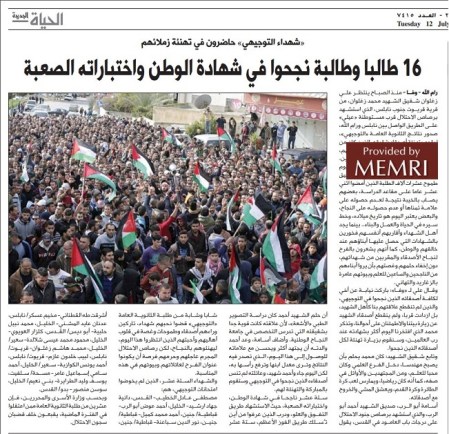
The July 11, 2016 release of high school seniors’ final exam results by the Palestinian Authority (PA) Ministry of Education is being widely covered in the Palestinian media. As part of this coverage, on July 12, PA dailies published articles on high school seniors who had been killed during the school year carrying out, or attempting to carry out, stabbing attacks against Israelis, and who thus would never graduate. The articles praised the teenagers’ martyrdom, playing with the Arabic wordshahada, which means both “diploma” and “martyrdom.” The lead article in the PA official daily Al-Hayat Al-Jadida listed 16 Palestinian students whom, it stated, had not been able to take their final exams, but had “passed the difficult [test] of dying as martyrs for the sake of the homeland” with flying colors. It added, “Dying as a martyr is the path of excellence and superiority.”

The list included 16-year-old Ahmad Abu Al-Rab, who participated in the February 3 shooting and stabbing attack at Damascus Gate in the Old City of Jerusalem in which a female Israeli Border Guard was killed, and Labib ‘Aazem and Muhammad Zaghlawan, both 17, who carried out the March 2 stabbing attack at Har Bracha, wounding two Israeli soldiers.

PA Dailies: ’16 [Students] Successfully Passed The Difficult Test Of Dying As Martyrs For The Sake Of The Homeland’

Articles in the PA dailies praised the dead students, calling them a source of pride for their families and for the entire Palestinian people. They quoted their relatives’ and friends’ expressions of praise for them and yearning for them, and referred to the teen attackers as martyred by “the bullets of the occupation” while omitting mention of the attacks they had carried out.

Thus, for instance, a front-page article in Al-Hayat Al-Jadida, which also appeared on page 12, stated: “The places of 16 students was not missing from yesterday’s announcement of the general high school [exam] results. This is despite the fact that the occupation’s bullets ended their lives and prevented them from taking their final exams, as they became martyrs in Paradise. Sixteen [students] passed the difficult [test] of dying as martyrs for the homeland, since dying as a martyr is the path of excellence and supremacy.

“Sixteen boys and girls, seniors in high-school, died as martyrs, leaving behind friends, ambitions, and sorrow in the hearts of their families and loved ones, who had waited for this day to congratulate them. But the bullets of the criminal occupation were swifter, and denied them the opportunity to be a source of joy for their families…”[1]

29059The full article in Al-Hayat Al-Jadida

The PA daily Al-Ayyam also quoted friends and relatives of some of the attackers, and, like Al-Hayat Al-Jadida, provided a selective narrative omitting mention of the attacks that they carried out or the victims of those attacks. The article opened by stating: “‘Ali Zaghlawan, the brother of the martyr Muhammad Zaghlawan [who carried out the March 2, 2016 Har Bracha attack], from the village of Qariout near Nablus, who was martyred by the bullets of the occupation near the settlement of Eli on the Nablus-Ramallah road, has been waiting since morning for the publication of the high school final [exam] results, in order to congratulate his brother’s friends [on their scores]. Muhammad’s name should have been among them [i.e. those who received results], especially as he was known for his [scholastic] excellence and diligence…”

The article also quoted the friend of dead student Ahmad Abu Al-Rab, who had participated in the Damascus Gate attack, describing him as having been “martyred by the bullets of the occupation soldiers on the steps of Damascus Gate in Jerusalem.”[2]

Palestinian Honor Students Dedicate Their Success To Palestinian Martyrs

One notable article on the finals results, published by the Palestinian news agency WAFA, focused on honor students who said that they dedicated  their success to the martyrs of the Palestinian people. Muhammad Abu Nahla, an honors student majoring in industry, dedicated his success to the martyr ‘Adnan Al-Mashni, killed while attempting to carry out a stabbing attack. Abu Nahla said: “I dedicate my success to the Palestinian leadership and its head President Mahmoud ‘Abbas; to the educational and pedagogical family; to my family and our people; and especially to my friend, the 17-year-old martyr ‘Adnan ‘Aaid Hamed Al-Mashni Al-Halaiqa,  from the town of Al-Shayoukh, who was martyred at Beit ‘Einun Junction east of Hebron on January 12, 2016… How I wish that he could have celebrated his success today – but the bullets of the occupation stole him, denying us and his parents of this joy. But we are all proud of the martyr’s death he attained.”[3]

PLO Executive Committee member Ahmed Al-Majdalani also mentioned the martyred students, saying: “In these moments, we feel the absence of 16 students, the martyrs who should have taken the high school finals but who were prevented from taking them by the violent and aggressive occupation forces, who denied joy to their families…”[4]


Endnotes:

[1] Al-Hayat Al-Jadida (PA), July 12, 2016.

[2] Al-Ayyam (PA), July 12, 2016.

[3] Wafa.ps, July 11, 2016.

[4] Al-Hayat Al-Jadida (PA), July 12, 2016.

Brexit Disrupts Nonchalant European Union Meddling

July 13, 2016

Brexit Disrupts Nonchalant European Union Meddling, Gatestone InstituteMalcolm Lowe, July 13, 2016

♦ In respect of the Palestinian problem, the European political elites have only the means to destabilize the status quo without installing an alternative. But Israel’s leaders can take heart. Any declarations made at French President François Hollande’s conference will be unenforceable, because the EU on its own lacks the means and because its energies must now focus on stopping its own disintegration.

♦ The underlying reasons for Brexit and for EU disintegration in general have still not been widely understood. Brexit was not merely a vote of no confidence in the EU but also in the UK establishment. Similar gaps between establishment and electorate now exist in several other major European states. In some cases, however, governments are united with their electorates in detesting the EU dictatorship in Brussels.

The June 23 vote by the United Kingdom electorate to leave the European Union should be seen in the context of two other recent European events. Three days earlier, on June 20, the EU’s Foreign Ministers Council decided to solve the Palestinian problem by Christmas with its endorsement of French President François Hollande’s “peace initiative.” Three days after the vote, on June 26, the second election in Spain within a few months failed once again to produce a viable majority for any government. Worse still, the steadily rising popularity of nationalist parties in France, Germany, Austria and the Netherlands suggests that political paralysis in other EU countries is on the way.

In short, the ambitions of the ruling political cliques of Europe to solve the problems of the world are being undermined by their own neglected electorates, which are increasingly furious at the failure of those cliques to solve the problems of Europe itself. Four years ago, we wrote about Europe’s Imminent Revolution. Two years ago, about the attempt and failure of those cliques to turn the EU into a make-believe copy of the United States. Today, that revolution is creeping ahead month by month.

Before threatening Israel’s security and local supremacy, the EU foreign ministers could have recalled the results of their previous nonchalant meddling in the area. We were all rightly horrified by the threat of Muammar Gaddafi to hunt down his enemies “street by street, house by house,” as he began by shooting hundreds in his capital, in February 2011. Hollande’s predecessor, Nicolas Sarkozy, rallied European leaders — first and foremost the UK’s David Cameron — to do something about it. President Obama turned up to give a speech, something that he is good at. More importantly, Obama supplied warplanes from the NATO base in Naples. The idea was to enable victory for the Libyan rebel forces by paralyzing Gaddafi’s own air force and bombing his land forces.

Victory was achieved. But the rebels were united only in their hatred of Gaddafi. So Libya has descended into a chaos that could have been prevented only by a massive long-term presence of European land forces, which Europe — after repeated cuts in army strength — does not have. Now it is the local franchise of the Islamic State, among others, that is hunting down enemies house by house.

Europe was incapable of achieving anything in Libya without the United States, and incapable of replacing a detestable regime with a superior alternative. The lesson could have been learned from Iraq. Here, a massive American military presence accompanied a constitutional revolution and the beginnings of parliamentary rule. But the whole costly achievement collapsed when Obama decided to remove even the residual military presence needed to perpetuate it.

In respect of the Palestinian problem, too, the European political elites have only the means to destabilize the status quo without installing an alternative. But Israel’s leaders can take heart. At Hollande’s conference in December, the UK will be half in and half out, if present at all. Neither Obama nor his by then elected successor will turn up to make a speech. Any declarations made at Hollande’s conference will be unenforceable because the EU on its own lacks the means and because its energies must now focus on stopping its own disintegration.

Of the authors of the Libyan adventure, David Cameron resigned after the vote for Brexit. Obama will shortly leave after what may charitably be called a mixed record in foreign affairs. Sarkozy’s aspiration to be reelected and succeed the unpopular Hollande, whose approval rate is now just 12%, has been challenge by a recent French court decision.

Sarkozy was trying to sue Mediapart, a French investigative agency, for publishing a letter of 2007 from Gaddafi’s intelligence chief about an “agreement in principle to support the campaign for the candidate for the presidential elections, Nicolas Sarkozy, for a sum equivalent to Euro 50 million.” (The maximum individual contribution permitted in French law is 1500 euros.) The judges investigating the corruption case against Sarkozy have ruled that the letter is genuine. The suspicion, then, is that Sarkozy’s campaign to eliminate Gaddafi was at least partly motivated by the need to eliminate the supplier of a bribe.

The underlying reasons for Brexit and for EU disintegration in general have still not been widely understood. Brexit was not merely a vote of no confidence in the EU but also in the UK establishment. Out of 650 members in the House of Commons, only around 150 — nearly all Conservatives — are estimated to have voted for Brexit. Against Brexit was also a clear majority of leading figures in commerce, academia and the churches. Similar gaps between establishment and electorate now exist in several other major European states. In some cases, however, governments are united with their electorates in detesting the EU dictatorship in Brussels.

That glaring discrepancy between the UK establishment and the electorate explains the establishment’s quick acceptance of Brexit, for fear of becoming totally discredited. A contributory reason was the broad consensus on both sides of the debate that the operative style of EU institutions is deeply flawed and often detrimental to UK interests. The concessions obtained by Cameron from the EU before the vote were widely regarded as derisory. Moreover, the President of the European Parliament, Martin Schulz, had loudly proclaimed that he could obtain a vote to cancel those concessions. The real issue, therefore, was whether a Remain vote could help to reform the EU, in cooperation with other member states, or whether the EU was fundamentally unreformable. The UK electorate decided for the latter view and the establishment is committed to implementing it.
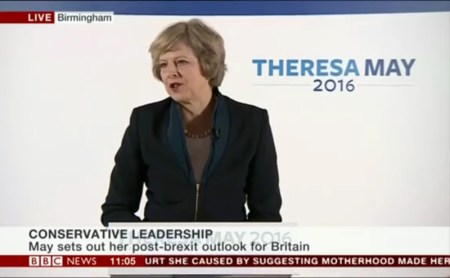
1693The glaring discrepancy between the UK establishment and the electorate explains the establishment’s quick acceptance of Brexit, for fear of becoming totally discredited. Pictured above: Theresa May launches her campaign for leader of the UK Conservative party on July 11, 2016, saying “Brexit means Brexit.”

The two earlier articles mentioned above first spotted the phenomenon of European disintegration and then explained it. Today, the intervening events have made the explanation all the simpler. Basically, the European political elites were correctly convinced, long ago, that considerable European integration was desirable, but their very successes in this area made them grossly overestimate what could and should be done further.

Up to a decade ago, it seemed that a similar pattern was becoming established in one EU country after another: the parliament was dominated by a large center-right party and a large center-left party that alternated in power from one election to another. The parallel to the United States seemed obvious, but the parallel was illusory, as we shall show.

Emboldened, the political parties concerned made the fatal mistake of trying to combine for the purpose of elections to the EU Parliament. Thus emerged a pan-European center-right pseudo-party, the “European People’s Party” (EPP), whose origins go back to a get-together of Christian Democrat parties in 1976. And a pan-European center-left pseudo-party, the “Party of European Socialists” (PES), founded in 1992 as an alliance between old-style Social Democrat parties and the former so-called Eurocommunist parties. The latter first emerged during the decline and discreditation of the Soviet Union in the 1970s and 1980s, then changed their names after its disappearance in December 1991. Thus, the core of Italy’s current Democratic Party derives from the Italian Communist Party (PCI), the major opposition party of post-war Italy.

Curiously but inevitably, the more those parties tried to unite, the more they lost support in their own countries of origin. Thus the Dutch Christian Democrats (CDA) are today a minor party of the right and the Panhellenic Socialist Movement (PASOK) barely crosses the threshold of 5% needed for entry into the Greek Parliament. (Incongruously, the last PASOK Prime Minister of Greece, George Papandreou, continues to be President of the Socialist International.) The reason for this development, however, is not far to seek.

Nationalism, it was forgotten, is an essential component of center-right sentiment. So a center-right party that prefers an international interest at the expense of the national interest of its own country loses credibility among its own core supporters; it becomes vulnerable to the rise of far-right upstart parties. Examples of this process in the EU are now so evident as not to need enumeration.

The attraction of socialism, it was forgotten, is that its core supporters expect increases in government social spending at the expense of financial stability. This becomes more difficult, the more a country is constrained by participation in a shared international framework. It becomes impossible to maintain once a country joins a common currency, since the usual remedy for socialist overspending is devaluation of the national currency. This is why PASOK has been eclipsed in Greece by the far-left SYRIZA, why the Spanish franchise of the PES (the PSOE) has lost severely to the upstart Podemos, and why support for its Dutch franchise (the PvdA) is now down to about the same as for each of two other left-wing parties.

It is also why in Britain, where the electoral system obstructs the rise of new parties, Jeremy Corbyn was voted leader by the Labour Party membership to the horror of the party establishment. Corbyn himself was a pronounced Euroskeptic until recently and only half-heartedly spoke in public for Remain, creating suspicions that he secretly voted for Leave.

A far-right party, like the Freedom Party (OFP) of Austria, has an easy sales pitch. Not so the far-left ones: after they come to power, it quickly and painfully becomes evident that they have no more ability than their derided Social Democrat predecessors to defy the constraints imposed by membership in the Eurozone.

Thus SYRIZA came to power in Greece and won a referendum to end austerity. The result was that all Greeks found that their bank accounts were virtually frozen: they were allowed to withdraw only sixty Euros a day. SYRIZA then split. The larger faction won the resulting general election and accepted the harsh conditions that the referendum had rejected. The paradoxical result in Greece is that the current government is a coalition of an upstart far-left party, SYRIZA, and an upstart nationalist party (the Independent Hellenes) that lies to the right of New Democracy (the Greek franchise of the EPP).

In other EU countries, however, the typical development has been the opposite: the erstwhile competing franchises of the EPP and the PES are in coalition against the motley upstart breakaway parties, since neither of the two gets an absolute majority in parliament any more. That is, their former raison d’être as competing alternatives has been abandoned in the need to survive in power at all. The paralysis in Spain comes from the fact that the two local franchises there are descended from the two sides in the murderous Civil War of 1936-1939. Joint government is still hardly imaginable especially for the losing socialists, who continued to suffer persecution long after the war.

Likewise, in the elections to the EU Parliament in May 2014, the EPP and the PES won only 221 and 191 seats respectively out of 751, each far short of a majority. So they clubbed together to make the top candidate of the EPP, Jean-Claude Juncker, President of the EU Commission and to retain the top candidate of the PES, Martin Schulz, as President of the Parliament. The incredible response of Juncker to Brexit has been to demand even tighter integration: he wants to force into the Eurozone the eight EU member states (other than the UK) that still have independent currencies. He also reiterated his proposal, originally made last March, to unite the armed forces of all states (with the UK gone) into a European army. For this he has the support of Schulz’s home party, the German SPD. That is, they want more and more of what the European electorates want less and less.

Especially in Eastern Europe, there are now also governments that resent the relentless centralizing urges of the EU establishment. In Hungary, for example, the government has rejected the demand of the EU Commission to absorb a quota of the immigrants currently streaming into Europe; it has scheduled a referendum on the matter for October 2. On the same day, Austria will hold a revote for the presidency, which the Freedom Party may narrowly win after narrowly losing the first time around.

These governments are among the new friends of Israel described in a recent Reuters article, titled “Diplomatic ties help Israel defang international criticism.” As it notes:

“Whereas a few years ago Israel mostly had to rely on Germany, Britain and the Czech Republic to defend its interests in the EU, now it can count Italy, Greece, Cyprus, Austria, Hungary and a handful of others among potential allies.”

These allies have no desire to penalize Israel on behalf of increasingly tedious Palestinians. On the contrary:

“Like Turkey, which last week agreed to restore diplomatic ties with Israel after a six-year hiatus, they see a future of expanding business, trade and energy ties.”

By “energy ties” is meant Israel’s recently discovered vast fields of natural gas, the phenomenon that we earlier dubbed “Israel as a Gulf State.” That is: just as governments care little for the human rights record of, say, Qatar in their eagerness to acquire its natural gas, so also the self-righteous moaning of the Palestinian Authority does not deter those governments from going for what Israel has to offer. As the Reuters article quotes a European ambassador: “There’s just no appetite to go toe-to-toe with Israel and deliver a really harsh indictment. No one sees the upside to it.”

Israel’s government is not, of course, gloating over the discontent spreading in the EU. But it surely appreciates some of the side effects.

GOP Strengthens Israel Platform Following Free Beacon Expose

July 12, 2016

GOP Strengthens Israel Platform Following Free Beacon Expose, Washington Free Beacon, July 11, 2016

(Please see also, Glick: AIPAC’s Moment of Decision. — DM)

Republican Party leaders reinserted key pro-Israel language into its 2016 platform on Monday following an exclusive Free Beacon report late last week describing efforts by certain elements of the GOP in 2012 to weaken language pertaining to the Jewish state.

The GOP decided to reinsert language describing Jerusalem as Israel’s “undivided” capital and remove language advocating in favor of Palestine, according to reports on the final 2016 platform language.

The Free Beacon revealed last week that some party leaders affiliated with the American Israel Public Affairs Committee, or AIPAC, the nation’s top pro-Israel lobbying shop, quietly pursued efforts in 2012 to remove references to an “undivided” Jerusalem and add language supporting Palestine.

These changes, viewed by many as an effort to water down the pro-Israel language, were opposed by a separate delegation of Republican leaders, who told the Free Beacon that AIPAC allies strong-armed platform committee members in order to force through the 2012 language.

AIPAC’s goal, the sources claimed, was to bring the GOP platform more in line with its Democratic counterpart. The lobby also opposed efforts from some Republicans to include alternative language viewed by many as more pro-Israel than what was ultimately included in the 2012 platform.

AIPAC has denied the charges.