PM Netanyahu at the 37th Zionist World Congress, PM Netanyahu, October 20, 2015
European Influx of Militiamen Loyal To Iran Could Pose Problems, Investigative Project on Terrorism, John Rossomando, October 19, 2015

Evidence uncovered on social media indicates that members of Iranian-trained Shiite militias may be entering Europe as refugees, a London-based Iraqi émigré group says. The Foreign Relations Bureau – Iraq (FRBI) identified images of 48 men on Facebook and Twitter who it says fought with Iranian-trained Shiite militias in Iraq and now are in Europe.
FRBI came into existence in 2014 and promotes women’s rights, equality, Iraqi independence from foreign control, and a non-sectarian approach to governance.
FRBI’s list shows pictures of militiamen in uniform and carrying weapons. Alongside those images are pictures showing the same people wearing Western street clothes and standing in places such as Germany, Sweden, Belgium, Greece and Finland. This same list also includes 16 people belonging to Iraq’s security services who similarly made their way to Europe and who FBRI accuses of crimes against the Iraqi people.
These militias engaged in serious human-rights abuses in places like Tikrit after they ousted the Islamic State, and Iraqi security forces similarly engaged in unlawful killings, according to Human Rights Watch (HRW). FRBI refers to HRW’s research about human-rights abuses in Iraq as a reason why these men should not have been allowed into the E.U.
Images of these fighters began surfacing on social media in August and early September, said FRBI spokesman A. Al-Mahmoud.
“Our lists are compiled with the efforts of some of our affiliate analysts who follow social media of all sorts mainly militia related pages whom suddenly started posting images from within the EU as the refugee situation escalated,” Al-Mahmoud said in an email to the Investigative Project on Terrorism (IPT). “A public page was then set up on our website to document what can be from these accounts in hope that media would find it easier to have what they need all in one page.”
Thus far, FRBI has no evidence that the influx of Shiite militiamen into Europe has been organized or orchestrated by Iran or any organized crime syndicate in Europe, but the scale of the militiamen’s migration is unprecedented, Al-Mahmoud said.
They may have varying motivations, he said. Some may fear war crimes prosecutions and are trying to remake themselves into refugees. Others may no longer care about their government’s or clergy’s goals.
The men regularly posted images of themselves on the battlefield, Al-Mahmoud said, then suddenly began posting images showing them in Europe, which led FBRI to believe they had infiltrated the wave of refugees.
No matter the reasons for their move, FRBI fears these men are on a collision course with European values and trapped by a vicious sectarian ideology that makes them a potential threat to their host countries. It alleges that some of these men may have participated in war crimes in Iraq.
“[M]ost of the people who did join the militias do have sectarian leanings and they will export their irrational thought of non co-existence outside Iraq, which will collide with other open and liberal societies, so they will bring their problems with them,” Al-Mahmoud said. “Finally, the background they are from is very low and poor with minimal education; unskilled and foreign, they will quickly find it easy to get into the criminal/theft and drug world adding more problems to the European Union immigrant communities already suffering from stereotyping and media pressure.
“They were paid members of organizations that were trained to kill under religious banners; this is the first time they have come out of Iraq in such large numbers.”
The men belonged to deadly militias such as Al-Hashid al-Shaabi and its subsidiaries such as: Kataib Hizballah (aka Hizballah Iraq), Kataib Imam Ali militia, Saraya al-Salam militia (Iraqi cleric Moqtada al-Sadr’s Peace Brigades) – all of which are trained and strongly influenced by the Iranian Revolutionary Guard Qods Force under the command of Gen. Qasem Soleimani. He emerged as a controversial figure in the discussions of the Iranian nuclear deal.
Kataib Imam Ali militia formed from splinter elements of al-Sadr’s militia that fought American forces during the Iraq War and remain “extremely anti-American,” said Phillip Smyth, an adjunct fellow at the Washington Institute and an expert on Shiite militias in Iraq and Syria. Kataib Imam Ali militiamen have been implicated in human-rights abuses similar to those carried out by the Islamic State (ISIS), he said. In one case, a video showed a militiaman dismembering the burned corpse of a Islamic State fighter as if he were “shwarma,” which sparked a reprisal video by the Islamic State in which two Shiite fighters were burned to death.
An IPT review of the information provided by FRBI lends credence to its contention that Shiite fighters have entered Europe among groups of refugees.
For example, the Facebook page of Al-Hashid al-Shaabi militia member Ali Spaaki shows a clear progression from being on the battlefield in Iraq in June to making his way across Europe throughout September and on to Helsinki, Finland on Oct. 4. Spaaki’s Facebook page shows him getting off a ferry along with a crowd of people in a picture posted to his timeline on Sept. 20 in front of a Greek-flagged ferry and a large crowd. A related photo, also taken Sept. 20, shows him standing in front of a boat that reads “Bodrum” [Turkey] on its stern as its homeport, suggesting the ferry may have departed from that Turkish town. Bodrum has become a “magnet” for refugees, and large numbers of refugees have left the town hoping to make it to Greece since the summer, according to news reports. Spaaki’s departure date came weeks after the body of Aylan Kurdi, a toddler refugee, washed up onshore near Bodrum.
A similar story can be told by examining the Facebook page belonging to Al-Hashid Al-Shaabi fighter Mustafa Al-Azawi. There, he explicitly discusses his effort to enter Greece on the island of Lesbos on Sept. 17 via Izmir, Turkey, which news reports say is a common point of departure for refugees. Pictures on Al-Azawi’s timeline of himself posing on the shore of the island and of inner tubes and a crowd of likely refugees happened the same day a Getty Images photographer captured an image of migrants arriving on Lesbos. Days earlier, on Sept. 10, Al-Azawi posted Google Maps images of routes to Lesbos on Facebook, suggesting he planned his route to the island. Like Spaaki, Al-Azawi’s Facebook page shows his travel across Europe before making his to his final destination in Oulu, Finland on Oct. 3.
Al-Mahmoud also worries these militiamen could become entangled in organized crime and become involved in Iranian-controlled social organizations across Europe, and they will be used for Iran’s political ends.
“A lot of them believe in … Iran’s guiding ideology, and that political and social matters are presided over by Ayatollah Khamenei … so they follow what he says,” Smyth said. “They (Iraqi Shiite militiamen in Europe) do pose a risk.
“These groups believe that both America and the State of Israel are their existential foes.”
In the past, Hizballah supporters living in Europe, Canada or the United States have engaged in criminal activities. This includes cigarette smuggling in the U.S. and accusations of organized crime in Canada and in the E.U. Hizballah supporters also plotted and carried out terrorist attacks in Argentina and Bulgaria. Although these Iraqi militias are not part of Hizballah, they are branches on the same Iranian Qods Force tree – first cousins in effect.
Shiites who support Hizballah and Iran in places like Sweden already have been recruited as foreign fighters by Iranian proxies to fight in Iraq, said Smyth, who traveled to Scandinavia last year on a related research trip. Having a passport from someplace like Sweden means a foreign fighter can come and go from hot zones like Iraq or Syria without the same hassles someone traveling on a Lebanese, Syrian or Iraqi passport.
While most attention has been given to Sunni foreign fighters traveling to Syria and Iraq to fight for the Islamic State and other Sunni jihadist groups, Smyth said, not enough attention has been given to Shiite fighters with ties to Iran.
“You now have a new transnational threat that is loyal to the Iranians, that is anti-American, is anti-Western, is anti-Israel,” Smyth said. “There is a direct threat that’s there.”
It is hard to tell how many people on the FRBI list actually are refugees or if they are in the E.U. vacationing or are there for some other reason. But Smyth sees them as a national-security threat either way.
“Here are examples of these guys when they are out of uniform, when they are possibly still militiamen, and they are traveling to Europe, which says something. How did they get there with a visa? Why, after all of this has been publicized, are they all still going?” Smyth asked in a phone interview with the IPT. “There are already examples of Shia militiamen, Hizballah for instance, who have used Western passports to go different places and to engage in bad deeds.”
This also has U.S. Customs officials concerned. The ease in which these Shia militiamen have entered Europe raises fears that they will be able to travel to the U.S. on E.U. passports, said one Immigration and Customs Enforcement (ICE) agent who spoke under the condition of not being named. Anyone with a passport from places like Germany, Sweden can easily get on a flight to the U.S. without the sorts of hassles they might experience traveling on an Iraqi or a Syrian passport.
A spokeswoman for Europe’s top law enforcement agency, EUROPOL, told the IPT her agency was unaware of any organized effort by terrorist organizations to infiltrate the E.U. However, none of the Shia militia groups whose members have made their way to Europe are listed as terror groups by the E.U.
“There are however concerns about the use of the Mediterranean routes. While the majority of irregular migrants and refugees are in search of safety, other groups such as returning foreign fighters and other individuals linked to IS (Islamic State), might make use of the services provided by the organized crime groups,” EUROPOL spokeswoman Agnieszka Biegaj wrote in an e-mailed statement. “Given the hazardous nature of the illegal migratory routes, from a terrorists’ perspective, it makes more sense to use regular travel methods and other resources such as false or genuine travel documents.”
New anti-terror measures, hospitals on emergency footing ready for long terror haul, DEBKAfile, October 13, 2015
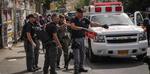 Medical services on terror alert in Jerusalem
After the first shooting in the current wave of Palestinian terror, the Health Ministry Tuesday, Oct. 13, put Israeli hospitals on emergency footing for the potential contingency of multiple casualties. Medical and auxiliary staff and supply centers were put on a state of preparedness. Hospitals in Jerusalem and other parts of the country are already facing a rise in emergency admissions as a result of terrorist attacks.
The security cabinet Tuesday approved a series of anti-terror measures, while warning that the end of the terrorist offensive was not yet in sight and it would take time for the new measures to take effect.
The families of five killer-terrorists were to be notified that their homes are listed for demolition. They were given 48 hours to appeal to decision before Israel’s High Court. The order was cleared with Justice Minister Ayelet Shaked. It was also decided to deploy IDF troops in Israeli cities to boost security and backup for the police. Partial shutdowns is to be imposed on Palestinian residential districts and villages in Jerusalem, where some 80 percent of the terrorists live, with check posts installed to monitor and control their entries and exits.
These measures were introduced shortly after three Israelis were killed, 22 were injured in Jerusalem by three terrorists from the same Palestinian Jebel Mukaber city neighborhood, which has a long history of terror. Armed with a gun and a knife, two terrorists tried to commandeer a bus a bus in the Armon Hanatziv district of Jerusalem, killing one Israeli and injuring 16, at least six seriously. One of the pair was shot dead, the second injured.
This was the first terrorist shooting attack in the current wave of violence. One of the killers was on the payroll of Bezek, Israel’s biggest telecom company.
In downtown Jerusalem, within minutes, a Palestinian ran down a group of pedestrians waiting at the Malchei Israel bus stop. He then jumped out of the car and struck his victims with a cleaver – continuing to strike even after he was shot by a local security guard. He killed 60-year old Rabbi Yeshayahu and injured three injured victims before he was shot dead.
Earlier, five Israelis were injured in two stabbing attacks carried out by a single terrorist in the town of Raanana north of Tel Aviv. He was overpowered by a civilian with a pepper gun and a selfie stick before police shot him dead.
After the Jerusalem attacks, police spokesmen admitted for the first time that they must have been synchronized and deliberately set up, finally abandoning the “lone wolf” theory attributed hitherto by Israeli officials to the current wave of terror.
Jerusalem’s two highway links – Rtes 1 and 443 – were meanwhile briefly shut to traffic in both directions as security forces swept for terrorist cars suspected of mingling with the intercity traffic.
DEBKAfile reported Monday.
The Palestinian knifing spree in Jerusalem Monday, Oct. 12, the day after an Israeli Arab from Umm al-Fham mowed down, then knifed, four Israelis in central Israel, puts the Palestinians on the same bloody course as Israeli Arabs, who launched an anti-Israel general strike Tuesday.
The day began at the Lions Gate, Border Guards police stopped a Palestinian who acted suspiciously. He pulled out a knife and stabbed one of the police men. The blade glanced off his body armor and the terrorist was shot dead.
At noon, a female terrorist inflicted moderate injuries on another two Border Guards officers opposite National Police Headquarters in northern Jerusalem. She was stopped by gun shots and seriously hurt.
A short time later, further north at Pisgat Zeev, two terrorists worked a street in tandem. They knocked a 13-year old Israeli boy off his bike and stabbed him. He is fighting for his life at Hadassah hospital on Mt. Scopus. The terrorist’s partner attacked a second Israeli, inflicting major knife wounds. Police at the scene stopped the rampage by shooting. One was killed.
The Umm al-Fahm assailant, Ali Riyadh Ahmed Ziwad, 20, who had to be restrained by police and passersby, Sunday night, assumed an air of surprised innocence after his arrest. “It was just a traffic accident,” he said, after running over, then critically injuring a 19-year old Israeli girl with a knife and stabbing three others.
He went into an act that is typical of the Palestinian tactic of assuming the role of victim after committing terrorist outrages.
Leaders of the Israeli Arab community (roughly one-tenth of Israel’s population) including its elected members of parliament embark on a general strike Tuesday, Oct. 13, followed Wednesday by a grandstand performance by Arab MKs at Al Aqsa, accompanied by a flock of Israeli and international camera crews.
They will have plenty of microphones to proclaim how badly they are treated and, above all, to continue to spread totally unproven falsehoods about Israeli desecrations of the Muslim Mosque of Al Aqsa, which has provided the Palestinians with their most evocative and unifying emblem for most of the past century.
Seventy-nine years ago, on April 19, 1936 – when Facebook, television and an Israel state were far in the future – the Arab High Command of Palestine declared a general strike which swiftly escalated into terrorist attacks against Jews and the British and evolved into the Great Arab Revolt.
Then, too, the rallying cry was “the Mosque is in danger!” for triggering the order to “burn a thousand buildings in Tel Aviv.” By the time it was over in 1939, 600 Jews, 200 British officials and 5,000 Arabs were dead. Many of the last group died in internecine tribal feuds.
The same rallying cry has ever since fired Palestinian campaigns of terror. The “Al Aqsa Intidafa” called by Yasser Arafat on Oct. 1, 2000, which saw the first intensive use of suicide attacks for terror, cost the lives of 1,178 Israelis and 50 foreigners, injured 8,022 civilians.
The Palestinians lost 3,333 dead and 30,000 injured – many self-inflicted.
No one can tell how the latest Israeli Arab strike will develop. Their leaders are doing their utmost to inflame passions and have already incited the first Israeli Arab stabbing attack in tune with Palestinian terrorists.
Israeli Arab leaders looks as though they have the bit between their teeth and are trying to use the weakness of the Palestinian Authority Chairman Mahmoud Abbas to set the pace of events for the Palestinians as well.
The Israeli government is trying to pour oil on these turbulent waters, turning to the slow-moving legislative process as a means of fighting terror, while beefing up police forces, who are barely able to keep pace with the slashing knives.
Officials and reporters still insist on the absence of a controlling hand behind the violence, despite the evidence of an unfolding stage-by-scale escalation. The policeman injured at Lions Gate Monday told reporters from his hospital bed that, while on duty at various sectors, he had traced systematic organization behind the stabbings;the knife terrorists kept on coming out at a steady, controlled pace, he said.
Israeli strategists are not moving swiftly or unhesitatingly enough to correctly evaluate this enemy and pounce strongly on his weaknesses.
Three Israelis killed in two Jerusalem terror attacks within minutes, DEBKAfile, October 13, 2015
 Body of terrorist victim evacuated from stricken bus
By noon, Tuesday, Oct. 13, three Israelis were killed, 27 injured in Jerusalem by three terrorists from the same Palestinian Jebel Mukaber city neighborhood, which has a long history of terror. Armed with a gun and a knife, two terrorists tried to commandeer a bus a bus in the Armon Hanatziv district of Jerusalem, killing one Israeli and injuring 16, at least six seriously. One of the pair was shot dead, the second injured.
This was the first terrorist shooting attack in the current wave of violence. One of the killers was on the payroll of Bezek, Israel’s biggest telecom company.
In downtown Jerusalem, within minutes, a Palestinian ran down a group of pedestrians waiting at the Malchei Israel bus stop. He then jumped out of the car and struck his victims with a cleaver – continuing to strike even after he was shot by a local security guard. He killed 60-year old Rabbi Yeshayahu and injured three injured victims before he was shot dead.
Earlier, five Israelis were injured in two stabbing attacks carried out by a single terrorist in the town of Raanana north of Tel Aviv. He was overpowered by a civilian with a pepper gun and a selfie stick before police shot him dead.
After the Jerusalem attacks, police spokesmen admitted for the first time that they must have been synchronized and deliberately set up, finally abandoning the “lone wolf” theory attributed hitherto by Israeli officials to the current wave of terror.
Jerusalem’s two highway links – Rtes 1 and 443 – were meanwhile briefly shut to traffic in both directions as security forces swept for terrorist cars suspected of mingling with the intercity traffic.
DEBKAfile reported Monday.
The Palestinian knifing spree in Jerusalem Monday, Oct. 12, the day after an Israeli Arab from Umm al-Fham mowed down, then knifed, four Israelis in central Israel, puts the Palestinians on the same bloody course as Israeli Arabs, who launched an anti-Israel general strike Tuesday.
The day began at the Lions Gate, Border Guards police stopped a Palestinian who acted suspiciously. He pulled out a knife and stabbed one of the police men. The blade glanced off his body armor and the terrorist was shot dead.
At noon, a female terrorist inflicted moderate injuries on another two Border Guards officers opposite National Police Headquarters in northern Jerusalem. She was stopped by gun shots and seriously hurt.
A short time later, further north at Pisgat Zeev, two terrorists worked a street in tandem. They knocked a 13-year old Israeli boy off his bike and stabbed him. He is fighting for his life at Hadassah hospital on Mt. Scopus. The terrorist’s partner attacked a second Israeli, inflicting major knife wounds. Police at the scene stopped the rampage by shooting. One was killed.
The Umm al-Fahm assailant, Ali Riyadh Ahmed Ziwad, 20, who had to be restrained by police and passersby, Sunday night, assumed an air of surprised innocence after his arrest. “It was just a traffic accident,” he said, after running over, then critically injuring a 19-year old Israeli girl with a knife and stabbing three others.
He went into an act that is typical of the Palestinian tactic of assuming the role of victim after committing terrorist outrages.
Leaders of the Israeli Arab community (roughly one-tenth of Israel’s population) including its elected members of parliament embark on a general strike Tuesday, Oct. 13, followed Wednesday by a grandstand performance by Arab MKs at Al Aqsa, accompanied by a flock of Israeli and international camera crews.
They will have plenty of microphones to proclaim how badly they are treated and, above all, to continue to spread totally unproven falsehoods about Israeli desecrations of the Muslim Mosque of Al Aqsa, which has provided the Palestinians with their most evocative and unifying emblem for most of the past century.
Seventy-nine years ago, on April 19, 1936 – when Facebook, television and an Israel state were far in the future – the Arab High Command of Palestine declared a general strike which swiftly escalated into terrorist attacks against Jews and the British and evolved into the Great Arab Revolt.
Then, too, the rallying cry was “the Mosque is in danger!” for triggering the order to “burn a thousand buildings in Tel Aviv.” By the time it was over in 1939, 600 Jews, 200 British officials and 5,000 Arabs were dead. Many of the last group died in internecine tribal feuds.
The same rallying cry has ever since fired Palestinian campaigns of terror. The “Al Aqsa Intidafa” called by Yasser Arafat on Oct. 1, 2000, which saw the first intensive use of suicide attacks for terror, cost the lives of 1,178 Israelis and 50 foreigners, injured 8,022 civilians.
The Palestinians lost 3,333 dead and 30,000 injured – many self-inflicted.
No one can tell how the latest Israeli Arab strike will develop. Their leaders are doing their utmost to inflame passions and have already incited the first Israeli Arab stabbing attack in tune with Palestinian terrorists.
Israeli Arab leaders looks as though they have the bit between their teeth and are trying to use the weakness of the Palestinian Authority Chairman Mahmoud Abbas to set the pace of events for the Palestinians as well.
The Israeli government is trying to pour oil on these turbulent waters, turning to the slow-moving legislative process as a means of fighting terror, while beefing up police forces, who are barely able to keep pace with the slashing knives.
Officials and reporters still insist on the absence of a controlling hand behind the violence, despite the evidence of an unfolding stage-by-scale escalation. The policeman injured at Lions Gate Monday told reporters from his hospital bed that, while on duty at various sectors, he had traced systematic organization behind the stabbings; the knife terrorists kept on coming out at a steady, controlled pace, he said.
Israeli strategists are not moving swiftly or unhesitatingly enough to correctly evaluate this enemy and pounce strongly on his weaknesses.
The cipher in the White House, Washington Times, Wesley Pruden, October 8, 2015

Mr. Obama, humiliated by Vladimir Putin’s seizure of the initiative in the Middle East, seems not to understand what has happened to him. No one fears him or respects him. He has become a harmless cipher in an empty suit in the affairs of serious men. The nation pays the price.
************************
ANALYSIS/OPINION:
Perhaps it’s not fair to blame Barack Obama for the mess he’s making. The Middle East is where chaos was invented, after all, and perhaps not even the collection of incompetents and boobs the president has installed in the White House could make things this bad. Maybe it’s someone else’s fault. He blames the Jews.
When Mr. Obama promised the United Nations General Assembly earlier this month “a different type of leadership,” he prescribed “a leadership strong enough to recognize that nations share common interests and people share a common humanity.” That’s all very nice, and Mr. Obama should buy the world a Coke (or at least a Perrier in a glass bottle). He may have a profitable post-White House career waiting for him writing treacle for greeting cards.
Well-meaning he may be (or not), but he doesn’t have a clue about how such leadership would deal with people who do not share the common humanity. Some people have no humanity, but are the bastard progeny of an alien species of an evil planet in a cosmos, far, far away from our own.
Israel, which has seen pain and death in every guise, was stunned this week by a round of stabbings and shootings, including the murder of an American and his Israeli wife, seated in their car on the road near Nablus, by Palestinian gunmen who required their four children — aged 9, 7, 4 and 4 months — watch while their mother and father bled out their lives. The brutes fled, leaving the terrified children to deal with the terror and the gruesome aftermath of unspeakable cruelty.
The Palestinians celebrated the slaying with what Palestinian newspapers described as “joy” over the “heroics” of the gunmen. They put up photographs of their grim work on Twitter and Facebook. In Washington, the government of the “leader from behind” said it was “monitoring” the violence with a “growing sense of alarm.” The leader from behind hoped the perpetrators would be “swiftly brought to justice.”
Senior officials at the White House viewed with alarm, and pointed with pride at the moral equivalence served at the State Department. “We are deeply concerned about recent violence and escalating tensions in the West Bank and Jerusalem, and we condemn in the strongest terms violence against Israeli and Palestinian civilians.”
And then, with its reserves of decency spent, comes the “but” that everyone knew was on the way. “We call upon all parties to take affirmative steps to restore calm, and refrain from actions and rhetoric that would further escalate tensions.” Memo to Israel: “This means you.” Those parents with their four children should have known their presence on the road was a provocation. Why else assess the not-so-subtle blame for both killer and prey? The super-sleuths in Foggy Bottom are still trying to figure out whether the slaying of the couple on the road, with their four children watching, was an “act of terror.” Why not ask the 9-year-old?
President Obama and his friends dismiss as canard the logical conclusion of a reasonable man that this president just doesn’t like Jews very much, and scorns Israelis in particular.
Israeli President Benjamin Netanyahu demonstrated with devastating effect his dilemma in getting a fair hearing for Israel at the U.N. When he observed that only 70 years after the Holocaust, Iran, guaranteed by Mr. Obama’s deal to get a nuclear bomb, threatens anew to annihilate the Jewish state. There was no response from the General Assembly audience — not a cheer, not even a rumble of applause, nothing but the silence of frightened churls. Mr. Netanyahu did not disturb the silence while 44 seconds ticked off the clock. The only movement in the hall was the squirming in the ranks of the West by the occasional delegate with still a remnant of shame.
The same audience had wildly cheered President Obama the day before as he took a victory lap for his deal with the mullahs, and for making sure a docile Congress took nothing away. The delegates now sat again in stony silence when Mr. Netanyahu observed that Iran continues to spread fear and terror, opposing every interest of America and the democracies, and works without rest toward establishing dominion over the region. Worst of all, there was no silence more profound and more frightening than in the ranks of the American delegates.
Mr. Obama, humiliated by Vladimir Putin’s seizure of the initiative in the Middle East, seems not to understand what has happened to him. No one fears him or respects him. He has become a harmless cipher in an empty suit in the affairs of serious men. The nation pays the price.
Curfews and Internet restrictions can’t be avoided for reining in Palestinian street terror, DEBKAfile, October 10, 2015
 Holding the line at Nablus Gate, Jerusalem
After nearly a month of rampant Palestinian violence and murder, Israel’s leaders and its forces of law and order were Saturday, Oct. 10, fast approaching an unavoidable decision to impose a curfew on the Old City of Jerusalem – both to bring the stabbing attacks at every corner under control, and to isolate this source of contagion from the disorders spreading in the West Bank and across Israeli Arab coummunities.
Once a curfew is in place, the security authorities – whose forces are stretched to the limit by the multiple outbreaks proliferating across the country – will be able to deal quietly and systematically with the disorders.
A major hindrance until now has the refusal of the heads of government, especially Prime Minister Binyamin Netanyahu and Defense Minister Moshe Ya’alon, to realistically appreciate the dynamic of the wave of terror, and their insistence on playing down its eruption in one place after another as random and uncontrolled.
They keep on harping on the incitement and lies spread by Mahmoud Abbas and radical Israeli Muslim leaders, although the street has since taken over.
Friday night, Ya’alon commented in a television interview that terrorists had committed “only” four fatal stabbings out of a population of four million.
This challenge was taken up with a vengeance. That night, Israeli Arabs staged riotous disturbances from northern Israel to the south, attacking security forces and blocking highway traffic on Routes 6, 444 and 65, with rocks and burning tires.
The following morning, the focus of violence switched back to Jerusalem and the Palestinians: A 16-year old Palestinian stabbed and badly injured two elderly religious Jews wrapped in prayer shawls.
He was shot dead when he brandished the knife against approaching police officers. A second Palestinian was killed after stabbing three police officers at Damascus Gate.
This sequence of events indicates that, while there is no single controlling hand behind them, they are nonetheless orchestrated in a way that keeps every Israeli constantly looking over his or her shoulder for fear of being taken off guard by the next attack – whether on an Israeli highway or town like Afula or Petach Tikva, or in Judea and Samaria. But Jerusalem remains the constant focal point because it is a powerful unifier.
Official Israeli spokesmen have tried relaying messages to Abbas and putting out reports that he has responded favorably to appeals. Saturday, Netanyahu asked US Secretary of State John Kerry to intercede with the Palestinian leader for help to quieten things down. However, none of the three, any more than Jordan’s Abdullah, holds the levers for controlling current events.
That is because they are being orchestrated to a large extent through messages of incitement and false inflammatory information which bounce back and forth between the cell phones and social media networks of young Palestinian and Israeli Arabs hungry for trouble.
In the latest example, the networks were flooded all day with calls to torpedo the international soccer match between Israel and Cyprus taking place Saturday night at the Teddy stadium in Jerusalem – even to setting the arena on fire.
This move had two objects: to dilute police strength in the Old City in order to reinforce security at the stadium and to terrify the public into staying away from the game.
Israel’s security authorities are finding they can no longer avoid stepped up measures, such as a curfew on the Old City of Jerusalem and blocking selected Palestinian cell phone networks and Internet connections and IPs of known inciters. This method was used by Turkish President Erdogan to stem the rising tide of opposition against him in 2014.
These measures are far from pleasant and will be frowned on by many people including Israelis. But they may possibly calm the turbulence and save Israeli and Palestinian lives.
Time is running out. Wednesday, Oct. 14, members of the Middle East Quartet are due to arrive in Israel. The Netanyahu government can’t afford to be found at a loss in the face of a major threat to its authority in Jerusalem. The ineffectual measures applied till now no longer serve.
Why hasn’t Sisi visited Washington yet? Al-Monitor, Mohamed Saied, October 8, 2014
(Obama thinks highly of the Islamist Muslim Brotherhood and rejects President Sisi because he supported the Egyptian masses who sought the overthrow of an increasingly dictatorial President Morsi. Obama’s rejection of Sisi’s Egypt pushed it into an alliance with Russia. Now Obama, et al, claim that alliance as a basis for the continuing hostility toward Sisi. Perhaps it is. Obama, et al, have also complained about Egyptian human rights violations in repressing the Muslim Brotherhood; few similar complaints have been made about far greater Saudi and Iranian human rights violations. Sisi is the only president of a Muslim nation who seeks to promote a more secular and hence moderate Islam, to which the Muslim Brotherhood is hostile. Please see also, Egypt’s secular culture minister ruffles Salafi feathers. — DM)
One of the most important issues that may hinder the return of US-Egyptian relations to their previous state is the strong relationship between Cairo and Moscow; Sisi has met his Russian counterpart Vladimir Putin four times so far, and Egypt is currently considered the most important ally of Moscow in the Middle East.
**********************
CAIRO — Ever since Egyptian President Abdel Fattah al-Sisi took office on June 8, 2014, US-Egyptian relations have been deteriorating. This has been further confirmed by the fact that Sisi has not visited Washington yet despite the shuttle visits he has made abroad.
Differences and conflicts plagued the US-Egyptian relationship during the era of President Gamal Abdel Nasser. These conflicts culminated in the 1967 Six-Day War, when diplomatic relations between the two countries were severed because of the economic and military support by the United States to Israel.
However, these relations started to take a positive turn based on the strengthening of the strategic interests shared between the two countries in the wake of the signing of the Camp David Accords with Israel — the US’ permanent ally — on Sept. 17, 1978, between Egyptian President Anwar Sadat and Israeli Prime Minister Menachem Begin, as per the State Information Service affiliated with the Presidency of the Republic.
Only one meeting was held between Presidents Sisi and Barack Obama on the sidelines of the 69th Session of the UN General Assembly in September 2014 in New York, but other than this the two presidents have been settling for phone calls to discuss the latest developments in the region.
According to The Washington Times, Obama refused to meet with Sisi on the sidelines of the 70th session of the UN General Assembly. Egyptian Foreign Minister Sameh Shoukry attributed this in a press statement on Sept. 24 to the mismatching agendas and schedules of the two presidents, which prevented them from holding individual talks.
According to the US Embassy in Egypt’s reports on the situation in the country following the revolution of June 30, 2013, Washington started a “comprehensive review” of its relations with Egypt on the background of the ouster of former Egyptian President Mohammed Morsi.
On Aug. 15, 2013, following the killing of hundreds of Muslim Brotherhood demonstrators in Al-Nahda Square and Rabia al-Adawiya Square, Obama announced the cancellation of the Bright Star maneuvers, which were launched in 1980 following the signing of the peace treaty between Egypt and Israel and consisted of a joint military exercise between the two countries.
By October 2013, the review of relations put a halt to the deal consisting of delivering arms to Egypt. Also in October 2013, the US administration suspended $260 million that was going to be directly transferred to the Egyptian government along with another $300 million in US loan guarantees.
However, in a telephone call on March 13, Obama told Sisi that the military aid amounting to $1.3 billion would continue.
Meanwhile, Dina Badawi, spokeswoman for the US State Department for the Middle East, expressed concerns in a live interview on the ONtv channel April 2 over the state of rights and freedoms in Egypt, and pointed out that aid is aimed at continuing the democratic track and the political reforms in the country.
Abdel Moneim Said, director of the Regional Centre for Strategic Studies, and Shai Feldman, the Judith and Sidney Swartz director at the Crown Center for Middle East Studies, said in a research paper titled “Resetting US-Egyptian relations,” which was published in March 2014 on the center’s website, that at the root of the downturn in the US-Egyptian relations is the huge gap between the two sides’ narratives regarding the events of June 30, 2013.
One of the most important issues that may hinder the return of US-Egyptian relations to their previous state is the strong relationship between Cairo and Moscow; Sisi has met his Russian counterpart Vladimir Putin four times so far, and Egypt is currently considered the most important ally of Moscow in the Middle East.
The dispute between Russia and the United States is in regard to several issues. Chief among these is the Syrian issue; Moscow launched airstrikes on Sept. 30, sparking criticism on the part of Obama during a press conference Oct. 2. Obama said that Moscow is acting “not out of strength, but out of weakness” in support of the losing party. The president was referring to Syrian President Bashar al-Assad, and he pointed out that Russia should help in reaching a political settlement.
Meanwhile, the Egyptian Foreign Ministry did not issue any statements condemning or supporting such strikes.
In January, spokeswoman for the US State Department Jennifer Psaki said during the daily press brief that a meeting she described as “routine” was held with a delegation of members of the former Egyptian parliament from the dissolved Muslim Brotherhood-affiliated Freedom and Justice Party, on the sidelines of their visit to Washington, which was organized and financed by Georgetown University in Washington.
This meeting raised the ire of the Egyptian political leadership, as well-informed sources told Reuters in June that the Egyptian government summoned the US ambassador in Cairo to express displeasure over visits to Washington by figures of the Muslim Brotherhood, which is banned in Egypt.
Concerning the fact that Egypt did not extend an official invitation to Obama to meet with Sisi, or vice versa, Atef el-Ghomri, former director of the office of the Egyptian Al-Ahram newspaper in Washington and a member of the Egyptian Council for Foreign Affairs, said, “There is an ongoing split within the US decision-making circles over the revolution of June 30, 2013, and the toppling of former President Mohammed Morsi, who belongs to the Muslim Brotherhood.”
Ghomri told Al-Monitor that over the past years, Egypt’s relations have been confined to its foreign relations with Washington as it only took into account its regional and international interests. This deprived Egypt of any international initiatives or insights about various issues. Also, Egypt had to give up its pivotal role in the Middle East as far as the African and Arab countries are concerned. This negatively affected Egypt over time.
“The Egyptian leadership is trying to diversify its foreign relations. It resorted to the Eastern bloc led by Russia, as well as East Asia represented by China and Singapore.” Ghomri added.
Washington is concerned about several files managed by the Egyptian leadership, mainly the human rights and political reforms issues. The United States has been expressing those concerns since the June 30 Revolution, when the Muslim Brotherhood was toppled and replaced by a military president.
Under such circumstances, Cairo had to resort to other countries, while the US-Egyptian relations are expected to witness further tension, especially with the differences in views concerning several international issues, namely Syria, Iran and Libya.




 anneinpt
 artaxes
 danmillerinpanama
 davidking1530
 Peter Hofman
 Joseph Wouk
 Peter
Peter Louisiana Steve
 WarSclerotic
Recent Comments