Archive for the ‘Islamic supremacy’ category

Hajj Amin Husseini’s Anti-Semitic Legacy

June 24, 2015

Hajj Amin Husseini’s Anti-Semitic Legacy, The Middle East Quarterly, Boris Havel, Summer 2015

(Islamic hatred of Jews goes back at least to the sixth century A.D. The pamphlet reproduced below, Islam and Judaism, was written by The Jerusalem Mufti, Muhammad Hajj Amin Husseini, apparently in the 1940s.  A fascinating book by Anthony Pagden titled Worlds at War, The 2,500-year struggle between East and West, provides a scholarly account of rivalries and wars and includes highlights of the rise of Islam. 

Jew hatred is now most visible in the Islamic Republic of Iran, soon to be welcomed into the “community of nations” by P5+1 “negotiators” under Obama’s guidance. — DM)

1379The Jerusalem mufti, Muhammad Hajj Amin Husseini (left), meets with SS-Reichsführer Heinrich Himmler, April 1943.

Hitler’s Mein Kampf has been a bestseller for years in predominantly Muslim countries, including the Palestinian Authority and Turkey.

***********************

The Jerusalem mufti, Muhammad Hajj Amin Husseini, leader of the Palestinian Arabs from the early 1920s to the late 1940s, is widely known for his close collaboration with the Nazis during World War II. Aspects of the collaboration remain to be more thoroughly scrutinized.[1]However, and without discounting his culpability for the collapse and dispersal of Palestinian Arab society (or al-Nakba, the catastophe, as it is called by Palestinians and Arabs), Hajj Amin’s role in shaping Muslim perceptions of Jews might be a far more important and lasting legacy than his political activism in Palestine, Germany, or elsewhere.[2] An important source supporting this fact is a booklet he authored for Muslim soldiers enlisted in the Nazi SS division in Bosnia.

During the mufti’s stay in Berlin in 1941-45, he befriended Hitler’s right-hand man, Reichsführer-SS Heinrich Himmler. Himmler’s fascination with Islam and the mufti’s zealous support for the Nazi cause resulted in several common enterprises, notably the establishment of a volunteer Waffen-SS division in Bosnia, made up mostly of Bosnian Muslims, later named the Handzar division. Most books about the division display photographs of its soldiers—distinguishable by its insignia on uniform lapels and fez headgear—reading a booklet titled Islam und Judentum—most certainly the German version of the mufti’s Croatian or Bosnian pamphlet Islam i židovstvo (Islam and Judaism).

In whatever language the pamphlet was originally written, the intended readers were Muslims (Bosnian or otherwise) and not Germans. This author has been unable to locate a German copy of the pamphlet, but it is reasonable to regard the text written in the language of the Bosnian Muslims (at the time called Croatian) as the most relevant. A translation of the booklet is presented below, followed by an analysis of its significance and far reaching implications.[3]

_________________

Islam and Judaism (Islam i židovstvo)

For us Muslims, it is unworthy to utter the word Islam in the same breath with Judaism since Islam stands high over its perfidious adversary. Therefore, it would be wrong to carry out comparison of those two generally different counterpoints.

Unfortunately, it is insufficiently known that animosity between Islam and Judaism is not of a recent date. It reaches long back in history, all the way to the time of the Prophet Muhammad. This short historical overview will demonstrate the importance and perfidiousness of Jewry and its animosity toward the founder of Islam, the Prophet Muhammad.

Jews are known in history only as a subjugated people. Their vulgar[4] nature
and insufferable stance toward the nations that offered them hospitality, and toward their neighboring nations, are the reason that those same nations had to resort to [certain] measures in order to suppress a Jew’s efforts to obtain his[5] desire by force.

The history of antiquity shows us that the pharaohs were already forced to use all means against Jewish usury and Jewish immorality. Ancient Egyptians finally expelled the Jews from their land. Led by Moses, the Jews then arrived in the Sinai desert.

Arab theologian Muhammad ibn Jarir al-Tabari [839-923 C.E.] narrates that the Jews even wanted to kill their leader and savior Moses when he came back from Mount Sinai. Because of that, God punished them, and they had to meander in the wilderness for forty years. It should have brought them to their senses, and the new generation should have been cleansed from the low esteem of their fathers.

Following that, the Jews spread like locust all over the Arab peninsula. They came to Mecca, to Medina, to Iraq, and to Palestine, which is the land of milk and honey. The group of the Jews that came to Syria and Palestine was now under Roman rule. The Romans, however, soon discerned the peril that threatened the land from the Jews, and so they introduced harsh measures against them. Besides that, a serious, contagious illness of plague erupted, which was by common opinion brought into the land by Jews. When even medical doctors stated that the Jews were indeed the source of the infection—and their opinion was obviously correct—there arose among the people such upheaval against the Jews that many Jews were killed. In addition, that event is the reason why the Jews have been called “microbes” in Arabia to this very day.
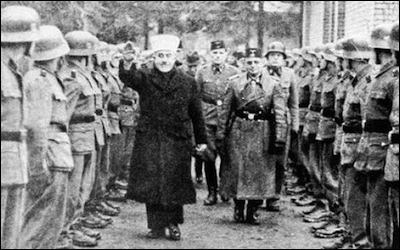
1380The mufti of Jerusalem, Muhammad Hajj Amin Husseini, visits the volunteer Nazi Waffen-SS division in Bosnia, made up mostly of Bosnian Muslims. The mufti was instrumental in the division’s formation.

The Arabs have a particular understanding for introducing forceful measures against Jews in Germany and for their expulsion from the country. After the [First] World War, England and America enabled the Jews to settle in Palestine and to establish a Jewish state there. Jewish excrement from all countries assembled there, rascally striving to seize the land from Arabs. And indeed, they succeeded in buying land from the poorest of the poor and from unscrupulous landlords. By doing so, they took poor widows’ bread and stole food from children to fatten themselves.[6] When the Arabs opposed the Jewish settlement, the Jews did not shun bloody murders. So they robbed many families of their livelihood and threw the families into misery and troubles. (God will punish them for those disgraceful deeds).

The Jewish struggle against Arabs is nothing new for us, except that as time passed, the location of the battlefield changed. Jews hate Muhammad and Islam, and they hate any man who wishes to advance the prosperity of his people and to fight against Jewish lust for possessions and Jewish corruption.

Struggle between Jews and Islam began when Muhammad fled Mecca to Medina where he created the base for the development of Islam. At that time, Jews were merchants, already permeated with guile, and they understood that Muhammad’s influence, in both the spiritual and business spheres, could turn into a danger for them. Thus they were possessed by a deep hatred toward Islam; hatred that intensified as Islam was growing more solid and powerful. The Jews breached the agreement they had concluded with Muhammad in Khaibar, of which we shall speak later. Moreover, their rage grew immensely when the Qur’an revealed the deepest inclinations of their soul, their heartlessness, and unscrupulousness by which their ancestors had been commonly known. At that time, the Jewish methods were already the same as they are today. Their weapon has been, as always, slander and quarrel, and so they attempted to humiliate Muhammad in the eyes of his followers. They claimed that he was a deceiver, an enchanter, and a liar. When they did not succeed in this, they attempted to undermine Muhammad’s honor by spreading a rumor that his wife Aisha committed adultery. The purpose of spreading such a rumor was to sow doubt in the hearts of Muhammad’s followers.

When that failed, they tried to show Muhammad’s teaching in a bad light. With that purpose, several Jews converted to Islam; only a few days later, they returned to the Jewish faith. When asked why they changed their mind so suddenly, they replied that they were very willing to settle in Islam but found that all of it is nothing but a lie. The following Qur’anic verse alludes to that:

Many of those knowledgeable in the Scriptures attempt to somehow render you infidels again by converting to our religion. It was, though, nothing but their souls’ envy, when they comprehended truth.[7]

When the Jews understood that they would not reach their goal by the means used until then, they started to ask Muhammad various meaningless and unsolvable questions. Thus, they wanted to convince others that Muhammad was poor in knowledge and wisdom. However, that method achieved no success. As they were thus persuaded that Islam was deeply rooted in the hearts of the Muslims, they commenced with the attempts to destroy the Muslims. Pursuant to that goal, they paid some non-Muslim tribes to fight against Muhammad. The almighty God, however, wanted it differently. With iron fist, Muhammad defeated the rebellious tribes and conquered their city. The Jews could not bear such a defeat, and so they decided to destroy Muhammad in every way. They hired men to murder him.

The Medina Jews lived in the city district of Banu Nadir. When Muhammad came to Medina, he concluded a contract with them. One day he set out to that city district, accompanied by only ten companions, to talk to the Jews and to try to convert them to Islam. Muhammad explained the principles of Islam to the Jews, and they seemed very interested and open-minded. Yet as Muhammad was talking in a friendly way with some of the Jews, another group prepared an attempt on his life. They persuaded a man to throw a piece of rock on Muhammad’s head. Surely Muhammad would have been killed were it not for God, who warned him. An inner voice advised him to leave that place, and so the treacherous Jews could not carry out their design. Consequently Muhammad sent a companion to deliver his message to the Jews to leave the city within ten days. They had breached the contract they concluded with him by trying to take his life. Any Jew found in the city after those ten days would be punished by death.

However, some of the Jews, who outwardly accepted Islam but in their innermost remained Jewish, persuaded other Jews not to leave the city. When the ten days passed, Muhammad was forced to expel the Jews from the city by armed force. Part of the Jews fled to Khaibar and part to Syria.

The Jews who fled to Khaibar, however, would not concede defeat and decided to avenge themselves on Muhammad. For that purpose, they turned to other Khaibar Jews and to the Jews of Taima and of Wadi Qura. Together they plotted a conspiracy: With large sums of money, they agitated non-Muslim Arab tribes to attack Medina. When Muhammad discovered their plan he quickly armed his men and set out toward the plotters’ base in Khaibar. Muhammad’s companions captured Khaibar and expelled most Jews from the site. With the remaining Jews, Muhammad concluded a contract by which peace was guaranteed.

Only after that devastating defeat [of the Jews] could an Islamic Empire peacefully develop. But when one takes into account the Jewish significance, it was not to be wondered that Jews, in spite of the agreements made, did not abandon their plans and continued to try to destroy Muhammad by all available means. They invited him to a feast, and he accepted the invitation suspecting no evil. In front of him was placed a roasted lamb prepared by the Jewess Zainab, wife of Sallam ibn Mishkam.[8] The [topic of] conversation around the table was the contract and a peaceful life in mutual agreement in which they now lived. Muhammad had not the slightest suspicion about treason. The Prophet and his faithful companion Bashr ibn Bara each took a piece of lamb meat. Muhammad, however, did not swallow his bite because its taste made him suspicious.

“The bone tells me that the lamb was poisoned,” he said and called the Jewess Zainab to ask whether the meat had been poisoned. She answered, “You know I am highly esteemed by the Jews, and I acknowledge that I have poisoned the lamb. In so doing, I thought that if you were a king, I would only kill a king, but if you were indeed a prophet, you would know that the meat had been poisoned.”

Muhammad’s companion soon succumbed to the poison’s effect, whereas Muhammad, despite spitting the poisonous bite, later suffered various health disorders, and the impact of the poison had always been evident. Some historians even believe that Muhammad’s death was a consequence of that poisoning. In this matter, they refer to a hadith by Abu Huraira, whereby the Prophet said shortly before his death, “The effect of Khaibar’s feast will manifest in me until I die!”[9]

1381Many books about the Waffen-SS division in Bosnia display photographs of its soldiers reading a booklet titled Islam und Judentum—most certainly the German version of the mufti’s Croatian or Bosnian pamphlet Islam i židovstvo (Islam and Judaism). The booklet offers a stark illustration of the lengths taken by the mufti to demonize Jews and Judaism and clearly was produced for propaganda and incitement purposes.

Now, the Jews were persuaded that Muhammad was immune to their attacks. Therefore, they made a decision to spread discord among the Arab tribes, so as to break the power of Islam. When Muhammad went back to Medina, he succeeded in reconciling the Arab tribes of Kawsha and Karasha,[10] which had been fighting each other ceaselessly for 120 years. In doing so, he significantly strengthened Islam’s position. Members of those two [formerly] hostile tribes became brethren in Islam, and peace entered the city. In this regard, the Jews tried to undermine the Islamic empire.

A revengeful old man by the name of Shas ibn Qais one day walked with his friends and came across an assembly of the reconciled tribes held in city square. He could not bear to see how [the members of] those two tribes, formerly at war with each other, now communicated nicely, and so devised a hellish plan. He sent to their assembly a friend of his, knowledgeable in war poems, and persuaded him to recite some of his old poems that were full of hatred. That Jew, an outstanding orator, came indeed to the assembly and started to recite old war poems of both tribes. By doing so, he managed to find in each tribe a man in whom old hatred flared up. Those two men started to fight each other and then urged their fellow-tribesmen to take up arms. An immense tragedy would have ensued were it not for Muhammad, who learned about the fight amongst brethren and hurried up to the battlefield.

“Oh my God, are the old times returning even while I am still amongst you!” he shouted. “When I gave you Islam as religion, the old fratricidal discord was buried, and you became brothers in your hearts. Do you wish to slip into infidelity again?”

Both tribes understood that disturbances among them were sown by the Jews alone. They threw away their weapons and asked God for forgiveness, and then they hugged each other and concluded a new brotherly alliance. Regarding Shas ibn Qais the Jew, it is said in the Qur’an,

Oh, you scribes,[11] why do you prevent the believer from walking on God’s path when you are witnesses yourselves? But God is not blind for what you do.[12]

Regarding the tribes of Kawsha and Karasha, the Qur’an said,

Oh, you who believe, would you listen to those who received the Scripture, so that they would turn you into unbelievers again, after you have received faith! How can you be infidels when God’s words were read to you, and his apostle is among you? He who holds unto God has already been introduced to a straight path.[13]

Notwithstanding their attempts, the Jews never succeeded in spreading division among Muhammad’s followers and in dragging them back into infidelity. However, even after all these events should have taught them the futility of their efforts, they persistently continued to carry out their devilish plans. Once, they tried by deceit to even bring down Muhammad himself.

There was a quarrel between two Jewish tribes, and the side that was wrong held an assembly and sent its leaders to Muhammad. Those Jewish leaders said to Muhammad, “You know that we are influential people. If you support us in our dispute with our opponents, we will apply all our influence to make all Jews convert to Islam.” Muhammad, of course, dismissed them. There is a verse in the Qur’an about this event:

Be careful to make decisions according to what God has revealed and not to consider their desires. Keep your guard toward them so that they would not even partially shift you from what God has revealed to you. If they rebel, know that God will surely punish them for a part of their sins. There are, indeed, many men who are evildoers.[14]

Another example of Jewish subversive action was recorded by Ibn Abbas. At the time when Muhammad went from Mecca to Medina, prayers were directed toward Jerusalem. However, it lasted only for seventeen months. Then Muhammad received God’s revelation that the direction of prayers should be Mecca, and ever since, prayers are uttered with faces turned to Mecca. The Qur’an says about this:

We see how you turn your face toward heaven, and we would like to give it a direction which you will like: Turn your face toward the holy place of prayer; wherever you find yourselves, turn your face in that direction. Don’t you see that even those who had received the Scripture know that it is the truth before their Lord? And God is never heedless of what they do.[15]

When the Jews found out about this Qur’anic verse, they were angered and asked Muhammad to return to the previous direction of prayer, which was Jerusalem. Were he to do so, they promised, all Jews would accept Islam. Muhammad, however, did not allow himself to be led astray by such a proposal and to transgress against God’s command. We find the following in the Qur’an about that:

The direction to which you used to turn in prayer until now we have changed only for the purpose of distinguishing those who follow apostles from those who turn on their heel. That was surely difficult but not for those led by God. And God does not want to destroy your faith because God is full of goodness and compassionate to men.[16]

Here is another example how the Jews did not hesitate to stab Muhammad in the back at the time of his utmost distress. When Muhammad won the Battle of Badr, he sent a messenger on his own camel, because that camel was the fastest, to carry the news about his victory to Medina. The Jews, however, tried to bring confusion into the Muslims’ ranks by spreading false rumors that Muhammad had been killed in the battle. As evidence, they pointed out that Muhammad’s camel returned to the city with another rider.

When even that design failed, the Jews turned to Mecca to incite Muhammad’s enemies against him. Moreover, they declared their readiness to support the Meccans in their fight against Muhammad with an army of theirs. When the pagans of Mecca asked the Jews—since the Jews had received the Holy Scripture even before Muhammad—whether or not Muhammad’s religion was good, the Jews answered, “You know that we are men of letters. Believe us, therefore, when we tell you that your religion is much better.” The following verse is in the Qur’an about this:

Don’t you see those who received the Scriptures? They believe in Jibt and Taghut [superstition and idolatry], but they nevertheless say about pagans that their way is better than believers’ way. Those are the ones whom God has cursed, and he who was cursed by God cannot be helped.[17]

As we see, that curse came true. Without a homeland, the Jews are scattered throughout the whole world, and nowhere do they find true help and support. Another Qur’anic verse reads:

You will certainly find out that the greatest animosity toward the believers foster the Jews and the pagans.[18]

That idea has been even better expressed by words of Muhammad: “It will never be possible for you to see a Muslim and a Jew together without secret intention in the [heart of the] Jew to destroy the Muslim.”[19] Abu Huraira passed to us the following hadith:

Judgment Day will not come before the Muslims completely destroy the Jews, and when every tree with a Jew hidden behind will say to the Muslim, “There is a Jew behind me, kill him!” Only the gharqad tree, which is a small bush with many thorns growing around Jerusalem, will not participate in it because it is a Jewish tree! [Bukhari-Muslim VIII, p. 188].

_____________________

Assessing the Pamphlet

The booklet Islam and Judaism offers a stark illustration of the lengths taken by the mufti to demonize Jews and Judaism. Qur’anic passages are freely paraphrased without reference to sura and verse while apparent quotations (like those about Jews converting insincerely to Islam in order to drag Muslims away from their faith) are nowhere to be found in the Qur’an, certainly not in the translation by Muhammed Pandža and Džemaluddin Čaušević[20] used by Yugoslav Muslims since 1937. Indicating the pamphlet’s clear propaganda and incitement purpose, this sloppiness reflected both Hajj Amin’s poor religious credentials and his apparent conviction that the pamphlet would not be subjected to critical scrutiny or even read by believers well-versed in the Qur’an. For, though bestowed with the title of Grand Mufti of Jerusalem, Mandatory Palestine’s highest religious authority, it was common knowledge at the time that Hajj Amin did not possess the necessary religious credentials for such a lofty post. Indeed, he even failed to make the final short-list for the mufti’s post having received only nine of the electors’ sixty-four votes; but the Husseinis and their British champions forced one of the final three candidates to step down in his favor, paving the road to his appointment.[21]

Some of the pamphlet’s assertions indicate the mufti’s deficient familiarity with Islamic history and theology. Nor was Hajj Amin averse to introducing novelties and fabrications for the purpose of defaming Jews. His text contains details with an unconventional interpretation of Qur’anic accounts, some of them erroneous. He accuses the Jews of having “attempted to undermine Muhammad’s honor by spreading a rumor that Muhammad’s wife Aisha committed adultery.” But renowned Islamic scholars, including Tabari, to whom the mufti refers in the booklet, do not mention the Jews at all in the context of this event: Aisha’s accusers were all Arabs. Some came from the tribe of Kharzaj; at least one was from the Quraish, Muhammad’s tribe, and another was the sister of Muhammad’s wife. Their names are listed in both Ibn Ishak’s and Tabari’s accounts of the event. After God revealed Aisha’s innocence to Muhammad, some of the accusers were punished by flogging.[22]

Furthermore, the mufti claimed that Muhammad attacked Khaibar because its Jews bribed Arab tribes to attack Medina. The sources, however, do not mention any such activity by the Khaibar Jews. Khaibar was in alliance with the Arab tribe of Ghatafan—which at this point seemed to be rather defensive—with the Quraish, and with the Persians. Muhammad’s attack occurred shortly after he concluded the peace of Hudaibiya (March 628) with the Meccans. It is hard to envisage that Muhammad’s enemies would plot an attack from the north without Meccan support. On the contrary, it seems that he concluded the peace of Hudaibiya to secure his southern front so as to be able to attack the Khaibar Jews, whose Persian allies had just been defeated by the Byzantine army.[23]
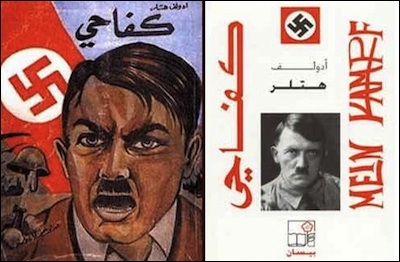
1382There remains a deep connection between Islamism and Nazism based on the common characteristics of racism, nationalism, religious bigotry, and intolerance. Hitler’s Mein Kampf has been a bestseller for years in predominantly Muslim countries, including the Palestinian Authority and Turkey.

There was, however, an event reminiscent of the mufti’s story that occurred a year earlier. The Jews of Medina had invited the Quraish and Ghatafan tribes to attack Muhammad. It was at this point, after the Battle of Badr, that the Quraish asked the Jews whose religion was better, theirs or Muhammad’s. Encouraged by the Jews, the two tribes marched on Medina, and their subsequent abortive attack came to be known as the Battle of the Ditch. After their retreat, Muhammad attacked Medina’s Jewish tribe of Banu Quraiza.[24] It seems likely that the mufti—unless he intentionally invented stories, a possibility that cannot be ruled out—confused the episode of the Banu Quraiza with that of Muhammad’s war on Khaibar.

Far more important than these technical details and idiosyncratic interpretations are the novelties the pamphlet introduces in Islamic political discourse regarding the Jews. By combining the Islamic canon with pre-Christian and Christian anti-Judaism, it attributes strengths and powers to Jews that cannot be found in Islamic tradition by portraying them as far more cunning and successful in their vicious designs than previous mainstream Islamic thought had recognized or permitted.

A simpler example of this anti-Jewish eclecticism can be found in the mufti’s accusation that Jews brought plague to Arabia. This statement evokes medieval European myths with similar themes. More significant is the notion that Muhammad’s death might have been a result of poison given to him by a Khaibar Jewess.

To be sure, Ibn Ishak and Tabari do mention how during the illness that led to his death Muhammad spoke to Umm Bashr, mother of his poisoned companion, and complained about his pain, caused by poisonous meat he had tasted three years earlier.[25] However, in classic Islamic thought, this tradition was not interpreted as proof that the Jewess had succeeded in her attempt on the Prophet’s life but as a desire to attribute to the Prophet the highest of virtues: martyrdom. In Ibn Ishak’s words, “The Muslims considered that the apostle died as a martyr in addition to the prophetic office with which God had honored him.”[26] Tabari repeats this explanation, as does Ibn Kathir (1300-73), who referred to eight different hadiths asserting that Muhammad had been warned by God about the poison: proof of his being a genuine prophet. Conversely, Ibn Kathir states that “the Messenger of God died a martyr.”[27]

The core theme of all these traditions is the Prophet’s martyrdom and not the Jews’ lethal craft; the reader is left with the clear impression that the two phenomena were unrelated. In contrast, the mufti’s pamphlet establishes the link and changes the emphasis from the Prophet’s virtue to the Jews’ mendacity. Apparently, his intention was to draw parallels with Christian traditions regarding Christ’s killing by the Jews. This accusation was intended to provoke more anger among Muslims, but it also violated Islamic tradition and theology.

The implications of the mufti’s claim that the Jews were successful in killing Muhammad despite God’s warning imply that Jews possess the power to defy God’s will. Such a blasphemous thought would be worse than Christian accusation of deicide. Jesus overcame death, and by his suffering, death and resurrection brought salvation to his community of believers; however, Muhammad not only remained dead but also failed to appoint his successor due to the rapid progression of his illness and his sudden, untimely demise. Consequently, the umma was split by different claimants to authority, and the dispute eventually led to the fiercest internecine strife in the history of early Islam, known as the fitna.

While the mufti’s Palestinian successors would not tire of reiterating this story (as late as November 2013, Palestinian Authority minister of religious affairs Mahmoud Habbash claimed that Yasser Arafat was poisoned by the Jews just as they had poisoned the Prophet Muhammad to death),[28]most contemporary Islamic scholars have a different understanding of this hazardous theology; inasmuch, the accusation that the Jews killed the Prophet has largely faded as a theological theme with mainstream Islamic commentary viewing the Jews, along the Qur’anic derision, as “adh-dhilla wa-l-maskan,” translated by Yehoshafat Harkabi as “humiliation and wretchedness.”[29] Bernard Lewis further explained:

The outstanding characteristic, therefore, of the Jews as seen and as treated in the classical Islamic world is their unimportance. … For Muslims, he might be hostile, cunning, and vindictive, but he was weak and ineffectual—an object of ridicule, not fear. This image of weakness and insignificance could only be confirmed by the subsequent history of Jewish life in Muslim lands.[30]

Departing from this conventional view, the mufti did not interpret contemporary events as a new historical phenomenon to which Muslims should respond in a new, ad hoc manner. Instead, he traced Jewish accomplishments of the 1920s, 1930s, and 1940s, and the alleged Jewish power and ambitions, to supposed Jewish activities at the time of Muhammad. In doing so, he created a precedent, later followed by prominent Islamic actors in the Middle East and elsewhere, particularly after Israel’s stunning military victories over its Arab adversaries. Thus Hamas accuses the Jews of “wiping out the Islamic caliphate” by starting World War I and of starting the French and the communist revolutions, establishing “clandestine organizations” and financial power so as to colonize, exploit, and corrupt countries.[31] Likewise, former Malaysian prime minister Mahathir Muhammad accused Jews of ruling the world by proxy.[32] Attributing such gargantuan accomplishments to the Jews, many of them at the expense of Muslims, presents a theological innovation with an immediate political consequence. Linking early Islamic with medieval Christian depictions of Jews results in their portrayal as “a demonic entity,” thus making their “extermination legitimate.”[33]

______________________

[1] Klaus-Michael Mallmann and Martin Cüppers, Nazi Palestine: The Plans for the Extermination of the Jews in Palestine, trans. Krista Smith (New York: Enigma Books in Association with the United States Holocaust Memorial Museum, 2010), p. viii.

[2] Boris Havel, “Haj Amin al-Husseini: Herald of Religious Anti-Judaism in the Contemporary Islamic World,”The Journal of the Middle East and Africa, 3 (2014): 221-43.

[3] The following text has been translated from the original pamphlet: Veliki Muftija Jeruzalemski Hadži Emin el-Huseini, Islam I Židovstvo (Zagreb: Hrvatski tiskarski zavod, 1943). I wish to thank the staff of the National and University Library in Zagreb for tracing the booklet. The Qur’anic verses and hadith are translated as they appear in the original text.

[4] The word “prostačkoj” can also be translated as: obscene, dirty, or indecent.

[5] This word was written in singular in the original text and introduces the notion that the average Jew was such; by referring to “a Jew,” the author refers to the whole people.

[6] The mufti fails to note that prominent members of his own family, including his father, were among the “unscrupulous landlords” selling plots of land to the Jews. See Efraim Karsh, Palestine Betrayed (New Haven: Yale University Press, 2010), pp. 15-19.

[7] Sura 2:109.-Ed.

[8] Ibn-Ishak, The Life of Muhammad: A Translation of Ibn Ishaq’s “Sirat Rasul Allah” by A. Guillaume(Karachi: Oxford University Press, 2004; repr., 1967), p. 516; Tabari, The History of al-Tabari [Ta’rikh al-Rusul Wal-Muluk] (New York: State University of New York Press, 1987-97), vol. VIII, pp. 123-4.- Ed.

[9] Bukhari’s Hadith, 4.394.-Ed.

[10] The author probably refers to the Arab tribes of Aws and Kharzaj though the transliteration (Kauša i Karaša) barely resembles those names.

[11] The word “pismenjaci” refers to the “People of the Book” (sljedbenici knjige in Čaušević-Pandža).

[12] Sura 3:99.-Ed.

[13] Sura 3:99-101.-Ed.

[14] Sura 5:41-5.-Ed.

[15] Sura 2:144-9.-Ed.

[16] Sura 2:142-3.-Ed.

[17] Sura 4:51-5.-Ed.

[18] Sura 5:82.-Ed.

[19] There is no Qur’anic verse with this message. The mufti perhaps refers to a non-canonical hadith or obscure tradition.

[20] Muhammed Pandža and Džemaluddin Čaušević (eds.), Kuran, Sedmo Izdanje (South Birmingham: Islamic Relief, 1937-89). Though the Qur’an condemns those who falsely feigned Islamic belief (e.g., sura 2:8-9, or sura 63), this condemnation does not specifically apply to the Jews but rather to the wider category of “hypocrites.”

[21] Karsh, Palestine Betrayed, p. 17; David Dalin and John Rothmann, Icon of Evil: Hitler’s Mufti and the Rise of Radical Islam (New York: Random House, 2008), p. 252.

[22] Ibn-Ishak, The Life of Muhammad, pp. 492-9; Tabari, The History of al-Tabari, vol. VIII, pp. 57-67; Qur’an: sura 24:11-26.

[23] Michael Lecker, “The Hudaybiyya-Treaty and the Expedition against Khaybar,” Jerusalem Studies in Arabic and Islam, 5 (1984), pp. 1-12.

[24] Ibn-Ishak, The Life of Muhammad, pp. 450-69.

[25] Tabari, The History of al-Tabari, vol VIII, p. 124.

[26] Ibn-Ishak, The Life of Muhammad, p. 516.

[27] Ibn-Kathir, The Life of the Prophet Muhammad (al-Sira al-Nabawiyya), trans. Trevor Le Gassick (Reading: Garnet Publishing, 2000-06), vol. 3, pp. 283-7.

[28] Palestinian Authority TV, Nov. 8, 2013; “PA: Arafat was poisoned by Jews like Islam’s Prophet Muhammad,” trans. Palestinian Media Watch, Nov. 12, 2013.

[29] Yehoshafat Harkabi, Arab Attitudes to Israel (Jerusalem: Israel Universities Press, 1972), p. 220.

[30] Bernard Lewis, Semites and Anti-Semites (London: Phoenix, 1997), pp. 117-39.

[31] See, for example, “Hamas Covenant 1988,” Yale Law School Avalon Project, accessed Mar. 14, 2015.

[32] CNN, Oct. 16, 2003.

[33] Moshe Sharon, Jihad: Islam against Israel and the West (Jerusalem: Moshe Sharon, 2007), pp. 77-8.

Progressivism, Obama, and Islam

June 24, 2015

Progressivism, Obama, and Islam, American ThinkerKen Blackwell, June 24, 2015

As the Obama administration winds down, I expect the situation only to get worse. The increasing desperation of the administration to realize the dream of fraternity with the Muslim world by 2016 will lead to ever more ignominious acts of national self-abasement that may soon verge on outright insanity.

**********************

Looking at President Obama’s foreign policy toward the Muslim world, especially Iran, makes me feel as if America has followed Alice into Wonderland. Nothing makes sense anymore, as the surreal has displaced the logical. Given Mr. Obama’s progressive ideology, it’s exactly what we should have expected.

Foreign policy is the realm of realpolitik. It has to be so, because the stakes are so high: the prosperity and even the survival of the human race. The first duty of every president has to be ensuring that the nation does not become vulnerable to the attacks of its enemies, but Mr. Obama fails to understand who our enemies are.

Progressivism, unfortunately, is not very good at recognizing reality. That’s because progressivism focuses on vision and aspiration. Conservatism begins with the facts on the ground and seeks improvement through gradual reform, while progressivism begins with a utopian vision and tries to conform reality to it.

Progressivism also errs fundamentally about the reality of human nature. Conservatives understand that man is a fallen creature, morally imperfect and inherently capable of evil in motives and actions.

Therefore, in foreign policy, you need to keep your powder dry.

Progressivism believes that man is innately good. In terms of foreign policy, that means we must trust that men’s motives are good, and we can work out our differences by talking with each other. After all, we’re all brothers under the skin.

The problem comes when reality refuses to conform to the utopian vision. One inescapable fact of foreign affairs is that it takes two to make peace, but only one to make war.

The late Robert Kennedy once said, “Some men see things as they are and say why. I dream things that never were and say why not.”

Barack Obama’s dream that never was is to see America reconciled to the Muslim world. He has been obsessed with Islam right from the beginning of his administration. To realize his dream, he insists on treating implacable enemies like Iran as if they were already friends.

Thus, we’ve witnessed inanities like repurposing NASA from space exploration to making nice with the Muslim world (yes, Allah began as the moon god of an Arabian tribe, but it’s not as if we’re going to find him on the Far Side). But emasculating NASA is not a laughing matter. While NASA has been sidetracked for the last six years, the Russians, Chinese, Indians, Japanese and Western Europeans are making strides in their own space programs. Some future president is likely to learn the hard way that falling behind in space will have very painful consequences for America.

We’ve witnessed incomprehensible tactical policy blunders like releasing diehard jihadists from Guantanamo and watching them return to the battlefield, and the infamous exchange of five al-Qaeda generals for an American deserter. How many Americans realize that the leader of ISIS, Abu Bakr al-Baghdadi, was in U.S. custody in Iraq at the beginning of the Obama administration?

We’ve witnessed colossal strategic blunders, like supporting our sworn enemies, the Muslim Brotherhood, in Egypt and elsewhere, and the inexplicable failure to support the pro-Western, pro-democracy revolution against the Iranian mullahs in 2009. Many foreign policy experts have agreed for years that the best chance we have to prevent the mullahs from obtaining nuclear weapons was not a U.S. invasion, but support for a popular Iranian regime change. Obama is missing every opportunity presented him.

We’ve even witnessed the outright denial of reality, such as Obama’s refusal to acknowledge that the Fort Hood massacre was the work of a Muslim terrorist. Officially it is considered “workplace violence,” even though Maj. Nidal Hassan was shouting “Allahu Akbar” as he gunned down his fellow soldiers. Obama won’t even allow his administration to use the words “Muslim” and “terrorist” in the same sentence.

Obama doesn’t seem to understand that the jihadists are not just like us. They have completely different values and ethics, and a worldview radically opposed to both Western secularism and Christianity. They don’t want peace with us; we are the Great Satan — they want to destroy us.

Back to realpolitik. The situation in the Iran nuclear arms talks is dire. Our European partners suspect that Obama is functioning primarily as Iran’s apologist, not adversary, and by watering down economic sanctions, may be cooperating with the mullahs in their quest to obtain the Bomb. Nuclear weapons in the hands of the mullahs would pose an existential threat to Israel immediately, and in time to the entire world as Iran improves its long-range missiles.

As the Obama administration winds down, I expect the situation only to get worse. The increasing desperation of the administration to realize the dream of fraternity with the Muslim world by 2016 will lead to ever more ignominious acts of national self-abasement that may soon verge on outright insanity.


Establishing a Palestinian Islamist State

June 23, 2015

Establishing a Palestinian Islamist State, The Gatestone InstituteBassam Tawil, June 23, 2015

  • The United Nations’ verdict of guilty to Israel, in its “Schabas Report,” issued yesterday, was written even before the trial began.
  • Only the wide-eyed West still does not believe that Mahmoud Abbas is telling the truth when he assures the Palestinians of his intent to destroy Israel.
  • All public opinion polls in the Palestinian Authority (PA) indicate that if elections were held today, Hamas — whose only openly-stated reason for existing is to destroy Israel — would win in a landslide, as in 2006. Gaza has already been lost to Hamas and perhaps soon to ISIS. All evidence reveals that to establish a Palestinian state now would turn it into an Islamist terrorist entity.
  • Abbas thought that forming a Unity Government with Hamas would give the PA a unified front with which to harvest more money and diplomatic concessions from Europe. But last summer, Abbas was informed of a Hamas murder plot against him.

The Middle East is at it again. At the top of the list, no one, it seems, is even thinking of stopping Iran from acquiring nuclear weapons capability — and by extension at least several other countries in the region, including Saudi Arabia, Turkey and Egypt.

First, It is dangerous enough for any openly expansionist regime, theological or not, to have nuclear weapons; Iran has recently shown itself to be nothing if not expansionist. Second, and, if possible, worse, several of the countries around Iran — who correctly feel in its crosshairs, have already announced that they will be building or buying nuclear weapons as well; and have probably already started. The Islamic State (ISIS) is also rumored to be on the market for a nuclear warhead; you too can apparently buy one for around $400 million. So we shall all have uncontrolled and uncontrollable nuclear proliferation to look forward to.

On top of all that, the Americans and Europeans are rumored to be at it again, pressuring the Palestinian Authority (PA) to renew peace negotiations with Israel. The London-based newspaper, Al-Quds Al-Arabi, recently quoted a senior Palestinian who suggested that the PA Chairman, Mahmoud Abbas, meet with Israeli Prime Minister Binyamin Netanyahu to jump-start the stalled negotiations.

New signs of triggering antagonism between the Palestinians and Israel are also reflected in the Vatican’s recognition of the Palestinian Authority as the State of Palestine, despite the vandalizing of the Church of the Nativity in Bethlehem and other acts that led to the mass-exodus of persecuted Christians from the Palestinian territories, and despite the PA having joined with the terrorist group, Hamas, in the so-called Palestinian National Consensus Government [“Unity Government”]. This union enabled Israel to accuse it of responsibility for the war crimes that really only Hamas committed against Israeli civilians during the last war. At the same time, the tottering Palestinian Authority is trying to delegitimize Israel by accusing it of war crimes in the International Criminal Court (ICC). Neither of these attacks bodes well for either Israel or the PA.

The ICC in The Hague also recently announced that it would unilaterally investigate Israel for alleged war crimes committed in the last clash in the Gaza Strip. This project will not end well for the Palestinians, the Israelis or the politicized “Jim Crow” International Criminal Court. Meanwhile, the Unite Nations’ verdict of guilty, in its “Schabas Report,” issued this week, was written even before the trial began.

The Obama Administration has also increased its pressure on Israel with not-so-subtle threats. Susan Rice and other sources within the US administration openly claimed in early March that, in view of Israel’s “refusal” to make peace, and because of its interpretations of statements made by Netanyahu during this Israel’s elections this year, Washington would not veto unilateral European proposals to establish a Palestinian state.

President, Barack Obama, on May 22, tried to reassure the Jewish community to the contrary and said that he was “an honorary member of the [Jewish] tribe,” but his assurances are suspicious. Obama has earned a reputation for not telling the truth, from blaming the 2012 slaughter of Americans at Benghazi, Libya on a YouTube video (even two weeks after he knew the video was not the reason), to welching on his “red line” commitment when Syria’s government used chemical weapons on its own people.

The Israelis regard the American stance as an anti-Israeli vendetta based on Obama’s personal dislike of both Israel and Netanyahu. Although Netanyahu has said that now might not be the best time for a Palestinian state, he has, in fact, never changed his fundamental policy: that a Palestinian state could potentially be in Israel’s best interests.

What Netanyahu did say, with justification — as hard as it is to admit he was right — is that, given the current regional chaos, establishing a Palestinian state at this time would mean establishing a terrorist state in the West Bank. To do so now would simply lead to what is euphemistically called “further regional destabilization” — namely, war. Recognizing a Palestinian state at this time will also encourage terrorist activities by giving extremist Islamic elements — presently operating throughout North Africa, Yemen, Syria, Lebanon and Iraq — even more territory from which to expand their operations.

This new Islamic extremist land-and-power grab would be similar to that of Hamas after it took over the Gaza Strip, after when Israel unilaterally withdrew in 2005; or the ISIS takeover of Syria and Iraq when the US withdrew or failed to act. Currently, Hamas and ISIS in the Gaza Strip menace the security of both Israel and Egypt.

A new Islamic emirate in the West Bank at this time would also be dangerous for Jordan. Even without an Islamic emirate, Jordan has to cope with waves of refugees, among whom are Islamist terrorist operatives infiltrating the kingdom with the goal of overthrowing the Hashemites and turning Jordan into a territory ruled by ISIS or the Muslim Brotherhood. Given Iran’s efforts to exploit the weakness of Sunni Islam in Syria, Iraq, Yemen, Lebanon and Bahrain, there seems no need for another extremist Islamic arena in Jordan.

Considerable pressure is also now being directed at the Palestinian Authority to renew negotiations with Israel. Some of the pressure comes from former President Jimmy Carter’s possibly well-intentioned but totally counterproductive demand that the Palestinians hold elections.

All public opinion polls in the PA indicate that if elections were held today, Hamas, as in 2006, would win in a landslide.

Unfortunately, many decision-makers in both the United States and Europe view the situation through the lens of Western democracy and practices. The overwhelming Hamas victory in the student council elections at Bir Zeit University, near Ramallah, should have been a wake-up call. Unfortunately, it was ignored.

1042Hamas supporters march during a student council election rally at Bir Zeit University, near Ramallah, on April 20, 2015. The overwhelming Hamas victory in the student council elections should have been a wake-up call to the U.S. and Europe.

Mahmoud Abbas has a dilemma. If elections are held in the Palestinian Authority, and Hamas– whose only openly-stated reason for existing is to destroy Israel — wins, the PA will cease to exist and Israel will be able to avoid the peace process for all time.

If, however, elections are not held, Mahmoud Abbas will continue to rule without international or Palestinian legitimacy. Not only did his four-year term expire six years ago, but at this point, he barely represents the Palestinians in the West Bank.

The almost two million Palestinians on the other side of Israel, in Gaza, are represented almost exclusively by Hamas, with continuing attempted inroads by ISIS. Abbas is thus unable to represent “the Palestinian people” in any serious political process. The proposal for elections is therefore an embarrassment for Abbas, and is generally ignored.

Tragically, to shore up its status locally, the Palestinian Authority in the West Bank has taken a series of hasty, contradictory and dangerous steps. Since the PA’s chance at controlling the Gaza Strip has disappeared forever, the PA, to ensure its own continued survival, coordinates security with Israel to prevent further Hamas subversion in the West Bank.

In the meantime, senior figures in the PLO and the PA compete with Hamas in issuing strident, extremist messages to the Palestinian populace, which is consequently being radicalized — to the point now of supporting Hamas and ISIS.

Mahmoud Abbas and his high-ranking associates, nevertheless, continue to hold formal ceremonies to honor terrorists killed during attacks on Israeli targets.[1] Abbas also continues to commemorate “shaheeds” [those who die in the cause of Islam, often called “martyrs”] who killed dozens of Israeli civilians in suicide bombing attacks. Abbas erects monuments, names town squares after them, and holds sports and chess tournaments in their honor.

On this year’s Nakba Day — “the day of catastrophe,” which commemorated the 67th anniversary of the establishment of the State of Israel — during the May 15 ceremonies, Mahmoud Abbas promised the Palestinian masses that the occupied territories and the Palestinian diaspora would soon be restored to the independent state of Palestine. He also swore that the “resistance” — that is, armed violence and terrorism against Israel — would continue until the goal was achieved: destroying the State of Israel and establishing the Palestinian state on its ruins.

These intentions are not a secret to Israelis. They therefore do not trust his sincerity when he claims he wants “peace.” Only the wide-eyed West still does not believe that Mahmoud Abbas is telling the truth when he assures the Palestinians of his intent to destroy Israel.

The deliberate tension crafted by the Palestinian Authority has, as its only objective, bloodshed — both Palestinian and Israeli. This tactic can usually be seen when the level of violence falls below what the PA finds acceptable. It then trots out the old saw, first coined by the anti-Israeli Islamist sheikh Ra’ed Salah (whose right to free speech is protected by Israeli law), “Al-Aqsa mosque is in danger!”

At the beginning of May 2015, Sheikh Yusuf al-Dayis, the PA Minister of Religious Endowments [Waqf], made headlines in the Palestinian daily, Al-Quds, with the incendiary statement that the fate of the entire Muslim nation hung on the 35 acres of the Temple Mount. He even provided a list of what he claimed were Israeli “attacks” on Al-Aqsa mosque. Sadly for him, visitors to the Temple Mount can see every day the exorbitant security measures taken by the Israelis to protect the site. In point of fact, the record shows that every time the Palestinians want to provoke another pointless round of violence and slaughter, they say, “Al-Aqsa mosque is in danger!” It invariably causes hundreds of casualties on both sides and achieves absolutely nothing.

The last time a mosque actually was damaged was recently, in the Gaza Strip, when Hamas’s security forces removed the holy books, then used three bulldozers to raze a Salafist mosque. Hamas claimed it was in retaliation for an alleged Salafist attack on Hamas “jihad fighters” south of Khan Yunis. Sources in Gaza confirmed that seven Salafist-jihadi operatives were arrested in the mosque, and that Hamas had recently arrested 30 Salafist-jihadi Ansar Bayt al-Maqdis members. Having started terrorism in the Gaza Strip, Hamas is now reaping the result: terrorism there is “going viral.”

All evidence reveals that to establish a Palestinian state now would quickly turn it into an Islamist terrorist entity. Each time governments encourage Islamist movements, or ignore them in the hope that they will attack someone else, these movements have boomeranged into their own backyards and then moved on to their neighbors’. This will be the fate of Syria’s Bashar Assad, who let Hamas and other terrorist groups set up shop in Damascus. Former PA Chairman Yasser Arafat let Hamas into the neighborhood, and the Palestinian people are now being repaid by Hamas. Arafat wrongly assumed that letting Hamas in the door would serve him by forcing Israel to make concessions. Mahmoud Abbas thought that forming a Unity Government with Hamas would give the PA a unified front with which to harvest more money and diplomatic concessions from Europe. But last August, Abbas was informed of a Hamas murder plot against him. “We have a national unity government and you are thinking about a coup against me,” he said to Hamas’s leader, Khaled Mashaal.

The Islamist terrorist enclaves are wholly the fruit of the Muslim Brotherhood doctrine freely being spread around the Middle East and the democratic West. The so-far isolated incidents of bloodshed in Europe, Africa and the United States are just at the beginning stages of a long, bloody campaign to engulf the world.

Gaza has already been lost to Hamas and perhaps soon to ISIS. Libya and Lebanon may follow next. If the West pressures Palestinians and Israel to create a Palestinian state now, the West Bank and Jordan will be sure to follow. Enabling an expansionist Iran to have a nuclear threshold capability will also throw the region into war.

We, the Palestinians who live in the Palestinian Authority and within Israel, have not stopped dreaming of a Palestinian state, but we also witness the chaos around us and are relieved that so far the catastrophe has not harmed us or our families.

Some Palestinian politicians have turned to more extreme rhetoric to find favor with Israeli Arabs, but despite the tendency in Palestinian society towards extremism and terrorism, what is certain is that even if the establishment of the Palestinian state is postponed, most Palestinians hope the West will not make the mistake of permitting Iran to go nuclear. A nuclear Iran will create a nightmare that will make the Nakba look like a coming attraction.

____________________

[1] For recent examples, see: “Fatah glorifies arch-terrorist who planned killings of 125,” May 14, 2015; “PA honors 3 terrorists who lynched two Israeli reservists,” May 11, 2015; “PA sports presents terrorist murderers as role models,” May 4, 2015.

Iranian Ex-President Says U.S. Seeks Arrest Of Hidden Imam

June 23, 2015

Iranian Ex-President Says U.S. Seeks Arrest Of Hidden Imam, Global Security Organization, Golnaz Esfandiari, June 22, 2015

The launch of his website and Instagram account earlier this year was seen by some as sign that the former president may be attempting a political comeback ahead of next year’s parliamentary elections.

**********************

Iran’s former hard-line President Mahmud Ahmadinejad has reportedly said that the United States is working to arrest the Hidden Imam, who according to Shi’ite belief went into hiding in the 10th century and will reappear to bring justice to Earth.

Ahmadinejad made the comments in a speech to a group of clerics marking the start of the holy Muslim month of Ramadan, according to a transcript posted on June 21 on the website Dolatebahar.com, which is run by his supporters.

Ahmadinejad is quoted as saying that the West has been building a case against the Hidden Imam to prevent his reappearance, a claim that the Islamic republic’s main reformist daily newspaper, Shargh, described as ‘strange.’

‘They’ve done so much research about the Hidden Imam in the human science universities of the United States that I am not exaggerating by saying that it is a thousand times more than all the work done in the seminaries of Qom, Najaf, and Mashhad,’ he reportedly said, referring to three Shi’ite holy cities.

Ahmadinejad, who is known for his controversial statements and his devotion to the Hidden Imam, added that U.S. universities have debriefed numerous individuals who have been in touch with the disappeared spiritual leader.

‘To quote a friend, they’ve completed a case against the Hidden Imam, and closed it also for his arrest,’ he was quoted as saying. ‘The only [evidence] they lack is his picture.’

Ahmadinejad suggested that the West — and particularly the United States — sees the return of the Hidden Imam as a threat to its ’empire,’ adding that the U.S. administration is ‘evil.’

‘It is really a government established by Satan to prevent reaching God and the Hidden Imam,’ Ahmadinejad was quoted as saying. ‘ … This evil government knows that its end will come if the Hidden Imam reappears.’

He reportedly acknowledged that ‘some in Iran laugh about these comments.’

Ahmadinejad, who served as Iran’s president from 2005 to 2013, has previously suggested that the United States is attempting to thwart the Hidden Imam’s return.

The launch of his website and Instagram account earlier this year was seen by some as sign that the former president may be attempting a political comeback ahead of next year’s parliamentary elections.

Ahmadinejad kept a low profile after his successor, self-proclaimed moderate cleric Hassan Rohani, came to power in 2013. He has become more visible in recent months thanks to his attendance at several public events — and because of the arrest of two of his former aides.

Hamid Baghaei, who served as Ahmadinejad’s vice president for executive affairs, was arrested on June 8. The charges have not been made public, though Baghaei’s arrest has fueled speculation that they may involve alleged financial improprieties.

In January, another former deputy to Ahmadinejad, Mohammad Reza Rahimi, was jailed for five years after being convicted of corruption and embezzlement.

Ahmadinejad has sought to distance his presidency from widespread allegations of corruption and mismanagement.

Source: http://www.rferl.org/content/iran-ahmadinejad-hidden-imam-us/27086798.html

The Iran scam worsens — Part III, Human rights and support for terrorism

June 22, 2015

The Iran scam worsens — Part  III, Human rights and support for terrorism, Dan Miller’s Blog, June 22, 2015

(The views expressed in this post are mine and do not necessarily reflect those of Warsclerotic or its other editors. — DM)

It is likely that the P5+1 nuke “deal” with Iran will be approved soon. Military and other nuke sites which Iran has not “disclosed” will not be inspected. Nor will Iran’s nuke ties with North Korea — which P5+1 member China seems to be helping, Iran’s massive support for terrorism and abysmal human rights record be considered because they are also deemed unnecessary for “deal” approval. Sanctions against Iran are moribund and will not be revived regardless of whether there is a “deal.” However, a bronze bust of Obama may soon be displayed prominently in Supreme Leader Khamenei’s office and one of Khamenei may soon be displayed proudly in Dear Leader Obama’s office.

Iran fenced in

Iranian support for terrorism

According to the U.S. State Department, The Islamic Republic of Iran continued its sponsorship of terrorism during 2014. The linked article observes,

Iran has increased its efforts to finance and carry out terrorist activities across the world and remains a top nuclear proliferation threat, according to a new State Department assessment. [Emphasis added.]

Iran is funding and arming leading terrorist groups in the Middle East and elsewhere, according to the State Department’s 2014 Country Reports on Terrorism, which thoroughly documents how Tehran continues to act as a leading sponsor terror groups that pose a direct threat to the United States.

The report comes as Western powers work to finalize a nuclear deal with Iran ahead of a self-imposed June 30 deadline, though it is unclear whether the new findings will come up in negotiations.

It seems clear that the new findings will not be considered.

Among many other terrorist organizations, Iran supports the Taliban.

Afghan and Western officials say Tehran has quietly increased its supply of weapons, ammunition and funding to the Taliban, and is now recruiting and training their fighters, posing a new threat to Afghanistan’s fragile security.

Iran’s strategy in backing the Taliban is twofold, these officials say: countering U.S. influence in the region and providing a counterweight to Islamic State’s move into the Taliban’s territory in Afghanistan. [Emphasis added.]

According to James Clapper, the U.S. Director of National Intelligence, the intelligence community considers Iran to be the “foremost state sponsor of terrorism.”

The assessment came after criticism from the Senate that the information was omitted in a global threat assessment submitted to Congress [in February of this year.] Initially, Iran and Hezbollah were not included as terror threats in the intelligence community’s report to the Senate in February. [Emphasis added.]

Might the Obama administration have been trying to ignore Iran’s continuing support for terrorist activities because of its fixation on getting a “deal” with Iran in the ongoing P5+1 “negotiations?” Probably, but that was then. Now, it is apparently not a problem to report on Iran’s terrorist activities because they are deemed unworthy of consideration by the P5+1 negotiators. It’s terrible, but so what?

Iran is the world’s biggest sponsor of terrorism. Its tentacles have a hold on Syria, Lebanon, Iraq, Afghanistan, Yemen and the Gaza Strip. Its terrorist operations know no border and its proxies partake in mass killings and war crimes. But as it has been demonstrated time and time again, the West appears unperturbed by all that. It views Iran as a potentially constructive state actor, which, as long as it gets its way, could serve to stabilize the region. [Emphasis added.]

Iran could, of course, “stabilize” the region with its own military and its terror proxies in much the same way that Hitler tried to “stabilize” Europe — by gaining military control and forcing his ideology on subjugated residents. At first, there was some resistance but that was shown to be useless as Britain under Chamberlain gave Hitler Czechoslovakia. Eventually, Britain and later her ally, the United States, became sufficiently upset to intervene militarily.

As noted in an article at Asia Times on Line, the “free world” is unwilling to confront Iranian hegemony:

For differing reasons, the powers of the world have elected to legitimize Iran’s dominant position, hoping to delay but not deter its eventual acquisition of nuclear weapons. Except for Israel and the Sunni Arab states, the world has no desire to confront Iran. Short of an American military strike, which is unthinkable for this administration, there may be little that Washington can do to influence the course of events. Its influence has fallen catastrophically in consequence of a chain of policy.

. . . .

President Obama is not British prime minister Neville Chamberlain selling out to Hitler at Munich in 1938: rather, he is Lord Halifax, that is, Halifax if he had been prime minister in 1938. Unlike the unfortunate Chamberlain, who hoped to buy time for Britain to build warplanes, Halifax liked Hitler, as Obama and his camarilla admire Iran. [Emphasis added.]

The bountiful windfall soon to be given to Iran if the P5+1 “deal” is approved, via a “signing bonus” and other Sanctions relief, will help Iran’s terror sponsorship.

[S]hould the “treaty” with Iran be consummated, this sponsor of global terrorism will receive at least $100 billion in sanctions relief. Not only will this money be used for Assad, but it will bankroll Hezbollah and Hamas with a new generation of rockets and weapons.

For Tehran, money buys weapons, and weapons buy power and influence. President Obama is counting on an accommodative Iran that receives foreign assistance. But is there any reason to embrace this hypothesis? And even if someone does, at what point can the International Atomic Energy Agency (IAEA), or any other relevant body, determine the turnabout in Iran’s nuclear program? How do we know when a genuine peace has arrived? [Emphasis added.]

Iranian leaders have made it clear that dreams of a Persian kingdom dance like sugar plums in their imagination. For that to happen, the money pump cannot run dry. There is a need to support their Houthi surrogates in Yemen; resupply Hamas rockets that were destroyed in the last war with Israel; continue to add to the Hezbollah war machine that is poised to attack Israel; and keep Assad afloat, the mechanism by which control of Lebanon is retained. [Emphasis added.]

Iran’s abysmal human rights record is getting worse

Executions in Iran

According to Iranian Human Rights,

[T]he Iranian regime has executed a prisoner every two hours this month.

“So far in 2015, more than 560 have been executed, and we are just in the first half of the year… What we are witnessing today is not so much different from what ISIS is doing. The difference is that the Iranian authorities do it in a more controlled manner, and represent a country which is a full member of the international community with good diplomatic relations with the West.” — Mahmood Amiry-Moghaddam, spokesman for Iran Human Rights. [Emphasis added.]

Now the West, with the possibility of a nuclear deal, stands to increase Iran’s diplomatic standing.

According to officials of the Islamic Republic of Iran,

Iran has “the best human rights record” in the Muslim world;[11] that it is not obliged to follow “the West’s interpretation” of human rights;[12] and that the Islamic Republic is a victim of “biased propaganda of enemies” which is “part of a greater plan against the world of Islam“.[13] According to Iranian officials, those who human rights activists say are peaceful political activists being denied due process rights are actually guilty of offenses against the national security of the country,[14] and those protesters claiming Ahmadinejad stole the 2009 election are actually part of a foreign-backed plot to topple Iran’s leaders.[15] [Emphasis added.]

Conclusions

Iran’s abysmal and already worsening records of human rights violations and support for terrorism will likely get even worse as it gets (or gets to keep) the bomb, along with a reward of massive further sanctions relief. None of that is deemed worthy of consideration by the P5+1 “negotiators,” lest Iran decline to sign a deal or lest its feelings be hurt — as they would be were IAEA inspections of “undisclosed” sites be demanded or if any Iranian demands were not met.

Iran and North Korea share not only nuclear weaponization technology; they also share a common contempt for human rights. Yet the North Korea – Iran nuclear nexus (denied by Iran) appears to be of no concern to the P5+1 “negotiators.”

Obama long ago “opened his heart” to the Muslim world.

“To the Muslim world, we seek a new way forward based on mutual interest and mutual respect,” Obama declared in his first inaugural address. The underlying assumption was that America’s previous relations with Muslims were characterized by dissention and contempt. More significant, though, was the president’s use of the term “Muslim world,” a rough translation of the Arabic ummah. A concept developed by classical Islam, ummah refers to a community of believers that transcends borders, cultures, and nationalities. Obama not only believed that such a community existed but that he could address and accommodate it.

The novelty of this approach was surpassed only by Obama’s claim that he, personally, represented the bridge between this Muslim world and the West.

ALL of My policies are the best ever

ALL of My policies are the best ever

Obama does deserve some credit: His foreign policies are the most foreign in U.S. history to the security of the United States and of what’s left of the free world. Much the same is true of His domestic policies.

Islamic Hate for the Christian Cross

June 22, 2015

Islamic Hate for the Christian Cross, Front Page Magazine, June 22, 2015 (Originally published by PJ Media.)

(Apparently Obama, who appears to favor Islam over all other religions, hopes that when The Islamic Republic of Iran gets or gets to keep the bomb and enjoys lots of sanctions relief its behavior toward non-Muslims will improve. — DM

pc

Islamic hostility to the cross is an unwavering fact of life—one that crosses continents and centuries; one that is very much indicative of Islam’s innate hostility to Christianity.

********************

Last May in Italy, a Muslim boy of African origin beat a 12-year-old girl during school because she was wearing a crucifix around her neck. The African schoolboy, who had only started to attend the school approximately three weeks earlier, began to bully the Christian girl—“insulting her and picking on her in other ways all because she was wearing the crucifix”—before he finally “punched the girl violently in the back.”

What is it about the Christian cross that makes some Muslims react this way?

The fact is, Islamic hostility to the cross is an unwavering fact of life—one that crosses continents and centuries; one that is very much indicative of Islam’s innate hostility to Christianity.

Doctrine and History

Because the Christian cross is the quintessential symbol of Christianity—for all denominations, including most forms of otherwise iconoclastic Protestantism—it has been a despised symbol in Islam.

According to the Conditions of Omar—a Medieval text which lays out the many humiliating stipulations conquered Christians must embrace to preserve their lives and which Islamic history attributes to the second “righteous caliph,” Omar al-Khattab—Christians are “Not to display a cross [on churches]… and “Not to produce a cross or [Christian] book in the markets of the Muslims.”

The reason for this animosity is that the cross symbolizes the fundamental disagreement between Christians and Muslims. According to Dr. Sidney Griffith, author of The Church in the Shadow of the Mosque, “The cross and the icons publicly declared those very points of Christian faith which the Koran, in the Muslim view, explicitly denied: that Christ was the Son of God and that he died on the cross.” Thus “the Christian practice of venerating the cross and the icons of Christ and the saints often aroused the disdain of Muslims,” so that there was an ongoing “campaign to erase the public symbols of Christianity, especially the previously ubiquitous sign of the cross.”

Islam’s hostility to the cross, like all of Islam’s hostilities, begins with the Muslim prophet Muhammad. He reportedly “had such a repugnance to the form of the cross that he broke everything brought into his house with its figure upon it.” He once ordered someone wearing a cross to “take off that piece of idolatry” and claimed that at the end times Jesus himself would make it a point to “break the cross”—an assertion the Islamic State regularly makes.

Islamic history following Muhammad is riddled with anecdotes of Muslims cursing and breaking crosses. Prior to the Battle of Yarmuk in 636, which pitted the earliest invading Muslim armies against the Byzantine Empire, Khalid bin al-Walid, the savage “Sword of Allah,” told the Christians that if they wanted peace they must “break the cross” and embrace Islam, or pay jizya and live in subjugation—just as his Islamic State successors are doing today in direct emulation. The Byzantines opted for war.

In Egypt, Saladin (d. 1193)—regularly touted in the West for his “magnanimity”—ordered “the removal of every cross from atop the dome of every church in the provinces of Egypt,” in the words of The History of the Patriarchate of the Egyptian Church.

Europe: Growing Violence against the Cross

Centuries later, not much has changed concerning Islam’s position towards the cross, though much has changed in Western perceptions. In other words, an African boy punching a Christian girl in Italy for her crucifix is part of a long continuum of Islamic hostility for the cross. Perhaps he learned this hatred in mosque—the same European mosques where Islamic State representatives call Muslims to jihad?

After all, earlier this year in Italy, another crucifix was destroyed in close proximity to a populated mosque.  The municipality’s Councilor, Giuseppe Berlin, did not mince words concerning the identity of the culprit(s):

Before we put a show of unity with Muslims, let’s have them begin by respecting our civilization and our culture. We shouldn’t minimize the importance of certain signals; we must wake up now or our children will suffer the consequences of this dangerous and uncontrolled Islamic invasion.

Nor is Italy the only European nation experiencing this phenomenon. In neighboring France, a “young Muslim” committed major acts of vandalism at two churches.  Along with twisting a massive bronze cross, he overturned and broke two altars, the candelabras and lecterns, destroyed statues, tore down a tabernacle, smashed in a sacristy door and even broke some stained-glass windows.  (Click for images.)

And in Germany, a Turkish man who checked himself into a hospital for treatment went into a sudden frenzy because there were “too many crosses on the wall.”  He called the nurse a “bitch” and “fascist” and became physically aggressive.

Of course, other times Europeans willingly capitulate to Islamic hostility for the cross. Real Madrid, a professional football (soccer) team in Spain reportedly stripped the traditional Christian cross from its club crest as part of a deal with the National Bank of Abu Dhabi—“so as not to offend Muslim sensibilities in the United Arab Emirates.” And in the United Kingdom, offensive crucifixes are being removed from prisons in order not to offend Muslim inmates (who are further provided with food baths for Islamic rituals).

Muslim World: Christians Killed for the Cross

If this is how some Muslims react to the Christian cross in Europe—where Muslims are aware of their outnumbered, minority status—how do other Muslims react to the cross in the Islamic world, where vastly outnumbered and ostracized Christian “infidels” are easy prey?

The answer is murderous—literally, Christians are being murdered by Muslims provoked at the sight of the cross:

Last year in Egypt, a young Coptic Christian woman named Mary was mauled to death—simply because her cross identified her as a Christian to Muslim Brotherhood rioters.   According to an eyewitness who discussed the episode, Mary Sameh George was parking her car by the church to deliver medicine to an elderly woman:

Once they [Brotherhood rioters] saw that she was a Christian [because of the cross hanging on her rearview mirror], they jumped on top of the car, to the point that the vehicle was no longer visible. The roof of the car collapsed in.  When they realized that she was starting to die, they pulled her out of the car and started pounding on her and pulling her hair—to the point that portions of her hair and scalp came off.  They kept beating her, kicking her, stabbing her with any object or weapon they could find….  Throughout [her ordeal] she tried to protect her face, giving her back to the attackers, till one of them came and stabbed her right in the back, near the heart, finishing her off.  Then another came and grabbed her by the hair, shaking her head, and with the other hand slit her throat.  Another pulled her pants off, to the point that she was totally naked.

In response, the Coptic Christian Church issued the following statement: “Oh how lucky you are, Mary, you who are beloved of Christ.  They tore your body because of the Cross.  Yet they offered you the greatest service and gave you a name of honor as one who attained the crown of martyrdom.” The statement also quoted Christ’s warning to believers: “Yes, the time is coming that whoever kills you will think that he offers God service” (John 16:2).

In October 2011, seventeen-year-old Ayman Nabil Labib, a Coptic student, was strangled and beaten to death by his Muslim teacher and some fellow students—simply for refusing to obey the teacher’s orders to remove his cross. Student eyewitnesses present during the assault said that while Ayman was in the classroom he was told to cover up his tattooed wrist cross, which many Copts wear. Not only did he refuse, but he defiantly produced the pectoral cross he wore under his shirt, which prompted the enraged Muslim teacher and students to beat the Christian youth to death.

Before that, an off-duty Muslim police officer on a train from Asyut to Cairo shouted “Allahu Akbar!” and opened fire on six Christians, killing a seventy-one-year-old man and critically wounding the rest. Before opening fire he had checked for passengers with the traditional Coptic cross tattooed on their wrists. (Days ago, another Coptic woman was “shot dead by an Egyptian police officer. Although officially an “accident,” the Muslim officer is notorious for hating Christians.)

In Pakistan, when a Muslim man saw Julie Aftab, a Christian woman, wearing a cross around her neck,

The man became abusive, shouting at her that she was living in the gutter and would go to hell for shunning Islam. He left and returned half an hour later, clutching a bottle of battery acid which he savagely chucked over her head. As she ran screaming for the door a second man grabbed her by the hair and forced more of the liquid down her throat, searing her esophagus. Teeth fell from her mouth as she desperately called for help, stumbling down the street. A woman heard her cries and took her to her home, pouring water over her head and taking her to hospital. At first the doctors refused to treat her, because she was a Christian. ‘They all turned against me . . . even the people who took me to the hospital. They told the doctor they were going to set the hospital on fire if they treated me’. . . . 67 percent of her esophagus was burned and she was missing an eye and both eyelids. What remained of her teeth could be seen through a gaping hole where her cheek had been. The doctors predicted she would die any day. Despite the odds she pulled through.

All this because she was wearing a cross.

Even in Muslim nations deemed “moderate,” violence provoked by the cross is not uncommon. In 2012, a 12-year-old boy in Turkey who converted to Christianity and decided to profess his new faith by wearing a silver cross necklace in class was spit on and beat regularly by Muslim classmates and teachers.

In the Maldives, October 2010, authorities had to rescue Geethamma George, a Christian teacher from India, after Muslim “parents threatened to tie and drag her off of the island” for “preaching Christianity.” Her crime was simply to draw a compass in class as part of a geography lesson. The compass was mistaken for the Christian cross.

Christians ‘Killed’ Again for the Cross

If some Muslims kill the wearers of the cross, so do they disturb the slumber of those already dead for having the cross on their tombstones. A few of the many examples follow:

  • Libya, March 2012: A video of a Muslim mob attacking a commonwealth cemetery near Benghazi appeared on the internet. As the Muslims kicked down and destroyed headstones with crosses on them, the man videotaping them urged them to “Break the cross of the dogs!” while he and others cried “Allahu Akbar!” Towards the end of the video, the mob congregated around the huge Cross of Sacrifice, the cemetery’s cenotaph monument, and started to hammer at it, to more cries of “Allahu Akbar.”Other Christian cemeteries in post-“Arab Spring” Libya have suffered similarly.
  • France, April 2015: Christian crosses and gravestones in a cemetery weredamaged and desecrated by a Muslim. After being apprehended, he was described as follows: “The man repeats Muslim prayers over and over, he drools and cannot be communicated with: his condition has been declared incompatible with preliminary detention.” He was hospitalized as “mentally unbalanced.” (See his handiwork.)
  • Malaysia, February 2014: AChristian cemetery was attacked and desecrated in the middle of the night by unknown persons in the Muslim majority nation.  Several crosses were destroyed, including by the use of “a heavy tool to do the damage.”
  • Germany, June 2014: After Muslims were granted their own section at a cemetery in Seligenstadt, and after being allowed to conduct distinctly Islamic ceremonies, these same Muslims begandemanding that Christian symbols and crosses in the cemetery be removed or covered up during Islamic funerals.

—–

One can go on and on with more recent examples of Islam’s hostility to the cross. Last April in “moderate” Malaysia, a Muslim mob rioted against a small Protestant church due to the visible cross atop the building of worship. It was quickly removed.

And in Pakistan, a nation where the mere accusation of offending Islam get Christians burned alive—a Muslim shopkeeper is allowed to sell shoes which depict the Christian cross on their sole: “In Pakistani culture, showing the sole of one’s shoe or foot is offensive because placing anything on the ground is considered to be an insult to the object. Therefore, something on the sole of a shoe is going to be constantly insulted as the person walks.”

From an African School Boy in Italy to ‘ISIS’

In light of the above, it should come as no surprise that the Islamic State—“ISIS”—also exhibits violence to the Christian cross.   In its communiques to the West, hostile reference to the cross is often made: “We will conquer your Rome, break your crosses, and enslave your women, by the permission of Allah…. [We will cast] fear into the hearts of the cross worshippers….”

After carving the heads of Coptic Christians off in Libya, the lead executioner waved his dagger at the camera and said, “Oh people, recently you have seen us on the hills of as-Sham and Dabiq’s plain [Syrian regions], chopping off the heads that have been carrying the cross for a long time.  And today, we are on the south of Rome, on the land of Islam, Libya, sending another message.”  He concluded by declaring: “We will fight you [Christians/Westerners] until Christ descends, breaks the cross and kills the pig” (all eschatological actions ascribed to the Muslim “Christ,” Isa).

Moreover, the Islamic State has committed countless atrocities against and because of the cross: it made and disseminated a video showing its members smashing crosses in and atop churches in territories under its sway; it beheaded and stabbed a man with his own crucifix after it exposed him as a Christian; and it published pictures of its members destroying Christian crosses and tombstones in cemeteries under its jurisdiction — and quoted Islamic scriptures justifying its actions.

Careful readers will note the similar parallels here: destroying crosses in churches and cemeteries and even killing Christian “infidels” for wearing them, as documented above, is not limited to “ISIS” but is happening all around the Muslim world, and even in Europe.

In short, Islam’s age-old hatred for the Christian cross—and what it represents—is not a product of the Islamic State, but of Islam.

The Postcolonial Rot Spreads Beyond Middle East Studies

June 15, 2015

The Postcolonial Rot Spreads Beyond Middle East Studies, Front Page Magazine, June 15, 2015

middle-east-scholarships

Middle East Studies programs, Kramer writes, “came under a take-no-prisoners assault, which rejected the idea of objective standards, disguised the vice of politicization as the virtue of commitment, and replaced proficiency with ideology.” The ideology, of course, comprised the old Marxist narrative of Western colonial and imperial crimes, a Third Worldism that idealizes the dark-skinned, innocent “other” victimized by Western depredations, and the juvenile romance of revolutionary violence.

*****************

In theory, Middle East Studies programs are a good idea. One of the biggest impediments to countering modern jihadism has been the lack of historical knowledge about the region and Islam. But even the attention and urgency that followed the terrorist attacks on 9/11 have not led to such knowledge. The result has been policies pursued both by Republicans and Democrats that are doomed to fail, as the current chaos in the region attests.

Rather than enlightening citizens and policy-makers, Middle Eastern Studies programs have darkened our understanding. As Martin Kramer documented in his important 2002 study Ivory Towers on Sand, most programs have become purveyors not of knowledge but of ideology. Under the influence of literary critic Edward Said’s historically challenged book Orientalism––“a work,” historian Robert Irwin has written, “of malignant charlatanry, in which it is hard to distinguish honest mistakes from willful misrepresentations”­­––Middle East Studies programs, Kramer writes, “came under a take-no-prisoners assault, which rejected the idea of objective standards, disguised the vice of politicization as the virtue of commitment, and replaced proficiency with ideology.” The ideology, of course, comprised the old Marxist narrative of Western colonial and imperial crimes, a Third Worldism that idealizes the dark-skinned, innocent “other” victimized by Western depredations, and the juvenile romance of revolutionary violence.

Yet Said’s baleful influence has not been limited to Middle East Studies programs, one of which has been created at my campus of the California State University, replete with the problems Kramer catalogues. It has insidiously corrupted much of the humanities and social sciences, operating under the innocuous rubric of “postcolonial” studies, which to the unwary suggests a historical rather than an ideological category. Through General Education courses that serve students across the university, and in departments like English that train primary and secondary school teachers, Saidian postcolonial ideology has been shaping the attitudes and presumed knowledge of Islam and the Middle East far beyond the reach of Middle East Studies programs.

Said’s dubious argument in Orientalism is that the work of Western scholars on the Middle East embodied “a Western style for dominating, restructuring, and having authority over the Orient,” thus creating the intellectual infrastructure for justifying colonialism and imperialism. As such, every European scholar perforce was “a racist, an imperialist, and totally ethnocentric.” For social science and humanities departments committed totally to the multiculturalist melodrama of white racism and oppression of the dark-skinned “other,” Said’s work seemingly provides scholarly bona fides to ideas that are in fact expressive of illiberal grievance politics.

English departments have been particularly vulnerable to Said’s work, for he overlaid his bad history with watered down Foucauldian ideas about the relationship of power to discourse. Thus English professors seduced by the poststructuralist theory ascendant in 1978 when Orientalism was published found in that book a seemingly sophisticated theoretical paradigm that shared both poststructuralism’s disdain for objectivity and truth, and its “hermeneutics of suspicion,” the notion that the apparent meaning of a discourse is a mask for the sinister machinations of power at the expense of the excluded “other.”

More important, postcolonialism is a politically activist theory, bound up as it is in the politics of the Middle East, especially the Arab-Israeli conflict. Now English professors could avoid the legitimate charge that poststructuralism, despite its patina of leftist ideology, was in fact an evasion of politics, a “symbolic politics,” as historian Russell Jacoby put it, “a replacement for, and a diversion from, the gritty politics of the community and the street.” On the contrary, the purveyors of postcolonialism were on the barricades, struggling to liberate Palestinians and other Muslims oppressed by a neo-imperialist America and its puppet Israel. Rather than pampered elitists guaranteed jobs for life, now the professors could fancy themselves freedom fighters and champions of the ex-colonial brown peoples still exploited and oppressed by the capitalist, racist West.

Finally, the dogma of multicultural “diversity” now firmly enshrined in American universities likewise has found Saidian postcolonialism a useful tool for interpreting and teaching literature, one that exposes the Western literary canon’s hidden racism and oppression. Moreover, in a university like Fresno State, half of whose students are minorities, a postcolonial perspective can establish a rapport with minority students who are encouraged to interpret their own experiences through the same lens of unjust exclusion and hurtful distortions of their culture and identity. At the same time white students are schooled in their privilege and guilt, minorities can be comforted by a narrative that privileges them as victims of historical oppression, one masked by the unearned prestige of the classics written by “dead white males.” Now minority students learn that Shakespeare’s Caliban is the true hero the Tempest with whom they should identify, the displaced victim of rapacious colonialists and slavers like Prospero who unjustly define the indigenous peoples as savages and cannibals in order to justify the brutal appropriation of their lands and labor.

Over the thirty years I have taught in the California State University, I have seen this transformation of the English department. Reading lists dominated by contemporary ethnic writers are increasingly displacing the classics of English literature, and even when traditional works are on the list, the books are often taught from the postcolonial perspective. New hires more and more comprise those Ph.D.’s whose specialties lie in ethnic or “world” literature, replacing the Shakespeare scholars and others trained to teach the traditional English and American literary canon. The traditional content of a liberal education––“the best which has been thought and said in the world,” as Matthew Arnold wrote––is disappearing, replaced by multicultural melodramas of Western crime and guilt.

More important for the culture at large, many of these students will go on to earn teaching credentials and staff public schools. They will carry the postcolonial ideology into their own classrooms, influencing yet another generation and reinforcing a received wisdom that will shape their students’ understanding of the important threats to our national security and interests emanating from the Middle East, especially jihadism. And it will encourage ordinary citizens to assent to the demonization of our most valuable regional ally, Israel, currently battling the Boycott, Divest, and Sanction movement that can more easily gain traction among those who from grade school to university have been exposed to the postcolonial ideology.

The damage done to our foreign policy by Middle East Studies is obvious. The influence of the godfather of such programs, Edward Said, on the social sciences and humanities departments like English is more insidious and subtle. But it is no less dangerous.

Islam’s ‘Baby Jihad’

June 12, 2015

Islam’s ‘Baby Jihad,’ Front Page Magazine, June 12, 2015

Islamic aspirations to dominate the world are set to happen—if not through might of arms, then apparently through sheer numbers.

In 1900, the Muslim population of the world was less than 200 million.  Conversely, the Christian population of the world was almost 560 million—almost three times the number of Muslims.

Times have changed.  According to the findings of a Pew Research Center in America:

The number of Muslims will increase at more than double the rate of the world’s population, which is expected to rise by 35 per cent in the next four decades.

There will be more Muslims than Christians in the world in less than sixty years, new research revealed.

The [Islamic] religion’s share of the world’s population will equal the Christian share – at roughly 32 per cent each – in 2070, analysis by the Pew Research Center showed.

[…]

By 2050 Muslims will make up around ten per cent of Europe’s population.

For a better idea of what is in store for Europe, simply look to the UK’s “Londonistan”—the apt name for London and other regions with a notable Muslim presence: Already with a 10 percent Muslim population, Londonistan is a reflection of Europe 35 years from now when it too is projected to be ten percent Muslim (and by which time the UK will likely have an even much larger Muslim population).

The same sorts of anti-infidel violence and sexual abuse that is a daily fixture in Muslim majority nations is already a normal feature of Londonistan with its mere 10 percent Muslim minority.

Put differently, if “ISIS” and other Islamic groups regularly behead “infidel” men and sexually enslave “infidel” women in the Middle East—so are “average” Muslims doing so in the UK:

Recall how in 2013, two Muslim men shouting “Allahu Akbar” beheaded a British soldier with a cleaver—in a busy intersection and in broad daylight no less.  They even boasted in front of passersby and asked to be videotaped.

Or recall how Muslims were recently busted for running a sex ring in Rotherham, England: 1,400 British children as young as 11 were plied with drugs before being passed around and sexually abused in cabs and kabob shops.

It was at least the fifth sex abuse ring led by Muslims to be uncovered in England—Muslims who only make 10 percent.

During the trial of an earlier Muslim-run sex ring “Several of the men on trial in Liverpool apparently told their victims that it was all right for them to be passed around for sex with dozens of men ‘because it’s what we do in our country.’”

In fact, that is exactly what some Muslim men do to infidel girls in their country.  Seemingly not a day goes by without Christian girls in Egypt, Pakistan, Nigeria, Iraq, Syria, and any number of other Muslim majority nations being abducted, enslaved, raped, and/forced to convert (See Crucified Again, pgs. 186-199 for a sampling, plus the doctrinal justification.)

When a Muslim man savagely raped a nine-year-old Christian girl in Pakistan, he told her “not to worry because he had done the same service to other young Christian girls.”  Commenting on this case, local human rights activists said,  “It is shameful. Such incidents occur frequently. Christian girls are considered goods to be damaged at leisure. Abusing them is a right. According to the community’s mentality it is not even a crime. Muslims regard them as spoils of war.”

Indeed, there is no end of patterns of abuse against Christian minorities in the Muslim world that are now occurring in the West.  While many are now aware that “ISIS” destroys churches and Christian cemeteries, few realize that Muslims—not “ISIS”—just average Muslims—are doing the same thing in the West.

Days ago in Canada, which has a miniscule Muslim population, a Muslim man vandalized and desecrated a church on several different occasions.  Among other things, he covered the Christ statue in front of the church with black paint and broke its fingers and tore up Christian books inside the church.

Weeks earlier in France, 215 Christian gravestones and crosses in the cemetery of Saint-Roch de Castres (Tarn) were damaged and desecrated by a Muslim man later described as follows:  “The man repeats Muslim prayers over and over, he drools and cannot be communicated with: his condition has been declared incompatible with preliminary detention.”

And last March in Germany, a potential jihadi attack on the cathedral and synagogue in Bremen was averted following action by police.

In short, along with all the other forms of jihad to be wary of—the sword jihad, the tongue jihad (deceit/propaganda), the money jihad (financial support to jihadis)—the West should also be aware of the baby jihad.

If the same sorts of crimes being committed against Christian minorities in Muslim majority nations are already being committed in Europe and North America—despite the fact that Muslims are currently minorities—how then when, as projected, Islam becomes the most adhered to religion in the world?

Death by Lashing: Saudi Arabia

June 11, 2015

Death by Lashing: Saudi Arabia, The Gatestone InstituteSalim Mansur, June 11, 2015

  • Nothing could uplift the universal image of Saudi Arabia and King Salman more than if today he issued a pardon. World leaders, including U.S. President Barack Obama, who has so far been silent on the issue, should immediately speak out — as should the media and human rights groups.
  • There was no insult of Islam, of the prophet, or of the Quran, in what Badawi wrote; and, truth be told, God, Islam and the prophet are all beyond insults, and beyond the reach of profanity that occasionally spills forth from the bigoted or tortured minds of individuals.
  • The treatment of Raif Badawi stands out, not merely for its cruelty, but how it has come to symbolize the grotesquely repulsive nature of the Saudi kingdom and what it represents behind the mask of religious austerity.

Tomorrow, Friday, the virtual death sentence by 1000 lashes, delivered “very harshly” according to the flogging order, fifty at a time, might continue for Raif Badawi, a 31-year-old Saudi blogger and father of three, for allegedly “insulting Islam.”

The flogging sentence, plus ten years in prison, was upheld last week by Saudi Arabia’s supreme court, and can now only be overturned by a pardon from King Salman.

Although Badawi, who is ill and frail, would most certainly perish, in Saudi justice there is little concern for sentences to be proportionate to the crimes for which the accused are found guilty, or for adequate legal representation. Badawi’s lawyer, Walid Abu al-Khair, was also jailed, effectively for the crime of representing him.

Badawi was accused of insulting Islam in his blog posts. In a country where thinking is forbidden, Badawi had expressed forbidden thoughts by questioning the nature of his society and going public with them.

Badawi, for instance, had written, “Muslims in Saudi Arabia not only disrespect the beliefs of others, but also charge them with infidelity — to the extent that they consider anyone who is not Muslim an infidel. They also, within their own narrow definitions, consider non-Hanbali [the Saudi school of Islam] Muslims as apostates. How can we be such people and build… normal relations with six billion humans, four and a half billion of whom do not believe in Islam?”

1106Raif Badawi and his children, before his 2012 arrest.

There was naivety in putting such thoughts in writing, as Badawi did, and drawing the attention of Saudi thought police. In another post, Badawi suggested, “Secularism respects everyone and does not offend anyone… Secularism is the practical solution to lift countries (including ours) out of the third world and into the first world.”

It appears Badawi wrote in the first blush of what seemed to have been a breath of fresh air, characterized as the “Arab Spring,” that wafted across the politically bleak landscape of the Arab world in early 2011. There had come news of a Tunisian vendor who had put lit himself on fire protesting police brutality, and had died as a result; his death sparked a movement against Arab despots.

The anguish of the Tunisian vendor, Mohammed Bouazizi, was genuine. His tragic death brought people into the streets, and the Tunisian strongman, Zine el-Abidine Ben Ali, eventually fled into exile in January 2011. The Tunisian protest stirred Egyptians to rise against their strongman, President Hosni Mubarak, and succeed in toppling him in February 2011.

The “Arab Spring,” for those brief few weeks in early 2011, held forth the promise of change for better across the Arab world. And young men like Raif Badawi could be forgiven for imagining that they, too, in Saudi Arabia, could no longer be denied freedom, democracy, and secularism — the accepted norms in the West.

But the hard realities of the Arab world turned the promise of the “Arab Spring” into the nightmare of religious terror and counter-terror. Saudi Arabia is the incubator and citadel of Islamic fascism, otherwise known as Wahhabism. And here in the land of the two holy cities of Islam — Mecca and Medina — religion and politics are inseparable, and anyone who trespasses either does so at the risk of losing his head — literally — in the public beheadings that are the hallmark of the Saudi kingdom.

Raif Badawi was arrested, and has been held in prison in Jeddah since June 2012. The arrest of Badawi and Souad al-Shammari came after they together set up the web site called Saudi Liberal Network. It was promptly closed by the authorities when Badawi posted criticism of the Saudi religious police.

The initial sentence for Badawi by the Criminal Court in Jeddah for mischief and subverting public order was for 600 lashes and seven years in prison. He appealed, and the court returned the verdict by raising the sentence to 1000 lashes and 10 years in prison. The Saudi supreme court has upheld this sentence.

In the interim Badawi was given 50 lashes in a Jeddah public square in January of this year, while further lashings were suspended on medical grounds. Badawi’s wife, Ensaf Haidar, fears the lashings will resume — according to court order the 1000 lashes are to be completed in 20 sessions in front of a mosque — and could be fatal for her husband.

* * *

There is very little the outside world can do to change the nature of the Saudi regime, or for that matter the regime in Iran, which is indistinguishable from the Saudi regime in terms of tyranny and the cruelty to which, in both countries, dissidents are subjected.

After Raif Badawi was arrested, Ensaf Haidar and her children found refuge in Quebec, Canada. Across Quebec there has been heartfelt popular support expressed for Raif Badawi, and condemnation of his punishment. Quebec has officially protested Badawi’s sentence, while demanding his release from Saudi Arabia so that he might join his family where they have settled.

In response to a Quebec National Assembly resolution, passed unanimously in February, condemning Badawi’s lashings in Jeddah in January 2015, the Saudi ambassador to Canada wrote a letter to the Quebec politicians. The same letter was also sent to the Canadian government in Ottawa.

The letter, signed by the Saudi ambassador, Naif Bin Bandir Alsudairy, was obtained by the Canadian Broadcasting Corporation (CBC). It states, “The Kingdom does not accept at all any attack on it in the name of human rights especially when its constitution is based on Islamic law, which guarantees the rights of humans and preserves his blood, money, honour and dignity.”

The stand taken by the Quebec government apparently rattled the Saudi kingdom sufficiently to have its ambassador write a letter addressed to members of a provincial legislature.

* * *

It is one of the anomalies of our age that when, by a fluke of nature, large deposits of fossil fuels are discovered in a country, as in Saudi Arabia, it is accorded attention and respect by other countries in excess of anything it has done, or achieved, or by the record of its conduct in human affairs.

Apart from the oil reserves of the kingdom, the House of Saud is indistinguishable from the House of Kim ruling North Korea, and it is as deserving of the same contempt.

Oil has not only made the difference for Saudi Arabia, it has also made the West complicit in the evil that Saudi Arabia does at home and perpetrates abroad: spreading its pre-modern and perverted culture as Islam or, more appropriately, Wahhabism; and funding terror as jihadism.

The treatment of Raif Badawi stands out, not merely for its cruelty, but how it has come to symbolize the grotesquely repulsive nature of the Saudi kingdom and what it represents behind the mask of religious austerity.

Saudi Arabia is possessed with the opposite of the “Midas touch”: wherever its money buys influence, there, the natural goodness in society is stained and corroded by its touch.

The tragedy surrounding Raif Badawi is both the savage treatment meted out to a young man by the Saudi regime for simply expressing his thoughts, and of how innocence, when it goes against the culture of Saudi intolerance, is mocked, abused, and strangled.

Raif Badawi is also the face of why “official” Islam — the one portrayed by Saudi Arabia and the other OIC member states, and to which the West routinely defers – is so terribly retarded. Freedom of thought is anathema to “official” Islam and its defenders, as it once was in the former Soviet Union; it is the defining characteristic of a closed, totalitarian society.

Raif Badawi is a young man, and the thoughts he expressed were the unsullied thoughts of the young that are at once universal in expectations and desires, as they are innocent and unburdened by the hardness of life’s experiences.

There was no insult of Islam, of the prophet, or of the Quran, in what Badawi wrote; and truth be told, God, Islam, and the prophet are all beyond insults, and beyond the reach of profanity that occasionally spills forth from the bigoted or tortured minds of individuals.

“Official” Islam is an insult to Muslims and non-Muslims alike — for “official” Islam is politics devoid of any redeeming quality found in faith, which nourishes the spiritual yearning of people and uplifts them in a broken world. Through betrayal and hypocrisy, “official” Islam insults God, Islam, and the prophet, every minute of each day, and has become a torment to Muslims.

It is “official” Islam, and Wahhabism in its most perverted expression among Sunni Muslims, that has turned God — Allah in Arabic — repeatedly invoked in the Quran as the “Most Beneficent, the Most Merciful,” into a vengeful and capricious deity.

The Quran states that on the Day of Reckoning the prophet will speak forth, “O my Lord! Lo! mine own folk make this Qur’an of no account” (25:30). In another verse, the Quran instructs the prophet to tell the wandering Arabs of the desert that they have merely submitted, but they have no belief “for the faith hath not yet entered into your hearts” (49:14). And then there is the verse stating categorically, “There is no compulsion in religion” (2:256).[1]

When religion is reduced to politics then it is the logic of politics, hence power and coercion, that takes precedence. In Albert Camus’s striking formulation, “Politics is not religion, or if it is, then it is nothing but the Inquisition.”[2] In Saudi Arabia, religion is a daily dose of inquisition, and the executioner with his sword is both the reality and the symbol of the vengeful deity that bears little resemblance to the merciful and compassionate God of the Quran.

Raif Badawi’s innocence betrayed him. Age and experience would have taught him the hard reality of his culture, veiled by the mask of “official” Islam. This hard reality of Arab culture has been best understood by Arab poets through the years of Arab and Muslim history. Here is one example of a poet’s disgust with the hard reality of his country’s culture and politics. These are lines from a poem of Nizar Qabbani (1923-98), a much-loved Syrian-Arab poet:

When a helmet becomes God in heaven
and can do what it wishes
with a citizen – crush, mash
kill and resurrect
whatever it wills,
then the state is a whorehouse,
history is a rag,
and thought is lower than boots.

When a breath of air
comes by decree
of the sultan,
when every grain of wheat we eat,
every drop of water we drink
comes only by decree
of the sultan,
when an entire nation turns into
a herd of cattle fed in the sultan’s
shed, embryos will suffocate
in the womb, women will miscarry
and the sun will drop
a black noose over our square.[3]

The Sultan’s power is vainglorious, whimsical, easily insulted, and secured by perpetrating fear, and the realm he rules by decree is by necessity a slaughterhouse.

If Raif Badawi survives the thousand lashes in the slaughterhouse that is the Kingdom of Saudi Arabia, it will be a testimony of how an individual’s courage, born of innocence, might well defy the Sultan’s decree.

Nothing could uplift the universal image of Saudi Arabia or King Salman more than if today he issued a pardon.

World leaders, including U.S. President Barack Obama, who has so far been silent on the issue, should immediately speak out — as should the media and human rights groups.

________________________

[1] Verses quoted from the Quran are from The Meaning of the Glorious Koran, translated by Mohammed Marmaduke Pickthall (New York: Alfred A. Knopf and Everyman’s Library, 1930, 1992).

[2] A. Camus, The Rebel (New York: Vintage Books, Random House, 1956), p. 302.

[3] Nizar Qabbani, “From The Actors” in Salma Khadra Jayyusi (editor), Modern Arabic Poetry: An Anthology (New York: Columbia University Press, 1987), pp. 378-379.

Directive 11: Obama’s Secret Islamist Plan

June 8, 2015

Directive 11: Obama’s Secret Islamist Plan, Front Page Magazine, Daniel Greenfield, June 8, 2015

Obama-450x240

What little we know about the resulting classified 18-page report is that it used euphemisms to call for aiding Islamist takeovers in parts of the Middle East. Four countries were targeted. Of those four, we only know for certain that Egypt and Yemen were on the list. But we do know for certain the outcome.

Obama’s insistence that human rights be made a core national security interest paved the way for political and military interventions on behalf of Islamists. Obama had never been interested in human rights; his record of pandering to the world’s worst genocide plotters and perpetrators from Iran to Turkey to Sudan made that clear. When he said “human rights”, Obama really meant “Islamist power.”

********************

Behind the rise of ISIS, the Libyan Civil War, the unrest in Egypt, Yemen and across the region may be a single classified document.

That document is Presidential Study Directive 11.

You can download Presidential Study Directive 10 on “Preventing Mass Atrocities” from the White House website, but as of yet no one has been able to properly pry number 11 out of Obama Inc.

Presidential Study Directive 10, in which Obama asked for non-military options for stopping genocide, proved to be a miserable failure. The Atrocities Prevention Board’s only use was as a fig leaf for a policy that had caused the atrocities. And the cause of those atrocities is buried inside Directive 11.

With Obama’s typical use of technicalities to avoid transparency, Directive 11 was used to guide policy in the Middle East without being officially submitted. It is possible that it will never be submitted. And yet the Directive 11 group was described as “just finishing its work” when the Arab Spring began.

That is certainly one way of looking at it.

Directive 11 brought together activists and operatives at multiple agencies to come up with a “tailored” approach for regime change in each country. The goal was to “manage” the political transitions. It tossed aside American national security interests by insisting that Islamist regimes would be equally committed to fighting terrorism and cooperating with Israel. Its greatest gymnastic feat may have been arguing that the best way to achieve political stability in the region was through regime change.

What little we know about the resulting classified 18-page report is that it used euphemisms to call for aiding Islamist takeovers in parts of the Middle East. Four countries were targeted. Of those four, we only know for certain that Egypt and Yemen were on the list. But we do know for certain the outcome.

Egypt fell to the Muslim Brotherhood, which collaborated with Al Qaeda, Hamas and Iran, before being undone by a counterrevolution. Yemen is currently controlled by Iran’s Houthi terrorists and Al Qaeda.

According to a New York Times story, Obama’s Directive 11 agenda appeared to resemble Che or Castro as he “pressed his advisers to study popular uprisings in Latin America, Eastern Europe and Southeast Asia to determine which ones worked and which did not.”

The story also noted that he “is drawn to Indonesia, where he spent several years as a child, which ousted its longtime leader, Suharto, in 1998.”

The coup against Mubarak with its coordination of liberals, Islamists and the military did strongly resemble what happened in Indonesia. The most ominous similarity may be that the Muslim mobs in Indonesia targeted the Chinese, many of whom are Christians, while the Muslim mobs in Egypt targeted Coptic Christians.

Both were talented groups that were disproportionately successful because they lacked the traditional Islamic hostility to education, integrity and achievement. Islamist demagogues had succeeded in associating them with the regime and promoted attacks on them as part of the anti-regime protests.

Chinese stores were looted and thousands of Chinese women were raped by rampaging Muslims. Just as in Egypt, the protesters and their media allies spread the claim that these atrocities committed by Muslim protesters were the work of the regime’s secret police. That remains the official story today.

Suharto’s fall paved the way for the rise of the Prosperous Justice Party, which was founded a few months after his resignation and has become one of the largest parties in the Indonesian parliament. PJP was set up by the Muslim Brotherhood’s local arm in Indonesia.

His successor, Bacharuddin Jusuf Habibie, was more explicitly Islamist than Suharto and his Association of Muslim Intellectuals (ICMI) conducted a campaign against Christians, Hindus and Buddhists. It helped purge non-Muslims from government while Islamizing the government and Indonesia’s key institutions.

Habibie had been the Chairman of ICMI and ICMI’s Islamists played a key role in moving Suharto out and moving him in. It was obvious why Obama would have considered the Islamization of Indonesia and the purge of Christians under the guise of democratic political change to be a fine example for Egypt.

While we don’t know the full contents of Directive 11 and unless a new administration decides to open the vaults of the old regime, we may never know. But we do know a good deal about the results.

In its own way, PSD-10 tells us something about PSD-11.

Obama’s insistence that human rights be made a core national security interest paved the way for political and military interventions on behalf of Islamists. Obama had never been interested in human rights; his record of pandering to the world’s worst genocide plotters and perpetrators from Iran to Turkey to Sudan made that clear. When he said “human rights”, Obama really meant “Islamist power”.

That was why Obama refused to intervene when the Muslim Brotherhood conducted real genocide in Sudan, but did interfere in Libya on behalf of the Brotherhood using a phony claim of genocide.

Positioning Samantha Power in the Office of Multilateral Affairs and Human Rights at the National Security Council was part of the process that made over the NSC from national security to servicing a progressive wish list of Islamist terrorist groups that were to be transformed into national governments.

Power, along with Gayle Smith and Dennis Ross, led the Directive 11 project.

Secret proceedings were used to spawn regime change infrastructure. Some of these tools had official names, such as “The Office of The Special Coordinator For Middle East Transitions” which currently reports directly to former ambassador Anne Patterson who told Coptic Christians not to protest against Morsi. After being driven out of the country by angry mobs over her support for the Muslim Brotherhood tyranny, she was promoted to Assistant Secretary of State for Near Eastern Affairs.

“The Office” is still focused on “outreach to emergent political, economic and social forces in Egypt, Tunisia, and Libya” even though counterrevolutions have pushed out Islamists in Egypt and Tunisia, while Libya is in the middle of a bloody civil war in which an alliance of the Muslim Brotherhood and Al Qaeda controls the nation’s capital.

But even as Morsi’s abuses of power were driving outraged Egyptians into the streets, Gayle Smith, one of the three leaders of Directive 11, reached out to the “International Union of Muslim Scholars”, a Muslim Brotherhood group that supported terrorism against American soldiers in Iraq and which was now looking for American support for its Islamist terrorist brigades in the Syrian Civil War.

The men and women responsible for Directive 11 were making it clear that they had learned nothing.

Directive 11 ended up giving us the Islamic State through its Arab Spring. PSD-11’s twisted claim that regional stability could only be achieved through Islamist regime change tore apart the region and turned it into a playground for terrorists. ISIS is simply the biggest and toughest of the terror groups that were able to thrive in the environment of violent civil wars created by Obama’s Directive 11.

During the Arab Spring protests, Egyptian Foreign Minister Ahmed Aboul Gheit had told Hillary Clinton that his government could not hand over power to the Muslim Brotherhood. “My daughter gets to go out at night. And, God damn it, I’m not going to turn this country over to people who will turn back the clock on her rights.”

But that was exactly what Hillary Clinton and Obama were after. And they got it. Countless women were raped in Egypt. Beyond Egypt, Hillary and Obama’s policy saw Yazidi women actually sold into slavery.

Directive 11 codified the left’s dirty alliance with the Muslim Brotherhood into our foreign policy. Its support for Islamist takeovers paved the way for riots and civil wars culminating in the violence that birthed ISIS and covered the region in blood.

And it remains secret to this day.